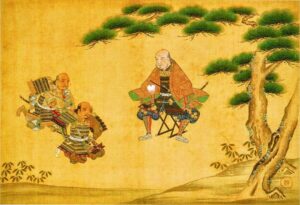
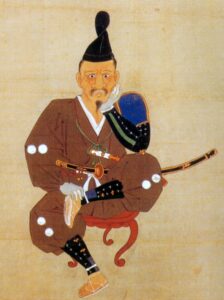
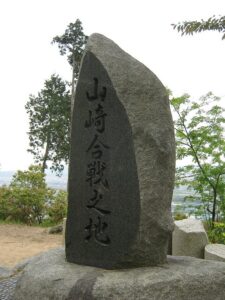
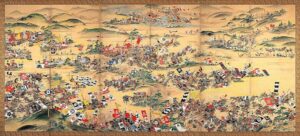
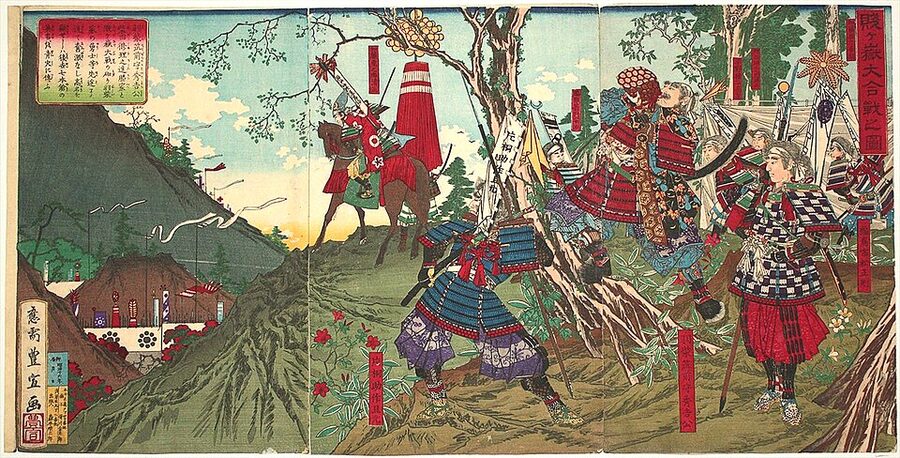
The Battle of Shizugatake was decided before it was fought. Specifically, it was decided during a five-hour forced march that Hashiba Hideyoshi ran up the side of central Japan on the afternoon of 20 June 1583 — fifty-two kilometres from Ōgaki Castle in Mino to the Lake Yogo battlefield in northern Ōmi — with about 15,000 men, cooking fires lit in relay formations every three kilometres so the men could grab rice balls without stopping, the whole army moving at roughly ten kilometres an hour. The march is known in Japanese military history as the Mino Ōgaeshi (美瀑大返し, “the Great Mino Return”) and it is the reason Hideyoshi won the battle. His opponent, the old Oda senior retainer Shibata Katsuie, was expecting Hideyoshi to be on the other side of Japan dealing with a separate rebellion for at least another four days. When the Hashiba banners appeared at the Shizugatake ridge at one in the morning on 21 June, the Shibata forward units thought they were hallucinating.
The battle itself took about eight hours. By nine in the morning on 21 June the Shibata army was broken, Shibata’s vanguard commander Sakuma Morimasa was captured, and Shibata’s main force was retreating north toward Kitanosho Castle. Three days later Shibata killed himself in his burning castle alongside his wife Ōichi (Oda Nobunaga’s sister) and her four daughters. Six months later Toyotomi Hideyoshi was the most powerful man in Japan. The Sengoku period did not end at Shizugatake, but the political architecture that produced the Toyotomi regime was set there in a single afternoon.
In This Article
- After Honnō-ji
- The Winter Feint
- The Trigger
- The Mino Ōgaeshi
- The Battle
- Kitanosho
- The Seven Spears
- Where to visit the Battle of Shizugatake today
- 1. Mount Shizugatake summit — Yogo-ko, Shiga
- 2. Ōiwa fort ruins and the Nakagawa memorial — south of Lake Yogo
- 3. Kitanosho Castle site — Fukui city
- 4. The Ōgaki-to-Shizugatake march route
- The Five-Hour Campaign
After Honnō-ji
To understand why the battle happened, you have to understand what was broken by Oda Nobunaga’s assassination at Honnō-ji in Kyoto thirteen months earlier, on 21 June 1582 (the synchronicity of dates is coincidence: Japanese calendar conversion makes it look like the assassination and the eventual battle happened exactly a year apart in Gregorian terms, but in the contemporary reckoning they were separated by about thirteen lunar months). Nobunaga’s death left the Oda domain, which at that point amounted to about half of the country, with no clear successor. His eldest son Nobutada had been killed alongside him at Honnō-ji. The next two sons, Nobukatsu and Nobutaka, were both legally eligible but neither commanded the senior-vassal loyalty required to hold the confederation together. And the real power structure of the Oda regime ran through the senior generals: Shibata Katsuie in the Hokuriku, Niwa Nagahide in Tango, Takigawa Kazumasu in the east, and, as the newest member of the inner circle, Hashiba Hideyoshi in the west.
Hideyoshi had moved first. Within eleven days of Nobunaga’s death he had crushed the assassin Akechi Mitsuhide at the Battle of Yamazaki (on 2 July 1582) and appropriated the rhetorical authority of being “Nobunaga’s avenger”. In the weeks that followed he used that authority to convene a conference at Kiyosu Castle — the Kiyosu Kaigi (清洲会議) of late July 1582 — at which he successfully argued for the infant Oda Hidenobu (Nobutada’s three-year-old son) as nominal successor, with himself as one of four senior regents. Shibata Katsuie attended the conference, argued unsuccessfully for Oda Nobutaka as successor, and walked out of Kiyosu understanding that Hideyoshi had outflanked him on the succession politics.
From Kiyosu forward, the two men were on a collision course. Shibata’s position was that Hideyoshi was an upstart peasant who had used a timing trick to seize influence he had not earned. Hideyoshi’s position was that Shibata was an old-guard Oda commander who had not kept up with Nobunaga’s more recent innovations and was now using the succession question to claw back authority he had not held during his master’s lifetime. Both positions had merit. Neither was going to yield. Winter closed in.
The Winter Feint
What makes the Shizugatake campaign interesting as a piece of military planning is that Hideyoshi spent the winter of 1582-83 executing an elaborate series of feints to make sure Shibata could not bring his full Hokuriku army south before the snow melted. The Hokuriku, the coastal region north of Lake Biwa, was blocked by roughly two metres of snow from December to March in most years, and Shibata’s 30,000 men at Kitanosho were effectively sealed in by geography. Hideyoshi used the five-month window to pacify the Kansai basin, eliminate the junior Oda claimants who were on Shibata’s side (Oda Nobutaka surrendered and was forced to commit seppuku on 1 May 1583), and position his forces around Lake Biwa so that when Shibata finally came south in April he would have no room to manoeuvre.
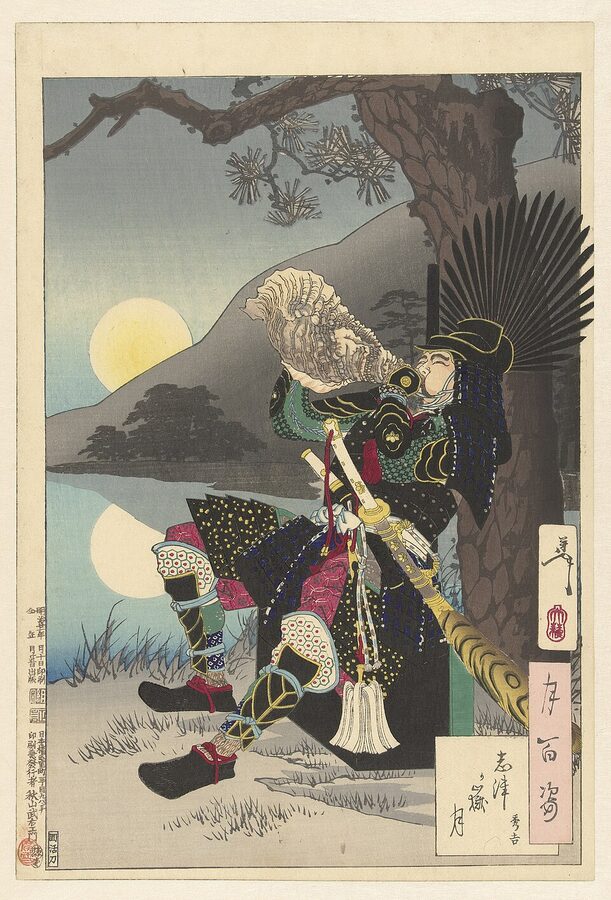
Shibata finally moved in early April 1583. His army crossed the mountains from Echizen into Ōmi, establishing forward positions on a line of low ridges north of Lake Yogo — an inland lake about twenty kilometres north of the main Lake Biwa, connected to it by a narrow isthmus. The Shizugatake ridge itself sat on the southern edge of that isthmus. Hideyoshi’s forces held the ridges south of Lake Yogo, including Shizugatake, and the two sides settled into a face-off with roughly equivalent numbers and no clear opening for either side to force a decision. The stalemate lasted most of April. Both commanders spent the time writing increasingly rude letters to each other through the formal diplomatic channels and waiting for an opening.
The Trigger
The opening, when it came, was created by Shibata’s most ambitious sub-commander — his nephew Sakuma Morimasa. On 20 April 1583, with Hideyoshi known to be away from the Shizugatake line (he had ridden east to Ōgaki Castle in Mino, fifty kilometres away, to deal with the residual Oda Nobutaka faction), Sakuma proposed an assault on the isolated Hashiba-held fort at Ōiwa, a small fortified position on the ridge east of Shizugatake commanded by Hashiba loyalist Nakagawa Kiyohide. Sakuma’s argument was that with Hideyoshi at Ōgaki, Nakagawa could be killed and the Ōiwa position taken before Hideyoshi could return; the captured position would then anchor a forward Shibata line that could push the whole Hashiba deployment back.
Shibata Katsuie reluctantly agreed to the operation but specified a strict time limit: if Ōiwa had not fallen by nightfall on 20 April, Sakuma was to withdraw immediately regardless of tactical opportunity. The specific worry was that an extended engagement would give Hideyoshi time to return. Sakuma accepted the constraint, attacked Ōiwa at dawn on 20 April, killed Nakagawa Kiyohide in a three-hour close-quarters fight inside the fort, and had taken the position by mid-morning. At this point, flush with success, he violated Shibata’s time-limit order. He did not withdraw. He began consolidating the position and planning an extension of the attack to the next fort west, Shizugatake itself.
The first messenger from the Hashiba command chain reached Hideyoshi at Ōgaki around midday on 20 April. Hideyoshi was inside the castle interrogating a captured Oda Nobutaka retainer. He read the message, dismissed the interrogation, called his senior staff, and within forty minutes had issued the order that would produce the Mino Ōgaeshi.
The Mino Ōgaeshi
The forced march from Ōgaki to the Shizugatake ridge was fifty-two kilometres through mountain-valley country in late-afternoon light turning to darkness. The geography of the route makes the logistical achievement comprehensible: a single main road runs along the valley of the Ibi River from Ōgaki west to Sekigahara, then over the Fu-wa pass into Ōmi province, then along the east shore of Lake Biwa north to Nagahama and the Lake Yogo basin. The road was flat for most of its length, well-maintained (Nobunaga had paved sections of it in the 1570s for his own rapid-deployment campaigns), and passed through territory that was either actively loyal to Hashiba or neutral. What Hideyoshi added to it was organisation.
The rice-ball relay stations — the detail that every Japanese schoolchild learns when the Mino Ōgaeshi is taught — had been set up in the preceding weeks as a contingency. Hideyoshi had calculated during the winter that he might need to move his army rapidly back to Shizugatake at short notice, and he had arranged with the peasant villages along the route to have cooking fires and pre-prepared rice balls waiting at roughly three-kilometre intervals. When the order came on 20 April, the relay villages got the message from advance runners about two hours before the army passed through; they had the food ready. Each soldier grabbed what he could eat without stopping. Nobody made camp. The army passed Ōgaki at 4 pm on 20 April and the first Hashiba units began arriving on the Shizugatake ridge at midnight — eight hours for the fastest units, full deployment of the main body by 4 am on 21 April. Hideyoshi himself arrived with the main body around 1 am.
Sakuma Morimasa, by that point, had been digging in on the Ōiwa position for about fifteen hours. He had not been expecting any Hashiba counter-attack before midday 21 April at the earliest. When the Hashiba vanguard unit commanded by Kuwayama Shigeharu hit his forward position at 2 am, Sakuma’s troops had just lit their own cooking fires and were still in their night clothes. The attack was almost unopposed for the first thirty minutes.
The Battle
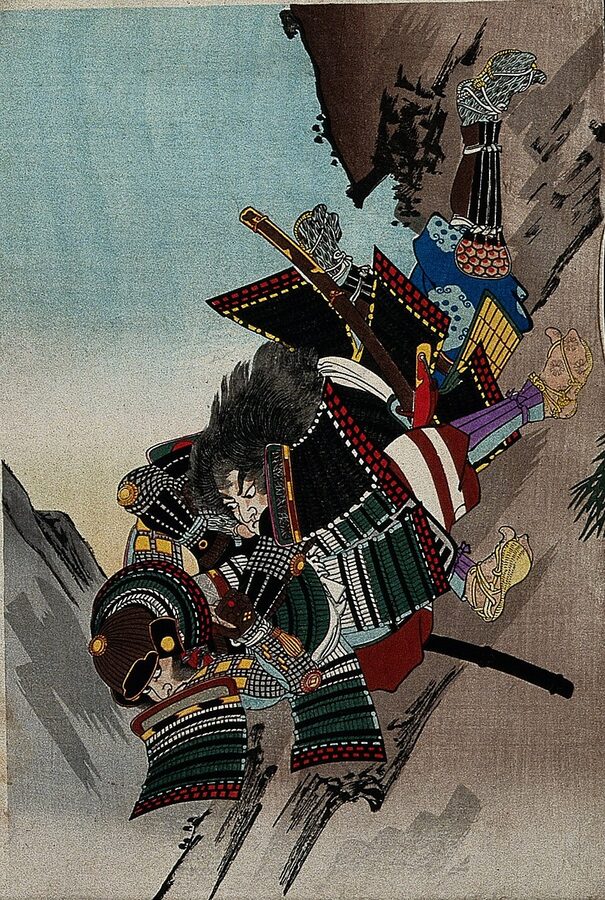
The actual battle of Shizugatake, after the initial Hashiba surprise at Ōiwa, ran across the following eight hours as a series of rolling engagements along the ridge line. Sakuma attempted to regroup his Shibata forces on the slope west of Ōiwa; the Hashiba vanguard under Kuwayama and Nakagawa’s surviving retainers (who had a debt to settle after their commander’s death the day before) pinned him there. Shibata Katsuie’s main army, two kilometres north at the Yokomori position, began to come south in support at about 6 am. Hideyoshi had anticipated this, and had held his own main body back in reserve on the south slope of Shizugatake specifically to meet the Shibata reinforcement when it arrived.
The decisive moment was the defection — or, more precisely, the retreat — of Maeda Toshiie. Maeda was commanding Shibata’s right flank at Yokomori. He had been a close personal friend of Hideyoshi since both men’s early careers as Oda retainers; his eldest daughter had married Hideyoshi’s adopted son. When the Hashiba main body began its counter-attack up the slope at about 7 am, Maeda looked at the developing situation, made a private calculation, and simply withdrew his entire command from the field without Shibata’s order. The right flank of the Shibata army dissolved. Shibata’s remaining units collapsed inward through the afternoon. By mid-morning on 21 April it was clear the day was lost.
Sakuma Morimasa, the man whose insubordination had produced the opening, was captured alive by Hashiba forces at around 11 am trying to flee north toward the Fu-wa pass. He was bound and delivered to Hideyoshi at the command tent. Hideyoshi had him tied to the back of a pack horse and paraded through the army for a full day as a punishment-display; then on 23 April he was beheaded at a ceremony in Kyōto. His severed head was later placed on display at Rokujō-gawara execution ground for three days. The specific theatricality of the public display was Hideyoshi’s message to the rest of the Oda confederation about the consequences of unauthorised action.
Kitanosho
Shibata Katsuie retreated with about two thousand surviving retainers to his main castle at Kitanosho in Echizen province, a three-day march north. Hideyoshi followed with his full army, laid siege to the castle on 23 April, and by nightfall on 24 April had the outer walls under control. Shibata, with his wife Ōichi and her four daughters by her first marriage, retreated to the inner keep. He had enough retainers left to hold out for perhaps three more days. He did not choose to.
Ōichi was Nobunaga’s younger sister, famously beautiful, previously the wife of Azai Nagamasa (who had died in 1573 when Nobunaga destroyed his own brother-in-law’s clan), and the mother of four daughters, one of whom — Chacha, later Yodo-dono — would become Hideyoshi’s most important concubine and the mother of his only son. Hideyoshi had sent messengers to the castle offering safe passage for Ōichi and the girls. Ōichi refused the offer on the evening of 24 April. She sent the four daughters out of the castle under escort to Hideyoshi’s lines, wrote formal last-letters to each of them, put on ceremonial court robes, and sat down next to Shibata in the main hall of the inner keep. Shibata ordered the castle set on fire. The two of them committed seppuku together around midnight on 24 April as the main keep burned around them.
The four daughters were absorbed into the Toyotomi household. Chacha grew up to be Yodo-dono, mother of Toyotomi Hideyori; she died in the 1615 fall of Ōsaka Castle, which is a separate story. Her middle sister Ohatsu married Kyōgoku Takatsugu and became one of the most important post-Sekigahara political mediators. The youngest, Gō, married Tokugawa Hidetada and became the mother of Emperor Go-Mizunoo’s wife — which means Shibata Katsuie’s Ōichi-side step-daughter became the grandmother of a reigning Japanese empress. The genealogical net from one burning castle in Echizen ran through Japanese political and imperial lineages for the next two centuries.
The Seven Spears
The most culturally durable legacy of the battle is the phrase Shizugatake no Shichi-hon-yari (賰ヶ岳七本殷), “the Seven Spears of Shizugatake”. It refers to seven young Hashiba retainers — all under thirty, all from obscure backgrounds, all decisively active in the battle’s close-quarters fighting — who distinguished themselves during the 21 April engagement. Hideyoshi named them personally in the post-battle dispatches, granted each of them substantial stipend increases, and promoted all seven to independent command positions within the following decade. The seven were: Katō Kiyomasa, Fukushima Masanori, Hirano Nagayasu, Kasuya Takenori, Wakisaka Yasuharu, Katō Yoshiaki, and Katagiri Katsumoto.
Each of the seven became one of the central figures of the late-Toyotomi and early-Tokugawa regime. Kiyomasa took Higo province at 520,000 koku; Masanori took Aki at 498,000; the others took smaller but substantial domains. The collective biography of the Seven Spears is the biography of Toyotomi field administration across the 1590s and the Korean campaigns, and their individual decisions during the Sekigahara campaign of 1600 — five sided with Tokugawa Ieyasu, two with the Toyotomi loyalist faction — are a case study in how a generation of retainers who all shared a single campaign bonding experience could split politically over the next generation.
The phrase “the Seven Spears” has become a standard Japanese idiom for a group of elite performers in any field who emerge together from a defining test. Modern sports journalism applies it to the seven best players in a particular generation; modern political journalism applies it to the seven most influential members of a party faction. The usage is unreflective; most contemporary users have no idea the source reference is a 440-year-old engagement in northern Shiga prefecture.
Where to visit the Battle of Shizugatake today
The entire Shizugatake battlefield is preserved as the Yogo-ko Historic Site Park in Nagahama city, northern Shiga prefecture. You can do everything in a long day from Kyoto.
1. Mount Shizugatake summit — Yogo-ko, Shiga
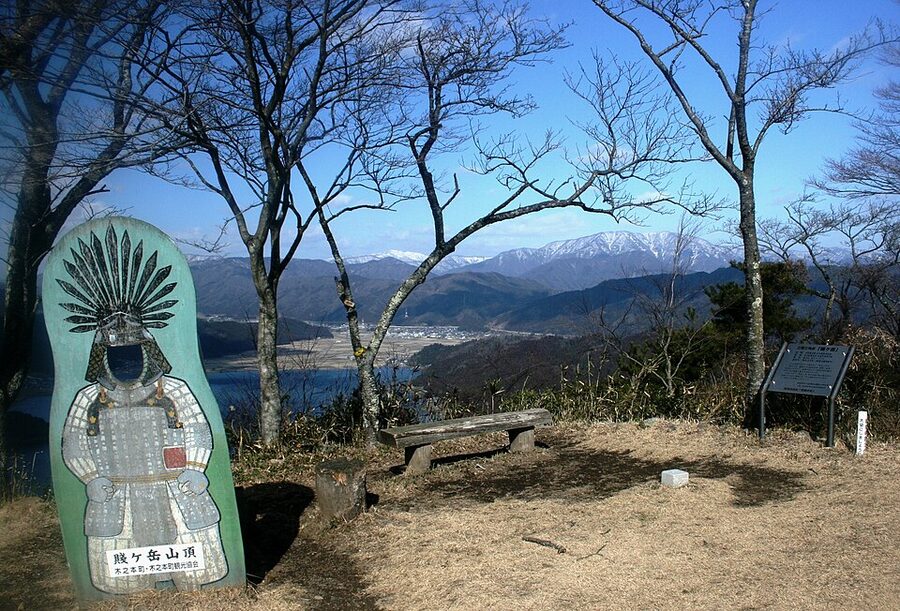
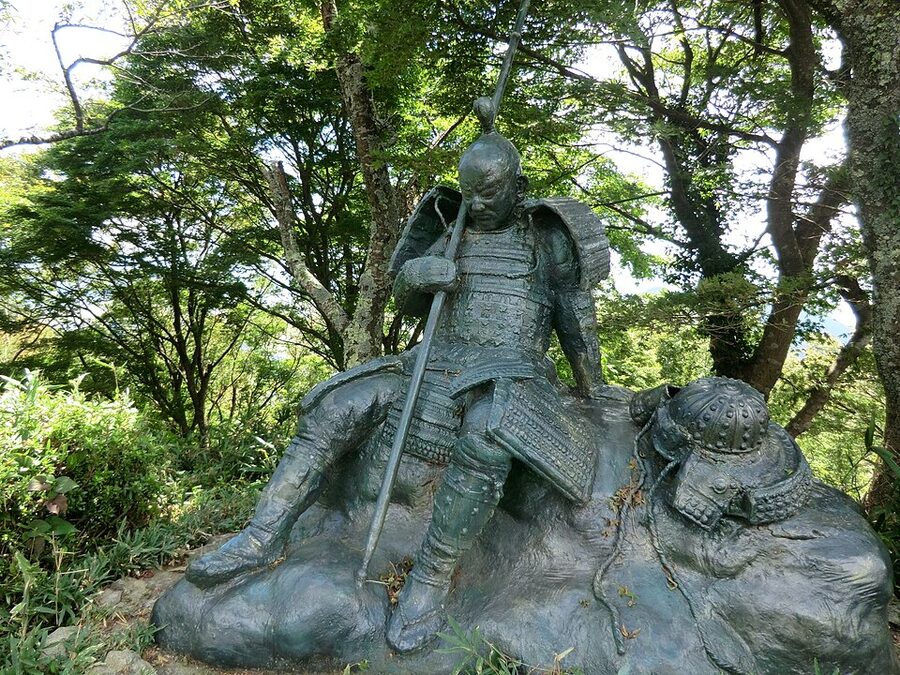
The Shizugatake summit sits at 421 metres, a short walk from the Shizugatake cable car station. Take the JR Hokuriku line from Nagahama to Kinomoto (fifteen minutes), then the community bus to the cable car base (another ten minutes), then the cable car up the mountain (six minutes each way, ¥1,300 round trip). From the cable car top station it is a fifteen-minute walk through cedar forest to the summit. The summit has the samurai-memorial statue, interpretive signage, and the best view of the battlefield.
Best visited: early morning, spring or autumn, clear weather essential. Avoid summer (humid and view-obstructing haze). The cable car does not run December through March; in winter you can hike up from the base in about ninety minutes but the trail can be icy.
2. Ōiwa fort ruins and the Nakagawa memorial — south of Lake Yogo
The Ōiwa position, where Sakuma Morimasa attacked at dawn on 20 April and triggered the whole sequence, is on the east side of Lake Yogo, reachable by a thirty-minute walk from the Shizugatake cable car base along the shore path. The fort itself is now earthworks only; the Nakagawa Kiyohide memorial stone is a small stele near the former main gate position. The walking path from Shizugatake to Ōiwa is a pleasant two-kilometre loop and gives you a physical sense of the distances the Hashiba counter-attack had to cover on the morning of 21 April.
3. Kitanosho Castle site — Fukui city
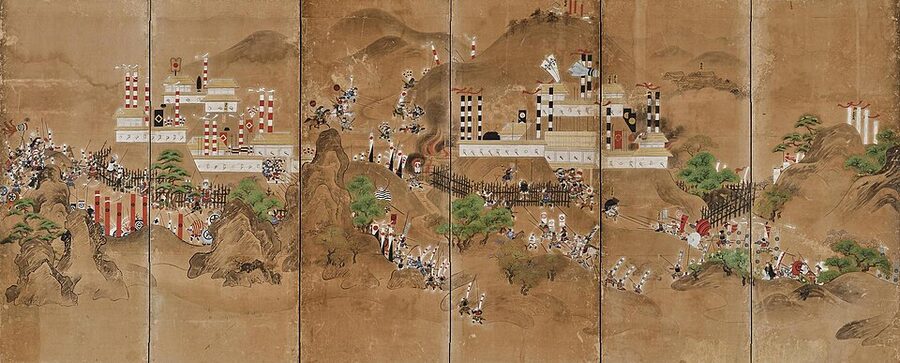
Kitanosho Castle, where Shibata and Ōichi killed themselves after the battle, stood on the site of the modern Fukui city centre. The castle was destroyed in the 1583 fire and never rebuilt; the grounds are now the Kitanosho Castle Historic Park — a small park with the main-keep foundation stones preserved, a bronze statue of Shibata and Ōichi, and a monument indicating the spot of the seppuku. Adjacent is the Shiba-jinja shrine, built in 1895 specifically to enshrine Shibata Katsuie and Ōichi.
Fukui is about two hours from Kyoto on the Thunderbird express; the castle site is a fifteen-minute walk from Fukui Station. Allow an hour. If you have time, the Fukui Prefectural Historical Museum a few streets away has a good Shibata-clan permanent exhibit including Ōichi’s personal effects and Shibata’s ceremonial battle-helmet.
4. The Ōgaki-to-Shizugatake march route
If you are seriously into this, you can drive the Mino Ōgaeshi route today in about ninety minutes. The modern road follows the same valleys as the 1583 march — Ōgaki to Sekigahara, over the Fu-wa pass (now a tunnel, but the old pass road is walkable and marked), through Maibara, along the east shore of Lake Biwa to Nagahama, then north to Yogo. Fifty-two kilometres. At ten kilometres per hour on foot, the army did it in five hours and change. On modern wheels at sixty, it takes the length of one radio-drama episode.
The Five-Hour Campaign
Shizugatake is worth walking because the scale is unusually compact for a Japanese battle of this period. Almost every other decisive Sengoku engagement — Nagashino, Sekigahara, Osaka — covers enough ground that the modern battlefield site feels like a landscape rather than a place. Shizugatake is the opposite. The ridge is short. The opposing positions are in eye-contact. The whole engagement fit inside six kilometres end to end, and almost every decision of the battle was made by commanders who could physically see each other’s standards.
What was not in anyone’s sight line was the Mino Ōgaeshi. Sakuma Morimasa, standing on the newly-captured Ōiwa position at sunset on 20 April, was looking west across Lake Yogo at Hashiba units he thought made up the entire Hashiba force in the theatre. He had no way to know that Hideyoshi’s fresh 15,000 men were at that moment crossing the Fu-wa pass forty kilometres away. The decisive force of the battle was in transit during the afternoon that Sakuma chose to disobey his orders. If Hideyoshi had arrived four hours later, Ōiwa would have been impregnable and Sakuma would have had the position he wanted. If he had arrived a day later, he would have been fighting on ground he had lost. The margin was hours.
Sassa Narimasa was in the north during this battle, holding Toyama against the Uesugi on Shibata’s orders. He did not fight at Shizugatake. He found out about the defeat from a messenger three days later, and the rest of his life was spent working out what to do with the fact that his master had died in a fire while he was guarding another front. If you read the Sassa biography and the Shizugatake battle together, the two pieces make sense in a way they do not apart.
If you are going to Kyoto anyway, take the train to Nagahama, then the cable car up the mountain. The walk from the top station to the summit is fifteen minutes. Stand at the samurai statue, look south over Lake Yogo, and read the interpretive sign for the Mino Ōgaeshi. The sign is there; the lake is there; the hills Shibata’s army came down from are visible on the far shore. Hideyoshi’s 15,000 men came up this slope at 1 am in light from a waning moon. They were told they would have a fight. They got surprise instead. Eight hours later the succession of the Oda regime had been settled. The route they came in on is still a main road.