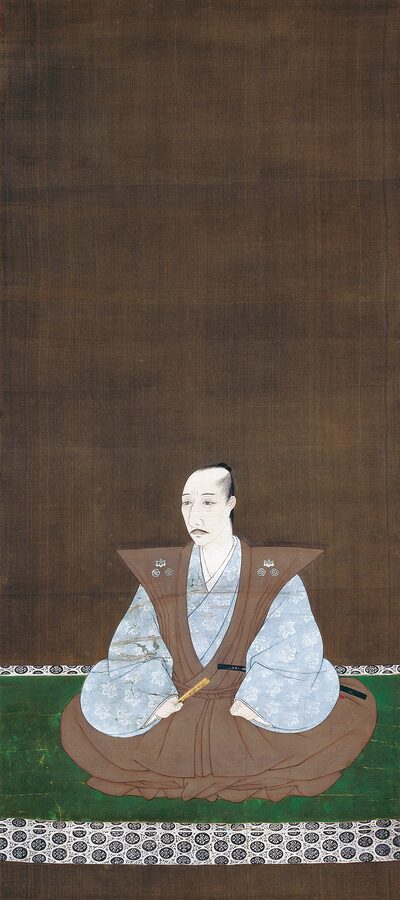
On a summer day in 1567, Oda Nobunaga stood at the summit of a mountain he had just captured, looked west across the Nōbi Plain toward Kyoto, and decided to rename the place. The mountain was called Inabayama, Rice-Leaf Mountain, and the fortress on top had been known for centuries as Inabayama Castle. Nobunaga borrowed instead from classical Chinese history. Three thousand years earlier, King Wen of Zhou had used the mountain called Qi, 岐山, as his base to overthrow the Shang dynasty and unify the Chinese realm. Nobunaga, who had just subdued Mino Province after six years of on-and-off fighting and was now surveying his lines of advance into Kyoto, took the Chinese character 岐 (Qi / gi) and paired it with fu 阜 (“mound” or “hill”). The mountain became Kinka-zan (Golden Flower Mountain). The castle and the town beneath it became Gifu. And the new seal he began stamping on his letters from this castle read Tenka Fubu, 天下布武, “Rule the Realm by Force.”
It’s hard to overstate how much of modern Japan crystallised at this specific castle in this specific year. Before Gifu, Nobunaga was a rising regional warlord with a good reputation in Owari and an unfinished war in Mino. After Gifu, he was the man who had explicitly announced, in four Chinese characters on every piece of correspondence, that he intended to unify Japan by force. The Tenka Fubu seal didn’t change what he was doing. It changed how he said what he was doing, and that distinction — publicly declaring the unification project, rather than simply executing it — is what made the 1570s unification campaign possible. Every daimyō who received a letter from Gifu after 1567 knew what that seal meant. And every daimyō who didn’t fall into line was a daimyō whose territory Nobunaga had publicly announced he intended to take. The castle was the address from which the unification of Japan began to be pursued, openly, as a defined political project.
In This Article
- What Gifu Castle actually is, and why the location matters
- Before Nobunaga — the Saitō era
- 1567 — how Nobunaga finally took it
- The renaming and the Tenka Fubu seal
- Luis Fróis visits — and the record we have of the interior
- The five falls — and the 1600 siege that finished it
- Reconstruction and modern status
- Where to visit Gifu Castle today
- Gifu Park and the Nobunaga residence ruins
- The Kinka ropeway — or the four hiking paths
- The castle tower and the summit complex
- Inaba Shrine and Jōzai-ji — the extended circuit
- Getting to Gifu
- Closing — the view Nobunaga wanted you to see
What Gifu Castle actually is, and why the location matters
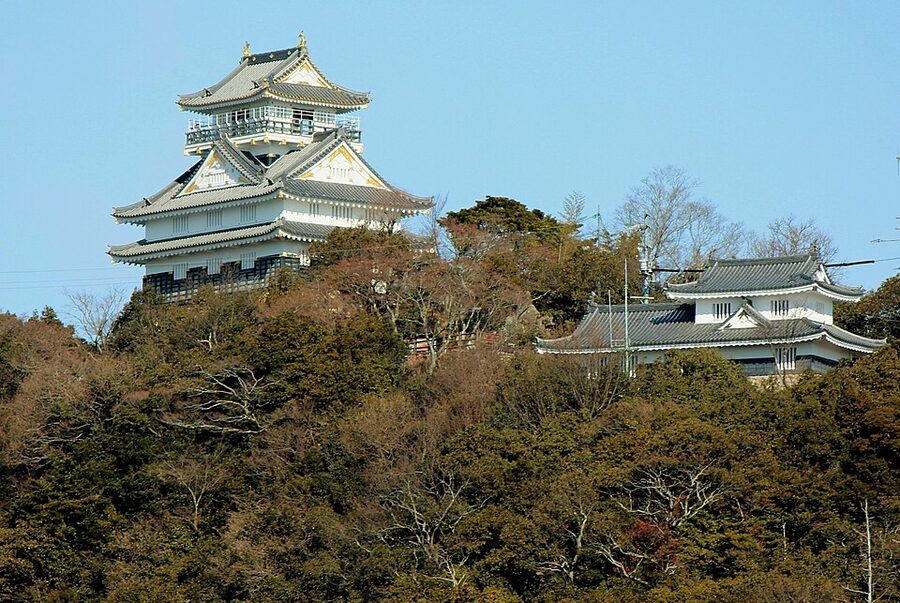
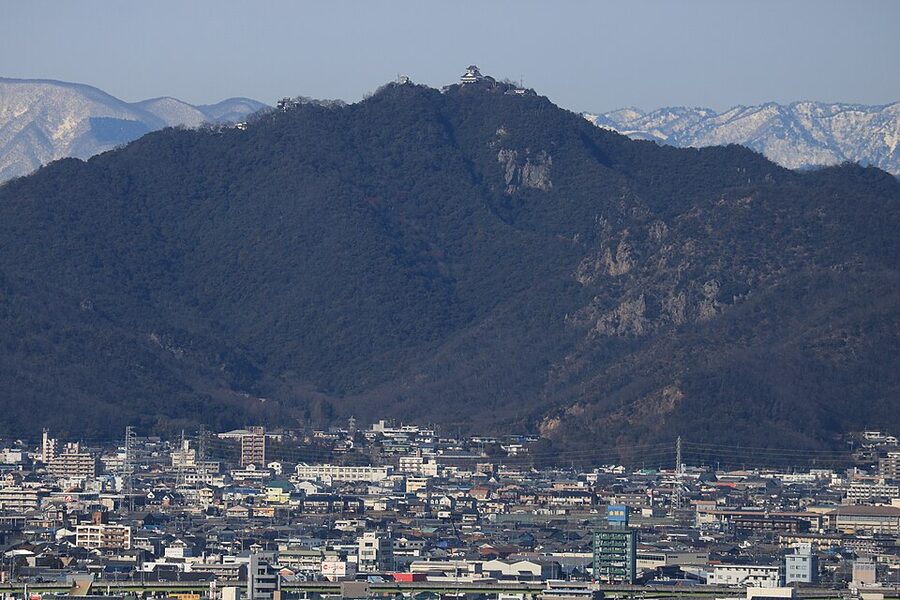
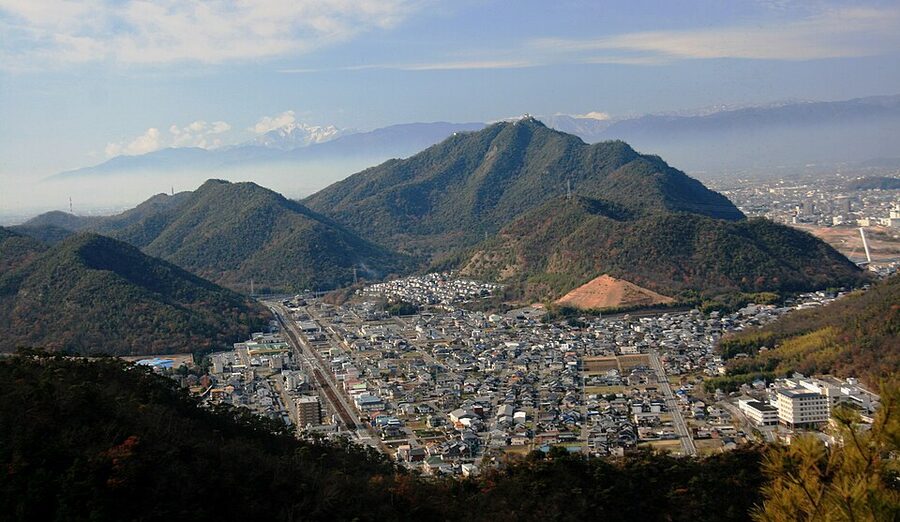
Gifu Castle is a Japanese yamashiro, a mountain castle, built on the summit of Mount Kinka, a 329-metre chert outcrop that rises abruptly from the flat Nōbi Plain in what is now central Gifu City. The location is the point. The Nōbi Plain is Japan’s main central-Honshu rice basin, and Mount Kinka sits almost exactly in its middle, with clear sightlines to the Ise Bay in the south, the Hida Mountains in the north, the Ibuki range to the west, and the Kiso mountains to the east. From the summit you can watch the Nagara River’s entire navigable course. For a Sengoku-era warlord trying to control movement across central Japan, Mount Kinka was the best single observation and command post in the country. Nobunaga understood this immediately — the Fróis letters from his 1569 visit describe Nobunaga as having moved his personal base to the summit specifically because he could read the regional situation from one vantage point.
The mountain’s geological composition made it simultaneously a natural fortress and a tactical headache. Mount Kinka is chert — hard, brittle, silicon-rich sedimentary rock. You can’t dig a well in it. The ja.wiki entry notes this with a historian’s dry precision: the castle had to collect rainwater in cisterns, because the bedrock was impenetrable to every well-digger who had tried since the Kamakura period. Any siege of Gifu that lasted more than a few dry weeks risked becoming a siege the defenders couldn’t win regardless of the attackers’ strength. This is why the castle fell five times in its history — not because the walls failed, but because the garrison ran out of options for feeding or watering itself while the enemy held the lower slopes. Nobunaga knew this. That’s why he used the castle as a residence and symbolic headquarters rather than as the site he intended to defend in a major siege. His actual military answer, when it came to serious battles, was to march out and fight somewhere else.
Before Nobunaga — the Saitō era
The castle’s history begins in 1201, when Nikaidō Yukimasa, one of the thirteen senior advisors to the Kamakura shogunate, built a small fortress on the peak to watch the eastern approach to Kyoto. It passed through the Iga and Inaba families, then fell into disuse around the mid-Kamakura period and sat abandoned for roughly 150 years. In the mid-15th century, the Mino shugo-dai Saitō Toshinaga rebuilt it; through the subsequent century of Mino power struggles, the castle passed through several Saitō hands. Then in 1533, a Kyoto-born former monk turned Mino retainer named Nagai Shinkurō Norihide inherited the fortress from his father. Norihide renamed himself Saitō Toshimasa, and history has come to know him as Saitō Dōsan — the Viper of Mino.
Dōsan is the man who made Gifu Castle militarily serious. Between 1539 and 1554, he rebuilt and expanded the fortifications on the summit, adding stone ramparts, cutting ridge-level flat spaces out of the narrow peak, and building the satellite bastions — Maruyama, Matsuda-o, Inari-yama, Inabayama-toride, Shōba-yama — that dotted the surrounding ridges. By the end of Dōsan’s reign, Inabayama Castle was genuinely difficult to take by frontal assault. The problem, as his son Yoshitatsu would demonstrate in the 1556 Battle of Nagaragawa when he killed his father and took the castle, was that the fortification could not protect against betrayal from within. Every one of the castle’s five historical falls happened through internal treachery or the garrison’s logistical collapse. The walls worked. The humans inside them didn’t always. You can read more about Dōsan himself in my separate piece on the Viper of Mino; for present purposes, he’s the reason the castle was worth capturing when Nobunaga finally got his hands on it eleven years after Dōsan’s death.
1567 — how Nobunaga finally took it
Nobunaga tried to take Inabayama three times. The first attempt, in June 1561, came immediately after Saitō Yoshitatsu’s sudden death and the succession of his 13-year-old son Saitō Tatsuoki. Nobunaga attacked on the logic that a child ruler meant weak defences. He was wrong — the Saitō retainers fought him to a standstill on the lower slopes and he retreated. The second episode, in 1564, was not a direct Nobunaga campaign at all: two Saitō retainers, Takenaka Hanbei and Andō Morinari, staged a six-month mutiny and seized the castle from Tatsuoki himself, demonstrating that the fortress could be taken but also demonstrating to Nobunaga that the Saitō faction had serious internal problems. Takenaka eventually returned the castle to Tatsuoki, but the episode had weakened the Saitō command and, more importantly, had drawn the regional warlords’ attention to the castle’s vulnerability. You can read more on Takenaka in my Takenaka Hanbei piece — he ended up serving Hideyoshi, partly as a result of the reputation he built during this mutiny.
The third and successful attempt began in August 1567. Nobunaga had spent three years building up his Owari-Mino border forces, cultivating Mino defectors, and waiting for the right opening. It came when the Nishi-Mino Sannin-shū — the “Three Men of Western Mino,” Inaba Ittetsu, Ujiie Bokuzen, and Andō Morinari — defected from Tatsuoki’s service and opened the western approach to the castle. With the western flank compromised, Nobunaga’s army crossed the Nagara and surrounded the mountain. Tatsuoki abandoned the castle rather than hold it, fleeing south by river boat down the Nagara-gawa to the Nagashima Ikkō stronghold in Ise. Nobunaga took possession on or about 15 September 1567 (variously dated — the sources are not entirely consistent). He ordered the existing Saitō fortifications partially demolished and the site rebuilt to his own specifications. He moved his personal base from Komaki Castle, 35 kilometres south in Owari, to Gifu. And he renamed everything.
The renaming and the Tenka Fubu seal
The Shinchō Kōki, the near-contemporary chronicle of Nobunaga’s life compiled by his retainer Ōta Gyūichi, records the renaming with a single terse sentence: “From Owari Province’s Mount Komaki, [the lord] crossed to Mount Inaba in Nōshū. The place called Iguchi was now renamed, and called Gifu.” Iguchi was the town at the base of the mountain; Mount Inaba was the peak. Both names went at once. The Gi came from the classical Chinese Mount Qi, where in the 11th century BC King Wen of Zhou had based himself to begin the overthrow of the Shang. The Fu was from a classical Chinese placename meaning “hill.” The naming was explicitly historical — the monk Sakugen Shūryō of Tenryū-ji temple in Kyoto is credited with the suggestion, drawing on his training in Chinese classics to give Nobunaga a name with the right political overtones. Gifu was, in Chinese-literate circles, a name that said this is the base from which the next unification campaign will be run.
The Tenka Fubu seal followed within weeks. Four Chinese characters, 天下布武, arranged in a compact square format, carved in seal script, stamped in vermillion ink. Tenka is “the realm under heaven,” meaning Japan as a political unit. Fu is “to spread” or “to proclaim.” Bu is “martial” or “military” — the character is also the second syllable of bushi (samurai). Translated literally: “Spread Military Rule Over the Realm.” Translated with the force the four characters actually carried in a 1567 political correspondence: I will unify Japan by military means, and this is my announcement that I am doing so. Nobunaga used this seal on almost every surviving letter from the next fifteen years. Receiving a document with Tenka Fubu on it was, for a Japanese daimyō, the unambiguous signal that they were now included in Nobunaga’s calculations — for either alliance or conquest, and which of those two was not always clear at the time of receipt.
Luis Fróis visits — and the record we have of the interior
Two years after Nobunaga took Gifu, in July 1569, the Portuguese Jesuit Luis Fróis travelled up the Nakasendō from Kyoto to pay the warlord an audience. Fróis was the Jesuit mission’s chief chronicler in Japan, and his letters home — collected in the História de Japam — are among the most detailed outsider accounts of Sengoku Japan that we have. His description of Gifu Castle is worth quoting at length, not least because almost nothing of what he describes survives. He climbed the mountain on foot, escorted by Nobunaga’s retainers. He was shown the summit buildings, which he described as modest in scale but “beautifully proportioned” and surrounded by “mountain gardens of remarkable ingenuity.” He met Nobunaga’s senior family members. He observed that Nobunaga’s immediate family and his political hostages lived on the summit, while Nobunaga himself split his time between the summit quarters and a more elaborate residence at the mountain’s base.
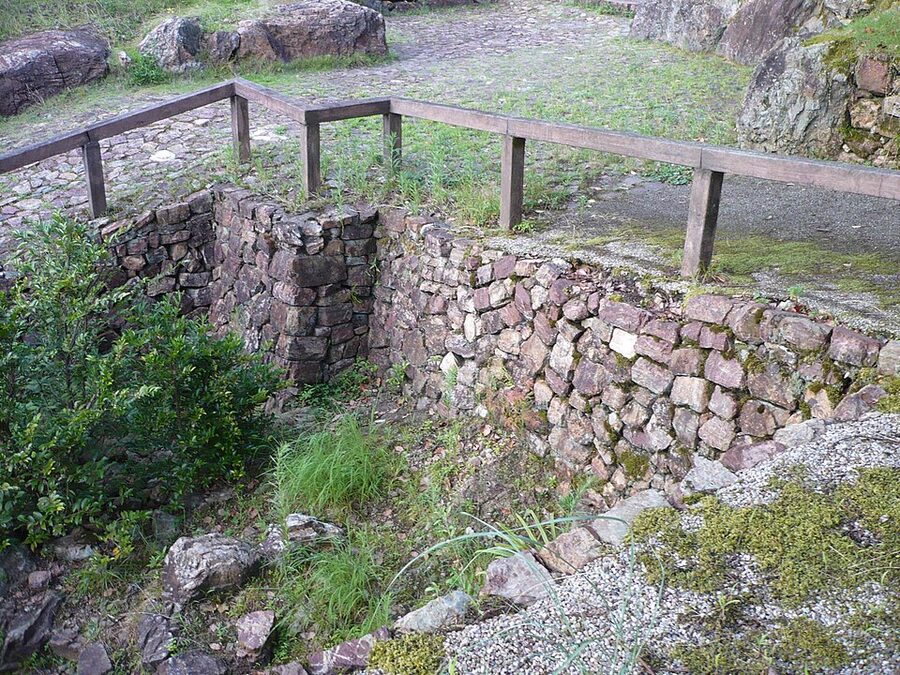
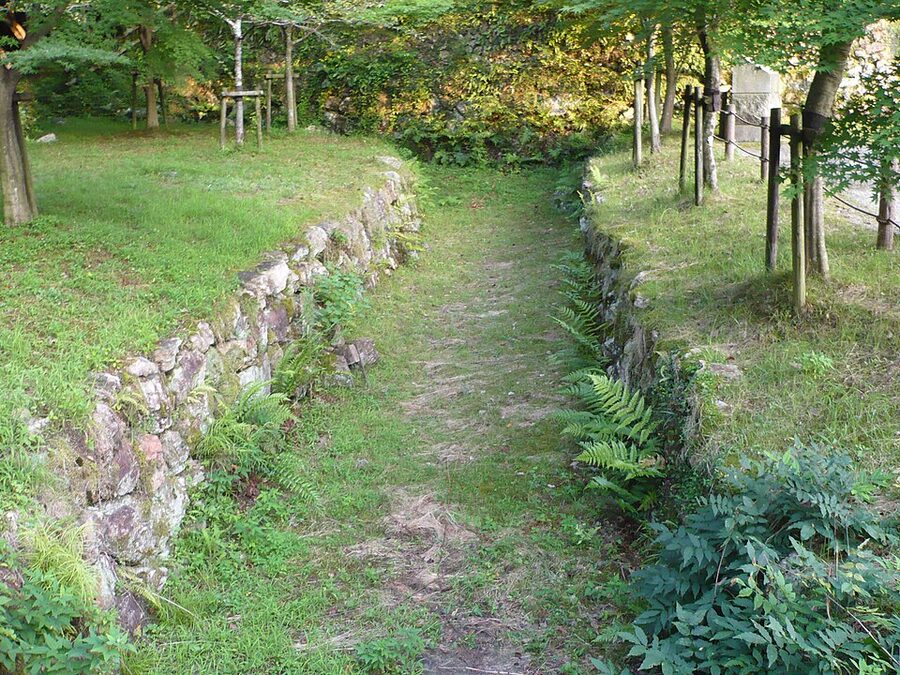
The base residence was the social face of Gifu. Fróis’s Portuguese eye was specifically struck by its elegance: “lacquered floors that reflected candlelight like still water,” “sliding screens painted with pine and crane,” a garden laid out with “river-stones of colours I have not seen before.” Modern archaeology, running continuously since 1984, has vindicated Fróis’s impressions. The base excavation has uncovered a large central pond, stone-walled garden terraces on both banks of the Keyakidani stream, high-stone retaining walls up to four metres tall, and, in a 2012 find that caused considerable excitement in the Japanese media, fragments of a roof-tile with gold-leaf chrysanthemum and peony designs. The chrysanthemum was the imperial crest; the peony was a high-status aristocratic motif. For a provincial warlord to be using gold-leafed chrysanthemum tiles on a residential roof in 1569 was a claim, made visually, to something close to imperial-level legitimacy. It is exactly the kind of assertion that Tenka Fubu implied in writing.
A second independent Japanese-source record of the castle’s interior comes from Yamashina Tokitsugu, a Kyoto aristocrat whose diary Tokitsugu Kyō-ki describes his 1569 climb up the mountain. Tokitsugu was escorted by one of Nobunaga’s administrators, Takei Sekian, and took the main Nanamagari (Seven-Bend) path up the south face. His description is drier than Fróis’s but also more structurally informative. He describes the summit quarters as “pleasant, with music and entertainments,” and the path as “so steep that we could not enjoy the scenery.” This matches modern visitor impressions almost exactly — the Nanamagari path is still the most-used route up the mountain today, and it still produces visitors who stumble onto the summit breathing too heavily to notice the view. The castle seems to have been almost deliberately designed to tire out anyone who approached it. Which, for a man who hosted ambassadors and checked their reactions carefully, was probably a feature rather than a bug.
The five falls — and the 1600 siege that finished it
Gifu Castle fell five times in its 400-year history, and a brief roll-call of those falls tells you most of what you need to know about the castle’s structural problem. Fall One, 1564: Takenaka Hanbei and Andō Morinari’s six-month internal mutiny against Saitō Tatsuoki. Fall Two, 1567: Nobunaga’s capture via the Western Mino Three’s defection. Fall Three, 1582: Nobunaga’s son Oda Nobukatsu briefly loses control after the Honnō-ji Incident; recovers within weeks. Fall Four, 1583: Nobunaga’s third son Nobutaka, who had been holding the castle, is defeated following Shizugatake, flees, and commits seppuku at Uchinomi in Chita. Fall Five, 1600: the siege that ended the castle’s military history. In every case, the fall came from a combination of internal fracture and the impossibility of holding a well-less summit against a besieging force with time on its side.
The 1600 siege is worth a separate paragraph because it was the castle’s final act and because the outcome directly shaped the rest of the Sekigahara campaign. The defender was Oda Hidenobu — Nobunaga’s grandson, a teenager at the time of Honnō-ji, now grown and holding Gifu as the domain lord under loose Toyotomi oversight. When Ishida Mitsunari organised the Western Army coalition against the Tokugawa in the summer of 1600, Hidenobu declared for the Western side — a decision heavily criticised then and since, given that his grandfather’s legacy favoured neither the Toyotomi nor the Ishida faction and that Tokugawa Ieyasu had been a political ally of the Oda family for decades. On 23 August 1600, a Tokugawa loyalist force under Ikeda Terumasa (Hidenobu’s own uncle) and Fukushima Masanori attacked Gifu Castle. The castle fell in a single day. Hidenobu surrendered, was shaved as a monk, exiled to Mount Kōya, and died there the following year at 26. Ieyasu ordered the castle dismantled in 1601. Its stones and timber were shipped fifteen kilometres south to build the new Kanō Castle, which became the seat of Tokugawa power in the area for the next two and a half centuries.
Reconstruction and modern status
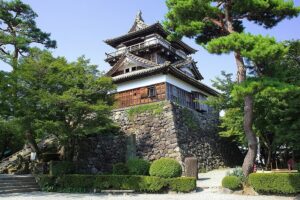
For nearly 300 years after Ieyasu’s 1601 dismantling, the summit of Mount Kinka sat empty. Fruit trees grew through the old foundations. Local farmers carted away the smaller stones. The castle existed only in writing and in the fading memory of the villages at the base. Then, in May 1910, the Gifu City Preservation Society built a 15-metre wooden tower on the summit, using reclaimed timber from the old Nagara Bridge. It was Japan’s first permanent reconstruction of a castle on its original site. The 1910 tower stood for 33 years before burning down on the night of 17 February 1943 — a station employee had been making a fire against the cold and lost control of it. The current 1956 reconstruction is the second replacement: a 17.7-metre four-story reinforced-concrete tower designed by Kidō Hisashi of Nagoya Institute of Technology, based on a surviving Kanō Castle turret blueprint (Gifu’s materials had been reused there) combined with references to Maruoka Castle. The 1956 building is the one you climb today.
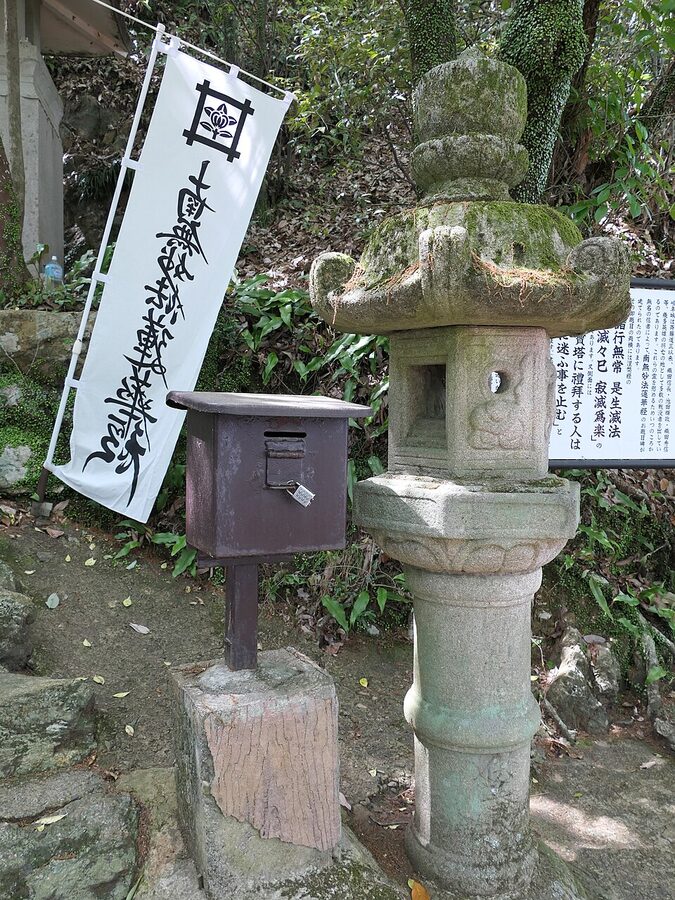
Gifu Castle’s modern official status reflects the complicated line between reconstruction and heritage. The castle site — the mountain, the surviving foundation traces, the 209-hectare zone of Mount Kinka — was designated a National Historic Site in February 2011, which gives it serious legal protection. The tower building itself, being a 1956 concrete reconstruction, has no heritage status. In 2006 the Japan Castle Foundation included Gifu Castle on its list of the Top 100 Castles of Japan (entry 39), primarily on the strength of the historical site rather than the modern building. In 2015, the combined Nobunaga-era footprint (summit castle + base residence + associated Mino urban fabric) received Japan Heritage designation under the theme “Nobunaga’s Hospitality: The Living Sengoku Castle Town of Gifu.” The designations stack usefully: the mountain and the base are protected as historical substance, the reconstructed tower serves as a visible anchor for tourism, and the combined “Japan Heritage” framing keeps the whole narrative coherent for visitors.
Where to visit Gifu Castle today
Gifu Park and the Nobunaga residence ruins
Start your visit at the base, not the summit. Gifu Park, Gifu-kōen, sits at the north-east edge of central Gifu City, at the foot of Mount Kinka. Within the park boundary is the ongoing archaeological excavation of Nobunaga’s residence, known locally as the Senjōjiki Iseki (“Thousand-Mat Platform Ruins”). The site is open to the public with minimal signage and no admission fee, and you can walk straight up to the original 16th-century stone walls. This is the location where Luis Fróis was received by Nobunaga in 1569 — where the Portuguese Jesuit’s diary-entry description of the lacquered floors, the pine-and-crane screens, and the river-stone garden was set. The 2012 gold-leafed tile fragments are on display at the Gifu City Museum of History at the park’s east edge, together with a full explanatory panel of the residence’s layout and excavation history.
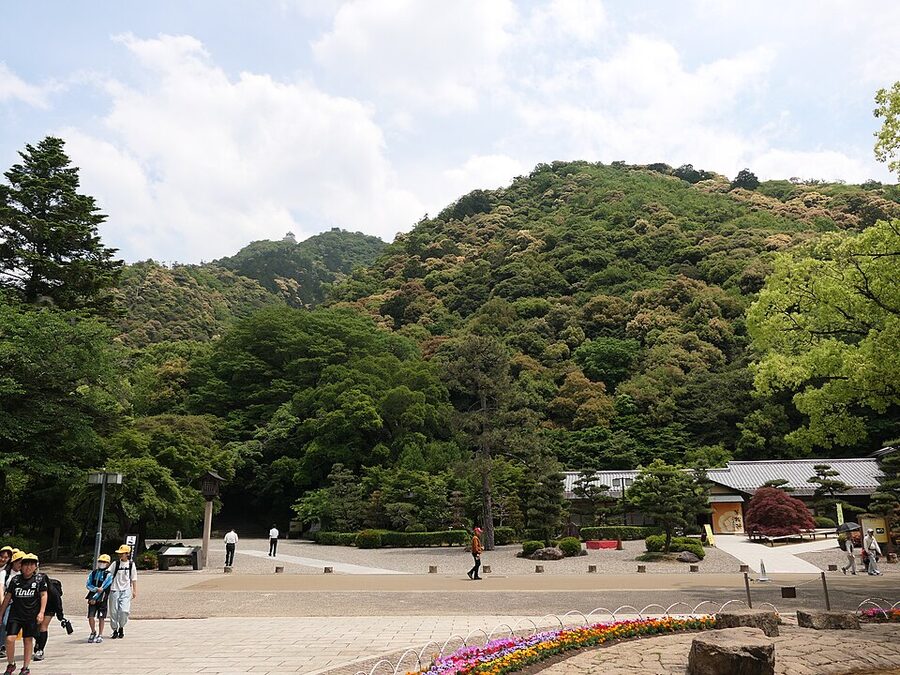
Gifu Park is a 15-minute bus ride from JR Gifu Station (N-series buses, get off at “Gifu Kōen / History Museum Mae”). The park is free and open 24 hours; the museum charges ¥600 and opens 9am-4:30pm, closed Mondays. Allow at least 90 minutes for the residence ruins and the museum combined before you start up the mountain.
The Kinka ropeway — or the four hiking paths
You have two options for getting from Gifu Park to the castle summit. The ropeway runs every fifteen minutes from the base station adjacent to Gifu Park, takes four minutes to reach the summit, and costs ¥1,300 round-trip as of 2025. The summit terminal is a seven-minute walk from the castle tower, along a paved ridge path that passes the Risu-mura (squirrel village, genuinely — a small petting zoo) and the restored Tenka-ichi-Enma-dō hall. For most visitors, the ropeway is the correct choice, particularly in summer heat or with older family members.
If you prefer to climb — and I recommend you do, at least once, to understand the castle’s strategic geography the way its historical visitors did — there are four maintained paths up the mountain. The Nanamagari Road (Seven-Bend Path) is the original main approach, 1.9 km, 60 minutes of walking, the gentlest gradient — this is the route Yamashina Tokitsugu complained about in 1569. The Hyakumagari Road (Hundred-Bend Path) is shorter and steeper, 1.1 km in 40 minutes, accessible from Zenrinji temple on the west side. The Uma-no-se (Horse’s Back) is the shortest, 1.1 km in 40 minutes, but climbs a steep chert face that requires four-limbed scrambling in places — not advisable in wet conditions. The Mizu-no-te (Water-Hand Path), also called the Meditation Trail, is the longest at 2.3 km over 70 minutes, winding up the northern slope with several small stream crossings. Start early — in summer, the mountain is uncomfortable after about 10am, and the paths are shaded only intermittently. Wear actual hiking shoes, not sneakers.
The castle tower and the summit complex
The 1956 tower has four floors. The ground floor is an armoury exhibit — replica arquebuses, spears, an original Sengoku-period helmet on loan from the prefectural museum. The second floor is reconstructed as the “Lord’s Chamber” with Sengoku-period dress on mannequins and period-furniture replica. The third floor is the “Nobunaga Room” — biographical exhibits on Nobunaga’s life, centred on the Tenka Fubu seal. The fourth floor is the observation gallery, a wrap-around outdoor balcony about 2 metres wide that runs on all four sides of the tower. The view from the fourth floor is the point of the visit — on a clear day you can see the Hida Mountains (including the Kiso-Komagatake and Mount Ena), the Northern Alps (Kasa-gatake, Yari-gatake, Hotaka, Norikura), Mount Ontake, the Ibuki range to the west, the Suzuka Mountains beyond that, and the Ise Bay on the south. The Gifu prefectural tourist office claims this is the best castle-summit view in Japan, and while that’s not quite my judgement (Matsumoto competes) it’s certainly a credible candidate.
The castle is open 9:30am-4:30pm daily with extended summer hours (8:30am-5:30pm, and some evening “night castle” openings in Golden Week and summer, check the Gifu City tourist website). Admission is ¥200. The small Castle Museum building 50 metres below the tower (the 1975-built Sumiyagura) is included in the same ticket. Budget 60-90 minutes for the summit complex total, longer if you want to sit with the view.
Inaba Shrine and Jōzai-ji — the extended circuit
Two temples at the base of the mountain extend the Nobunaga story meaningfully. Inaba Shrine, Inaba-jinja, sits just north of Gifu Park and was moved to its current location by Saitō Dōsan in the 1530s, specifically to clear the mountain’s ridgeline for his castle expansion. The small Mitarashi pond in the shrine grounds preserves a purification basin from the pre-move location, and the shrine’s annual Inaba Matsuri festival in April is one of the region’s major shrine celebrations. A short walk west of the shrine is Jōzai-ji, which holds the oldest surviving painted portrait of Saitō Dōsan, a 16th-century hanging scroll by an anonymous artist, plus Dōsan-era temple records. The two sites together give you the Pre-Nobunaga side of the story: the Mino-Saitō framework that Nobunaga inherited in 1567.
Getting to the extended sites: Inaba Shrine is a three-minute walk north of Gifu Park. Jōzai-ji is a ten-minute walk west of the shrine along Nagara-bashi Avenue. Both are free and open to walk-up visitors during daylight hours; the temple’s Dōsan portrait is in a side hall that the head priest will usually open on request for a small donation.
Getting to Gifu
Gifu is 20 minutes by JR Tōkaidō local train from Nagoya Station, or around 25 minutes by Meitetsu Nagoya line to Meitetsu Gifu. From Tokyo, you can either take the Tōkaidō Shinkansen to Nagoya (1h40) and transfer to the local for Gifu (20 minutes), or, more comfortably for a day trip, take a bullet through to Maibara and double back east on the Tōkaidō local (about 2h20 total). From Kyoto and Osaka, Maibara-and-double-back is again the sensible route, about 1h50 from Kyoto, 2h20 from Osaka. The town has plenty of business-hotel accommodation if you want to overnight, and the Nagara-gawa onsen district on the north bank of the river (a kilometre north of Gifu Park) is worth an overnight if you can spare one — the cormorant fishing, ukai, runs between May and October in the evenings, and watching it from the riverbank below Kinka-zan is one of Japan’s genuinely unique summer experiences.
Closing — the view Nobunaga wanted you to see
The fourth floor of the 1956 reconstruction is a view Nobunaga wanted visitors to have. He could not have planned the reconstruction, obviously, but he did plan the site — and a clear, uninterrupted 360-degree view from the summit was the reason he moved his base here in the first place. Stand at the west side of the observation gallery and look toward the Ibuki range; that’s the direction his retainers rode out toward Azuchi when he eventually moved his capital there in 1579. Look south toward the Nōbi Plain; that’s the direction every ambassador, merchant, and Christian missionary came from in the decade they knew they needed Nobunaga’s approval. Look east to the Kiso mountains; that’s the direction his son Nobutada would ride on the way to Takeda territory, and the direction Akechi Mitsuhide would ultimately ride from when he turned on him. The view is not a museum exhibit. It’s a functional observation post, and it is the actual view that a functioning Japanese unification campaign was run from for the decade 1567-1577.
When you come down the mountain, whether by ropeway or by the Nanamagari path, walk back through Gifu Park, past the excavated residence ruins, and pause at the stone wall where Fróis stood in 1569. That’s where the gold-leafed chrysanthemum tiles were found, the roof Fróis described as “of surprising sumptuousness.” Four hundred and fifty-seven years have passed. The roof is gone. The man is gone. The fragments in the museum are tangible, Nobunaga-touched objects. But what you can still read on the ground, in the stone walls and the platform outlines, is the confidence of the 1567-1582 moment — a provincial warlord who walked up a mountain, looked around, decided he was going to unify Japan, wrote Tenka Fubu on a seal, and acted on it without blinking until someone murdered him in a temple fifteen years later. Gifu Castle is where that decision was made visible. The tower on the summit is not the original. The decision, and the view it was taken from, are.
If this story draws you deeper, the obvious companion reads on this site are my pieces on Saitō Dōsan, the man who built up Inabayama Castle to the serious fortress Nobunaga eventually took, and Takenaka Hanbei, who briefly held it during the 1564 mutiny and whose reputation was made by that act. For the Oda family context, my Battle of Komaki-Nagakute piece covers the decade after Nobunaga’s death when the succession was contested; and the Tsushima Tennō Matsuri piece covers the summer festival Nobunaga watched from his family’s Shōbata base before moving east to Gifu.