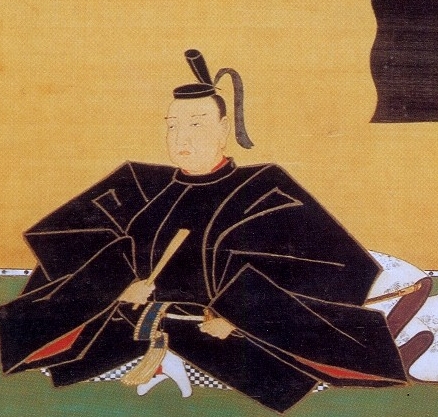
Hosokawa Tadaoki lived to eighty-three, which is a remarkable age for a Sengoku commander, and one of the reasons you should read his biography instead of a shorter-lived samurai’s is that he outlived almost everyone he loved. His father outlasted him by eighteen years in memory only — Fujitaka, the poet-warrior, died when Tadaoki was forty-seven and Tadaoki never managed to replace him as a conversation partner. His wife Tama — baptised Gracia, a Japanese convert to Catholicism, one of the most famous women of the period — was killed in their Ōsaka mansion in 1600 when Tadaoki was thirty-seven. His first-born son Tadataka was disinherited and spent most of his adult life in exile. His second son Tadatoshi died before him. His tea master Sen no Rikyū was ordered to commit seppuku by Hideyoshi when Tadaoki was twenty-eight. By the time Tadaoki himself died in 1646 he had been alone in important ways for forty-six years, and much of what he wrote during that period is an attempt to keep the absent ones in view.
The dominant English-language treatment of Tadaoki is as the husband of Gracia. The traditional Japanese treatment is as a Tokugawa loyalist, skilled administrator, and major tea-ceremony figure. Both are true. The more interesting way to read the biography is as a long marriage that was interrupted by two of the three most dramatic political events of the period and finished by the third.
In This Article
- The Poet’s Son and the Rebel’s Daughter
- Honnō-ji
- The Baptism
- The Ōsaka Mansion
- Buzen, Kumamoto, and the Tea Pot
- Where to visit Hosokawa Tadaoki’s story today
- 1. Sōkoku-ji and Gracia’s grave — Kyoto
- 2. Kokura Castle — Kitakyūshū, Fukuoka
- 3. Kumamoto Castle and Suizen-ji Garden — Kumamoto
- 4. Eisei Bunko — Bunkyō-ku, Tokyo
- The Survivor
The Poet’s Son and the Rebel’s Daughter
Tadaoki was born in 1563 in Kyōto, the second son of Hosokawa Fujitaka. Fujitaka — also known by his later Buddhist name Yūsai — was one of the most interesting figures of the late-Muromachi / early-Sengoku transition: a senior Ashikaga retainer who had defected to Oda Nobunaga in 1568, a classically trained waka poet who had inherited the Kokin-denju lineage of formal poetry transmission, and a competent military commander into his seventies. The Hosokawa household in Kyōto in the 1560s and 1570s had both a poetry-circle salon and a sword-and-armour training ground on the same set of grounds, and Tadaoki grew up in both.
In 1578, when he was fifteen, Nobunaga personally arranged his marriage to Akechi Tama, the thirteen-year-old fourth daughter of Akechi Mitsuhide. Mitsuhide was at that point Nobunaga’s most trusted senior general — the man who had just finished campaigning down the San’in coast and was being groomed to run the Kansai region. The marriage was a double-alliance: it bound two of Nobunaga’s key retainer clans together, and it gave each family a legitimising marriage-tie to the Oda inner circle.
By the standards of political marriages the match worked. The contemporary accounts — the Hosokawa household diaries kept by Fujitaka’s secretary, which survive at the Eisei Bunko collection — describe Tama and Tadaoki as unusually close from the start. Tama had been educated at her father’s court in Tamba; she was literate in both Japanese and Chinese, practised waka poetry, and had absorbed enough of her father’s tactical thinking to be a real conversation partner on military matters. For the first four years of the marriage they lived together at the Hosokawa Kyōto residence and later at Aoryusen Castle in Tango, where Tadaoki took his first provincial posting at seventeen.
Honnō-ji
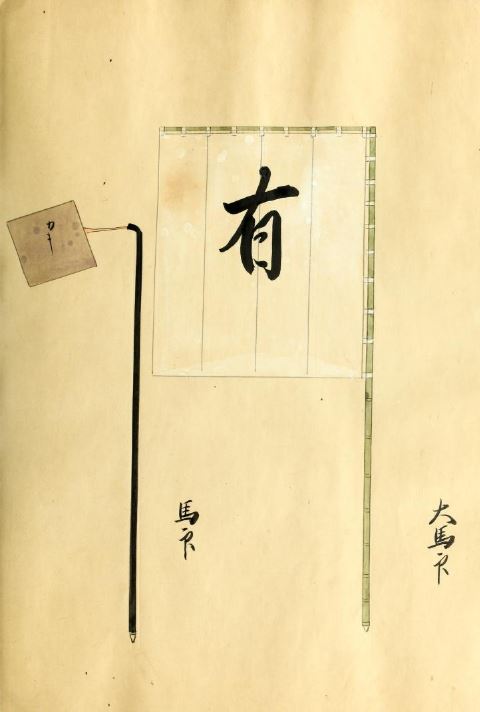
On 21 June 1582, Akechi Mitsuhide led his army into Honnō-ji temple in Kyōto and killed Oda Nobunaga. The event destroyed the political order of Japan and created an impossible personal situation for Tadaoki and Tama. Her father was now the rebel who had murdered the lord her husband had sworn to; every Oda-aligned vassal in the country was about to take up arms against him; and Mitsuhide, in the hours after Nobunaga’s death, sent messengers to Tango expecting his son-in-law Tadaoki to join the rebellion as an ally. The messengers made a plausible case — Tama was Mitsuhide’s daughter, the Akechi-Hosokawa alliance was genuine, Mitsuhide’s family estates would be available as a reward — and the messengers waited three days at Tango for an answer.
Tadaoki refused. His father Fujitaka refused. They both shaved their heads in public mourning for Nobunaga, which was both a symbolic commitment and a visible withdrawal from the succession politics — a shaved head in 1582 Japan meant retirement from secular affairs. They sent Mitsuhide’s messengers back empty-handed and wrote to Hideyoshi, who was the senior Oda commander most likely to move against the rebellion, to pledge the Hosokawa forces to the counter-campaign. Mitsuhide was dead within thirteen days, killed at the Battle of Yamazaki on 2 July 1582 by Hideyoshi’s returning army.
What happened to Tama during those thirteen days is the subject of the most-contested chapter of Tadaoki’s biography. The Hosokawa household records, written thirty years later by Tadaoki’s grandson’s archivist, state that Tama was “placed in a mountain residence at Midono for safekeeping” and imply that this was done for her protection from Oda retribution. The Jesuit mission records from the same period, written by the Portuguese missionaries who corresponded with Tama in the 1590s, describe it as a form of house arrest. The truth is probably both: the Hosokawa needed to visibly distance themselves from the Akechi to survive the post-Honnō-ji political rebalancing, and Tama had to disappear from public view for as long as anyone was still cataloguing Mitsuhide’s relations for reprisal. She spent two years at the Midono residence in the mountains of Tango with a small household of women. Tadaoki visited her a handful of times. The marriage held.
The Baptism
In 1584, at Hideyoshi’s direct request, Tadaoki formally restored Tama to the Hosokawa household. She returned to the main residence in Osaka, where Tadaoki had been assigned a post as one of Hideyoshi’s senior retainers. Her time in the mountain house had changed her. She had spent two years reading; what she had read, among other things, was a Japanese-language translation of the De Imitatione Christi that had been smuggled into Midono by one of her ladies-in-waiting. By the time she was back at the Ōsaka residence she was seriously considering conversion to Catholicism.
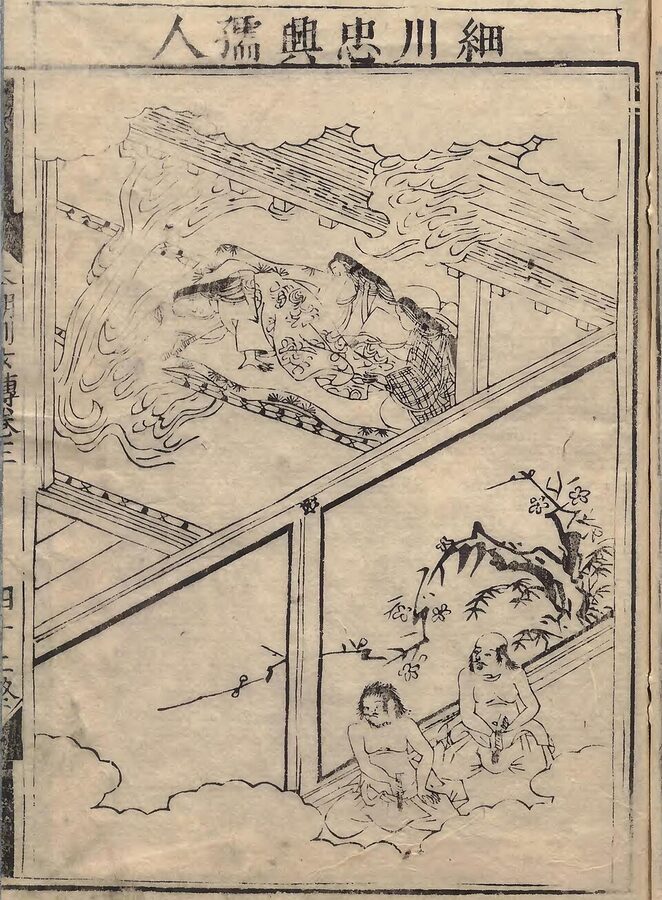
She was baptised in 1587, while Tadaoki was away on campaign in Kyūshū, by a Jesuit priest at the Catholic community in Ōsaka. The baptismal name was Gracia — “grace” in Latin, a pun on her Japanese given name Tama, which means “jewel” but also “soul”. Her conversion was probably unplanned in its timing; she had been expecting to do it with Tadaoki’s knowledge, but Hideyoshi’s 20 July 1587 Bateren-tsuihō-rei (伴天連追放令), the anti-Christian expulsion edict against missionaries, made the moment urgent. If she had waited she might not have been able to do it at all.
Tadaoki’s reaction is the subject of another scholarly argument. The hagiographical Christian sources, mostly 17th-century Jesuit accounts written for European circulation, describe him as violently opposed, cutting off the noses and ears of her Catholic attendants, threatening to kill her. The domestic Hosokawa sources describe him as “displeased but forbearing” and record no specific violence. The truth is again probably somewhere between. Tadaoki was genuinely jealous — by all accounts his jealousy was a recognised personality trait, to the extent that he once killed a gardener at the Ōsaka mansion for what he perceived as excessive eye contact with Tama — and he had not been consulted about the baptism. But he did not renounce the marriage, did not push her toward divorce, and did not turn her over to the authorities when Hideyoshi’s anti-Christian enforcers began looking for high-ranking converts in 1589. They stayed married. They did not see each other for long stretches during Tadaoki’s military campaigns. She was not permitted to attend Mass in public. But the marriage held.
The Ōsaka Mansion
The second major interruption to the marriage came in October 1600, in the run-up to Sekigahara. Tadaoki had committed to the Eastern (Tokugawa) side and was campaigning in the north with Ieyasu’s main force. Tama, Gracia by this point for thirteen years, was at the Hosokawa residence in Ōsaka. Ishida Mitsunari, who was running the Western coalition, sent an order on 17 October that every Eastern-aligned commander’s family still in Ōsaka was to be taken into Toyotomi custody as collateral for their husbands’ good behaviour. Ogasawara Shōsai, the head of the Hosokawa Ōsaka security detail, received the order around midday on 18 October.
Gracia had prepared for this. She had long-standing instructions from Tadaoki, written before he left for the northern campaign, that she was not under any circumstances to be taken hostage by the Toyotomi faction — the Hosokawa commitment to the Tokugawa was absolute, and a Toyotomi hostage would compromise the Eastern war effort. The instructions specified that she was to die rather than be captured. Gracia, as a Catholic, could not commit suicide without mortal sin, so the instructions had been written with an alternative method: her senior retainer was to kill her on her order, then set fire to the mansion and die himself in the flames.
Ogasawara Shōsai arrived at the mansion around three in the afternoon of 18 October. Gracia was in the main hall. She was thirty-seven years old. She had said her prayers earlier; the household Catholic priest was present; she said goodbye to the children; she gave Ogasawara the order. He killed her with a single strike. He killed the priest and the lady-in-waiting Kiyohara Yazaemon who had been Gracia’s Latin teacher. He set fire to the mansion. When the fire had reached the inner hall he committed seppuku in the flames. The mansion burned for about four hours. Twenty-two Hosokawa retainers died with them, mostly by their own hand, some in the fire. Gracia’s body was never recovered, the mansion burned too hot, but a small piece of bone from the approximate location of the main hall was later identified as probably hers and buried at Sōkoku-ji temple in Kyōto.
Tadaoki heard the news on 22 October, the day after Sekigahara. The Hosokawa household records describe him as sitting silently in his command tent for most of the following day and night, then emerging and issuing a formal statement that the Hosokawa forces would honour the terms of the Tokugawa victory settlement and that he personally would continue to serve Ieyasu. He did not weep; he did not rage; he wrote three letters. The letters survive in the Eisei Bunko collection. One is to Ogasawara Shōsai’s son, granting the Ogasawara family a permanent annual stipend of 300 koku in recognition of the father’s service. One is to the Jesuit mission at Nagasaki, requesting the formal Catholic prayers for Gracia’s soul. The third is to Ieyasu, a one-page letter pledging the Hosokawa to the Tokugawa order for as long as the Hosokawa name existed. All three were sent on the same day.
Buzen, Kumamoto, and the Tea Pot
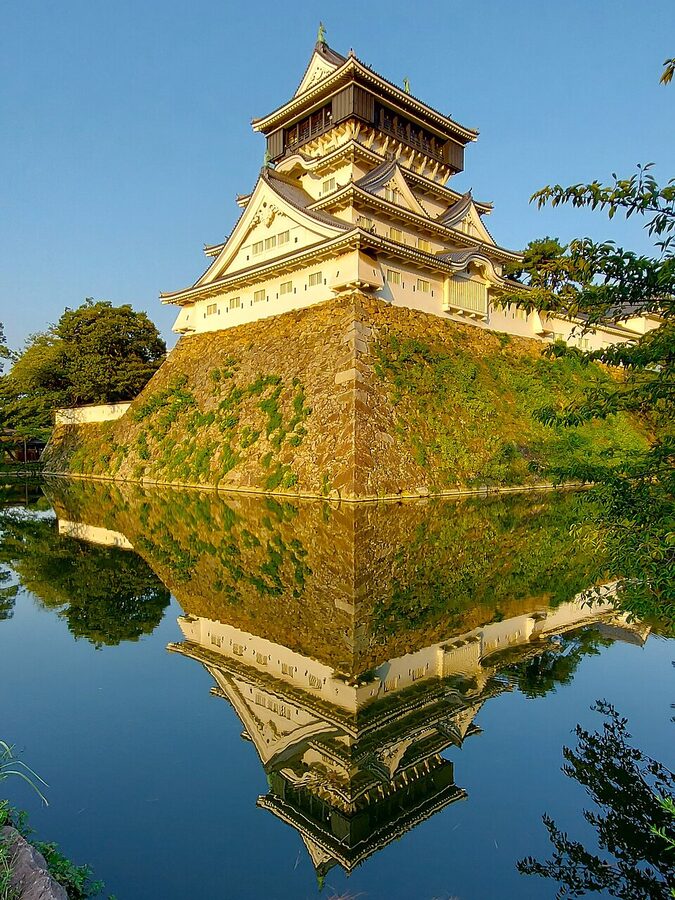
Ieyasu rewarded Tadaoki’s loyalty with the provinces of Buzen and Bungo — roughly 400,000 koku, two-thirds of modern Fukuoka prefecture — and permission to build a new seat at Kokura. Tadaoki broke ground on Kokura Castle in 1602 and finished it by 1609. Like Date Masamune’s Sendai, Kokura was a planned castle town; unlike Sendai, it was on a flat coastal plain that gave it direct ocean access, which Tadaoki used to build a domestic trade network across the Shimonoseki straits into Honshū. By 1615 Kokura had a population of about 25,000 and was the third-largest city in north Kyūshū.
In 1620, aged fifty-seven, Tadaoki retired. He handed the Hosokawa domain to his son Tadatoshi, moved to a small tea-house estate at Yawata in Kōzuke province, shaved his head, took the Buddhist name Sansai (三斋), and spent the next twenty-six years on the tea ceremony.
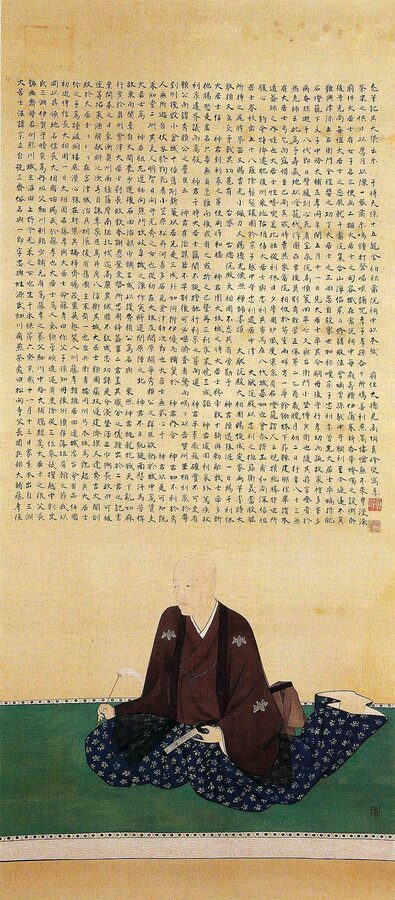
The tea-ceremony commitment was not decorative. Tadaoki had studied under Sen no Rikyū himself from about 1585; he was one of the seven senior disciples (Rikyū shichi-tetsu, 利休七哲) who received the master’s direct teaching. Rikyū’s forced seppuku in 1591, ordered by Hideyoshi, had ended Tadaoki’s formal training, and the quarter-century between Rikyū’s death and Tadaoki’s retirement was spent maintaining the practice without a teacher. The Yawata retirement let Tadaoki finally turn the study into teaching. He wrote a tea treatise called Sansai Chasho (三斋茶書), which is one of the canonical texts of early-Edo tea-ceremony philosophy and is still read by serious tea practitioners today.
His son Tadatoshi inherited the Hosokawa domain in 1620 and ran it competently. In 1632 the shogunate stripped the Katō clan of Kumamoto province after Katō Tadahiro — Kiyomasa’s son — failed to manage the post-Christian-rebellion Higo administration. The domain was transferred to the Hosokawa; Tadatoshi relocated to Kumamoto Castle, and the Hosokawa remained the lords of Higo for the next 239 years, until the Meiji restoration dissolved the daimyo system in 1871. Tadaoki watched all of this from his tea house.
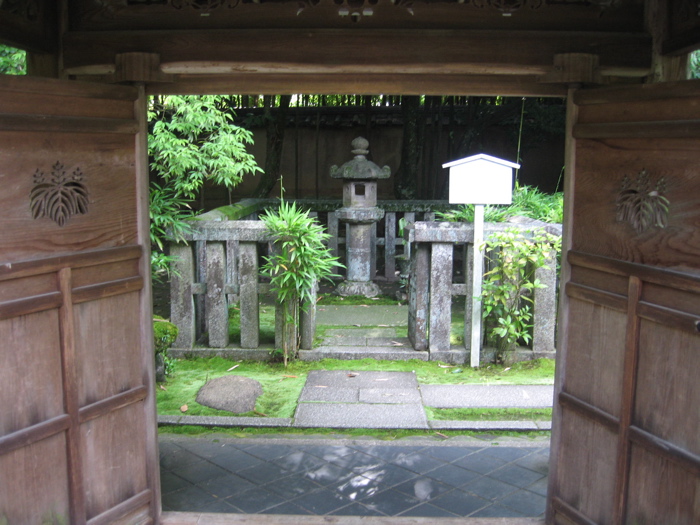
Tadaoki died on 7 February 1646, aged eighty-three. His last recorded act was to dictate a letter to his grand-son Mitsuhisa instructing him to maintain the Gracia grave at Sōkoku-ji “for as long as the Hosokawa have the resources to do so”. The grave has been maintained continuously since. It is currently managed by the Hosokawa family endowment, which is administered by the 18th head of the Hosokawa main line, Hosokawa Morihiro — who also happens to be the former Prime Minister of Japan (1993-1994). The endowment is still funded. The grave still has fresh flowers weekly.
Where to visit Hosokawa Tadaoki’s story today
Four places, across three prefectures. You can do Kyoto in half a day, Kumamoto and Kokura in a long weekend combined.
1. Sōkoku-ji and Gracia’s grave — Kyoto
Sōkoku-ji (相国寺) is a large Zen temple complex in north-central Kyōto, five minutes’ walk from Imadegawa station on the Karasuma subway line. Gracia’s grave is in the small Hosokawa sub-temple compound on the east side of the grounds. The main complex is free to enter; the sub-temple requires paid admission during spring and autumn exhibition periods only, and most of the year is accessible by appointment through the temple office. The approach through the Hosokawa sub-temple garden is one of the better preserved early-Edo gardens in Kyōto and is worth an hour on its own.
Allow ninety minutes. Best visited in autumn when the maples in the sub-temple garden turn. If you want to combine the visit with related sites, the grave of Sen no Rikyū at Jukkō-in is fifteen minutes’ walk west.
2. Kokura Castle — Kitakyūshū, Fukuoka
Kokura Castle is in the heart of modern Kitakyūshū, five minutes’ walk from JR Kokura Station. The main keep is a 1959 reconstruction built on Tadaoki’s original stone foundations; the Matsumoto-seichoku-en garden on the castle grounds is an original Hosokawa-era landscape garden, unchanged in layout since Tadaoki’s 1602 commission. The Kitakyūshū Municipal Museum is adjacent and contains an excellent Hosokawa-era exhibit including Tadaoki’s personal armour and a number of his tea utensils.
Admission ¥350 for the castle, combined ¥560 for castle plus garden. Allow three hours. The castle is particularly good in cherry-blossom season (early April) when the outer moat is lined with trees.
3. Kumamoto Castle and Suizen-ji Garden — Kumamoto
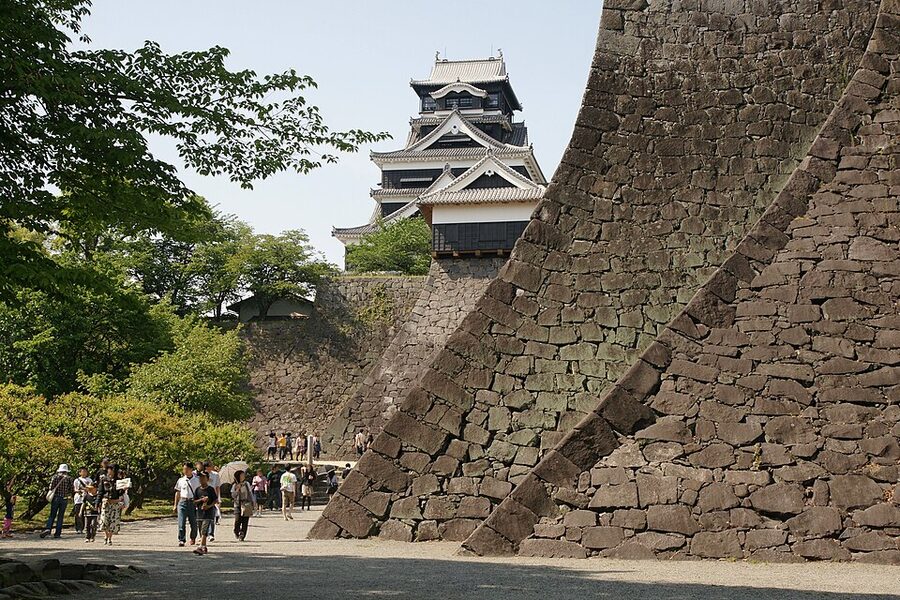
Kumamoto Castle is about fifty minutes by Shinkansen from Hakata (Fukuoka). The castle was badly damaged in the 2016 Kumamoto earthquake; restoration is ongoing and the main keep has been accessible only since 2021. The Hosokawa treasures, including the family archive, were moved to the Eisei Bunko collection in Tokyo after the Meiji restoration, but the Kumamoto City Museum adjacent to the castle has a strong Hosokawa-era permanent exhibit. Suizen-ji Garden (水前寺成退園), the Hosokawa retirement garden on the east side of the city, is a classical Edo-period stroll garden and was one of Tadaoki’s son Tadatoshi’s major projects.
Allow a full day for the castle plus museum plus garden. Best visited in late October through November for autumn colours or early April for plum blossom.
4. Eisei Bunko — Bunkyō-ku, Tokyo
The Eisei Bunko (永青文庫) in Meguro, Tokyo, is the private museum of the Hosokawa clan collection — Tadaoki’s tea utensils, his father Yūsai’s poetry manuscripts, the family archive that includes the Gracia correspondence, and one of the great private Japanese art collections. It is run by Hosokawa Morihiro, the current head of the main line. Open Tuesday through Sunday, admission ¥1,000 with a themed exhibition schedule that rotates four times a year. Allow ninety minutes. This is the single best Tadaoki-focused site in Japan and is rarely crowded because most tourists do not know about it.
The Survivor
Compared to the other samurai biographies on this site, Tadaoki’s is unusual in that it has almost no battlefield climax. He fought at Sekigahara but did not command the decisive action; he campaigned in Korea under Shimazu Yoshihiro but did not produce a Sacheon; his military career is competent rather than brilliant. The moments that shape the life are domestic: the marriage at fifteen, the isolation at Midono after Honnō-ji, the baptism without consent, the Ōsaka mansion fire, the long tea-ceremony retirement. The biography is domestic in the full sense, its arc is the arc of the marriage, and that is what makes it a more complicated piece of reading than the more military samurai biographies.
Tadaoki got through the Sengoku period by surviving people rather than fighting them. The father-in-law who became a rebel; the master who ordered his teacher’s death; the wife who chose her own dying; the generation of daimyo who died at Sekigahara and Osaka; the son who died young. He outlived every major decision point of his lifetime and kept the clan consolidated through each of them. The Hosokawa are still one of the most prominent families in Japan because of those twenty-six years of retirement tea ceremony after age fifty-seven. It is not the brightest way to run a Sengoku biography, but it is the way that keeps the name attached to something that still has flowers on the grave 426 years after the Ōsaka fire.
If you are going to Kyōto anyway, walk to Sōkoku-ji. The Hosokawa sub-temple is quiet. The maples in the garden turn later than the ones in the main complex. Gracia’s grave is small. Stand at the stone, and if you want a full reading of the marriage that shaped it, continue from there to the Eisei Bunko next time you are in Tokyo. The letters Tadaoki wrote on 22 October 1600 are still there. His handwriting was competent, not distinguished. The second letter, to the Jesuit mission at Nagasaki, contains the only sentence in his surviving correspondence that addresses her directly. In translation it reads: “Please tell them that she is now, as she wished to be, with God.”