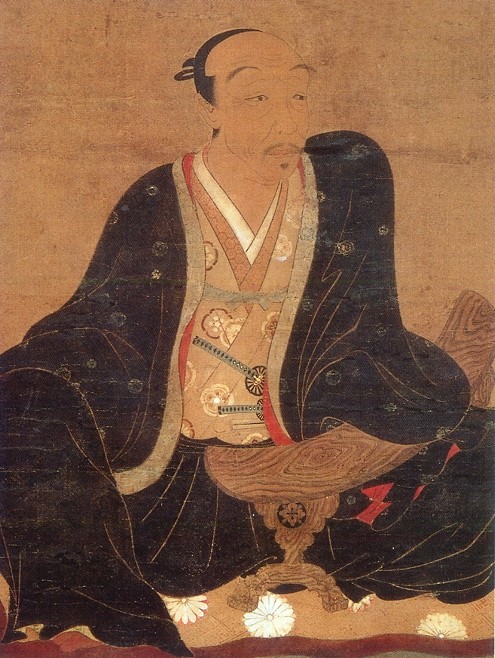
By the numbers alone, Maeda Toshiie’s legacy is the largest single non-Tokugawa feudal holding in Japanese history. The Kaga domain he founded by his death in 1599 covered 830,000 koku of registered rice production; by the time his son Toshinaga inherited and consolidated it, the aggregate holding — Kaga, Noto, and Etchū combined — was 1,195,000 koku, making the Maeda family’s Kaga-han the largest tozama domain in Edo Japan by a comfortable margin. The Shimazu of Satsuma came second at around 720,000 koku. The Date of Sendai third at 620,000. No other outer daimyō house came within 30% of the Maeda’s bulk. And Toshiie himself had been born the fourth son of a minor Owari castellan with a 2,000-kan fief — a status so modest that he was not expected to inherit anything, and he did not in fact inherit the family’s small Arako castle-town until he was already 31 years old and a senior Oda retainer on his own merit. The arc from Arako to Kanazawa, over the course of a 60-year career, is steeper than any other feudal-class upward trajectory in pre-modern Japan except Hideyoshi’s — and Toshiie, unlike Hideyoshi, started as a recognised samurai rather than from the peasant class.
The career produced him three distinct Japanese nicknames, each marking a different phase. Yari-no-Mataza, “Mataza of the Spear”, was the younger-man’s identity, a 6.30-metre red-shafted weapon that he carried on campaign from the 1556 Battle of Inō onward, and for which Nobunaga specifically commended him. Fuchū-sannin-shū, “the Three of Fuchū”, was the mid-career identity, a triumvirate with Sassa Narimasa and Fuwa Mitsuharu who governed the Echizen border region under Shibata Katsuie from 1575. And finally Kaga Hyakuman-goku no Oya, “the Father of the Million-Koku of Kaga”, was the late-career identity, the founding lord of the domain that his family would hold for 270 years across 14 generations until the Meiji Restoration. The three identities are useful because they map onto three distinct tactical and political approaches, and you can see Toshiie shifting between them as the political landscape changed around him. The spear-fighter of 1556 became the regional commander of 1575 became the Toyotomi Senior Regent of 1598 — the same man, continuously, applying different instruments to different problems.
In This Article
- Arako, 1539 — a fourth son with a red spear
- The red spear and the Akahoro guard
- The Shu’ami affair and the self-imposed exile
- The Oda campaigns and Shibata’s lieutenant
- Shizugatake, 1583 — the defection
- Komaki, Suemori, and the Hokuriku consolidation
- The Toyotomi regency and the Go-tairō appointment
- Death, 1599 — and the aftermath
- Where to visit Maeda Toshiie today
- Arako and Nagoya — the birthplace
- Kanazawa — the Maeda capital
- Nanao and Noto Peninsula — the early daimyō years
- Closing — the fourth son who built a million-koku
Arako, 1539 — a fourth son with a red spear
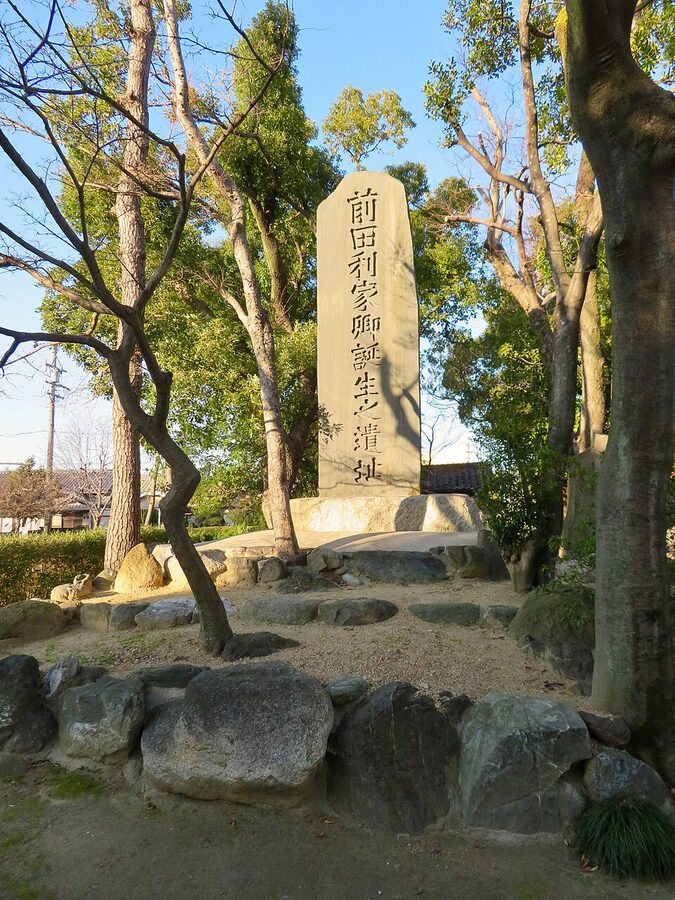
The standard date for Toshiie’s birth has traditionally been 25 December 1538 (Japanese calendar) or 15 January 1539 (Gregorian), based on the Maeda family’s own Shōun Kō Gokō-ki chronicle. Recent scholarship has pushed the birth date earlier, to 1536 or 1537, based on inscriptions at the Hōshun-in memorial and the traditional story that Toshiie performed the mimi-fusagi-mochi ritual (an age-based mourning practice) at Hideyoshi’s death in 1598 — which requires Toshiie to have been the same age as Hideyoshi, who was born in 1537. This revision is now fairly widely accepted among Japanese historians. Whether 1537 or 1539, Toshiie was born at Arako village in Aichi-gun of Owari Province, on the western flats of modern Nagoya City (now Nakagawa-ku), as the fourth son of Maeda Toshiharu — castellan of the small Arako fortress, with a 2,000-kan (roughly 40,000-koku) fief as a minor retainer of the Oda Danjō-no-jō (the same Oda branch Nobunaga would inherit). His childhood name was Inu-chiyo — “Dog-Thousand-Generations,” a typical Sengoku-era auspicious child-name. As a fourth son, he had no expectation of inheriting the Arako fief, and his likely career path in 1539 was to enter either a temple or a senior-branch retainer service to build a career from scratch.
In 1551, aged 14, Toshiie entered Oda Nobunaga’s service as a koshō — a page/attendant, the standard entry-level role for a samurai-class teenager. He took the adult name Sonshirō Toshiie at the same time. The Maeda family had been long-time retainers of the senior Oda vassal Hayashi Hidesada, so the placement was natural rather than exceptional. What distinguished Toshiie almost immediately was his physical presence — he was unusually tall for the period, estimated at 180-181 cm based on surviving clothing, and had a reputation among the Kiyosu garrison as a kabuki-mono: the extravagantly-dressed young rowdy of Sengoku-era popular culture, who went out of his way to attract attention through flamboyant clothing and provocative behaviour. Nobunaga at the same period was similarly characterised as a kabuki-mono, and the two of them, both teenagers in the Kiyosu Oda camp, established an intimate early relationship that the Asho Kō On-yawa chronicle explicitly describes as including shudō (male-male pederastic) content. Whether this is literally accurate or a later chronicle-writer’s inference, the practical point is that by age 14-15, Toshiie was operating inside Nobunaga’s closest personal circle.
The red spear and the Akahoro guard
Toshiie’s first battle was the 1552 engagement at Kayazu, where he reportedly took his first head. But the action that established his military reputation was the 24 August 1556 Battle of Inō, fought inside the Oda succession dispute between Nobunaga and his younger brother Nobukatsu. During the engagement, Toshiie was struck under the right eye by an arrow shot by an enemy commander named Miyai Kanbei — a serious facial wound that a normal 19-year-old would have retreated from to seek medical attention. Toshiie, arrow still in his face, pushed forward, identified the archer, and killed Miyai with his distinctive long spear. Nobunaga, on receiving the report, is said to have exclaimed “Inu-chiyo has hair on his liver!”, the Sengoku-era equivalent of “this boy has nerves of steel”, and publicly congratulated him on the field. Toshiie declined to have the arrow removed until after the post-battle head-inspection. This is the episode the Edo chroniclers later seized on as the definitive Toshiie-in-youth tableau: the arrow in the face, the enemy killed regardless, the refusal to retire from the field.
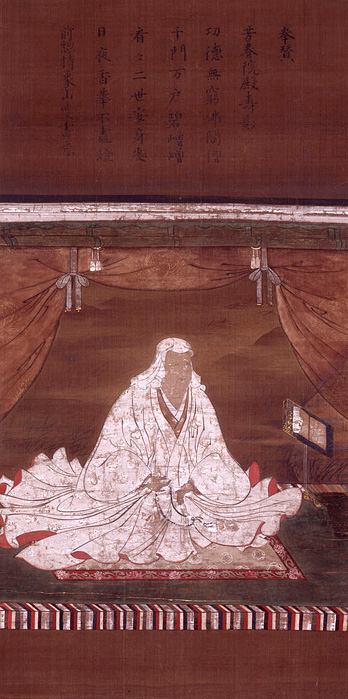
By 1558, Toshiie had been promoted to the Akahoro-shū, the red-cape guard, one of the two elite personal-retinue units (red and black) Nobunaga had just established as his close-protection bodyguard. This was a rapid rise for a 21-year-old fourth son; the red-cape unit had about 30 members at any given time, each personally selected by Nobunaga from the broader retainer corps. Toshiie was made the unit’s fuku-taishō (deputy commander), assigned 100 auxiliary retainers (yoriki), and given a 100-kan fief increase. At the same time he married his cousin Matsu, the 12-year-old daughter of Shinoharatori Harutsugu — a modest-status cousin-marriage, but one that would prove to be the most consequential domestic alliance of Toshiie’s life. Matsu would go on to bear 11 children, run the Kaga domestic administration through his absences, and after his death serve as a Tokugawa hostage to protect her son Toshinaga’s succession in 1599-1601. She outlived Toshiie by 18 years. Her portrait is at the Sōji-ji temple memorial to her memory.
The Shu’ami affair and the self-imposed exile
The single most famous episode of Toshiie’s youth, and the one that nearly destroyed his career, came in 1559. A Nobunaga attendant named Shu’ami — a member of the dōbō-shū, the lord’s personal entertainers — had taken a decorative hair-ornament (kōgai) from Toshiie’s weapons rack without permission. When Toshiie demanded it back, Shu’ami refused and mocked him. Toshiie drew his sword and killed Shu’ami on the spot. This was a serious breach: Shu’ami was one of Nobunaga’s personal favourites, and killing a member of the immediate household retinue was formally a capital offence. Nobunaga ordered Toshiie’s execution. Senior retainers, including Shibata Katsuie and Mori Yoshinari, interceded urgently on Toshiie’s behalf, arguing that the provocation had been real and the young guardsman’s honour had required a response. Nobunaga commuted the sentence to rōnin, removal from service, but did not allow Toshiie back into active duty.
What Toshiie did during the two-year exile (1559-1561) is one of the more distinctive moments of Sengoku-era self-marketing. Rather than leaving Owari or seeking service with a different lord, he continued to attend Oda battles as an uninvited volunteer, fighting at the sode-furi (outside-the-sleeve) periphery of the Oda line without any formal standing. He participated in this manner at the 1560 Battle of Okehazama (taking three heads in the dawn skirmish and main engagement combined), then the 1561 Battle of Moribe (taking two more, including Adachi Rokubei — a famous Saitō champion nicknamed “Adachi the Head-Taker”). The message to Nobunaga was explicit: I am your man regardless of whether you let me serve; I will continue to demonstrate loyalty until you relent. It worked. In 1561, after Moribe, Nobunaga reinstated Toshiie at an increased stipend (450 kan, a 300-kan raise over his pre-exile level). The message received was that Toshiie’s loyalty was unconditional, and the standard Oda retainer treatment recognised that.
The Oda campaigns and Shibata’s lieutenant
Between 1561 and 1575, Toshiie served as a steady mid-rank Oda commander across most of the major campaigns of Nobunaga’s rising period. His elder brother Toshihisa (who had been childless and infirm) died in 1569, and Nobunaga, with characteristic bureaucratic directness, ordered Toshihisa’s adopted successor Matsutoshi demoted and Toshiie promoted to family headship. Toshiie was now Arako-jō’s castellan at age 32, with the Maeda clan name under his direct control. His military responsibilities expanded accordingly. In 1570, at the Battle of Kanegasaki, he commanded the Oda rear-guard; at Anegawa later that year, he personally killed the Azai commander Asai Sukeshichirō; at the 1572 Tsutsumi-no-ue action during the Ishiyama Hongan-ji campaign, he held a position single-handed while the Oda infantry retreated safely past him. The Shinchō Kōki records Nobunaga’s specific praise: “This is not a new kind of spear but it is peerless.” Toshiie had become, by his mid-thirties, one of Nobunaga’s most reliable regional commanders.
At Nagashino in 1575, Toshiie served as one of Nobunaga’s six teppō-bugyō, matchlock commissioners, alongside Sassa Narimasa, Nonomura Masanari, Fukutomi Hidekatsu, Hirō Naomasa, and Ban Naomasa. This was the highest-ranking musket assignment at Nagashino and places Toshiie directly in the palisade-defense that broke the Takeda cavalry. He was wounded in the right leg during the late-afternoon pursuit phase by an enemy named Yuge Saemon, a deep sword-cut that required his retainer Murai Nagayori’s battlefield-medic attention, but recovered fully. This is the only recorded wound of Toshiie’s military career. Three months later, in August 1575, after the completion of the Echizen Ikkō-Ikki suppression, he received 33,000 koku at Fuchū in Echizen Province and became one of the Fuchū-sannin-shū — the Three of Fuchū, a governing triumvirate with Sassa Narimasa and Fuwa Mitsuharu under the overall command of Shibata Katsuie.
From 1575 through 1582, Toshiie served as Shibata’s senior lieutenant in the Hokuriku (northern coast) theatre, fighting against the Uesugi in Etchū, against the remaining Ikkō-ikki pockets in Kaga and Noto, and against various minor daimyō resisting Oda consolidation. His administrative reputation grew during this period — he was effective at village-level pacification, he managed supply and billeting with unusual care, and he was remembered kindly by the Hokuriku peasantry in a way that Sassa Narimasa (my separate piece covers the contrast) explicitly was not. In 1581, Nobunaga awarded Toshiie all of Noto Province — approximately 230,000 koku — with Nanao Castle as his headquarters. This made Toshiie a full daimyō in his own right for the first time, governing an entire province rather than sitting on a domain-fragment. He was 42-44 years old depending on which birth-year one uses.
Shizugatake, 1583 — the defection
The most consequential single decision of Toshiie’s career came at the 1583 Battle of Shizugatake, and the analysis of that decision is still a subject of Japanese historical debate. The general situation is covered in my Shizugatake piece; the specific Toshiie question is this. When Shibata Katsuie moved against Hideyoshi in the spring of 1583 over the post-Nobunaga succession, Toshiie was legally Shibata’s subordinate and theoretically committed to the Shibata side. He deployed with approximately 5,000 men at the Shizugatake front in early April. On 21 April 1583, at the critical moment of the engagement — when Sakuma Morimasa’s unauthorised attack on the Hideyoshi rear position created the opening that Hideyoshi exploited with his famous Mino-ō-gaeshi return-march — Toshiie’s forces suddenly withdrew from the front without orders. This left Shibata’s flank exposed at precisely the moment the Hideyoshi counter-attack was closing, and ensured the Shibata collapse.
The traditional explanation, which is probably correct, is that Toshiie had been in secret correspondence with Hideyoshi for months before the battle — the two men had been neighbours at Kiyosu and then at Azuchi during Nobunaga’s life, their wives (Matsu and Nene) were close personal friends, and the 1574 offer by Hideyoshi to adopt the Maeda’s third daughter Gō had created a formal alliance bond that outweighed the formal Shibata-subordinate relationship. Toshiie had probably committed to withdraw at a signal, and the signal came when Sakuma’s assault failed. The retreat was not an act of cowardice but a premeditated political switch. Shibata himself, retreating through Fuchū toward Kitanoshō on the night of 21-22 April, is said to have stopped at Toshiie’s castle for tea — Toshiie received him warmly and served him yuzuke (tea-poured rice), in what the Shizugatake Kassen-ki describes as an extraordinary scene of a defeated lord accepting hospitality from the subordinate who had just destroyed him. Toshiie then, on 22 April, surrendered formally to Hideyoshi’s envoy Hori Hidemasa and joined the Hashiba column advancing on Kitanoshō.
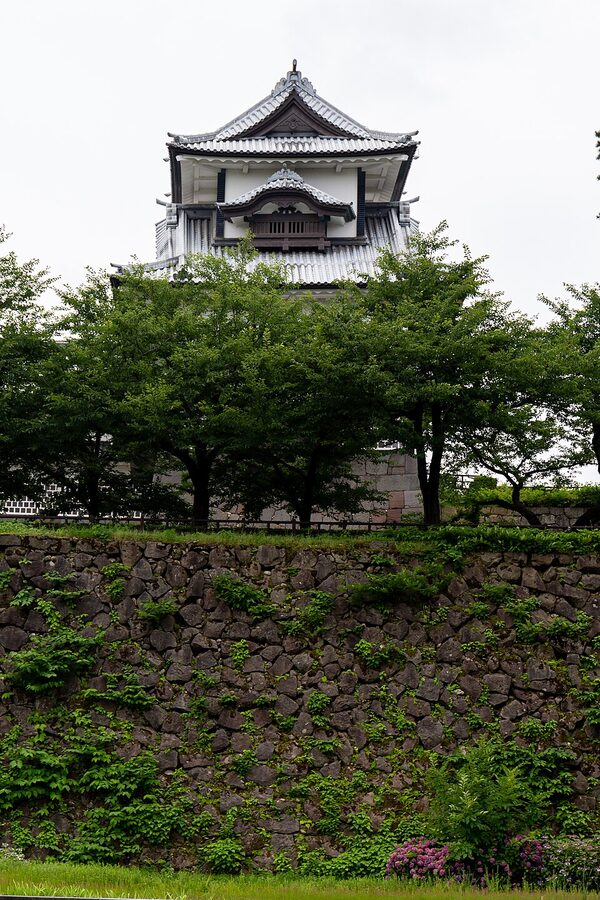
The reward was substantial. Hideyoshi confirmed Toshiie’s existing 230,000-koku Noto holding and added two gun (counties) of the forfeited Sakuma Morimasa fief in Kaga Province — roughly another 120,000 koku — bringing the Maeda total to approximately 350,000 koku. Toshiie moved his base from Nanao in Noto to Kanazawa Castle in the centre of his new Kaga holding — the castle had been the Sakuma family’s Kaga headquarters, which Sakuma Morimasa had renamed from the Ikkō-ikki-era Oyama-gobō. Toshiie briefly renamed it again to Oyama-jō (reflecting his own Owari origin and the Ikkō-ikki reconciliation) but it reverted to Kanazawa in popular usage within a generation. The Kanazawa headquarters he established in 1583 is the urban centre of the modern Kanazawa City, and the street grid he laid out is, in large part, still the street grid you walk today.
Komaki, Suemori, and the Hokuriku consolidation
The 1584 Komaki-Nagakute Campaign brought Toshiie his second major post-Shizugatake military test. Sassa Narimasa — Toshiie’s former Fuchū triumvir colleague, now isolated in Etchū on the Shibata-loyalist side of the post-1583 settlement — broke for Tokugawa Ieyasu’s faction and invaded Kaga and Noto while Hideyoshi was distracted in the central theatre. Toshiie’s lieutenant Okumura Nagatomi held Suemori Castle in northern Noto against Sassa’s 15,000-man advance for three days; Toshiie, racing from Kanazawa with 3,000 reinforcements, relieved the siege on 16 September 1584 and drove Sassa back across the provincial border in a pitched battle at the Suemori approaches. The victory, combined with Hideyoshi’s strategic stalemate at Komaki, is what finally eliminated Sassa Narimasa as a military threat. A year later, in August 1585, Toshiie led the Hokuriku vanguard in Hideyoshi’s 100,000-man invasion of Etchū, which forced Sassa’s formal surrender in late August (covered in more detail in my Sassa piece).
After Sassa’s surrender, Hideyoshi consolidated the Hokuriku administrative structure. Toshinaga, Toshiie’s eldest son, received three of Etchū’s four gun (counties), which pushed the Maeda family’s combined holding to 765,000 koku across Kaga, Noto, and Etchū. And Hideyoshi then appointed Toshiie as Hokuriku-dō no Sōshoku, “Chief Administrator of the Northern Road”, a regional-viceroy role with responsibility for all Toyotomi affairs across the five provinces from Echizen to Echigo. This was the position that made Toshiie a senior Toyotomi regime official rather than a senior regional daimyō. For the next decade, he was effectively the Toyotomi regency’s representative on the north coast, receiving visiting daimyō on Hideyoshi’s behalf, adjudicating cross-provincial disputes, and running the diplomatic outreach to the far-northern Uesugi and Date territories.
The Toyotomi regency and the Go-tairō appointment
In 1586, Hideyoshi granted Toshiie the Hashiba surname and the Chikuzen-no-kami court title — a ceremonial name-sharing that signalled direct Toyotomi family-relationship. In 1588, when Hideyoshi received the brand-new Toyotomi surname from the emperor, Toshiie received the Toyotomi surname as well. During the 1590 Odawara Campaign against the Hōjō — covered in my Hideyoshi piece — Toshiie commanded the northern wing of the Toyotomi army, reducing the Hōjō’s Matsuida, Hachigata, and Hachioji fortresses in sequence and then participating in the final Odawara siege. After the Hōjō fell, Toshiie was appointed one of the three senior investigators conducting the post-campaign interview of the surrendered Date Masamune — a politically delicate role that required handling a powerful outer daimyō while preventing further rebellion. Toshiie and Masamune developed a durable working relationship during this period that would later be useful when the post-Hideyoshi succession crisis opened in 1598-99.
The 1590s were Toshiie’s peak years. In 1594 he was elevated to Jusanmi Chūnagon — Junior Third Rank, Middle Councillor — making him one of the highest-ranking court-civilian figures in the country. His registered domain reached its maximum of 835,000 koku in 1595 with the addition of the last Etchū county (Niikawa-gun) through his son Toshinaga. And in 1598, as Hideyoshi was dying, Toshiie was appointed to the Go-tairō — the five-member senior council that was to guide the succession for Hideyoshi’s 5-year-old son Hideyori. The other four regents were Tokugawa Ieyasu, Mōri Terumoto, Uesugi Kagekatsu, and Ukita Hideie. Toshiie’s specific role was the one Hideyoshi trusted most: fu-yaku, the guardian-mentor of the boy lord himself. Toshiie was to move personally to Osaka Castle, live with the young Hideyori, and manage his upbringing until adulthood. This role placed him directly between Ieyasu (whose ambitions were obvious to everyone by mid-1598) and the Toyotomi legitimacy. Hideyoshi died on 18 September 1598 believing Toshiie would hold this position for at least the next decade.
Death, 1599 — and the aftermath
Toshiie did not hold the regency for the decade Hideyoshi had hoped. In February 1599, just five months after Hideyoshi’s death, Ieyasu openly violated the Toyotomi testamentary ban on private marriage alliances — arranging matches between his own relatives and the Date, Fukushima, and Hachisuka clans. Toshiie, as the designated protector of Hideyori and the most senior Toyotomi-faction figure, confronted Ieyasu directly. For several weeks in February and early March 1599, the two sides mustered forces at their respective Osaka and Fushimi mansions, each expecting the other to open hostilities. The political alignment gathered around Toshiie: Mōri Terumoto, Uesugi Kagekatsu, Ukita Hideie, Ishida Mitsunari — plus several of the pro-war retainers (Katō Kiyomasa, Fukushima Masanori, Kuroda Nagamasa, Hosokawa Tadaoki) who would later famously switch to Ieyasu’s side at Sekigahara — all rallied initially to Toshiie’s camp. The 1599 crisis was, essentially, the Sekigahara coalition in its original 1598-design configuration, with Toshiie in the central leadership role that Ishida Mitsunari would later occupy by default.
On 2 February 1599, the two sides exchanged mutual guarantee oaths and pulled their forces back. Toshiie visited Ieyasu’s mansion personally to seal the agreement and, in one of the characteristically-reported Toshiie moments, brought a concealed drawn sword under his ceremonial futon in case the meeting went badly. It didn’t go badly; Ieyasu relocated from Fushimi to Mukojima as a de-escalation gesture; the immediate crisis passed. But the long-term accommodation was not real, and everyone knew it. Toshiie’s health was already failing when the crisis closed. On 3 Leap-3rd-month 1599, 27 April 1599 Gregorian, he died at his Osaka mansion aged either 60 or 62 depending on the birth-year adjustment. He had held the regency for exactly 221 days. Within months, Ieyasu was back at Fushimi and the Toyotomi political structure was dissolving visibly. Ishida Mitsunari’s 1600 Western Army coalition would fight Sekigahara without the senior-regent anchor Toshiie had been supplying, and would lose. Matsu went to Edo as hostage that year. The 14-year hostage period that kept the Maeda domain intact was the specific price of Toshiie’s absence.
The domain the Maeda inherited was huge, strategically placed, and politically vulnerable in ways that the 1583-1599 Toshiie-era administration had not needed to consider. Toshinaga, Toshiie’s eldest son, managed it carefully through the Ieyasu-friendly period 1600-1614; his successor Toshitsune consolidated it through the early Edo bakufu period; and the domain continued — as Kaga-han, the “Kaga hundred-myriad-koku” — until 1871 under 14 generations of Maeda lords. The domain held a larger population than Ieyasu’s Tokugawa-bakufu direct holdings, and Kanazawa in the Edo period was consistently the third- or fourth-largest city in Japan. The modern Kanazawa cultural profile — the Kenroku-en garden, the Ishikawa-mon gate, the tea-ceremony and Noh traditions, the gold-leaf industry, the lacquer-work — all of these developed as Edo-period Kaga-han projects, funded by the 835,000-koku income Toshiie had assembled in 1585-1599 and Toshinaga had consolidated. Kanazawa is, in a very direct way, the ongoing physical manifestation of what Toshiie built.
Where to visit Maeda Toshiie today
Arako and Nagoya — the birthplace
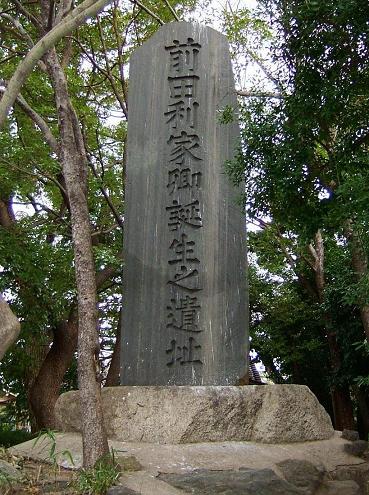
Toshiie’s birthplace is preserved in Nakagawa ward of modern Nagoya City — the Arako Castle ruins site, now a small urban park with the original castle foundations and a monument stone. The site includes the Maeda Toshiie Tanjō-chi (“Maeda Toshiie Birthplace”) marker and a small adjacent shrine. Arako is about 15 minutes from Nagoya Station on the Meitetsu Tsushima Line or the Aonami Line; the Arako Kannon temple, Toshiie’s childhood family temple, is a 5-minute walk from the park and has a modest Maeda-family memorial display.
The Arako sites pair well with the Oda-era Kiyosu Castle (30 minutes west by JR) and with Okazaki (45 minutes east by Meitetsu) — a full-day Owari circuit covering the pre-Kaga Toshiie, Nobunaga’s Kiyosu base, and Ieyasu’s Okazaki birthplace is easily doable from Nagoya.
Kanazawa — the Maeda capital
Kanazawa is the essential destination for any Toshiie-focused trip. The city is served by the Hokuriku Shinkansen (2.5 hours from Tokyo, 2 hours from Shin-Osaka via Maibara). The core Toshiie-related sites are all walkable from Kanazawa Station:
Kanazawa Castle Park. The reconstructed main compound is free to enter; the interior keep buildings are ¥320. The site has been under active archaeological and reconstruction work since 1996, so the specific buildings open to visitors rotate. Open 7am-6pm daily. The 1602-era Ishikawa-mon gate (actually a 1788 rebuild on the original foundation) is always the first photograph people take. The Gojikken-nagaya long storehouse is the most atmospherically-impressive of the recent reconstructions.
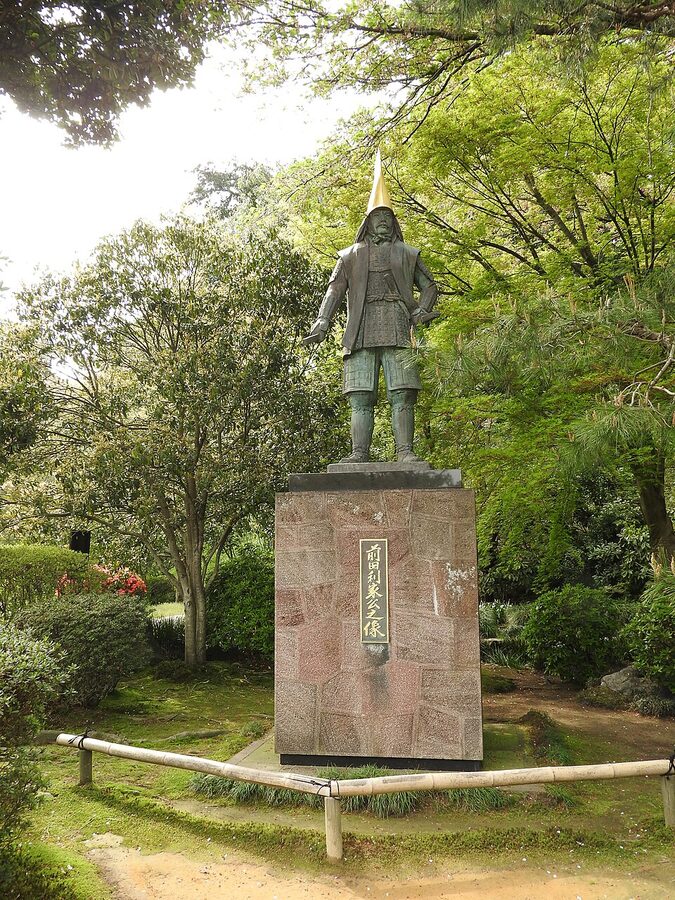
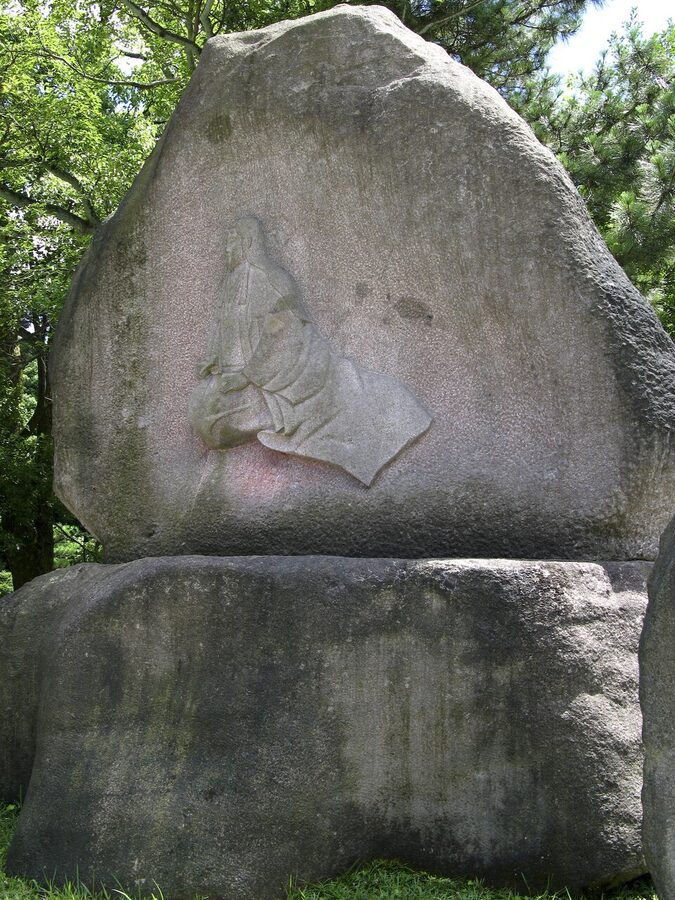
Oyama Shrine. The dedicated shrine to Toshiie — and, unusually, to Matsu as well — in the form of their posthumously-deified kami identities. The shrine’s main hall dates to 1873 but the site has been continuously maintained since 1599. The Toshiie equestrian statue (pictured above) is in the front courtyard; the Matsu stone relief is behind the main hall. Free, always open. The annual Hyakuman-goku Festival in the first weekend of June is one of Kanazawa’s major civic events and features reenactments of Toshiie’s 1583 entry into the city in period costume.
Kenroku-en Garden. Not from the Toshiie period itself, Kenroku-en was developed across the 1620s-1860s by successive generations of his descendants, but the garden is the single most-famous physical legacy of the Maeda family’s Edo-period wealth, and one of the three “Great Gardens of Japan.” A ¥320 admission fee gets you a 3-hour visit minimum. The Hyakken-bei earth wall along the garden’s north edge, the Kasumigaike pond, and the Karasaki pine are the obvious focal points. The garden is adjacent to Kanazawa Castle Park; you can walk from castle to garden in 5 minutes via the Ishikawa-mon gate.
Sōji-ji temple. Matsu’s posthumous temple, with the Momoyama-era portrait of her on display by appointment. 10 minutes north of Kanazawa Station by local taxi. Not open to walk-in visitors — call ahead through the city tourism office if you want to see the portrait. Free admission, but make a small offering.
Kanazawa as a whole is designed, consciously, as a Maeda-family heritage landscape. A two-day visit covers the main sites comfortably. The city’s Higashi-Chaya and Nishi-Chaya geisha districts, the Nagamachi samurai residence district, the Myōryū-ji “Ninja Temple,” and the D.T. Suzuki Museum are all within 30 minutes’ walk of the castle and all tie into the broader Maeda-domain Edo-period economic and cultural development.
Nanao and Noto Peninsula — the early daimyō years
For a more specialised trip covering Toshiie’s 1581-1583 Noto daimyō period, Nanao City on the Noto Peninsula holds the Nanao Castle site where he was based before his transfer to Kanazawa. The castle itself was a mountain fortress that Toshiie briefly used, then dismantled in 1582 in favour of the coast-side Komaruyama Castle. The Nanao Castle Historic Site Park has surviving earthworks, a small museum, and a challenging 90-minute hike from the Nanao-higashi bus stop up to the summit ruin. The adjacent Komaruyama Castle site, Toshiie’s 1582-1583 residence before the Kanazawa transfer, is closer to the centre of Nanao and more easily accessible. Both sites are free and always open.
Nanao is accessible via the JR Nanao Line from Kanazawa — about 90 minutes one way, making it a reasonable half-day add-on from the Kanazawa base. The Noto Peninsula has its own distinct regional cuisine and several worth-while onsen villages (Wakura, Ikenobu), so a one-night stay in Nanao is worth considering if you have the schedule for it.
Closing — the fourth son who built a million-koku
The thing about Maeda Toshiie’s career that still stops people when they look closely at it is the trajectory asymmetry. He started as a fourth son in a minor Owari fortified village with no reasonable expectation of inheritance. He died as the second-ranking figure in the regency government of Japan, with an 835,000-koku fief under direct family control. His descendants would continue to govern that fief for 270 more years, across 14 generations, producing the Kanazawa urban fabric that is now a UNESCO-adjacent cultural heritage region. This is not a story that fits the normal Sengoku-to-Edo mobility template. It is closer to the Hideyoshi template, peasant-to-regent, except that Toshiie started from a higher base and ended at a slightly lower one, and where Hideyoshi’s heir was eliminated within 17 years, Toshiie’s was stabilised and preserved across a quarter-millennium.
The operational question historians ask is: how did he do it? The standard Japanese answer is in three parts. First, physical capability — the early Yari-no-Mataza reputation was not puffery; Toshiie really was a combat-effective personal warrior who could be relied upon in close-quarters fighting, and that base of personal credibility shaped the Oda and later Toyotomi regard for him. Second, political timing — the 1583 Shizugatake defection was a brilliant piece of positioning, but it worked because Toshiie had maintained both the Shibata relationship (to his own advantage through 1582) and the Hideyoshi relationship (quietly, through Matsu-Nene friendship) simultaneously for years; when the moment came, he had the optionality to switch sides effectively, which is the hard part. Third, administrative capacity — the Hokuriku governance work of 1575-1598 was detailed, grinding, often-unglamorous bureaucratic construction, and Toshiie did it well enough that the Kaga domain he left for his descendants was a functioning institution rather than a personal-reputation edifice. All three together added up to something none of his Sengoku contemporaries quite achieved, because none of them combined all three elements at the level Toshiie did.
Walk the Kanazawa Castle outer moat on a spring morning and you can feel the scale of the thing. A million people under one family’s administration for ten generations. A city grid that preserves the 1583 Toshiie-era street alignment. A garden complex built by his descendants. A shrine built to deify him and his wife. A line of men 14 generations deep, each of whom in their turn managed the inherited domain competently enough to pass it intact to the next. It is the largest and longest-lasting individual political accomplishment of the Japanese Sengoku-to-Edo transition. And it started with a fourth son from a backwater Owari fortified village, who had a red-shafted spear and a willingness, at age 19 with an arrow in his face, to refuse to retire from the field.
For more on the specific campaigns and connections that produced Toshiie’s career arc, read my pieces on the men and events that shaped his path: Sassa Narimasa (his Fuchū-sannin-shū colleague who ended up on the wrong side of the 1584-85 settlement), Shizugatake (the 1583 defection that made Toshiie a Toyotomi senior retainer), Nagashino (the 1575 musket-commissioner role that established his tactical credentials), Toyotomi Hideyoshi (whose personal trust placed Toshiie in the guardian role for Hideyori), and Sekigahara (the post-Toshiie battle his family sat out, which preserved their domain for the next two and a half centuries).