
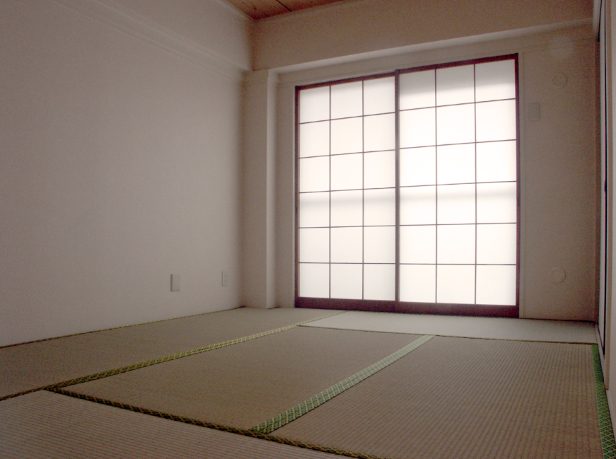
A Japanese real-estate listing in 2026 will tell you the floor area of an apartment in square metres and also in tatami mats. The tatami unit is the live measurement: a “four-and-a-half-mat room” is what the listing calls a 7.3-square-metre small bedroom, a “six-mat room” is the standard 9.7-square-metre reception, an “eight-mat room” is a large living area. Modern Tokyo real estate is priced in tatami. The listings for purely Western apartments with no actual tatami in them still use the tatami metric; it is the default way a Japanese reader processes room size. The mat is the unit.
This is unusual. Most industrial countries standardised on the square metre or square foot in the 20th century and forgot the older units. Japan kept its traditional floor-measurement system because the traditional floor system was already a module grid: the rice-straw mat that gave the unit its name was the physical object that actual carpenters cut actual rooms to fit. The floor determined the room; the room determined the house; the mat set everything above it. Every dimension of a traditional Japanese building is still, at its root, a multiple of one tatami edge.
In This Article
What a Tatami Mat Is
A traditional tatami mat is a three-layer sandwich: the straw core, the rush-grass facing, and the cloth border. Each of the three components has specific material requirements, dedicated production chains, and separate artisanal traditions. The finished mat is about 5 centimetres thick, weighs 25-30 kilograms (heavier than most people expect), and will last 40-60 years before the core needs replacing.
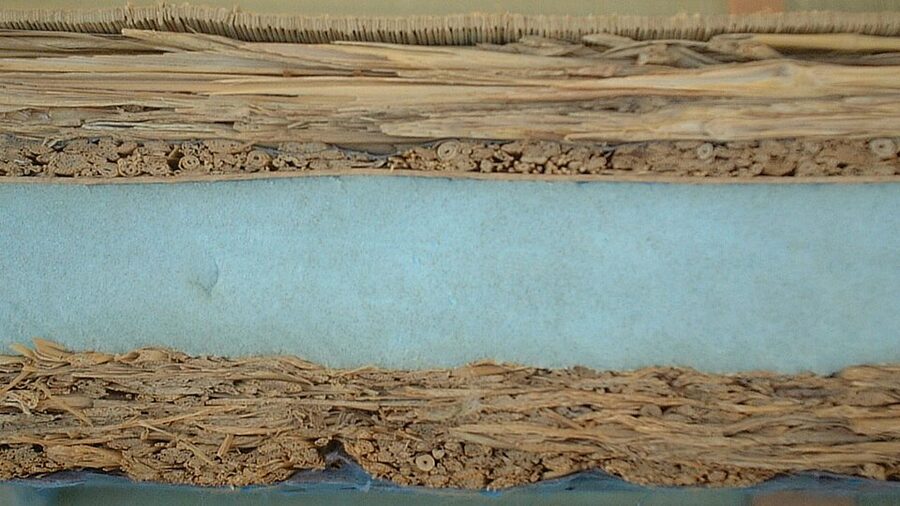
The straw core (toko, 畳床) is compressed rice straw, bundled and sewn into a dense mat about 5 cm thick. The compression ratio is specific: about 40 kilograms of raw straw compresses down to a 25-kilogram finished core, which is enough density to support a seated adult without deforming. The straw is usually from late-autumn rice harvests because the stems are dryer and denser. Traditional core-making is a specialty craft; the tokoshi (床咨) who make cores are a separate trade from the tatami-shi who assemble the finished mats. Core manufacture has been increasingly displaced by synthetic foam alternatives since the 1970s, but the artisanal end of the market still uses straw.
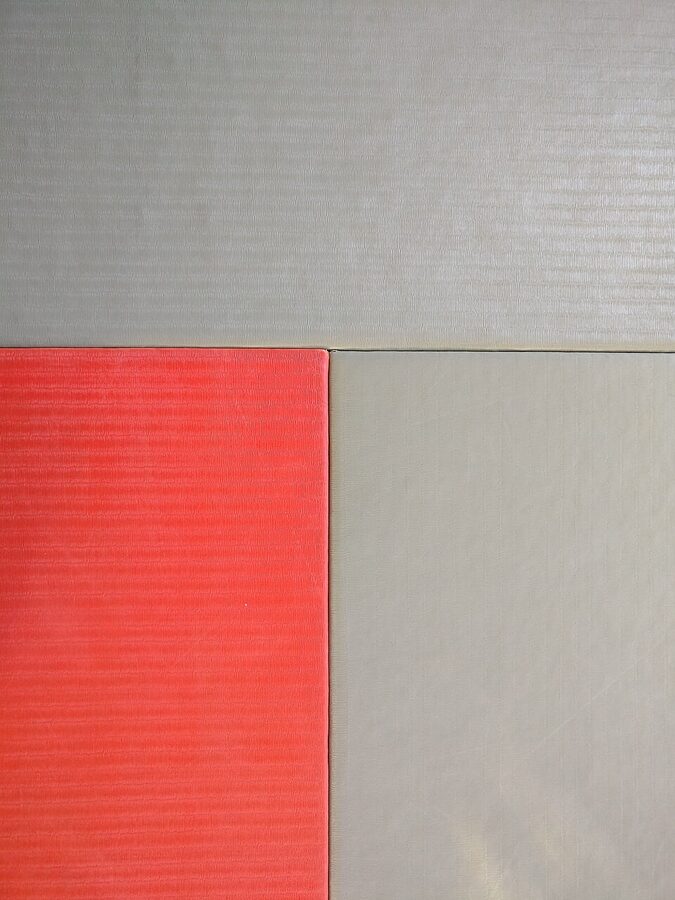
The rush facing (omote, 畳表) is woven from igusa (糤草, soft rush, Juncus effusus), a wetland grass grown in flooded paddy fields. Each mat requires about 4,000-6,000 individual rush stems, hand-sorted by length and diameter, then woven on a specialised loom over about four hours. The weave uses hemp or cotton thread as the structural binder. Finished omote are a characteristic pale-green colour that darkens over time to honey-gold. The igusa side of the mat is the one you sit on; the cloth-side is pinned to the straw core underneath.
The cloth border (heri, 緣) is a woven strip 3-6 centimetres wide sewn along the two long edges of the mat. The border protects the vulnerable cut-rush edges of the omote from fraying, and traditionally identifies the owner or the rank of the room: there are strict hierarchical rules about heri colour and pattern. Gold thread is reserved for imperial use; dark-blue and crimson for samurai and daimyo; simpler striped patterns for merchants; plain black or dark grey for commoners. The Edo-period shogunate issued multiple regulations on which household could use which heri pattern and enforced them through spot inspections. The regulations have lapsed in the modern period but the conventions still hold at temples and shrines.
Three Regional Sizes
There is no single standard tatami dimension. Three regional size conventions exist and have coexisted since at least the late 16th century:
Kyōma (京間, “Kyoto space”) or Honma, used in Kansai and Western Japan: 191 cm × 95.5 cm per mat. This is the oldest surviving standard; the dimensions derive from Heian-period aristocratic-court architecture and have been stable since about the 11th century. A Kyōma six-mat room is roughly 10.9 square metres.
Chukyōma (中京間, “central-Kyoto space”) or Ainoma, used in Nagoya and the Tōkai region: 182 cm × 91 cm per mat. Slightly smaller than Kyōma; the size apparently became standard around 1600 during the Tokugawa domain-distribution period as a compromise between the older western standard and the newer eastern one.
Edoma (江戸間, “Edo space”), used in Edo (Tokyo) and eastern Japan: 176 cm × 88 cm per mat. The smallest of the three traditional standards. The size reflects Edo-period urban density: shogunate-capital land was expensive and the Edo merchant class built on smaller plots than their Kansai counterparts; the tatami shrank to match. An Edoma six-mat room is about 9.3 square metres.
A fourth size, Danchima (団地間, “housing-complex space”), appeared in post-war mass-housing: 170 cm × 85 cm per mat. This is not a traditional size but is now the most common in modern apartment construction, especially rental units. A Danchima six-mat room is 8.7 square metres. If you are looking at an apartment listing that describes a “six-mat room” and the apartment was built after 1960, it is almost certainly Danchima-sized rather than one of the three traditional sizes.
This variation matters because the regional size determines everything else in the room. Fusuma and shōji doors are cut to tatami-edge dimensions; ranma are sized to fit between them; the ceiling-beam spacing follows the same module. A Kyoto merchant who moved to Edo in the 17th century and built a new house would find that none of his standard-size furniture fit. Modern pre-fab housing manufacturers have to offer separate regional specifications for the same-layout house sold in Osaka versus Tokyo. The fragmentation is genuinely inconvenient, and it has survived because the underlying cultural commitment to the tatami-module building system has survived.
The Heian Beginning and the Edo Universalisation
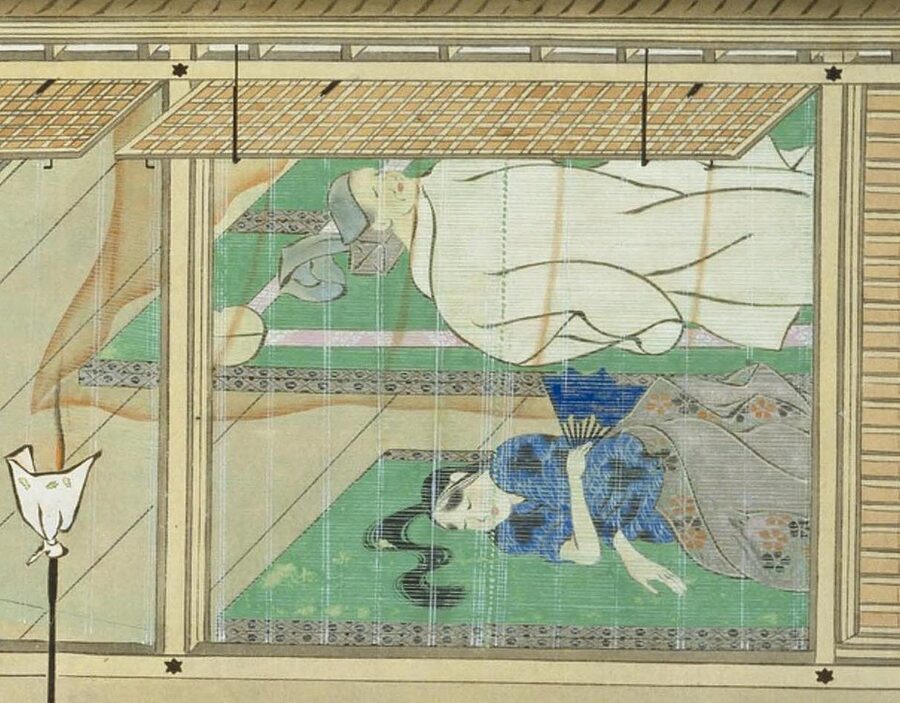
The earliest tatami in Japan were not floor mats but movable platforms. In Heian-period aristocratic houses (794-1185 CE), the main floors were plain wooden boards; aristocrats who wanted to sit or sleep comfortably brought out individual portable mats, placed them where they wanted them, and stored them when not in use. Tatami at this point was a luxury object, owned by only the top aristocratic households, varying wildly in size, and signifying status in its own right — the number of mats a particular lord could summon for a formal occasion was a direct measure of his wealth.
The Kamakura and Muromachi periods (1185-1573) saw two related shifts. First, tatami size standardised as workshops consolidated around the Kyoto court’s dimensional preferences (what would become the Kyōma standard). Second, tatami began to be laid across entire rooms in the new shōin-zukuri aristocratic and temple architecture of the 14th and 15th centuries. The transition from portable-platform to full-room-flooring was gradual; by 1500, upper-tier Zen temples and senior aristocratic residences typically had fully tatami-floored reception rooms, but the overall national penetration was still low.
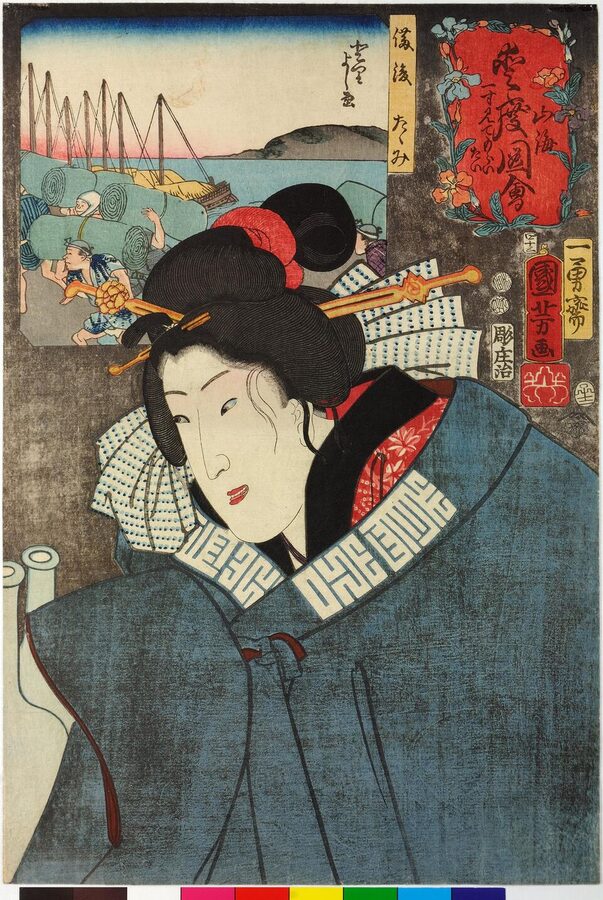
The Edo period (1603-1868) completed the universalisation. By 1800, essentially every house in Japan above the farmer-subsistence level had tatami floors in at least its main reception room, and the craft had industrialised into clearly differentiated regional production centres: Bingo (Hiroshima), Bitchū (Okayama), Omi (Shiga) were the biggest producers. The Edo-period guild structure had about 11,000 registered tatami-shi nationally by 1860. Production was concentrated in dedicated workshop districts; a mid-sized provincial castle town would typically have a tatami-chō district with twenty to fifty tatami workshops operating side-by-side.
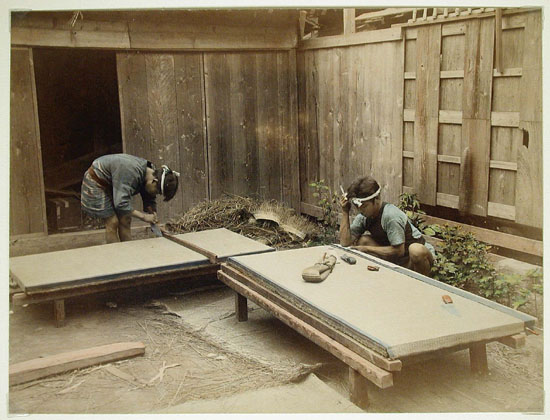
Yatsushiro Igusa
The current Japanese tatami industry is overwhelmingly concentrated in one agricultural region for its key raw material. Yatsushiro city in Kumamoto prefecture produces about 85% of all igusa rush grown in Japan today; the Kumamoto prefectural industry as a whole produces over 95%. The regional specialisation is the result of post-war agricultural consolidation: igusa is a finicky crop requiring specific soil chemistry, flooded-paddy cultivation, and September-November harvest-timing expertise, and the Kumamoto plain has all three plus a centuries-old tradition of growing the crop.
The Yatsushiro industry peaked in 1989 with roughly 6,000 active igusa farmers producing enough rush for 15 million mats per year. Since then it has declined sharply. Chinese igusa imports, grown at larger scale and cheaper cost in the Zhejiang province region, now account for about 75% of the raw material used in Japanese tatami manufacture. The Yatsushiro active farmer count as of 2024 is around 280, producing roughly 2 million mats’ worth of rush per year, almost entirely for the high-end artisanal domestic market. The industrial mass-market tatami in typical danchi apartments uses Chinese igusa or synthetic-fibre alternatives.
What has kept the Yatsushiro industry alive at its reduced size is the temple, shrine, and imperial-household tatami replacement market. Tatami in heritage buildings are replaced every 5-10 years on a rolling schedule; the imperial palace in Tokyo, the major shrines at Ise and Izumo, and the main Kyoto and Nara temples collectively replace several thousand mats per year. All of that work specifies domestic Yatsushiro igusa. The industry is small but the high-end segment is stable.
The Post-War Decline (and What Remains)
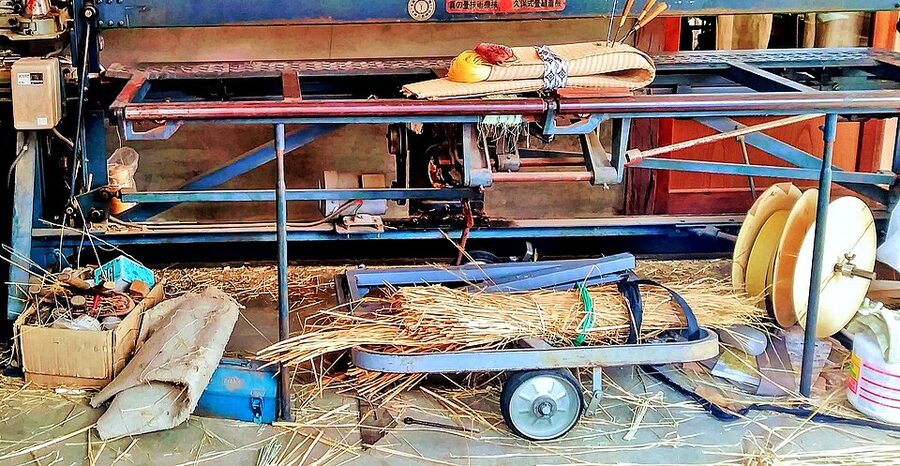
The post-1960 trajectory of the Japanese tatami industry is a case study in craft-decline mechanics. The key data points: in 1970 the industry produced about 15 million new and replacement mats per year, employed around 60,000 tatami-shi, and had significant export volumes to Hawaii and California. By 2020 the figures had fallen to roughly 2 million mats per year, 7,000 tatami-shi, and no significant export market. The underlying driver was the shift in residential architecture from traditional Japanese rooms with full tatami flooring to Western-style flooring in new construction.
The shift was not total. Most Japanese apartments built between 1965 and 1995 had at least one “Japanese room” (washitsu, 和室) with tatami flooring; the proportion dropped but did not disappear. Modern new-build apartments built since 2000 often have no tatami at all. The market has stabilised at a smaller size with the artisanal end disproportionately preserved because temple restoration and ryokan inn demand are sticky. There are currently about 15,000 ryokan and hotels with tatami rooms in Japan; together they form the single largest commercial source of tatami-replacement work in the country. The tourism rebound of the post-2022 period has meaningfully helped the industry.
What has not survived well is the regional workshop geography. In 1970, essentially every Japanese city of over 20,000 people had a tatami-chō workshop district; by 2020, most Japanese cities have zero resident tatami-shi, and mat replacement is handled by travelling craftsmen who arrive with a van, measure the room, take the old mats away to a regional workshop, and return the refurbished mats a week later. The hyper-local craft infrastructure has thinned out. The surviving regional workshops serve larger geographic areas by truck.
Where to visit tatami country today
Three kinds of sites: the Yatsushiro production region, a working-craft visitor facility, and any of several thousand ryokan-inn overnight stays.
1. Yatsushiro Igusa District — Kumamoto
The Yatsushiro plain is the only place in Japan where you can walk through commercial-scale igusa paddies. The cultivation area is concentrated in the Sengan-machi and Kagami-chō districts on the south side of Yatsushiro city. Visits are informal, the paddies are along public roads, but the best guided experience is at the Yatsushiro Traditional Crafts Centre (八代市伝統工芸センター), which offers weekly 90-minute tours of an active igusa paddy and workshop combination. Tour ¥1,200 per person, booking required one week ahead.
Access: Yatsushiro is 90 minutes from Kumamoto city on the Hisatsu Orange Railway. The traditional crafts centre is 15 minutes from Yatsushiro Station by bus. Best visited in July-August when the igusa is near full height (about 1.5 metres), or in late October at the harvest. Year-round the indoor facility has good educational exhibits.
2. Tatami Museum — Kyoto
The Kyoto Tatami Museum (京都たたみ議為館, Kyōto Tatami Shuyokan) is a small private museum in the Shimogyo district of Kyoto run by the Takenaka Tatami family, a fourteenth-generation tatami-shi workshop that has been in the same premises since the 1680s. The museum occupies part of their workshop; you can watch the craftsmen work and see historical examples of heri borders, omote weaves, and complete mats from the Edo period onward. Admission ¥500, open Tuesday-Saturday. The Takenaka also accept commissions for small souvenir mats (hand-sized, around ¥6,000) which you can take home.
Access: 15 minutes from Kyoto Station on foot south into the old merchant district.
3. A night at a ryokan — anywhere
The most direct way to understand tatami as living architecture is to sleep on it. Stay at a mid-tier traditional ryokan — not a capsule hotel, not a Western-bed business hotel — for at least two nights. The futon sleeping setup, laid out on tatami each evening by staff and taken away in the morning, is the architectural logic the tatami module was designed for. After two days you will notice how the room works differently with the futon in place versus with the futon stored: same room, two functions. The whole system is built around mats being the thing that absorbs activity variation. No other floor system does this.
Good mid-tier ryokan are available in every major Japanese tourist destination, with regional specialisation — Kyoto for formal traditional rooms, Takayama for Gasshō-zukuri mountain variants, Kagoshima for southern-style onsen ryokan with local-feeling tatami rooms. Prices start around ¥15,000 per person per night including breakfast and dinner, rising quickly at the premium end.
The Module
Tatami is the building block of traditional Japanese architecture in a way that has no close Western analogue. The closest comparison is the Roman-Greek column order, which similarly set the dimensional system above it, but columns are decorative and tatami is functional: you walk on tatami; you sleep on tatami; you eat on tatami; you entertain guests on tatami. The module-grid is the floor under your body at every moment of your traditional-architecture life. Everything else is scaled to it.
The post-war decline of the tatami industry has been real but partial. The module has survived even in houses that do not use it as physical flooring. Modern Japanese architects still work in tatami units when planning residential interiors; modern Japanese real estate still prices in tatami counts; the cultural mental-grid has outlived the material itself in any given specific apartment. The module is durable in a way the mat is not. If you want to see the mat, you need to go to the right kind of building. If you want to see the module, you just need to read any Japanese apartment listing.
Compared to kawara and ranma, tatami has had the roughest 20th century. Kawara kept the temple-restoration market; ranma kept the Inami workshop tradition; tatami lost most of its residential volume to Western flooring and has not recovered. What it did keep is the module, the idea of a tatami room measured in mats, which has proven more durable than the industry that produced the mats. If you are going to Kyoto anyway, sleep at a ryokan for two nights. If you are going to Kumamoto, take the Hisatsu Orange Railway down to Yatsushiro and walk the igusa paddies in July. Both experiences do the same teaching work in different directions. The mat is the object; the module is the idea; modern Japan still uses both. That is more than most 1,200-year-old craft traditions have managed to keep.


.jpg)