The thing that nobody tells you about Miyamoto Musashi is that he was a better painter than he was a swordsman. He was a remarkable swordsman. He killed sixty or so men in formal duels across his career and died in bed, which is not the ratio most of his contemporaries managed. But at twenty-nine he had already accomplished almost all of the killing he was going to do, and then he spent the remaining thirty-two years of his life teaching, reading, writing strategy, and producing the most spare and technically accomplished ink paintings of the early Edo period.
The English-language reception of Musashi, ever since the postwar translations of the Book of Five Rings, has fixed him as the sword-saint who cut down a hundred enemies. The Japanese reception, particularly after the 1950s scholarship of Watsuji Tetsurō and the Edo-literary historians, treats him instead as a man whose duelling career was a fifteen-year apprenticeship in a craft whose real form turned out to be something else entirely. This article is an attempt to write him the way the Japanese scholars do.
In This Article
- The Boy Who Killed the Priest
- Yoshioka and the Kyoto Years
- Ganryūjima
- The Sekigahara Problem
- Reigandō and the Book of Five Rings
- The Paintings
- Where to visit Miyamoto Musashi’s story today
- 1. Ganryūjima — Shimonoseki, Yamaguchi
- 2. Reigandō — Kumamoto
- 3. Musashi-jinja — Mimasaka, Okayama
- 4. Shimada Museum of Art — Kumamoto
- The Two Swords
The Boy Who Killed the Priest
Musashi was born in 1584, in either Harima or Mimasaka province — the two local archives fight about this, both claim him, and the truth is probably a village on the border between them. His birth name was Shinmen Bennosuke (新免弧之助). His father was Shinmen Munisai, a swordsman of middling provincial reputation who had served the Shinmen clan of Mimasaka, and he trained his son from about the age of seven in the family jitte style — a hooked truncheon used to disarm sword-bearing opponents, usually by the village constable, and not considered prestigious enough for first-son careers. Musashi was the second son. He was not being set up for anything in particular.
At thirteen, according to his own later testimony in the Book of Five Rings, he killed a man in a formal duel. The man he killed was a touring jitte-master-turned-monk named Arima Kihei (有馬喜兵衛), who had posted a public challenge in Musashi’s home village. The actual fight lasted a few seconds; Musashi wrestled Kihei to the ground with a six-foot wooden staff and bludgeoned him to death. The account is flat. The reader is meant to understand that the boy who did this had been surprised by how easy it was.
He left home at about fifteen. For the next fifteen years he was a mushā-shugyō (武者修行) — a wandering swordsman pilgrim, a role that was already semi-formalised in late-Sengoku Japan. You travelled alone, you carried what you could, you challenged the chief instructor at every school you passed, and you fought in empty fields or temple precincts until one of you surrendered or one of you was dead. Musashi did this about sixty times. Nobody kept a formal score; he said sixty in the Gorin no Sho forty years after the fact. In the same book he admits that after his late twenties he never lost a duel, which implies strongly that there are some earlier losses he simply did not write about.
Yoshioka and the Kyoto Years
The Kyoto duels of 1604 are the ones that mattered. Musashi was twenty. He walked into Kyoto that spring and challenged the hereditary sword masters of the Yoshioka (吉岡) family, who ran one of the two largest sword schools in the capital and whose head had been the official fencing instructor to the Ashikaga shogunate for a century. The Yoshioka were not gutter-level swordsmen. They were the incumbent aristocracy of the trade.
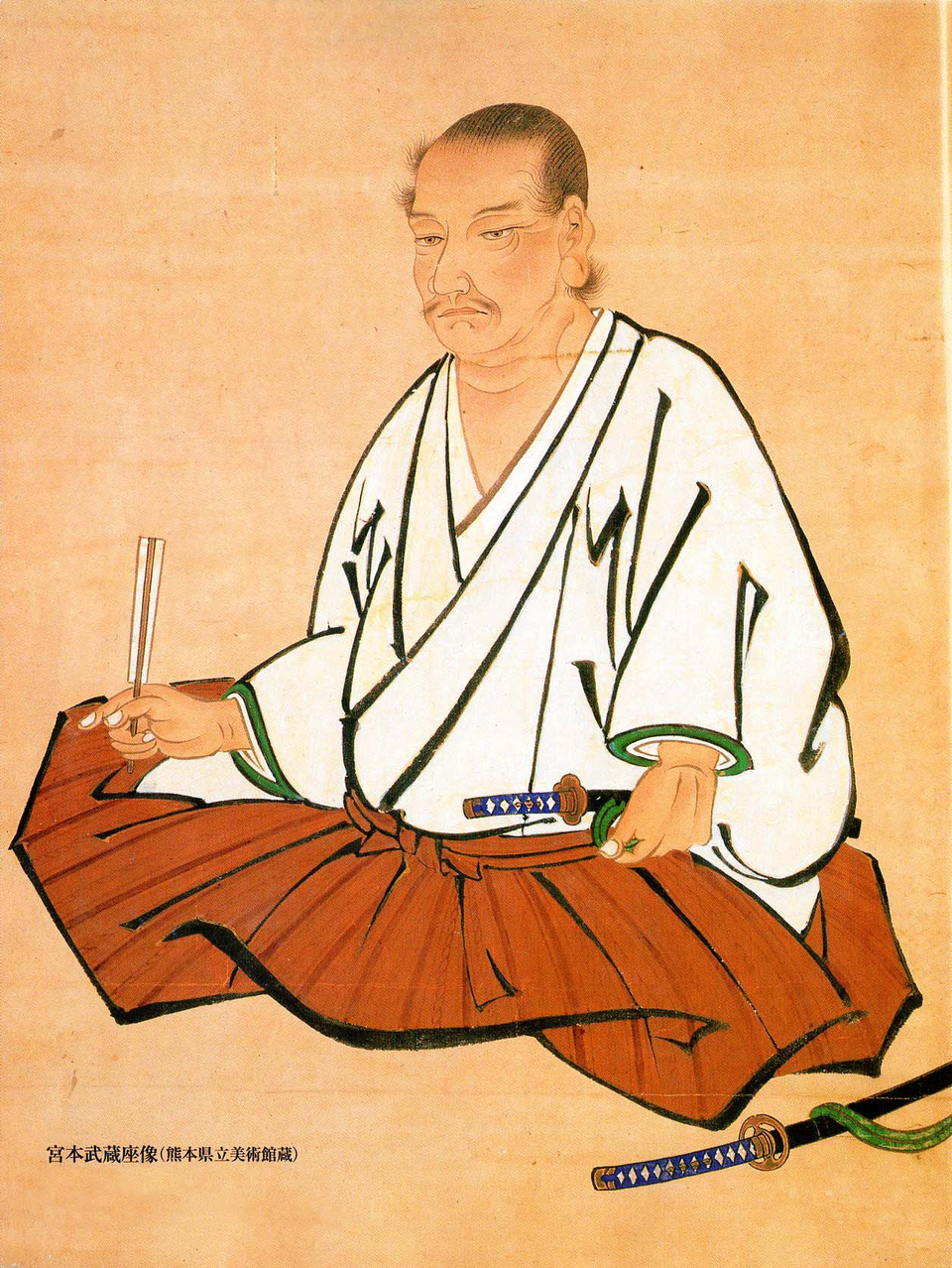
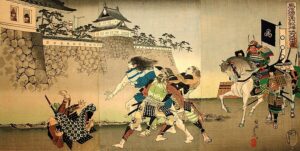
Musashi fought three duels against the Yoshioka across the spring of 1604. The first was against the head, Yoshioka Seijirō, at Rendai-ji outside the northern gate of Kyoto. Musashi arrived three hours late deliberately, which enraged Seijirō and threw his timing off; Musashi then killed him with a wooden sword to the skull in the first exchange. The second duel, against Seijirō’s younger brother Yoshioka Denshichirō, played out the same way: Musashi late, opponent rushed, opponent dead. The third was against the entire remaining Yoshioka school, who understood by that point that a formal duel against Musashi was not going to end well and had assembled a force of about seventy retainers at a pine grove outside the city to ambush him en masse.
Musashi turned up hours early, hid behind a tree, killed the twelve-year-old Yoshioka heir Matashichirō who had been set up as the figurehead of the ambush, and then fought his way out through the retainers with two swords — this is the moment the two-sword style is supposed to have been born. He was out of the pine grove and across the Kamo River within an hour. The Yoshioka school never recovered. Kyoto swordsmanship as an institutional hierarchy stopped dating itself from the founder and started dating itself from the day Musashi came into town.
You should understand what this did to the sociology of the craft. Until 1604, a sword school was an institution — a teaching lineage, a set of properties in Kyoto, a client list of samurai houses who paid retainers to attend. After 1604, a sword school was at best a temporary consensus, defensible only as long as nobody nastier turned up at the gate. Everyone who watched the Yoshioka go down understood the new rule.
Ganryūjima
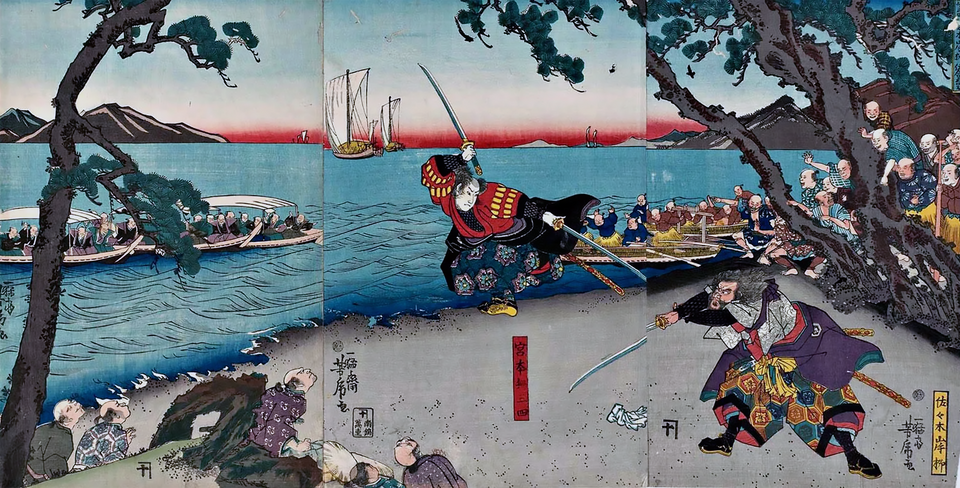
Eight years after Kyoto, on 13 April 1612, Musashi fought the duel that would be more famous than all the others combined. The opponent was Sasaki Kojirō (佐々木小次郎), a swordsman who had invented his own long-sword style called Ganyū-ryū using a blade so long (over three feet) that it required a two-handed overhead draw. Kojirō was younger than Musashi, better-born, better-paid, and had a perfect duelling record of his own. He had been hired by the Hosokawa clan as their official fencing master.
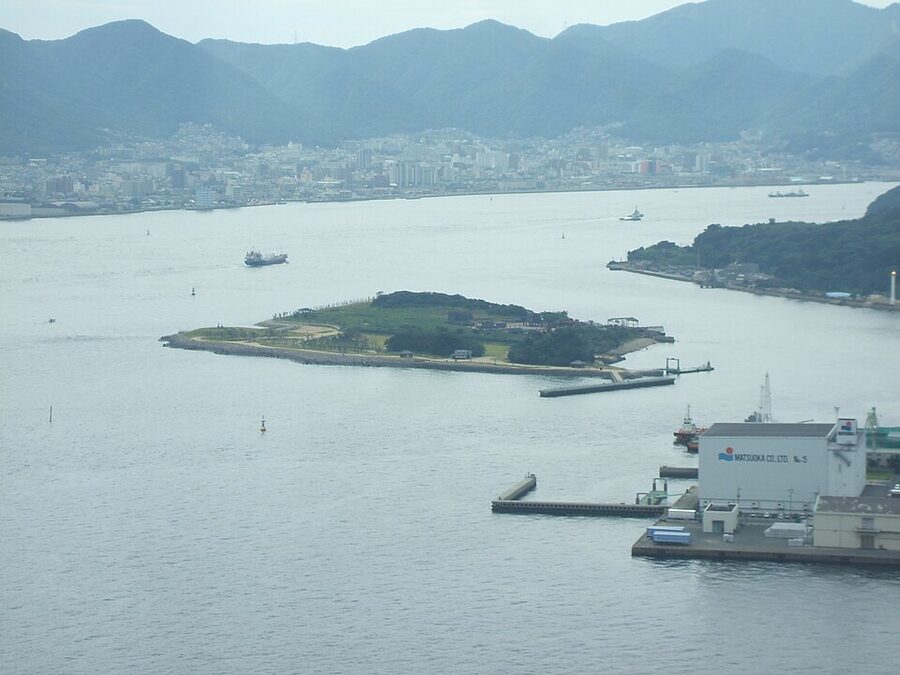
The duel was arranged on a small uninhabited island in the Kanmon Straits, between Honshū and Kyūshū, in what is now the Shimonoseki ferry channel. The island was technically called Funa-jima (舟島) at the time. It is called Ganryūjima (巻流島) now because Ganryū was Kojirō’s art name, and the island took the loser’s name after the loser lost. Musashi won. This is also why it is called Ganryūjima, not Nitenjima.
The details of the fight, as recorded in the Hosokawa retainer chronicles, are psychologically interesting. Musashi turned up several hours late, just as he had at Kyoto. He came rowing across the strait from Kokura in a fishing boat, and between leaving shore and arriving at the island he carved himself a wooden sword from one of the boat’s oars — the sword was longer than Kojirō’s long sword, which was the whole point. He walked up the beach eating rice balls. Kojirō, who had been drilling his two-handed overhead draw on the sand for three hours, was already angry. The fight lasted less than a minute. Musashi feinted inside Kojirō’s overhead draw and broke his skull with a single horizontal strike from the wooden oar. Kojirō died on the sand.
Two details about Ganryūjima that the popular story tends to skip. First: the Hosokawa chronicles record that Musashi’s sword hand was bleeding badly by the end of the minute, and that Kojirō’s sword had cut his headband and his forehead right down to the skin, missing his eyes by about a centimetre. Musashi won, but the duel was close. Second: the duel was the last formal duel Musashi ever fought. He was twenty-eight years old. He had taught himself to walk off a battlefield having just killed a man he respected, and he seems to have noticed something about himself in that moment that he could not articulate for another thirty years.
The Sekigahara Problem
Here is the part of the Musashi story that rarely gets told. In 1600 — four years before the Kyoto duels, twelve years before Ganryūjima — Musashi fought at the Battle of Sekigahara. He was sixteen. He fought on the Toyotomi loyalist side, the side that lost. He was ordered to kill himself in the rout and declined. He walked home to Mimasaka and did not fight in a pitched battle again for fifteen years.
In 1614 and 1615, when Tokugawa Ieyasu closed the account on the Toyotomi clan by besieging Osaka Castle, Musashi fought in the Osaka campaign. The domain chronicles are ambiguous on which side. The pro-Musashi Shinmen-clan records say he fought for the Tokugawa; the more neutral Kuroda-han records suggest he may have fought for the Toyotomi again and switched sides during the siege; the Gorin no Sho, written thirty years later, is conspicuously silent on the whole thing. Whichever account you believe, he came out the other side of Osaka alive and with no patron, which is the significant data point.
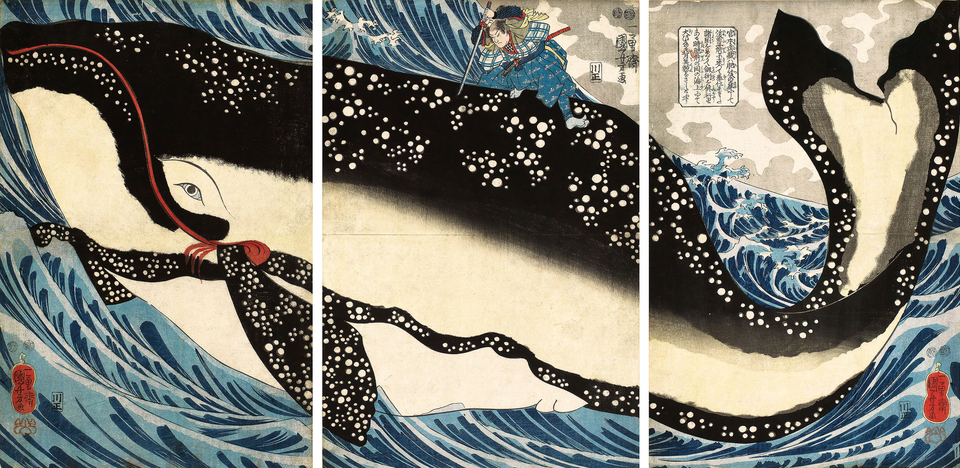
Sekigahara matters because it explains the rest of his life. Most post-Sekigahara Toyotomi loyalists were absorbed into the Tokugawa domain structure within ten years; they were given small fiefs as a consolation for the defeat, and they lived out their careers as retainers of the new order. Musashi refused this path. He was offered positions, repeatedly — the Hosokawa clan offered him a generous one after Ganryūjima — and he turned them down until he was past fifty. The refusal pattern was consistent: he wanted to work but did not want to kneel. It took the shogunate thirty years to build the administrative structure that allowed a man with his specific skill set to work without kneeling. When it finally did, he accepted the first offer.
Reigandō and the Book of Five Rings
In 1640, aged fifty-six, Musashi accepted a post with the Hosokawa clan at Kumamoto. The post was unusual. He was given a stipend, a house, and the title hyōhō shihan (兵法師範), master of strategy, with no formal teaching load and no requirement to train retainers. What the Hosokawa wanted was his presence in the castle and occasional informal lectures on strategy to the lord himself. He had, for the first time in his adult life, an income.
In October 1643, at fifty-nine, he asked permission to withdraw from castle duties to a cave in the mountains above Kumamoto, named Reigandō (霊巫洞, “Spirit Rock Cave”), a natural cavity in the limestone cliff above the valley of the Iwato River. The permission was granted. He lived in the cave for eighteen months, fed and supplied by the temple at Unganzen-ji, and in that time wrote the Gorin no Sho (五輪書) — the Book of Five Rings.
The book is short. Sixty-odd pages in any modern edition. It is divided into five chapters named for the elements — Earth, Water, Fire, Wind, Void — and on its surface it is a manual for the two-sword style of swordsmanship. It is not, actually, a manual for swordsmanship. It is a manual for strategic thought, written in the language of swordsmanship, because swordsmanship was the only language the author had fluent access to. The translation by Victor Harris from 1974 is serviceable; the Kenji Tokitsu translation from 2000 is better; the original is better than both.
The key paragraph, in the Void chapter, reads roughly: “In things where there is no Way, seek the Way. Look at the truth of the matter. Take the true Way as the foundation, and cultivate its essence. When the essence is in place, withdraw from it, and it will remain, and it will remain in action.” This is not a sentence about fencing. It is a sentence about how to learn anything. Corporate middle managers have been reading Musashi for forty years because of this paragraph and the six or seven others like it.
Musashi finished the book in May 1645. Seven days after finishing it he died in his house outside the cave, of what the Hosokawa surgeon’s log describes as “a growth in the chest” — probably lung cancer, although thoracic aneurysm is also consistent with the reported final symptoms. He was sixty-one. He had been teaching for five years, writing for one, and fighting for nobody at all.
The Paintings
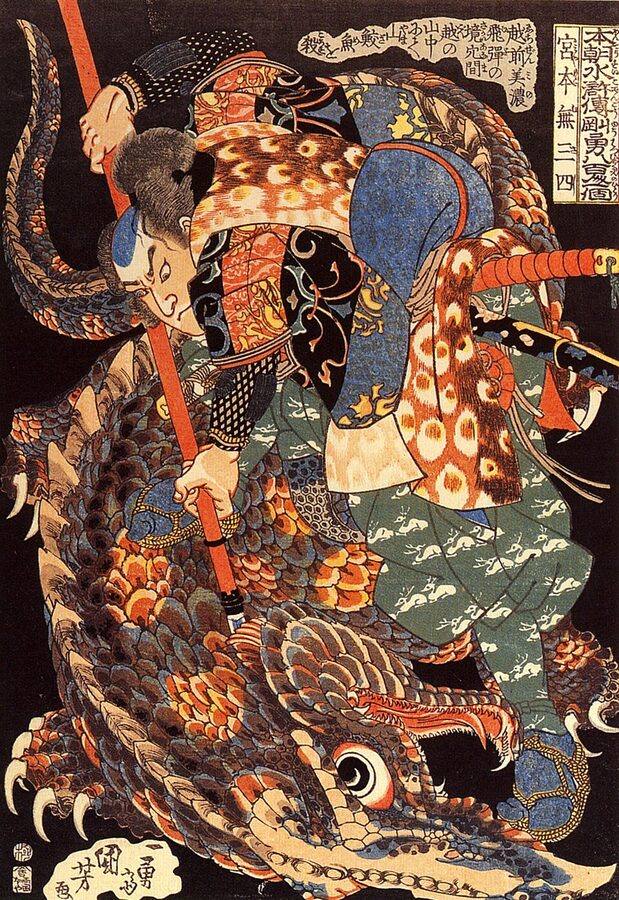
You will not see his paintings on the Ganryūjima ferry-stop signs or in the NHK dramatisations. This is a problem of popular attention span, not of the paintings. Musashi produced ink work for the last twenty-five years of his life, most of it on small scrolls; his surviving body of work is about forty confirmed pieces and twenty more probably-his. The best of them are the Daruma paintings, ink-sketch Zen-patriarch portraits, which hold their own against Hakuin (active a hundred years later) and beside Sesshū (active a hundred and fifty years earlier) read as mannered rather than innocent.
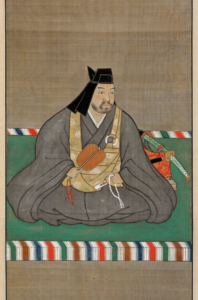
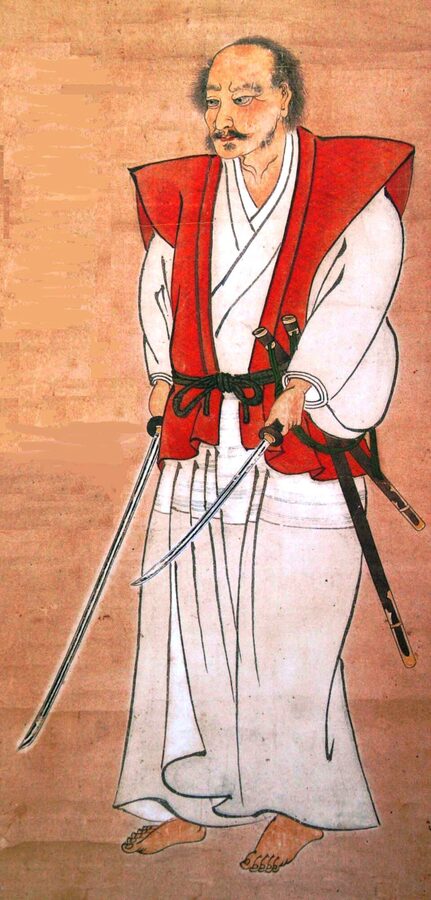
Go and see them in person if you can. The Shimada Museum in Kumamoto holds the best single collection. The self-portrait at the top of this article is one of theirs. Reproduction on a screen flattens the line in the paintings badly; the physical paper shows you wet brush and dry brush, slow line and fast line, pauses and recoveries, in a way digital reproduction has not yet matched.
If you read Japanese cultural history of the 17th century with any seriousness, you eventually realise that Musashi’s paintings and Musashi’s swordsmanship are the same activity viewed at different scales. The duelling career was the apprenticeship. The ink work was the mature practice. Nobody teaches it that way in the English-language reception because the swordsmanship pays better, but it is the correct reading of the life.
Where to visit Miyamoto Musashi’s story today
Four places, across three prefectures. You could do all of them in a long week if you timed the trains right; for most visitors Ganryūjima and Reigandō are the priority.
1. Ganryūjima — Shimonoseki, Yamaguchi
Ganryūjima (technically Funa-jima on some old maps) is a small uninhabited island in the Kanmon Straits between Honshū and Kyūshū. The ferry runs from Karato Port in Shimonoseki, roughly ten minutes each way, about every thirty minutes between 08:00 and 17:00. The last return ferry leaves the island at 17:20 and will not wait for you. The fare is around ¥900 round trip. There is no food or toilet on the island; bring water.
On the island itself there is a bronze statue group of Musashi and Kojirō at the moment of the strike, a small stele with the Gorin no Sho Void passage carved into it, and the beach, which is one of the few places in Japan where the physical geography of a famous event has not been built over. The strait is still the strait. The sand is still the sand. Allow forty minutes on the island if you are just looking; three hours if you are willing to walk its perimeter path and sit on the beach for a while.
Best visit: early morning first ferry, before the Shimonoseki tour-bus traffic arrives. Pair with Shimonoseki-shi’s famous fugu puffer-fish lunch back at Karato Market (which is literally at the ferry terminal), although nothing about Musashi’s life requires you to eat fugu.
2. Reigandō — Kumamoto
Reigandō is the cave where Musashi wrote the Book of Five Rings. It is in the mountains above Kumamoto city, at Unganzen-ji (雲峚禽寺) temple in the Iwato district. Access is by bus from Kumamoto Station — the Saiken bus line to Iwato-Kannon-mae, about forty minutes; the cave is a twenty-minute walk from the bus stop up a mountain path past a row of stone Rakan Buddha carvings that are themselves worth the trip.
The cave itself is small. A rectangular mouth about three metres across, a floor worn smooth by four centuries of respectful visitors, a stone Buddha at the back placed there by the temple after Musashi’s death. Stand inside it and try to imagine writing a book here. Musashi did not do it alone; he had an attendant who brought food from the temple once a day, and he came down to the temple every few days to sleep and bathe. But the text was written here. Fifty-nine-year-old hand on the paper, cave floor stone, the mountain behind him, the winter of 1643-44 coming down through the pines outside. It is not a large cave. The book is not a large book. The correspondence is one of the more exact between place and work that Japanese cultural history records.
Entrance to the temple and the cave is ¥200 for adults. The temple’s own stone-Rakan garden — carved by the monk Keikōkei in the 1780s — is on the way up and is technically a separate UNESCO-prospective site. Allow ninety minutes for the walk and cave together.
3. Musashi-jinja — Mimasaka, Okayama
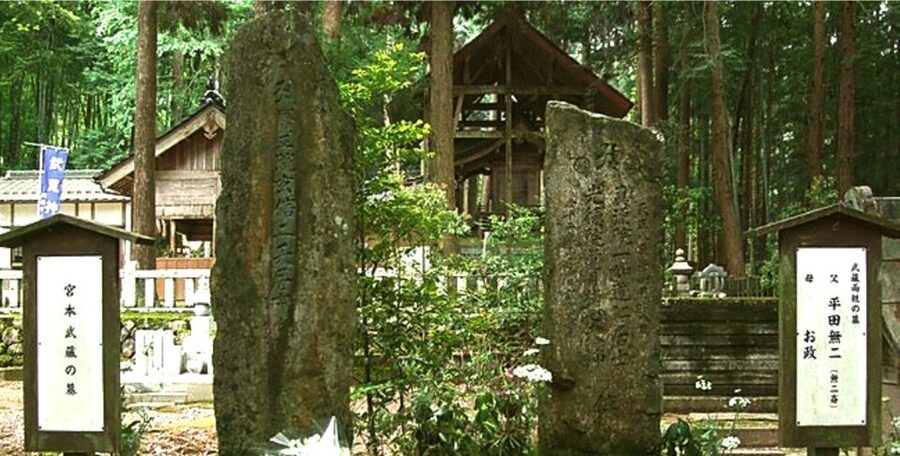
Musashi’s formal grave is in Ōhara, in Mimasaka city, Okayama prefecture. The shrine complex is called Musashi-jinja (武蔵神社) and sits on what is almost certainly his birthplace. The local authorities in Mimasaka take this seriously — there is a Musashi-Budokan museum and martial-arts dojo on the same site, an annual kendo festival in May, and a set of walking paths that take you past the stream where Musashi supposedly first trained. If you want to walk the physical geography of his early life, this is the place.
Getting there: take the Chizu Express from Himeji or Kyoto, get off at Miyamoto-Musashi station (the only major train station in Japan named after a specific historical person), and walk ten minutes. Allow three hours for the shrine, museum, and walking paths. If you arrive during the May kendo festival the whole village is worth an afternoon by itself.
4. Shimada Museum of Art — Kumamoto
The Shimada Museum of Art in Kumamoto holds the single best collection of Musashi’s paintings, including the self-portrait at the top of this article. The museum is private, purpose-built for the collection by the Shimada family in 1979, and houses six confirmed Musashi ink works plus a number of attributed ones. The self-portrait is always on display; the other paintings rotate on a seasonal schedule.
The museum is a ten-minute walk from Kumamoto Castle. Admission is ¥700. If you are visiting Reigandō on the same day, do the Shimada in the morning and the cave in the afternoon; the paintings will tell you what the book and the duels were always pointing towards, and the cave will tell you what conditions they needed to be produced in.
The Two Swords
The standard English-language summary of Musashi reduces him to the duellist. Sixty fights, undefeated, two-sword style, killed the kind of man Sengoku Japan produced regularly and Edo Japan was trying very hard to stop producing. That summary is not wrong. It is incomplete in the same way “Sassa Narimasa was a warlord” is incomplete.
The fuller summary is that Musashi was a man who spent his first thirty years becoming good at one specific physical activity, then spent his next thirty years figuring out what the activity had actually been teaching him. The duels and the paintings and the Book of Five Rings are not separate careers. They are the same career at different tempos. He is interesting because most people do not get this far, and most people who do do not write any of it down.
If you are going to Ganryūjima anyway, take the morning ferry, and on the way across the strait read the Void chapter. Then walk up the beach where he came ashore, stand on the sand where the fight happened, and try to imagine a sixty-year-old man somewhere above Kumamoto thirty years later, sitting cross-legged in a cave, trying to write down what he had learned from killing a better-dressed opponent with a wooden oar. That is the full picture. The beach is small. The book is short. The self-portrait is in the museum. Go.