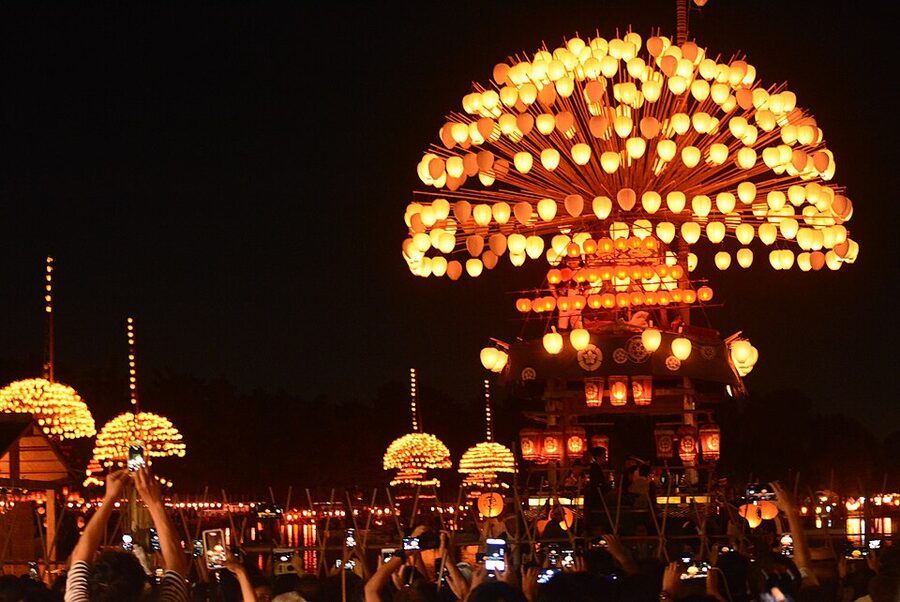
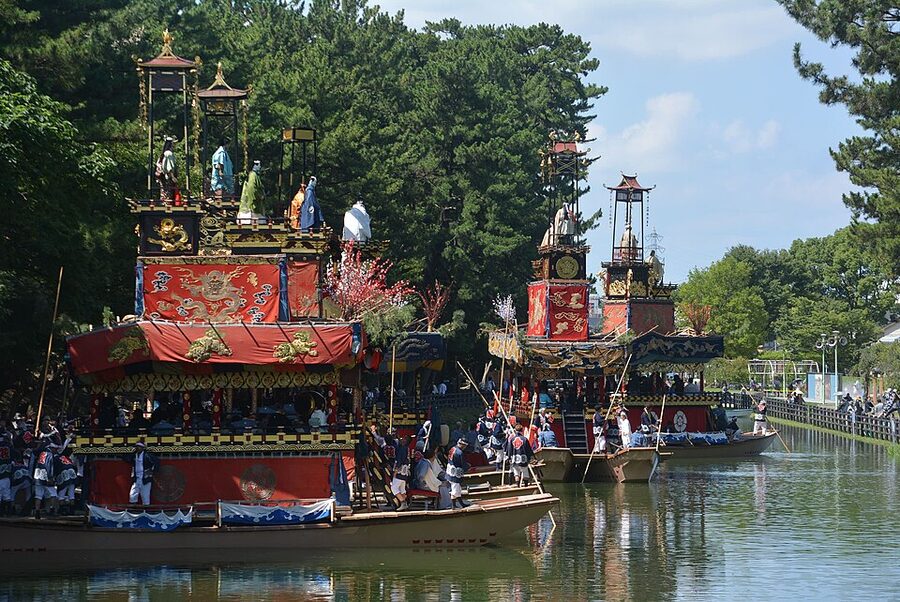
On the fourth Saturday of July, after dark, in a small Aichi city that most foreign tourists have never heard of, six wooden boats put out onto a still pond carrying more than 500 paper lanterns each. They move slowly, rowed by men in loincloths, to the notes of a one-note bamboo flute called the Tsushima-fue that has been played the same way since the 15th century. The lanterns — red at the top, white lower down, stacked in a domed tower that rises nine or ten feet above the deck — reflect off the water in shifting columns of light. The crowd on the banks stands in almost complete silence. Local families bring folding stools and tea. This is the Yoimatsuri, the evening ceremony, of the Owari Tsushima Tennō Matsuri, and it is the same ceremony, more or less exactly, that Oda Nobunaga used to ride over from his family castle at Shōbata to watch. 450 years later, on almost the same night, the same boats still come out.
The Tsushima Tennō Matsuri — officially the Owari Tsushima Tennō Matsuri, since it belongs to the old Owari province and not the separate Tsushima Island off Kyushu — is one of the three Great River Festivals of Japan, alongside Osaka’s Tenmangū Tenjin Matsuri and Itsukushima Shrine’s Kangensai. In December 2016 UNESCO added it to the Intangible Cultural Heritage register as part of the combined “yama, hoko, yatai” festival category covering 33 Japanese float-and-procession festivals. If you’re trying to build a shortlist of Japanese summer festivals that are genuinely worth travelling for, the ones that locals defend against tourism and that the Cultural Affairs Agency has spent decades protecting, this one sits in the top five, maybe the top three. It gets less coverage in English than the more famous urban festivals, but that is largely because it happens in a small city on the western edge of Aichi that nobody visits for anything else. It is absolutely worth the detour.
In This Article
- What the festival actually is — and when, and where
- Three stories about how it started
- Saturday night — the makiwarabune and the tower of lanterns
- Sunday morning — the Noh dolls and the ten young men
- The UNESCO classification and why it matters
- Where to see it — planning a visit
- Tennō-gawa Park, Tsushima — the festival venue itself
- Tsushima-jinja Shrine — the anchor
- Ichie-sha origin site, Aisai — where Susanoo landed
- Shōbata Castle site — the Oda family’s base
- Getting to Tsushima
- Closing — lantern after lantern, century after century
What the festival actually is — and when, and where
The festival is the summer festival of Tsushima Shrine (Tsushima-jinja or Tsushima-san), a major Shinto shrine in the west of modern Aichi Prefecture with formal ties to Susano-no-mikoto, the storm god brother of Amaterasu. The shrine is located in Tsushima City, a small city of about 60,000 people sitting on the flood plain of the old Tennō River. The festival runs for several months of preparatory rituals, shrine offerings, and ceremonial precedents — the public climax is a single weekend at the end of July. The Saturday night is the Yoimatsuri (“evening festival”), featuring the 500-lantern makiwarabune boats rowed across the pond. The following Sunday morning is the Asamatsuri (“morning festival”), featuring six daytime sharakubune float boats carrying life-size dolls in Noh costume, accompanied by musicians, rowed in ceremonial formation to the shrine precinct. The two nights are complementary, and most locals who come to one also come to the other.
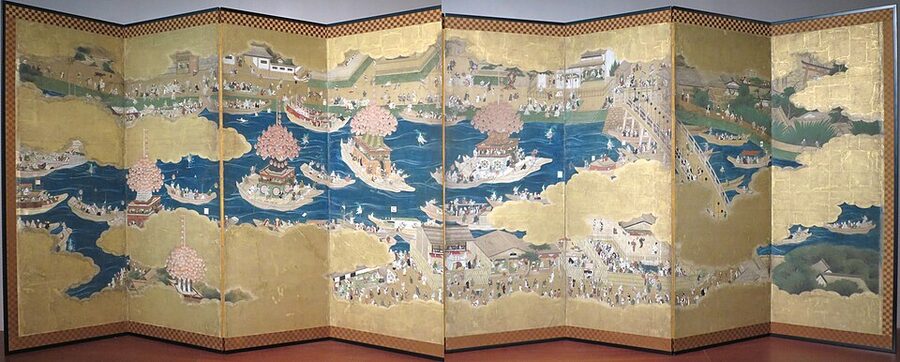
The modern venue is the Maruike pond in Tennō-gawa Park — a 17-hectare park built around the former course of the Tennō River. This is where things get complicated. The original festival was held on the Tennō River itself, a tributary of the Kiso that flowed past the shrine from the 15th century until 1785, when Tenmei-era flood control works diverted the river and dammed the old channel. The pond that remained from the damming is what the festival now uses. Before 1785, the boats put out from a long wooden bridge called the Tennō-bashi that crossed the river on the approach path to the shrine. That bridge is the one Oda Nobunaga is said to have watched from — he was based at Shōbata Castle, a few kilometres north of Tsushima, and the Tsushima festival would have been on his regular summer calendar. The bridge is long gone; the river is long gone; the festival continues essentially unchanged on the pond that replaced them. That is how the ceremony has survived — by letting the surroundings change while the ritual itself stays stubbornly static.
Three stories about how it started
Like most pre-documented Japanese festivals, the Tsushima Tennō Matsuri has several competing origin myths and no single canonical version. The ja.wiki entry lists three, all of which locals will cheerfully tell you if you ask, usually with the caveat that they are not sure which is correct. The first is the Nanboku-chō legend: during the dynastic split between Northern and Southern imperial courts in the late 14th century, a Southern court prince named Ryōō Shinnō fled to Tsushima and was sheltered by four samurai families — the Yonka Shichi-myōji, the “four houses, seven names” — who were local notables loyal to the Southern cause. A Northern court loyalist named Dajiri Ōsumi-no-kami from the neighbouring Saya village invited these samurai out for a boat excursion, killed them on the water, and returned the prince to Northern custody. The festival commemorates the dead samurai, the boats recreate the fatal boating party, and the annual ceremony prevents the spirits of the betrayed from rising as onryō. This is the legend locals quote most often.
The second origin story is the Susanoo arrival myth. In this version, the storm god Susanoo-no-mikoto arrived from the western sea at Ichie-jima, an island in what is now Higashibo-chō in neighbouring Aisai City, and came ashore to find local children playing while cutting grass in the fields. He composed a short piece of flute music for their dance, the Tsushima-fue, which is the same flute tune still played on the boats tonight. Some time later a plague struck the region; the villagers began holding annual festivals with boats and the flute to placate Susanoo and thereby halt the plague. This is the version that explains why the Asamatsuri’s lead boat, called the Ichie-sha, still comes from Higashibo-chō rather than Tsushima proper — the Ichie people are descendants of the original Susanoo-welcoming community, and they carry the ceremonial responsibility forward. The third version derives the whole complex from the Shinsen’en imperial garden ceremonies in Kyoto, propagated out to provincial shrines in the Heian period — this is the scholar’s explanation, less colourful than the first two but plausibly the historical root.
The documentary record begins to pick up during the 15th and 16th centuries. By the late Muromachi period, multiple regional chronicles reference the Tsushima festival as an established ceremony, which places its codified form in roughly the same era as the Kyoto Gion Matsuri’s consolidation. The boats, the lanterns, the flute, the Noh-costumed dolls — most of these elements are attested in the 1500s. By the end of the Sengoku period, the festival had become prominent enough that the Oda family, based at Shōbata Castle just north of Tsushima, treated it as part of their annual calendar of religious patronage. This is Oda Nobunaga’s family — the main Oda Danjō-no-jō line, before Nobunaga’s generation moved the base east to Kiyosu — and Nobunaga himself is documented in several local chronicles as having watched the festival from the old Tennō-bashi bridge. The detail is characteristic: Nobunaga destroyed and rebuilt enough of the rest of the country, but this festival he left alone.
Saturday night — the makiwarabune and the tower of lanterns
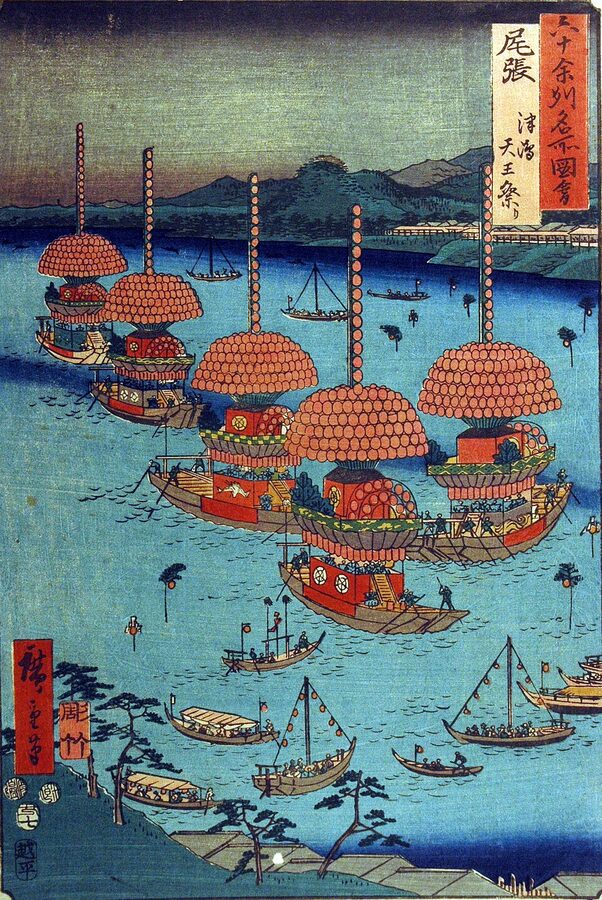
The Yoimatsuri begins at around 7:30 pm on the fourth Saturday of July. Before it starts, the boats — there are five of them, each representing one of the old Tsushima districts — are rigged during the afternoon. A makiwarabune is a flat-bottomed river boat roughly 10 metres long, to which the festival crews attach a tall bamboo framework that tapers upward into a pointed dome shape. The framework is covered with paper lanterns. Each boat carries 365 lanterns on the main dome (one per day of the year), 12 on the secondary tier (one per month), and another 150 or so on the outer frame, for a total somewhere north of 500 per boat. The lanterns are lit from bottom to top in sequence as the boat pushes off from the bank, which means the full tower of light emerges gradually rather than all at once. For a good ten minutes, each boat is partially lit and partially dark, the lanterns climbing in waves up the framework until the whole tower is aflame — and then, at that moment, the boat moves out into the centre of the pond.
On the water, the five boats form a slow procession across the pond. A single musician on each boat plays the Tsushima-fue, the one-note bamboo flute whose melody is attributed to Susanoo in the origin myth. The rowers, traditionally young men from the district that owns the boat, wear loincloths and headbands in the district colours. The boats travel at walking pace, close enough to the banks that you can see the rowers’ faces in the lantern light, and the crossing takes about 45 minutes from the first boat pushing off to the last boat mooring at the far end. During this entire time, the crowd stays quiet. The absence of commercial announcements, amplified music, or the usual Japanese festival PA-system ambient is the thing that most distinguishes this festival from a big urban one — you can hear the water against the boats and the single bamboo flute carrying across the pond, and almost nothing else. It is closer to a Noh performance than to a modern festival.
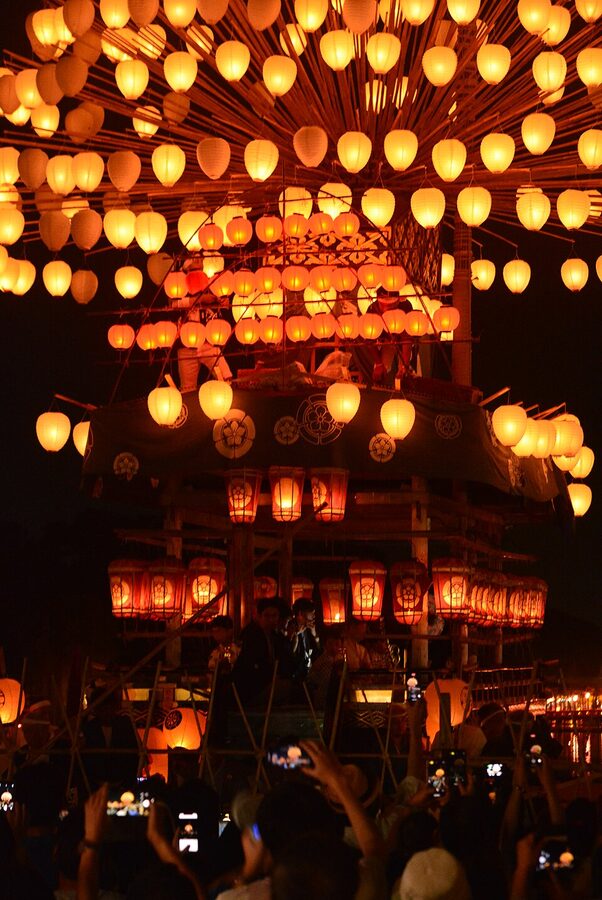
What the lanterns symbolise, if you ask the shrine priests, varies by boat. The oldest explanation ties them to tamashii — the placation of the spirits that the festival originally commemorated. The 365 lanterns on the central dome represent the year of days that the living owe to the dead; the 12 on the tier below represent the months of the ceremony’s recurrence; the outer frame represents the boundary between the human and the divine. Later generations of priests have added more elaborate readings, but the core symbolism remains the simple one: fire on the water, at the edge of summer, to keep the unquiet dead from crossing back. It is not explicitly an obon ceremony, obon is a separate event on the Buddhist calendar, but it occupies a similar psychological space in local life. This is the month when the dead are closer than usual. The lanterns are how you acknowledge them.
Sunday morning — the Noh dolls and the ten young men
The Asamatsuri the following morning is a very different ceremony, and in some ways a more striking one. It begins at about 9 am. The five Tsushima district boats from the previous night are re-rigged, the lantern frames removed and replaced with elaborate stages, and joined by a sixth boat — the Ichie-sha, belonging to Higashibo-chō in Aisai City across the river. Each of the six boats now carries a life-size doll on its central stage. The dolls are characters from specific Noh plays, in full Noh costume, positioned as if performing — Takasago from the play of the same name, Kinuta, Tamura, Ataka, and others from the standard Noh repertoire. The dolls face the shrine. The boats process across the pond in formation, Ichie-sha in the lead. On board, the actual musicians play not the single Tsushima-fue but the full Noh-style hayashi — drums, flutes, and the clipped signal-shouts of classical Japanese percussion — giving the morning procession a completely different sonic character from the previous night’s meditative silence.
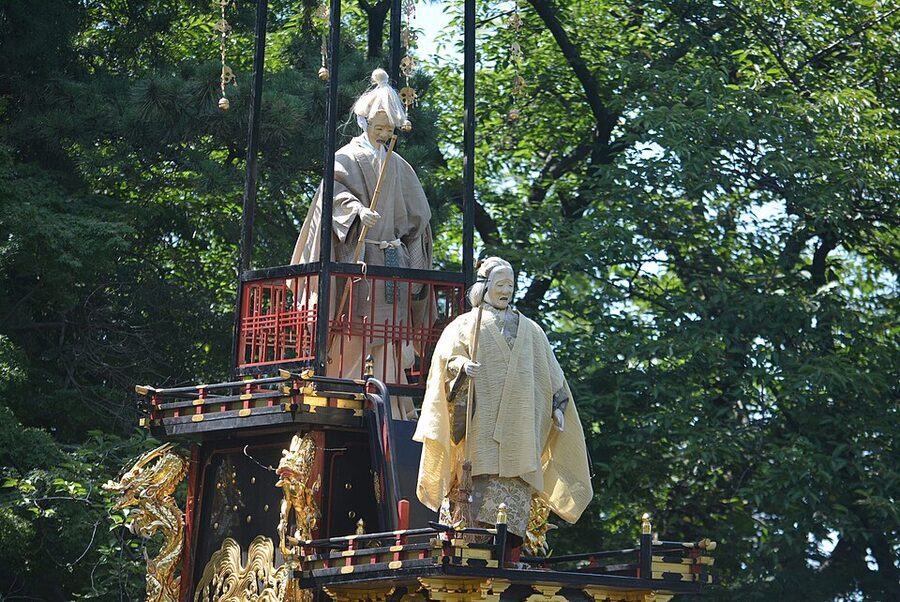
About halfway through the Asamatsuri, the ceremony’s most athletic element happens. From the Ichie-sha lead boat, ten young men — again in loincloths, heads shaved or close-cropped, bodies wet from the initial river splash — dive into the pond carrying nunohoko, ceremonial halberds wrapped in white cloth. They swim across to the shrine-side bank, run from the water up the stone embankment, and sprint through the shrine precincts to deliver the nunohoko to the priests at the main altar. The run is about 200 metres, uphill, in wet loincloths, in front of several thousand spectators. It is the one part of the festival that doesn’t fit the otherwise stately tone — it is explicitly furyū, meaning “virile” or “spirited,” the kind of young-men’s-performance that Japanese festivals have traditionally included to balance the ceremonial formality with a dose of physical bravado. The men who do the run are volunteers from the Ichie district, typically in their twenties, chosen for swimming ability and willingness. It is a serious honour to be selected. The delivery of the nunohoko to the shrine ends the festival’s public portion.
The UNESCO classification and why it matters
In 2016, UNESCO’s Intergovernmental Committee for the Safeguarding of the Intangible Cultural Heritage approved a Japanese government application covering 33 separate festivals under the single heading “Yama, Hoko, Yatai: float festivals in Japan.” The Owari Tsushima Tennō Matsuri was one of the 33. The other entries included the Kyoto Gion Matsuri, the Takayama Matsuri, the Nagahama Hikiyama Matsuri and the Chichibu Night Festival — in other words, the greatest hits of Japanese festival culture. Inclusion on the list does not directly protect the festivals legally (they were already protected as Important Intangible Folk Cultural Properties under Japanese law), but it does raise their international profile and, more importantly for local practitioners, triggers specific UNESCO funding channels for preservation, training, and documentation.
The Tsushima festival’s specific designation under Japanese cultural property law is “Owari Tsushima Tennō Matsuri no Sharakubune Gyōji”, the “Sharakubune ceremonies of the Tsushima Tennō Matsuri”, which covers both the evening and morning boat events but not the many preparatory rituals that precede them through the earlier months. The naming is careful and characteristically Japanese: the protected object is the ceremony, not the festival as a social whole, and the shrine’s broader religious calendar continues unprotected (and, the shrine priests would argue, rightly so — if the whole religious practice were frozen as cultural heritage, it couldn’t live). What the UNESCO and national designations actually guarantee is that the core ceremonial elements — the 500 lanterns, the Tsushima-fue flute, the six boats in the Asamatsuri formation, the ten-man nunohoko delivery — will be preserved through whatever social, economic, or demographic changes come next. The festival has already survived the 1785 river damming, the Meiji anti-shrine reforms, both world wars, and COVID-19. The UNESCO protection is insurance against whatever follows.
Where to see it — planning a visit
Tennō-gawa Park, Tsushima — the festival venue itself
Tennō-gawa Park is a 17-hectare greenspace built around the Maruike pond in central Tsushima City. The park is free to enter, open at all hours, and functions normally as a neighbourhood park for the rest of the year — cherry trees, jogging paths, kids on tricycles. On the night of the Yoimatsuri and the morning of the Asamatsuri, sections of the pond perimeter are cordoned off for crowd control, and the main viewing areas along the southern and eastern banks fill up from about 5 pm for the evening event. If you’re arriving from outside, aim to be in place by 6 pm for the Yoimatsuri — later than that and the good spots on the south bank will be taken by family groups who staked their territory in the afternoon. For the Asamatsuri, arrival by 8:30 am for a 9 am start is generally fine.
The festival dates are on the Saturday-Sunday of the fourth full weekend in July. In practice this means the last Saturday-Sunday pair that falls entirely in July — check the official Tsushima City website (tsushima-kankou.com) in the spring for the current year’s dates. Festival attendance is tolerated by the city at a level that keeps things manageable; in 2023, the first full post-COVID festival, attendance ran to around 40,000 people over the two days, which sounds like a lot but spreads out across multiple viewing zones. There are food stalls, there is beer, there are official festival goods on sale, but the commercial sprawl is much smaller than you’d find at Gion or Tenjin. Budget 2,500 yen per person for a couple of meals and some local sake.
Tsushima-jinja Shrine — the anchor
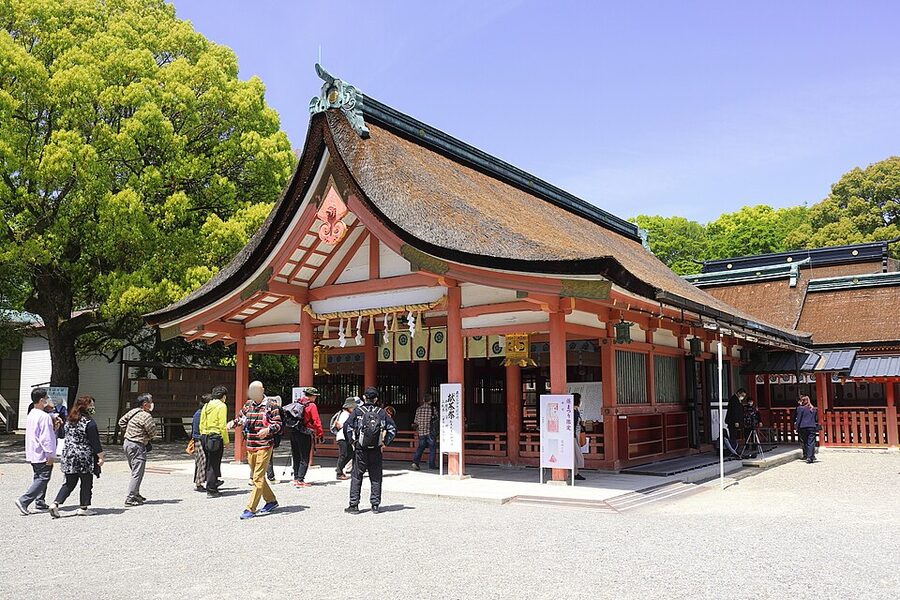
The shrine itself is a ten-minute walk north of Tennō-gawa Park, in the Shimmei-chō neighbourhood. It’s a significant working shrine with a long history as the head of the Tennō-sha shrine network — roughly 3,000 affiliated shrines across Japan use Tsushima-jinja as their honshā (main shrine), which makes it one of the more influential Shinto institutions in the country despite its modest city of location. The main Rōmon gate is a 15th-century structure, painted vermillion, flanked by the usual pair of komainu guardian dogs. Through the gate is a wide gravelled courtyard; beyond it, the Haiden worship hall in the Owari-zukuri style. There’s a small museum on the grounds showing festival artefacts, including retired makiwarabune frames and old doll costumes from previous Asamatsuri cycles, which is worth fifteen minutes if you’re visiting off-season and want to see the festival’s paraphernalia.
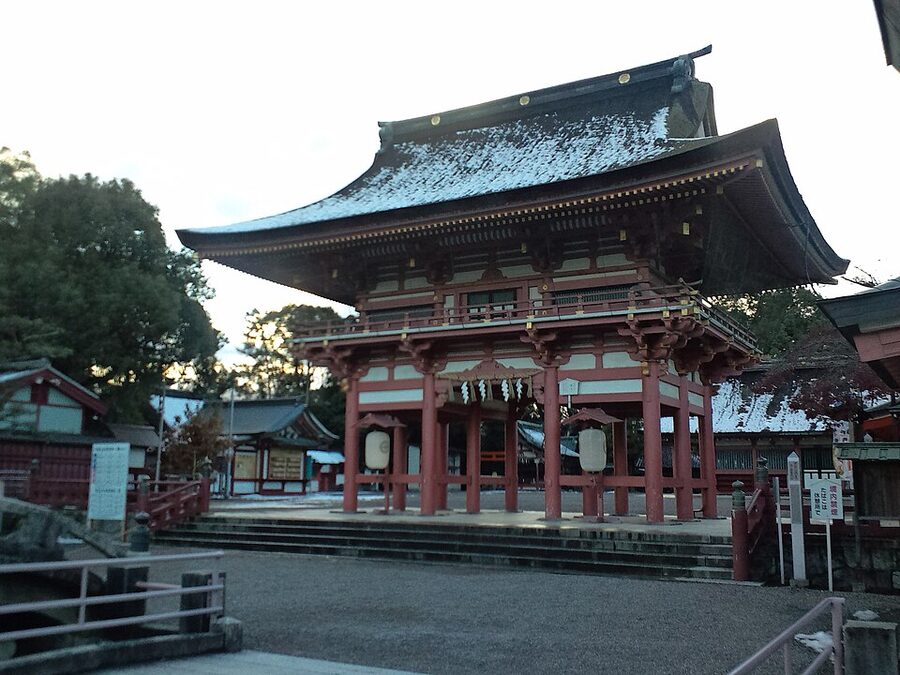
Shrine hours are 8 am to 5 pm, admission free. The annual New Year visit — hatsumōde — draws over a million visitors in early January, which is the one time of year Tsushima-jinja feels genuinely crowded; at most other times it’s quiet enough that you can sit on the step of the Haiden for half an hour without disruption. For festival purposes, the shrine is most interesting after the Asamatsuri on Sunday morning, when the nunohoko halberds have been delivered and are on display in the inner shrine area — priests are usually happy to point them out if you ask in basic Japanese.
Ichie-sha origin site, Aisai — where Susanoo landed
Across the former Tennō River in Aisai City’s Higashibo-chō neighbourhood is the historical location of Ichie-jima — the “island” where Susanoo-no-mikoto is said to have made landfall in the Susanoo-origin version of the festival myth. The old island is no longer physically an island (the river that surrounded it is now dry land), but the community that still mounts the Ichie-sha boat for the Asamatsuri traces direct descent from the families Susanoo allegedly encountered. There’s a small shrine at the site — Ichie-jima Tennō-sha — with a memorial stone and a panel explaining the tradition. It’s unmanned for most of the year, but the Ichie-sha boat is stored in a warehouse nearby and is occasionally visible through the sliding doors if the building is open. Go the week before the festival and you might see the boat being rigged.
Getting there: from Tsushima-jinja, a 20-minute walk west across the former river channel, or a 5-minute drive. Most foreign visitors skip this site because it’s less visually dramatic than the main shrine, but if you’re interested in the origin-myth structure of the festival, and in how a geographical “island” that no longer exists still structures the ceremony, it’s worth the detour. The Ichie community’s willingness to keep supplying the lead boat for a festival held in the neighbouring city, 400+ years after their own island dried up, is the kind of institutional stubbornness that makes Japanese festival culture persist.
Shōbata Castle site — the Oda family’s base
For the Nobunaga connection, make the extra journey to the Shōbata Castle ruins in the far south of Inazawa City, about 8 kilometres north of Tsushima. Shōbata was the main castle of the Oda Danjō-no-jō — the senior branch of the Oda family, which Nobunaga’s grandfather Oda Nobusada commanded, and where Nobunaga’s father Oda Nobuhide spent his early career. The castle itself was dismantled during Nobunaga’s generation after the family moved their base east to Kiyosu, and what remains today is a modest archaeological park: the raised earth platform of the former donjon, a reconstructed moat section, and a small museum. The site has no dramatic superstructure, but the sight-lines to Tsushima are clear on a good day, and the castle’s former southern gate faces almost directly at the Tsushima-jinja approach road. If Nobunaga watched the festival from the Tennō-bashi, he rode here — three-quarters of an hour in the saddle, probably with a small retainer group, in the evening, with the Tsushima lanterns visible on the southern horizon.
Getting there: Shōbata Station on the Meitetsu Bisai Line, 40 minutes from Tsushima by train with one change. The castle site is a 12-minute walk from the station. Free entry, always open. The on-site museum is open only on weekends, 10 am to 4 pm, free admission. Combine with a visit to the Oda family’s earlier Kiyosu Castle, now reconstructed as a modern museum, for a full Nobunaga-family pre-Kiyosu itinerary, which is one of the best day-trips in Aichi for samurai-history visitors and almost completely overlooked by foreign tourism.
Getting to Tsushima
Tsushima City is a 25-minute train ride west of Nagoya on the Meitetsu Tsushima Line from Meitetsu Nagoya Station (platform 2 or 3 at the underground terminal). Trains run every 10-15 minutes during the day. Festival-weekend trains run more frequently, and the Meitetsu operates extra evening trains back to Nagoya after the Yoimatsuri. Tsushima has a handful of business hotels — most budget chains (Route Inn, APA, Toyoko Inn) — within a 10-minute walk of Tsushima Station, but they book solid for the festival weekend by late spring. If you can’t get a Tsushima room, stay in Nagoya and take the train out for the festival nights; the final Meitetsu service back is around 11 pm on Saturdays during the festival, which is usually enough margin.
The festival pairs naturally with a broader Aichi history circuit: Kiyosu Castle and the Oda pre-Kiyosu sites on one day, Nagoya Castle and the Hommaru Palace on another, Inuyama Castle for the oldest original-donjon castle in Japan a little further north, and the Ise-Jingu shrine complex an hour south on the Kintetsu line. Any of these make reasonable overnight anchors. Tsushima itself is small enough that one full day plus the festival weekend covers everything — don’t build it into a long stop, build it into an evening and a morning.
Closing — lantern after lantern, century after century
One thing you notice at the Yoimatsuri, if you stay for the full procession: the pace doesn’t vary. The first boat crosses the pond at approximately the same walking pace as the last boat, and each boat takes approximately the same amount of time from lantern-lighting to mooring. This is not accidental. The festival’s organisers rehearse the timings, the rowers train for the cadence, the flute-player matches the tempo. The ceremony runs to an internal metronome that was set sometime in the 15th century and has not been adjusted since. When you watch it, you’re watching a rhythm that Oda Nobunaga’s eye followed at the same tempo you’re following it now. The lanterns were different — fewer, smaller, with different construction — but the pace of the boats, and the sound of the Tsushima-fue, and the silence on the bank, these have not changed in any important way for approximately 450 years.
That is the thing that makes a small provincial festival worth the trip. Not the Instagram shot of the lanterns (though that is striking), not the UNESCO citation (though it is well-earned), but the simple fact of the continuity. A man born in 1530 could ride into Tsushima on the fourth Saturday in July of 2026 and, after the initial shock of electric lights in the surrounding streets, recognise exactly what was happening on the pond and exactly how to respond to it. He would know the music, the boats, the order of the dolls on the Asamatsuri, the rough timing of the lantern-lighting sequence, and probably the names of some of the rowers’ ancestors. Japanese festival culture has preserved a lot, and the Tsushima Tennō Matsuri is preservation at near its highest density: 500 lanterns, one flute, six boats, unchanged — crossing still water, in the dark, while the city on the bank watches quietly.
If this kind of preservation interests you, the natural companion pieces on this site are on the context that surrounds the festival: Sassa Narimasa, the Owari-born samurai who would have grown up knowing this festival; Saitō Dōsan, the neighbouring Mino warlord whose daughter married Nobunaga during the years Nobunaga was patronising this shrine; and on other Japanese traditions that have survived at similar density, traditional Japanese candles, which light the non-festival interior of the Tsushima shrine the rest of the year, and tatami, which the festival priests kneel on during every month of preparation before the July weekend.