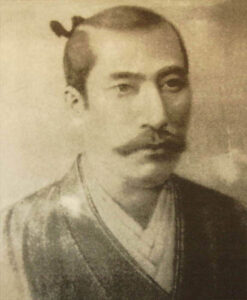
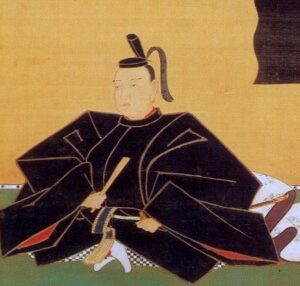
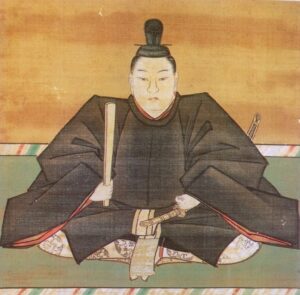
Honda Tadakatsu fought in at least 57 recorded battles over a 50-year military career, and, according to every surviving contemporary source, never received a wound that broke his skin. Not a scratch. The claim sounds like one of those polished samurai legends that accrue around famous warriors in the Edo period, the kind of thing the Kōyō Gunkan and the Mikawa Monogatari would reach for when they ran out of more plausible things to say. Except that this one was noted while Tadakatsu was still alive, by people who saw him on campaign. Toyotomi Hideyoshi called him kokon dokuho no yūshi — “the bravest warrior in all ages, peerless in the present.” Oda Nobunaga, who was not free with compliments, called him hana mo mi mo kaneta bushō — “a general who has both the flower and the fruit.” When he finally did get injured — a tiny slip of the knife, carving his own name into a piece of wood at Kuwana Castle in October 1610 — he said out loud “Tadakatsu has been wounded; his time has come,” and died peacefully three days later at age 62.
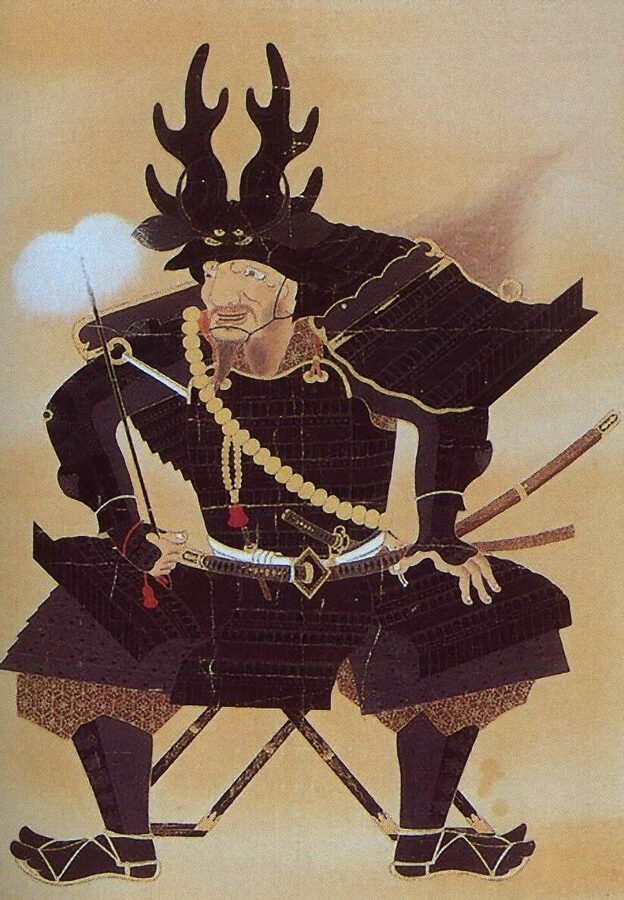
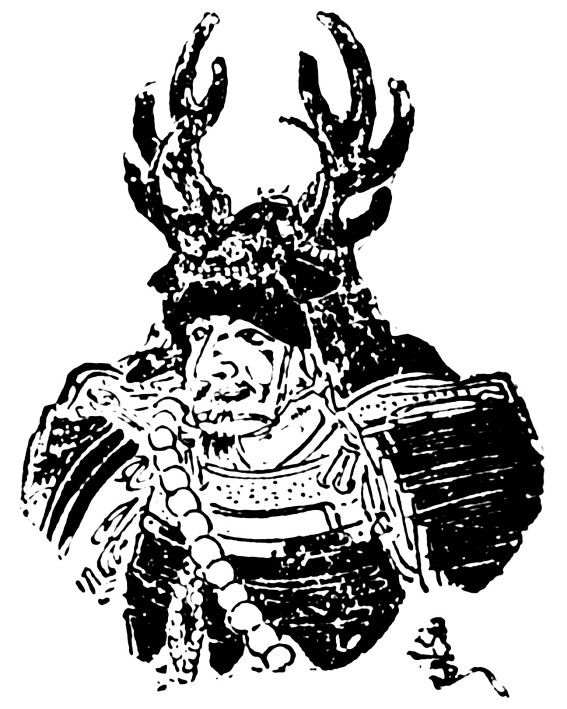
The stories about Tadakatsu tend toward this mythic register, and most of them turn out, on investigation, to be closer to true than you’d expect. The deer-antler helmet, famously recognisable across a battlefield — real, and in the collection of the Kuwana City Museum. The twenty-foot spear named Tombogiri (“Dragonfly-Cutter”), reputedly so sharp a dragonfly bisected itself by landing on the tip — real, one of the Tenka San-meisō (the Three Great Spears of Japan), currently held by the Yabe family in Numazu. The 500-man standoff at Ryūsenji against Hideyoshi’s 80,000 at Komaki-Nagakute, where Tadakatsu rode into the river and washed his horse’s mouth while Hideyoshi’s entire army watched — documented in the Hōrin Gisho. The 90 heads at Sekigahara, taken personally at the close of the day — also documented, by the Eastern Army’s own tally rolls. Tadakatsu was the Tokugawa Four Heavenly Kings’ ranking field commander for 45 years, and what survives of the contemporary record suggests he earned every one of the epithets Hideyoshi and Nobunaga hung on him.
In This Article
- Okazaki, 1548 — the Mikawa boy
- First blood at Ōdaka — 1560
- The Four Heavenly Kings take the field
- Mikatagahara, the deer-antler helmet, and Shingen’s compliment
- Nagashino, Iga-goe, and the Honnō-ji scramble
- Komaki-Nagakute, 1584 — the 500 against 80,000
- Otaki, Sekigahara, and the 90 heads
- Tombogiri, the three greatest spears, and the fighting style
- Final years and the death poem
- Where to visit Honda Tadakatsu today
- Okazaki Park and Ryūjō Shrine — the birthplace
- Kuwana Castle, Jōdo-ji, and the final residence
- Otaki Castle and Ryōgen-ji — the Chiba domain
- Sekigahara position marker and Engyō-ji Honda mausoleum
- Closing — the unwounded servant
Okazaki, 1548 — the Mikawa boy
Tadakatsu was born in 1548 in Kuramae village, on the western edge of the Okazaki castle-town in Mikawa Province — now Okazaki City in Aichi Prefecture, about an hour east of Nagoya. His father Honda Tadataka was a hereditary retainer of the Anjō Matsudaira (Ieyasu’s immediate ancestors) and died in combat in 1549, when Tadakatsu was one year old. The boy was raised by his uncle Honda Tadamasa — another Matsudaira retainer, formidable by all accounts, though killed in 1573 at Mikatagahara while covering Ieyasu’s retreat. The two branches of the Honda lineage, Tadakatsu’s and Tadamasa’s, remained closely linked through Tadakatsu’s childhood and would produce some of Ieyasu’s most effective military retainers.
Ieyasu himself was three years older than Tadakatsu and had been a Matsudaira hostage in the Imagawa court at Sunpu since age six. The Mikawa retainer corps was, in 1548, loyal to Imagawa Yoshimoto only by coercion — the real emotional allegiance was to the absent Matsudaira heir. Tadakatsu grew up inside this complicated feudal arrangement: nominally serving Imagawa, actually loyal to a child lord who was living fifty kilometres away in enemy custody. When Ieyasu finally returned to Okazaki at age 19 in 1560 — shortly after the Imagawa catastrophe at Okehazama, which killed Yoshimoto and collapsed the Imagawa power structure — Tadakatsu at 12 was already a designated retainer in the reforming Mikawa army. His first campaign came almost immediately.
First blood at Ōdaka — 1560
Tadakatsu’s initial combat action — ujin, first battle — came at the Ōdaka Castle resupply operation in May 1560, immediately before Okehazama. Imagawa Yoshimoto had sent the 19-year-old Ieyasu (then still called Matsudaira Motoyasu) with a small force to push supplies into the besieged Ōdaka fortress on the Owari-Mikawa border. The operation succeeded; Tadakatsu, aged 13, took his first head in the associated skirmish and simultaneously underwent the genpuku coming-of-age ritual at which he formally received his adult name. Two weeks later, Imagawa Yoshimoto was killed by Nobunaga at Okehazama; the Imagawa position in Mikawa collapsed; Ieyasu returned to Okazaki as an independent lord. Tadakatsu went with him.
The first serious test of Tadakatsu’s loyalty came three years later in the Mikawa Ikkō Ikki — the 1563 Ikkō sectarian uprising that nearly destroyed Ieyasu’s fragile new regime. Many of the Mikawa samurai families were adherents of the Jōdō Shinshū (True Pure Land) Buddhist sect and faced a direct theological conflict when the Jōdō Shinshū leadership declared war on Ieyasu. A significant number of Honda-branch retainers — including Tadakatsu’s senior relative Honda Masanobu, who would later be the architect of Tokugawa administrative policy — sided with the Ikkō faction and fought against Ieyasu. Tadakatsu made the opposite choice: he formally converted from Jōdō Shinshū to Jōdō-shū (the mainstream Pure Land sect, Ieyasu’s own) and fought for Ieyasu throughout the rebellion. The conversion was not cosmetic. Ieyasu would remember this choice for 45 years, and Tadakatsu’s position in the Tokugawa retainer hierarchy was shaped permanently by the fact that in 1563, aged 15, he had chosen feudal loyalty over religious kinship.
The Four Heavenly Kings take the field
By 1566, aged 19, Tadakatsu was appointed hatamoto senshū-yaku, commander of the shogun-standard vanguard, with 54 attached retainers under his direct command. This was the youngest appointment to vanguard command in Ieyasu’s service, and it made Tadakatsu the operational head of the Tokugawa household troops. The other three of the Four Heavenly Kings — Sakai Tadatsugu, Ii Naomasa, Sakakibara Yasumasa — each commanded separate wings with different specialisations (Sakai held the strategic reserve, Ii the cavalry shock troops, Sakakibara the infantry). Tadakatsu’s hatamoto were the elite core that fought immediately around Ieyasu’s banner. From 1566 onwards, wherever Ieyasu went in person, Tadakatsu went too.
The first major test of the new formation came at the 1570 Battle of Anegawa, where Ieyasu’s Tokugawa force fought alongside Nobunaga’s Oda army against the allied Asakura and Azai clans. When 10,000 Asakura infantry threatened to overrun the Tokugawa command position in the central phase of the battle, Tadakatsu led a single-horse charge directly into the front of the Asakura formation — an act that contemporary chroniclers describe as tactically insane but psychologically devastating. The Tokugawa retainer corps, seeing their 22-year-old vanguard commander riding alone into 10,000 men, followed him in a mass counter-attack. The Asakura centre collapsed. During the resulting melee, Tadakatsu personally engaged the Asakura champion Magara Jūrōzaemon Naotaka, a man renowned for his seven-foot naginata, in a formal one-on-one duel that both sides reportedly paused to watch. Tadakatsu won. The Anegawa single-horse charge is the origin of his reputation for fighting beyond reasonable risk levels and surviving anyway.
Mikatagahara, the deer-antler helmet, and Shingen’s compliment
In December 1572, as Takeda Shingen’s invasion force pushed south through Tōtōmi toward Mikawa, the Tokugawa vanguard encountered the Takeda main body at Hitokoto-zaka — a narrow ridge on the approach to Futamata Castle. The Tokugawa forward patrol was outnumbered and outflanked; Tadakatsu and Ōkubo Tadasuke covered the retreat with a rearguard action on the ridge’s downslope, where the terrain forced the Takeda cavalry into single-file attack. The specific detail recorded in multiple sources is that Tadakatsu was wearing, for the first time in combat, the deer-antler-crested helmet that would become his signature. He held the narrow pass for long enough for the main Tokugawa column to retreat safely to Hamamatsu, with negligible casualties to his 200-man rearguard.
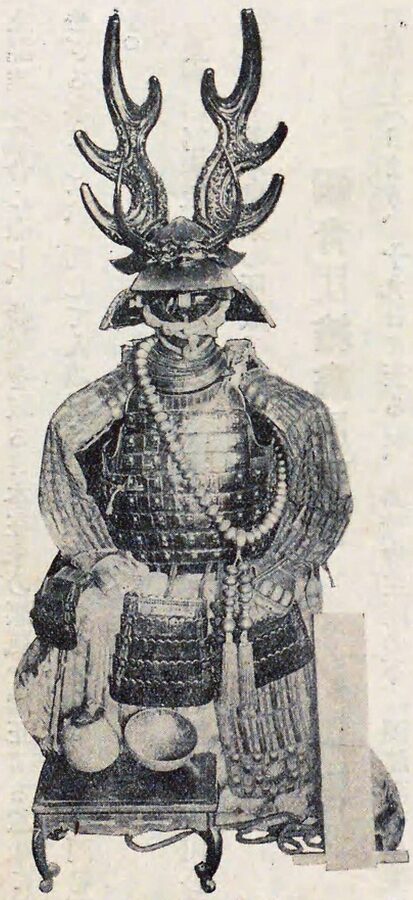
The exchange at Hitokoto-zaka produced the most-quoted single compliment in Tadakatsu’s career, issued by a Takeda junior officer named Kosugi Saemon immediately after the action. Kosugi left a poem pinned to a post by the roadside where the rearguard had stood: “Ieyasu ni sugitaru mono ga futatsu ari — Kara no kashira to Honda Heihachi” — “There are two things Ieyasu has that are too good for him: the plumed kara-no-kashira helmets, and Honda Heihachirō.” The couplet spread through both armies within days. Three weeks later, Ieyasu committed his forces to the 25 January 1573 Battle of Mikatagahara, covered in detail in my separate piece, where Tadakatsu commanded the Tokugawa left wing against Yamagata Masakage’s Takeda cavalry and personally stabilised the line when the central formation collapsed. Yamagata, who killed several senior Tokugawa retainers that afternoon, did not break Tadakatsu’s wing. The Tokugawa lost the battle anyway; but Tadakatsu’s wing came off the field intact, and Ieyasu’s own survival on the retreat was attributable to the rearguard Tadakatsu organised on the spot.
Nagashino, Iga-goe, and the Honnō-ji scramble
At Nagashino in May 1575, the battle where Nobunaga’s palisades broke the Takeda cavalry tradition, Tadakatsu commanded the Tokugawa centre behind the third-tier palisade, absorbing and returning fire against the successive Takeda waves. He did not lead any single spectacular charge at Nagashino; the nature of the engagement did not call for it. What he did, and what the Oda-Tokugawa chronicle explicitly credits him with, was maintaining formation discipline through eight hours of sustained combat against charges that should have broken a less-experienced force. The Yamagata Masakage death, the first of the Takeda Four Heavenly Kings to fall, happened in Tadakatsu’s sector of the palisade, though the final killing blow was delivered by an Oda matchlock-man rather than Tadakatsu personally.
The most tense moment of Tadakatsu’s career, by his own reckoning, came in June 1582 during the Iga-goe, the emergency retreat from Sakai to Mikawa after the Honnō-ji Incident. Ieyasu had been in Sakai meeting with Sakai merchants when word of Nobunaga’s assassination reached him; with only a small party of retainers, he was caught between Akechi Mitsuhide’s forces moving south from Kyoto and the hostile Iga countryside to the east. The chroniclers record Ieyasu briefly breaking composure and declaring he would kill himself at the Chion-in temple rather than be captured. Tadakatsu, who was present, physically restrained him, told him to pull himself together, and organised the improvised 200-kilometre overland flight through Iga ninja territory back to Mikawa. The Iga-goe took five days and cost Ieyasu about half his remaining retainers, but he survived. Tadakatsu, at the Kidzugawa river crossing, is supposed to have punched the bottom of the ferry boat out with the butt of his spear after Ieyasu’s party had crossed, to prevent any pursuing force from using the same boat. The Tokugawa Jikki treats this as a founding-story for the Tokugawa regime itself: the warrior-retainer who kept his lord alive through the gravest four days of his life.
Komaki-Nagakute, 1584 — the 500 against 80,000
The most famous single episode in Tadakatsu’s career came during the Battle of Komaki-Nagakute in 1584. The general situation is covered in my separate piece; the specific Tadakatsu episode is this. On the afternoon of 9 April 1584, as Hideyoshi’s 80,000-strong main army was pursuing the retreating Tokugawa forces toward Komaki, Tadakatsu was holding a rear position at the Ryūsenji River with approximately 500 retainers. Ieyasu’s main body had pulled back to the Komaki entrenchments. The Tokugawa situation was critical: if Hideyoshi’s advance caught Ieyasu’s column in the open before they reached the fortifications, the whole Tokugawa army could be destroyed. Tadakatsu’s 500-man force was the only formation between the Toyotomi pursuers and the Tokugawa main body.
What Tadakatsu did was theatrical. He advanced his 500 men to the near bank of the Ryūsenji in full view of the approaching 80,000, arrayed them in formal battle order, and then — personally, alone, on horseback — rode into the middle of the river and spent several minutes washing his horse’s mouth with the water, demonstratively unhurried. The Toyotomi vanguard halted. Hideyoshi’s staff officers Katō Kiyomasa and Fukushima Masanori (both then in their mid-twenties, both veterans of several major battles) recommended attacking; Hideyoshi himself, watching from the opposite ridge, countermanded them. The Hōrin Gisho preserves what is supposed to be Hideyoshi’s exact remark: “That man is deliberately showing us a small force to hold us here. He knows exactly what he is doing. When we destroy the Tokugawa, we should capture this one alive — he would make a great retainer for me.” The Toyotomi vanguard held position for an hour and a half. By the time Hideyoshi ordered a resumption of the advance, Ieyasu’s main body had reached Komaki Castle. Tadakatsu’s 500 withdrew unharmed. The campaign ended in negotiated stalemate two weeks later.
Otaki, Sekigahara, and the 90 heads
When the Tokugawa were transferred to the Kantō in 1590 after the Odawara Campaign, Tadakatsu received Otaki-han in Kazusa (modern Chiba Prefecture) as a 100,000-koku domain — the second-largest grant among the Tokugawa retainers, trailing only Ii Naomasa’s 120,000 koku at Minowa. The placement was strategic: Otaki sat on the southern boundary of the new Tokugawa territory, watching the Satomi clan in Awa Province, and required a senior commander to hold it. Tadakatsu spent the next decade on administrative work — building Otaki Castle, organising the domain’s tax rolls, running the local infrastructure — with only occasional military deployment. It was the quietest stretch of his career, and he apparently hated it. The 1598 death of Hideyoshi and the subsequent political crisis pulled him back into active service almost immediately.
At the Battle of Sekigahara in September 1600, Tadakatsu commanded a 500-retainer personal force attached directly to Ieyasu’s central command. His original assignment had been to accompany Tokugawa Hidetada’s 38,000-man Nakasendō column — the force that was supposed to suppress the Sanada and arrive at Sekigahara on time, and which famously failed to do so — but he had been detached to the Tōkaidō column after the first-round Gifu Castle engagement. At the main battle, Tadakatsu’s force was involved in the central valley melee against Ukita Hideie and Ishida Mitsunari’s combined line, and later in the afternoon participated in the pursuit of the broken Western Army toward the Satsuma retreat. The 90 heads Tadakatsu took personally that day, documented in the post-battle tally, were the second-highest individual count on the Eastern side (only Ii Naomasa’s 104 exceeded it), and the majority were collected during the late-afternoon pursuit rather than the main-melee phase. This was Tadakatsu at 52 years old, apparently not slowed at all by age.
Ieyasu’s post-Sekigahara rewards promoted Tadakatsu from Otaki (100,000 koku) to Kuwana in Ise Province (100,000 koku). The move looked lateral on paper, same income, but Kuwana was a more strategic location, controlling the Tōkaidō route between Mikawa and Ōmi, and the promotion was in practice a significant vote of confidence. Tadakatsu’s son Honda Tadatomo was given a separate 50,000-koku grant at Otaki as a branch-family domain. The move from Otaki to Kuwana was completed in 1601, and Tadakatsu spent his final nine years as Kuwana-han’s first daimyō, rebuilding the castle, reorganising the domain’s town infrastructure, and producing administrative reforms that later Kuwana lords would build on for the next 250 years. He is still regarded locally as the founder of modern Kuwana.
Tombogiri, the three greatest spears, and the fighting style
Tadakatsu’s personal weapons are worth attention because they became a central part of the legend. The spear — Tombogiri, “Dragonfly-Cutter” — is one of the three Tenka San-meisō (great spears of Japan), alongside Kuroda Kanbei’s Nihon-gō and Yūki Harutomo’s Otegine. It was forged by the Mikawa-based smith Fujiwara Masazane in the middle of the 16th century; the blade alone is 43.8 centimetres long, in the broad sasaho (bamboo-leaf) style, and bears the inscription “藤原正真作” on the tang. The name Tombogiri, Dragonfly-Cutter, comes from the legend that a dragonfly landing on the spear’s tip cut itself in half, demonstrating the edge’s sharpness. The shaft, exceptionally for the period, was originally about six metres long (standard Sengoku-era spears were 4.5m); in his final decade Tadakatsu shortened it by 90 cm, telling his retainers that “a spear should match your own strength.” The spear is currently owned by the Yabe family in Numazu City, Shizuoka Prefecture, which acquired it through an early-Edo inheritance; a high-fidelity replica is on permanent display at the Mikawa Bushi no Yakata Ieyasu-kan museum inside Okazaki Park.

The helmet — the shika-tsuno wakidate deer-antler kabuto — is at the Kuwana City Museum on permanent display, and the armour (kurokawa-odoshi dōmaru-gusoku) is in the Tokugawa Museum collection in Nagoya. His horse, Mikuni-kuro (“Three-Kingdoms Black”), a gift from Tokugawa Hidetada, was shot from under him at Sekigahara by Shimazu retreating musketry and killed. Tadakatsu completed the pursuit on foot and later on a borrowed horse from his vassal Kaji Katsutada, who reportedly gave up his mount with the words “a Honda without a horse is unsafe for everybody involved.” The horse incident gives you a sense of the immediate vassal-lord relationships — Kaji would later commit oibara seppuku to follow Tadakatsu in death at the 1610 mourning period.
On Tadakatsu’s actual combat style, the contemporary sources are surprisingly unified: he was not a spectacular technical swordsman. The Kasshi Yawa, a 19th-century compilation of Edo-era miscellany, specifically notes that Tadakatsu’s technique in formal training matches was “remarkably clumsy” and that observers who knew him only from drills were “surprised to hear of his fame in battle.” Tadakatsu’s effectiveness in actual combat came from something closer to overwhelming aggression, combined with a genuine gift for reading which way an engagement was moving. The Kasshi Yawa records him in retirement at Kuwana demonstrating to his son Tadatomo the difference between formal practice and real fighting: the two of them out in a boat on the local river, Tadakatsu saying “cut that reed with the oar”; Tadatomo swiping at the reed and flattening it; Tadakatsu reaching down with a small sickle and slicing the reed off clean. The point being, and this is presumably what Hideyoshi and Nobunaga both recognised, that formal skill and combat effectiveness are not always the same thing.
Final years and the death poem
The last decade of Tadakatsu’s life, 1600-1610, was administrative rather than military. Ieyasu had taken the shogunal appointment in 1603 and was building the Tokugawa bakufu; the senior military men of the Sengoku generation were being quietly replaced by civilian administrators — the ri-ryō-ha, the “policy clerks” — under Honda Masanobu (Tadakatsu’s distant cousin, the man who had sided with the Ikkō Ikki against Ieyasu in 1563 and whom Tadakatsu reportedly never forgave) and later under Hōjō Ujinobu’s descendant Hōjō Ujimaki. Tadakatsu disliked the ri-ryō-ha passionately, and made no secret of it; his correspondence to his son during this period includes a letter dismissing Masanobu as “that cowardly Sado-no-kami” and denying any shared family relationship. The bakufu’s strategic orientation was moving away from men like Tadakatsu. He knew it. He withdrew to Kuwana and concentrated on the domain.
From 1604 he was increasingly ill — the exact condition unclear, probably a combination of age-related issues and old injury-accumulation, though as noted he had no recorded wound in battle. In 1607 he developed an eye condition that gradually impaired his sight. In June 1609 he formally retired at age 61, passing the domain to his son Tadatomo. In October 1610 came the famous minor accident: carving his name into a piece of wood with a small knife, he slipped and cut the back of his left hand. The cut was superficial. Tadakatsu is supposed to have looked at it for a long time in silence, then said: “Honda Tadakatsu is wounded. Honda Tadakatsu’s time has come.” He died peacefully three days later, on 18 October 1610, at Kuwana Castle. Two of his senior retainers, Nakane Tadazane and Kaji Katsutada, committed oibara, following-death seppuku, and were buried flanking his tomb at Jōdo-ji temple.
His death poem, preserved in the Honda-ke Kakō, is an extraordinarily direct expression of feudal loyalty: “Shini to mo na / Ā shini to mo na / Shini to mo na / Fukaki go-on no kimi o omoeba” — “I do not want to die. Ah, I do not want to die. I do not want to die. When I think of the deep favour of my lord.” The poem is unusual in the genre because most Japanese samurai death-poems reach for cosmic detachment — mountain mist, dew on grass, cherry blossom falling. Tadakatsu’s is the opposite: direct, human, regretful, with the lord-servant relationship explicitly at the centre. He did not want to leave Ieyasu behind. Ieyasu, who outlived Tadakatsu by six years, is said to have wept openly on receiving the news of the death and to have remarked: “Tadakatsu was truly the best of my retainers. Every family must lose its finest men eventually, but I did not expect mine to go first.”
Where to visit Honda Tadakatsu today
Okazaki Park and Ryūjō Shrine — the birthplace
Start in Okazaki, the Mikawa castle-town where Tadakatsu was born and where he grew up serving the young Matsudaira Motoyasu who would become Ieyasu. Okazaki Park — the fully-preserved grounds of the former Okazaki Castle, Ieyasu’s birthplace — has a prominent bronze statue of Tadakatsu at the castle’s main gate, along with statues of Ieyasu himself and Sakai Tadatsugu. The small but excellent Mikawa Bushi no Yakata Ieyasu-kan museum inside the park holds a high-fidelity replica of Tombogiri plus reproductions of Tadakatsu’s helmet and armour — the originals are at Kuwana, but the Okazaki replicas are close to indistinguishable. Admission ¥530, open 9am-4:30pm daily. The Okazaki Castle keep itself was rebuilt in 1959 and houses a historical exhibit on the Tokugawa founding.
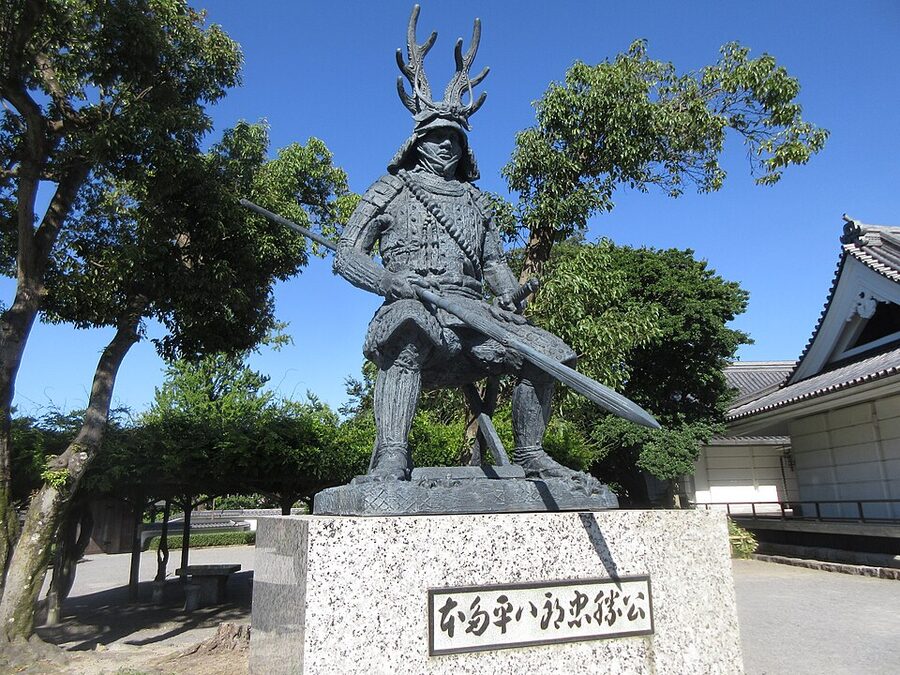
Also in Okazaki Park is Ryūjō Shrine — a shrine founded in 1770 within the former castle’s Honmaru enclosure, specifically dedicated to the deification of Tadakatsu as a protective kami. Renamed from Eise Shrine during the early Meiji era, the shrine continues to hold annual commemorative rites on Tadakatsu’s death anniversary (18 October). Free to visit, always open. The combination of the statue, the museum replicas, and the shrine makes Okazaki Park a half-day visit that covers most of Tadakatsu’s Mikawa-period biographical ground.
Kuwana Castle, Jōdo-ji, and the final residence
Tadakatsu’s final domain was Kuwana in Mie Prefecture — a 45-minute train ride east of Nagoya on the Kintetsu Nagoya Line, or an hour on the JR Kansai Line. The castle itself was dismantled during the Meiji period, but the site is preserved as Kyūka Park, complete with original stone-wall foundations, the restored inner-moat ring, and a modest on-site museum called the Kuwana-jō Shiryō-kan (Kuwana Castle Documents Hall). Tadakatsu’s actual armour and helmet, the genuine 1600-vintage articles, are on permanent display at this museum, along with administrative documents from his 1601-1610 domain leadership. Admission ¥150; open 9am-5pm, closed Mondays.
Tadakatsu’s primary tomb is at Jōdo-ji, a Jōdō-shū Buddhist temple about 800 metres north-east of the castle site in central Kuwana. The temple was the Honda clan’s designated memorial temple (bodai-ji) and holds Tadakatsu’s grave along with those of his senior retainers Nakane Tadazane and Kaji Katsutada who committed oibara. The grave-marker is unusually modest for a daimyō of his rank — a single stone stupa, weathered to the point that the inscription is barely legible. Tadakatsu had specifically instructed that the grave be “plain enough that visitors would not mistake it for pretension.” The temple itself is a pleasant small walk-in, free to visit, open daily 9am-4:30pm. Bring incense if you want to leave an offering — the monks keep a small bundle near the side path.
Otaki Castle and Ryōgen-ji — the Chiba domain
For a second-tier visit, Otaki Castle in Chiba Prefecture covers Tadakatsu’s 1590-1601 period as the first Otaki daimyō. The original castle was dismantled by the Meiji government, but a partial reconstruction of the keep was built in 1975 on the original footprint and now houses the Otaki Town History Museum. More interesting for Tadakatsu-specific purposes is nearby Ryōgen-ji temple, which holds a branch-family tomb for Tadakatsu — a portion of his remains were transferred from Kuwana to Ryōgen-ji in 1611 at the request of Otaki residents who felt the town that had benefited from his ten-year lordship deserved a memorial. The tomb is adjacent to the main hall, marked by a small stone stupa with inscription.
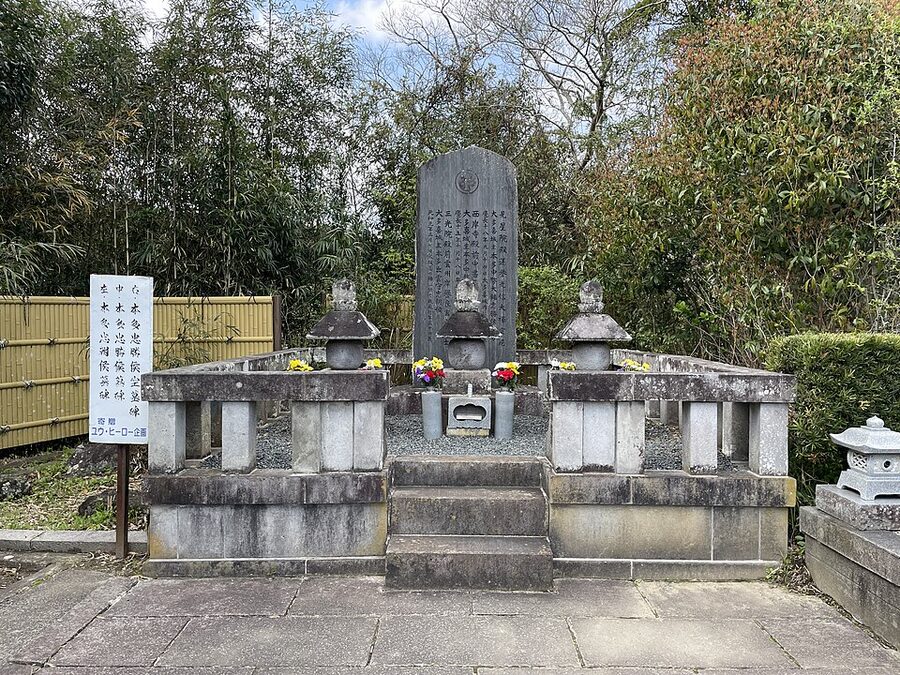
Getting to Otaki: Otaki Station on the JR Uchibō Line, about 2 hours from central Tokyo via Chiba. The castle and temple are both within a 15-minute walk of the station. The Otaki Town History Museum (inside the reconstructed keep) has a full exhibit on Tadakatsu’s decade as daimyō, including original domain documents and replica armour. Admission ¥200, open 9am-5pm, closed Mondays. Ryōgen-ji is free, always open.
Sekigahara position marker and Engyō-ji Honda mausoleum
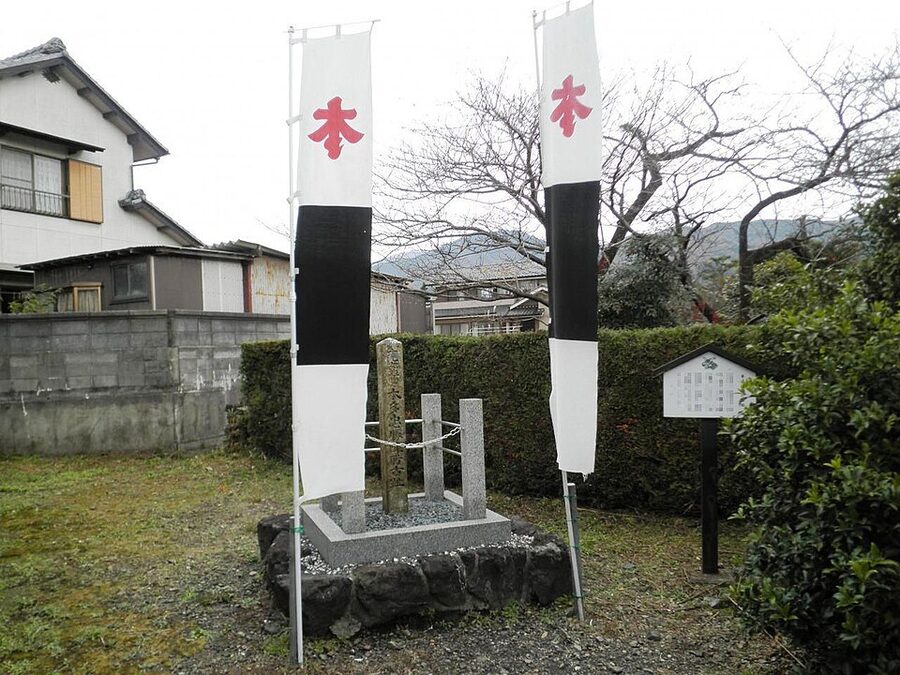
For completists, two more sites round out the Tadakatsu circuit. The Sekigahara battlefield’s Honda Tadakatsu command-position marker is on the standard walking circuit I described in my Sekigahara piece — about 200 metres south of the main decisive-battlefield monument, near the present-day Imai local intersection. And at Engyō-ji temple on Mount Shosha above Himeji in western Hyogo Prefecture, there’s a Honda-family mausoleum complex built by Tadakatsu’s grandson Honda Tadamasa in 1626. Tadakatsu’s own memorial hall within the mausoleum is reachable by a steep 15-minute ropeway plus a 20-minute walk through the temple grounds; admission to Engyō-ji is ¥500, and the ropeway (which you’ll want unless you’re a fit hiker) is ¥1,000 round trip. Engyō-ji is a worthwhile destination in its own right — it’s one of the Tendai-school’s major training monasteries, and the grounds (used as a filming location for The Last Samurai) are among the most atmospheric temple-landscapes in Japan.
Closing — the unwounded servant
What makes Tadakatsu interesting, long after the 57-battles-no-wound statistic has stopped being the most remarkable thing about him, is that his career is a working example of a specific feudal relationship done to its limit. Most famous Sengoku warriors rose by changing sides at the right moment. Katsuie served Nobunaga, Hideyoshi served Nobunaga, Ieyasu allied with Nobunaga — but each of them was ultimately working a personal trajectory that happened to intersect with their lord’s. Tadakatsu did not do this. He joined Ieyasu’s service at age twelve, spent the next fifty years inside it, and never gave serious consideration to any alternative. Hideyoshi, at the peak of his power in the 1590s, is documented as having tried directly to recruit Tadakatsu — offering him up to 200,000 koku as a direct Toyotomi retainer, double what Ieyasu was giving him. Tadakatsu refused and reported the offer to Ieyasu that same week. The 1584 Komaki remark — “when we destroy the Tokugawa, we should capture this one alive, he would make a great retainer for me”, was spoken by a man who understood Tadakatsu’s loyalty precisely, and who knew it was non-negotiable.
This is what the death poem means. Shini to mo na, fukaki go-on no kimi o omoeba: I do not want to die, because of my lord’s deep favour. Sengoku samurai death-poems are usually designed to demonstrate the writer’s Zen-like detachment from mortal concerns. Tadakatsu’s explicitly refuses detachment. The man’s reason for wanting to live is explicitly and entirely about not leaving his lord’s service. It is a startlingly un-modern sentiment for anyone reading it in 2026, and it was probably already somewhat unfashionable in 1610, in an Edo bakufu that was rapidly reorganising itself around professional civil administration rather than personal feudal loyalty. The loyalty Tadakatsu describes in his final four lines is essentially the Sengoku-period definition of samurai virtue, expressed with no irony and no retreat, at the close of a career that had put him personally in every major Tokugawa military engagement between 1560 and 1600. He had fought 57 battles. He had not been wounded. He had taken 90 heads at Sekigahara alone. And what he was thinking about as he died, apparently, was his obligation to the boy he had met at age twelve in Okazaki castle.
If you want to read deeper into the specific actions Tadakatsu fought in, my separate pieces cover each major engagement he participated in: Mikatagahara (1573, where he held the left wing against Yamagata), Nagashino (1575, where he commanded the central palisade), Komaki-Nagakute (1584, where he stared down 80,000 with 500), and Sekigahara (1600, where he took the 90 heads that ended his career as an active field general). For the political-strategic context, see Toyotomi Hideyoshi, the man who tried to recruit him twice and respected him anyway, and Gifu Castle, which Tadakatsu’s Tōkaidō column captured in August 1600 as the opening operation of the Sekigahara campaign.