The Three Sacred Treasures of Japan have not been seen in public since 1928, and the sword among them, Kusanagi-no-Tsurugi, has not been viewed by an emperor in centuries. When Emperor Naruhito received them on May 1, 2019, the sword and the curved jewel were brought into the room wrapped in cloth and placed on a stand without ever being unwrapped. Court chamberlains carried them in. The new emperor bowed.
Nobody at the ceremony, not even Naruhito himself, saw what was inside the boxes. The mirror, the third regalia, was not brought in at all. It stayed at Ise. That is how Japanese imperial succession actually works in 2019.
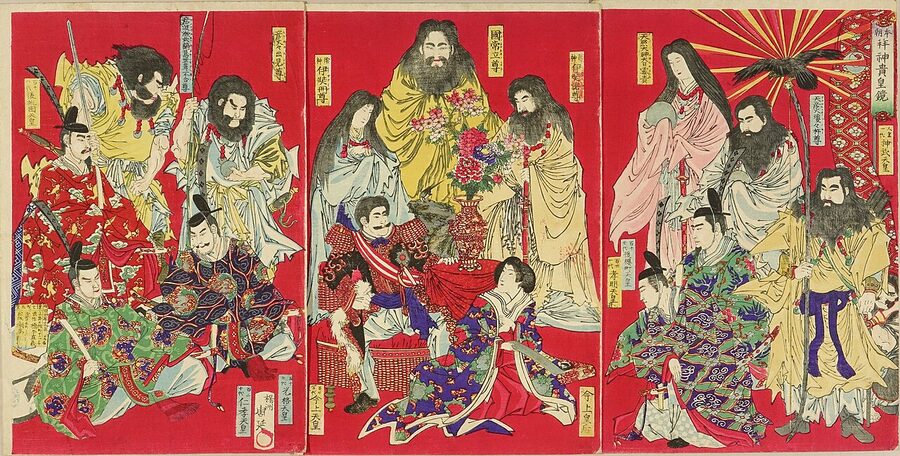
I find this kind of ritual fascinating, because the most powerful objects in Japanese imperial tradition are powerful precisely because nobody is allowed to look at them. The Sanshu no Jingi (三種の神器) are the sword, mirror, and jewel that, in Shinto myth, the sun goddess Amaterasu handed down to her grandson Ninigi when he descended from the High Plain of Heaven to rule the islands. From Ninigi they passed to Emperor Jimmu in 660 BCE, and from Jimmu through every emperor since.
That, at least, is the story Japanese myth tells. It is also the story the imperial accession ceremony still acts out today.
In This Article
- Three Objects, Three Virtues
- Where the Three Treasures Live
- Susanoo, the Drunken Serpent, and the First Sword
- How Kusanagi Got Its Modern Name
- The Mirror, Amaterasu, and the Cave
- Ise and the 20-Year Rebuild
- The Magatama, the One Real Original
- The Hi River and the End of the Heike
- What Sank, and What Came Back Up
- The Replicas, the Court, and the Three Palace Sanctuaries
- From Kyoto to Tokyo: The Meiji Move
- Hirohito, the War, and the “At All Costs” Order
- Reiwa: The Boxes Nobody Opened
- Replicas Within Replicas
- Oda Nobunaga and the Limits of Reverence
- Edo and the Doubled Capital
- The Meiji Restoration and the Modern Cult
- Festivals and the Living Tradition
- Tokugawa Tsunayoshi and the Fragile Court
- What Is It Like to See What You Cannot See
- Why the Regalia Still Matter
- Connection to the Sword Tradition
- What You Can Actually See If You Visit
- One Last Anecdote About the Edo-Period Priest
- If You Want to Go Deeper
Three Objects, Three Virtues
The three regalia are easy enough to list, harder to actually pin down. The sword is Kusanagi-no-Tsurugi (草薙剣), the Grass-Cutting Sword. The mirror is Yata-no-Kagami (八咫鏡), the Eight-Span Mirror. The jewel is Yasakani-no-Magatama (八尺瓊勾玉), the Curved Jewel of Eight Shaku.
Each one stands for a virtue an emperor is supposed to embody. The sword represents valour. The mirror represents wisdom, sometimes translated as honesty, because a polished bronze surface tells you only what is in front of it. The jewel represents benevolence.
Together they make up the trinity of qualities that Shinto theology insists a sovereign needs to rule properly. You will hear the regalia called Imperial Treasures or simply the Three Sacred Treasures in English, but the Japanese phrase Sanshu no Jingi has a specific connotation. Jingi means “sacred vessel” in the Shinto sense, the body in which a kami can dwell.
These are not symbols of office in the European crown-jewel sense. They are objects considered to actually contain divine presence.
Where the Three Treasures Live
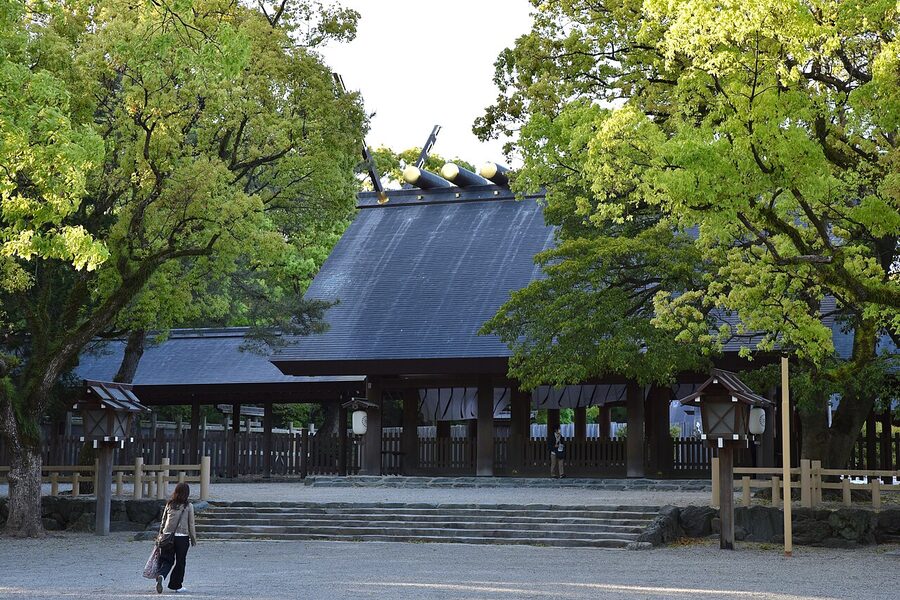
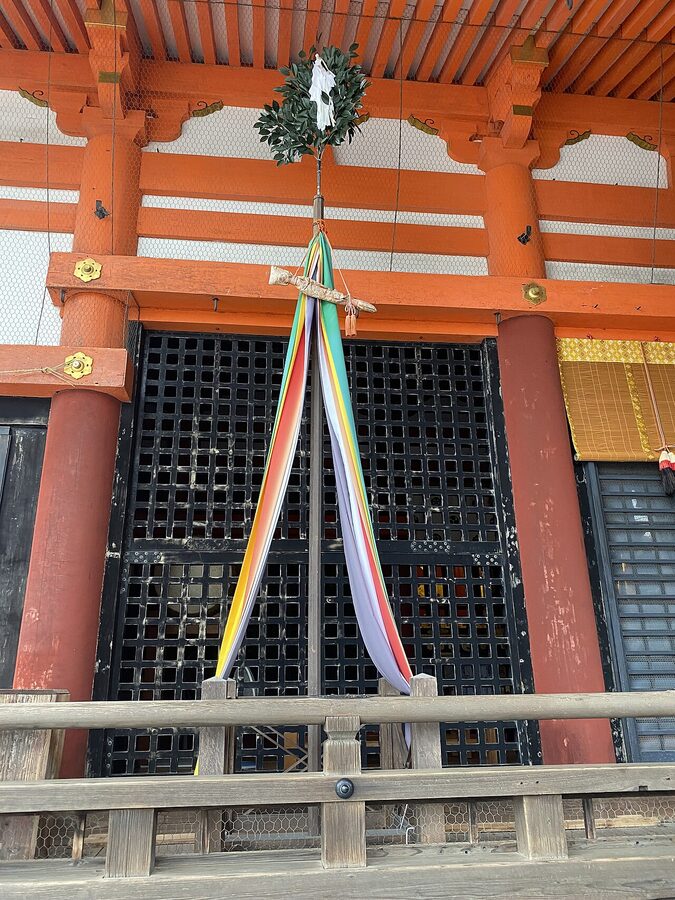
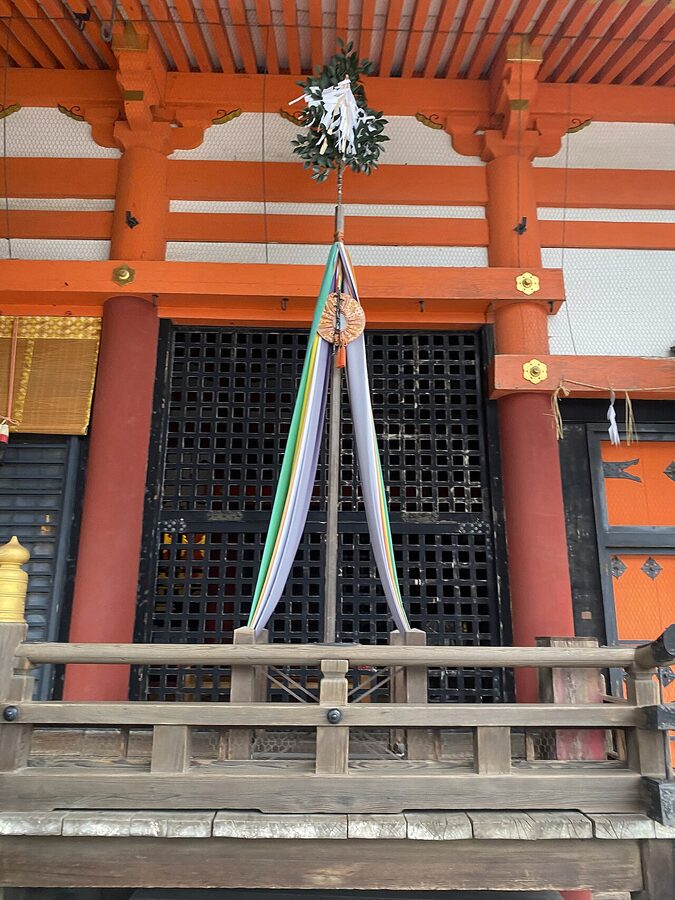
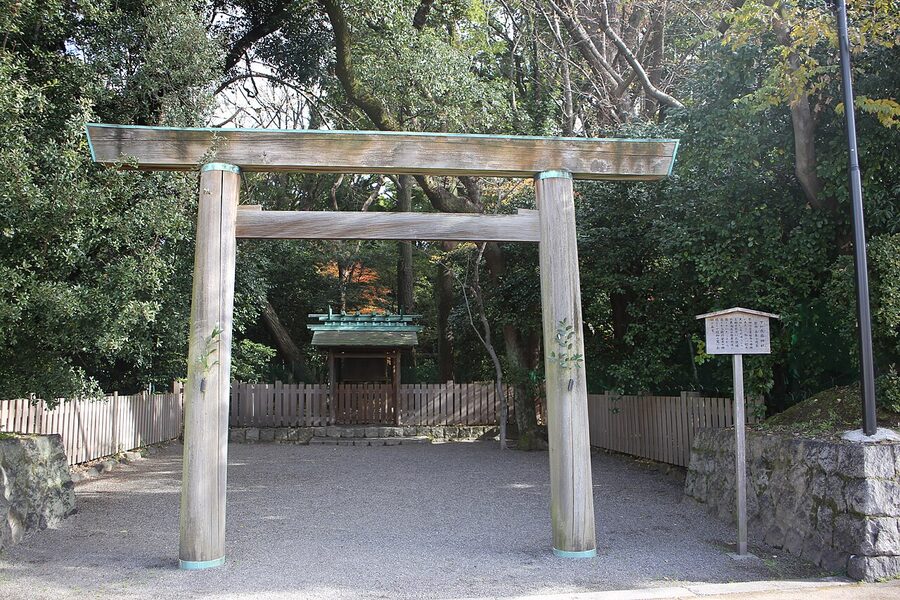
Two of the regalia are nominally not in Tokyo at all. The sword Kusanagi is enshrined at Atsuta Shrine in Nagoya. The mirror Yata-no-Kagami is enshrined at the Inner Shrine of Ise Grand Shrine in Mie Prefecture. Only the jewel, Yasakani-no-Magatama, is held at the Imperial Palace in Tokyo, in the Three Palace Sanctuaries (宮中三殿) inside the imperial residence.
That split makes practical sense if you accept the mythology, because the regalia were entrusted to the imperial line for safekeeping, not for hoarding. Atsuta and Ise are two of the oldest and most prestigious Shinto shrines in Japan. The shrines guard the originals; the palace, since the Heian period, has held replicas (御形代, mikatashiro) for use in actual court rites.
The complication is that nobody at the shrines, the palace, or the Imperial Household Agency will confirm which version is which. The sword you cannot see at Atsuta might be the original, or it might be a centuries-old replica. The mirror at Ise might be the actual mirror Amaterasu spoke into, or it might be a substitute made after one of the many palace fires.
Even priests of the highest rank are forbidden to look. The objects retain their authority partly because their identity is never tested.
Susanoo, the Drunken Serpent, and the First Sword
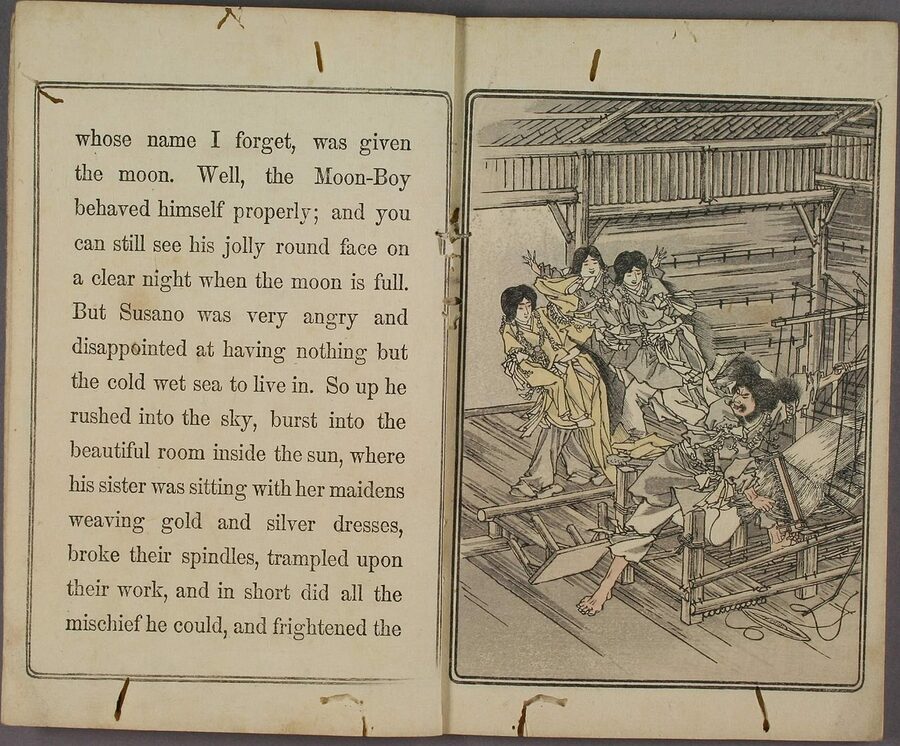
The sword has the most theatrical origin story of the three, and you can read about it in both the Kojiki (712) and the Nihon Shoki (720), the two earliest Japanese chronicles. The setting is Izumo Province on the Sea of Japan. There, the storm god Susanoo had been exiled from heaven after a tantrum that included flaying a horse and throwing it into his sister Amaterasu’s weaving hall.
Susanoo wandered along the Hi River and came upon an elderly couple, Ashinazuchi and Tenazuchi, weeping with their last surviving daughter, Kushinada-hime. The couple explained that an eight-headed, eight-tailed serpent named Yamata-no-Orochi had eaten seven of their daughters, one each year. The eighth was due to be taken next.
The serpent’s eyes were red as winter cherries. Its body sprawled over eight valleys and eight ridges. Cypresses and cedars grew on its back. It is the kind of monster that exists in oral tradition before anyone tries to draw it.
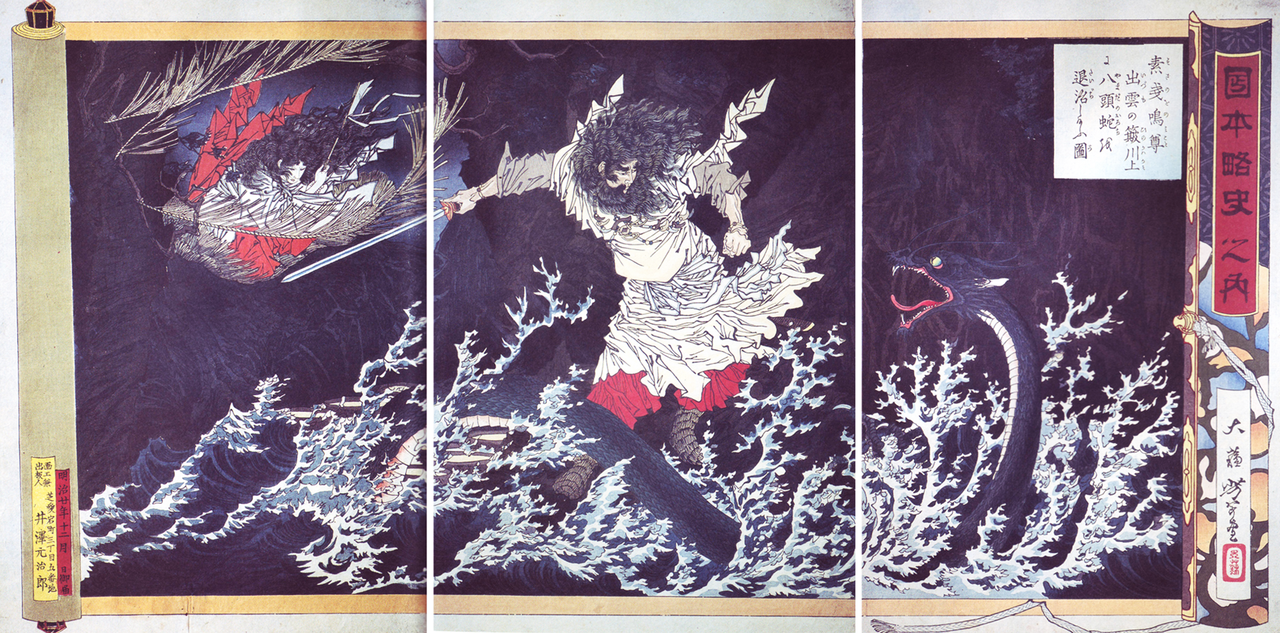
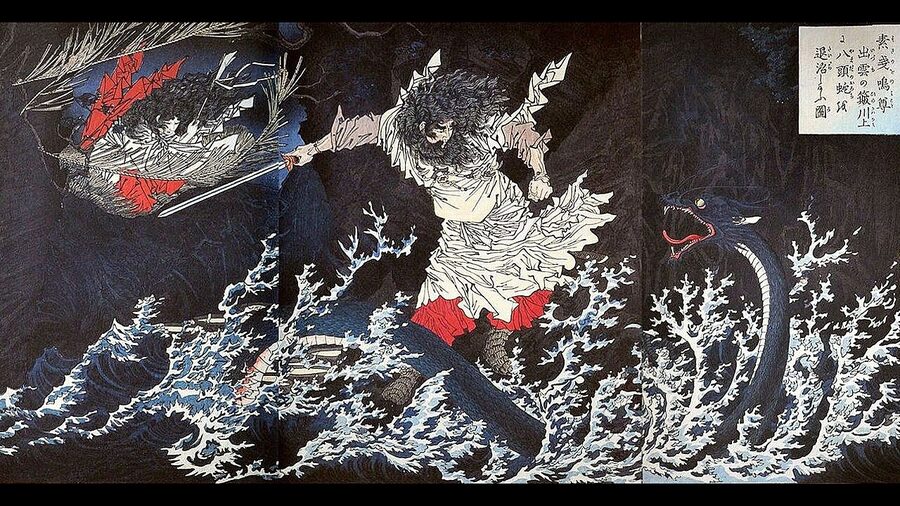
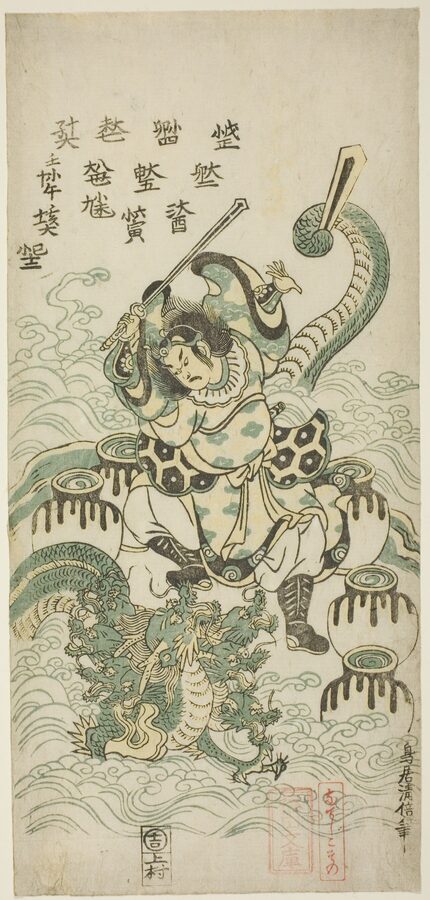
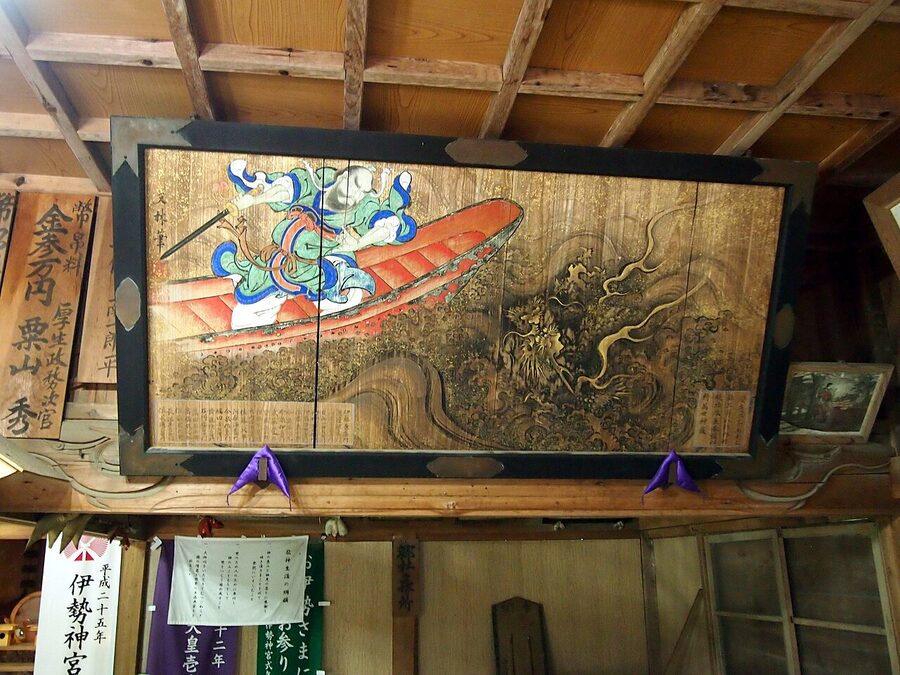
Susanoo’s plan was clever and a little cruel. He turned Kushinada-hime into a comb and stuck her in his hair to keep her safe. Then he had the parents brew eight vats of strong sake and place them inside an eight-gated palisade. The serpent arrived, dipped one head into each vat, drank itself stupid, and fell asleep.
Susanoo then attacked. He hacked through seven of the necks with no trouble. On the eighth, his sword struck something hard and chipped. He cut the tail open and found a blade inside, gleaming and unfamiliar.
He named it Ame-no-Murakumo-no-Tsurugi (天叢雲剣), the Heavenly Sword of Gathering Clouds, because clouds had been forming above the serpent. As an act of contrition for his earlier behavior, he sent the sword up to Amaterasu in heaven. That is how the sword entered the imperial line in the first place.
How Kusanagi Got Its Modern Name
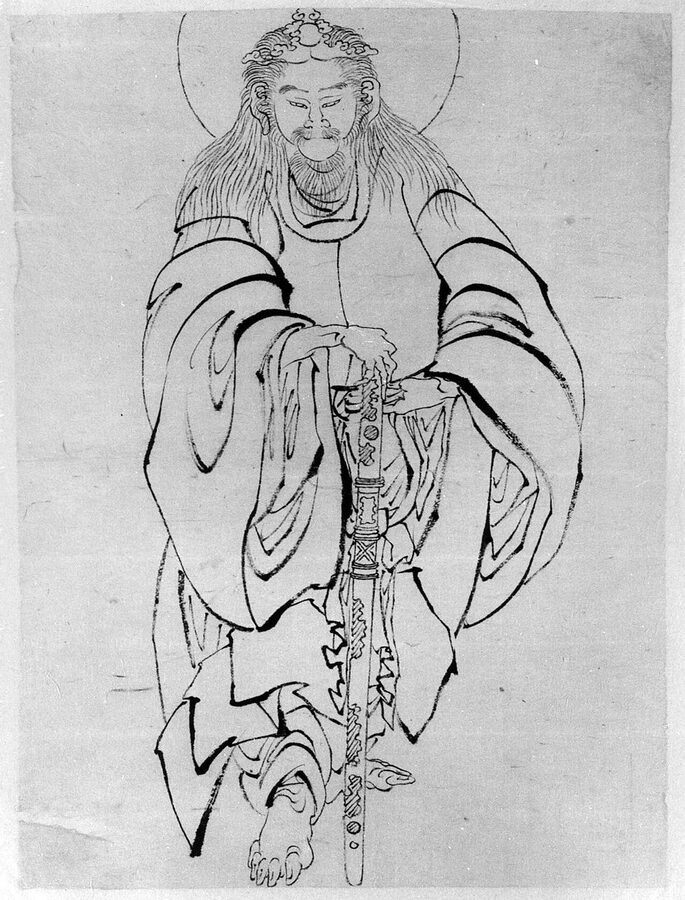
The sword’s second name, Kusanagi (Grass-Cutter), came generations later, during the lifetime of Yamato Takeru, the legendary prince-warrior of the early Yamato court. He was a great-great-grandson of Ninigi and a son of Emperor Keiko, whose reign Japanese tradition places between 71 and 130 CE. Yamato Takeru’s aunt, the high priestess of Ise, gave him the sword for protection on a campaign east.
The story goes that a treacherous warlord lured him into a grass plain and set the grass on fire, planning to burn him alive. Yamato Takeru drew the sword and discovered it could control wind. He cut the grass around him and turned the flames back on the men who had lit them.
After that escape, the sword was called Kusanagi-no-Tsurugi. Same blade, new nickname.
Atsuta Shrine itself, according to its own records, was founded in 192 CE specifically to enshrine the sword after Yamato Takeru’s death. The shrine sits about 20 minutes south of central Nagoya by subway. Most of its current buildings date from a postwar reconstruction that finished in 1955 after the original main hall was destroyed in 1945 air raids.
If you visit, you are walking through a midcentury shrine guarding a sword no living person can describe. The shrine complex covers about 200,000 square meters and gets close to nine million visitors a year. Almost none of those visitors realize how strange it is to walk past a sword nobody has officially seen for 800 years.
The Mirror, Amaterasu, and the Cave
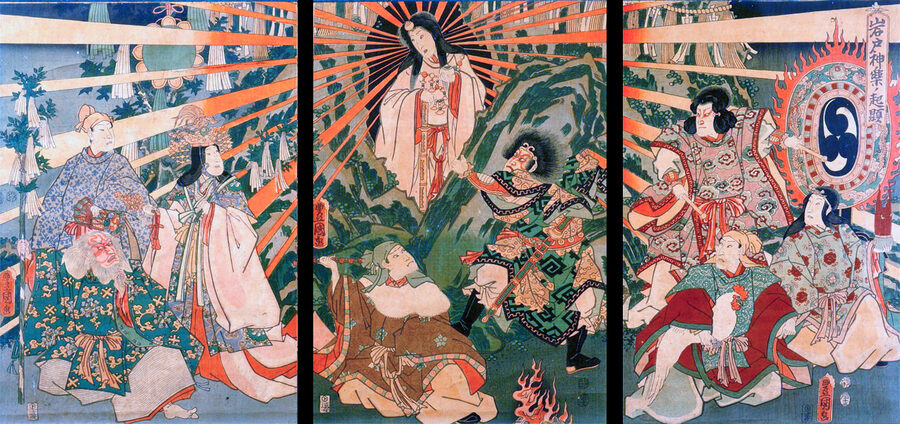
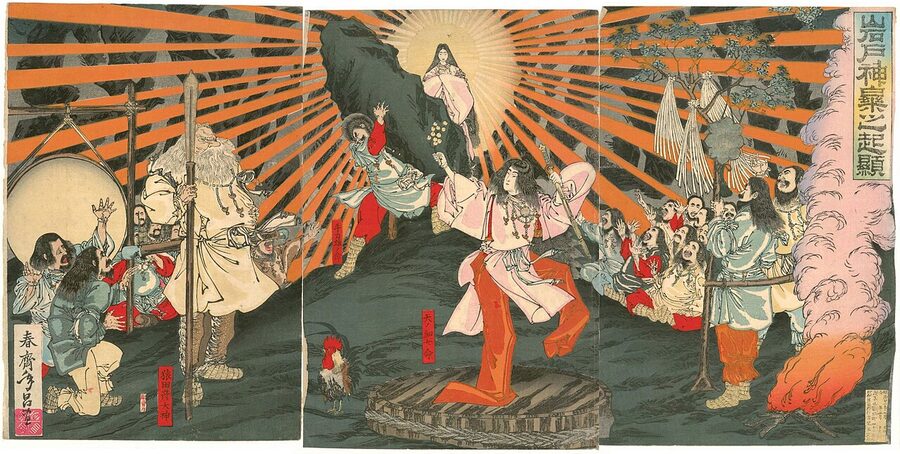
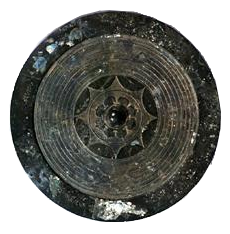
The mirror has the oldest and weirdest origin of the three. The story is set entirely among the kami, before anything resembling a human emperor existed. Amaterasu, after Susanoo’s outrages, retreated into the heavenly cave Ame-no-Iwato, sealing herself in. The world went dark.
The other kami panicked. To lure her out, the gods staged a kind of cosmic distraction. The deity Ishikoridome forged a mirror from heavenly metals. The deity Tamanoya threaded magatama jewels onto a sakaki tree.
The dawn goddess Ame-no-Uzume danced lewdly on an overturned tub until the assembled gods roared with laughter. Amaterasu, curious about the noise, opened the cave a crack and saw her own reflection in the mirror they had hung outside, mistaking it for a brighter goddess. She came forward to look more closely. The other kami yanked her out and sealed the cave behind her.
That mirror is the one Amaterasu later gave to Ninigi, with explicit instructions: “Treat this mirror exactly as you would treat me. Worship it as you worship me.” It is the only one of the three regalia that Amaterasu speaks directly through. That is why the mirror is sometimes ranked first among the three in importance, even though the sword has the better stories.
Ise and the 20-Year Rebuild
The mirror’s home is Naiku, the Inner Shrine of Ise Grand Shrine, in the city of Ise in Mie Prefecture. The shrine is dedicated to Amaterasu directly. Tradition dates its founding to about 4 BCE, when the imperial princess Yamatohime spent 20 years searching for the right place to enshrine the sun goddess and her mirror, settling at last on the banks of the Isuzu River.
What makes Ise unique is the Shikinen Sengu (式年遷宮), the ritual rebuilding cycle. Every 20 years, the entire main shrine is taken down and reconstructed beside it on a parallel plot, using fresh Japanese cypress and no nails. The mirror is moved across to the new building. The old building is dismantled.
The current iteration is the 62nd, completed in 2013. The next rebuild is scheduled for 2033.
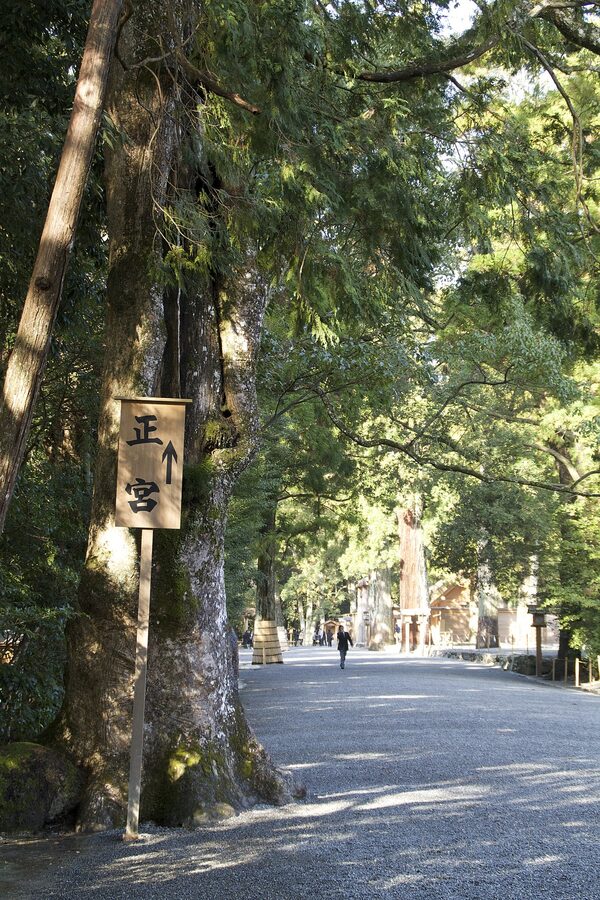
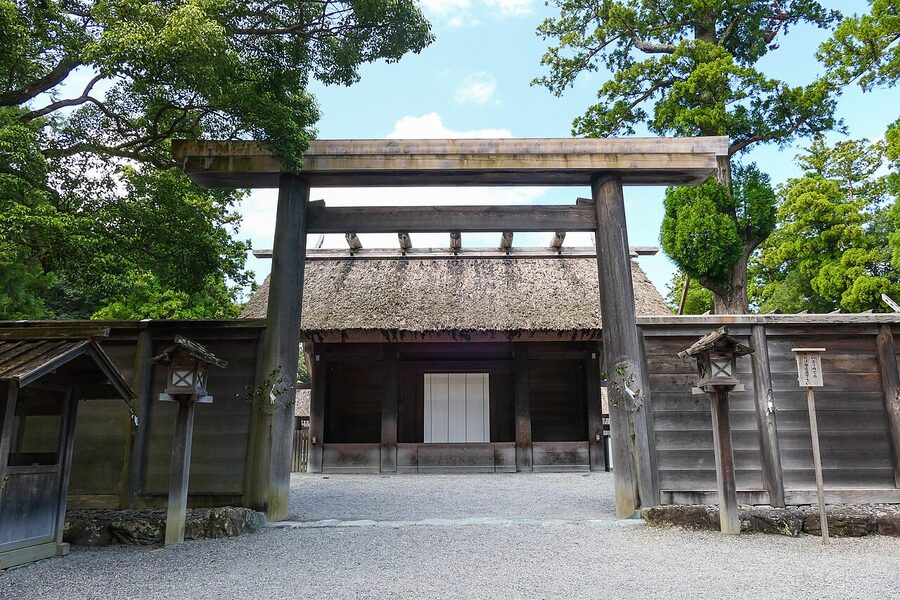
The mirror itself, according to the records, lives in the shoden, the innermost sanctuary, in a chamber that almost no one entering Ise will ever even glimpse. There was a fire in the ninth lunar month of 1040 that destroyed the chamber housing it. Chronicle accounts insist the mirror itself survived undamaged.
Whether that is literally true or a face-saving palace claim is the kind of question nobody is permitted to investigate.
The Magatama, the One Real Original
The jewel is the strangest of the three, because it is, by most accounts, the only one of the three regalia that is still genuinely an original, in continuous use without a replica. Magatama (勾玉) are curved comma-shaped beads made of jade, jasper, agate, or other stones. They appear in Japanese archeological sites going back to the Jomon period, more than 5,000 years ago.
By the Yayoi and Kofun periods (roughly 300 BCE to 538 CE), magatama were standard high-status grave goods.
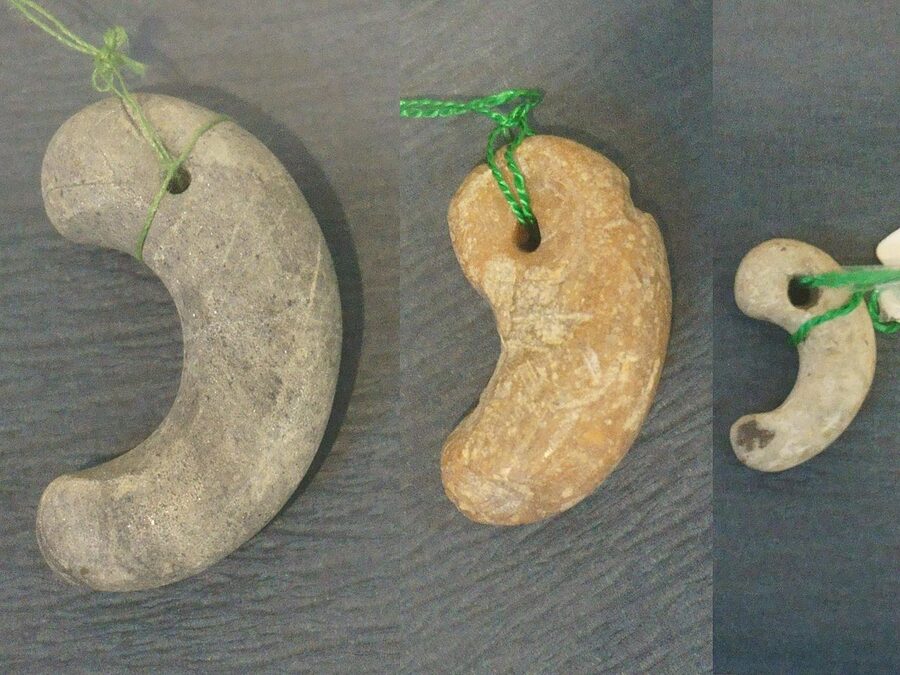
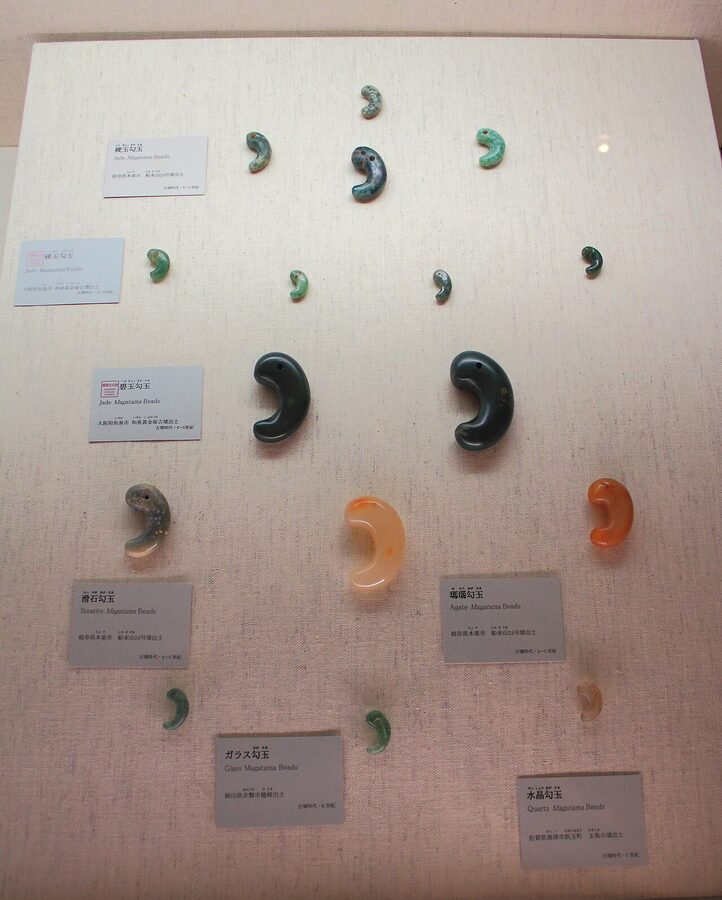
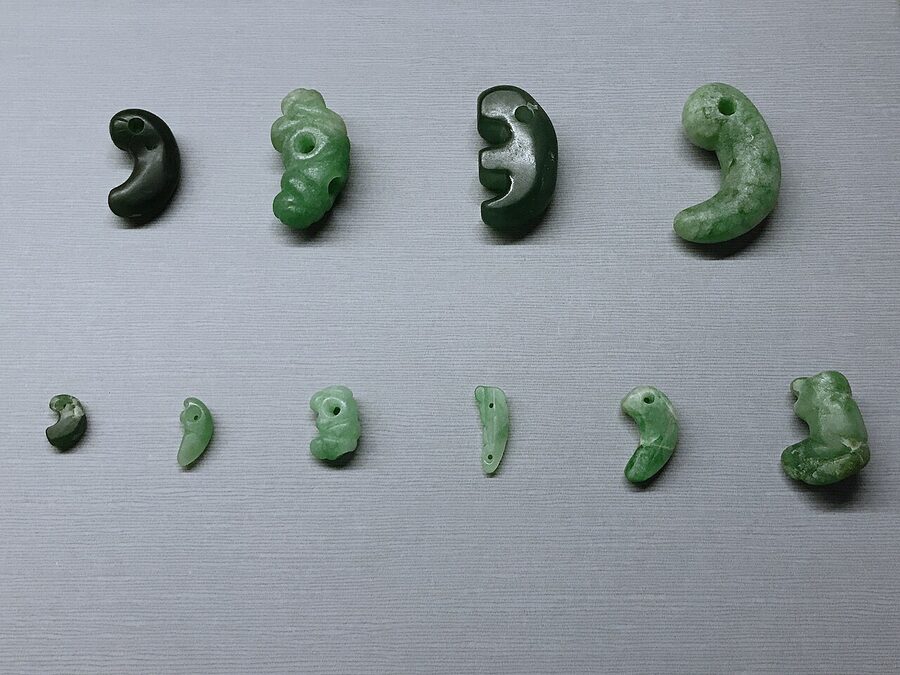
The sacred magatama, Yasakani, is named for its size: yasaka means “eight shaku” or roughly two and a half meters in old Japanese measurement. That is almost certainly a poetic exaggeration for a single bead. More likely it refers to a string of magatama of substantial total length.
The myth says it was forged by Tamanoya and threaded onto the same sakaki tree as the mirror during the Ame-no-Iwato episode. Why is this the only original to survive? The jewel was small and durable. The mirror cracked in fires.
The sword was lost at sea, more than once. Polished stone, by contrast, is almost indestructible. So the bead, or string of beads, that emperors handle today is plausibly the same physical object that was being passed along when the imperial line first formalized the regalia tradition in the seventh or eighth century.
The Hi River and the End of the Heike
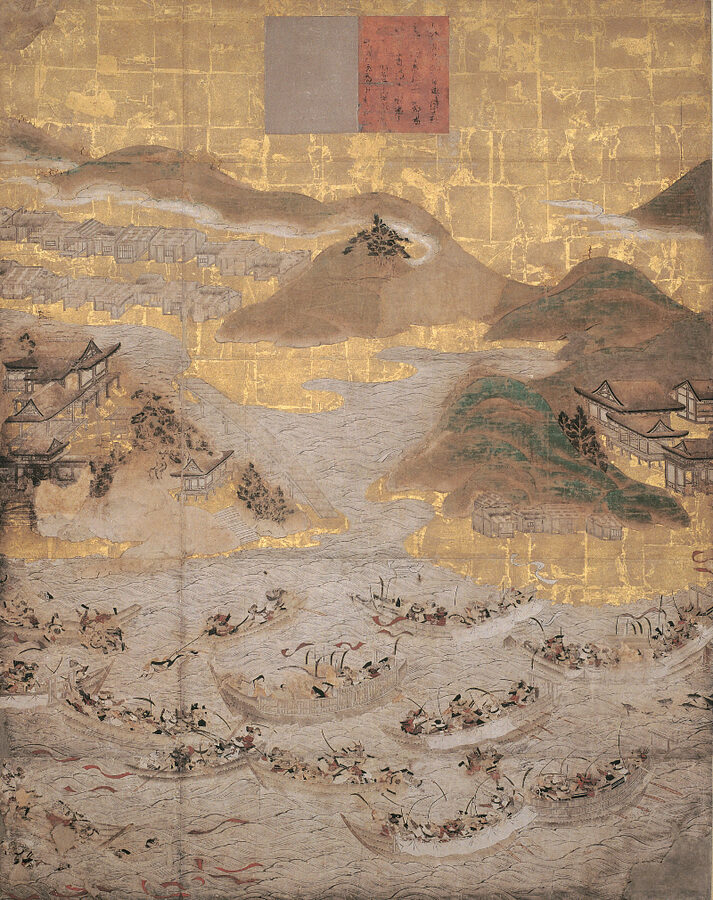
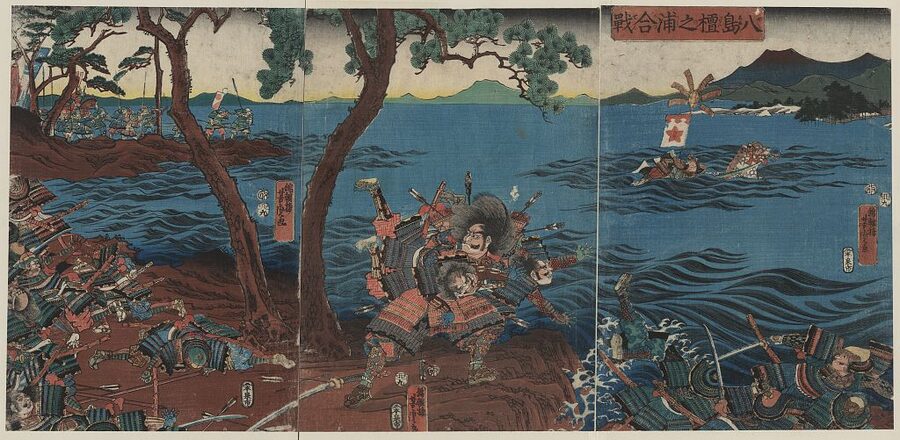
If the regalia have one truly disastrous moment in their long career, it is the Battle of Dan-no-Ura on April 25, 1185. The battle was the final naval engagement of the Genpei War, the civil war that ended the dominance of the Taira clan and brought the Minamoto, and Japan’s first shogunate, to power. The Taira had spent the previous year retreating south through the Inland Sea, taking with them the seven-year-old Emperor Antoku and the Three Sacred Treasures.
The fleets met in the Kanmon Straits, the narrow channel between Honshu and Kyushu off Shimonoseki. The morning tide favored the Taira. By afternoon it had reversed. A Taira commander named Taguchi Shigeyoshi defected mid-battle and turned his ships against his former allies, and the engagement collapsed into a rout led by the Minamoto general Yoshitsune.
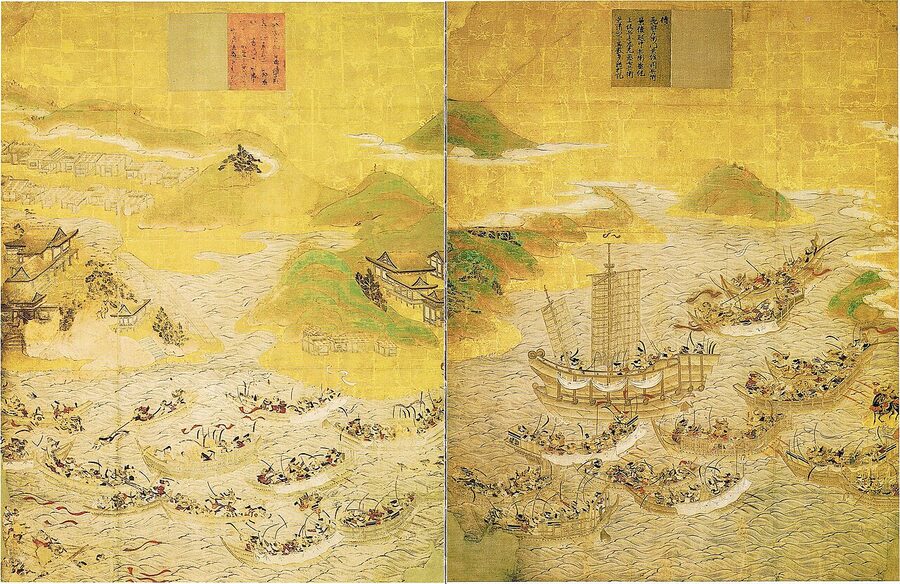
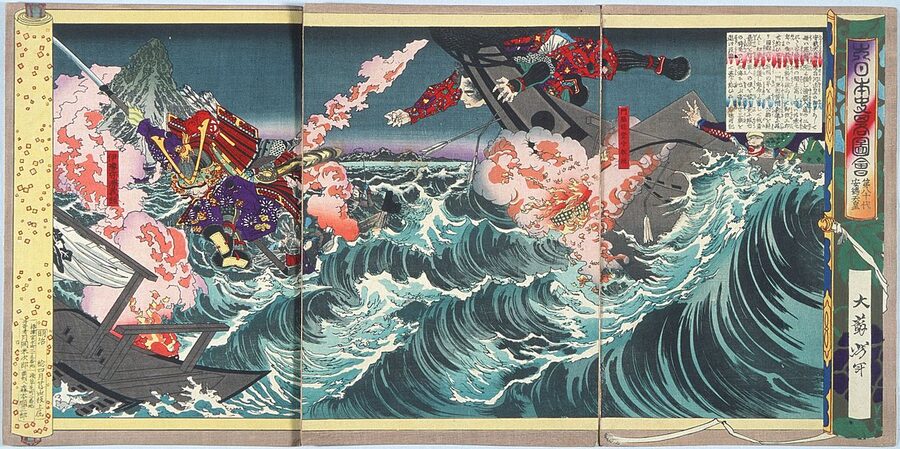
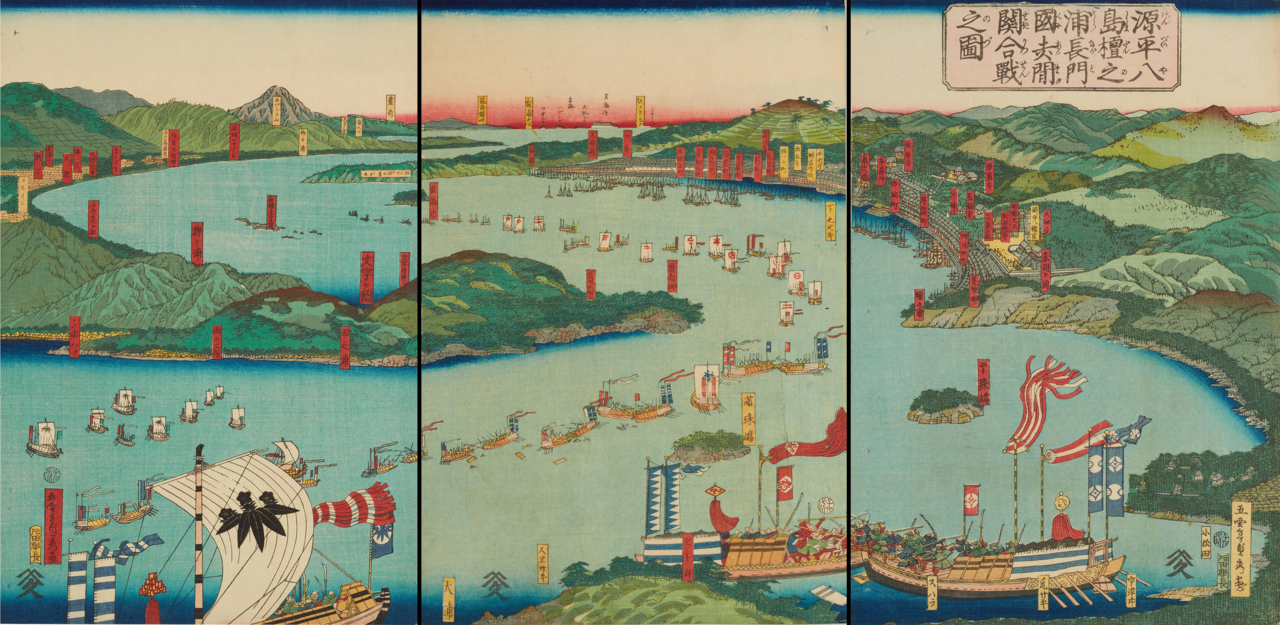
Antoku’s grandmother was Taira no Tokiko, also called Niinodono or Nii-no-Ama, the widow of Taira no Kiyomori. Realizing the battle was lost, she gathered the boy emperor in her arms and carried him to the side of the ship. The 13th-century Heike Monogatari preserves the speech she made, telling Antoku that there was a capital under the waves where they would not be defeated.
Then she stepped off the deck with him and the regalia.
What Sank, and What Came Back Up
What followed is the most consequential salvage operation in Japanese mythological history. Minamoto divers worked the strait for days. They recovered the mirror, in its box. They recovered the jewel, also intact.
The sword, by every credible chronicle account, was not found. The Heike Monogatari and the Gukansho both say the sword was lost. Later sources tried to soften this with stories of a supernatural recovery, of a fisherman finding the blade in his net, of priests forging a substitute that was magically infused with the same kami.
The version most often told today is that a substitute, made earlier in the Heian period as a court replica, took over as the operational sword while the original lay on the seabed off Shimonoseki.
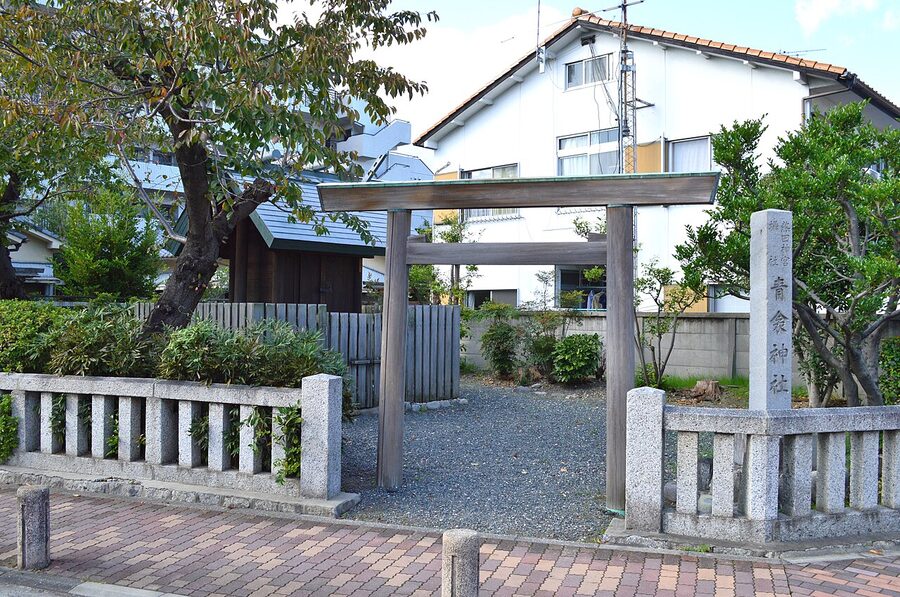
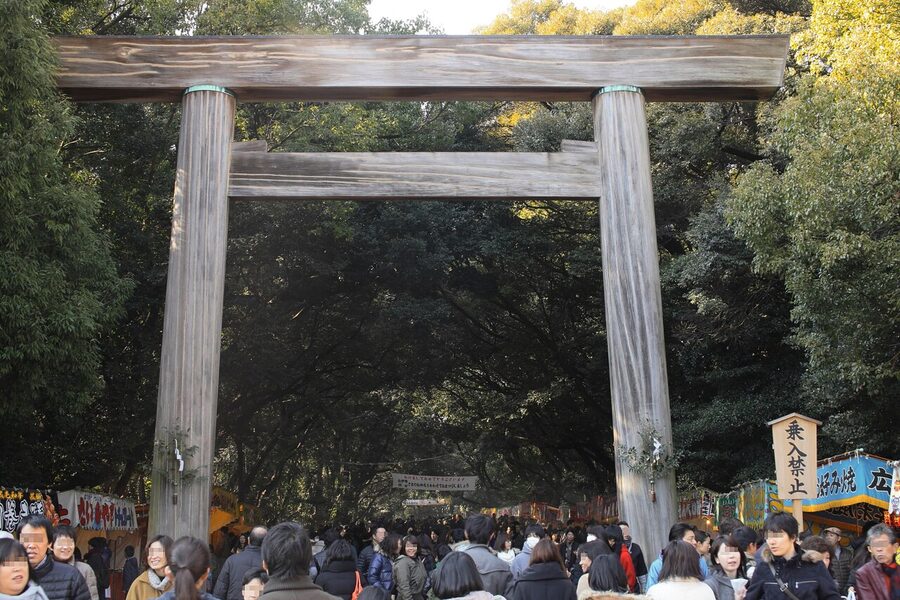
Whatever happened, the sword that resides at Atsuta today is the operational Kusanagi for ritual purposes. The Imperial Household Agency is content to leave the question of its physical history alone.
A Shinto priest named Matsuoka Masanao did peek at the bundle in the Edo period and recorded that the blade was about 82 centimeters long with a distinctive shape. He was, depending on which retelling you read, either fired, exiled, or struck with a mysterious illness for his trouble. The lesson everyone took from his disobedience was simple: stop opening the bundle.
The Replicas, the Court, and the Three Palace Sanctuaries
Replicas of the sword and mirror were created during the Heian period, with the earliest documented sword formae dating to the ninth century and the most consequential replica, the one used in coronations, made in the 12th century. These mikatashiro (御形代) were not understood as fakes. In Shinto theology, a kami can occupy more than one body, and a replica properly consecrated and ritually treated holds the same divine presence as the original.
That theology is what allows the imperial court to function. The original Kusanagi sits at Atsuta. The original mirror sits at Ise.
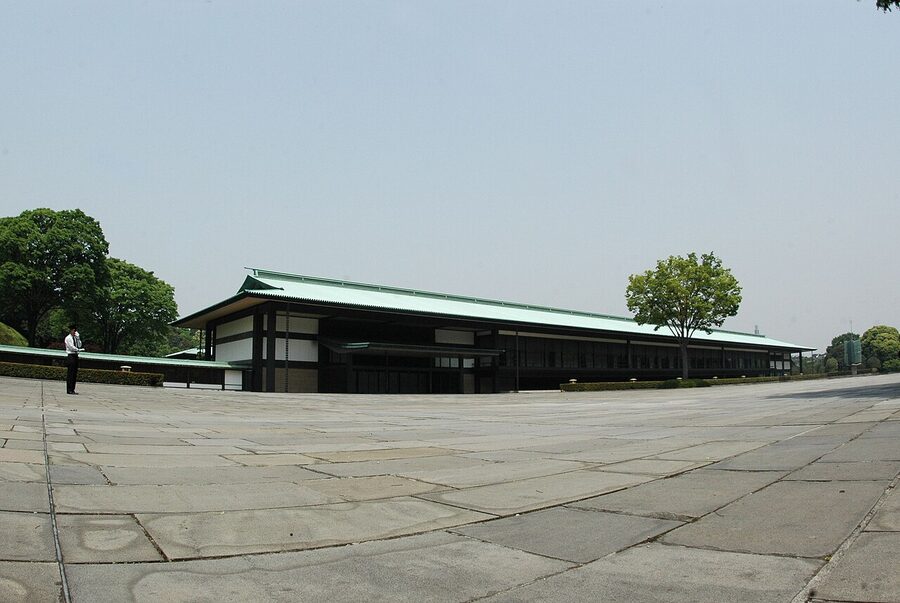
Their replicas sit at the Imperial Palace, in the three small wooden buildings of the Kyuchu Sanden (宮中三殿), the Three Palace Sanctuaries inside the imperial residence. The buildings are the Kashiko-dokoro (賢所, mirror), the Korei-den (皇霊殿, ancestors), and the Shinden (神殿, kami of heaven and earth).
The Kashiko-dokoro is the most important of the three sanctuaries because it houses the mirror replica. The current mirror replica is treated as the operational mirror in palace rites, while the Ise mirror remains in its sealed chamber as the absolute spiritual original. The jewel, the only authentic original, is kept in the imperial residence proper rather than at Ise or Atsuta. That fits the logic that the most precious thing should stay closest to the emperor’s daily life.
From Kyoto to Tokyo: The Meiji Move
For most of Japanese history, the Three Palace Sanctuaries were in Kyoto, because the imperial capital was in Kyoto. After the 1868 Meiji Restoration, the young Emperor Meiji moved his court to the former Tokugawa Edo Castle, which became the Tokyo Imperial Palace. The regalia and the sanctuaries moved with him.
This was a logistical operation as much as a symbolic one. Contemporary accounts treat it as a delicate, multistage transfer with riders and palanquins traveling under heavy guard along the Tokaido road.
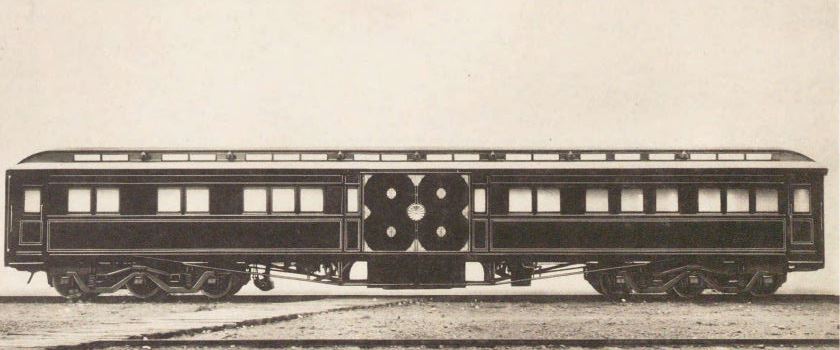
Once installed in Tokyo, the regalia mostly stayed put. They left the city only twice in the 20th century: once for Emperor Taisho’s enthronement in Kyoto in 1915, and once for Emperor Hirohito’s in Kyoto in 1928. In each case the sword and the jewel made the trip, while the mirror replica stayed in Tokyo and was substituted with a different ceremonial mirror.
The 1928 procession was the last public appearance of the sword and jewel before the Reiwa accession of 2019. You may already know about the postwar Tokyo Imperial Palace if you have read about Edo Castle, since the modern palace inherits the moat layout of the Tokugawa castle. The fact that the imperial residence sits inside an old shogun’s fortifications is one of those Japanese juxtapositions that, once you notice it, you cannot stop noticing.
Hirohito, the War, and the “At All Costs” Order
The most acute survival crisis the regalia faced in modern history came in the summer of 1945. On July 25 and again on July 31, Emperor Hirohito told the Lord Keeper of the Privy Seal, Marquis Kido Koichi, that the Three Sacred Treasures were to be protected at all costs. Hirohito’s recorded conversation makes clear he was prepared to die personally to keep them out of Allied hands.
This was not theatrical loyalty to objects. By 1945, the regalia were the operational center of the imperial cult that the Meiji and Taisho governments had built around the throne. To lose them would have been, in the imperial worldview, to lose the line itself.
There were contingency plans to move the regalia from the palace and from Atsuta and Ise into mountain caves if the home islands were invaded. None of those plans had to be executed.
Atsuta Shrine, however, was hit during American air raids. The Kaijo-mon (Sea Gate) burned on May 17, 1945. The Chinko-mon went on July 29, 1945, both designated National Treasures destroyed in eight weeks.
The shrine claims, and most historians accept, that the inner buildings holding the sword survived. Whether the sword was moved to a contingency site at any point during 1945 is one of the questions Atsuta priests still decline to answer.
Reiwa: The Boxes Nobody Opened
Emperor Akihito announced his intention to abdicate in August 2016. The legislation enabling it passed in June 2017, and the actual abdication took place on April 30, 2019, with the Taiirei-Seiden-no-gi (退位礼正殿の儀) ceremony in the State Room of the Tokyo Imperial Palace. Akihito gave up the regalia. They stayed in their boxes the whole time.
The next morning, on May 1, 2019, Emperor Naruhito received them in a ceremony called Kenji-to-Shokei-no-gi (剣璽等承継の儀), literally “the rite of inheriting the sword and jewel and so on.” Court chamberlains carried two black lacquered boxes into the Pine Room (Matsu-no-Ma) and placed them on tables to either side of the new emperor. Inside one box was the sword Kusanagi (or rather, its operational replica). Inside the other was the jewel, the Yasakani-no-Magatama.
The mirror remained at Ise; a state seal and a privy seal also accompanied the regalia for legal continuity reasons.
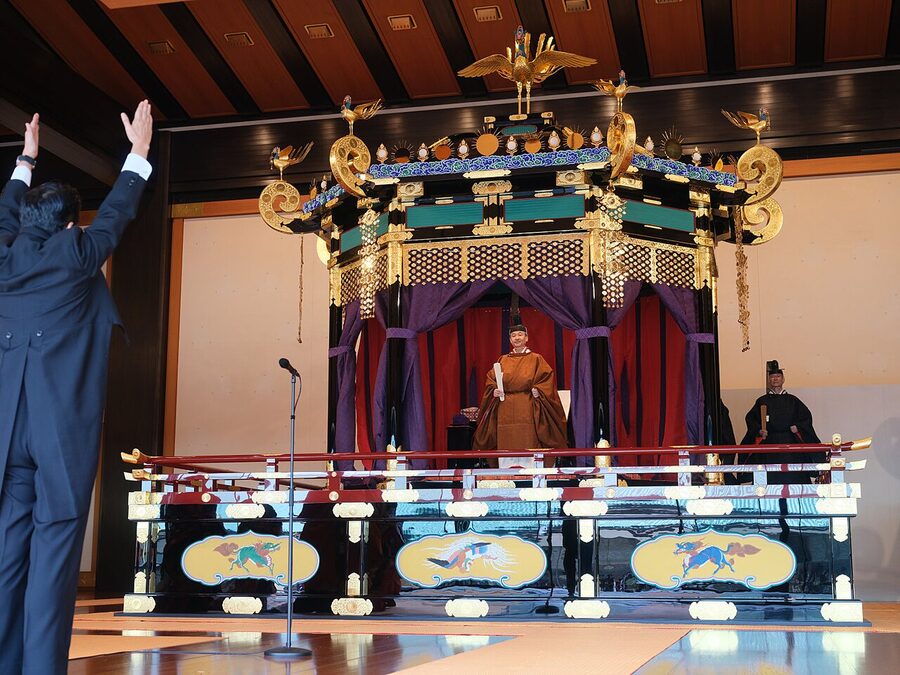
One detail I find quietly remarkable is that no woman attended the May 1 ceremony. Empress Masako was not present. Crown Princess Kiko was not present.
Under the current Imperial Household Law, only male royals participate in the Kenji-to-Shokei-no-gi, a constraint the government has revisited and shelved several times. The October Sokuirei followed three weeks later and included foreign dignitaries, but the actual transfer of the sacred objects happened in a male-only room.
This is the kind of constitutional knot Japan keeps tying itself into with these objects. A 21st-century constitutional monarchy organizes the most important succession rite of the reign around objects nobody can see, in a room that excludes the empress, by passing them from one elderly male to a younger male.
Whether that is durable for the long term is a real political question. Whether it works as theater, however, is unambiguous: it absolutely works. The world watched.
Replicas Within Replicas
The strangeness compounds when you think about how many copies are involved. The Reiwa boxes contained mikatashiro, replicas. The Atsuta sword may itself be a replica, depending on which medieval account you trust.
The Ise mirror, after a thousand years of fires, may also be a replica of the original, with the original lost in some 11th-century blaze and reconstituted afterward. What this means in practice is that the imperial line may be passing along, in theological terms, the kami-presence rather than the physical object. The regalia work because a long enough chain of priests have agreed they work.
That is a more interesting form of authenticity than mere material continuity. Japanese culture, with its 20-year Ise rebuild and its endless tradition of recreating wooden buildings to original spec, has more practice with this kind of authenticity than almost any other tradition I can think of.
Oda Nobunaga and the Limits of Reverence
Not every Japanese ruler treated the regalia with the requisite awe. Oda Nobunaga, the late-16th-century warlord who came closest to unifying the country before being assassinated in 1582, was famously irreverent about almost every form of authority, including the imperial cult. Nobunaga maintained the symbolic protocol but treated the emperor as a useful figurehead and the court as a tool. He restored the imperial palace and contributed to its finances, then ignored its political wishes wholesale.
Nobunaga is also one of the few late-medieval figures known to have asked priests at Atsuta direct questions about the sword. He was reportedly told, like everyone else, that no one knew. Whether he believed it or simply moved on to other matters, his court left no record of the answer.
After Nobunaga came Toyotomi Hideyoshi, after Hideyoshi came Tokugawa Ieyasu. The tradition that the regalia were sacred and unseeable settled back into place for the entire Edo period.
Edo and the Doubled Capital
One thing the Edo period did to the regalia was institutionalize the doubled-capital structure that would shape Japan for two and a half centuries. The emperor and his sanctuaries stayed in Kyoto. The shogun lived in Edo. Daimyo from across the country traveled between the two cities under the sankin-kotai alternate attendance policy, with their families effectively held hostage in Edo while they served their domains.
The regalia inside Kyoto’s imperial precinct were one of the things that legitimized this whole arrangement. The shogun ruled because the emperor delegated authority. The emperor ruled because the regalia were intact.
The whole pyramid of legitimacy in Tokugawa Japan rested on objects that, even at the time, only a handful of priests had ever supposedly seen. That worked surprisingly well as governing ideology for 268 years.
The Meiji Restoration and the Modern Cult
When the Tokugawa system collapsed in 1868, the new Meiji government did not relax the secrecy around the regalia. It intensified it. State Shinto, codified between the 1870s and 1945, made the imperial line the linchpin of national identity, and the regalia became the physical anchor of that line.
Schoolchildren learned the myths as if they were history. The 660 BCE founding date of Emperor Jimmu was treated as an actual calendar fact.
That ideology drove a great deal of 19th- and 20th-century Japanese politics, including Japan’s overseas wars. Reformers like Saigo Takamori, who helped bring the Meiji emperor to power and then watched the new system transform into something they did not recognize, would have been the first to say that the regalia ideology had run away with itself.
Saigo himself died in 1877 leading a revolt against the very Meiji government he had founded, and the ideology of imperial continuity continued without him.
Festivals and the Living Tradition
The other thing to understand about the regalia is that they exist alongside a living, year-round festival tradition that keeps the underlying mythology current. Atsuta hosts more than 70 ceremonies a year, including a June 5 Reisai festival that lights 365 lanterns and features procession of portable shrines. The Bugaku Shinji on May 1 is a court-style dance.
The Shinyo to Gyoshinji on May 5 is a procession to the western gate with prayers for the security of the imperial palace.
The Shinto mythology these festivals draw on is the same mythology you encounter at Toyokawa Inari in Aichi, or at Gion Matsuri in Kyoto. Each major shrine is a node in a single network of stories about Amaterasu, Susanoo, Inari, the dragon kings, the kami of mountains and rice.
The regalia are the highest-status objects in that network, but they share a theology with the magatama that an ordinary visitor can buy as a souvenir at any shrine shop.
Tokugawa Tsunayoshi and the Fragile Court
The Edo-era relationship between shogun and emperor had its quirks, and the period of Tokugawa Tsunayoshi, the fifth Tokugawa shogun who ruled from 1680 to 1709, is a useful example. Tsunayoshi was famously erratic about Buddhist policy and protective of animal life, but on the question of the imperial court he was careful and thorough. He funded ceremonies, restored shrine grants, and kept Atsuta and Ise solvent.
This was not generosity. It was politics. A solvent imperial court was a quiet imperial court. A quiet imperial court did not threaten Tokugawa rule.
The regalia, in their boxes, were a kind of self-managing political asset that needed only steady funding to keep working. Tsunayoshi understood this, and so did every shogun before and after him.
What Is It Like to See What You Cannot See
I have been to Atsuta and to Ise. I have walked along the rope barrier outside the inner sanctuary at Naiku. I have stood at the haiden at Atsuta and clapped twice, bowed twice, clapped once more.
There is, in that ritual moment, an odd awareness that on the other side of the wooden screen sits an object I am theologically interacting with even though it is, in any literal sense, totally hidden from me. That structure of presence-without-sight is what the regalia are. The whole apparatus, from the Heian-period replicas to the cloth-wrapped boxes of 2019, was designed to make sure the encounter would always be mediated.
You face a shrine. The shrine faces a building. The building contains a chamber. The chamber contains a box.
The box contains a wrapped object. The object may or may not be the thing the myth describes. The entire structure works because every level reinforces the level above it.
Why the Regalia Still Matter
The Three Sacred Treasures are not just antiques. They are a working component of how Japan organizes its constitutional monarchy. The Imperial Household Law, the post-1947 civil legislation governing the throne, treats them as the ceremonial core of succession even though it does not require them to be unwrapped, examined, or even confirmed to exist by external parties.
That is a very particular kind of legal arrangement. It is the constitutional acknowledgment that some things in a culture are too important to verify.
You have probably encountered the same logic, in milder form, in the way certain religious objects are treated in other traditions: the Ark of the Covenant, the Shroud of Turin, the relics of saints. What is unusual in the Japanese case is that the objects are still operational.
They are not in a museum. They are not displayed for tourists. They are performing a function in 2026.
Connection to the Sword Tradition
One thing it would be strange not to mention is how Kusanagi sits relative to the rest of Japanese sword history. Kusanagi is the prototype, the first culturally important sword in Japanese mythology, the blade that all later sword-veneration ultimately points back to. When a 17th-century swordsmith forged a tachi for a daimyo and the smith’s family had been forging blades since the Heian period, the implicit reference, the metaphysical horizon, was always Kusanagi.
That is part of why Japanese sword culture is so unlike European weapon-history. In Europe, swords are usually individual artifacts: Excalibur, Joyeuse, Durendal. They have personalities.
Kusanagi has a personality, but it also has a kind of ancestor-status. It is the original. Every other Japanese sword is, in some implicit sense, descended from it. That gives Japanese sword culture a religious texture European sword culture mostly lacks.
What You Can Actually See If You Visit
If you go to Atsuta, the experience is essentially walking through a wooded shrine compound to a haiden, clapping, bowing, and walking back. The shrine treasure hall, the Bunkaden, holds about 4,000 objects including 174 Important Cultural Properties and one National Treasure dagger, which is on rotating display and worth seeing on its own merits. The sword Kusanagi is not in the Bunkaden.
The sword Kusanagi is somewhere behind walls you will never approach.
If you go to Ise, the experience is grander but similarly partial. You cross the Uji-bashi bridge over the Isuzu River, walk a long approach lined with cypress, pass through several gates, and stop at the outermost rope barrier of Naiku.
Beyond that point only priests go. The mirror is somewhere in there. You will never see it.
If you go to the Tokyo Imperial Palace, you can wander the East Garden, which used to be the inner bailey of Edo Castle, and you can see the moat and the Nijubashi bridge from the outside. The Three Palace Sanctuaries are inside the imperial residential zone, restricted even to most government officials. The jewel is in there. The jewel is the only one of the three regalia you have any meaningful chance of being in the same general building as, and you still cannot see it.
One Last Anecdote About the Edo-Period Priest
I want to come back to Matsuoka Masanao, the Atsuta priest who looked. The accounts of what he saw when he lifted the cloth and opened the box vary by source, which is itself diagnostic. One version says the blade was 82 centimeters with a fish-bone shape and white gleam.
Another says it was rust-encrusted and almost unrecognizable. A third version says he saw nothing, because the box was empty, and that he never spoke of the experience again.
Whichever account is true, the consequence was the same: subsequent priests stopped looking. The sword’s ritual identity matters more than its physical identity, and the only way to keep the ritual identity intact is to refuse the test.
That is, in miniature, the entire logic of the Three Sacred Treasures. They are objects whose authority depends on never being verified.
I find this oddly modern. You live in a world that wants everything documented, photographed, x-rayed, DNA-tested. Japan kept three of its most important objects out of that system entirely.
Whether the sword in Atsuta is the literal blade Susanoo found in the serpent’s tail in some Yayoi-period encounter is, in the framework of the regalia, the wrong question. The right question is whether the chain of priests, ceremonies, and emperors who have treated it as Kusanagi is unbroken. As of May 1, 2019, that chain extended through 126 emperors. As of 2026, it still does.
If You Want to Go Deeper
Read the relevant sections of the Kojiki and the Nihon Shoki, both available in English translations. Visit Atsuta in Nagoya and Ise in Mie if you can. Visit the East Garden of the Tokyo Imperial Palace, which is open to the public and gives you a sense of the scale of the place that holds the third object.
Look at the Yoshitoshi prints of Susanoo and the Yamata-no-Orochi: the Edo and Meiji woodblock artists imagined the regalia myth with an intensity that contemporary television specials about the imperial family rarely match.
The objects themselves you will not see. You can stand near them, you can read about them, you can let the mythology accumulate in your mind until the cloth-wrapped boxes start to feel familiar. That is, I think, the most you are supposed to get.
The Three Sacred Treasures of Japan are designed to be experienced as an absence. Once you accept that, the strange logic of the system clicks into place. The most important objects in the country are the ones you trust to be there without ever needing to look.