After the Imperial army broke the 53-day siege of Kumamoto Castle in April 1877 and Saigō Takamori began his long retreat down the spine of Kyūshū that would end with him dead at Shiroyama five months later, he is reported to have said: “I was not beaten by the Imperial army. I was beaten by Kiyomasa’s castle.” Saigō was not a man given to excuses, and the Imperial army commanders he had fought at Tabaruzaka and the Shirakawa crossing were his own former colleagues. What he meant was specific. He meant that the walls Katō Kiyomasa had bent and angled into the hillsides between 1601 and 1607 had held against siege artillery and mass infantry assault for nearly two months with 4,000 defenders against 13,000 attackers — and that no set of tactics available to a Kyūshū samurai army in 1877 was ever going to get over them.
That quote is the reason Kumamoto is the castle it is. Himeji is larger and older in current form. Matsumoto is older still in actual original timber. But Kumamoto is the castle that was built by a Sengoku general who expected it to be besieged and then, 270 years after his death, actually was.
In This Article
- What Kumamoto Castle actually is
- Before Kiyomasa — the 15th-century mountain posts
- Sassa Narimasa, and the Higo that nearly killed Hideyoshi’s plans
- The 1601-1607 Kiyomasa rebuild
- Musha-gaeshi — the walls that turn warriors away
- The Hosokawa arrive — 1632 and the long peace
- Meiji — the garrison, the haijō-rei, and the 1877 siege
- “I was beaten by Kiyomasa”
- Twentieth century — the 1960 concrete keep and the long restoration
- 14 April 2016 — and the 20-year rebuild
- Three surviving originals — Uto, Higashi-Jūnoku, Monomi
- Visiting Kumamoto Castle today
- The main keep grounds and the Ōtemon approach
- Uto Yagura approach (structure currently closed)
- Katō Shrine (Katō-jinja)
- Honmyō-ji Temple and Kiyomasa’s grave
- Sakura-no-Baba Jōsaien
- Shiroyama Park
- Getting there and logistics
- What the castle is telling you
What Kumamoto Castle actually is
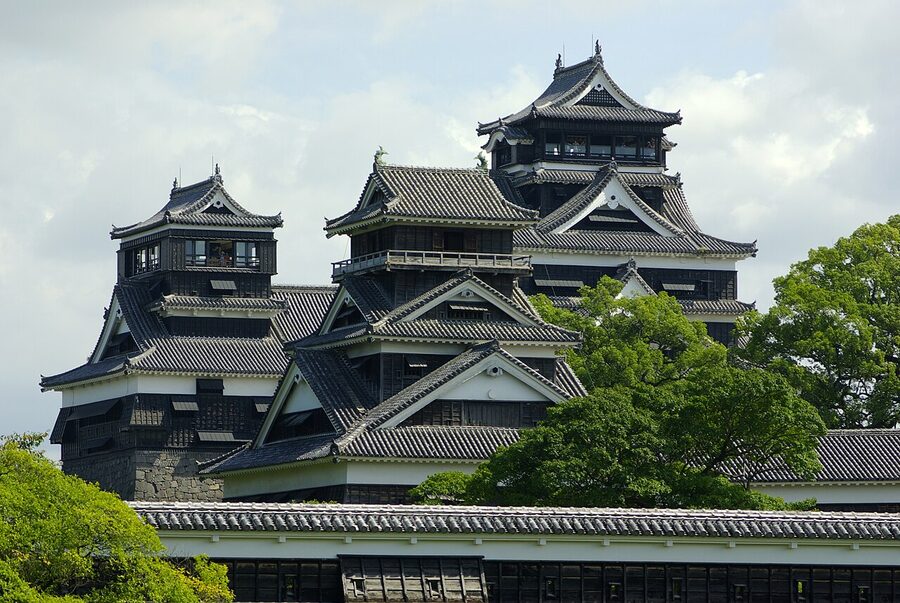
Kumamoto Castle is a hirayama-jō, a flat-hilltop castle, built on the southern spur of the Chausu-yama ridge in what is now Chūō-ku, Kumamoto City, Kumamoto Prefecture. The special-historic-site designation covers 512,300 square metres, a little over 51 hectares. The protected grounds at full extent once reached 98 hectares; Meiji-era land reallocations and the 1870s Kumamoto Garrison construction shaved off about half before the city and the nation got around to protecting what was left.
The headline numbers are the three-storey kotenshu (small keep) and the six-storey daitenshu (main keep), standing on a stone plinth that puts the rooftop at 30.3 metres above the honmaru ground. Those two towers are 1960 ferro-concrete exterior reconstructions — not original. What is original, and what you come to Kumamoto to see, is underneath and around them.
Thirteen surviving Edo-period structures — eleven yagura (guard towers), one gate, one section of wall — are nationally designated Important Cultural Properties. The Uto Yagura is the largest surviving original structure in any Japanese castle complex that lost its main keep.
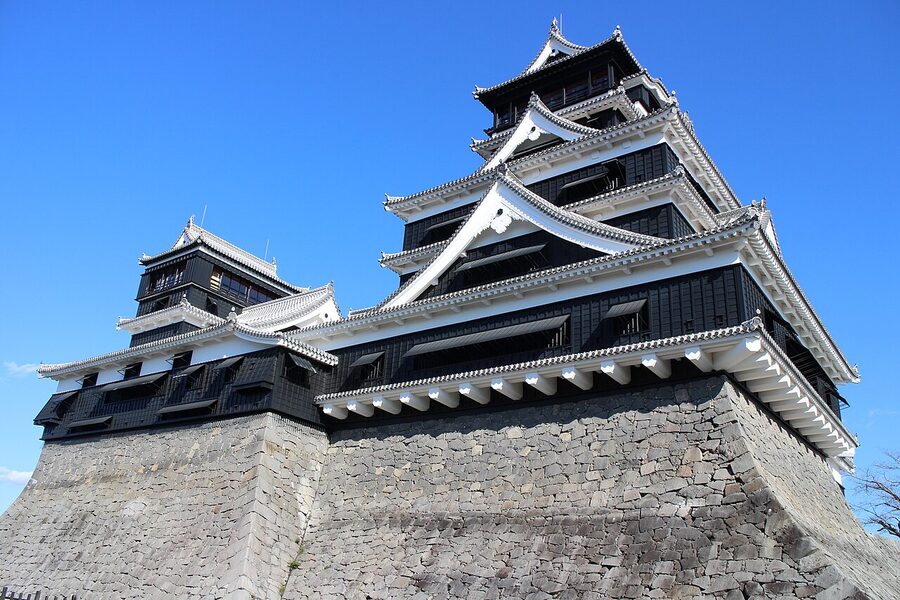
The complex footprint runs 1.6 kilometres east-to-west and 1.2 north-to-south. Inside that perimeter, at full Edo configuration, Katō Kiyomasa and his successors had 49 yagura, 18 turret-gates, and 29 smaller gates. The Meiji-era haijō-rei (castle-abandonment order) and the 1877 fire between them erased roughly three-quarters of those structures. What you see today is the survivor set plus a generation of careful wooden reconstruction work done between 1998 and 2008.
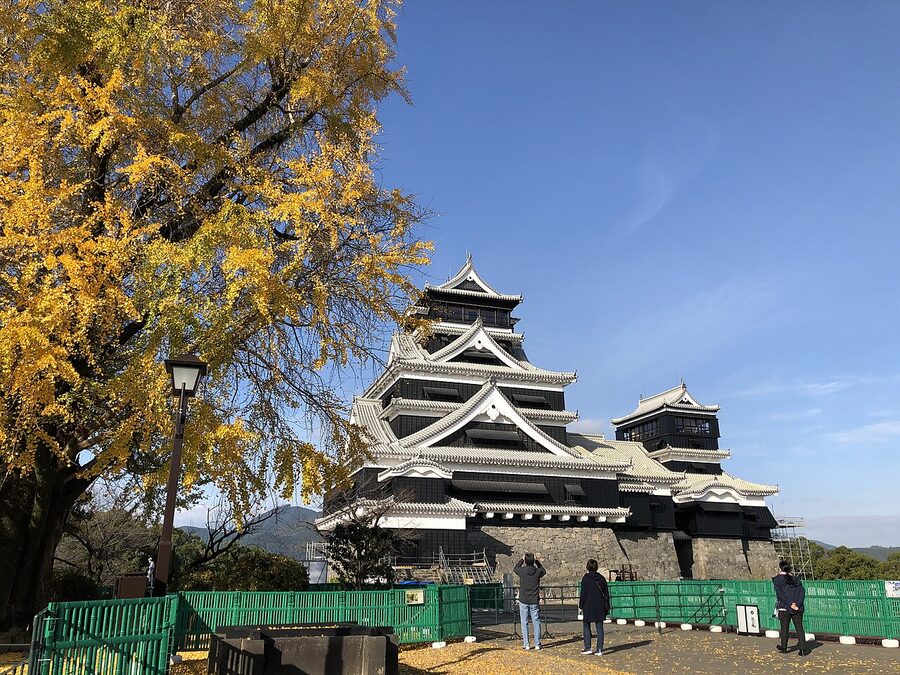
The site is also known as Ginnan-jō, Ginkgo Castle, after the ginkgo tree Kiyomasa is supposed to have planted in the honmaru himself when the keep was finished in 1607. The tree you see today isn’t his; the original burned with the tenshu in the 1877 fire and the current one is a second-generation shoot off the stump, now a respectable 400-year-lineage specimen about 30 metres tall. Kumamoto locals still call the castle Ginnan-jō in conversation, which tells you something about how long these trees figure in the civic memory.
Before Kiyomasa — the 15th-century mountain posts
The site has been fortified in some form since the Bunmei era (1469-1487), when Ideta Hidenobu, a branch-line retainer of the Higo shugo Kikuchi clan, threw up a small stockade on what is now the Chiba-jō-machi corner of the castle grounds. That first structure was called Chiba Castle, and it was a jin’ya-grade post, not a Sengoku-scale fortification. The Ideta held it for maybe thirty years before their line ebbed and the Kikuchi pushed them out.
The actual castle predecessor, the one Katō Kiyomasa would incorporate into his rebuild, was Kumamoto Castle’s first incarnation, spelled with the older 隈本 characters, built between 1521 and 1531 on the Kojō-machi ground west of the current honmaru. The builder was Kanokogi Chikakazu, known in religious retirement as Jakushin, installed by the Kikuchi after the Ideta were moved out. Jakushin is a minor but documented figure: in 1529 he performed the reconsecration of Fujisaki Hachimangū, the main shrine of Higo, and he received an imperial edict acknowledging his work from Emperor Go-Nara.
From Jakushin the castle passed through the Jō family — his grandson Kanokogi Shigearu received the Kikuchi heir Kikuchi Yoshitake after a family succession killing in 1550, got chased out by the Ōtomo, and the Jō family came in. By the 1580s the castellan was Jō Hisamoto, who had aligned with the Shimazu of Satsuma. When Toyotomi Hideyoshi’s 1587 Kyūshū campaign ended with the Shimazu submitting, Hisamoto handed over the castle without fighting and moved to Chikugo. Hideyoshi himself wrote in a vermillion-seal letter to his retainer Hitotsuyanagi Naosue that Higo was “a country worthy of attention” and Kumamoto was “a famous castle” — the old 隈本 name, two decades before Kiyomasa would change the spelling.
Sassa Narimasa, and the Higo that nearly killed Hideyoshi’s plans
The first new lord of the post-Shimazu Higo was Sassa Narimasa, the warlord who had crossed the Japanese Alps in the winter of 1584 and who Hideyoshi had parked in Etchū after submitting. In 1587 Hideyoshi moved him south and gave him Higo. Sassa took possession of Kumamoto Castle (still 隈本) and immediately did the one thing Hideyoshi had specifically told him not to: he ordered a kenchi, a full land survey with property reassignment, before the Higo kokujin (locally entrenched landholders) had settled into the new order.
The Higo kokujin uprising ignited within weeks. Sassa’s retainer Jinbō Ujiharu held the castle through a full siege by the rebel forces and it did not fall, but the province was in open revolt for months. Hideyoshi was livid.
In 1588 Sassa was recalled, ordered to commit seppuku at Osaka, and Higo was split in two. The northern half — 195,000 koku — went to Katō Kiyomasa, who had fought under Hideyoshi from the Shizugatake campaign through the Kyūshū pacification. The southern half went to Konishi Yukinaga.
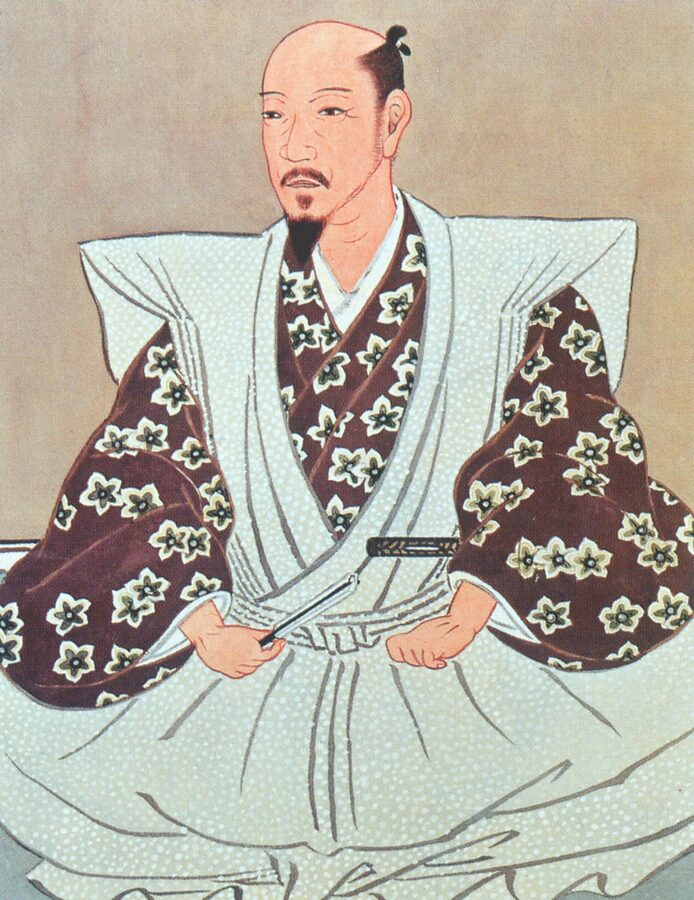
Kiyomasa arrived in 1588, moved into the existing 隈本 castle, and spent the first three years stabilising the domain and suppressing the last of the kokujin resistance. The actual new construction on the Chausu-yama ridge east of the old castle, the castle you visit today, began in 1591.
The 1601-1607 Kiyomasa rebuild
The reason you have to draw a 1591-start line and a 1601-intensification line separately is that Kiyomasa spent most of the 1590s in Korea. The first Korean expedition consumed him from 1592 to 1593. The second ran from 1597 to 1598. Work on the Higo castle continued in his absence under his retainers, but the scale of construction that produced the present complex — the 49-yagura, 18-turret-gate establishment — only accelerated after Sekigahara.
Kiyomasa had backed Tokugawa Ieyasu at Sekigahara (against his old colleague Ishida Mitsunari, whom he loathed), and the reward was the southern half of Higo, Konishi Yukinaga’s confiscated lands, folded into his own holding. By late 1600 he held the whole province at 520,000 koku. For a Toyotomi-trained Sengoku builder sitting on half a million koku with an explicit mandate to reinforce Tokugawa power against the tozama daimyō of Kyūshū, the answer was obvious: build the castle at the scale the koku rating justified.
The main push ran 1601 to 1607. Kiyomasa’s working-in-Korea engineers, men who had built fortifications across southern Chosŏn from 1592 through 1598, came home and applied peninsular stone-angle knowledge to the Higo site. In 1606 the keep was effectively finished; the completion ceremony was held in 1607, and as part of the ceremony Kiyomasa formally changed the place-name character from 隈本 to 熊本 — literally bear-origin rather than recess-origin.
The new kanji was chosen for better auspices; the old one has a hen (radical) meaning “corner” which was read as pinching-in. The change was gazetted and stuck.
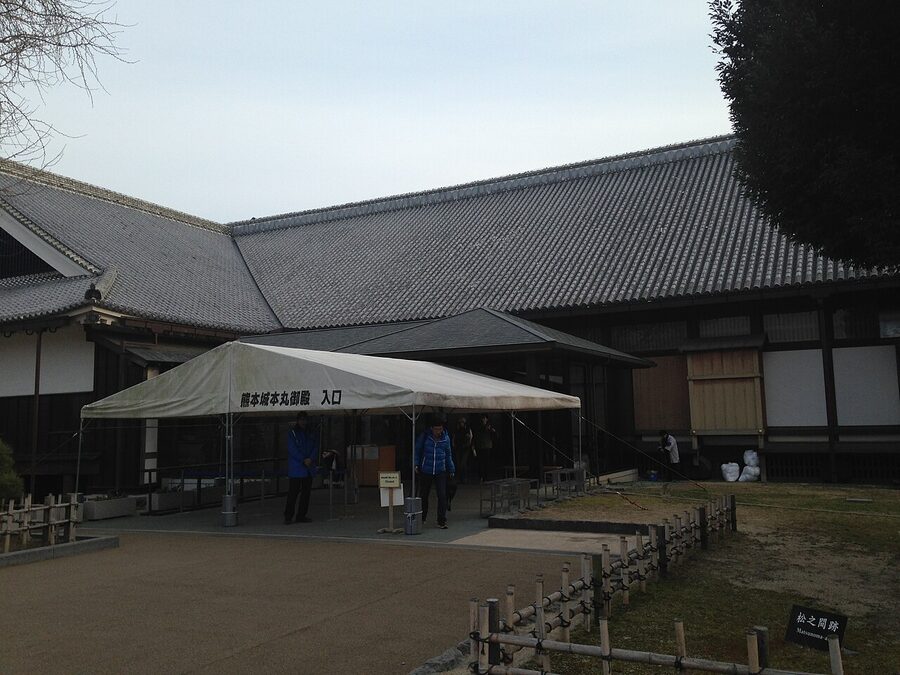
From 1610 the honmaru was remodelled to accommodate a full Honmaru Goten, the lord’s residence-palace, built around a central path that the castle’s existing main approach ran under. The effect was that anyone climbing to the tenshu had to pass through the Goten’s basement first. This is a specifically Kumamoto feature; no other Japanese castle of this period has an approach path that runs under the palace floor.
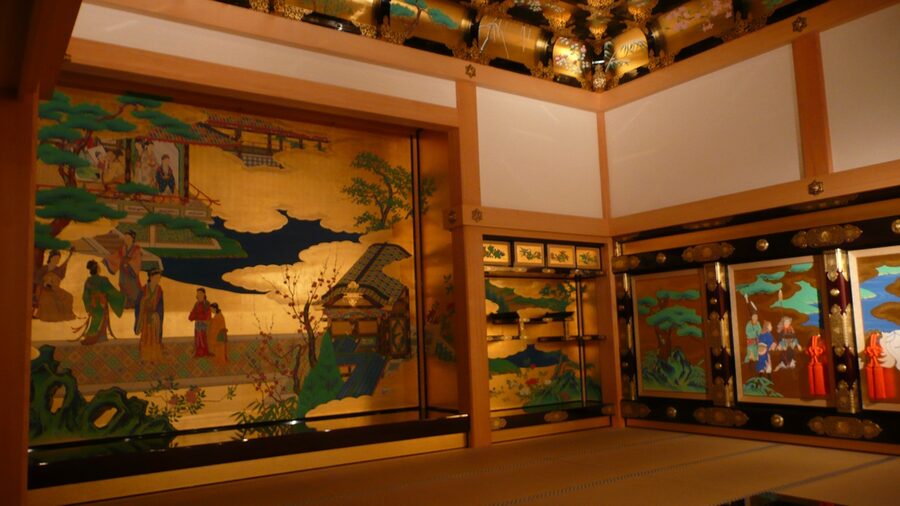
Inside the Goten the Shōkun-no-ma, the Lady Zhaojun room, was painted with a Han-era Chinese historical subject: Wang Zhaojun, the palace beauty sent north to marry a Xiongnu chieftain in the 1st century BC. The original paintings burned in 1877; the 2008 reconstruction used period-accurate pigment and technique to reproduce them. The gold-leaf in the room today is about thirty kilos of leaf over sixteen panels.
Musha-gaeshi — the walls that turn warriors away
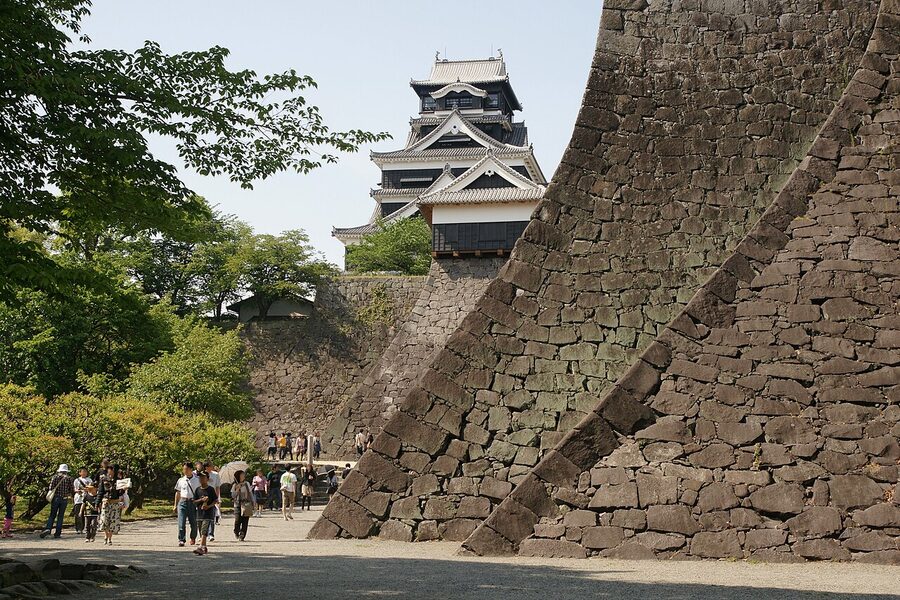
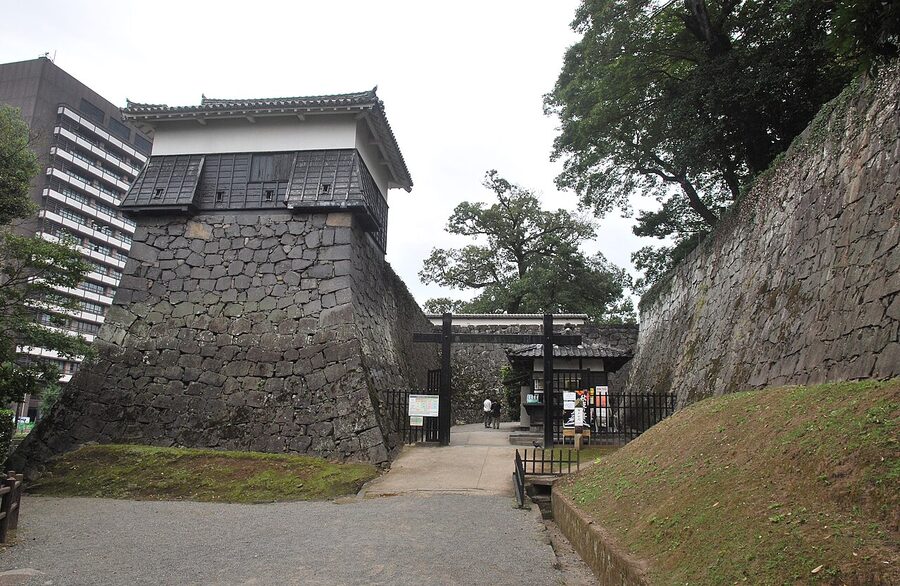
If you come to Kumamoto for one specific architectural feature, it is the stone-wall profile known as musha-gaeshi. The name translates, unhelpfully, as “warrior-turner” or “warrior-turn-back”. The useful translation is: stone wall that starts at a gentle angle at the bottom and steepens severely toward the top, so that a samurai climbing in full armour has a climbable approach for the first three metres and an effectively vertical upper six metres with inverted parapet stones jutting out at the crest.
The technique is not unique to Kumamoto. You see variations at Kumamoto’s sister castles of Uto (Kiyomasa-era outwork, since demolished) and Hitoyoshi (later Edo-era copy), and a related profile at some Korean-campaign fortifications in southern Chosŏn built by Kiyomasa’s engineers in the 1590s. But Kumamoto is where the technique is most systematically deployed across an entire complex and where the surviving stone-face is in the best condition. The curve you are photographing when you take the obligatory honmaru-plinth photo is the real thing.
The later mythology — which came out of Meiji-era popular writing, not contemporary chronicles — is that the walls were designed specifically to stop ninja. That is not quite right. The engineering target was massed infantry with scaling ladders and grappling ropes in a mid-17th-century siege, which is what Kiyomasa had seen in Korea.
The musha-gaeshi works against any climber not equipped with pitons, and a Kyūshū infantry assault in 1877 was no better equipped than a Chosŏn siege army in 1593 in this respect. Saigō’s troops discovered this in February.
The related wooden overhang — the kōrō fighting-gallery that projects out from the upper yagura with a downward-hinged floor-board — is the other Kumamoto defensive signature. The board drops on an attacker who has reached the base of the wall, and stones or boiling water can be poured through. Kiyomasa had dropped boards of this kind at Ulsan in 1597. They are one of the things that held the 1877 siege.
The Hosokawa arrive — 1632 and the long peace
Katō Kiyomasa died in 1611. His heir Tadahiro, the second Higo lord, held the domain until 1632, when the shogunate bakufu abolished the Katō house on a transparent pretext and moved the family out. The cited reason was a financial-administrative irregularity; the unstated reason was that Tadahiro was married to a Tokugawa niece, a potential succession complication, and the shogunate preferred a cleaner handover.
The replacement was Hosokawa Tadatoshi, son of Hosokawa Tadaoki — the tea-ceremony master Sansai, the Sekigahara veteran whose wife Gracia had famously died during the pre-battle Ōsaka siege. Tadatoshi moved the main Hosokawa branch from Kokura to Kumamoto in November 1632 and took over the castle essentially as Kiyomasa had built it. The Kumamoto Hosokawa would hold the Higo domain for the next 240 years, through nine generations, until the Meiji Restoration ended the han system in 1871.
The Hosokawa contribution to the castle is primarily additive rather than reconstructive. Tadatoshi added the western second and third baileys (nishi-ninomaru and sannomaru) to give the administrative footprint room. Successive generations refined the garden at the Gyōbu-tei residence just south-west of the castle.
Hosokawa Tadaoki himself, already retired at 67 when his son moved to Kumamoto, visited but never held the castle — he kept his separate retirement residence at Yatsushiro further south. The tea-ceremony tradition Tadaoki had inherited from Sen no Rikyū stayed with the Hosokawa line into the modern era.
The 240 years of Hosokawa peace are what allowed the castle’s wooden fabric to last. Most Japanese castles cycled through multiple clan-holders in the Edo period; the constant turnover meant constant repair interruptions. Kumamoto sat under a single stable clan with one continuous maintenance programme. By 1870 the castle was, in terms of original 1607 timber still in place, the most intact major Japanese castle in the country.
Meiji — the garrison, the haijō-rei, and the 1877 siege
The 1871 haihan-chiken (abolition of the domain system) left Kumamoto Castle in the hands of the new imperial army. In 1873 the castle became the headquarters of the Kumamoto Garrison — one of six regional army headquarters under the new Meiji conscription system. The 1874 haijō-rei would have demolished most of the castle outright if the army hadn’t already taken it over as a working military base; garrison castles were protected from the demolition order.
What the garrison did instead was worse in a slower way. Army construction between 1873 and 1876 tore down a significant fraction of the sannomaru and ninomaru outbuildings to make room for barracks, parade grounds, and supply depots. The original 49-yagura establishment was reduced to about 30 by 1876. What survived was mostly the honmaru cluster and the high-ground yagura on the main plinth.
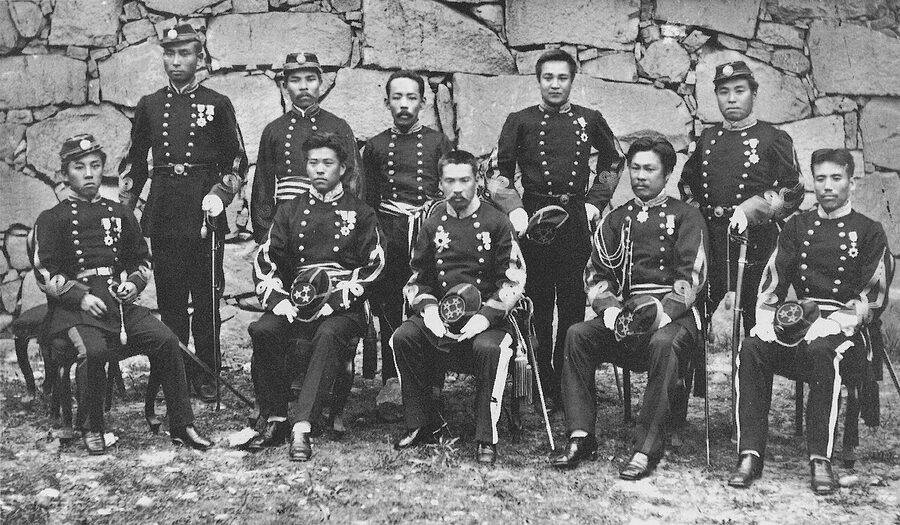
The commander at the Kumamoto Garrison from 1876 was rikugun-shōshō Tani Tateki, a Tosa-born Boshin War veteran who had taken his first administrative posting under sanji Saigō Takamori himself at Kagoshima in the early Meiji. Saigō would have assumed Tani would step aside. Tani did not.
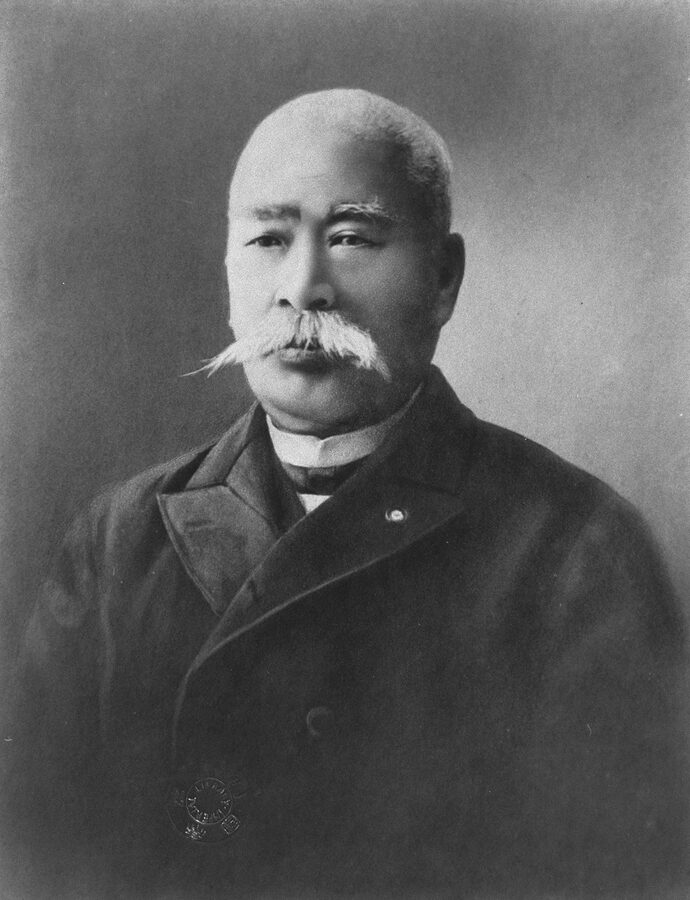
The timeline is worth keeping straight. In late January 1877 the private-school faction of Saigō’s Satsuma circle raided the Kagoshima arsenal and took 84,000 rounds of Snider-rifle ammunition. On 15 February, in the heaviest snowfall Kagoshima had seen in sixty years, Saigō led 13,000 men out of Kagoshima for Tokyo. His route north ran through Kumamoto.
Tani had a telegraph. Saigō did not. By the time Saigō requested safe passage from Tani on 19 February, Tokyo had already instructed Tani to refuse, and Tani had pulled roughly 4,000 men into the castle perimeter.
On the same day, 19 February 1877, the Kumamoto tenshu caught fire and burned. The cause was never established. The two most-cited hypotheses are a kitchen accident in the Honmaru Goten basement or deliberate arson by Imperial Army officers to deny the tower’s strategic visibility and thousand-bale rice reserve to the besiegers if the castle somehow fell. A 1-month infantry rice supply, prepared for the siege, was completely destroyed.
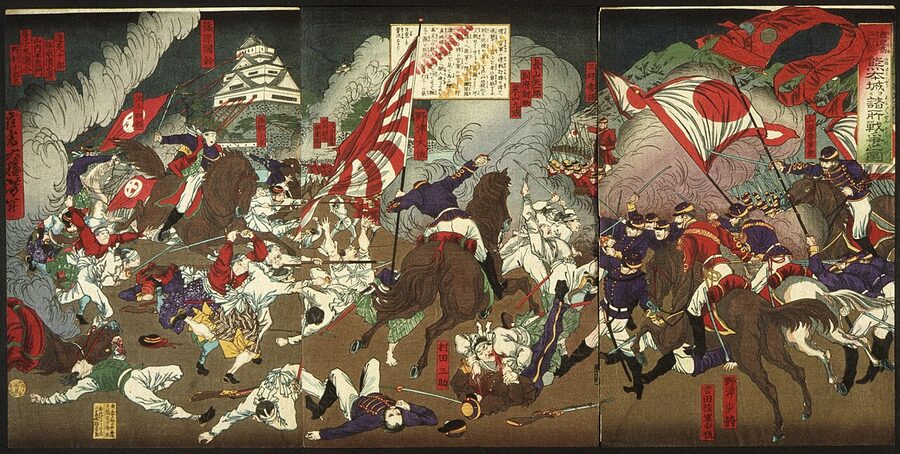
The Satsuma army surrounded the castle on 22 February 1877 and opened general assault from the north over the Akazaka ridge. Saigō had not expected the castle to hold a full siege — his plan had been to pin the garrison with a blocking force and run his main body up through the Chikuzen Plain toward Kitakyūshū and Osaka. When Tani did not surrender in the opening three days, Saigō committed eight full battalions to the investment and settled in.
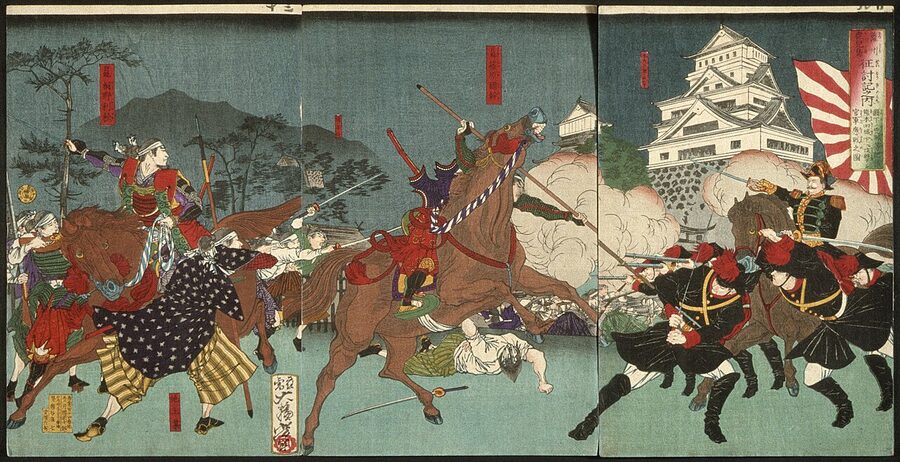
The siege ran 53 days, from 22 February to 15 April 1877. The Satsuma attackers broke their teeth on the honmaru stone walls. They used captured artillery from the Kumamoto Castle armoury itself but could not range the tenshu plinth effectively.
Imperial Army relief columns fought their way south from Kokura through Tabaruzaka (3-20 March) and over the Shirakawa in early April. On 14 April 1877 the relief broke Satsuma positions on the south and east; on 15 April Saigō ordered general withdrawal.
“I was beaten by Kiyomasa”
The quote is attributed by multiple Satsuma sources to Saigō in the days after the withdrawal. The most reliable version comes from Shimaji Mokurai’s conversation with Saigō at Kayoi-dake in late April 1877, a week after the retreat: “I have never lost to the Imperial army. I lost to Kiyomasa’s castle.” The point Saigō was making was about the walls, not the defenders, he knew most of the Imperial officers personally, and that has been the received reading ever since.
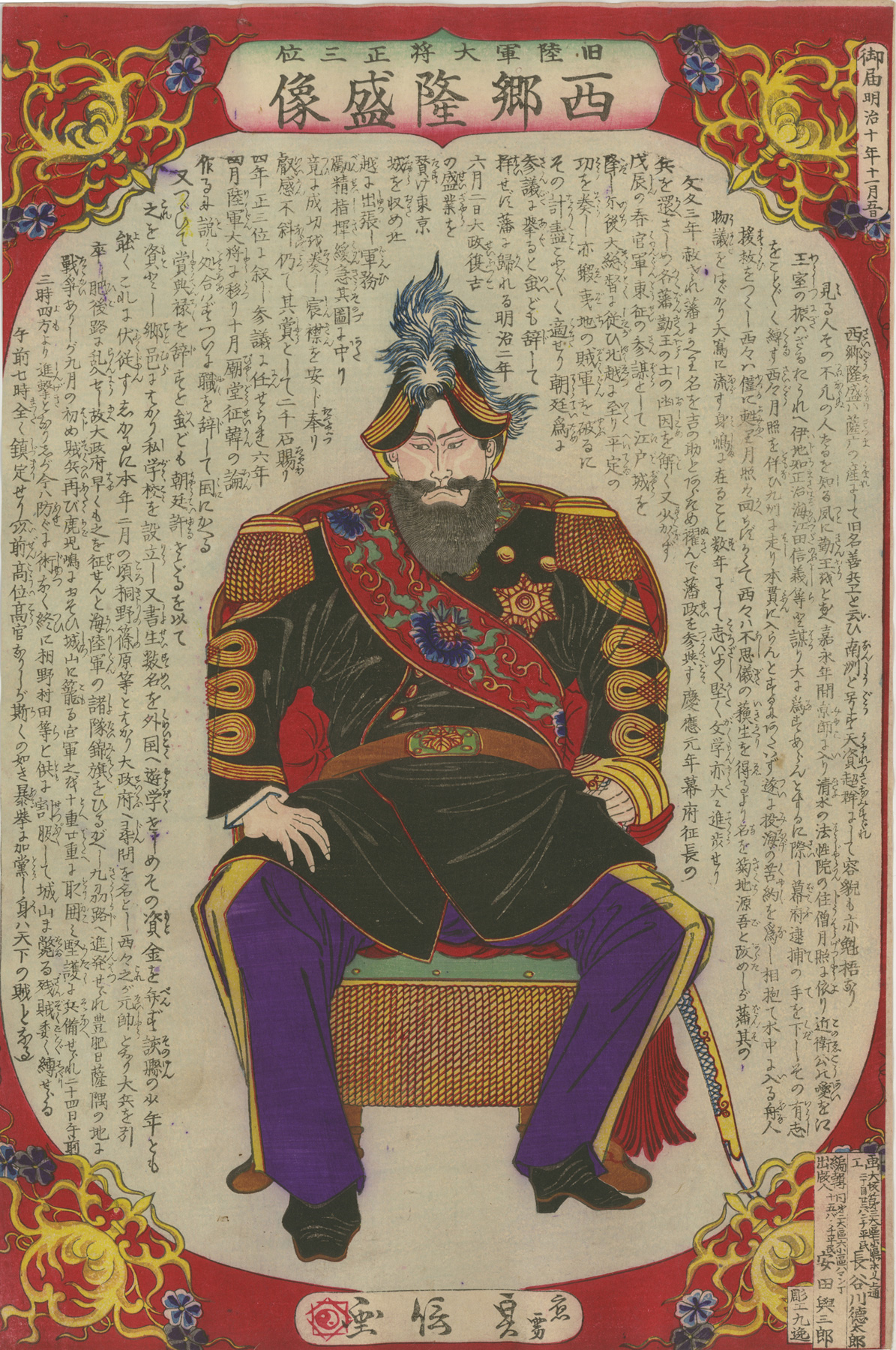
Saigō’s retreat ran south-east through the Shirakawa basin, down into Hitoyoshi, across to Miyakonojō, and eventually back to his home ground at Shiroyama above Kagoshima. The Imperial army pursued. On 24 September 1877 Saigō was wounded by Satsuma’s own fire, asked his retainer Beppu Shinsuke to behead him, and died. His head was found by Imperial troops within the hour.
The Satsuma Rebellion cost about 13,000 lives on both sides over nine months. It was Japan’s last civil war. It confirmed the Meiji conscript army as a functional fighting force capable of beating traditionally-trained samurai. And for Kumamoto Castle specifically, it meant that the first real combat test of Kiyomasa’s 1607 design came 270 years after construction, and the design passed.
Twentieth century — the 1960 concrete keep and the long restoration
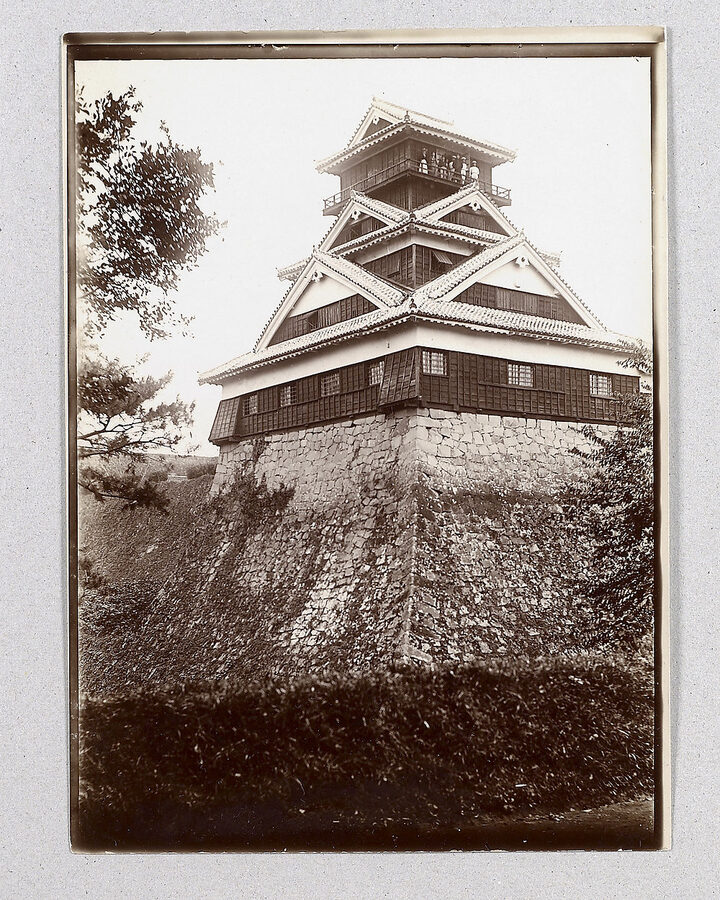
After the 1877 fire the castle sat as a half-ruin through the Meiji and Taishō periods. The 1889 Kumamoto earthquake (magnitude 6.3) damaged sections of the Kiyomasa-era stone walls that had survived the siege, and those were crudely rebuilt by the army in the 1890s. The broader complex — the burned-out honmaru, the missing yagura — was left as a brick-and-stone archaeological surface through the Second World War.
The 1945 firebombing of Kumamoto City destroyed most of the surrounding urban fabric but largely spared the castle grounds, which by that point were an open-space army training zone with no significant wooden structures left to burn in the western part of the complex. The 13 Edo-period yagura and associated walls that had survived 1877 survived 1945 as well.
In 1960, for the 350th anniversary of the 1607 completion, Kumamoto City commissioned a ferro-concrete exterior replica of the tenshu. The reconstruction was built on the original 1607 stone plinth, to the correct external dimensions, but the interior was a steel-frame museum space, the Kumamoto Castle Museum Branch, rather than a timber replication. This was standard 1950s-60s Japanese castle practice; the same approach produced the concrete reconstructions at Osaka, Nagoya, and dozens of smaller sites.
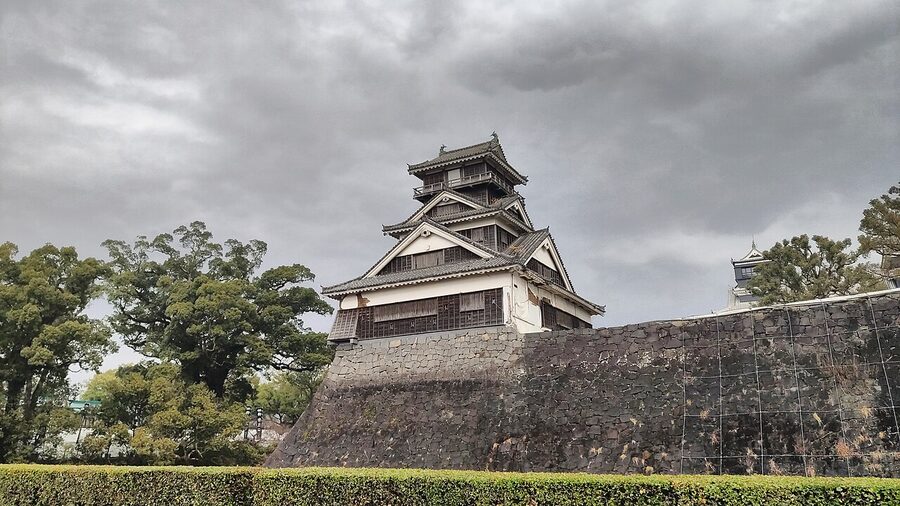
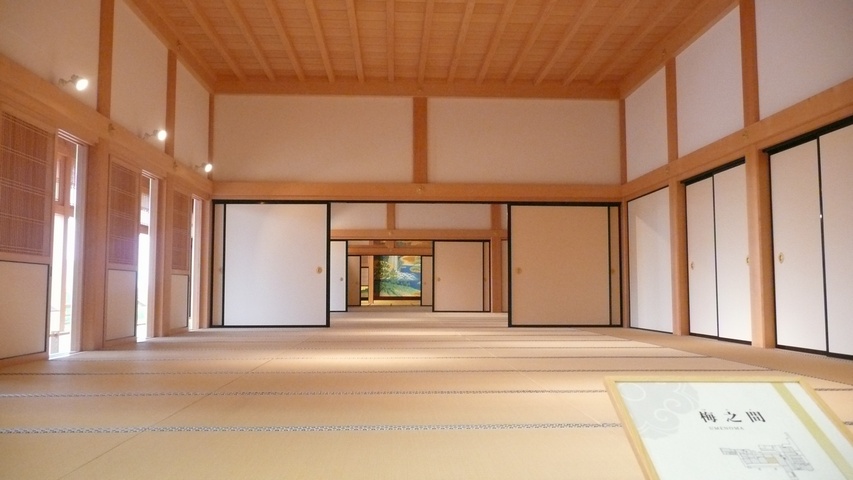
From 1998 onwards Kumamoto City shifted strategy. The philosophy changed from “replicate exteriors in concrete for tourist visibility” to “rebuild in period-accurate wood where foundations survive and documentation supports reconstruction.” Between 1998 and 2008 the Honmaru Goten, five yagura, and multiple gates were rebuilt in timber, on the original stone foundations, using Edo-period methods and materials. The Honmaru Goten opened to the public on 20 April 2008.
By 2012 the protected area had been formalised at 512,300 square metres and the Kumamoto Castle Special Historic Site status reconfirmed. The wooden-reconstruction programme was scheduled to continue into the 2020s with further yagura and gate rebuilds. And then the earthquake happened.
14 April 2016 — and the 20-year rebuild
At 21:26 on 14 April 2016 a magnitude-6.2 earthquake struck beneath Mashiki, a town 15 kilometres east of Kumamoto. It was substantial enough to shake the castle visibly — several roof tiles and two of the main keep’s shachihoko ornaments fell — but it was not yet catastrophic. Residents and castle staff treated it as the main event. It was not.
At 01:25 on 16 April, a magnitude-7.3 earthquake struck from essentially the same epicentre. This was the mainshock; the 14 April event had been the foreshock. The 7.3 quake hit the castle for roughly forty seconds of severe shaking in the upper sixes on the Japanese intensity scale. The damage report, once daylight allowed inspection, was the worst at any Japanese castle since the Second World War.
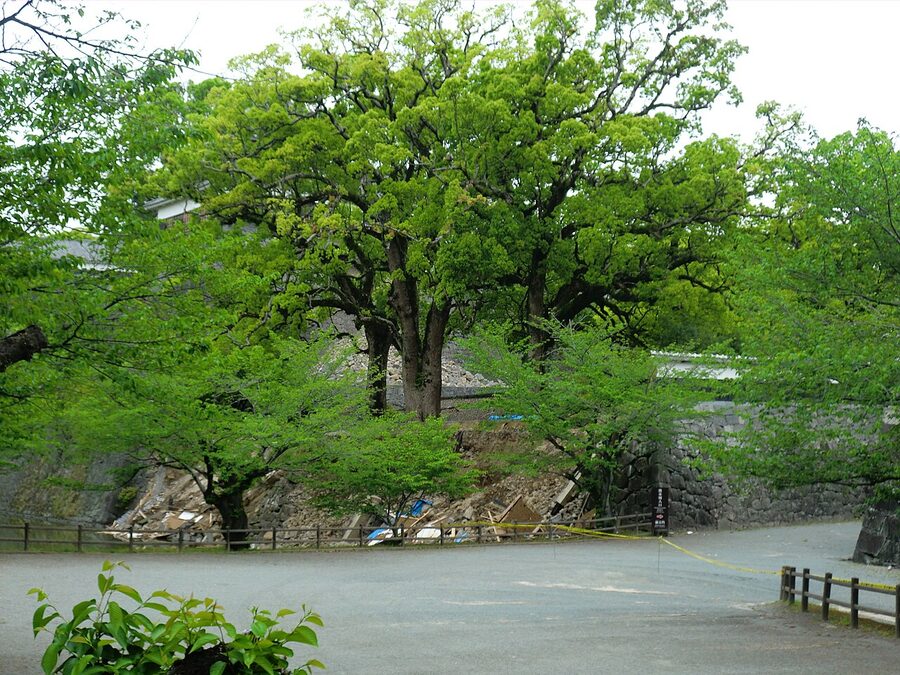
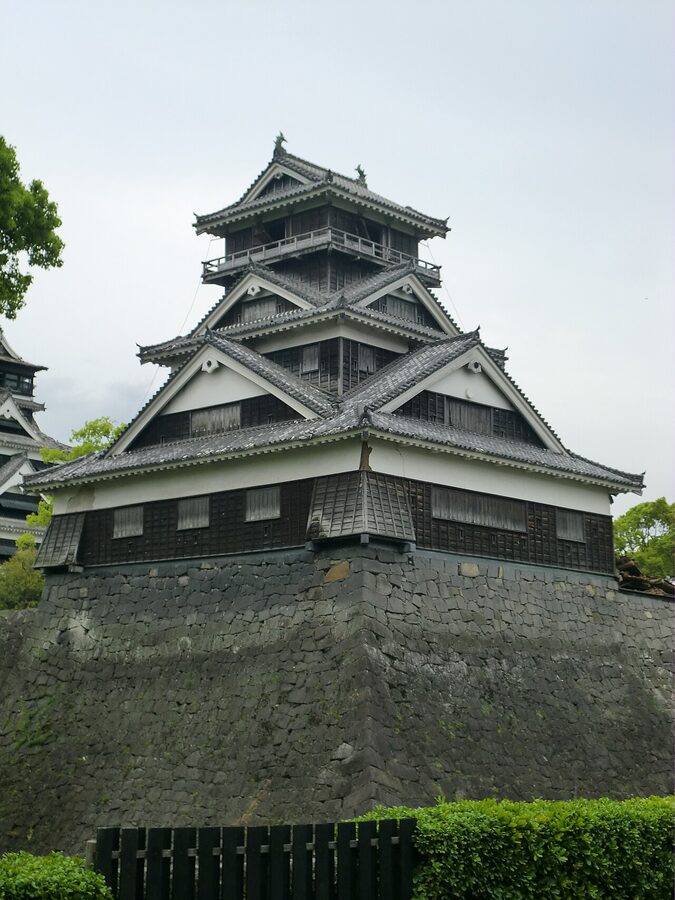
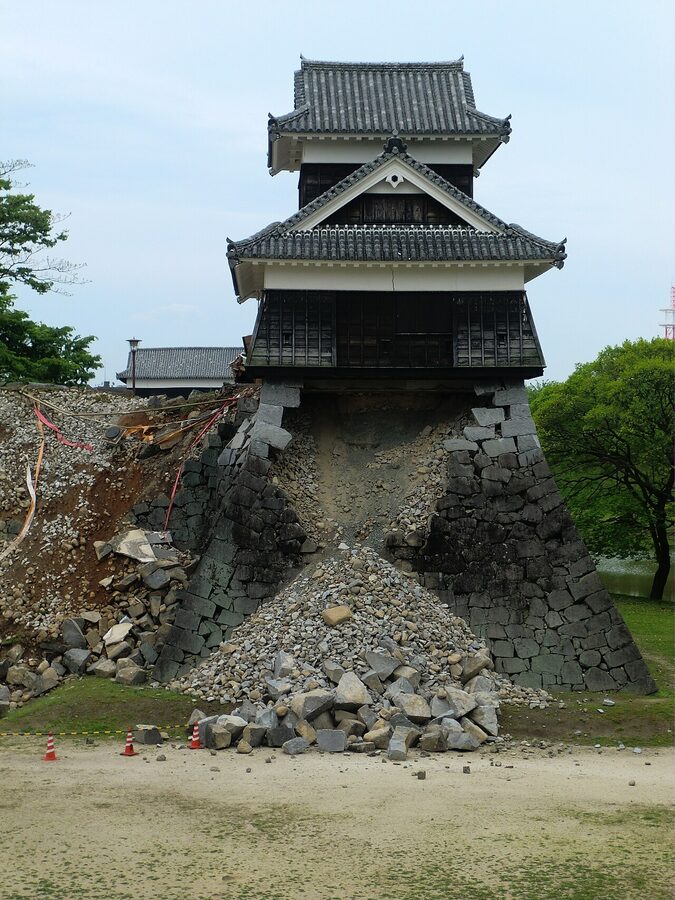
Thirteen of the 13 Important-Cultural-Property yagura took structural damage. Fifty separate stone-wall collapses were mapped across the complex. The 2008 Honmaru Goten reconstruction sustained frame damage. The Uto Yagura, the main surviving 1607 original, had its upper structure partially bent by the shaking and began leaning; a decision was made later in 2016 to disassemble it entirely for rebuild, a process that has taken until the late 2020s.
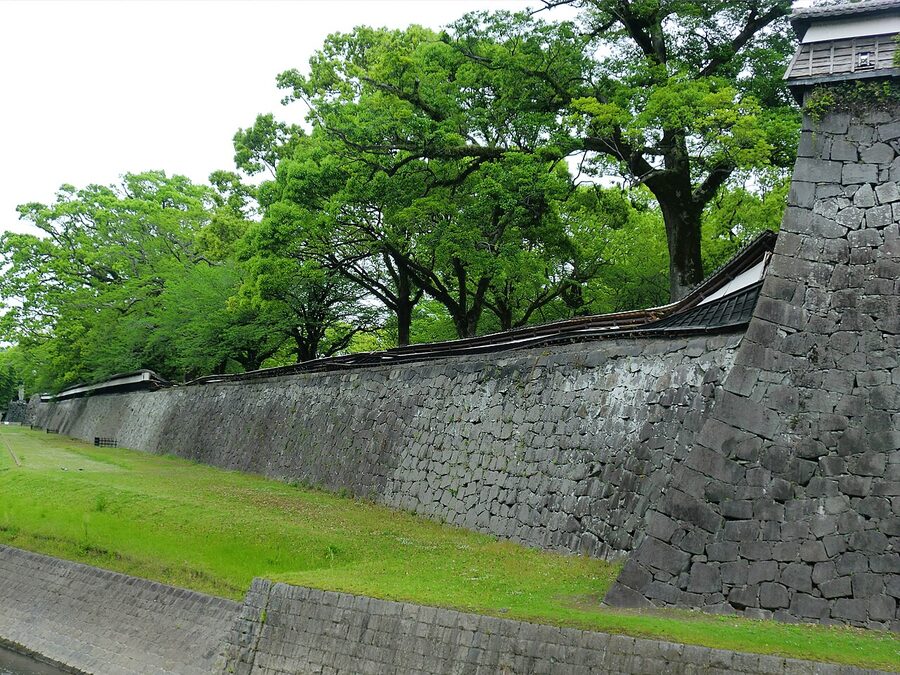
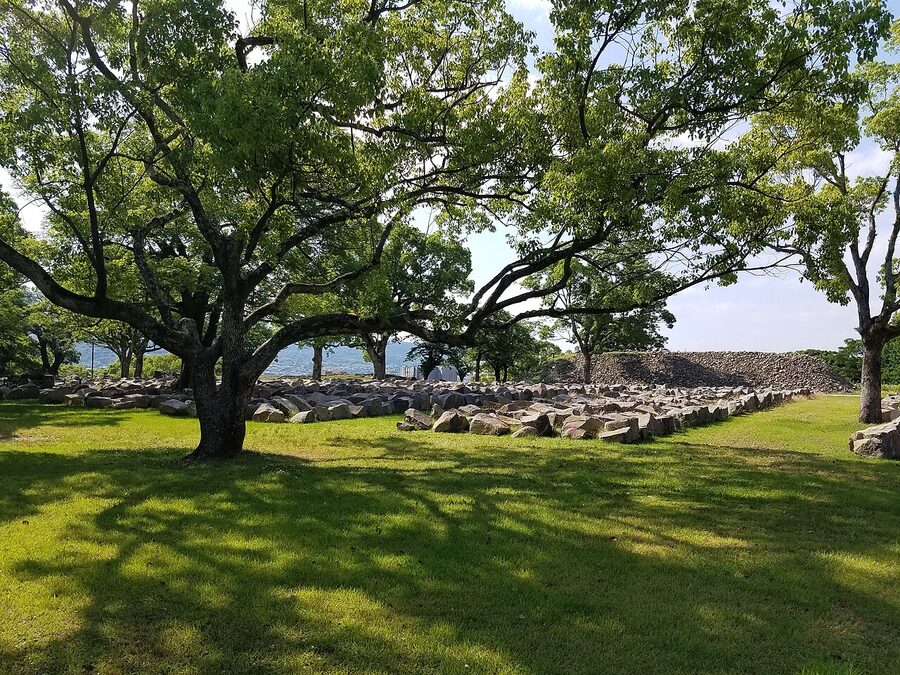
Then there is the stone-wall problem. When the quake collapsed roughly 50 separate sections of wall, somewhere between 23,000 and 30,000 individual stones ended up on the ground. Each stone is a unique cut piece weighing between 40 kilos and 2 tonnes.
Putting them back requires not just identifying which stone came from which wall but which face pointed which direction and which neighbour stone it locked against. The restoration crew has photographed and numbered every one. The reassembly is still happening.
The reconstruction budget as originally scoped in 2016 was about ¥63.4 billion over a 20-year programme targeting 2036-2037 completion. In November 2022 the city revised the estimate upward: full restoration now targets 2052, 36 years after the quake. The revision was not about money; it was about skilled-craftsmen availability. The number of working carpenters in Japan who can handle Edo-period timber-framing to cultural-property standard is roughly 60 people, and every major castle, temple, and shrine restoration project in the country is competing for their time.
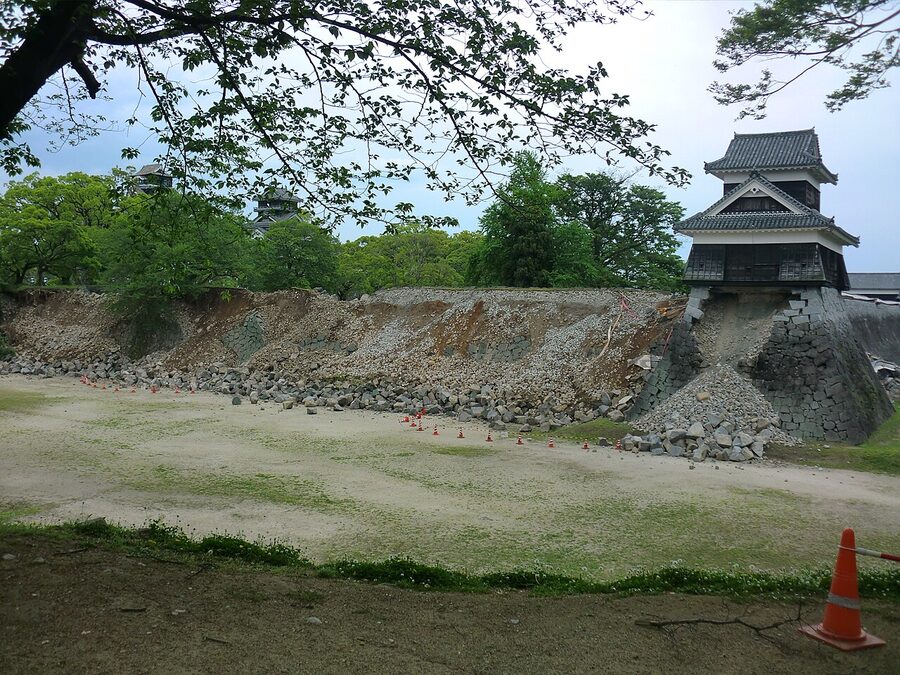
The phased reopening has been working ahead of schedule. The main keep exterior reopened on 8 October 2020. The Honmaru Goten was reopened for special-exhibition use in 2021.
The main observation level inside the tenshu reopened to the public on 26 June 2021. The Nagabei wall finished in January 2021. As of 2024 the central visitor route through the complex is fully walkable; the outer yagura and the Uto Yagura are still closed.
Three surviving originals — Uto, Higashi-Jūnoku, Monomi
Of the 49 original yagura in the 1607 establishment, three structures of keep-scale size survived 1877 and the haijō-rei and remain. They matter more than the concrete main keep does for the same reason that an Edo-period temple beam matters more than a 1960 reinforced-concrete temple: they are the actual thing.
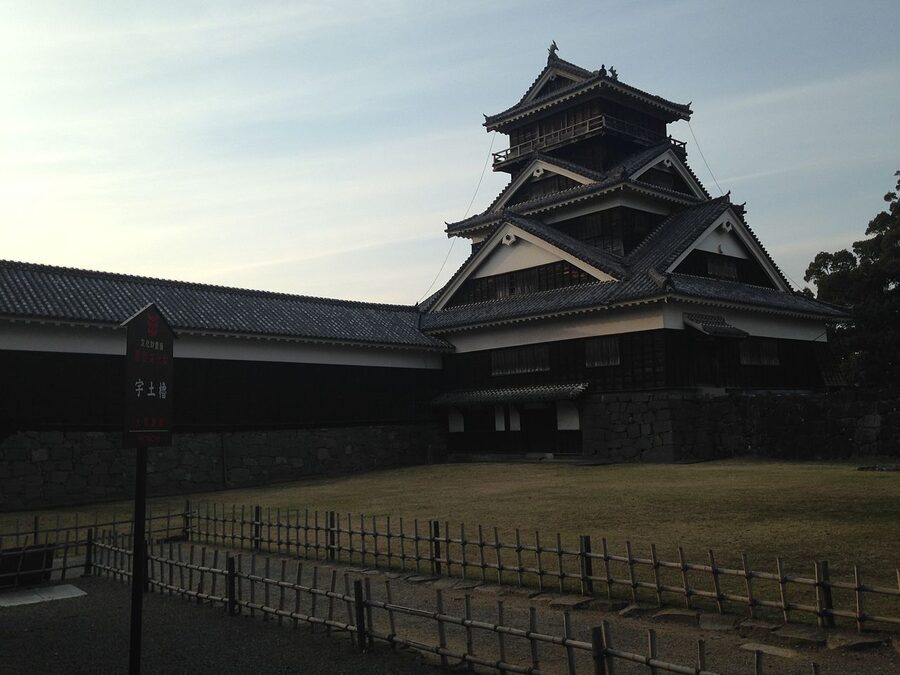
The Uto Yagura is the largest. Built in 1607 on the southwest corner of the honmaru plinth, it is 19.1 metres tall, three-storied plus a basement, and was the command tower of the Uto-Hosokawa branch until 1632. It is sometimes described as the “third keep” of the Kumamoto complex, parallel to the daitenshu and kotenshu. It survived 1877 with plaster damage; it survived 1945; it did not survive the 2016 quake undisassembled, but it is being reassembled from its original timber.
The Higashi-Jūnoku Yagura is on the eastern flank, smaller, two-storied, and was originally a branch-watch post rather than a main tower. The Monomi Yagura is the smallest of the three, on the southeast ridge, used as a field-observation post for the ninomaru defence perimeter. Both survived the siege and the haijō-rei; both took lighter 2016 damage than the Uto and are back in service.
What you get with an original structure, in addition to the aesthetic of actual 400-year-old timber, is the evidence of what Sengoku builders actually did. The mortise-and-tenon joinery inside the Uto Yagura’s middle floor shows the Korea-campaign returnees’ signature angled pegging — a technique you find at Ulsan and Sachen but not at Osaka or Nagoya. That specificity is why the reassembly is being done slowly, with full documentation. The alternative was to concrete the footprint like in 1960, and the city decided, correctly, that that was no longer good enough.
Visiting Kumamoto Castle today
The castle is a special-historic-site open-air complex in the centre of Kumamoto City. Admission to the main keep and the currently-open portions of the inner grounds is ¥800 for adults; the ticket covers the keep observation levels and the reopened yagura. Access is via Kumamoto Castle/City Hall-mae tram stop on the city-tram line, five minutes’ walk to the Ōtemon main entrance. Allow half a day at minimum; a full day if you are also going to Honmyō-ji.
The main keep grounds and the Ōtemon approach
The current visitor route enters from the Ōtemon gate on the northeast side, runs up through the Baba-guchi approach past the Tsuzumi-no-tsuki drum-fence, and reaches the honmaru plinth from the south. The Tsuzumi-no-tsuki is one of the most-photographed sections of the castle, a wall of white-plaster-over-timber with a distinctive drum-bulge profile, and it reopened in 2020 after reconstruction. The main keep exterior, Honmaru Goten ground floor, and the Sakura-no-Baba outer bailey are walkable as of 2024.
Uto Yagura approach (structure currently closed)
The Uto Yagura is being reassembled as of the mid-2020s; the structure itself is currently enclosed in restoration scaffolding and not accessible. What you can still do is walk the southwest honmaru perimeter from which the tower is visible. The Hōhōatego-mon gate approach gives you the best angle on the Uto from below. Signs around the restoration enclosure explain the disassembly-and-rebuild process and update the reassembly schedule — as of 2026 the target reopening is 2028.
Katō Shrine (Katō-jinja)
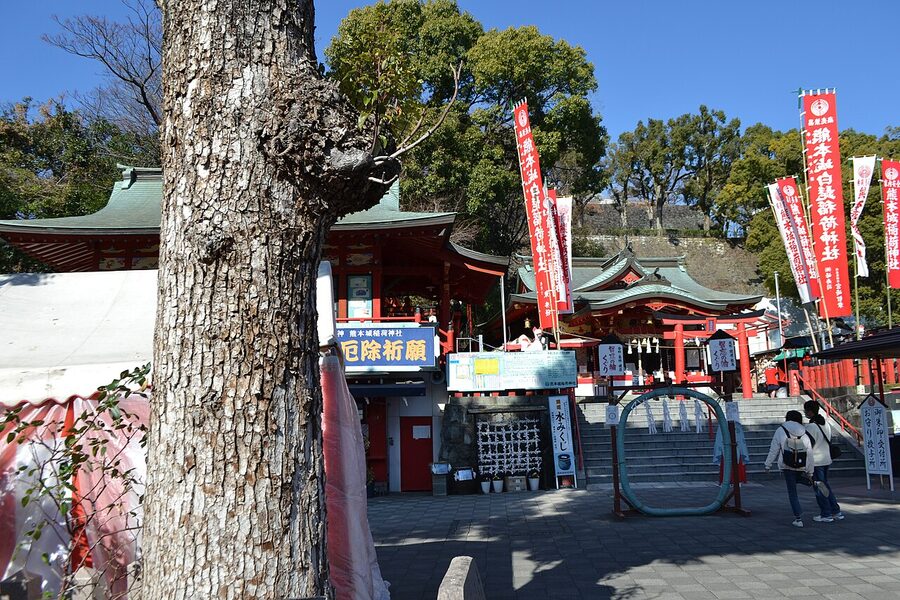
Katō-jinja sits inside the castle grounds, on the southwest edge of the ninomaru. It was founded in 1871 — Meiji-era, not Edo — specifically to deify Katō Kiyomasa as a tutelary kami of Kumamoto City. This is late-stage state-Shintoism theology applied retroactively to a Sengoku warlord, and Kiyomasa joined the small set of major historical figures similarly enshrined in the same period (Tokugawa Ieyasu at Nikkō from 1617, Toyotomi Hideyoshi at Toyokuni from 1599, Sanada Masayuki at Ueda much later). You approach through a double-torii path; the main hall sits in a cedar grove with the daitenshu visible through the tree line.
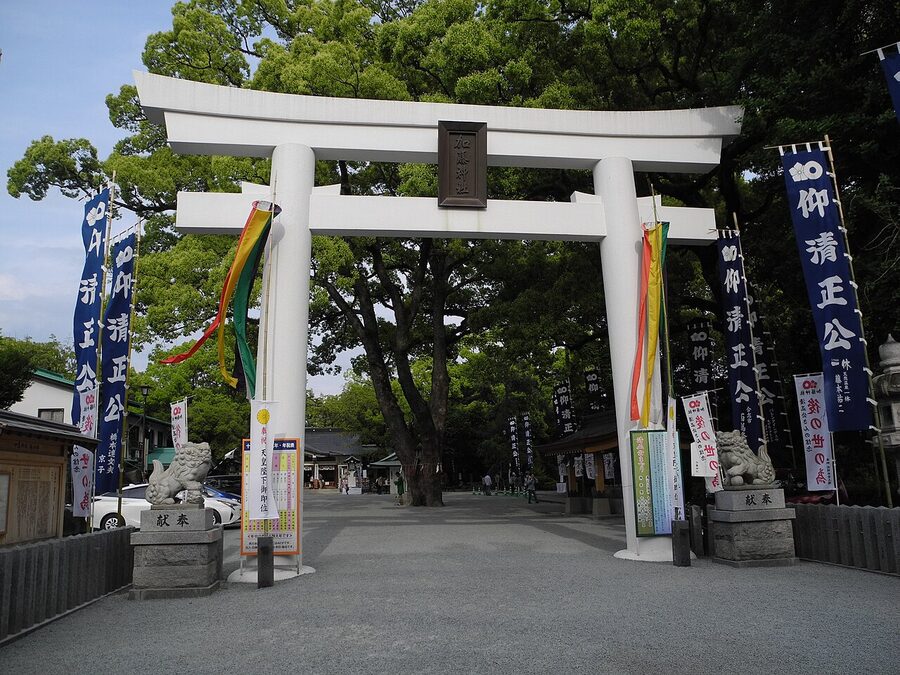
The shrine is free to enter, open in daylight hours, and the small omamori-shop offers a Kiyomasa-themed budō-mamori (martial-arts charm) that Kumamoto-native kendo and judo clubs still buy in bulk for their competition squads. Whether Kiyomasa himself would have approved of a protective-charm economy built on his posthumous deification is an interesting question; probably he would have priced it higher.
Honmyō-ji Temple and Kiyomasa’s grave
Honmyō-ji is the Katō family’s bodai-ji, the memorial temple, and sits on a hillside about four kilometres northwest of the castle, on the Nishi-ku border. The temple is Nichiren-shū. It was founded in 1585 at Osaka by Kiyomasa’s mother, moved to Higo when he did, and relocated to the current hillside site after the 1877 siege destroyed the earlier building. The current precincts are mostly late-Meiji to early-Shōwa, with some earlier stone monuments and founder-lineage tablets preserved.
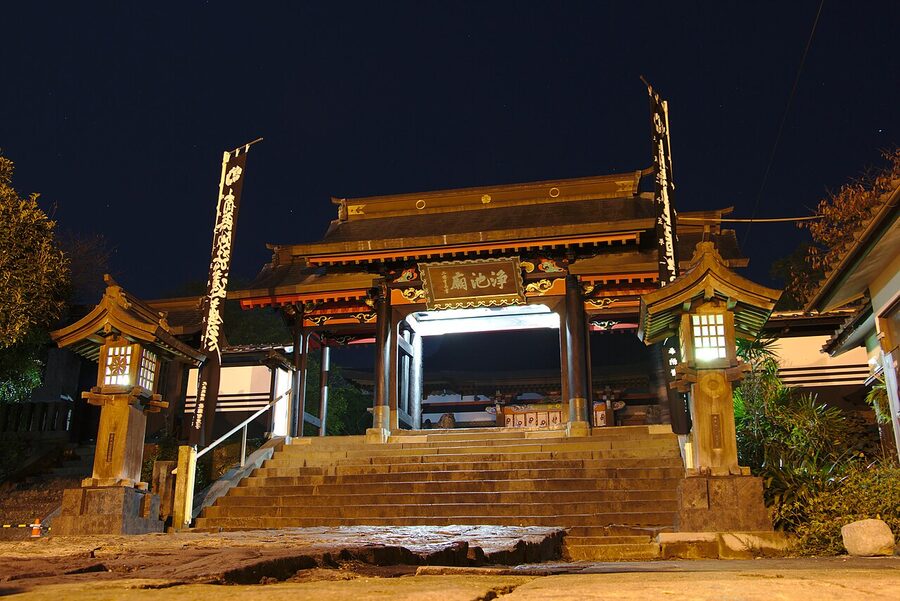
The grave itself — Jōchi-byō — is at the top of a 176-step stone staircase that locals call the Ginkgo Approach. The climb takes maybe fifteen minutes unhurried. The tomb chapel is a small stone-and-timber structure from the 1610s, built by Kiyomasa’s son Tadahiro shortly after his father’s death.
Inside is a single stone stele inscribed with Kiyomasa’s posthumous Buddhist name. You can enter the chapel precinct but not the stele enclosure itself.
Sakura-no-Baba Jōsaien
Sakura-no-Baba Jōsaien is a reproduction Edo-period merchant-street complex at the castle’s southern edge, built in 2011 as an official visitor-services site. It is a commercial precinct — food stalls, souvenir shops, a Kumamoto-specific restaurant row — laid out to look like an Edo-era castle-town shopping street. The cherry trees along the Sakura-no-Baba itself are actual 150-year-old specimens; the merchant buildings are from 2011.
This is not historically important. It is, however, where the castle ticket office and the visitor information centre now operate from, and it is where the castle’s best restaurants are. If you are in Kumamoto for the castle and you want a proper meal within walking distance, this is the place to go.
Shiroyama Park
Shiroyama Park is not at Kumamoto Castle — it is south of the Kumamoto city-tram line, in the Shiromaemachi neighbourhood. It is where Saigō’s final stand took place in September 1877, five months after the siege of Kumamoto ended. The actual “Shiroyama” is a small hill, about 107 metres at the summit, and the 1877 battle was a close-quarters infantry action in the wooded slopes above the city. The Saigō memorial monument sits near the summit; the surrounding park is quiet and mostly used by local residents.
It is, however, worth 30 minutes of your time if you have come to Kumamoto specifically for the Satsuma Rebellion story and not just for Kiyomasa’s castle. You can walk from Kumamoto Castle to the foot of Shiroyama in about 40 minutes along the Shirakawa River. The final-stand monument is a granite stele with a short inscription; there is a separate bronze statue of Saigō himself further up. If you go in late September, the date of Saigō’s death (24 September), local societies put fresh flowers at the stele.
Getting there and logistics
Kumamoto Station is on the Kyūshū Shinkansen line — direct trains from Hakata (30 minutes), Kagoshima-Chūō (45 minutes), and Osaka via Shin-Osaka (3 hours 20 minutes). From Kumamoto Station take the city tram to Kumamoto-Jō/Shiyakusho-mae, seven stops, 15 minutes, ¥170. Get off and walk north five minutes to the Ōtemon entrance.
Opening hours are 09:00 to 17:00 for the main keep ticketed area (last entry 16:30). The outer grounds are accessible as a city park until 18:00 without ticket. Closed on 29-31 December.
Admission is ¥800 adults, ¥300 children. The castle has an English-language audio guide available free with the entry ticket; the Honmaru Goten has English signage; the outer yagura mostly do not.
If you are visiting in spring, the Sakura-no-Baba approach is one of the Japan-100 cherry-blossom sites and gets crowded in the 25 March – 5 April peak week; come on a weekday morning before 10:00 if you want photographs without people in them. In autumn, the ginkgo in the honmaru turns late — mid-November is the reliable peak, later than most Kyūshū maple sites.
If you are coming specifically for the 2016-earthquake restoration story, the castle operates a small exhibition on the quake-damage-and-repair programme, entered from the Ninomaru side of the grounds. It is in Japanese with sparse English signage; the photography and the before-and-after comparisons are worth the 20 minutes regardless of language. The castle restoration office publishes a quarterly English-language progress newsletter that you can pick up free at the ticket desk.
Kumamoto Castle is also within 90 minutes of Mount Aso’s Nakadake caldera to the east, and Aso is active — the volcano erupts episodically and the visitor road closes during activity. If you are combining Kumamoto with Aso, check the Aso Volcano Museum website for current access status before you leave the city.
What the castle is telling you
When Saigō said he had been beaten by Kiyomasa’s castle rather than by the Imperial army, the comment landed because it cut through the surface story. The surface story of Satsuma 1877 is that the old samurai order was defeated by the new conscript army in a generational changing-of-the-guard. The castle-specific story is different and older: it is about what Kyūshū engineers had learned from fighting in Korea in the 1590s, what they had built into a hillside in Higo between 1601 and 1607, and what held for 53 days in 1877 because Kiyomasa had understood exactly what would be thrown at his walls.
The 2016 earthquake broke some of that. Not the core structural fact of the castle — the 1960 concrete main keep rode out the 7.3 without existential damage — but the original-timber fabric that Kiyomasa’s engineers had left in the Uto Yagura, the Inui Yagura, and the perimeter walls. The walls were not designed for lateral-acceleration loadings of the kind the quake produced; 17th-century fortification engineering is good against siege towers and ladders, not against 40-second shaking at Japanese intensity 6-upper. The restoration programme is mostly about putting original timber back where the quake moved it, and reinforcing with modern structural-steel underneath where it has to.
What you get, now, is a castle that works on three time-depths at once. The honmaru plinth stone walls, the Uto Yagura (when its reassembly finishes), and the Higashi-Jūnoku and Monomi yagura are Kiyomasa-era, 1601-1607 originals. The Honmaru Goten interior and the cluster of reconstructed gates and yagura are 1998-2008 wooden rebuilds to 1610 specifications.
The main keeps, daitenshu and kotenshu, are 1960 concrete shells re-plastered in 2020-21. Each tier is visible to someone who knows to look for it.
I keep coming back to Kumamoto because it is the only major Japanese castle where you can see the Sengoku-engineering reasoning and the 19th-century combat proof of that reasoning and the 21st-century restoration of that reasoning all in the same hour’s walk. Himeji has survival; Matsumoto has age; Hikone has completeness. Kumamoto has the specific thing of walls that were designed in 1601 to defeat a 17th-century infantry assault and that, in 1877, actually defeated a 19th-century infantry assault. The engineering was correct at the design stage and it remained correct 270 years later.
If you are travelling in Kyūshū anyway, give the castle a full day. Do the Ōtemon approach and the honmaru plinth properly. Climb the 176 steps up to Kiyomasa’s grave at Honmyō-ji; the man who built the walls deserves the climb.
And if you are standing on the sixth floor of the main keep looking west toward Shimabara Bay, remember that the concrete under your feet is not the point. The point is five metres down, in the stone that Kiyomasa’s engineers bent into the slope so that no attacker in armour, then or in 1877, could ever get up it.