In a 14th-century essay called Tsurezuregusa, the priest Yoshida Kenkō wrote that the moment a country reveals itself most plainly is during a festival. He meant Kyoto in the 1330s. I think the line still holds in 2026: there is no faster route into how Japan actually thinks about itself than to stand on a kerb in Aomori at 19:30 on 2 August and watch a 9-metre painted warrior float bounce past on the shoulders of thirty volunteers, or to sit on a folding stool in Tokushima on 13 August and listen to the same five-bar tune (the zomeki rhythm) played continuously for three nights by men whose ancestors have played it since the 1580s. This is a guide to fourteen festivals worth planning a trip around, ordered by season, with notes on why each one matters and which combinations are worth chasing.
Before I get to the calendar, a quick word on what makes a festival “great” in Japanese terms. Most are matsuri: shrine processions where the deity (the kami) is loaded onto a portable shrine called a mikoshi, paraded through a defined territory, and returned. The procession defines the parish. Outside that core type you have flower-viewing (hanami), Buddhist memorial ceremonies (Obon), nudity-purification rites (hadaka matsuri), and pure secular spectacle (Sapporo Snow Festival, the post-1950 outlier on this list). I have included all of those. The list is not “the fourteen biggest” or “the fourteen oldest.” It is the fourteen that, if you have a year and a flexible calendar, are individually worth the trip.
I will warn you up front that the phrase “Three Great Festivals of Japan” (Nihon Sandai Matsuri) is genuinely contested. Depending on which prefecture printed the brochure, the trio is Gion + Tenjin + Kanda, or Gion + Tsushima + Itsukushima Kangensai, or sometimes a Tōhoku-only list (Aomori Nebuta + Akita Kantō + Sendai Tanabata), or a yatai-float-only list (Gion + Hida-Takayama + Chichibu). I get into the four most common framings in their own section near the end. For now, just take the calendar.
In This Article
- Spring (March to May): the season that gets the most international tourists for the wrong festival
- Hina Matsuri (3 March): the festival I almost left off
- Sakura and Hanami (late March to early May, north-bound)
- Takayama Matsuri (Spring): 14 and 15 April in Hida-Takayama
- Kanda Matsuri (mid-May, odd-numbered years): the Tokugawa-shogunate parade
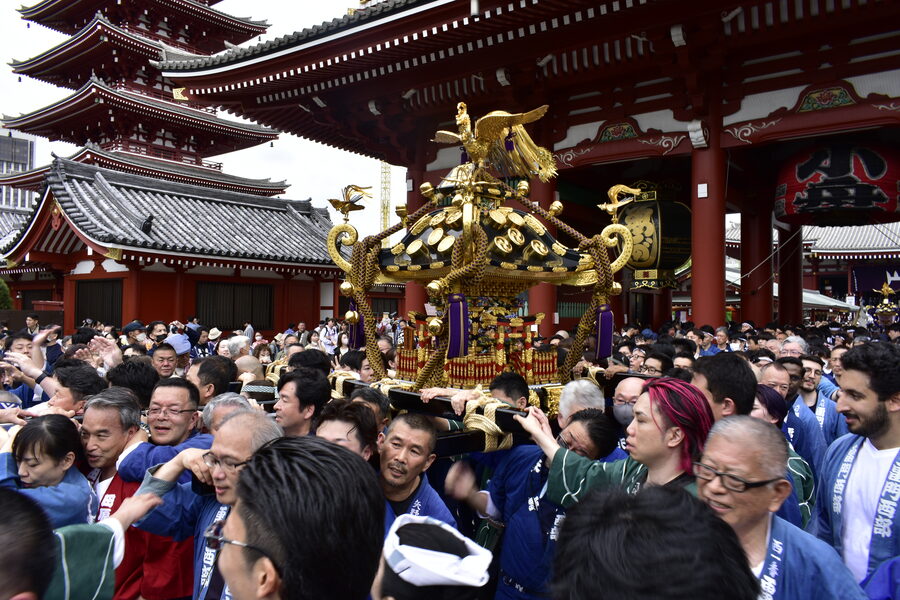
- Sanja Matsuri (third weekend of May): Asakusa’s three-day riot
- Summer (June to August): the heaviest festival season of the year
- Gion Matsuri (1 to 31 July): Kyoto’s plague-deflection ritual
- Tsushima Tennō Matsuri (fourth Saturday of July): Oda Nobunaga’s favourite
- Sendai Tanabata (6 to 8 August): the streamer canopy
- Aomori Nebuta Matsuri (2 to 7 August): the warrior float festival
- Akita Kantō Matsuri (3 to 6 August): 46 lanterns balanced on a pole
- Awa Odori (12 to 15 August): the Fool Dance
- Obon (13 to 16 August nationwide, 13 to 15 July in Tokyo)
- Autumn (September to November): the quietest festival quarter
- Takayama Matsuri (Autumn): 9 and 10 October
- Winter (December to February): the season most foreign visitors skip
- Toyokawa Inari (1 to 3 January): Japan’s only Buddhist Inari
- Hadaka Matsuri (third Saturday of February): the naked festival
- Sapporo Snow Festival (4 to 11 February): the post-1950 outlier
- The “Three Great Festivals of Japan”, and four other rival lists
- Practical visiting: planning a festival-led trip
- Booking and timing: the brutal logistics
- Best regional pairings
- What to wear and how to behave
- Festival food: a category by itself
- If you only have one week: my contrarian three-pick
- Festivals as the country looking at itself
Spring (March to May): the season that gets the most international tourists for the wrong festival
Spring in Japan is dominated, internationally, by cherry blossoms. Domestically, the spring festival calendar is much more varied: doll-day in early March, sakura-viewing through April, two of the three Edo-period Tokyo flagships in May, and the spring half of the Hida-Takayama yatai festival on 14 to 15 April. If you arrive in late April you can chase Takayama in Gifu, then come down to Tokyo for Kanda or Sanja in May without ever leaving central Honshū.
Hina Matsuri (3 March): the festival I almost left off
I do not have a dedicated post on Hina Matsuri, the doll-display day on 3 March, because it is genuinely a domestic event. Families with daughters set up tiered displays of Heian-period dolls (the emperor and empress on the top tier, court attendants below) and put them away on the evening of 3 March. The folk belief is that leaving the dolls out late delays a daughter’s marriage.
There are public displays at Inuyama and at the Hyakudan Kaidan in Meguro, but if you have a single spring week, I would not build it around Hina. Mention it as context for the rest of the spring calendar.
Sakura and Hanami (late March to early May, north-bound)
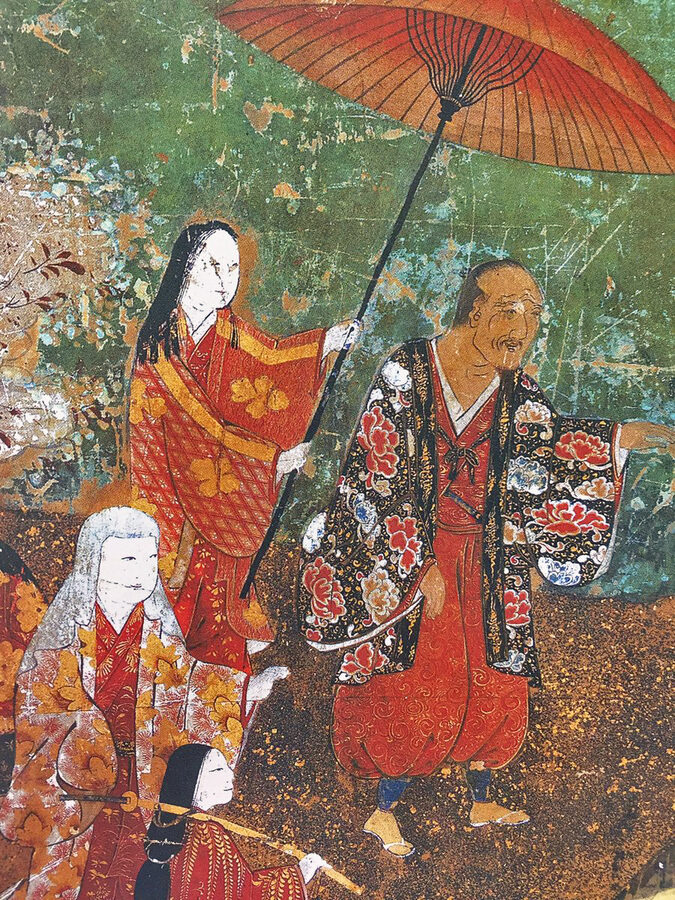
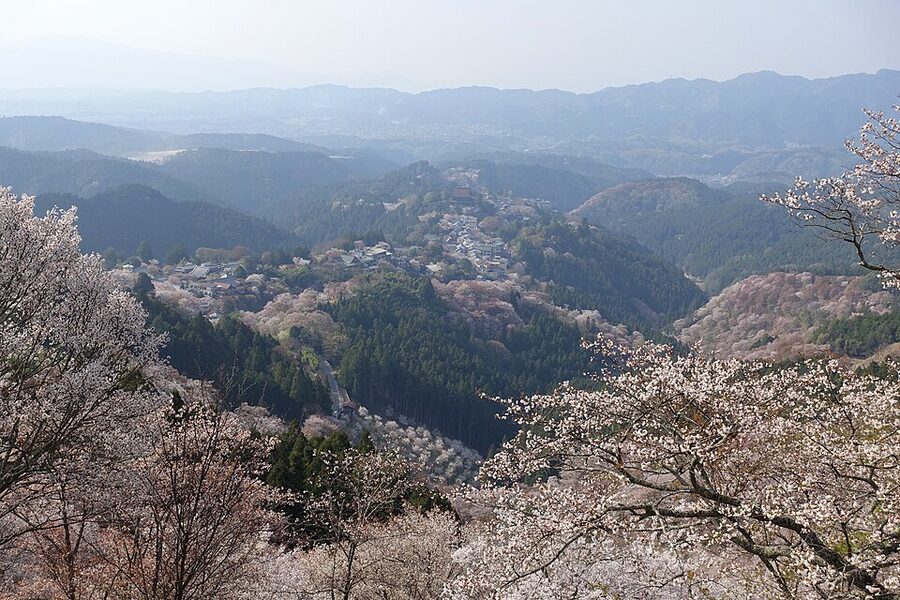
The cherry blossom season is the festival that almost everybody can name, and for once I think the international perception is roughly accurate. The bloom moves north from Kyūshū in late March, passes through Tokyo and Kyoto around 1 April, hits Tōhoku in late April, and finishes in Hokkaido around 5 May. The whole sequence is forecast, mapped, and re-mapped daily by the Japanese Meteorological Corporation. I have written a long piece on the 1,300-year history of hanami and how the modern picnic-under-the-trees ritual descends from Heian-court flower-viewing parties.
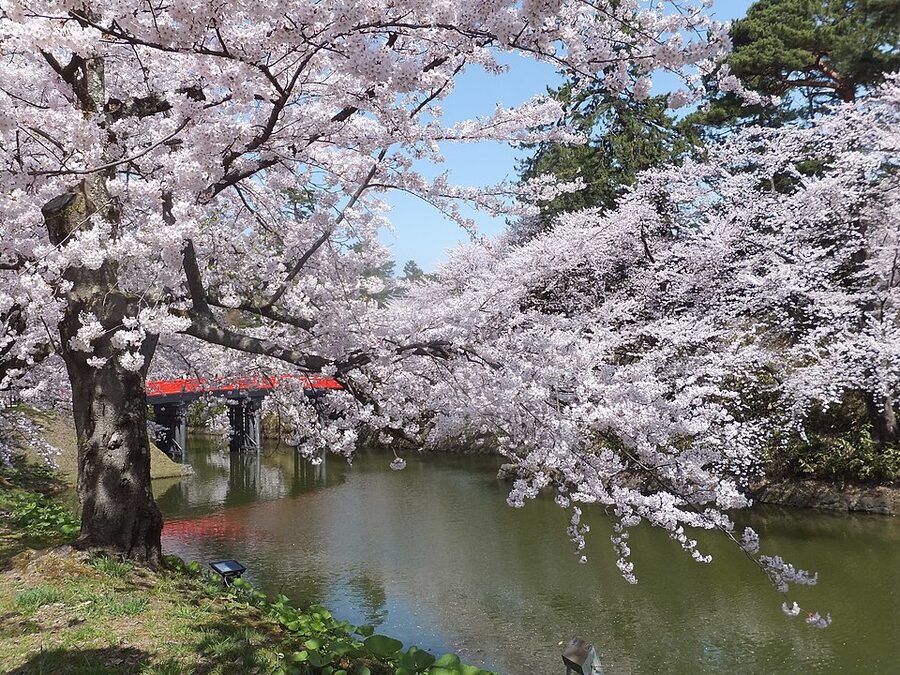
The crucial planning point is that the actual peak bloom (mankai) lasts roughly four days at any given location. If you book your flights to Tokyo for “cherry blossom season” three months in advance, you are guessing. The way locals do it is to keep a flexible week and follow the front. If Tokyo blooms early, you head north to Tōhoku. If Tokyo blooms late, you stay put. Hirosaki Castle in late April is, in my opinion, a better hanami destination than Ueno Park for any photographer; the castle moat is lined with 2,600 cherry trees and the petal-fall covers the water in pink for forty-eight hours.
The other thing I would tell anyone planning a hanami trip is to do at least one night-bloom (yozakura) viewing. The trees are lit with paper lanterns or floodlights, the temperature drops, and the crowds shift from picnicking families in the daytime to drinking salarymen at 21:00. Rikugien Garden in Tokyo runs the most disciplined night illumination, and the weeping cherry near the entrance is theatrical lighting at its best. Maruyama Park in Kyoto does the loudest version, with food stalls, blue tarpaulins, and the famous central shidare tree lit until 23:00.
Takayama Matsuri (Spring): 14 and 15 April in Hida-Takayama
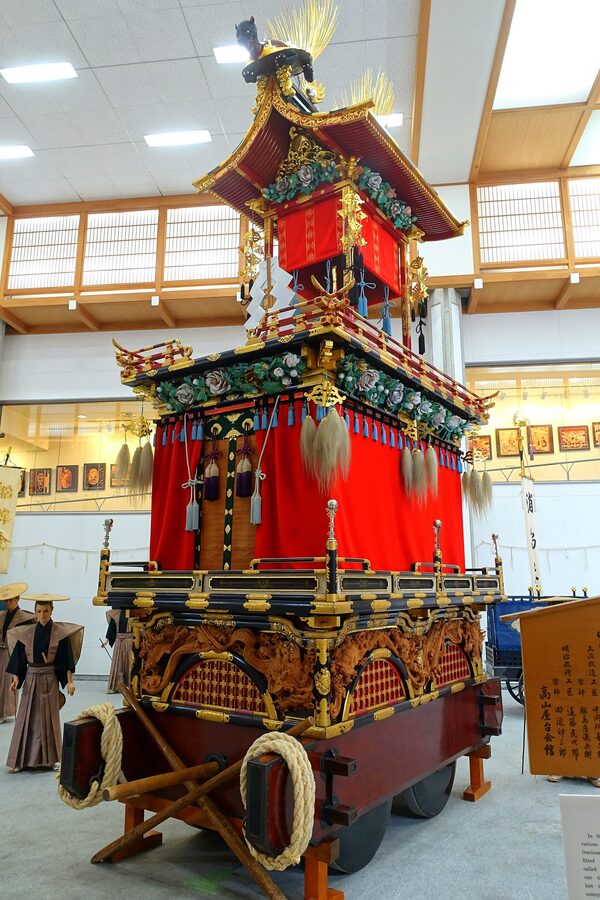
The Takayama Matsuri is split: the spring half runs on 14 and 15 April, the autumn half on 9 and 10 October. Both are organised around twelve mechanical-puppet floats called yatai, some of which are 350 years old and weigh more than two tonnes apiece. The spring festival belongs to Hie-jinja, on the southern half of Takayama; the autumn one belongs to Sakurayama Hachimangū, on the north. I have a complete walkthrough of the Takayama Matsuri here if you want the full story on the puppets.
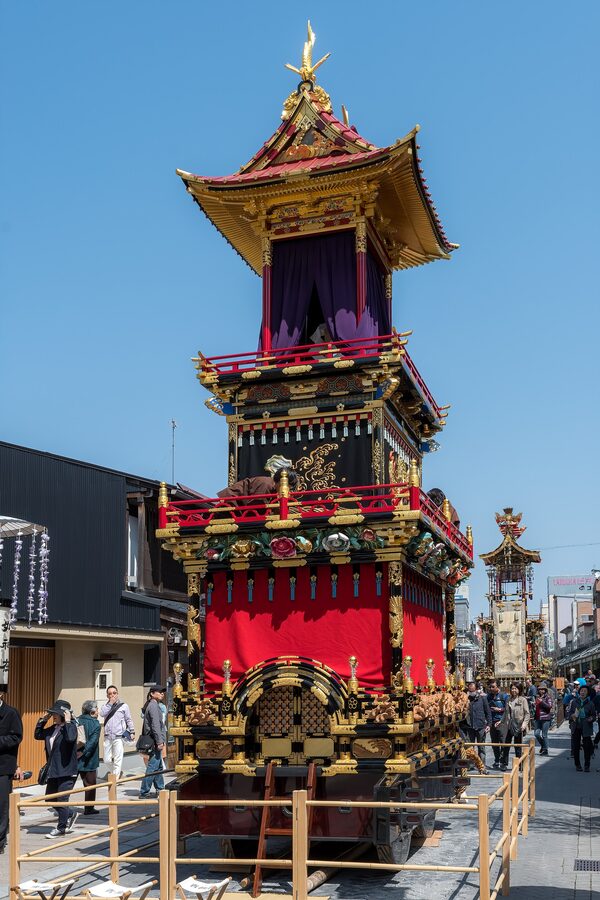
The single thing to time the trip around is the karakuri hōnō, the puppet-dedication performances. Three of the spring yatai (Sankōdai, Ryūjin-tai, and Ishi-bashi-dai) carry mechanical puppets that perform short stories using strings, levers, and weights, all controlled by puppeteers hidden inside the float. The performances run twice a day on the festival square, take roughly six minutes apiece, and they are the moment when 350-year-old engineering reads as a magic trick. Get there an hour early. The square fills.
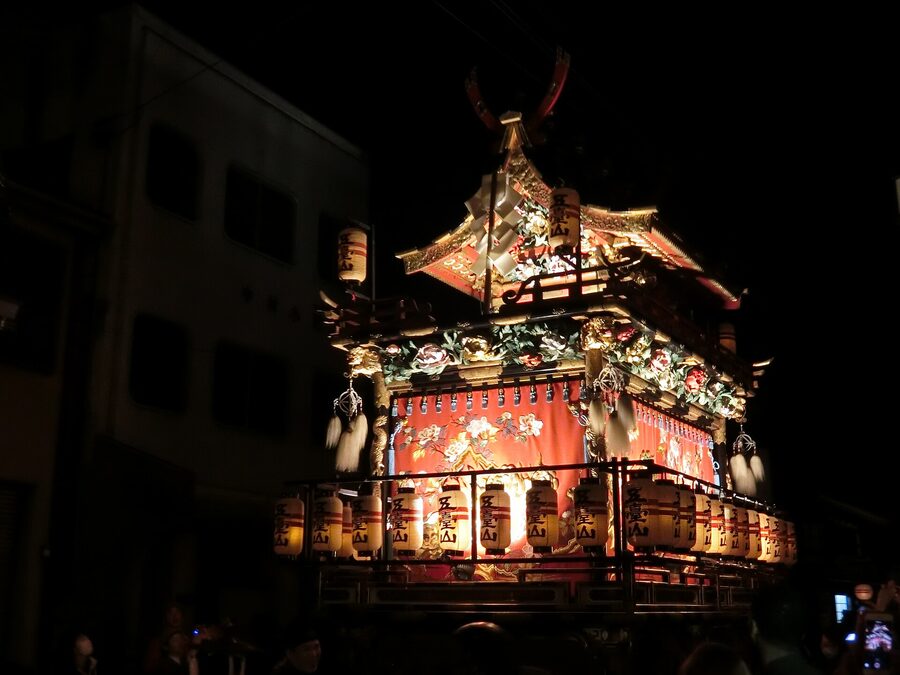
Hida-Takayama is also one of the few Japanese festival towns where the festival storehouses (yatai-gura) are open as a museum on non-festival days. The Takayama Yatai Kaikan rotates four of the twelve yatai every quarter, so you can see the engineering up close even if your trip falls in the wrong week. I prefer the on-festival experience by a wide margin, but if your itinerary forces you here in summer or winter, the museum is genuinely satisfying.

Kanda Matsuri (mid-May, odd-numbered years): the Tokugawa-shogunate parade
Kanda Matsuri is the festival that the Tokugawa shogunate co-opted into a state event. After the Battle of Sekigahara in 1600, Ieyasu attributed his victory partly to a prayer made at Kanda Myōjin shrine the night before the battle. The shrine became the protective deity of Edo Castle, and the Kanda Matsuri became one of only two festivals (with Sannō Matsuri) that the shogun’s procession was permitted to enter the castle grounds. It alternates with Sannō by year: Kanda in odd-numbered years, Sannō in even ones. My full piece is at Kanda Matsuri: the festival Tokugawa Ieyasu started in 1600.
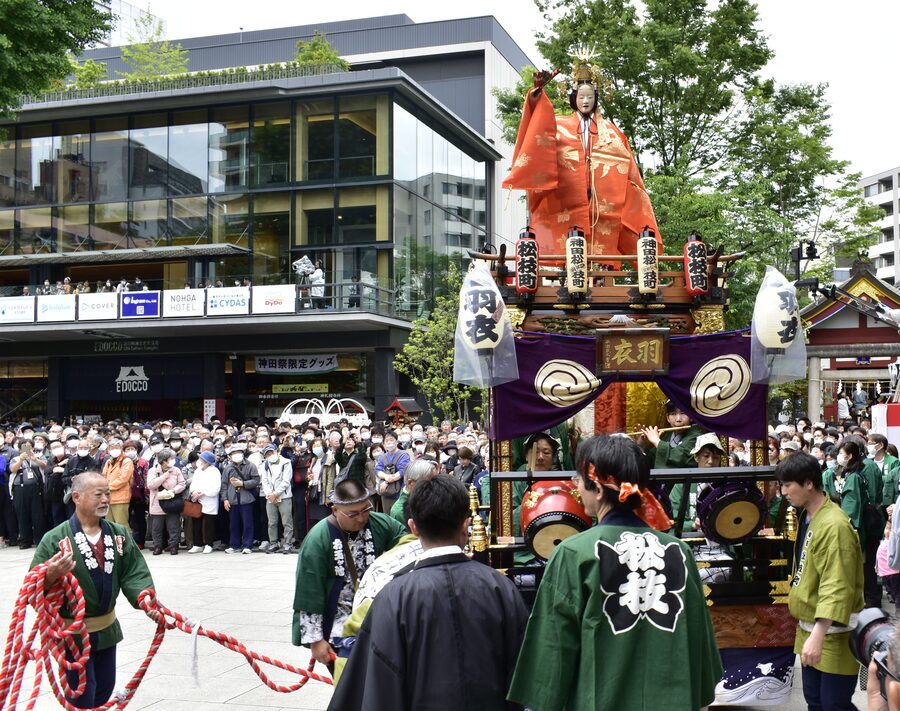
The two key events are the Shinkō-sai on the Saturday (a 9-kilometre route through Kanda, Nihonbashi, and Akihabara, taking roughly twelve hours) and the Mikoshi Miyairi on the Sunday (when each parish mikoshi enters the shrine grounds for blessing). I prefer the Sunday because the procession converges. You can stand near the shrine steps from about 10:00 onward and watch each neighbourhood arrive, fight up the staircase with their mikoshi, get blessed, and leave. By 17:00 the staircase looks like a high-water mark on a beach.
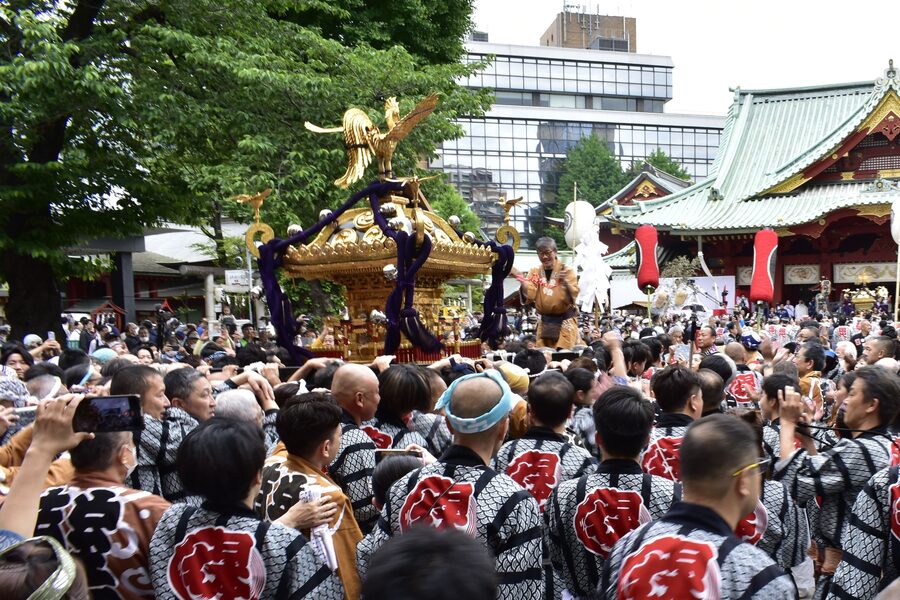
The Edo-period Kanda Matsuri included a full set of yatai-float teams pulled by the parish neighbourhoods, but those floats were destroyed in the 1923 Great Kantō Earthquake and again in the 1945 firebombings. The modern festival is mikoshi-only, which gives it a tighter, more athletic feel than Takayama or Gion. If you have ever wondered what it sounds like to have 200 people screaming “wasshoi” at the same time on a closed Tokyo street, this is the answer.
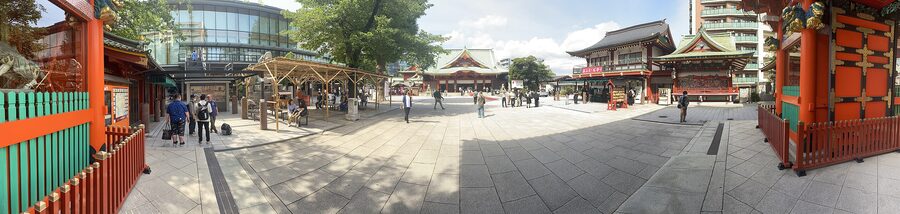
Sanja Matsuri (third weekend of May): Asakusa’s three-day riot
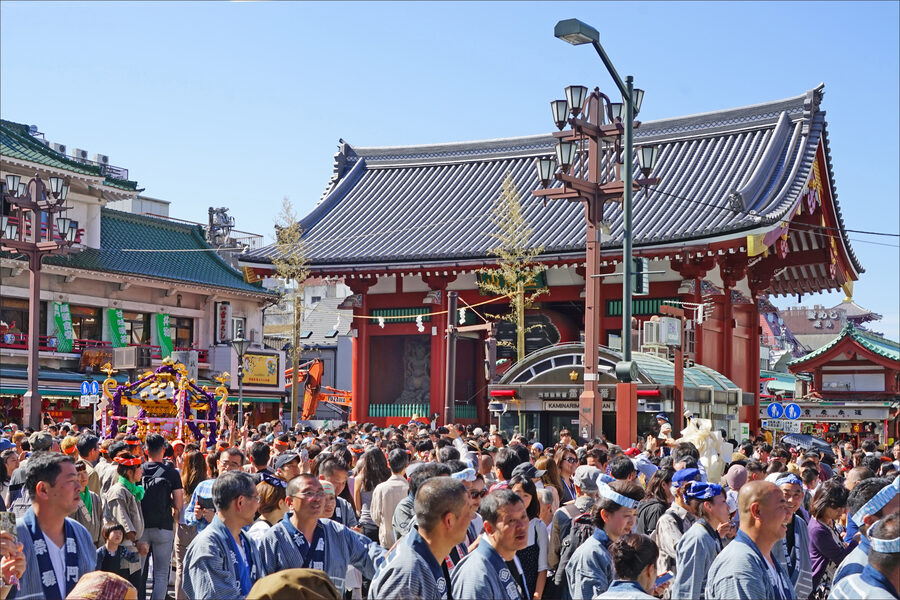
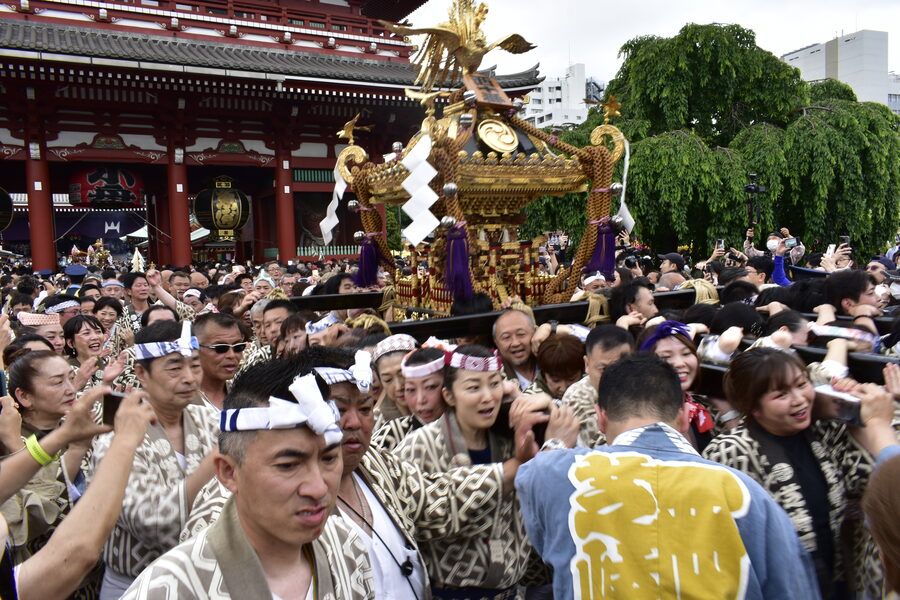
If Kanda is the festival the shogunate co-opted, Sanja is the festival the Tokugawa never managed to discipline. Sanja Matsuri belongs to Asakusa Shrine, located right next to Sensō-ji, and it has been the noisiest and most working-class festival in Tokyo since at least the 1640s. The three-day count includes roughly 100 neighbourhood mikoshi plus the three honmikoshi (the deity-bearing main shrines), and crowd estimates routinely run between one and two million. My piece on the structure is at Sanja Matsuri: Asakusa’s three-day riot of mikoshi.
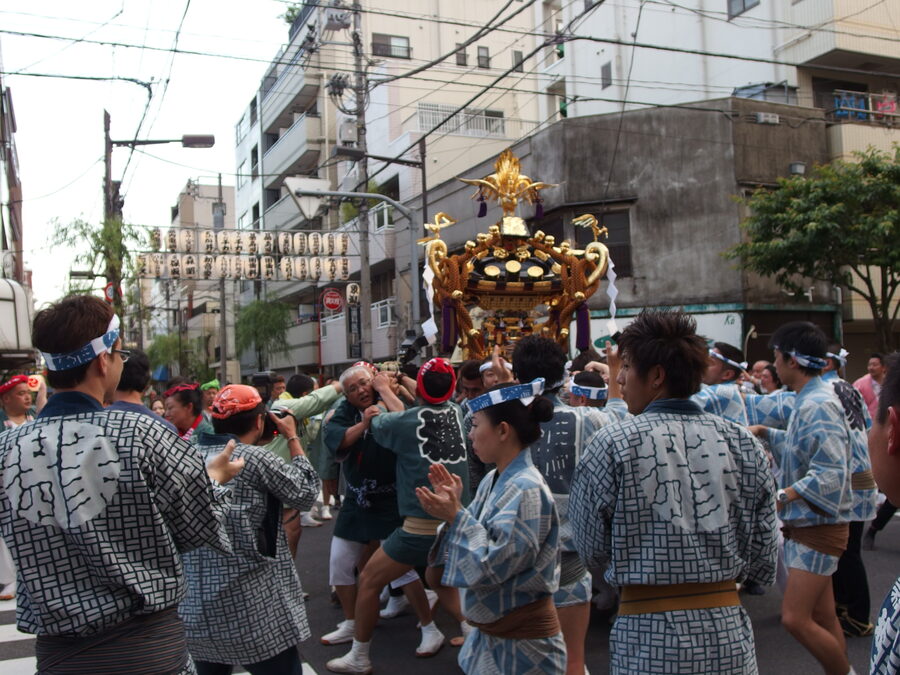
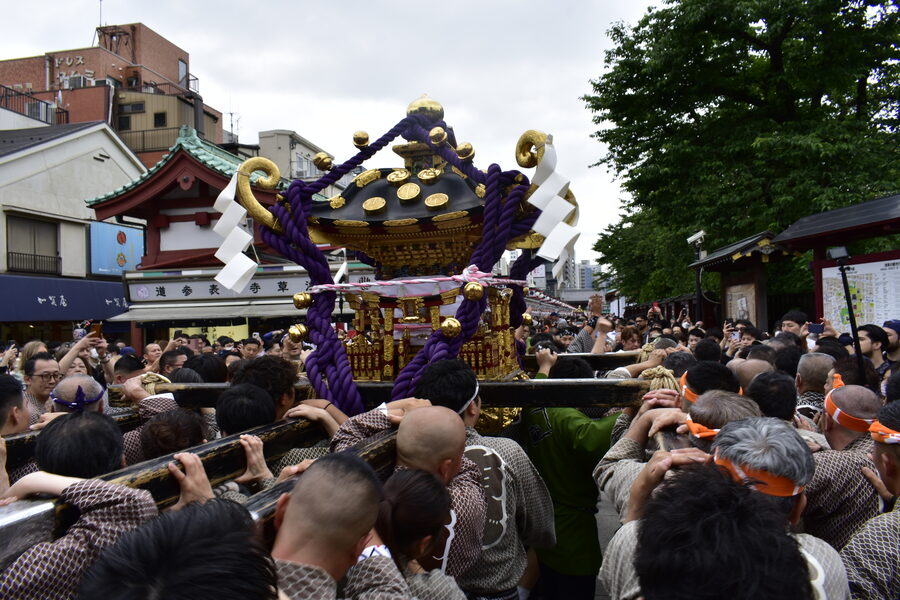
The Sunday is the one to plan around. The three honmikoshi leave Asakusa Shrine at dawn, split into three routes that cover the entire Asakusa parish, and reconverge at the shrine in the evening. The crowd density between Kaminari-mon and the shrine’s torii is the highest you will see at any Tokyo festival, and the energy is genuinely manic by mid-afternoon. The Saturday is calmer (the 100 neighbourhood mikoshi take their parishes one at a time), the Friday night daigyōretsu is a Heian-period costumed procession that almost nobody stops to watch.
One thing worth knowing in advance: the back-tattooed Tekiya members of the Asakusa parish (often, though not exclusively, with yakuza-affiliated histories) traditionally appear at Sanja shirtless during the procession. There has been increasing pressure since 2007 to keep the tattoos covered, and the Asakusa Shrine board has formally banned tattooed mikoshi-bearers from the honmikoshi route since 2012. You will still see tattoos on neighbourhood mikoshi. Do not photograph people in tattoos at Sanja unless they make eye contact and nod.
Summer (June to August): the heaviest festival season of the year
If you want to maximise festival density per travel-day, plan a summer trip. July and August together account for nine of the fourteen festivals on this list, including all three “Great Tōhoku Festivals” within a five-day window in early August. The weather is brutal (Kyoto in mid-July routinely hits 36 degrees Celsius and 80 percent humidity), but every prefecture has its flagship matsuri ready and the calendar is dense enough that you can chain three or four in one trip.
Bring a small towel. Drink more water than you think you need.
Gion Matsuri (1 to 31 July): Kyoto’s plague-deflection ritual
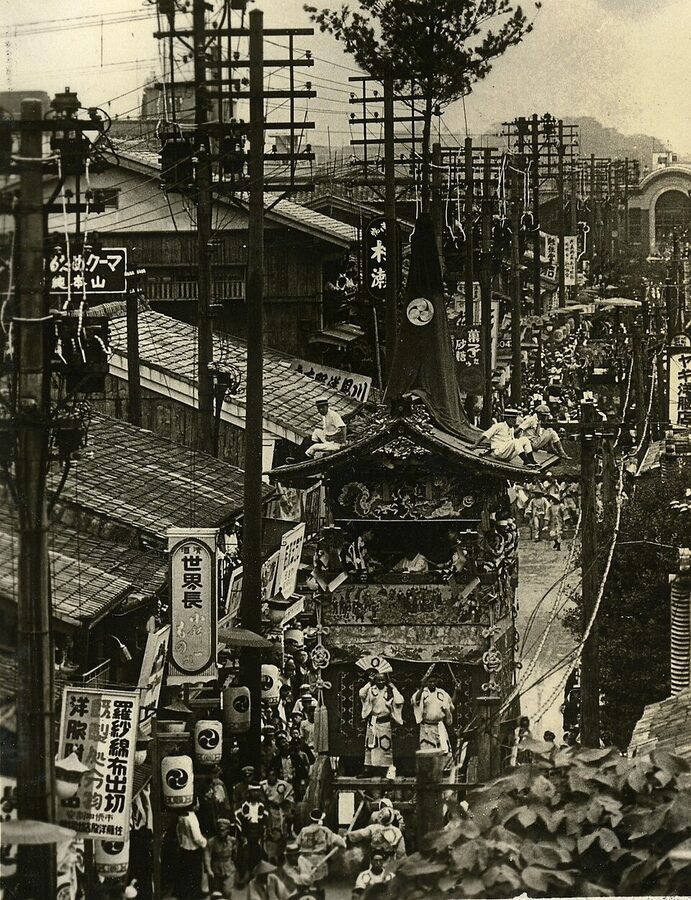
Gion Matsuri is, by most counts, the oldest continuously running festival in Japan. The original event in 869 was a public ritual at the imperial Shinsen-en garden to repel a plague that had been killing Kyoto residents through the summer. The festival continues for the entire month of July, with the climax procession on 17 July (Saki-matsuri) and a smaller second procession on 24 July (Ato-matsuri). The full structure is in my piece Kyoto’s 1,150-year-old plague response.
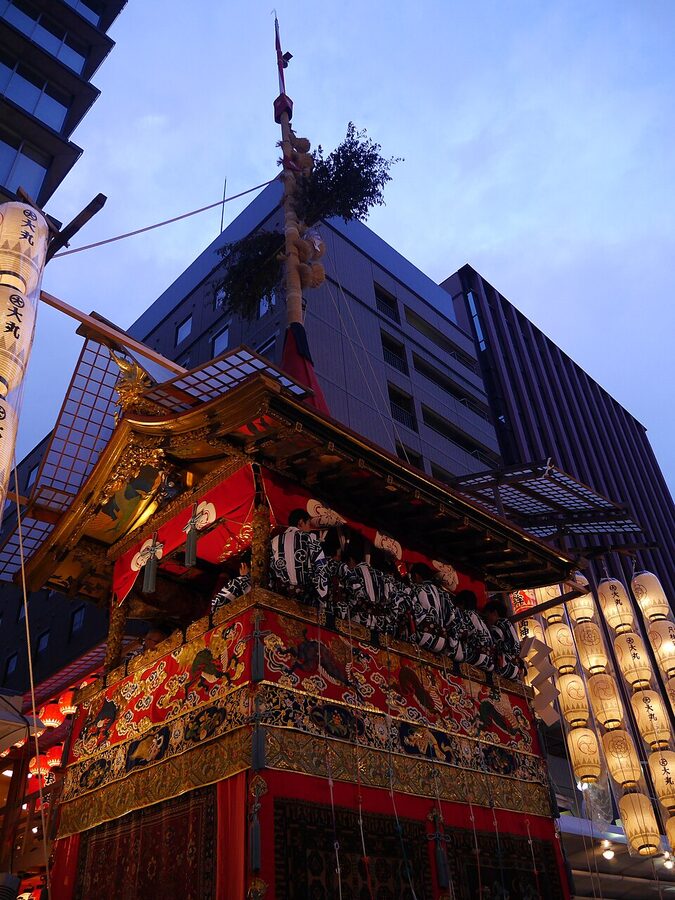
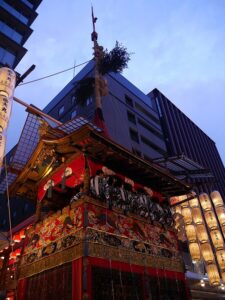
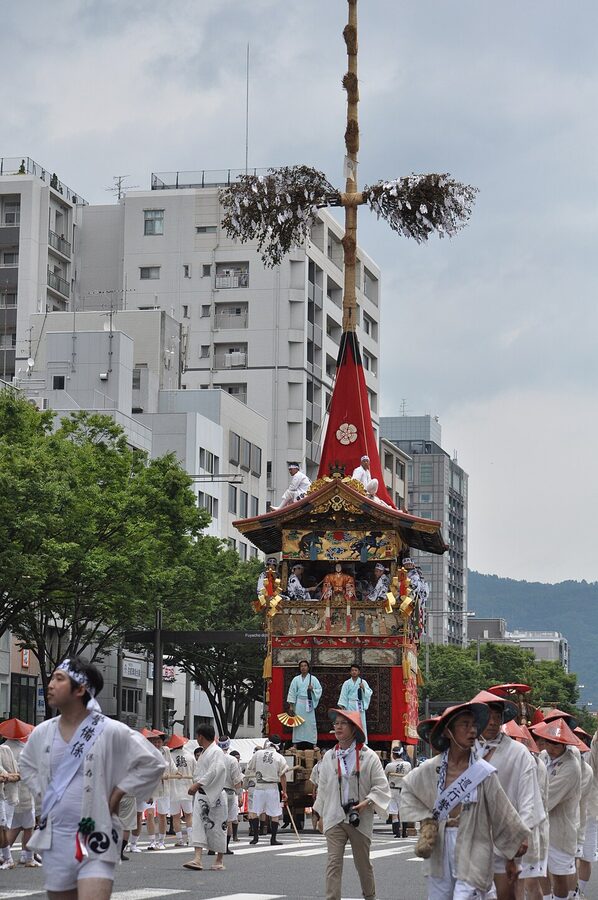
The technical highlight of Gion Matsuri is the tsuji-mawashi, the corner turn. The yamaboko floats have no steering. To turn a corner, the rope crew lays wet bamboo strips under the right rear wheel, then yanks the float sideways in three coordinated pulls. The whole operation takes about ninety seconds and the applause when it goes well is the closest a Kyoto crowd ever gets to ovation. The best corner-turn viewing is at the Kawaramachi-Oike intersection, on the south-west corner, between roughly 11:00 and 12:30 on 17 July.
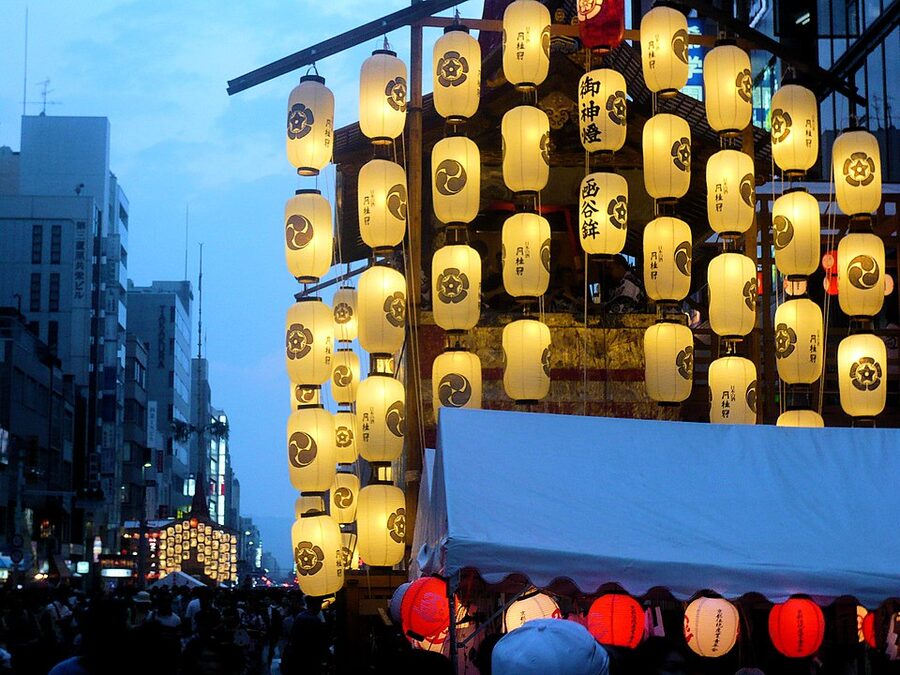
The other piece I would not skip is Yoiyama, the three nights before the 17 July procession. The yamaboko floats are fully assembled and parked on Kyoto’s central streets. Local merchant houses open their ground-floor rooms and display family folding screens, which is why Yoiyama also goes by the name Byōbu Matsuri, the Folding-Screen Festival. Walk the route slowly between 18:00 and 22:00. You will not see the same set of paintings twice.
Tsushima Tennō Matsuri (fourth Saturday of July): Oda Nobunaga’s favourite
Tsushima Tennō Matsuri is, in my opinion, the single most underrated festival on this list. It runs in Tsushima, Aichi Prefecture (about half an hour by train from central Nagoya), centred on Tsushima-jinja, the head shrine of about 3,000 Tsushima/Tennō shrines across Japan. Oda Nobunaga reportedly favoured it; his wife’s family worshipped at the shrine, and Nobunaga himself donated portions of the precinct buildings in the 1570s. The full piece is at Oda Nobunaga’s favourite summer festival.
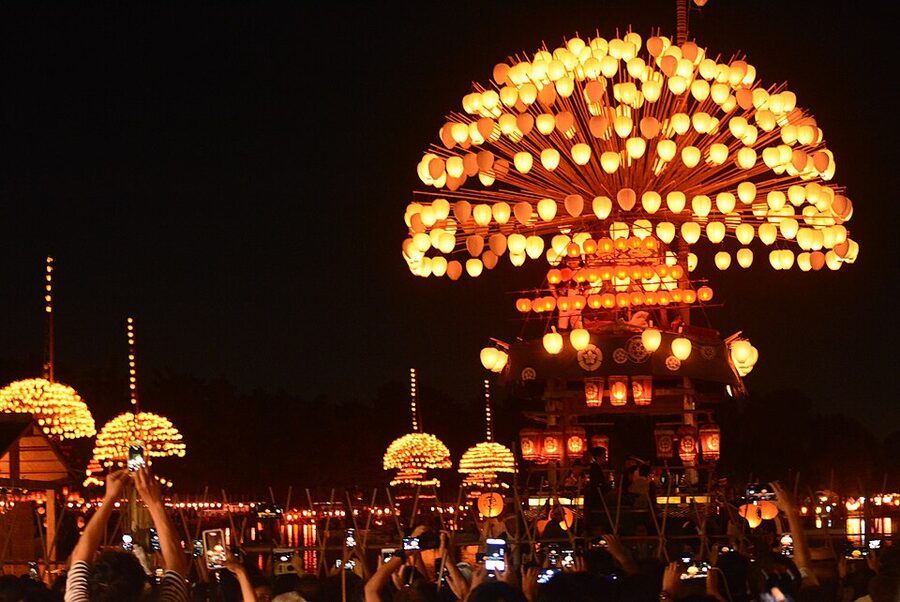
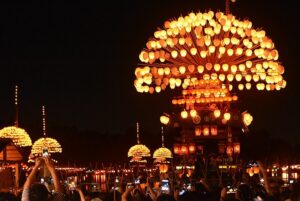
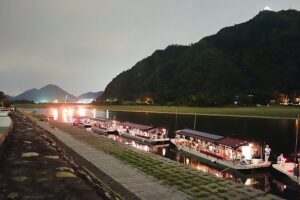
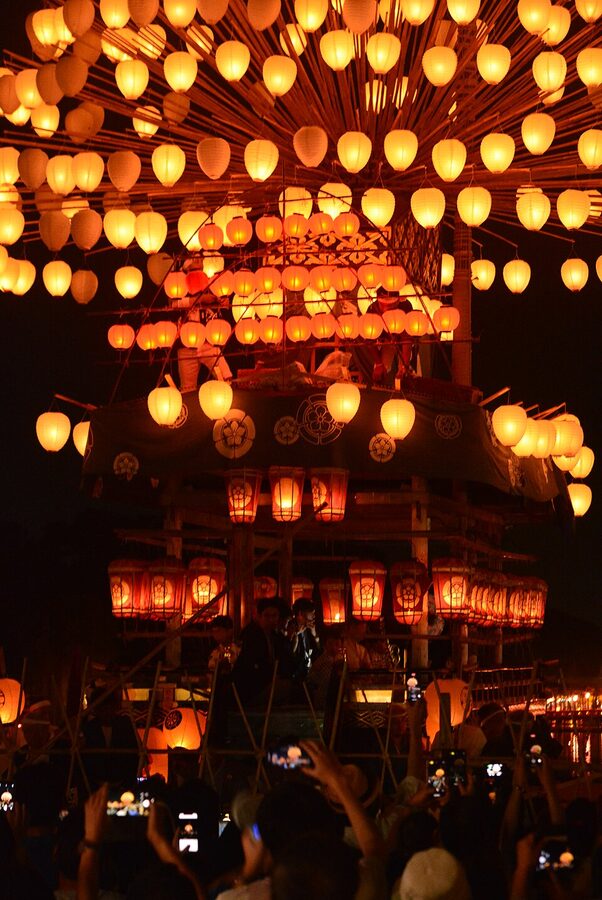
The festival has two halves. The Yoimatsuri (Saturday evening) is the lantern-boat ritual: five makiwarabune circulate slowly on Maruike pond from sunset to roughly 22:00, accompanied by drum music played from a smaller central boat. The Asamatsuri (Sunday morning) is the doll-boat ritual: six danjiri-bune carrying life-size Noh-play dolls cross the same pond as a daytime offering. Most international visitors only see the evening half because the morning event starts at 08:30 and is not advertised in English.
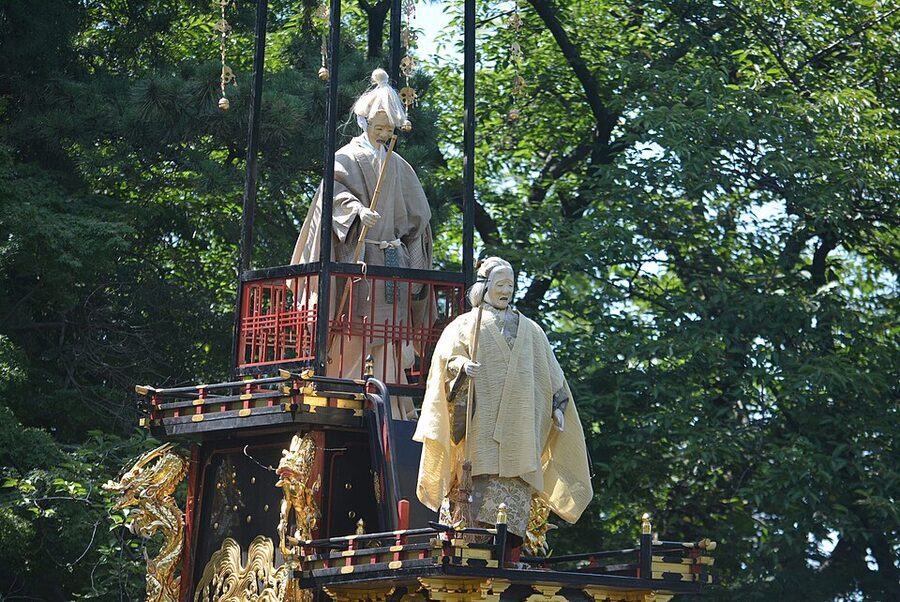
The Tsushima festival is one of the components of the most common framing of the Three Great Festivals of Japan (Gion + Tsushima + Itsukushima Kangensai). It is also the only one of the three you can comfortably see on a budget. There is no paid seating, no English ticketing infrastructure, and the food stalls along the pond are run by Tsushima’s volunteer associations rather than by national chains. Plan a Saturday-evening trip from Nagoya; the trains run until midnight.
Sendai Tanabata (6 to 8 August): the streamer canopy
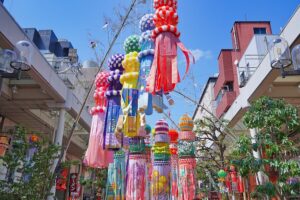
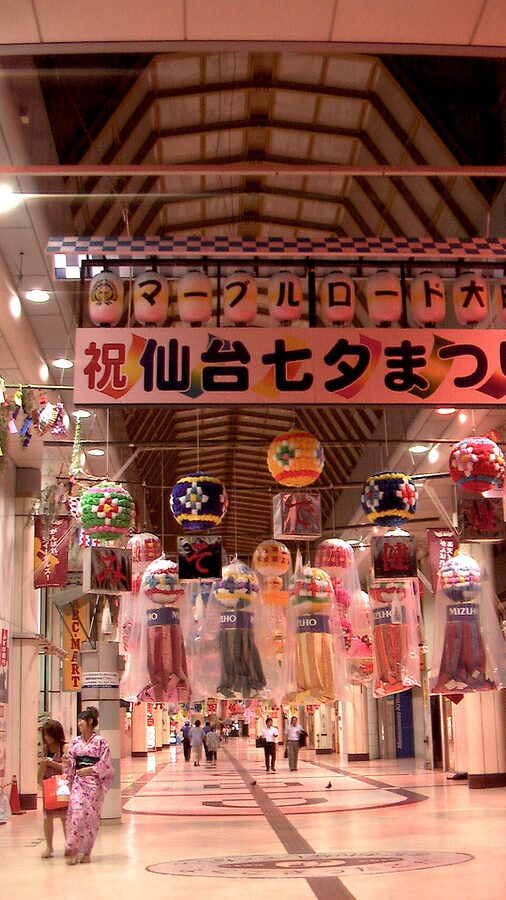
Tanabata is celebrated nationwide on 7 July (or 7 August in lunar-calendar holdouts), but the festival worth travelling for is in Sendai, Miyagi Prefecture. The Sendai version was institutionalised by Date Masamune in the early 1600s as a literacy-and-needlework promotion for samurai daughters, and it has been refined ever since into the largest Tanabata display anywhere in Japan: roughly 3,000 paper streamers (fukinagashi) suspended in the central shopping arcades. My full version is at Sendai Tanabata: when 3,000 paper streamers cross the Milky Way.
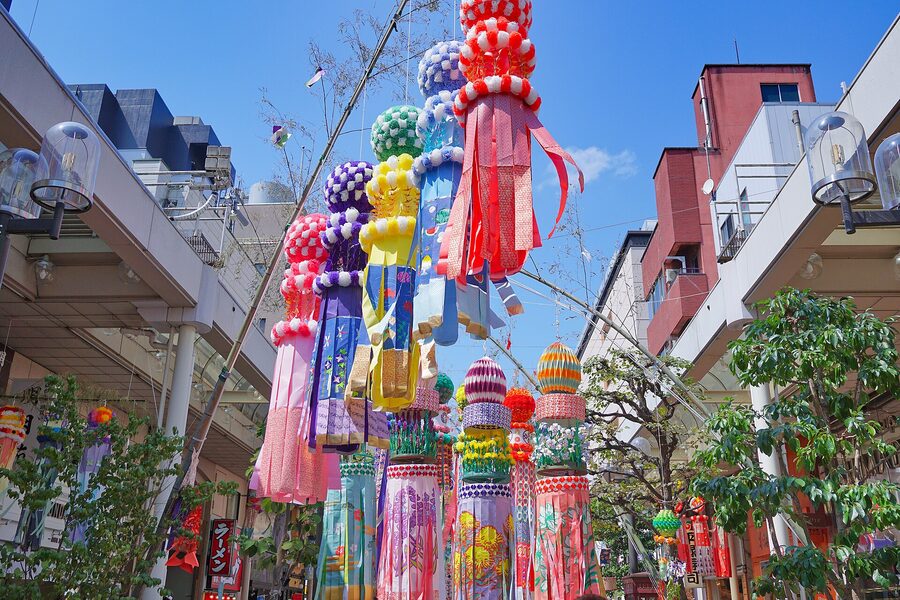
The reason Sendai Tanabata works on a casual visitor is that the venue is the city itself. The Chūō-dori and Ichibanchō covered arcades, where most of the streamers hang, run for roughly a kilometre and a half through central Sendai. You walk in, you walk out, you can repeat it three nights in a row, and there is no admission. This is the rare festival where the thing you came to see is at eye level all day, every day, for the full three days.
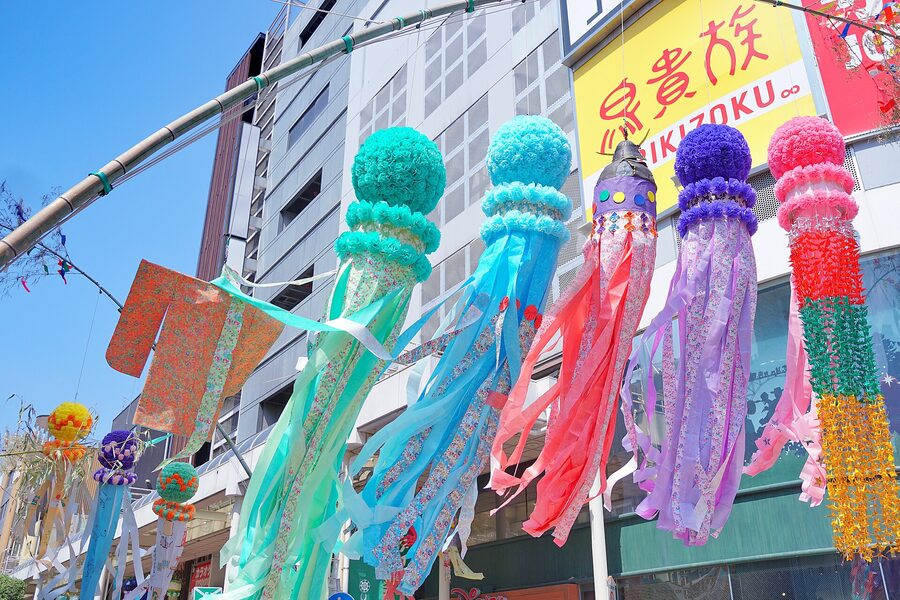
The seven traditional decorations have specific meanings: tanzaku (paper strips for wishes, related to literacy), kamigoromo (paper kimono, for needlework), orizuru (paper cranes, for longevity), kinchaku (purses, for prosperity), toami (cast nets, for the harvest), kuzukago (waste baskets, for cleanliness), and the fukinagashi streamers themselves (for weaving). Sendai shopkeepers traditionally hide a kuzukago in the corner of every display. Find it. It is a folk tradition for tourists since at least the 1980s.
Aomori Nebuta Matsuri (2 to 7 August): the warrior float festival
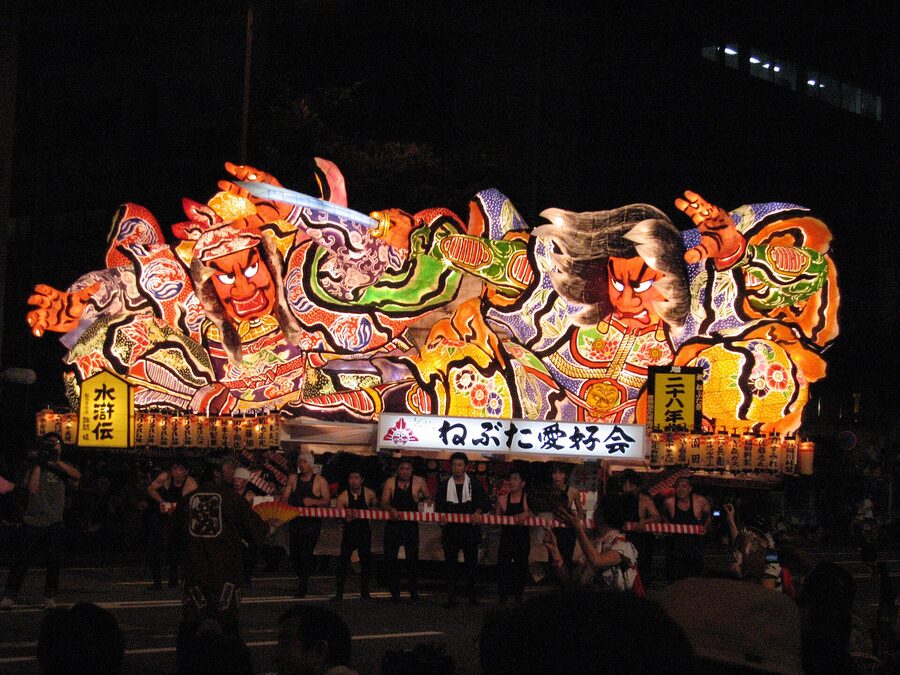
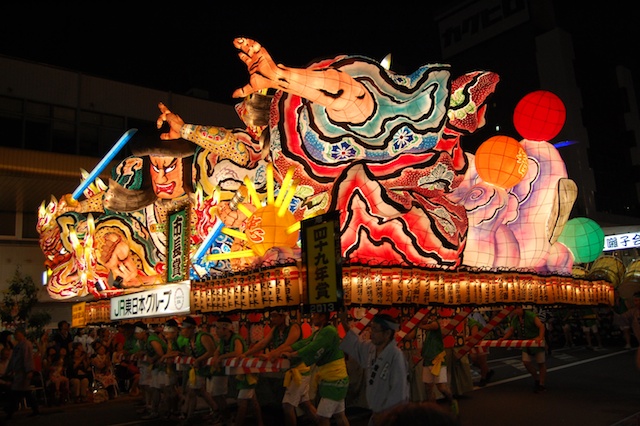
Nebuta is the festival I would prioritise if you have only one summer week in Tōhoku. It runs nightly from 2 to 6 August in Aomori City, with a daytime parade and seafront finale on 7 August. The signature object is the Nebuta float itself: a 9-metre, 4-tonne washi-paper-on-wood-frame sculpture of a samurai or mythological warrior, lit from inside by an electric bulb array, carried by a 30-person human chassis that swings the entire structure left and right as it rolls. The full piece is at Aomori Nebuta Matsuri: the warrior floats that light up Tōhoku every August.
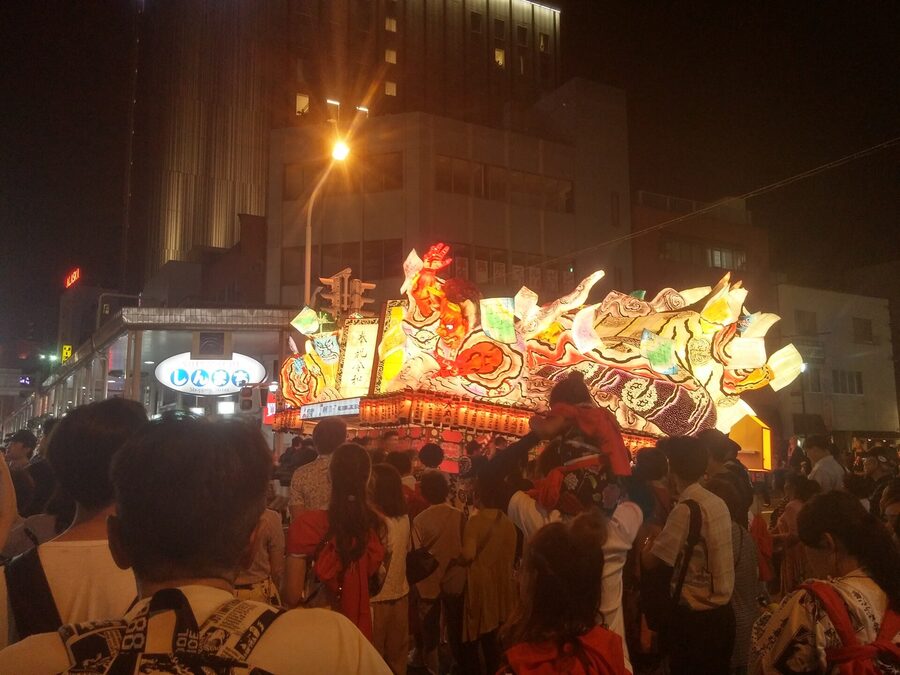
The dance side of Nebuta is the haneto, the bouncing dancers in white-and-purple costumes who lead each float. Anyone can join the haneto for the price of renting a costume (roughly 10,000 yen at any of the dozen rental shops near JR Aomori Station). The basic step is two hops on the right foot, two hops on the left, repeated for two hours.
By the end of the route you cannot feel your knees. I recommend it once.

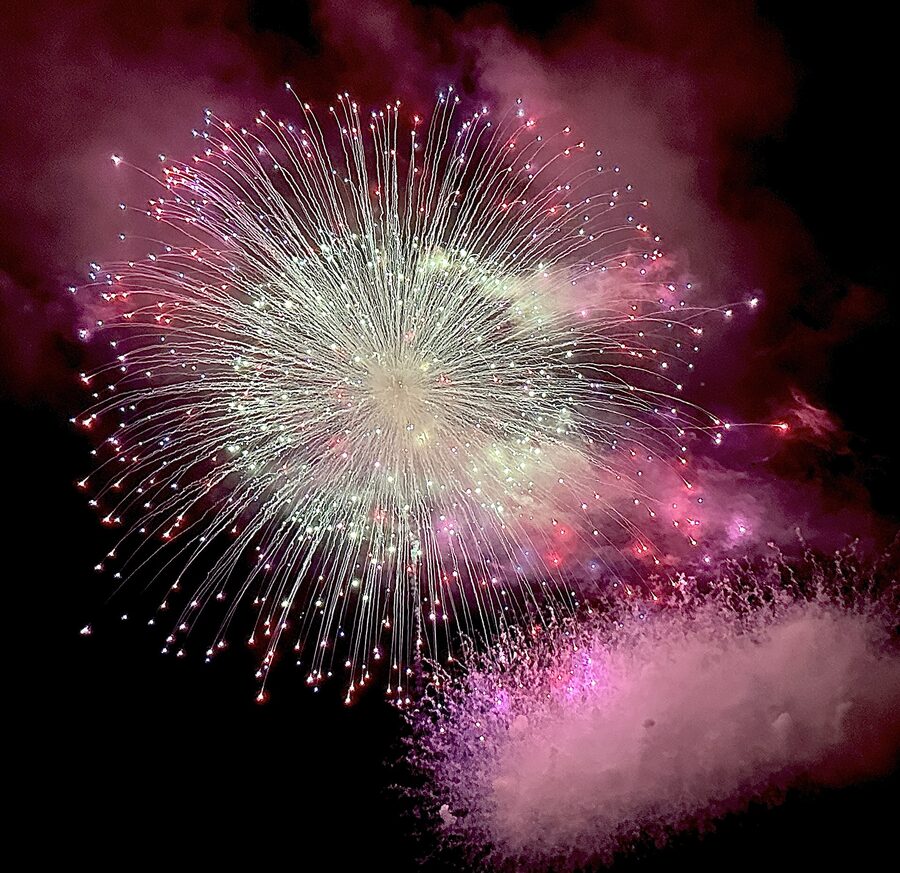
The 7 August finale is a separate event: the prize-winning floats from the previous five evenings are loaded onto barges, towed out into Aomori Bay, and paraded across the water while a roughly two-hour fireworks show fires off above them. The viewing is on the Aspam-side waterfront promenade; arrive by 17:00 to get a kerb-front spot. Bring a folding stool. The fireworks finish around 21:15 and the float-barge return runs to about 22:00.
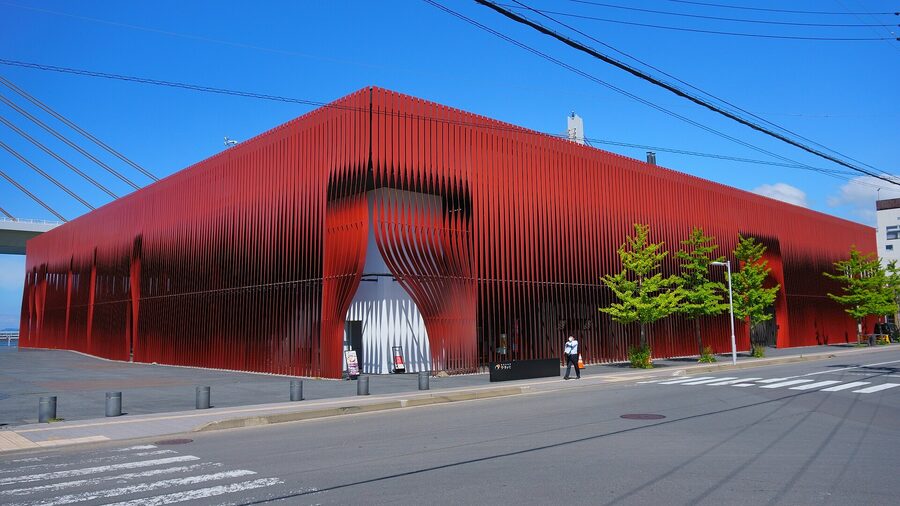
Akita Kantō Matsuri (3 to 6 August): 46 lanterns balanced on a pole
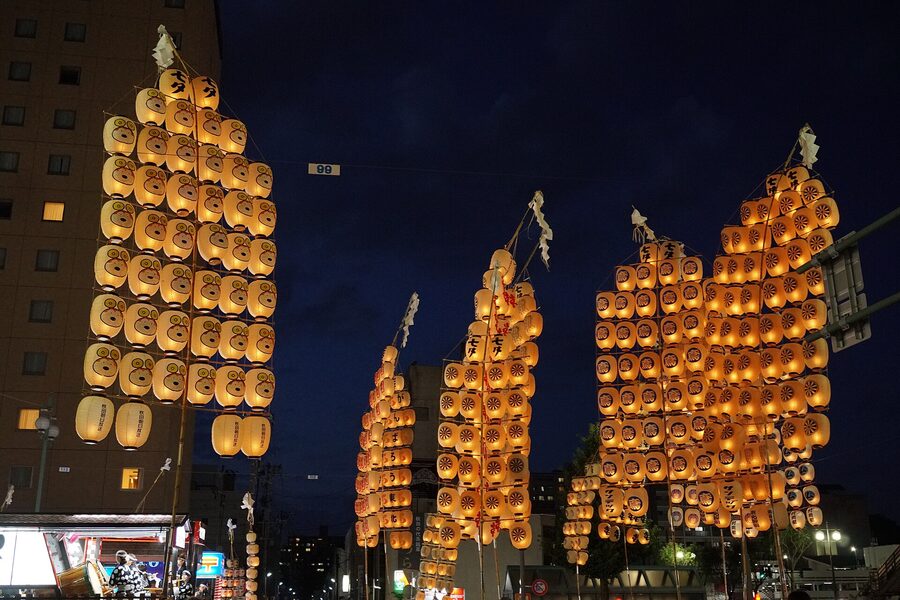
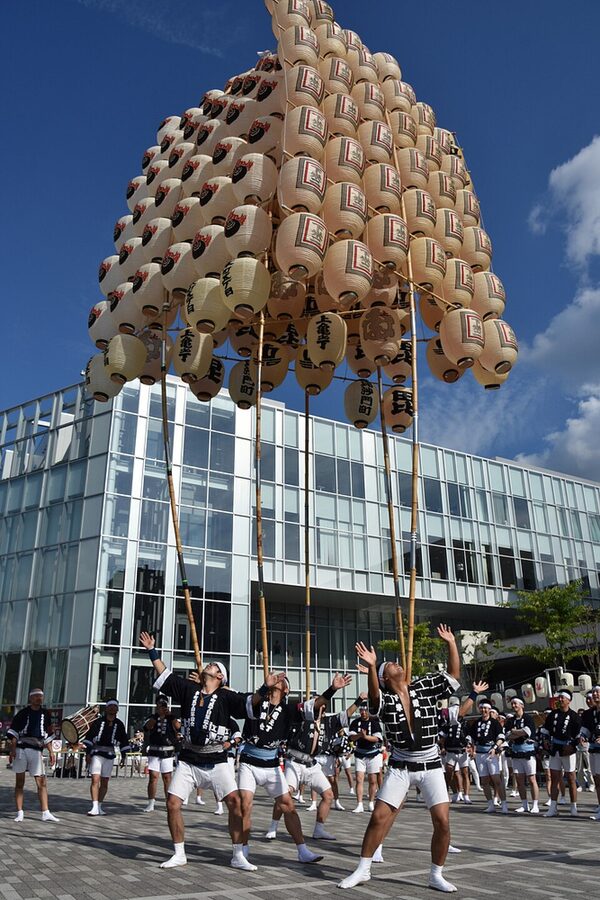
Kantō Matsuri is the third member of the “Three Great Tōhoku Festivals” trio, running in Akita City on the four nights overlapping with Nebuta. It is the strangest and most physically demanding event on this list: 250 men balance 12-metre bamboo poles, each carrying 46 paper lanterns and weighing roughly 50 kilograms, on their hands, foreheads, hips, and shoulders, walking down Kantō-dōri while the bamboo flexes alarmingly under the weight. My piece is at Kantō Matsuri: 46 lanterns balanced on a pole.
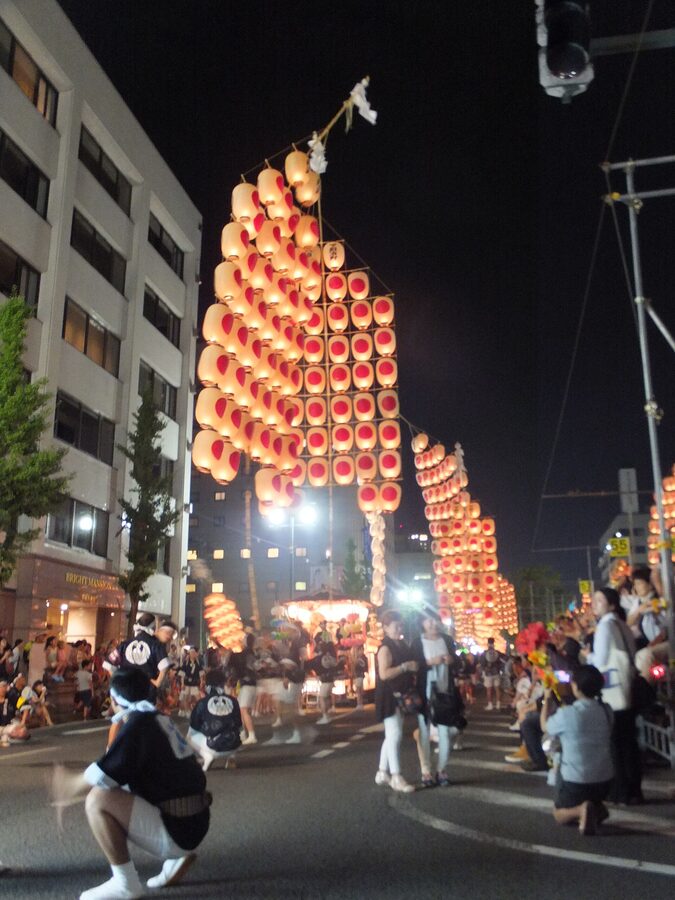
The four traditional balance positions are nagashi (palm), hira-te (forehead), koshi (hip), and kata (shoulder). A skilled performer can hold each position for twenty to forty seconds before transferring the pole to the next person. The bamboo flexes in a long arc, the lanterns sway, and the crowd’s reaction depends on whether the pole stays vertical or tips. When it tips, the lanterns catch fire roughly one in twenty times. There are extinguishers on the route. Nobody panics.
The myōgi-kai daytime competition (held at Nigiwai Hiroba on the southern half of central Akita on the 4th and 5th) is, in my opinion, the better viewing slot for technique. The lights are off, you can see the balance points clearly, and the judges are scoring on a tight rubric: balance time, transition cleanliness, height of the pole’s curve. Go to the night parade for atmosphere; come back to the daytime competition for craft.
Awa Odori (12 to 15 August): the Fool Dance
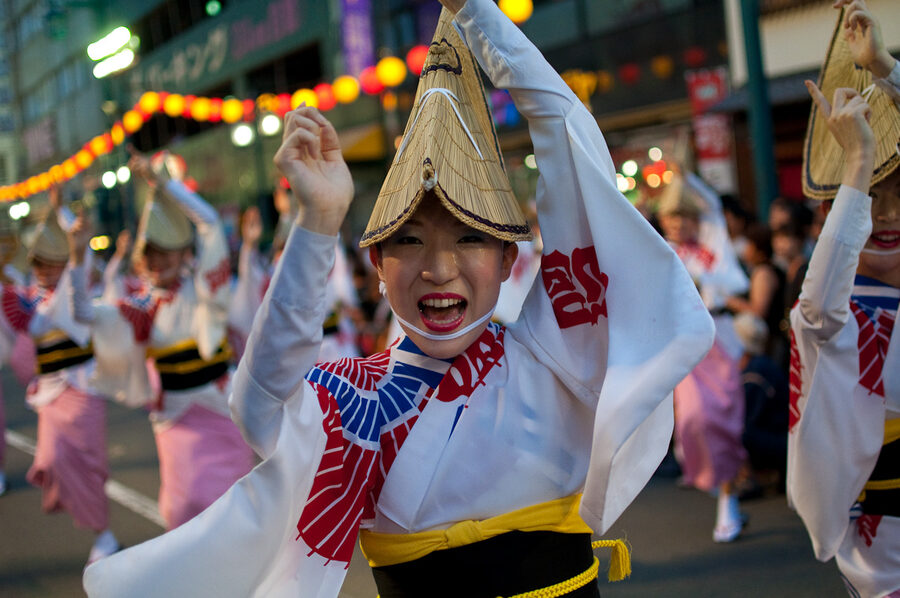
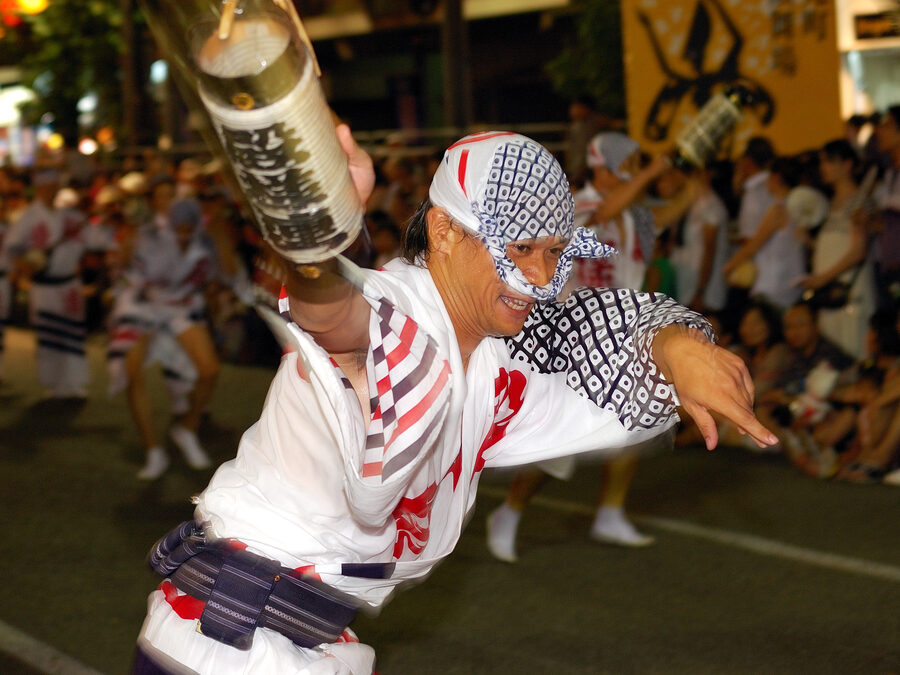
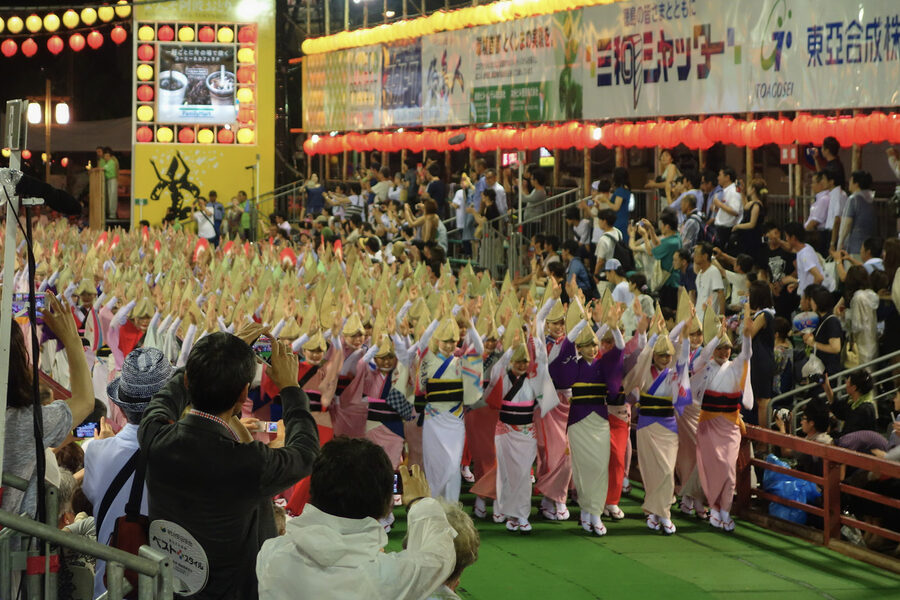
Awa Odori is the festival you want if your tolerance for crowds is high and your tolerance for music repetition is even higher. It runs in Tokushima City, on Shikoku, for four days in mid-August, and it is fundamentally a dance festival: roughly 100,000 dancers organised into 1,000 named teams (ren), all performing variations on the same five-bar tune across the city centre, all night, every night. The full piece is at Awa Odori: 400 years of the Fool Dance.
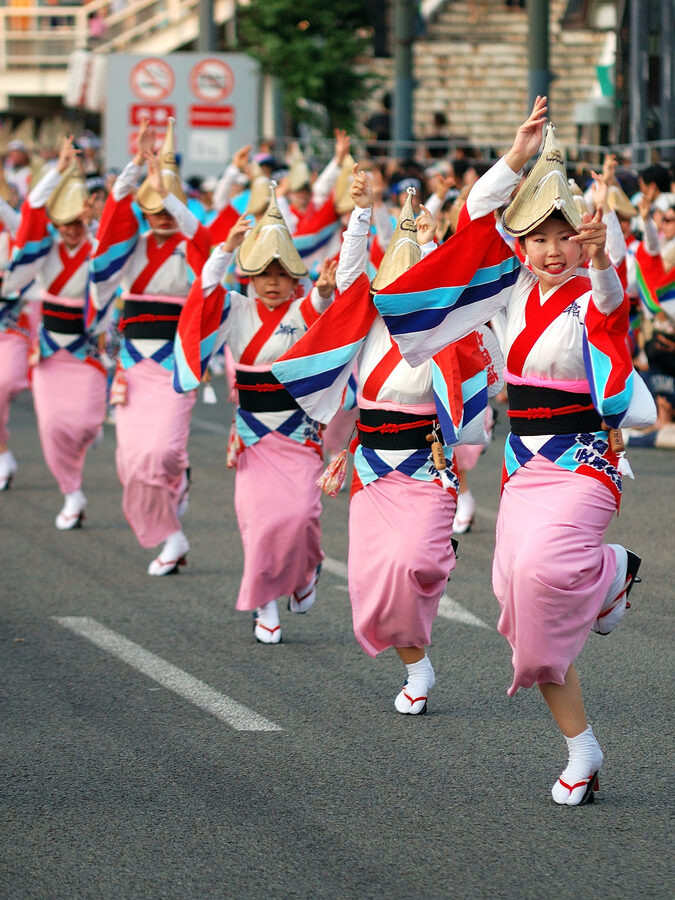
The dance has two distinct gendered forms. The men’s version (otoko odori) is a low crouch, knees bent, both arms held out and rotating in time. The women’s version (onna odori) is performed on the ball of the foot, in a tight shuffle, with arms raised in a high open frame. Both forms run on the same beat, and most ren rotate between the two as a team. The lyric (the chant rather than a melody) translates roughly to “the fool dances and the fool watches; if both are fools, you might as well dance.”
If you want a paid seat at one of the four enbujō stages (Minami-Uchimachi, Aibahama, Shiyakusho-Mae, or Ryōgokubashi-Minami-Zume), you must book through the official Tokushima City booking site, opening in mid-July. Tickets are 1,800 to 2,800 yen and they sell out within a week. If you are willing to stand on the kerb, the free street performances run on roughly six routes between 18:00 and 22:30 every evening, and they are arguably better viewing.
Obon (13 to 16 August nationwide, 13 to 15 July in Tokyo)
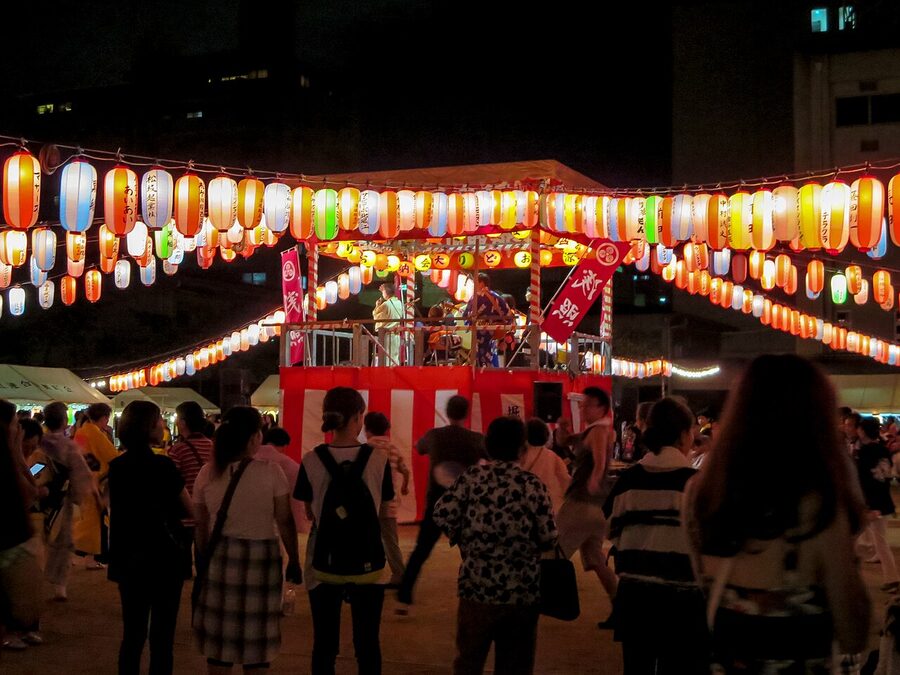
Obon is the closest Japan has to a national holiday in the religious sense. It is a Buddhist memorial period when the spirits of the dead are believed to return to their family homes for three days. Most workplaces close, the highways jam, the rural inland-Honshū villages double in population overnight, and the central rituals are private (cleaning the family grave, lighting a welcome fire on the doorstep) rather than public. My full piece is at Obon: three days when the ancestors come home.
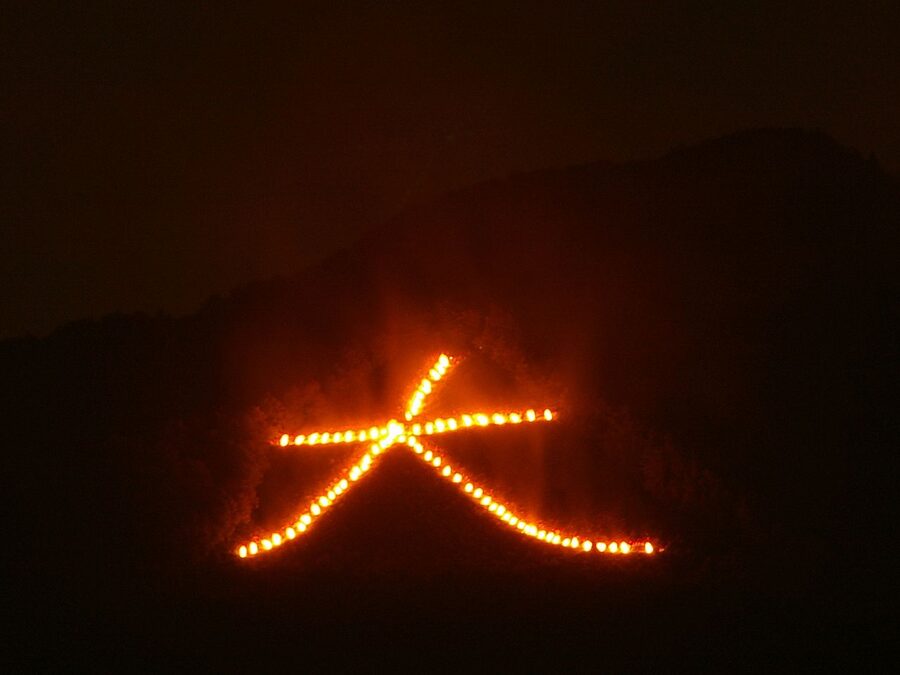
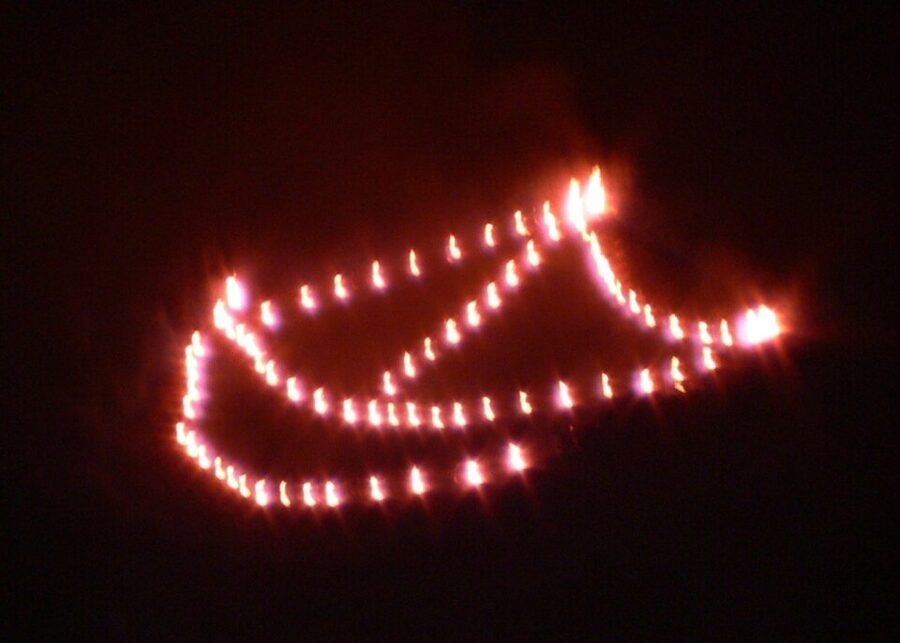
The most photogenic Obon ritual is the Gozan no Okuribi (or Daimonji) in Kyoto on the night of 16 August. Five mountainsides around the Kyoto basin are lit on fire, in five enormous shapes (the kanji 大, 妙, 法, a torii gate, and a boat). The fires burn for roughly thirty minutes each, in sequence starting at 20:00.
The viewing is from any high point in central Kyoto. I prefer the rooftop of Demachi Yanagi or the front lawn of the Imperial Palace. The Hotel Granvia top floor charges for the view but the elevation is best.
The other ritual worth seeing is toro nagashi, the lantern-floating that closes Obon in many parts of Japan. Each family writes the name of the deceased on a paper lantern with a candle inside, places it on a river or the sea at sunset, and lets the lantern drift. The Hiroshima version, around the Atomic Bomb Dome on 6 August (which doubles as the city’s atomic memorial), is the most photographed. The Asakusa version on 14 August on the Sumida River is the densest.
Autumn (September to November): the quietest festival quarter
Autumn is, paradoxically, the season with the fewest big festivals on this list. Most regional matsuri have folded into the spring-and-summer calendar, and the remaining autumn ones (Jidai Matsuri in Kyoto, Nagasaki Kunchi, Kishiwada Danjiri Matsuri) tend to be highly localised. The single autumn event I would build a trip around is the autumn half of Takayama Matsuri on 9 to 10 October. Beyond that, my honest advice is to pick a foliage destination (Nikkō, Kyoto, Kamikōchi) and visit any local matsuri you happen to overlap with rather than designing the trip around festivals.
Takayama Matsuri (Autumn): 9 and 10 October
The autumn half of Takayama Matsuri runs at Sakurayama Hachimangū, on the north side of the old town, with eleven yatai (one fewer than the spring count). Three of the autumn yatai (Hōteidai, Kaguratai, and Kinpōtai) carry karakuri puppets, and the autumn yomatsuri night procession is roughly the same scale as the spring version. If you cannot make spring, do not feel cheated; the autumn version is the one with the cleaner foliage backdrop, and the air temperature in early October is more forgiving than mid-April. My piece on both halves is at Takayama Matsuri: the festival of the mechanical float dolls.
The other autumn festivals worth a passing mention if you happen to be in Japan during this season: Jidai Matsuri (Kyoto, 22 October) is a single-afternoon costume parade through 1,200 years of Kyoto history, and it is impressive but not, in my view, worth a dedicated trip. Kurama no Hi-Matsuri (Kyoto, 22 October) is a small village fire-festival on the same evening; the train back is a nightmare. Nagasaki Kunchi (7 to 9 October) is a Portuguese-and-Chinese-influenced shrine festival, photogenic but parochial.
Kishiwada Danjiri Matsuri (mid-September, near Osaka) is famous for the way teams race timber-and-iron danjiri floats around tight street corners at speed, occasionally flipping them. There are usually injuries. I have been twice. I am ambivalent.
Winter (December to February): the season most foreign visitors skip
Winter is the cheapest festival quarter to travel in (excluding the New Year week), it is the least crowded with foreign visitors, and it is where you find the two most physically committed festivals on the list: Hadaka Matsuri at Saidai-ji on the third Saturday of February, and the Sapporo Snow Festival in early to mid-February. There is also the New Year hatsumōde shrine-visit at Toyokawa Inari, which is a different kind of event but worth pairing with the rest. If you can tolerate cold, this quarter is the best value of the year.
Toyokawa Inari (1 to 3 January): Japan’s only Buddhist Inari
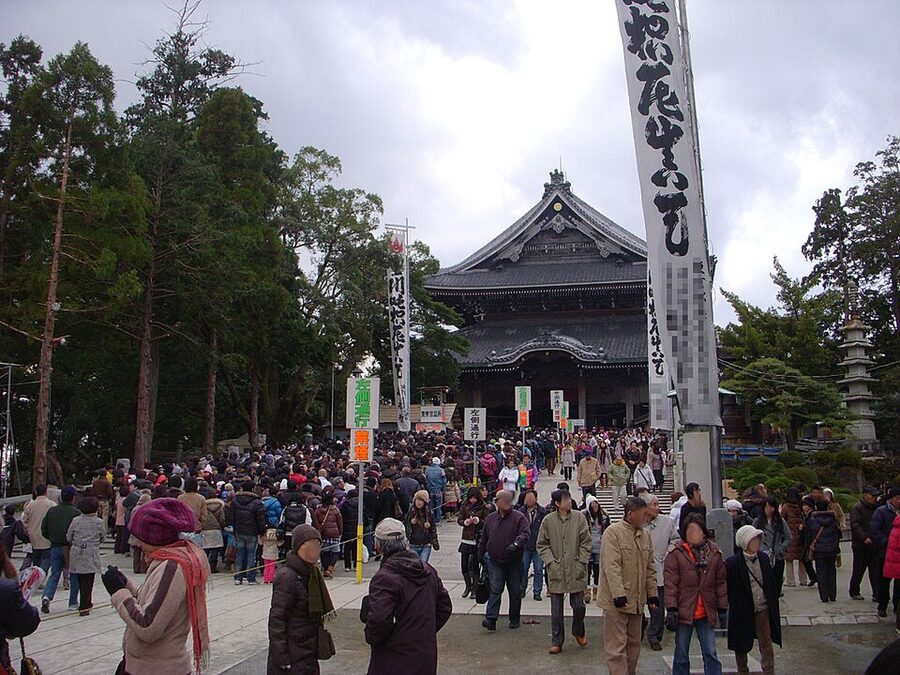
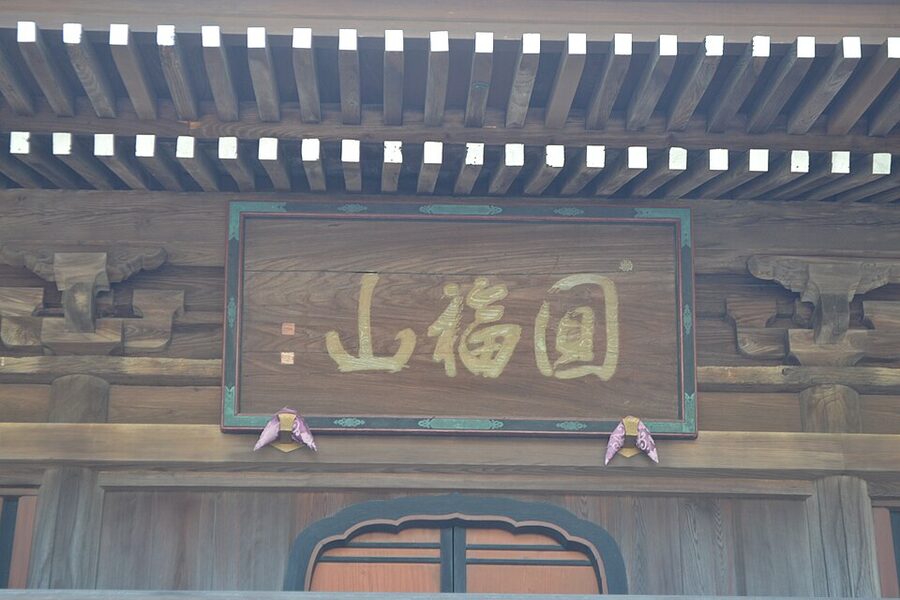
Hatsumōde, the first shrine or temple visit of the New Year, is the most-attended religious ritual in Japan: roughly 90 million people in the first three days of January. Toyokawa Inari, in Aichi Prefecture, is unusual because it is the country’s only major Buddhist Inari (most Inari are Shintō). The fox-deity worship at Toyokawa is folded into a Sōtō Zen temple complex, and the hatsumōde crowd typically tops two million in the first three days. My piece is at Japan’s only Buddhist Inari: 620 years in Toyokawa.
The defining sight at Toyokawa Inari is the Reikozuka, the fox shrine inside the precinct. It contains roughly 1,000 stone fox statues, donated by worshippers over the past century, all clustered behind the main hall in tight rows. Each fox is between thirty and sixty centimetres tall; the oldest are weathered to almost nothing; the newest are still bright grey. Walking through the rows feels closer to a graveyard than a shrine, in the best sense.
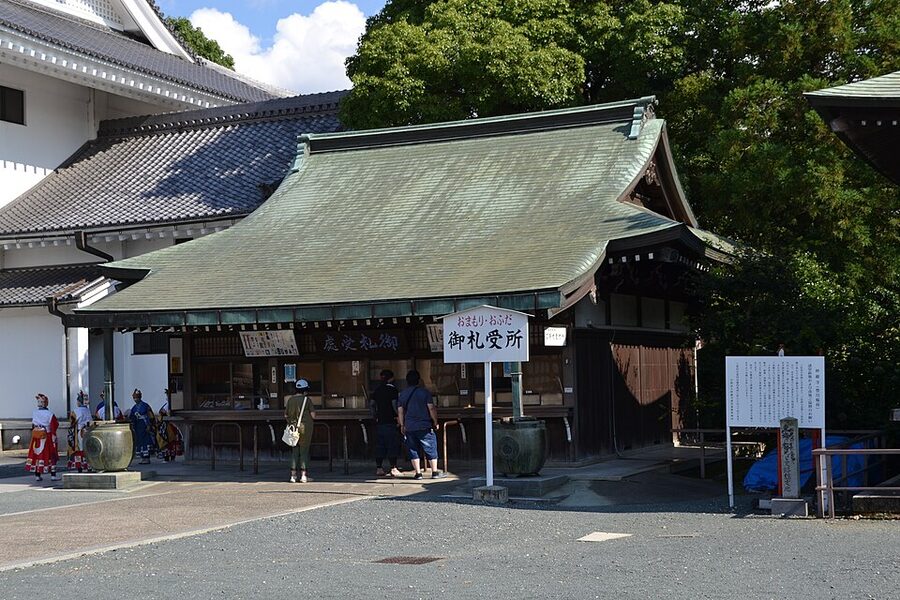
The food signature at Toyokawa is inarizushi, sushi rice stuffed inside a sweetened tofu pouch. Every food stall along the approach road sells a version. Toyokawa town claims to be the inarizushi origin point in Japan, which is mildly contested but has good documentation back to the 1830s.
Buy two, eat them on the kerb, hand the wrapper to the stall owner. This is one of the few hatsumōde sites where the food is good enough to plan around.
Hadaka Matsuri (third Saturday of February): the naked festival
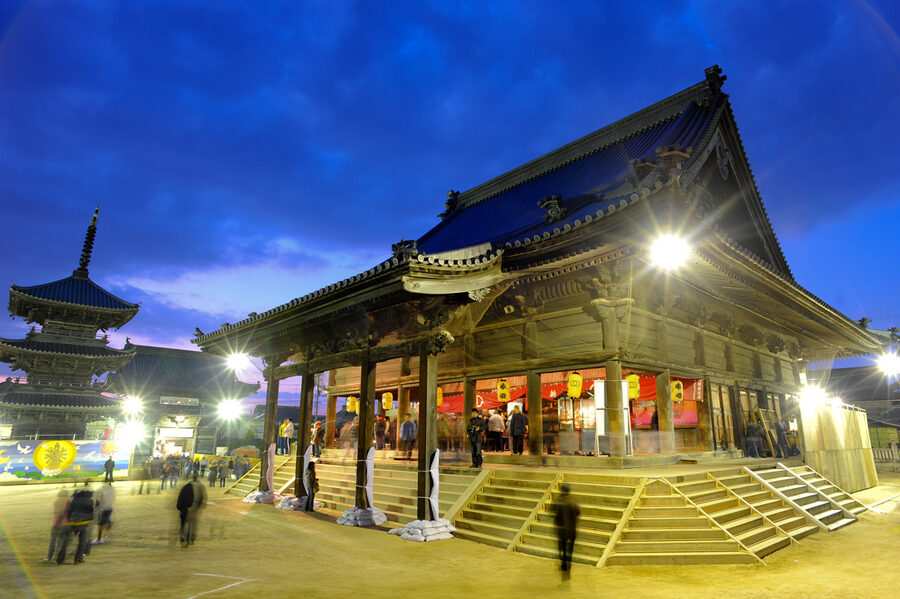
Hadaka Matsuri at Saidai-ji in Okayama is the largest and most photographed of the roughly thirty hadaka (literally “naked”) festivals held across Japan in February. Roughly 9,000 men in white loincloths (fundoshi) pack themselves into the temple’s main hall on the third Saturday night, in temperatures often below five degrees Celsius, to compete for two short pieces of sacred wood (the shingi) thrown into the crowd at midnight. Whoever extracts a shingi from the scrum and gets it out of the hall is declared fukuotoko (lucky man) for the year. The full piece is at Hadaka Matsuri: 9,000 men in fundoshi for two lucky sticks.
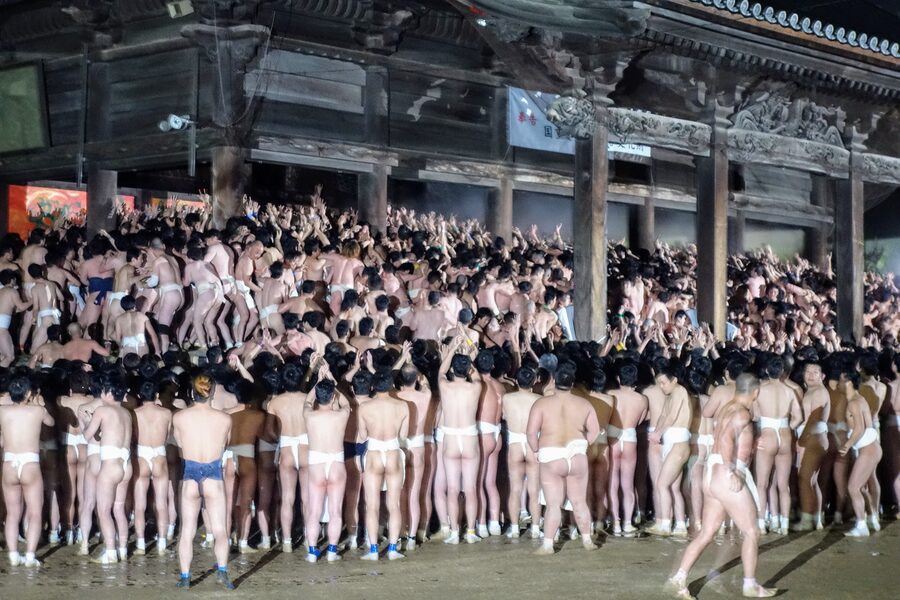
The reason this is on the list, and not in some side category labelled “weird,” is that hadaka festivals are one of the oldest forms of Japanese ritual purification. The fundoshi-only dress code dates to a Heian-period belief that the naked body, properly purified by cold water, can carry off the village’s accumulated bad luck. The Saidai-ji version was first recorded in 1510.
The structure has not changed: cold water, midnight, two pieces of wood. What has changed is that women’s groups began participating in 2024, after the temple board reversed a 500-year-old men-only rule.
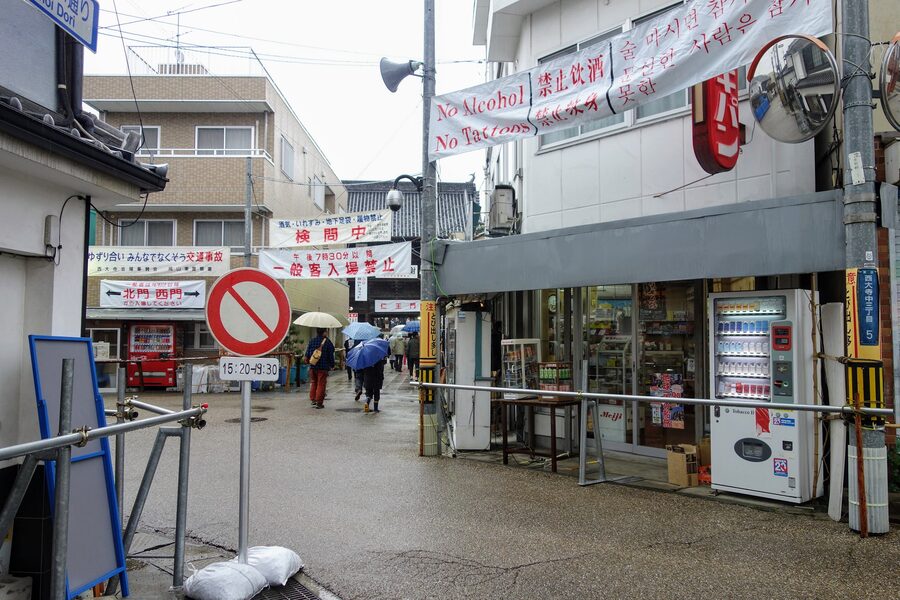
You can watch from outside the hall (which is what most foreign visitors do; the temple hands out free seating tickets at the entrance from 21:00) or join as a participant. Joining is open to anyone willing to register at the temple office, sign the waiver, strip to the fundoshi (rented or bought on-site for 3,000 yen), submit to a cold-water purification at the temple cistern, and walk into the main hall. I have done it once. The cold water is the part nobody warns you about properly.
Sapporo Snow Festival (4 to 11 February): the post-1950 outlier
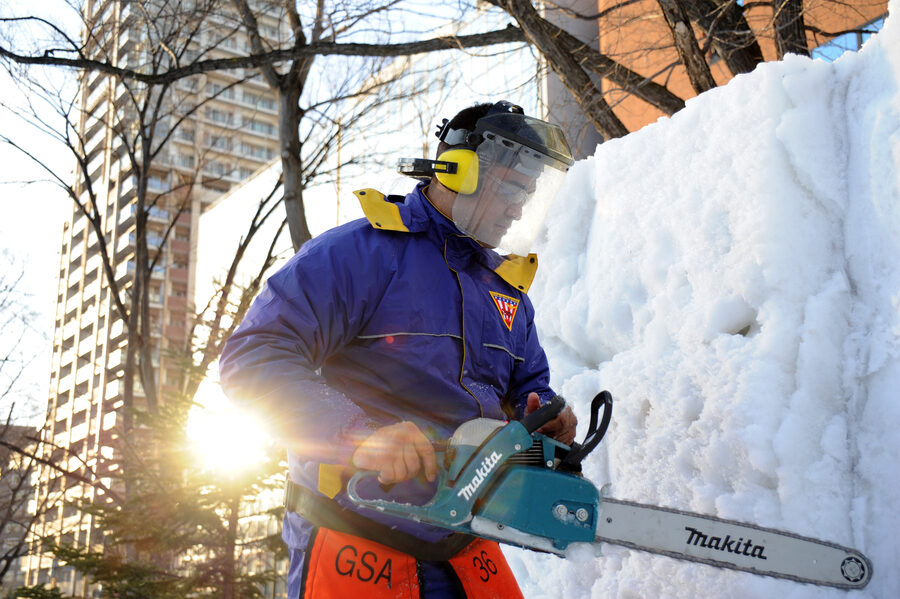
Sapporo Snow Festival is the youngest festival on this list. It started in February 1950 as six small snow figures built by Tōhō High School students in Odori Park, attracted an unexpected 50,000 spectators, and has since grown into the largest single-event tourist draw in Hokkaido: roughly two million visitors a year, 400 large sculptures across three sites, with the central Odori Park site stretching for 1.5 kilometres of carved-snow apartment-block-sized works. My piece is at Sapporo Snow Festival: how six high school sculptures became two million visitors.
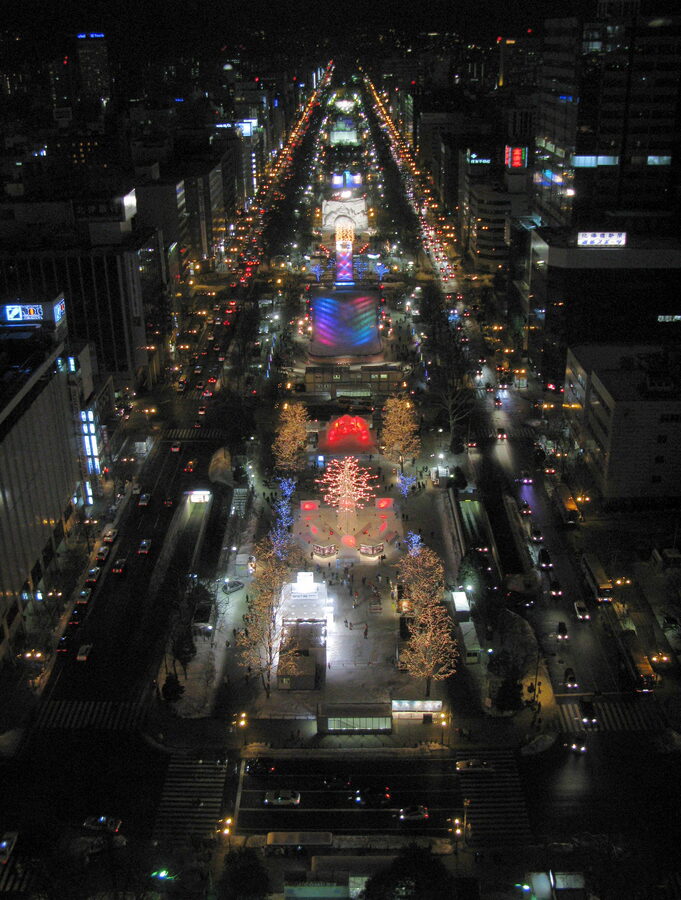
The festival operates across three sites: Odori Park (the central commercial site, 1.5 km of large sculptures), Susukino (the city’s nightlife district, 60 ice sculptures running between bars), and Tsudome (the family-friendly suburban site, slides and snow tunnels for children). The Odori site is what every photograph shows.
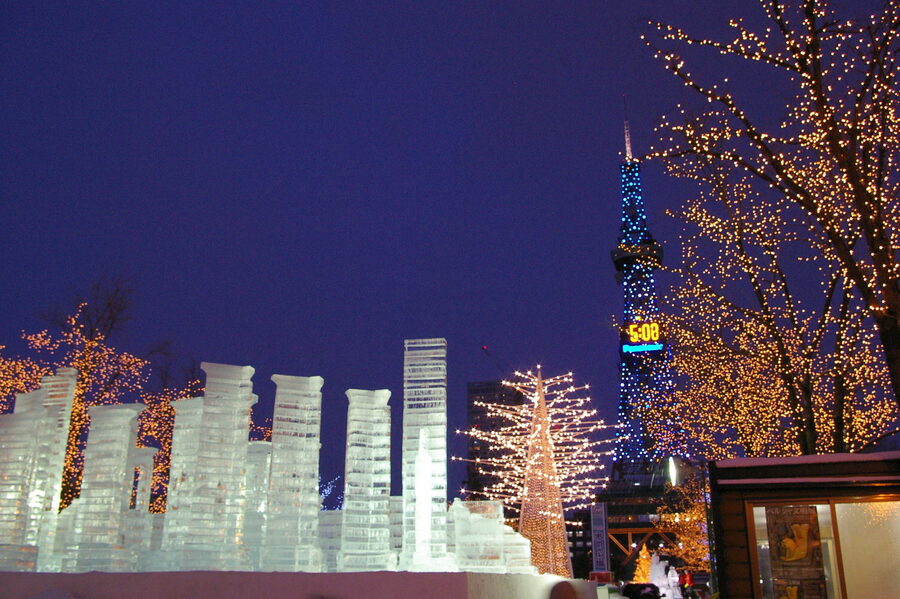
Susukino is the most photogenic at night because the carvings are ice rather than snow, lit from inside, and the bars across the street are open until 03:00. Tsudome is for parents with kids under ten.
The single most important planning point for Sapporo is hotel availability. The festival pulls roughly two million visitors into a city of 1.95 million residents, and the hotel inventory is, frankly, insufficient. Book by mid-November for early February stays.
Prices spike to roughly 250 percent of normal Sapporo rates during the seven festival days. If you cannot get a Sapporo hotel, Otaru (forty minutes by JR rapid train) is a workable base; Chitose (nearer the airport) is too far inland.
The “Three Great Festivals of Japan”, and four other rival lists
The phrase Nihon Sandai Matsuri, “Three Great Festivals of Japan,” is one of those tidy formulations that has at least four contradictory answers depending on whose tourism brochure you are reading. I am going to lay out the four most common framings here, since the question gets asked at every dinner table I have been seated at while researching this list.
The most widely cited list, dating roughly to the late Edo period, is Gion Matsuri (Kyoto) + Tenjin Matsuri (Osaka) + Kanda Matsuri (Tokyo). This is the list a Tokyo-Osaka-Kyoto traveller is most likely to encounter. Gion is on this list as the oldest and the Kyoto flagship; Tenjin is on it as the river-and-fireworks Osaka flagship; Kanda is on it as the Tokugawa shogun’s parade. I have a piece on Kanda already; Tenjin Matsuri is one of the few major events on which I have not written a dedicated article yet.
The second-most-cited list, especially favoured by older Aichi residents, is Gion Matsuri + Owari Tsushima Tennō Matsuri + Itsukushima Kangensai (the “music-on-the-water” festival at Itsukushima Shrine). This list emphasises water-based festivals and was likely codified in the early Meiji period as a regional counterweight to the Tokyo-centric Tenjin/Kanda framing. Tsushima is on this list because of Nobunaga’s patronage; Itsukushima is on it because of the Heike-clan connection to the shrine.
The third list, the Three Great Tōhoku Festivals, is the one that matters most for a foreign visitor with a flexible early-August week. It is Aomori Nebuta + Akita Kantō + Sendai Tanabata. All three run in overlapping windows between 2 and 8 August, all three are within four hours of each other on the JR Tōhoku Shinkansen, and the trio together is, in my opinion, the single best festival itinerary in Japan. I will return to this in the practical-visiting section.
The fourth list, the Three Great Yatai Festivals, is for connoisseurs of the wheeled-and-decorated-float tradition. It is Gion Matsuri + Hida-Takayama Matsuri + Chichibu Yomatsuri (the early-December night-yatai festival in Saitama). All three feature large wooden floats with mechanical or musical components; all three are UNESCO Intangible Cultural Heritage; all three have their own corner-turn or steep-hill spectacle. Chichibu is the one I do not have a piece on yet; it runs on 2 to 3 December and the night procession up the Dango-zaka slope is, by reputation, comparable to Takayama’s yomatsuri.
The fifth list, the Three Great Edo Festivals, is specifically a Tokyo framing: Sannō Matsuri (Hie Shrine, mid-June, even years) + Sanja Matsuri + Kanda Matsuri. This is the inside-the-Yamanote-line list, defined during the Tokugawa shogunate. Two of the three (Kanda and Sannō) were the only festivals whose processions could enter Edo Castle; Sanja is the populist working-class outlier that the shogunate tolerated rather than sponsored. If you are spending May in Tokyo, you can knock off two of the three (Kanda and Sanja) in a single weekend pair.
Practical visiting: planning a festival-led trip
Booking and timing: the brutal logistics
Sapporo Snow Festival is the only event on this list where hotel scarcity is genuinely a problem. Book by mid-November for early February. Aomori Nebuta and Sendai Tanabata both have a moderate hotel squeeze in early August; book by April for August.
Awa Odori in Tokushima requires advance booking for the four paid stages (mid-July online release, sells out in roughly a week). Hadaka Matsuri requires no advance booking for spectators but requires day-of registration at the temple office for participants. Kyoto in mid-July (Gion Matsuri) is hot and crowded but hotel availability is reasonable if you book sixty days out.
The single best general-purpose tip I can offer about Japanese festival planning: do not assume the dates are fixed in the same way Western public holidays are. Many of these festivals follow lunar-calendar conventions or adjust to the nearest weekend. Tsushima is “fourth Saturday of July.” Sanja is “third weekend of May.”
Hadaka Matsuri is “third Saturday of February.” Always confirm the year-specific date on the relevant tourism office website (Japan Visitor or the prefecture’s English-language tourism portal) before booking flights.
For most of these festivals, the JR Pass is your friend. The Tōhoku trifecta works almost perfectly with a 7-day pass, the Tokyo-May pair (Kanda + Sanja) works with a 7-day pass plus local Suica, and the Hida-Takayama trip is comfortably done with a 5-day Hokuriku Arch pass. Sapporo and Tsushima are the two awkward cases: Sapporo is reached via a regional shinkansen-plus-rapid combination from Tokyo (or by air), and Tsushima is a Nagoya local-line trip that the JR Pass does not enhance. Plan accordingly.
Best regional pairings
The strongest pairing on the calendar is the early-August Tōhoku trifecta: Aomori Nebuta (2 to 7 August), Akita Kantō (3 to 6 August), and Sendai Tanabata (6 to 8 August). The geography lines up so well that you can do all three in a five-day trip with the JR East Pass, sleeping in Aomori for nights one to two, Akita for night three, and Sendai for nights four to five.
The shinkansen routing is Aomori to Akita (1.5 hours via Morioka) and Akita to Sendai (2 hours via the Akita-Tōhoku line). Bring a small bag.
The Tokyo May pair (Kanda + Sanja) works in either order: Kanda Saturday-Sunday in mid-May, Sanja the following weekend, with everything within walking distance of the Hibiya or Ginza lines. If you are basing yourself in Tokyo for two weekends in May (and Kanda happens to fall in your odd-numbered year), you have done a third of this list with two metro rides and minimal travel time.
The Hida-Takayama spring-and-autumn pair is another strong combination if you are willing to do two trips in one calendar year (or live in Japan and can split the visits). Spring at Hie-jinja on 14 to 15 April; autumn at Sakurayama Hachimangū on 9 to 10 October. The yatai are not the same; the karakuri puppets are not the same; the two halves complement each other in a way that no other festival pair on this list does.
The Kyoto-Aichi summer pair (Gion + Tsushima) is awkward but rewarding. Gion’s main procession is 17 July; Tsushima’s is the fourth Saturday of July, which can be the same weekend or the following weekend depending on the year. If you can build a five-day trip around Kyoto-then-Nagoya in mid-to-late July, you cover both flagships of the most-cited Three Great Festivals list. The shinkansen routing is straightforward: Kyoto to Nagoya is 35 minutes; Nagoya to Tsushima is 30 minutes on the Meitetsu local line.
What to wear and how to behave
Yukata, the lightweight summer cotton kimono, is the conventional festival dress for spectators in summer. You will see roughly thirty percent of locals in yukata at any major summer matsuri, and you can rent one at most central tourist offices for 3,000 to 5,000 yen for the day. The protocol is simple: belt tied right-over-left (left-over-right is for the deceased), feet in geta sandals, hair tied back if long.
Almost no foreign visitor wears yukata correctly, and almost no Japanese person will correct you. Wear it anyway.
Photography norms are the same at every matsuri on this list, with one exception. The general rule is: photograph the floats, the procession, the food stalls, and any group activity freely. Do not photograph private worshippers (people praying alone at the shrine), do not photograph children without a parent’s nod, and do not photograph the back-tattooed Sanja participants.
The exception is the Tsushima Tennō Matsuri morning ceremony, where photography is permitted but flash photography is forbidden during the doll-boat crossing. Local volunteers will tap you on the shoulder if you violate this. Comply.
The general etiquette at every shrine festival is: do the temizu (the rinsing of hands and mouth at the temizuya pavilion before approaching the main hall), bow once on entering the precinct, do not eat or drink inside the inner shrine grounds, and step back to let the procession pass. The folkloric grounding for almost every matsuri is that the deity is, in some sense, present in the mikoshi. Treating the procession as a sporting event with an audience misses the point; it is a religious act with a crowd.
Festival food: a category by itself
Yatai stalls are part of the experience. The standard menu is the same at every major matsuri: takoyaki (octopus balls), yakisoba (fried noodles), karaage (fried chicken), kakigōri (shaved ice with syrup), kasutera-baby-castella (small egg-and-flour cakes baked in a fish or animal mould), choco-banana (a chocolate-coated banana on a stick), and beer or chū-hai for adults. The price point is uniformly 500 to 800 yen per item, paid in cash. The quality is highly variable; the experience is consistent.
Three regional specialities worth seeking out: at Toyokawa Inari, inarizushi (the tofu-pouch sushi mentioned earlier); at Sendai Tanabata, zunda mochi (a sweet edamame-paste rice cake unique to Sendai); at Sapporo Snow Festival, the Hokkaido stalls along the Odori site selling jingisukan (grilled lamb), genghis-khan-style, on the snow. The Tokushima stalls at Awa Odori sell sudachi-flavoured everything; the citrus is a Tokushima Prefecture monopoly and the entire city smells of it from 12 to 15 August.
One general rule: do not eat at the first stall you see. The first row of stalls, especially at the entrance to a major site, is staffed by national-chain operators (the same stalls you see at every matsuri across the country). The neighbourhood-association stalls, run by local volunteers as fundraisers for the parish shrine, are usually further inside the site and have better food.
At Gion Matsuri, the best food is on the side streets off Karasuma rather than on Karasuma itself. At Sanja, walk past Kaminari-mon and into the Asakusa side streets for the local stalls.
The cash-only convention is worth flagging too. Almost every yatai stall takes physical yen and nothing else, even in 2026, when the rest of urban Japan has finally accepted IC-card payments at convenience stores. Bring a thousand-yen note for every stall meal you plan to eat, plus a thicker wad in coins for the games.
The festival economy runs on cash because the stall operators are usually unincorporated parish associations rather than registered businesses, which means no point-of-sale terminal and no consumption-tax invoicing. The local tax office knows. Nobody enforces it.
Drinks are the other thing nobody warns you about. The standard yatai beer is Asahi Super Dry from a tap-can pour, and the standard hard-alcohol option is chū-hai, a vodka-style spirit mixed with grapefruit, lemon, or peach soda. Both run roughly 600 yen for a 350-millilitre cup.
The stalls at the bigger summer matsuri (Awa Odori, Sanja, Gion-Yoiyama) typically run out of cold beer by 21:00 because the cooling kegs are limited. If you want a cold drink at 22:00, pre-buy a bottle from a vending machine or a convenience store before you walk into the festival site.
If you only have one week: my contrarian three-pick
If a friend told me they had exactly seven days to spend in Japan and wanted to maximise festival exposure, I would not send them to Gion. Gion is the famous one, the oldest one, the listed one, and it is, frankly, the most crowded and the most photographed. The 17 July procession is hot, the streets are choked, the foreign-tourist density is the highest of any matsuri on this list, and the actual viewing window is roughly 90 minutes of slow corner-turning that you will mostly see on the back of someone else’s phone screen.
If you want to claim you have seen Gion, fine. If you want to feel something, look elsewhere.
My contrarian three-pick is: Sapporo Snow Festival in early February, Sanja Matsuri in mid-May, and Awa Odori in mid-August. The reasoning is climate range plus tonal contrast plus crowd-density variety. Sapporo gives you minus-eight-degrees, all-quiet, slow-moving crowd around carved snow at night. Sanja gives you twenty-five-degree humid Tokyo, a riot of mikoshi and chanting and beer, the loudest version of urban Japan you will ever see. Awa Odori gives you thirty-two-degree Shikoku summer, four nights of dance, and the dissolution of the performer-audience boundary by 22:00 every night. Three different countries, basically, in one passport.
The reason I rate Sapporo above Gion is the photograph problem. The Snow Festival sculptures are 6-metre carved-snow apartment-block-sized works lit at night against minus-eight-degree air, and on the night you walk Odori, every visitor on the kerb is doing the same thing you are: standing still, looking up, breathing white steam, taking pictures of light through ice. The crowd is dense but not pushing.
There is no procession to chase. You can spend two hours on the same kilometre of street and not feel pressure to move. Gion’s procession is the opposite social experience: the float moves, the crowd packs in behind it, you have to commit to a viewing spot two hours before, and once you commit you are stuck. Sapporo is a slow walk; Gion is a stationary wait.
The reason I rate Sanja above Kanda is more contrarian still. Kanda is the prestige Edo festival; the Tokugawa shogunate’s parade; the one with the official history and the deep imperial-grant paperwork. Sanja is the messier, louder, more working-class festival, and it is the one where you can actually feel what an Edo procession was like in 1700: thousands of bearers, dozens of mikoshi, a grid of streets with no traffic for forty-eight hours, and a crowd that has been drinking since 09:00.
Kanda is impressive in the same way a museum is impressive. Sanja is impressive in the way a stadium is impressive. I would always pick the stadium.
If you would prefer to substitute for any of those: drop Sapporo for Hadaka Matsuri (winter, more committed, much weirder); drop Sanja for Kanda (calmer, more historical, less working-class energy); drop Awa Odori for Aomori Nebuta (also August Tōhoku, but float-based instead of dance-based, with arguably the best single photograph on this list as the seafront finale on 7 August). The pair I would not substitute is Sapporo + Awa Odori. The temperature delta of forty degrees Celsius between those two is the sharpest thing this calendar can do to you.
If you have two weeks, add Hadaka Matsuri (third Saturday of February in Okayama, pairs with Sapporo) and Tsushima Tennō Matsuri (fourth Saturday of July in Aichi, pairs with Gion). If you have a month, add Hida-Takayama spring (mid-April, pairs with hanami in Hirosaki for a north-bound itinerary) and Toyokawa Inari hatsumōde (1 to 3 January in Aichi, fits a one-week New Year window with Tokyo-side temple visits).
Festivals as the country looking at itself
To come back to where I started: Yoshida Kenkō, in Tsurezuregusa around 1330, wrote that festivals are the moments when a country reveals itself most plainly, because the rituals are public and the audience is the whole community. He was talking about Kyoto, and probably about Gion specifically, since the festival was already four hundred years old when he wrote. What I think he understood, and what I have come around to after maybe twenty years of attending these things, is that what you see at a matsuri is not the deity or the procession or the float. It is the parish, the parish’s relationship to itself, and the parish’s relationship to the year.
You can see this most clearly in the seasonal calendar. Spring matsuri are about renewal and the resumption of agricultural cycles (Hina, Sakura, Kanda, Sanja, Takayama-spring). Summer matsuri are about plague-deflection and the management of crowds in the worst months of the heat (Gion, Tsushima, Tanabata, Nebuta, Kantō, Awa Odori, Obon).
Autumn matsuri are about harvest gratitude (Takayama-autumn, Jidai, Nagasaki Kunchi). Winter matsuri are about purification and the surviving of the cold (Toyokawa, Hadaka, Sapporo, in their three different idioms). The list of fourteen is not arbitrary. It tracks the year.
If you make a single trip a year for the next fourteen years and visit one festival per visit, you will have seen Japan more completely than most Japanese people see it. That is not a marketing line. The internal Japanese tourism industry is regional: a Kantō person rarely visits Tōhoku festivals, a Kansai person rarely visits Hokkaido, an Aichi person never visits Shikoku.
A foreign visitor with a JR Pass and a flexible schedule can do what a Japanese person almost never does, which is stitch the country together in real time. The festivals are the stitching. Plan accordingly.
For deeper reading on related themes: my piece on the twelve original castles covers the architectural infrastructure that hosted many of these festivals during the Tokugawa period; sankin kōtai is the policy that made parade culture central to Edo identity in the first place; the tea ceremony covers the slower, more domestic counterpart to the matsuri tradition; Japan’s greatest gardens covers the spaces where many of these festivals are staged or processed through; the Dog Shogun Tokugawa Tsunayoshi is the Tokugawa ruler who most aggressively regulated Edo festival behaviour. If you want a year-round companion guide to where the procession history sits in the geography of Japan, those five plus this one are a complete starter library.