On the third day of the third lunar month of 1868 — 3 April by the Gregorian calendar, not the 11 April sometimes cited by sources that confuse the meeting with the formal handover a month later — Katsu Kaishū sat down with Saigō Takamori in a small house in Takanawa, south of the city, and surrendered Edo Castle. Between them on the mat they had an agreement that the Tokugawa shogunate would evacuate the castle without a fight, Tokugawa Yoshinobu would go into house arrest at Kan’ei-ji, and the imperial army — 50,000 men who had been preparing to burn the city — would walk in through the gates instead of smashing them. The conversation saved a million people. It also saved the walls, the moats, the stone foundations, the three surviving yagura, and the site the Meiji government would move the Emperor onto eighteen months later.
That is the load-bearing fact for everything else in this article. Edo Castle was never stormed. It was never shelled. It never surrendered at swordpoint.
The shogun simply walked out, and the imperial household walked in, and the buildings that were lost after 1868 were lost to fire and to bureaucratic indifference — not to war. What you can walk through today is the same ground Tokugawa Ieyasu laid out in the 1590s, with most of the same outer stonework, a handful of the same yagura, and the great empty tenshu-dai platform that has stood bare since 1657. The Emperor of Japan lives on a castle footprint — the only reigning monarch in the world who does.
In This Article
- What Edo Castle actually is
- Ōta Dōkan and the founding of Chiyoda-jō, 1457
- Ieyasu arrives, 1590
- Tenka-bushin: the shogunate builds its castle, 1603-1636
- Three keeps in thirty years, and then no keep for ever
- Edo peace, 1657-1867
- The bloodless surrender, 1868
- From Edo-jō to Kōkyo, 1868-1945
- What actually survives, and what does not
- Where to visit Edo Castle today
- Imperial East Garden (Kōkyo Higashi-Gyoen)
- Nijūbashi and the south front
- Sakurada-mon and the Ii Naosuke site
- Chidorigafuchi and the north moat
- The tenshu-dai, which nobody climbs
- What to read, and what to skip
- One last thing
What Edo Castle actually is
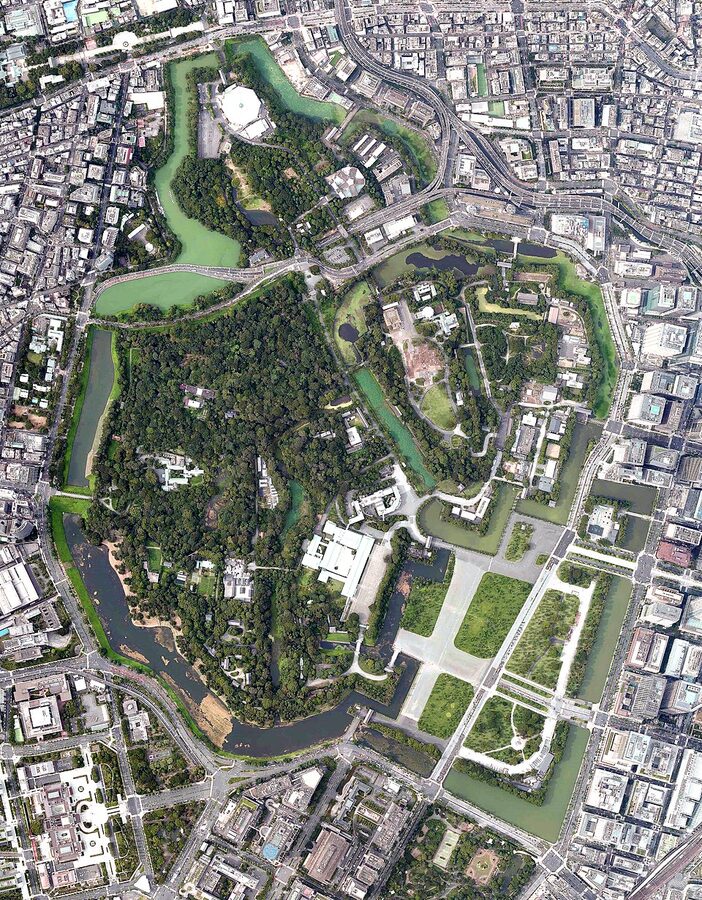
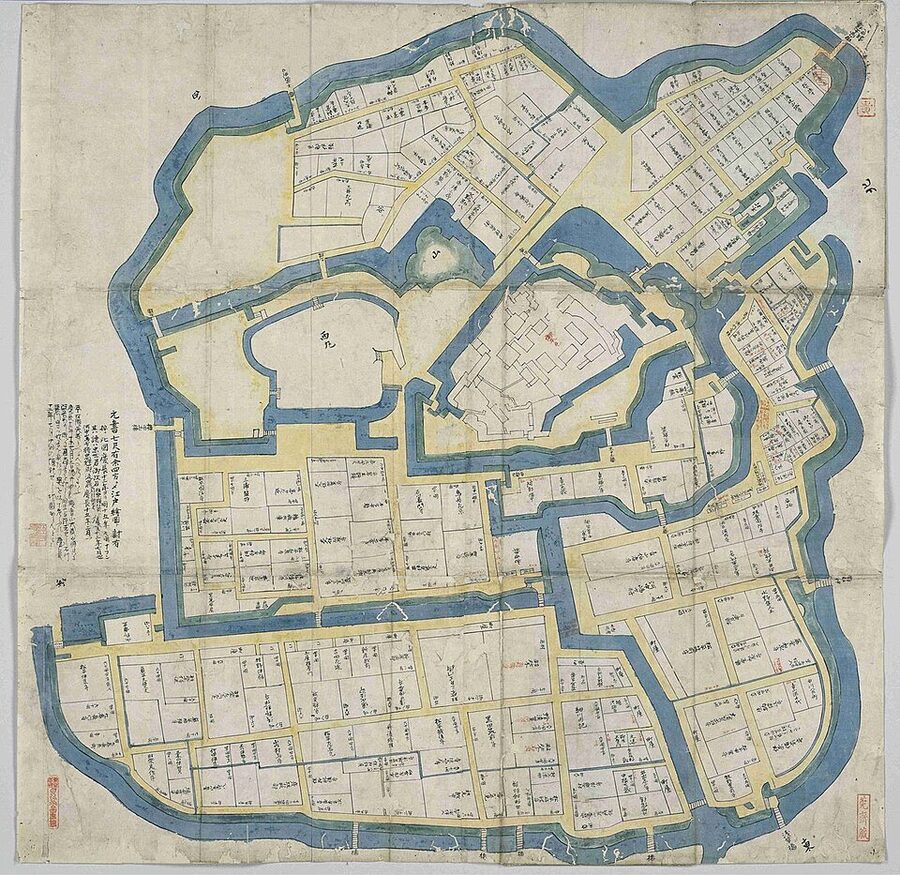
Edo Castle — Edo-jō (江戸城), also called Chiyoda-jō (千代田城) — is the largest castle complex Japan ever built. At the sōgamae perimeter it enclosed 2,082 hectares, which is about five times the area of Osaka Castle and 1.7 times the modern Chiyoda ward. Inside that perimeter ran three concentric moat rings connected in a clockwise spiral, twenty baileys, thirty-eight gates, twenty yagura turrets and a five-tier tenshu that until 1657 was the tallest wooden tower ever built in Japan at 58 metres over a 10-metre stone base.
The inner bailey — Honmaru, Ninomaru, Sannomaru, Nishinomaru, Fukiage, Kitanomaru — is the walled compound you can still walk through today. The middle moat is mostly intact. The outer moat survives in fragments: you can see it at Ichigaya, at Yotsuya, and at Akasaka-mitsuke where the Benkei-bori ponds still hold water. Everything else within the original 15.7-kilometre outer circuit has been built over. Tokyo’s financial district sits on Ieyasu’s lower-bailey daimyō mansions; Marunouchi is literally “inside the round” of the outer moat.
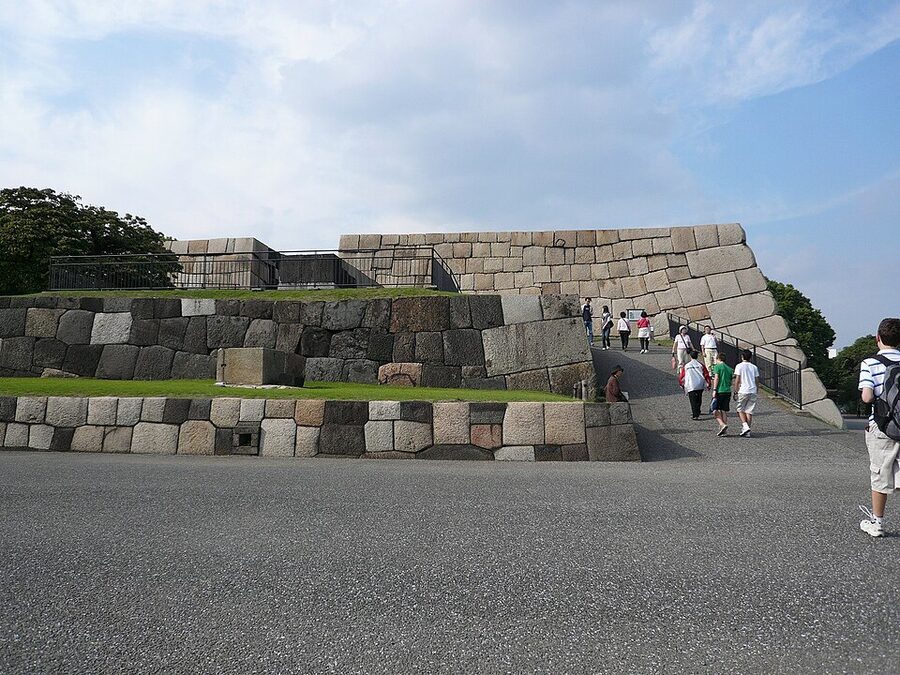
The keep is gone. The inner and middle moat walls are the originals. The tenshu-dai, the stone platform the keep stood on, is still there, empty, 45 metres on a side, rebuilt by Maeda Tsunanori of Kaga in 1658 after the fire. You can climb it. You can stand on top of it and look south across the Honmaru lawn and understand how the shogunal world was laid out. The Kaga-rebuild platform is six-ken (10.9 m) shorter than the Kan’ei original because they never expected to put a tower back on it.
Ōta Dōkan and the founding of Chiyoda-jō, 1457
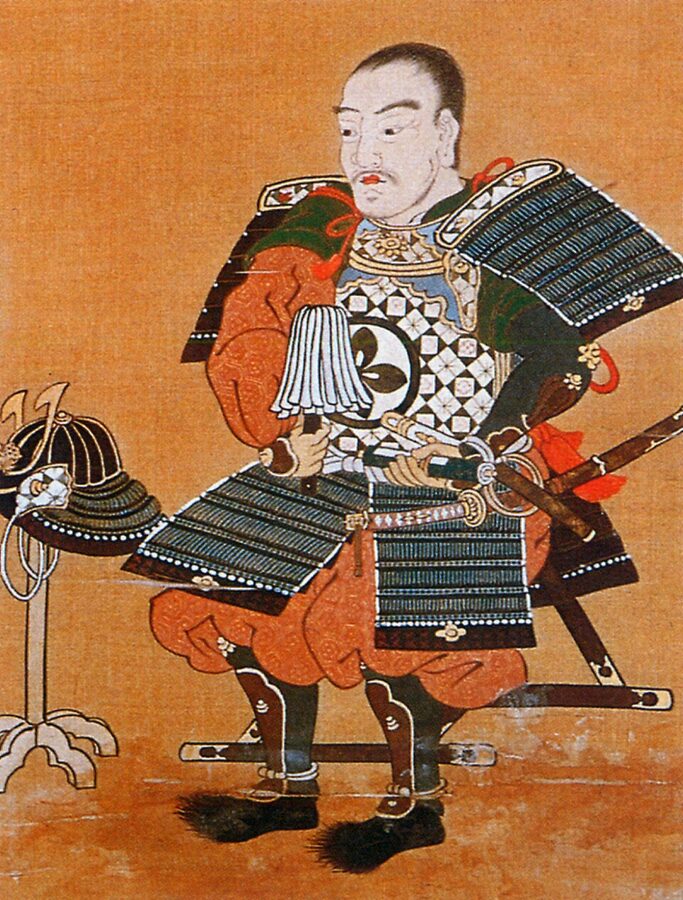
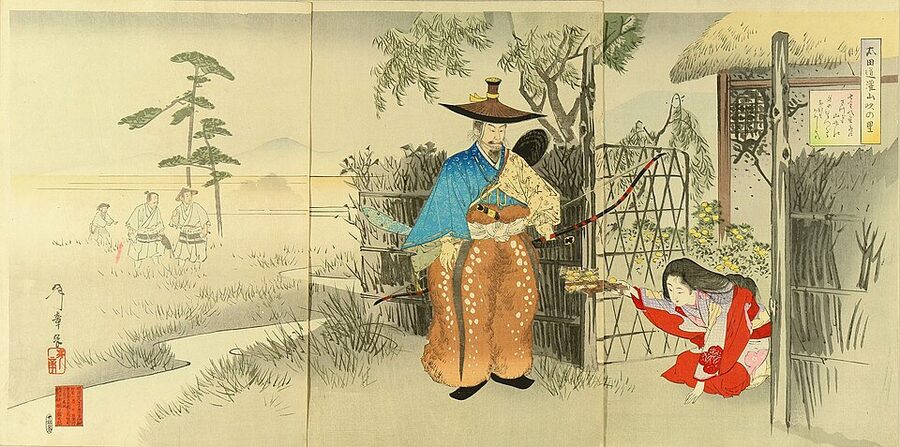
The first castle on this ridge was not Ieyasu’s and not Hōjō Ujitsuna’s — it was Ōta Dōkan’s, built in 1457 for the Ōgigayatsu Uesugi during the Kyōtoku Disturbance. Dōkan was a monk-warrior of the kind the Muromachi era kept producing: literate, a poet, a siege engineer, fatally useful to his lord until he was too useful and the lord had him killed. His Edo Castle was a three-bailey hirayama-jō, “flat-hilltop castle”, built on the eastern lip of the Kōjimachi plateau, where the Hibiya inlet came in close to the base of the ridge and the seabound travel and the inland travel met.
The castle Dōkan built was a three-kuruwa structure — Shijō, Chūjō and Gejō in the period’s Chinese-influenced naming — connected by kiri-gishi cut-away slopes and water moats. He lived in the main bailey in a residence called Seishō-ken, with a high pavilion behind it for viewing the bay. There was a plum orchard on the north side where the 10th-century exile-scholar Sugawara Michizane had been enshrined, which is the remote reason there is still a Yushima Tenjin a few kilometres north today. None of the physical structure remains. But the spiral layout Dōkan used is the spiral Ieyasu’s engineers extended 140 years later.
Dōkan survives in Tokyo culture through one story: the yamabuki incident. Caught in a squall on a hunt in what is now Shinjuku, he knocked on a farmhouse door to ask for a straw raincoat and was handed instead a branch of yellow yamabuki rose by a girl who said nothing. Dōkan left angry.
Later that night someone explained to him the Heian-era poem she had been quoting — “Seven-fold, eight-fold the yamabuki blooms, but it is sad that they have not a single fruit” — where the pun on mi means both fruit and rain-cape. Dōkan, who had prided himself on his literature, had missed it; he spent the rest of his life writing waka. The story is almost certainly apocryphal, and it is also the only Muromachi anecdote every Tokyo schoolchild knows.
After Dōkan’s death in 1486 the castle passed to the Ōgigayatsu Uesugi main line, then in 1524 to the Odawara Hōjō under Hōjō Ujitsuna, who made it one of the six branch castles that held the eastern Kantō. The Hōjō held Edo for 66 years, through the rise of Takeda Shingen and Uesugi Kenshin further north, through Oda Nobunaga’s unification push, and into the 1590 Odawara Campaign that ended them. They kept Edo in good order but did not substantially extend it. When Toyotomi Hideyoshi took Odawara and distributed the Kantō to Tokugawa Ieyasu in August 1590, Edo Castle passed to Ieyasu as a down-at-heel secondary fort with a collapsing stockade and a hundred-odd thatched houses around it. That is the castle Ieyasu walked into.
Ieyasu arrives, 1590
Ieyasu entered Edo on the first day of the eighth lunar month of 1590, 30 August by the Gregorian calendar, and the sight that met him was, by every account, unimpressive. The Dōkan-era residence was 133 years old and rotting. The moats were silted. The castle town was a fishing village with about a hundred straw-thatched cottages clustered near the north gate. The Hibiya inlet came right up to the eastern wall, which meant that at high tide the lower baileys were literally in the sea. Ieyasu had just traded Suruga, Tōtōmi, Mikawa, Kai and Shinano — five provinces, his ancestral homeland — for this.
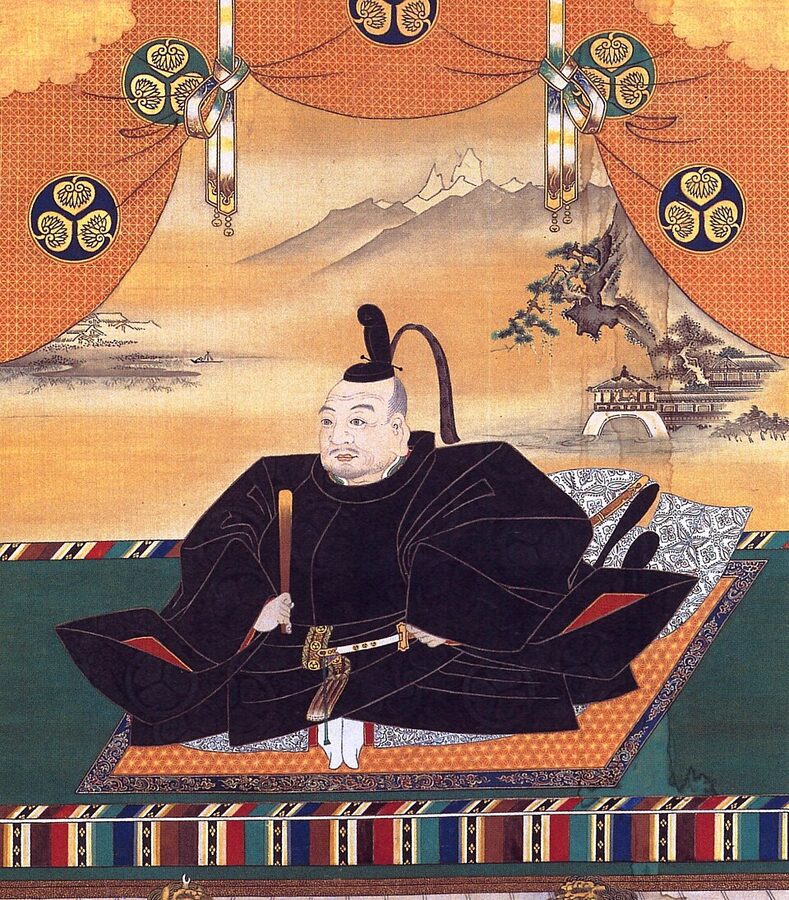
Hideyoshi’s politics were simple. Ieyasu was too powerful to destroy but dangerous left where he was; the Kantō transfer was a gilt exile disguised as promotion. What Hideyoshi did not count on, and what Ieyasu understood immediately, was that the Kantō plain was a better base than Mikawa ever could be.
It was bigger. It had more arable land, a harbour that could feed a capital, and was one ridge-crossing from the Tōhoku that Hideyoshi had just acquired but not yet integrated. Ieyasu spent the first ten years drainage-engineering the harbour and the plain. The castle could wait.
What he did expand, in those pre-1600 years, was the bailey layout. The old Dōkan three-bailey plan got extended with a new Nishinomaru (west), Sannomaru (third), Fukiage (the upper gardens) and Kita-no-maru (north). The spoil from the Hibiya drainage went to fill in the land between the castle and the bay, which is why everything east of the Imperial Palace down to modern Shinbashi sits on 1590s reclamation. The Dōsan-bori canal, named for the Ieyasu physician Nakurai Dōsan who supervised its cutting, still runs under Nihonbashi as a concrete box culvert. The water is there. The original banks are gone.
Tenka-bushin: the shogunate builds its castle, 1603-1636
After the Battle of Sekigahara in October 1600, Ieyasu had the political authority to stop building the castle with Tokugawa money and start building it with everyone else’s. The device he used was tenka-bushin (天下普請), “realm-wide public works”, a forced-contribution system where the ~200 daimyō of Japan were assigned quotas of stone, timber, men and money to deliver to the Edo site on pain of losing their domains. The first big round ran from 1603 to 1607 and it produced the castle’s basic form. The second ran from 1618 to 1622 under Tokugawa Hidetada. The third, 1628 to 1636, under Tokugawa Iemitsu, closed the outer moat ring and finished the sōgamae.
The assignment lists survive and they make sobering reading. Hosokawa Tadaoki, Maeda Toshinaga, Ikeda Terumasa, Katō Kiyomasa, Fukushima Masanori, Asano Yukinaga, Kuroda Nagamasa, Tanaka Yoshimasa, Nabeshima Katsushige and sixteen others drew the outer stone walls. Kuroda Nagamasa alone took the tenshu-dai. The stone itself mostly came by sea from Izu, Ieyasu’s engineers preferred Izu granite for its density, with the largest blocks reportedly up to 24 tonnes, cut at the Atami and Itō quarries and rafted 100 kilometres up the coast on purpose-built stone barges.
Kiyomasa’s Edo contribution is the one that people still point to. He was the most highly-regarded castle mason of his generation — Kumamoto is his work, and the Nagoya stone bastions — and for the Edo job he sent a team of Higo stone-cutters who produced the Ōte-mon bastion, the Fujimi-yagura platform, and the Honmaru well that still bears his name. The well, Kiyomasa-no-Ido, is in the Honmaru lawn at the base of the tenshu-dai. It still holds water. The story that Kiyomasa dug it himself is at best decorative, but the well-cap stones carry his masons’ tally marks, so it is at least a Higo-team job. You can see it on the East Garden loop today.
The forced-contribution system is the same administrative logic that would later produce sankin-kōtai, the alternate attendance system that kept the daimyō in permanent rotation between Edo and their home domains. Tenka-bushin was the prototype: a tax levied as labour and material, payable to the shogunate, non-negotiable. The Tokugawa ran it for 33 years on Edo Castle alone. By the time Iemitsu finished the Sanada-bori outer moat in 1636 the daimyō had collectively shifted, at a conservative estimate, 1.2 million tonnes of stone from Izu to the Kantō — enough to resurface most of the Tōkaidō twice over.
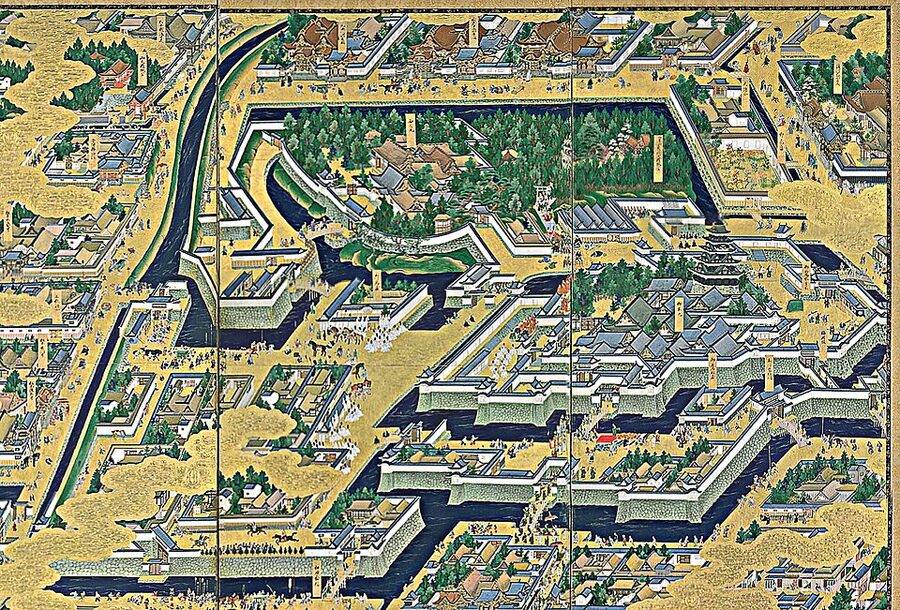
Three keeps in thirty years, and then no keep for ever
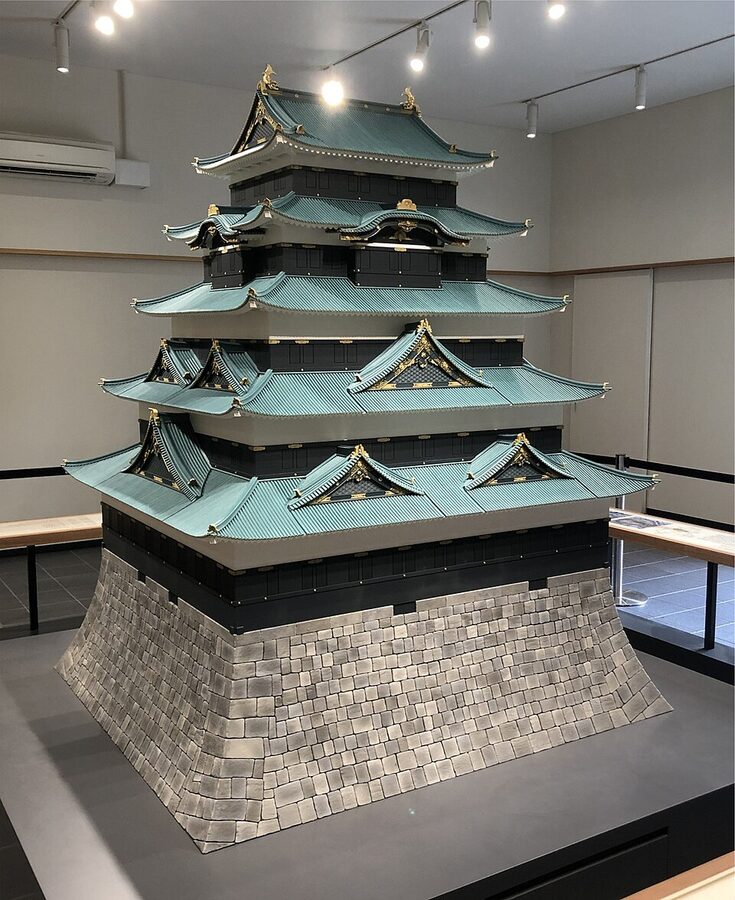
The Kan’ei-do keep that appears on the byōbu was the third main tenshu to stand on the site, not the first. Ieyasu had Kuroda Nagamasa throw up the Keichō-do (慶長度) in 1607 — a white-walled five-tier tower, lead-tiled, roughly 48 metres tall, with the central pillars of Kiso fir running full-height. Hidetada pulled it down in 1622 and rebuilt it as the Genna-do (元和度), shifted to a more northerly position in the bailey, six-tier inside with an enshrinement of the Tōshō-gū to Ieyasu on the interior. Iemitsu pulled that one down in 1636 and built the third, the Kan’ei-do (寛永度) — black copper tiles, copper sheet on the walls, 58 metres of superstructure, the tallest in Japanese history. Thirty years of keeps, three generations, no continuity of design.
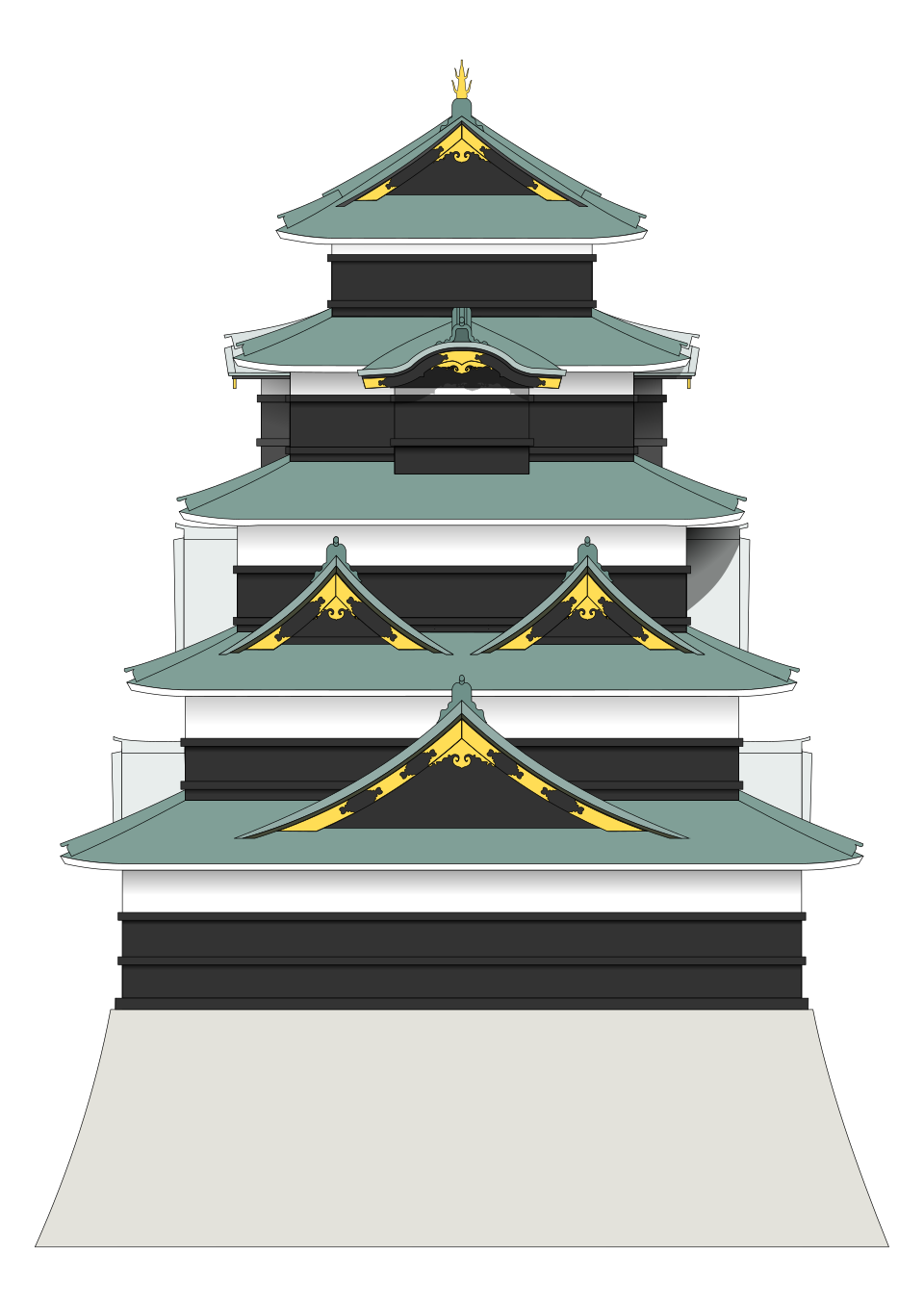
The Kan’ei-do lasted twenty-one years. On the 18th day of the first lunar month of 1657, 2 March by the Gregorian calendar, a fire starting in a Honmyō-ji temple in Hongō, three kilometres north of the castle, caught a winter gale off the Musashino plain and ran south. By the evening of the third day the fire had killed an estimated 100,000 people, burned 60 per cent of Edo including most of the inner bailey, and taken the Kan’ei-do keep down with it. The contemporary accounts say a copper shutter on the second tier was left open by a careless guard, a flying ember caught the interior, and the building burned from the inside out because the copper exterior was sealing the flames in. The two great pillars crashed through all six floors.
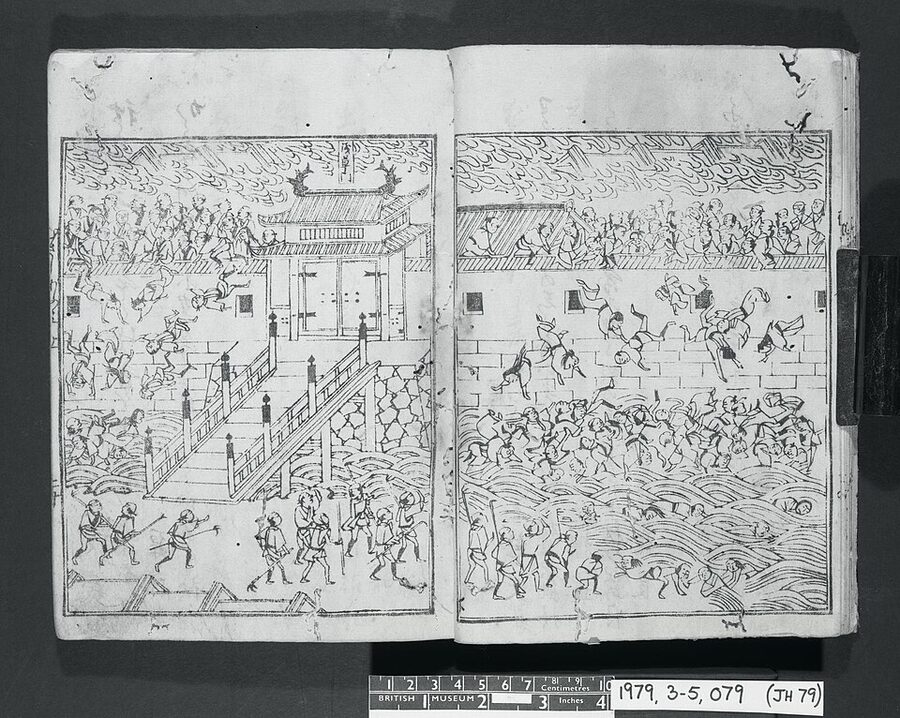
Maeda Tsunanori of Kaga rebuilt the tenshu-dai during the summer of 1658, using Kaga white granite, to a height of six ken (10.9 metres) instead of the original ten. Plans for a fourth keep were drawn up and materials quietly ordered. Then, and this is the turning point of the whole Edo Castle story, the shogunal elder Hoshina Masayuki intervened.
Masayuki argued that Nobunaga had introduced the tenshu at Gifu (which he had) and Azuchi, that it was essentially a symbol of warlord self-promotion, and that a castle’s defences did not require one. The whole project was paused to prioritise city reconstruction. It was never unpaused — every subsequent revival attempt (Arai Hakuseki in the 1710s, the Meiji government in the 1870s, two NPO campaigns in the 21st century) has died on the same argument.
The decision is, on reflection, extraordinary. The Tokugawa had three generations of tenshu on file. The plans from the Kan’ei rebuild survive today — the “Edo-jō tenshu tate-wari zu” at the Kōra family archive is a complete set of full-elevation and floor plans, detailed enough that modern woodworkers could rebuild the keep from it. They chose not to. For 366 years they have chosen not to. The shogunate found it politically more useful to be a regime without a keep, an administrative bureaucracy whose symbolic centre was deliberately empty, than to replace the tower. The Fujimi-yagura, on the south ridge, became the de facto keep for ceremonial purposes and remains so today.
Edo peace, 1657-1867
Between the Meireki fire and the Meiji Restoration the castle’s political function stayed roughly constant. Fifteen Tokugawa shoguns governed Japan from here. About 5,000 men were on the premises during working hours — bugyō in the administrative offices, bangata guards on the rotating three-shift garrison, koshō pages in the residential quarters — and another 600 to 1,000 women lived permanently in the Ōoku, the inner chambers no man under the rank of shogun or physician could enter. The total full-time population of the castle on any given weekday was around 6,000. It was the largest single workplace in Japan for 264 years.
The daimyō came in and out on the sankin-kōtai rota, presenting themselves in the Ōhiroma on designated days. Senior rōjū elders served one month on, three months off, commuting from mansions in what is now Marunouchi. Metsuke, the shogunate’s inspectors, reported from their offices in the Sannomaru. On ceremonial days the Ōhiroma held 500 daimyō at once, arranged by rank in a sequence of tatami rows that was worked out to the centimetre. The social geometry of the Edo political order was encoded in the Honmaru floor plan.
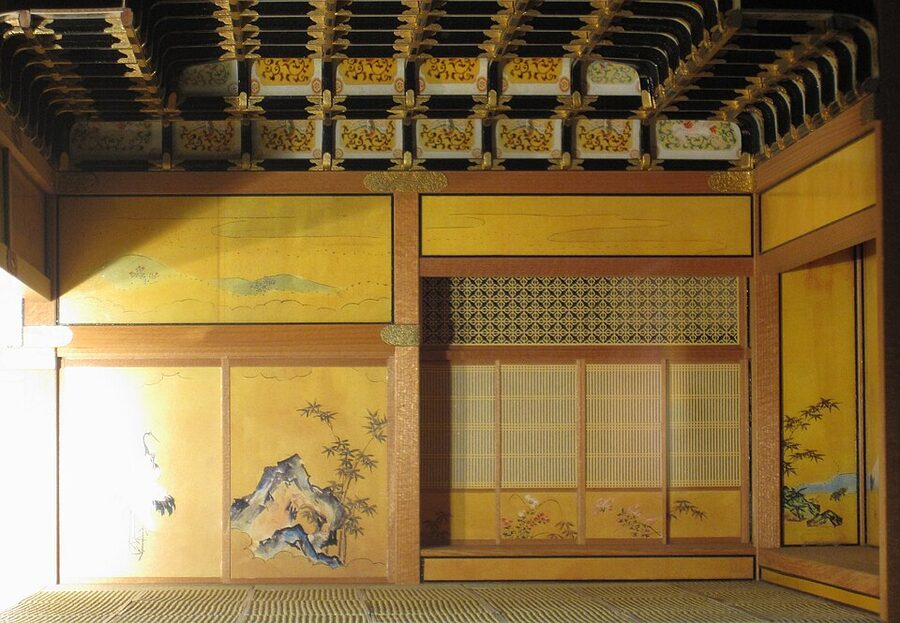
Security on the outer ring was the responsibility of specific fudai retainers’ houses. The Sakurada-mon gate was routinely assigned to the Ii clan of Hikone — the house of Ii Naomasa, the original Sekigahara-era Red Devil. The arrangement held for 260 years. It ended on the snowy morning of 24 March 1860 when Ii Naosuke, the shogun’s chief councillor and direct descendant of Naomasa, was cut down outside Sakurada-mon by seventeen Mito and Satsuma rōnin. The assassination broke the shogunate’s grip on foreign policy and started the sequence that led, eight years later, to Katsu and Saigō in Takanawa.
The Edo-period peace was also the peak of Edo’s fires. Twelve catastrophic conflagrations touched the castle between 1657 and 1867 — the Ninomaru in 1747, the Honmaru and Ōoku in 1844, the Nishinomaru in 1852, another Honmaru fire in 1859, and a combined Honmaru-Ninomaru-Nishinomaru loss in 1863 that ended the reconstruction cycle entirely. The Honmaru palace was never rebuilt after 1863. The Ninomaru was never rebuilt after 1867. By the time the Meiji imperial household arrived in November 1868 the physical plant of Edo Castle was substantially smaller than the plant Iemitsu had left in 1651.
The bloodless surrender, 1868
The Boshin War started in the Kyoto suburbs on 27 January 1868 at the Battle of Toba-Fushimi and it went, for the Tokugawa side, very badly very quickly. Tokugawa Yoshinobu, the fifteenth and last shogun, retreated to Edo aboard the warship Kaiyō-maru arriving on 12 February. By mid-March the imperial Eastern Expeditionary Force under Arisugawa Taruhito was moving east along the Tōkaidō toward Edo with 50,000 men, Armstrong guns and Minié rifles; the plan was to take the castle by force and reduce what was left of Tokugawa power at a stroke.
Katsu Kaishū was the Tokugawa navy minister — 45 years old, San Francisco-returned (he had captained the 1860 Kanrin-maru mission), a reformer who had spent the previous decade arguing that the shogunate should modernise or fall. He was the one member of Yoshinobu’s inner circle who both accepted the impossibility of military resistance and had standing with the imperial side. The imperial commander on the Edo front was Saigō Takamori of Satsuma, 41 years old, who had been running the war since Toba-Fushimi. Katsu had known Saigō through Sakamoto Ryōma for several years. That personal relationship is the hinge of everything.
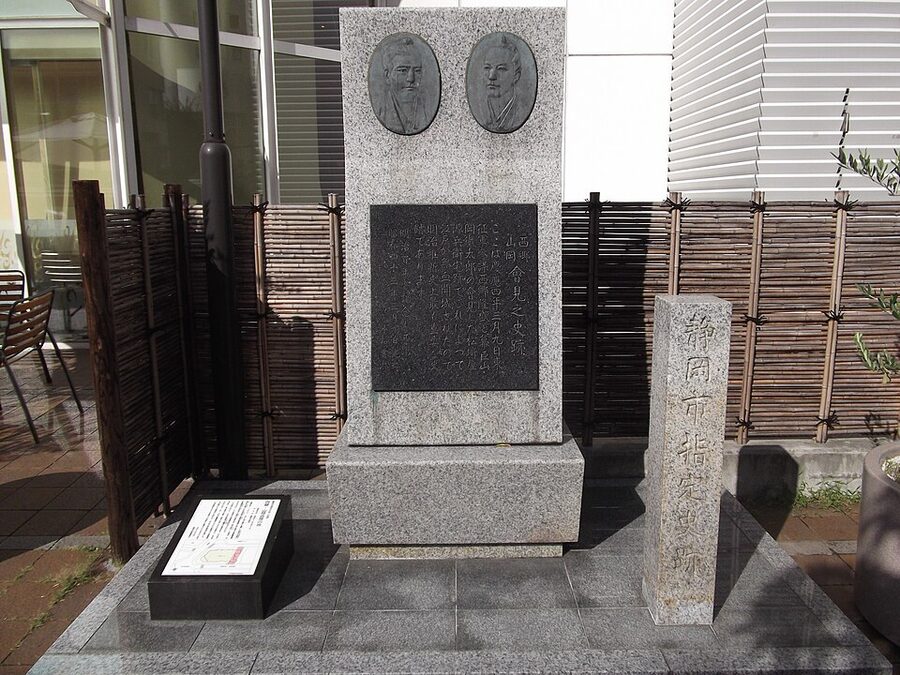
Katsu and Saigō met in Takanawa on 13 March (old calendar; 5 April Gregorian) and again on 14 March (6 April Gregorian). The earlier emissary — Yamaoka Tesshū, Katsu’s deputy — had already travelled through the imperial lines to Sunpu in mid-March to deliver the preliminary terms to Saigō personally. At the Takanawa meetings the two men worked out the full surrender: Yoshinobu would retire to Mito, the castle would be evacuated, imperial forces would enter without resistance, and the Tokugawa fleet and armoury would be handed over. The formal transfer of the castle took place a month later, on 3 May 1868 by the Gregorian calendar, when Tayasu Yoshiyori presented the keys in the Nishinomaru to the imperial representatives.
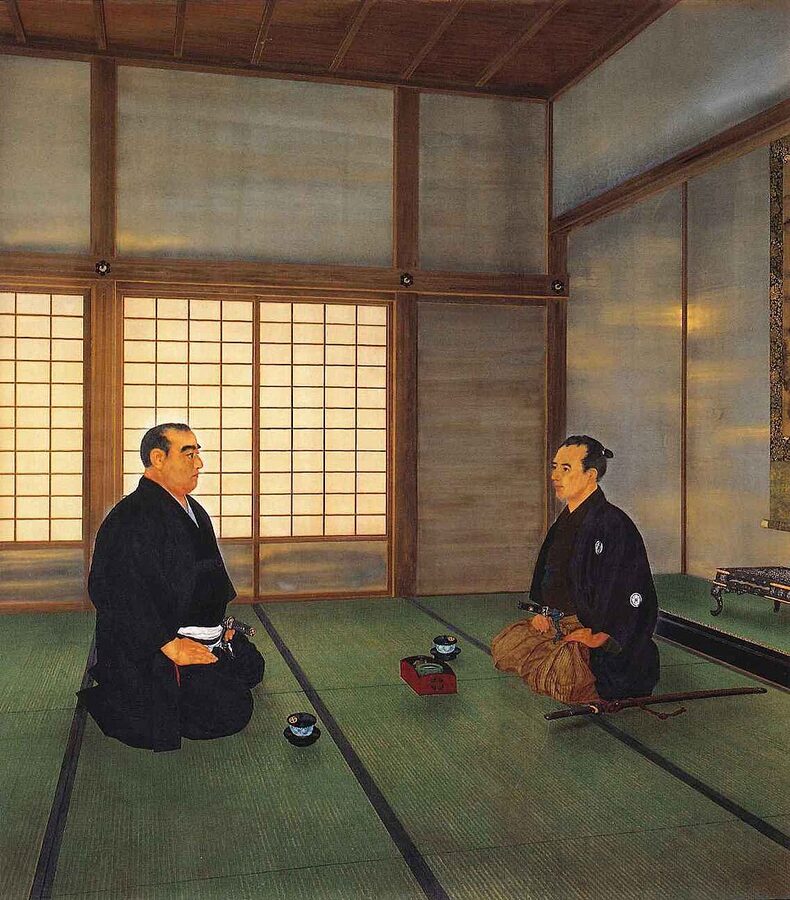
Sources routinely confuse the three dates. The usually-cited “11 April 1868” is the Gregorian conversion of the meeting on 14 March (old calendar), which was an agreement in principle. The formal surrender was 3 May 1868 Gregorian. The lunar-calendar 3rd day of the 3rd month (the canonical “Edo Castle surrender date” in Japanese patriotic historiography) corresponds to 25 March by modern reckoning and refers to the first Katsu-Saigō contact via Yamaoka. Take your pick; the practical outcome is the same. A million people did not die, the castle stones stayed in place, and the 260-year Edo peace got a final non-violent coda.
From Edo-jō to Kōkyo, 1868-1945
The Meiji emperor entered the castle on 26 November 1868, renamed it Tōkei-jō (東京城), and, having briefly returned to Kyoto, came back to stay on 9 May 1869 when it was renamed Kōjō (皇城, “Imperial Castle”). The Nishinomaru palace, formerly the shogunal residence, became the imperial residence. The Honmaru, wrecked by the 1863 fire, stayed as an open lawn. The Ninomaru, also burned in 1863, was left as gardens. The changing nomenclature across the period — Tōkei-jō, Kōjō, Kyūjō (宮城), and from 1948 Kōkyo (皇居) — is not a rebrand but a step-by-step secularisation of a warrior fortress into an imperial household and then into a public garden.
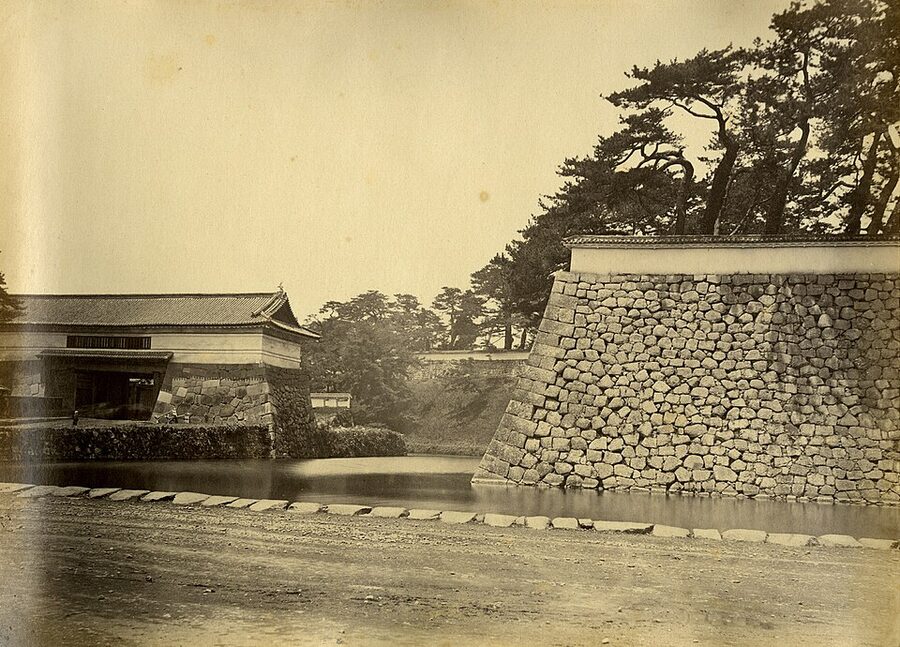
On the night of 5 May 1873 a fire destroyed the Nishinomaru palace, taking with it most of the shogunal residential structure Beato had photographed a decade earlier. The Meiji household lived in the Akasaka detached palace for fifteen years while the new Kyūjō palace was built on the Nishinomaru footprint. The new palace opened in 1888, and from 1889 to 1945 it was the working residence of the Meiji, Taishō and early Shōwa emperors. It was a wooden building, designed in a conscious fusion of Japanese exterior and European interior — coffered Japanese ceilings over European parquet floors, traditional roof lines with Belgian chandeliers underneath. It held 737 square metres of main audience hall, the largest single Japanese-style interior of the 19th century.
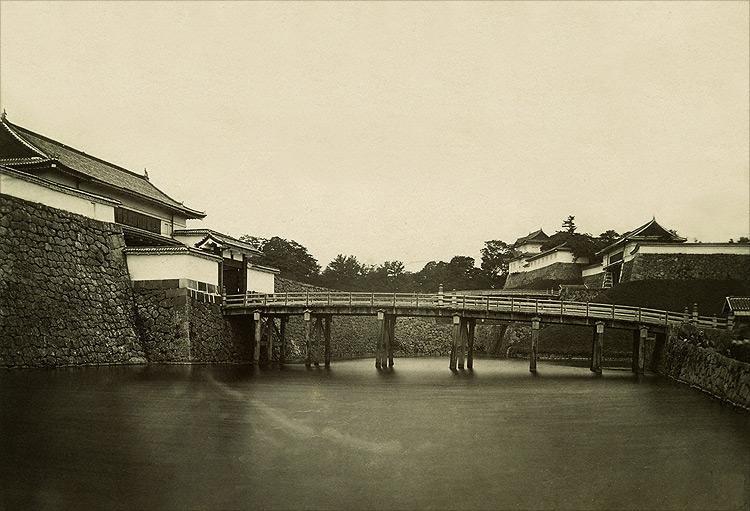
The Meiji palace burned on the night of 25 May 1945 during the B-29 firebombing raid on central Tokyo. 88 of the 101 wooden structures on the imperial compound were destroyed. Pilot Richard Lineberger’s squadron later recorded that the palace had been a secondary target on a 29 July raid where they dropped 2,000-pound bombs specifically into the grounds; the full-scale destruction was the 25 May fire. The imperial family had moved into the Obunko underground annexe earlier that year, which is where Emperor Hirohito held the 14 August privy council meeting that concluded the Pacific War. The surrender was, effectively, decided in a bomb shelter under the old Fukiage garden.
From 1948 the compound was renamed Kōkyo (皇居, “Imperial Residence”), losing the last of its jō (城, “castle”) nomenclature. The architect Junzō Yoshimura designed the current Kyūden palace, completed in 1968 on the Nishinomaru footprint — steel-reinforced concrete with traditional gabled-hip roof lines and a large-span audience hall. The Fukiage residence, where Emperor Naruhito lives today, was built by Shōzō Uchii and finished in 1993. The Honmaru, Ninomaru and Sannomaru were opened to the public in 1968 as the Imperial East Garden.
What actually survives, and what does not
There is no keep. There has been no keep since 1657, and the argument that the Tokugawa and then the Meiji and Shōwa governments made against rebuilding it, that an administrative centre does not require a symbol of warlord power, has held for 369 years. You should not come to Edo Castle expecting a Himeji-style wooden tower or a Matsumoto-style black keep. There is no Kumamoto-scale donjon here either. There is a lot of moat, a lot of stone wall, three original yagura, one original gate, and the empty tenshu-dai.
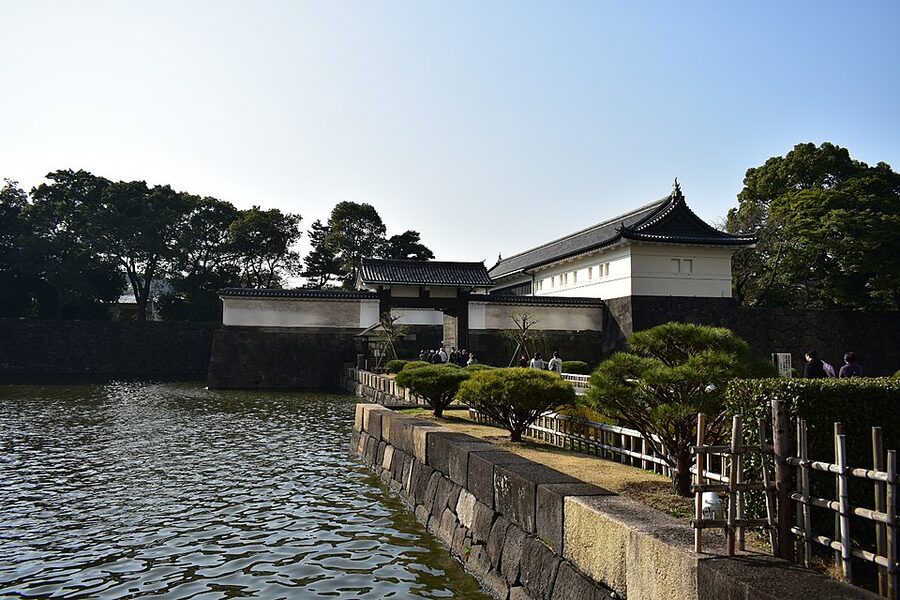
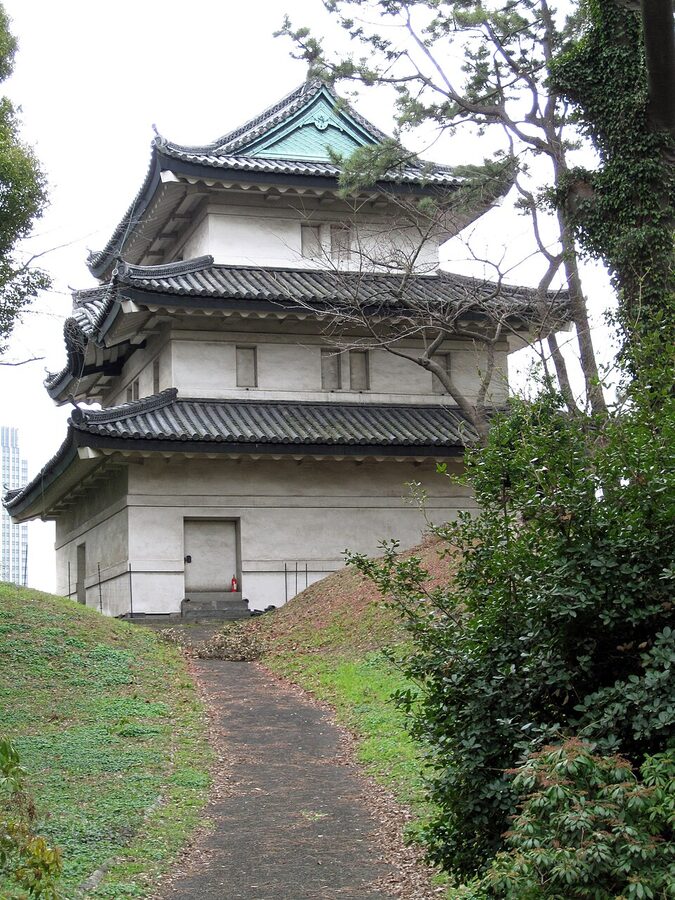
The three original yagura — Fujimi-yagura, Fushimi-yagura and Tatsumi-yagura — are the oldest wooden superstructures on the site, all rebuilt after the Meireki fire in the 1660s. The Fujimi is on the Honmaru south ridge, the de facto keep substitute. The Fushimi sits above the Nijūbashi moat on the southern approach — this is the yagura you see in every tourist photograph of the palace. The Tatsumi is in the Ninomaru south-east corner, less visible. All three are Important Cultural Properties. None is open to the public interior.
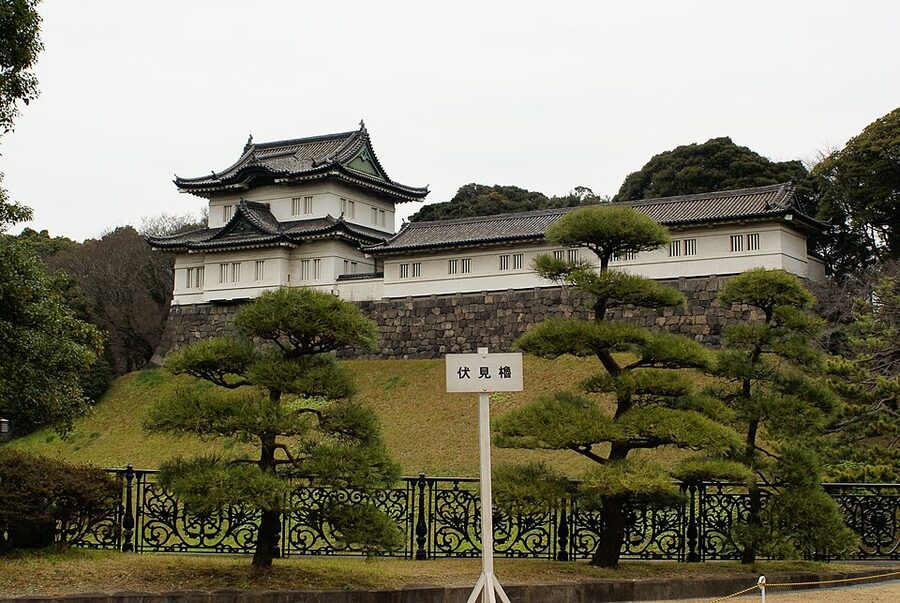
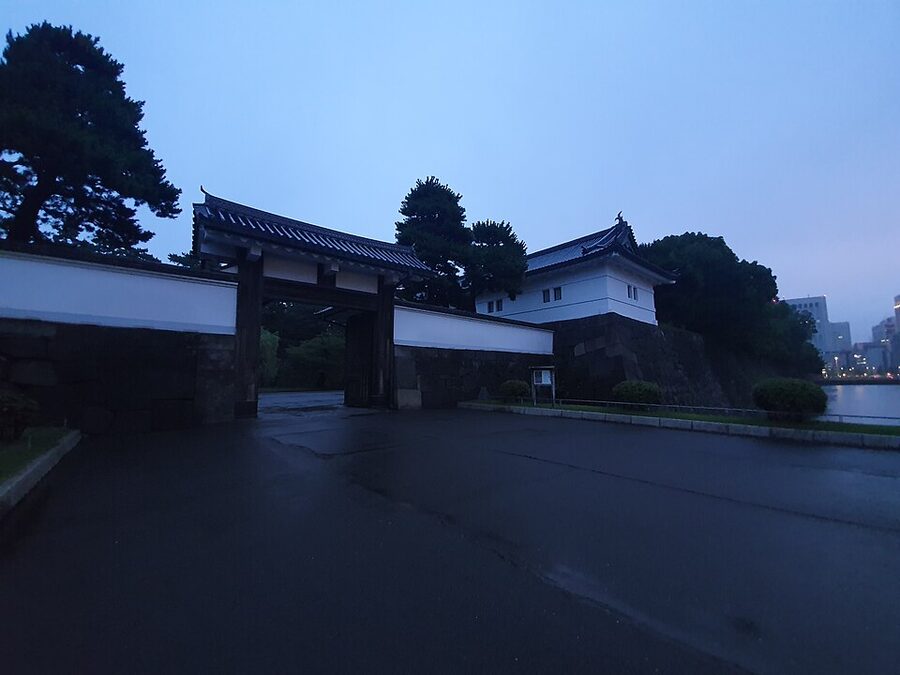
The original gates that survive are the Sakurada-mon and, in modified form, the Tayasu-mon and the Shimizu-mon. The Ōte-mon is a 1968 reconstruction above original stone. The Hirakawa-mon and the Kita-Hanebashi-mon are substantially original Edo-period structures. The Sakurada-mon is the gate where Ii Naosuke was cut down in 1860 — the outer masugata courtyard, where the assassination happened, still stands, and the small modern marker inside notes the date without much commentary.
The stone walls are more important than the buildings. The inner-moat wall, the Honmaru revetments, the tenshu-dai, the Kiyomasa-no-Ido, the Momiji-yama retaining wall, the Sakurada outer bastion and most of the eastern inner wall are all original Keichō-to-Kan’ei-era masonry, 1606-1636. If you know the tally-mark system, each daimyō’s teams carved an identifying mark on their quarried stones to prove delivery for the quota, you can walk the Honmaru perimeter and identify which section was Hosokawa, which was Kuroda, which was Ikeda Terumasa, which was Kiyomasa. The marks are small, about the size of a 500-yen coin, and worn. But they are there.
Where to visit Edo Castle today
Imperial East Garden (Kōkyo Higashi-Gyoen)
The East Garden occupies the old Honmaru, Ninomaru and Sannomaru compounds and is the only part of the inner bailey fully open to the public. Entry is free. The main gate is the Ōte-mon on the east side — Ōtemachi Station exit C13a, about 200 metres.
The garden is open Tuesdays, Thursdays, Saturdays and Sundays year-round, and also Mondays and Wednesdays if they are public holidays; closed December 28 through January 3. You get a numbered token on entry and hand it back on exit — this is how they count visitors. No reservation required; allow two to three hours for the full circuit.
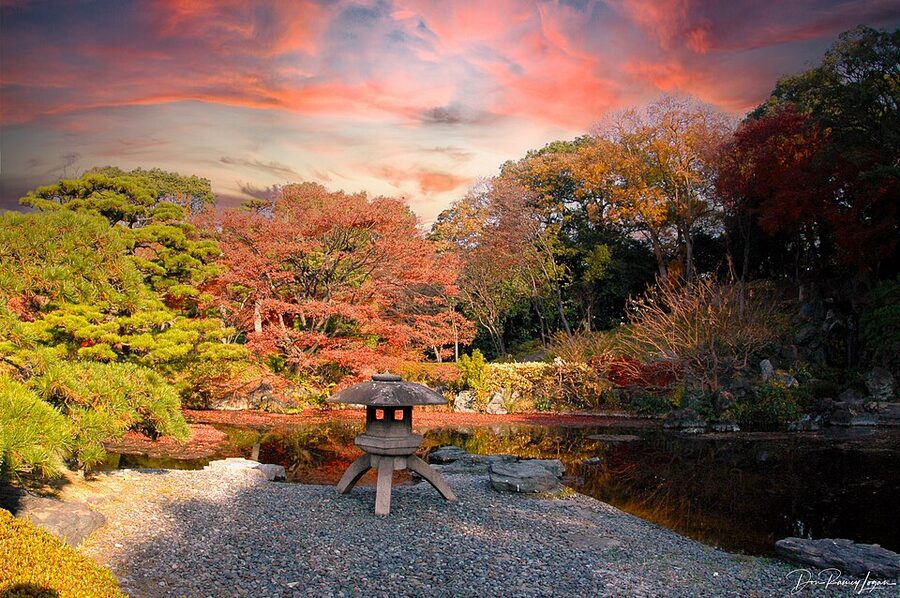
Things to see, in order: the Ōte-mon itself with its 1606 stonework and 1968 superstructure; the Hyakunin-bansho guard-house on the right as you enter; the Ōban-sho beyond it; the Nakanomon stone base; the Kiyomasa-no-Ido well at the foot of the tenshu-dai; the tenshu-dai itself, climbable; and the Honmaru lawn running south to the Fujimi-yagura. Loop back through the Ninomaru garden — a rare surviving Edo-period kaiyū-shiki stroll garden, recreated in 1968 from Edo plans — and exit via the Hirakawa-mon on the north side. The full walk is about 2.5 kilometres. Bring water in summer; there are no vending machines inside the main compound.
Nijūbashi and the south front
The Nijūbashi — or properly, the Nijūbashi approach — is the set of twin bridges on the southern face of the palace, where every tourist photograph of the Imperial Palace is taken. The front span is the Seimon Ishibashi (“main gate stone bridge”), a two-arch granite structure built in 1887. Behind it, barely visible from the public viewpoint, is the Seimon Tetsubashi (“main gate iron bridge”), the 1964 replacement for the original Meiji-era iron span. The Fushimi-yagura stands directly above the inner bridge.
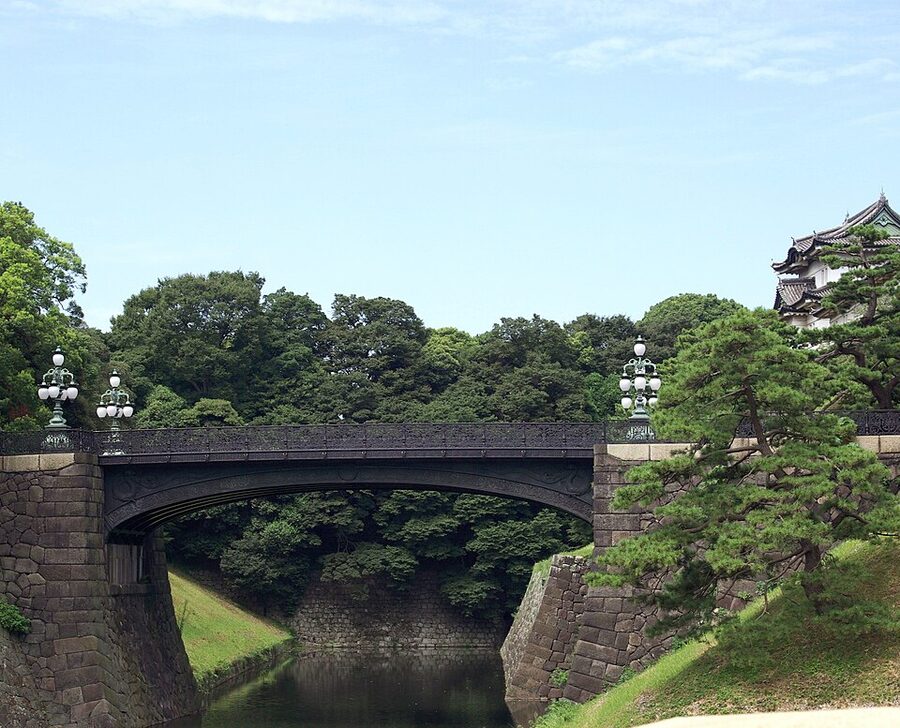
The Seimon Ishibashi is not normally open to the public. Twice a year, New Year’s general audience on 2 January and the Emperor’s Birthday on 23 February, the inner Nakamon gate is opened and the public is allowed across both bridges into the Kyūden Totei plaza, where the imperial family appears on a balcony. The Emperor gives a short speech of about 90 seconds. I have been to the New Year audience twice. The crowd is in the tens of thousands and the atmosphere is closer to a political rally than anything sentimental. Worth doing once if you happen to be in Tokyo on 2 January; not worth planning a trip around.
Sakurada-mon and the Ii Naosuke site
Sakurada-mon is the western gate on the southern moat, closest to Sakuradamon Station (exit 3) on the Yūrakuchō line. It is a full surviving masugata gate-pair from the 1620s Hidetada-era rebuild, including both the outer kōrai-mon and the inner watariyagura, and the courtyard between them is where Ii Naosuke was killed on 24 March 1860. There is a small modern bronze plaque inside the gate marking the date — nothing more. The Ii family‘s gate-guard assignment ran from 1603 to the very morning of the assassination; Ii Naosuke was on his way in to the castle, from his Hikone mansion on the other side of the bridge, when it happened.
The gate is open at all hours and free. You can walk right through it and stand in the courtyard; no signage, no guides, no tourist concession. The main Hikone clan mansion across the moat is gone, it was on the land now occupied by the Ministry of Justice building, but the Ii’s second residence survives as the Kyūchū Sanjō-den ceremony hall on the current palace grounds. The combination of the gate, the plaque, the 1860 date and the geometry of how the assassins positioned themselves (in front of and behind the palanquin simultaneously, on the corner where the road turned into the courtyard) makes the whole site one of the most politically dense few hundred square metres in Tokyo.
Chidorigafuchi and the north moat
The Chidorigafuchi moat on the north-west side of the castle is the most photographed stretch of Edo-period water in Tokyo — about 700 metres of boat-rentable moat, lined with cherry trees, running from the Tayasu-mon at the top to the Chidorigafuchi green-way at the bottom. The trees are somei-yoshino, planted in the early Shōwa period on a site that was moat-bank from 1636. In peak bloom in late March or the first days of April the rowing boats are stacked four-deep at the rental pier and the water is not visible for petals.
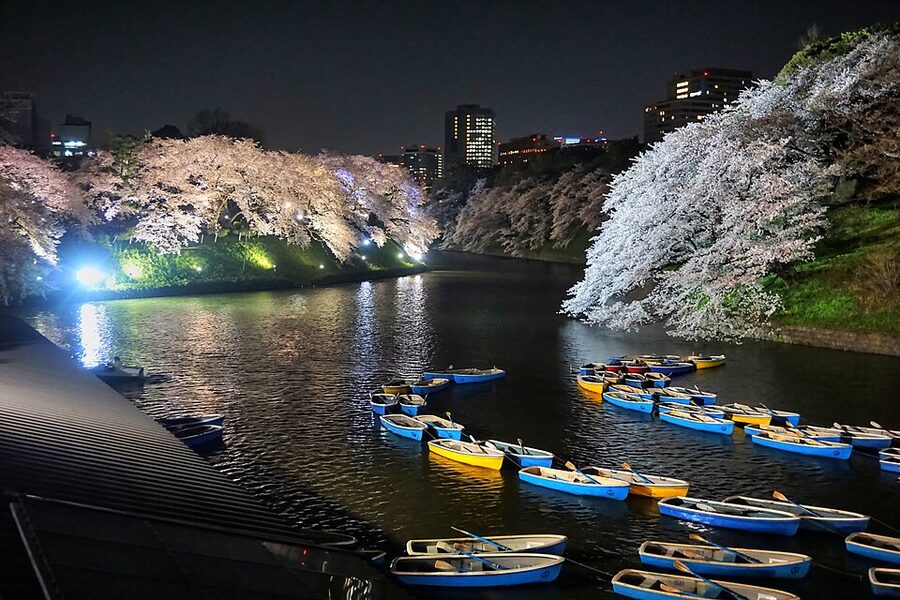
Combine the Chidorigafuchi loop with a walk through Kitanomaru Park, which occupies the castle’s old northern enceinte and contains the Nippon Budōkan (the wooden octagon built for the 1964 Olympics), the National Museum of Modern Art, and the Science Museum. The Tayasu-mon at the top of the park is an original Edo-period gate, 1685 rebuild after a storm, one of the three survivor gates on the north side. It is the one the Tayasu Tokugawa family — one of the three gosankyō branches — used as their compound entrance; Tayasu Yoshiyori, who handed over the castle keys in 1868, came out through it on his way to Kan’ei-ji.
The tenshu-dai, which nobody climbs
The tenshu-dai, the empty keep platform in the Honmaru, is the feature most visitors miss because they are looking for a tower. Go up it anyway. The stone staircase on the north face, installed in the 1968 East Garden redesign, takes you to the top of the 10.9-metre platform; you stand on a 45 × 41-metre granite rectangle with nothing on it. From the south-east corner you can see the Fujimi-yagura; from the north-east corner, the Hirakawa-mon. The platform is the single tallest surviving stonework on the castle site.
The experience of the empty platform is the thing to bring away from Edo Castle. The space is the point. Japan’s other great early-modern castles — Himeji’s renritsu-shiki cluster, Matsumoto’s black keep over its pine moat, Inuyama‘s perched-on-the-Kisogawa tower, Kumamoto’s Kiyomasa-built double keep — kept their tenshu or rebuilt them. Edo’s decision, twice over, to not rebuild was a deliberate political statement in the 1650s and a deliberate repetition of that statement in every subsequent generation. You can argue the Tokugawa were pacifist in their way. The absent keep is the argument.
What to read, and what to skip
The canonical English-language book on the castle is William Coaldrake’s Architecture and Authority in Japan (Routledge, 1996), which has a long and accurate chapter on Edo Castle’s symbolic architecture. For the surrender specifically, Romulus Hillsborough’s Samurai Tales and his longer Ryoma: Life of a Renaissance Samurai treat the Katsu-Saigō negotiations in more depth than most summaries. For the Meireki fire, Asai Ryōi’s 17th-century Musashiabumi chronicle is translated; the modern study by Seidensticker in Low City, High City (1983) uses it well.
Skip the guidebook treatment of the “Imperial Palace” that does not mention the castle history. You are not visiting an imperial palace; you are visiting a Tokugawa shogunal fortress that the imperial household moved into in 1868 without substantial reconstruction. The asymmetry between what the signage emphasises (Meiji palace, imperial garden, current emperor) and what is actually physically there (Ieyasu’s moats, Hidetada’s stone walls, Iemitsu’s gate bastions, a 1658 Kaga granite platform where a 1636 keep used to stand) is the interesting thing. The signage is going to mostly not help you.
One last thing
If you are at the Takanawa monument on a weekday when the commuter trains are sparse, or at the tenshu-dai on an off-season afternoon, the site becomes quiet enough to hear the logic of what happened in 1868. Katsu walked in with no army and a signed letter from a shogun who was finished. Saigō walked in with 50,000 men, Armstrong guns, and instructions to take the city. They agreed in a small room that nothing would burn.
The whole weight of that decision is present in the castle as it stands today — in the walls that never got shelled, in the empty keep platform that was not rebuilt to commemorate a victory, in the turrets that survived because they had nothing to survive. Go to the Takanawa marker first if you can, and then walk north along the old Tōkaidō to the palace. It takes an hour at a slow pace, and you arrive at the same gate the imperial army arrived at on 3 May 1868 — and you understand why it is still standing.