
On the twenty-eighth day of the second month of 1591, 21 April by the modern Gregorian calendar, a seventy-year-old fish-merchant’s son named Sen Sōeki, better known by the title the emperor had given him six years earlier, sat down in a small tea room inside his mansion at the Jurakudai in Kyoto and cut his own abdomen open with a short blade. An armed cordon of Uesugi Kagekatsu’s soldiers, dispatched on Toyotomi Hideyoshi’s order, surrounded the block so the condemned man’s powerful samurai students — Hosokawa Tadaoki, Maeda Toshiie, Furuta Oribe — could not ride in and rescue him. His severed head was taken to Ichijō Modori-bashi and displayed on a pike, stepped on by a wooden effigy of himself. The man killed that afternoon was the most powerful tea master in Japan. The man who ordered his death was the most powerful political figure in Japan. They had been close collaborators for nine years.
This is the founding paradox of chadō, the Way of Tea, that the aesthetic tradition now practised by four million Japanese was brought to its final and definitive form by a merchant who was ordered by a peasant-turned-dictator to die at the height of his own fame, and nobody has ever settled the question of exactly why. The official charges placed on a notice-board beside Rikyū’s exhibited head named two crimes: placing a wooden statue of himself above a temple gate that the dictator had to walk under, and profiteering on overpriced tea utensils. Neither explanation satisfies. The rumours that circulated at the time — a refused daughter, an intercepted plot on Hideyoshi’s life, a disagreement about the invasion of Korea, the deliberate suppression of a man whose aesthetic authority had grown to rival his patron’s political authority — have all been argued over by scholars for four centuries. The one thing everyone agrees on is that tea, after Rikyū, was not the same tea it had been before him. You cannot separate the art from the death.
In This Article
- What chadō actually is (and isn’t)
- Eisai, the Zen monasteries, and four centuries of incubation
- Sen no Rikyū, 1522-1591 — the fish-merchant from Sakai
- The Hideyoshi decade — patronage, power, collision
- Kitano Ōchanoyu 1587 and the Golden Tea Room
- The Daitoku-ji statue and the 1591 seppuku order
- The three Senke schools
- The utensils — what actually goes on the mat
- Where to visit the tea tradition today
- Daitoku-ji temple complex, Kyoto Kita-ku
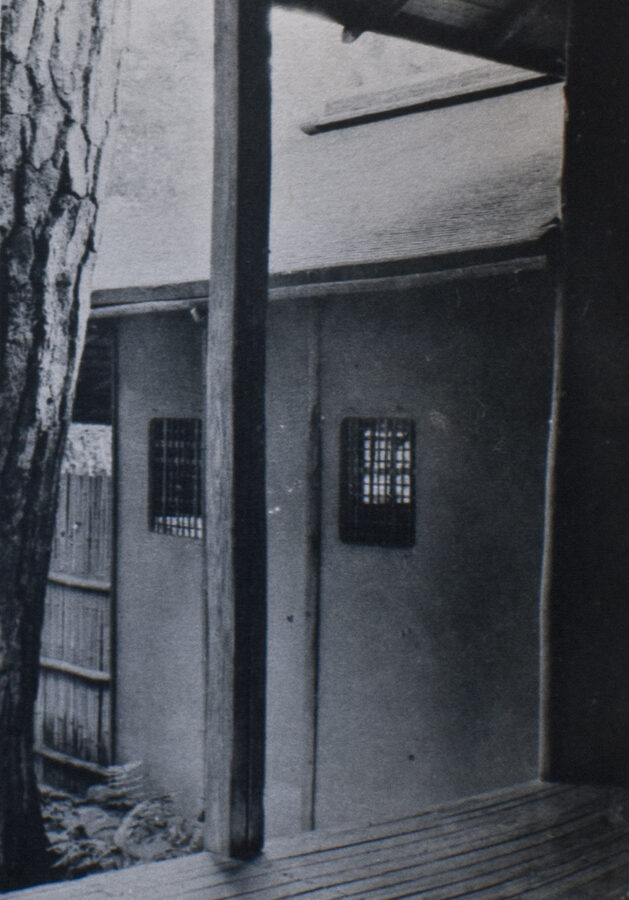
- Tai-an at Myōki-an, Ōyamazaki, southern Kyoto prefecture
- Urasenke Konnichian, Kyoto Imadegawa
- Sakai Plaza of Rikyū and Akiko Yosano (Sakai Rishō no Mori)
- The Rikyū Yashiki memorial, Shukuin, Sakai
- Kitano Tenmangū shrine, Kyoto Kamigyō
- The uncertain legacy
What chadō actually is (and isn’t)
An English speaker hearing “Japanese tea ceremony” tends to imagine a single fixed performance — a kimono-clad woman kneeling, whisking green powder, bowing. The reality is that chadō is a lifelong discipline of preparation and service, and what you see at a tea gathering is the top millimetre of an iceberg whose submerged bulk includes the cultivation of the rush mats, the firing of the bowl, the carving of the scoop, the sweeping of the garden path, the choice of flower in the alcove, the hanging of the scroll, the timing of the kettle, and the year-long study the host has given to each of those choices for the one morning you happen to be sitting there.
The Japanese word chadō (茶道, also read as sadō) translates literally as “the way of tea”. The suffix -dō is the same one that appears in budō (the martial arts), shodō (calligraphy), kadō (flower arrangement), and kendō (the way of the sword). It marks a practice as a lifelong path of cultivation rather than a skill you pick up for a dinner party. The event itself is called chanoyu (茶の湯, “the hot water of tea”) or chakai (茶会, “tea gathering”) for a short session, chaji (茶事, the full four-hour ceremonial meal-and-tea) for the formal version. A tea master — chajin — spends decades inside the discipline. There is no endpoint. You die still studying.
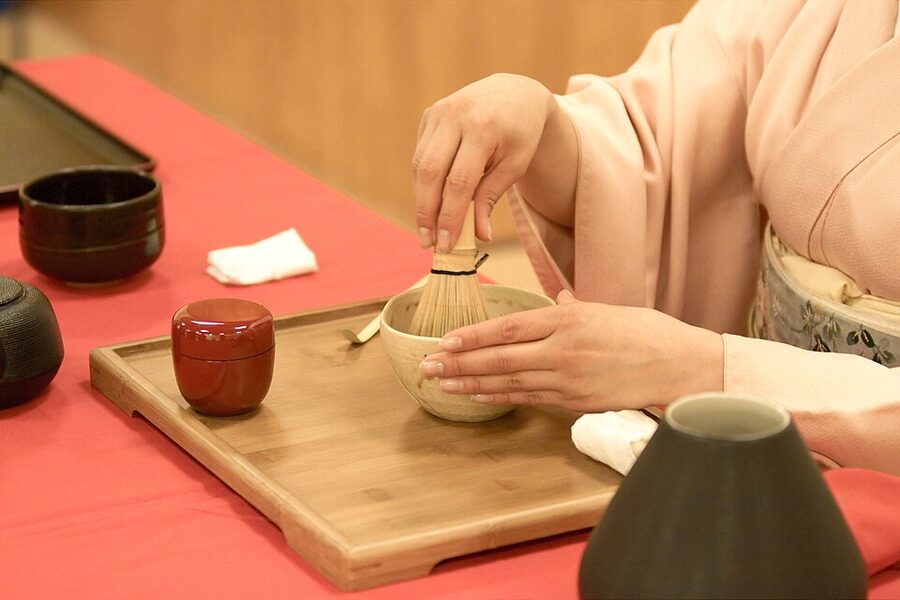
The aesthetic that governs the whole discipline is called wabi-sabi — a compound of two words whose full sense defeats every attempt to translate it into English. Wabi names the austerity and loneliness of simple, rustic, deliberately underdecorated objects and spaces. Sabi names the patina that time and use leaves on things: the flaked glaze on an old bowl, the darkened wood of a worn handle, the asymmetry of a cracked-and-repaired kettle. The tradition values these above polish and freshness. An iron kettle that has been used every day for three hundred years is more beautiful than the one that came out of the forge last Tuesday. This is not sentimentality; it is a formal aesthetic doctrine with specific craftsmen, specific materials, specific rules about how asymmetry should be introduced. Rikyū’s contribution, as we’ll see, was to take this aesthetic as far as it could go.
Eisai, the Zen monasteries, and four centuries of incubation
Tea came to Japan the way almost everything else useful came to Japan between the 7th and the 12th centuries — from China, carried by a Buddhist monk. The monk was Eisai (栄西, 1141-1215), the founder of the Rinzai Zen school, and the year was 1191. Eisai had been studying in Song China, and he came back with tea seeds and a practical thesis that tea was medicinal. His 1211 treatise Kissa Yōjōki (“Drinking Tea for Health”) argued that tea cured everything from hangovers to paralysis. This is not literally true, but for the next three hundred years it was the official reason Japanese monasteries were allowed to cultivate and drink it. Tea came in wrapped in a Zen justification, and the association stuck.
For four centuries after Eisai, tea was almost entirely a monastic and aristocratic practice. The Daitoku-ji and Nanzen-ji Zen complexes in Kyoto developed formal tea-drinking protocols as part of monastic discipline. The Ashikaga shogunal court, particularly under the eighth shogun Ashikaga Yoshimasa (1436-1490), built tea-drinking into a courtly aesthetic — Yoshimasa’s Ginkaku-ji villa at Higashiyama is the best-preserved architectural expression of the period’s tea culture. The tea served at these events was the powdered matcha that still defines the ceremony today, whisked with a bamboo chasen in a ceramic bowl. The format was largely fixed by the mid-1400s. What was not yet fixed was the aesthetic stance.
There were two possible directions. One was the karamono, Chinese-import, path: expensive Song-dynasty ceramic bowls, lacquered lacquer stands, silk-mounted paintings, an aesthetic of display that signalled the host’s wealth and international connections. This was the dominant strand in the Ashikaga court and remained the prestige option into the Sengoku period. The other direction, which eventually won, was the wabi-cha (侘茶) path, pioneered by a Kyoto Zen practitioner named Murata Jukō (村田珠光, 1422-1502). Jukō argued for an austere, native-material, deliberately humble version of the ceremony — a small-roomed, dim-lit, Korean-or-Japanese-ceramic, rough-texture aesthetic that would carry the emotional weight the imported luxury tea simply couldn’t.
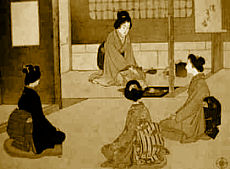
Jukō’s successor was Takeno Jōō (武野紹鷗, 1502-1555), a Sakai-based tea master who pushed wabi-cha further and trained the generation that would produce Sen no Rikyū. Jōō was a wealthy merchant himself, and he institutionalised the pairing of mercantile money with austere aesthetic — a pairing that Rikyū would inherit intact. Sakai, the free port on the Osaka coast that had grown rich on Ming-dynasty trade and firearms manufacturing, was the natural soil. By the time Jōō died in 1555, the broad aesthetic framework was in place: the small tea room, the native ceramics, the Zen-adjacent restraint. What Rikyū did in the next thirty-six years was take that framework and push it to a place nobody else had dared to go.
Sen no Rikyū, 1522-1591 — the fish-merchant from Sakai
Sen no Rikyū was born Tanaka Yoshirō (田中与四郎) in Sakai in 1522, in the eighth month of the second year of the Daiei era. His family kept a warehouse and retailing business under the trade-name Totoya (魚屋, “fish-shop”) — salted-fish monopoly rights, storage for other traders’ inventory. He lost his father at nineteen. The family history is precise: the Ryokutai Bokuseki, kept at the Fushin’an, records him performing his grandfather’s seventh-year memorial so broke he couldn’t afford the offerings and wept at the grave while cleaning the stone. By that stage Sakai’s merchant monopolies were collapsing under Ōnin-war aftershocks, and the family’s old insurance had gone.
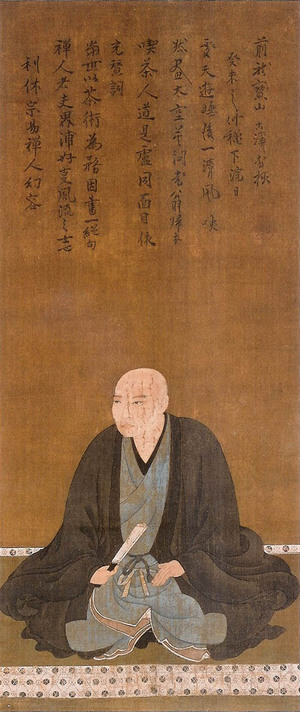
He started studying tea at seventeen, under a Sakai teacher named Kitamuki Dōchin. His first recorded tea gathering is dated 27 February 1544 — he was twenty-one, and he served the occasion with a Shukō-chawan, a blue-tinged celadon that had belonged to Murata Jukō himself. The choice is significant; Rikyū is signalling a direct line of descent from the wabi-cha founder, even this early. He moved on to study under Jōō. By the 1550s he was one of the three senior tea masters of Sakai, with Imai Sōkyū and Tsuda Sōgyū, and had taken up the Buddhist name Sōeki (宗易). He was also running a substantial business: he sold Jukō’s blue bowl to the daimyō Miyoshi Jikkyū for a thousand kan in around 1560, an enormous sum that marks the moment tea utensils became a real financial asset class.
When Oda Nobunaga seized direct control of Sakai in 1569, he pulled the three senior Sakai tea men — Imai, Tsuda, Rikyū — into his service as sadō, court tea masters. The relationship was strictly political. Nobunaga understood what the Ashikaga court had also understood, and what Hideyoshi would later take to an extreme: the control of tea utensils and the ability to host elite tea gatherings was a form of currency that could substitute for land grants. A daimyō could not receive another province, but he could receive a famous tea bowl from the shogun’s hand, and the social weight of that gift was comparable. This is called ocha no yu goseidō, “tea-hot-water political doctrine”, and it would, under Hideyoshi, become one of the pillars of the Toyotomi regime.
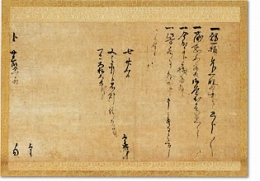
After the Honnōji Incident in June 1582 — where Akechi Mitsuhide killed Nobunaga and triggered the succession war Hideyoshi won at Yamazaki thirteen days later — Rikyū transferred his services from the dead lord to the new one. He was sixty years old. His student Yamanoue Sōji later wrote in the Yamanoue Sōji Ki that Rikyū “only began his own tea at sixty-one”. That is a striking thing for a senior disciple to write about his master. It means the Rikyū style that now defines Japanese tea — the wabi-cha that took the Jukō-Jōō framework and broke through into its final, radical form — was the work of the last ten years of the old man’s life. He had been practising tea for forty years before that. But the thing that became chadō as we know it is the synthesis of the Hideyoshi decade.
The Hideyoshi decade — patronage, power, collision
Hideyoshi took Rikyū on as his personal tea master in August 1582, two months after Yamazaki. The first order the new lord gave the new servant was to design a tea room, and Rikyū spent six months on it, finishing in March 1583 — the Tai-an at what became Myōki-an temple in Ōyamazaki, the only surviving tea room indisputably built to Rikyū’s own design and now a registered National Treasure. In a letter Rikyū sent to a fellow tea man Yabuuchi Jōchi on 14 November 1582, he complains that Hideyoshi has asked for something “troublesome”. The complaint is almost certainly about the Tai-an commission. It is the earliest evidence we have that the relationship was already, even at the beginning, structurally difficult.
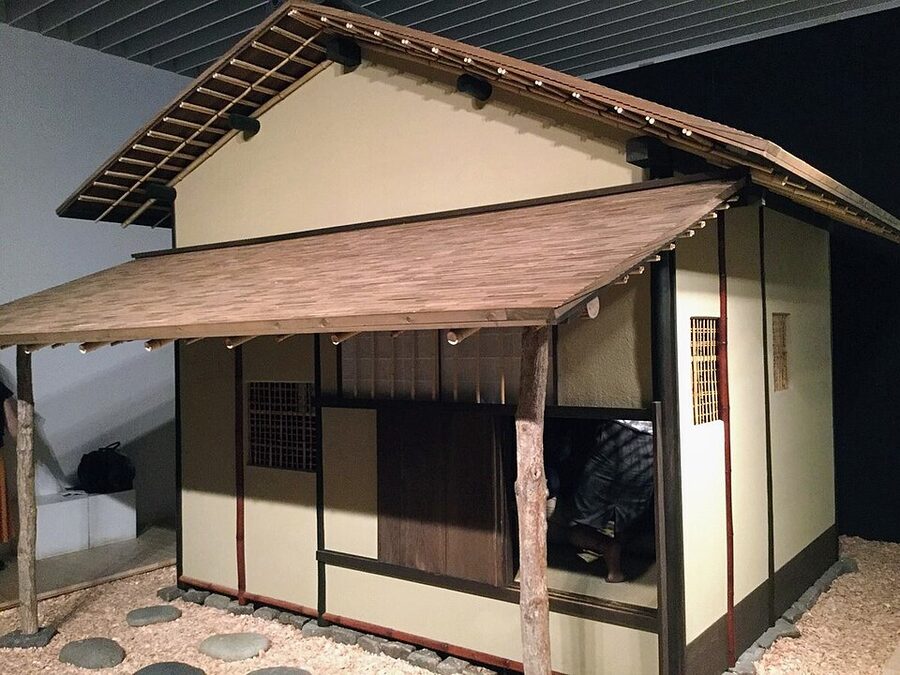
The Tai-an is the thing to look at if you want to understand what Rikyū meant by wabi. The room is two tatami mats — roughly 3.3 square metres — with walls of exposed mud plaster streaked by the straw fibres embedded in it, a ceiling of bamboo lashed with wisteria vine, and a nijiriguchi entrance so low that a full-sized man has to crawl through it on his knees. A samurai visitor had to leave his long sword on the rack outside. The design was calculated; there is no weapon-sized space inside, and there is no rank-hierarchy inside either, because everyone is on the floor in the same roughly six-square-metre cell. An imperial regent going in had to crawl through the same hole a fish merchant’s son did. Rikyū had designed a room that structurally denied the Hideyoshi regime’s social grammar, and then he handed the keys to Hideyoshi. This is not a small thing.
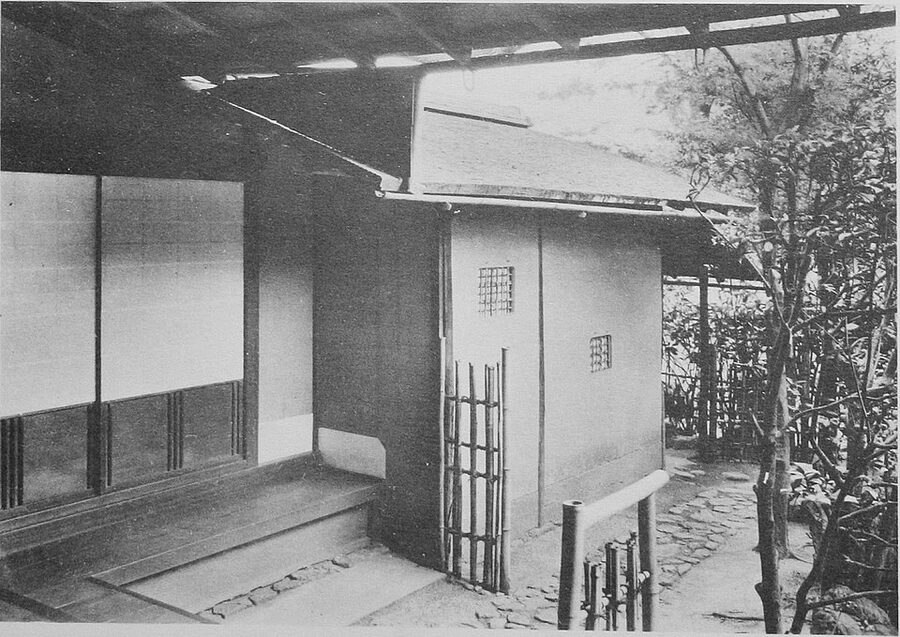
In May 1583 Rikyū served as tea master at Hideyoshi’s tea gathering at Sakamoto Castle on Lake Biwa — his first official appearance in the role. In 1584 he built Hideyoshi a two-mat tea room inside the Osaka Castle gardens, with a bamboo-gate roji path leading to it. This is the moment the roji, the tea garden, became a standard element of the ceremony rather than a mere access path. After this point the utensil innovations start cascading. Rikyū commissioned the first-generation Raku potter Chōjirō to produce hand-formed, irregular, deliberately-imperfect tea bowls for his use; these are the originals of what is still called raku-yaki ware today. He designed bamboo flower vases, bamboo tea scoops, the Banko iron kettles. Every one of the gestures that would define wabi-cha material culture took its canonical shape in Rikyū’s personal workshop between 1583 and 1590.
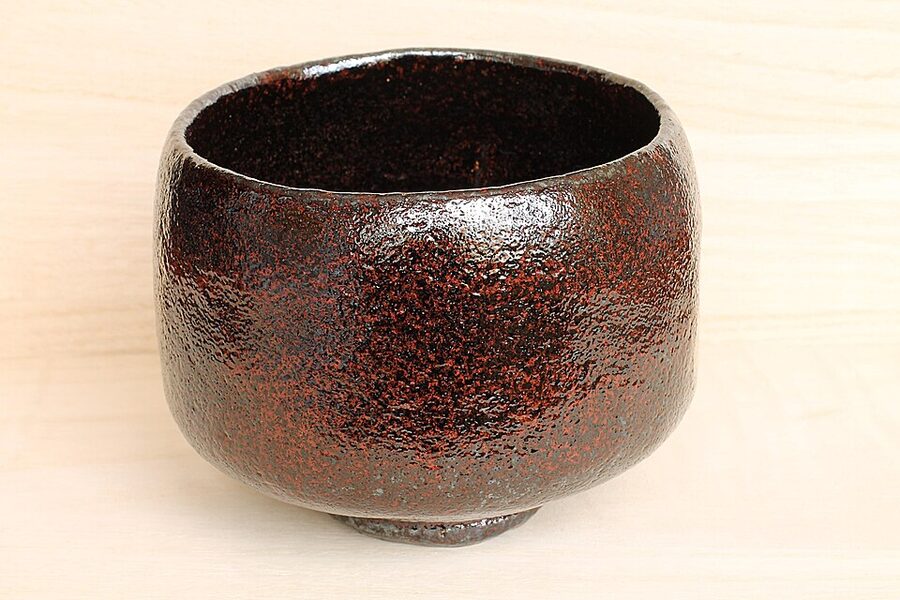
In October 1585 Rikyū served tea to Hideyoshi at a ceremony held inside the Imperial Palace, for the retired emperor Ōgimachi. A commoner could not enter the palace, so the emperor granted Rikyū a kojigo — a formal Buddhist-laic honorific title. The title was Rikyū (利休), and it is the name he has been known by ever since. It means, depending on whose reading you follow, either “cast-off worldly gain” or “let the sharp intellect rest”. He was sixty-three. In a strict legal sense the name was only his for the last six years of his life; for the previous forty-three years of tea practice he had been Sōeki. Most of his recorded career is filed under a name that is not the one history remembers him by.
Kitano Ōchanoyu 1587 and the Golden Tea Room
In November 1587, Hideyoshi staged the largest tea gathering in Japanese history at the Kitano Tenmangū shrine in north-west Kyoto. The event was called Kitano Ōchanoyu — the Great Kitano Tea Gathering. Notices went up months in advance in every province: any tea enthusiast, regardless of social rank, could attend.
Merchants, farmers and townspeople were explicitly welcomed. They were told to bring one kettle, one bucket, one cup, one tea-serving tray each, and a rush mat to sit on. Over eight hundred individual tea stations were set up across the shrine grounds, and Hideyoshi himself moved from station to station. It was scheduled to last ten days. After the first day it was cancelled.
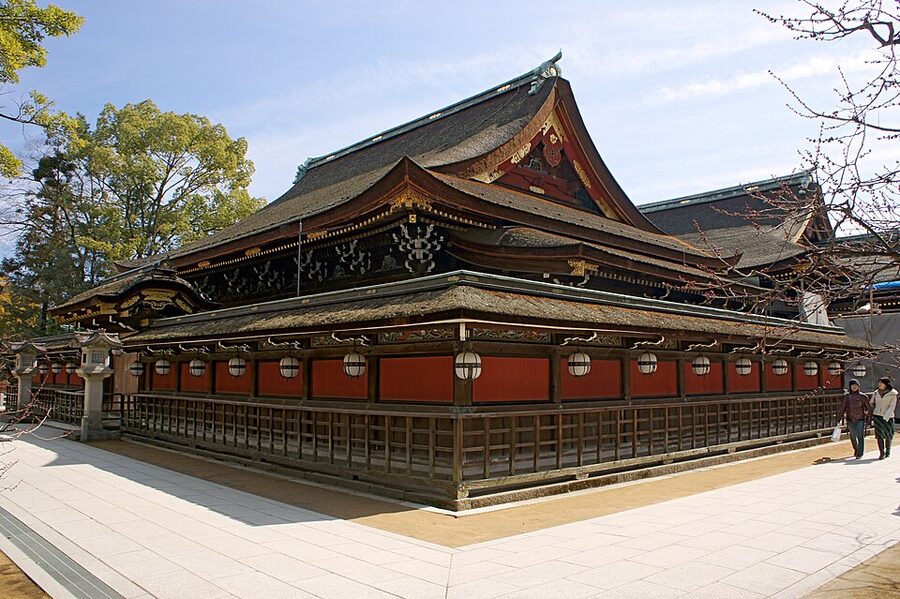
The official reason for the cancellation was a peasant uprising in Higo Province. The unofficial theories are more entertaining and at least one of them is probably also true. Hideyoshi had committed to rewarding the best tea of the gathering, the peasant version, with a substantial prize. The day one reports suggested that at least one humble merchant’s wabi-cha station had been more talked-about by the Kyoto attendees than Hideyoshi’s own Golden Tea Room, and that the regent was not prepared to sit through nine more days of being out-served by his own subjects. The Higo rebellion gave him a face-saving exit. Whatever the truth, the event is remembered now as the largest single public-tea gathering in Japanese history, and the closest the art ever came to being a genuinely popular festival rather than an elite discipline.
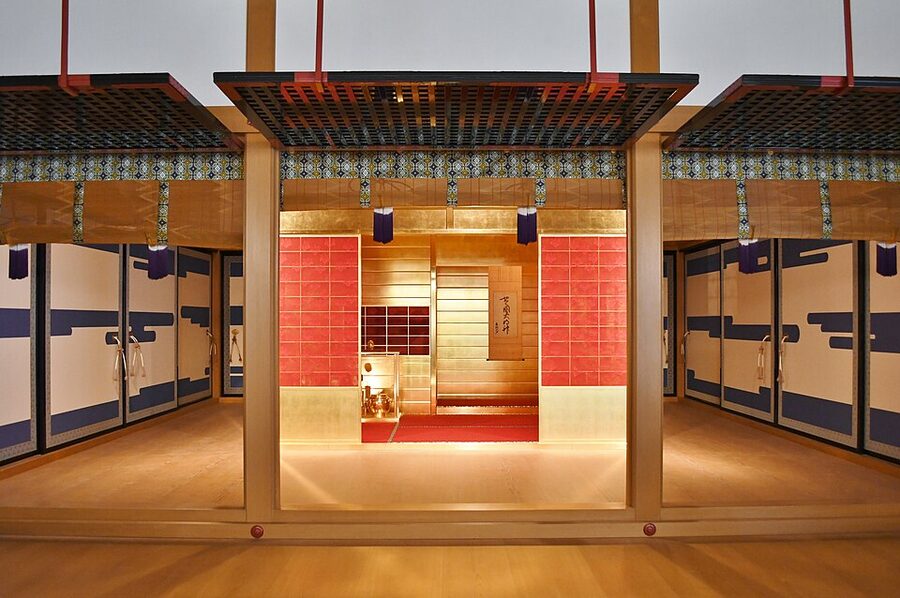
The Golden Tea Room is the aesthetic compromise-artefact of the Rikyū-Hideyoshi partnership. Hideyoshi had it built in 1586 — a three-mat portable tea room, every surface gold-leafed, red-felt-carpeted instead of tatami, with solid-gold kettle, gold tea caddy, gold stand. In January 1586 he had the whole thing re-erected inside the Imperial Palace and served tea out of it to Emperor Ōgimachi, with Rikyū acting as attendant. What Rikyū privately thought about this has been the subject of careful extrapolation for four hundred years. The ja.wiki account notes that Hideyoshi “disliked wabi-cha as depressing” and wanted the tea done in the bright, showy, Golden-Room idiom. Rikyū produced it for him, flawlessly — and then went back to his own two-mat mud-walled Tai-an and kept building in the opposite direction.
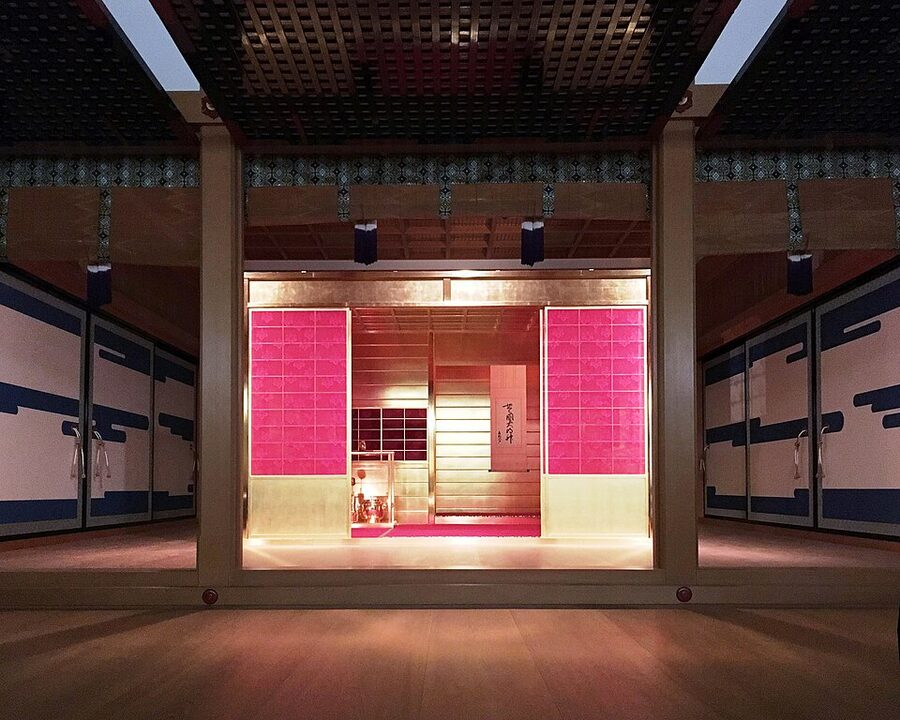
The two men held these two opposing aesthetics inside the same working relationship for roughly five years. It is, looking back from four centuries later, a remarkable collaboration. Hideyoshi got the political theatre he needed; Rikyū got the patronage he needed to keep inventing, and also the social cover to build rooms like the Tai-an in which the regent had to kneel and crawl. At some point between 1589 and 1591, one of them, or both of them, stopped being able to keep the two frames in the same head at the same time. The specific moment is usually dated to a sculptural intervention at a temple gate.
The Daitoku-ji statue and the 1591 seppuku order
In 1589 Rikyū, as principal patron, sponsored the reconstruction of the two-storey sanmon gate at Daitoku-ji in Kyoto’s Murasakino district — the Kinmōkaku. The monks, in gratitude for his donation, commissioned a wooden statue of the old tea master and installed it on the second floor of the completed gate, straw sandals on its feet, staff in hand. The installation was aesthetic; it was a thank-you, the kind of donor statue any Zen temple might put up. It was also, as Hideyoshi would shortly observe, a statue of a commoner that anyone passing through the gate, including the regent of the realm, would physically walk under. The feet of a straw-sandalled merchant sat directly above the imperial regent’s head every time he entered the temple complex.
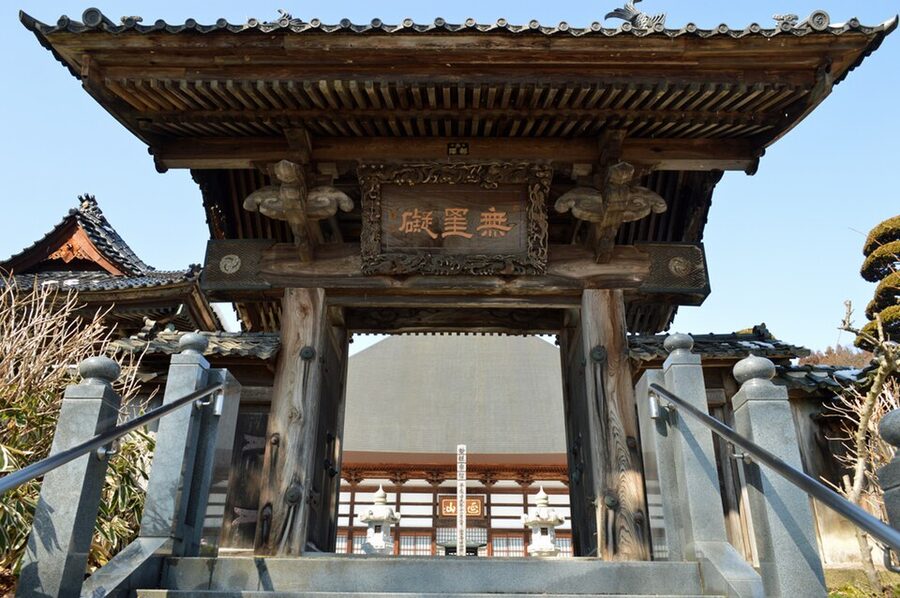
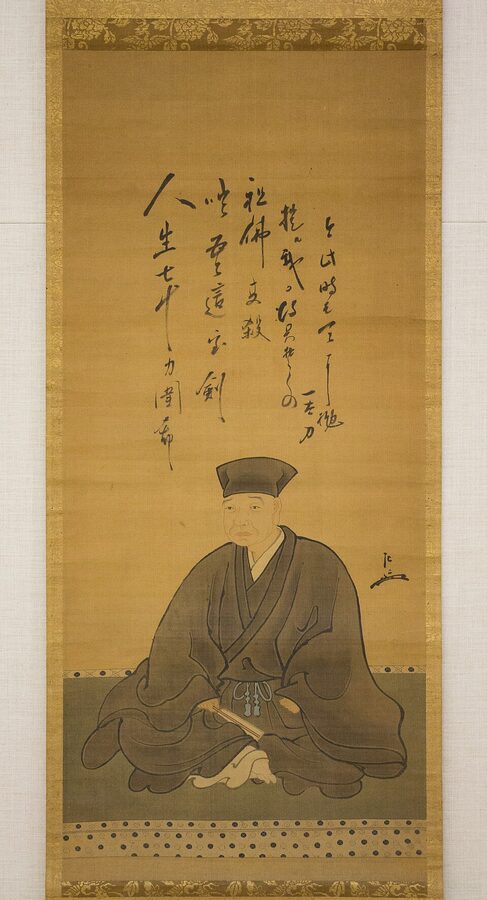
On 13 February 1591, Rikyū was placed under house arrest at Sakai. Two weeks later, on 28 February, he was recalled to Kyoto and ordered to commit seppuku in his Jurakudai mansion. He was seventy years old. Uesugi Kagekatsu’s troops surrounded the compound to prevent rescue attempts — Maeda Toshiie and Hosokawa Tadaoki were known to be considering armed intervention.
The formal charges were the Daitoku-ji statue and the profiteering accusation. His last act, according to the Chawa Shigetsu-shū chronicle, was to compose a death poem and, when the executioner’s messenger arrived, to remark calmly that he had lost the key to his tea room. His severed head was taken to Ichijō Modori-bashi, the “Returning Bridge” on Ichijō Street, and exposed on a pike, with the now-dismantled wooden statue of himself positioned so the effigy’s wooden foot stood on the preserved head. The tableau was Hideyoshi’s. He was not a subtle man in his enmities.
The official charges explain almost nothing. Sponsorship of a Zen temple with a donor-statue above the gate was entirely conventional; the Jukō-Jōō lineage had done the same thing. Selling tea utensils at a mark-up was the living of every senior tea master in the country, and there is no evidence Rikyū’s pricing was out of line with his peers’. The ja.wiki catalogue of alternative explanations runs to eleven distinct hypotheses, and the better ones all involve a structural collision rather than a single offence. Rikyū’s aesthetic had become a second centre of authority in Kyoto. The tea rooms he was inviting Hideyoshi into were rooms where Hideyoshi had to kneel and crawl; the bowl Hideyoshi drank from was one Rikyū had chosen; the scroll Hideyoshi contemplated was one Rikyū had hung. The regent who had unified Japan by military force could not tolerate being aesthetically managed by a fish-merchant’s son.
There are wilder theories. One has it that Mitsuhide‘s daughter, Hosokawa Gracia, was the real wedge: her husband was Rikyū’s top student, and Hideyoshi believed Rikyū’s tea-circle was a covert pro-Akechi salon. One has it that Rikyū’s refusal to give his daughter to Hideyoshi as a concubine was the direct personal offence. One has the Rikyū-versus-Ishida Mitsunari court faction war as the engine; Mitsunari wanted the old tea master out of the way for his own reasons.
One, the Korean-invasion theory, has Rikyū privately telling Hideyoshi that the 1592 Korean expedition was a mistake, and Hideyoshi deciding he had heard enough. One has Rikyū as a covert Tokugawa agent, brewing poison into the tea. None can be definitely proved. The plurality of the theories is the honest answer. Hideyoshi killed him, and nobody who was in the room for the final conversation ever wrote down what was said.
The three Senke schools
Rikyū’s execution came close to ending the Sen family’s tea lineage outright. His son Dōan and his son-in-law Shōan were both placed under house arrest; the Sen house was temporarily dissolved. In 1595, four years after Rikyū’s death, Tokugawa Ieyasu and Maeda Toshiie interceded with Hideyoshi on the family’s behalf, and the pardon was granted. Dōan took over the original Sakai house, which died out within a generation. Shōan restored the Kyoto house, and it is through his son, Rikyū’s grandson Sōtan (1578-1658), that the living tea lineage comes down today.
Sōtan had four sons. The eldest, Sōsetsu, left to become a doctor. The remaining three inherited the household and built their own tea rooms inside it — the three houses gradually becoming three institutional schools. The compound at Honpō-ji in Kyoto is still where the three schools sit, next to each other, walls touching.
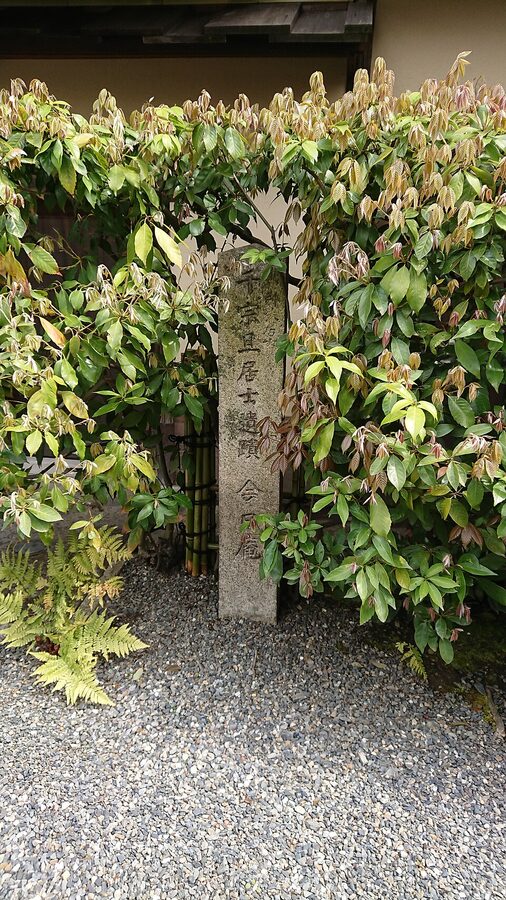
The second son Sōshu founded the Mushakōji Senke, based at the Kankyū-an tea house. The third son Sōsa founded the Omote Senke, at the Fushin-an tea house — “Omote” meaning “front” because his was the front-facing Kyoto-street property. The fourth son Sōshitsu founded the Ura Senke at the Konnichi-an tea house — “Ura” meaning “behind” because his was the rear property. All three schools teach Rikyū’s method, and they have been loyal fraternal rivals for four centuries.
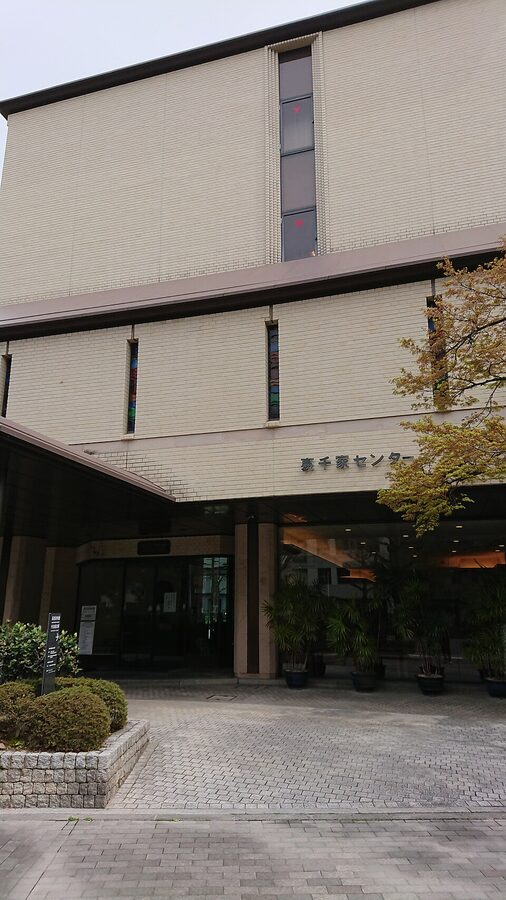
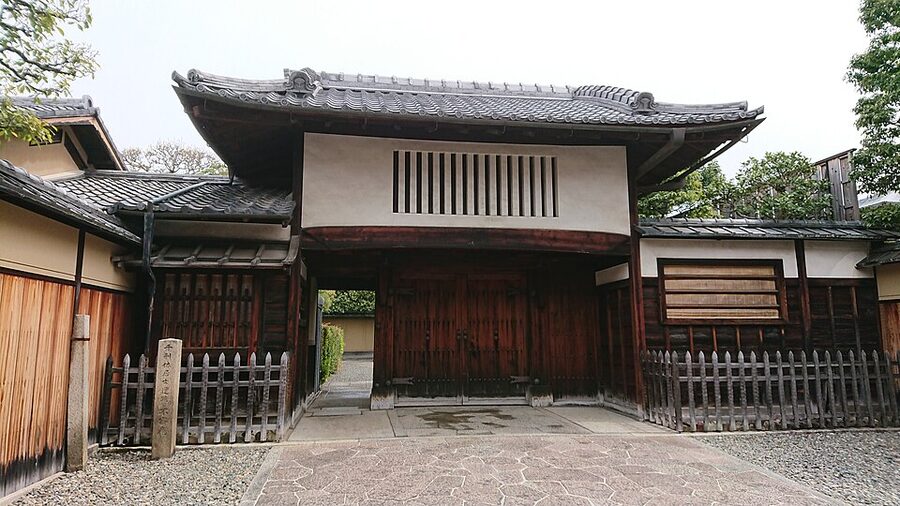
Urasenke is the largest of the three today — roughly three million registered students across Japan and overseas, with active chapters in New York, Paris, São Paulo. Omotesenke is the second-largest and is generally regarded as the most conservative, keeping closest to Rikyū’s own recorded practices. Mushakōji Senke is the smallest and the most traditionalist — its grand-master line has never split, its membership has stayed concentrated around Kyoto, and it is the one an overseas student is least likely to encounter because it does not run an international promotion the way Urasenke does. All three use iemoto succession: the grand-master title passes from father to son, or to adopted son where biological succession fails. The current Urasenke grand master is the sixteenth in direct line from Sōtan. You can visit the public-facing gate of all three houses on a single morning in Kyoto — they are within walking distance of each other.
The utensils — what actually goes on the mat
Tea ceremony material culture is a specific repertoire of objects, each with its Japanese name, its proscribed form, and its dedicated artisan trade. The ceremony cannot be performed without them, and the intelligent student learns the objects before learning the choreography. The core set runs to perhaps a dozen items. Each one has a full-dress version and a grass-hut version. Rikyū’s innovation was, broadly, to push every one of them toward the grass-hut end of the spectrum.
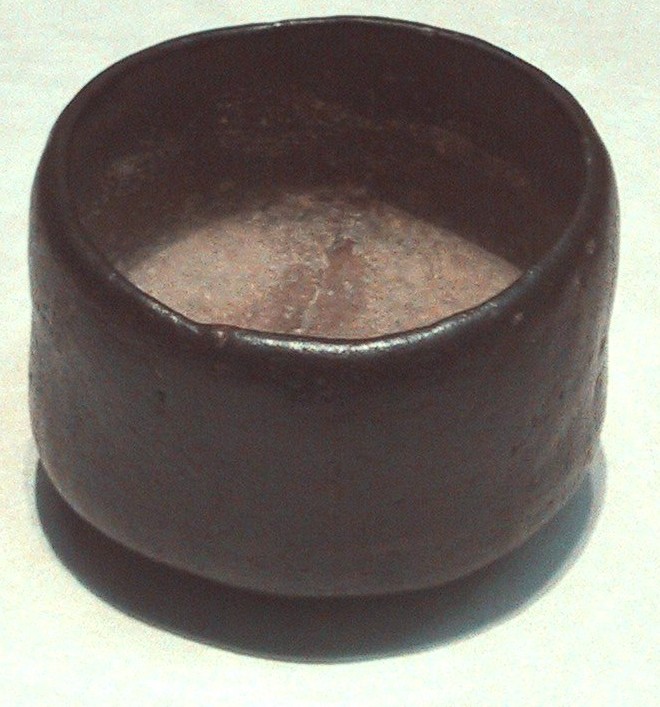
The chawan (茶碗) is the tea bowl. It comes in winter and summer versions — a taller, deeper bowl for winter that holds in heat, a shallower flat one for summer that releases it. The Rikyū-Chōjirō raku bowl set the tone: hand-moulded, not wheel-thrown, low-fired, glazed in simple black or red, deliberately a bit lumpy. A good bowl has a defined mikomi (the interior hollow where the whisk goes), a finished koudai (the unglazed foot-ring that sits on the mat), and a personality that emerges after a decade of use. Famous bowls are individually named; Rikyū’s own collection included the Fujinasu, the Nasu-chawan, the Marutsubo. Each of those names attaches to a specific physical object that is still held somewhere in Japan, many of them in private collections and a few in museum stores.
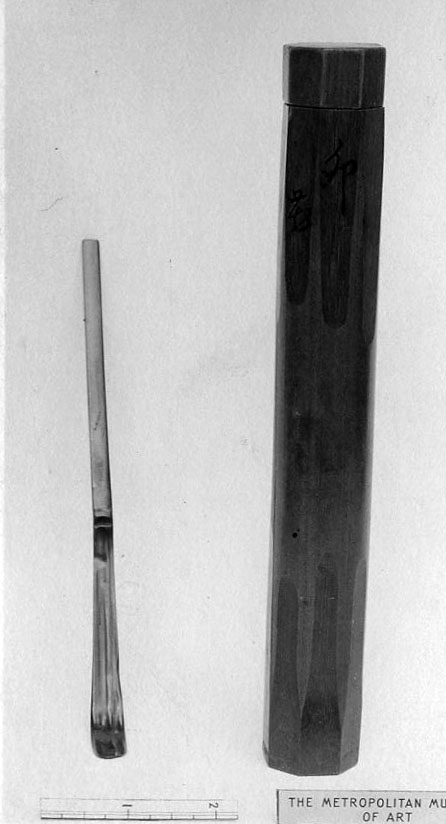
The chasen (茶筅) is the whisk, split from a single block of Takayama-village bamboo, with anywhere from 48 to 120 tines depending on the school. The chashaku (茶杓) is the tea scoop, usually a single strip of bamboo cut and bent over steam to a specific curvature. Master-grade chashaku are individually named and signed by their maker, kept in a silk bag with the maker’s hand-written identification — they are small, fragile, and often the most valuable single object on the mat. The chakin (茶巾) is the linen wiping-cloth, folded in a prescribed origami sequence before the ceremony and re-folded during.
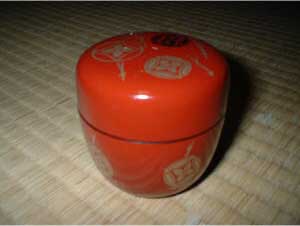
The natsume (棗) is the tea-caddy — a small lidded container, named after the Chinese jujube fruit it resembles, typically lacquer-coated black or lacquer-with-gold. It holds the powdered matcha. A formal chaji uses a chaire (茶入), a more precious ceramic caddy with a shifu silk pouch, rather than the natsume; the natsume is for less formal occasions. Inside the caddy, the matcha has been whisked from fresh tencha leaves — the shaded, vein-stripped green-tea-leaf stock that powders into the characteristic bright green — and it is the specific quality of that matcha, more than any other single element, that determines whether a sitting is any good.
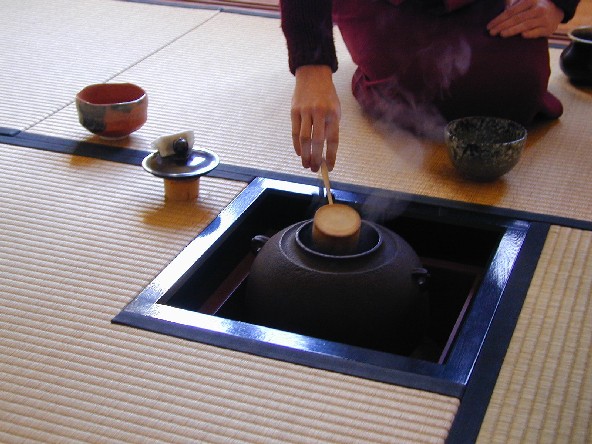
The chagama (茶釜) is the iron kettle. For the winter months (November to April) it hangs on a chain over a sunken hearth — the ro — that is cut into the tatami floor. For summer (May to October) it sits on a portable brazier — the furo — on the mat itself. The seasonal swap, the kuchikiri, is a formal event in the tea calendar, and the winter-summer shift reshapes the spatial geography of the whole room. A good chagama is cast iron, often Banko-yaki or Ashiya-yaki, and the sound of its water coming to the boil — a specific low-resonance matsukaze, “pine wind” — is one of the aesthetic marks of the ceremony. Masters listen for it.
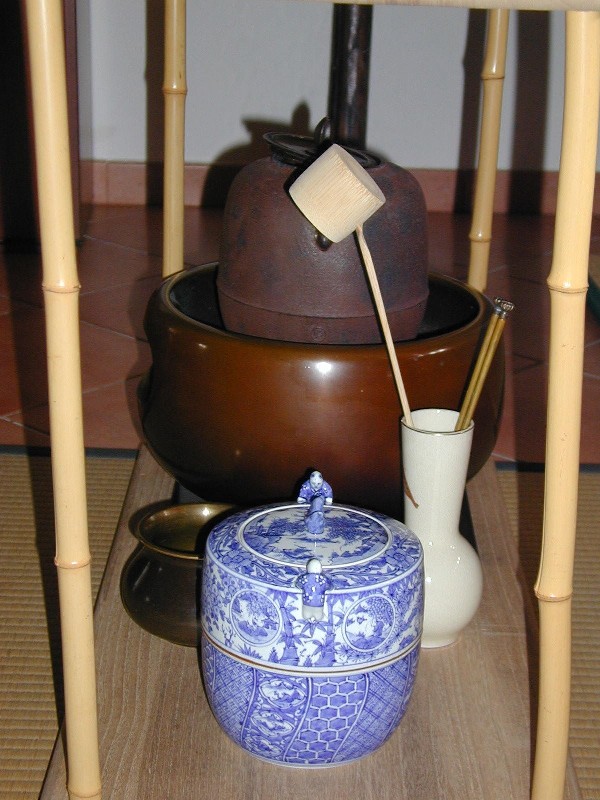
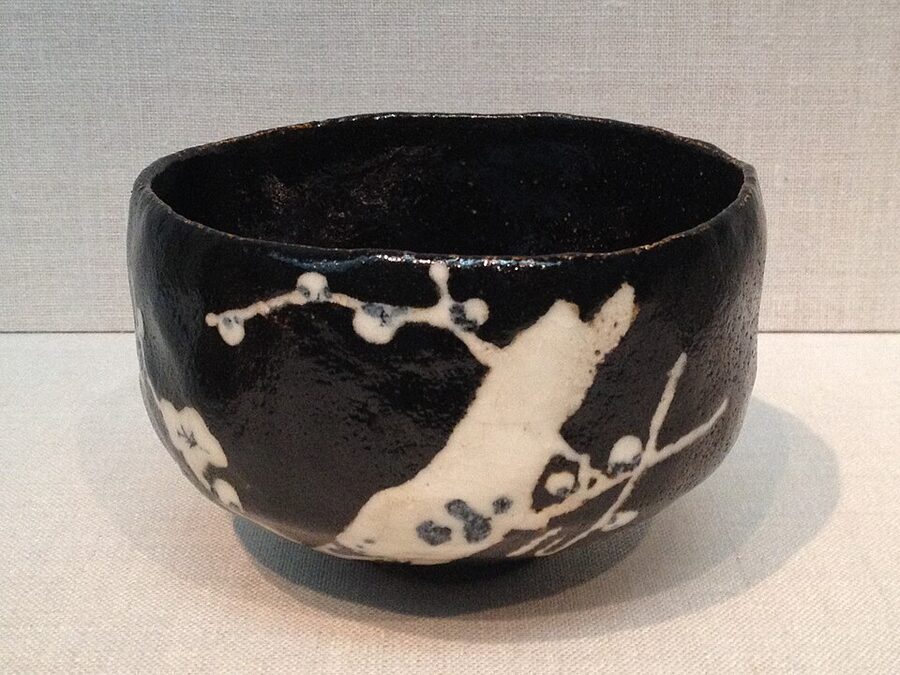
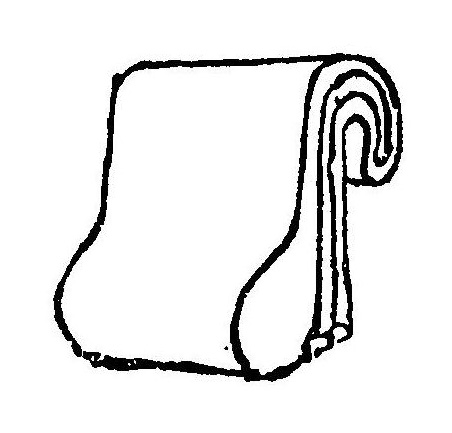
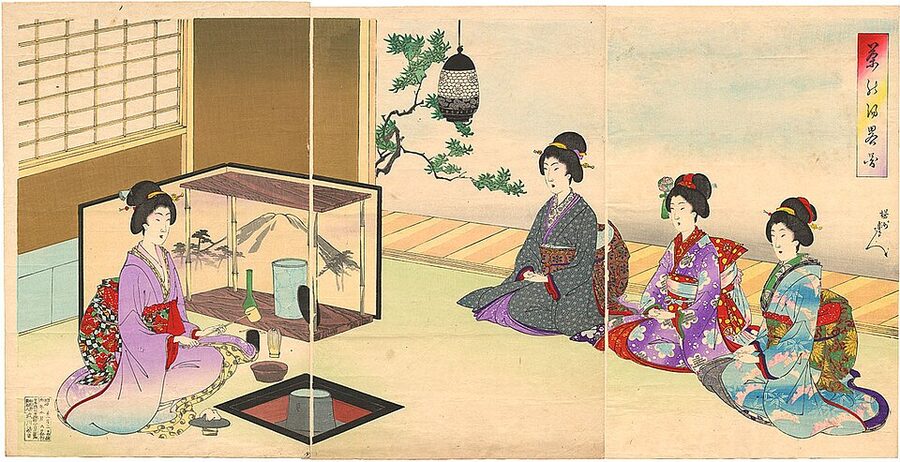
There is, finally, the host and the guests, and the kakemono scroll hung in the alcove, and the flowers in a bamboo or ceramic vase below it, and the sweet (wagashi) served with the tea, and the protocol of entry, bowing, receiving, drinking, wiping, returning. The full choreography of a chaji takes three and a half to four hours for four guests. Each minute of that has been prescribed by Rikyū’s successors and taught in an unbroken line since the 1590s. On the surface, it looks like a performance. From the inside, after a few years’ practice, it is closer to meditation — a very slow sequence of attention, where the utensils are the meditation’s objects.
Where to visit the tea tradition today
You cannot stroll into the working tea rooms of the three Senke schools unannounced; the houses are private property, and even the Urasenke Center’s public demonstrations require advance booking. But the tea tradition is materially present across Kyoto and Sakai, and if you plan carefully you can see most of the load-bearing sites in a two-day trip. What follows is the list in the order I would walk it.
Daitoku-ji temple complex, Kyoto Kita-ku
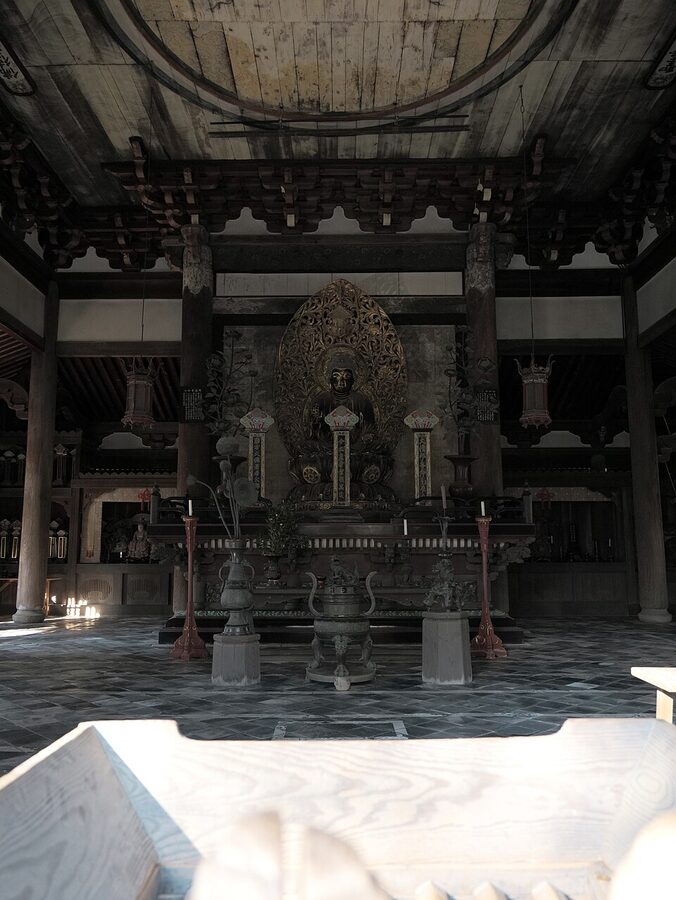
The single most important address in the whole story. Daitoku-ji is the Rinzai Zen temple where Rikyū did his Zen training, where the Kinmōkaku gate still stands, where the donor statue was installed and (when the statue was finally recovered) re-housed at the nearby Konnichi-an, and where Rikyū is buried in the subtemple Jukō-in. The main temple grounds are free to walk; the Butsuden and the main gate are always viewable. The subtemples — Jukō-in, Shinju-an, Daisen-in, Kōtō-in — are the ones that matter most for the tea story, and all of them require specific entry. Kōtō-in, founded by Hosokawa Tadaoki, Rikyū’s student, contains a shoin reception room that may be a fragment of Rikyū’s own Jurakudai residence, relocated after the master’s death. Jukō-in holds Rikyū’s grave; access depends on the temple’s current public-opening schedule, which rotates. The Daitoku-ji main grounds are on a ten-minute walk from Kitaōji Station on the Karasuma subway line.
Tai-an at Myōki-an, Ōyamazaki, southern Kyoto prefecture
The only tea house Rikyū definitely designed himself, National Treasure status since 1951, and, for my money, the most important two-mat interior in Japan. Located in Ōyamazaki on the old Sanyōdō road between Kyoto and Osaka, the temple is a five-minute walk from Ōyamazaki Station on the JR Kyoto line. Access to the tea room itself is by advance written application only; the temple accepts a limited number of viewing slots per year and gives priority to serious tea students. You can, with a simple day-visit, see the temple grounds, the exterior of the Tai-an (including the nijiriguchi crawl-in doorway), the reconstructed garden, and the adjacent Aji-sai-zuka memorial. Seeing the two-mat interior itself takes months of planning. If you are serious about tea, do the paperwork.
Urasenke Konnichian, Kyoto Imadegawa
The Urasenke school’s Kyoto headquarters on a small lane off Horikawa-Imadegawa, about a ten-minute walk from Imadegawa subway station. The Konnichi-an tea house itself, Sōtan’s original, is private. The Urasenke Center next door runs scheduled public tea-ceremony demonstrations in English and Japanese; booking goes through the Urasenke international office and spaces fill up two or three months in advance. If you have the time, this is the single most reliable way for an overseas visitor to sit through a full, well-trained demonstration tea. The Omotesenke Fushin-an gate is sixty metres down the same lane. The Mushakōji Senke Kankyū-an is two blocks further on. Walking past all three gates in a morning is free; getting inside any of them is not.
Sakai Plaza of Rikyū and Akiko Yosano (Sakai Rishō no Mori)
Sakai’s modern interpretive centre, a ten-minute walk from Sakai Station on the Nankai line. It pairs Rikyū (born Sakai 1522) with Yosano Akiko (the Meiji-era poet born Sakai 1878) and runs bilingual exhibits on both. The Rikyū wing is particularly good on the early Sakai-tea-circle context; it has a partial reconstruction of the Tai-an, a decent collection of period utensils on loan from the Fushin-an archive, and a ground-floor café that does a properly trained formal tea for about 1,500 yen. The staff are Urasenke-trained and will explain the basic protocols if you ask — this is the single best place for a first-time tea visitor to get started.
The Rikyū Yashiki memorial, Shukuin, Sakai
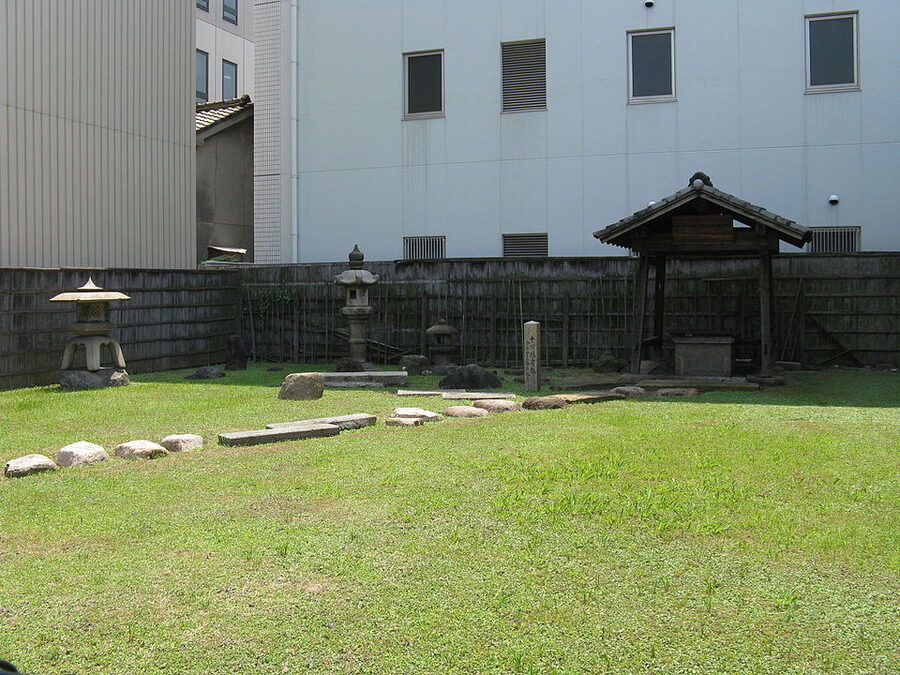
A quiet, rarely-visited stone in a small garden on Nakahama-suji in Sakai’s Shukuin district, the site of the Totoya family compound where Rikyū was born. It is marked by a small Sakai-city monument and a surviving well — the Tsubaki-no-I, “camellia well” — which Rikyū used as water source for his tea-making practice. The surrounding lanes hold a concentrated cluster of traditional Sakai confectioneries: kurumi-mochi, keshi-mochi, nikkei-mochi, some of them reportedly named by Hideyoshi himself. It is not a major tourist site; you are likely to be the only foreign visitor for the morning. Ten minutes from Sakai Station on foot.
Kitano Tenmangū shrine, Kyoto Kamigyō
Kitano Tenmangū is the host shrine of the 1587 Ōchanoyu festival. The shrine is active year-round as one of Kyoto’s major Tenjin (Sugawara no Michizane) cult centres, and its grounds are always open and free. The plum and camphor trees that were there when the 1587 festival took place are mostly gone, but the shrine’s central axis — the approach path, the romon gate, the main hall — is unchanged. An interpretive monument on the grounds notes the Ōchanoyu site. The 25th of each month is the Tenjin flea-market day, which draws thousands of visitors; if you want the site quiet, go on any other day. Ten-minute walk from Kitano-Hakubaichō tram stop, or twenty minutes from Imadegawa subway.
The uncertain legacy
The most uncomfortable question about Rikyū is the one nobody likes to answer directly. Did he know, when he designed the Tai-an with its low crawl-entrance and its mud walls and its single flower in a bamboo tube, that what he was building was an aesthetic machine specifically engineered to relativise a dictator’s power? Did he know, when he signed off on the Kinmōkaku statue that would stand directly above the Jurakudai regent’s path to the temple, exactly what Hideyoshi would see when he looked up? Was the structural offence deliberate, or was it inadvertent? The answer we cannot have is the answer that matters most.
My own guess — and this is speculation, not a defensible historical claim — is that Rikyū knew exactly what he was doing, and that his jisei death poem’s serenity reflects not resignation but a final, quiet, three-line acknowledgement that the game had gone the way it was always going to go. He had taken the idea of wabi as far as it could be pushed inside a system ruled by a man who believed in gold tea rooms. One of the two had to give, and the only one of the two who had calibrated his daily practice for forty years toward this exact kind of giving was Rikyū. On the morning of 28 February 1591, he sat down in his tea room, whisked one final bowl — the utensil was one Hosokawa Tadaoki had given him, and he returned it to his student as a bequest — and put the short sword in with the composure of a man who had rehearsed the sequence. Hideyoshi outlived him by seven years. The tea tradition Rikyū had finalised has outlived both of them by four centuries.
If you go to Kyoto looking for Rikyū, start at Daitoku-ji and walk slowly. The gate where the statue stood is still there. The grave in Jukō-in is still there. The Kōtō-in reception room his student Hosokawa Tadaoki — who had tried to ride in and rescue him, and was stopped by the Uesugi cordon — built afterwards from the salvaged timbers of Rikyū’s Jurakudai house is still there, with its two-mat tea room preserved in the same austere mud-walled register.
The utensils the Senke family still teaches with — the raku bowls, the bamboo scoops, the cast-iron kettles, the folded linen cloths, the tatami mats on a scale he prescribed — all of it has descended from a two-mat room Rikyū built in 1583 and from a decade of collaboration with a man who eventually ordered him to die. What he left behind is the discipline the collaboration produced. Its practitioners serve the next person’s tea as though neither the gold nor the mud matters except insofar as it becomes the cup. Go, sit down, kneel, receive the bowl. This is what he built.


.jpg)

_Butsuden_hdsr_S5_01.jpg)


