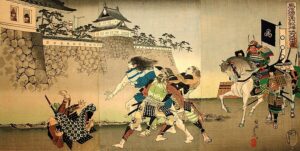
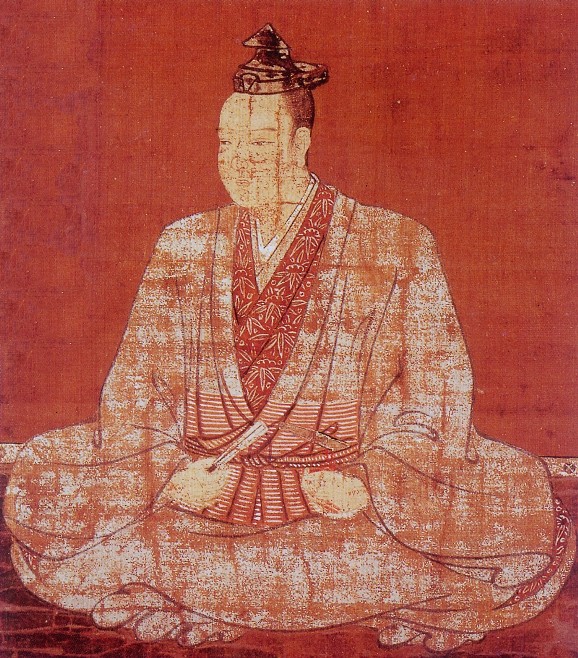
Akechi Mitsuhide held sovereign power over Japan for eleven days. Some chroniclers generously say thirteen. Either way, it is the shortest reign in Japanese political history, and it ended in a bamboo grove at Ogurusu on the 13th night of the sixth lunar month of 1582, when a peasant called Nakamura Chōbei drove a rusted spear through the hipbone of the most powerful man in the country and sent him, already dying, back into the folklore that has never really let him go.
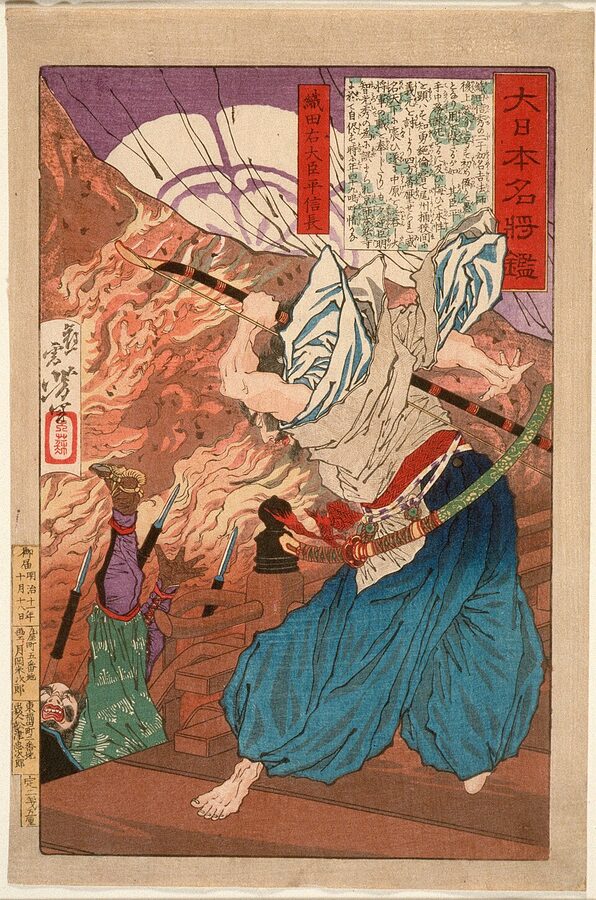
Every Japanese schoolchild learns the phrase san-nichi-tenka, “three-day kingdom”, a rhetorical short-hand for Mitsuhide’s regency. The number is wrong by an order of magnitude, but the poetry is right. Between the dawn of 2 June 1582, when his army of thirteen thousand surrounded the Honnō-ji temple in central Kyoto and burnt his lord Oda Nobunaga out of this world, and the late afternoon of 13 June 1582, when Toyotomi Hideyoshi’s forty thousand scattered Mitsuhide’s remnants at the Yamazaki pass, there are precisely eleven full days. Mitsuhide used them to collect the Imperial court’s tacit acknowledgement as the new master of the realm, to distribute Nobunaga’s gold to his retainers, to send letters to every major daimyō in Japan asking for their support — and to watch, with growing dread, as almost none of them replied. The man who had just killed the most powerful warlord in Japanese history had planned the assassination with extraordinary thoroughness and the aftermath with none at all. By the time Hideyoshi’s army appeared at Yamazaki, Mitsuhide’s son-in-law Hosokawa Tadaoki had shaved his topknot in mourning for Nobunaga and refused to move, his wife’s-brother Tsutsui Junkei had gone over to Hideyoshi, and most of the Kyoto kuge were hedging. Mitsuhide lost at Yamazaki before Yamazaki began.
In This Article
- Origins that refuse to resolve
- Echizen, Ashikaga Yoshiaki, and the ashigaru register
- Sakamoto, Hiei-zan, and the proof of loyalty
- The Tanba campaign — four years for one province
- 1582 — the year everything became possible
- The motive — which one do you prefer?
- Yamazaki — eleven days later
- Gracia — the daughter who kept the name
- The Tenkai theory and other afterlives
- Where to visit Mitsuhide today
- Honnō-ji — the rebuilt temple, the marked-out original
- Sakamoto Castle site — the submerged fortress
- Kameyama Castle site in Tanba — the march-out point
- Ogurusu bamboo-grove monument — where it ended
- Saikyō-ji, Sakamoto — the head-grave
- The thirteen days
Origins that refuse to resolve
Nobody knows where Mitsuhide was born, and nobody knows when. The conventional birth year is 1528, drawn from an Edo-period hagiography, but contemporary records place his age variously at forty-three, fifty, and “over fifty” at the time of his death — sources variously give 1516, 1526, 1528, 1532 and 1534. The Meichi Keizu, the Akechi family genealogy kept in the Zoku-gunsho-ruiju, claims descent from the Tokisō line of the Mino Toki clan, a legitimate minor-gentry pedigree. Modern Japanese historians are sceptical. The Zoku-gunsho-ruiju is itself an Edo compilation, the Tokisō link is not attested in any sixteenth-century document, and, more damning, when Ashikaga Yoshiaki later registered Mitsuhide at his Echizen court, he put him in the ashigaru-shū rather than the hōkō-shū. The ashigaru-shū was for foot-soldiers. The hōkō-shū was for pedigreed samurai. Whatever Mitsuhide was, the Ashikaga shogunate’s own record-keepers did not think he was a Toki branch aristocrat.
The traditional story has him born at Akechi Castle in Mino, the son of Akechi Mitsutsuna, nephew of Saitō Dōsan‘s wife. This is probably romance. The historian Kobayashi Masanobu, who has spent decades on the Mitsuhide problem, concludes plainly that no contemporary source names any man as Mitsuhide’s father, and that every genealogy claiming otherwise is later fabrication. Tanigichi Kengo has pointed out that the Toki clan genealogies were already a confused mess by the Nanbokuchō period two centuries earlier, and that the Edo-period Akechi-in-Toki connection is effectively unprovable. What you can say — and what Tachiri Takasuke, a contemporary of Mitsuhide’s, does say in a 1579 document — is that the Kyoto aristocrats around him believed he was “Toki-related” (Toki-no-zuibun-shū). That was the story in the air. Whether the story was true, or whether Mitsuhide had adopted it to paper over an obscure origin, the contemporary record does not resolve.
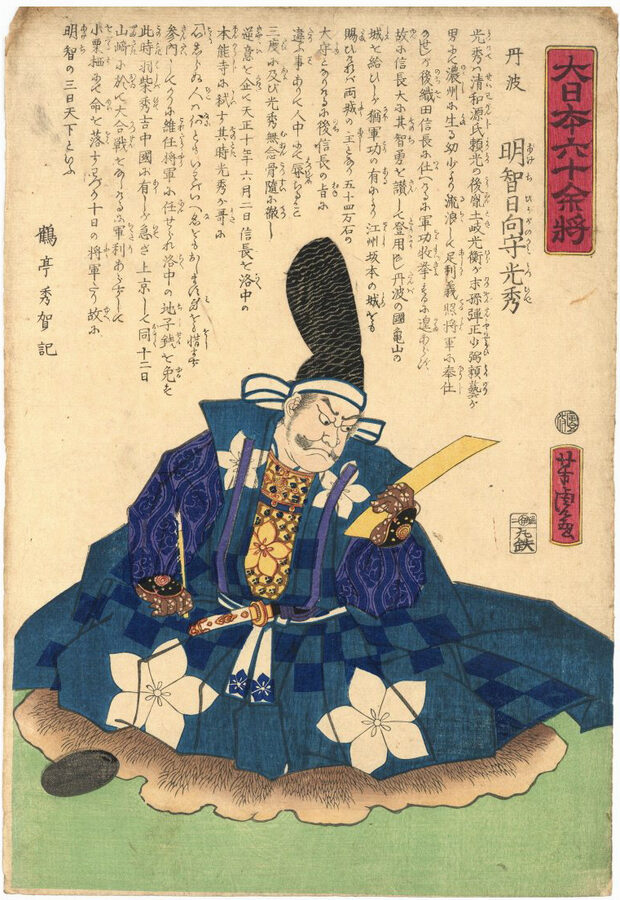
What is certain is that Mitsuhide passed through the Saitō household in Mino at some point in his youth. The Akechi Castle in Ena district is traditionally identified as his birthplace, the small fortress Dōsan’s faction held in the period before Dōsan went to war with his own son. After the 1556 Battle of Nagara River, in which Dōsan was killed by his son Yoshitatsu, the Akechi holdings were overrun. The family scattered. Mitsuhide — whether a son of the castle lord, a nephew, a retainer, or a hanger-on — lost whatever patrimony he had. This is the period when he enters the record as a rōnin. The historian Takayanagi Kōju has Mitsuhide drifting for roughly a decade between 1556 and 1566, travelling through Wakasa, reaching Echizen, picking up a modest living as a physician specialising in firearm-wound treatment, he is supposed to have studied Portuguese matchlock medicine at a port in Wakasa, and eventually settling outside the Shōnen-ji temple in Nagasaki village in Echizen, where he is said to have lived for “about ten years.” No contemporary document confirms the medical training or the decade-long stay, but the Nagasaki tradition is old enough and specific enough to be taken seriously.
Echizen, Ashikaga Yoshiaki, and the ashigaru register
Mitsuhide surfaces in verifiable history in 1566 or thereabouts, as a low-level retainer of the Asakura clan at their Ichijōdani headquarters. Asakura Yoshikage was the last great northern-Honshu daimyō outside the Oda–Takeda–Uesugi triangle, and his court at Ichijōdani was where the refugee Ashikaga Yoshiaki, the younger brother of the murdered shogun Ashikaga Yoshiteru, had come after fleeing the Miyoshi-Matsunaga coup that killed his brother in 1565. Yoshiaki wanted help getting to Kyoto and installing himself as shogun. Yoshikage was reluctant to commit. Mitsuhide, somewhere in this stalled court, formed a connection with Hosokawa Fujitaka — the distinguished Kyoto courtier who had attached himself to Yoshiaki’s cause, and who would be the conduit to everything that followed.
The Luis Frois Historia de Japam, which is often hostile to Mitsuhide but specific, says that Mitsuhide began his career “as an ashigaru and chūgen in the service of Hosokawa Fujitaka.” The diarist-monk Eishun records the same thing in the Tamon-in Nikki entry for 17 June 1582, immediately after the Honnō-ji coup, as if it were common knowledge in the capital: “Akechi was originally Hosokawa Fujitaka’s servant.” Chūgen is the lowest grade of samurai household worker, one step above a porter. The later genealogies swept this over; the contemporary record keeps insisting on it. The best modern synthesis has Mitsuhide entering Fujitaka’s household somewhere around 1565–1566, moving with Fujitaka into Yoshiaki’s service, and earning his way up on competence — which is the career shape the Eiroku-rokunen-shoyakunin-tsuki, the shogunate personnel register of 1566–1568, seems to confirm when it lists him at the bottom of the ashigaru-shū with just the surname “Akechi” and no given name. A single-surname listing was a way of saying that this man was too obscure for the court to bother recording in full.
Yoshiaki eventually concluded, as Mitsuhide advised him, that the Asakura would never march on Kyoto and that Oda Nobunaga — who had just annexed Mino and captured Gifu in 1567 — was the more useful ally. In the summer of 1568, Mitsuhide crossed from the Asakura court to the Oda camp as the go-between, reportedly (though the Hosokawa-ke ki is suspect on this point) as Yoshiaki’s designated envoy. Nobunaga agreed to move on the capital. In October 1568 the combined Oda-Yoshiaki army entered Kyoto. Yoshiaki was installed as shogun. Mitsuhide was given a small fief in southern Yamashiro and entered the Oda administrative system at Nijō Castle in Kyoto, in effect serving both masters — Nobunaga as a new retainer, Yoshiaki as his old one. The double allegiance lasted until 1573, when Yoshiaki’s quarrel with Nobunaga came to open war, Yoshiaki was defeated and exiled, and Mitsuhide quietly and decisively picked Nobunaga. His old master was sent into exile. He was given Sakamoto Castle.
Sakamoto, Hiei-zan, and the proof of loyalty
The grant of Sakamoto in 1571 was the making of Mitsuhide. The castle sat on the western shore of Lake Biwa at the foot of Mount Hiei, commanding the lake crossing and, more importantly, the road from Kyoto to Sakamoto that the Enryaku-ji temple warriors had been using to threaten Nobunaga’s rear for a decade. Sakamoto was the reward for a specific horror. On 12 September 1571, Nobunaga ordered the annihilation of Enryaku-ji on Mount Hiei — the thousand-year-old headquarters of the Tendai sect, the centre of Japanese Buddhism since 788 — because its warrior-monks had been harbouring his Azai and Asakura enemies. The assault killed somewhere between three and twenty thousand people, depending on the chronicler. Every building on the mountain was burned. Everyone on the mountain — monks, attendants, women, children, refugees from the villages — was put to the sword.
Historians used to tell the story that Mitsuhide, a known friend of Buddhism, had privately begged Nobunaga to spare the mountain — the Tendai-zasu-ki chronicle includes a line that “Mitsuhide repeatedly remonstrated.” Since the 1990s, this version has been effectively demolished by the rediscovery of a 2 September 1571 letter from Mitsuhide to Wada Hidezumi, a local landlord at Ōgi in southern Ōmi. The letter orders the full massacre of the village of Ōgi, whose inhabitants were refusing to cooperate with the impending assault on Hiei. The line reads: Ōgi no koto wa, zehi tomo nadegiri ni tsukamatsuru-beku sōrō — “as for Ōgi, we will most certainly put them to the sword wholesale.” This is written by Mitsuhide in his own hand, ten days before the Hiei-zan assault. He was not a reluctant participant. He was one of the primary enforcers, and his reward was the castle at the foot of the mountain he had just helped to burn.
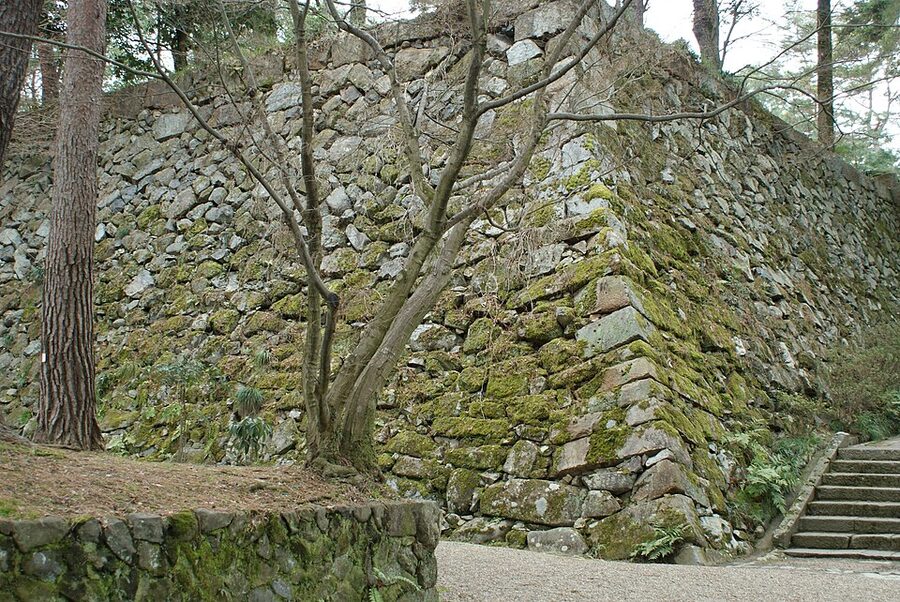
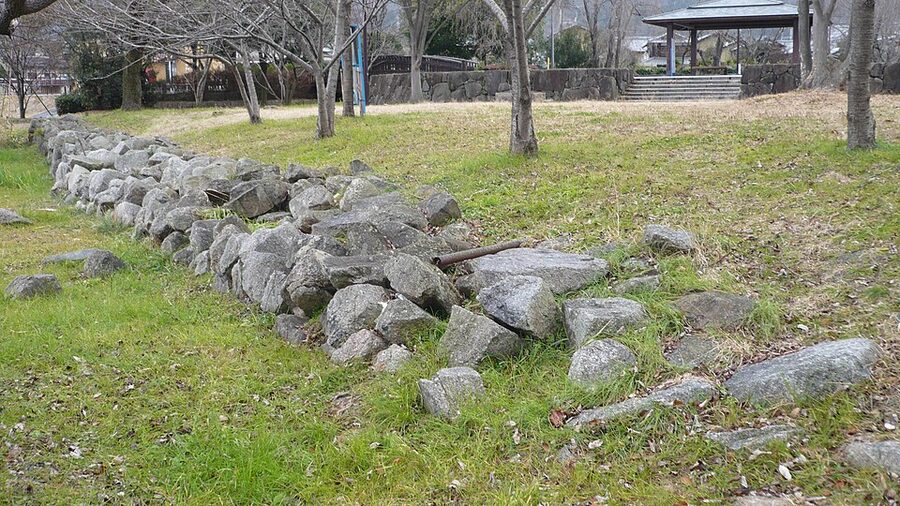
Sakamoto Castle itself was one of the most advanced fortifications in the archipelago at the time of its construction. Mitsuhide built it starting in 1571 on an artificial promontory jutting into Lake Biwa, with a five-storey central keep, one of the first in Japan outside Nobunaga’s Azuchi, and outer walls that dropped directly into the water so that the lake served as the eastern moat. The castle was a working port as well as a fortress; Mitsuhide used it for lake traffic between the Kyoto end of his Ōmi holdings and the northern shore. Nothing above ground survives. The current Sakamoto stretches along the lakeshore, and at low water you can still see the tops of the original stone pilings from his castle wall poking out of the lake. The Meiji-era land reclamation and the modern lakefront road have covered most of the compound, but the site is well-known locally, signed, and walkable in a morning.
Between 1571 and 1579 Mitsuhide went from being the Hiei-zan specialist to one of Nobunaga’s four or five primary generals. He fought at the Battle of Anegawa (1570) in the Oda rearguard, held the retreat at Kanegasaki (1570) when Azai Nagamasa’s defection caught Nobunaga between two armies, participated in the sieges of the Nagashima Ikkō-ikki strongholds (1574), and, by 1575, had been given his own territorial command in the province of Tanba, a mountainous and notoriously ungovernable region on the Kyoto side of the Chūgoku mountain range. The pacification of Tanba took him four years, from 1575 to 1579, and is the most admired single military feat of his career.
The Tanba campaign — four years for one province
Tanba in the 1570s had forty or so independent kokujin families dug into valleys and ridge-top strongholds that had repelled every outside army for three centuries. The largest was the Hatano clan at Yakami Castle, whose head Hatano Hideharu had nominally been in Nobunaga’s column from 1568 and nominally an ally of Mitsuhide from the start of the campaign in 1575. In January 1576, during Mitsuhide’s first serious attempt on the western Tanba stronghold of Kuroi Castle, Hatano Hideharu switched sides and attacked the Akechi rear. Mitsuhide’s army broke, Akai Naomasa’s Kuroi defenders swept down off the mountain, and the whole Tanba expedition collapsed. The Oda side described it in letters as komaru-beki hōdō — an incident to be ashamed of. Mitsuhide fell ill with what the contemporary sources call “extreme exhaustion”, probably a minor stroke, and withdrew to Sakamoto for most of the following year.
The second assault on Tanba, begun in 1577, was a different kind of campaign. Mitsuhide had spent the lost year planning. He built a new forward base at Kameyama Castle in the western hills above the Kyoto basin, at the eastern entrance to Tanba. He recruited the local Oguro and Kawakatsu families who had grudges against the Hatano. And he shifted his tactics from open-field confrontation to siege-and-starvation, in a manner that closely parallels Hideyoshi’s contemporary campaigns in Chūgoku. Yakami Castle was surrounded in October 1578. The encirclement held for eight months. In June 1579 the defenders surrendered on terms — reportedly because Mitsuhide sent in his own mother as a hostage to guarantee the safety of the Hatano brothers if they came out peacefully. Hatano Hideharu and his brother Hidenao came out. Nobunaga had them executed. Mitsuhide’s mother, according to the old tradition, was killed in the retaliation.
The mother story is one of the anchor points of the Mitsuhide-revenge theory of the Honnō-ji Incident — the idea that three years later, Mitsuhide was still avenging a personal betrayal. Modern historians are cautious. No contemporary source names Mitsuhide’s mother or records her death in Tanba; the story first appears in the Meishō Gensei of 1624, forty years after the events, written inside the Tokugawa-era ideology that needed a reason for Mitsuhide’s treachery that was not about the Tokugawa. The story may be entirely posthumous fabrication. It may also be true and simply unrecorded. Either way, the fall of Yakami in June 1579 was followed two months later by the fall of Kuroi, and by October 1579 Tanba was under Akechi rule. Mitsuhide was now lord of Tanba, governor of Sakamoto, and the senior Oda general in the Kyoto-to-Tanba corridor — about 340,000 koku of income in his own right, and the designated commander of the kinki-hōmen-gun, the Oda regional army covering the home provinces and the western approaches to Kyoto.
1582 — the year everything became possible
At the start of 1582, Akechi Mitsuhide was arguably the second-ranking general in the Oda military system. He commanded a larger allocated army than anyone except Hideyoshi. He was given the ceremonial role of welcoming Tokugawa Ieyasu to Azuchi Castle in May 1582 — a compliment from Nobunaga, who was using the Ieyasu reception to celebrate the destruction of the Takeda clan two months earlier. The Ieyasu reception lasted for several days and was by all accounts elaborate and well-executed. The Frois Historia, which was not present but was collecting stories afterwards, includes the famous anecdote that Nobunaga came in through the kitchen, smelled something rotten, and kicked Mitsuhide in the head in front of the assembled retainers for serving spoiled fish to the honoured guest. The anecdote is everywhere in the later literature. It is probably not true — no contemporary diary records it, the Frois version has obvious story-shape improvements — but it was believed widely enough that it became part of the why-did-Mitsuhide-do-it ecosystem.
On 17 May 1582, Nobunaga reassigned Mitsuhide from the Ieyasu reception to the Hideyoshi reinforcement: Hideyoshi had been besieging Takamatsu Castle in Bitchū for six weeks and needed the Akechi army to help finish the Mōri. Mitsuhide returned to Sakamoto, then moved west to his Tanba base at Kameyama Castle, and began preparing his 13,000-man army for the march to Chūgoku. On the same date, Nobunaga announced that he would himself travel to Kyoto in early June to coordinate the final Mōri campaign, and that he would lodge at Honnō-ji — a mid-sized Nichiren-sect temple in central Kyoto where he usually stayed on visits to the capital because its grounds were defensible without being fortified. On 29 May, Nobunaga arrived at Honnō-ji with a guard of approximately one hundred. His son and heir Nobutada arrived separately on 31 May and lodged at Myōkaku-ji, a few blocks east. Between the two of them they had perhaps three hundred men in the capital. The full Oda army was dispersed between Hideyoshi in Bitchū, Niwa Nagahide at Settsu embarking for Shikoku, and Shibata Katsuie’s Hokuriku front — none of them within three days’ march of Kyoto.
On 1 June 1582, at around 6 p.m., Mitsuhide ordered his Kameyama garrison to prepare for the march to Chūgoku. The column left the castle at roughly 8 p.m. — thirteen thousand men including the core Akechi bannermen, the Saitō Toshimitsu cavalry, and the Mizoe Shigetoku wing. At the Ōinoyama pass, about five kilometres east of Kameyama, the column would normally have turned south toward the San’yō road and Chūgoku. Instead, Mitsuhide turned the army east, toward the Oi River and, on the far bank, the Kyoto basin. The Honjō Sōuemon Oboegaki, the memoir of a foot soldier in the Akechi column who survived Yamazaki, records that the soldiers did not know what was happening until they were already in the Saga district of western Kyoto and the order went out to the officer corps: teki wa Honnō-ji ni ari — the enemy is at Honnō-ji. Honjō himself thought until dawn that he was attacking Tokugawa Ieyasu on Nobunaga’s orders.
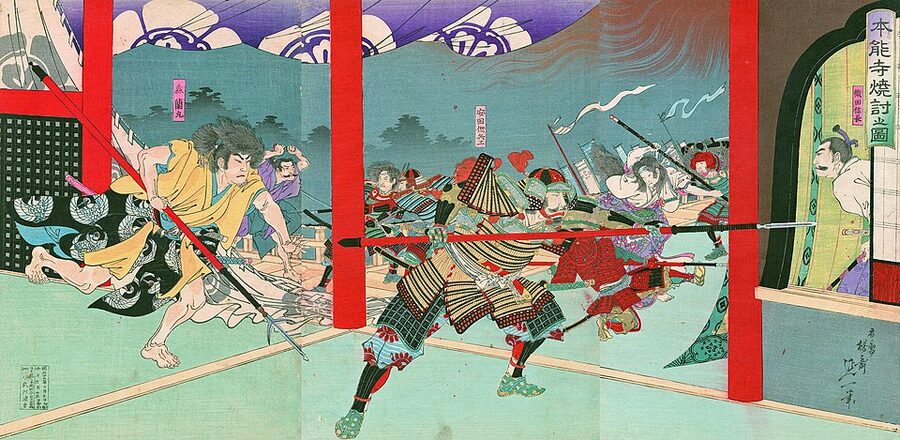
The motive — which one do you prefer?
There are, approximately, twenty competing theories for why Mitsuhide killed Nobunaga. None of them are definitively supported by primary documents. Mitsuhide himself left no statement of motive that survives — the letters he sent after the coup to potential allies explain what he wanted them to do next but not why he had done it. He was dead within eleven days and the Akechi clan was extirpated within a month, so there was no one left alive at the centre of the conspiracy to be interviewed. The motive question is a void into which every period of Japanese history has projected its own anxieties about power and loyalty, and the result is a menu of possibilities worth working through.
The personal resentment theory is the oldest. Versions include Nobunaga kicking Mitsuhide during the Ieyasu reception, Nobunaga publicly insulting Mitsuhide’s mother after the Yakami surrender, Nobunaga demoting Mitsuhide from his Tanba lands to a not-yet-conquered domain in Izumo and Iwami as punishment, Nobunaga insulting Mitsuhide’s head-wife Osakabe-no-kata, and, most lurid, Nobunaga groping Mitsuhide’s daughter Tama (the future Gracia) at a court banquet. All are recorded, all are Edo-period, all are sourced from the Sōken-kiki, the Taikō-ki, or later kabuki. None are contemporary. What is contemporary is that Mitsuhide and Nobunaga had worked together without rupture for fourteen years, and Mitsuhide in January 1582 issued a clan law code that opens with the line “Nobunaga-sama rescued us from ruin and gave us immense lands; let no retainer forget this.” You don’t write that if you are planning to kill him.
The structural conflict theory, favoured by modern historians, focuses on Nobunaga’s growing ambitions and the shape of the Oda succession. In 1582 Nobunaga was starting to talk about, in oblique ways that the chroniclers picked up on, replacing the emperor. He had already forced the abdication of Emperor Ōgimachi’s intended successor and was said to be considering relocating his court from Kyoto to a rebuilt Ōsaka or Azuchi. If true, this would have ended the Kyoto court system that Mitsuhide had spent fifteen years inside and built his political identity around. Mitsuhide, in this reading, was acting on behalf of the kuge aristocracy — the Konoe, the Kujō, the Ichijō — who had more to lose from a Nobunaga imperial coup than anyone else in Japan. There is a letter from Konoe Sakihisa to Mitsuhide, dated 4 June 1582, two days after the killing, that reads as if Konoe had been expecting it. This is the theory Tatsuo Akamatsu argues in his 2014 reassessment, and it has gained ground since.
The Ashikaga conspiracy theory has Mitsuhide acting on behalf of the exiled shogun Yoshiaki, who by 1582 was living in Mōri territory in Bingo and still claimed the shogunal title. Yoshiaki had sent letters to every major daimyō in Japan over the 1570s asking for help returning to Kyoto. Mitsuhide had been one of Yoshiaki’s men originally, and the Mōri were the faction Hideyoshi was currently fighting. If Mitsuhide had coordinated with Yoshiaki and the Mōri, killing Nobunaga while Hideyoshi was pinned at Takamatsu would have opened the way for a joint march on Kyoto to restore Yoshiaki. The theory has the advantage of explaining why Mitsuhide sent those letters to the Mōri on 3 June. The problem is that the Mōri never replied — Hideyoshi intercepted the letters, the Mōri never knew about the opportunity, and Mitsuhide’s plan fell apart before the Mōri had a chance to act. If it was a Mōri-Yoshiaki plot, the conspirators at the Mōri end either knew nothing or did nothing.
The Tokugawa-conspiracy theory has Ieyasu either complicit in the assassination or at least forewarned of it. Ieyasu was a guest at Osaka on 2 June, heard about the killing within hours, and made an extraordinary forced march through the Iga hills back to his Mikawa territory — the famous Iga-goe, which he afterwards called the most dangerous passage of his life. The Tokugawa-complicity version has Ieyasu deliberately leaving Kyoto the day before and pre-positioning his retainers for a fast retreat because he knew what was coming. The theory is old — it surfaces in the Kawasumi-taikōki of 1626 — but the complicity interpretation of the Iga-goe is Edo-period Tokugawa-hagiography in reverse. No Mitsuhide-to-Ieyasu letters survive. If they existed, Ieyasu or his descendants had three centuries of control over the archives in which to burn them.
The most interesting recent theory, and the one I find hardest to dismiss, is the Chōsokabe plot reading, which ties the coup to Mitsuhide’s failing diplomatic patron-role with the Chōsokabe clan of Tosa. Mitsuhide had been the Oda’s main liaison with Chōsokabe Motochika in Shikoku for most of the 1570s, negotiating what had been understood as a vassalage compact — Motochika would keep Shikoku, Nobunaga would keep the home provinces, and neither would interfere with the other. In 1581 Nobunaga abruptly reversed the policy, demanded Motochika hand over half of Shikoku to Oda Nobutaka, and in May 1582, two weeks before Mitsuhide moved, began preparing an invasion force at Osaka under Niwa Nagahide to destroy Chōsokabe. The policy reversal humiliated Mitsuhide’s decade of diplomatic work and, crucially, Mitsuhide’s daughter’s-husband Saitō Toshimitsu was married into the Chōsokabe household. The Hayashibara Museum in Okayama in 2014 made public a set of 1582 letters from Mitsuhide’s household to Motochika’s, expressing outrage at the policy shift. The first letter is dated 21 January 1582. The killing is 2 June. The interval is the preparation time.
My honest view is that several of these motives are simultaneously true. The structural conflict with Nobunaga’s court-overthrow ambitions is the background condition. The Chōsokabe policy reversal is the triggering event. The Konoe and Ashikaga Yoshiaki circles were potential political cover that Mitsuhide hoped, wrongly, would come in behind him once the act was done. And the personal resentments, if any of them are real, explain why Mitsuhide thought he would be believed when he presented himself afterwards as the seibatsu, the rightful punisher of a tyrant, rather than as a mere regicide. What is certain is that nobody came in behind him. The political calculation was catastrophically wrong. The Konoe wrote polite letters and took no action. Yoshiaki and the Mōri never moved. Mitsuhide’s nominal son-in-law Tadaoki publicly went into mourning for Nobunaga and imprisoned the daughter who connected them. Tsutsui Junkei, whose column was supposed to reinforce at Yamazaki, sat on his hill above Hōrakuji and watched — Hōrakuji-ki in Japanese is now an idiom meaning to fence-sit at a decisive moment. The broader Oda loyalist network, which Mitsuhide had assumed would split along his lines, united behind Hideyoshi instead.
Yamazaki — eleven days later
Hideyoshi’s Chūgoku Great Return is covered in my Hideyoshi piece, and it is the decisive operational fact of the post-Honnō-ji week. Forty thousand men from the Bitchū siege to the Yamazaki pass in ten days — 230 kilometres over hill roads in rain, dragging artillery, feeding off requisitioned rice from villages along the route. Mitsuhide spent those same ten days in Kyoto and Azuchi, distributing Nobunaga’s gold and silver from the Azuchi treasury to retainers and court nobles (a silver tribute of 500 mai to the imperial court, 100 mai each to the Kyoto five-mountain Zen temples), taking possession of Nobunaga’s Omi holdings, and writing letters that did not produce replies. Hideyoshi used the same ten days to move. This is, simply, the difference.
On the evening of 12 June 1582, Hideyoshi’s column met Mitsuhide’s at the narrow pass between Mount Tennō and the Katsura River where the old San’yō road enters the Kyoto basin from the west — the Yamazaki pass, sitting astride what is now the border between Ōyamazaki town (Kyoto) and Shimamoto town (Osaka). Mitsuhide had about 17,000 men. Hideyoshi had 27,000 to 35,000, depending on the source. The numbers on the Akechi side had already been reduced because two of Mitsuhide’s expected reinforcements, the Tsutsui column from Yamato and the Hosokawa column from Tango, had failed to arrive. The terrain at Yamazaki is a bottleneck: two or three thousand men is the maximum either side could deploy at once, and the battle turned on the seniority of the wings. Hideyoshi’s right wing under Ikeda Tsuneoki and Nakagawa Kiyohide, reinforced by Takayama Ukon’s Takatsuki contingent who had originally been Mitsuhide’s ally, broke through the Akechi left. Saitō Toshimitsu’s 3,000-man central column was pinned and reduced within the first hour. By nightfall the Akechi army was routed. The Kawasumi-taikō-ki records that Mitsuhide fled east with only thirteen horsemen, heading for Sakamoto across the Yodo plain.
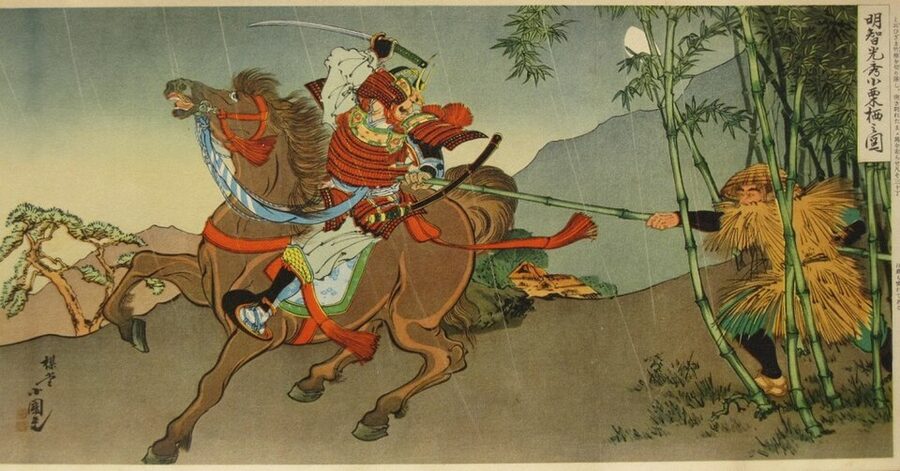
Mitsuhide never reached Sakamoto. The escape route from Yamazaki to Sakamoto ran through the district of Ogurusu in modern Yamashina-ku, the eastern edge of the Kyoto basin — an area of bamboo groves and flood-plain paddy, crossed by a single raised path that was the standard route for post-battle fugitives. It was, therefore, the standard route for the ochimusha-gari, the peasant fugitive-hunts, that post-battle Japan had been running for three hundred years. Defeated samurai passing through peasant territory were fair game for anyone willing to strip their armour, take their weapons, and bring their head in for the reward. On the night of 13 June, in the bamboo grove at the modern junction of Ogurusu Mukaihata-chō, a peasant called Nakamura Chōbei — the name is recorded in three separate contemporary sources, and a memorial stone marks the spot — thrust a rusted bamboo spear up from the bamboo thicket and caught Mitsuhide in the hip. According to the Ōta Gyūichi Kyūki, Mitsuhide turned in the saddle, realised he was finished, asked his retainer Mizoo Shigemoto to take his head, and requested that the head be delivered to Chion-in wrapped in a “shugo-class” felt saddle-cover. Mizoo complied. The head was hidden in a bamboo ditch. Chōbei found it the next morning.
The head, after identification, was put on display at Honnō-ji, the temple Mitsuhide had burned twelve days earlier, then at Awataguchi in eastern Kyoto alongside the head of his primary lieutenant Saitō Toshimitsu, who had been captured alive at Yamazaki and beheaded on 17 June. A joint head-mound was raised at the Awataguchi crossroads on 24 June. The mound still exists, though it is easy to miss if you do not know the street address. Meanwhile, at Sakamoto Castle, Mitsuhide’s senior retainer Akechi Hidemitsu, left in charge during the Yamazaki campaign, received news of the defeat, killed Mitsuhide’s wife and remaining children, set fire to the castle, and cut his own throat on the burning keep. The Akechi line was broken. Every Akechi relative except one was killed in the week that followed. The one survivor was Mitsuhide’s third daughter, Tama, married into the Hosokawa clan in 1578 and imprisoned by her husband Hosokawa Tadaoki on a mountain estate in Tango through the Yamazaki aftermath — the imprisonment, paradoxically, saved her life. She would convert to Christianity in the 1580s, take the baptismal name Gracia, and die in 1600 in a politically-compelled suicide in the prelude to Sekigahara. She is the only direct Mitsuhide bloodline that survives.
Gracia — the daughter who kept the name
The connection between Mitsuhide and Hosokawa Tadaoki runs through one marriage and two generations, and it is worth spending a paragraph on because it is how Mitsuhide’s name survived to the Meiji period. Tama was Mitsuhide’s third daughter, born in 1563 at Sakamoto. The marriage to Tadaoki, son of Mitsuhide’s old patron Hosokawa Fujitaka, was arranged by Nobunaga in 1578 as part of the general Akechi-Hosokawa alliance. Tama was fifteen; Tadaoki was sixteen. The marriage was unusually affectionate by sixteenth-century standards, and when the Honnō-ji Incident broke Tadaoki’s loyalties at their deepest point, between his father-in-law and the lord his father served, he resolved it by publicly going into mourning for Nobunaga and privately sending Tama into comfortable but strict internal exile at Mitono in Tango.
She stayed there two years. Hideyoshi, once secure in 1585, instructed Tadaoki to bring Tama back to Osaka — she was a useful hostage. Tama returned to the Hosokawa residence in Osaka, encountered Jesuit priests in her mid-twenties, secretly converted around 1587 under the name Gracia, and lived the remaining thirteen years of her life as a clandestine Catholic under constant domestic surveillance. When Ishida Mitsunari’s forces attempted to take her hostage at the opening of the Sekigahara campaign in 1600, she chose death — Catholic doctrine prohibited suicide, so Gracia ordered a retainer to kill her, and the retainer then set fire to the Hosokawa mansion to prevent her body being desecrated. She was thirty-seven. Her story is the reason the Akechi name carries on in Japanese Catholic and Hosokawa family records — a Mitsuhide descendant still alive and Christian at the moment Japan was deciding whether to let Christians live. The modern Hosokawa family, descendants of Tadaoki and Gracia through their son Hosokawa Tadatoshi, were the Meiji-era Marquesses of Kumamoto and produced, in the twentieth century, Morihiro Hosokawa, who served as prime minister of Japan in 1993-1994. That bloodline is half Mitsuhide.
The Tenkai theory and other afterlives
Mitsuhide is one of the two or three Japanese historical figures whom popular tradition has refused to accept as dead. The main counter-story — the Mitsuhide-wa-Tenkai theory, “Mitsuhide-was-Tenkai” — has him escaping from Ogurusu, taking Buddhist ordination, and reappearing in Edo around 1600 as the monk Tenkai, a Tendai-sect priest who became the senior religious advisor to Tokugawa Ieyasu, laid out the spiritual geography of the new city of Edo, and lived to the astounding recorded age of 108 (d. 1643). Tenkai was real; the Tenkai-equals-Mitsuhide identification is a conspiracy theory first floated in the Meiji period and revived in Japanese popular history every generation or so. The evidence advanced includes: Tenkai’s birth year is unknown; Tenkai was proficient in military matters; there is a lantern at Nikkō Tōshō-gū dedicated by Tenkai that has the Akechi family crest incised on the base; a map of Edo drawn by Tenkai includes a place-name “Akechi-daira”; the names of several gates of Edo Castle were changed by Tenkai into kanji spellings that include characters from Mitsuhide’s name. None of this rises to proof. The handwriting samples of Mitsuhide that survive and the handwriting samples of Tenkai are, to be plain, not the same hand. But the theory will not go away. It satisfies a deep Japanese wish that the most consequential man of his generation did not die at the hands of a farmer in a bamboo ditch.
The softer afterlife is the regional one. In Kameoka and Fukuchiyama, the two cities he founded and planned, Mitsuhide is honoured as meikun, the “good lord.” The Fukuchiyama Ondo folk song goes Fukuchiyama idete / Nagata no koete / koma wo hayamete / Kameyama e — “Out of Fukuchiyama, over the Nagata ridge, spurring the horse on to Kameyama” — and is still sung at the annual Fukuchiyama Mitsuhide festival. The historian Takayanagi Kōju, writing in the 1950s, argued that Mitsuhide was not a traditionalist but a rationalist, in Nobunaga’s own mould, and was valued by Nobunaga precisely because he shared the lord’s impatience with outdated forms. Contemporary Japanese scholarship has, in the last twenty years, shifted firmly in Takayanagi’s direction. The Mitsuhide of current academic work is not the tragic Buddhist-leaning courtier of Edo morality-plays but a capable modern-minded administrator who solved hard problems with calculated violence and — on one occasion, and for reasons still obscure — made one catastrophic political misjudgement.
Where to visit Mitsuhide today
Honnō-ji — the rebuilt temple, the marked-out original
The Honnō-ji Mitsuhide burned is gone. Within a year of the 1582 fire, Hideyoshi had ordered the Nichiren-sect temple rebuilt, but he moved it from its original site near modern Oike-dōri and Aburanokōji-dōri to a new block about 500 metres east, where the reconstructed Honnō-ji stands today at 522 Shimohonnōjimae-chō, Nakagyō-ku. The current Honnō-ji has a main hall, a small museum of 1582-era artifacts (including the sword Nobunaga was supposedly carrying the morning of the attack), and, the centrepiece for visiting Mitsuhide-heads, a neat tablet-grave of Oda Nobunaga in the side compound, inscribed simply “Ryōgen-in-dono Taisōken-den Shōgetsu-dōka Daikoji.” The irony of Hideyoshi installing Nobunaga’s grave at the rebuilt Honnō-ji, so the temple that watched Mitsuhide kill Nobunaga now keeps Nobunaga, is the kind of thing Hideyoshi enjoyed about his own post-1582 politics.
The original Honnō-ji site, the block where the 1582 attack actually happened, is marked by a small stone monument at the corner of Oike-dōri and Aburanokōji-dōri, two blocks west of the current temple. The monument is about waist-high, set into a pavement wall, and easy to miss. The inscription reads Honnō-ji no Hen Kyū-seki: “Former site of the Honnō-ji Incident.” You can walk from Hon’nō-ji-mae bus stop to the original site and on to the rebuilt temple in about 15 minutes. I have a weakness for this sort of ghost-historical walking. If you come to Kyoto with any interest in the sixteenth century, do this walk in the hour before lunch, and then go and eat at one of the o-men noodle houses on Oike-dōri. The attack happened before dawn. You can do a reasonable reconstruction of the Akechi approach route starting from the Nijō bus stop to the west and walking east down the early-morning avenue to where the original compound stood.
Sakamoto Castle site — the submerged fortress
On the western shore of Lake Biwa in the city of Ōtsu, about six kilometres north-east of Kyoto, sits the old district of Sakamoto — the Edo-period temple-town at the foot of Mount Hiei and the site of Mitsuhide’s primary fortress from 1571 to 1582. The castle occupied a promontory at what is now the Hommachi district, with the keep directly on the lakeshore. The Akechi Hidemitsu fire of 14 June 1582 destroyed most of the above-ground structure; the 1585 reconstruction of a Sakamoto Castle by Asai Nagamasa’s grandson was itself demolished in 1600; and the subsequent Meiji-era land reclamation filled the shallows where the outer walls had stood. What you can see today is a stone monument at the Sakamoto Castle Site Park, a plaque-board with historic maps, and, if the lake level is low, a line of ashlar pilings poking out of the water about 30 metres offshore where the eastern wall met the lake.
Sakamoto itself is worth a half-day whether you are doing the Mitsuhide pilgrimage or not. The Enryaku-ji head temple sits above it on the mountain, accessible by the Sakamoto cable car; the Hiyoshi Taisha shrine is a twenty-minute walk from the castle site; Saikyō-ji, the Tendai-sect temple that holds Mitsuhide’s head-burial grave, is five hundred metres north. Getting there: Sakamoto Hieizanguchi Station on the Keihan Ishiyama-Sakamoto line, about 25 minutes from Kyoto via the Keihan line. Better still, come from Kyoto by the JR Kosei Line to Hieizan-Sakamoto Station, then walk east downhill to the lake. That walk takes you through the Edo-period temple quarter that Hideyoshi deliberately preserved as compensation after burning Enryaku-ji’s political power.
Kameyama Castle site in Tanba — the march-out point
Kameyama Castle, now in the city of Kameoka about 20 kilometres west of central Kyoto by the San’in line, was Mitsuhide’s Tanba headquarters from 1577 and the castle he marched out of at 6 p.m. on 1 June 1582 when he made the decision to attack Nobunaga. The modern site is not much — the inner keep foundations are preserved by the Omoto religious order that occupies the grounds, and visitors must call ahead for a guided tour — but the remaining ishigaki, the drystone outer walls with their distinctive Azuchi-Momoyama corner-stacking, are the most intact Mitsuhide-era stonework anywhere in Japan. The Ōinoyama pass, five kilometres east of the castle, is the point at which Mitsuhide turned his column from the southbound Chūgoku-road to the eastbound Kyoto-road. There is a small marker at the pass — Oinoyama-tōge kinen-hi — commemorating the decision.
Kameoka itself runs the Mitsuhide Matsuri on the first Sunday of May every year — a parade of about 200 volunteers in 1580s Akechi-army armour, a short re-enactment of the Ōinoyama decision, and a genuinely good street market. Getting there: Kameoka Station on the JR San’in Line, 26 minutes from Kyoto Station. The castle site is a 10-minute walk north-west from the station. I would pair a Kameoka half-day with the Hozu-gawa river-cruise in the afternoon — the two-hour boat trip down the Hozu gorge from Kameoka to Arashiyama is the most beautiful single approach into Kyoto from the west.
Ogurusu bamboo-grove monument — where it ended
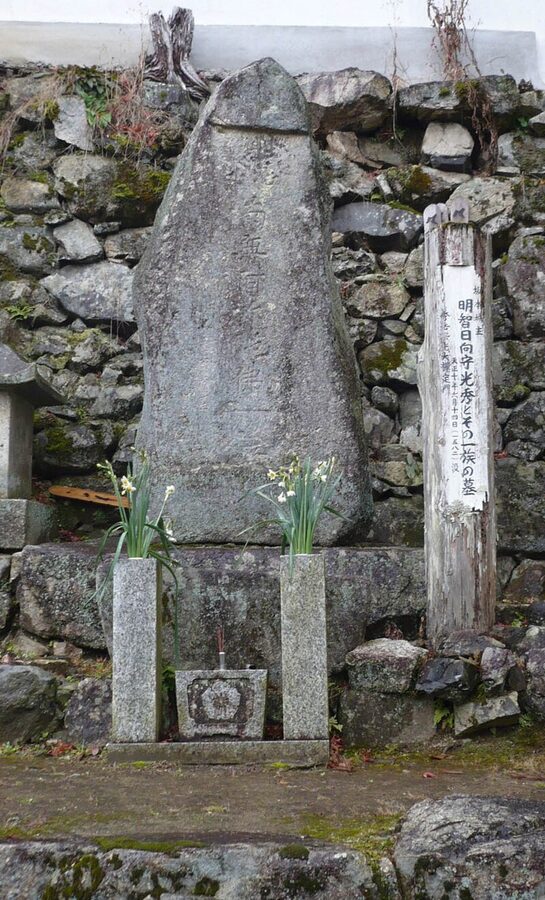
The modern Ogurusu is an unremarkable residential district in Kyoto’s Fushimi-ku, administratively part of the city but physically a quiet suburban belt of narrow lanes and surviving bamboo-grove patches between the JR Nara Line and the eastern Kyoto hills. The spot where Mitsuhide was speared is marked by a small stone monument at the corner of Ogurusu Mukaihata-chō — Akechi-yabu is the local name, “Akechi’s bamboo grove.” The monument is a square stone about half a metre high, inscribed Akechi Mitsuhide-kō Chūyō-no-chi: “Lord Akechi Mitsuhide’s final resting place.” There is a small Buddhist roofed shelter over the monument, an incense burner, a plaque from the Kameoka Mitsuhide society, and absolutely nothing else — no gift shop, no parking lot, no interpretive sign in English. I keep coming back to it because it is the opposite of a monument. A man who for eleven days controlled Japan died here, and modern Japan has marked the spot with the minimum possible quantity of granite.
Getting to Akechi-yabu: Ogurusu Station on the Keihan Uji Line, or Kuinabashi Station on the Keihan Main Line, then a 15-minute walk east into the residential lanes. I recommend having the precise address on your phone, “京都市伏見区小栗栖小阪町”, because the bamboo-grove area is discreet enough that without GPS you will spend a cheerful half-hour getting lost. Which is not the worst way to spend the afternoon. The Kyoto Ogurusu district has, by official Kyoto City historical survey count, eleven other Mitsuhide-related monuments within 500 metres of the Akechi-yabu — local ones, erected by Ogurusu locals over the centuries, including the stone where the head was supposedly hidden in the ditch overnight before Nakamura Chōbei retrieved it.
Saikyō-ji, Sakamoto — the head-grave
Saikyō-ji is the Tendai-sect temple at the northern end of the Sakamoto temple-town on the western shore of Lake Biwa. It is one of the largest Tendai temples outside Enryaku-ji itself, with a 900-year continuous history, a substantial cluster of Kamakura-period halls, and, in a side garden between the main hall and the bell tower, the head-burial stone of Akechi Mitsuhide, moved here from the Awataguchi displaying site in approximately 1583 by the temple’s Hidemitsu-related head abbot. The stone is not especially prominent; you can miss it if you are not looking. There is a wooden sign in the forecourt with the kanji Akechi Mitsuhide-kō go-shuzuka — “Lord Akechi Mitsuhide’s honourable head-mound.”
Saikyō-ji also keeps the meinin-chō, Mitsuhide’s donation register to the temple, recording the 1571–1572 offerings he made on behalf of the eighteen Akechi foot-soldiers who died in the Shiga campaign — a list that shows Mitsuhide, uniquely for a 1570s general, paying temple commemorations for the souls of his own common soldiers by individual name. One of the eighteen was a chūgen, a non-samurai retainer. The temple still has the original document under glass. The contrast between the bloodless Ogurusu stone and the 450-year record of Mitsuhide’s solicitude for his dead men, across the same lake, is the contradiction the contemporary Japanese scholarship is still trying to fit into one coherent life. Getting there: Sakamoto Hieizanguchi Station, 12-minute walk north along the lakeshore. Admission 500 yen. Pair with the Sakamoto Castle site in the morning and Enryaku-ji up the mountain in the afternoon.
The thirteen days
Japanese popular memory has given Mitsuhide san-nichi-tenka, “three-day kingdom.” The real number, eleven, is one of the short-form cruelties of the period. If he had reigned longer — if Tsutsui Junkei had come down off his hill at Hōrakuji, if the Hosokawa had marched, if the Mōri had broken out from Bitchū — the story would be different. None of them did. Mitsuhide miscalculated every one of the political loyalties he had spent fifteen years in Nobunaga’s service building, and at the one moment when he needed them to hold, they did not hold. The most striking thing about the Honnō-ji Incident is not that it happened but that it happened with such precise operational competence and such total political failure. Nobunaga died at Honnō-ji because Mitsuhide was a better soldier than his master had remembered. Mitsuhide died at Ogurusu because he was a worse politician than he had believed himself to be.
If you are in Kyoto anyway, walk the Ogurusu lane at dusk. The bamboo grove is smaller than it used to be, the surrounding Fushimi residential estate has eaten two-thirds of it since 1950, but the surviving strip, behind the monument, still has the same kind of soft dark understory that would have hidden a peasant holding an old spear in June 1582. Stand at the stone, listen to the bamboo, and work out for yourself whether you believe the Tenkai story. I do not. But I understand why the Japanese have kept it going. For the man who killed Nobunaga to die like that, in the dark, with a farm tool, at the end of a fortnight in which almost no one came when he called — the country has always preferred to imagine that it was someone else the peasants killed. That Mitsuhide walked out of the grove, took the tonsure at Kuroda-dani, and wound up whispering advice into Ieyasu’s ear forty years later. History says no. The bamboo keeps a different answer.