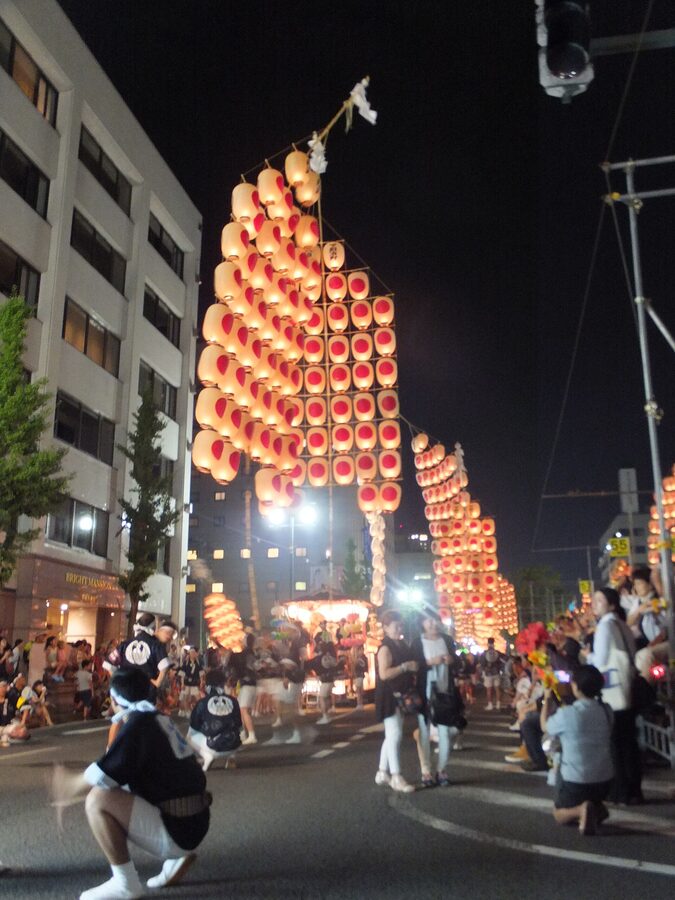
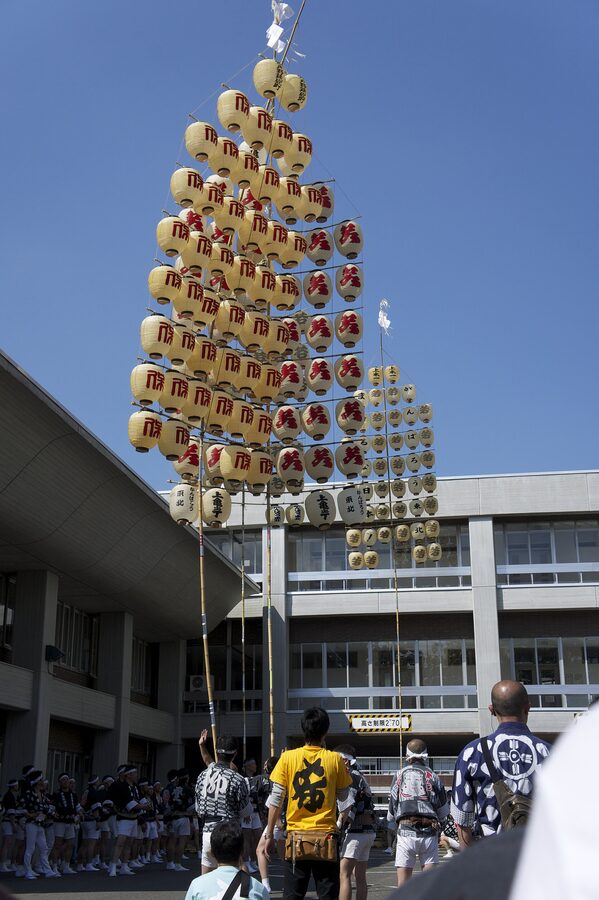
Picture a bamboo pole twelve metres tall, hung with forty-six paper lanterns, weighing fifty kilograms when lit, and held in balance on the palm of one hand. That is the central image of the Akita Kantō Matsuri (秋田竿燈まつり), the four-night August festival on the Sea of Japan coast that is one of the Three Great Festivals of Tōhoku. The full pole, called an ōwaka (大若), has nine sections of bamboo, two layers of cross-bracing, and a fan of sixteen wires holding the lantern array in tension. When a carrier moves it from the palm to the forehead to the shoulder to the hip, the bamboo curves under the load and the whole structure ripples in a long lit S-curve down Kantō Ōdōri.
In This Article
- What “竿燈” actually means
- The hook: balanced on a palm
- Origin: rice prayer and sleep wash-away
- The five technique positions
- The four sizes of pole
- The kake-goe and the bayashi
- The four-day schedule
- The lantern, by hand
- The neighbourhoods that participate
- Daytime competition: the technical side
- The night parade and seating
- Seeing the kantō outside the festival
- Three Great Tōhoku Festivals
- The 1980 designation
- The pandemic gap
- How to plan a visit
- What to eat at the festival
- The Akita inu connection
- Senshū Park, the other half of the city
- Behind the scenes: the bamboo team
- Akita as a kantō stage
- The festival, the city, and the harvest
- For first-time visitors
- Beyond the festival
- The pole, one more time
What “竿燈” actually means
The festival’s name is written 竿燈, which literally means “pole lantern”: sao (竿) is the bamboo pole and tō (燈) is the lit lantern. The first kanji is the same one used for fishing rods and flagpoles, the second is the older formal character for tōrō (燈籠), the lantern. The word kantō (竿燈) was coined in the late nineteenth century by the Akita scholar Ōkubo Tetsusaku, who borrowed it from a Zen Buddhist phrase, hyakushaku kantō shin shimpo (百尺竿頭須進歩), meaning roughly “from the top of a hundred-foot pole one must still take a step forward.” Before that, locals just called the contraption tsukuri-tōrō (作り灯籠, “made lantern”) or neburi-nagashi (ねぶり流し, “the sleep wash-away”).
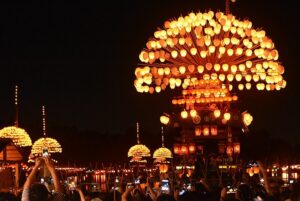
The full official name is “Akita Kantō Matsuri” (秋田竿燈まつり), and it runs from 3 to 6 August every year on Kantō Ōdōri (竿燈大通り), a roughly one-kilometre stretch of central Akita City. About 1.1 million visitors came in 2023 according to the city’s published count. The festival belongs to the same tier as Aomori’s Nebuta and Sendai’s Tanabata as the three flagship Tōhoku summer festivals (東北三大祭り), and is also counted as one of Japan’s “Three Great Lantern Festivals” along with the Nihonmatsu Chōchin Matsuri in Fukushima and the Tsushima Tennō Matsuri in Aichi.
You will hear locals shorten it to just “kantō” (cant be confused with the Kantō region around Tokyo, written 関東, an entirely different set of kanji). When I first arrived in Akita and asked where to see “kantō,” the station staff at first thought I had taken the wrong train.
The hook: balanced on a palm
The number that hits you first is the lantern count. An ōwaka pole carries forty-six lanterns arranged in nine descending tiers, plus two more lanterns at the very top, on a twelve-metre bamboo. Each lantern is about thirty-six centimetres tall, painted with a town crest or sponsor mark, and lit by a single candle inside. Wet paper, hot wax, and a strong August sea breeze are the three things every carrier is fighting at once.
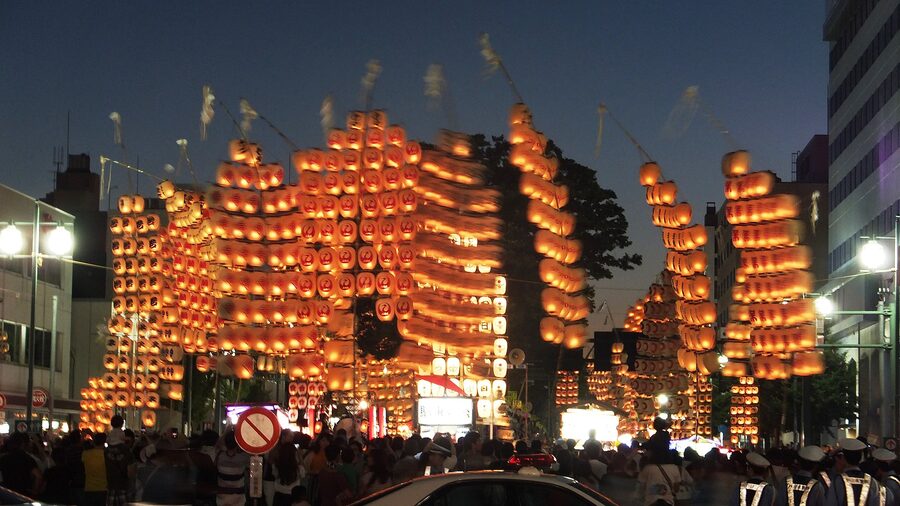
The fifty-kilogram weight comes from the bamboo, the cross-frame, the lantern paper, the candles, and the wires. That is the unmodified pole. During performances, carriers also slot in extra “tsugi-take” (継竹) bamboo extensions to push the pole even higher, and the city’s record holder has stacked nine extensions on a single pole. The weight does not change much, but the moment arm does, and a nine-section extension turns a tall pole into something more like a twenty-metre fishing rod with a flammable tip.
You balance that on your palm, then on your forehead, then on your shoulder, then on your hip. While playing nothing on a drum, while a flute carries the kantō-bayashi melody behind you, while two tonnes of crowd presses against the rope barrier ten metres away, and while a wind off the Sea of Japan picks up at sundown. I have watched this for two summers now, and I am still not sure how anyone learns to forget the candles.
Origin: rice prayer and sleep wash-away
The kantō you see today started as something much smaller, a private summer-purification rite called neburi-nagashi (ねぶり流し), literally “sleep washed away.” Households in Akita and across northern Japan would write a wish on a paper strip, tie it to a sasa branch or a nemu (合歓) tree branch, and float the bundle down a river in the heat of late summer. The point was to send away the laziness, drowsiness, and bad spirits that hot weather brought before the rice harvest. The same custom is the ancestor of tanzaku-tied bamboo branches that you still see at summer Tanabata celebrations across Japan.
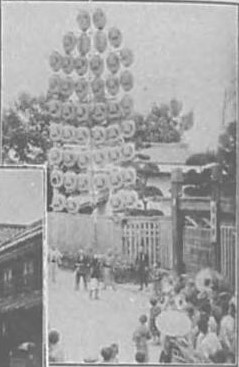
By the Hōreki era (1751-1764) the rite had scaled up. Akita merchants and craftspeople in the outer-town district (sotomachi 外町) started carrying their household lanterns through the streets together rather than just floating wishes on a stick. The “high lantern” (takadōrō 高灯籠) that families erected in front of the gate during Obon got merged with the sleep-wash-away custom, and the result was something portable, communal, and competitive. By 1789, an Akita document called Yuki no furu michi (雪の降る道, “Snowy Road”) described and illustrated something very close to the modern kantō.
The skill side came in a few decades later. A 1814 record, Akita Fūzoku Mondoku (秋田風俗問状答), shows the hira-te (palm) balance position. An 1867 record, Dewa no Michiwake (出羽の道わけ), shows the hitai (forehead) position. So by the late Edo period, the carriers had moved from “lift the lantern higher than the next street” to “balance the lantern in five different positions, with style.” The word “kantō” itself only appears in the late nineteenth century, after the Meiji Restoration.
The five technique positions
Modern kantō has five canonical balance positions, called gowaza (五技) or “the five techniques.” They run roughly from easy to hard, and a carrier needs all five to be considered fully trained.
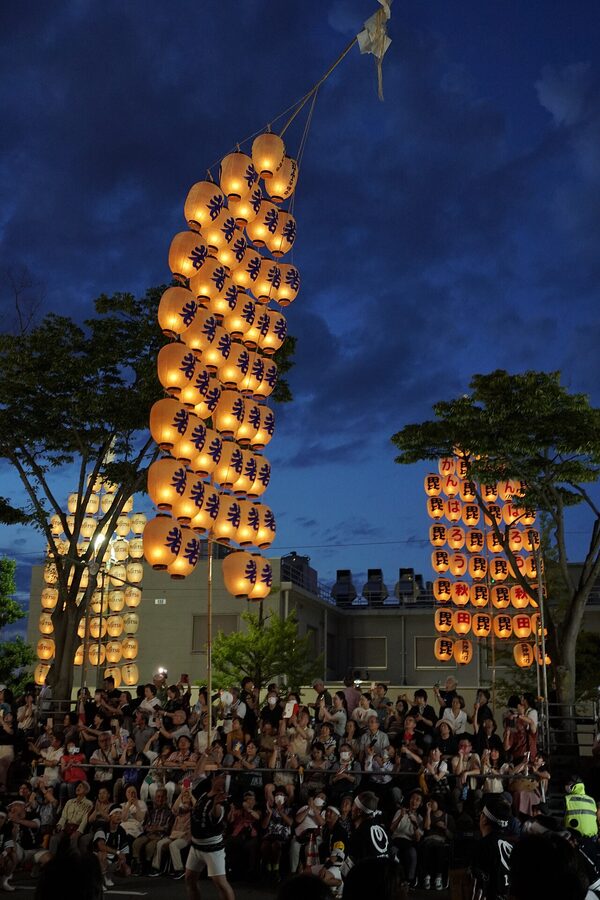
The first is nagashi (流し), the “flow.” The carrier holds the pole with both hands at chest height, walking and rocking it side to side as the procession moves down the street. This is the transit position, and it is also how a carrier resets after a difficult balance fails.
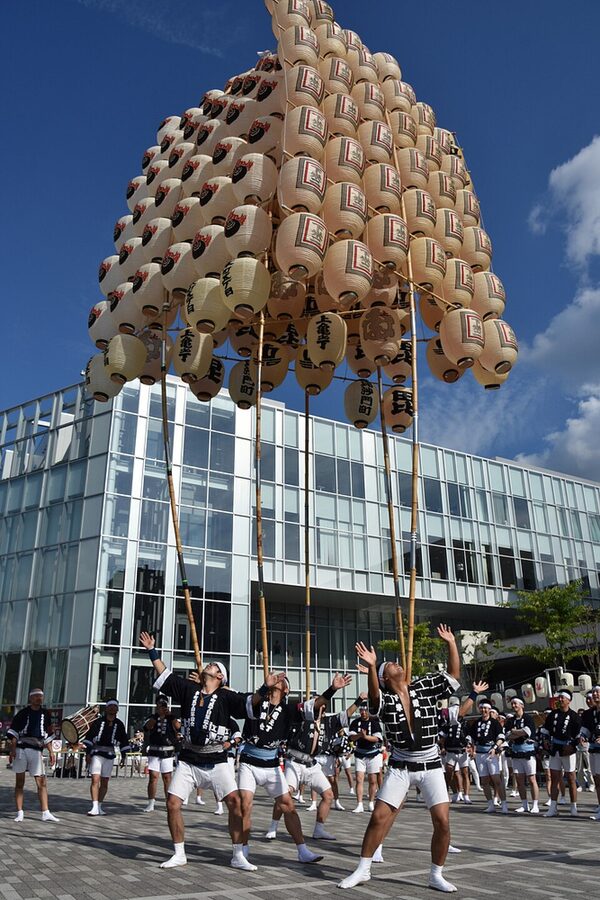
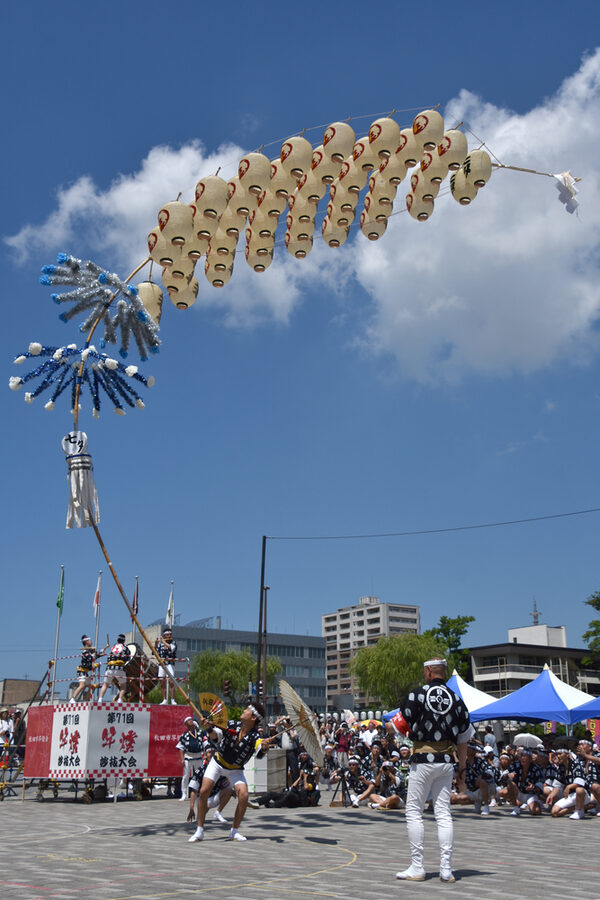
The second is hira-te (平手), the “flat palm.” One hand opens up palm-up, and the base of the bamboo balances on it. The other arm sweeps out for counterweight. You have probably seen photos of this one, and it is the iconic kantō image.
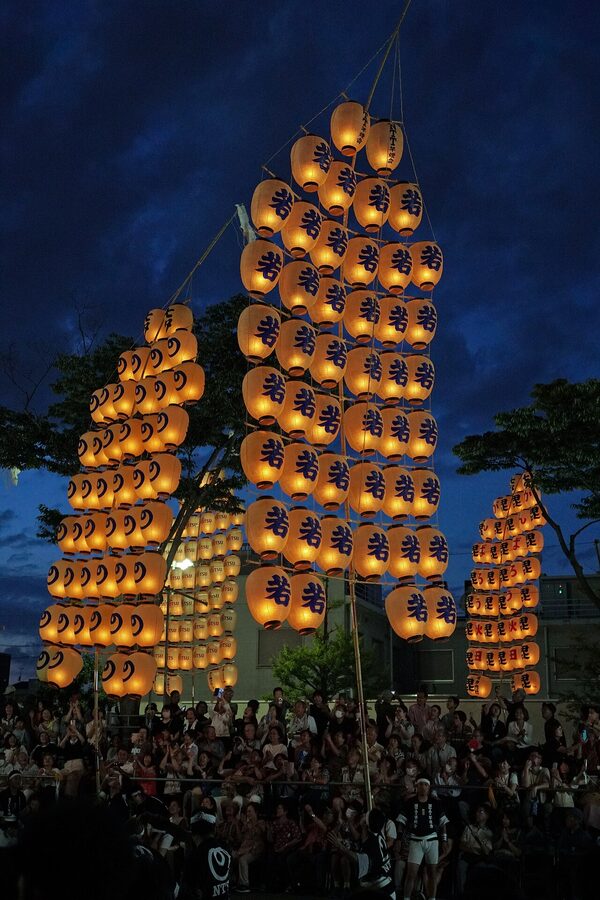
The third is hitai (額), the “forehead.” The base of the pole rests in the small dip just above the eyebrows, with both hands held out wide for balance. The carrier looks straight up at the underside of the lowest lantern and trusts neck and core. Watching this one for the first time will give you a real respect for cervical vertebrae.
The fourth is kata (肩), the “shoulder.” The pole base sits on top of the trapezius, with one hand near the head and the other free for a fan or umbrella. Carriers in the kata position often add an open wagasa (和傘) Japanese umbrella in their free hand, spinning it as a flourish.
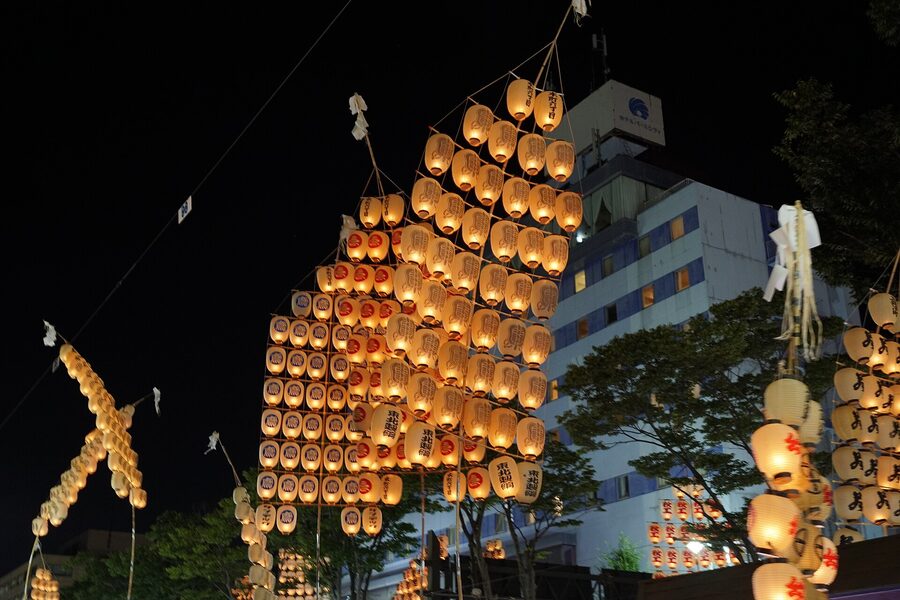
The fifth and hardest is koshi (腰), the “hip.” The base balances on the iliac crest, with no hand near the pole at all, while the carrier’s torso bends sideways to keep the centre of gravity over the foot. Local kantō-kai veterans say it takes three to five years of constant practice to hold koshi for any meaningful time. Even watching a near-miss is alarming, because once the pole leaves vertical there is no immediate way to catch it from the hip.
Real masters add fans (ōgi 扇子), Japanese umbrellas (wagasa 和傘), and even single-tooth tengu geta (一本歯, “one-tooth getas”) for an extra layer of difficulty. The single-tooth wooden clog is the same kind tengu mountain spirits wear in folktales, and standing still on one is hard before you add a twelve-metre pole.
The four sizes of pole
You will see four pole sizes during the festival, scaled to the age and skill of the carrier. The biggest is ōwaka (大若), at twelve metres long and fifty kilograms, with forty-six lanterns. The middle is chūwaka (中若), at nine metres and thirty kilograms, also with forty-six lanterns but smaller and lighter. Then comes kowaka (小若), at seven metres and fifteen kilograms with twenty-four lanterns. Finally yowaka (幼若), at five metres and five kilograms with twenty-four lanterns, designed for elementary-school children to handle.
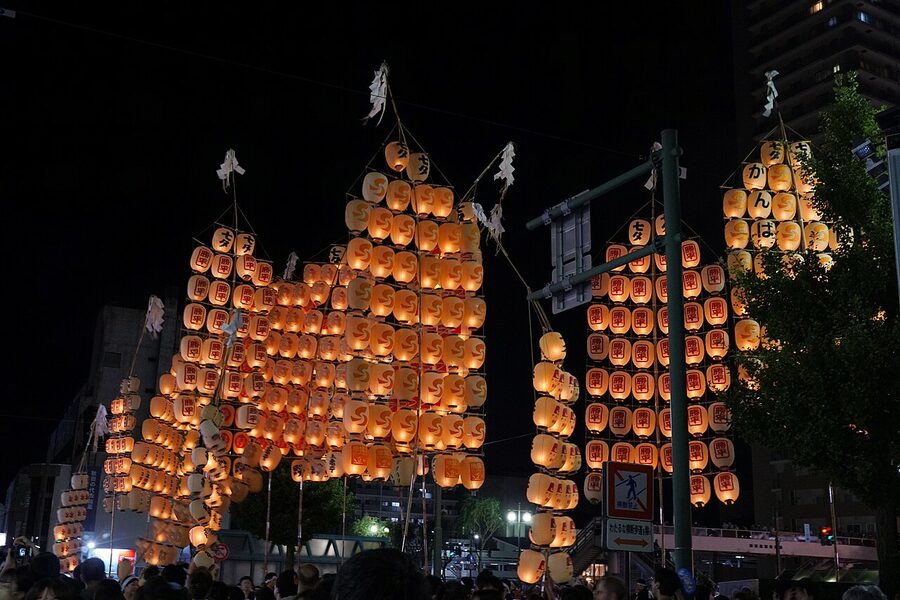
The small ones are not just decoration. Each Akita neighbourhood team trains its kids in yowaka before they graduate up the sizes, and you will see ten-year-olds handling kowaka poles with the kind of focus most adults bring to a job interview. By the time a carrier reaches ōwaka in the late teens or early twenties, the muscle memory of the smaller poles is already there.
The bamboo itself is local, harvested from Akita and surrounding prefectures. A single ōwaka pole is built from nine joined bamboo sections, with the bottom one thicker and the top sections progressively narrower. You can see the joins as small bumps along the length when a pole is held vertical. The cross-frame at the top is a wooden ladder-like structure called a kotoji (横木), and the lantern wires hang from each rung.
The kake-goe and the bayashi
The festival’s call-and-response is “Dokkoisho! Dokkoisho!” (どっこいしょ どっこいしょ), an expression that ordinarily means “heave-ho” when lifting something heavy. The crowd shouts it back to the carriers as the poles go up. There is also a longer ceremonial version, “Dokkoishō dokkoisho dokkoishōsho dokkoisho, oetasā oetasa, nekko-tsuita oetasa,” which translates roughly as “heave heave heave, growing growing, taken root growing.” The “taken root” line means the rice plants have anchored in the paddy, which is the actual prayer at the heart of the festival.
The shape of the kantō is itself a piece of agricultural symbolism. The whole pole stands in for a stalk of rice (ine 稲), and the cluster of lanterns hanging from each crossbar is meant to look like the heavy clusters of grain that tip a healthy rice plant over to one side. When carriers balance the pole motionless on the forehead or shoulder, that “the lantern array stays still” is read as “the rice is heavy and well-rooted.” The festival is, at its core, a prayer for a successful late-summer rice harvest.
The musical accompaniment is the kantō-bayashi (竿燈囃子), a percussion-and-flute ensemble. There are two main pieces. Nagashi-bayashi (流し囃子) plays during the parade, when poles are moving from one performance area to the next. Hon-bayashi (本囃子) plays during the actual balancing performances, with two drummers on a single barrel taiko, and a flute carrying the melody. Some neighbourhoods add a kane (鉦) hand gong on top.
The kantō-bayashi is descended from older Akita-bayashi (秋田囃子) court music, and from the Tsuchizaki-port minato-bayashi (湊ばやし) and the Hitachi tenjin-bayashi that the Satake clan brought with them when they were transferred from Hitachi (now Ibaraki) to rule Akita in 1602. That last connection is the link between kantō and the broader Edo-era political story of the sankin-kōtai system, under which daimyō like the Satake of the Kubota domain (the old name for Akita) had to alternate years of attendance in Edo.
Live, the bayashi sounds nothing like recorded versions. The drum patterns are simple but the layered flute and the open echo of Kantō Ōdōri turn the whole thing into a wall of sound. By 9pm on the third night I had the rhythm stuck in my head for a week.
The four-day schedule
The festival runs the same way every year. On the morning of 3 August, neighbourhood representatives gather at Hachiman Akita Shrine inside Senshū Park and receive the gohei (御幣) paper streamer that goes on the very tip of every kantō. This ceremony is called gohei-watashi (御幣渡し), the “gohei handover.” Each pole’s gohei has its town’s crest, and is the part that consecrates the pole for the four nights ahead.
Daytime on 4, 5, and 6 August is the kantō-myōgi-kai (竿燈妙技会), the “kantō technique competition,” held at Nigiwai Hiroba in the Area Nakaichi development. This is where the technical scoring happens. Performers stand inside a six-metre circle and run through their five positions in front of a panel of judges. There are team events with both a “regulated” routine and a “free” routine, plus solo events and a separate music division for the bayashi musicians.
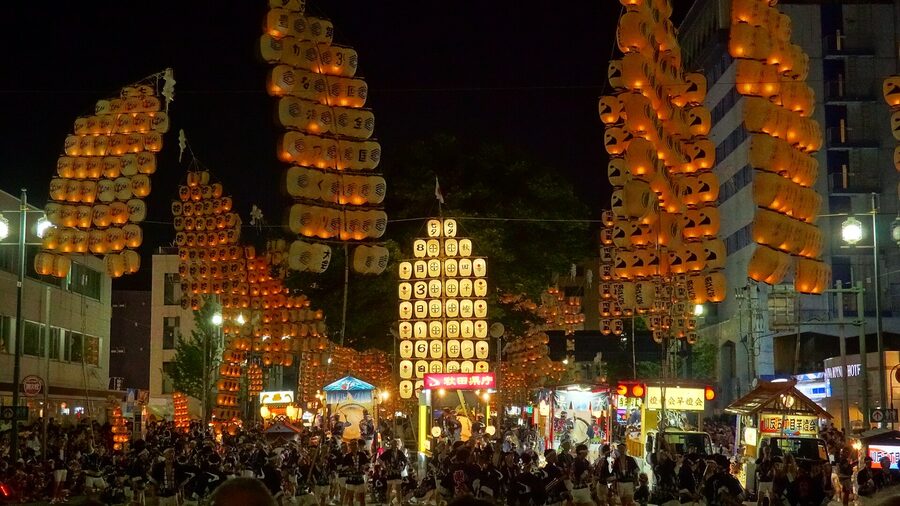
The big nightly event is the yoru-kantō (夜竿燈), the night kantō, on Kantō Ōdōri. The street is closed, paid grandstand seating is built along both sides, and from about 18:50 on each evening you watch about 250 poles enter, light up, and perform three rounds of position changes interleaved with two parade movements. Each round runs roughly twenty minutes, and the gaps in between let teams rotate to new spots so every section of the audience gets a different vantage.
After the third round, there is a fureai-kantō (ふれあい竿燈) “touch kantō” period, when small kowaka and yowaka poles come out for visitors to hold. You can pick up a five-kilogram yowaka, take a photo with a lit lantern array overhead, or try a few of the bayashi drum strokes. This is the only time during the festival when an outsider gets to feel how the bamboo flexes.
The festival closes on the morning of 7 August with gohei-nagashi (御幣流し), the “gohei flow.” Town representatives gather at Karihobashi (刈穂橋) over the Asahi River and float the now-used gohei downstream, the ritual heart of the original neburi-nagashi. With that, the four-night cycle ends, and the lanterns and bamboo come down for storage.
The lantern, by hand
Each town’s lantern carries a unique crest, and the crests are not generic. They are family-style mon (家紋) developed over the Edo period for that specific neighbourhood. Kamiyone-cho ichi-chōme (上米町一丁目) uses a rabbit pounding mochi. Kamiyone-cho ni-chōme (上米町二丁目) uses Date-style peonies. Hodono-no-Tepposhi-cho, Yanagimachi, Yokachō, Bakurō-machi, and Kamiyone-chō ni-chōme are the five towns that have won every category of the daytime competition at least once, and each carries its own visual signature on its lanterns.
Many of the crest designs are attributed to Satake Yoshimasa (佐竹義和), the eighth Satake daimyō of Kubota, who ruled Akita from 1785 until 1815 and was an enthusiastic painter and patron of local design. The originals have been redrawn and repainted across generations, but the basic shapes are unchanged.
The lanterns themselves are hand-built by craftspeople using washi (和紙) Japanese paper stretched over a thin bamboo frame, then painted with the crest. To keep summer rain from dissolving the paper, the outer surface is treated with oil. Two small holes are cut near the top of each lantern so that if the pole tips over, air can rush through and blow the candle out before the paper catches fire. The system mostly works, but on a windy night you will sometimes see a lantern catch and burn like a small flare on top of an arc of bamboo.
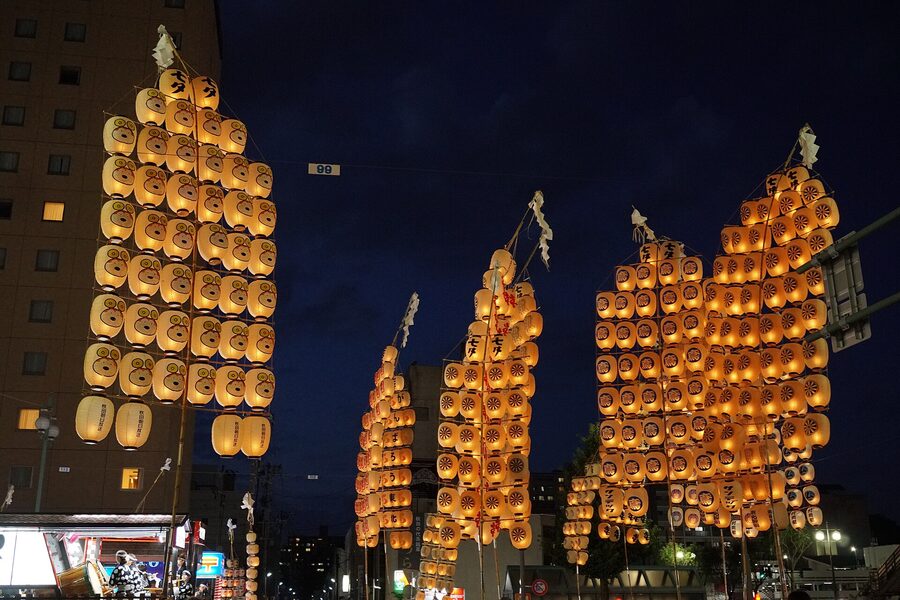
About ten thousand lanterns are lit on the four festival nights combined, every one of them by candle. After the festival, the leftover wax stubs are gathered up and given out as omamori (お守り) safe-childbirth charms. Locals say the candles that have stood vertical through four nights of balanced pole work make particularly potent talismans.
The neighbourhoods that participate
Modern kantō pulls from over forty Akita neighbourhood teams. Eighteen of them have been running their own poles since the Edo-period origin of the festival, when only the sotomachi outer-town districts of merchants and craftspeople were allowed to participate. After the Meiji-era abolition of samurai class restrictions, inner-town neighbourhoods joined too, and the participant list expanded.
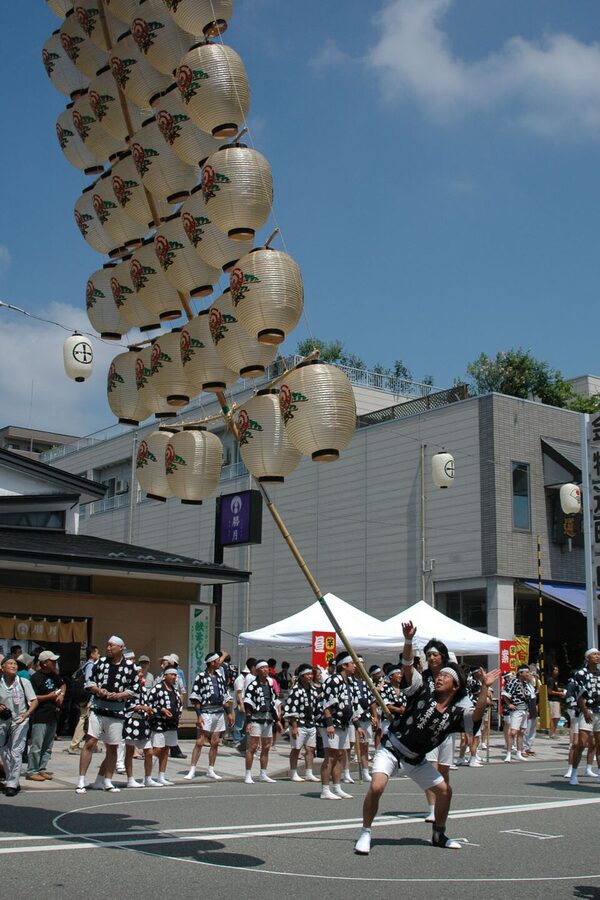
The original Edo-era eighteen include Hodono-tepposhi-cho, Kamiyone-cho ichi-chōme, Kamiyone-cho ni-chōme, Shimoyone-cho ichi-chōme, Shimoyone-cho ni-chōme, Honmachi roku-chōme, Toshimachi, Yanagimachi, Yokachō, Shimosakana-machi, Teramachi ni-ku, Tepposhi-cho, Kami-kaji-machi, Shimo-kaji-machi, Shijukken-bori-cho, Shiromachi, Bakurō-machi, and Kamikamenochō. The names look interchangeable to a newcomer, but locals know them as well as football fans know team rosters.
Kawabata go-chōme is interesting because the team is supported by the bars and restaurants of the Kawabata entertainment district rather than a town association. Their pole carries cloth banners (“tare-maku”) with restaurant names, instead of the usual single-crest lantern. It is the most commercially branded of the participating poles, and locals tell me it is also one of the best-funded.
The most decorated team historically is Hodono-tepposhi-cho (保戸野鉄砲町), which has won the team-event regulated routine four years running on two separate occasions. The personal-best record holder, Fujita Hideyuki of Yanagimachi (柳町) and Kishi Fuyuki of Kamiyone ichi-chōme, are the only two performers in history to have won every individual event in the daytime competition with the ōwaka.
Daytime competition: the technical side
The daytime myōgi-kai is the festival’s serious athletic event. It runs from 1931 onwards as a way to keep technical standards high and let teams settle rivalries beyond the night parade. Performances happen inside a six-metre-diameter circle, with judges scoring on stability, accuracy of position, and beauty of form.
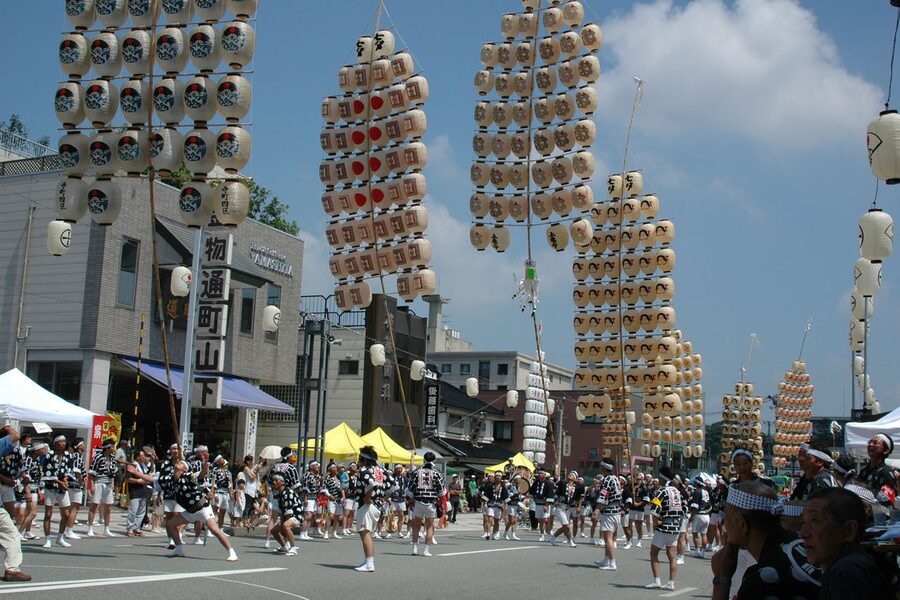
Team events have two formats. The “regulated routine” is a fixed sequence of moves that every team performs identically, judged on cleanness and uniformity. The “free routine” lets teams design their own choreography, judged on creativity and difficulty. The big-pole ōwaka qualifying rounds run on 4 and 5 August, and the finals run on 6 August along with the small-pole kowaka finals.
Solo events let individual performers run a sequence of all five positions on an ōwaka, with extra points for adding a fan, an umbrella, or single-tooth tengu geta. The bayashi-kata music division is judged separately, with teams playing both nagashi and hon-bayashi pieces in front of judges who care about every drum stroke.
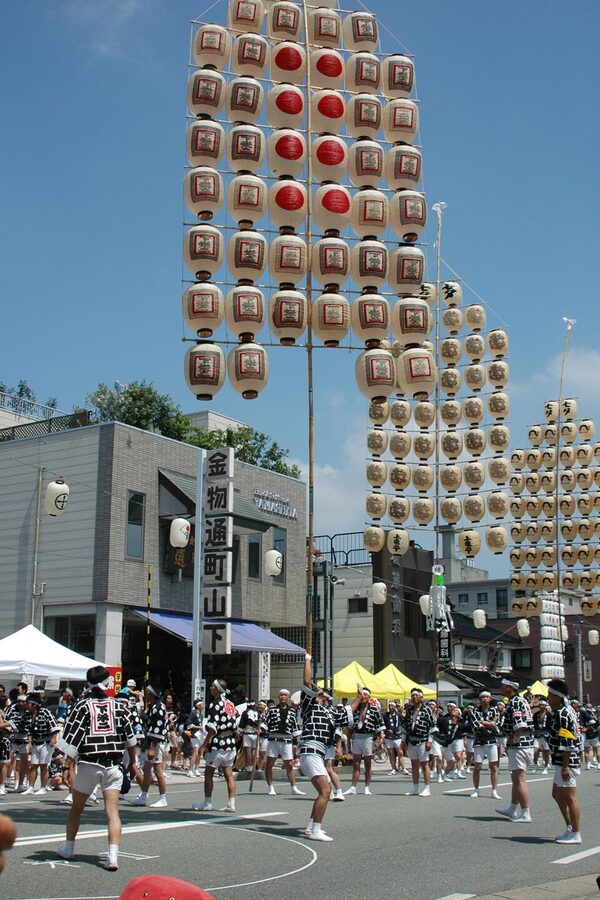
The kowaka small-pole competition is mostly elementary-school and junior-high students. It runs the same regulated routine as the adults, with the bayashi music event scaled down. I find it more nerve-wracking to watch than the adults because the kids are still learning, and a kowaka pole is small enough that a tip-over reaches the ground fast.
If it rains hard enough to cancel the outdoor competition, the entire myōgi-kai moves indoors to the Akita City Gymnasium. This has happened a handful of times in recent years, and the indoor format produces some of the best photos of the year because the lighting is even and the crowd is closer.
The night parade and seating
Yoru-kantō runs from 18:50 to about 21:00 on each of the four nights. The performance area is the section of Kantō Ōdōri between Nichōme-bashi (二丁目橋) bridge and the Sannō intersection (山王十字路), about a kilometre of street. Older festival editions used different streets, including Ōmachi, Chamachi, Tōrimachi, Narayama, Dotechōmachi, Hirokōji, Senshū Park, Sannō Ōdōri, and the Shin-Kokudō, before the current Kantō Ōdōri stretch became the standard route.
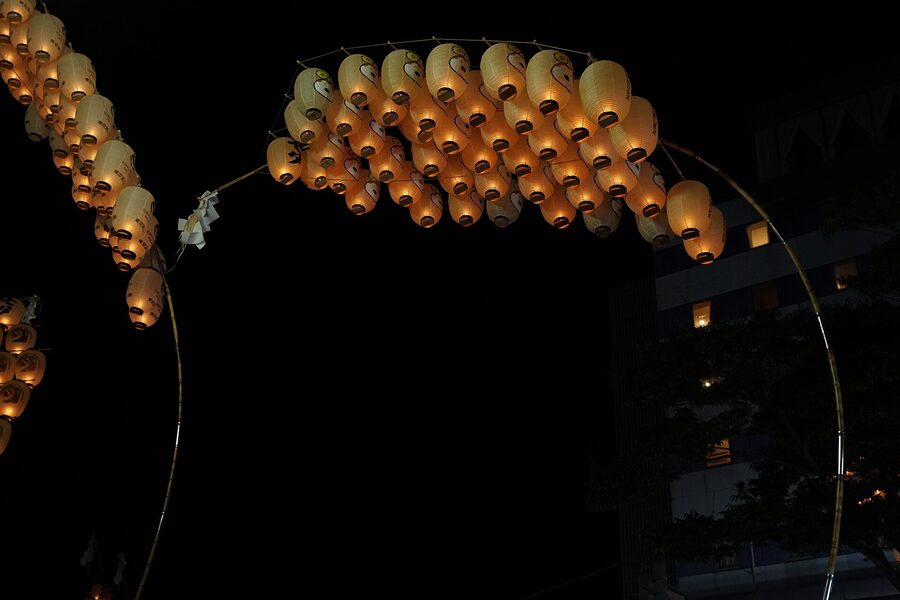
Reserved seating is sold every year through the Akita Kantō Festival Executive Committee. Prices in recent years run about ¥3,000-3,500 for individual fixed-grade seats and ¥18,000-25,000 for box seats that hold four to six people. The seats are wooden benches in tiered stands along both sides of the street. Free standing-room areas are available behind the paid sections, but they fill up fast and the view is partly blocked by lighting rigs.
If you are coming as a casual visitor and you have not booked, my recommendation is to arrive at Kantō Ōdōri by 17:00, walk the full length once to see the pole staging area, then settle into the free area at either the Yamaōji or Nichōme-bashi end. Both ends have a slightly elevated curb that gives you a usable view across the heads of people in front of you. Avoid the centre-block free standing area where the rope barriers cut your sight lines.
From 2023 onwards, the organisers added pedestrian crossing windows during performance breaks so that people can move along the street more easily during the festival itself. Before that, once the lanterns went up, the only way across Kantō Ōdōri was to walk a few blocks south or north and round the closed area.
Seeing the kantō outside the festival
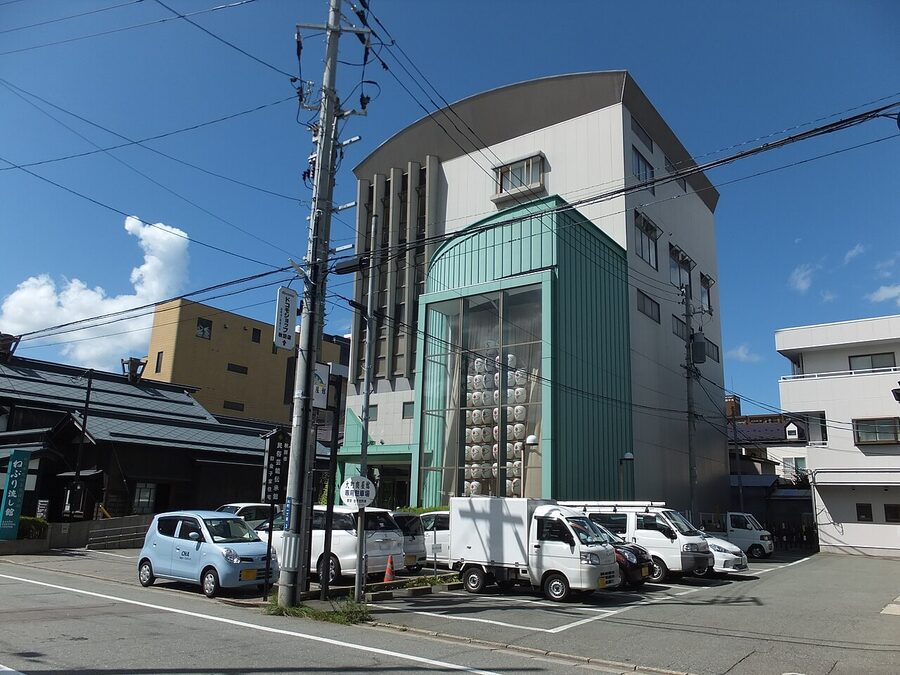
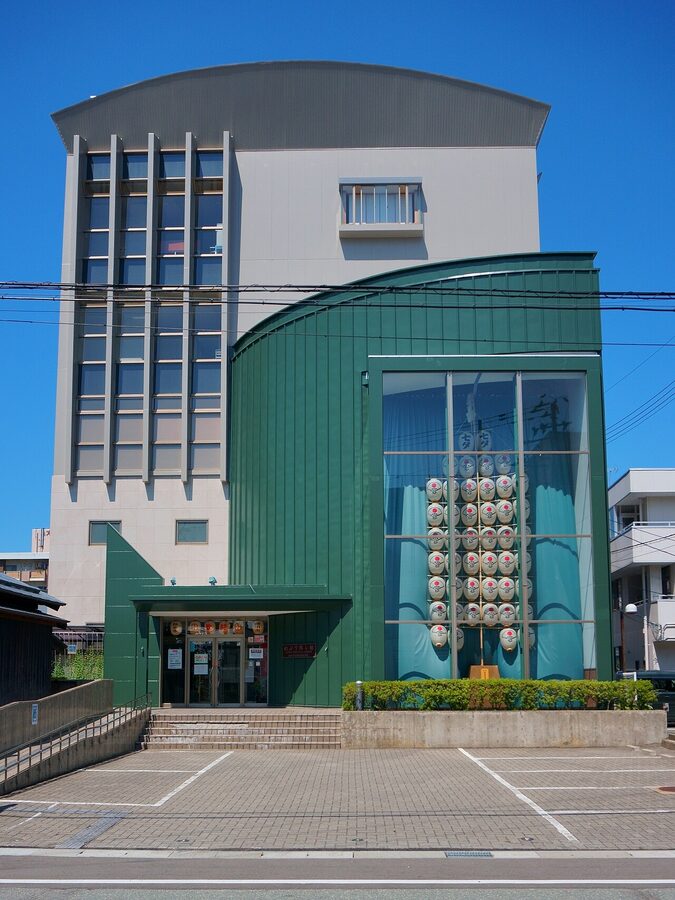
If you are in Akita any time from late spring through autumn, you can see live kantō demonstrations year-round at Neburi-nagashi-kan (ねぶり流し館), the Akita City Folk Performing Arts Heritage Center. The hall keeps the festival’s tradition alive in the off-season with weekend demonstrations, an interactive area where visitors can try lifting a small pole, and a permanent exhibit of historic lanterns and bamboo.
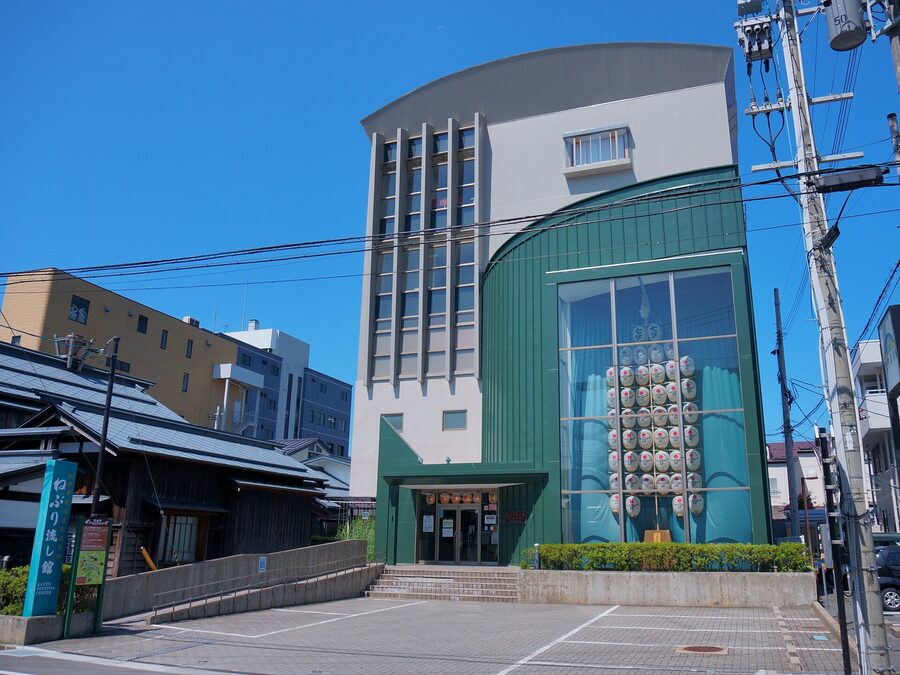
Neburi-nagashi-kan sits in central Akita’s Ōmachi district. The neighbouring red-brick Akarenga Local History Museum is the main branch, and Neburi-nagashi-kan is its annex. The complex is also adjacent to the Kaneko family residence, an Edo-era merchant house preserved as a cultural property.
Outside Akita, the kantō poles travel often. Every January the Furusato-Matsuri Tokyo at Tokyo Dome features kantō demonstrations alongside Aomori Nebuta. Every August the Matsuri Tsukuba festival in Ibaraki includes both kantō and Nebuta. There are also regular demonstrations at Sensō-ji’s Orange Street near Asakusa from May, and at the Ueno Hirokōji “Ueno Summer Festival Parade” in central Tokyo. Once you know what kantō looks like, you can spot it at small festivals across Japan.
In May 2018, on the 150th anniversary of the Boshin War’s Akita campaign, the kantō travelled to Takeo, in Saga Prefecture (the home of the Saga clan that fought hardest in Akita’s defence). Around 80,000 people from Kyushu turned out to watch. Akita and Takeo signed a sister-city partnership agreement off the back of that event, and the city’s kantō team makes occasional return visits.
Three Great Tōhoku Festivals
Aomori Nebuta, Sendai Tanabata, and Akita Kantō are the three flagship summer festivals of the Tōhoku region, each running across the first week of August. Together they are called the Tōhoku Sandai Matsuri (東北三大祭り). All three are listed as Important Intangible Folk Cultural Properties, all three pull more than a million visitors a year, and all three trace their origins to the broader neburi-nagashi summer purification rite.
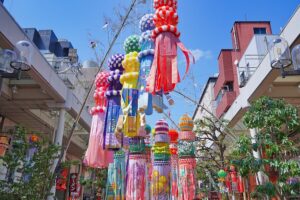
What sets them apart is the visual signature of each. Nebuta uses massive painted-paper float-floats of warriors and gods, sometimes nine metres tall, pushed through Aomori’s streets by hundreds of haneto dancers shouting “rassera-rassera!” Sendai Tanabata fills the city’s covered shopping arcades with thousands of long, hanging paper streamers, until the streets become a tunnel of pastels. Akita Kantō is the vertical pole festival, the balance act, the single-figure-with-pole image.
If you compare them side by side, Nebuta is the loudest, Tanabata is the most photogenic from above, and Kantō is the most precise. Carriers in Kantō have to do less raw athletic work than Nebuta dancers, but the margin for error is much smaller. A Nebuta float can lurch to one side and recover. A kantō pole that lurches hits a powerline, an audience, or a face.
The three festivals are deliberately scheduled to overlap so that travellers can see all three in a single trip. Aomori Nebuta runs 2-7 August, Akita Kantō runs 3-6 August, and Sendai Tanabata runs 6-8 August. With careful planning, you can do all three in one Tōhoku week, ideally riding the Akita and Tōhoku Shinkansen lines that connect the three cities directly.
The 1980 designation
On 28 January 1980, the Japanese government designated Akita Kantō Matsuri an Important Intangible Folk Cultural Property (重要無形民俗文化財). This is the same heritage classification that protects the Aomori Nebuta and several dozen other community festivals across Japan. The designation comes with public-funding support for the festival’s preservation, and it formally recognises kantō as a custom of national cultural value.
Designation is not a tourism category, despite how it sometimes gets used in promotional materials. It is a legal protection that requires the host community to keep the festival running in a recognisable form, and that requires the central government to support that work. In practice this means money flows to the Akita City Kantō-kai (秋田市竿燈会), the umbrella body that coordinates the participating neighbourhood teams.
The kantō-kai also handles training, equipment, and the inter-team rules. New neighbourhoods that want to join the festival have to go through them, learn the standard pole sizes, train carriers in the five positions, and commission lanterns with their own town crest. The process can take several years, which is part of why the participant list grows slowly.
The pandemic gap
In 2020 and 2021 the festival was cancelled outright because of COVID-19, the first cancellation since the early postwar reconstruction era. In 2022 it returned with restrictions: the kake-goe call-and-response was banned to limit aerosol spread, audience seating was reduced, and the parade route was shorter. In 2023 the kake-goe came back, the seating capacity returned, and 1.1 million visitors attended, the highest count in five years.
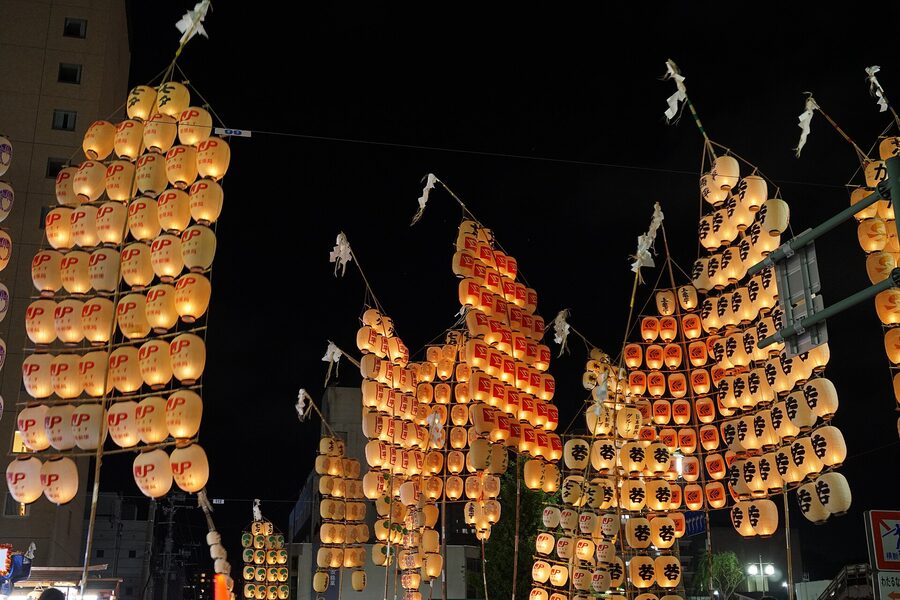
Locals I spoke to in 2024 were still talking about the silence of 2022. Carriers said balancing without the crowd’s “Dokkoisho!” felt fundamentally wrong, because the call is part of the tempo of the pole movement; the carrier expects an answering shout from a few specific places in the crowd, and uses that audio cue to time the next position change. Without it, the rhythm broke.
Equipment-wise, the gap also forced the kantō-kai to renew bamboo stocks. Most of the active poles had sat unused for two years, and bamboo dries out and cracks. The 2022 and 2023 festivals saw a wave of newly-built poles, which is the kind of generational equipment turnover that usually only happens every fifteen or twenty years.
The festival has always been more resilient than scheduled. Akita’s first major air raid during the Second World War destroyed parts of central Akita, and the festival was suspended for several years afterwards. Each time it returns, the neighbourhood teams rebuild bamboo stocks together, and the equipment ages forward.
How to plan a visit
From Tokyo, take the Akita Shinkansen “Komachi” service from Tokyo Station to Akita Station, which takes about three hours fifty minutes for the direct service. Reservations are mandatory during the festival week because both Akita Shinkansen carriages and Akita-area hotels fill out months ahead. Book by mid-June at the latest if you want a hotel within walking distance of Kantō Ōdōri.
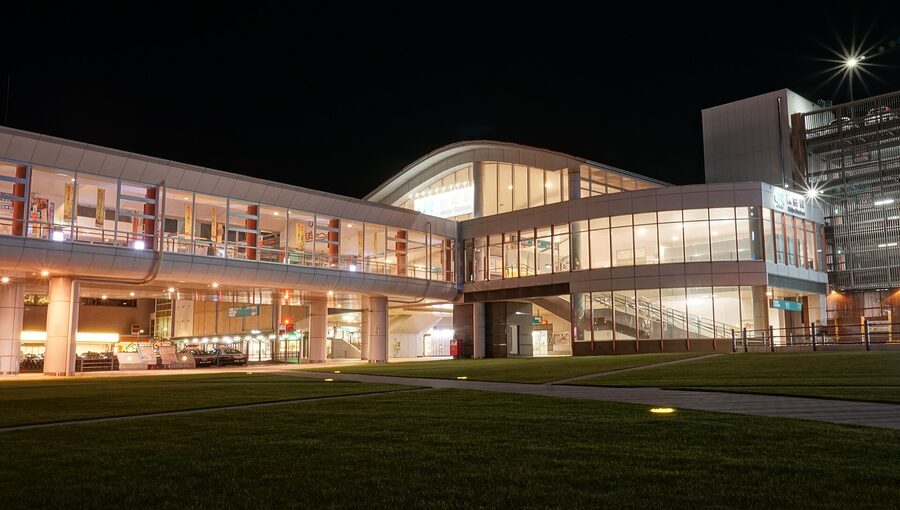
From Akita Station’s west exit, walk straight along Hirokōji Boulevard for about ten minutes and you will hit the Sannō intersection, which is the south end of Kantō Ōdōri. The street is closed during festival hours, so you can walk up the centre to Nichōme-bashi at the north end. The two ends are about a kilometre apart, and standing at one end on a clear night you can see lanterns going up along the entire stretch.
If you are flying in, Akita Airport is southeast of the city. The airport bus to Akita Station takes about forty minutes and costs about ¥1,000. If you are arriving from Akita Port (occasional ferry services from Tomakomai or Niigata), the Port Tower Selion area has a regular bus to Akita Station. Driving in from elsewhere in Tōhoku, the Akita Expressway south of Akita is the standard route, and the Akita-minami interchange is about ten kilometres from central Akita.
Accommodation-wise, the hotels near Akita Station fill first because they are walkable to Kantō Ōdōri. Look at properties along Sannō Ōdōri, Hirokōji, and the streets just north of Senshū Park. Anything more than fifteen minutes’ walk and you are essentially using a taxi to get back after the night kantō ends, which is fine but expensive during festival traffic.
What to eat at the festival
Akita is a serious food region, and the festival lineup at Kantō Ōdōri leans into local specialties more than generic festival food. The signature dishes are kiritanpo (きりたんぽ) grilled rice cylinders skewered on cedar sticks, hinai-jidori (比内地鶏) free-range chicken in soup or skewers, and Akita ramen with the city’s signature smooth fish-stock broth.
Specifically for the festival, the food stalls along the side streets off Kantō Ōdōri sell kiritanpo skewers on the spot, with miso glazes painted on while you wait. There is also babahera (ババヘラ) ice cream, sold by older women (the “baba” in the name) using a metal spatula (the “hera”) to scoop pink and yellow stripes onto a cone. The babahera carts are an Akita institution, and you will see them at every major event in the city.
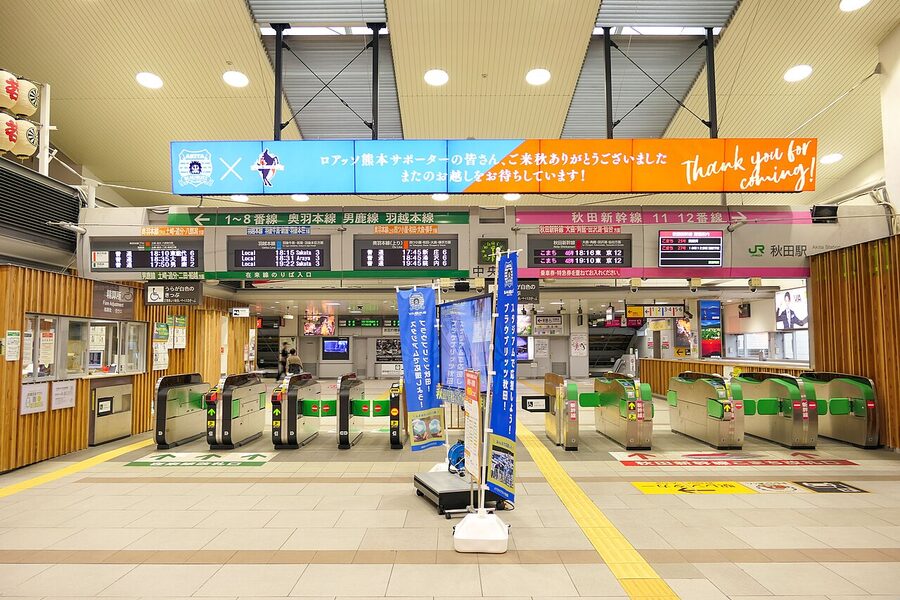
Inside Akita Station, Poporoad is the underground food and souvenir corridor that runs between the east and west exits. It carries Akita Komachi rice (in vacuum bags small enough to fly home with), Akita’s famous inaniwa udon (thin, hand-stretched wheat noodle), and a long line of sake from local breweries. If you only have an hour at the station before catching the Shinkansen back, Poporoad is the place to spend it.
The Akita inu connection
Akita is the home of the Akita inu (秋田犬), the breed that includes Hachikō, the loyal dog of the Shibuya Station statue. The breed originated in Ōdate, a city about an hour and a half north of Akita City by train, and you will see Akita inu motifs in souvenir shops across the prefecture during the festival. The Ōdate dog museum runs a permanent display of breed history.
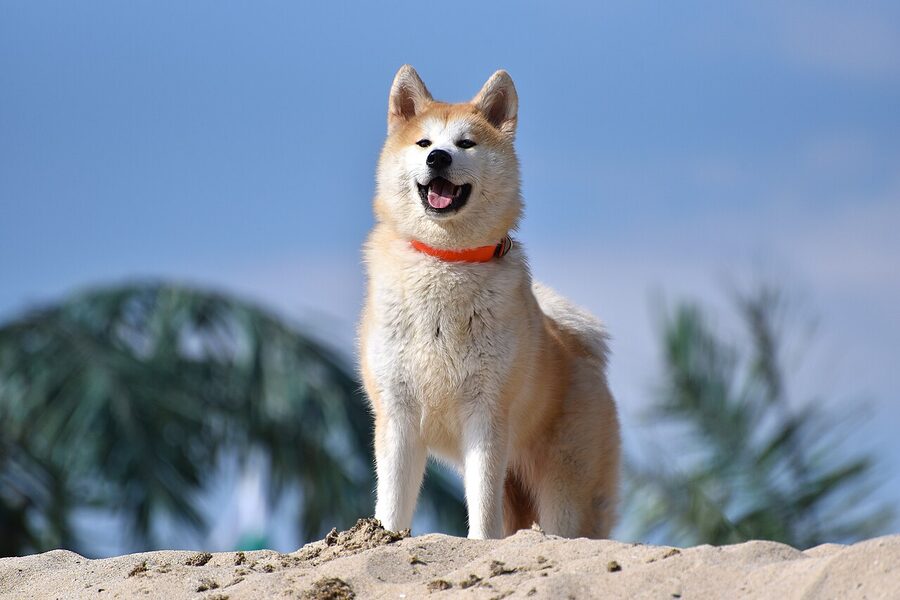
The Akita inu is not technically part of Kantō Matsuri, but if you are travelling all the way to Akita Prefecture for the festival it is a logical add-on. Ōdate is reachable in about ninety minutes from Akita Station on the Ōu Main Line, and the Akita Inu Visitor Center near Ōdate Station has live dogs you can meet during opening hours. The breed was almost extinct after the Second World War, when the wartime food shortage and the export of dogs for fur led to dramatic population collapse.
The breed’s recovery is one of the small post-war heritage stories of Japan, and you can see preserved bloodlines at the Akita Inu Hozonkai (秋田犬保存会) headquarters in Ōdate. If you have a free day either side of the festival, the Akita-Ōdate trip is a nice contrast: city festival on one end, rural breed-preservation centre on the other.
Senshū Park, the other half of the city
Across Hirokōji from Akita Station sits Senshū Park (千秋公園), the former site of Kubota Castle, the Satake clan’s seat. The castle’s keep is gone, but parts of the moat, walls, and several reconstructed buildings remain, and the park is the green heart of the city. Hachiman Akita Shrine inside the park is where the festival’s gohei-watashi opening ceremony takes place on the morning of 3 August.
If you are visiting outside festival hours, Senshū Park is a good morning walk before the daytime myōgi-kai starts. The cherry blossom season in mid-April is the other big draw, and the park is registered as one of Japan’s hundred best cherry blossom sites. After the festival ends, the park offers a quiet place to recover from the four nights of crowds.
The Akita Prefectural Museum of Modern Art and the Akita International Hall are both inside or adjacent to the park, and a few short blocks east is Kawabata, the entertainment district where Kawabata go-chōme’s kantō team is based. A walk between Senshū Park and Kawabata covers the cultural and the convivial sides of the city in about two hours.
Behind the scenes: the bamboo team
Each neighbourhood team has a tightly defined structure. There is the head carrier (sashite 差し手), who does the actual balance work. There is a “tsugi” assistant, who hands the carrier the next pole section between extensions. There is a bayashi musician trio for drum and flute. And there is a town representative who carries the team’s banner and handles the gohei.
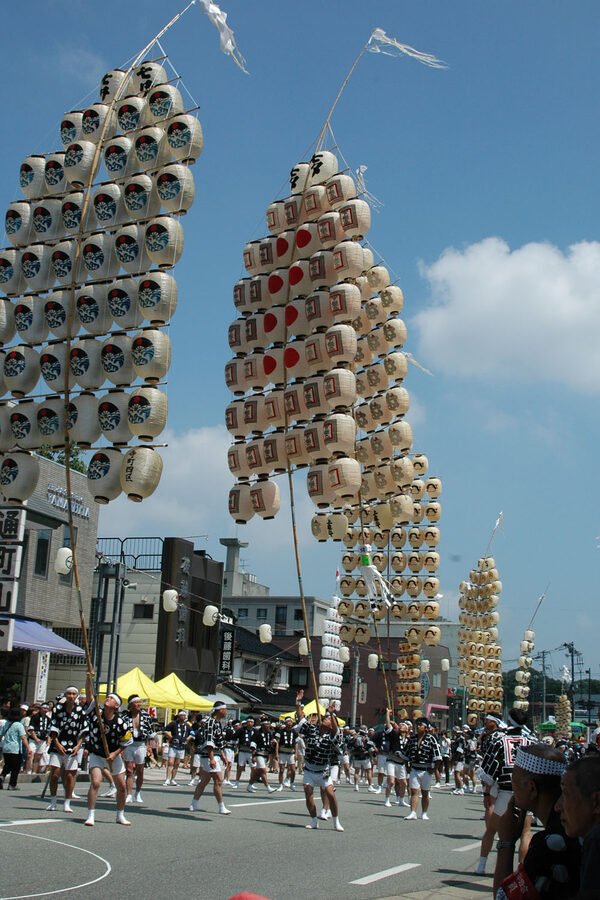
Practice happens year-round. Every neighbourhood has a community-hall practice space, and the local kantō-kai branch runs weekly sessions through the off-season. The youngest carriers train with yowaka poles in elementary school, graduate to kowaka in junior high, take chūwaka in high school, and only handle ōwaka after years of demonstrated stability with smaller poles. A first-time ōwaka carrier is usually around twenty years old.
The bamboo for new poles comes mostly from local Akita supplies, with each pole hand-built by a small workshop. The cost of a single ōwaka pole, fully fitted with crest-painted lanterns, is around ¥500,000. Sponsor support pays for most of it, but neighbourhood teams pool funds to maintain a pole stock of three to four poles each.
The nine-section extension challenge is something only a few teams have managed. The current record is a successful nine-extension performance during a recent night kantō, and the additional bamboo length adds about two metres of vertical reach without changing the lantern count. Each extension is decorated with a small wagasa (花傘) flower-pattern parasol or a fire-warden’s matoi (纏) banner.
Akita as a kantō stage
Akita the city is not large by Japanese standards, with a population of about 305,000. Kantō Matsuri brings about 1.1 million visitors during the four days, which means the city’s population effectively triples for the week. Hotel capacity in the central city is about 8,000 rooms, so most visitors come as day-trippers from nearby cities (Morioka, Sendai, even Tokyo) or arrive by train from the prefectures.
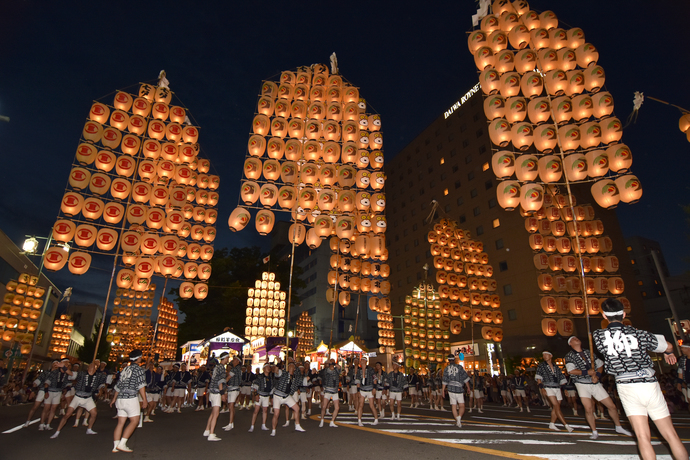
The infrastructure is built around this. Kantō Ōdōri is wide enough that pole carriers do not have to dodge audience seating, and the side streets are pre-staged with food stalls. The taiko-and-flute trucks parked at the edges are decorated for each town team. In the older days, before pickup trucks were common, the bayashi musicians played from manually-pulled hiki-yatai (曳き屋台) wooden carts. A few teams have started rebuilding the wooden carts in recent years for traditionalist reasons, which is the kind of revival you see across many older Japanese festivals.
You will see a moveable festival office, with kantō-kai staff in matching navy happi coats coordinating timings between teams. The whole thing runs on a long-rehearsed timetable, with each round of position-changes synced across all 250 poles to a few seconds. Watching that level of coordinated public performance is one of the things that distinguishes kantō from a lot of Japan’s other large urban festivals.
The festival, the city, and the harvest
Step back, and the whole thing makes sense as a four-day inversion. For most of the year Akita is a working agricultural and small-industry city. For these four nights, the central street becomes a stage for an athletic prayer about the rice harvest. The pole shape, the lantern colour, the rhythm of the bayashi, the “Dokkoisho!” calls, all of it is structured around the moment when rice plants set their grain heads and “take root” before harvest.
The closing gohei-nagashi ritual on 7 August completes the original neburi-nagashi loop. The paper streamers go onto the river, the laziness and bad spirits of summer go with them, and the rice plants are theoretically free to ripen for a successful September-October harvest. That is the agricultural reading of the festival, and it is the one most locals will give you if you ask why they do this.
The other reading is more straightforward: the festival is fun, and it has been for two and a half centuries, and that is enough. Carriers train all year for these four nights, and audiences come from all over Japan to watch. Heritage rituals do not have to mean only one thing. The kantō balances the prayer for rice, the technical athletic competition, the neighbourhood pride contest, and the four-night party, all on the same bamboo pole.
For first-time visitors
If you have never been, my advice is to come for at least two of the four nights. The first night is overwhelming because you do not yet know what to look for. The second night you start to identify positions, recognise neighbourhood teams, and follow the bayashi rhythm. By the third night the patterns make sense, and you can finally relax and watch the pole flex without worrying about what is about to happen.
Pack for hot, humid Tōhoku summer evenings, with mosquito repellent and a portable fan. Bring a small umbrella because rain showers happen and the festival continues through light rain (only heavy rain causes cancellation). Wear sturdy shoes because you will be standing for two and a half hours. Binoculars help if you have free standing-room seats and the pole tips are far away.
If you want to take pictures, the gold-hour glow happens around 18:30 to 19:00 just before the lanterns are fully lit. Long-exposure shots from a tripod work for the lit-pole formation moments, but you will need permission to set up tripods in the paid seating areas. Free-standing-room photography is usually fine without a tripod.
For lodgings, Akita View Hotel and Hotel Metropolitan Akita are both walkable to the festival route. Comfort Hotel Akita, Richmond Hotel, and the older Akita Castle Hotel are all in the central area. Outside central Akita, hotels in Tsuchizaki Port (about a fifteen-minute train ride) tend to have availability when the central city is sold out.
Beyond the festival
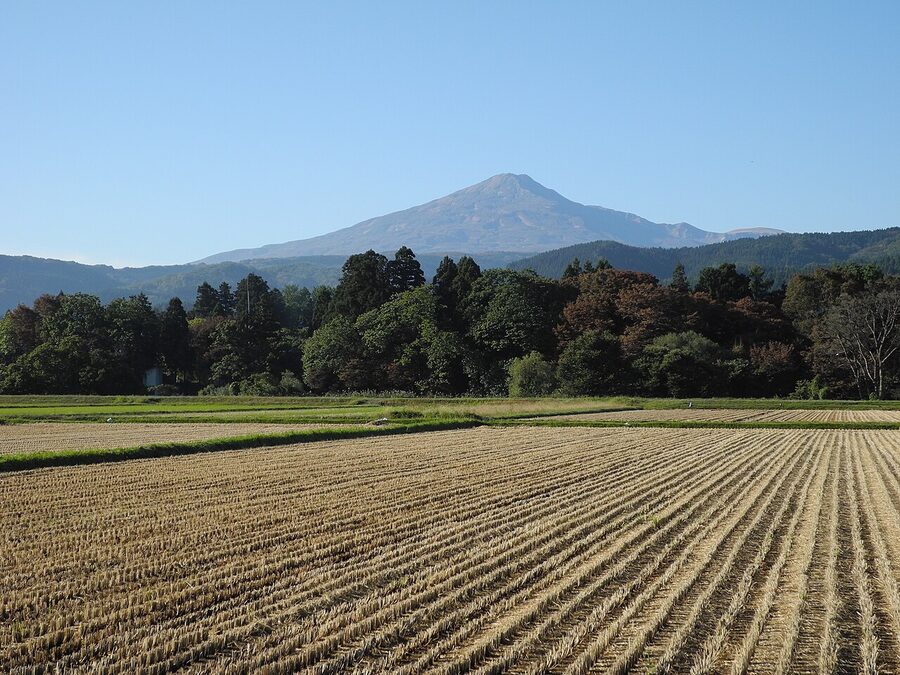
If you have time around the festival itself, Akita Prefecture has more than enough to fill a week. North of Akita is Nyūtō Onsen, a cluster of seven hot springs in the mountains, and Tazawako, the deepest lake in Japan. South is the Honjō plain along the Sea of Japan, with rice paddies and Mt Chōkai in the distance. East is Lake Towada, technically across the Aomori border, and the famous Oirase mountain stream.
If you want to compare festivals directly, you can travel between Akita and Aomori on the same day during festival week. The Tsugaru limited express service goes north from Akita to Aomori in about three hours and twenty minutes. Aomori Nebuta runs 2-7 August, so on 6 August (the last night of Kantō and the second-last of Nebuta) you can have lunch in Akita, take an early afternoon train, and watch Nebuta in Aomori that evening. Aomori Prefecture also has the surviving keep of Hirosaki Castle in its centre, an easy half-day side trip if you want to add a samurai-era anchor to your festival itinerary.
For broader cultural context, the kantō festival is part of a long Edo-era tradition where neighbourhood communities organised seasonal rituals as both worship and celebration. The same pattern produced Kyoto’s Gion Matsuri, Aichi’s Tsushima Tennō Matsuri, and dozens of other community-organised festivals across Japan. The Akita variant is unusual in that the central object is athletic skill rather than a fixed shrine procession or a parading float.
If you want to read more about the Edo-period background to all of this, the Satake clan that ruled Akita came to the area through the sankin-kōtai system after Tokugawa Ieyasu reorganised the daimyō map in 1602. They brought musical traditions, court culture, and administrative practices that shaped the kantō ceremony’s modern form, especially the bayashi music. And the agricultural prayers behind the festival connect back to the rice-cultivation cycle that has shaped spring blossom rituals across Japan for centuries.
The pole, one more time
Twelve metres of bamboo, forty-six painted lanterns, fifty kilograms of weight, balanced on the palm of one hand for as long as the carrier can hold it. That is the kantō. Around it, four nights of synchronised performance, a 270-year-old harvest prayer, a competition between Akita’s neighbourhood teams, and the sound of a flute that has been answering “Dokkoisho!” for ten generations.
Plan ahead. Book a hotel by mid-June, and take the Akita Shinkansen on 3 August or earlier. Watch at least two of the four nights from a paid grandstand if you can, plus one from a free standing-room area to feel the crowd.
Visit Neburi-nagashi-kan in the off-season if you want to see the poles up close without the crowds. And try kiritanpo, hinai-jidori, and babahera at the food stalls, because the festival’s culinary side is genuinely good.
The last time I left Akita after the festival, I noticed the kids on the train back to Tokyo were still humming the bayashi flute melody. That is the test of a festival’s hold on a city. Once you have heard the rhythm of “Dokkoisho! Dokkoisho!” against a flute on a hot August night, with forty-six paper lanterns balanced overhead on twelve metres of curving bamboo, you do not forget it.