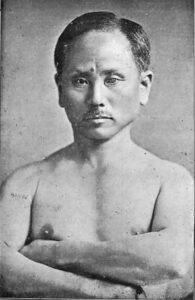
Morihei Ueshiba was officially rejected from the Imperial Japanese Army in 1903 for being half an inch under regulation height. He went home to Tanabe, tied weights to his ankles, and hung from tree branches by his arms for six weeks until he had stretched his spine enough to pass a second medical inspection. Forty years later, the same body that had to be physically lengthened to make the Russo-Japanese War minimum was being filmed in slow motion at his Tokyo dojo, throwing men twice his size with what looked, on the grainy 16mm reel, like nothing at all.
The art he eventually called aikido is younger than people think. The name itself was only formally adopted in 1942, when wartime authorities forced every Japanese martial school into a single umbrella organisation and asked Ueshiba’s people to pick a label. Before that the same techniques had been called Daitō-ryū aiki-jūjutsu, then Ueshiba-ryū, then aiki budō, drifting through three or four working titles in twenty years. The art that millions of people now train in worldwide existed under its current name for less than three decades while its founder was still alive.
I have been interested in aikido since the first time I watched an old man on a Tokyo mat throw a much younger student without seeming to move his arms. What I did not understand then, and what took me longer than it should have to work out, is how strange the art’s history actually is. Aikido has a parent style with a documented technical curriculum (Daitō-ryū). It has a religious founder figure (Onisaburo Deguchi) who was arrested twice for treason. It has a 1924 Mongolia incident, a 1942 wartime renaming, a post-war split into rival schools, and a single Hollywood movie that is still doing more for its global recognition than any of the actual masters. None of this is invented. Most of it sits in the public-domain photo archives.
In This Article
- Tanabe, the boy with the weak constitution
- Hokkaidō, and the man who walked in from the snow
- Ayabe, and the Omoto-kyō detour
- The Mongolia trip, and the cart of executed prisoners
- The Tokyo years, and the dojo full of admirals
- 1942, the name “aikidō,” and the retreat to Iwama
- After the war, and the picture book that built the brand
- The styles, and how they fell out with each other
- The techniques, and what they actually do
- The hakama, and how aikido looks on the mat
- Aikido next to its cousins
- Self-defence, and the limits of the art
- Steven Seagal, briefly, with care
- Where to see it, and how to start
- A note on the Edo and Meiji frame
- What I think it is, in the end
Tanabe, the boy with the weak constitution
Ueshiba was born on December 14, 1883, in Nishinotani village, which is now part of Tanabe city on the Pacific side of Wakayama Prefecture. Tanabe sits at the mouth of a river valley running back into the Kii Peninsula mountains, and is the gateway town for what is now the Kumano Kodō pilgrimage route. His father Yoroku owned good farmland and held a town council seat. His mother came from the Itokawa clan, an old Kii lineage with samurai pedigree.
By every account he was a sickly child. He read constantly, was sent for a while to a Buddhist temple to study, and was small enough that his father started him on sumo and swimming partly out of worry. The Itokawa side of the family had stories of a strong samurai ancestor that the father liked to tell at dinner. Whether or not that ancestor existed, the stories took root.
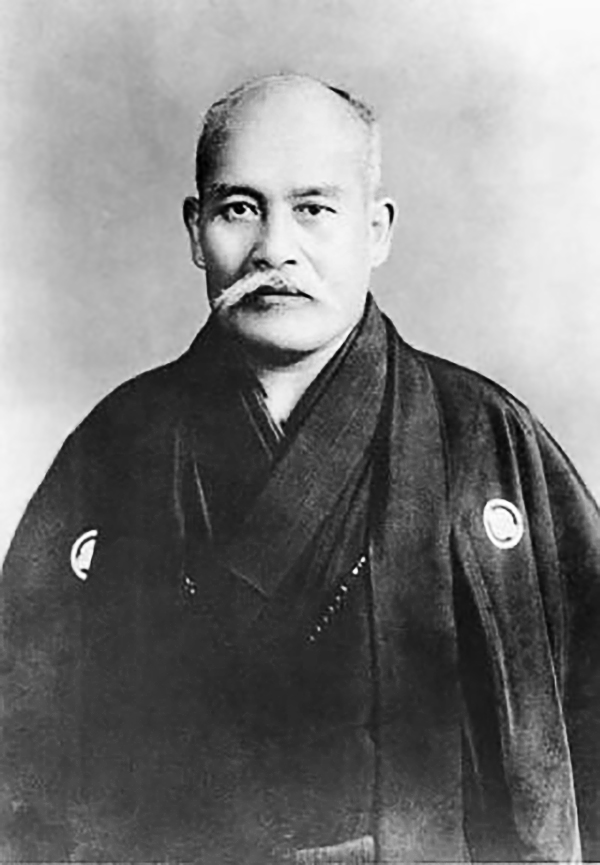
The army medical of 1903 told him he was 5 feet 2 inches and the conscription minimum was 5 feet 2.5 inches. The story I told you in the opening paragraph, the one about hanging from tree branches with weights, comes from his own later recollection passed down through Aikikai biographers. I do not know how literally to take it. What I do know is that he passed the second medical, served through the Russo-Japanese War, and was discharged a sergeant in 1907.
Between 1907 and 1912 he drifted. He tried farming, he tried local politics, he wrestled in village sumo competitions where he was apparently very hard to throw. Tanabe was small and getting smaller, and Ueshiba was looking for a project bigger than himself. The project that found him was Hokkaidō.
Hokkaidō, and the man who walked in from the snow
In 1912 Ueshiba led the Kishū Settlement Group, eighty-five families from Wakayama, north to a place called Shirataki on the Engaru river in north-central Hokkaidō. The Meiji government was pushing pioneer settlement programs to consolidate Japanese control over the territory, and Wakayama families with little land at home were a natural recruitment pool. Ueshiba was twenty-eight when the group set out and he led it with a kind of moral seriousness that older men remembered.
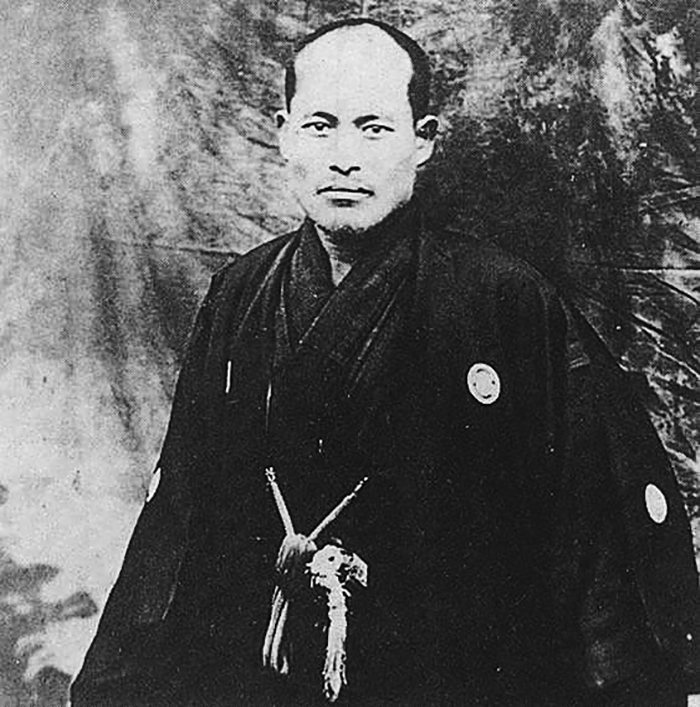
The first three years almost broke them. Crops failed, the winter killed two of the colony’s horses, and a 1917 fire took most of the housing. Ueshiba kept the group together by pivoting from farming to timber, and by 1918 the settlement had reached around 500 families and was sustainable. He was elected to the village council. He was, by Hokkaidō standards, a man of standing. Then in March 1915 he walked into a hot-spring inn in Engaru called the Hisada and met a small middle-aged man named Takeda Sōkaku.
Takeda was a touring martial arts instructor, almost a freelancer, who had been issuing Daitō-ryū teaching certificates to police academies and military officers around Hokkaidō for years. The Daitō-ryū system that he taught descended, in the family tradition, from the Aizu-domain palace techniques called oshikiuchi, the close-quarters joint-locking and immobilising work that bodyguards inside the daimyō’s residence were trained in. Whether Takeda actually inherited an unbroken Aizu lineage or whether he creatively reconstructed it from his own swordsmanship background under Sakakibara Kenkichi is still argued. What matters is that Ueshiba walked into the inn, watched Takeda demonstrate, and never went home again.
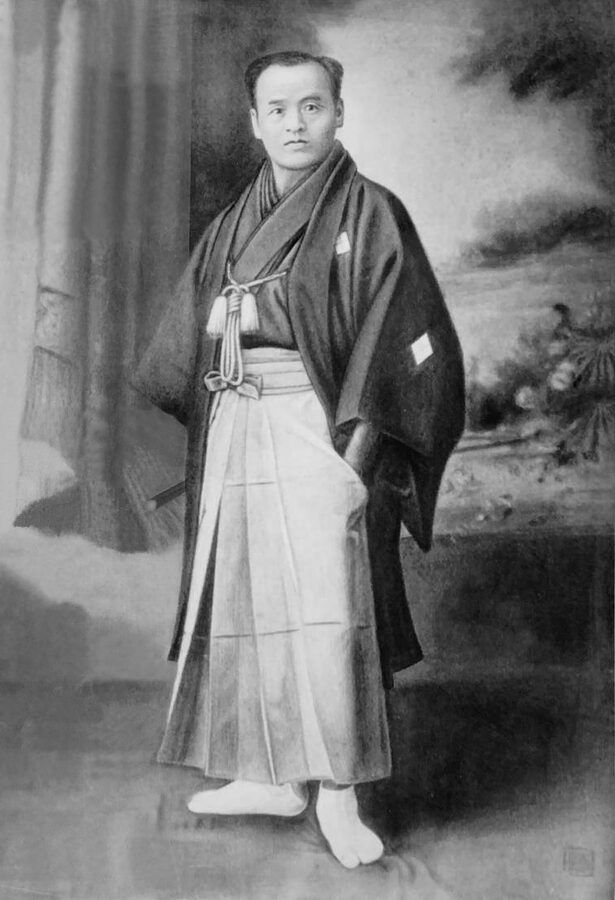
Or rather, he abandoned the work he had been doing for the Shirataki colony to study with Takeda in five-day intensives whenever Takeda passed through. By 1922, Ueshiba had earned a teaching license, the kyōju dairi, which entitled him to instruct the system on Takeda’s behalf. He kept paying Takeda fees and gifts well into the 1930s. The technical seed of every aikido school in the world today was planted at the Hisada inn by a small fierce man who almost no one outside Hokkaidō had heard of.
Ayabe, and the Omoto-kyō detour
In late 1919 Ueshiba received a telegram telling him that his father was dying back in Tanabe. He left Shirataki, sold his shares in the colony, and started south. On the way he diverted to Ayabe in Kyoto Prefecture to visit a religious group his father had been curious about. The group was Ōmoto-kyō, a Shinto-derived new religion led, since the death of its foundress Deguchi Nao, by her son-in-law Onisaburo Deguchi.
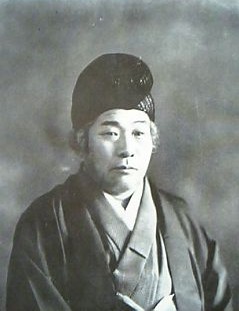
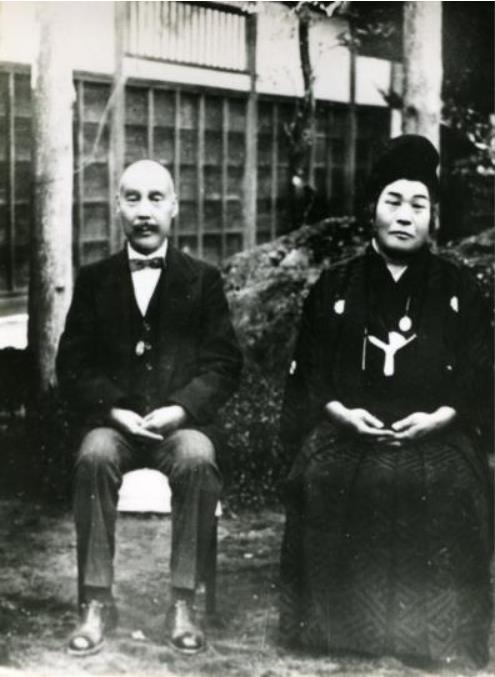
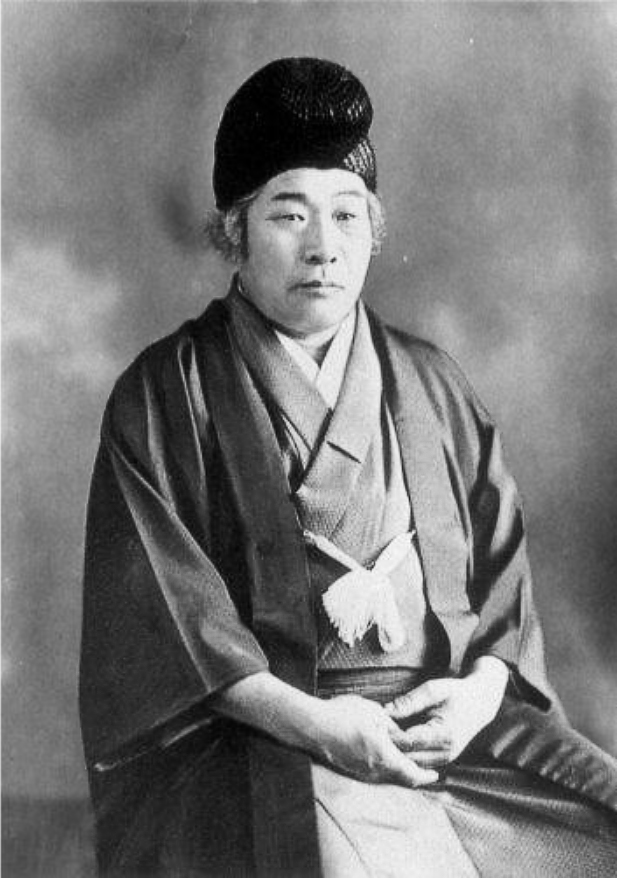
Onisaburo was a hard person to describe. He produced 81 volumes of channelled spiritual writing called Reikai Monogatari, painted thousands of tea bowls, recorded songs, learned Esperanto, and ran a movement that the Japanese government raided twice and tried to dismantle once. He claimed to have undergone an ascetic retreat on Mount Takakuma in 1898 and to have travelled to the spirit world. He had a habit of arranging his own funeral when he wanted publicity. He was charismatic in the way that builds and dissolves national movements inside thirty years.
Ueshiba arrived at Ayabe and the visit ran long. By the time he reached Tanabe his father had died. Onisaburo had told him, in their first meeting, that the spirit of Yoroku was already beside him and travelling south. Whether or not you take that literally, Ueshiba came back from his father’s funeral, sold the rest of his Hokkaidō affairs, and moved his family to Ayabe permanently in 1920. He set up a small dojo inside the Ōmoto compound called the Ueshiba Juku and started teaching what he had learned from Takeda to other Ōmoto adherents.
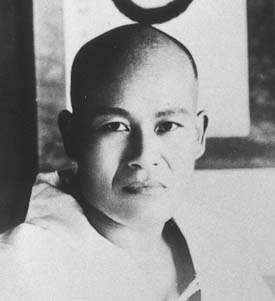
This is the period when aikido stops being a regional Daitō-ryū franchise and starts becoming something else. The technical content was still mostly Takeda’s. The framing was Onisaburo’s. Ōmoto-kyō teaching insisted that the universe was animated by a divine principle of harmony, that violence was a misalignment of the practitioner with that principle, and that human language itself, through a discipline called kotodama, could be used to access cosmic order. Ueshiba, who had spent his Hokkaidō years training to disable men by breaking their joints, started looking for a way to integrate that with a metaphysics of universal love.
The Mongolia trip, and the cart of executed prisoners
In February 1924, Onisaburo crossed into Manchuria with a small group of Ōmoto followers and Ueshiba as bodyguard. The plan, depending on who you read, was either to negotiate the establishment of a religious kingdom in Inner Mongolia, or to support a local Mongolian warlord named Lu Zhankui in a separatist project against the Beiyang government, or both. They travelled with letters of introduction from Japanese sympathisers, including some military attachés, and they crossed the border in disguise.
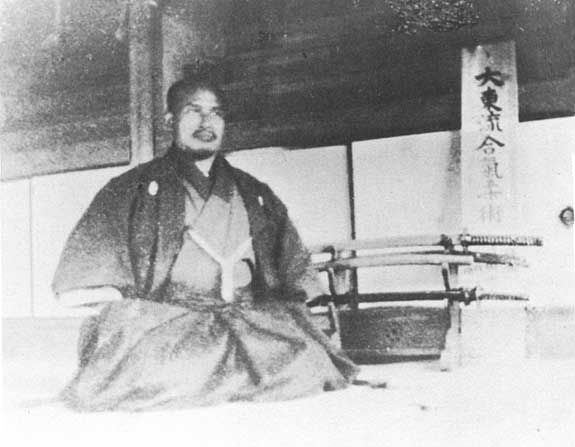
By June the group had been arrested by forces loyal to the warlord Zhang Zuolin, who controlled most of southern Manchuria and did not appreciate the destabilising of his patron territory. Lu Zhankui and several of his Mongolian officers were marched out and executed. Onisaburo, Ueshiba, and the rest of the Japanese were held in shackles in a Chinese town called Pailingmiao while the Japanese consulate negotiated their release. There is a photograph.
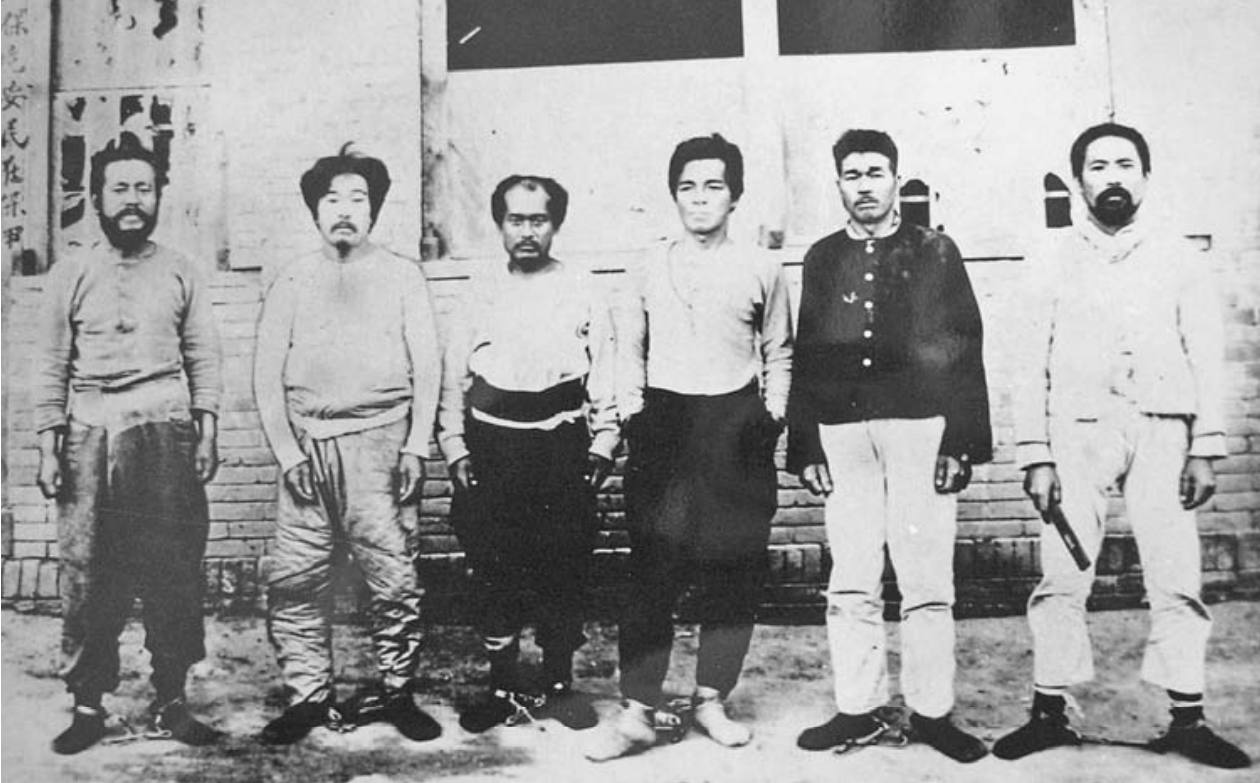
Ueshiba came back from Mongolia in mid-1924 changed. He told later students that the experience of being marched in line with men who had just been killed in front of him reset his understanding of what budō was for. The standard biography says he started speaking, around this time, of the moment when “I realised that the source of budō is divine love and that to study budō is to refine and clarify that love within yourself.” How much of that wording is later editing by the Aikikai and how much is contemporaneous I cannot say. The change in his teaching after 1924 is, however, well documented. He starts emphasising that the goal of the technique is to neutralise an attack without injuring the attacker, that masakatsu agatsu, true victory is self-victory, and that aiki is not a fighting principle but a principle of cosmic alignment.
The Tokyo years, and the dojo full of admirals
In 1925 Onisaburo released Ueshiba to take up an invitation from a retired admiral named Takeshita Isamu, who wanted him to demonstrate his art to senior naval and army officers in Tokyo. Ueshiba did the demonstration, the audience was impressed, and an aristocratic patronage network started to congeal around him. By 1927 he had moved permanently to Tokyo with Onisaburo’s blessing, and by 1931 he had opened the Kobukan dojo in Shinjuku.
The Kobukan ran a system that aikido old-timers called jigoku dōjō, the hell dojo, because the standards were murderous. Students were expected to take ukemi from full-power techniques, were expected to meditate at dawn, were expected to be available whenever Ueshiba felt like teaching. Several of the people who would later define every major branch of aikido learned the work in this room. Gozō Shioda, who would later found Yoshinkan, was a teenager throwing himself into mats here. Kenji Tomiki, the future Shōdōkan founder, was already a Kōdōkan judo black belt before he arrived.
The student list at Kobukan in the 1930s reads like a senior officer list of pre-war Japan. Princes of the imperial household trained here. Admirals trained here. The army’s Toyama gakkō officer school sent men. So did the Nakano spy school. Ueshiba taught at the Imperial Naval Academy, the Military Police academy, and the staff colleges. The art he was teaching had not yet been called aikidō, was still officially “aiki budō,” and was already absolutely embedded in the upper echelons of the Japanese military apparatus by the time war reached the Pacific.
This is the awkward fact that post-war aikido publications tend to handle delicately. Ueshiba was not a militarist. His personal correspondence shows a man horrified by the direction of Japanese imperial expansion. But the dojo was full of generals, and his living came partly from the army payroll. When you read aikido’s later philosophy of universal harmony you have to remember that the man writing it had spent fifteen years teaching joint locks to the people running the war.
1942, the name “aikidō,” and the retreat to Iwama
In 1942 the Dai Nippon Butokukai, the wartime umbrella body for all martial arts, decided to formalise the name of the various aiki schools. A bureaucrat named Hisatomi Tatsuo proposed “aikidō” as a generic, harmless-sounding label that could cover Ueshiba’s school and several smaller ones. Ueshiba was not enthusiastic about the consolidation. He resigned his Tokyo positions on the grounds of ill health and moved his family to a piece of farmland he had bought years earlier in Ibaraki Prefecture, in a small town called Iwama.
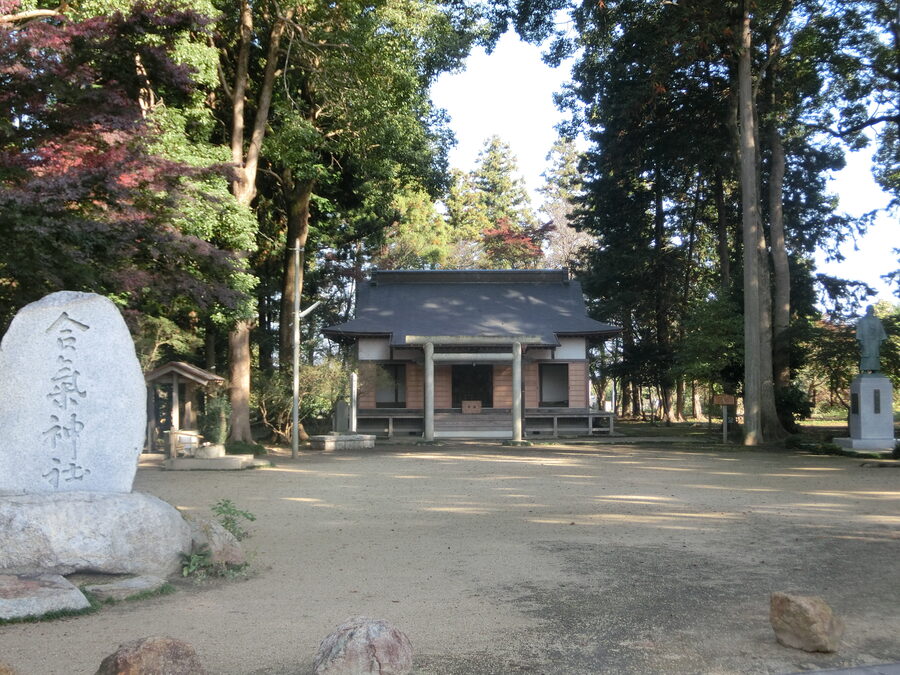
Iwama was supposed to be temporary. It became, instead, the place where Ueshiba did his deepest technical work. Between 1942 and his death in 1969 he split his time between Tokyo and Iwama and increasingly weighted toward Iwama. He cleared the land himself, built the Aiki Shuren dojo, and in 1944 consecrated the Aiki Jinja shrine on the same plot. The Iwama-period training is what most aikido masters point to when they want to claim direct succession from the founder, partly because the Tokyo classes after 1942 were largely run by Ueshiba’s son Kisshōmaru, not by Ueshiba himself.
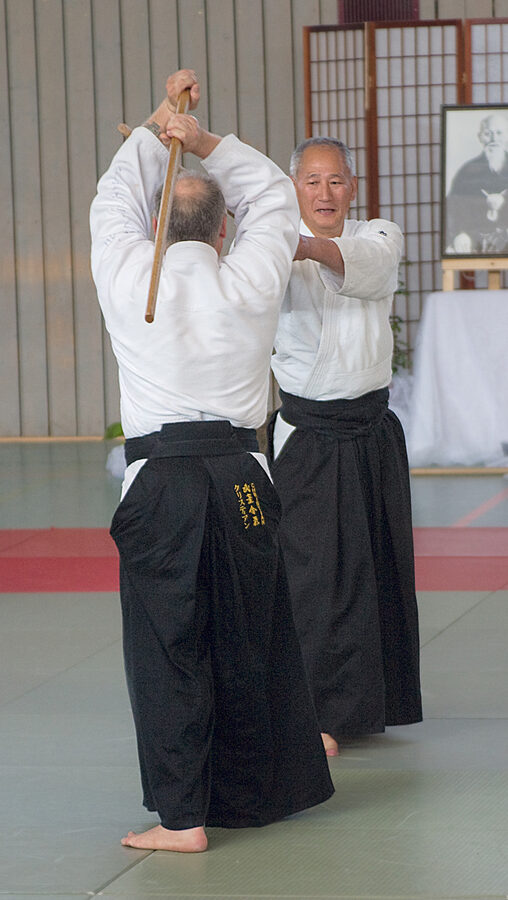
The Iwama curriculum that emerged is what people now call aiki-ken and aiki-jō, the sword and staff work, integrated with the empty-hand techniques. Morihiro Saitō, who began training under Ueshiba in Iwama in 1946 at the age of eighteen, was the student who systematised this body of weapons work and transmitted it. When you watch a modern Iwama-style class start with a sequence of suburi staff exercises, you are watching a curriculum that was assembled inside a half-converted farmhouse in Ibaraki during food rationing.
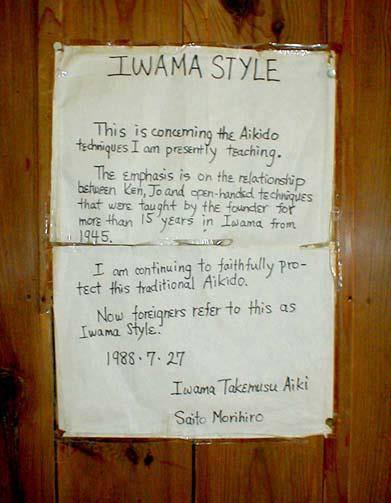
The Aiki Shrine is still there. You can take a JR Jōban Line train from Tokyo to Iwama Station and walk to it in about fifteen minutes. There is no ticket gate. The Saitō family still maintain it. People practise on the small grass area in front of the haiden, badly, on weekends, and no one minds.
After the war, and the picture book that built the brand
The Allied occupation banned most martial arts practice in Japan from 1945 onward. Aikido was technically not exempted, but the Aikikai handled the prohibition by simply describing aikido as a non-combative art of physical and spiritual cultivation. The Foundation was officially registered with the Ministry of Education on February 9, 1948, and from that date the name “aikidō” was the only label the headquarters used.
The breakthrough event for public visibility was a five-day demonstration at the Takashimaya department store in Nihonbashi in late September 1950. The Aikikai had a booth, Ueshiba’s senior students gave demonstrations on a roped-off mat, and the Tokyo press came. For the first time the techniques were being shown to a general non-military audience. Within a year, Aikikai branch dojos were opening in Osaka and Nagoya. The art was about to become something it had never been before, which was popular.
Through the 1950s and 1960s, aikido spread internationally in a pattern that would have surprised Ueshiba in 1924. Minoru Mochizuki gave the first European demonstrations in France in 1951. Kōichi Tōhei flew to Hawaii in 1953 to teach to the Japanese-American community there, and that became the bridgehead into the continental United States. By the time Ueshiba died in April 1969, aikido was being trained on every continent except Antarctica.
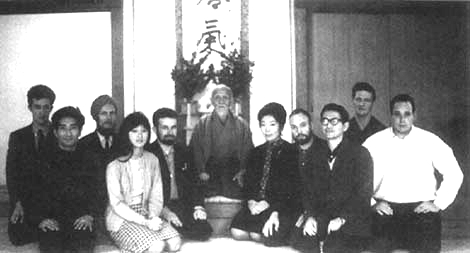
His final demonstration was on January 15, 1969, at the Aikikai’s New Year ceremony. He was already very ill and his son Kisshōmaru was visibly steadying him. He gave a short demonstration, made a brief speech about the necessity of continuing to refine the practice, and went home. He died of liver cancer at the Hombu in Shinjuku on April 26, 1969, at the age of 85. His ashes were divided. Most went home to Kōzan-ji temple in Tanabe. A portion was interred at the Aiki Jinja in Iwama. A portion stayed in Tokyo.
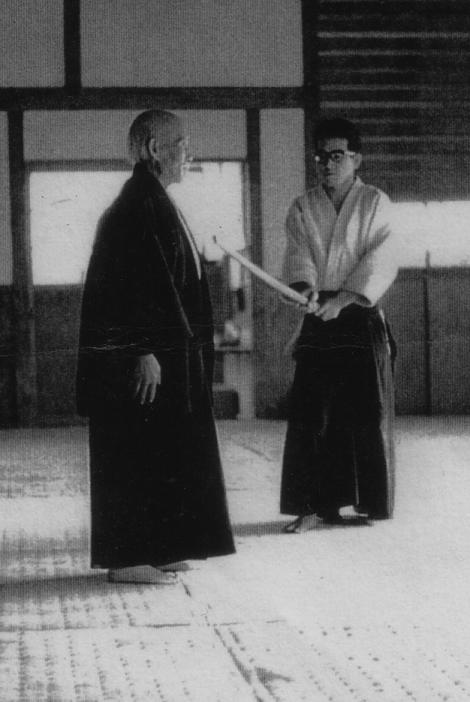
The styles, and how they fell out with each other
By the time Ueshiba died, his most senior students had already started codifying the art in mutually incompatible ways. Aikido today is not a single tradition. It is at least five major lineages and a long list of smaller offshoots, and the disagreements between them are not trivial. They are about whether competition is permissible, about how much spiritual content is core to the practice, about how the techniques should be taught, and about who has the right to certify rank.
The Aikikai is the largest and the original. Kisshōmaru Ueshiba succeeded his father as dōshu (master of the way) in 1969, and his son Moriteru took over in 1999. The Aikikai recognises about 100 foreign organisations across more than 40 countries through the International Aikido Federation, which was set up in 1976. If you train aikido and your federation does not call itself something else, you are almost certainly Aikikai.
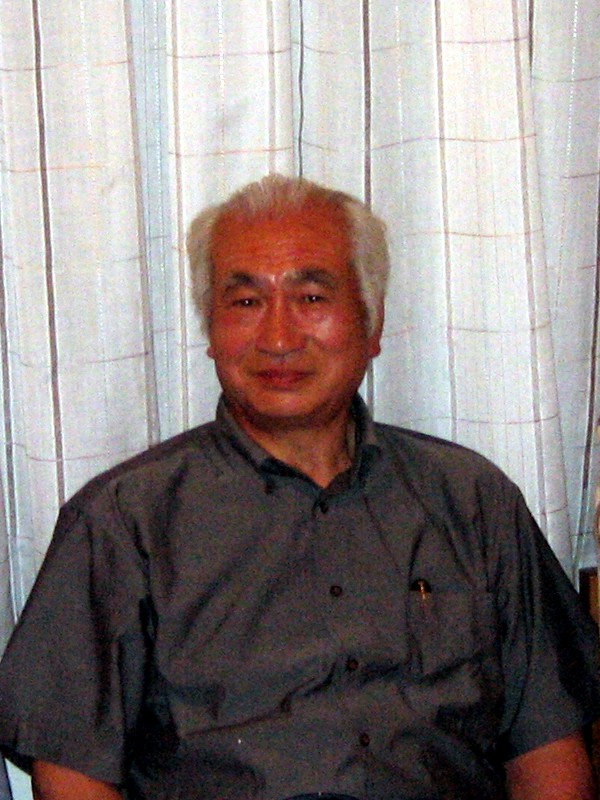
Yoshinkan is the second-largest. Gōzō Shioda founded it in Tokyo in 1955 with the explicit ambition of preserving the harder, pre-war Kobukan style of training. Where Aikikai post-war classes had drifted toward fluidity and softness, Yoshinkan kept the rigid stances, the named basic movements, the militarised drilling. The Tokyo Metropolitan Police’s senshūsei riot police program adopted Yoshinkan as its official curriculum in 1957 and is still run from the Yoshinkan hombu today. If you have ever seen footage of Japanese riot police restraining a protester at a Diet building demonstration, the joint locks they are using are Yoshinkan.
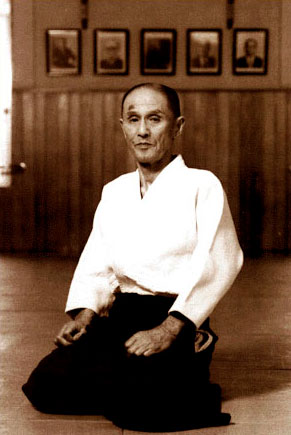
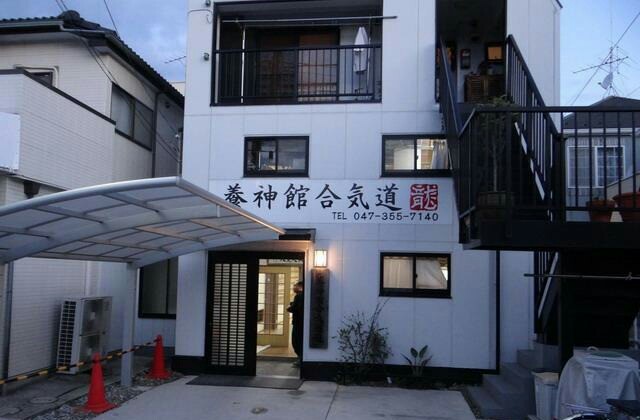
Tomiki, or Shōdōkan, is the controversial branch. Kenji Tomiki was a Kōdōkan judo black belt under Kanō Jigorō before he ever met Ueshiba, and when Waseda University asked him in 1953 to design an aikido curriculum suitable for student athletes, he did the unthinkable. He introduced competition. The Tomiki competition format uses a soft tantō knife and rules for scoring evasions and locks. Mainline Aikikai practitioners viewed this as a betrayal of Ueshiba’s explicit principle that aikido should not have a winner, and the rift has never really healed. Shōdōkan tournaments, however, are still held.
The Ki Society broke off in 1974, when Kōichi Tōhei resigned as the Aikikai’s chief instructor over what he considered an insufficient emphasis on ki development inside Aikikai pedagogy. Tōhei’s school, called Shin Shin Tōitsu Aikidō, focuses on ki extension exercises, breath training, and the principle of mind-body unification. It is large in Hawaii and on the US west coast, and it is essentially absent in Japan outside its Tochigi headquarters.
Iwama style, finally, is the lineage that runs through Saitō. It emphasises the weapons curriculum that Ueshiba developed at the Aiki Shuren dojo in the 1950s and 1960s, integrates the staff and sword work with the empty-hand throws, and treats the static technical foundations as non-negotiable before any flow practice. After Saitō’s death in 2002, his son Hitohiro broke from the Aikikai and set up an independent organisation called Iwama Shin Shin Aiki Shuren-kai that issues its own grade certificates.
The techniques, and what they actually do
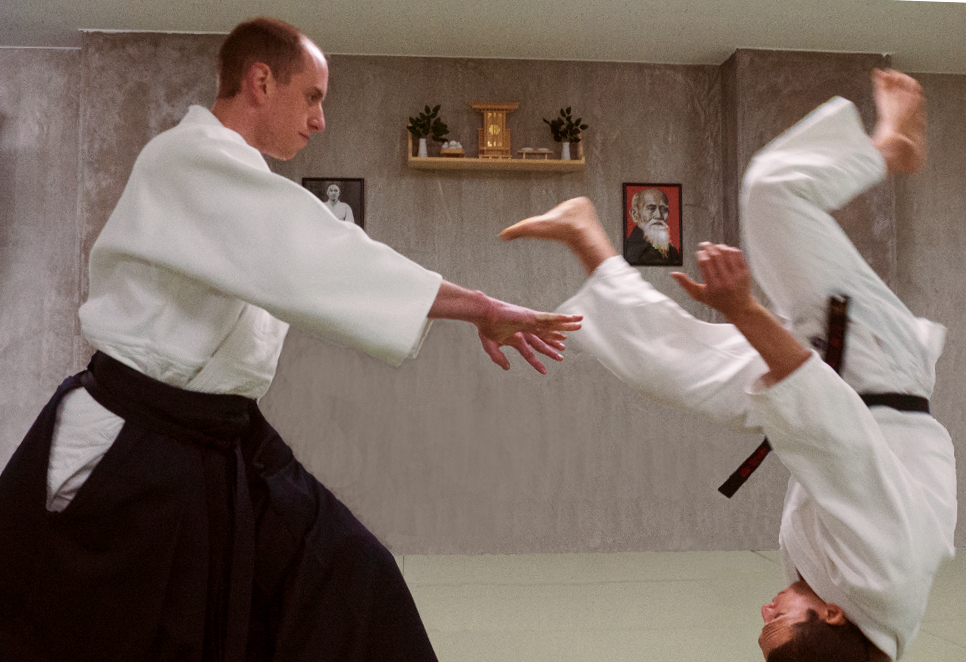
You can describe aikido techniques in two ways. The internal description uses the Japanese names. Ikkyō, first technique, is an arm bar against the elbow. Nikkyō, second, is a wrist lock that flexes the joint downward. Sankyō, third, twists the wrist while extending the arm. Yonkyō applies pressure to the inside of the forearm with a knuckle. Gokyō, fifth, is a variant of ikkyō used specifically when the attacker is holding a knife. There are five basic immobilisations, and most teaching dojos drill them in numerical order until you can do them in your sleep.
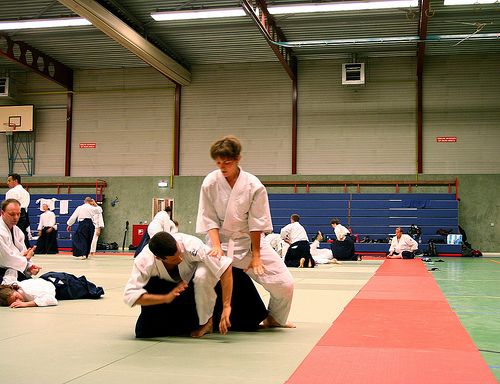
The throws are a separate set. Shihōnage, the four-direction throw, takes the attacker’s wrist and rotates it through 180 degrees of horizontal arc before bringing the arm back behind the head and dropping the attacker on their back. Iriminage, the entering throw, walks straight into the attacker’s space and clotheslines them with a forearm to the throat or upper chest. Kotegaeshi, the wrist return, takes hold of the back of the attacker’s hand and rotates it outward until the attacker rolls forward to escape the joint pain. Kokyūnage, breath throw, is a category of throws that work by timing rather than by joint pressure, and it is the one most aikidoka spend years trying to learn properly.
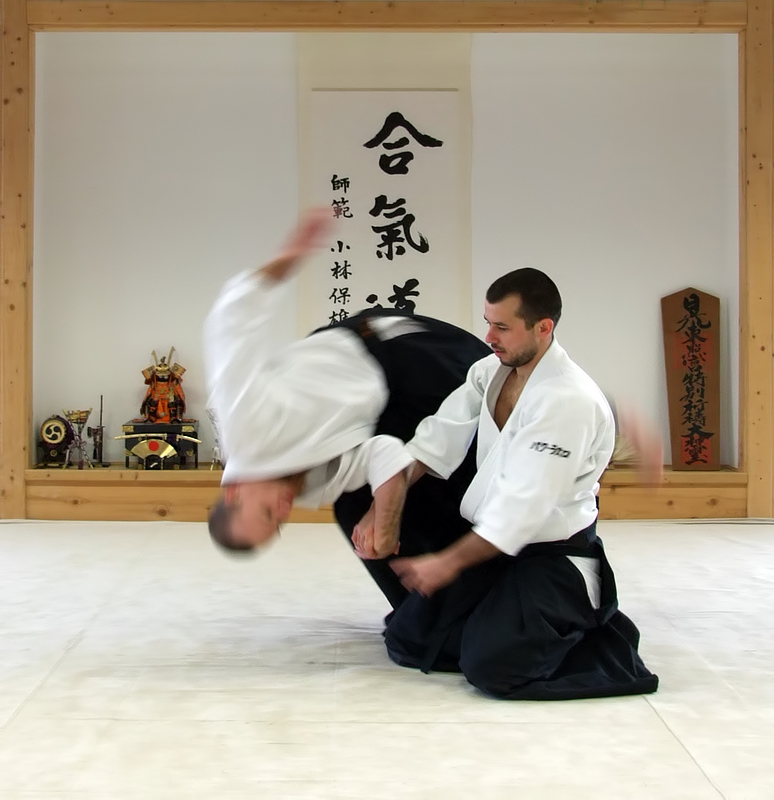
The external description, the one I would give if you had never seen a class, is simpler. The defender takes a step that puts them off the line of the attack. They place a hand somewhere on the attacker’s arm, and they keep walking. The attacker, who has committed to forward momentum and now has nothing to push against, falls. That is, essentially, every aikido technique. The internal name is just a label for which joint or which timing or which line was used to deliver the moment when there was nothing to push against.
The principles that cover all the techniques have proper Japanese names. Irimi is to enter directly. Tenkan is to turn around the attacker’s centre. Kuzushi is the moment you take the attacker’s balance. Aiki is the alignment of your timing and breath with theirs. None of this is mystical when you watch it on the mat, but it is hard to explain in writing without sounding mystical, which is part of why aikido has always had a reputation for being more talked about than understood.
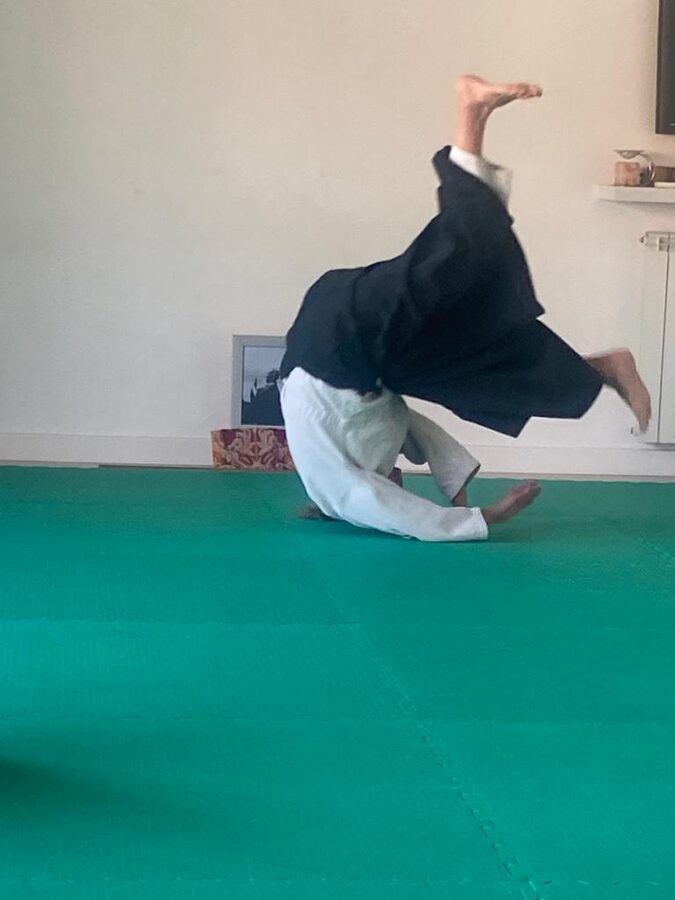
The hakama, and how aikido looks on the mat
Walk into a Japanese aikido class and the visual signature is the hakama, the wide pleated divided skirt that black-belt practitioners wear over their training trousers. The hakama is shared with kendo, kyūdō, and a number of older budō traditions. It descends from samurai formal wear and was kept on after the Meiji period for reasons that are partly aesthetic and partly practical. I wrote a separate piece on how samurai trousers were designed to hide the feet if you want the long version.
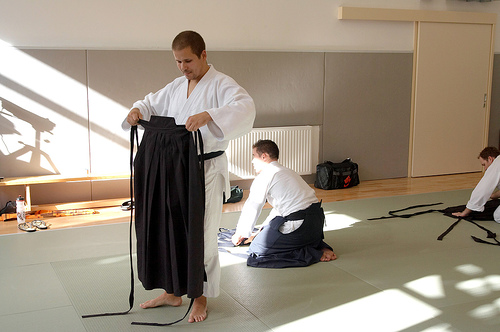
Aikikai dojos generally allow practitioners to start wearing the hakama from shodan, first-degree black belt. Yoshinkan typically requires it from the first day of practice. Some Aikikai schools, particularly women’s classes following older customs, let women wear it from the beginning of training, which is a residue of an earlier period when hakama was considered modesty wear for female students. The fold is identical regardless of style.
The training uniform underneath is called the aikidōgi or just dōgi, and it is similar to a judo uniform but slightly lighter. Aikido does not throw with the same grip-heavy gripping work as judo, so the cloth does not need to be as reinforced. The belt grading system runs from kyū grades (white belt, with coloured belts in some Western schools) up through ten dan ranks of black belt. Aikikai does not award tenth dan posthumously the way some Asian martial arts do. It does, very rarely, award ninth.
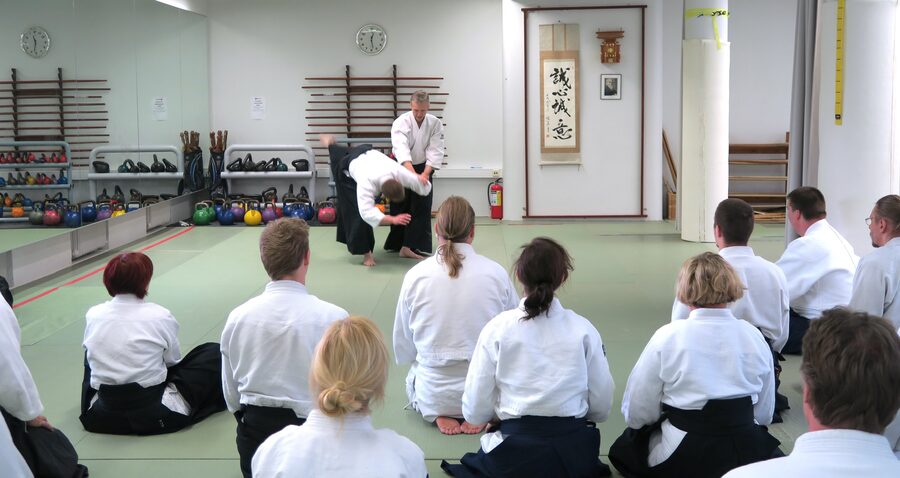
Aikido next to its cousins
It helps to position aikido against the other Japanese martial arts you might have heard of. Karate is from Okinawa and reached mainland Japan only in the 1920s. It is built around striking, with throws and joint locks as supplementary work. Aikido has almost no offensive striking. The atemi strikes that aikido does include are positioning tools to break the attacker’s posture, not finishing techniques, and most modern Aikikai practice underweights them deliberately.
Judo is the other big sibling. Kanō Jigorō founded the Kōdōkan in 1882 and built judo as a sportified, competition-friendly distillation of older jūjutsu schools. Judo and aikido share grappling roots and you will find the same ankle sweeps and hip throws in both, but judo’s whole pedagogical structure is built around randori sparring. Aikido is built around partner-based kata, and the schools that introduced randori (Tomiki) ended up isolated from the rest. The cleanest way to think about it: judo asks how you outfight your opponent under rules, aikido asks how you outflank them so they fall on their own.
Jūjutsu, the older umbrella for grappling and joint locking, is the closer parent. Daitō-ryū is technically a branch of aiki-jūjutsu, and aikido is technically a refinement of Daitō-ryū. The grandparent relationship is direct and well documented. The discipline I pair aikido with most often, though, is not another martial art at all. It is the tea ceremony. Both arts use repeated training in fixed forms to build a state of attention that is the actual point of the practice. Both, when done well, look like nothing happened. Sen no Rikyū, the sixteenth-century tea master, would have understood the Aikikai mat in about eight seconds.
The other discipline I would put aikido next to is the sword. Not just because Ueshiba’s late curriculum at Iwama added aiki-ken sword work, but because the geometry of every aikido technique is the geometry of the sword. The straight line of irimi is the same line a kenjutsu cut takes. The tenkan turn is the same turn a swordsman uses to clear an attack. If you have read the piece on how Japanese swords are mounted edge-up versus edge-down, the same body mechanics that distinguish a katana cut from a tachi cut are visible in the way an Iwama-style aikidoka enters and turns.
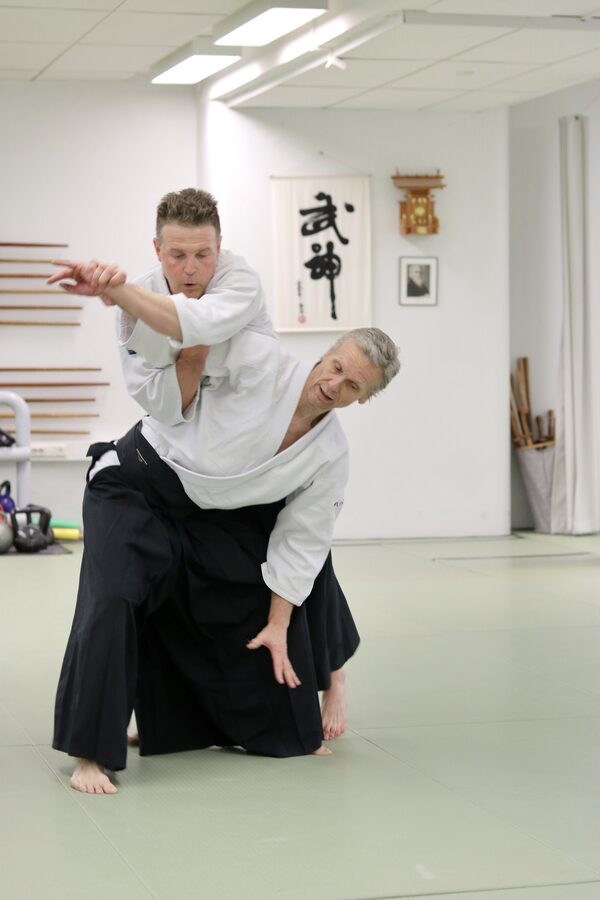
Self-defence, and the limits of the art
I have to be honest about this part. Aikido has a complicated relationship with self-defence claims. The art was built, in its Daitō-ryū roots, as a system for stopping a committed armed attacker without injuring them, and there is a respectable historical record of aikido masters who did exactly that. Ueshiba himself, several times in his pre-war career, demonstrated against Western boxers, against army officers attacking with bayonets, against armed police, and won every recorded encounter. The art’s effectiveness, in his hands, was not in question.
The problem is that what Ueshiba could do with his aikido is not what most modern Aikikai students can do with theirs, because the training has drifted. The post-war Aikikai pedagogy emphasises cooperation between attacker and defender, holds the attacker to predictable committed lunges, and rewards the defender’s flow over their effective control. This is fine if your goal is to train the principle. It is less fine if your goal is to be ready when someone shoves you in a bar.
The Yoshinkan school made its name partly by refusing to drift. The Tokyo Metropolitan Police senshūsei program runs eleven months of aikido as functional restraint training, and the police officers who graduate from it can use ikkyō to put a violent suspect on the ground in three seconds. Those officers can also testify that the techniques work. The Tomiki competition format, similarly, forces practitioners to train against a resisting opponent, which exposes the techniques to live pressure. The Aikikai mainstream, in my experience, mostly does not, and you should be honest with yourself about what training you are actually getting.
The deeper question, though, is what aikido is for. Ueshiba’s late writings explicitly repudiate self-defence as the goal. He wrote that the purpose of training is to refine the practitioner’s alignment with the universe, that the attacker should be considered an opportunity to practise non-injury rather than an enemy to defeat, and that the moment you train aikido for the purpose of winning a fight you have already abandoned what makes it different from karate. Whether or not you believe that, it is what he believed, and the modern Aikikai pedagogy reflects it.
Steven Seagal, briefly, with care
I have to address this because everyone asks. Steven Seagal is a 7th-dan Aikikai instructor who ran a dojo in Osaka through the 1970s and early 1980s before moving to Hollywood and becoming famous through the 1988 film Above the Law. His Japanese training was real. His instructor was Kiyoyuki Terada and he eventually opened his own school, the Tenshin Aikidō, in Osaka. He was the first non-Japanese to run a dojo in Japan during this period. His onscreen aikido in his early action films is technically recognisable, if dramatically exaggerated.
The complication is that Seagal’s later public conduct, both his personal life and his political affiliations, have made the aikido world reluctant to claim him as an ambassador. The Aikikai has not formally distanced itself from him, but the senior shihan I have spoken to in Tokyo over the years tend to change the subject when his name comes up. The art reached more Americans through Above the Law than through any single official source, and the art is uncomfortable with that fact. Both things are true, and you can hold them at the same time without either canceling out.
Where to see it, and how to start
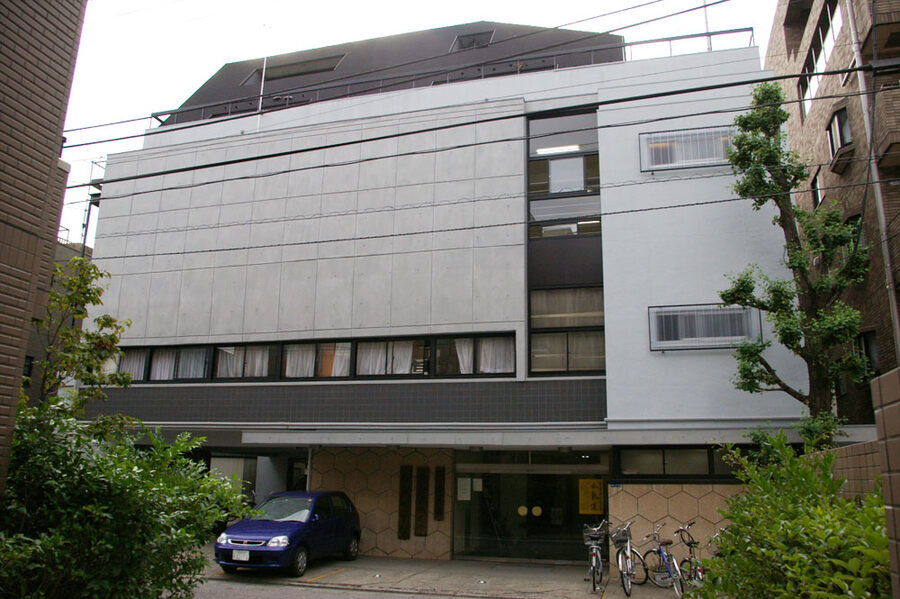
If you want to see real aikido in Japan, the order of priority is roughly Tokyo, Iwama, Tanabe. The Aikikai Hombu in Wakamatsu-chō, Shinjuku, runs morning, evening, and weekend classes that visitors can usually attend with permission from a home dojo. The training is in three rooms over multiple floors and the etiquette is fairly strict. You wear a hakama only if you are a black belt and you do not photograph during practice.
Iwama is more pilgrimage than training tourism. The Aiki Jinja shrine and the original Aiki Shuren dojo are about fifteen minutes’ walk from JR Iwama Station on the Jōban line. There is no entry fee. Take the train from Ueno, get off at Iwama, walk through the small post-town centre, and the shrine is at the back of a wooded plot on the right side of the road. The dojo next door is generally open during posted hours.
Tanabe in Wakayama is the deepest pilgrimage. The Tanabe city authorities have set up a small Ueshiba memorial near Kōzan-ji temple, where the founder’s main grave is. The walk from Kii-Tanabe Station is about twenty minutes through the old town. Combine it with the Wakayama gardens loop if you are visiting the prefecture for hanami or for the Kumano Kodō.
If you want to start training, the practical advice is simple. Find an Aikikai-affiliated dojo in your city. Watch a class first, because the styles vary and the right teacher matters more than the right organisation. Buy a basic dōgi. Plan to fall down at least three thousand times before you understand what the back of your shoulders should be doing. The art rewards the slow learner more than almost anything else I have tried, and the ones who quit fastest are usually the ones who came in expecting it to be a fight.
A note on the Edo and Meiji frame
One thing I have not mentioned is the political shape of the world the parent arts came from. Daitō-ryū’s Aizu-domain palace techniques were a product of the Tokugawa-era class system, in which samurai retained the legal monopoly on weapons but were obliged to live a sanctioned regulated life inside daimyō residences. The sankin-kōtai alternate attendance system kept those samurai trained, bored, and close to their lord, and palace martial arts like oshikiuchi were the answer to having too many armed men with not enough to do.
When the Meiji Restoration abolished the samurai class in 1869, those technical curricula went looking for new homes. Some went into the police academies, some went into the new military, and some, like Daitō-ryū, went into private hands and became travelling teaching circuits. Takeda Sōkaku’s career as a freelance instructor in the 1900s was only possible because the system that had produced his art had collapsed and the techniques were now portable. The samurai had ended in a rebellion led by Saigō Takamori in 1877, and the techniques he and his contemporaries had trained in were already, by the time Ueshiba was born in 1883, antiquarian.
The same Tokugawa context produced the law-and-order obsession of Tokugawa Tsunayoshi’s reformist regime, the gardens that Edo daimyō built as one of the few things they could legally spend their koku on, and the codified court cuisine that became the kaiseki served at modern tea ceremonies. Aikido is not a Tokugawa art. Aikido is what happens when an art that was specifically built inside the Tokugawa class system is rebuilt by a man whose own working life ran across the entire Meiji-Taishō-Shōwa span, and who was trying to make sense of something he had inherited from a world that no longer existed.
What I think it is, in the end
I keep coming back, when I think about aikido, to the moment in 1924 when Ueshiba was led out of a holding cell in Inner Mongolia and watched a column of his Mongolian colleagues marched the other way to be shot. He had a documented sword background, a Daitō-ryū teaching license, a mid-career body honed through the Russo-Japanese War, and the first signs of the spiritual conviction that Onisaburo Deguchi had spent four years deepening. He was 41 years old. He had every reason, when he came home to Japan, to teach what he had been taught and call it good.
Instead he took the next twenty years to slowly redirect the art toward the principle that the attacker is not an enemy. The aikido that I see on the Tokyo mats today, when I get to drop in on a Hombu class, is the result of that redirection. It is technically rich, it is sometimes self-defensively complacent, it is institutionally fractured, and it is one of the very few martial arts ever developed by anyone whose explicit goal was that the techniques never have to be used.
Whether the art will survive its second century is an open question. The Aikikai is institutionally healthy and the international federations are stable, but the average age in most overseas dojos is rising, and the schools that emphasise the spiritual content are not always the schools the next generation wants. If you are reading this and you have ever thought about training, my advice is the same as it has been since I started writing about Japanese arts. Find a class, watch it, and if anything in the way the practitioners move feels worth understanding, walk in once. The decision after that takes care of itself.
The art Ueshiba built from forty other arts is not really one art. It is a long argument that began in a Hokkaidō hot-spring inn, ran through a Mongolian prison camp and a wartime Tokyo dojo, was systematised by a son who wanted to keep his father’s work alive, and is now being maintained by a few thousand teachers around the world. It is, in the most literal sense, a working tradition. You can walk onto an Iwama mat tomorrow and feel the same techniques that were being practised in 1947, and that is, in itself, a small unlikely miracle.