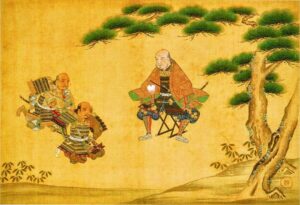
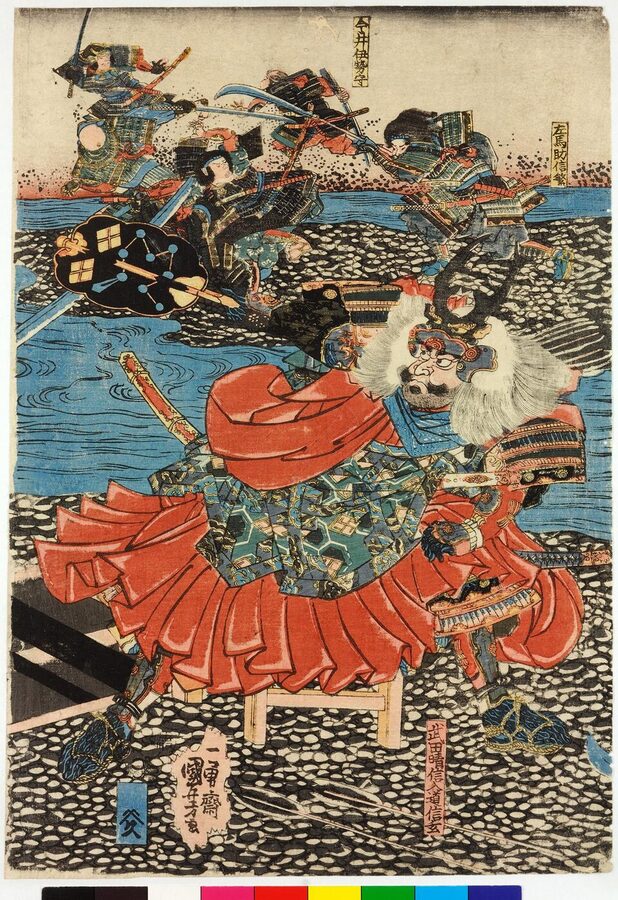
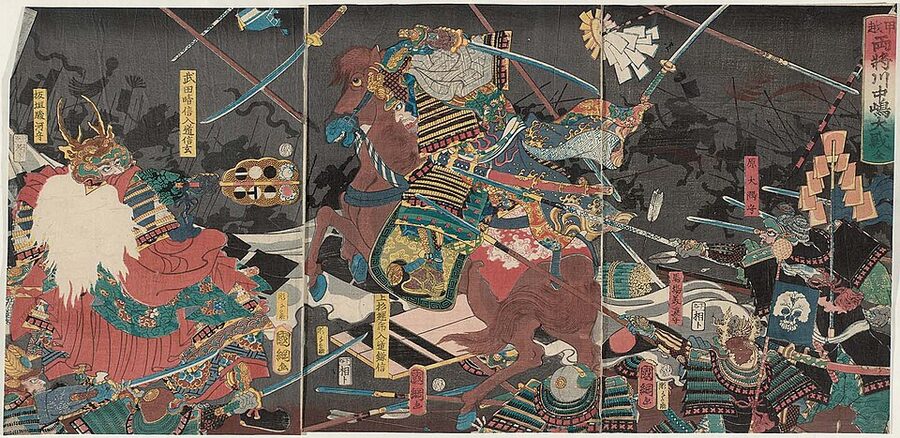
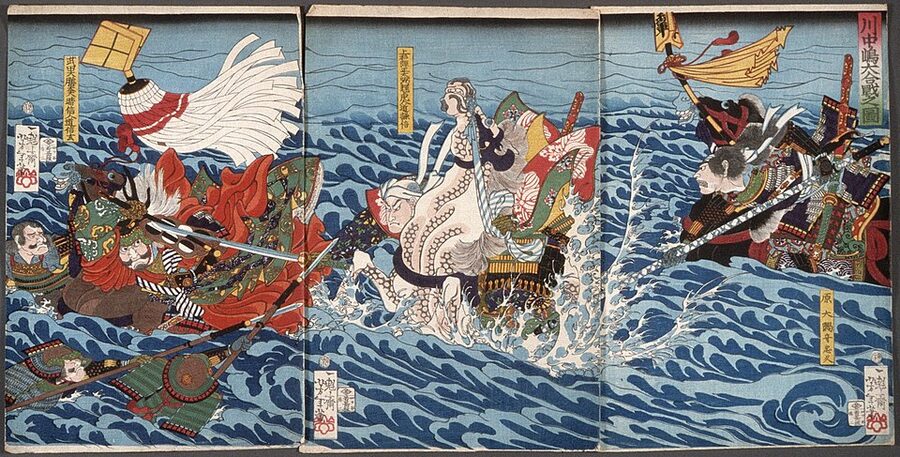
On the morning of 10 October 1561 — old lunar calendar; the Gregorian date is 28 October, though the Japanese sources will keep giving you the ninth day of the ninth month, Eiroku 4 — a Japanese warlord in a white head-cloth and dark robes rode his yellow horse straight through the Takeda headquarters line at Hachimanbara. He bypassed half a dozen of the country’s most experienced soldiers and brought his sword down three times on Takeda Shingen, who was sitting on a low camp stool and parrying with an iron war fan. A Takeda spear-retainer named Hara Torakichi drove a spear into the attacker’s horse; the attacker wheeled away and disappeared back into the general melee.
It was a few seconds of combat. The Takeda side insisted afterwards that it had happened. The Uesugi side disagreed about exactly where it had happened and what weapon Shingen had used to block. Both sides agreed that the man who had ridden in was Uesugi Masatora — who would, nine years later, take the tonsure and the dharma-name that posterity now uses: Kenshin.
It is the single most famous minute in Japanese military history. It is also, almost certainly, fiction. No confirmed contemporary source records the duel; the account comes from the Kōyō Gunkan, the Edo-era Takeda chronicle that was not written down until some forty years after the event.
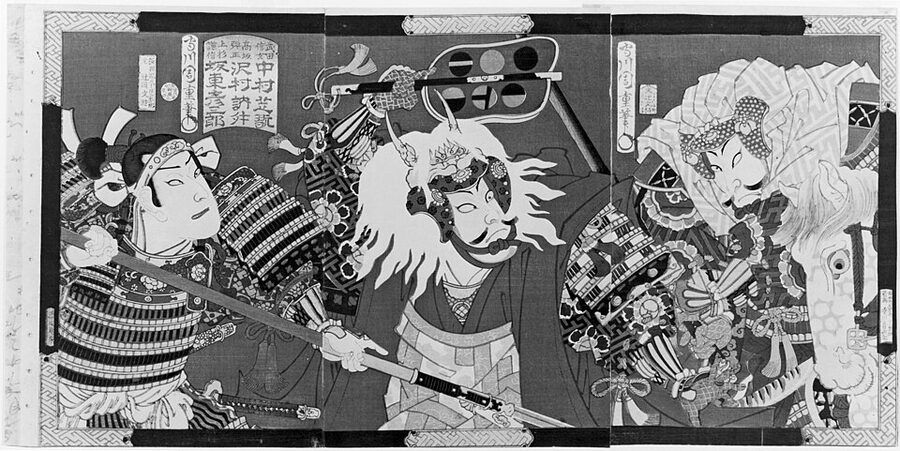
The Kantō regent Konoe Sakihisa, in a letter to Kenshin after the battle, wrote that Kenshin had himself drawn his sword in the fighting — which has been taken by most historians as at least circumstantial proof that something unusual happened. But the iron-war-fan-against-the-sword image is probably later dramatisation. Every ukiyo-e printer from Hiroshige onward drew the scene anyway, and every NHK adaptation films it. The single combat at Hachimanbara is the scene the 4th Battle of Kawanakajima is remembered for, and it is the scene I keep coming back to when I stand on the plain today.
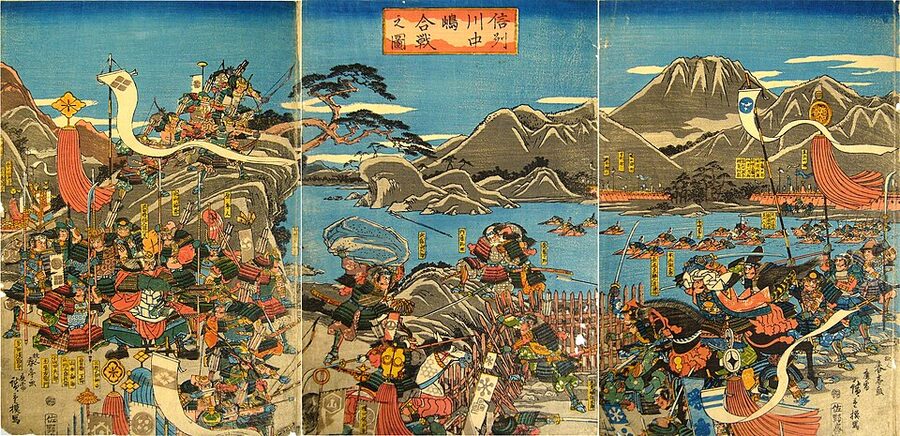
What Kawanakajima actually is, as a place, is a roughly triangular plain at the confluence of the Chikuma and Sai rivers on the southern edge of the modern city of Nagano. The name means “river-between-island” because the two rivers wrap around it on both sides and a sequence of smaller streams cut through the middle, so that in flood the flat ground does genuinely become an archipelago of drier patches. The Chikuma is the long one, coming out of the Kantō mountains; the Sai collects the water off the Hida range. They join just below Hachimanbara.
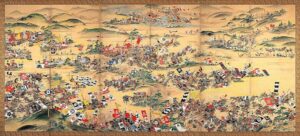
Between 1553 and 1564, twelve years, the two most militarily capable warlords of northern Japan fought each other five times across and around this plain, and never settled anything. I have walked Hachimanbara once in October, which is the anniversary month of the decisive fourth battle, and once in January in deep snow, and the weather on both visits told me more about the campaign than any of the Edo-era screen paintings.
The plain is wide and wet. It floods. In autumn a thick river-fog can sit on it until eight or nine in the morning. The strategic problem that neither man was ever able to solve was the same problem the physical landscape poses to any commander: you cannot manoeuvre here without your enemy seeing you, and you cannot sit still here without him coming down off the hills.
In This Article
- The Tiger and the Dragon
- The first battle, 1553 — Fuse
- The second battle, 1555 — two hundred days on the Sai
- The third battle, 1557 — Uenohara
- The fourth battle, 1561 — Hachimanbara
- The night of 9 October — Kenshin reads the smoke
- Morning on Hachimanbara — the duel and the generals who died
- Casualties, claims, and what was lost
- The fifth battle, 1564 — and the long fade
- Cultural afterlife — the kabuki stage and the Mifune films
- Where to visit the Kawanakajima battlefield today
- Hachimanbara Historical Park, Nagano
- Matsushiro Castle — the former Kaizu
- Saijō-san — Kenshin’s command post
- Zenkō-ji temple — the relocated buddha
- Hachimanbara in winter
- For the Kai side — Erin-ji and the Kōfu Takeda sites
- Closing — the horseman in the white cloth
The Tiger and the Dragon
Before I take you through the five battles, the two men. I have covered each at full length elsewhere — the Shingen and Kenshin biographies on this site are both recent, both long — so what follows is shorthand.
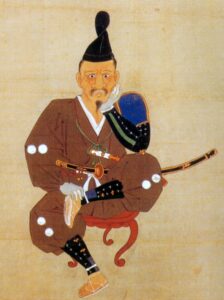
The Tiger of Kai was Takeda Harunobu, who took the Buddhist name Shingen in 1559 after receiving novitiate orders. Born 1521, the nineteenth head of the Kai Genji Minamoto line, he ran a landlocked mountain province with no coastline and no direct access to the Sakai trade routes, and he built it up into a military machine that scared everyone around him. By 1553 he had conquered almost the whole of Shinano Province. That conquest is what brought him onto Kenshin’s doorstep.
The Dragon of Echigo, or Tiger of Echigo depending on which chronicle you read, was Nagao Kagetora, who would adopt the Uesugi surname in 1561 from the deposed Kantō regent Uesugi Norimasa and would, nine years later, take the Buddhist name Kenshin. Born 1530, nine years younger than Shingen, he had unified Echigo Province by age twenty-one and ran it as a zealot for Bishamonten, the Buddhist war-god, whose single character he flew on his battle-banners in place of a Chinese classical motto. The two men were the first and second tier of the Sengoku military imagination: Shingen the Sun Tzu reader with the four-character Fūrinkazan banner; Kenshin the Buddhist fanatic who believed, literally, that Bishamonten was fighting alongside his cavalry.
The reason they ended up at Kawanakajima specifically is that Shingen’s Shinano conquests pushed a stream of refugee lords north into Echigo. Murakami Yoshikiyo, whose stronghold at Katsurao Shingen had taken in 1553, ran to Kenshin. So did the Takanashi, the Ogasawara remnant, the Suda, most of the northern Shinano barons.
Kenshin intervened as their protector. You can read the campaign, from the Uesugi side, as a principled defence of petitioning lords; from the Takeda side, as meddling in a consolidation that was finished but for the last ten miles. Both readings are correct. That’s why the fighting went on for twelve years.
The first battle, 1553 — Fuse
The 1st Battle of Kawanakajima, called either Fuse (布施) or Sarashina-Hachiman (更科八幡) in the Japanese sources, was not really much of a battle. It was a short campaign that ran from the summer to the autumn of Tenbun 22, 1553 in the Julian calendar, after Takeda Harunobu pushed Murakami Yoshikiyo out of Katsurao Castle and seized his Shinano domain. Yoshikiyo, who was related by marriage to the Takanashi family and through them to Nagao Kagetora, rode north to Echigo and asked for military support.
Kagetora sent him back into northern Shinano with five thousand Echigo troops in May. Yoshikiyo briefly recaptured Katsurao. Then Harunobu counter-attacked with the main Takeda army, pushed the Uesugi-backed coalition out again, and Yoshikiyo fled back to Echigo for the second time.
On 1 September Kagetora himself crossed the border with the bulk of his army, beat a Takeda vanguard at Fuse, modern Shinonoi ward of Nagano city, and pushed as far south as Araito Castle. Harunobu declined the general engagement Kagetora wanted; sat it out in Shioda Castle; Kagetora, unable to force a decisive battle, pulled back to Echigo on 20 September. Harunobu went home to Kōfu on 17 October. Neither side held much new ground, but neither had lost decisively either.
The political result of the 1st Battle mattered more than the military one. Kagetora had not won back Yoshikiyo’s ancestral domain, but he had established that he would intervene in northern Shinano, and he had prevented the remaining unaligned lords there from collapsing toward Harunobu en masse. The Takeda had taken the whole of Sarashina and Hanishina districts, including Murakami’s home base Katsurao, which was now a forward operating position from which further northern campaigns could be launched. The ground-truth was that Shinano was now effectively Shingen’s, but the last ten miles to the Echigo border were going to cost.
The second battle, 1555 — two hundred days on the Sai
The 2nd Battle, known as the Sai-gawa no Tatakai (犀川の戦い), is the only one of the five that was actually fought on the Kawanakajima plain proper. It was also, by some distance, the longest and the dullest. Harunobu had just completed the Kai-Sō-Sun Triple Alliance with the Late Hōjō in Sagami and the Imagawa in Suruga — the Kōsō Sun Sangoku Dōmei of 1554 — which secured his eastern and southern flanks and freed him to push north. He incited a rebellion by Kagetora’s senior retainer Kitajō Takahiro, which Kagetora put down but at cost; and in 1555 the Takeda-aligned Zenkō-ji monk-general Kurita Eijū seized the Asahiyama fortress overlooking the plain.
Kagetora marched south in April. He could not ignore Asahiyama and cross the Sai river to engage the Takeda main body, because leaving the fortress intact behind him would let the garrison cut his line of retreat. So he built a counter-fortress at Katsurayama, facing Asahiyama across the Susobana river, to pin the Takeda garrison in place.
Harunobu then arrived with reinforcements and dug in on the south side of the Sai. The two armies faced each other across the river from July 1555 until late October. On 19 July a Uesugi force crossed the Sai and engaged, inconclusively; thereafter both armies sat.
The standoff ran for more than two hundred days. The Takeda army had the longer supply line and felt it first — rice and fodder had to come up the Tōsan-dō road through the Shinano valleys. The Uesugi army had internal morale problems of its own; Kagetora demanded oaths of loyalty from his senior commanders in August, which is the kind of thing a general does when he is worried about desertion.
In the 10th intercalary month (閏10月), roughly early December 1555, Imagawa Yoshimoto, who had his own reasons for not wanting his Takeda ally wasting his army on the northern frontier, brokered a negotiated settlement. Harunobu agreed to restore the northern-Shinano lords Suda, Inoue, and Shimazu to their original domains and to dismantle the Asahiyama fortress. Kagetora retained practical control of the northern half of Kawanakajima. Both armies pulled out.
The 2nd Battle is the one that established the real tactical shape of the rivalry. Neither man was willing to throw his army at the other in a decisive open engagement if he didn’t have overwhelming positional advantage. Kagetora wouldn’t cross the river without Asahiyama neutralised. Harunobu wouldn’t cross the river under the Uesugi guns at all.
What happened, nine years later at the 4th, was an exception. The rule was what you are looking at here — two exceptional generals, across a river, declining to die for Shinano.
The third battle, 1557 — Uenohara
The 3rd Battle, known as the Uenohara no Tatakai (上野原の戦い), ran through the summer of Kōji 3, 1557, and is if anything even less satisfying to write about than the 2nd. The Takeda spent the winter of 1556 taking the Nagao-aligned Amakazari Castle in Minochi district, then pushed on to threaten Iiyama — Takanashi Masayori’s home base, and effectively the northern frontier of the Uesugi sphere. Kagetora, delayed by the spring snow, mobilised on 18 April and moved south through Zenkō-ji to reconquer the Nagao-aligned castles the Takeda had taken that winter.
He pushed as far south as Iwa-no-hana, near the Hanishina-Chiisagata border. Harunobu declined the pitched battle Kagetora wanted; held his positions around Shioda and waited. The Late Hōjō of Sagami sent reinforcements under Hōjō Tsunashige to Ueda, pinning Kagetora’s line of retreat.
In late August the Takeda finally engaged the Uesugi at Uenohara, a hamlet near the Motodori-yama fortress in Minochi district — modern Nagano city. The encounter was inconclusive. Kagetora withdrew to Iiyama in September, Harunobu returned to Kai in October. Neither side had reopened the strategic question — Kawanakajima’s northern border was still somewhere in between, and nobody was sure exactly where.
The 3rd Battle is historically interesting chiefly for its diplomatic consequences. Shōgun Ashikaga Yoshiteru, in Kyoto, tried to broker a Takeda-Uesugi peace using the Shinano Protectorate as a carrot for Shingen — who was formally appointed Shinano Shugo on 16 January 1558.
Yoshiteru also encouraged Kagetora to travel to Kyoto, which he did in 1559. Yoshiteru appointed Kagetora as Kantō Kanrei deputy and Uesugi family heir, with formal rights over northern-Shinano lord dispositions — a diplomatic award that gave Kagetora an outright shōgunate-endorsed legal basis for continuing to fight Shingen over Kawanakajima. None of this made the actual border situation more stable. What the Kyoto decisions did was give Kagetora a stronger theoretical argument for intervention, which he would use two years later to spectacular effect.
The fourth battle, 1561 — Hachimanbara
When Japanese sources say Kawanakajima no Tatakai without a qualifier, they mean the fourth. The 4th Battle of Kawanakajima is the single engagement that is reconstructed in minute tactical detail in every reader of Japanese military history, and it is the engagement the entire cultural inheritance of the rivalry rests on — the kabuki plays, the NHK Taiga dramas, the Inagaki and Kurosawa films.
It is also the battle for which our primary source is thinnest. Most of the specific tactical choreography — the Kitsutsuki Woodpecker Strategy, the night crossing of the Chikuma, the kuruma-gakari rotating formation, the war-fan duel — comes from the Kōyō Gunkan, which was compiled decades after the event. The contemporary evidence is limited to a handful of after-battle commendation letters and Konoe’s letter to Kenshin. The historical consensus is that a major engagement happened at Hachimanbara around 10 October 1561 and that casualties on both sides were severe; the specific choreography may be Edo-period reconstruction.
What is certain is the strategic context. Kagetora had, in the spring of 1561, mounted a full-scale invasion of the Late Hōjō sphere in the Kantō plain, besieged the Hōjō stronghold at Odawara with a coalition army of ten thousand-plus, and, on the Hachiman Shrine platform at Kamakura on 28 April, accepted the formal handover of the Uesugi surname and the Kantō Kanrei deputyship from the deposed Norimasa. From that date he was Uesugi Masatora. He lifted the siege of Odawara in May (the castle was too strong and some of his coalition partners deserted), pulled north, and by August was back at Kasugayama.
While Masatora had been in the Kantō, Shingen had used the breathing space to strengthen his Kawanakajima position. He built Kaizu Castle, now Matsushiro Castle, at the eastern edge of the plain, putting Kōsaka Masanobu in command with an 8,000-strong garrison.
The castle was a direct existential threat to Masatora’s position in northern Shinano: any future Kantō campaign would now have to be launched with Kaizu sitting on his supply line. Masatora’s choice was to attack Kaizu before it became permanently established, or to accept that the strategic window in the Kantō was closing. He chose to attack.
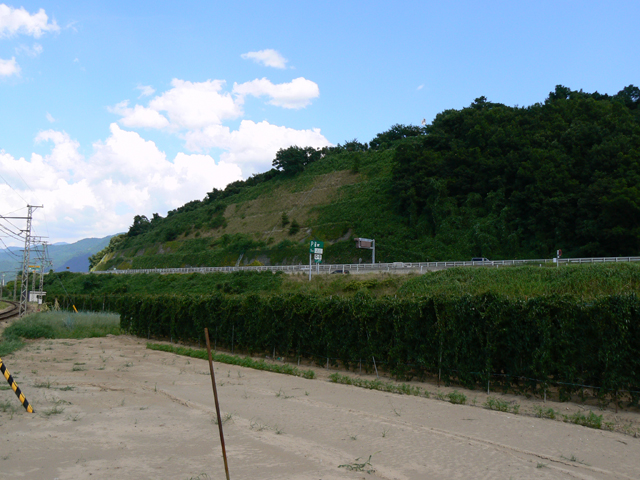
Masatora left Kasugayama in the 8th lunar month. He passed through Zenkō-ji, dropped five thousand troops and the supply train there, and took the remaining thirteen thousand south across the Sai and the Chikuma to Saijō-san — a mountain across the Chikuma from Kaizu Castle, maybe three kilometres east of the plain’s southern edge. From Saijō-san he could see Kaizu’s cooking fires and count the garrison’s daily troop movements.
Shingen, alerted by Kōsaka from Kaizu, set out from Kōfu on 16 August with twenty thousand men. He moved into the Chikuma valley on the 24th, eventually concentrating at Chausuyama on the western edge of the plain — and then, on the 29th, across the open Hachimanbara plain into Kaizu Castle itself. Kaizu plus Chausuyama now boxed Saijō-san in on two sides.
The two armies sat across from each other for ten days. Shingen had more men, twenty thousand against thirteen, and he held Kaizu. But Masatora held the higher ground, and Kawanakajima in late September is a place where a wet night can make any crossing of the Chikuma dangerous.
What the Edo chronicles say is that Shingen, under pressure from his senior retainers who wanted a decisive engagement, ordered Yamamoto Kansuke, his one-eyed strategist, to propose a plan. Kansuke, in consultation with Baba Nobufusa, proposed what became known as the Kitsutsuki Gakari, the Woodpecker Strategy.
Split the army. Send twelve thousand men on a night march up Saijō-san to attack the Uesugi position at dawn. Keep the remaining eight thousand on the Hachimanbara plain in kakuyoku, the Crane’s Wing defensive formation, waiting.
The Saijō-san attack would drive the Uesugi down off the mountain and into the plain, where the waiting main body would crush them. The woodpecker taps the tree, the insect flies out, the second bird eats it.
The night of 9 October — Kenshin reads the smoke
On the night of the ninth day of the ninth lunar month — 9 October 1561 in the Julian calendar, 27 October in the Gregorian — Kōsaka Masanobu and Baba Nobufusa led a twelve-thousand-strong detachment out of Kaizu and up the Saijō-san approach. Shingen took the remaining eight thousand across to Hachimanbara and deployed them in the Crane’s Wing. The plan required that Masatora be still on Saijō-san at dawn. What the Kōyō Gunkan says, and what has entered every subsequent retelling, is that Masatora, watching Kaizu’s cooking fires from his command post, noticed that the garrison’s smoke columns were running heavier than usual. He read the signal correctly: the garrison was cooking evening rations for a much larger force. He ordered his thirteen thousand men to strike camp in total silence, muffle their horses, and descend Saijō-san.
They crossed the Chikuma at the Amemiya ford in the middle of the night — the Amemiya-no-watashi — and deployed onto the Hachimanbara plain ahead of the Takeda rearguard under Amakasu Kagemochi, a thousand men posted at the ford to intercept the Takeda flanking column when it returned. The Chinese-style war-poem the Edo historian Rai San’yō later wrote about Kawanakajima is built around this crossing. “Bensei shukushuku yoru kawa wo wataru” — whip-cracks muffled, in the dark, crossing the river. It is the most famous line in Japanese military poetry. Whether it happened exactly like this is, again, debated. That something like it happened is near-certain.
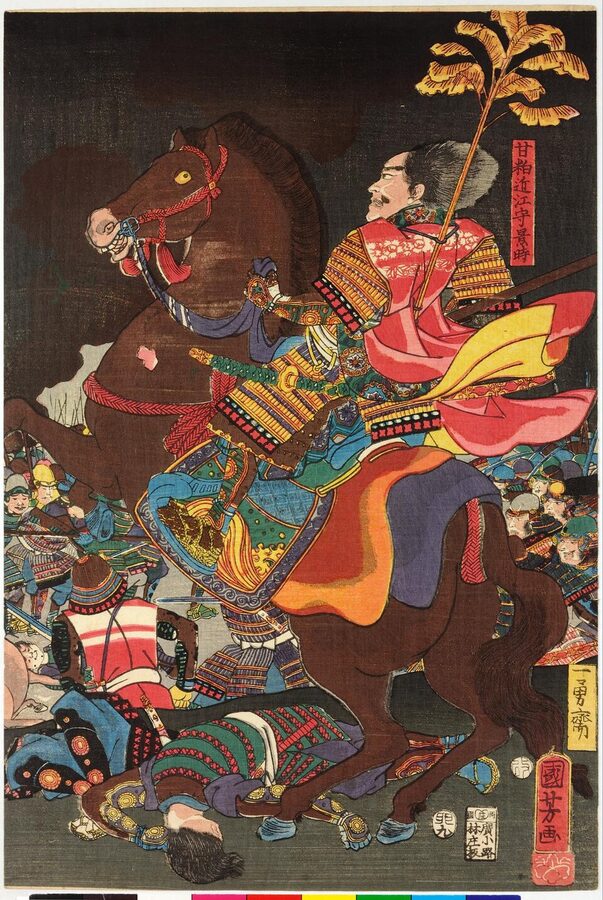
By eight in the morning on the tenth the mist was thinning. Shingen’s eight thousand were drawn up in the Crane’s Wing on Hachimanbara, waiting for the Woodpecker to beat against the tree. What emerged from the thinning fog was thirteen thousand Uesugi troops in kuruma-gakari formation — the “wagon-wheel” rotating-attack formation that sends successive waves against a single point, each wave falling back to reform behind the next as it advances. Kakizaki Kageie’s vanguard led the first wave. Shingen’s Crane’s Wing, designed to envelop an advancing force, had no answer to a frontal assault by a superior enemy on a fog-cleared plain.
Morning on Hachimanbara — the duel and the generals who died
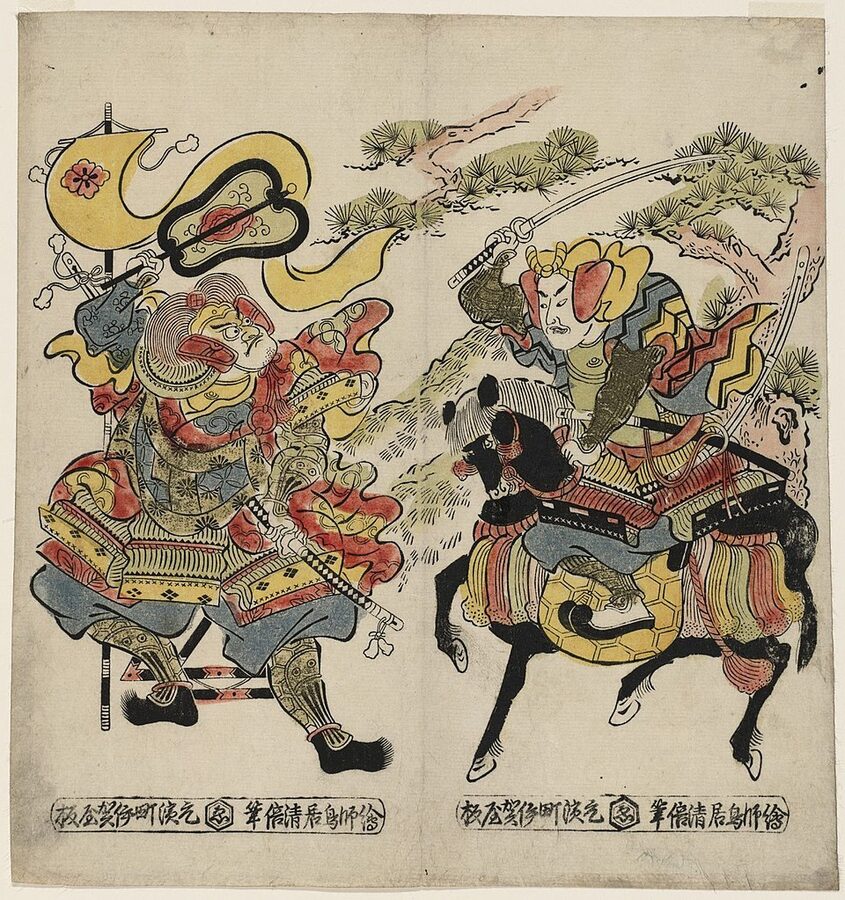
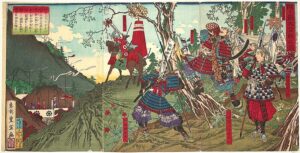
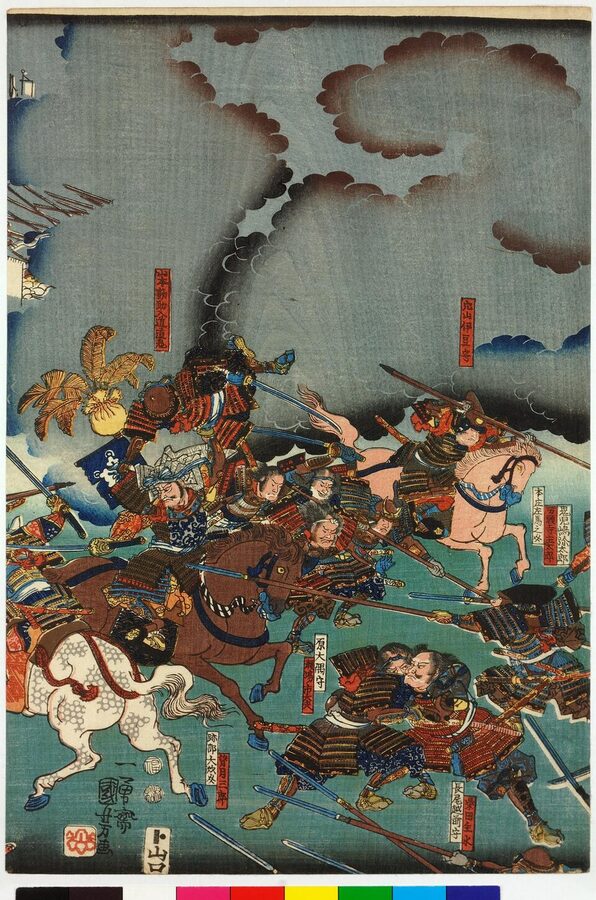
What happened in the next three hours is the most-painted, most-dramatised, and most-disputed engagement in the Sengoku record. The Takeda main body took heavy casualties in the opening waves. Shingen’s younger brother Takeda Nobushige — his closest confidant, the commander of the left wing — was killed outright. So was Morozumi Toratada, a fifty-three-year-old senior general. So was Hatsukano Tadatsugu. And so, almost certainly, was Yamamoto Kansuke. The Kōyō Gunkan has Kansuke, realising that his Woodpecker had failed and that the main army was about to be overrun, leading a personal charge into the Uesugi line and dying at around eleven in the morning — which is the moment Kuniyoshi fixed in the 1854 triptych I showed above. Whether Kansuke even existed in the shape the Takeda chronicles give him is a question modern Japanese historians still argue. What is agreed is that a Takeda strategist named Kansuke, whatever his actual biography, was on Hachimanbara and did not come home.
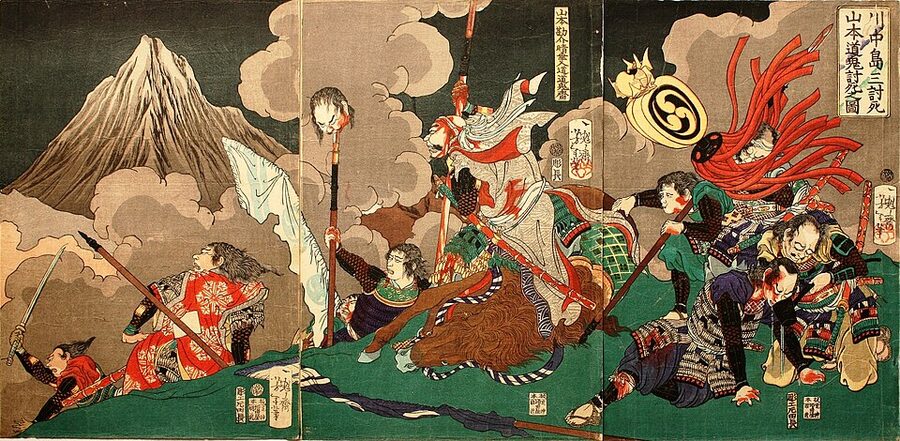
Into the middle of this chaos, around ten or eleven in the morning, the sources disagree, rode the single horseman in the white head-cloth. According to the Takeda version of events, he rode his hōshō-tsukige yellow horse straight through the Takeda line, reached Shingen’s personal command post (which by this point was dangerously exposed because the generals around it were dead), and struck down three times with a sword. Shingen parried with the iron war fan. The horseman was driven off when Hara Torakichi, a gonchū-ke-ashigaru retainer, speared the horse in the flank. The horseman rode back out the way he had come and disappeared into the general melee.
The Uesugi side’s version, in the Hokuetsu Taiheiki, says the fight happened at the Onusa-gawa stream rather than at Shingen’s command post, that both men were mounted rather than one sitting and one riding, that Shingen used a sword rather than a fan to block, and that Shingen took a hand wound and retreated. The Uesugi-ke Goyoroku, an Edo-period Uesugi history, says the attacker was not Kenshin but a retainer named Arakawa Izu-no-kami. Konoe Sakihisa, writing after the battle, said Kenshin himself drew his sword — which is at least consistent with the duel having happened, whatever its exact choreography. The historical record, as it stands, does not let you reconstruct the duel with any confidence. The iconographic record is unanimous.
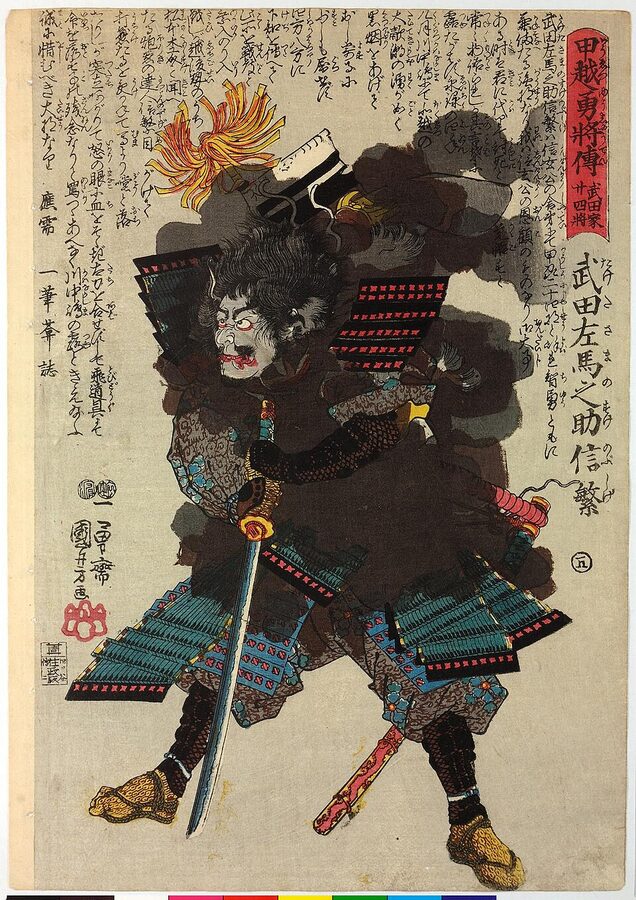
Kōsaka and Baba’s twelve-thousand-man flanking column, meanwhile, had reached Saijō-san at dawn and found nothing there. They turned around and marched as fast as they could back down to the plain. Amakasu Kagemochi’s thousand-man rearguard at the Amemiya ford held them up for long enough — the Kōyō Gunkan‘s assessment of Amakasu is famously, and uncharacteristically for a Takeda source, glowing — but by late morning the column was approaching the battlefield from the south. When they arrived, around eleven, the Uesugi main body was suddenly between two pincers. Masatora ordered a general withdrawal across the Sai river northward to Zenkō-ji, where he linked up with the 5,000-strong reserve. Shingen, having held the field but lost the quality of his senior retainer corps, declined to pursue beyond four in the afternoon.
Casualties, claims, and what was lost
The casualty figures given in the Kōyō Gunkan are Takeda 4,000 dead and Uesugi 3,000 dead — roughly a 4-to-3 ratio in Uesugi favour. Modern historians are cautious about the specific numbers but broadly accept the shape: both sides took heavy losses, with the Takeda slightly worse despite holding the field. Both sides held head-verification ceremonies — the kubi-jikken — and both claimed victory. The Kōyō Gunkan‘s own assessment, which is generous to the Takeda, rates the battle as “first half Uesugi, second half Takeda.” The three blood-stained commendation letters — the chi-zome no kanjō — that Masatora issued to his retainers afterwards, and which still exist in copy, explicitly frame the 4th Battle as a Uesugi victory. Shingen’s two surviving commendation letters frame it, equally explicitly, as a Takeda one.
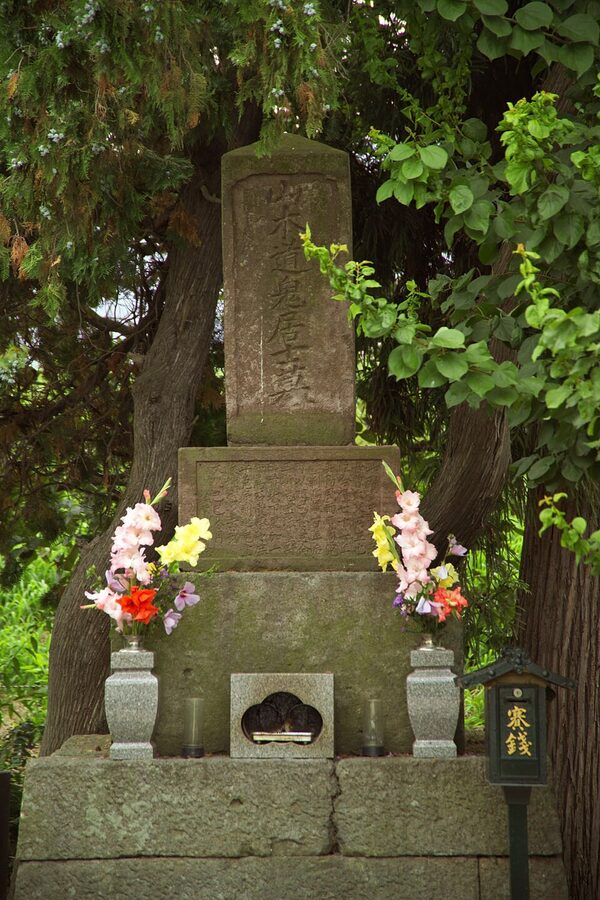
What the 4th Battle actually cost the Takeda, if you read the loss-list carefully, was the next generation of senior retainers. Takeda Nobushige had been Shingen’s deputy and his most reliable field commander for twenty years. Morozumi Toratada had been with the family since Shingen’s father Nobutora’s time. Kansuke, if he existed as we know him, had been the strategist of the Kai-Shinano campaign. These were not replaceable losses. The Takeda military pool for the rest of the 1560s and 1570s was deeper than most Sengoku clans’ but it was noticeably thinner at the very top, and the thinning traces directly to Hachimanbara. Fourteen years later, at Nagashino in 1575, three more Takeda Four Heavenly Kings died against Nobunaga’s palisade — and the specific feature of the Takeda retainer corps that made it fragile enough to collapse after Nagashino was the 1561 thinning.
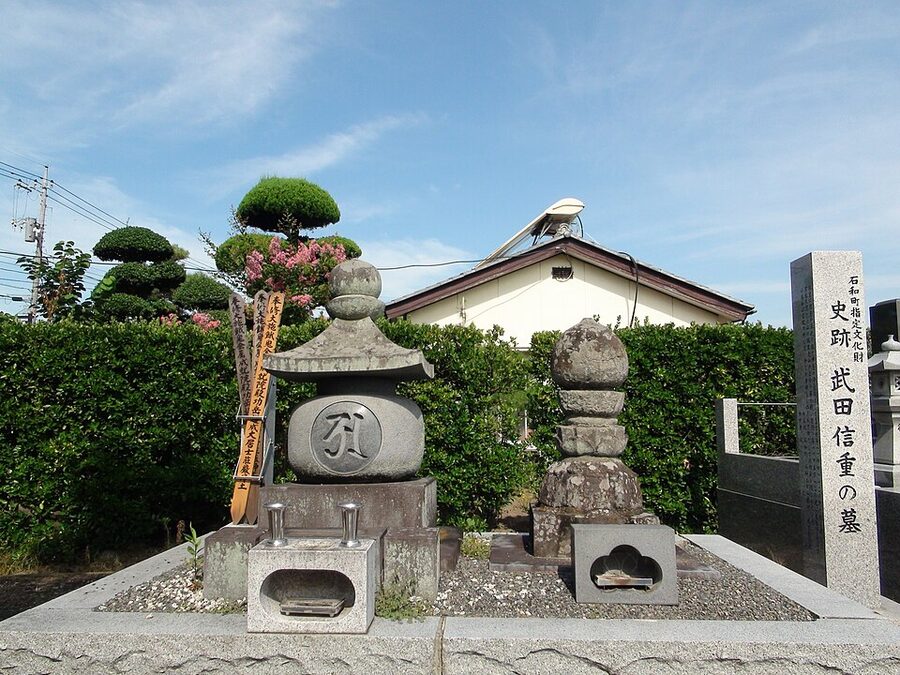
For the Uesugi side, the 4th Battle was operationally expensive but strategically ambiguous. Masatora had defeated Kaizu Castle’s supporting army, which was the tactical goal, but Kaizu itself was intact and Kōsaka’s garrison was, if anything, more firmly in place afterwards than it had been before. The 3,000 Uesugi dead were mostly senior Echigo retainers, and the specific losses included some of the northern-Shinano-refugee generals whose political commitment to the Uesugi cause had been the original justification for Masatora’s intervention. It is not obvious, from the Uesugi political record in the years immediately after, that the victory at Hachimanbara translated into any specific improvement in Masatora’s strategic position. He had taught Shingen a costly lesson, but he had not recovered northern Shinano, and he had used up material he would need for his next set of wars.
The fifth battle, 1564 — and the long fade
The 5th Battle, also called the Shiozaki no Tai-jin (塩崎の対陣), in Eiroku 7, 1564, is what happens when a rivalry loses its strategic rationale but continues anyway by inertia. Uesugi Masatora had, after 1561, renamed himself Uesugi Terutora (with the shōgunal “teru” character) and then, in 1570, adopted the Buddhist name Kenshin. His campaigns in the Kantō against the Late Hōjō were consuming most of his military energy. Shingen was under intermittent pressure from Uesugi-allied guerilla actions in the Hida province and in 1564, late summer, sent a force under Yamagata Masakage and Amari Masatada into Hida to support the anti-Uesugi Kōjō family. Masatora-Terutora marched south into Kawanakajima in August to draw Shingen back.
Shingen moved up to the southern edge of the plain at Shiozaki Castle but declined any general engagement. The two armies faced each other across the Chikuma for two months. In October — the tenth lunar month, Gregorian around November — both sides withdrew without fighting. That was the 5th Battle. It was a standoff.
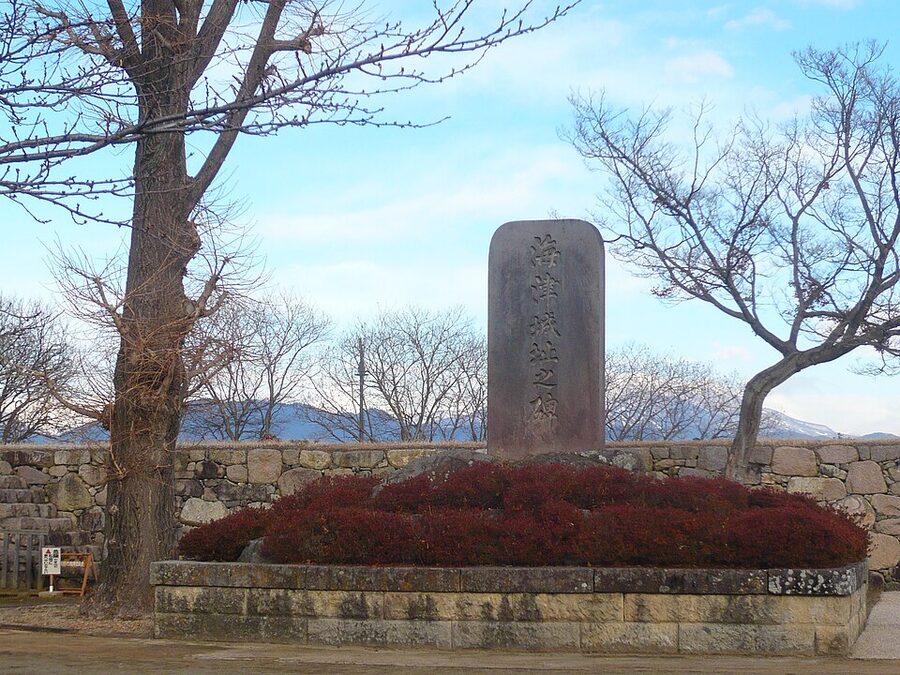
After 1564 the two men never fought each other directly again. Kenshin diverted north-east to the Kantō and the anti-Hōjō coalition, where he would spend most of the rest of his life. Shingen, having secured Shinano permanently, turned south toward Suruga after the Imagawa collapsed in 1568 and then west on the Seijō Sakusen, the Westward Advance Strategy against Tokugawa Ieyasu and Oda Nobunaga, which carried him to his decisive victory at Mikatagahara in January 1573 and, four months later, to his death at Komaba. Kenshin outlived him by five years and died at Kasugayama in 1578, probably of a stroke, probably not of poisoning as later Takeda rumour had it. The 5-battle rivalry had consumed twelve years of both men’s military careers. Some Japanese historians argue, and I think they are right, that it also consumed the energy that would have been needed to mount a decisive challenge for central Japan. If Shingen had skipped Kawanakajima entirely and turned south in 1555 he might have reached Kyoto before Nobunaga. If Kenshin had ignored Murakami Yoshikiyo and concentrated on the Kantō he might have broken the Hōjō before the Takeda-Hōjō alliance was set. Kawanakajima was, by one reading, the most expensive thing either man did.
Cultural afterlife — the kabuki stage and the Mifune films
Within a century of the battle, the Kawanakajima cycle had been absorbed into the kabuki and puppet-theatre repertoire. The Kawanakajima Chōfu Uta-monogatari, written around 1700, was one of the earliest stage treatments of the war-fan duel and ran regularly at the Edo theatres through the 18th century. Ukiyo-e printers — Kuniyoshi, Yoshitoshi, Hiroshige, Chikanobu, Chikashige, Kuniteru II — returned to the scene so many times that by the Meiji period Hachimanbara was one of the three or four most-printed single battlefield subjects in Japanese woodblock art.
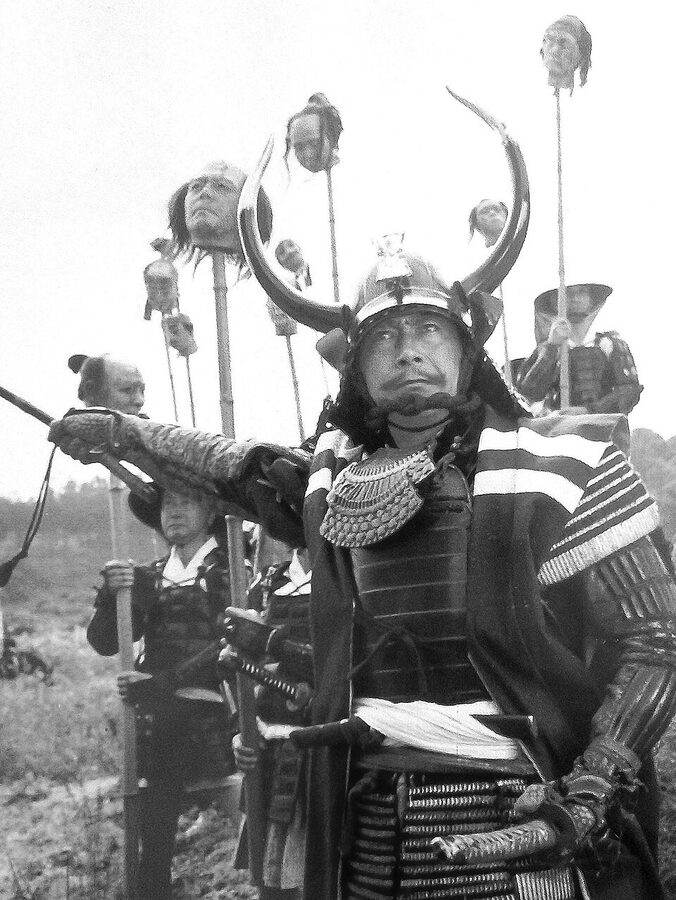
The cinematic record is deeper than most English viewers realise. Inagaki Hiroshi’s 1969 Fūrinkazan, Samurai Banners, with Toshirō Mifune as Yamamoto Kansuke and Kinnosuke Nakamura as Shingen, is the most ambitious single-film treatment and is very close to the Kōyō Gunkan version of events. Kurosawa Akira’s 1985 Ran — based nominally on King Lear, but the clan-warfare infrastructure is pure 1560s-Shinano — is not a Kawanakajima film in the literal sense but is a Kawanakajima film in the cultural one. The 2007 NHK Taiga drama also called Fūrinkazan, with Uchino Masaaki as Kansuke and Ichikawa Kamejirō II as Shingen, made the war-fan duel the single most-watched scene of that year’s Taiga broadcast. The 2022 Taiga Jū-sannin no Kubi-tori touched the campaign from the peripheral Sanada perspective.
The scene has also become the property of everyone adjacent. Sanada Yukimura‘s ancestors, Sanada Yukitaka and his son Masayuki, served the Takeda through Kawanakajima as Shinano kokujin retainers; the Sanada later inherited Matsushiro Castle itself from the Tokugawa in 1622, which puts a Sanada clan on the former Kaizu site for the whole of the Edo period. The Gion Matsuri floats in Kyoto include a yama referencing the Shingen-Kenshin duel. Pachinko halls across Japan run Kawanakajima-themed machines. The duel has escaped the historical record entirely, at this point, and become a free-floating cultural reference.
Where to visit the Kawanakajima battlefield today
Hachimanbara Historical Park, Nagano
The canonical site is the Hachimanbara Historical Park, the Kawanakajima Kosenjō Park (川中島古戦場公園), in Shinonoi ward of Nagano city. The park covers the approximate centre of the 4th Battle’s main engagement zone, with the Hachiman Shrine at its heart and stone markers for the key commanders (Takeda Nobushige, Morozumi Toratada, Yamamoto Kansuke) set in the grass around the edges. The central bronze is the one the Japanese visitor-photograph industry has made famous: Kenshin mounted with the sword raised, Shingen seated with the war fan up, the war-fan duel at the frozen moment of the first strike.
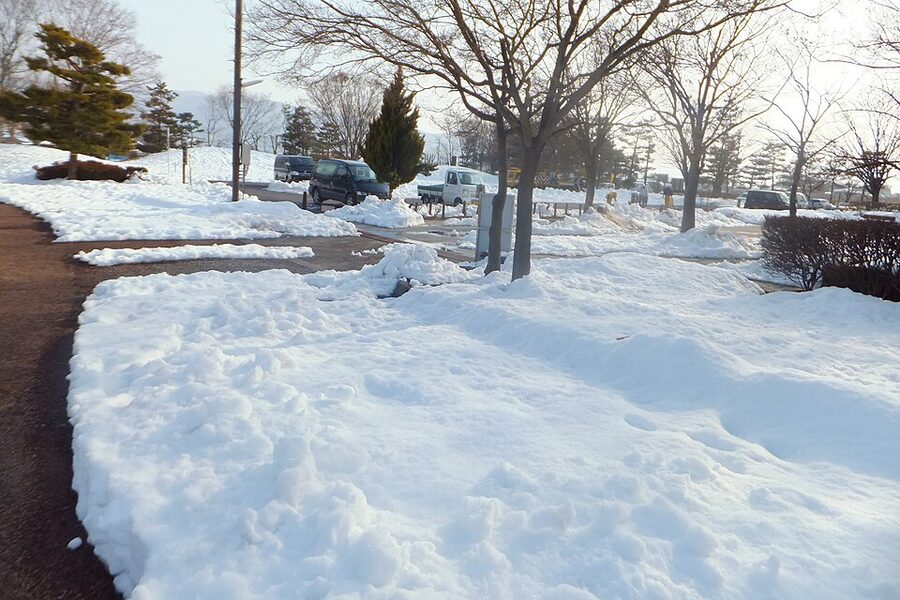
The park is a twenty-minute bus ride from Nagano Station on the Alpico city bus, running roughly every half-hour in daylight. Free, always open. The on-site museum, the Nagano-shi Museum of History, sits just north of the park and is worth the ¥300 entry if you want the specific campaign detail. The annual memorial ceremony is held on 10 October, the anniversary of the 4th Battle in the Julian calendar, and is worth planning a visit around if you are in Japan that week.
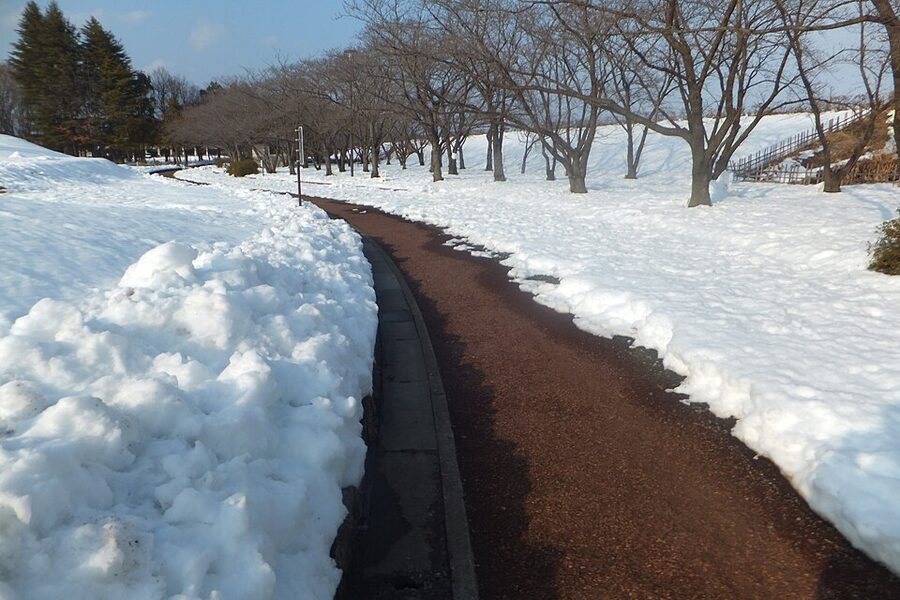
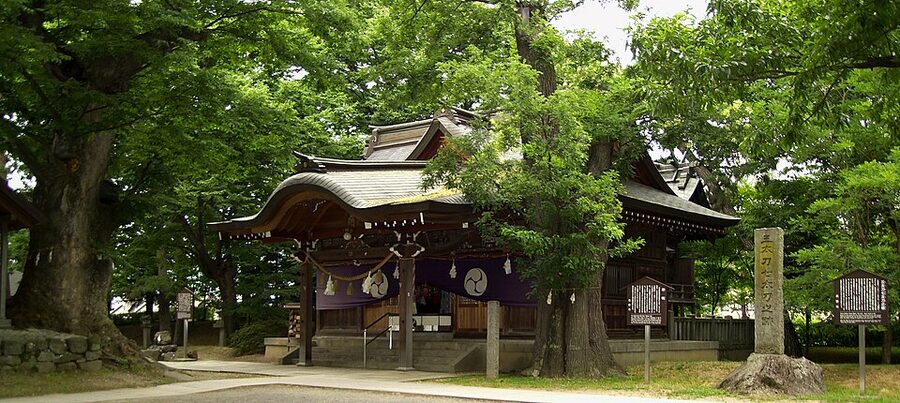
I have walked Hachimanbara twice, once in October and once in January, and the October visit is the one I remember. Ten o’clock in the morning on the anniversary of the duel is the right time. The river fog over the Chikuma was not as thick as the Kōyō Gunkan says it was in 1561, but it was thick enough that the statue came into view suddenly from the northern approach path — which is the right way to meet it. The park empties out by lunchtime; you will share it with one or two Nagano locals and the occasional school group. The Hachiman Shrine in the centre is still actively used and accepts the traditional coin-offering. A small omikuji stand sells fortune-slips in the morning.
Matsushiro Castle — the former Kaizu
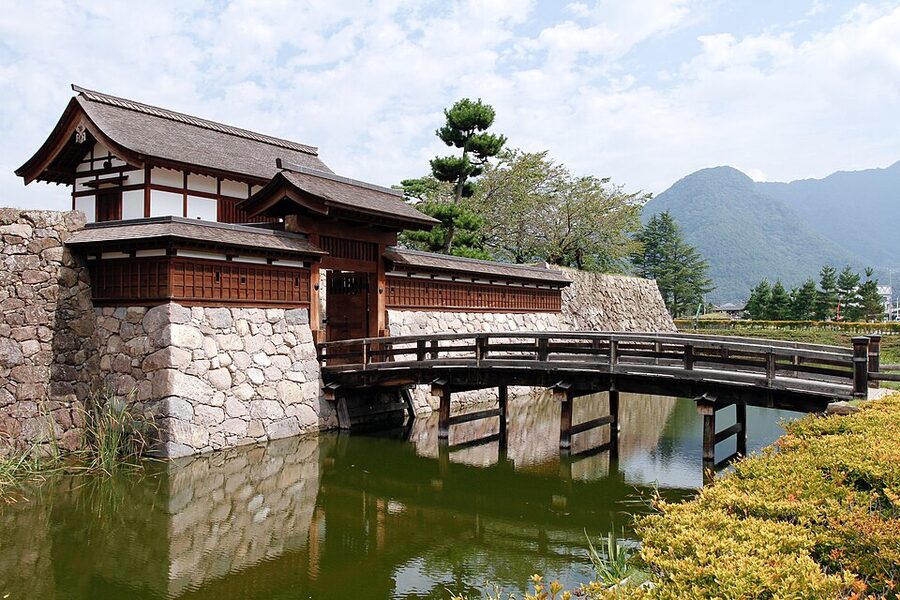
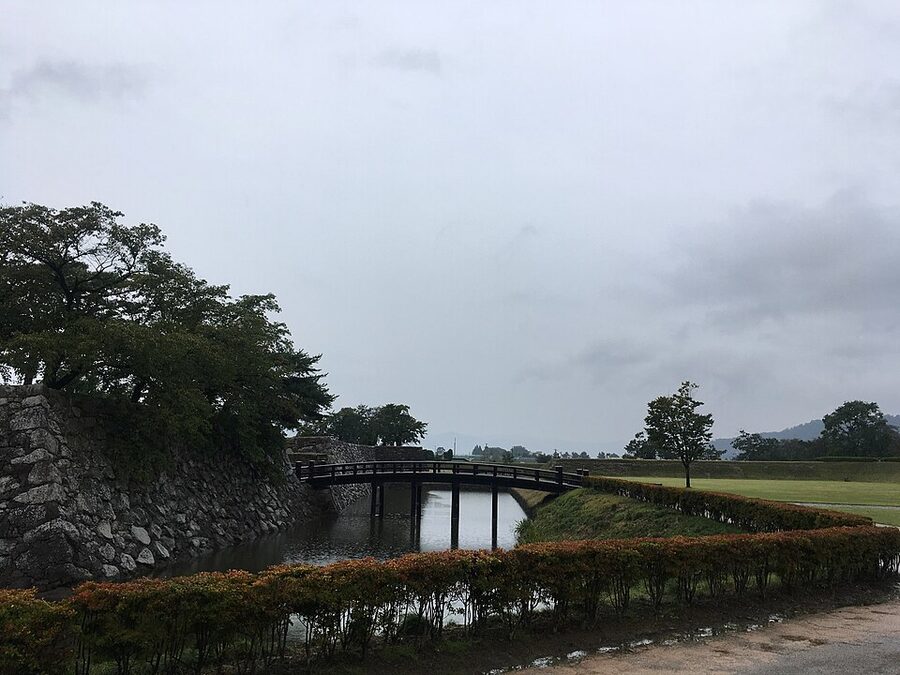
Matsushiro Castle (松代城), the Takeda-built Kaizu Castle that Kōsaka Masanobu held during the 4th Battle, is a ten-minute bus ride from Hachimanbara Park, or a twenty-minute walk if you cut across the Chikuma bridge. The castle has been partially reconstructed — the tai-yagura main gate and a short section of wall are 1990s replicas, the honmaru moats and the ground plan are original — and you can walk the perimeter in about forty-five minutes. The Sanada-family Matsushiro-han museum inside the outer walls is the better of the two Nagano-area history museums and is the place to see the Sanada-Takeda succession archives in one set.
The Sanada angle matters here. Sanada Yukitaka, the first-generation Sanada retainer of the Takeda, fought in the 4th Battle as a mid-level kōshū ashigaru-taishō. His son Masayuki would become the generation that rose through the later Takeda campaigns and the Sekigahara loyalism split. And the Sanada family got the former Kaizu Castle in 1622 from the Tokugawa as part of the Matsushiro-han 100,000 koku grant — and held it continuously until 1871. The Sanada Yukimura side of the family ran the Osaka rebellion and died out; the Nobuyuki line ran Matsushiro and prospered. The castle has been in the Sanada orbit, either directly or via the Takeda retainer history, for four-and-a-half centuries. This is not a coincidence.
Saijō-san — Kenshin’s command post
Saijō-san (妻女山), the mountain Kenshin-Masatora occupied from 15 August 1561 until the night of 9 October when he crossed the Chikuma, is in modern Chikuma city, four stops south of Nagano on the Shinano Railway line. The mountain is not tall (about 410 metres) and the path to the summit is paved; you can walk up in about forty minutes from Iwano station. The view from the top is the whole plain — Matsushiro to the north, the Chikuma winding across the middle, Chausuyama across the other bank to the west. Stand here for twenty minutes and the campaign’s geography makes itself obvious. The military logic of Kenshin’s deployment — high ground, long sight-lines, boxed in on two sides but able to see anything Shingen did — becomes visible in a way no map will give you.
There is no formal on-site museum and no entry fee. The visitor centre at the base is closed on Mondays and otherwise open daylight hours. A small marker stone at the summit identifies the spot as the Jin-ba, the campaign command post. Whether this specific peak is the exact site where Kenshin-Masatora actually deployed is something local Nagano historians still argue about; the rough area is agreed. The topography is unchanged.
Zenkō-ji temple — the relocated buddha
Zenkō-ji (善光寺) in central Nagano is the temple that both sides of the Kawanakajima war considered sacred and neither side could bear to damage. It contains a secret absolute hibutsu — the original Zenkō-ji Amida Triad, brought from Baekje in the 6th century — which is the oldest Buddhist image in Japan and is never shown (not even to the abbots; what is displayed to the public every six years is a medieval replica). During the 2nd Battle in 1555 the temple’s chief-priest family, the Kurita, had defected to the Takeda, and in the subsequent campaign Shingen physically relocated the principal image to Kai and established a secondary Kai Zenkō-ji at Kōfu. The original buddha was returned after the 1582 Takeda collapse. The Nagano Zenkō-ji kept the main sanctuary intact.
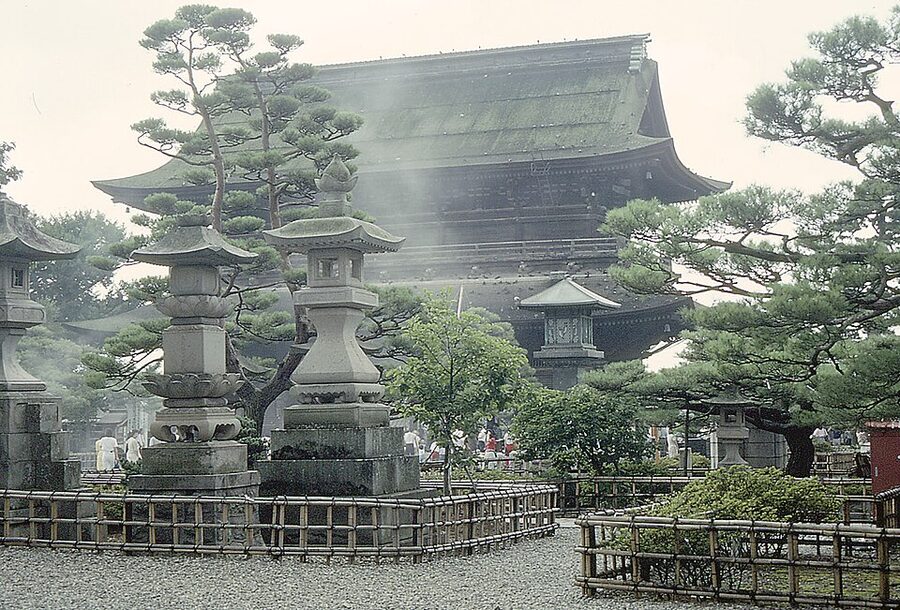
Zenkō-ji is fifteen minutes from Nagano Station by city bus or a ten-minute walk up the main pilgrim avenue. It is free to enter the main compound; the inner-sanctum pilgrimage through the dark kaidan-meguri key-tunnel under the altar is ¥600. If you are doing a Kawanakajima circuit, do Zenkō-ji first thing in the morning, Hachimanbara at midday, and Matsushiro in the afternoon. The bus connections work for that sequence and nothing else.
Hachimanbara in winter
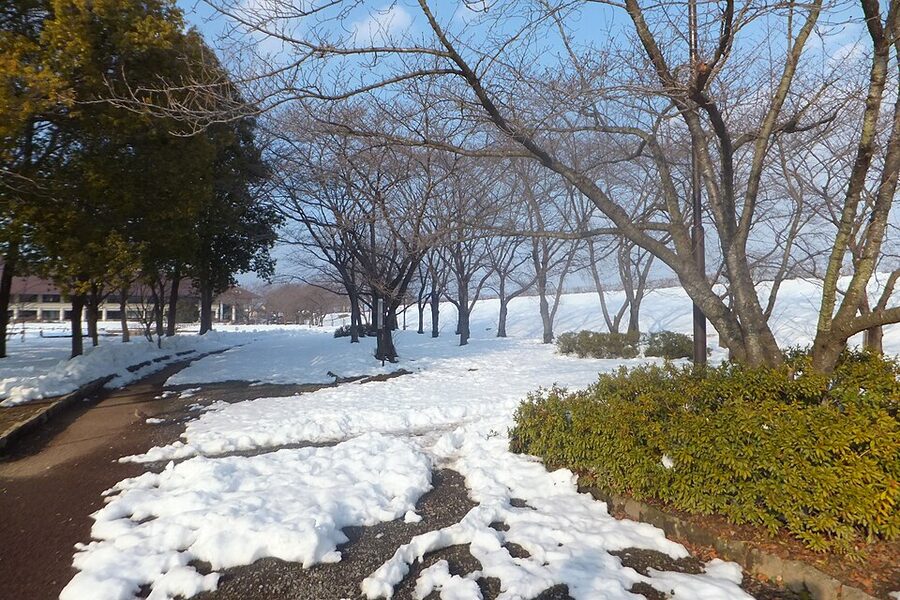
If you come in winter, which is what I would recommend if you can afford the cold, the plain is under snow from late December through early March. The markers still show through. The statue still stands. The river fog off the Chikuma in January is, if anything, denser than in October, and standing at the Hachiman-sha in a light snow at seven in the morning is the closest I have come to what the 1561 army would have seen at dawn on the tenth. Bring thermal layers and accept that the bus frequency drops off-season.
For the Kai side — Erin-ji and the Kōfu Takeda sites
If your interest is in the Takeda side of the story rather than the specific Nagano battlefield, Erin-ji (恵林寺) in Kōshū city, Yamanashi, is the Takeda family bodai-ji and the site of Shingen’s own grave. The temple was burned by Oda Nobutada in 1582 during the Takeda destruction — the abbot Kaisen Shōki’s famous last sermon was “in the midst of the flames, cool your mind and the fire is also cool” — and was rebuilt in the Tokugawa period as a Sanada-and-Takeda co-memorial site. Jōjū-in in Fuefuki, which holds Nobushige’s grave, is the secondary Takeda retainer memorial network. Both are in the Shingen article in detail. For the Kawanakajima purpose, either one gives you the Kai side of the casualty list that Hachimanbara produced, and from them the military geography of the whole campaign becomes intelligible in a way that visiting only the Nagano side does not quite accomplish.
Closing — the horseman in the white cloth
The thing I find hardest to come to terms with, about the 4th Battle and about the whole Kawanakajima cycle, is how much of the historical record is dramatic reconstruction and how little is contemporary record. The duel is almost certainly Edo-period dramatisation of something more chaotic. The Woodpecker Strategy is almost certainly a Takeda-side post-hoc explanation of a tactical situation that went wrong in the fog. The casualty counts are approximate at best. The specific choreography of Amakasu’s rearguard on the Amemiya ford is from Kōsaka Masanobu’s own oral testimony, recorded decades later, and there is every reason to believe the Takeda captain who wrote it down was flattering a rival he respected rather than a man he had met.
And yet. The Konoe letter exists. Kenshin-Masatora did draw his sword personally at the 4th. Shingen’s brother Nobushige did die. Yamamoto Kansuke, in whatever shape he actually existed, did not come home. Three thousand to four thousand men were killed on the plain on 10 October 1561, which in Sengoku terms is a very large number for a single morning’s work. When you stand on Hachimanbara in the fog at the right time of year, with the Chikuma invisible below the mist and the Saijō-san ridge invisible beyond it, the historical reality of what happened here is not diminished by the dramatised overlay. If anything the dramatisation is protective: the scene is so iconic that its cultural gravity has kept the ground preserved for four hundred and sixty-five years, and the plain today is still recognisably the plain where thirteen thousand Uesugi men came out of the mist at eight in the morning and the Takeda Crane’s Wing had no time to reform.
Go to Hachimanbara on 10 October. Stand at the statue in the hour before the memorial ceremony. Walk down to the Chikuma ford and look across at the Matsushiro walls, at where Kaizu’s garrison was sitting. Walk back up through the Hachiman-sha grounds. Think about the man in the white head-cloth, whoever he actually was, riding in through the fog and bringing his sword down three times. Whether it happened exactly as the Kōyō Gunkan says is the kind of question academic historians get paid to not answer. Whether it happened is another matter. Something happened. The plain is still here. The markers are still here. The statue is still here. The Sanada are still in Matsushiro. If you want to read it across the other battles of the period, my pieces on Mikatagahara, Nagashino, and Sekigahara cover what came after; Matsumoto Castle and Sanada Yukimura cover the Takeda-adjacent Shinano network that Kawanakajima created. And the Shingen and Kenshin pieces go at the two men in full — this article was about what they did when they met.