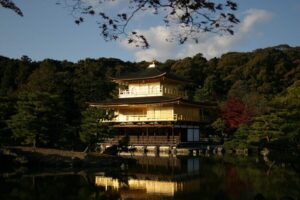
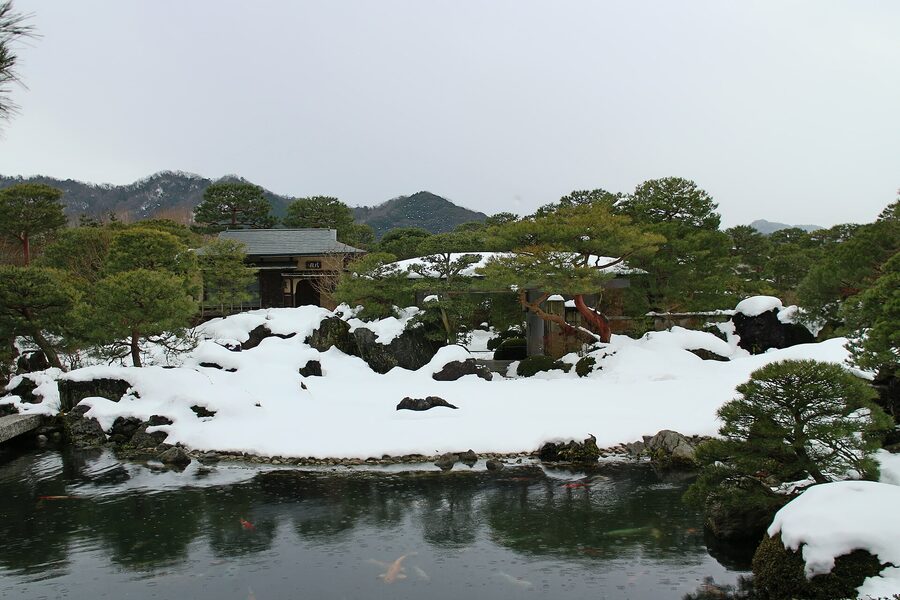
The Adachi Museum of Art in rural Shimane has been ranked the number-one Japanese garden in the country every single year since 2003. The ranking is published in Sukiya Living, a Tokyo-based journal kept by retired curators and Kyoto-trained landscape architects who walk the gardens unannounced and grade them on a fifty-point rubric. They have looked at Kenroku-en, they have looked at Katsura, and they keep choosing a private museum garden in Yasugi.
That ranking exists because Adachi Zenko, a textile millionaire, decided in 1970 that the gardens at the Adachi Museum should be viewed only from inside the building, framed by sliding shoji like a sequence of living paintings. You cannot walk the paths. The composition is fixed, like a hung scroll, and a team of gardeners rakes it back into shape every morning before the doors open. It is not a garden you visit so much as a garden you watch.
I have been to most of the gardens in this guide more than once. The order in which I list them is geographical, not preferential. If you read to the end I will tell you which three I would actually visit if you had a single week and a JR Pass, and the choice will not be the obvious one. Before any of that, a brief note on what counts as a “great” garden, and how this piece sits next to the longer history piece on the site.
In This Article
- Reading this guide, and what counts as “great”
- The Three Great Gardens (San-meien)
- Kenroku-en, Kanazawa
- Korakuen, Okayama
- Kairakuen, Mito
- Kyoto’s garden quarter
- Ryoan-ji and the fifteen-rocks paradox
- Saiho-ji, the Moss Temple
- Tenryu-ji, Arashiyama
- Daitoku-ji subtemples: Daisen-in, Zuiho-in, Koto-in
- Tofuku-ji Hojo Gardens
- Katsura Imperial Villa
- Sento Imperial Palace Garden
- Tokyo’s Edo-period daimyo gardens
- Hama-rikyu
- Koishikawa Korakuen
- Rikugien
- Kiyosumi Garden
- Castle and estate gardens beyond Tokyo and Kyoto
- Adachi Museum, Yasugi
- Sengan-en, Kagoshima
- Suizenji Jojuen, Kumamoto
- Genkyu-en, Hikone
- Ritsurin Garden, Takamatsu
- Tea gardens (roji)
- Practical visiting
- Booking and timing
- Best season per garden
- Photo etiquette and tripods
- Combination tickets and passes
- How to “see” a garden
- My pick of three if you only have a week
Reading this guide, and what counts as “great”
The shorthand “great garden” usually points to the Edo-era San-meien, the Three Great Gardens, which I cover first. The list is a Meiji-period invention, as it happens, but it has stuck for a century and you will find it on every signpost. It is also incomplete. Several of the gardens I rate higher are Kyoto temple gardens that do not show up in any San-meien tally, plus the modern Adachi composition that did not exist when the original list was drawn up.
If you want the long answer to “what is a Japanese garden, actually,” I wrote that piece separately. Read the history and principles guide first if you have never sat on the veranda of a Zen abbot’s hall and tried to count fifteen rocks. This piece is the practical companion. It tells you which gardens, in detail, when to go, what to look at when you arrive, and what the price of admission actually buys.
One ground rule on names. I use the macron-stripped form (Kenroku-en, Saiho-ji, Tofuku-ji) in the body for legibility, and the kanji where it adds something. The gardens themselves do not care. They are objects of a particular attentiveness, and the only consistent rule across all of them is that you should look slowly, sit when sitting is offered, and leave the camera in your bag for the first ten minutes.
The Three Great Gardens (San-meien)
Three Edo-period feudal gardens were grouped into the San-meien in the late nineteenth century by a writer named Kuroda Kosuke, who borrowed the rhetorical structure from a Sung-dynasty Chinese essay on landscapes. Each is supposed to embody two of the six virtues that a perfect garden requires: spaciousness and seclusion, artifice and antiquity, water and panorama. Kenroku-en in Kanazawa, the most famous of the three, is the one whose name actually means “garden combining six attributes.”
You will not see the six virtues itemised when you visit. The list is a piece of nineteenth-century criticism, not a design brief. What the three gardens do share is a chisen-kaiyu (pond-stroll) layout, a daimyo patron, and the kind of late Edo polish that comes from a hundred and fifty years of continuous gardener employment. They are also all open to the public for around 450 yen, which is a bargain.
Kenroku-en, Kanazawa
Kenroku-en started as a Maeda family villa garden in 1676 on a slope above Kanazawa Castle. The Maeda were the second-richest daimyo house in Japan after the Tokugawa, with a domain rated at a million koku of rice, and they spent their wealth conspicuously on culture rather than military expansion. You can read about the founder of the line in the Maeda Toshiie biography; the garden is what his great-grandsons did with the family fortune.
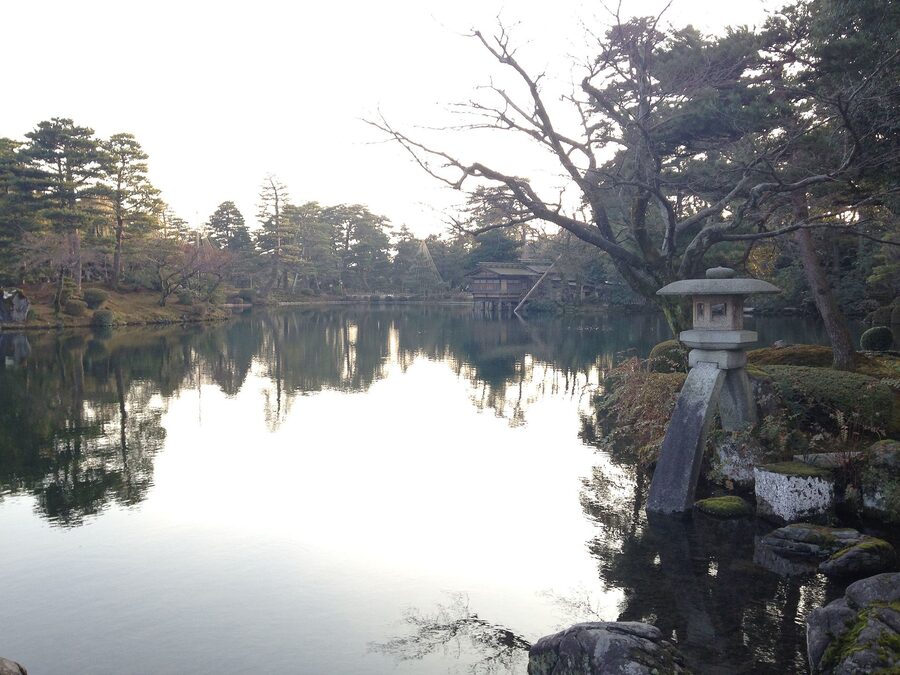
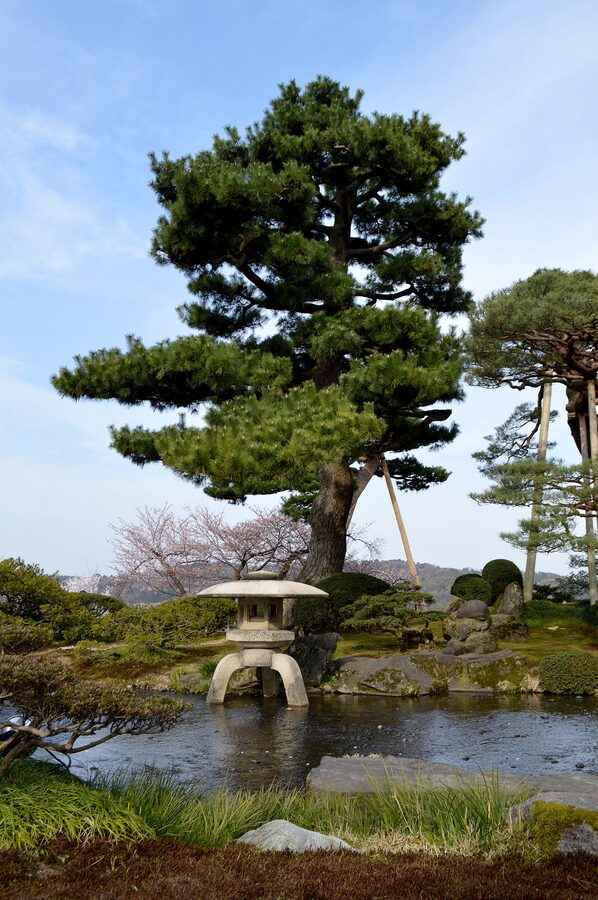
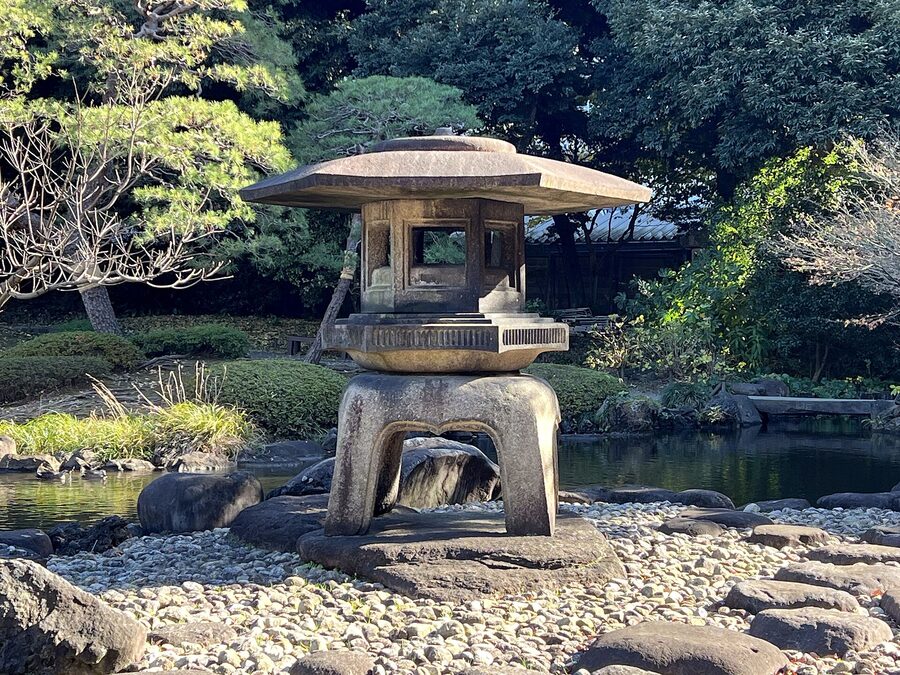
The single object every visitor photographs is the Kotoji-toro lantern at the edge of Kasumigaike pond. The lantern is a two-legged form unique to this garden, named after the small wooden bridges (koto-ji) that hold up the strings of a thirteen-stringed koto. One leg stands in the water and one on the bank, which is structurally pointless and visually load-bearing. The asymmetry is the point.
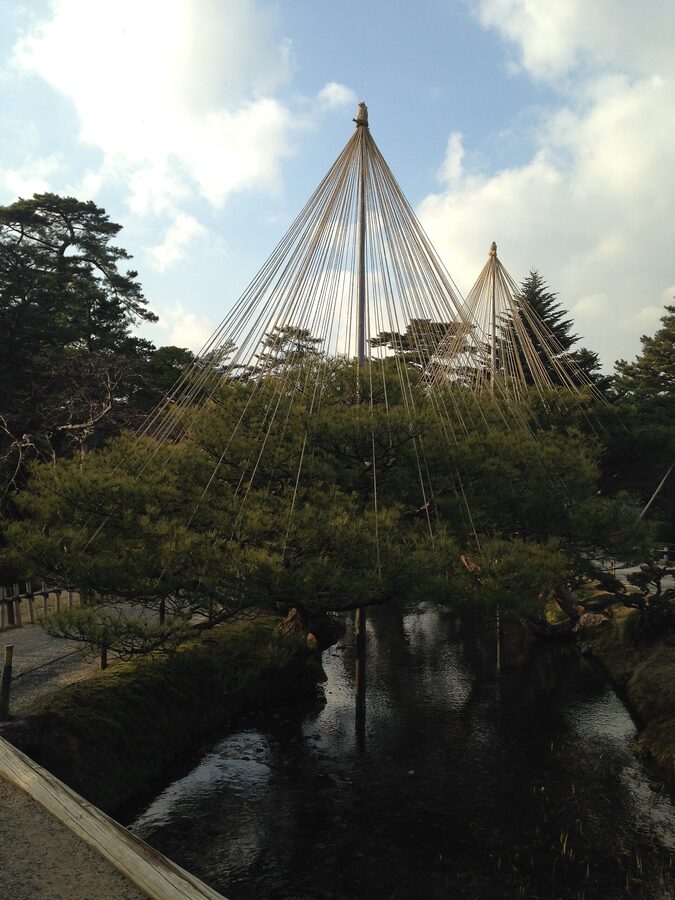
The other thing to time your trip around is the yukitsuri rope rigging, which goes up on 1 November every year and stays up until mid-March. Each Karasaki pine, the variety the second Maeda lord brought back from Lake Biwa in the 1740s, gets a bamboo pole above it and a tent of ropes pulling its branches up so the snow weight does not break them. It is the most famous winter scene in Japanese landscape gardening, and the Kanazawa tourism office has perfected the floodlit version for evening visits.
Kenroku-en is at its best in two windows. Late February to mid-March, you get plum blossom over snow if you are lucky, and the yukitsuri still rigged; early April, the cherry trees by Hanami-bashi peak for about a week and the city pulses with hanami visitors. Avoid the August heat. The garden’s “spaciousness” virtue evaporates when there are coach tours every twelve minutes and the cicadas are at full volume.
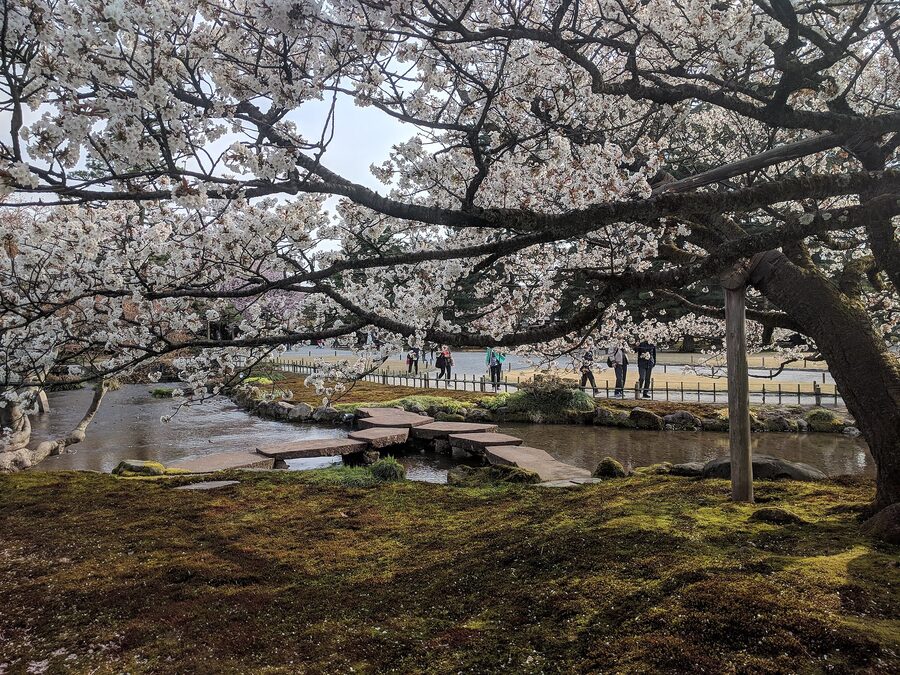
Practical: 320 yen adult, opens 7 a.m. in the warm half of the year, free entry between 4 and 6 a.m. for the keenest. Buy a combination ticket with Kanazawa Castle next door and the local Seisonkaku villa, which adds the Maeda women’s quarters and a smaller more intimate garden. Walk the perimeter clockwise from the Kodatsuno entrance; you arrive at the Kotoji lantern early in the route while you still have the energy to look properly.
Korakuen, Okayama
Korakuen Okayama, on a sandbar of the Asahi river facing Okayama Castle, was begun by Ikeda Tsunamasa in 1700 and substantially completed by 1700, which is fast even by daimyo standards. He commissioned it after a journey to Edo on the sankin-kotai alternate attendance circuit, where he had walked the gardens of his peers and decided his own province should not look provincial. The Korakuen name borrows from a Chinese phrase meaning “garden of pleasure after,” from the Sung statesman Fan Zhongyan: rule your domain first, then take pleasure later.
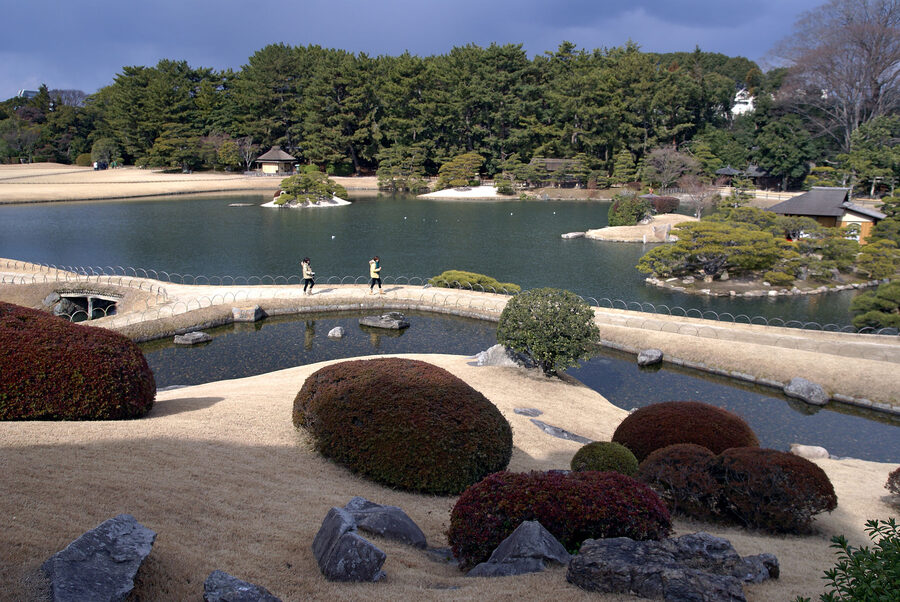
What sets Korakuen apart from the other two great gardens is the open lawn. Most chisen-kaiyu gardens of the period packed every square metre with composition, with stones and bridges and false hills, on the principle that a noble’s leisure should be visibly expensive. Ikeda’s gardener left the central area as a flat planted lawn instead, deliberately, to draw the eye out across the river to the Soja plain and the borrowed scenery of Mt Misao on the horizon. It is the single best example of shakkei in any of the San-meien.
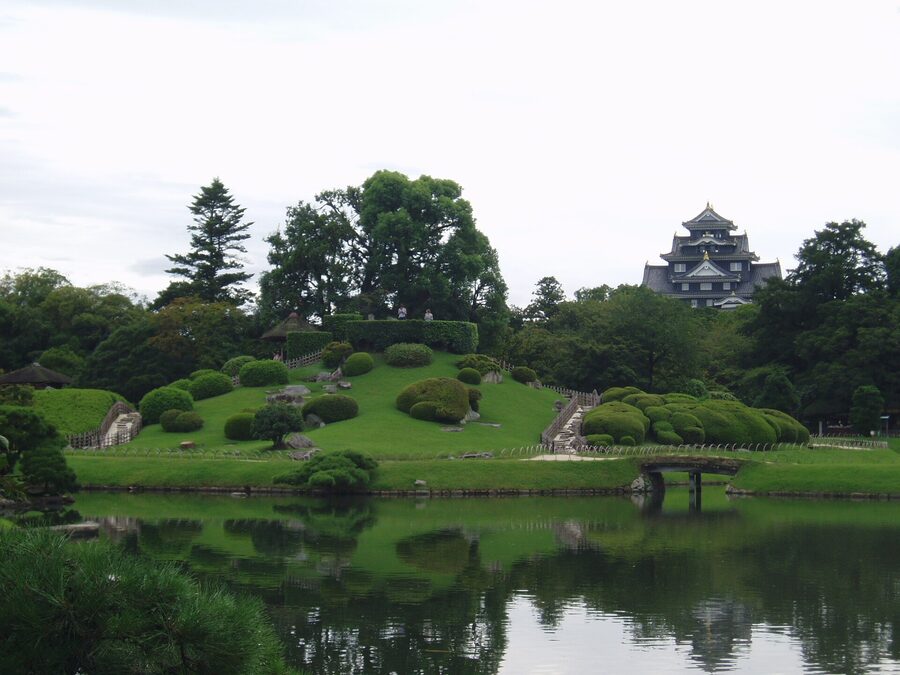
The Enyotei pavilion at the south end of the garden is open as a tea house most weekend afternoons. Sit on the tatami, take a 600-yen matcha-and-wagashi set, and the view through the doorway frames the lawn, the pond, and Okayama Castle (the “Crow Castle”) in succession. The whole composition is the Edo-period equivalent of a wide-screen establishing shot. Ikeda hired the Tsuda gardening line, who would also later work for the Tokugawa, and the lineage continued under municipal employment until the Second World War.
Practical: 410 yen adult, open 7:30 a.m. to 6 p.m. April through September, otherwise 8 to 5. The combination Castle-and-Garden ticket at 720 yen is worth it: you cross the Tsukimi-bashi bridge and enter Okayama Castle directly. Aim for late October when the maple groves around the Yatsuhashi-zigzag bridge come into colour, or the third week of June when the iris fields by the Kayohashi peak in lavender and white.
Kairakuen, Mito
Kairakuen, the third of the San-meien, is the most idiosyncratic. Tokugawa Nariaki, the ninth lord of Mito and one of the more politically dangerous late-Edo daimyo, built it in 1841 expressly as a public garden. The name means “garden to enjoy with” (the people), and Nariaki opened it on the first and sixth day of every month to commoners, which was unusual to the point of being faintly seditious. He was a vocal anti-foreign loyalist and the garden was, among other things, propaganda for the Mito school of nativist Confucianism.
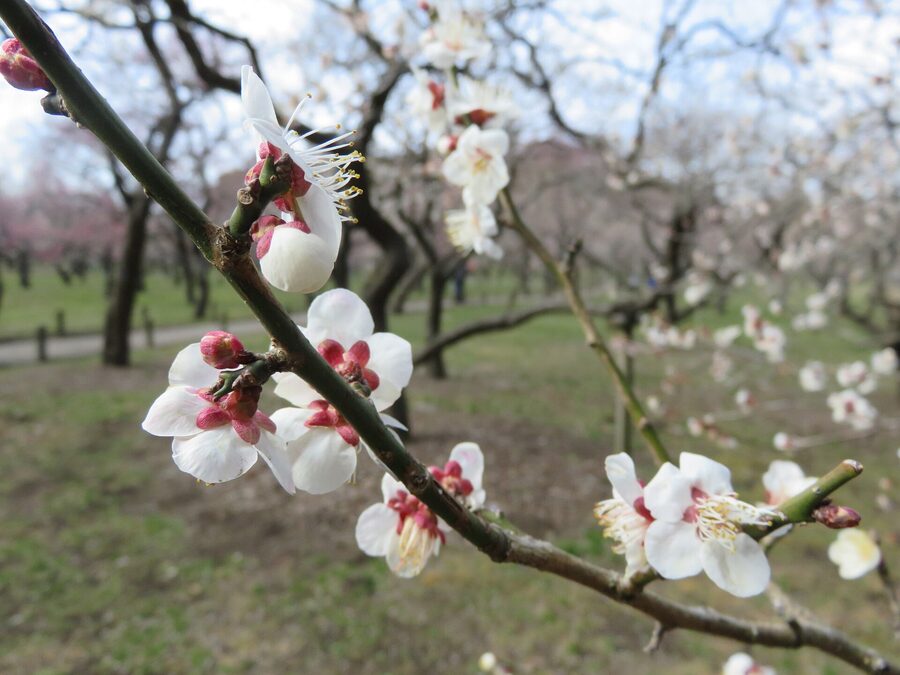
It is also still the only one of the three with free admission to the main grove, which I find satisfyingly consistent with Nariaki’s intentions. The plums (around 3,000 trees of about a hundred cultivars) bloom in late February and early March, and the Mito Plum Festival has run continuously since 1897. If you go in the first week of March you will see the place at maximum density and probably need to queue.
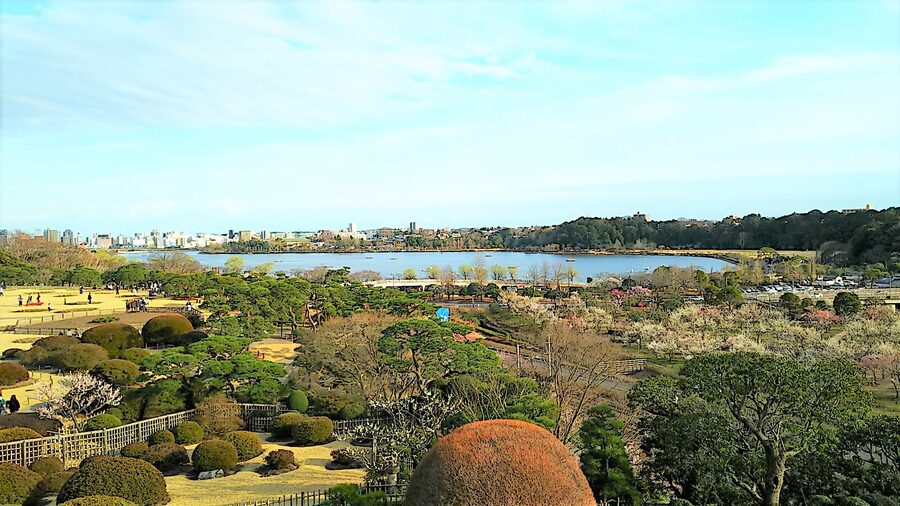
The piece of Kairakuen most visitors miss is Koubuntei, the three-storey pavilion Nariaki built into the cliff above Lake Senba. The lower two floors house a recreated daimyo study, the third floor (200 yen extra) is a viewing room with the lake on one side and the plum grove on the other. Koubuntei was destroyed in the 1945 air raids and rebuilt in 1958 to the original Edo plans, which is why everything you walk on is post-war timber. You can spot the seam at the second-floor balcony.
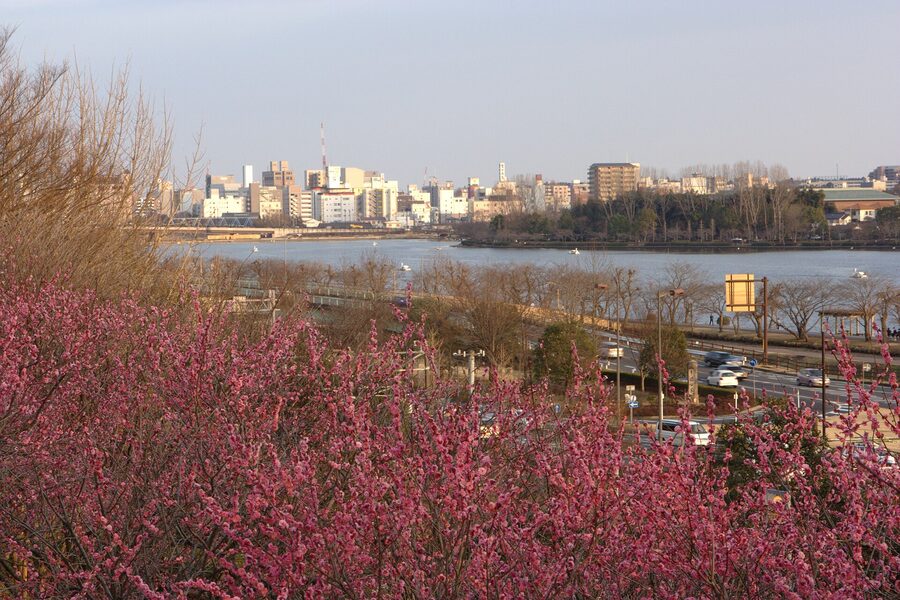
Practical: free for the main plum grove, 300 yen for Koubuntei, free again on weekends if you arrive by 9 a.m. The JR Joban line gets you to Mito in just over an hour from Ueno on a limited express, and the dedicated Kairakuen station opens only during the plum festival, which gives the visit a slightly festival-day feel. Walk down to the lake afterwards and eat at Yabusoba, which has been serving the same buckwheat formula since the Meiji period.
Kyoto’s garden quarter
If the San-meien are the Edo-period domestic gardens, Kyoto is where you go for almost everything that came before, and quite a lot that came after. The city has somewhere between 70 and 200 gardens of standalone interest, depending on whether you count subtemples and private estates. The list below is the seven I would put in front of any first-time garden visitor, in roughly the order I would walk them.
Ryoan-ji and the fifteen-rocks paradox
Everyone goes to Ryoan-ji at least once. The famous karesansui (dry-landscape) garden in front of the Hojo abbot’s hall is fifteen rocks on raked white gravel, twenty-five metres long and ten metres wide, walled on three sides by an oil-rubbed earth wall. From any seated position on the wooden veranda you can count fourteen rocks. One is always hidden by another, and which one varies by where you sit.
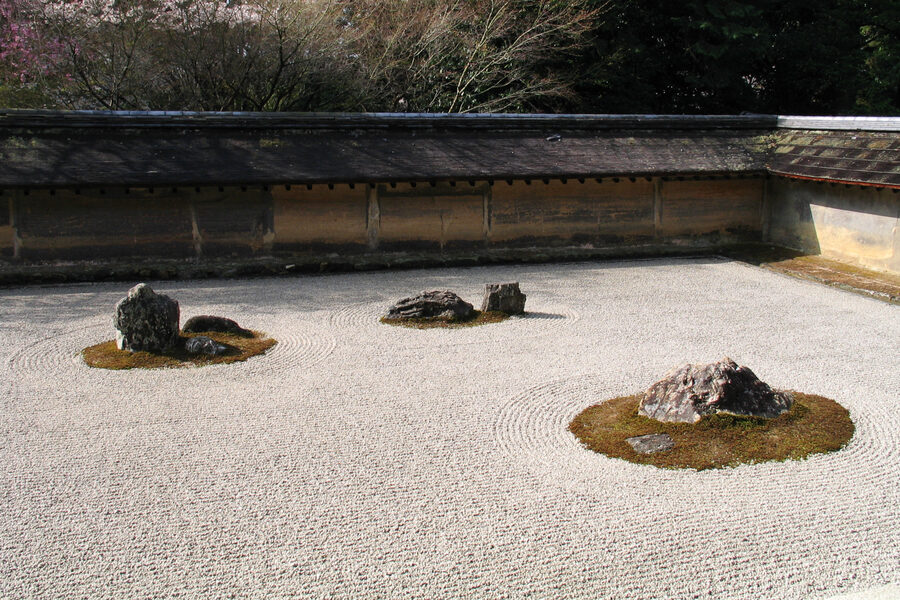
I have seen the garden when it was empty (twice, both times in February at 8 a.m.) and when it had a hundred and forty visitors on the veranda at once. It survives the crowds better than you would think, because the composition is small enough to absorb almost any number of people without losing its centre. The garden’s effect comes from a sustained gaze, not a wide one, and the gaze is yours to do.
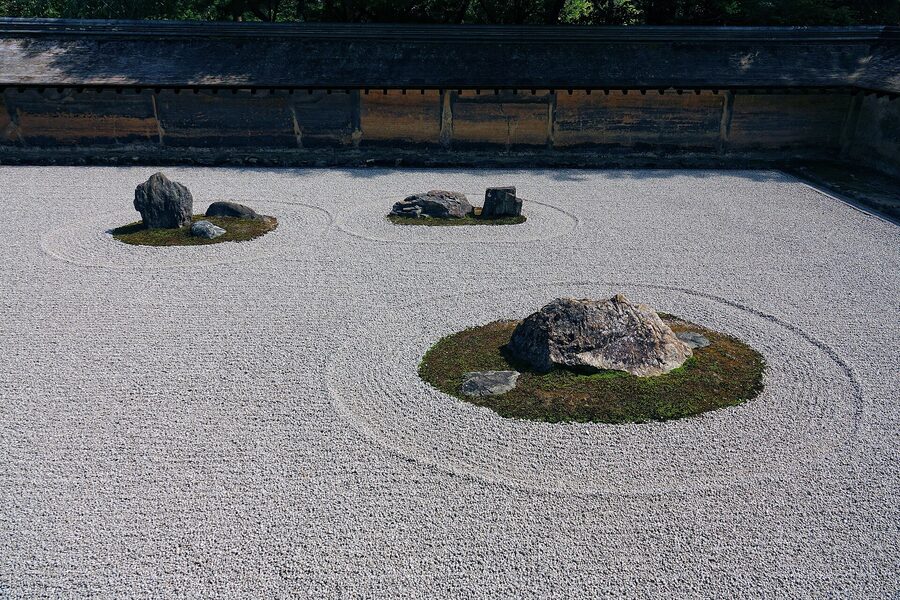
The other thing nobody tells you in advance is that the date and the designer are unknown. Tradition attributes the garden to Soami around 1499, but the earliest documentary record places it later, possibly as late as the early seventeenth century, and the rock arrangement was certainly altered after a 1797 fire. The garden you see is at most three-quarters of its original composition, and the missing quarter is a debate that has been productive for art historians for around two centuries.
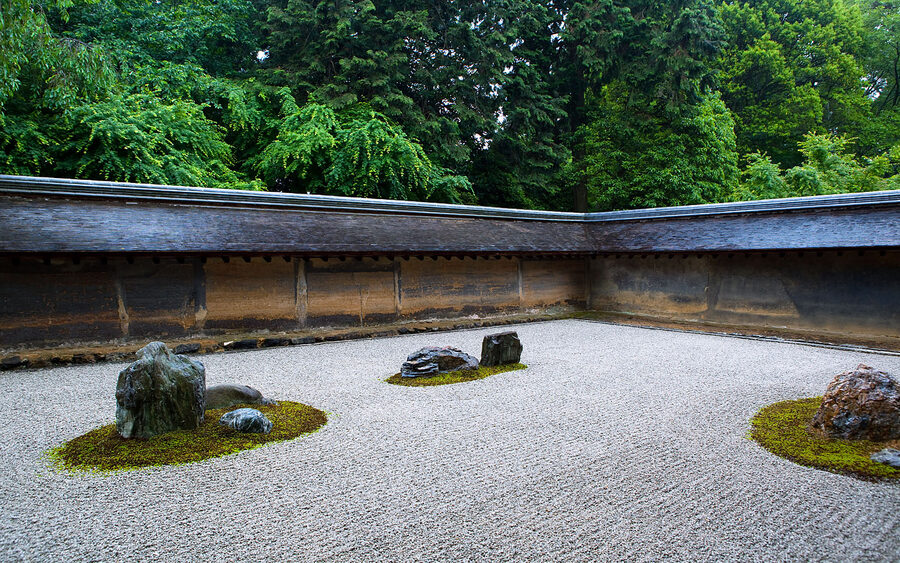
Practical: 600 yen, open 8 to 5 in summer and 8:30 to 4:30 in winter. There is a smaller pond garden behind the Hojo with a famous tsukubai inscribed “I learn only to be contented,” which most visitors blow past in their hurry to leave. Sit at the pond for ten minutes after the rock garden. The contrast is the point.
Saiho-ji, the Moss Temple
Saiho-ji is also called Kokedera, “the Moss Temple,” and it is the most awkward garden to visit in Japan. To enter you have to write a postal request at least two months in advance, on a return-paid postcard, addressed to the temple administration office in Matsuo Ohgura-cho. They reply with a date and a time. You bring 4,000 yen in cash and arrive at the gate forty minutes before your slot.
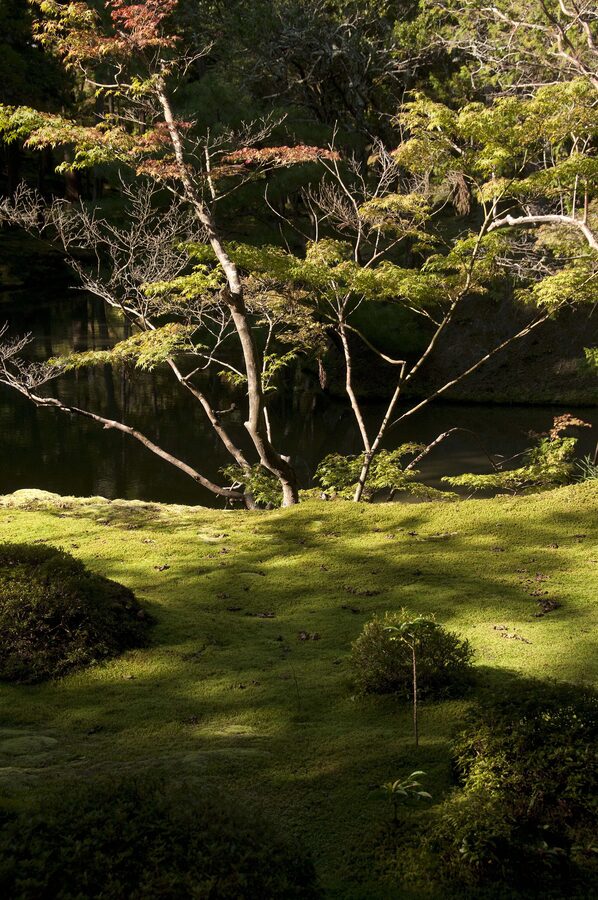
Before you are allowed into the garden you sit on a tatami floor in the main hall, listen to a head monk chant for around ten minutes, and then trace a sutra in ink on a printed sheet. This takes another twenty to thirty minutes. You do not have to finish, but you do have to start. Only after you hand the sutra in are you taken through the inner gate to the moss garden itself.
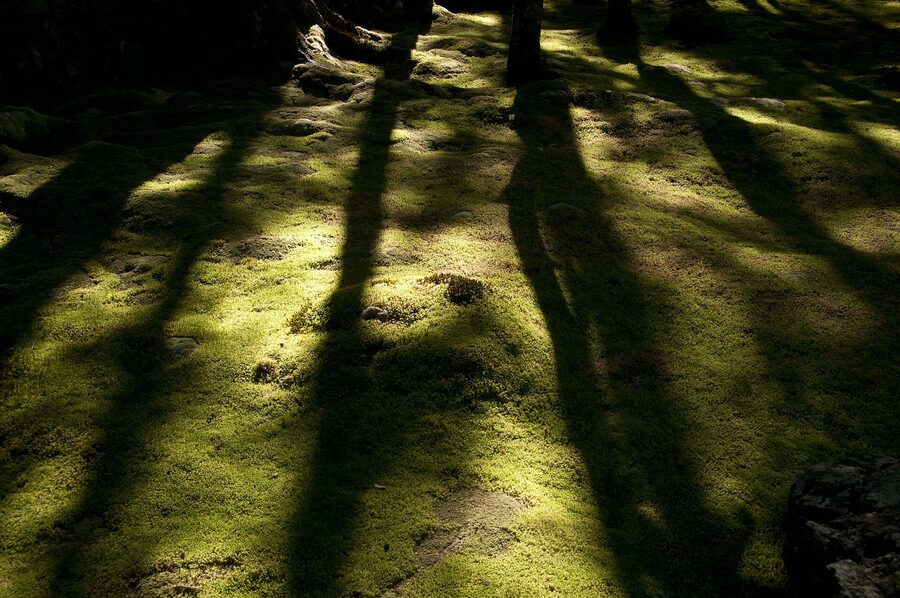
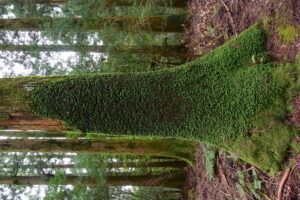
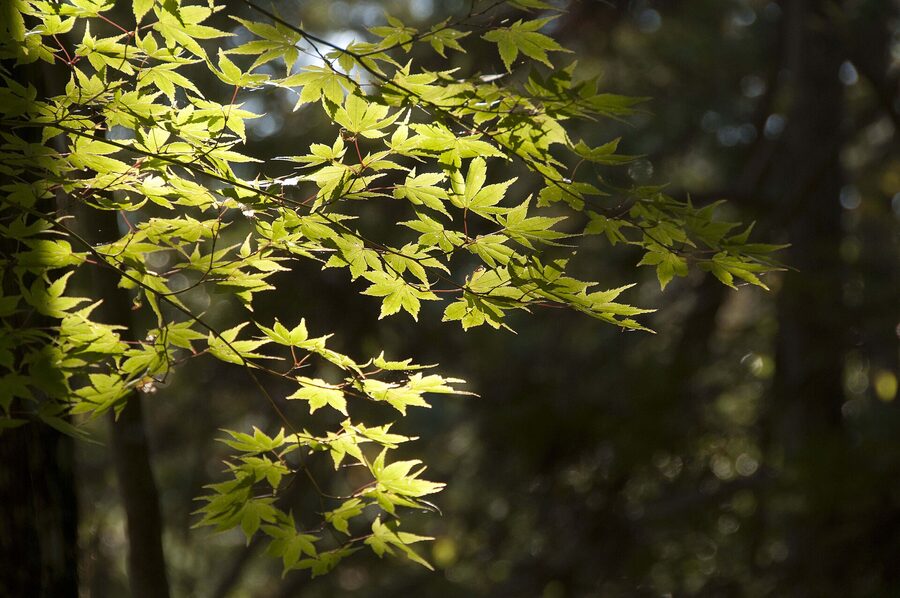
This sounds annoying, but it is not. The booking system was introduced in 1977 explicitly to slow visitors down, after a 1960s mass-tourism period almost destroyed the moss. The forty-minute approach ritual works as it is supposed to: by the time you reach the pond you have stopped checking your phone, and your eye has adjusted to the green. The garden itself, designed by the Zen monk Muso Soseki in 1339, is the oldest surviving great composition in Japan, and the moss is mostly a beautiful accident from a flood-and-neglect period in the late Edo.
Practical: postcard application, 4,000 yen on the day, slots are 9 a.m., 10 a.m., 11 a.m., 1 p.m. and 2 p.m. The temple sometimes accepts online bookings during off-peak periods; check the official site before booking flights around the visit. Avoid the rainy season weeks of June if you do not like mosquitoes; the moss is at its absolute peak then but so are the bugs.
Tenryu-ji, Arashiyama
Tenryu-ji’s Sogen-chi pond garden is the oldest surviving Muso Soseki design, completed in 1345 and never substantially redrawn. The temple has burnt down eight times in seven hundred years; the garden has not. Muso designed it on Buddhist cosmology, with seven stones on the far shore representing the legendary Mt Horai (the island of immortals), and a dry waterfall (kare-taki) in the upper west corner that “flows” upward toward heaven.
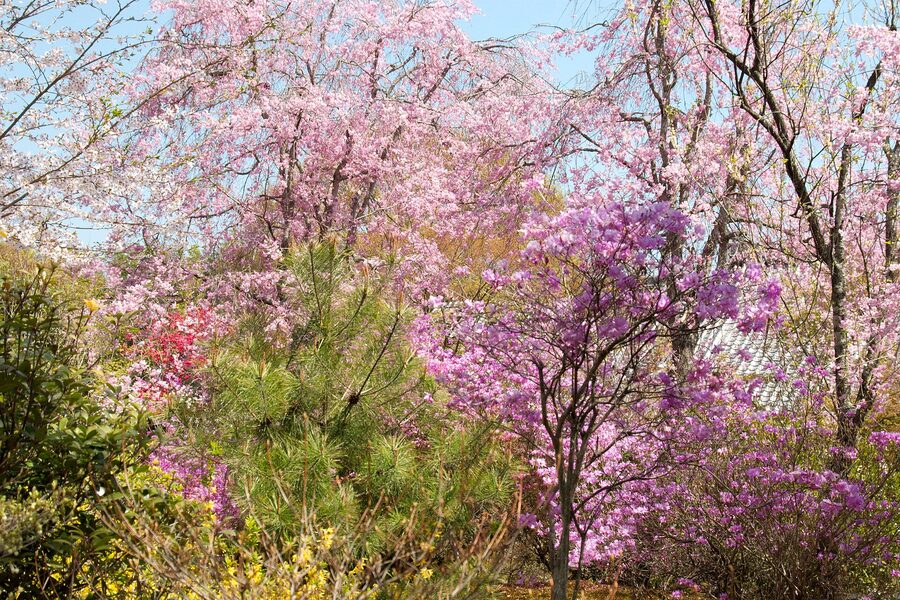
What the garden actually does, for the visitor on the deck of the Hojo, is borrow the Arashiyama mountain range to the west. The two unequal peaks of Mount Arashi and Mount Kameyama enter the composition through a deliberately framed clearing in the foreground trees. Muso planned it that way: the stones in the pond and the mountains beyond are meant to be read as a single horizontal painting, with the pond as ink and the mountains as wash.
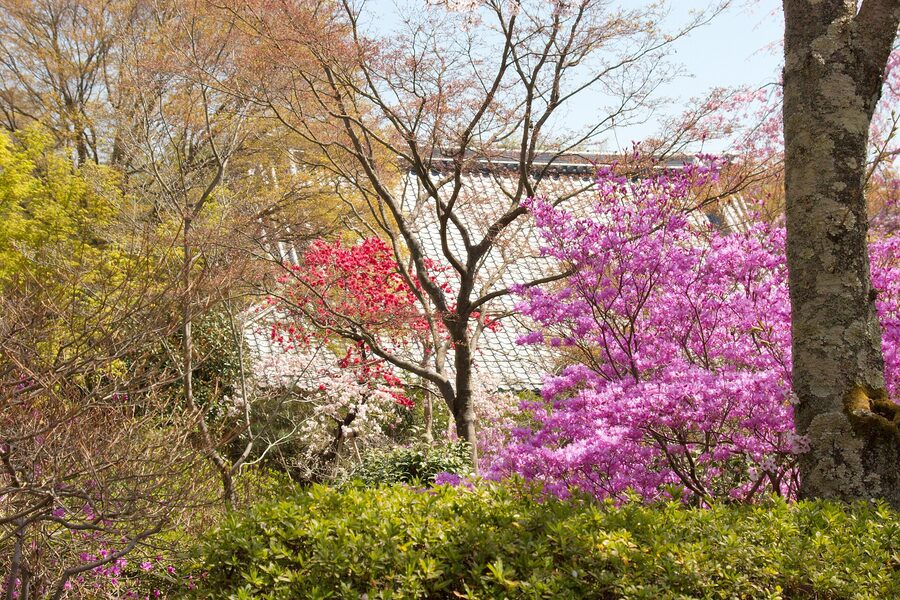
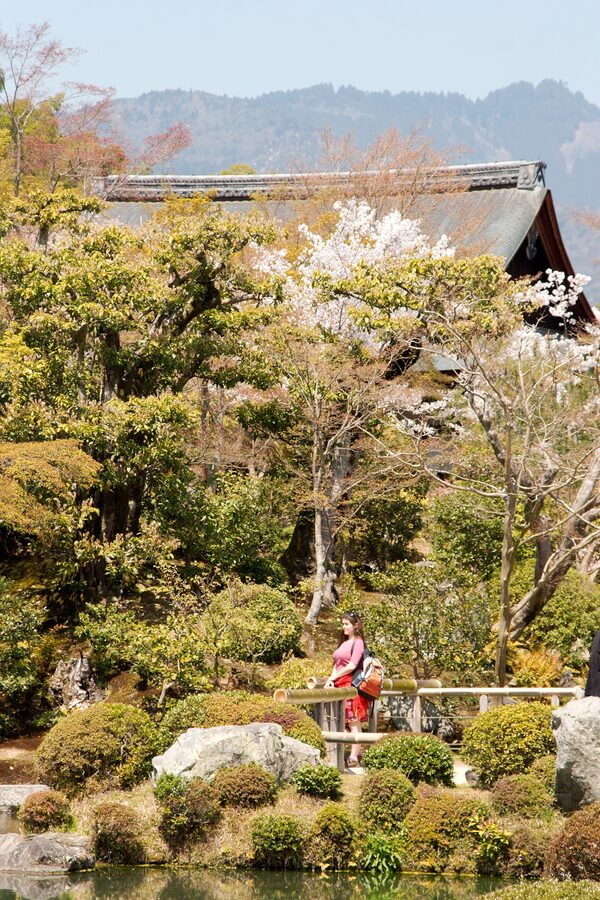
Practical: 500 yen for the garden alone, 800 yen including the Hojo. Get there at opening time (8:30) on a weekday, because by 10 a.m. the bus tours from Arashiyama station have arrived and the deck is six bodies deep. Combine with the bamboo grove behind the temple, then walk twenty minutes uphill to Saiho-ji if you got your booking. That is one of the great half-day walks in Kyoto.
Daitoku-ji subtemples: Daisen-in, Zuiho-in, Koto-in
Daitoku-ji is a complex of more than twenty Zen subtemples in north Kyoto. Roughly eight of them open their gardens to the public on a rotating basis, and three are essential. Daisen-in (Sōami, c. 1513) is a karesansui composition that condenses an entire Chinese landscape painting into a fifteen-metre L-shaped courtyard, with a “river” of raked sand carrying small stone “boats” past a “mountain” of standing rocks.
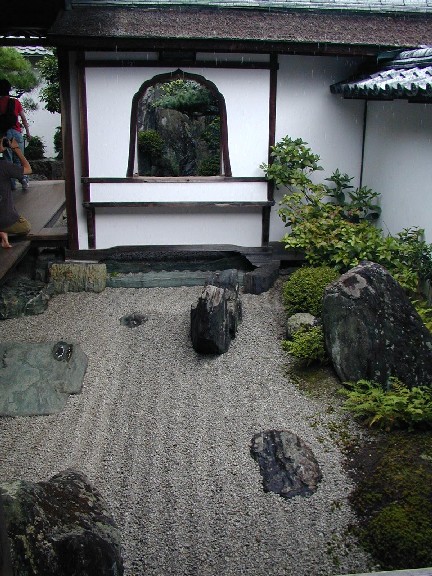
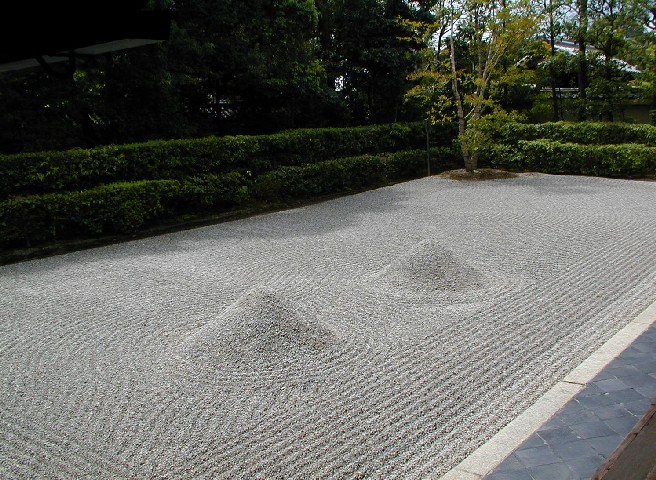
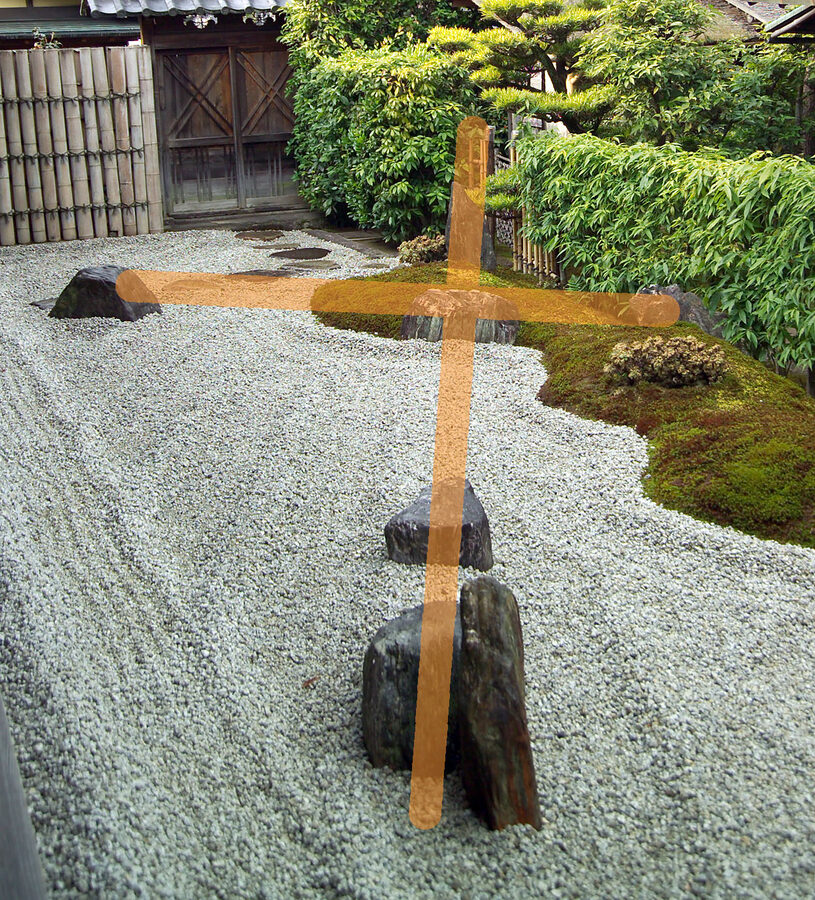
Zuiho-in is the strangest. The 1961 north garden by Mirei Shigemori, a polarising twentieth-century landscape architect, is raked gravel ploughed in a slow oceanic wave, with seven dark stones rising out of it. The south garden, however, is the one that gets people talking: Shigemori arranged the stones in a hidden Christian cross pattern, in homage to the founder Otomo Sorin, the sixteenth-century Kyushu daimyo who converted to Catholicism. You only see the cross when you look at the right angle.
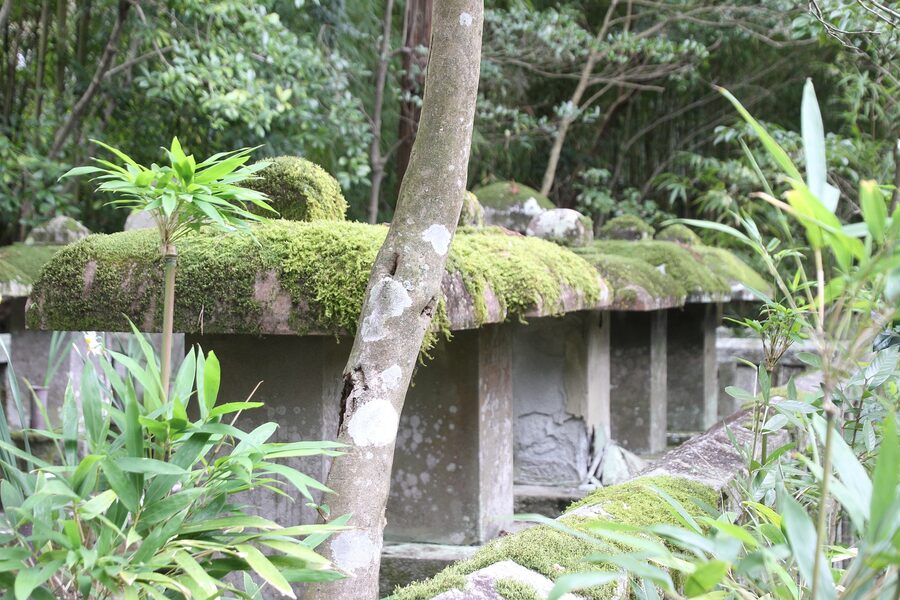
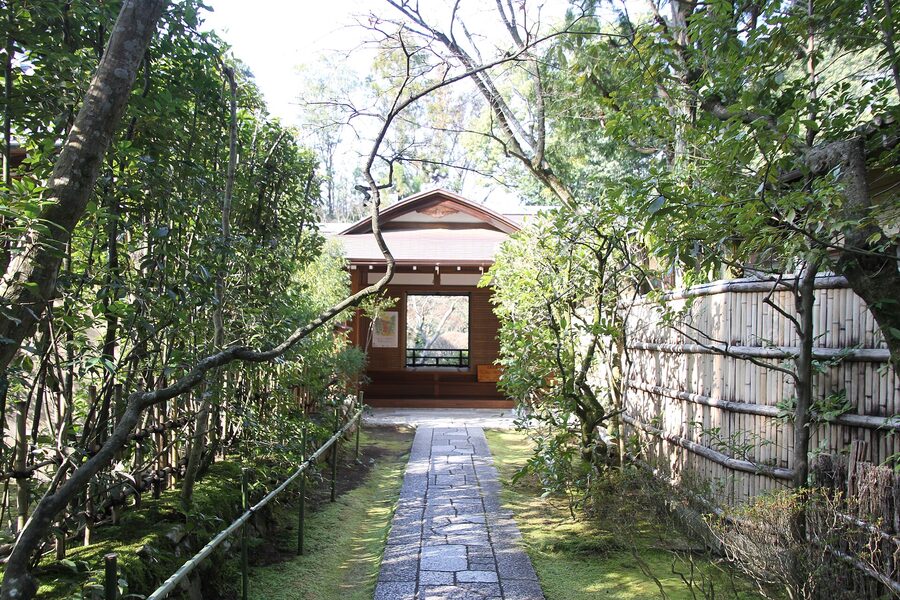
Koto-in is the most contemplative of the three, and was the bodai-ji (memorial temple) of the Hosokawa family. You can read about the founder couple in the Hosokawa Gracia piece and the warrior-tea master Hosokawa Tadaoki piece; both are buried in the inner stone garden. The famous straight maple-lined entrance path is photographed about a thousand times a day in late November, and is empty by 8:45 a.m. when the gates open.
Practical: each subtemple charges 400 to 500 yen separately. The complex’s main temple itself is rarely open to the public, and a Daitoku-ji visit is best understood as a loose route between three or four subtemples in a single morning. Daisen-in and Zuiho-in are usually open daily; Koto-in closes for renovations every few years and reopens, as it did most recently in 2024. Check the Daitoku-ji subtemple board at the main gate.
Tofuku-ji Hojo Gardens
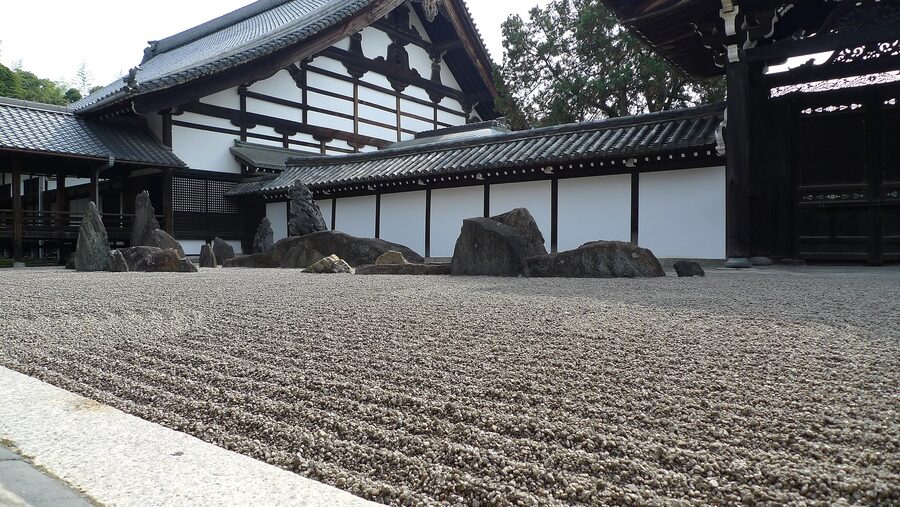
The Hojo gardens at Tofuku-ji are Mirei Shigemori’s masterwork from 1939. Tofuku-ji is a thirteenth-century Rinzai Zen temple, and Shigemori was commissioned to redesign the gardens around the abbot’s hall after a 1934 typhoon damaged the existing layout. He wrapped the Hojo on all four sides with four distinct gardens, each in a different style, and the result was the first significant new Zen garden composition in nearly three centuries.
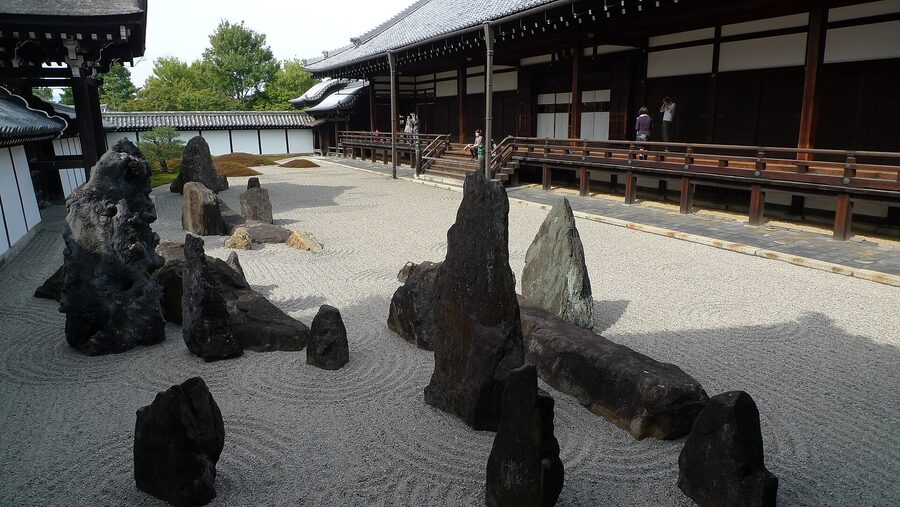
The south garden is the largest of the four and the most rhetorical. Four stone groups represent the four Daoist islands of immortality, and five rounded moss-covered mounds at the far end represent the five sacred Buddhist mountains. Shigemori was making a deliberate point about Zen syncretism: he uses both Daoist and Buddhist iconography in a single composition, where a more orthodox temple gardener would have stuck to one tradition.
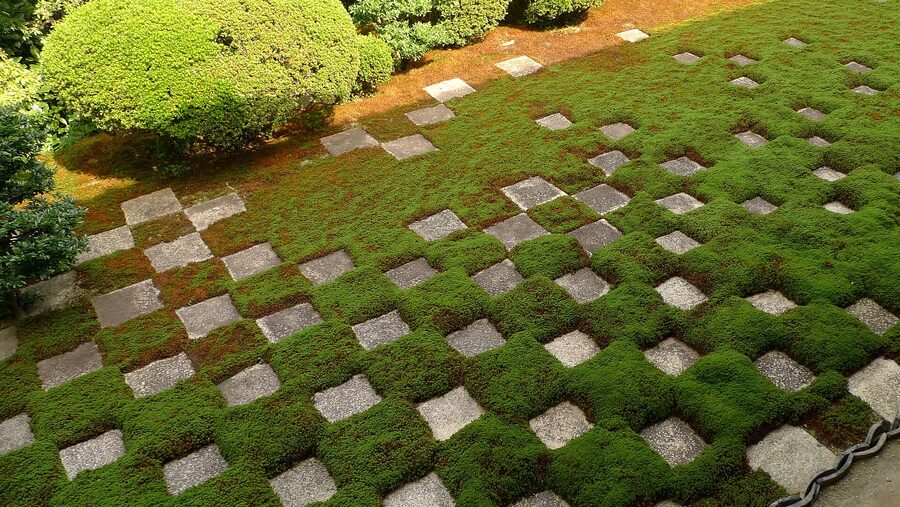
The north garden is the one you have probably seen on a postcard. Square-cut stone slabs are inset in moss in a thinning checkerboard pattern, transitioning from formal grid at the east end to scattered randomness at the west. The pattern is borrowed from the floor of the destroyed temple kitchen, again following Shigemori’s habit of reusing salvaged materials. It looks like a Japanese garden version of a Mondrian painting, made twenty years before Mondrian was famous in Japan.
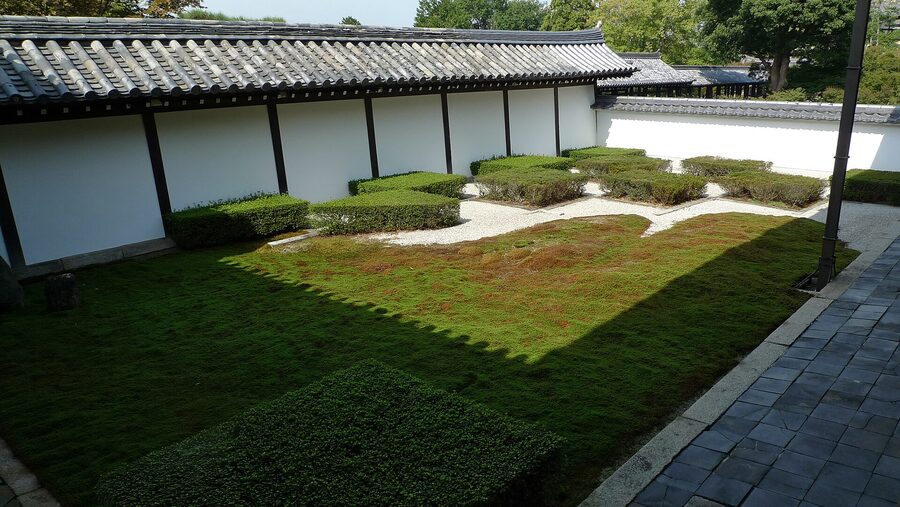
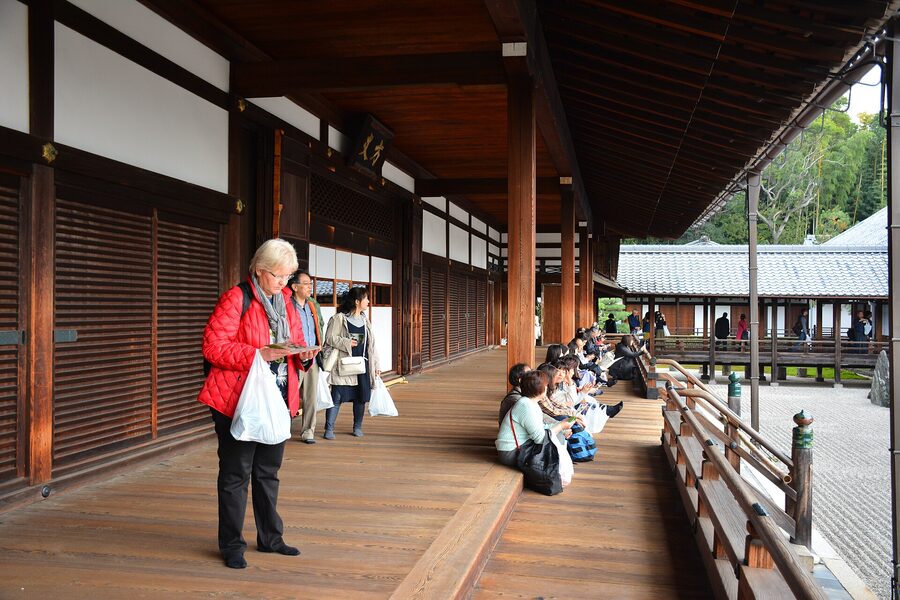
Practical: 1,000 yen including both the Hojo gardens and the Tsutenkyo bridge over the maple ravine. Tofuku-ji is one of Kyoto’s two great November maple destinations (the other being Eikan-do); avoid the third weekend of November unless you specifically want to test your tolerance for queuing. Spring and summer the temple is calm, and the Mirei Shigemori gardens are arguably better in greenery than peak autumn anyway.
Katsura Imperial Villa
Katsura Imperial Villa is the gold standard, the garden Walter Gropius and Bruno Taut said had defined modernism for them, and the only major Edo-period imperial garden where you cannot just walk in. Katsura was built between 1615 and 1662 for Prince Toshihito and his son Toshitada, with design and construction guidance traditionally attributed (perhaps overstated) to Kobori Enshu, the warrior-aesthete who codified the formal Edo daimyo garden style.
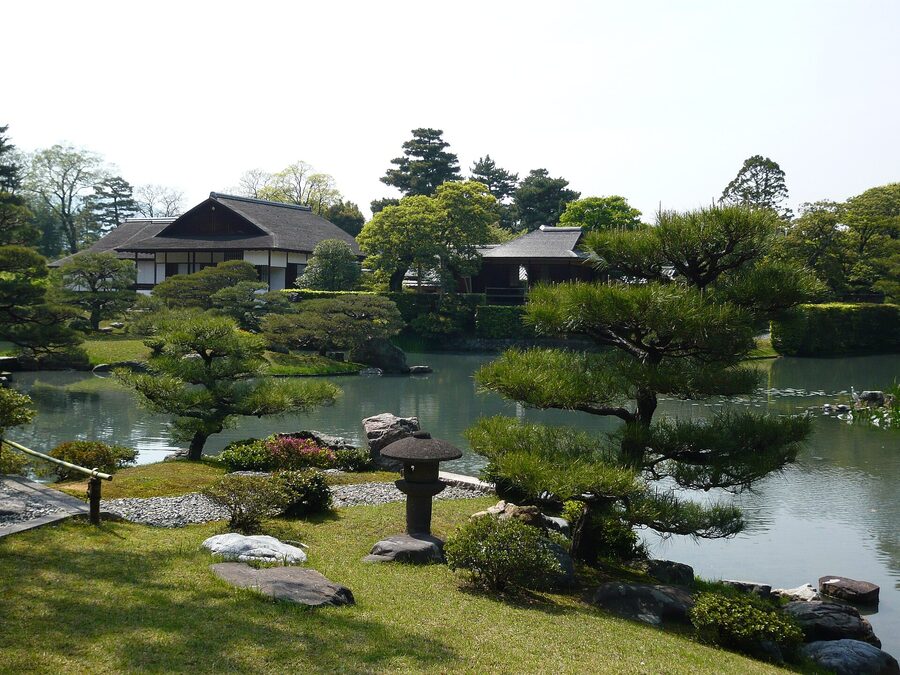
The villa is a masterclass in compositional sequencing. As you walk the path you encounter four separate teahouses, each calibrated for a different season: Shokin-tei for spring, Shoiken for autumn moon-viewing, Geppa-ro for summer rain on the eaves, and Shokatei for winter. The path between them is laid in stepping stones (tobi-ishi) that force you to look down at the ground at the precise moments the designers wanted to delay your gaze. Look up at the wrong second and you miss the framed view; look up at the right second and the composition opens.
The booking process changed in 2018. You can apply online at the Imperial Household Agency website (sankan.kunaicho.go.jp), select a date and slot up to a month in advance, and pay 1,000 yen on the day. There are now also walk-up tickets sold at the gate at 11 a.m. for around 250 same-day slots, but these go in twenty minutes on a busy day. Bring your passport; the tour is in Japanese with English audio-guide handsets, and runs about an hour.
Sento Imperial Palace Garden
Sento, behind the Kyoto Gosho in the central palace grounds, is the other great imperial garden you can visit. Sento was begun in 1630 as the retirement palace of Emperor Go-Mizunoo, with Kobori Enshu working the original layout. The buildings burnt down in 1854 and were never rebuilt, but the garden survives, and the absence of the buildings actually reads as a strength: the pond and the bridges occupy the empty spaces left by the lost shoin.
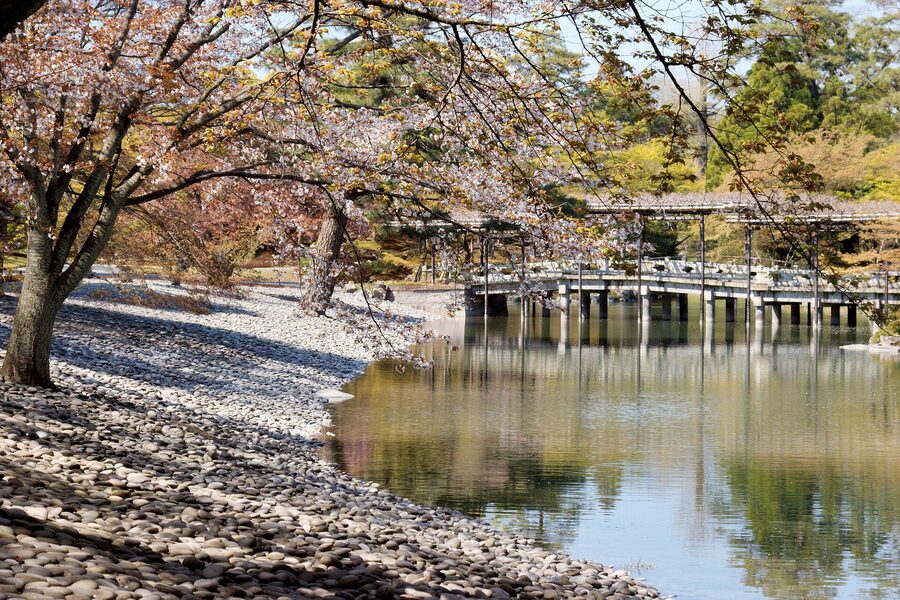
What you have to know about Sento is the Suhama beach. On the south shore of the lower pond is a beach of about 110,000 polished round black stones, each one roughly fist-sized, gathered as tribute by the Odawara daimyo Okubo family in the 1630s. Each stone was wrapped individually in silk for the journey to Kyoto. They are still there, you walk past them on the tour, and you should try to register that fact for a moment before you keep walking.
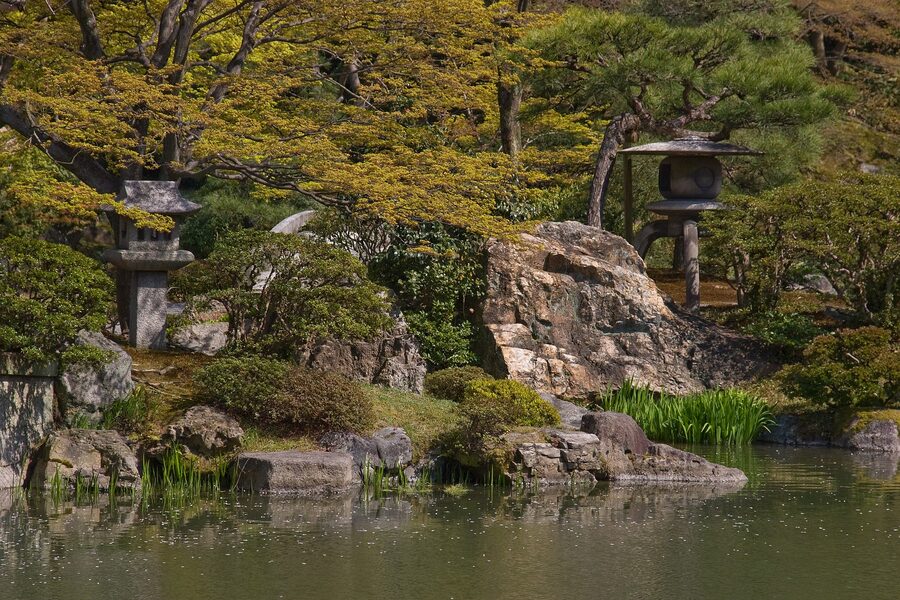
Practical: same Imperial Household Agency booking system as Katsura, free admission for Sento, slots are 11 a.m. and 1:30 p.m. on weekdays. Bring your passport. The tour starts at the Seisho-mon gate and is around an hour. There is no audio guide, the docent speaks Japanese only, but Sento is one of those gardens that needs no commentary if you have read about it before you arrive.
Tokyo’s Edo-period daimyo gardens
Tokyo (Edo) had hundreds of daimyo gardens during the Tokugawa centuries. Each of the 270 or so daimyo houses kept at least one Edo residence under the sankin-kotai alternate attendance system, and most of those residences had a stroll garden of some kind. Most were built over by the Meiji and Taisho-era city. Four major Edo-period gardens survive intact in central Tokyo, and they are all still good.
Hama-rikyu
Hama-rikyu sits at the mouth of the Sumida river, where the Tsukiji fish market used to be, and it was the Tokugawa shogunate’s private duck-hunting reserve. The shogun would arrive by boat, hide in screened blinds, and shoot waterfowl driven into a fan of canals by trained dogs. The duck blinds and decoy ponds are still there, marked with small wooden plaques, in the back garden behind the central pond.
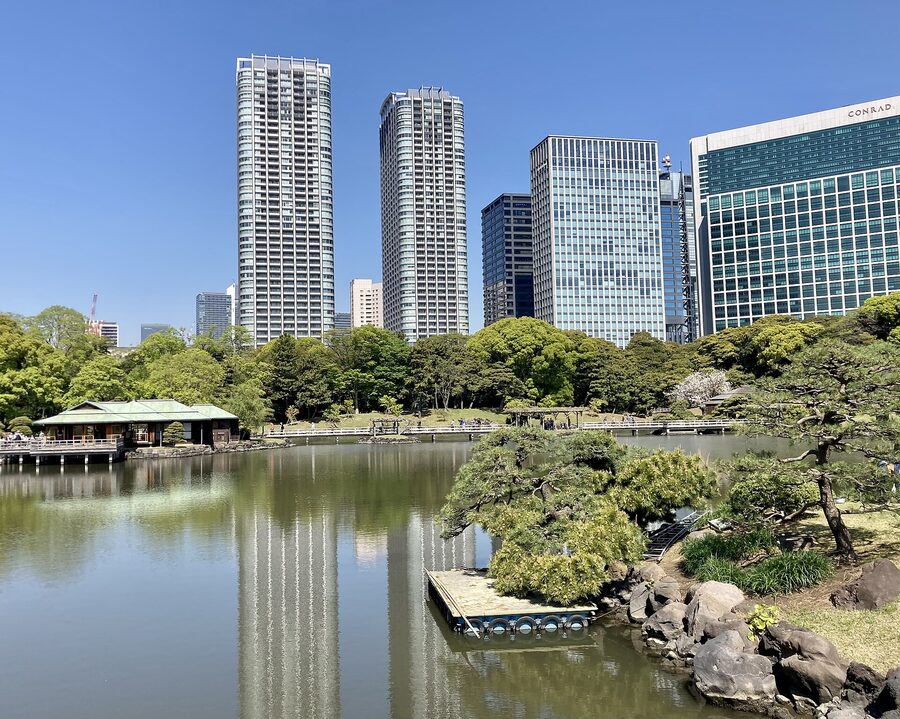
The strange thing about Hama-rikyu is the seawater. The central pond is tidal: a sluice gate in the south-east corner connects it to Tokyo Bay, and the water level rises and falls by about thirty centimetres twice a day. It is the only tidal pond garden in Japan still in working condition. The fish in the pond are sea fish (mullet and sea bass) rather than freshwater carp.
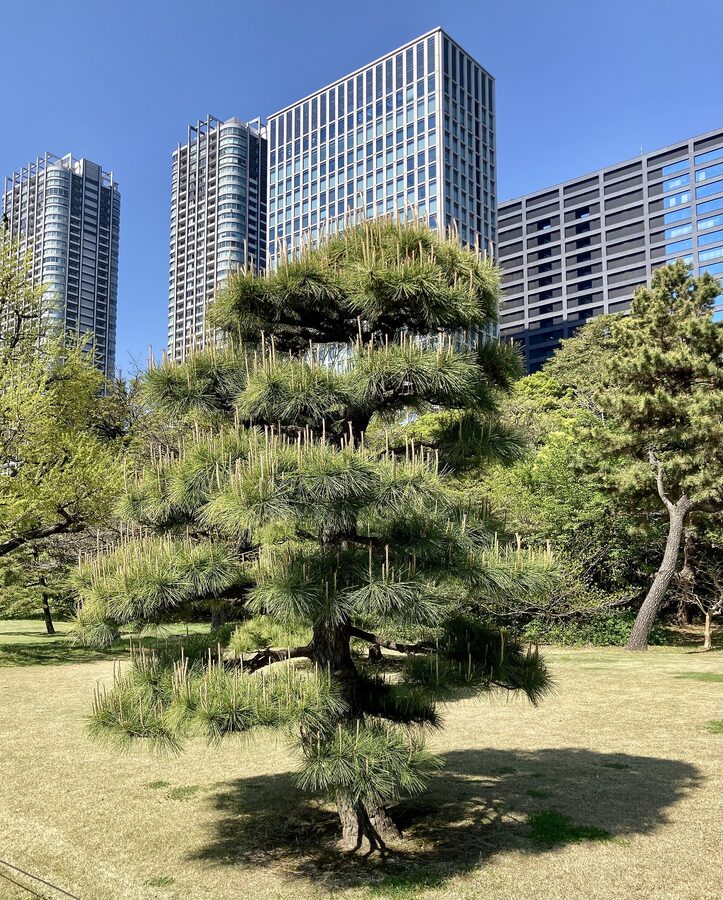
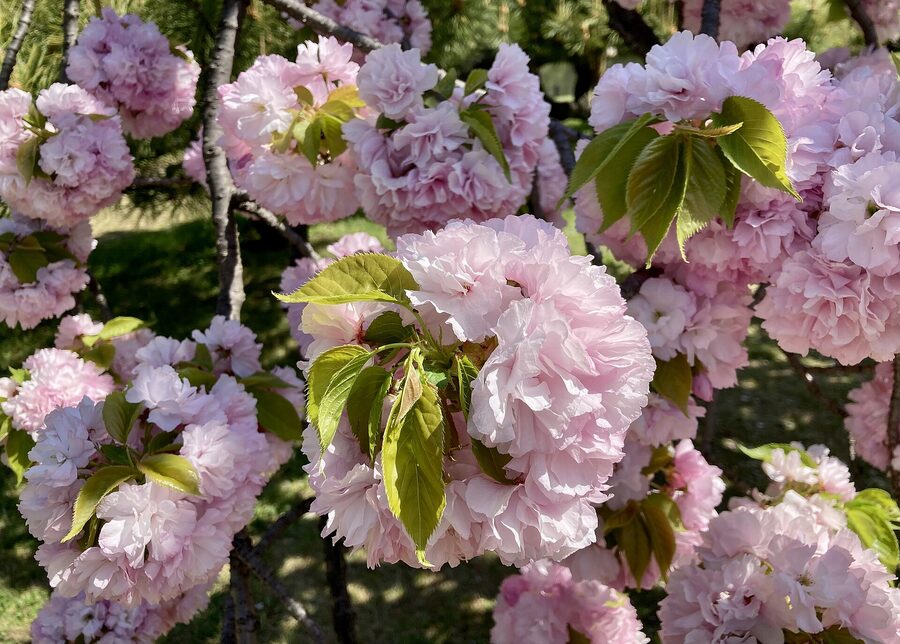
Practical: 300 yen, open 9 to 5. Take the Yurikamome line to Shiodome and walk; or, much better, take the Tokyo Cruise water bus from Asakusa down the Sumida and arrive at the garden’s own pier. The boat journey is the original way the Tokugawa retainers approached the garden, and the geography of Edo-period Tokyo (water city, not road city) clicks into focus the moment you do it. The Nakajima teahouse on its island in the central pond serves a 850-yen matcha set; sit there for half an hour and watch the tide.
Koishikawa Korakuen
Koishikawa Korakuen is in north-central Tokyo, next to the Tokyo Dome stadium, and it is the older of the city’s two surviving major daimyo gardens. The Mito Tokugawa branch began it in 1629, and Mitsukuni (the famous “Mito Komon” of later folklore) finished it in the 1660s. Mitsukuni was a Confucian scholar and a Ming sympathiser, and he salted the garden with allusions to the Chinese classics that you will entirely miss without a guidebook.
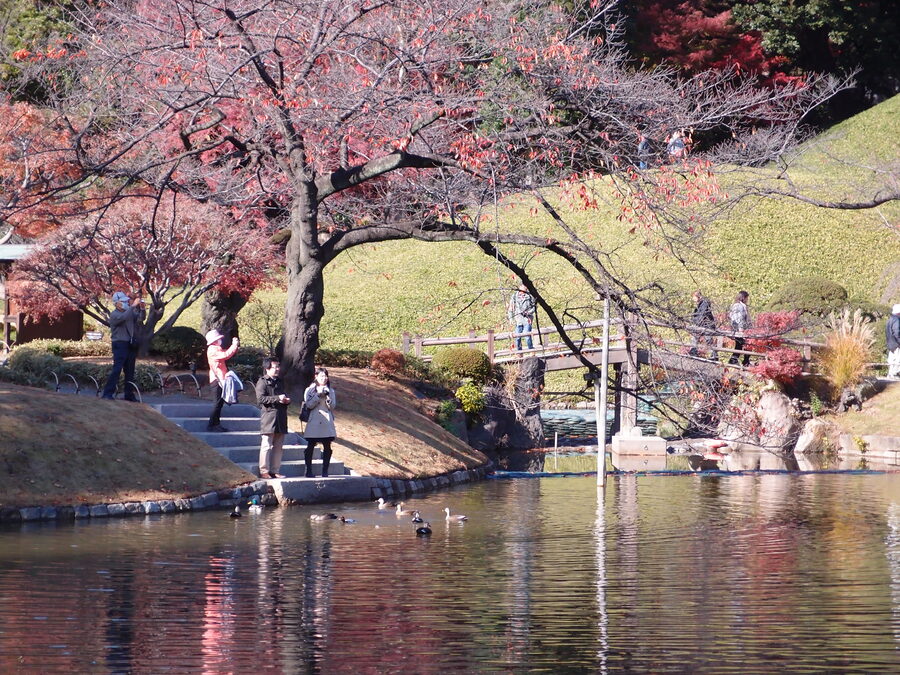
The whole garden is a sequence of references. The central pond imitates Hangzhou’s West Lake; the small thatched moon-viewing platform is named for a Tang-dynasty poem; the rice paddy at the back was added in 1701 to teach the daimyo’s heir how rice was actually grown (a Confucian gesture; rulers should know what their subjects do). The Engetsukyo bridge over the inflow is a half-circle whose reflection completes a perfect circle on still water, which is a rhyme on a Sung-dynasty poem about full moons.
Practical: 300 yen, open 9 to 5. From Iidabashi station it is six minutes on foot. The garden is busy on November weekends and almost empty in February. The combination ticket with Rikugien is 400 yen and worth it if you are doing a Tokyo gardens day; the two together take maybe four hours of slow walking.
Rikugien
Rikugien was built between 1695 and 1702 by Yanagisawa Yoshiyasu, the chamberlain of the fifth shogun Tokugawa Tsunayoshi. Yoshiyasu was a literary man as well as a political one, and the garden’s name and structure are a six-precepts (rikugi) reference to a Heian-era waka poetry treatise. Eighty-eight separate features in the garden are named after specific places mentioned in classical poems.
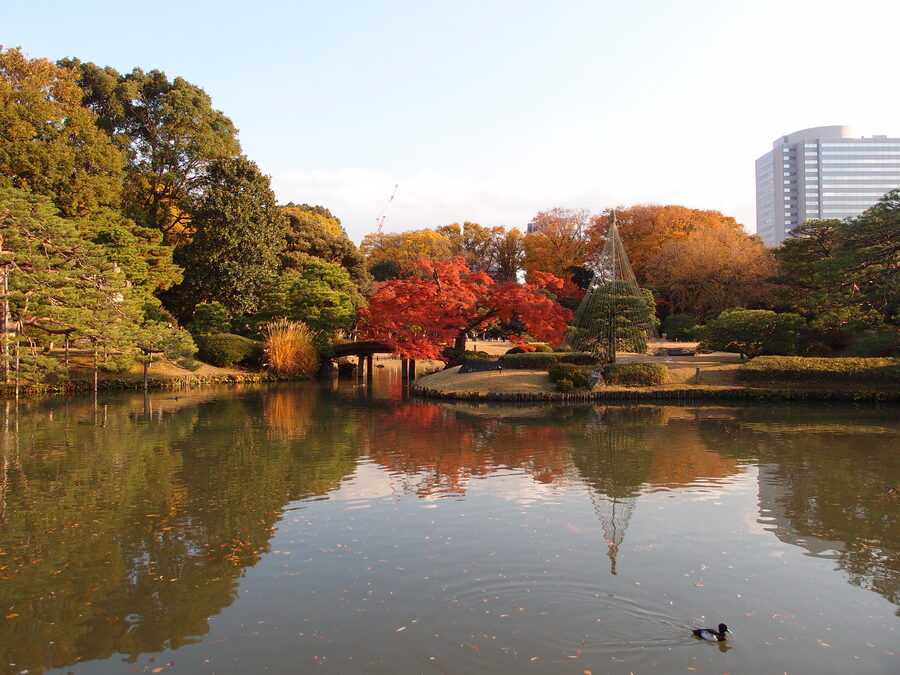
The result is a garden that is hard to read without preparation. Without a guide you experience Rikugien as a quiet pond stroll with a few obvious features (the central island, the elevated viewing mound, the weeping cherry by the gate). With a guide or with the printed paper map at the gate you start to see how every bend of the path is a quotation. Mt Wada hill is named for a poem about a famous fortress; Imose-no-yama, the two paired stones at the south end, are named after a married couple in the Manyoshu.
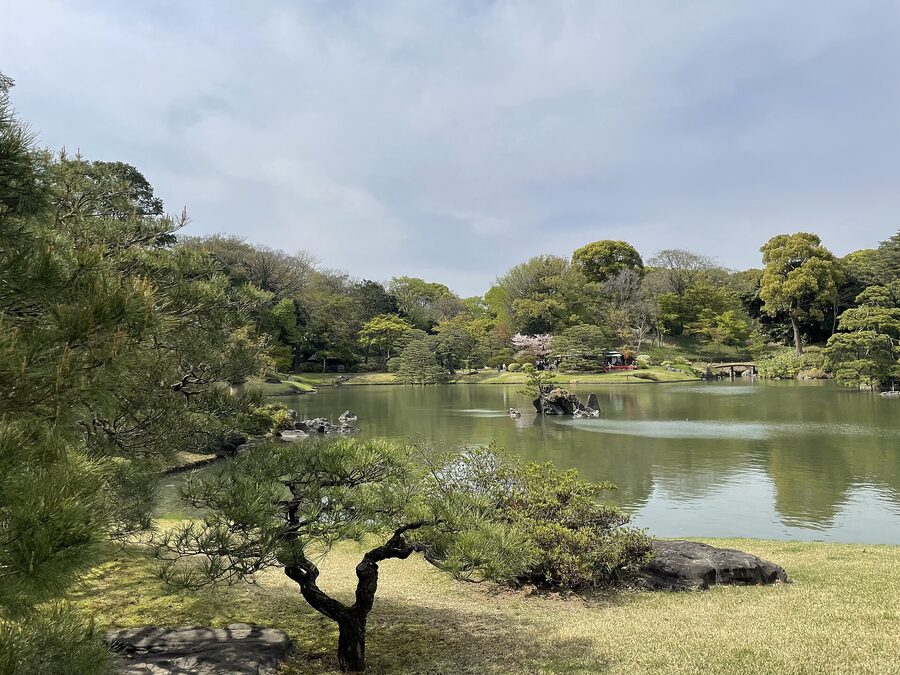
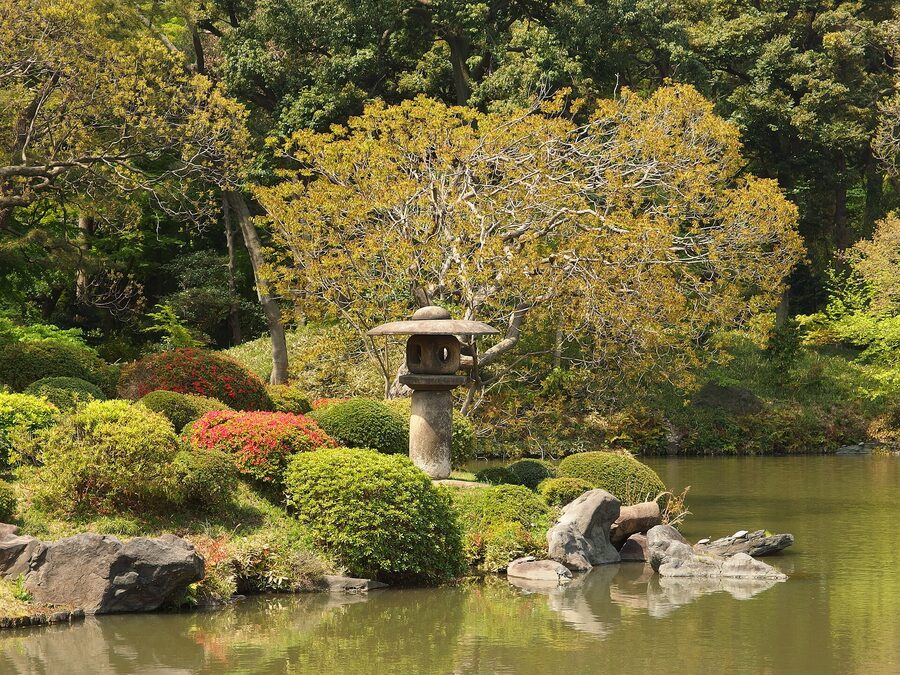
Practical: 300 yen, open 9 to 5, late illumination during the third week of November and the first week of April. The closest station is Komagome on the Yamanote line, six minutes on foot. Rikugien is one of the few Tokyo gardens whose evening illumination genuinely improves the visit, because the lighting was redesigned in 2019 by the Tokyo gardens authority to highlight the original Yanagisawa scene-by-scene composition rather than blast every tree.
Kiyosumi Garden
Kiyosumi sits in Koto ward, on the east side of the Sumida, in what used to be the merchant quarters of Edo. The site was a daimyo garden first, then in 1878 the Mitsubishi founder Iwasaki Yataro bought it as a corporate retreat and entirely reworked it. Iwasaki used Mitsubishi’s shipping fleet to bring back stones from across the Japanese coastline, and the Kishu stones at the south edge of the pond are individually labelled by province of origin.
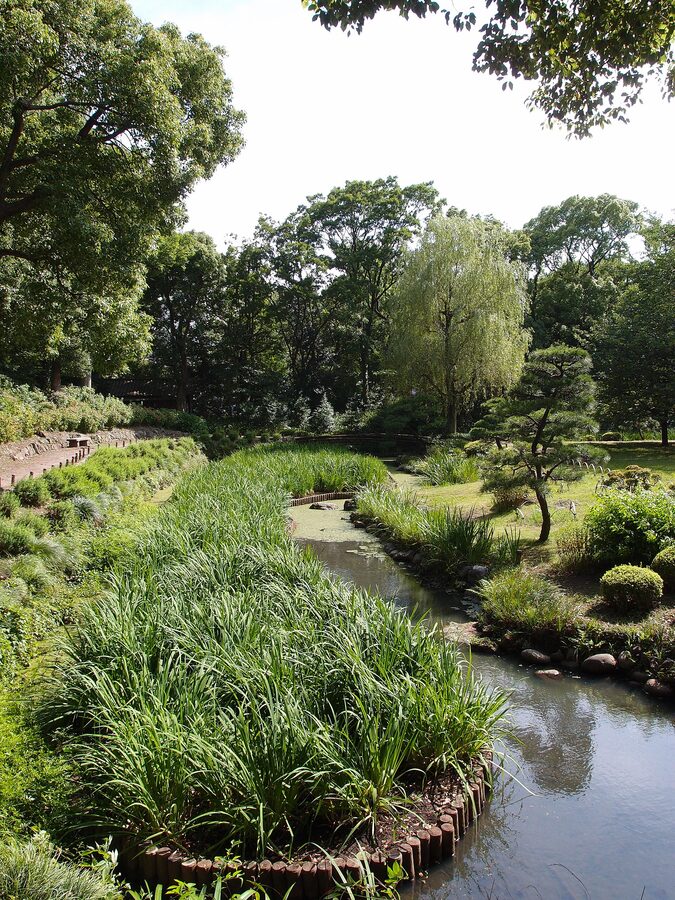
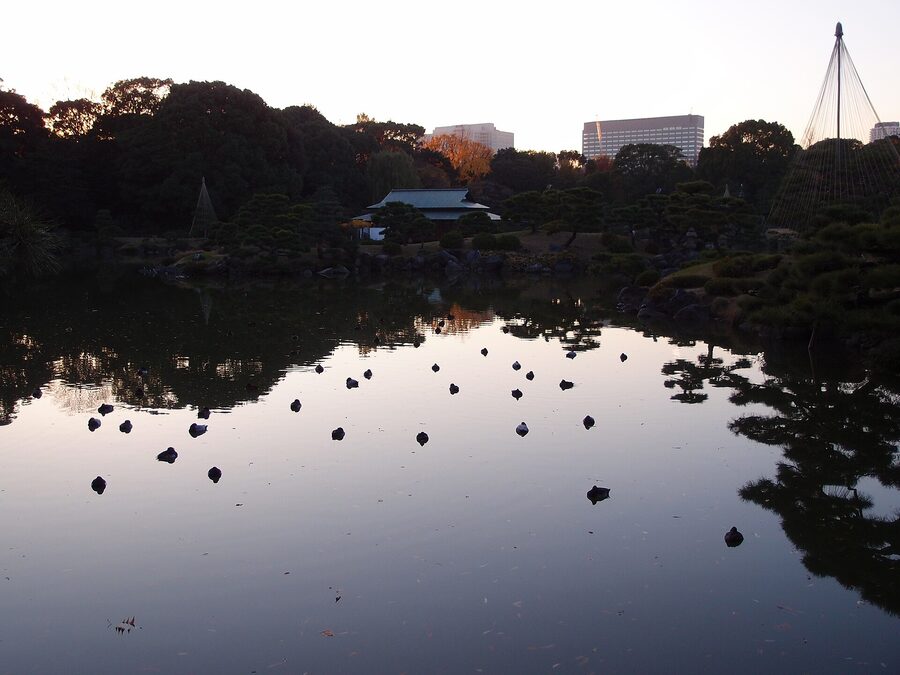
The signature feature is the iso-watari stepping stones across the central pond. You walk on flat stones placed just below the water surface so it looks like you are walking on the pond, and the carp scatter under your feet. The stones are deliberately uneven and deliberately wet, and on a busy weekend you will see at least one tourist take a small picturesque tumble. (I have not, yet.)
Practical: 150 yen, open 9 to 5, the cheapest of the four major Tokyo gardens. From Kiyosumi-shirakawa station on the Hanzomon line it is three minutes on foot. The neighbourhood is one of Tokyo’s better third-wave coffee districts (Blue Bottle’s first Japanese location is two blocks from the gate); plan around it.
Castle and estate gardens beyond Tokyo and Kyoto
Some of the best gardens in Japan are nowhere near the two main cities, and the JR Pass is the cheapest way to see them. The five below are scattered from Shimane to Kagoshima, and you will not see most of them on a normal first-trip itinerary. Each is worth the train ride.
Adachi Museum, Yasugi
The Adachi Museum garden is the one I opened with. Adachi Zenko, born 1899 in Yasugi, made a fortune in textiles and shipping and retired in the 1960s with the express ambition of opening a private museum that would marry traditional Japanese painting with a garden composed in the same idiom. The museum opened in 1970 and the garden was designed under his direct supervision over the next twenty years. He died in 1990.
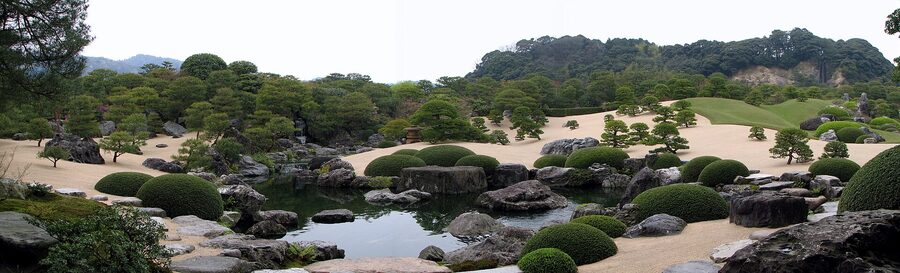
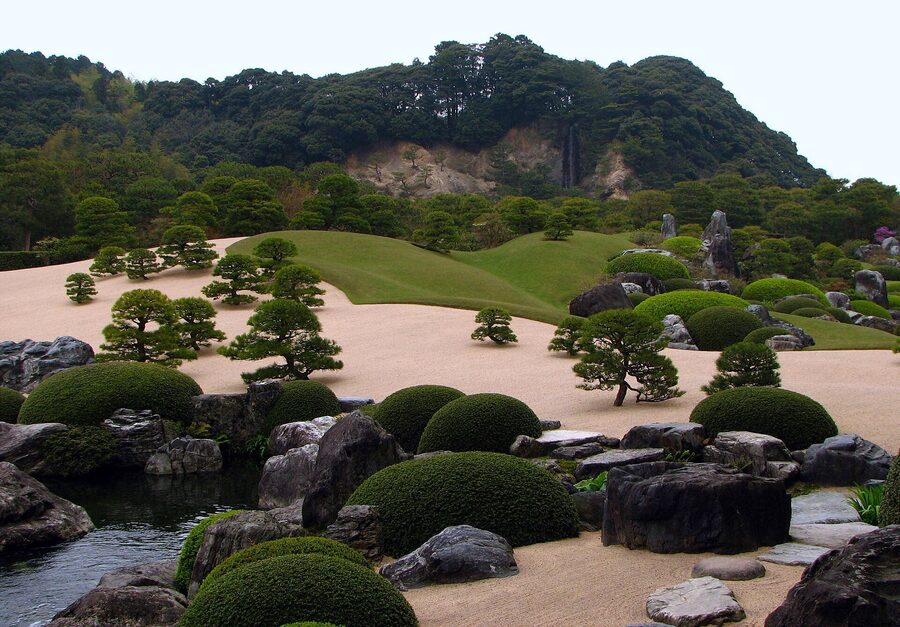
The defining trick is that you cannot enter the garden. The composition is fixed at exactly the angles Adachi specified, viewable through the museum windows, and the whole sequence (six panels with a moss garden, a dry garden, a pond garden, a white-gravel-and-pine garden, a tea garden, and a borrowed-scenery panorama of the Yasugi hills) is laid out on a viewing line along the south corridor of the building. Each window frames a separate composition. You walk between the windows and the views snap from one image to the next.
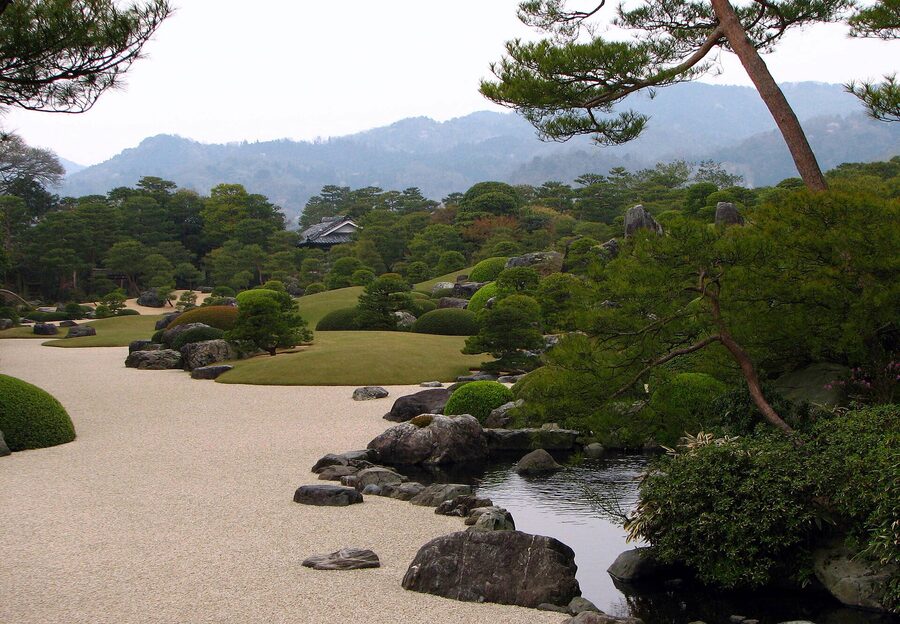
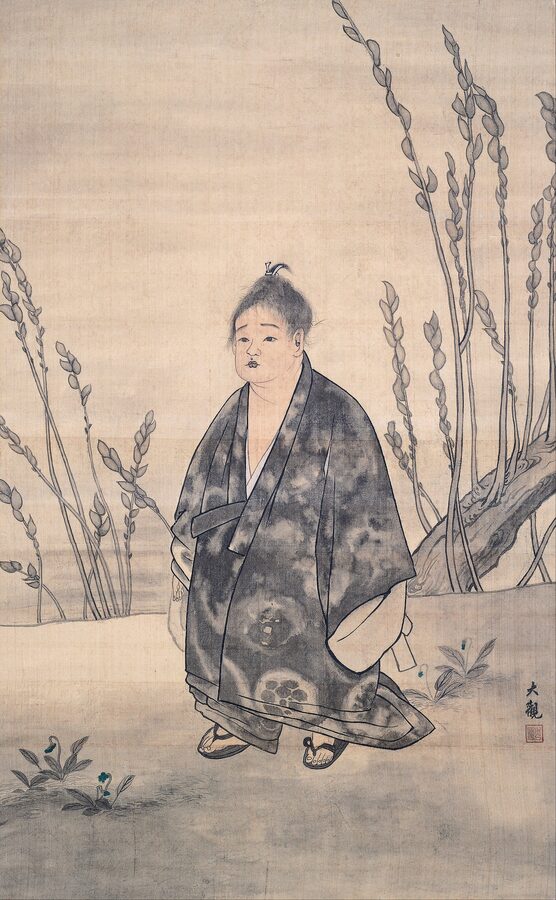
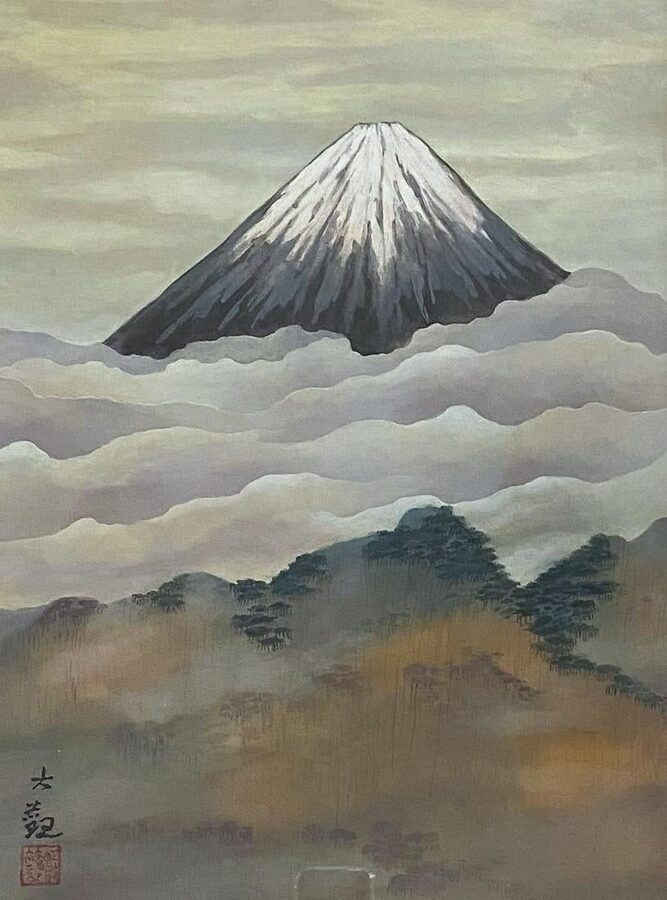
The other reason to come is the painting collection. The museum holds 130 Yokoyama Taikan works, the largest single Taikan collection in Japan, and Adachi’s argument was that the garden and the paintings should be experienced together. You walk the windows, you see the gardens; you walk the galleries, you see the paintings of the same kind of landscapes. The Taikan room (especially “Innocence” of 1897 and “Autumn Leaves”) is a separate experience from the garden but the two were designed to harmonise.
Practical: 2,300 yen, the highest admission of any garden in this guide. Yasugi is on the JR Sanin line, 25 minutes east of Matsue and easily reachable on the Sunrise Izumo overnight sleeper from Tokyo, which I recommend. From Yasugi station the museum runs a free shuttle every fifteen minutes. Allow three hours for the full circuit; longer if the weather is good and you want to sit at the cafe window seat above the moss garden, which is the best 800-yen coffee in Japan.
Sengan-en, Kagoshima
Sengan-en, on the north shore of Kagoshima Bay, was the Shimazu family villa garden. The Shimazu were Kyushu’s southernmost daimyo and one of the houses that helped overthrow the Tokugawa shogunate in 1868. Their villa garden was begun in 1658 and substantially completed by 1700, with periodic renovations under Shimazu Nariakira in the 1850s, who used parts of the grounds as Japan’s first industrial-revolution test site (a steam furnace, a glassworks, and a primitive shipbuilding facility).
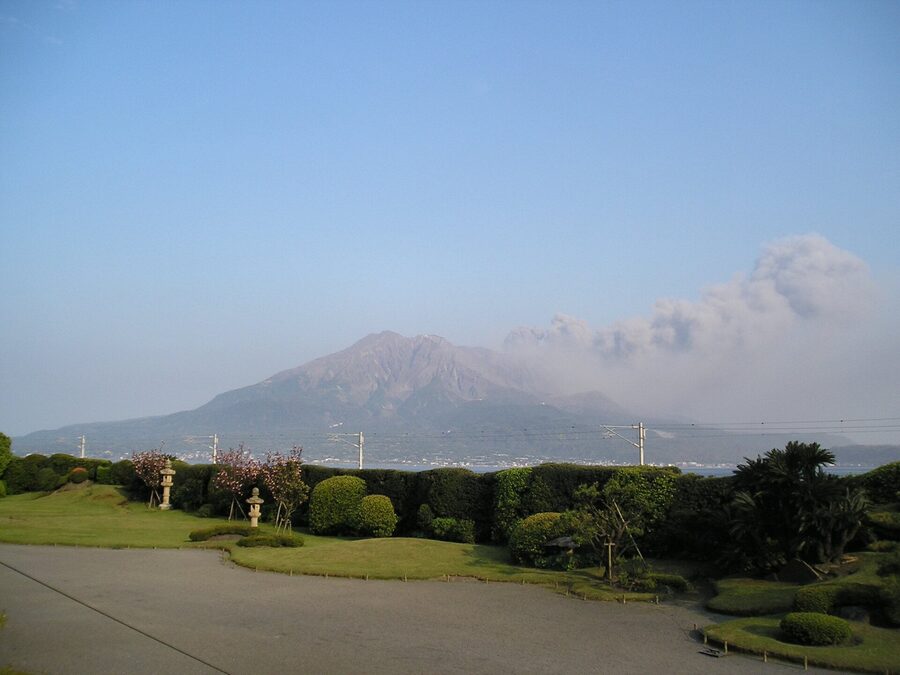
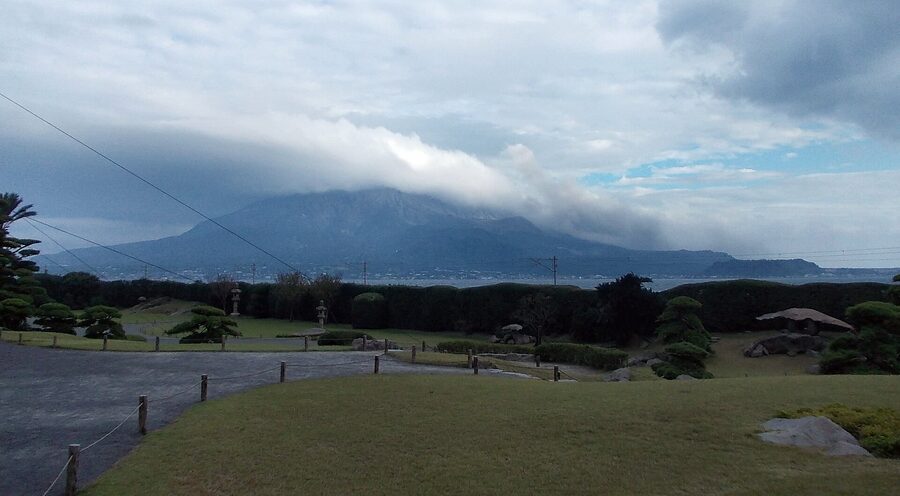
The borrowed scenery is the obvious feature. The garden faces directly onto Kagoshima Bay, and the active stratovolcano of Sakurajima sits about four kilometres across the water as the central element of every view. The volcano erupts a small column of ash on a regular schedule (a few times a month on average), and every twenty or thirty years a major eruption sends ash down on the garden itself. The Shimazu accepted this as part of the deal.
Practical: 1,000 yen for the garden, 1,600 yen including the Goten residence. From Kagoshima-Chuo station it is fifteen minutes by city bus. Pair with the Shoko-shuseikan industrial heritage museum on the same grounds (Shimazu Nariakira’s reverberatory furnace foundations) for the full Shimazu picture. Avoid August unless you want to sweat through your shoes.
Suizenji Jojuen, Kumamoto
Suizenji Jojuen sits on the east side of Kumamoto city, on a spring-fed pond, and was begun in 1632 by the third Hosokawa lord Tadatoshi. The same Hosokawa family had run the Daitoku-ji subtemple Koto-in (mentioned above), and there is a clear stylistic family resemblance: restrained, low-key, elegant. The Hosokawa moved their seat from Buzen to Kumamoto in 1632 and immediately began commissioning a major garden as a statement of arrival.
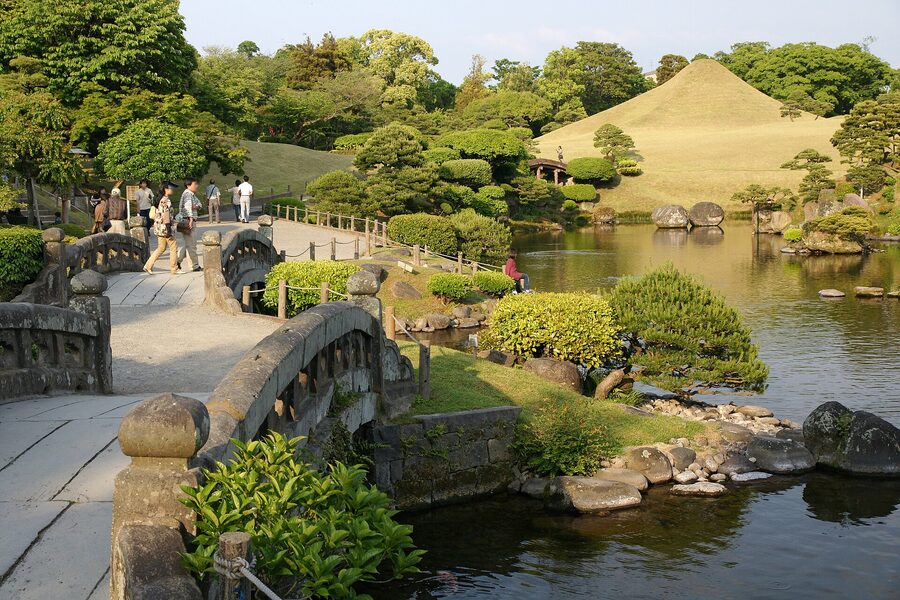
The garden’s signature feature is its scale-model layout of the Tokaido highway from Kyoto to Edo, the route the daimyo themselves walked every other year on sankin-kotai duty. The pond shore is laid out as the Pacific coast, and a series of named hills represents Mt Fuji, the Hakone pass, and other landmarks the lord would have seen on his journey. It is, in other words, a Edo-period travel diary in landscape form, made by a daimyo for whom the journey was a defining annual experience.
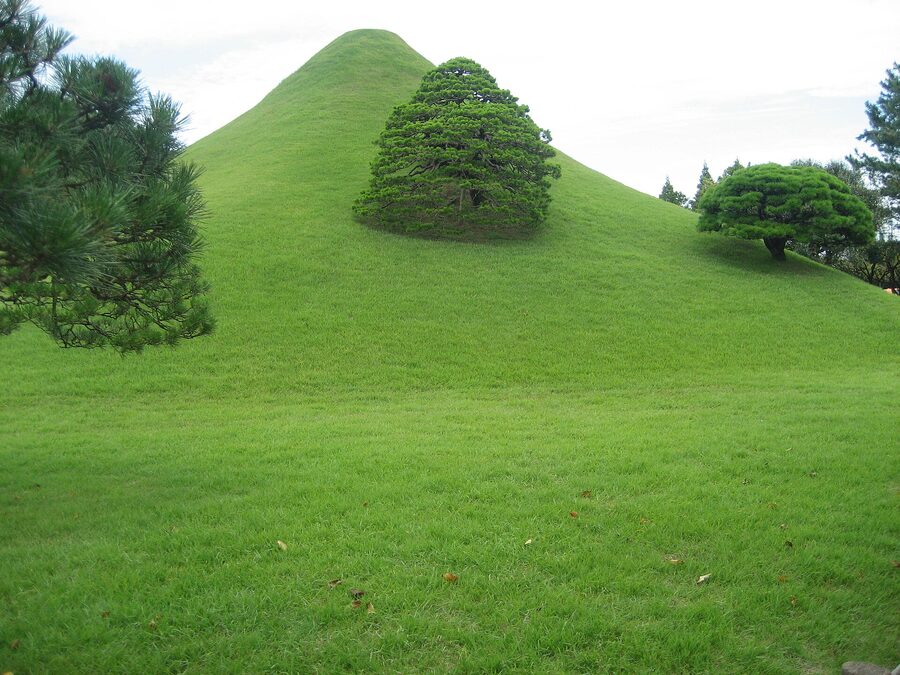
The 2016 Kumamoto earthquakes did serious damage to the garden’s south wall and the Noh stage, both of which have since been rebuilt. The gate has a slightly newer-looking second register of timbers; that is the post-2016 patch. While you are in the city, walk over to the Kumamoto Castle reconstruction (also damaged in 2016 and still restoring); the two together make a half-day Hosokawa-history walk.
Practical: 400 yen, open 7:30 to 6 (5 in winter), tram from Kumamoto station to Suizenji-koen-mae stop. The Izumi shrine on the grounds is on the site of an older Hosokawa family shrine and is worth a separate twenty minutes.
Genkyu-en, Hikone
Genkyu-en sits in the lower bailey of Hikone Castle on the east shore of Lake Biwa, and was built in 1677 by the fourth Ii lord Naooki, on the model of the Tang-dynasty imperial palace gardens at Genkyu. (Hence the name. It is one of the few Japanese gardens named directly after a Chinese original.) The Ii were the Tokugawa’s most senior eastern vassal house, and you can read about the founder in the Ii Naomasa piece.
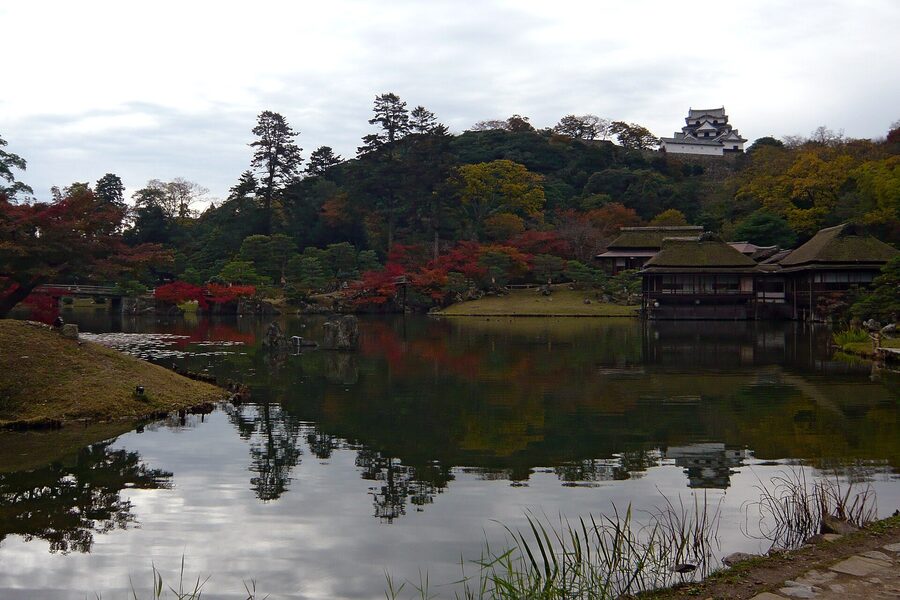
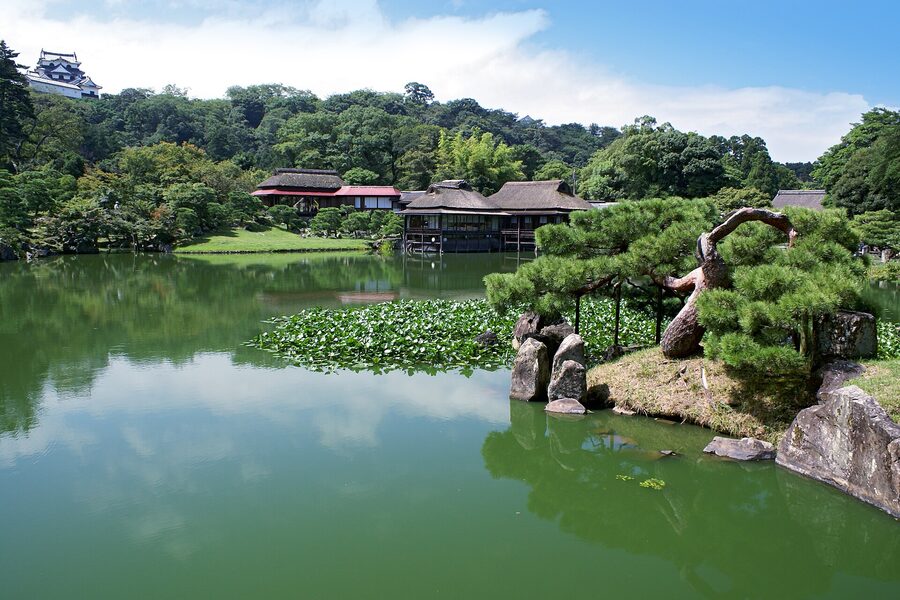
The castle keep above the garden is one of only twelve original feudal keeps still standing in Japan, and the relationship between the keep and the lower-bailey garden is one of the great castle-garden pairings. From the Hosho-dai pavilion in the south-east of the garden you frame the keep in the upper third of the doorway, and the composition has been the subject of woodblock prints since the 1850s. (For the broader castle context I cover Hikone in detail elsewhere, but the garden and the keep are inseparable as a visit.)
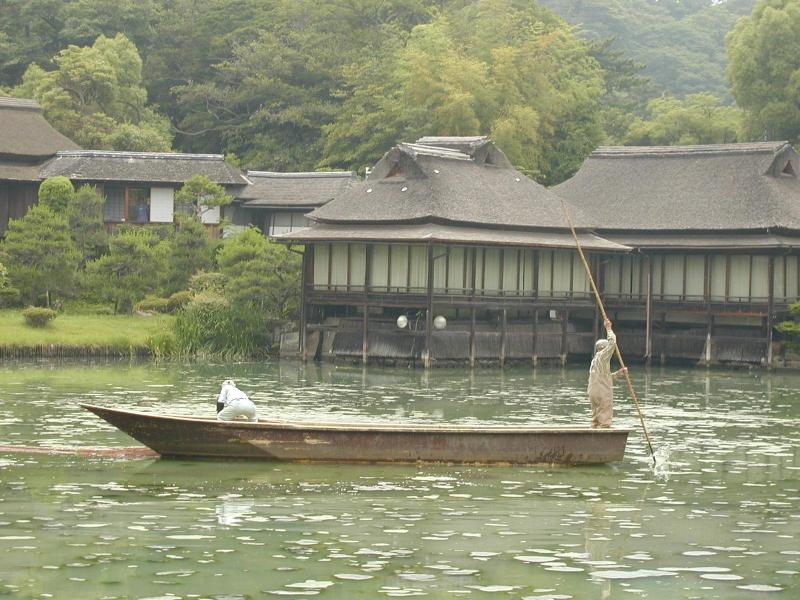
Practical: 200 yen for the garden alone, 600 yen for the combination ticket with the castle keep, both in operation 8:30 to 5. The boat ride on the pond is 1,500 yen extra and worth doing once in the warm half of the year. Hikone is 50 minutes from Kyoto on the JR Tokaido line and is one of the easiest day trips you can make.
Ritsurin Garden, Takamatsu
Ritsurin Garden in Takamatsu, Shikoku, is one of the largest stroll gardens in Japan: about 75 hectares, with six ponds, thirteen artificial hills, and several thousand pruned pines. It was a Matsudaira Takamatsu villa garden completed by 1745 under the fifth lord Yoritaka, with substantial Edo-period work by the local Awa-Sanuki gardening line. Officially Ritsurin is a “park” and was excluded from the San-meien on a technicality (gardens listed had to be daimyo-built and Ritsurin was, in part, the work of a junior branch of the Tokugawa).
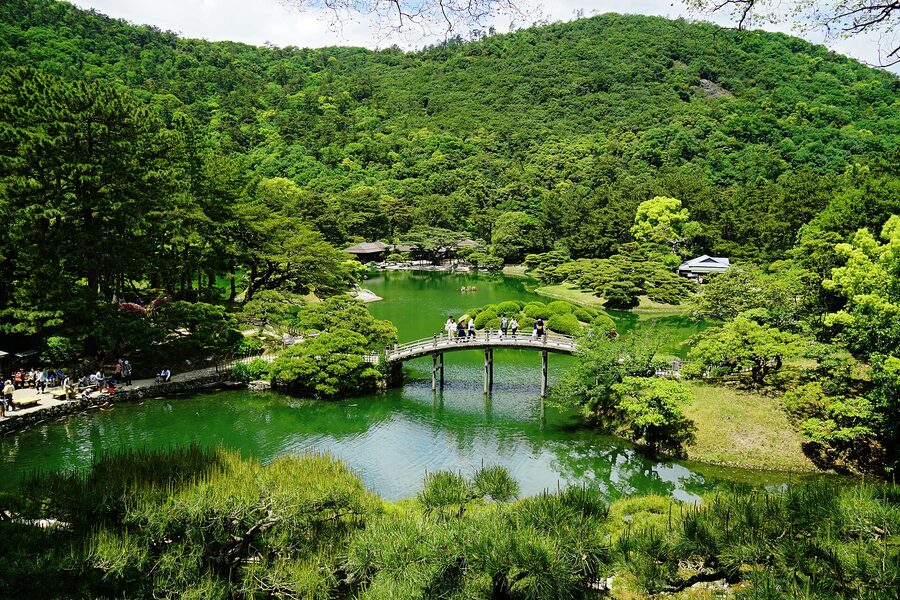
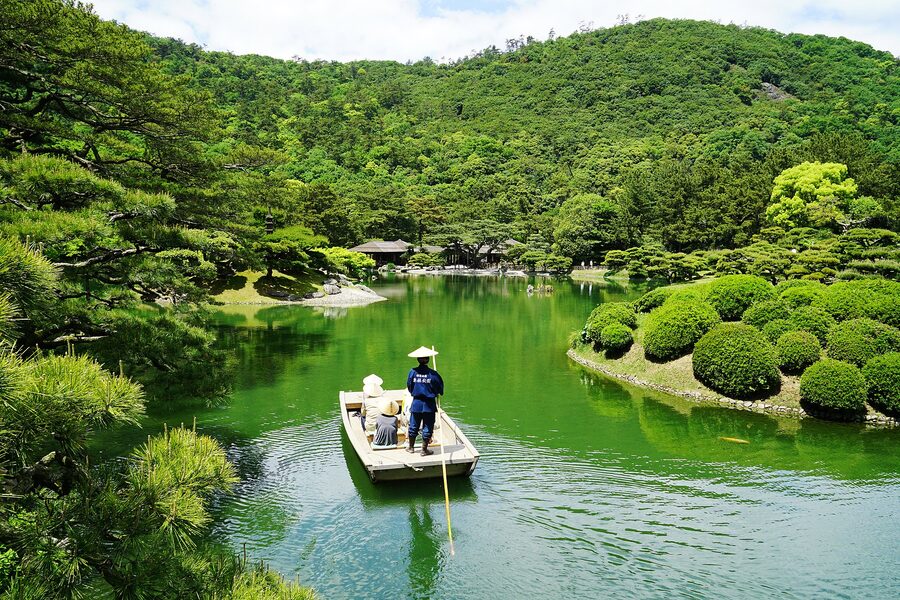
Most visitors agree that Ritsurin is at least the equal of any of the three official greats, and the rural wealthier-than-Kanazawa thing was an open secret in the late Edo. The garden’s borrowed backdrop is Mt Shiun, a steep low peak whose silhouette occupies the upper half of every view from the south end of the south pond. Mt Shiun is technically a park and protected from development; you cannot build above it.
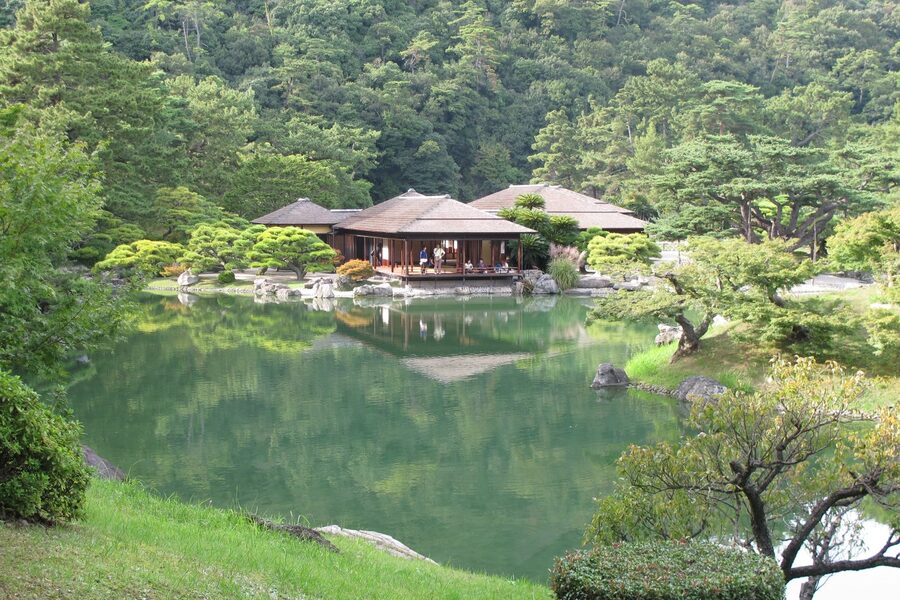
The Kikugetsu-tei tea house is the original Edo structure and is open as a tea house most days. Sit there at 9 a.m. with the sliding doors open onto the pond, take a 700-yen matcha set, and you have the closest thing to time travel that any Japanese garden offers. The Matsudaira lords drank tea on the same tatami in the same posture and looked at the same view. Two hundred and seventy years.
Practical: 410 yen, open from 5:30 a.m. (yes) in the warm half of the year, and from JR Takamatsu station it is the Kotoden tram three stops south. Combine with a half day of Shikoku noodle eating; sanuki udon is the regional speciality and Ritsurin is the perfect post-noodle walking. The garden is large enough that 90 minutes is barely the south end; allow at least three hours.
Tea gardens (roji)
The roji is a different kind of garden. It is the path from the world to the tea room. It was codified in the late sixteenth century by Sen no Rikyu, the tea master who developed wabi-cha for Toyotomi Hideyoshi and was eventually ordered to commit ritual suicide for political reasons that historians are still debating. The roji is supposed to take you out of the city and into a state of mind suited for the tea ceremony, and the garden grammar serves that single purpose.
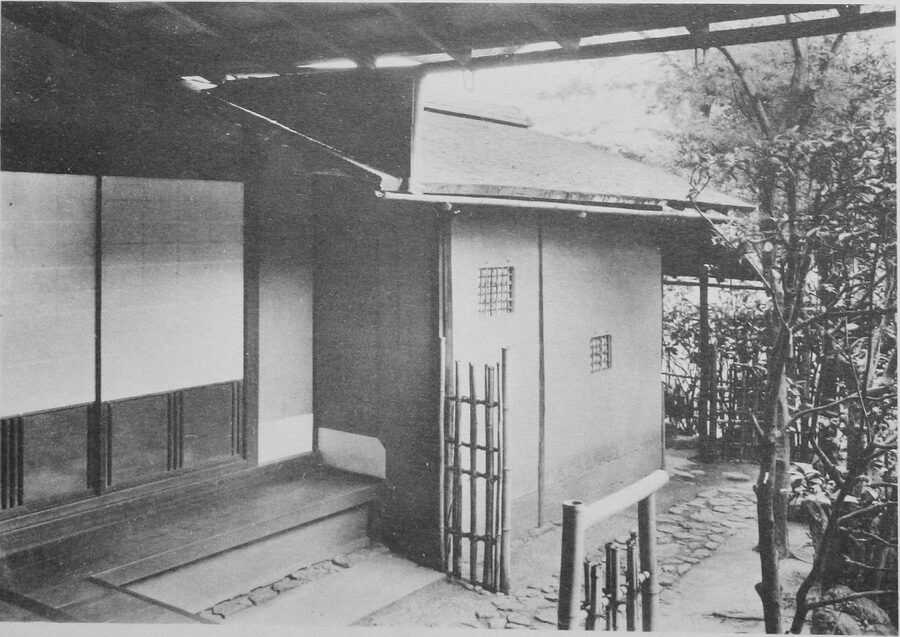
The most famous surviving Rikyu tea house is Tai-an, at Myoki-an in Yamazaki, between Kyoto and Osaka. The tea house itself is two tatami and a half, plus a small preparation alcove. The associated roji is short (Yamazaki is on a tight site) but contains every element of the orthodox roji grammar: the outer waiting bench (machiai), the gate to the inner garden (chumon), the stepping stones (tobi-ishi) that force the guest’s eye downward, and the tsukubai water basin where guests crouch to rinse their hands and mouths before entering.
Most visitors will not get inside Tai-an itself. The tea house is open to the public only on certain days a year and only via a Myoki-an guided group, by reservation. The exterior view of the tea house and the stripped-back roji you can see any day on a 400-yen entry. For tea ceremony context generally, see the Japanese tea ceremony piece; for the political and biographical Rikyu story see the linked Rikyu article above.
The three Senke schools (Omotesenke, Urasenke, Mushakojisenke) all keep major roji in central Kyoto. None are open to the casual visitor without a tea ceremony reservation, but Urasenke runs an introduction-to-tea programme at Konnichian, the family’s flagship tea house, that includes a walk through the roji. The fee is around 9,000 yen, the experience is in fluent English, and you should book several months in advance through the Urasenke North America office.
If you remember nothing else about the roji, remember this: the path is not a destination, the tea house is. The garden’s job is to ready you, slow you down, narrow your attention, and deliver you to the kettle. A roji that draws attention to itself has failed its assignment. A successful roji you forget about by the time the tea is whisked.
Practical visiting
Booking and timing
Three of the gardens above require advance booking, and the systems are not the same. Katsura and Sento are booked through the Imperial Household Agency at sankan.kunaicho.go.jp, online, up to a month ahead, payment on the day, passport at the gate. The agency releases additional walk-up slots at Katsura at 11 a.m.; if you are flexible this is fine, but in cherry season you will queue from 9 a.m. for those.
Saiho-ji is booked by mailing a return-paid postcard to the temple administration two months in advance, and the official temple website explains the format. There is a parallel online booking system that goes live for some windows a few months at a time, but the postal route remains the most reliable way to secure a slot. The 4,000 yen fee is paid in cash at the gate. Bring a black pen for the sutra exercise.
Tai-an at Myoki-an opens a few days a year for full inspection; the dates rotate and need to be confirmed by phone. For everything else (Kenroku-en, Korakuen, Kairakuen, Tofuku-ji, all Daitoku-ji subtemples, the four Tokyo gardens, Adachi, Sengan-en, Suizenji, Genkyu-en, Ritsurin) you walk up and pay at the gate. No booking is required and no booking is possible.
Best season per garden
Cherry season (late March to mid-April depending on latitude) is the obvious choice for any garden with a major sakura grove, including Hama-rikyu, Rikugien, Kenroku-en’s Hanami-bashi area, and Korakuen Okayama. The official forecasts are surprisingly reliable; for a wider seasonal angle see the cherry blossom guide.
Plum season (late January to early March) is Kairakuen’s only argument for visiting. Around 3,000 trees of about a hundred varieties bloom over six weeks, and the Mito Plum Festival is the right time to be there. The Kyoto karesansui gardens do not change much across seasons (the rocks do not bloom) but the surroundings change a lot, and the moss gardens (Saiho-ji especially) are at peak vibrance in mid-June through July when the rains have been good.
Autumn maple (mid-November to early December) is the high season at Tofuku-ji, Koto-in at Daitoku-ji, Rikugien, and Koishikawa Korakuen. Tofuku-ji’s Tsutenkyo bridge and the maple grove below it are the single most photographed maple scene in Japan; expect crowds. Winter is the quiet season everywhere, and is the best time at Kenroku-en (yukitsuri ropes), at Adachi (frost on the gravel), and at Ryoan-ji (which I have had to myself in February).
Photo etiquette and tripods
Tripods are forbidden inside almost every garden in this guide. The exceptions are some Tokyo metropolitan gardens (Hama-rikyu, Rikugien, Kiyosumi) where small tabletop tripods on the deck are tolerated. Do not deploy a tripod inside any temple or imperial garden without explicit permission. The reason is partly safety (people walking into legs) and partly aesthetic (you slow other visitors down).
At Saiho-ji the monks specifically ask you not to step off the gravel paths to compose a shot, and not to talk while photographing. Camera bags should be small. Selfie sticks are forbidden almost everywhere now. At Adachi there are seven specific marked viewing windows and you should not lean a camera or a phone over the rope barrier; the gardeners will politely ask you to step back.
For drones the answer is uniformly no. The Imperial Household Agency gardens, all temple gardens, all metropolitan gardens, and Adachi all prohibit them outright. The only place I have seen drone footage of a Japanese garden where the drone was legally operated is Sengan-en, on a closed-grounds permit during a documentary shoot. Do not test this; the fines are real.
Combination tickets and passes
The Tokyo metropolitan gardens (Hama-rikyu, Kyu-Shiba-rikyu, Koishikawa Korakuen, Kyu-Furukawa, Kiyosumi, Mukojima-Hyakkaen, Rikugien, Kyu-Iwasaki-tei) can all be visited on a single 800-yen Garden Pass purchased at any of the gates. The pass pays for itself if you visit three or more gardens. Tokyo has nine such gardens in total and you could plausibly do them all in a long weekend.
Kanazawa sells a combination ticket for Kenroku-en, Kanazawa Castle, the Maeda residence Seisonkaku, and the Higashi Chaya district teahouse Kaikaro at around 1,200 yen. Kyoto has no city-wide gardens pass; each temple takes a separate fee at the gate. The Kyoto Sightseeing Card covers all city buses and trains and is the only pass worth buying for garden hopping in the old capital.
The full JR Pass is the most cost-effective option for a multi-garden trip that includes Adachi (Yasugi), Sengan-en (Kagoshima), Ritsurin (Takamatsu), and the three San-meien. A two-week JR Pass at 80,000 yen is paid back inside the first three or four bullet-train rides. Do the maths before you go.
How to “see” a garden
Start by sitting. Most great Japanese gardens are designed to be viewed from a fixed position (a deck, a window, a tea-house mat), and the longer you sit the more the composition comes apart and rebuilds. If the garden has a deck, take the deck; if it has a tea house, take the tea house. The Hojo veranda at Ryoan-ji, the Kikugetsu-tei at Ritsurin, the Hosho-dai at Genkyu-en, the south corridor at Adachi: in every case the seated experience is the designed one.
Walk slowly the second time. After ten or fifteen minutes seated, walk the perimeter at half your normal pace, and watch how the composition shifts as your viewpoint moves. The chisen-kaiyu stroll gardens (Korakuen, Kenroku-en, Koishikawa, Rikugien, Sengan-en, Ritsurin) are designed to read at walking pace, with each turn of the path opening a fresh vignette. The temple karesansui (Ryoan-ji, Daisen-in, Tofuku-ji) are designed to read at sitting pace.
For the deeper aesthetics (shakkei, miegakure, ma, the kasanarizukuri overlap rule, the yang-yin balance of stone and water) read the history and principles guide before your trip. You will see fifty per cent more once you know what kind of looking the gardens were built to reward.
My pick of three if you only have a week
If I had a week and a JR Pass and you asked me to pick three gardens, the answer would not be the obvious one. I would skip Kenroku-en. I have seen Kenroku-en six or seven times and the chisen-kaiyu daimyo grammar is well represented at Korakuen, Rikugien, and Ritsurin. Kenroku-en is famous because of the Maeda’s wealth and because Kanazawa has a tourism budget; it is not the best of its type.
I would also skip Ryoan-ji on a first trip. It is the canonical karesansui and you should see it eventually, but you will see it better on a second visit, with the rest of Daitoku-ji’s subtemples for context. On a first trip the Daisen-in river-of-sand and the Tofuku-ji checkerboard north garden tell you more about what karesansui actually does, and they have a tenth of the crowds.
So my three would be Saiho-ji, Tofuku-ji, and Adachi. Saiho-ji because the booking process is part of the garden, and you will not understand what a Japanese garden is for until you have spent forty minutes copying a sutra in advance of the moss. Tofuku-ji because the Mirei Shigemori Hojo gardens are the only twentieth-century compositions in this guide that genuinely modernise the form, and the Tsutenkyo maple bridge is the bonus. Adachi because the painting-and-garden combination is the best argument I know for treating Japanese landscape gardening as a serious branch of art history.
The route works. Saiho-ji is in west Kyoto (postcard the temple two months ahead), Tofuku-ji is in south Kyoto (walk-up), Adachi is the Sunrise Izumo overnight sleeper from Tokyo or two and a half hours west of Kyoto on the bullet-train-plus-Sanin-line combination. Three gardens, one week, the clearest possible introduction to what Japanese gardens actually do.
And after that, when you come back, you do Kenroku-en in February with the yukitsuri up and the place to yourself. That is the reward visit.