
There are fifteen rocks in the karesansui garden at Ryōan-ji, arranged on a rectangle of raked white gravel about twenty-five metres long and ten metres wide, and from any vantage point you choose on the wooden veranda of the abbot’s hall you can see fourteen of them. Not fifteen. One stone is always hidden by another, and which stone that is depends on where you are sitting.
You move six inches along the mat and a different rock vanishes. Nobody has ever been able to sit on that veranda and count all fifteen at once, and the design has been carefully wrong in exactly this way since the late fifteenth century. The monks who laid out the garden around 1499 knew what they were doing.
This is the founding fact about Japanese gardens that most English-language guides miss: they are not decoration. They are compositions, made for a specific viewer at a specific vantage point, and the rules of the composition are usually load-bearing in a way that you only notice when you break them. The rocks at Ryōan-ji are fifteen because fifteen is the number used in the Chinese shichigosan arrangement — three groups of five, seven, three — that a Ming-educated Japanese abbot of the 1490s would have recognised immediately. The one-rock-always-hidden rule is either a reference to the Zen idea that totality is not available to human perception, or a technical demonstration of the kasanarizukuri “overlapping” design principle, or both. You can argue for either. You cannot argue that it is accidental.
In This Article
- What a Japanese garden actually is
- The three main garden types
- Karesansui — the dry landscape
- Tsukiyama — the hill-style garden
- Chisen-kaiyū — the pond-stroll garden
- Heian origins — the Sakutei-ki and the south-facing pond
- Kamakura and Muromachi — Musō Soseki, and the Zen shift
- The tea garden and the roji
- Kobori Enshū and the Edo-period daimyō gardens
- The Three Great Gardens of Japan
- Kenroku-en — the Maeda family, 1676 onwards
- Kōraku-en Okayama — the Ikeda family, 1700
- Kairaku-en Mito — Tokugawa Nariaki, 1841
- Shakkei — borrowed scenery
- The vocabulary — lanterns, bridges, stepping stones, asymmetry
- Some individual gardens that repay the attention
- Ryōan-ji — the fifteen stones
- Daisen-in — the river of sand
- Katsura Imperial Villa — the peak of the form
- Adachi Museum gardens — the twentieth-century refinement
- Where to see the tradition in person today
- Kenroku-en, Kanazawa
- Kōraku-en, Okayama
- Kairaku-en, Mito
- Ryōan-ji, Kyoto
- Saihō-ji / Kokedera, Kyoto
- Katsura Imperial Villa, Kyoto
- Closing
What a Japanese garden actually is
An English speaker hearing “Japanese garden” tends to imagine a generic pond with a red bridge and some koi. The reality is that nihon teien (日本庭園) is a formal compositional tradition with at least three distinct major styles, a thousand-year written theoretical literature, and a body of specific design rules about stone placement, water representation, and borrowed distant scenery that are still taught in working garden-design schools in Kyoto today. The tradition is closer to a musical score than to a park. It is meant to be read.
The defining move of the tradition is mitate (見立て) — “seeing as”. A stone is not a stone; it is a mountain, a crane island, a tortoise island, a ship, a waterfall. A rake pattern in gravel is not gravel; it is the sea, a river, the concentric ripples of a fallen leaf. The reason Japanese gardens feel dense when they are small is that every object is doing double or triple duty. A six-metre rock arrangement is standing in for the Hōrai mountains of Daoist legend. Three gravel marks are a river mouth and the open sea and the turn of a tide.
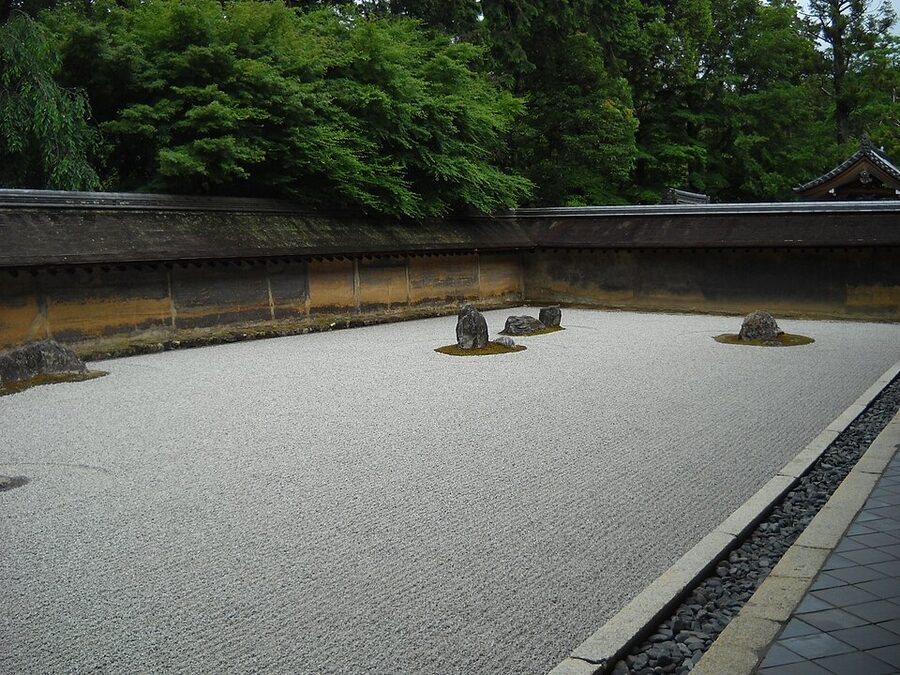

The other thing to absorb before you walk into your first serious garden is that many of the canonical ones are designed to be viewed from a particular position. Ryōan-ji is a seated garden — you sit on the veranda, you do not walk on the gravel. Daisen-in’s karesansui has a single fixed viewpoint from inside the abbot’s hall. The shoin garden at Katsura Imperial Villa is laid out to read correctly from the second tatami mat of the old shoin room. The Kyoto garden-history term for this is zakan, “seated viewing”, and it is the older tradition. The walk-through stroll garden, which most foreign visitors assume is the default, is actually a later Edo-period innovation.
The three main garden types
Every Japanese garden falls into one of three major stylistic families, and once you can tell them apart the whole country rearranges itself into three neat stacks. The categories are not modern labels imposed for tourist convenience; they are distinctions that the Muromachi and Edo-period garden manuals themselves drew, and they carry specific design rules.
Karesansui — the dry landscape
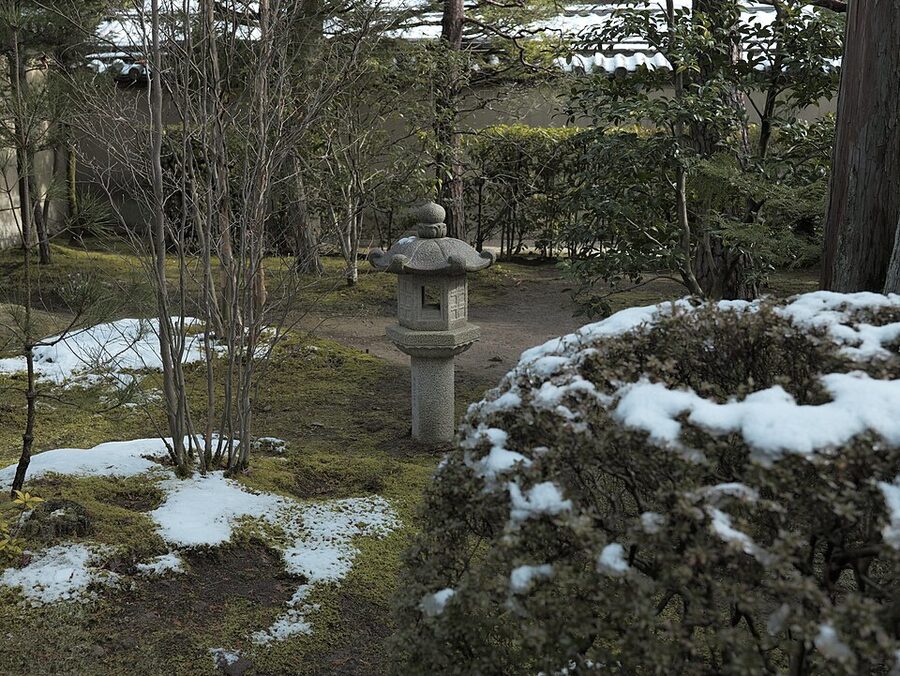
Karesansui (枯山水, “dry mountain water”) is the style most people think of when they say “Zen garden”. Stones and gravel represent mountains, rivers, islands, waterfalls. No actual water. The style crystallised in the Muromachi period (the 1400s) at Zen monasteries in Kyoto, and the standard vocabulary was in place by roughly 1500. The critical visual move is that the raked gravel does the work of water — white gravel standing in for a sea, a lake, a river, a waterfall’s pool — and the stone arrangements stand in for whatever the gravel is pretending to flow around.
_SubTemple_hdsr_S5_18.jpg)
The oldest surviving written reference to karesansui is in the Sakutei-ki (作庭記), an eleventh-century garden-design manual. In that source it is not yet a full style in its own right — it describes a technique, a way of building dry stone-and-sand features inside a larger pond garden. The fully independent small-scale karesansui that we recognise today matured two or three centuries later under the Zen monasteries, and the historian Mori Osamu has classified the early Sakutei-ki version as “proto-karesansui” and the Muromachi-period version as “late karesansui” to mark this distinction.
The Zen association is real but should not be oversold. Karesansui gardens are overwhelmingly found at Rinzai and Sōtō Zen monasteries — Ryōan-ji, Daisen-in, Tōfuku-ji, Ryōgen-in, Ryūgin-tei at Ryōgen-in. The small scale, the seated viewpoint, and the meditation-hall adjacency all fit the Zen programme.
But the garden designer Masuno Shunmyō, himself a Zen priest, is careful to point out that not every karesansui is a Zen garden, and not every Zen garden is karesansui. The style predates the explicit Zen framing and outgrew it; there are karesansui at Pure Land temples and secular daimyō estates too.
_SubTemple_hdsr_S5_14.jpg)
The gravel itself is a small technical study. The traditional Kyoto karesansui used a weathered-granite white sand quarried from the Shirakawa riverbed on the east side of the city; Shirakawa extraction has been prohibited since the mid-twentieth century for environmental reasons, and today’s replacement material is crushed white granite, slightly coarser and less luminous. The rake patterns have names: sazanami (漣, “ripples”) for calm water, seigaiha (青海波, “blue-sea-waves”) for the scalloped half-circle pattern that represents the open sea, uzumon (渦紋) for whirlpools, ajironami (網代波) for a folded zigzag river pattern. A senior gardener can look at a single raked bed and tell you which water body the composer was imagining.
Tsukiyama — the hill-style garden
Tsukiyama (築山, “built hill”) gardens use actual water, constructed artificial hills, real bridges and real trees to compose a miniature natural landscape. The name comes from the deliberate construction of small hills inside a flat garden site — the Japanese word tsukiyama breaks down as “pile up” plus “mountain” — to introduce elevation, distance, and multiple viewpoints. The hills are read as distant mountains; the pond at their base is read as a lake or inlet; the bridges connect islands that stand in for the Daoist immortals’ mountains of Hōrai or Hōjō.
The style is the oldest continuous Japanese garden idiom. It traces directly back to the Heian-period aristocratic shinden gardens of the tenth and eleventh centuries, which themselves traced back to the Asuka-period South Garden tradition of the sixth and seventh centuries — and those in turn to Baekje (Korean-peninsula) garden traditions brought over by immigrant craftsmen. The Nihon Shoki, writing about 612 CE, records a Baekje immigrant named Michiko-no-Takumi (also called Shikimaro, 路子工・芝耆摩呂) being commanded by Empress Suiko to build a Mount Sumeru sculpture and a Chinese-style arched bridge in the south garden of the imperial palace. The form was imported, and it was built by foreign specialists before it was built by domestic ones.
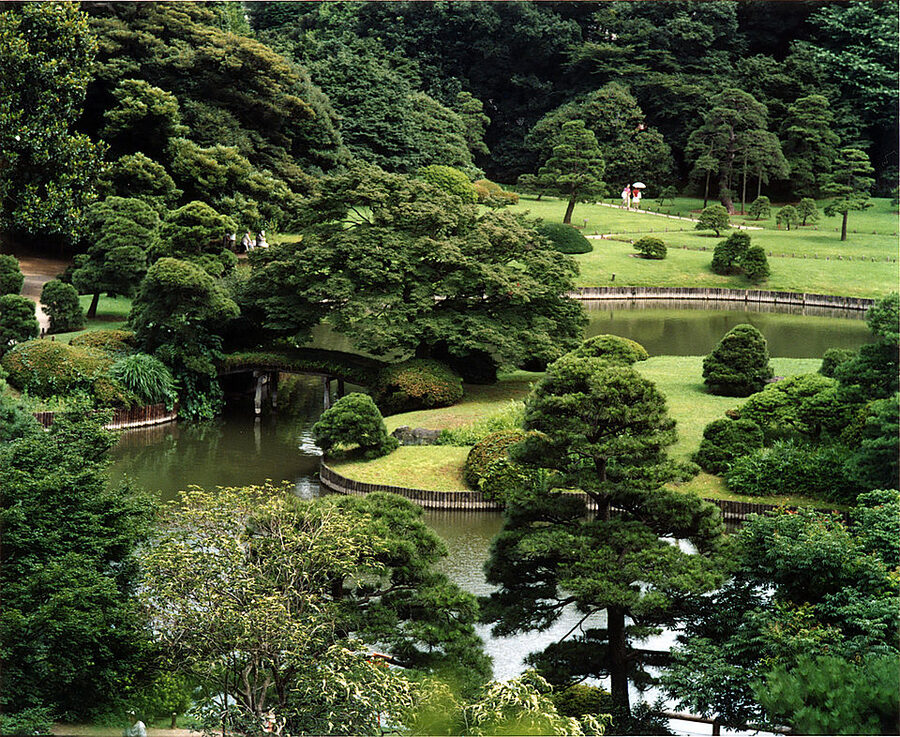

Tsukiyama gardens can be small, a courtyard version fits comfortably into a six-metre-square space, or enormous, as at Rikugien in Tokyo or the private gardens of the Edo-period daimyō. The Sakutei-ki lists specific rules for the construction: the hill should rise from the north side of the pond so the viewer looks south across the water towards it, the largest stone should go on the hill’s flank rather than its summit, the pond should have at least one island, the island should have at least one crane-figure and one tortoise-figure. These rules are a thousand years old and they are still adhered to by working garden designers.
Chisen-kaiyū — the pond-stroll garden
Chisen-kaiyū-shiki (池泉回遊式, “pond-spring stroll-style”) is the category most western visitors meet first and assume is the whole tradition. A large central pond with a circular path around it; viewing spots at regular intervals; at each spot the composition rearranges itself as you turn your head. The style is emphatically Edo-period, it matures in the seventeenth century under the daimyō, and what it does that the earlier shinden and karesansui styles do not do is incorporate sequential time into the composition. You walk, and the garden changes.
The three famous members of the “Three Great Gardens” — Kenroku-en, Kōraku-en Okayama, Kairaku-en — are all chisen-kaiyū, and every one of them was built on daimyō land in the late seventeenth or early nineteenth century. The design logic assumes you are a member of the owning family or a visiting dignitary, you are being walked through the garden in sequence by a host, and the composition is working on you with the cumulative effect of a set of coordinated tableaux. If the only garden you have seen is a chisen-kaiyū stroll garden, you have seen the most recent development of the form and none of its predecessors.
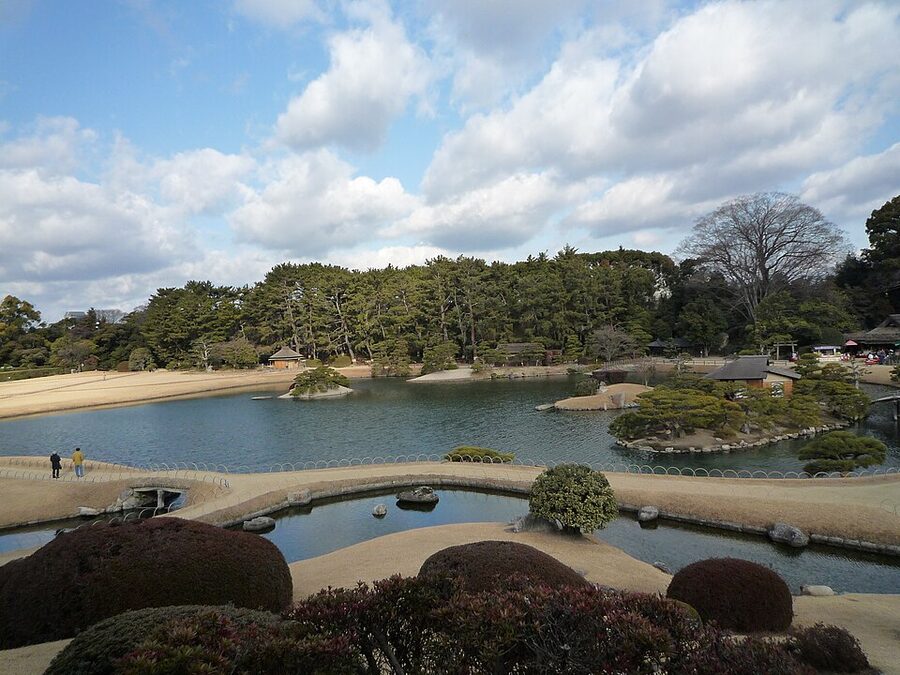
What tsukiyama and chisen-kaiyū share, and what karesansui does not, is the assumption that the viewer moves. That is the single deepest structural distinction in the Japanese garden tradition. Seated gardens (karesansui, some shoin-style gardens) are composed for a fixed eye; walking gardens (tsukiyama, chisen-kaiyū, tea-garden roji) are composed as a sequence.
When you visit a new garden the first thing to ask is which of these two families it belongs to, and the second thing is where the composer thought you would be standing.
Heian origins — the Sakutei-ki and the south-facing pond
The oldest Japanese garden tradition we can read about rather than guess at is the Heian-period aristocratic shinden garden. The shinden (寝殿造) was the standard layout of a Heian-court nobleman’s mansion — a main hall facing south with two wings running east and west, and a large ceremonial courtyard between the hall and a pond that occupied most of the southern half of the property. The pond had at least one island, usually connected by two bridges of different styles, and the whole composition was oriented so that aristocratic guests arriving by boat from the pond’s southern inlet would see the main hall rising at the far end of the water. Boats on the pond, fishing pavilions at its corners, fireflies in June, moon-viewing in September. The elite of Heian Kyoto spent more of their lives in these gardens than in the buildings.
The critical text is the Sakutei-ki (作庭記), an eleventh-century garden-design manual attributed to Tachibana no Toshitsuna (橘俊綱, 1028-1094), the son of the regent Fujiwara no Yorimichi. It is the oldest garden-design treatise in the world — predating anything comparable in Chinese, Persian, or European literature by at least a century — and it is shockingly specific. There are prescriptions for how to set a standing stone so it does not “flee” from the viewer, how to arrange stones so they do not “turn their backs” on the main hall, how to represent each of the four canonical waterfall types, how to plant so that the spring maple succession runs correctly from the south slope to the north.
The Sakutei-ki also contains warnings. Stones placed with the wrong face upwards will bring misfortune; stones removed from wild mountains must have their “home-sickness” addressed with the correct ritual before placement; certain island shapes are reserved for imperial use only.
The text treats a garden as a place where spiritual forces live, and where breaking the formal rules has real-world consequences for the household. Nine hundred years later, working garden designers in Kyoto still quote Sakutei-ki passages from memory. It is that kind of text.

Kamakura and Muromachi — Musō Soseki, and the Zen shift
The thirteenth and fourteenth centuries reshape Japanese gardens in two linked ways. The political centre of gravity moves from the aristocratic Heian court to the Kamakura military government, which means the budget for imperial pond-gardens evaporates and the budget for Zen monastery gardens starts climbing. And the Zen monks themselves, many of whom had studied in Song-dynasty China and come back with Chinese ink-painting aesthetics in their heads, start applying those aesthetics to outdoor garden design. The monochrome ink-painting convention of a distant mountain suggested with three brush strokes becomes, in a Zen temple courtyard, a rock arrangement suggesting the same mountain with three stones.
The decisive figure is Musō Soseki (夢窓疎石, 1275-1351), a Zen priest and garden designer whose work brackets the Kamakura-to-Muromachi transition. Musō designed the gardens at Zuisen-ji in Kamakura (1327), Erin-ji in Kai province (1330), and, most importantly, the lower pond garden and upper karesansui garden at Saihō-ji in Kyoto (1339). He also laid out Tenryū-ji in Kyoto, built the same year for Ashikaga Takauji to commemorate Emperor Go-Daigo. His Saihō-ji design is, in the consensus view of Japanese garden historians, the point at which the dry-landscape karesansui becomes a fully independent idiom rather than a feature inside a pond garden.
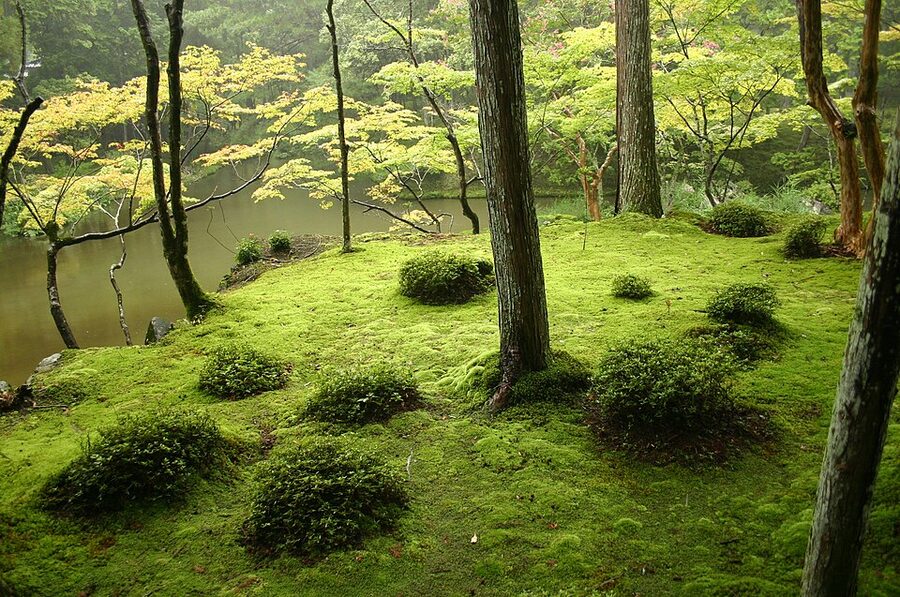
There is an irony about Saihō-ji that needs naming. The moss that has made the temple famous, a hundred and twenty separate moss species carpeting every available surface, was not part of Musō’s design. His fourteenth-century garden was a conventional two-level pond composition: the lower pond of Ōgonchi (黄金池, “gold pond”) with its three islands for the Daoist immortal mountains, and the upper slope with a karesansui arrangement of stones representing a dragon’s gate-waterfall.
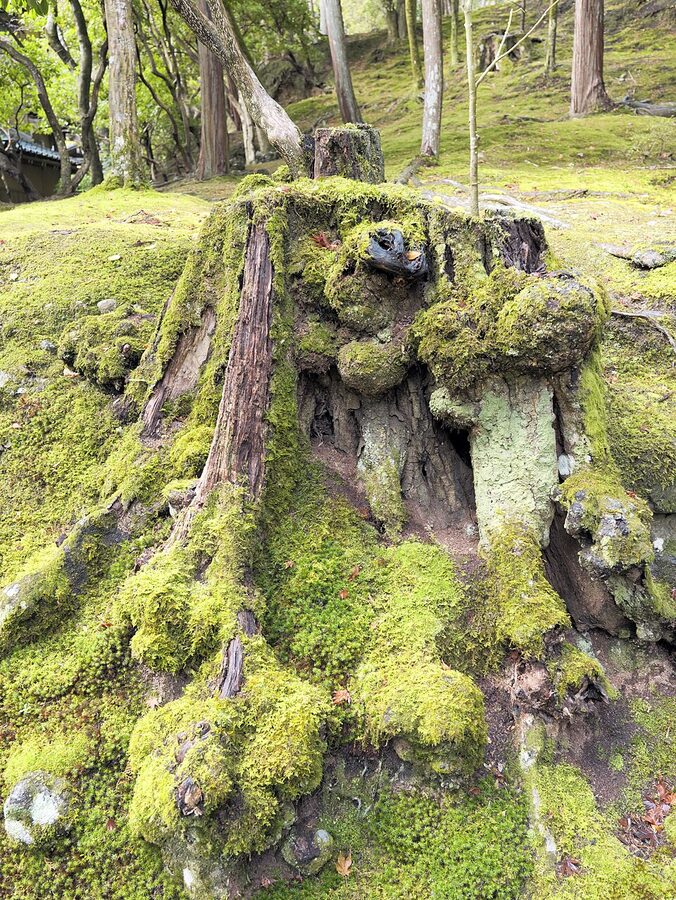
After the temple was damaged in the Ōnin War (1467-77) and again in the seventeenth- and late-Edo-period flooding, the maintenance lapsed, moss took hold, and by about 1820 the whole ground plane was a green carpet. The monks stopped fighting it. The accident became the feature.
_hdsr_Garden_S5_91.jpg)
The fifteenth-century painter-priest Sesshū Tōyō (雪舟等楊, 1420-1506) is also sometimes credited with major gardens — Jōei-ji in Yamaguchi, the Mitoshi-Daiji gardens, the Chikurin-in karesansui — though the attributions are contested by Japanese garden historians and the documentary trail is thinner than Musō’s. What is clear is that by the time Ryōan-ji is laid out around 1499, the karesansui idiom is complete. The sixteenth century then spends most of its energy on tea gardens, which is a different structural problem altogether.
The tea garden and the roji
Sixteenth-century tea-master Sen no Rikyū made the tea-garden path — the roji (露地, “dewy ground”) — into a new genre of Japanese garden, and the structural logic of it is quite different from anything that came before. A roji is a linear path, typically sixty to eighty metres long, that leads from the entrance gate to the tea room. It is not decorative. It is functional: it takes the guest out of the city street he has just walked off, through a compressed and deliberately unobtrusive landscape, and delivers him in the correct psychological state to kneel and crawl through the nijiriguchi into the tea room.
The rules of roji design are precise. Stepping stones at irregular intervals slow the walker; the path bends so that the tea house is not visible from the entrance; a stone water basin (the tsukubai, 蹲踞) forces the guest to crouch to rinse their mouth and hands before entering; evergreen trees dominate so that the path looks the same in summer and winter. You are not supposed to enjoy the roji the way you enjoy a stroll garden; you are supposed to be slowly emptied out by it. Rikyū’s successors pushed the form through three or four variant schools — Omotesenke, Urasenke, Mushakōjisenke, Yabunouchi — and the basic structure has remained stable for four hundred years.
Kobori Enshū and the Edo-period daimyō gardens
The seventeenth century’s defining garden designer is Kobori Enshū (小堀遠州, 1579-1647), a tea master and Tokugawa administrator whose day job was supervising shogunal construction. Enshū personally designed the gardens at Katsura Imperial Villa, Sentō Imperial Palace, Nijō-jō ni-no-maru, Nagoya-jō, Sunpu-jō, Sampō-in, Konchi-in, Kōdai-ji, and Ōtemon Gate. The list is not exhaustive. Modern attribution has become more cautious, some of these are now thought to be “Enshū school” rather than Enshū himself, but the aesthetic signature is consistent: clean geometric rock groupings, strong diagonal compositions, tea-ceremony sensibility applied at a daimyō scale.
The Edo period (1603-1868) is the moment the daimyō pond-stroll garden becomes the dominant prestige form. This is not an accident. The sankin-kōtai alternate-attendance system forced every daimyō to maintain an Edo residence and cycle between it and his home province on a biennial schedule. The Edo residence, usually a sprawling compound near the shogunal castle, needed impressive outdoor spaces for entertaining shogunal officials. And the home-province castle town needed an equivalent establishment for rear-base political theatre. The political economy produced a building boom in large-scale stroll gardens, and the people who designed them were, typically, pupils of the Enshū school.
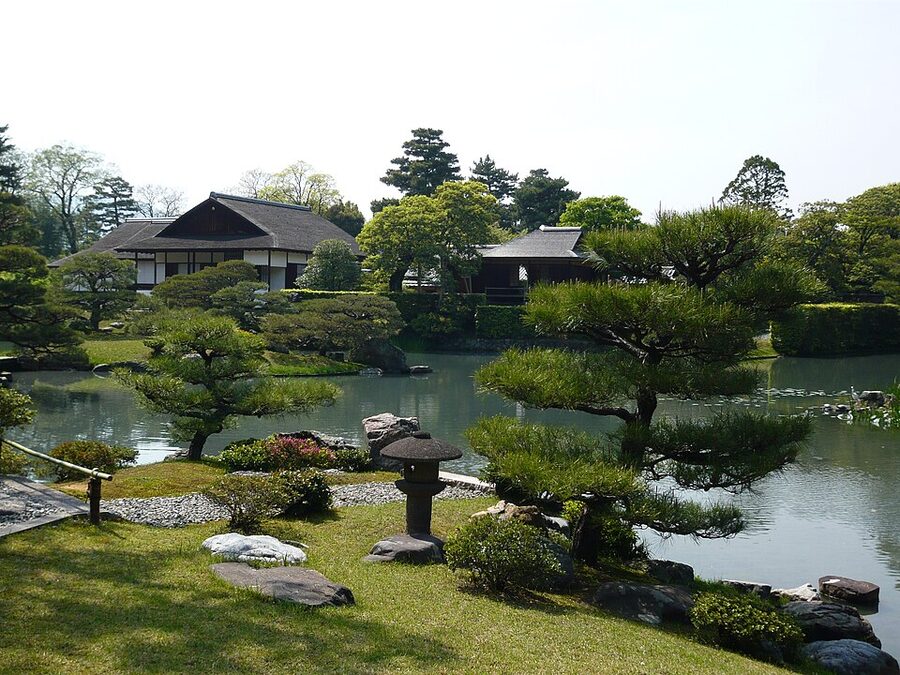

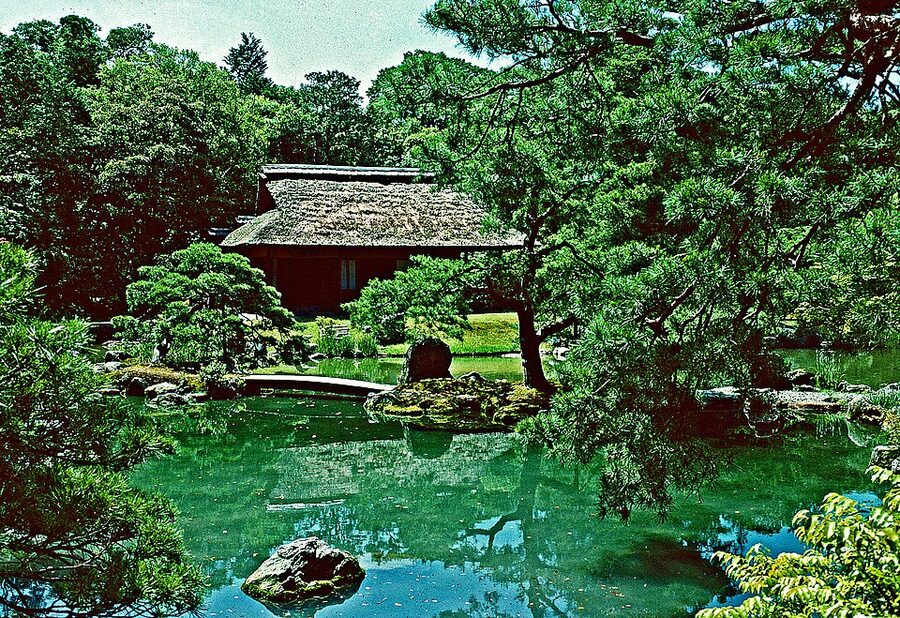
The Katsura Imperial Villa (桂離宮) is the Edo-period peak. Built between 1615 and 1662 for Prince Toshihito and his son Prince Toshitada of the Hachijō-no-miya branch of the imperial family, on a site on the west bank of the Katsura River, the villa is a twelve-hectare composition that fuses shoin architecture, chisen-kaiyū-style stroll, four separate tea houses for the four seasons, and a degree of shakkei “borrowed scenery” from the distant Arashiyama hills that has never been bettered. The Katsura plan is studied today in every serious Japanese garden-design programme, and the modernist architect Bruno Taut, who visited in 1933, wrote that he had found in Katsura the Japanese equivalent of the Parthenon.

The Three Great Gardens of Japan
The canonical list of the “Three Great Gardens” — Nihon San-mei-en (日本三名園) — is Kenroku-en in Kanazawa, Kōraku-en in Okayama, and Kairaku-en in Mito. The three-way ranking was first formalised in the Meiji period, and the specific grouping is less ancient than you might assume: all three are Edo-period daimyō chisen-kaiyū gardens, all three became publicly accessible in the 1870s, and all three were designated national cultural properties in the early twentieth century. The list is a Meiji-era canonisation of Edo-era aesthetics, which is a pattern that turns up a lot in Japanese heritage-curation history.
That said, the three are genuinely the top three in chisen-kaiyū scale-and-execution terms. Every Japanese garden textbook names them; every national tourism map highlights them. And unlike some canonical lists they are not geographically concentrated — Kanazawa on the Japan Sea, Okayama on the Inland Sea, Mito north of Tokyo — which makes visiting all three a natural country-scale itinerary.
Each has distinct characteristics, distinct founding daimyō, and distinct historical rhythms. They are worth taking separately rather than as a group.
Kenroku-en — the Maeda family, 1676 onwards
Kenroku-en (兼六園) in Kanazawa is the oldest of the three and, in the consensus of the chisen-kaiyū historians, the most complete. It was begun in 1676 by the fifth-generation Kaga-han lord Maeda Tsunanori, descended from the great sixteenth-century samurai Maeda Toshiie, as a riverside villa with a small pond-garden attached to Kanazawa Castle. The initial garden — called Renchi-tei, “Lotus Pond Garden” — burned down in the Hōreki fire of 1759. The eighth-generation lord Maeda Harunaga rebuilt it starting in 1774, and the fine-grained composition you see today is mostly the work of the eleventh-generation lord Maeda Narinaga in the 1820s and the twelfth-generation lord Maeda Nariyasu in the 1830s-1860s.
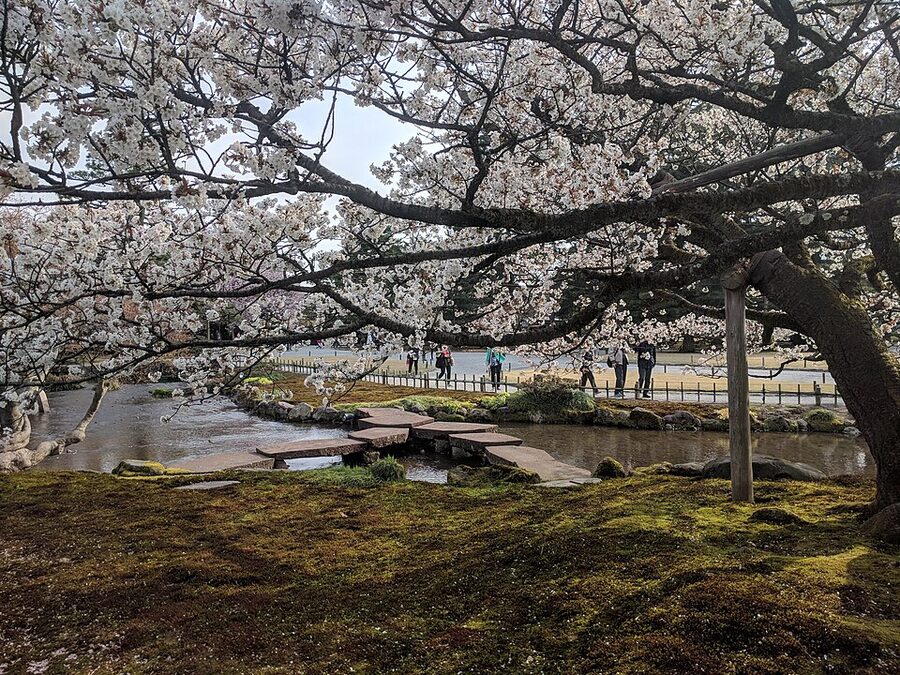

The name Kenroku-en comes from a Song-dynasty Chinese treatise, Li Gefei’s Luoyang Ming-yuan Ji (11th century), which lists six qualities a great garden should combine: kōdai spaciousness, yūsui seclusion, jinryoku artifice, sōko antiquity, suisen waterways, and chōbō panorama. The claim is that Kenroku-en has all six. Calling the garden ken-roku, “combining six”, is a scholarly rather than poetic name, and it is the tipoff that the garden was designed by lords who were reading Chinese garden theory as part of their education. The naming was done by the reformer Matsudaira Sadanobu at the request of Maeda Narinaga in 1822.
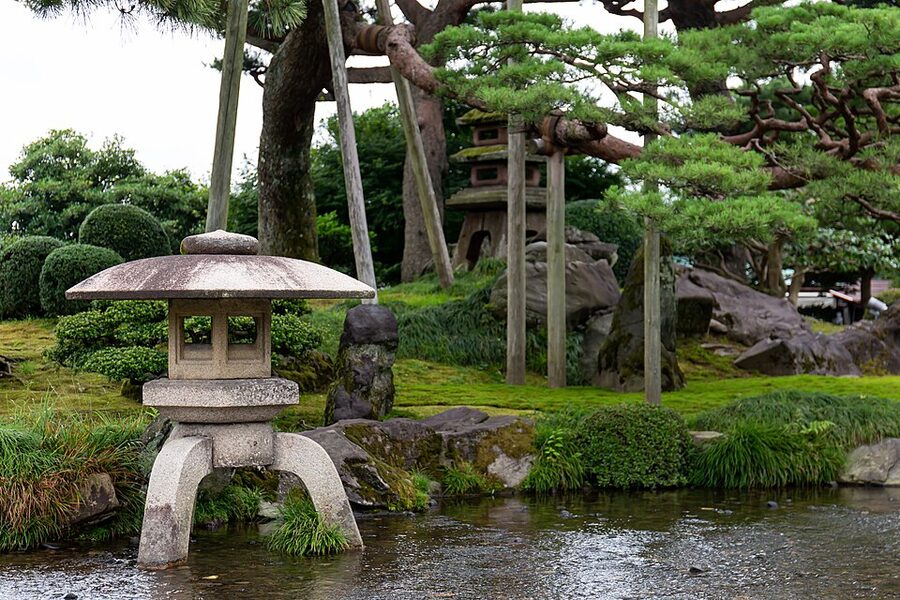

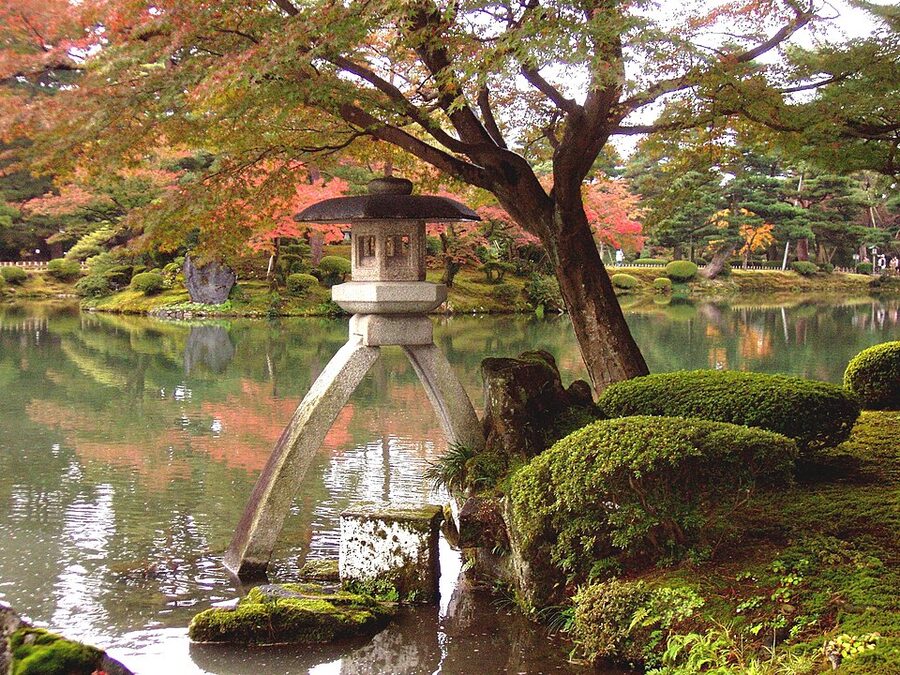
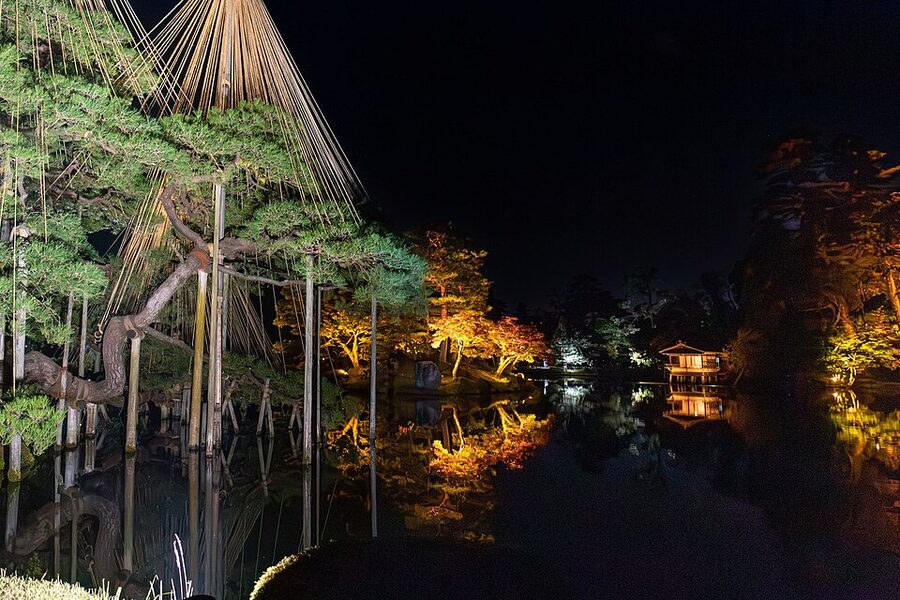
Kenroku-en’s most famous single feature is the Kotoji-Tōrō stone lantern on the edge of Kasumi-ga-ike pond — a two-legged lantern whose legs are deliberately of different lengths so it can sit level on the uneven pond edge. The lantern has become a visual shorthand for the whole garden; you will see it on prefecture tourism posters, station wall murals, and the back of the ¥10 Kanazawa bus ticket. The winter version of Kenroku-en, when the pines are protected by conical yukitsuri rope frames to keep the branches from breaking under Hokuriku snow, is also iconic in a different way. Both images are specific Kenroku-en images and neither of them is the whole garden.

Kōraku-en Okayama — the Ikeda family, 1700
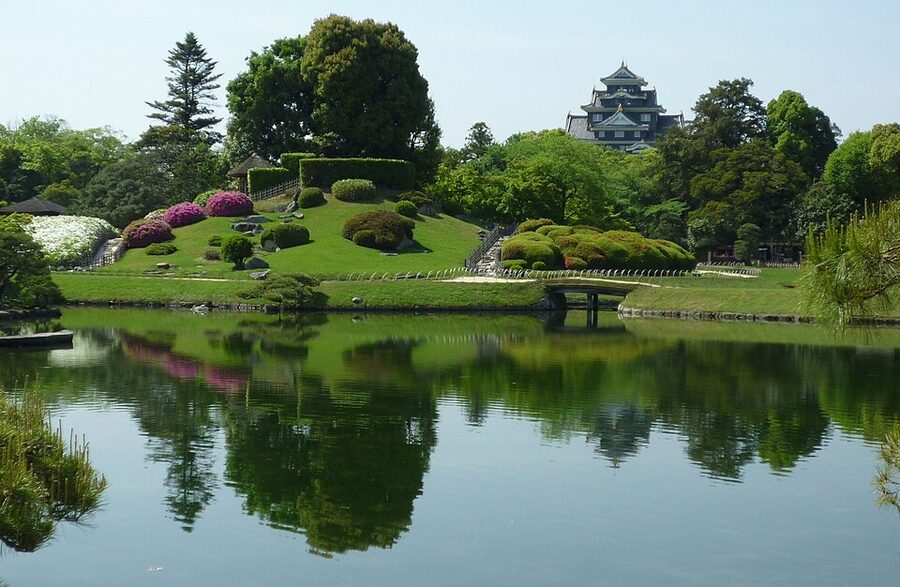
Kōraku-en (後楽園) in Okayama was built by the fourth-generation Okayama daimyō Ikeda Tsunamasa between 1687 and 1700, on a fourteen-hectare island in the Asahi River directly across from Okayama Castle. The garden designer of record was the Ikeda retainer Tsuda Nagatada, who was brought in from flood-control engineering, he had just finished the Hyakken-gawa bypass channel that stopped the castle town flooding, and asked to turn part of the reclaimed low-lying land into a retreat for the lord. The result is a chisen-kaiyū of unusual horizontal openness; Kōraku-en has more lawn and less massing than Kenroku-en, and it feels, at first walk-through, more like an eighteenth-century English landscape park than a Japanese garden.

The name Kōraku-en is also textual: it comes from a phrase in Fan Zhongyan’s eleventh-century essay Yueyang Lou Ji, “Preceding in sorrow before the rest, following in pleasure after the rest” (先憂後楽, sen’yū kōraku) — a Confucian doctrine that a responsible ruler should grieve first and celebrate last. The garden was renamed Kōraku-en in 1871 when the Ikeda family handed it over to the new Meiji government; the original Edo-period name had been the colourless Go-kō-en, “the Rear Garden”. The rebranding is a piece of Meiji ideological repositioning, a daimyō leisure-garden was relabelled as a monument to Confucian service-of-people ethics, and the rebrand stuck.
_and_Okayama_castle.jpg)
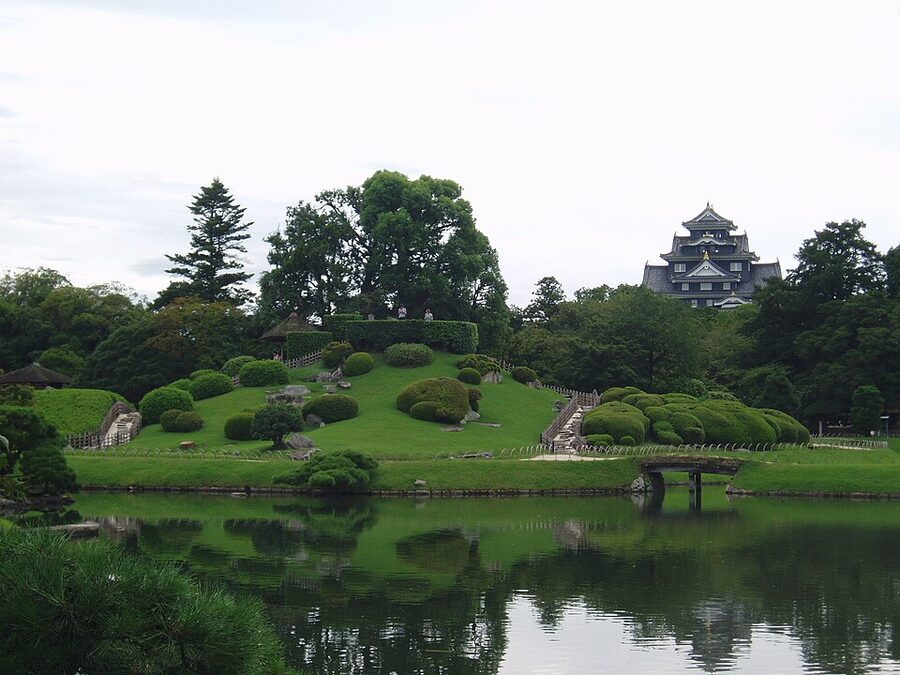
Kōraku-en’s critical signature is the shakkei of Okayama Castle across the river. The original Ikeda design explicitly placed the central pavilion, the Enyō-tei, so that its south veranda looked across the pond and directly at the castle keep two hundred metres away. The castle was the Ikeda family’s seat; the garden was the Ikeda family’s retreat; the visual line between them was a deliberate assertion of identity. The whole layout is one of the clearest illustrations in Japan of what shakkei is for, which is what the next section is about.

Kairaku-en Mito — Tokugawa Nariaki, 1841
Kairaku-en (偕楽園) in Mito is the youngest of the three and the outlier in several ways. It was opened in 1842, two hundred years after Kenroku-en was first laid out, by Tokugawa Nariaki, ninth-generation lord of the Mito branch of the Tokugawa clan and a man whose politics were about to make him the most important provincial daimyō of the pre-Meiji period. Nariaki was a Confucian reformer, a Wang Yangming-school intellectual, a rabid anti-foreign-intervention hawk, and the father of the future fifteenth shogun Tokugawa Yoshinobu. He built Kairaku-en not as a private retreat but as a public garden open to the people of Mito on set days of each month.
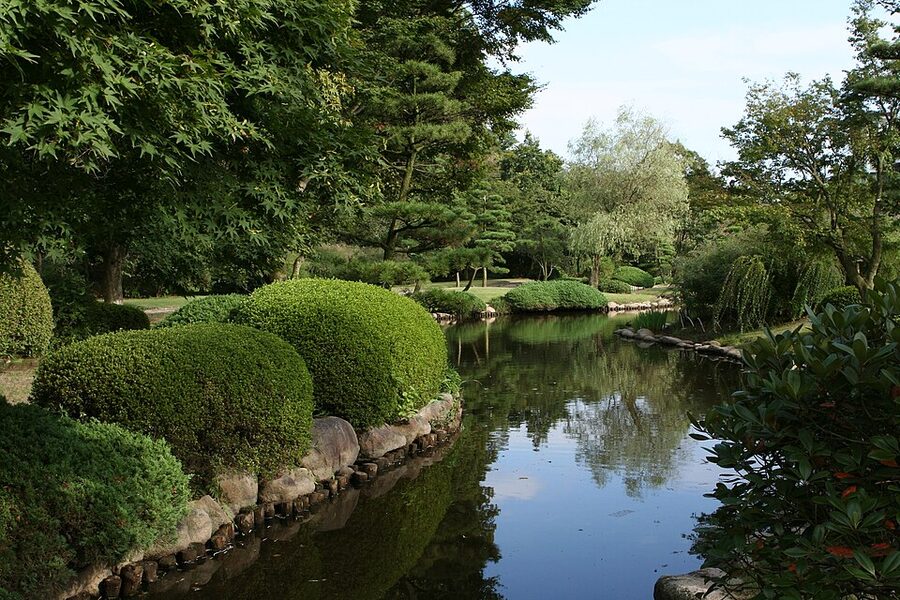

The name Kairaku-en comes from the Mencius phrase “enjoying together with the people” (偕楽, kairaku) — the principle that a virtuous ruler enjoys his pleasures in company with his subjects rather than behind closed gates. Nariaki was quite explicit about this; the garden was open to commoners on days ending in 3 and 8 (the 3rd, 8th, 13th, 18th, 23rd, 28th of each month), which meant the population of Mito could visit it roughly twice a week. This was, in 1842, an ideologically loaded gesture, a daimyō making his private garden semi-public, and it was the only one of the Three Great Gardens to remain free of admission charge into the twenty-first century.
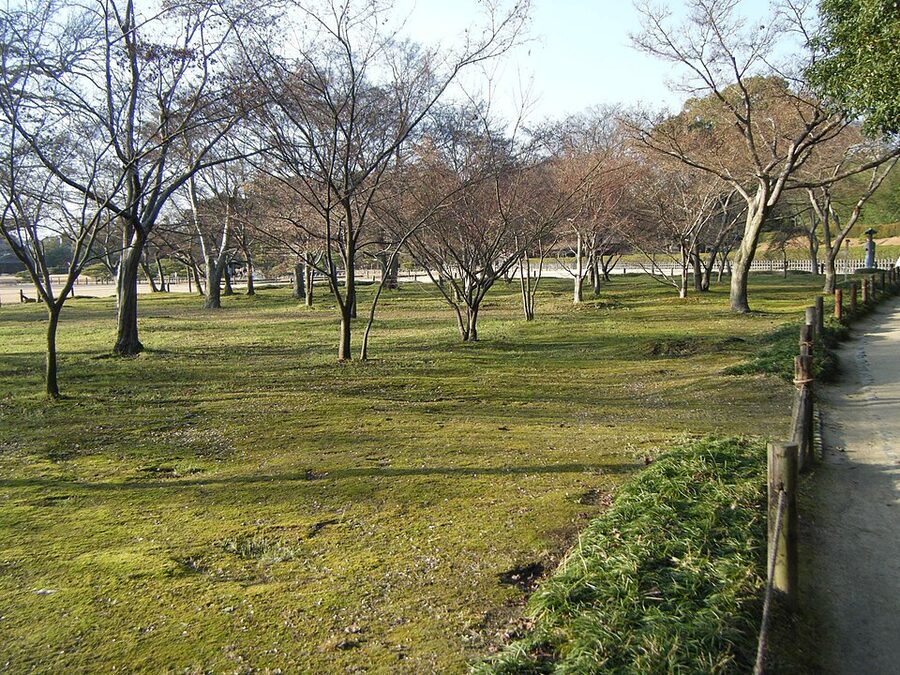
Kairaku-en’s defining feature is the three thousand plum trees. The planting is a deliberate contrast with Kenroku-en’s cherries and Kōraku-en’s lawn: Nariaki chose plums because they flower in late February, when the domain was still economically quiet, and because the unripe fruit was a reserve food source in case of famine. The Mito clan had been through two bad Edo-period famines and had theorised it properly.
A garden, in Nariaki’s conception, was useful food-crop infrastructure that also served as a place for the public to rest on. The three-thousand-tree plum orchard is a Confucian reformer’s garden, in other words, and the February flowering is its political statement.

Shakkei — borrowed scenery
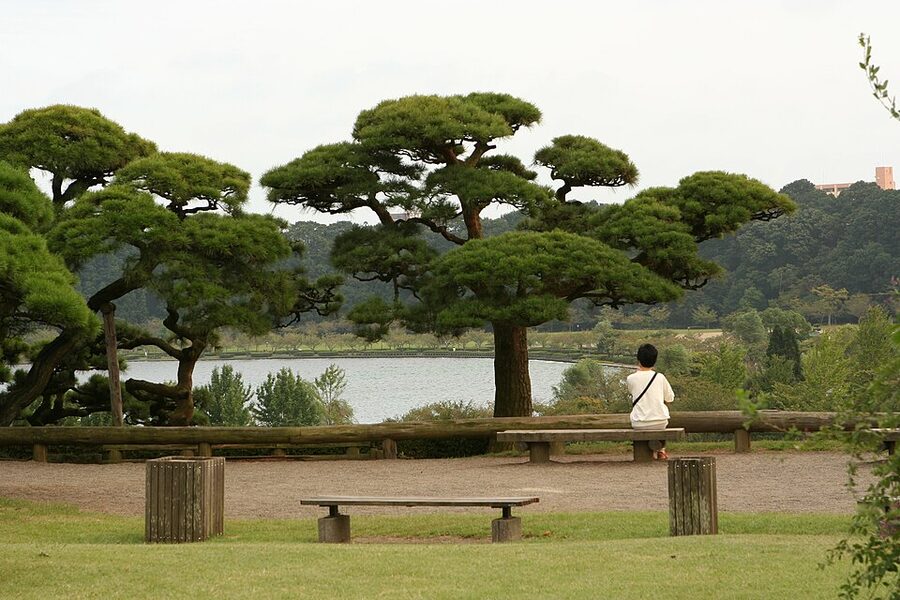
Shakkei (借景, “borrowed scenery”) is the single idea that separates Japanese garden design from every other classical garden tradition in the world, and it is the one that takes a small garden and makes it infinite. The principle is that a hill, a mountain peak, a distant temple roof, or a line of trees beyond the garden wall can be treated as part of the composition even though you don’t own it and have no control over it. You frame the view with a cut in your hedge, you align your principal stone with the distant silhouette, and you incorporate someone else’s mountain into your ten-metre-square garden.
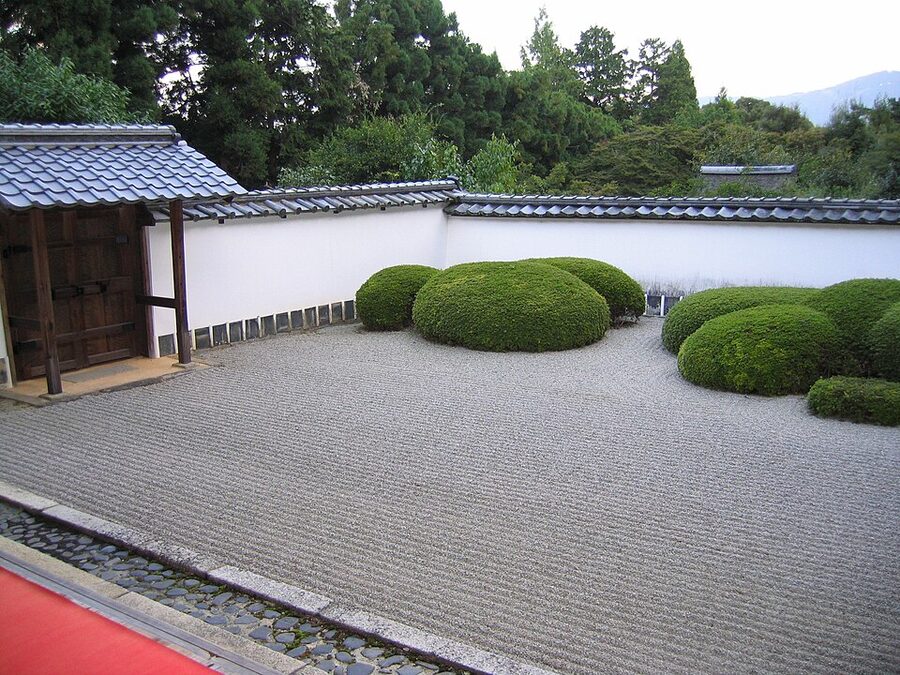

The classical shakkei examples are all seventeenth-century Kyoto gardens: Entsū-ji with Mount Hiei, Shōden-ji with the same peak, Shūgaku-in Rikyū with the northern Higashiyama range, Murin-an with the eastern Higashiyama foothills. What all four share is that the borrowed mountain is too far away to actually incorporate physically and too large to modify. The designer is working with a view rather than a thing. The specific Japanese design term for what the designer does is misete (“showing”) and kakushite (“hiding”) — deliberately arranging the foreground plantings so that the distant view is revealed through selective gaps and concealed through selective screens.
The grand shakkei design at Shūgaku-in Rikyū, built in the 1650s for the retired Emperor Go-Mizuno’o on a fifty-hectare site in the northeast Kyoto hills, takes the concept to the structural limit. From the upper pavilion of the Kami-no-chaya tea garden, you look out across the whole Kyoto basin at the Eastern Mountains, and the entire basin is composed as garden. The frame is the garden wall; the middle ground is the rice fields of Shūgaku-in village; the background is the Higashiyama range.
The view is not stable — villagers plant crops, weather changes, forests grow — and the emperor and his successors accepted that as part of the design. Shakkei that incorporates land you don’t own is shakkei that commits to sharing the composition with time.

The vocabulary — lanterns, bridges, stepping stones, asymmetry
Every Japanese garden works from a standard kit of objects, and knowing the vocabulary makes them readable. Stone lanterns — ishi-dōrō — come in five major types and originated as votive objects at Heian-period shrines before migrating into secular garden use in the sixteenth century. The commonest in a stroll garden is the yukimi-dōrō “snow-viewing lantern” with a broad flat cap designed to catch and display snow, typically placed at the edge of a pond so the snow-capped silhouette reflects in the water. The Kotoji-Tōrō at Kenroku-en is a specific Kenroku-en variation.
Bridges come in three main types: the flat slab ishi-bashi stone bridge, the arched taikō-bashi drum bridge (whose semicircle forms a perfect circle with its reflection in the water), and the zigzag yatsuhashi plank bridge that crosses a pond or marsh in a folded W-shape. Each bridge type carries a meaning. A drum bridge is auspicious — it makes a whole circle with its reflection. A zigzag bridge is defensive — the folds, according to folk belief, throw off pursuing evil spirits, which do not like turning corners.
Stepping stones — tobi-ishi — are not just decorative. They are engineering. The stone spacing controls the walker’s speed, the stone height controls where the walker looks, the stone orientation controls where the walker’s feet point. A senior garden designer can make you turn your head towards a specific view just by rotating the next stepping stone fifteen degrees. Sen no Rikyū’s pupils developed the full theory of stepping-stone gardening, and the Kobori Enshū school in the seventeenth century pushed it into its modern form.
Asymmetry is not a mood; it is a rule. The Sakutei-ki specifies that stone groupings should be in groups of three, five, seven, or other odd numbers — never four, six, or any even number. Island arrangements should have one primary island and two subordinate ones, or one large and four small. Stone-lantern placement should avoid the centreline of a scene. The reasoning is partly Buddhist (odd numbers are yang, even are yin, and yang is the active principle) and partly compositional (the eye settles on symmetrical arrangements and stops working; the eye reads asymmetric arrangements and keeps moving). The result is that no Japanese garden ever looks static. Every composition leans a little.
Some individual gardens that repay the attention
Ryōan-ji — the fifteen stones
Ryōan-ji (龍安寺) sits in northwest Kyoto, five minutes’ walk from Kinkaku-ji and well inside every international tourist itinerary. The rock garden itself is attributed to the late fifteenth century, around 1499, and the attribution is, as always with Muromachi-period karesansui, contested. The names “Kotarō” and “Niijirō” are carved into one of the wall stones, and these are probably the names of the men who laid the garden out; we do not know who commissioned it or what specific meaning they intended.
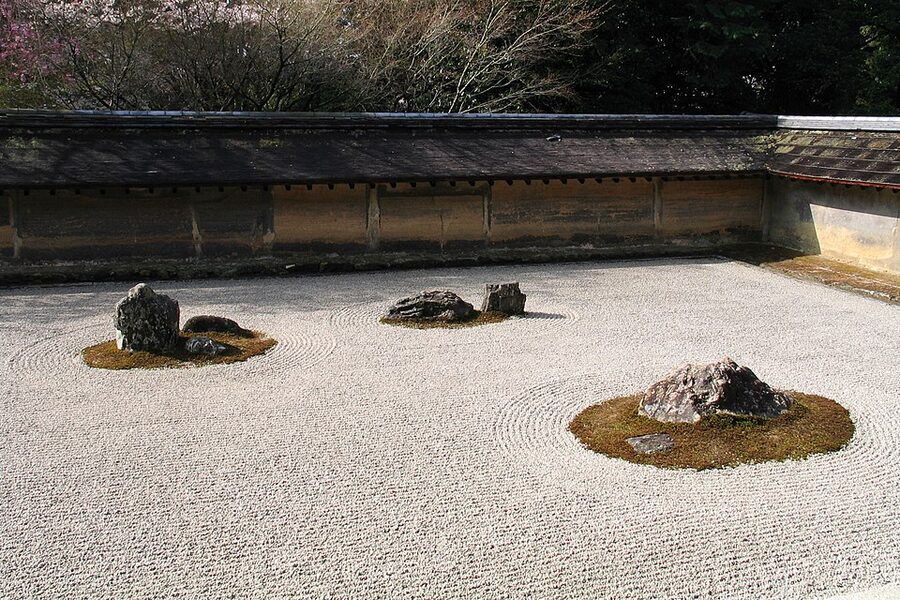

Four theories compete for what the garden “means”. The first is that the fifteen stones represent the Chinese shichigosan odd-number auspiciousness (5+2=7, 3+2=5, 3 = 7-5-3). The second is that the arrangement figures a tigress carrying her cubs across a river, in reference to a Chinese folk tale. The third is that it is a map of the Daoist immortals’ mountains. The fourth is that it means nothing and is simply a demonstration of kasanarizukuri “overlapping design” — a technical flex, not a philosophical statement. All four theories have serious defenders. I would bet on the first and fourth combined, but I could not prove it.
The practical advice for visiting Ryōan-ji is to go first thing in the morning. The temple opens at 08:00; the buses drop visitors there around 10:30. Between 08:00 and 10:30 you can sit on the veranda with maybe a dozen other people and read the garden at the viewing speed it was designed for. After 10:30 you cannot. I keep coming back because the garden is completely different with ten people on the veranda than with a hundred, and the late-November morning, when the gravel is frost-lit and the maple behind the wall is red, is the best I have ever seen it.
Daisen-in — the river of sand
Daisen-in (大仙院) is a subtemple of the Daitoku-ji complex in northern Kyoto, founded in 1509 by the Zen priest Kogaku Sōkō. Its karesansui is arguably the most narrative rock garden in Japan — a long narrow composition read left to right as the course of a river from its mountain spring to the open sea, with every stone along the route doing specific narrative work. The waterfall is the mountain source; the river breaks around a turtle-stone and a carp-stone (two symbols of determination); it passes under a bridge; it widens into a treasure-boat stone arrangement; it opens into the open-sea composition at the far end, which is two mountain-stones standing alone in a bed of gravel ripples.
The narrative is unambiguous; Daisen-in’s monks will walk you through it on request if you visit outside peak hours. The garden is small — about a hundred square metres, tight against the abbot’s hall — and it is meant to be read slowly, from a seated position on the veranda, moving your eyes in a left-to-right arc. The contrast with Ryōan-ji is instructive. Both are late-fifteenth to early-sixteenth century. Both are Zen-temple karesansui. Ryōan-ji is abstract, ambiguous, open to interpretation. Daisen-in is narrative, specific, and walks the viewer through a clearly-intended meaning. They are, on that axis, the poles of what Muromachi-era karesansui could do.
Katsura Imperial Villa — the peak of the form
Katsura Imperial Villa’s garden is the most studied garden in Japan. The villa was begun in 1615 by Prince Toshihito and completed in the 1660s by his son Prince Toshitada, on a twelve-hectare site beside the Katsura River in the southwest of Kyoto. The design synthesises everything the Japanese garden tradition had developed in the previous eight hundred years — shinden-period pond composition, Zen-period karesansui restraint, tea-garden roji sequence, daimyō-period chisen-kaiyū stroll, Kobori Enshū-era shakkei of the Arashiyama hills — into a single walkable composition that has four separate tea houses (Shōka-tei, Shōi-ken, Gepparō, Shōkin-tei) representing the four seasons.
The specific Katsura move that nobody else has ever quite matched is the calibration of sightlines. The entrance path deliberately does not reveal the pond; the pond appears suddenly at the third turn. The principal shoin building is visible from the pond at only two specific angles; from all other positions the building is obscured by trees. Each tea house has exactly one optimal approach-sightline, and the stepping-stone path is laid out so that you walk into that sightline at reading speed. The whole garden is, in other words, a carefully-designed film edit in physical space. You are being shown cuts, in a controlled sequence, at a controlled speed.
Visiting Katsura requires an application in advance to the Imperial Household Agency. The system is online, in English, and works about thirty days out. Do not show up at the gate hoping to walk in; you will not be admitted. Once you are in, you are walked through the garden by an IHA guide on a fixed route of about ninety minutes. The tour is in Japanese with an English audio guide; the IHA does not let visitors wander or sit. This is frustrating, and it is also, if you think about it, the way Katsura was always designed to be experienced. It is a guided composition. The imperial family did not let their guests wander either.
Adachi Museum gardens — the twentieth-century refinement
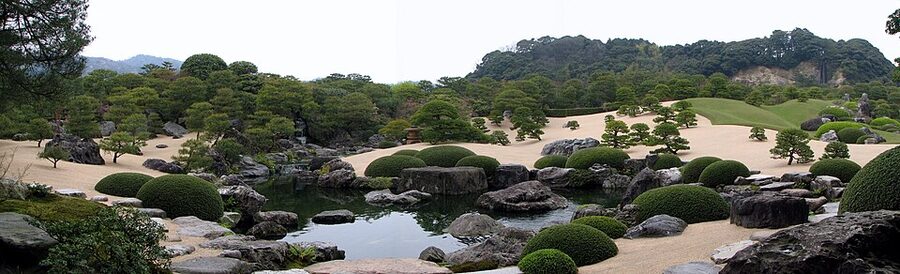
The Adachi Museum of Art in Yasugi, Shimane, is the twentieth-century answer to the classical tradition. It was founded in 1970 by the Shimane-born industrialist Adachi Zenkō, who had made a fortune in Osaka trading and come back to his home prefecture with a collection of Yokoyama Taikan paintings and a determination to build a garden worthy of them. Adachi bought fifty hectares of land behind the museum specifically so that he could control the shakkei view, had the intervening rice paddies maintained by local farmers, and contracted a rotating team of gardeners who prune every sightline to the millimetre.
The trade journal Sukiya Living (also known as the Journal of Japanese Gardening) has ranked Adachi as the number-one Japanese garden in Japan for twenty-one consecutive years, ahead of Katsura, Kenroku-en, and Saihō-ji. The ranking is controversial; the classical Kyoto establishment considers Adachi a modern theme-park version of the tradition. But the gardening itself is technically unimpeachable. If you want to see what a team of elite garden designers can do when they have essentially unlimited budget and no historical constraint, Adachi is the answer. The ninety-minute JR Yakumo express from Okayama puts you at Yasugi station; a free shuttle runs from the station to the museum.
Where to see the tradition in person today
Six gardens, arranged by transport logic rather than aesthetic ranking. If you are doing a first pass at Japanese gardens you could do worse than run this circuit as a week-long loop. All six are open to the public. Three require advance application; three do not. All six are different enough from each other that you do not feel you are seeing the same garden twice.
Kenroku-en, Kanazawa
Admission ¥320 adults, ¥100 children. Open 07:00-18:00 from March to mid-October, 08:00-17:00 the rest of the year; the early-morning opening hours (pre-08:00 or 07:00 depending on season) are free of charge, which is the best-kept secret in Kanazawa tourism. Take the Kanazawa Loop Bus from Kanazawa Station — the ride is fifteen minutes; the Kenrokuen-shita stop is the front gate. The garden pairs naturally with Kanazawa Castle (next door across a bridge), the Higashi Chaya-gai geisha district (fifteen minutes’ walk), and the D.T. Suzuki Museum of Zen (ten minutes’ walk). You can do Kenroku-en properly in two hours if you are not stopping for tea.
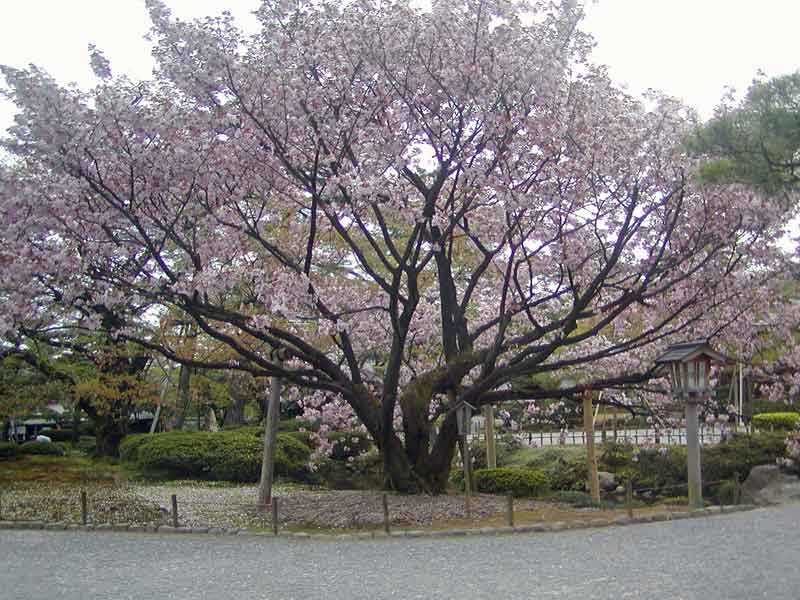

The best month at Kenroku-en is a matter of opinion; I would say late November for the maples, late March for the plum blossom, late April for the cherries (including the Kumagai cultivar noted above), and either very early January or late February for snow — late February is the better call because the yukitsuri rope frames are at peak drama then. The garden has no bad season, but summer is its weakest; the July-August heat in Kanazawa is unpleasant and the pines look tired. If you are travelling Kyoto-Osaka-Kanazawa on the Hokuriku Shinkansen, a Kenroku-en-in-the-morning, Higashi-Chaya-in-the-afternoon day is a coherent use of one night in Kanazawa.
Kōraku-en, Okayama
Admission ¥410 adults, ¥140 children (or free for over-65s with an Okayama resident’s card — not a tourist concession). Open 07:30-18:00 from late March to September, 08:00-17:00 in winter. The Okayama Station east exit is a fifteen-minute walk or a five-minute tram ride (Shiroshita tram stop, then ten minutes’ walk across the Asahi River bridge). You pair Kōraku-en naturally with Okayama Castle, which is directly across the river and which Kōraku-en was built to look at; the castle itself is a 1966 reconstruction of the 1597 original but the shakkei view works either way.
Kōraku-en is the Inland-Sea garden of the three, and it has a softer climate than Kenroku-en or Kairaku-en — summer is hot but not unreasonable, autumn maples are reliable from early November. The festival calendar is worth checking: the late-May iris festival and the late-October chrysanthemum exhibition are both significant. Do not miss the cormorant fishing (see our ukai article) on the Asahi River immediately north of the garden; the May-through-October cormorant season ends at a small park just upstream of Kōraku-en and is a good evening pairing with a morning garden visit.
Kairaku-en, Mito
Admission ¥300 for out-of-prefecture visitors; Ibaraki residents still free (the 2019 introduction of admission for non-residents was the first paid admission in the garden’s history and remains a local controversy). Open 06:00-19:00 February-September, 07:00-18:00 October-January. The walking distance from Mito Station is fifteen minutes; a shuttle bus runs every ten minutes during the plum-festival season from the station north exit. Kairaku-en pairs with the Kōdō-kan han school — Nariaki’s other foundation, two blocks east of Mito Station — and with the Tokugawa Museum in the same park complex.
The plum festival runs from the third Saturday of February to the last Sunday of March. The garden has three thousand trees of a hundred cultivars, and the cultivars flower at different dates across that six-week window; you can come twice during the festival and see completely different blossom arrangements. The rest of the year Kairaku-en is quieter than the other two San-mei-en members — the Tokyo-to-Mito run is ninety minutes by Hitachi Limited Express but relatively few foreign tourists make it up there. The February-March peak is the exception.
Ryōan-ji, Kyoto
Admission ¥500 adults, ¥300 children. Open 08:00-17:00 March-November, 08:30-16:30 December-February. Take the Kyoto City Bus 59 from Shijō-Kawaramachi or the JR bus 10 from Kyoto Station — Ryōan-ji-mae stop is the front gate. The classic Kyoto morning run is Kinkaku-ji at 09:00 (it opens at 09:00 and the crowds are manageable in the first half-hour), walk down to Ryōan-ji in twenty minutes, read the garden at 10:00, lunch in the Ryōan-ji grounds at the temple’s own restaurant Seigen’in (the yudōfu is expensive but correct), and then walk to Ninna-ji in the afternoon.
The karesansui is not the only thing at Ryōan-ji. The Kyōyō-chi pond behind the main hall is a genuine chisen-kaiyū-style stroll garden that predates the rock garden — the Edo-period guidebooks make clear that until about 1780 the pond was the famous garden and the rocks were an afterthought. The inversion, with the rocks now famous and the pond now secondary, is a Meiji-period phenomenon. Walk the pond too. It is quieter and in some seasons more beautiful than the main attraction.
Saihō-ji / Kokedera, Kyoto
Saihō-ji (西芳寺, also known as Kokedera 苔寺, “the moss temple”) is in western Kyoto, in the Matsuo district at the foot of Arashiyama. It is the hardest garden on this list to visit, and the visit is worth the hurdle. Since 1977 the temple has required advance application by return-postcard or (since 2021) online booking through the temple’s own website. The advance window is about two weeks. Admission is ¥4,000, which is a substantial multiple of the other gardens — justifiable because your ticket includes a forty-five-minute sutra-copying or chanting session at the main hall before you are allowed into the garden proper.
This is not a formality. You sit on the floor, they hand you a brush and a sheet of traced kanji, you copy the Heart Sutra for forty-five minutes while a monk chants alongside you, and then and only then are you shown into the garden. The logic, established by the thirty-eighth-generation abbot in 1977 after the previous open-access policy produced enough visitors to damage the moss, is that Saihō-ji is primarily a working Zen monastery and secondarily a tourist site. You pay with time, not just money. The moss garden, after the sutra, is completely different from how it would have been without it. This is deliberate.
Katsura Imperial Villa, Kyoto
Admission ¥1,000 adults, free for under-18s. Visits are by advance online application through the Imperial Household Agency (sankan.kunaicho.go.jp) and application slots open exactly thirty days in advance; popular dates, spring and autumn weekends, fill within the first fifteen minutes of the booking window. There is a same-day standby queue for about twenty slots per tour, with a 50% no-show rate in my experience, but it is not a reliable plan. Book ahead. The villa is in the Katsura district in southwest Kyoto, about fifteen minutes’ walk from Katsura Station on the Hankyū line.
The tour is about ninety minutes, conducted in Japanese with a multilingual audio guide, on a fixed route. You do not get to wander. You do not get to sit. You do not get to take photographs from most of the interior viewpoints. If these restrictions frustrate you, that is a legitimate reaction, and you should probably not bother with Katsura; you will get more out of Kenroku-en, where you can sit on the pond edge for an afternoon. If the restrictions feel, instead, like part of the texture of the place — the way access works at an imperial property, both in 1660 and in 2026 — then Katsura is the single best piece of Japanese garden-craft accessible to the public, and the ninety minutes are worth what you pay for them.
Closing
I said at the start that there are fifteen rocks at Ryōan-ji and you can only ever see fourteen. What I did not say is that there is a standing debate among Japanese garden historians about whether the fifteenth rock, the one you can never see from the veranda, is actually visible from a single specific spot: the abbot’s private chamber behind the garden, at a viewing angle not accessible to the public. I have read both sides of that argument in detail and I still don’t know which is right.
What I know is that you could spend your life reading Japanese gardens and never finish. Every one of the three hundred surviving Edo-period daimyō gardens has its own composition grammar; every one of the two thousand Zen temple karesansui has its own narrative; every one of the fourteen extant Heian-period aristocratic garden sites is still debated by the specialists. Start with Ryōan-ji on a frost-lit November morning. Then go to Saihō-ji and copy the sutra first. Then Katsura, with the advance booking. Then the Three Great Gardens if you have time. You will not come out the other side an expert. You will come out knowing which fourteen rocks, on that specific morning at that specific sitting angle, you could see.
You Might Also Enjoy
 Sengoku: 136 Years of War, Three Unifiers, and the Country That Came Out of It
 Japan’s Three Sacred Treasures: The Sword, Mirror, and Jewel No One Has Seen
 Heisei: Thirty Years of Lost Decades, Disasters, and the Japan Most Visitors Actually Saw
 Meiji: How Japan Industrialised in 44 Years (and Got Away With It)