The Nagara River runs past Gifu Castle at the base of Mount Kinka, and on any summer night between 11 May and 15 October, if the river is not flooded and the moon is not full, six long wooden boats push out into it shortly after dark with burning pine torches hanging from their bows. Each boat carries a man called an usho (鵜匠) in black robes and a reed head-wrap, twelve trained sea cormorants on tethered leads, and two crew working the stern. The usho holds the twelve lines in his right hand and the torch-pole’s balance in his left, and as the birds dive he reads the tension of the leads the way a blind man reads a cane. He has been doing this since he was a boy. His father did it, and his grandfather, and his great-grandfather, and the chain goes back past 1890 (the year the Emperor Meiji made the arrangement official) through Tokugawa Ieyasu’s 1615 visit, through Oda Nobunaga’s 1564 patronage, through the Heian-period imperial grants, and into the 702 CE census of Mino Province, where a group of people listed as professional cormorant fishermen are already on the tax rolls. That is the continuity. 1,300 years.
The Nagara-gawa ukai is one of only two places in Japan where the usho is an employee of the Imperial Household Agency. The Gifu masters — six of them, from hereditary houses carrying six family names that have held the position unbroken since before Edo — are formally titled Kunaichō Shikibu-shoku Ushō (宮内庁式部職鵜匠), which translates to “cormorant-fishing master, Board of Ceremonies, Imperial Household Agency”. Their civil-service salary is paid out of the imperial budget. Eight times each season they perform what is called the goryō ukai (御料鵜飼), the imperial-preserve fishing, and the sweetfish they catch on those nights are packed in ice and couriered to the palace in Tokyo. The rest of the nights, they fish for paying spectators on boats that can hold anywhere from fifteen to fifty people. The fish are the same. The birds are the same. The fire is the same. The price of the spectator boat, in 2026, is somewhere around ¥3,800.
In This Article
- What ukai actually is, and how it works
- Before it was a show — the 8th-century origins
- Nobunaga, Ieyasu, and why the Nagara tradition survived
- The usho’s dress, and why it looks that way
- What you see from the spectator boat
- The season, the mechanics, and the moon
- Where to see it today
- Nagara-gawa, Gifu — the imperial, the real thing
- Uji-gawa, Kyoto — the Heian-era survivor
- Nishiki-gawa, Iwakuni — under the Kintai bridge
- Kiso-gawa, Inuyama — the samurai-route pairing
- Getting to Gifu — the practical anchor
- Closing — the line of torches on the water
What ukai actually is, and how it works
If you have only ever seen the tourism-ministry posters, you could be forgiven for thinking ukai means a man in traditional dress standing serenely in a boat while a trained bird glides in graceful arcs around him. It does not. On the boat, on a working night, the usho is operating twelve leashed birds simultaneously, each line maybe three or four metres long, all twelve untangled constantly by hand while the cormorants dive, surface, re-dive, and occasionally try to fight each other. The torch drops low enough to the water surface that the glare attracts the ayu sweetfish; the fish panic upward in flashes of silver; the birds see them and strike. The usho knows by the weight on the line that a bird has caught something, pulls it gently back, and empties the throat into a basket. The entire boat crew is three people: the usho, a mid-boat assistant called the nakanori, and a stern-pilot called the tomonori. They travel the river in formation, six boats in a line, and at the finale — the sōgarami — they go abreast and drive the fish into a shallow as a single net.
The birds themselves are not river cormorants. They are sea cormorants — specifically Phalacrocorax capillatus, the Japanese cormorant, caught wild off the cliffs at Uo-no-misaki in Hitachi City, Ibaraki Prefecture — because the sea cormorant is bigger, tougher, and better swimmer than the freshwater variety. They are trapped in spring and autumn in a small hut on the cliff called a toya (鳥屋), using tame decoy birds to lure wild ones into capture range. Once caught, each cormorant goes through about two to three years of training before it is ready to work. It is paired permanently with a partner bird — the two of them sleep together, travel together, work together — and the usho keeps roughly twenty birds at home, of which ten to twelve are selected each evening for that night’s boat. Birds are fed once a day, always after the fishing, to keep their appetites up when they are in the water. Good birds work for twelve to fifteen years before retirement. Each usho knows every one of his birds by its character.
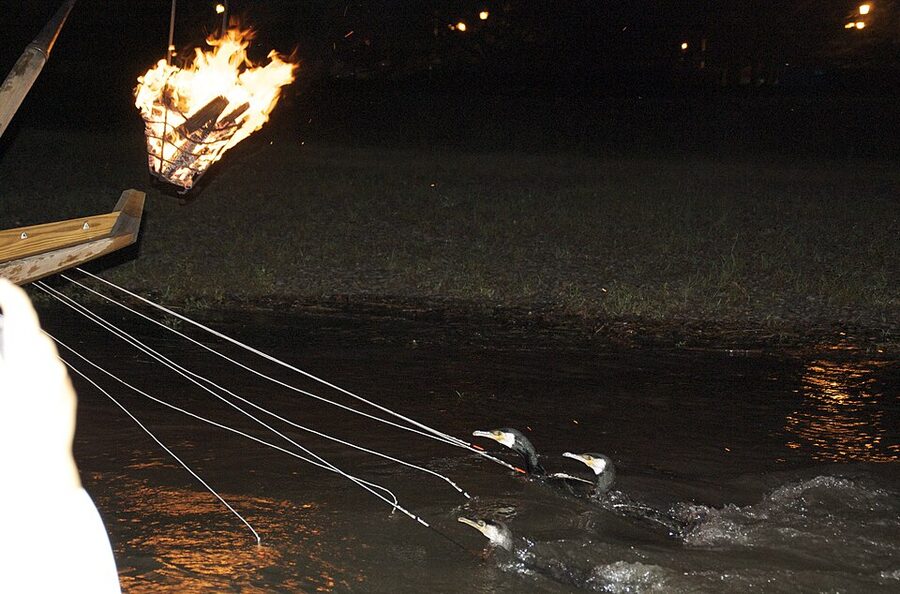
The famous detail — the thing everyone tells you about ukai before you go — is the cord tied loosely around the base of each cormorant’s neck. This is the device that separates ukai from ordinary bird-fishing: the cord is tight enough that a large ayu (the target species, Japan’s prized sweetfish) cannot pass down into the bird’s stomach, but loose enough that smaller, less valuable fish can. A bird that catches a good-sized ayu holds it in the throat pouch; the usho reels the bird in, tips its head back, and the fish comes out undamaged. What the birds get to keep is the smaller catch — which is, as it happens, about what they would eat in a day. This is the thing that gets described in popular accounts as a kind of cruelty; it is not, actually. The cord is sized to each bird’s individual neck, adjusted by the usho personally, and if the bird cannot pass the smaller fish it cannot eat, so the sizing has to be right or the bird starves. The arrangement is old and worked-out. It is also the origin of the Japanese idiom unomi-ni-suru (鵜呑みにする), “to swallow like a cormorant” — meaning to accept something whole, without chewing it over. A phrase from the fishing boat, now common in office conversation.
Before it was a show — the 8th-century origins
The oldest documentary reference to ukai in Japan comes from the Nihon Shoki (日本書紀), compiled in 720 CE, where a passage about the legendary Emperor Jinmu mentions a man making a weir to catch fish and being asked by the emperor what his method is — the answer identifies the man as the ancestor of the Atai-no-Yoshino cormorant-keepers. The Kojiki, from the same decade, references cormorant fishing in a song attributed to the emperor himself. Beyond mythology, the hard ground is the Shōsō-in treasure-house archives at Nara, which preserve household registers from the Taihō era (701-704 CE) listing a group of Mino-province (modern Gifu) households whose declared profession is cormorant-fishing. This is what the ja-wiki is referring to when it says the practice is attested “over 1,300 years ago”: the 702 CE register is the paper, and a collective of professional ukai fishermen is already on it. The claim is not fanciful. The claim is bureaucratic.
Interestingly, an earlier foreign account exists too. The Chinese Sui Shu (隋書), the official history of the Sui dynasty, includes a report from an embassy to Japan in 600 CE describing a peculiar Japanese fishing method in which “they put a small ring at the neck of the cormorant, let it into the water to catch fish, and can take more than a hundred tails a day.” This is the earliest surviving description of the technique from any source, and it is neither Japanese nor admiring — it is a bureaucratic observation in a Chinese chronicle, written by someone watching Japanese fishermen with a degree of puzzled professional interest. The technique itself was already mature at that point. The Mino-province tradition that the Taihō register documents, and that the Nagara-gawa masters still continue today, is one strand of a practice that was widespread across pre-Nara Japan and had already been going long enough that foreign observers made notes on it.
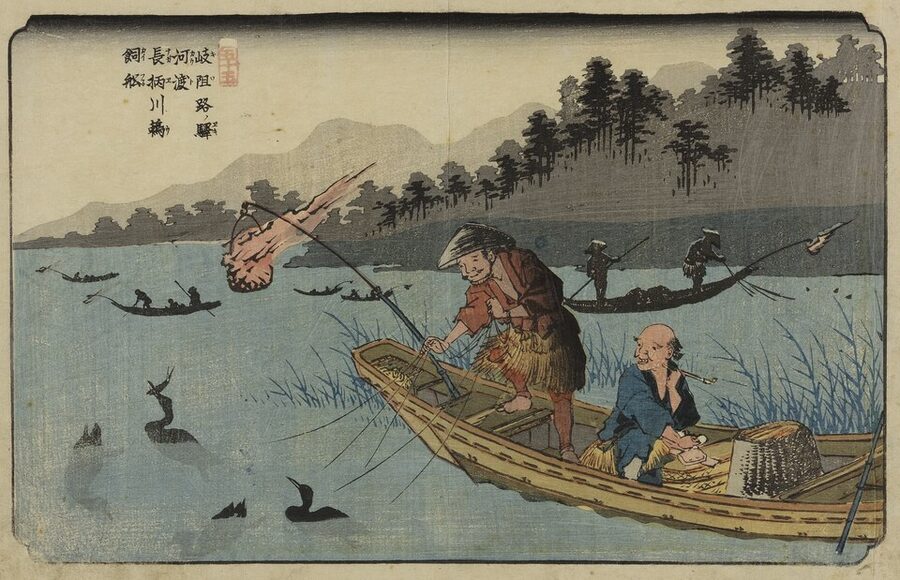
By the Heian period the practice had stratified. In the countryside, ukai remained what it had been in the 8th century — a working fishery, families pulling their living out of the river. But among the Kyoto nobility it had also become a leisure spectacle. From the early 900s on (the Engi-era records, 901-923), the Nagara River was home to seven officially listed ukai households, and their fish were being sent to the capital as tribute. The court regulator Fujiwara no Toshihito tasted the Nagara sweetfish, approved, and designated seven villages in Kata-agata district as the ukai-no-shō — the “cormorant-fishing manor,” an endowed land whose rents supported the fishermen. This is the first serious state sponsorship of the Nagara-gawa tradition, and it is the origin of the arrangement that the Imperial Household Agency eventually formalised a thousand years later in 1890. Everything that came after — the Kamakura-era protection under Yoritomo, the Oda and Tokugawa patronage, the Meiji civil-service designation — is reinstitution of this same basic deal: the Nagara River cormorant-fishers get land, rank, and protection, in return for their fish.
Nobunaga, Ieyasu, and why the Nagara tradition survived
By the time of the Sengoku wars, the Nagara-gawa ukai had been a working tradition for over eight hundred years and a nobility-endorsed one for six. In 1564, Oda Nobunaga — newly master of Mino Province after taking Gifu Castle from the Saitō clan, and based directly above the fishing grounds on Mount Kinka — watched the fishing for himself and decided he liked it. He did three things that are directly traceable in the records. First, he conferred the title usho on each of the Nagara fishing-masters personally, elevating them to the same status as his falconers (the closest analogy in his administrative vocabulary). Second, he granted each usho household ten koku of rice per year as salary. Third, in 1568, when he received a delegation from Takeda Shingen, he had a special guest-boat built, invited the delegation out onto the Nagara, personally selected the best ayu from the night’s catch, and sent the fish back to Kai Province with the ambassadors as a gift. The whole exercise — boat-building, hosting, gift of the imperial fish — was explicitly theatre, a display to Takeda that Nobunaga’s Mino was as cultured and as connected to ancient courtly tradition as Takeda’s Kai. It worked. This is how ukai became, in addition to fishing, a tool of samurai-diplomatic hospitality.
Tokugawa Ieyasu inherited the arrangement. In the summer of 1615, having just finished the Osaka Summer Campaign that ended the Toyotomi line, he came to Gifu on the way back east. He watched ukai on the Nagara, ate stone-roasted ayu, and was apparently charmed enough that he established a formal arrangement: each of the 21 Nagara usho households now in existence received a stipend of ten ryō per year, and in return they delivered ayu to Edo Castle annually, expedited by a three-senior-councillors’ seal so that the fish arrived in Edo in two days and nights at most. The stipend arrangement held, with some decay through the 19th century, until the Meiji Restoration tore up all the feudal patronage relationships and briefly threw the Nagara usho into free-fall. For a few years in the 1870s-80s the tradition looked like it might not survive. It survived because in 1890 (Meiji 23) the Imperial Household Ministry, now a modern ministry rather than a feudal court, formally took over the patronage and designated 1,471 ma of river, extending from Kodsu in Inaba district through Furoma in Mugi district upstream to Gunjō, as the Imperial Game Preserve for cormorant fishing. The Nagara usho became imperial civil servants. They have stayed so ever since.
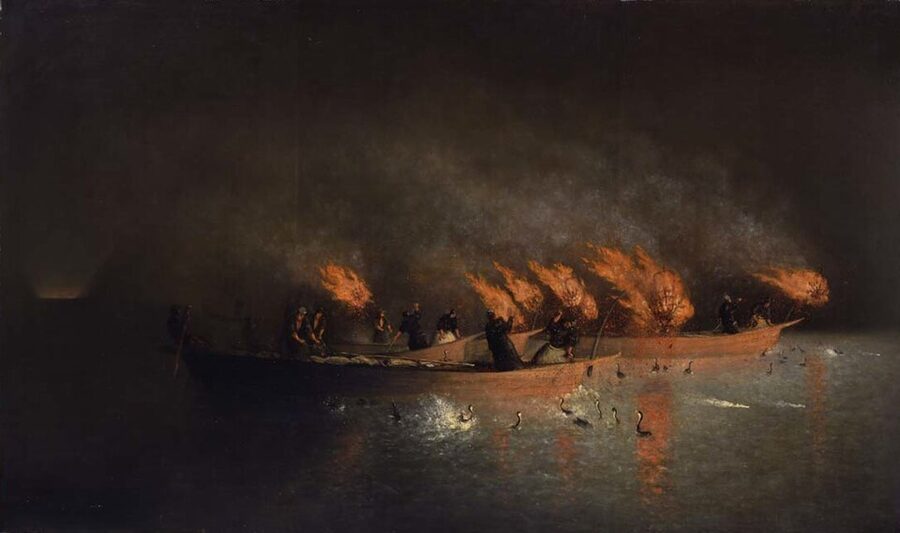
The six families who currently hold the hereditary positions at Gifu — the three Yamashita branches (Marichi, Maruyama, Maruwa) and the three Sugiyama branches (Yamajō, Wachigai, Maruyo) — can each trace their line back through at least the early Edo period, and in some cases much further. The positions are inherited from father to son on the father’s death or retirement; the son begins his apprenticeship in his teens and is expected to complete at minimum a ten-year training before operating a boat on his own. Seki City, on the Nagara above Gifu, has three more imperial usho running a smaller show called the Ozu-ukai. These nine men — six at Gifu, three at Seki — are the only hereditary imperial fishing-masters in Japan. All other ukai operations in the country, of which there are about eleven active ones, are run by independent or municipally-employed fishermen using the same technique without the imperial designation. When the ja-wiki says the Nagara-gawa ukai is “unique” in being imperial, it is stating a literal bureaucratic fact. There is one imperial cormorant fishery in Japan and this is it.
The usho’s dress, and why it looks that way
Every item of the usho‘s working dress is functional and has been refined over centuries. The head-wrap is called a kazaori-eboshi (風折烏帽子), a ragged black or dark-blue hemp cap wound round the head to protect the hair from the torch sparks and keep it off the brow; its pointed end, folded over as if the wind had bent it, originally held the wearer’s topknot. The dark-coloured cotton jacket is called the ryōfuku (漁服), dyed dark specifically so it does not reflect the torch light and frighten the birds. Across the chest, a padded straw plate called the muneate (胸当て) stops the falling torch sparks and pine-sap from setting the jacket alight; in its natural role it also doubles as a pocket. A light rattan skirt called the koshimino (腰蓑) shields the legs from splashing water and, more usefully, keeps the usho‘s core warm through a 9 pm summer descent. Below the knee he wears ashinaka (足半), rattan-and-vinyl half-sandals, cut at the instep, deliberately short at the front so they do not slip on a deck slick with fish oil and water weeds. Nothing in the outfit is decorative. Everything is there because it is what four hundred years of trial have agreed works.
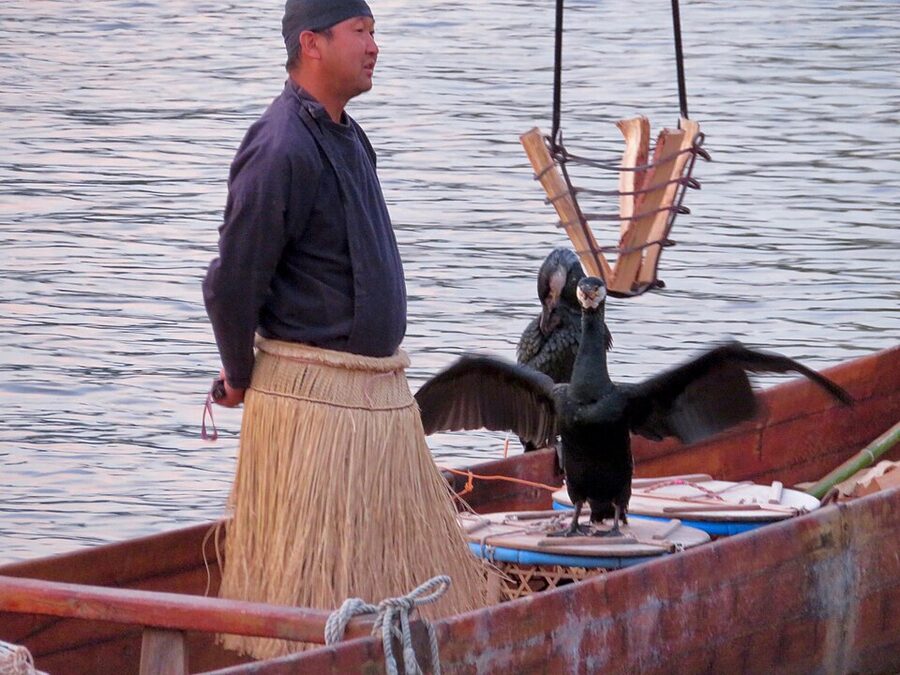
The boat itself, the ubune (鵜舟), is 13 metres long, flat-bottomed, and pointed at both ends, rigged with a forward-leaning iron fire-cage called the kagari (篝) that is fed from below with split pine — specifically matsuwariki (松割木), logs of Japanese red pine split into quarters. The fire is called kagaribi (篝火), from the cage. When it is lit and the boat pushes off, the fire at the bow lights the river for maybe seven or eight metres in front of the boat; the usho stands just behind it holding the lines; the nakanori bails water from the mid-boat; and the tomonori, at the stern, poles the boat down the current. Everything visible — the iron cage, the wooden boat, the pine kindling, the usho‘s dress, the rope technique — is essentially the technology of 9th-century Japan. Modernisation has touched the spectator boats (they now have electric lights at the mooring, fibreglass hulls for the newer ones, proper catering kitchens), but the cormorant boat itself is a pre-industrial object operating inside a post-industrial country.
What you see from the spectator boat
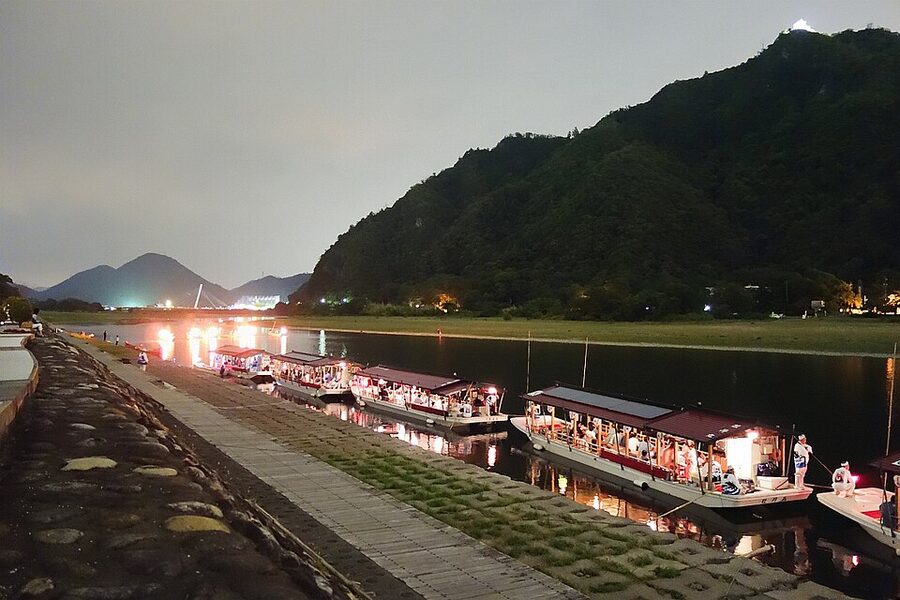
You board at the Nagaragawa Ukai-kan boarding dock, a concrete pier with wooden benches just south of the Nagara Bridge on the Gifu City bank. The spectator boats, there are about fifty of them in the fleet, range from small fifteen-seaters to large fifty-seaters with covered canopies. Every boat has a river-side pilot poling it. You launch around 18:30 on a summer evening, still in daylight, and the first forty-five minutes is effectively a cruise: the boat anchors on the riverbank, the passengers eat the boxed dinners they have brought or ordered, merchants come alongside to sell sake and fireworks, and entertainment boats pass with geiko dancers performing for the anchored spectators. Then at about 19:45, with full dark settled, three signal fireworks go up from the shore. This is the ukai starting. The six imperial cormorant boats push off from their moorings upstream and begin to come down the river toward the spectator fleet.
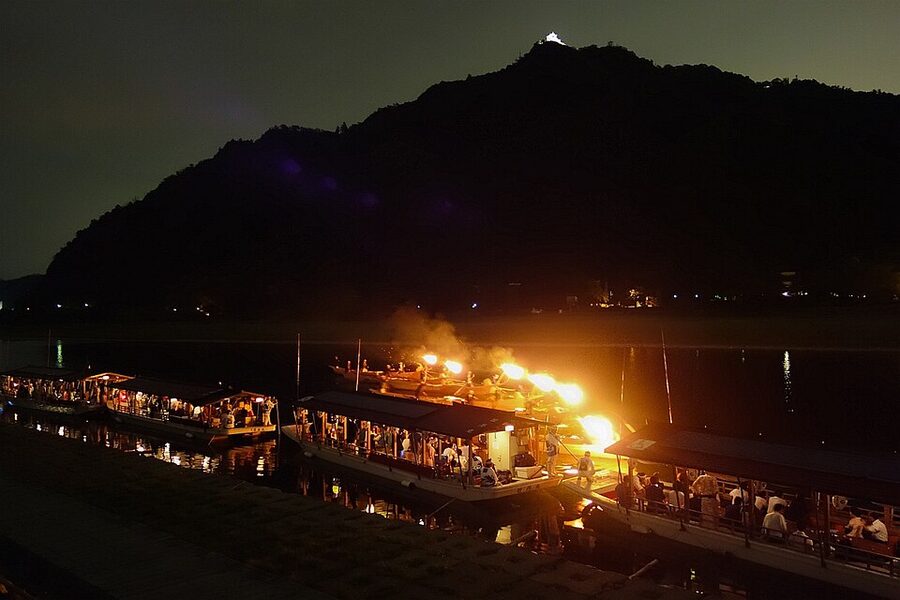
The boats pass your spectator boat one by one, in line, torches at the bow, roughly 15 metres off your side. Each takes maybe ninety seconds to go past. The usho‘s voice is audible, a low calling and occasional shouted command to the birds, and the sound of the wood knocking on the hull (the funbera, a method of driving the birds active by rhythmically hitting the gunwale with a long pole) is surprisingly loud across the water. You cannot see the fish being caught; the ayu is only eight to ten inches long and the action happens below the waterline. What you see is the torch flame, the profile of the usho in black against the fire, the birds surfacing and diving, and the occasional flash of silver when an ayu is briefly in the air. It is a slow spectacle. The boats pass, and then they pass again, six of them total, and then at the end they regroup downstream and come back up the river abreast, in a finale line called the sōgarami, to push fish into a shallow at the end of the run for a coordinated catch. This is the climax. From the spectator boat it is about 90 minutes of active fishing, plus the earlier dinner cruise. You disembark around 21:00. The quiet on the walk back to the hotel through Gifu City, after two hours on the water in the torchlight, is a particular quality that the ceremony produces and that I have not found elsewhere.
The fish, if you have arranged for it, you can eat afterwards. The ukai-caught ayu is called hagata-no-ayu (歯形の鮎), meaning “tooth-marked sweetfish,” because the cormorant’s beak leaves a small puncture on each fish; this is in fact a mark of authenticity, since the puncture kills the fish instantly and preserves the flesh quality above what you can get by net-fishing. The tooth-marked ayu does not enter the ordinary market — it goes to specific ryokan and restaurants that pre-contract with individual usho. The best way to eat it is shioyaki, skewered and salt-grilled over charcoal, head to tail in one piece. The fat deposits under the scales melt during grilling; the flesh stays sweet and almost watermelon-like, which is why the fish is called “sweetfish” in the first place. If you book a dinner-plus-ukai package at a riverside hotel (the Jūhachirō and the Gifu Grand Hotel both do this), they will grill the fish for you an hour or two after it is caught. This is the closest most modern Japanese food gets to a zero-transit agricultural practice.
The season, the mechanics, and the moon
The season runs 11 May to 15 October every year, inclusive. 11 May is the opening day, celebrated at the boarding pier with a Shinto safety-blessing, taiko drumming, and a flotilla of dance-boats parading before the first commercial run. 15 October is the closing day, marked more quietly — the final fishing of the imperial preserve season, after which the usho perform a ritual purification and the boats go into dry dock for maintenance. Inside the season, ukai runs every night except during two kinds of interruption: a full moon (because the moon’s light drowns out the torch’s effectiveness at attracting fish) and heavy rainfall that raises the river level (because a fast river makes both the bird work and the boat control dangerous). The mid-autumn full moon of September-October is traditionally observed as a pause day — locals call this chūshū-no-meigetsu, and it is the one authorised cancellation on the calendar in addition to weather closures. Across a full season the six imperial boats will run roughly 120-130 nights, of which eight are the full goryō imperial sessions.
There is a 10 October annual ceremony at which the Gifu usho formally report to the Imperial Palace in Tokyo on the season’s catch. The report is delivered in person by the senior usho travelling up to Tokyo on the new Shinkansen — a curious modern detail: the same civil servants who spend five months on a pre-industrial river boat make one annual formal trip on Japan’s fastest train. The first ayu of every season, caught at the 11 May opening, are similarly couriered, this time by refrigerated vehicle, to the palace within 24 hours. And the goryō-ukai imperial nights themselves are open to the public: you can book a spectator boat on any of the eight imperial dates and watch the same fishing, at the same site, that the imperial household has claimed since 1890. Nothing at all changes about the ceremony on those nights. The imperial preserve is a legal fiction about fish-ownership; the fishing itself is indistinguishable from any other evening.
Where to see it today
Nagara-gawa, Gifu — the imperial, the real thing
This is the one. The Nagara-gawa ukai at Gifu City is the imperial fishery, with six hereditary usho, the 1,300-year-unbroken line, and the full 11 May to 15 October season. The boarding pier is the Gifu-shi Ukai Kanran-bune Jimusho, directly south of the Nagara Bridge (Nagara-bashi) in the Minato-machi district. Tickets cost ¥3,500 for the standard evening plan on weekdays and ¥3,800 on weekends or high-season dates, with reserved-seat upgrades available. You can book on the day at the pier for daylight-plan boats; the evening boats that include the full fishing spectacle need to be booked ahead, either by phone in Japanese (+81-58-262-0104) or through the Gifu City English-language online booking system, which has been running reliably since about 2018. The website is ukai-gifucity.jp; the English-side UI is straightforward. Once you have the ticket, arrive at the pier by 18:00, bring your own dinner or buy a bentō at the pier, and plan on getting off the water around 21:00.
For the non-fishing part of the trip: Gifu Castle sits directly above the boarding pier, on the peak of Mount Kinka. The natural day-plan is to take the Mount Kinka Ropeway up to the castle in the afternoon, spend about two hours at the summit (the castle interior, the reconstructed shoin, the panoramic terrace), ride the ropeway down as it gets dark, walk the ten minutes to the Ukai boarding pier, and go straight onto the water. This pairing is the one the Gifu City tourism office push, and they are right to — you will have seen the castle from the river, and the river from the castle, in a single day. For Sengoku-history travellers it is a dense day: Oda Nobunaga‘s headquarters and his preferred evening entertainment within ten minutes of each other, both preserved in forms he would recognise.
Uji-gawa, Kyoto — the Heian-era survivor
The Uji River ukai, just south of Kyoto in Uji City, is the other historically significant location. This one is not imperial — the usho at Uji are municipally employed — but it has two attractions Gifu does not. First, the Uji-gawa operation is the one that pioneered, beginning in 2014, a successful captive-breeding programme for cormorants: instead of catching wild birds, the Uji usho now raise chicks from eggs laid at the Uji breeding facility. This is a live experiment in whether ukai can continue once the wild-cormorant catch becomes unsustainable, which, given Hitachi’s coastal development and the declining Japanese cormorant population, may matter within a generation. The second attraction is that Uji has two female usho, Sawaki Mariko and Ehara Mika, who are among the very few women to hold the position in modern Japanese ukai. The Uji-gawa boats run a shorter season (1 July to 30 September), smaller spectator boats (typically 10-15 seats), and a simpler format (no dinner cruise; just a 90-minute fishing observation) at ¥2,000 per adult.
The travel argument for Uji is that it pairs with the Byōdō-in Phoenix Hall — the 11th-century temple on the Heian-era 10-yen coin, a UNESCO World Heritage site, and arguably the most beautifully preserved piece of Heian-period architecture in Japan. A proper Uji day is: morning train from Kyoto Station (20 minutes on the JR Nara Line), morning at Byōdō-in (allow two hours, including the Phoenix Hall interior tour), lunch at a riverside soba shop (Uji is one of the main soba-producing regions), afternoon at the Genji Museum (the Tale of Genji closes in Uji, and the museum documents the Heian literary connection), and the evening ukai boat on the river at 19:30. Last train back to Kyoto is around 22:00, which is enough margin. If you are based in Kyoto for a longer trip and only want one ukai experience, and can live without the imperial connection, this is a serviceable alternative.
Nishiki-gawa, Iwakuni — under the Kintai bridge
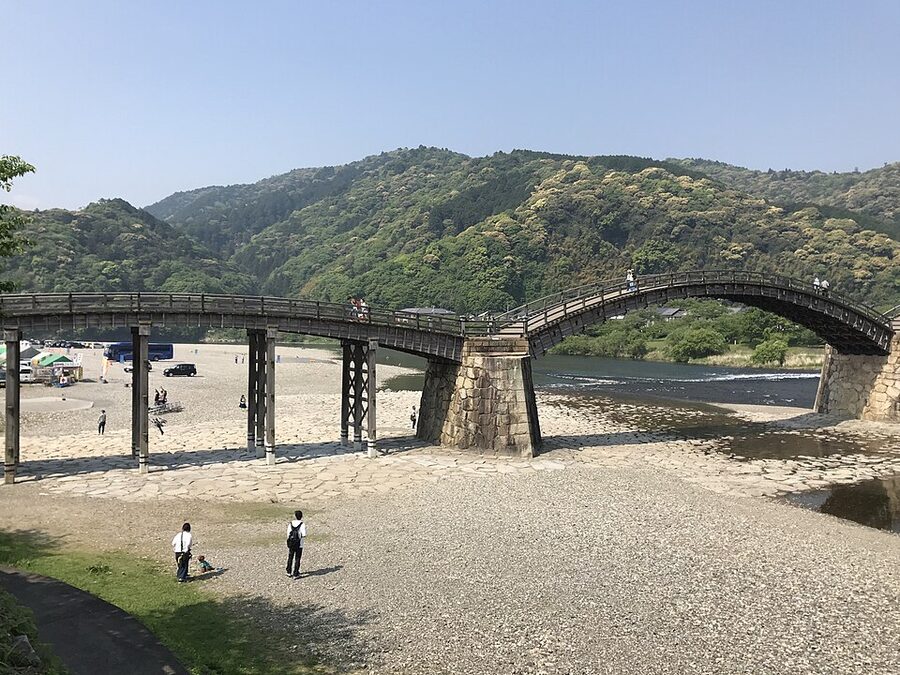
The Nishiki-gawa ukai at Iwakuni, Yamaguchi Prefecture, runs from 1 June to 10 September under the Kintai-kyō (錦帯橋) — the famous five-arched wooden bridge, one of Japan’s three great bridges, built in 1673 under the Kikkawa lords of Iwakuni Domain. The setting is probably the most visually striking of any ukai venue in Japan: the torchlit boats operate directly beneath the arched timber of the bridge, which is floodlit from the bank during the evening runs. The Kikkawa clan patronised ukai on the Nishiki-gawa from roughly the mid-17th century onward, and while the tradition lapsed during the Meiji dislocation (as most lord-sponsored ukai did), it was revived in 1952 and has run continuously since. Three usho currently work the river.
Booking: the Iwakuni Ukai Kumiai (Iwakuni Cormorant Fishing Association) operates the ticket sales, and the fee is ¥3,000 for a standard evening boat. The pier is at the Iwakuni-gawa parking area adjacent to the Kintai-kyō, a 5-minute walk from the bridge itself; the JR Iwakuni Station is 20 minutes by bus from the bridge, and the bus runs regularly in tourist season. For a Hiroshima-based itinerary, Iwakuni is a reasonable day-or-overnight addition; the ukai here is very good even if you have already seen Gifu, and the bridge setting genuinely is remarkable. The practical argument against Iwakuni is that the season is shorter than Gifu’s and the usho are not imperial; the practical argument for is that you will see ukai under a 17th-century bridge, at night, which you cannot do anywhere else in Japan.
Kiso-gawa, Inuyama — the samurai-route pairing
The Kiso-gawa ukai at Inuyama, in northern Aichi Prefecture, is probably the most under-visited of the major sites. The Kiso-gawa was historically the main transport river of Mino, running south from the Japan Alps through Gifu and Aichi to the Ise Bay, and ukai on the Kiso is attested at least as far back as the 14th century. The current operation runs from 1 June to 15 October — a long season, close to Gifu’s — and the setting combines the river with a direct view of Inuyama Castle, which is the oldest surviving original-donjon castle in Japan (the keep was built in 1537 and has never been dismantled, unlike almost every other castle on mainland Japan). Four usho currently work the river. The boats here are slightly smaller than Gifu’s, and the spectator experience is a bit more relaxed — more like a private boat party than a big civic event.
Inuyama Castle is where the 1584 Komaki-Nagakute campaign — the one where Hideyoshi and Ieyasu tested each other without committing to full war — had its northern anchor. Ieyasu’s forces occupied and used the castle during the campaign. A day-plus-night itinerary that combines the castle with the ukai is one of the better Sengoku-history day-trips in the Nagoya area: train out to Inuyama-yūen Station (25 minutes from Nagoya), walk up to the castle (15 minutes from the station), tour the donjon (allow 90 minutes including the climb and the period-interior exhibits), visit Uraku-en garden (the 16th-century tea house Jōan is a National Treasure), and at 18:30 walk to the Kiso-gawa riverside for the ukai. Tickets are around ¥2,800-3,500 depending on the boat and date. Book through the Inuyama City Tourism Association; English-language booking is available through Viator and Klook if the Japanese site is inaccessible to you.
Getting to Gifu — the practical anchor
For travellers based in Tokyo: Tokaido Shinkansen from Tokyo to Nagoya (1 hour 40 minutes), transfer to the JR Tōkaidō Line for Gifu Station (20 minutes), walk to the Nagara-bashi Minato-machi bus stop (or take the ¥210 bus from Gifu Station’s north exit, 15 minutes to the river). Total door-to-door is a touch over three hours. For Kyoto-based travellers: Tōkaidō Shinkansen to Nagoya (40 minutes) then the same JR onward; door-to-door around two hours. The pier is 500 metres from the Gifu Grand Hotel and 400 metres from the Jūhachirō, which are the two best-reviewed hotels for an ukai-focused stay; both are on the river, both include the ayu-grilled dinner as a premium option, and both have English-speaking reception. The Jūhachirō’s outdoor riverside rooftop bath is worth the extra ¥3,000 per night; you can actually see the ukai from it if you time dinner right.
A plausible 48-hour Gifu itinerary for a Sengoku-interested traveller: arrive Gifu by noon on Day 1, Gifu Castle via Mount Kinka Ropeway in the afternoon (with a stop at the free Gifu Museum of History at the castle base — small but has good ukai exhibits), early dinner at the Jūhachirō, ukai boat at 18:30, dinner-continuation after 21:00 with grilled ayu. Day 2: the Sōfuku-ji temple Oda family memorial graves (15 minutes’ walk from the hotel, free, very quiet), Nawa Insect Museum if you have an entomologist in the party, and then train out to Nagoya for Nagoya Castle or on to Inuyama for the castle-plus-ukai second night. This is a remarkably dense two days for a two-hour-from-Tokyo location. The Nagaragawa ukai by itself is worth the trip; paired with the castle and the sankin-kōtai context of the river-road geography of Mino, it is better than most of what a same-length trip to Kyoto can deliver.
Closing — the line of torches on the water
Here is what you notice when you have watched the Nagaragawa ukai twice. The second time, you notice that the first boat and the sixth boat, the ones arriving a good twenty minutes apart in the procession, are operating at exactly the same pace, with exactly the same torch-height above the water, the same cadence of the usho‘s line-work, the same rhythm of the stern pilot’s pole. This is the imperial discipline. The usho are paid by the Imperial Household Agency to maintain a specific, reproducible ceremonial standard, and they do. You will see the same shape of fire with the same distance off the same water, in 2026, as you would have seen in 1926 or in 1826 or in 1626 — with the unobservable exception that the fabric of the jacket is modern dyeable cotton rather than hand-dyed hemp, and the torch’s iron cage was probably welded rather than hand-forged sometime in the last fifty years. Almost nothing else has changed.
That is the thing that is worth travelling to see. Not a show — not something designed for the tourist market, though the tourist market has been attached to it for the last 130 years without substantially altering it — but a daily, working fishery with a civil-service payroll and a 1,300-year institutional memory, being conducted in front of you with the same tools and the same birds and the same fire that Nobunaga watched from the castle above. The Japanese word for this kind of continuity is den-shō (伝承), transmission-inheritance — the passing-forward of a practice through the bodies of each successive generation, rather than through books about it. The Nagaragawa ukai is den-shō in its most literal form. The birds teach the younger birds. The usho‘s son watches his father for fifteen years before taking the lines. The imperial stipend is passed father-to-son. The pine logs come from the same forest they came from in the Edo period. The torch-fire’s shape is the same.
If you are travelling in Japan between 11 May and 15 October, and you are going to Kyoto or Nagoya anyway, go to Gifu. Do it on a weeknight for the cheaper boat and the slightly quieter crowd. Book the ayu-grilled dinner at the Jūhachirō. Come out to the pier at 17:30, take the ropeway up the mountain to Gifu Castle for the sunset, come down as the light goes, and get on the boat. Sit on the river side, not the bank side. When the torches appear upstream as pinpricks of moving fire and the first boat comes past you, close enough that you can smell the burning pine, the companion pieces on this site that make most sense after are the festival pieces — the Tsushima Tennō Matsuri, which runs the same preservation logic in the same region, and sankin-kōtai, which is the institution that connected the Mino river-road to the shogun’s Edo and made possible the two-day courier of the imperial ayu for three hundred years running. Sassa Narimasa, Nobunaga’s neighbour to the north in Etchū, would have known this fishing well. On the long summer evenings, at Gifu, he may have watched it from the same keep.