Around 657 CE, in the court of Empress Saimei, Buddhist monks held a strange new ceremony for the dead. Lanterns burned, sutras were chanted, and food was offered to monks so the merit could pass to ancestors who, the priests said, were trapped in the realm of hungry ghosts. That single recorded ritual is the earliest reference to what Japan now calls Obon, the three days every August when, according to belief, the dead come home to the living.
The Buddhist mass turned into a national rite, the rite turned into a country-wide migration, and the country-wide migration kept its medieval bones intact.
I want to walk you through what those three days actually look like, on the ground, in 2026. Not the airport-poster version. The version where your grandmother lights a small fire at the front step of her house in Iwate to call her dead husband home, where five mountains burn above Kyoto on the night of 16 August in characters that read 大 妙 法 船形 鳥居形, and where Tokushima fills with two-bar musical phrases that have not changed for 400 years.
Obon is the festival nobody outside Japan really understands, partly because there is no single Obon. There are three calendar systems, two religious frames, dozens of regional dance styles, and one shared belief that the gates between this world and the next swing open in mid-August.
In This Article
- The Monk Who Saw His Mother in Hell
- 657, 733, 1873: The Calendar That Will Not Settle
- The Migration Nobody Calls a Migration
- 13 August: The Welcoming Fire
- 14 and 15 August: The Days of Visiting
- The Yagura, the Drum, and Six Hundred Years of Bon Odori
- Awa Odori: The Tokushima Variant That Refused to Stay Local
- Gujo Odori: Thirty-One Nights of Continuous Dancing
- Nishimonai Bon Odori: The Dance of the Hidden Faces
- Eisa: Okinawa’s Bon Drum
- 16 August: The Sending-Off
- Toro Nagashi: The Lanterns That Float Out to Sea
- Nagasaki’s Spirit Boats: Shoro-Nagashi
- The Quieter Side: Butsudan, Tana-Gyo, and the Family Priest
- The Edo Print and the 1786 Mountain
- Where to See Each Variant in 2026
- The Religious and the Secular Arguing in the Same Family
- What Comes After Obon
- Further Reading
The Monk Who Saw His Mother in Hell
The Buddhist origin of Obon comes from a sutra called the Yulanpen, in Japanese 盂蘭盆経. The story is short and brutal.
Mokuren, in Sanskrit Maudgalyayana, was one of the Buddha’s ten chief disciples. After his mother died, he used his newly-developed power of clairvoyance to find out where she had been reborn. He saw her in the Realm of Hungry Ghosts, the gaki-do, a place of permanent starvation where the dead have throats too narrow to swallow.
The reason was karmic. While he had been a wandering monk, his mother had eaten his share of the food meant for the sangha and lied about it. So she suffered.
Mokuren tried to feed her with his own bowl of rice, but the food turned to flames in her mouth. He went weeping to the Buddha and asked how he could free her.
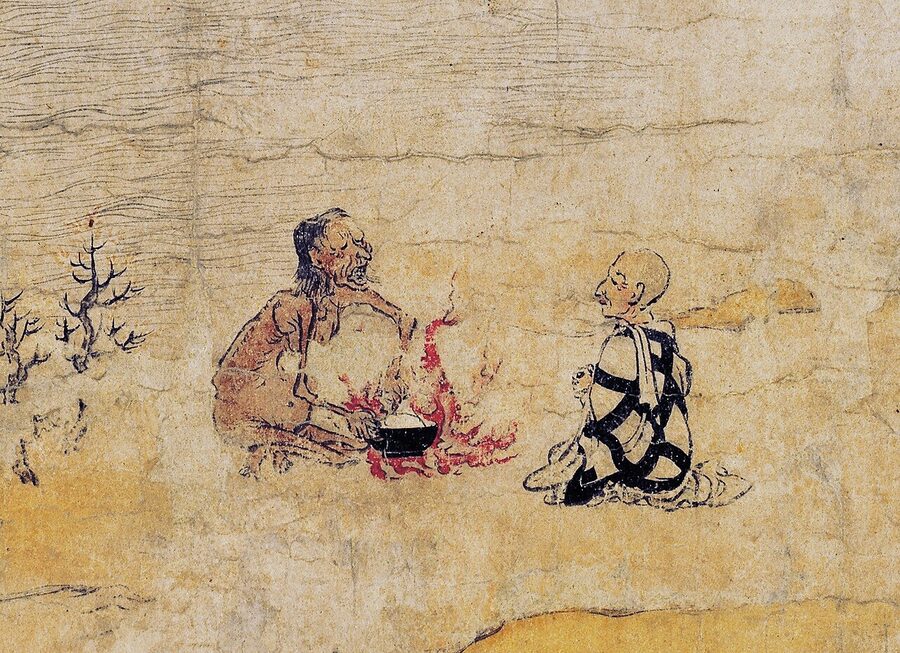
The Buddha’s answer was specific and sets the entire shape of Obon to this day. Make offerings to the assembled monks on the fifteenth day of the seventh lunar month, the Buddha said. The collective merit of the sangha will be transferred to your mother, and she will be released.
Mokuren did this. His mother was freed, and in his joy he danced. That dance, in tradition, is the first Bon Odori.
Whether you take the story literally or not, the structure has held: offerings to the dead, a fire that mirrors the realm-burning of hungry ghosts, and dancing as the sign that liberation has been accomplished.
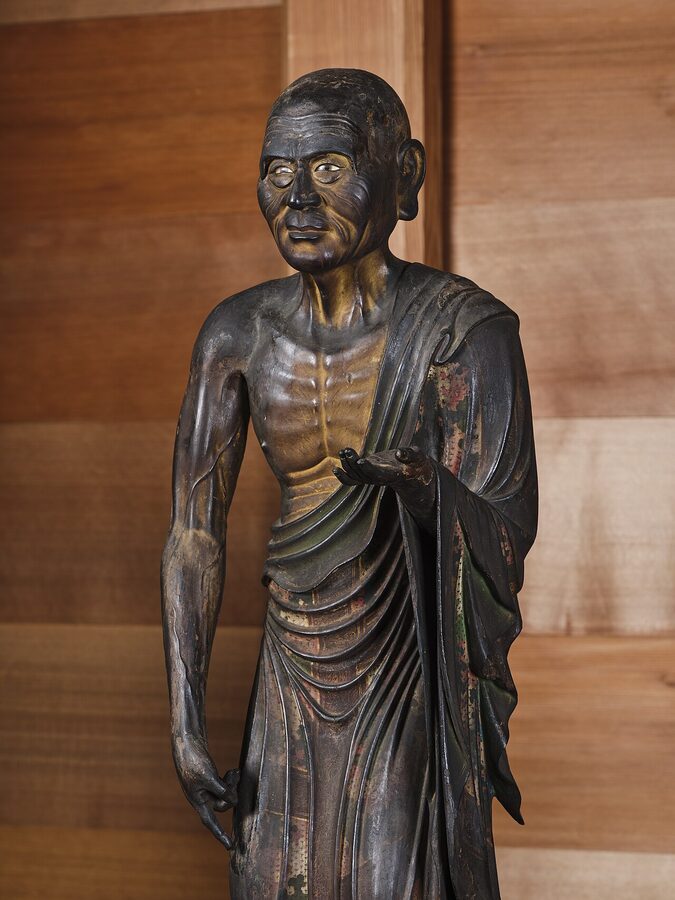
You will see Mokuren’s name everywhere if you look. The Hungry Ghosts Scroll at the Kyoto National Museum, painted in the late twelfth century, shows him meeting his starved mother in the gaki realm. There is a 1220 statue of him by the master sculptor Kaikei kept at Daihoonji temple in Kyoto.
Both are national treasures. Both are why your neighbour in suburban Osaka sets out a small bowl of rice on the family altar on 13 August.
657, 733, 1873: The Calendar That Will Not Settle
The first time Obon shows up in a written Japanese source is 657 CE during the reign of Empress Saimei. By 733, the rite had become a regular court observance under Empress Komyo, with monks reading the Yulanpen Sutra during the seventh lunar month at the Imperial palace.
For most of the next thousand years it stayed an aristocratic and Buddhist temple practice. The breakthrough into popular culture came during the Edo period, when Tokugawa-era stability allowed villages and merchant towns to host their own bon-related ceremonies, and when Bon Odori turned from a religious dance into a public summer entertainment.
Then, in 1873, the Meiji government switched Japan from the lunar calendar to the Gregorian solar one. Obon, which had always been observed on the fifteenth of the seventh lunar month, suddenly had no fixed date. Three traditions came out of the calendar shift, and none of them ever fully won.
The most common today is Hachigatsu Bon, 13 to 16 August, used across most of mainland Japan. It is the version your office shuts down for.
The second is Shichigatsu Bon, 13 to 16 July, which Tokyo and a few surrounding wards observe, partly because urban schedules did not need to dodge the August harvest. The third is the original lunar-calendar version, kyu-bon, still kept in Okinawa and a small number of rural districts where the seventh-month full moon, not 15 August, is the night the gates open.
One detail surprises people. Obon is not a national public holiday. The 1873 decree that established Japan’s modern holiday calendar specifically excluded it, leaving New Year as the one major rest period.
What you see today, the great Obon shutdown of August, is a custom built on top of the law rather than written into it. Companies close because everyone goes home. Trains run extra services because everyone goes home. The infrastructure of an empty Tokyo and a packed Tohoku in mid-August is bottom-up, not government decreed.
The Migration Nobody Calls a Migration
If you have ever booked a Shinkansen ticket for the second week of August, you already know the result. JR runs roughly 130 percent of normal Tokaido Shinkansen service during the Obon week.
Tokyo Station empties. Akita Station fills. The expressways turn into thirty-kilometre traffic jams on 11 and 12 August, and back-fill again on 16 and 17 August as everyone returns to the cities.
NHK reports the daily Obon migration figures the same way it reports Golden Week figures, with a road map updated by the hour.
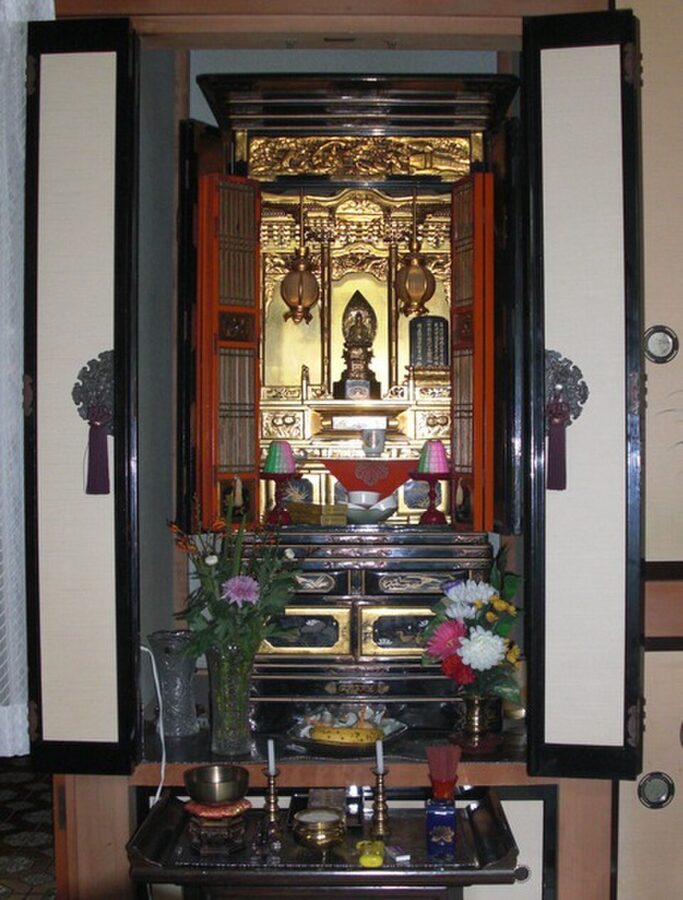
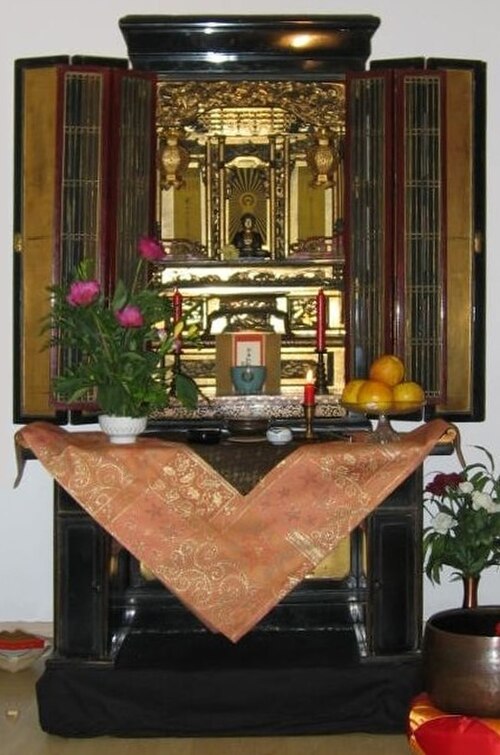
The reason is simple and old. The honke, your ancestral house, is where your butsudan lives. The butsudan is the family Buddhist altar, the one with the photographs and the ihai memorial tablets of every dead relative the family has tracked.
During Obon those tablets get cleaned, fresh offerings are placed on the altar, and a priest visits to chant. If you live in Osaka and your honke is in Akita, you go to Akita. The dead are visited at the place where the dead were buried. That is the rule.
What this produces, year after year, is the largest internal travel pulse in Japan after Golden Week. JNTO does not promote it. The transit ministry does not advertise it.
But Tokyo’s seven-million-strong commuter belt empties in three days, and the small mountain towns of Tohoku, Shikoku and Kyushu fill with the children and grandchildren of people who left them in the postwar years. I have stood in a half-empty Tokyo conbini at 11 pm on 14 August and watched the staff genuinely surprised to see a customer. I have stood in a tiny Iwate convenience store in the same week and watched the staff look ready to faint from the volume.
13 August: The Welcoming Fire
Obon proper begins on the evening of 13 August with mukaebi, the welcoming fire. The traditional form is a small fire built from broken hemp stalks, ogara, lit at the front gate of the family house.
The smoke is meant to function as a beacon. Ancestral spirits, the belief goes, can find their way back to the family by the smell and direction of that mukaebi flame.
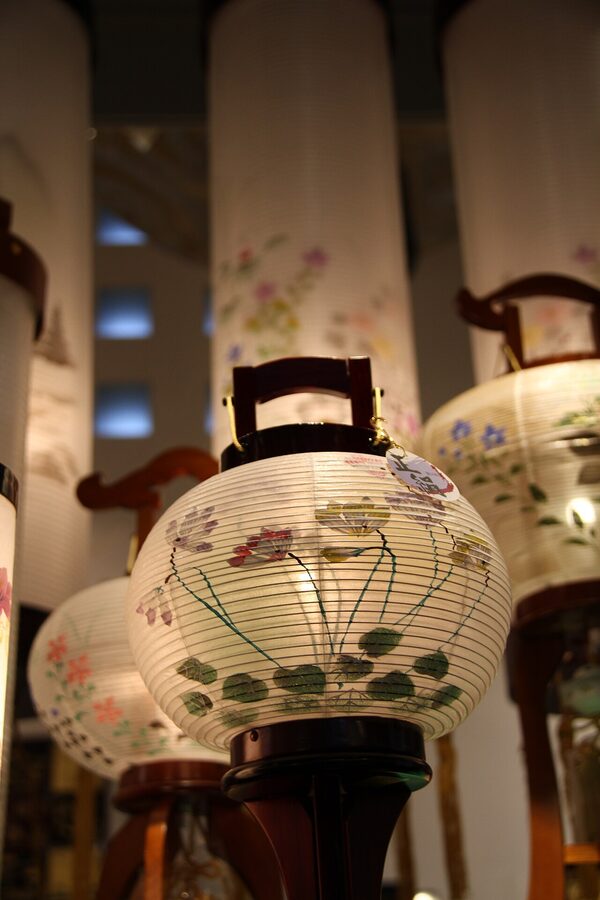
You will see this everywhere in the countryside still. In urban Tokyo and Osaka the fire is often replaced with a bon-chochin lantern, a paper lantern hung from the gate or eave with the family crest. The lantern serves the same beacon role with less of a fire-safety problem in dense neighbourhoods.
The 提灯 character itself means a portable lantern, and bon-chochin in the strictest sense are white if the family is observing their first Obon since a death, and patterned with seasonal motifs if they are not.
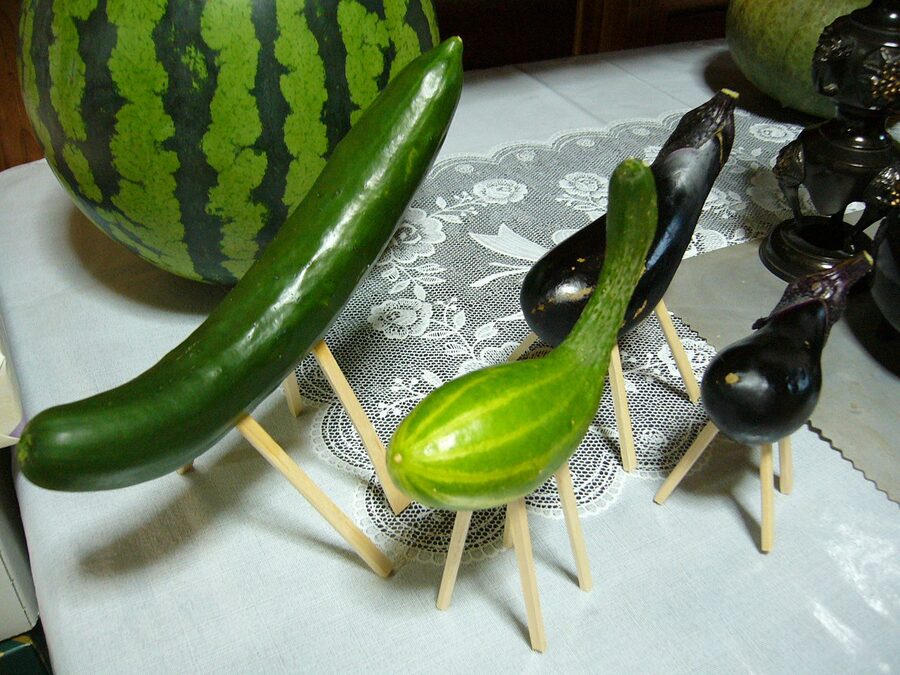
The other thing that goes up on 13 August is the shoryouma, the spirit horse and ox. These are made by sticking four wooden chopsticks into a cucumber, and four into an aubergine.
The cucumber becomes the spirit horse, fast, so the ancestor can ride home from the afterlife quickly. The aubergine becomes the spirit ox, slow, so on 16 August the same ancestor can ride back to the afterlife at a leisurely pace, savouring their last hours with the family.
It is the most domestic, smallest-scale piece of religious symbolism in Japan, and you will find one on the altar of every observant household on the morning of the thirteenth.
14 and 15 August: The Days of Visiting
The middle two days are when the visiting happens. Ohaka-mairi, grave visiting, is the central act.
Family members travel to the cemetery where their ancestors are buried, usually at the local Buddhist temple, and clean the grave with water poured from a wooden ladle. They scrub the stone with a brush. They cut back any weeds.
They place a fresh offering of flowers, often the chrysanthemum or shikimi, an aromatic evergreen used in Japanese Buddhist funerals.
The cleaning is symbolic and practical. The ancestor is being received as a guest. You would not invite your grandfather into a dirty room, so you do not invite his spirit to a dirty grave.
Incense is lit. The family bows. Often the youngest member is taught the order of the bows by the eldest. The whole rite takes about thirty minutes per family, but on 14 August the queues at popular temple cemeteries can stretch for an hour as families wait for their turn at the family stone.
Back at the house, the butsudan altar has been rearranged into the shoro-dana, the spirit shelf. This is a low platform set in front of the butsudan and laid with offerings the spirits are believed to consume in some immaterial form.
Cooked rice in small bowls, water, tea, and seasonal fruit (often watermelon, peach or grape, which is what is in season in mid-August). The shoryouma cucumber-horse and aubergine-ox sit on the shelf alongside the food.
A priest from the family temple will visit on one of these days to chant a short sutra in front of the altar. The rite is called tana-gyo, which translates roughly as shelf-chanting because the priest is reading the sutra over the spirit shelf.
Modern urban Japan has watered all this down, and there is a generational anxiety in the priesthood about whether the next generation will keep it up. But in the rural prefectures, ohaka-mairi remains the most attended single religious act in the Japanese year, even more than New Year shrine visits in raw participation numbers.
The Yagura, the Drum, and Six Hundred Years of Bon Odori
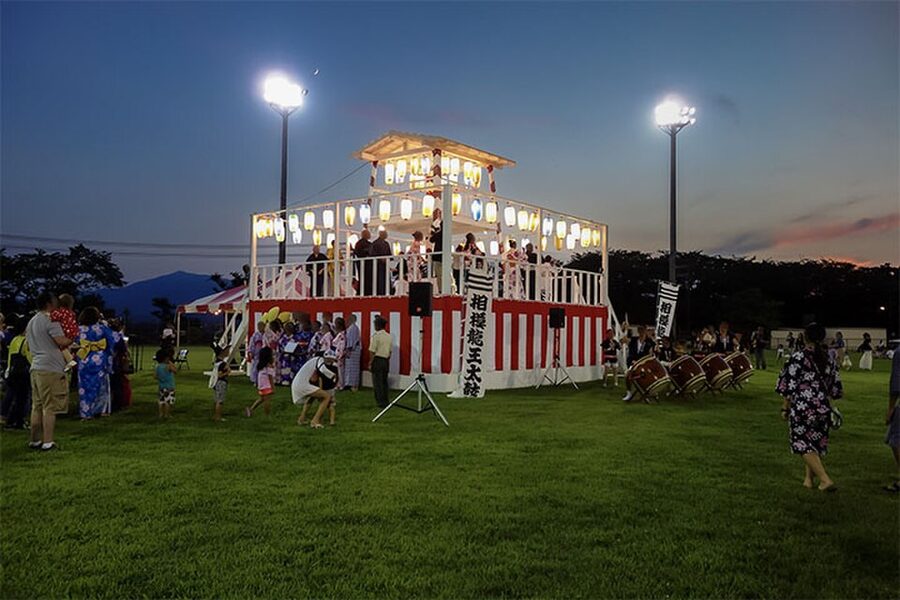
While the religious side of Obon plays out at altars and graves, the public side plays out under a yagura. The yagura is a tall wooden tower, usually three metres high, built in the centre of an open square or shrine ground specifically for Obon.
On top of the yagura sits a taiko drum, often a single large barrel drum two metres across, played by a rotating set of drummers. Around the base of the yagura, in concentric circles, the dancers move.
This is Bon Odori, and the form is roughly 600 years old. The dance grew up in the Muromachi period out of nenbutsu odori, an ecstatic Buddhist chanting-dance practice, and gradually shed its purely religious function during the Edo period to become a community-wide entertainment.
It survived the Meiji religious reforms because it had become secular faster than anyone could regulate it. Today every neighbourhood shrine, community centre and shopping arcade in urban Japan hosts at least one Bon Odori during the August week.
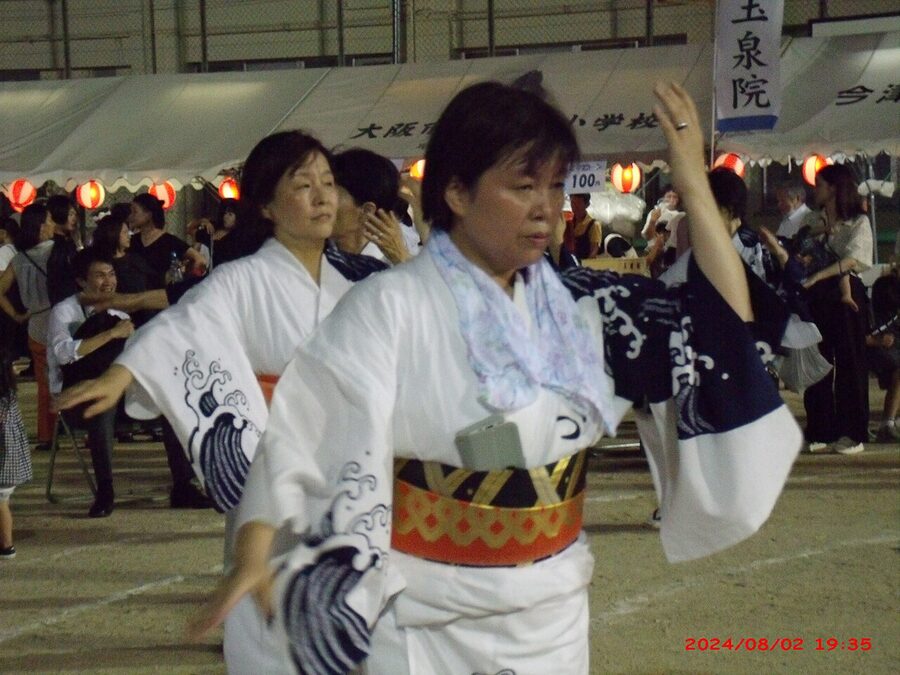
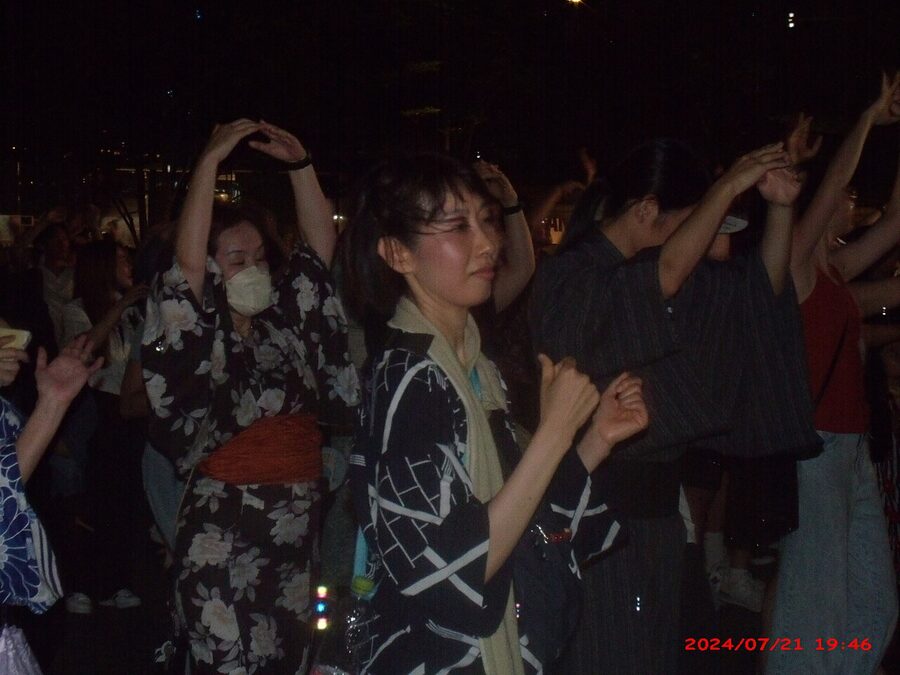
The basic Bon Odori is simple by design. The choreography is two or three hand gestures and one foot pattern, repeated for the length of one or two songs. Anyone can join. You watch the row in front of you for thirty seconds and copy.
Children learn at four. The elderly continue until they cannot stand. Yukata cotton summer kimonos are the standard costume, and some dances use props (hand fans or small wooden clappers called kachi-kachi) but most use empty hands.
The point is participation, not performance.
The musical repertoire is fascinating. A standard neighbourhood Bon Odori in Osaka or Nagoya will play the same eight or nine songs every year for decades.
Tokyo Ondo. Tanko Bushi, the coal-miner’s song. Kawachi Ondo, with Soran Bushi if there are any Hokkaido roots in the neighbourhood.
The same recordings, the same loop, generation after generation. The repetition is the comfort.
Awa Odori: The Tokushima Variant That Refused to Stay Local
If the standard Bon Odori is a circle around a yagura, Awa Odori is a parade. Tokushima city, on the island of Shikoku, has been holding its 400-year-old version of Bon dance every 12 to 15 August since the late 1500s.
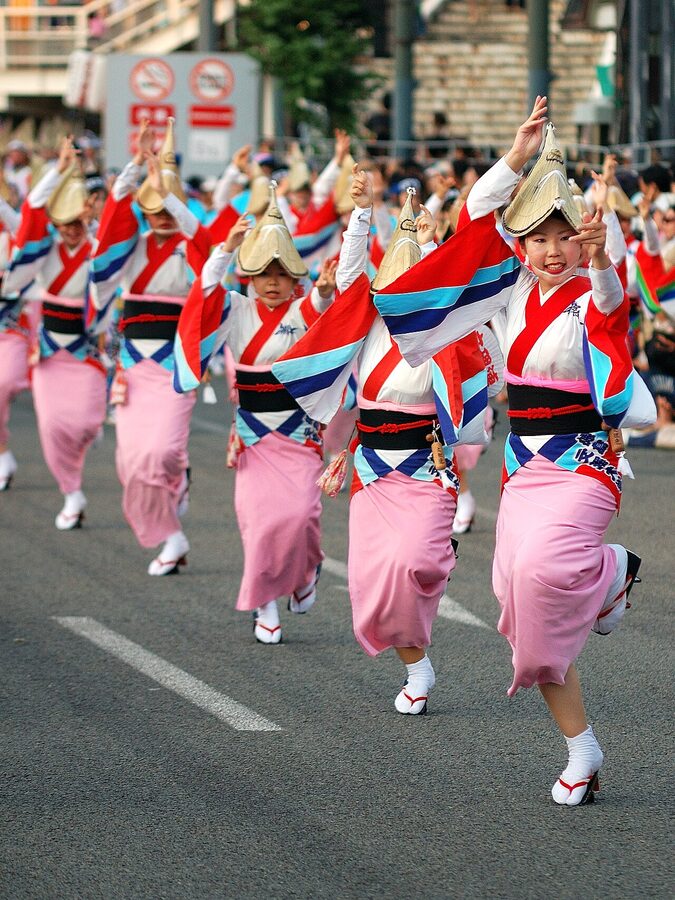
Unlike the typical neighbourhood Obon dance, Awa Odori sends its troupes, called ren, marching down the main streets in long lines.
The look is unmistakable. Female dancers wear yukata, wide-brimmed straw hats called amigasa pulled forward at a steep angle that hides most of the face, and high zori sandals that they balance on the toes.
Male dancers wear short happi coats and crouch low, knees bent, throwing their arms in the air with a deliberate, looping motion. The accompanying instruments are shamisen, taiko, the small kane bell, and shinobue bamboo flutes. The two-bar musical phrase, ya-tto-sa, ya-tto-yatto, is one of the most recognisable in Japan.
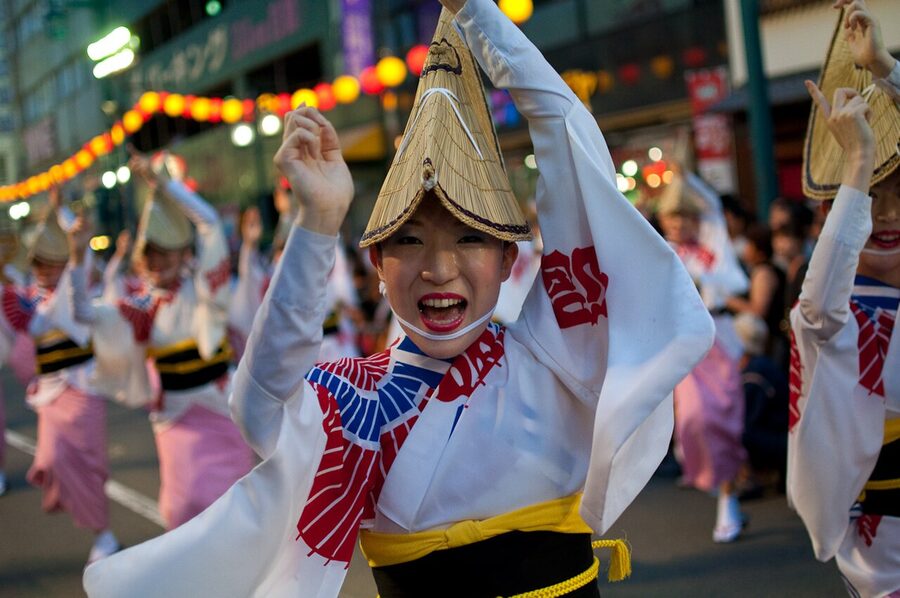
The festival’s official chant translates as roughly: the dancers are fools, the watchers are fools, both are fools alike, so why not dance. That is its character. About 1.3 million people pack Tokushima city during those four nights every year.
There are temporary grandstands, paid seating, official ren and amateur ren, and a general open invitation in the late-night informal session for anyone in the audience to step in and join.
I have a particular soft spot for Awa Odori because it is one of the few Japanese traditional festivals where the line between performer and spectator legitimately dissolves around 9 pm. (For more on Tokushima’s signature dance, see my deeper Awa Odori piece.)
The 400-year claim is not a marketing line. The earliest written reference to Awa-odori comes from Tokushima domain records in 1586, at the founding of Tokushima Castle by Hachisuka Iemasa.
The dance is said to have spread from a wedding-day commoner celebration into the city’s annual Obon, and from the city’s annual Obon into a regional identity marker that the Hachisuka domain eventually formalised.
Gujo Odori: Thirty-One Nights of Continuous Dancing
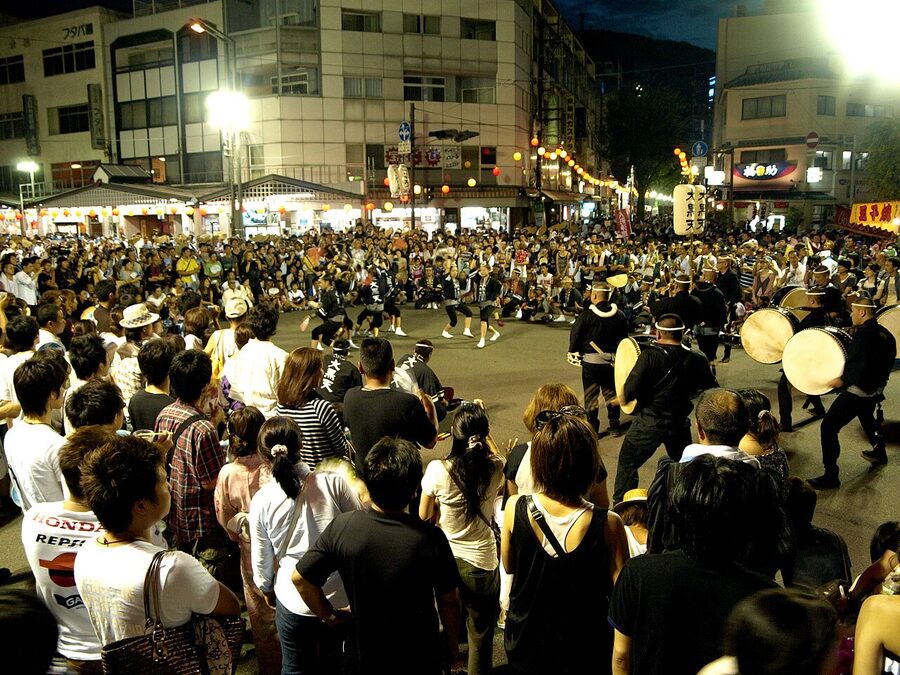
The other Bon Odori that gets singled out by name is Gujo Odori, in Gifu prefecture. Where Awa Odori is famous for scale, Gujo Odori is famous for length.
The town of Gujo Hachiman holds Gujo Odori for thirty-one nights, from mid-July to early September, with the four nights of mid-August being all-night marathons that run from 8 pm to dawn.
The repertoire is ten traditional songs, each with its own choreography. The dancers, locals and visitors mixed together, circle a yagura set up in different town districts on different nights.
Footwear is a particular point of pride. Traditional Gujo Odori is danced in geta, the wooden-soled clogs with two transverse blocks underneath, and the rhythmic clatter of two thousand pairs of geta on the cobblestones is part of the music.
By dawn on 16 August, the streets of Gujo Hachiman are knee-deep in broken geta. The town sweeps them up.
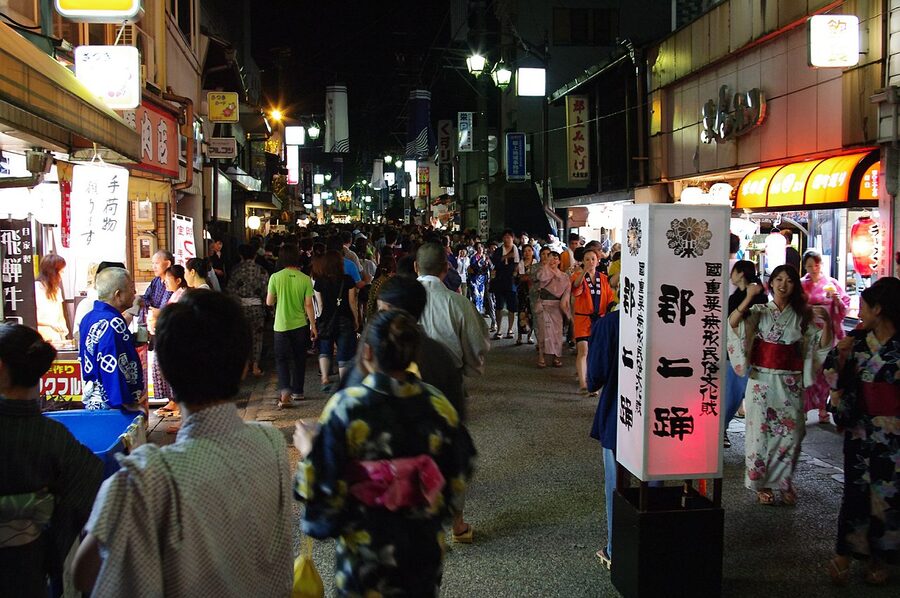
Like Awa Odori the form is roughly 400 years old, with a Hachiman-domain origin and a deliberate egalitarianism about who can dance. Visitors can join any night without registration. There are no roped-off VIP sections.
The first all-night, the night of 13 August, is sometimes called the night of welcoming the dead, and the last all-night, the night of 16 August, is the night of sending them off.
Gujo Hachiman’s small population, around 14,000, is overwhelmed by the 200,000 visitors that arrive across the four-night marathon, and yet the dance has stayed almost unchanged since the Edo era.
I think of Gujo Odori as the deep Bon Odori, the one most resistant to commercialisation. There is no entrance fee. There is no stage.
There is just the yagura, the drums, the geta, and the choice of whether to dance until dawn or sit on a stoop and watch.
Nishimonai Bon Odori: The Dance of the Hidden Faces
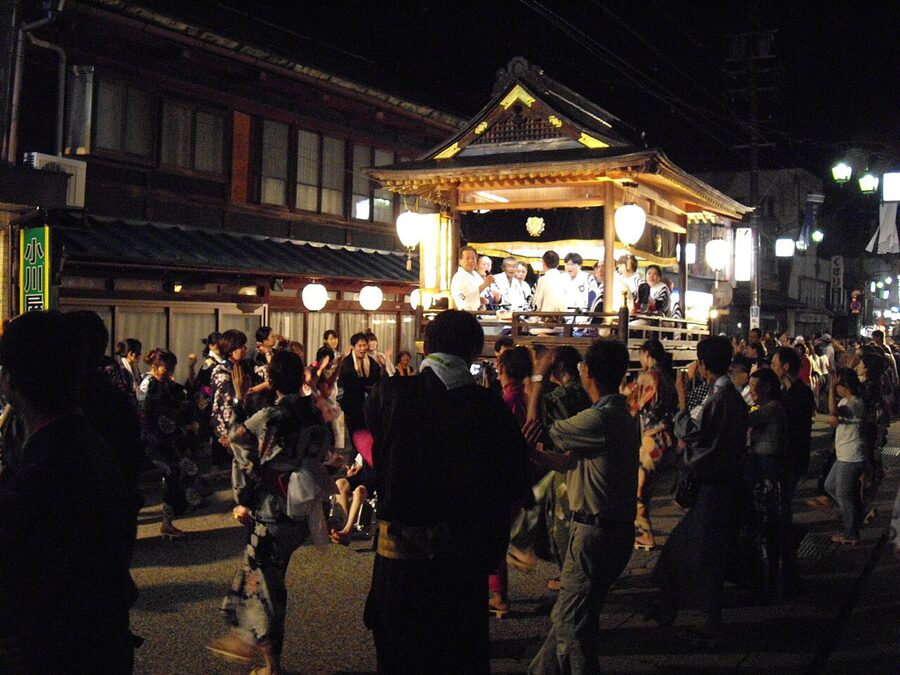
The third name worth knowing, and the strangest, is Nishimonai Bon Odori in Akita. Held 16 to 18 August in the small town of Ugo, Nishimonai is the eeriest of the three big Bon Odori traditions, partly because the dancers’ faces are hidden.
The female dancers wear hanui, a patchwork garment sewn from small fragments of antique kimono cloth handed down through families, and over their heads a black cloth called a hikosan-zukin draped down to cover the entire face.
Male dancers wear a deeply curved straw amigasa pulled so far forward that the face vanishes inside a deep shadow. The dance is slow, the gestures are precise, and the silhouettes you see moving in lantern-light have no faces at all.
The traditional explanation is that the dancers represent the returning dead themselves rather than the living welcoming them. You cannot see their faces because the dead do not have faces in our world.
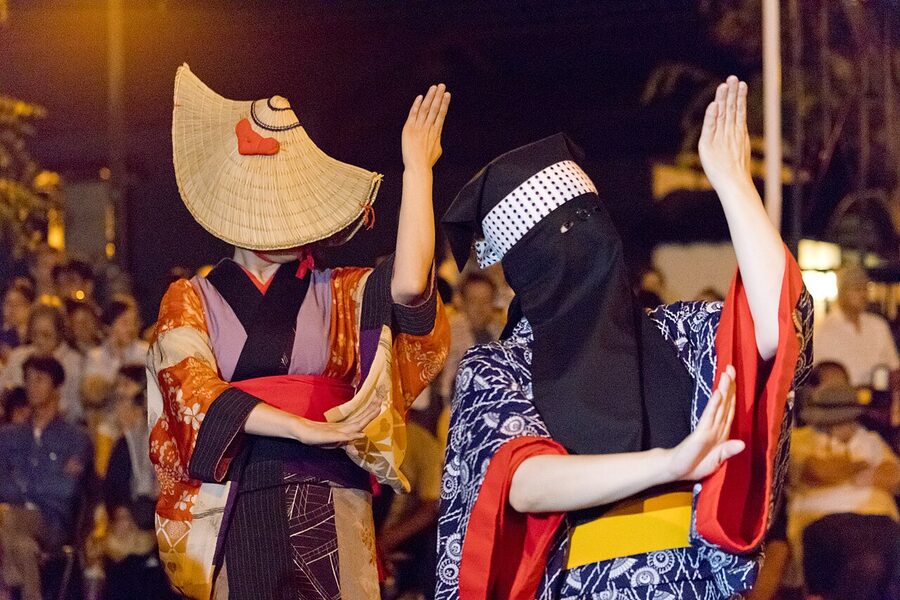
Nishimonai is one of Japan’s three most distinguished Bon Odori, alongside Awa and Gujo, and unlike them it has stayed almost entirely local. The town of Ugo has fewer than 14,000 people. The dance has roughly 700 years of unbroken history.
There are no commercial sponsors, no large grandstands. It is a serious and slightly unsettling thing to watch, and the official footage on YouTube does not communicate the silence between the music phrases.
Eisa: Okinawa’s Bon Drum
Okinawa runs Obon on its own clock and its own form. The kyu-bon, lunar calendar Obon, is observed in Okinawa rather than the August-15 mainland version, which means Okinawan Obon falls on a different week every year, usually late August or early September.
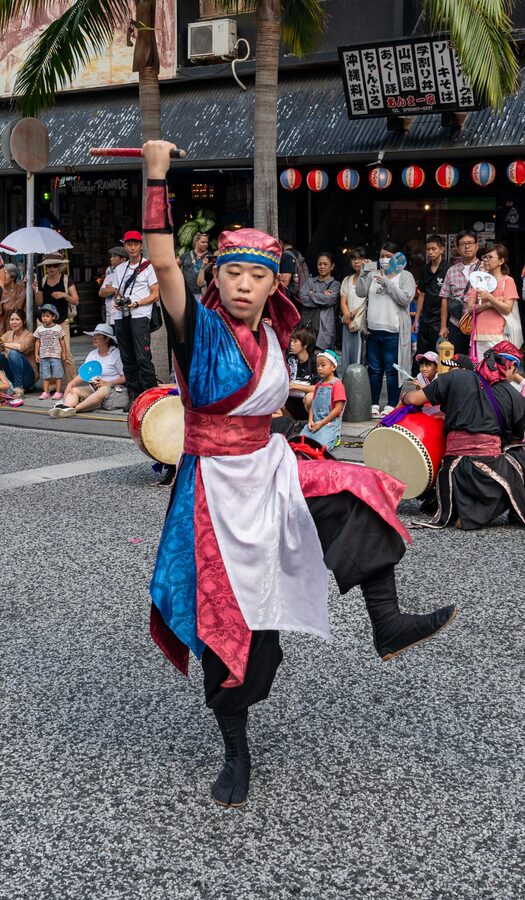
The dance form is also different. Eisa is not Bon Odori. It is a distinct Okinawan tradition built around big shime-daiko taiko drums slung across the body, smaller paranku hand-drums, and a parading column of dancers led by a flag-bearer.
The youth associations of each Okinawan village run their own Eisa troupe and patrol the streets in their village’s territory on the lunar Obon nights, drumming the ancestors home.
The visual is more aggressive than mainland Bon Odori. The colours are brighter. The tempo is faster. The drumming is louder, much louder.
You can argue that Eisa is the survival of the older, more shamanic form of Bon Odori before Buddhism filtered it. There are scholars who think mainland Bon Odori was once closer to what Okinawa still does.
Whether or not that is true, Eisa is the Bon-related form that has aged the least, and the night sound of an Eisa column moving through a Naha alley at midnight is one of the more memorable things you will hear in Japan.
16 August: The Sending-Off
The third night, 16 August, is when the spirits go home. The mukaebi welcoming fire of three nights earlier is mirrored by an okuribi sending-off fire. Same hemp, same gate, same evening hour, different intent.
The smoke is now a road back, not a road in.
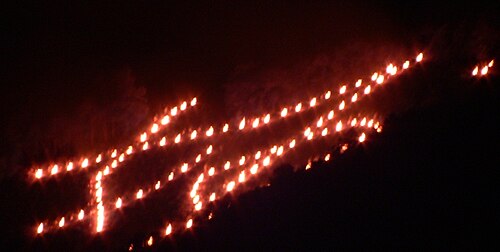
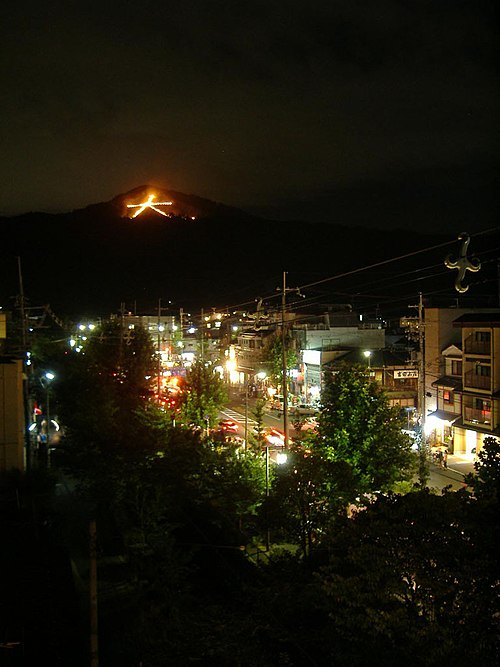
The grand-scale public version of okuribi is the Kyoto Gozan no Okuribi, the five-mountain sending-off fires, sometimes called Daimonji-yaki because the most famous of the five is the kanji 大. These are five enormous bonfires laid out across the mountains around Kyoto, lit in a precise sequence on the night of 16 August.
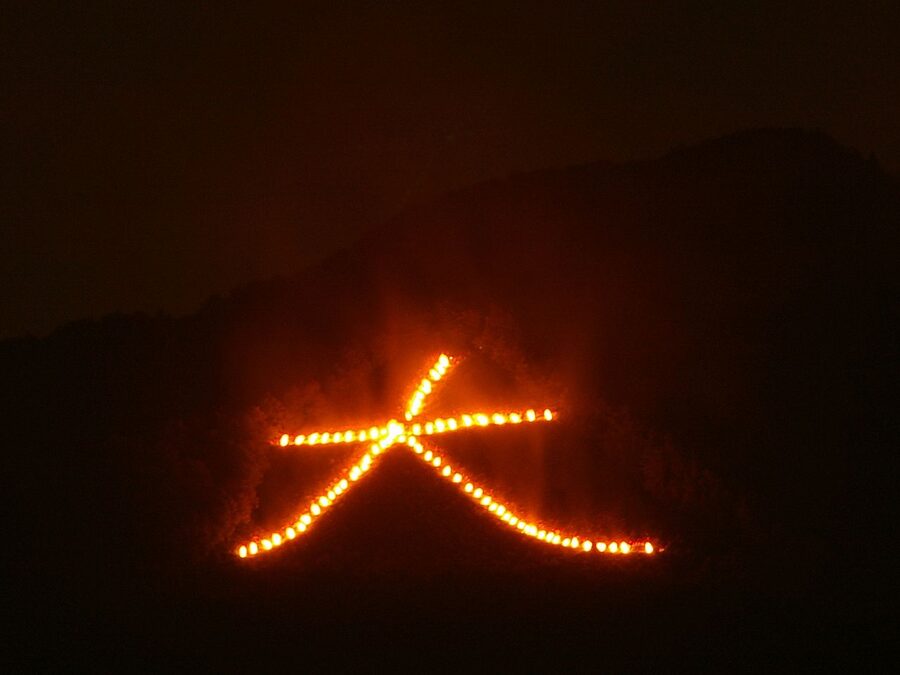
The order is fixed and the timing is by the minute. At 8:00 pm sharp, on the eastern slope of Mt Nyoigatake above the Ginkaku-ji temple, the first fire is lit. It forms the character 大, dai, meaning great.
The character is enormous, 160 metres tall on its longest stroke, made up of 75 separate fire-bundles staked into the slope.
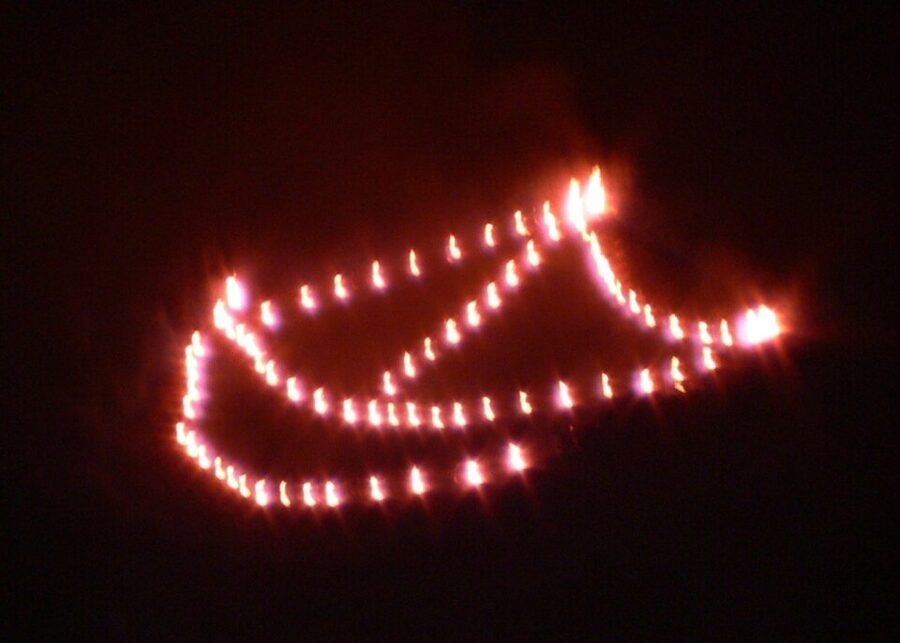
Ten minutes later, on Mt Mantoro on the north side of the city, two more fires light simultaneously, the characters 妙 and 法, myo and ho, together meaning the wondrous dharma. At 8:15 pm two more light, the boat-shape funagata on the western Mt Nishigamo and a second 大 character, the hidari-daimonji, on Mt Hidaridaimonji.
At 8:20 pm the final fire lights, the torii-gata gate-shape on Mt Mandara on the western edge of the city. By 8:30 pm all five characters are burning at once.
I have watched Daimonji-yaki from three different vantage points in Kyoto over the years and the geography matters more than people realise.
The Kamogawa river bank between Sanjo and Imadegawa gives you the eastern dai but only the corner of the others. The roof of the Kyoto Hotel Okura gives you all five in sequence but at distance. The hill of Funaoka park to the north is where you stand if you want to be close to the Funa-yama boat fire.
None of these is the wrong choice. They give you different versions of the same hour.
The fires burn for about 30 minutes each, and there is a particular fifteen-minute window between 8:20 and 8:35 pm when all five are blazing at full strength simultaneously.
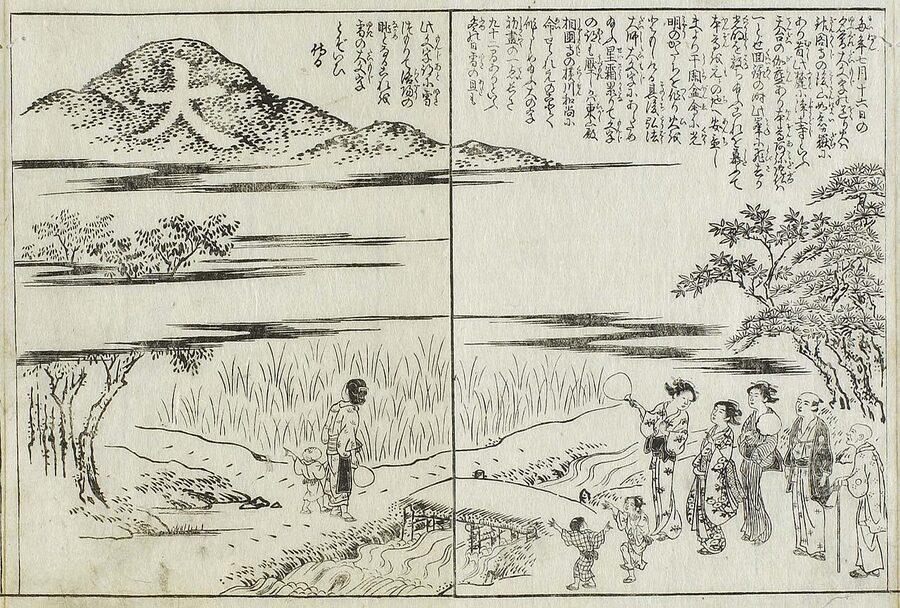
The history of Daimonji-yaki is, like a lot of folk-religious Kyoto, not fully traceable. There are documents from the 1500s referring to mountain fires, and a ukiyo-e print from 1786 shows the dai character clearly burning on Mt Nyoigatake exactly where it burns today.
The most common origin theory is that the fires evolved from individual temple-led okuribi rituals that gradually consolidated into a city-wide sequence during the Edo period. The Buddhist meaning is consistent with the ground-level mukaebi: the fires are the path home for the ancestral dead.
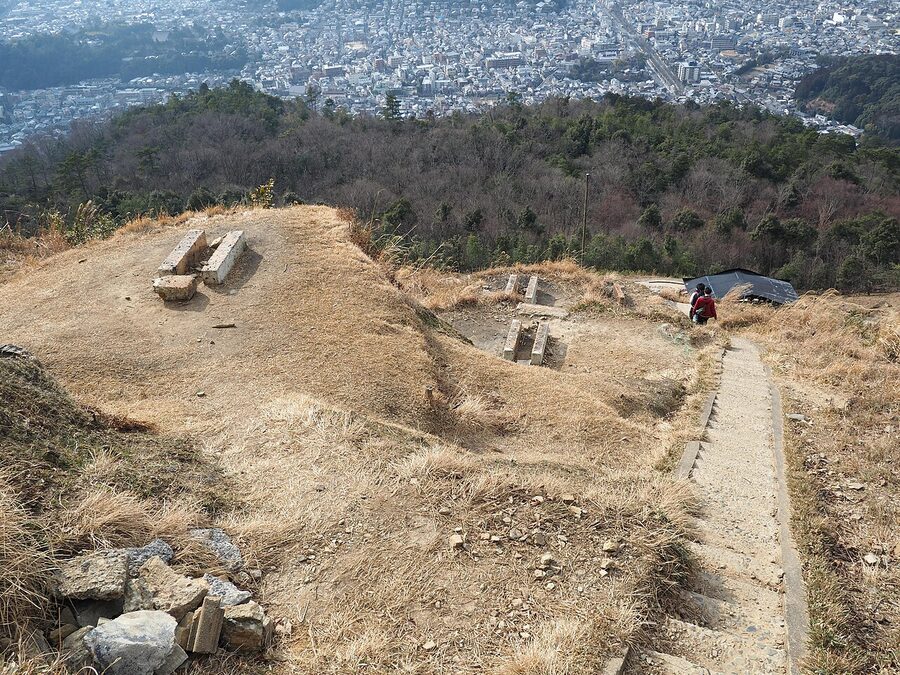
You can climb Mt Daimonji during the day and walk along the trough where the fires burn at night. The 75 fire-piles are visible as squared earth platforms staked into the hillside. The city of Kyoto controls a small group of caretaker families who maintain the platforms year-round and rebuild the bundles every July.
The actual lighting on 16 August is done by hand, by approximately 100 men working in coordinated waves, with each fire pile ignited by a senior member of the caretaker family using a long pole carrying a torch.
Toro Nagashi: The Lanterns That Float Out to Sea
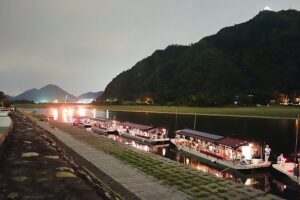
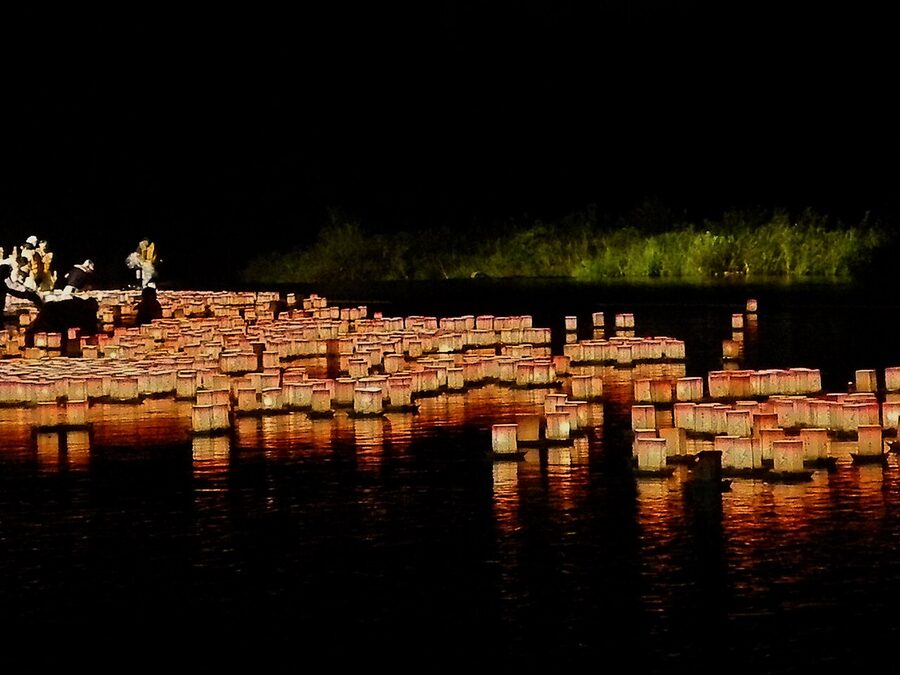
Not every region uses fires for the okuribi. Many use water. Toro nagashi, the floating-lantern ceremony, is the riverside or coastal version of sending the dead off.
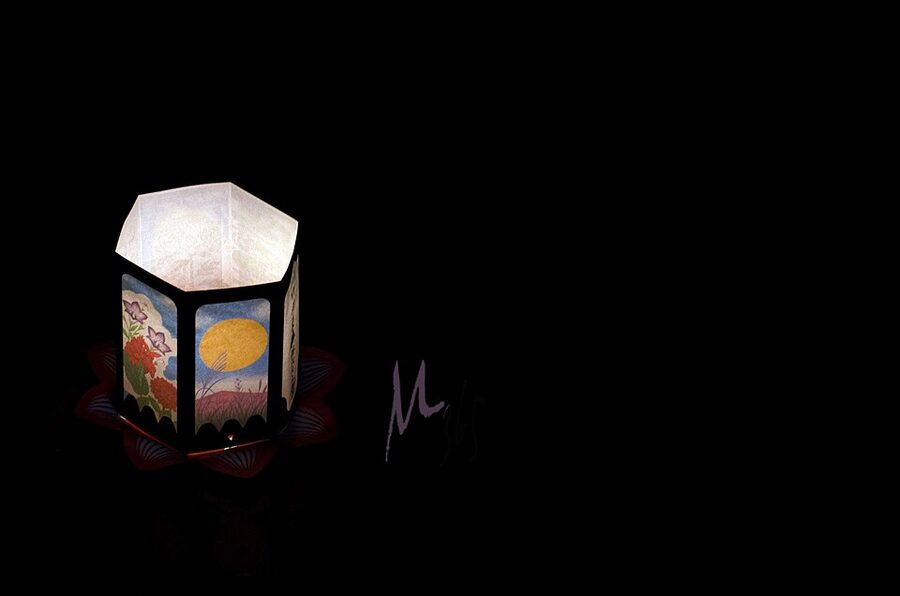
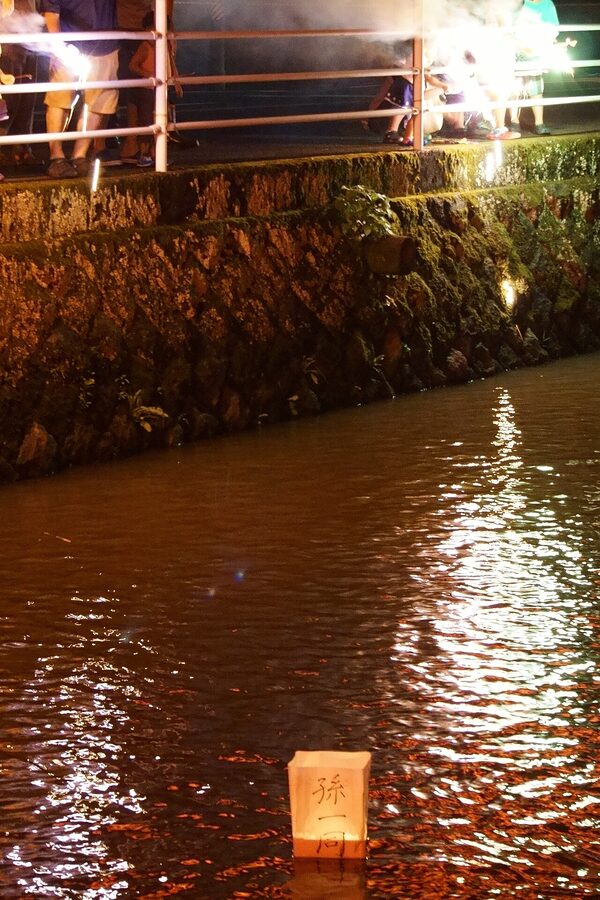
Small wooden-frame paper lanterns, each holding a single candle, are lit and released into a flowing river or harbour at dusk on 16 August. The current carries them out toward the sea. The dead are believed to ride the lanterns home.
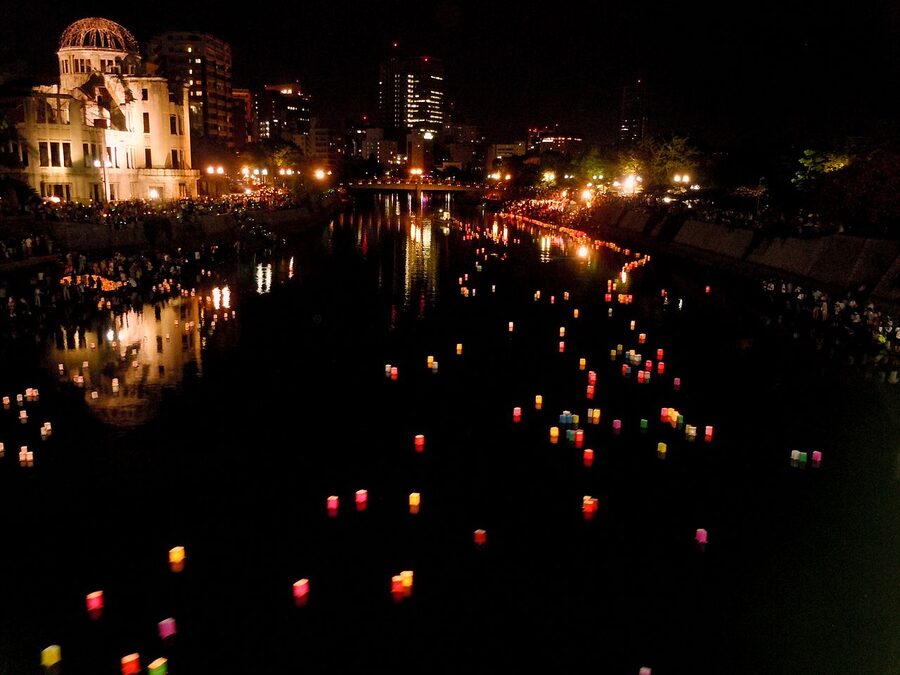
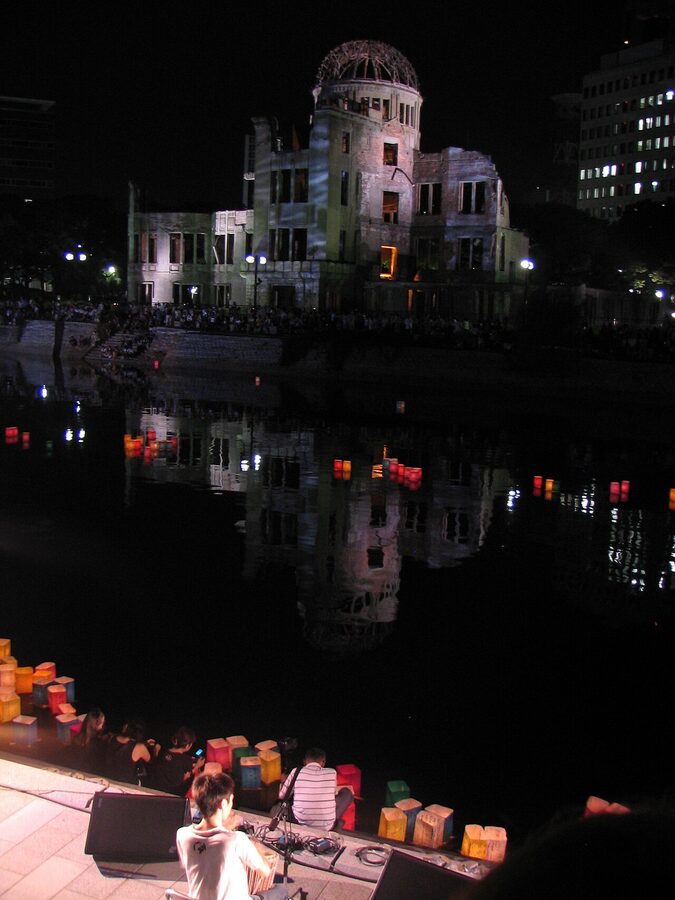
The most famous toro nagashi is the one at Hiroshima on 6 August, which is technically not Obon at all but the anniversary of the atomic bomb, and the lanterns there carry the names of the bomb victims as well as the sender’s ancestral dead.
The Motoyasu river next to the Atomic Bomb Dome fills with thousands of lanterns drifting toward the harbour, with the dome lit silently behind them.
The two ceremonies, anniversary peace lanterns and Obon lanterns, are not the same rite, but the visual and emotional charge has merged in the popular imagination, and the August toro nagashi at Hiroshima specifically attracts a crowd that is mourning both the family dead and the historical dead at once.
Outside Hiroshima, toro nagashi happens at hundreds of smaller scales across Japan. Eiheiji Zen temple in Fukui floats lanterns down its precinct stream every August, drawing pilgrims from across the country.
Tafuse river in Saga prefecture pairs the lantern release with hand-held fireworks, a regional flourish. Tokyo’s Asakusa river has a Bon-week toro nagashi that drifts down past the Asahi headquarters and the Tokyo Skytree.
Each one has its own scale and its own colour scheme. The unifying detail is that the candle inside the lantern continues to burn until the lantern falls apart in the current and the spirit is, in the metaphor, fully released.

Nagasaki’s Spirit Boats: Shoro-Nagashi
Nagasaki has its own variant, more spectacular and louder than anywhere else. Shoro-nagashi, the spirit boat procession, is the Nagasaki version of okuribi, held on the evening of 15 August.
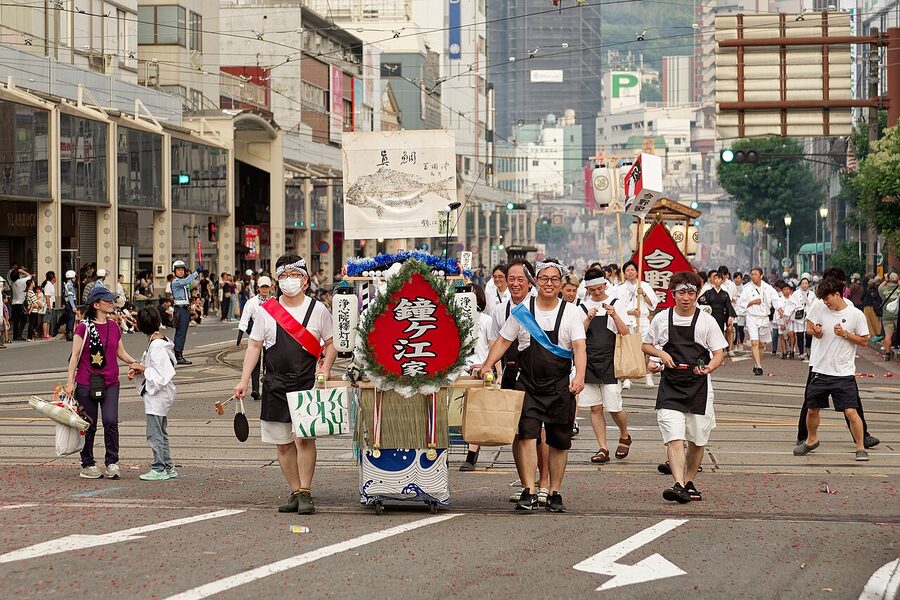
Families who have lost a relative in the past year build a small wooden boat, sometimes the size of a car, sometimes the size of a small house, painted with the family name, the deceased’s name, and decorated with paper flowers and lanterns.
The boats are pushed through the streets of Nagasaki on the evening of 15 August in a long procession down to the harbour.
The procession is not silent. Family members carrying the boat shout the funeral chant doi-doi, doi-doi, throw firecrackers in handfuls under the boat as it moves, and in some cases set off small commercial fireworks alongside.
The ground vibrates with the sound. The Nagasaki shoro-nagashi crowd of 2025 was estimated at over 300,000 people lining the route between the residential neighbourhoods and the central harbour.
At the harbour the boats are received by the city, ritually disposed of (the wood is recycled and the paper is burned), and the spirits are considered formally sent off.
The Nagasaki firecrackers are not local invention. Nagasaki was Japan’s principal Chinese trading port through the Edo period, and the bakuchiku tradition of throwing red-paper firecrackers comes directly from the Chinese seventh-month Ghost Festival, the Yulanpen-derived Zhongyuan-jie, which Japanese Obon shares its origin sutra with.
So in Nagasaki you get the Chinese sound layer and the Japanese ritual layer at once, and a 15 August walk through Hamano-machi can be physically deafening because of the firecracker volume.
It is unique in Japan. Nowhere else does Obon sound like this.
The Quieter Side: Butsudan, Tana-Gyo, and the Family Priest
I want to come back to the household side, because the parade and the fires can drown out what Obon actually is on the inside of the house. The butsudan, the family Buddhist altar, is the centre of the ritual.
It is a wooden cabinet, usually black-lacquered with gold-leaf ornamentation, that contains the ihai memorial tablets of every dead family member the household tracks, the family’s main Buddhist statue, an incense burner, candle stands, a small bell, and offering bowls.
During Obon the butsudan gets cleaned. Fresh water and fresh tea are placed in front of it on the morning of 13 August, new flowers replace whatever was there, and the candles are lit.
The wooden ihai tablets are taken out, dusted, and replaced.
A bowl of fresh-cooked rice goes in front of the altar, plus a small dish of seasonal fruit. A separate offering of the deceased’s favourite food, sometimes specific to the individual, is sometimes placed alongside, especially for the recently dead.
I have seen sake in front of the butsudan for grandfathers, dorayaki sweet bean cakes for grandmothers, and once a bottle of Pepsi for a child who had died young.
On one of the three days the family priest visits. He arrives in formal robes with a bag of sutras and ritual implements, sits in seiza on the tatami in front of the butsudan, and chants. The chanting takes about fifteen minutes.
The priest may give a short sermon afterward. The family pays him with a small white envelope containing an ofuse offering, the polite Japanese-Buddhist construction of payment that is technically a gift rather than a fee.
This is tana-gyo, shelf-chanting, and it has barely changed in 800 years. The Buddhist denomination affects the specific sutras chanted, the priest’s robes, and minor procedural details, but the structure is consistent across Soto Zen, Shingon, Pure Land Jodo-shu, and Nichiren households alike.
For the past decade the priesthood has been worried, openly, that this is the rite the next generation will not maintain. A family priest visit costs about 30,000 yen per Obon. The butsudan itself is bulky and does not fit modern apartments.
Some Tokyo households have switched to compact butsudan no larger than a bookshelf or, more controversially, to digital butsudan that display the ihai tablets on a screen.
The 2024 figure from the Japan Buddhist Federation showed that family priest visits during Obon had dropped roughly 35 percent from 2010 levels in metropolitan areas. The countryside has held more steady.
But the trend is one direction, and most priests I have spoken to expect the family-altar Obon to continue contracting in cities while the dance and fire components of Obon will probably outlast it by decades.
The Edo Print and the 1786 Mountain
One of my favourite single objects in the Obon archive is a 1786 ukiyo-e print, anonymous, from a series called Miyako Meisho Zue, scenes of famous Kyoto places.
The print shows Mt Daimonji from below, with the dai character clearly burning on the slope on a moonlit night, with viewers gathered on the riverbank below to watch.
It is in the public domain now, and I have seen it reproduced on the cover of academic histories of Kyoto folk religion.
What I find compelling is that the 1786 image is essentially identical to what you see today. Same character, same mountain, same time of year, same bank of the Kamogawa filled with people. Two hundred and forty years separate the two scenes and they are visually indistinguishable.
There are very few rituals in Japan that have survived the Meiji religious reforms, the Taisho urbanisation, the wartime restrictions, and the postwar entertainment-industry pressure intact, but Daimonji-yaki is one of them.
The 1786 print and a 2026 photograph could be cropped together and you would not see the join.
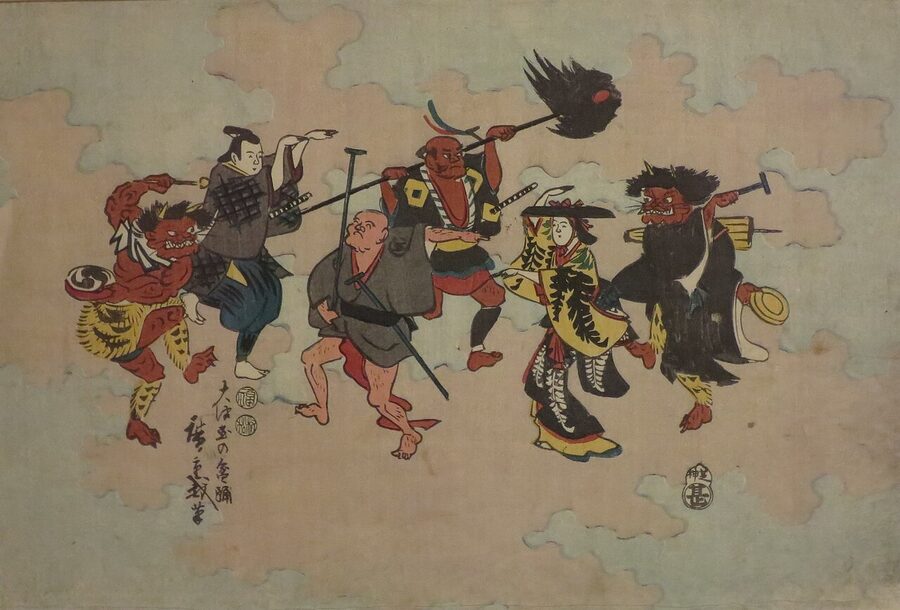
The same is true of Bon Odori. Hiroshige’s Otsu-e print of the 1840s shows Bon Odori dancers moving in a rough circle to a yagura-mounted drummer, with paper lanterns hanging above and the same hand-and-foot positions a child in Osaka will dance tonight.
The form is locked in. Whatever else has happened to Japan in the past two centuries, the central performance of mid-August has been unusually resistant to change.
Where to See Each Variant in 2026
If you are reading this in time for the August 2026 Obon and you want to actually go, the geography is simple.
For Daimonji-yaki, base yourself in Kyoto for the night of 16 August. Hotels book up six months ahead, and at the time of writing the Imperial Palace Hotel and the Hotel Okura are already over 90 percent reserved for the night of 16 August 2026.
Cheaper options like the small ryokan around Kyoto Station tend to free up about three weeks before the date as group bookings get cancelled.
For Awa Odori, get to Tokushima city by 11 August at latest. The festival peaks 12 to 15 August, and the city’s hotel stock is roughly 4,000 rooms, against a 1.3 million visitor count.
The math means many visitors stay in Naruto, Anan or even Kobe and commute in. Reserved-seat tickets for the formal grandstands cost around 4,000 yen and sell out by mid-July.
The free street viewing is genuinely good if you are willing to stand for two hours.
For Gujo Odori, the four all-night dances of 13 to 16 August are the moment. Gujo Hachiman is small and accessible by JR Takayama line. Stay in Gifu city or Takayama and day-trip in.
The 16 August all-nighter is the one to attend if you can only do one, because it is the okuribi-dance and the emotional centre of the four nights.
For Nishimonai, the 16 to 18 August window in Ugo, Akita is the only chance, and the trip is a logistic project. Akita Shinkansen to Yuzawa station, then a local bus 30 minutes to Ugo.
There is essentially no tourist hotel infrastructure in Ugo itself. Most people stay in Yuzawa city or in Akita city and travel in.
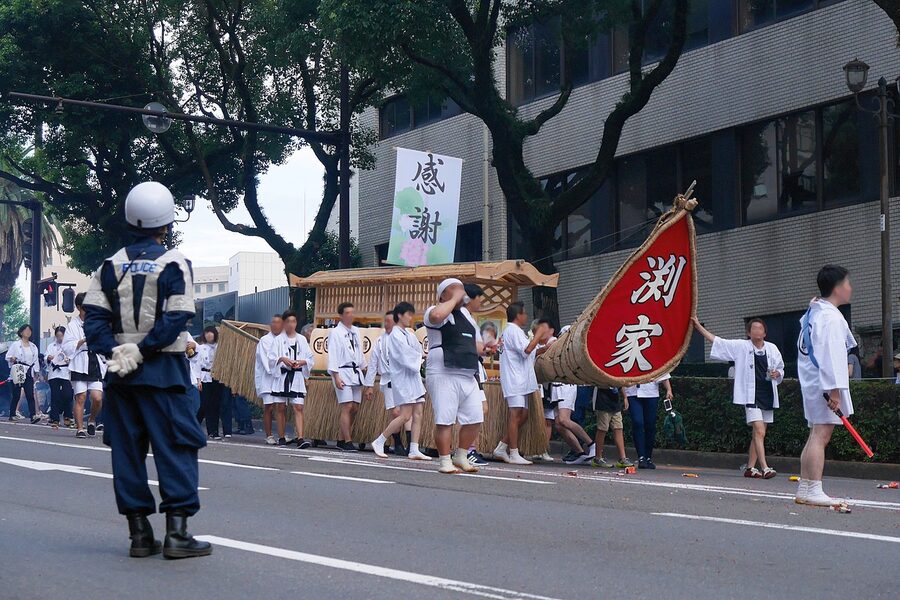
For Nagasaki shoro-nagashi, the night of 15 August. Nagasaki Station to Hamano-machi by tram, then walk the procession route on foot.
Wear earplugs if you are firework-sensitive, because the bakuchiku volume is genuinely industrial. The procession concludes at the harbour around 11 pm.
The Religious and the Secular Arguing in the Same Family
One thing worth saying clearly: Obon is religious for some Japanese people and secular for others, and the division runs through individual families.
My friend Takashi, third-generation Tokyo, treats Obon as a long weekend with relatives and considers the butsudan an heirloom rather than a ritual object. His wife Yumi, raised in a Pure Land Buddhist household in rural Kagoshima, treats the same days as a serious devotional rite and personally chants the Yulanpen Sutra in front of her in-laws’ butsudan on 14 August.
They are married. Both are Japanese. Both are observing Obon. Their experiences of the same week are completely different.
This is normal. Japan’s religious life has always been layered rather than exclusive, and a single household can run a Buddhist Obon, a Shinto New Year, and a Christian-influenced Christmas across the calendar year without anyone considering the combination strange.
Obon is the most stubborn of the three because the dead are non-negotiable. Even the most secular Japanese household will visit the family grave in mid-August, because not visiting feels like an active rejection of an ancestor rather than a neutral abstention.
The grave is the irreducible centre.
The corporate Obon-yasumi, the August holiday week that empties Tokyo, is built on this irreducibility. Companies do not close because they have decided 13 to 16 August is a religious observance.
They close because every employee who has rural family is going to leave anyway, and the office cannot function without them. The economy bends around the festival, not the other way around.
That is in part why Obon has survived where so many other premodern Japanese rituals have shrunk into nostalgia.
What Comes After Obon
The nights of 16 August leave a particular feeling. The fires burn out. The lanterns drift to the sea. The Bon Odori records are wound up.
The yagura is dismantled the next morning. Within 48 hours the country will have rebooted, the trains will run normal schedules, the offices will reopen, and the August heat will continue.
And yet for a few hours, between 8 pm on 16 August and dawn on 17 August, there is a sense in many Japanese houses that the house is emptier than it was the night before.
The candles on the butsudan are extinguished. The shoryouma cucumber-horse and aubergine-ox are taken outside and disposed of, traditionally placed in a flowing stream so the spirits ride them away.
The shoro-dana shelf is taken down. The grandparents pack their things and head back to their condos in Osaka. The grandchildren start dreading school.
What lingers is the same thing the 657 ceremony at Empress Saimei’s court was trying to produce. A specific arrangement of lights and food and bows that, for three days, opens a door between this world and the dead’s.
Whether the door is metaphorical or literal is up to you, your priest, your grandmother, and your particular branch of Japanese Buddhism. But the door opens. And, on the night of 16 August, it closes again.
If you want to see Japan understanding itself, the high-speed bullet trains and the Akihabara neon will tell you nothing. Go to a small Tohoku town on the night of 13 August and watch a grandmother, alone in the dark, light a hemp fire on the stone step in front of her house.
She will be facing the road in the direction of the cemetery. She will not be looking at her phone. She will be waiting for someone she loved who has been dead twenty years to find his way home for three nights.
That is Obon. The dance is the celebration. The fires are the directions. The food is the welcome.
But the centre is the small fire on the stone step, and the listening that comes after the smoke rises.
Further Reading
Obon does not exist in isolation in the Japanese summer. The Daimonji-yaki of 16 August closes a Kyoto festival season that opens a month earlier with the great Gion Matsuri of July, the 1,150-year-old plague-response procession that is the city’s other defining summer rite.
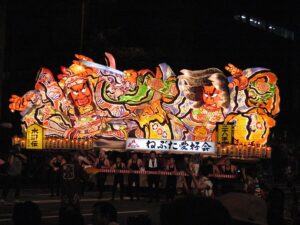
Across the country, the August Obon week overlaps with the Aomori Nebuta Matsuri and the Tsushima Tenno Matsuri, two of the great summer float festivals of Tohoku and central Honshu.
If Bon Odori’s Tokushima sibling is what you are after, my full piece on Awa Odori covers the 400-year history of that parade in depth.
For the wider religious context that frames Obon, the Yulanpen Sutra and Mokuren story sit alongside the Three Sacred Treasures of Japan in a broader picture of Japanese spiritual inheritance.
The modern Obon-yasumi mass migration is a direct descendant of the sankin-kotai alternate-attendance system of the Edo era.
For the seasonal frame that contains Obon, you might also like my essay on sakura and the 1,300-year-old hanami tradition, which is Obon’s bright spring counterpart in the Japanese cultural calendar.