
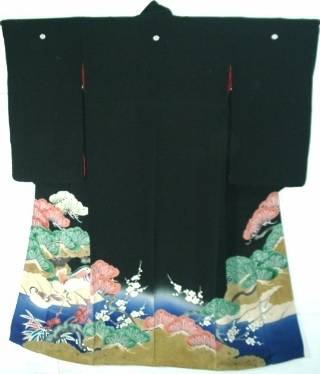
Here is the single most disorienting fact about a kimono, and it is also the fact that explains everything else. Every kimono on earth begins life as one continuous bolt of fabric called a tanmono (反物), woven to a standard 36 centimetres wide by 12.5 metres long, and the cloth is cut into only eight straight rectangles. There are no curves, no darts, no tailored shoulders, no set-in sleeves, no shaped waistline. The garment is drape, not tailoring. When you see a woman in a full kurotomesode at a Kyoto wedding and you cannot understand how the sleeves fall that particular way or why the silhouette sits exactly so on the collarbone, the answer is that it is not the sleeves doing it or the silhouette being cut — it is 12.5 metres of flat silk wrapped around a body on the morning of the event, and a dresser who learned over twenty years exactly where to pull and fold.
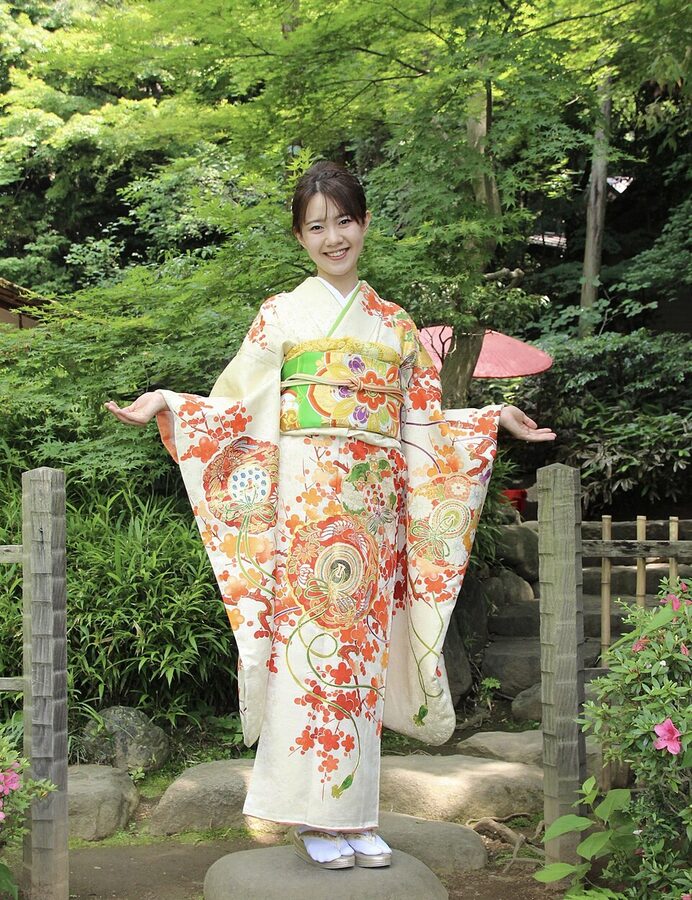
I keep coming back to this because the West has looked at kimonos for a hundred and fifty years and consistently missed the point. A European tailor sees a dress and thinks about seams and structure. A kimono has almost none. The engineering is not in the garment; the engineering is in the relationship between one rectangle of cloth and the body it is being wrapped around. You can tell a woman’s marital status from forty metres away by looking at her sleeve length — unmarried wear furisode (振袖) with sleeves that drop past the knee, married switch to tomesode (留袖) with sleeves at the wrist — and you can tell her exact social rank at a formal event by counting the small circular crests, the mon, arranged on her garment: five for top-rank, three for upper-middle, one for formal-but-casual. This is information a Japanese wedding guest reads at a glance. It took me nearly a decade of living here before I could.
In This Article
- What a kimono actually is, honestly described
- The layers — a kimono is at least five garments
- The women’s formality ladder, top to bottom
- The men’s ladder — shorter, stricter, almost extinct
- Before there was a kimono — Jōmon to Heian
- Kamakura, Muromachi, and the samurai simplification
- Edo 1650-1750 — the century the kimono was standardised
- Meiji erases, ceremony preserves
- Yūzen — the dye technique that made Kyoto and Kanazawa
- Nishijin-ori — the Kyoto weaving district that predates Kyoto
- Tsumugi — the rural silks that became UNESCO heritage
- The obi — the garment that holds the garment together
- The modern kimono calendar — when it actually gets worn
- Where to see it worn and where to learn it — travel
- Nishijin Textile Centre, Kamigyō, Kyoto
- Kyo-yūzen workshops, Horikawa and Kamigyō, Kyoto
- Kaga-yūzen, Nagamachi district, Kanazawa
- Kimono Museum, Nihonbashi, Tokyo
- Kimono rental — Asakusa, Gion, Kanazawa
- Ōshima-tsumugi, Amami Ōshima
- Yūki-tsumugi, Ibaraki
- The three hundred years of refinement
What a kimono actually is, honestly described
The word kimono (着物) is a compound of ki, to wear, and mono — thing. It means, literally and boringly, “thing to wear.” Before the 1870s the Japanese had no special name for the garment because there was no competing category. The word only became specific after Meiji Westernisation imported suits and trousers, at which point Japan needed a term to distinguish the native form from the foreign one.
In shape, a kimono is a T-shaped garment with rectangular body panels, rectangular sleeves, and an overlapping front closure — always left wrapped over right for the living, right over left only for the dead. It hangs from the shoulders, is held closed by ties at the waist rather than buttons, and is finished by a broad sash called the obi (帯) that wraps twice around the torso. The construction takes eight pieces: two panels folded over the shoulder, two sleeve panels, two narrower okumi overlap panels at the inner front edges, plus collar and inner-band. That’s it.
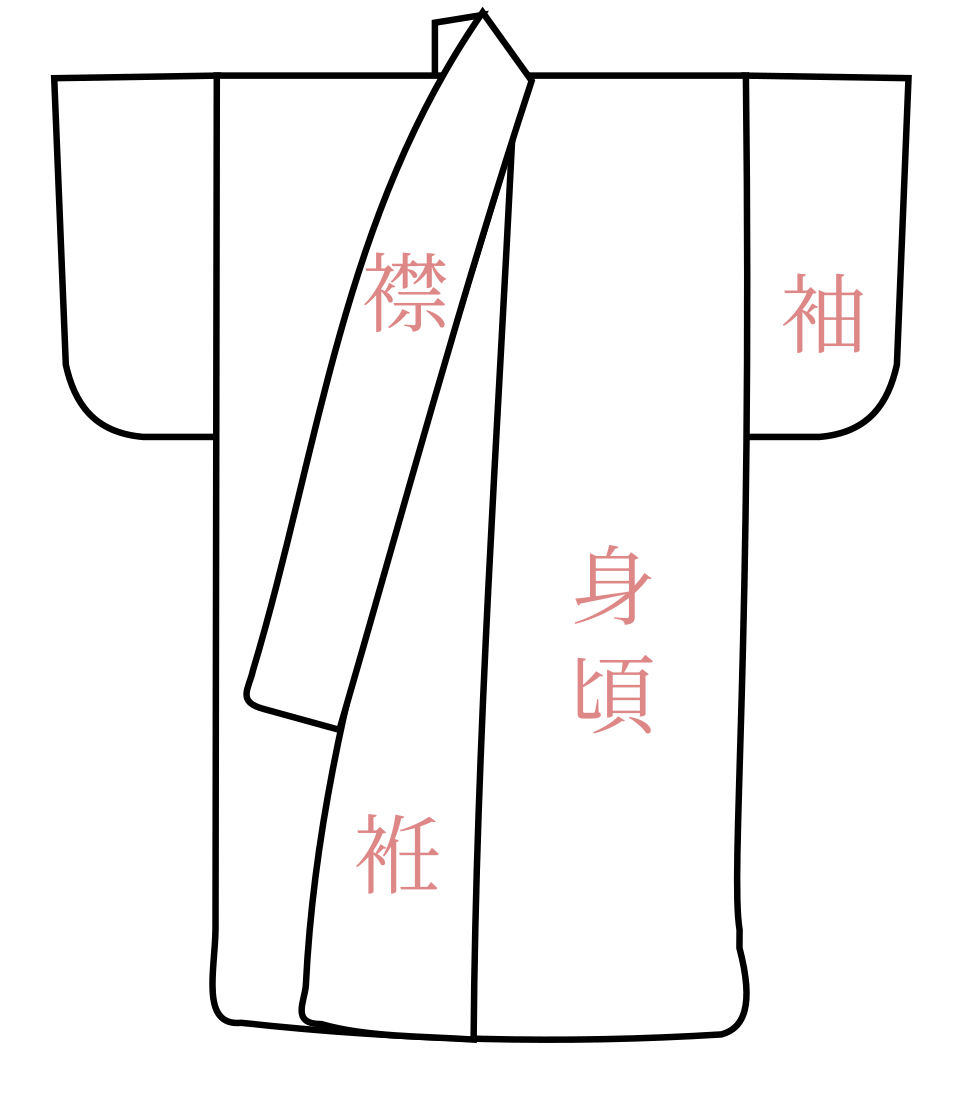
The tanmono bolt is 36 centimetres wide for a reason — almost exactly the width you need to cover one side of an adult body from shoulder to hip without a side seam running through the wearable area. Change the width and you break the grammar of the garment. This is why Western designers who “reinterpret” the kimono almost always fail to capture it. The moment you cut a kimono on the bias or shape a sleeve, it stops being a kimono.
The bolt length of 12.5 metres is calculated to produce exactly one adult kimono with enough offcuts for collar, eri band, and sleeve turnback. Nothing is wasted. If the cloth is patterned, the pattern is designed to flow continuously across the seams from one panel to the next — getting it to run smoothly across the shoulder and down into the sleeve without a visible break is the single technical achievement that separates a good kimono from an expensive one.
The layers — a kimono is at least five garments
When a Japanese woman says she is “wearing a kimono,” what she is in fact wearing is five to seven distinct garments plus a dozen ties, pads, and clips. The outer kimono is only the top layer. Underneath, against the skin, is a cotton T-shirt-like undergarment called the hadajuban (肌襦袢) — absorbent, washable, and there to keep body moisture off the silk above it. Over that comes the nagajuban (長襦袢), a full-length under-kimono usually in plain white or pastel silk, cut to match the outer garment’s length and specifically visible at the collar, where a narrow band of nagajuban fabric shows deliberately at the neckline of the outer kimono.
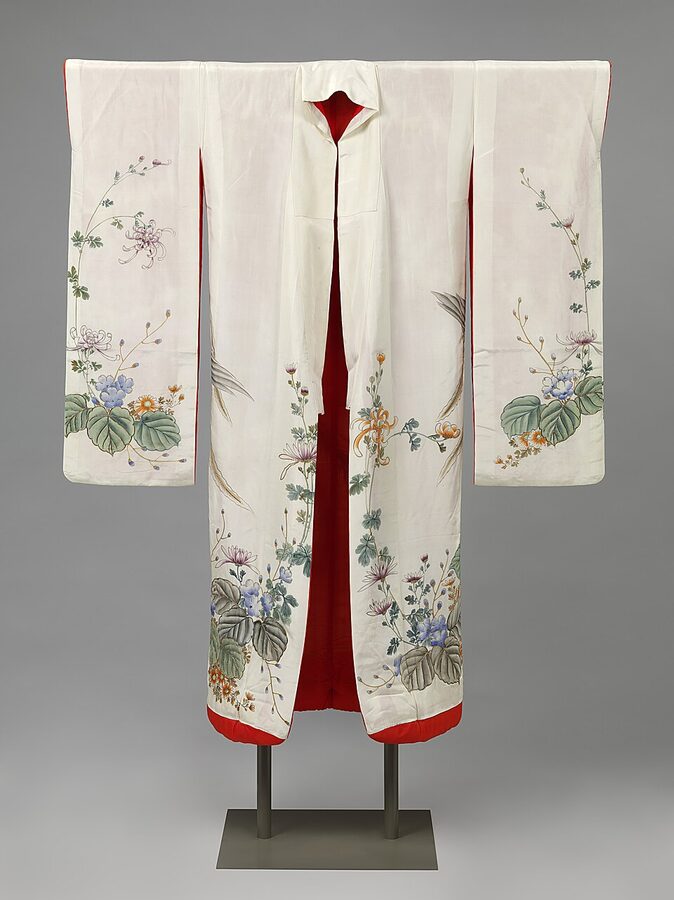
Over the nagajuban goes the kimono itself. Around the waist it is held first by a cotton tie called the koshi-himo (腰紐), wrapped twice and knotted at the front. A second tie, the date-jime, goes higher up the ribcage to smooth the excess bodice fabric. Only then does the obi go on — and the obi is itself a multi-piece system: the obi proper, the folded obiage scarf visible at the top, the decorative obijime cord across the front, and sometimes an obi-ita stiffener inside. That is ten components, and a formal kimono in full regalia can include up to fifteen separate items.
This is why dressing for formal kimono is outsourced. Wedding-guest women routinely visit a professional kimono-kitsuke two hours before the event and pay six to twelve thousand yen to be put into the garment properly. The dresser will tie twenty-seven knots in forty-five minutes and leave the wearer in a structure so tight many cannot fully bend at the waist. The tightness is structural — without the underlying layers compressed evenly, the outer silk will rumple during movement, and rumpled silk at a wedding is a social catastrophe the dresser gets blamed for.
The women’s formality ladder, top to bottom
There are six ranks of formality for women’s kimono and they stack in a strict hierarchy. At the very top sits the kurotomesode — the black, five-crested married-woman’s kimono — worn by the mothers of the bride and groom at a traditional wedding, and by senior female relatives at Imperial-level ceremonies. Below it is the iro-tomesode, the coloured version of the same pattern, which allows blue, silver, or muted gold in place of black but keeps the five-mon formality. Next down is the hōmongi (訪問着), the “visiting wear” with pattern flowing across the seams rather than confined to the hem — the typical formal kimono for a middle-aged married woman attending a wedding as a guest rather than a family member. Below that, tsukesage, looking almost identical to hōmongi but with the pattern cut per-panel rather than running across seams — a slightly less formal garment than the untrained eye can distinguish from.
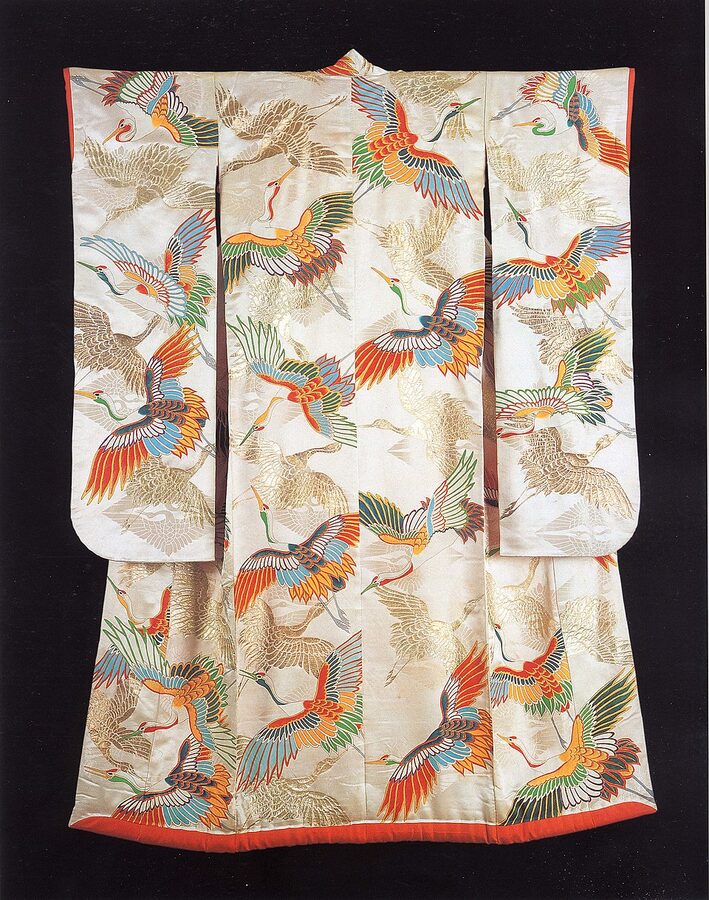
Below the tsukesage comes iromuji (色無地), the single-colour kimono without pattern at all, worn to tea ceremonies and semi-formal occasions where elaborate pattern would distract — this is the rank tea practitioners favour because the absence of pattern directs attention to the ceremony itself, and the iromuji’s one or three crests mark it as formal enough for the tokonoma alcove without competing with it. Below that, komon (小紋), the small-all-over-pattern kimono for casual town wear, followed at the bottom of the ladder by yukata (浴衣), the cotton summer kimono worn to festivals and bathhouses and never, under any circumstances, to a formal event.
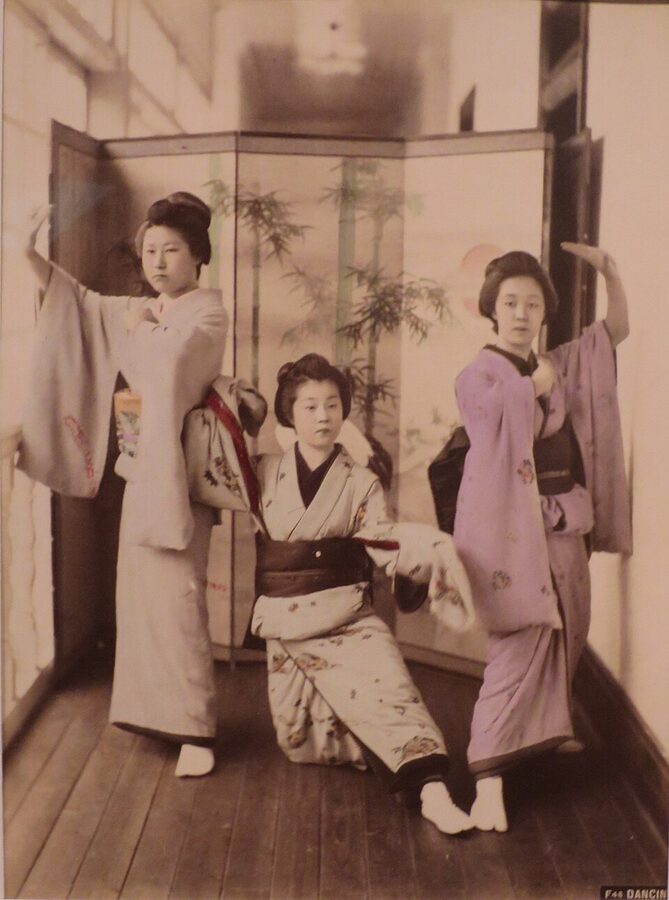
The unmarried-woman ladder compresses slightly: the top formal is furisode rather than kurotomesode, identified by long flowing sleeves that can drop a full metre from the wrist. A woman wears furisode from her Coming-of-Age Day (seijinshiki) at twenty until she marries, at which point the long sleeves were historically cut down to wrist length so the same cloth could become a tomesode. Most women now rent both garments from different rental houses — the symbolism survives even when the textile does not.
The men’s ladder — shorter, stricter, almost extinct
Men’s kimono is a narrower category than women’s, because the Meiji Restoration killed it more comprehensively. By 1920 most Japanese businessmen wore Western suits to work, and the male kimono survived only in specific ceremonial contexts. The top-formal is kuromontsuki-haori-hakama — a black five-crested kimono, paired with a black crested haori jacket over the top, and the striped sendaihira hakama trousers below. This is what a Japanese groom wears at his own wedding, what the father of the groom wears to his son’s wedding, and what the Prime Minister wears when he is formally received by the Emperor at the New Year.
Below that is iromontsuki, the coloured crested version, which allows navy, brown, or deep green in place of the black ground. Semi-formal is the haori-and-nagagi combination without hakama — the silk kimono plus the overjacket, appropriate for a male guest at a less formal wedding reception or a formal dinner. Below that is nagagi alone, the unadorned kimono robe in solid colour or muted stripe, which men wear around traditional inns, at certain tea ceremonies, and during the hatsumōde first-shrine-visit of the New Year. At the bottom, as with women, the yukata — cotton, summer, festival.
Men’s kimono construction is almost identical to women’s but with one important difference: the men’s obi is much narrower (about 10 centimetres wide versus 30), tied low on the hips rather than at the natural waist, and usually in a simple knot called kai-no-kuchi (“mouth of the clam”) rather than the elaborate butterfly bows of women’s dress. The effect is to signal that the garment is worn rather than being the primary statement — a man in formal kimono is dressed, not dressed-up. The understatement is the point, as it was with the samurai kamishimo two centuries earlier. Status through restraint, not ornament.
Before there was a kimono — Jōmon to Heian
The kimono’s direct ancestor is the kosode (小袖), “small sleeve,” first appearing in the late Heian period as an undergarment worn beneath heavier court robes. Before that, during Jōmon and Yayoi, Japanese dress looked more like the continental mainland — long straight tunics in hemp or early silk, no overlap closure and no T-shape construction. The Nara court faithfully wore imported Tang Chinese fashion for nearly two hundred years. The gradual transition from Chinese-style to Japanese-style dress happens across the ninth and tenth centuries.
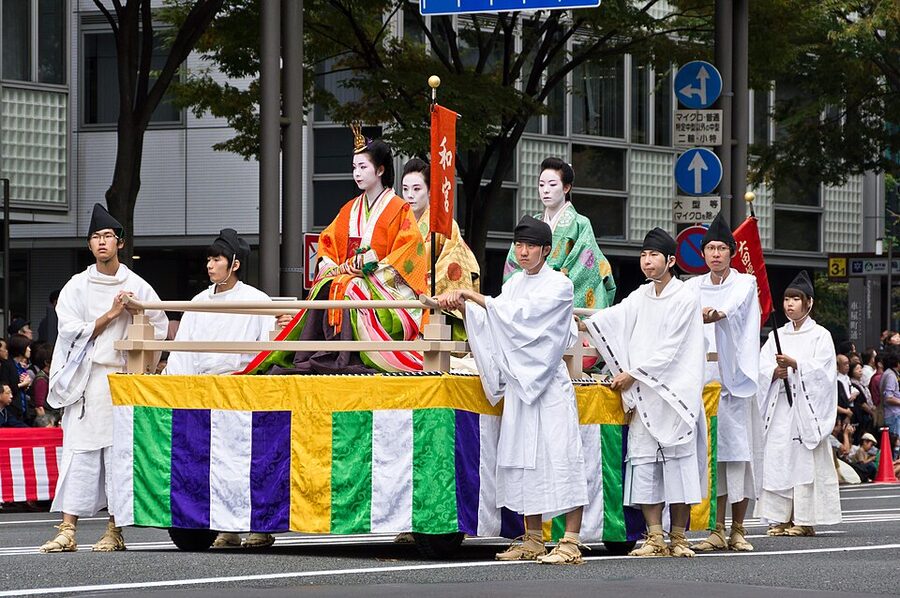
The Heian court at Kyoto took Japanese clothing to an elaborate peak in the form of the jūnihitoe (十二単), literally “twelve-layered robe.” This was not twelve identical layers — it was a precisely ordered stack of silk robes in varying cuts and colours, each slightly shorter or shorter-collared than the one underneath it, producing a visible colour-gradient (kasane no irome) at the cuffs and hem that could reveal as many as twenty individual shades at once. The jūnihitoe weighed around twenty kilograms when fully assembled, could take an hour to put on, and made fast movement essentially impossible. Heian court women spent much of their lives effectively immobilised by their own clothes, which sounds like a criticism but was the point — the robe demonstrated that the wearer did not need to move quickly.
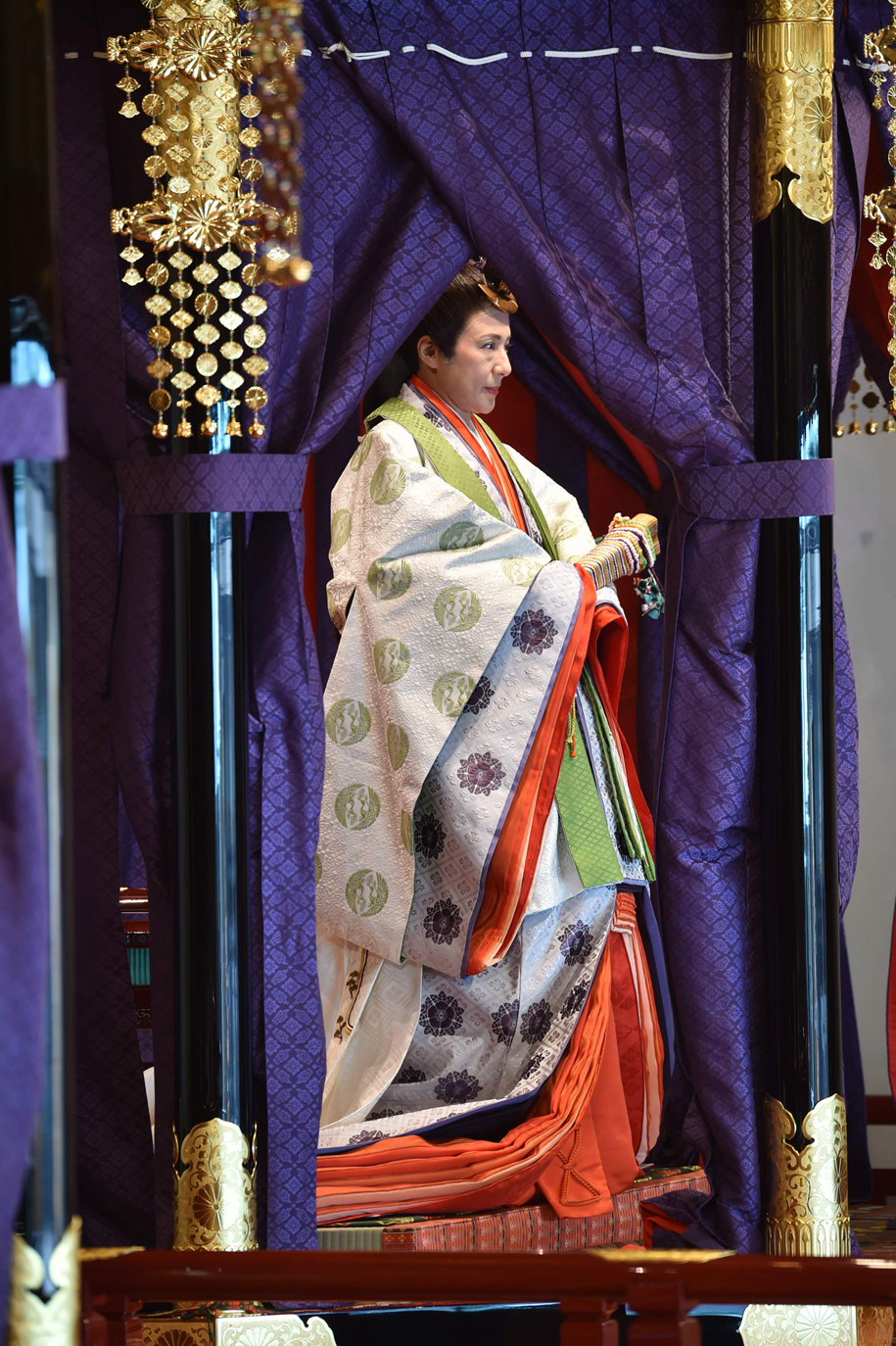
Underneath the jūnihitoe, against the skin, was the kosode — the small-sleeve plain robe that kept body heat in and that absorbed sweat. For three centuries it was purely underwear. That is the starting point. The whole history of the kimono is the story of how the underlayer slowly fought its way up the social ladder until it became the outermost garment, and how everything worn over it was discarded as the warrior class replaced the courtly one.
Kamakura, Muromachi, and the samurai simplification
When the warrior class displaced the Heian nobility at the close of the twelfth century and installed the Minamoto shogunate in Kamakura, they brought with them a different relationship to clothing. A samurai on campaign could not wear twelve layers of silk; a samurai on horseback could not wear dragging skirts. The warrior class simplified, ruthlessly, and what they kept was essentially the kosode plus a functional overgarment — hitatare for formal wear, later suō and daimon, all of them cut for a man who needed to sit astride a horse or unsheathe a sword without unwrapping half his wardrobe first. By the Muromachi period (1336-1573), the kosode had stopped being underwear and had become outerwear.
This is the point at which the kosode stops being the word for a small-sleeve robe and starts being the word for the Japanese civilian garment generally. The sleeves gradually lengthened; the body became wider; decoration began to appear on the outside of the cloth rather than being reserved for underlayers that nobody would see. By the late Muromachi and into the Azuchi-Momoyama period — the century from roughly 1500 to 1600 that saw the Sengoku civil wars, the rise of Oda Nobunaga, and the unification campaigns of Toyotomi Hideyoshi — the kosode had become the dominant garment in both male and female dress. Hideyoshi’s own surviving kosode at the Jurakudai, now dispersed across museum collections, are extraordinary: bold gold-leaf backgrounds, tie-dyed shibori fields, embroidered pines and bamboos. The late sixteenth century was the first moment the kimono became a canvas.
Edo 1650-1750 — the century the kimono was standardised
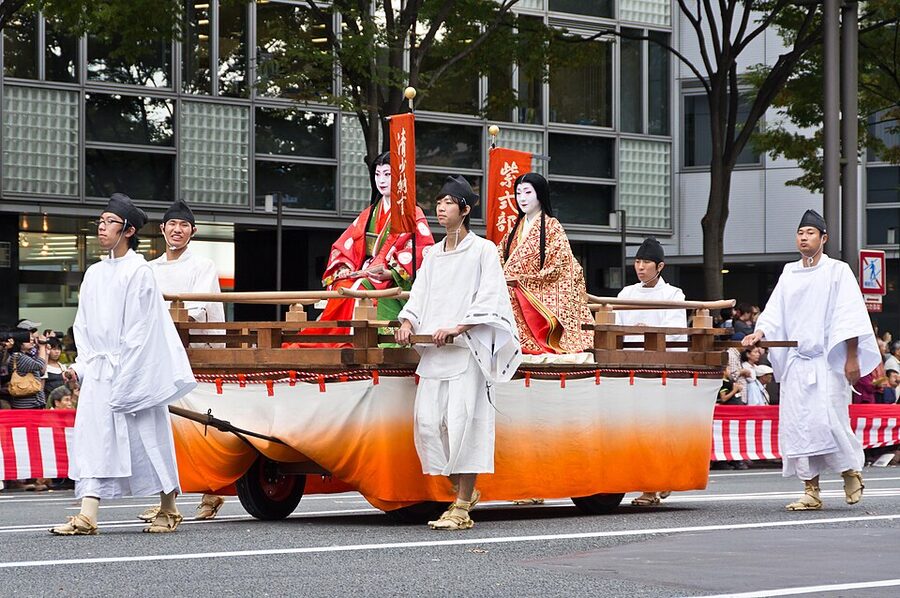
The kimono as it now exists — sleeve lengths fixed to the ranks, obi widths codified, the formality ladder written down — was standardised in a hundred-year stretch during the early and middle Edo period. Tokugawa Ieyasu’s establishment of the shogunate at Edo in 1603 produced, for the first time in Japanese history, two and a half centuries of unbroken domestic peace, and that peace did something very specific to Japanese clothing: it removed the need for military function and replaced it with social signalling. In 1645 the shogunate issued an edict standardising male formal court dress as the haori-hakama combination that still defines it today. By the Genroku era (1688-1704), under Tsunayoshi’s prosperous and culturally extravagant reign, the female kosode had reached its full decorative peak.
Genroku kosode are what most art-history books mean when they show a “classical Japanese kimono.” The silhouette is the shape the modern eye now recognises; the decoration runs across the back and up one sleeve in a single flowing composition; the obi has widened from the narrow Muromachi sash into the 15-to-30-centimetre band that still defines formal wear. Hideyoshi’s late-Momoyama taste for massive field compositions softened in the hands of the Edo townsman class into more refined imagery — seasonal landscapes, poetic references, auspicious creatures. The Edo merchant wives and daughters, newly wealthy from the post-sankin-kōtai economic boom, became the primary market for decorative silk, and the Nishijin and Kyoto weavers responded with fabric of a technical sophistication that was probably never equalled anywhere in the world.
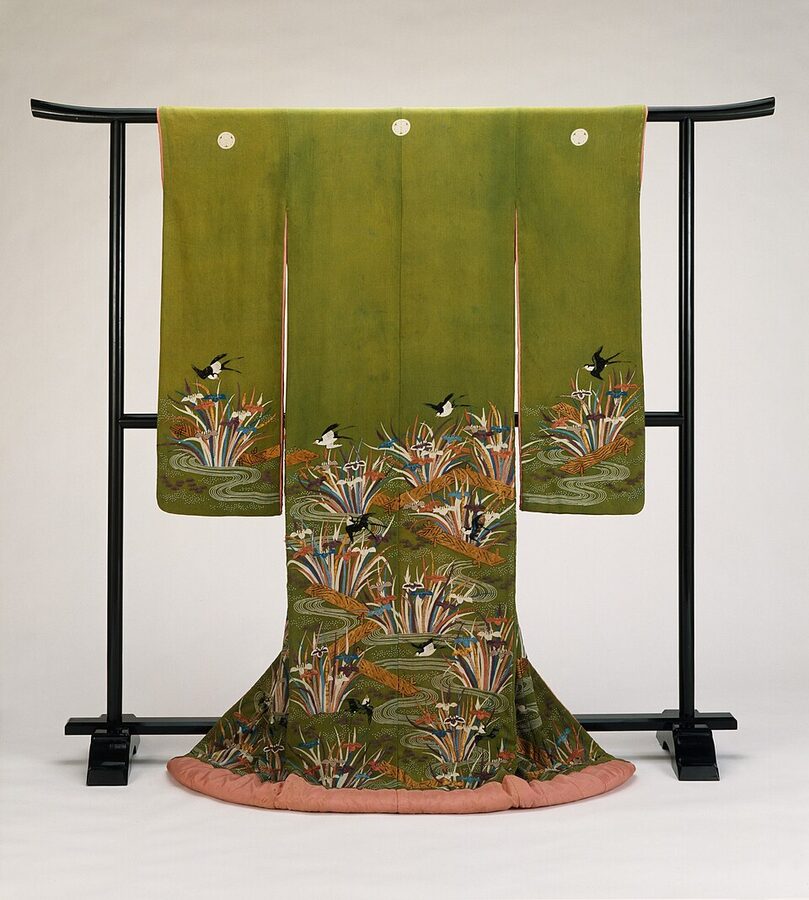
The Edo sumptuary laws, repeated edicts restricting which colours and silks townspeople could wear, accelerated rather than suppressed design evolution, because the bans pushed decorative ingenuity inwards. Merchants forbidden from outer silks lined plain-cotton kimono with extravagant silk undergarments that flashed at the cuff. Banned from gold-leaf fronts they commissioned gold-embroidered linings visible only when the sleeve swept aside. The Japanese word for this cultivated restraint — iki — is the aesthetic produced by a decorative tradition trying to hide what it was doing from the authorities. It is one of the most beautiful solutions to censorship anyone has ever designed.
Meiji erases, ceremony preserves
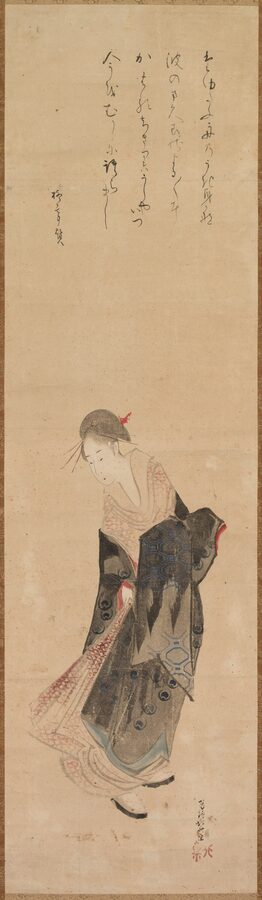
The Meiji Restoration of 1868 and the subsequent Westernisation should have killed the kimono. It killed the kamishimo, the topknot and the samurai sword within a decade; installed European frock coats at court by 1872; and issued the Haitōrei edict of 1876 forbidding public sword-wearing. By 1890 most men had adopted Western dress for business; by 1920 it was everyday wear for urban women too. The kimono retreated into weddings, funerals, festivals, formal inn stays, stage performance and shrine duty.
But the ceremonial contract was strong. Imperial court functions continued to specify jūnihitoe for empresses, kuromontsuki for emperors. Shinto weddings were themselves being newly codified in this period as national ceremonies. Graduation adopted the hakama-and-kimono combination. Girls’ Day, Boys’ Day and Shichi-Go-San all kept kimono as their emblem. What Meiji actually did was confine the garment to the calendar of Japanese ritual life — and because that calendar is extraordinarily dense, the kimono never vanished; it simply moved into scheduled use.
Yūzen — the dye technique that made Kyoto and Kanazawa
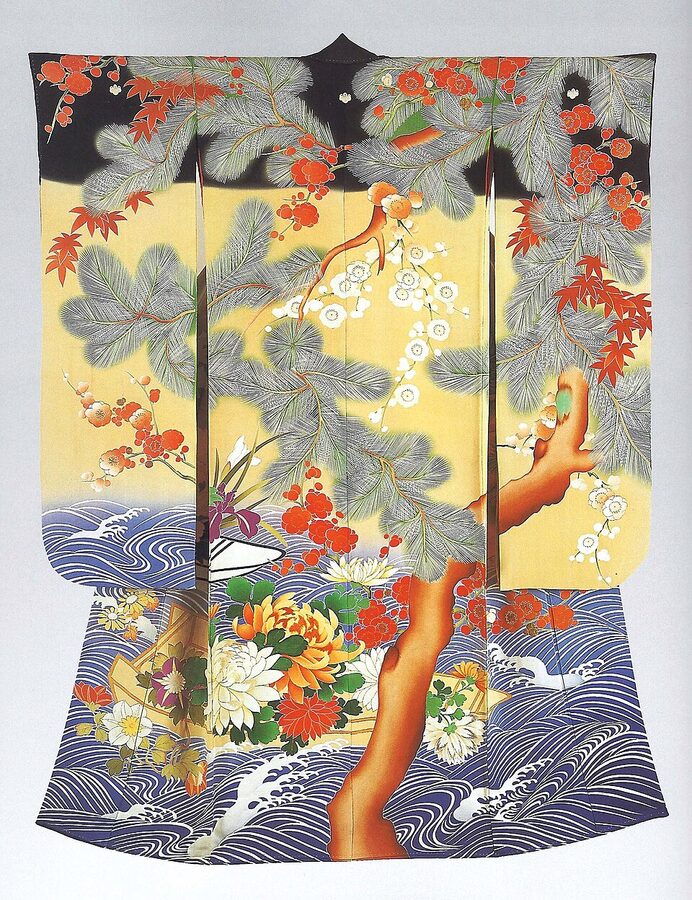
Of all the decorative traditions applied to kimono silk, yūzen (友禅) is the one that produced the richest visual vocabulary and the most collectible garments. The technique is a resist-paste dye method invented in the seventeenth century, traditionally attributed to a Kyoto fan-painter named Miyazaki Yūzensai who is thought to have adapted fan-painting techniques to kimono decoration in the 1680s. What yūzen does is allow full painterly freedom on silk — the dyer draws the design directly onto the cloth in fine lines of rice-paste resist (itomenori), then fills the enclosed shapes with pigment, one colour at a time, with a small hand-brush. The resist prevents colours from bleeding into one another. The result is a kimono that looks and functions as a painting on wearable cloth.
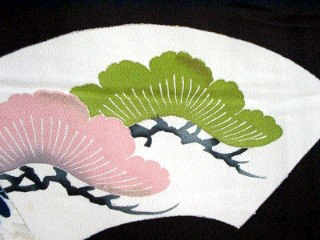
Yūzen split into two regional schools almost immediately. Kyo-yūzen stayed in Kyoto under Yūzensai’s direct successors, developing a refined aesthetic of muted colour and seasonal reference. Kaga-yūzen moved to Kanazawa in the 1710s, when the Maeda daimyō family recruited Kyoto-trained dyers for their castle town — this is the period when Maeda Toshiie‘s great-grandchildren were ruling Kaga as one of Japan’s wealthiest daimyō houses, and Kanazawa’s cultural infrastructure rivalled Kyoto’s. The Kaga school developed a bolder, more painterly palette — deeper reds, yellow ochres, and the distinctive mushikui insect-damaged-leaf motif that no Kyoto master would have touched.
The distinction still matters. A collector can identify a kimono as Kyo-yūzen or Kaga-yūzen from six feet away by the palette alone. The two schools are intensely proud, mutually respectful, and routinely competing for the same buyers at the annual traditional craft fairs. The Kyoto yūzen-dyers’ guild still holds its annual cloth-washing in the Kamo river in January, where long strips of freshly-painted silk are rinsed in the ice-cold current to remove the rice-paste resist.
Nishijin-ori — the Kyoto weaving district that predates Kyoto
If yūzen is what goes on the cloth, nishijin-ori (西陣織) is what the cloth actually is. Nishijin is both a weaving technique and a Kyoto district, and the district is older than the capital city itself — the weaving lineage traces back to the Hata clan who brought silk-weaving technology from the Korean peninsula in the sixth century and settled in what would become Kyoto around 590 CE. By the time Emperor Kammu founded Heian-kyō in 794, the silk-weavers were already established in the area, and they became the core of the court’s textile supply for the next four centuries. This is weaving as continuous tradition without interruption, rare in any culture and nearly unique in Japan.
The name nishijin itself dates from the Ōnin War of 1467-1477, the ten-year conflict that devastated Kyoto and scattered the weavers to safer ground. When peace returned the weaving community regrouped and re-established their workshops on the site of the Western Army’s jin (camp) that had stood in the district during the war — hence nishi-jin, “Western camp,” and by extension the weaving style that came from there. This is one of the cleaner etymologies in Japanese textile history and the Ōnin War connection is regularly overlooked by writers who take the place-name for granted. Without that catastrophic mid-Muromachi conflict, there would be no Nishijin name.
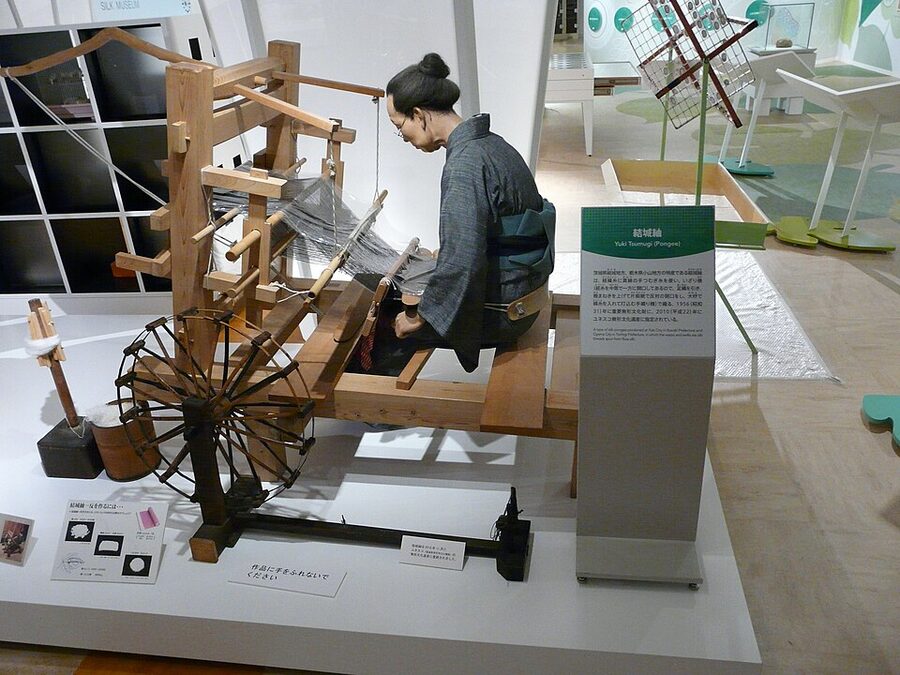
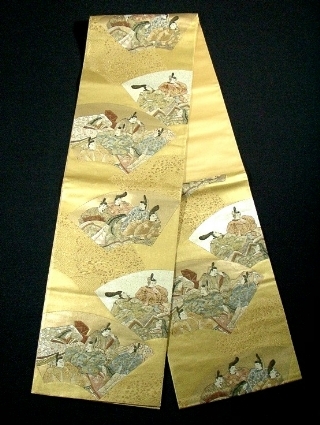
Nishijin-ori is distinct from ordinary silk weaving because the pattern is woven into the cloth rather than dyed onto it afterwards. A Nishijin loom can carry up to twenty or thirty different coloured weft threads simultaneously, selecting which one appears at each pass through a Jacquard-card pattern mechanism introduced from France in the 1870s but developed, in a hand-pulled form, in Kyoto itself centuries earlier. The effect is a cloth whose image is integral to its structure — no surface decoration, no overlay, just the pattern emerging as the cloth is made. This is why Nishijin obi cost what they do. A formal fukuro-obi in full Nishijin weave, with a polychrome pattern across its 4.5-metre length, can take a senior weaver four months of loom time. Prices start around 300,000 yen and rise into the millions.
Tsumugi — the rural silks that became UNESCO heritage
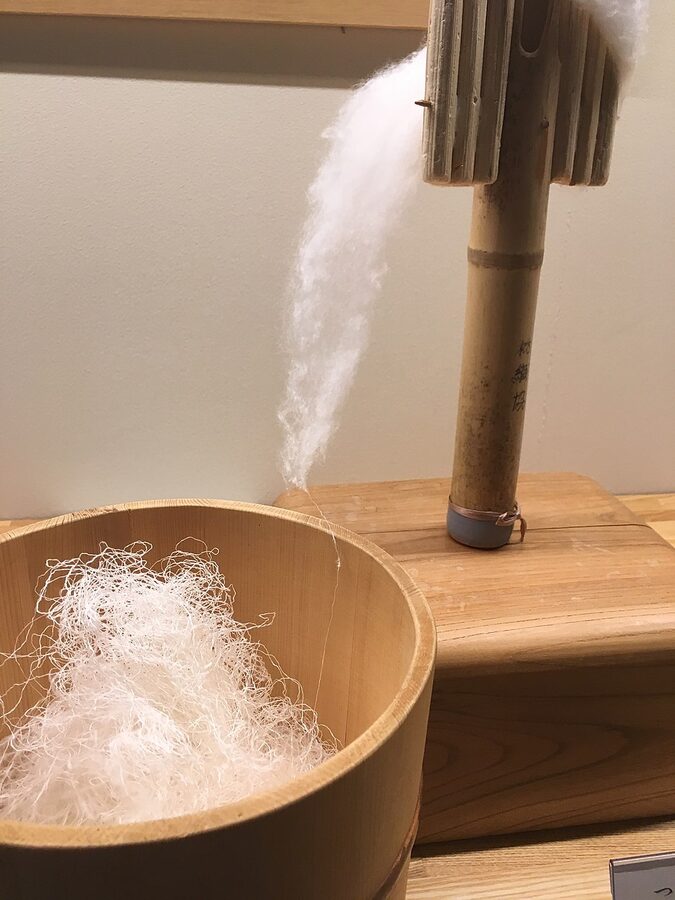
Away from the Kyoto court tradition, two regional silk-making villages developed parallel kimono traditions that produced cloth as fine as anything Nishijin made. Yūki-tsumugi (結城紬) comes from the town of Yūki in Ibaraki prefecture, a hundred kilometres north of Tokyo, where the local spinners and weavers have been producing spun silk from cocoons for at least fifteen hundred years. The defining Yūki technique is spinning the silk by hand directly from the cocoon into the yarn, without any mechanical spindle — the spinner pulls the filament from a warmed cocoon between her fingers and twists it into thread continuously. This is an obsolescent skill; fewer than a hundred people in Japan can still do it at commercial quality.
Yūki-tsumugi was inscribed on UNESCO’s Intangible Cultural Heritage list in 2010, and the inscription is one of those rare UNESCO designations that actually changed the economic reality on the ground — Yūki’s production doubled in the decade after, apprenticeship applications rose fivefold, and the cloth now reaches buyers who would never have encountered it otherwise. A full Yūki-tsumugi kimono takes about a year of work from spin to finished garment and costs between 500,000 and five million yen depending on pattern complexity. It is not a cloth you throw a wedding stain on. People who buy them store them between usings and the cloth outlasts the wearer.
Ōshima-tsumugi (大島紬) is the other heritage tsumugi, from Amami Ōshima in the far south of the Ryukyu archipelago. The technique here is radically different — the cloth is woven from silk that has been pre-dyed by a process called dorozome, mud-dyeing, in which the yarn is first dyed with sharinbai-tree tannin and then deposited in iron-rich mud from the Ōshima rice paddies. The tannin-iron reaction produces a deep blue-black tone that cannot be reproduced by any industrial dye. The yarn is then tied off in small bundles (ikat style) before weaving, so that the final cloth emerges with a fine pixelated pattern of tiny light-and-dark squares making up the motif.
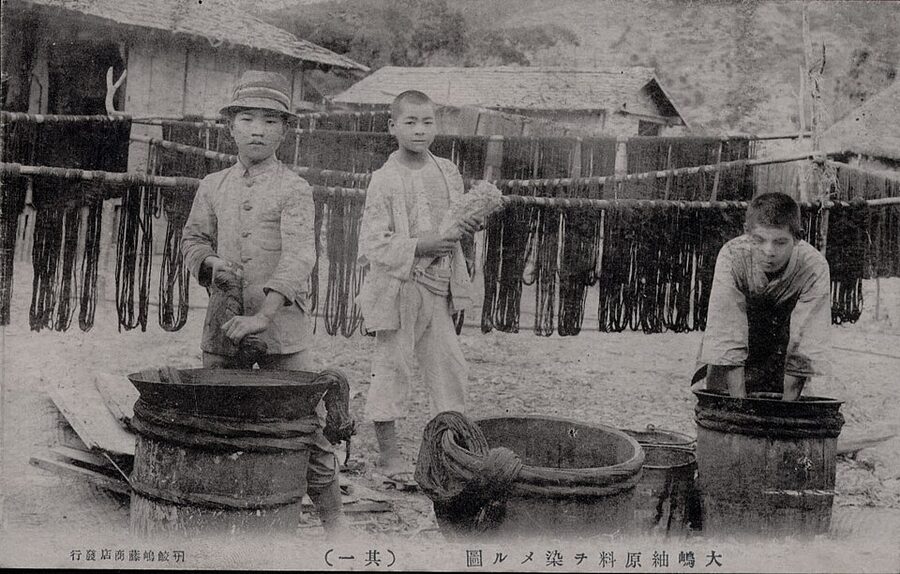
Ōshima-tsumugi is officially classified as a “semi-formal” kimono in the contemporary ladder, which is a slight technical injustice — the cloth is immensely fine and the workmanship is unmatched, but the formality code is tied to design vocabulary rather than quality, and tsumugi’s traditional association with island rural wear keeps it permanently outside the kurotomesode-and-iromuji tier. This is one of those Japanese distinctions that rewards understanding: the cloth can be more valuable and more finely made than the formal category above it, and still rank below it ceremonially, because ceremony codifies what things are rather than what they are worth.
The obi — the garment that holds the garment together
The obi deserves its own treatment because it is not actually an accessory. It is the structural component that keeps the kimono on the body, and in modern formal wear it is often more expensive than the kimono itself. Types of obi split by width, length, and occasion. The fukuro-obi is the full-formal obi — 30 centimetres wide and 4.5 metres long, typically in Nishijin silk with a woven polychrome pattern on one face and a plain cloth back. It pairs with kurotomesode, hōmongi, and furisode. The Nagoya-obi (名古屋帯) is the semi-formal working solution — 30 centimetres wide at the back but pre-folded and sewn into a narrower 15-centimetre band for the wrap segment, which makes it far easier to tie and suitable for hōmongi and tsukesage. A hanhaba-obi is the casual 15-centimetre-wide unlined obi worn with yukata and everyday komon.
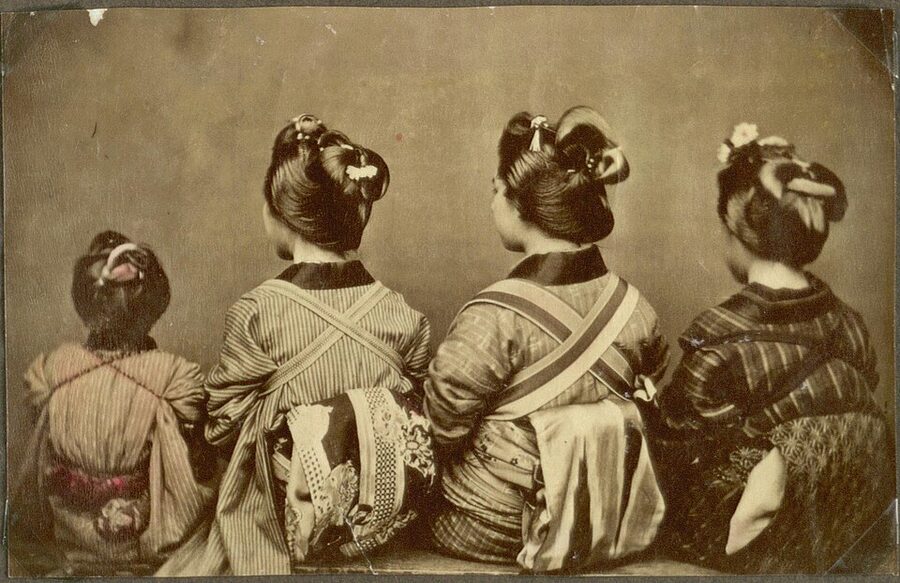
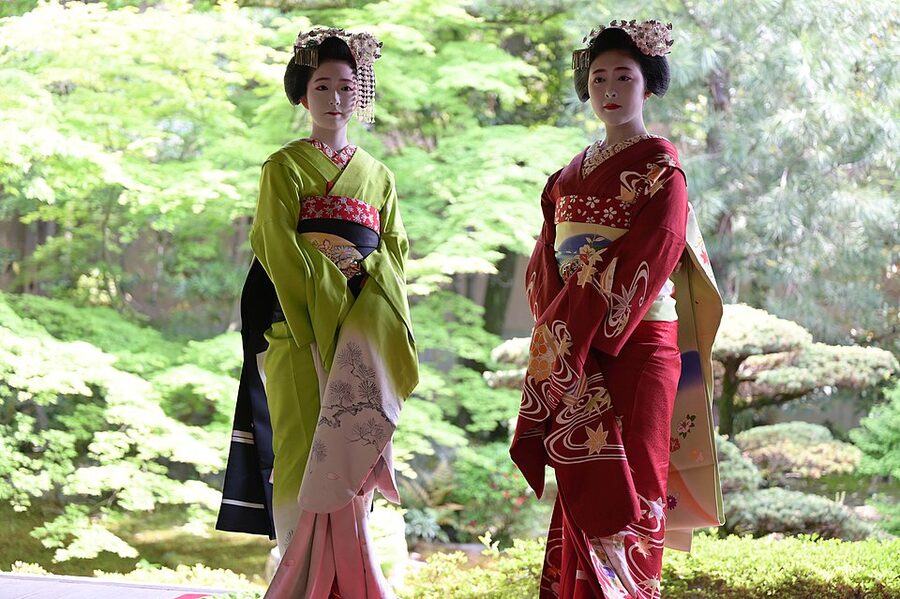
The obi-knot language is as detailed as the kimono ladder. A married woman wears a flat taiko (“drum”) knot, a squared-off rectangle at the back of the waist, because it is dignified and does not flap. An unmarried woman wears fukura-suzume (“plump sparrow”), a butterfly-winged knot that makes the back of the kimono look lightly animated, signalling youth and marriageability the same way a furisode sleeve does from the front. Maiko in Kyoto wear the dramatic darari-obi, a four-metre-long trailing knot that hangs almost to the ankle, visually marking the wearer as a trainee geisha. You can tell a Kyoto maiko from twenty metres away by that trailing obi, and watching them walk through Gion at dusk is one of the specific visual pleasures of the city.
The modern kimono calendar — when it actually gets worn
In contemporary Japan, the kimono appears on a specific set of scheduled occasions, and knowing the list tells you when and where you will encounter it during any visit. First, weddings — the bride wears a white shiromuku during the Shinto ceremony, often changes into a coloured iro-uchikake for the reception, and may change again into an evening gown for the Western-style banquet. The groom wears montsuki-haori-hakama. Mothers of both bride and groom wear black kurotomesode. Female relatives wear coloured iro-tomesode or hōmongi depending on their relationship to the couple.
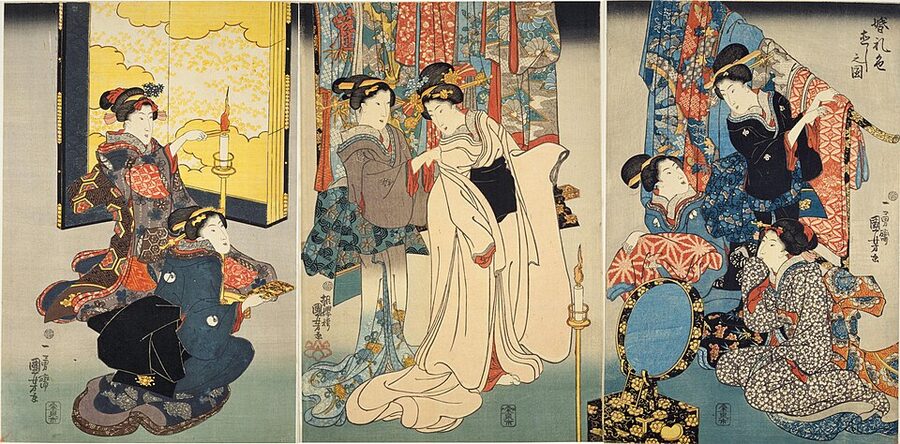
Second, the Coming-of-Age Day (seijinshiki) every January — twenty-year-olds, almost entirely women, wear furisode to their local city hall for the formal ceremony marking adulthood. This is the single biggest kimono day in the Japanese year. Rental houses are booked solid from November through January, photographers are booked from October, and the furisode worn that day becomes a family photograph that stays on the shelf for the rest of the wearer’s life. Men wear montsuki-haori-hakama or, increasingly, a Western suit — the male side of seijinshiki is a losing battle the traditionalists have mostly given up.
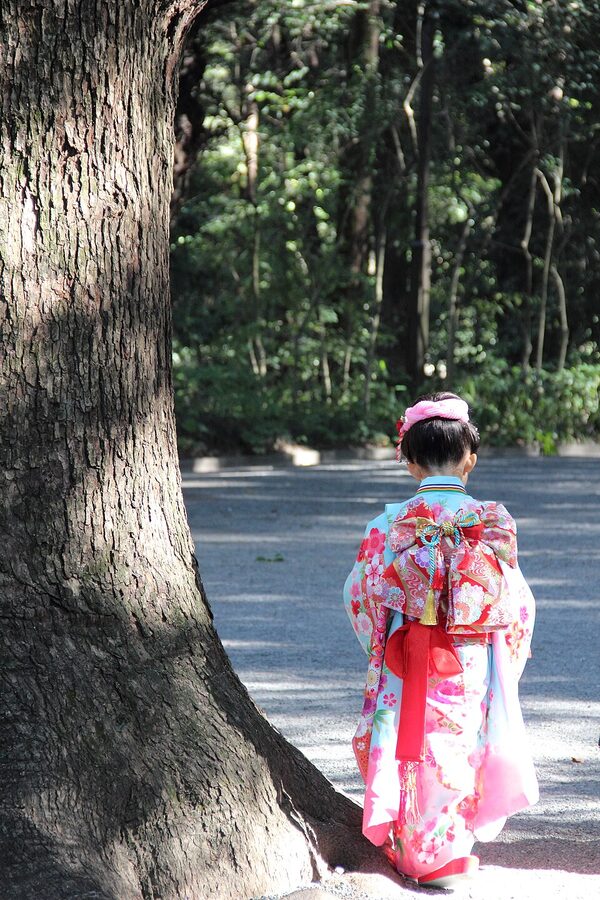
Third, Shichi-Go-San — the November 15th children’s rite for three-, five-, and seven-year-olds. Seven-year-old girls wear a full miniature kimono with a real obi rather than the child’s-bow version they wore at three; five-year-old boys receive their first hakama; three-year-olds of both sexes wear a simpler hifu-and-kosode combination. Shrines fill up on the nearest weekend to the 15th and professional photographers work non-stop. Fourth, funerals — black mofuku kimono for close female relatives, with minimal white obi, and specific rules about the number of crests. Fifth, the summer festival (matsuri) season, when yukata (浴衣) wear explodes across every Japanese town from June through August.
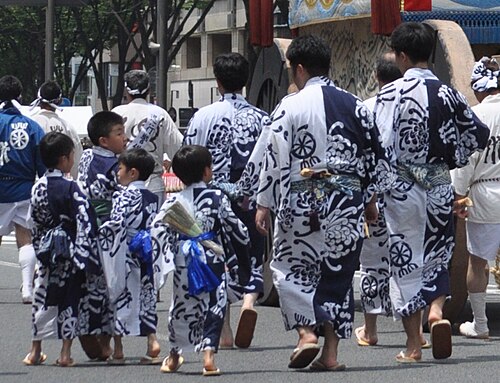
The yukata is worth pausing on because it is the one kimono most travellers will encounter, and because it breaks the formality rules to such a degree that veteran kimono-wearers sometimes disavow it as kimono at all. It is cotton, not silk; it is unlined; it is washable; it has no nagajuban or hadajuban underneath, though a cotton under-layer is sometimes worn; and it is paired with a hanhaba-obi tied in a simple bunko or hondai knot that most twenty-year-olds can do themselves in five minutes. You see it at Gion Matsuri in Kyoto in July, at Tsushima Tenno Matsuri in Aichi, at literally every town-scale fireworks show in August, and during the hanami cherry-blossom season where a number of Tokyo and Kyoto visitors rent yukata for the afternoon even when the weather makes silk more appropriate.
Where to see it worn and where to learn it — travel
Japan has thousands of places where you can watch or wear a kimono. The six I come back to are the ones where either the craft is actively being made, the garment is being worn by someone who needs it for work rather than tourism, or the history is being kept seriously enough that an hour of your time will pay back in understanding. These are for travellers who already have a little context — if you want to rent a yukata for the afternoon in Asakusa, the city will oblige you and you do not need me to point you to it.
Nishijin Textile Centre, Kamigyō, Kyoto
The single best introduction to nishijin-ori as a living craft is the Nishijin Textile Centre (西陣織会館) in the Kamigyō ward of Kyoto, about ten minutes on foot from Imadegawa subway station on the Karasuma line. The centre runs free exhibitions of contemporary Nishijin work on the ground floor, demonstrations of the handloom (including the hand-pulled Jacquard variant that predates the French machine) at fixed times through the day, and a small shop selling obi bolts and offcuts at prices that start honest and go up steeply. The kimono fashion show on the second floor is aimed at tour groups — skip it. The ground-floor loom demonstrations are not.
Around the centre, the Nishijin district is still a working weavers’ neighbourhood, with about a thousand small workshops behind latticed shopfronts. Walking the streets north toward Kitano Tenmangū in the mornings, you can hear the looms through open windows. Kyoto is one of the few cities where you can hear a handwoven obi being made in an alley that has been producing them since before the city itself was founded. Walk the district once, even without entering a workshop — the ambient sound tells you most of what you need to know.
Kyo-yūzen workshops, Horikawa and Kamigyō, Kyoto
The Kyoto yūzen dyeing tradition is distributed across about two hundred workshops, mostly on the eastern side of the Horikawa canal and up through the Kamigyō and Kita wards. Several of these workshops offer short demonstrations and some allow hands-on experience at the itomenori rice-paste application stage. The Yūzen Cultural Hall (京都友禅文化会館) in Shimogyō ward, near Shijō-Ōmiya station on the Hankyu line, runs workshops priced between 3,500 and 8,000 yen for a half-day class, producing a small silk sample you can take home.
The Kamo river cloth-washing — the yūzen-nagashi — used to happen publicly every January and was a minor Kyoto visual event; it is now rarer because most workshops have installed private water-recirculation facilities and the city has restricted river-use for pigment reasons, but you can still catch it occasionally along the Horikawa canal near Horikawa-Nakadachiuri, and it makes a fine photograph. Ask at the Textile Centre which workshops are washing that week.
Kaga-yūzen, Nagamachi district, Kanazawa
For Kaga-yūzen, the place is Kanazawa, and specifically the Nagamachi samurai district on the west side of Kanazawa castle. The Nagamachi Yūzen-kan (長町友禅館) runs demonstrations, an exhibition of senior Kaga masters’ work, and a rental-and-experience programme where you can dress in a full Kaga-yūzen kimono and have photographs taken in the surviving period streetscape of the Nagamachi merchant-samurai quarter. Combine this with a morning at Kenrokuen, ten minutes’ walk away, and the Maeda family’s Oyama Jinja, and you have the best day of traditional-culture tourism that Kanazawa can offer.
Kanazawa is my preferred yūzen experience over Kyoto, honestly. The Kyoto workshops are fine but they are hemmed in by centuries of tourist traffic and the craft feels, in a way I cannot fully articulate, slightly polished. The Kanazawa equivalent is quieter, less visited, and the Maeda family’s two-century patronage of the craft is still visible in the architecture, the garden, and the way the local artisans speak about their own work. You will see better Kaga-yūzen here than in any Kyoto exhibition outside of the National Museum.
Kimono Museum, Nihonbashi, Tokyo
In central Tokyo, the Kimono Museum (染織館) on the eighth floor of the Nihonbashi Tokyu department store presents a small, well-curated historical collection spanning the Edo through early Shōwa periods. Admission is 500 yen. The galleries are compact, you can see everything thoroughly in forty-five minutes, and include a handful of Meiji-era wedding uchikake that are exceptional. It is the only central Tokyo kimono collection I recommend; most of the department-store branded “kimono galleries” are retail operations dressed up as exhibitions, and the Edo-Tokyo Museum’s kimono holdings were dispersed during the renovation and have not fully returned.
The museum is an unannounced ten-minute walk from Mitsukoshimae station on the Ginza line, or Nihonbashi station on the Tōzai line. Combine with the Bank of Japan’s museum and the Kiya knife shop on the Ginza-machi side, and you have a morning of specifically-Tokyo old-merchant-quarter culture that most first-time visitors miss entirely while they are queuing for Sensō-ji.
Kimono rental — Asakusa, Gion, Kanazawa
The casual kimono experience for visitors is rental, and it is a good experience if you pick the right shop and go in with realistic expectations. Standard rental is between 3,000 and 6,000 yen for a half-day package including kimono, obi, and basic kitsuke-dressing by a staff member — this will get you a middle-quality synthetic or rayon komon-rank kimono and a Nagoya-type obi, tied in a simple taiko knot that will stay on for the afternoon. Higher-end packages at 8,000 to 15,000 yen get you closer to silk, better sizing, and a more skilled dresser.
The three districts that offer this most seriously are Asakusa in Tokyo (high volume, moderate quality, good for the Sensō-ji temple backdrop), Gion in Kyoto (the best selection and the most visually-coherent street setting — you can walk to Yasaka Shrine and Kiyomizu-dera in rental kimono without looking out of place), and the Nagamachi district of Kanazawa (smaller scale, often higher-quality silk options, quieter streets for photographs). I avoid the Arashiyama rental shops, the bamboo grove is so crowded that wearing a kimono through it becomes a hazard to both garment and wearer, but the other three work well. Book ahead for cherry blossom and autumn foliage seasons; walk-in works most of the rest of the year.
Ōshima-tsumugi, Amami Ōshima
For Ōshima-tsumugi, you have to go to Amami. The Tatsugō Municipal Ōshima Tsumugi Training Centre, a short drive south of Amami airport on the north-east side of the main island, runs demonstrations of the full dorozome mud-dye sequence including the paddy-dipping stage that you cannot see anywhere else. You can pre-dye your own silk handkerchief at a short workshop for about 2,500 yen and take it home with the distinctive deep-black Ōshima tone. The main production season runs roughly February through November, and January is a lean month if you are going specifically for the craft.
Amami itself is an eight-hour ferry from Kagoshima or an hour-and-a-half flight direct from Tokyo or Osaka. The island rewards a longer stay — the Setonaikai-style inner bay at Kakeroma, the blue-coral beaches, and the traditional shochū distilleries. But if you are there for the cloth, two days is enough to cover the training centre, one or two remaining working paddies, and the Ōshima Tsumugi Museum in Naze town.
Yūki-tsumugi, Ibaraki
Finally, for Yūki-tsumugi, you go to Yūki town in Ibaraki prefecture, about an hour north-east of Tokyo by Utsunomiya Line from Ueno station. The Yūki Tsumugi Hon-basho craft centre runs free exhibitions of current senior-artist work, loom demonstrations, and pre-booked workshops where you can try hand-spinning the silk filament for an hour. The demonstrations are at 10am and 2pm on weekdays; the hand-spinning workshop costs 3,500 yen for two hours and must be reserved a week in advance through the centre’s website.
Yūki town itself is a pleasant surviving merchant town with a preserved old-quarter in the Okebashi district — an hour of walking covers the centre of it, and the old sake breweries around the station have been operating for between two and four centuries. The craft is more immediately visible here than the town tourism economy reflects, because the spinning and weaving work happens in small family houses rather than in a consolidated factory. You can pay 500 yen at the tourist office for a self-guided walking map that includes about twenty working houses that accept visitors; most do not advertise in English.
The three hundred years of refinement
The kimono that a Japanese bride wears at her Shinto ceremony this afternoon is the same garment that Hideyoshi’s wife wore to the Jurakudai four centuries ago, made in essentially the same way, with the same eight rectangles cut from the same 36-centimetre-wide bolt by an apprentice who has trained for a decade to do it. The yūzen she picked was invented in the 1680s and is still dyed by hand with rice-paste resist. The Nishijin obi around her waist was woven on a loom whose operation has not fundamentally changed since the fifteenth century. Five mon, a butterfly obi knot, sleeves at the wrist: all of this is information the older guests read at a glance and the younger ones increasingly have to look up on their phones.
This is what I meant at the top about drape not being tailoring. A kimono is a method for turning flat cloth into a wearable signal system, and the signal system took three hundred years of Edo-period peace to codify properly. You can read it in forty minutes with a good book and watch it being lived in a single afternoon at any of the places above.
What you cannot do is replicate it. The reason Western designers keep bouncing off the kimono is that the cloth, the tradition and the obi-tying hands of the dresser are inseparable — you cannot extract one without losing all three. Some things are meant to be themselves. If you are in Kyoto in July, stop in at Nishijin and listen to the looms through an open window in the mid-morning — you will understand more from ten minutes of that than from an hour at any museum.


.png)


,_Irises,_and_Swallows_LACMA_M.90.8.jpg)


,_Japan._(10796834556).jpg)


.jpg)