
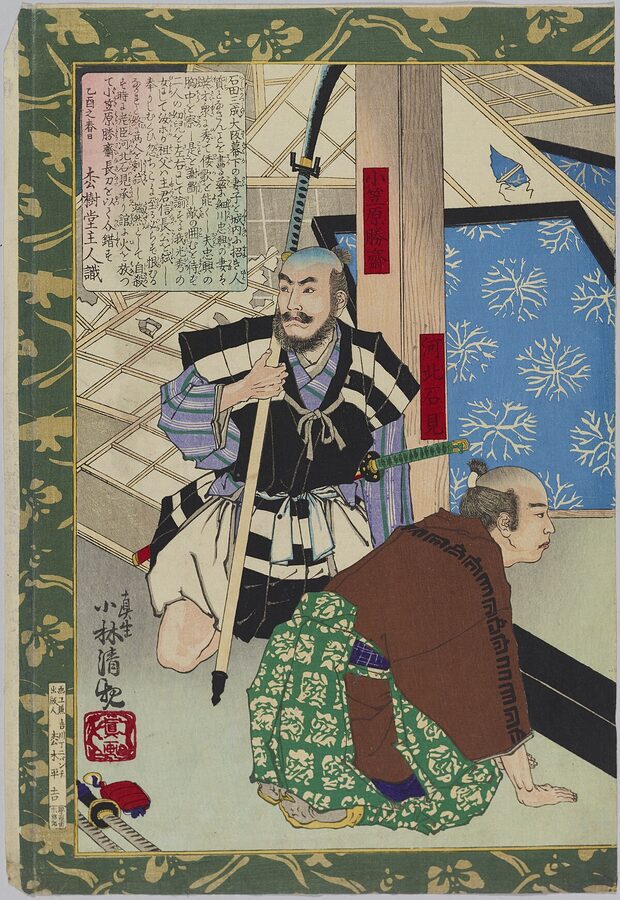
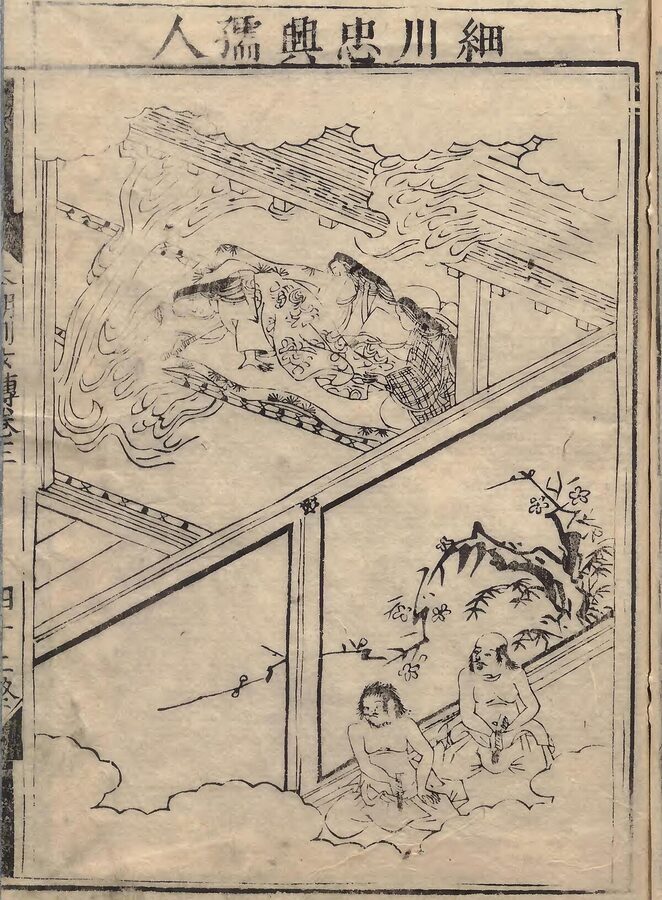
On the night of 17 July 1600, at the Hosokawa residence in the Ōsaka-Tamatsukuri quarter, a thirty-seven-year-old woman named Tama, baptised Gracia thirteen years earlier, knelt on the floor of the main hall, repeated the names of Jesus and Mary, and asked her household steward to kill her with a long-bladed naginata. She could not commit suicide. Catholic doctrine forbade it, and she was a serious Catholic.
But Ishida Mitsunari’s Western Army troops were surrounding the mansion with orders to take her hostage against her husband’s good behaviour at the eastern front, and being taken hostage was not an option her husband had authorised. So she gave the order, and Ogasawara Shōsai, who had held the security posting for the previous twelve years, did what he had been instructed to do. He struck once. She died instantly, and he then set the mansion on fire, walked back into the flames, and cut himself open.
The event was over before midnight. By the following week it was the talk of Kansai, and within a year it had reached Rome. Within a hundred years a Jesuit in Vienna had turned it into an opera called Mulier Fortis, “The Constant Woman”, and the Habsburg court had sat through two performances of it on the saint’s day of the Empress.
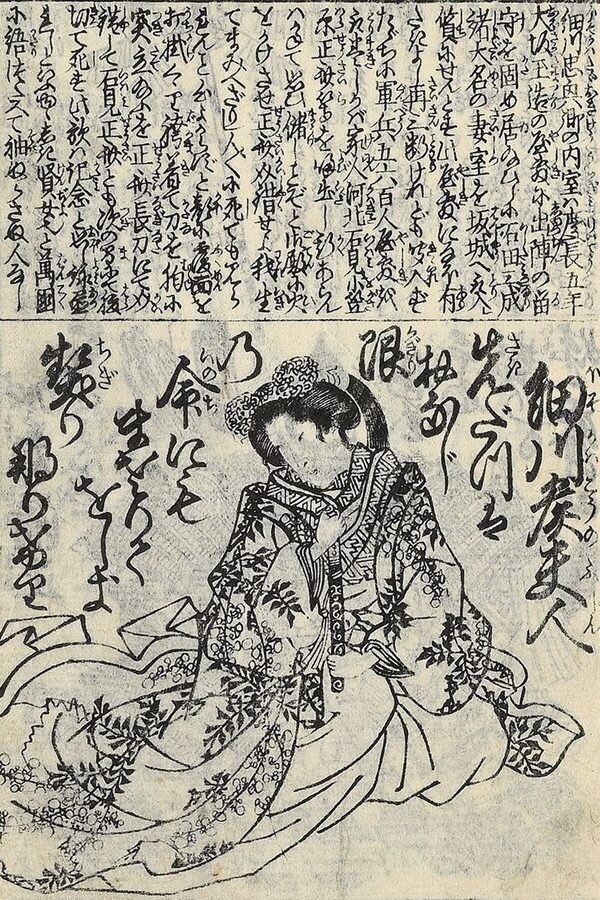
Within three hundred years it had become the single most-depicted female death in Japanese Christian devotional art. The woman at the centre of all this is the subject of this article: the daughter of the man who killed Nobunaga, the wife of one of the hardest men of the Sengoku era, and the most famous Japanese Catholic convert in history. She also wrote one of the more memorable death poems of the period, which translates roughly as “Fallen as it must, the blossom holds the name of blossom; so must a person hold the name of person.”
In This Article
- The Rebel’s Daughter
- Married at Fifteen
- Honnō-ji and the Mountain House
- The Ōsaka Residence and the Baptism
- The Thirteen Years of Secret Faith
- The 1595 Rehearsal
- Sekigahara, and the Order
- The Death Poem
- Tadaoki’s Long Aftermath
- Vienna, 1698
- Where You Can Visit Gracia’s Story Today
- 1. Kōtō-in at Daitoku-ji — Kyoto (the primary grave)
- 2. Midono (味土野) — Kyōtango, northern Kyoto prefecture
- 3. Shōryūji Castle — Nagaokakyō, south of Kyoto (where she was married)
- 4. Taishō-ji and the Kumamoto family memorial
- 5. The Ecchui well and the Ōsaka Catholic sites
- 6. Akechi Jinja — Fukui
- A Note on the Imperial Line
- Closing
The Rebel’s Daughter
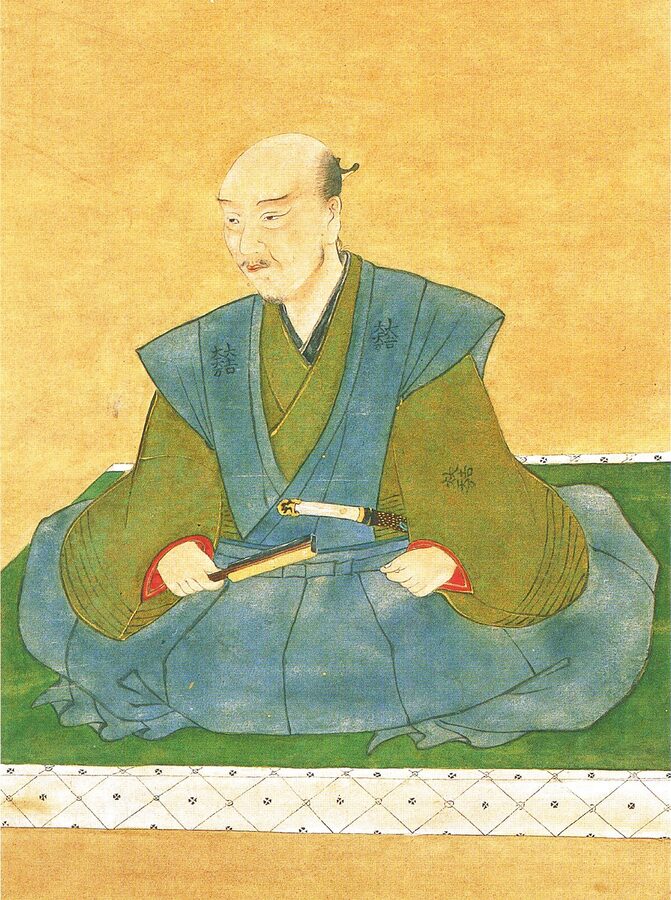
Gracia was born in 1563 as Akechi Tama (明智玉), the third daughter of Akechi Mitsuhide. The standard birth-place in the genealogies is Sakamoto Castle on the western shore of Lake Biwa, Mitsuhide’s main base from 1571 onwards — though some sources put it earlier at her father’s Echizen (Fukui) estate, before he was fully installed as one of Nobunaga’s senior generals. Either way, the household she grew up in was the household of one of the more intellectually serious men of the late Sengoku.
Mitsuhide was a waka poet, a student of the classics, and an unusually educated military commander. He spoke and wrote Chinese, and he had the social manners for Kyoto court circles — which most of Nobunaga’s generals did not.
His daughters were given the same education his sons would have had, and Gracia by the time she was a teenager was literate in Japanese and Chinese, versed in both the Buddhist sutras and the waka anthologies, and reportedly fluent enough at the classical dialogue games to hold her own against her father’s courtly guests. You should hold onto that detail, because she is going to use it later when she teaches herself enough Latin to read the Catholic service books sent to her by the Jesuit mission in Ōsaka.
She had two older sisters and at least two younger brothers. Her mother, Tsumaki Hiroko, was a woman of similar educational stock, she is credited in one family letter with persuading Mitsuhide that the daughters should read Chinese, and died in late 1576 when Gracia was thirteen.
By the time the marriage offer came two years later, Gracia had been running parts of the Sakamoto domestic household herself, the way the oldest unmarried daughter of a powerful house was expected to. She was already a serious young woman. The priests who met her in Ōsaka a decade later would all independently note the same thing: she was the most formidable mind in any room she entered, and she knew it.
Married at Fifteen
In August 1578, Nobunaga personally arranged Gracia’s marriage to Hosokawa Tadaoki, the fifteen-year-old heir of the Hosokawa clan. The two children were the same age. Tadaoki was the son of Hosokawa Fujitaka — the poet-warlord who would later take the Buddhist name Yūsai — and the Hosokawa were the most culturally literate of all the major Oda retainer families.
Tadaoki had himself been taught waka from the cradle and would later become one of the seven senior disciples of Sen no Rikyū in the tea ceremony. The match was, by any Sengoku-political measure, a double-alliance. It bound Mitsuhide’s and Fujitaka’s houses, both key Oda retainers with Kyoto-court connections, and gave Nobunaga a unified Kansai-court cultural front.
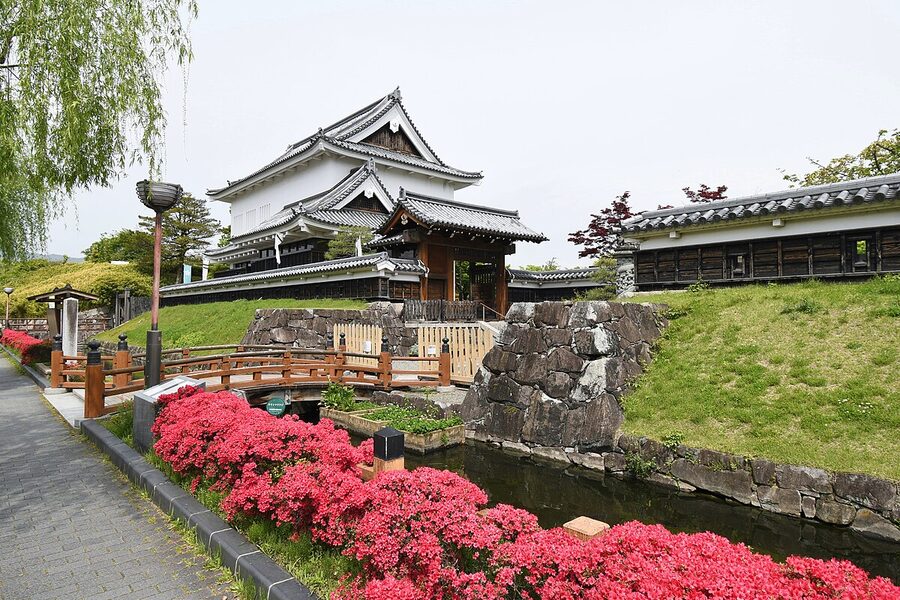
The wedding itself was held at Shōryūji Castle, the Hosokawa seat in Yamashiro province, in the eighth month of 1578. The contemporary Hosokawa chronicle the Menshōroku preserves the receiving-party list: Akechi Samanosuke Hidemitsu escorted the bride from Sakamoto, and Matsui Yasuyuki received her on the Hosokawa side.
For the first two years Tadaoki and Gracia lived at Shōryūji, then, when the Hosokawa were given Tango province in 1580, moved west to Miyazu Castle on the Japan Sea coast. By the standards of Sengoku political marriages, theirs worked. Contemporary records describe the two fifteen-year-olds as “uncommonly fond of each other” from the start, a remark which is repeated and embellished in every later chronicle.
Their first child was Tadataka, the elder son, born in April 1580 when both parents were seventeen. A daughter, later known as Cho, followed in 1581 or 1582. You may notice the rapidity: the Hosokawa tradition was for the heir to get on with producing an heir, and Tadaoki and Gracia were both conscious of the politics of it.
The first two years of the marriage read, in the surviving household correspondence, as the comparatively happy years. Then came Honnō-ji.
Honnō-ji and the Mountain House
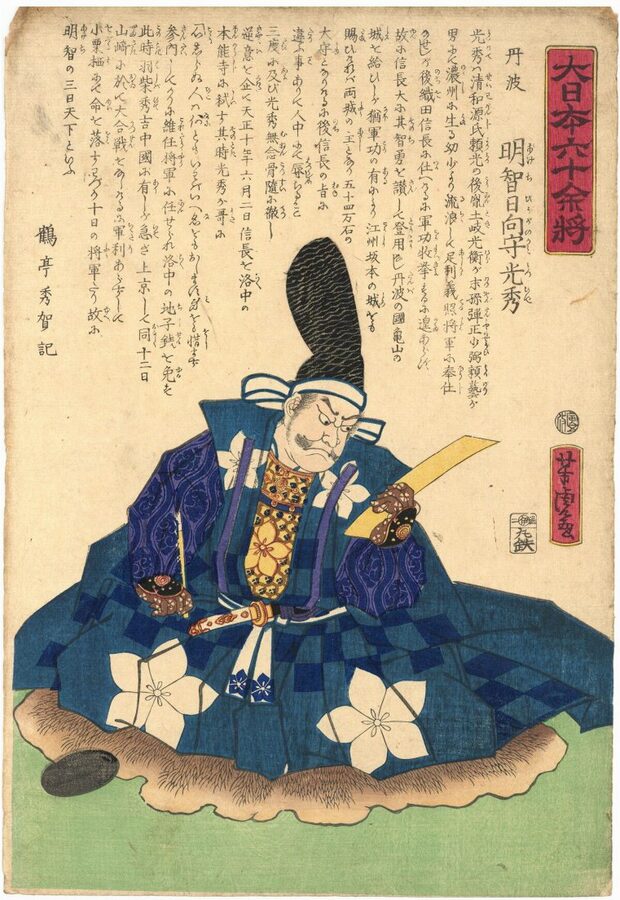
On 21 June 1582, at dawn in central Kyoto, Gracia’s father led his army into Honnō-ji and killed Oda Nobunaga. The event detonated the political order of Japan. Every Oda-aligned vassal in the country immediately had to decide whether to join Mitsuhide or crush him.
The Hosokawa, Fujitaka and Tadaoki, made their decision fast. Mitsuhide had sent personal messengers expecting his son-in-law to join the rebellion, and the messengers made a plausible case: Tama was Mitsuhide’s daughter, the Akechi-Hosokawa alliance was genuine, and the rewards for joining would be substantial. Fujitaka and Tadaoki refused.
They both shaved their heads in public mourning for Nobunaga, a political statement as much as a ritual one, and wrote to Hashiba Hideyoshi pledging the Hosokawa forces to the counter-rebellion. Thirteen days later, Mitsuhide was dead, killed during the retreat from the Battle of Yamazaki by a peasant’s bamboo spear in a grove outside Ogurusu. Gracia, nineteen, pregnant with her second son, now had a father who had killed his own lord, a husband who had publicly declared against her father, and a political situation in which any move the Hosokawa made visibly favouring her could be used against them by Hideyoshi. What they did with her is one of the most-contested chapters of the biography.
The Hosokawa household records, written a generation later, describe her as “placed in a mountain residence at Midono for safekeeping”. The Jesuit mission records, written by the Portuguese who met her in Ōsaka later, describe it as a form of house arrest. Both are true.
Tadaoki sent her, with a small retinue of ladies-in-waiting, to a remote mountain hamlet called Midono in the Tango peninsula — high, cold, forested, accessible only by one difficult footpath — and kept her there for two years, from the summer of 1582 until the summer of 1584. The Hosokawa could not openly protect her (that would have looked like sympathy with the Akechi rebels) but they could hide her, which bought time for the political dust to settle.
She was twenty when she arrived. She gave birth to her second son, Okiaki, at Midono in 1583 in a wooden farmhouse with no doctor in attendance.
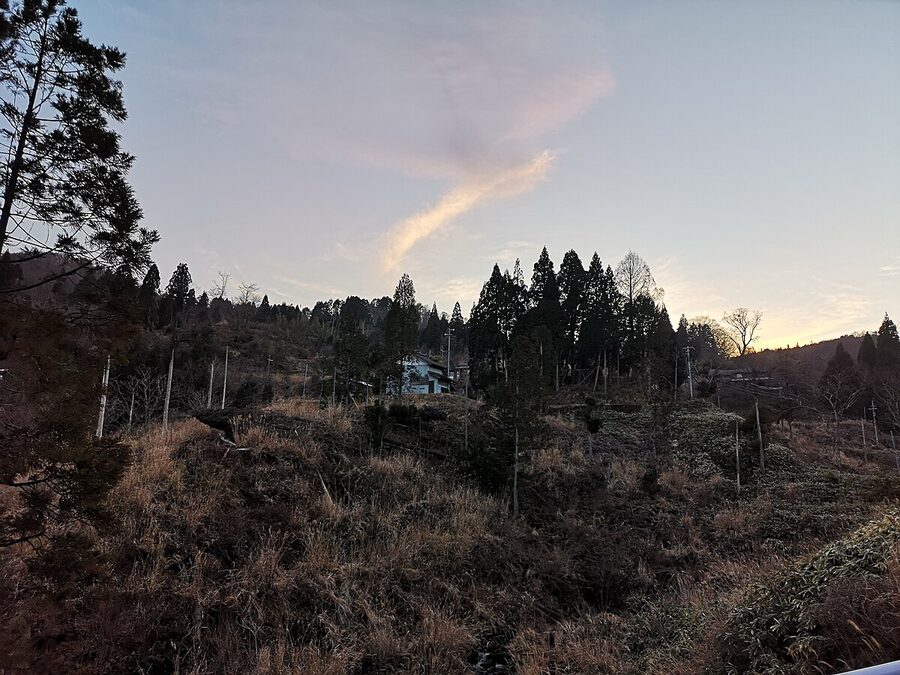
The two years at Midono mattered. The Edo-period Hosokawa chronicle the Watanabe Shūroku mentions that Gracia read through whatever books she could have sent up the mountain, and there is a late-nineteenth-century family tradition, unverifiable but plausible, that a lady-in-waiting smuggled her a Japanese translation of Thomas à Kempis’s De Imitatione Christi during this period. Whether she read the Imitatio at Midono or slightly later is not established.
What is established is that by the time she returned to the Hosokawa household in 1584, she was no longer the young woman who had gone up the mountain. She was harder, more literate, more serious. She had also, quietly, started thinking about Christianity.
The Ōsaka Residence and the Baptism
In 1584, at Hideyoshi’s direct instruction, Tadaoki formally restored Gracia to the Hosokawa household and brought her to the new residence the clan had built in the Tamatsukuri quarter of Ōsaka. She was twenty-one. She resumed her role as the senior wife, gave birth to a third son (Tadatoshi, October 1586) and a second daughter (Tara, 1588), and ran the inner household of one of Japan’s ten largest-income daimyo families. She also began, cautiously, to investigate Catholicism.
Her entry point into Christianity was a conversation with Tadaoki. He had attended a chanoyu gathering at which Sen no Rikyū‘s circle had discussed Takayama Ukon, the Catholic daimyo of Takatsuki, and his reasons for conversion. Tadaoki came back to the residence and described the conversation to her, not recommending the religion but recounting an interesting topic from the day.
But Gracia, who had already been thinking about a spiritual question of her own, asked to hear more. She then asked permission to have a book sent. Then, during a stretch when Tadaoki was away on campaign in Kyūshū, she made the more audacious move.
It was the spring of 1587, Easter week. Tadaoki was out of Ōsaka with Hideyoshi‘s main army, on the Kyūshū campaign against the Shimazu. Gracia slipped out of the residence on 21 February — the seasonal equinox, a day the other household ladies had gone to the temple for the seasonal service, a day she could plausibly have been elsewhere — and went to the Jesuit church in the Ōsaka merchant district.
She listened through the Easter sermon, cornered the Japanese Jesuit brother Takai Cosme afterwards, and asked to be baptised on the spot. Takai, who knew a dangerous political situation when he saw one, passed her up the chain to the Spanish senior Gregorio de Cespedes. Cespedes, who had not been told who she was, refused — he suspected she might be one of Hideyoshi’s own concubines, which would have been a serious problem, and he said he would not baptise her without knowing who she was.

Cespedes sent a younger priest to follow her home. When the man watched her disappear through the Hosokawa side-gate at Tamatsukuri, the Jesuits recalibrated. They could not baptise the wife of a senior Toyotomi retainer, on the main residence’s schedule, without causing an earthquake. But they could teach her.
Over the next three months, with Tadaoki still in Kyūshū and the summer approaching, Gracia sent her lady-in-waiting Kiyohara Ito to the church as her proxy student. Ito was educated, literate, and fiercely loyal to Gracia. She memorised the catechism, took baptism herself on 8 March 1587 as “Maria Kiyohara”, and then came back to the Hosokawa residence and taught the lessons to Gracia in the women’s quarters, night after night.
Then Hideyoshi, on 19 June 1587, issued the Bateren-tsuihō-rei (伴天連追放令) — the anti-Christian expulsion edict. It did not yet persecute Japanese converts, but it gave the Jesuits six months to leave the country and made any future adult baptism harder.
Father Organtino, who was running the Ōsaka mission, decided that Gracia should be baptised before the Jesuits were evicted, but that he could not risk bringing her to church a second time. He therefore authorised a proxy baptism (代洗): Kiyohara Maria, herself now recently baptised, would administer the sacrament to Gracia in the Hosokawa mansion — a procedure normally reserved for emergencies like deathbeds, shipwrecks, or wartime.
Gracia was baptised this way in late June or early July 1587, privately, in her own room, by her lady-in-waiting. She took the name Gracia, Latin for “grace”, a pun on her Japanese given name Tama (“jewel” but also “gift”).
The Thirteen Years of Secret Faith
Tadaoki came back from Kyūshū later that summer and discovered, if not the baptism itself, then at least the full extent of the Christian activity in his own household. His reaction is the most-contested passage in the biography.
The Jesuit chronicles — written in Portuguese for European audiences, and tending to hagiography — describe him as violent and threatening. There is a famous passage claiming he cut off the nose and ears of a Christian nurse in the household as a warning. The Hosokawa domestic records describe him as “displeased but forbearing” and record no specific violence.
The truth is somewhere in the middle. Tadaoki was genuinely jealous, the household records also preserve a story in which he killed a gardener at the mansion for what he perceived as excessive eye contact with Gracia, and he had not been consulted about the baptism. He was furious. But he did not renounce the marriage, did not turn her in, and did not push her toward divorce.
What he did do, on reflection, was impose restrictions. Gracia was not permitted to leave the residence. Her Christian practice had to be strictly internal and invisible. She could not attend public Mass, and she could not openly receive priests at the house.
The Jesuit records record only three further direct meetings between Gracia and an ordained priest for the rest of her life — all in emergencies, all conducted through the women’s quarters entrance, all held in her room at night. For the main practice of her faith she was dependent on proxies and written correspondence. She wrote letters to Father Organtino at the Nagasaki mission, got Latin prayer books in return, and memorised the services.
She taught the catechism to her own household servants and eventually to her daughter Cho. At its peak there were sixteen other baptised Catholics in the Hosokawa Ōsaka household, all quietly invisible, all under Gracia’s own spiritual direction.
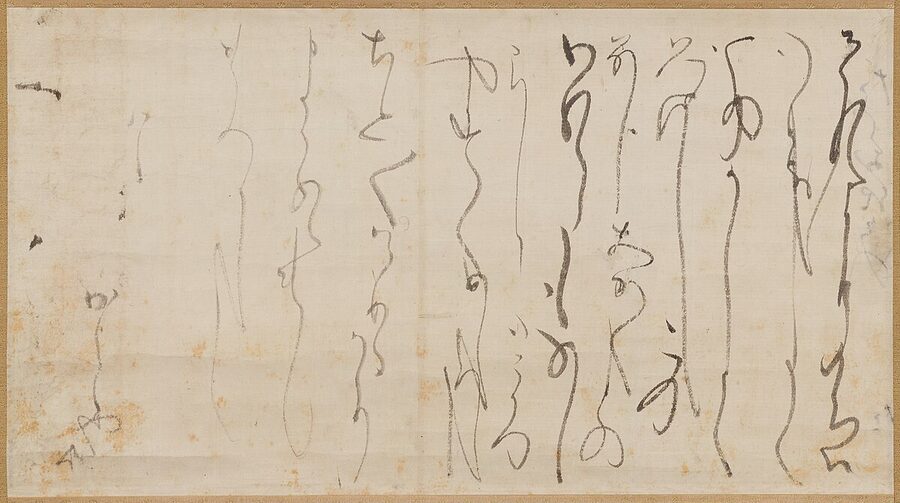
She also, during this period, wrote. Fifteen of her letters survive — ten at the National Diet Library, four at the Eisei Bunko, one at Tokyo National Museum — and she is one of the most-preserved female Japanese writers of the sixteenth century.
The letters are mostly practical: instructions to the household, condolences and congratulations to other daimyo wives, requests for books. But several are to her young lady-in-waiting Kojijū (the same one whose poetry is preserved in a separate anthology, the Nyobō Sanjūrokkasen), and these are the freer letters. In them she signs herself “Karashiya” or “Ka”, the phonetic short form of Gracia, rather than Tama. It is the earliest evidence of a Japanese Christian using her baptismal name in ordinary household correspondence.
Tadaoki’s position softened gradually through the 1590s. His younger brother Okimoto converted in 1594 under Takayama Ukon’s influence, which changed the family dynamic. Tadaoki himself did not convert, he was a Zen-practising tea man to his bones, but he began to accept that the religion was not going anywhere.
Later letters between husband and wife from this period show, behind the formality, a restored working relationship. Gracia signed some of them “Karashiya”. The marriage held.
The 1595 Rehearsal
In the summer of 1595, when their daughter Cho’s husband Maeno Nagayasu was implicated in the Hidetsugu affair and forced to commit seppuku, the politics briefly swept Tadaoki into it too. He had accepted a hundred pieces of gold from Hidetsugu, and Ishida Mitsunari, Mashita Nagamori, and Natsuka Masaie moved to have him ordered to follow Maeno.
Tokugawa Ieyasu extended Tadaoki an emergency loan to return the gold, and Hideyoshi was persuaded to back off. But for about ten days it looked possible that Tadaoki was going to be forced to die. And in those ten days he drew up instructions for the household in case it happened.
The instructions were clear. If Tadaoki received the order, he would fight his way out of Fushimi and die there; simultaneously the Ōsaka residence was to be destroyed. Gracia was not to be captured, and Tadaoki told his household commanders that if it came to that, they were to kill her rather than allow her to fall into Toyotomi hands.
Gracia, when she heard this, sent a message through a lady-in-waiting to Father Organtino at the Nagasaki mission asking whether she could in good conscience obey such an order. Organtino’s reply has not survived, but we have Gracia’s subsequent statement, recorded in the Watanabe Shūroku: she said she was “greatly satisfied” with Organtino’s answer and had “peace of mind” about it. In other words, Organtino had given her a theological path.
The Organtino doctrine, as it seems to have been given to her, ran roughly like this. A Catholic is forbidden to take her own life. A Catholic is not, however, forbidden to die by the authorised hand of another when the alternative is dishonour to her family or the cause.
The formal theological term later associated with this reasoning is that of the bellum justum tradition, and Organtino’s boss the Visitor Valignano was on record elsewhere that a Japanese convert could permissibly accept ordered death to preserve honour. The distinction is fine, and you may or may not find it convincing. Gracia found it convincing.
So when Tadaoki’s instructions were written out formally — and they were written out in the summer of 1595, and again before he left for the Sekigahara campaign in 1600 — they named a specific person to do the actual killing: her household steward Ogasawara Shōsai.
The 1595 scare passed. But Gracia had, by the end of it, accepted the structure that would kill her five years later. She had signed off on her own death mechanics.
Sekigahara, and the Order
In June 1600 — 27 June, by the lunar date — Tadaoki left Tango for the Aizu campaign against the Uesugi. He was going with Tokugawa Ieyasu, on the eastern side of what was about to become the most consequential political split of the seventeenth century. Before leaving, he revised the household instructions.
Ogasawara Shōsai was reconfirmed as the designated executioner. The core orders were unchanged: if the Toyotomi Ōsaka faction tried to take Gracia hostage, she was to die. After her death, Shōsai was to set fire to the residence and commit seppuku; the household was to fight to the last, or to die in the fire alongside them.
Within ten days of Tadaoki’s departure, Ishida Mitsunari — who was running the Western coalition against the Tokugawa from Ōsaka — had issued his first demand. On 12 July, a Buddhist nun arrived at the Hosokawa residence as an informal envoy, asking that Gracia, along with the families of the other Eastern-aligned daimyo still in Ōsaka, present herself at Ōsaka Castle for safekeeping under Toyotomi protection. The Hosokawa refused.
On 16 July a formal envoy arrived from the Western Army with a harder ultimatum: either she move to Ōsaka Castle, or a neutral relative’s residence (the suggestion was Ukita Hideie’s mansion, since Gracia’s sister had married into the Ukita family), or the Western Army would take her by force. The Hosokawa refused again. Gracia sent her final letters that afternoon — a letter to Tadaoki, a keepsake to her infant son Tadatoshi, instructions to the steward.
On the evening of 17 July, Mitsunari’s troops surrounded the Tamatsukuri quarter. The Shimo Onna Oboegaki, a memoir written by Gracia’s lady-in-waiting Shimo on the order of Gracia’s grandson Hosokawa Mitsunao in 1648, gives the sequence that night.
Shōsai’s plan was for the gate commander Inatomi Sukenao to hold the front gate while the internal protocol played out. Inatomi, though, had been ordered not to fight under any circumstances, an arrangement Mitsunari’s negotiators had apparently made with him in advance, and he went over to the Western side. Shōsai, realising his front gate was no longer defended, ran through the mansion to the inner hall with a long-bladed naginata. He announced to Gracia: “The hour is upon us.”
Gracia looked for her son’s wife Chiyo, whom she had asked to die with her; Chiyo had already fled to her father Maeda‘s nearby residence for safety. Gracia accepted that she was going to die alone. She said her prayers.
She sent her two remaining attendants, Oku and Shimo herself, out of the mansion with the instructions to survive and bear witness. She gave them the final letter for Tadaoki and a lock of her hair for Tadatoshi. She knelt, repeated the names “Jesus” and “Mary”, the Jesuit account preserves this detail, and “calmly met her end” by Shōsai’s naginata. The blade went through her chest, and she died instantly.
Shōsai then did exactly what he had been told. He killed the priest who had been kept on household staff; he killed Gracia’s Latin tutor Kiyohara Ito (Maria); he set gunpowder along the corridors of the mansion; he set the fire; he withdrew to the innermost courtyard and committed seppuku in the flames.
Roughly twenty-two Hosokawa retainers died with him, some by their own hand, some in the fire. The mansion burned for four or five hours. Gracia was thirty-seven, and the date by the Gregorian calendar was 25 August 1600 — Sekigahara was still five weeks away.
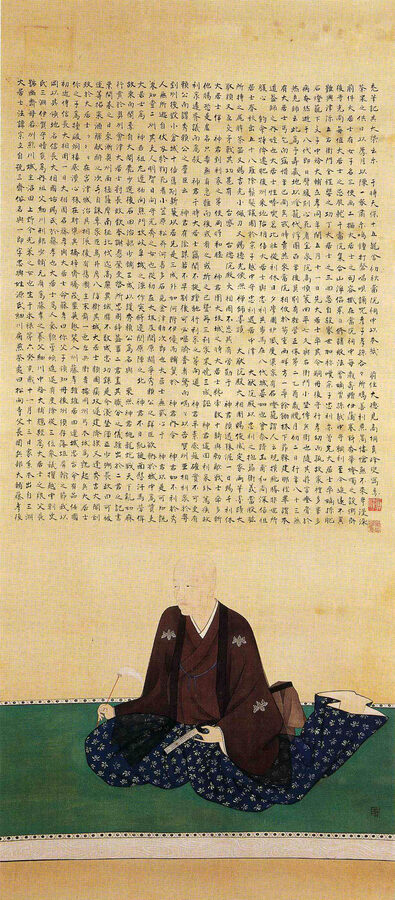
The news reached Tadaoki on 27 July, by the fastest courier possible, at the Eastern Army’s camp on the Tokaidō. The Hosokawa household record says he sat silently in his command tent for most of a day and a night, then emerged and wrote three letters — one to Organtino requesting Catholic funeral prayers, one to Ogasawara’s son granting the Ogasawara family a permanent annual 300-koku stipend, and one to Ieyasu reconfirming the Hosokawa commitment to the Tokugawa. He did not weep. He fought at Sekigahara on 15 September and was conspicuous.
The Death Poem
The death poem attributed to Gracia by the Hosokawa family chronicles is:
散りぬべき 時知りてこそ 世の中の 花も花なれ 人も人なれ
Chirinubeki / toki shirite koso / yo no naka no / hana mo hana nare / hito mo hito nare.
The translation is slippery. A literal version might run something like: “Only by knowing the hour it must fall does the blossom deserve the name of blossom in this world; the same is true of a person.” The whole point of the poem is that it locates courage as a form of timing rather than a form of nerve.
The good death is the timely death. It is also the earliest recorded use in Japanese literature of the cherry-blossom-as-falling-samurai metaphor, which would become ubiquitous three hundred years later in Meiji military poetry. The poem has been quoted at countless Japanese funerals since, and the governor of Shizuoka prefecture quoted its closing line at his 2024 resignation speech.
Organtino and the Jesuit sisters of the Ōsaka mission had the more immediate task. On the morning of 18 July they sifted through the still-smoking ruin of the Hosokawa mansion for Gracia’s remains. They could identify a small fragment of bone from the approximate location of the main hall, which they placed in a Christian reliquary and kept at the mission until Tadaoki could claim it.
A year later, Tadaoki had Organtino formally bury it with Catholic rites at Sōkoku-ji in Kyoto, a Zen temple with a Hosokawa sub-temple attached, and a formal Catholic funeral Mass was held there on the first anniversary, attended by over a thousand “noble persons”, with Tadaoki and the senior Hosokawa retainers in tears. The Jesuit account of the 1601 memorial Mass describes Tadaoki saying publicly afterwards: “I am not a Christian. But I am drawn toward this faith by many things.” It is as close as he ever came.
Tadaoki’s Long Aftermath
For the first decade after Gracia’s death, Tadaoki ran his new provinces of Buzen and Bungo — the reward Ieyasu had given him for Sekigahara — as pro-Christian domains. He staged annual anniversary Masses at the Nakatsu church; he invited Father Cespedes, who had known Gracia personally, to move from Nagasaki to Kokura when he built the new castle there in 1602.
Second and third anniversaries were celebrated with priests shipped in from Nagasaki. The Jesuits recorded that the 1604 memorial attracted spectators from all over north Kyūshū. After 1610, Tadaoki cooled; the Tokugawa anti-Christian position had hardened and he would not risk the Hosokawa political position.
When Cespedes died in 1611, Tadaoki wrote that while Cespedes had been alive “my affection for him kept me from destroying all of it”. After Cespedes, he shifted Gracia’s annual memorial from a Catholic Mass to a Pure Land Buddhist service, and quietly moved her primary memorial tablet to the Buddhist Gokuraku-ji.
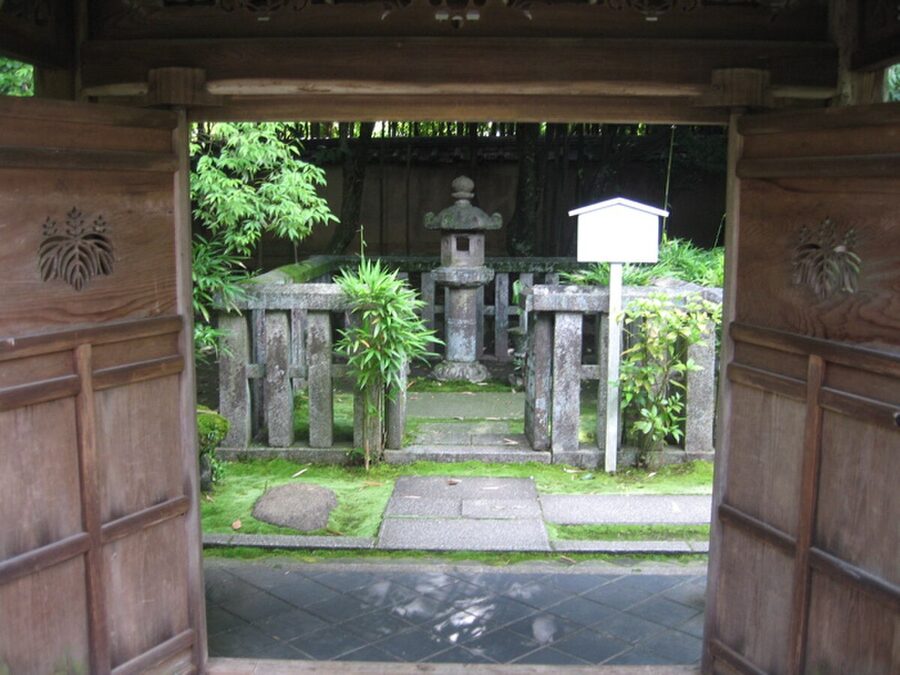
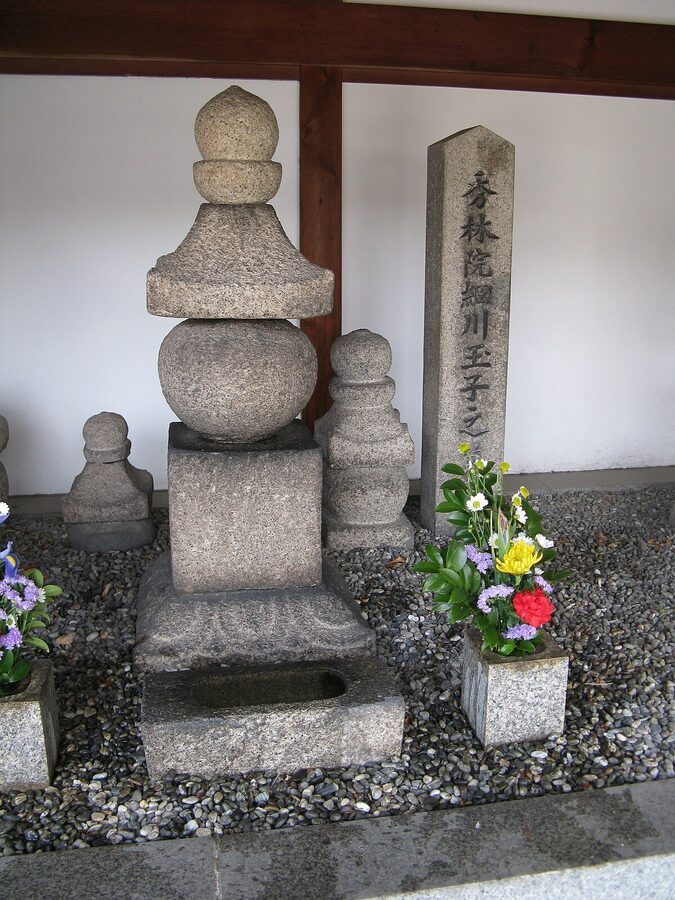
There are three separate Gracia burial sites in modern Japan, and the reason is the complicated political choreography of the Edo period. The original bone fragment was buried at Sōkoku-ji / Kōtō-in in Kyoto under Catholic rites in 1601; after 1610 Tadaoki also erected a second memorial (a five-ringed gorintō) in Pure Land style at Sōzen-ji in Ōsaka, close to the site of her death; and in the 1620s a third memorial with her posthumous Buddhist title Shūrin-in Kaoku Sōgyoku Daishi was installed alongside the other three Hosokawa family gorintō at Taishō-ji in Kumamoto. All three survive. The Kyoto grave is the primary one; the Ōsaka memorial is the site-specific one; the Kumamoto memorial is the family-continuity one.
Vienna, 1698
Gracia has a European afterlife, and the European afterlife is easily the most unlikely thing about her. Within three decades of her death, Jesuit reports of her life had reached Rome, and François Solier published a French Histoire de l’Église du Japon in 1627 which gave her a short hagiography.
Over the next forty years the German-language Jesuit writer Cornelius Hazart embellished her story into a full martyrdom narrative in his 1667 Church History of the Whole World: in Hazart’s version, her death is caused directly by her husband’s violent rejection of her faith, and her dying forgiveness reforms him. Jean Crasset’s 1689 Histoire de l’Église de Japon refined this further.
Then, in 1698, something remarkable happened. On 31 July of that year, for the feast day of Empress Eleonora Magdalene of Habsburg, the Jesuit gymnasium in Vienna staged a music drama titled Mulier Fortis — Die standhafte Fürstin: Gracia, die Königin von Tango.
The libretto was written by the Jesuit schoolmaster Johann Baptist Adolph, and the score was composed by Johann Bernhard Staudt. The story was Gracia’s, filtered through Hazart’s Catholic-exemplar version. Two performances were given at court, and Empress Eleonora Magdalene sat through both.
The Habsburgs, in other words, had turned a samurai woman’s death into a Catholic opera 6,000 miles and a century away from where it actually happened, and performed it for the highest-ranking Catholic woman in the German-speaking world.

The Mulier Fortis story then ran backwards into Japan through the Meiji period. Crasset’s Histoire was translated into Japanese from 1878 to 1880 as Nihon Saikyōshi (日本西教史), the European Catholic version of her story arrived in Tokyo, and the combined Protestant/Catholic interest in the 1890s-1920s did more than anything to turn her into a household name in Japan.
By the 1921 lecture by Nishimura Shinji in the journal Chūōshidan, the name “Gracia” had become the standard Japanese designation. The name “Tama” now feels like the formal archaic form, which is the exact inversion of her own lifetime. She won this fight posthumously, and she made her own baptismal name the one that survives.
Where You Can Visit Gracia’s Story Today
Four places, across four prefectures. Kyoto is the most concentrated; the Tango peninsula and Kumamoto need a full day each. If you are building a trip around her, fly into Kansai, base in Kyoto, take a day to the Tango peninsula for Midono, and if you have a full week add the Kumamoto day at the end. Kokura, Tadaoki’s base after Sekigahara, is covered separately in his article rather than duplicated here.
1. Kōtō-in at Daitoku-ji — Kyoto (the primary grave)
Kōtō-in (高桐院) is a small sub-temple within the large Daitoku-ji Zen complex in northern Kyoto. It was founded in 1601 by Tadaoki’s uncle Gyokuho Shōsō, the same year as Gracia’s Catholic memorial Mass, as the Hosokawa family bodaiji. The joint grave of Tadaoki and Gracia sits in a mossy courtyard behind the main hall, marked by the stone lantern Tadaoki inherited from his teacher Sen no Rikyū and which he chose as her grave marker on his deathbed.
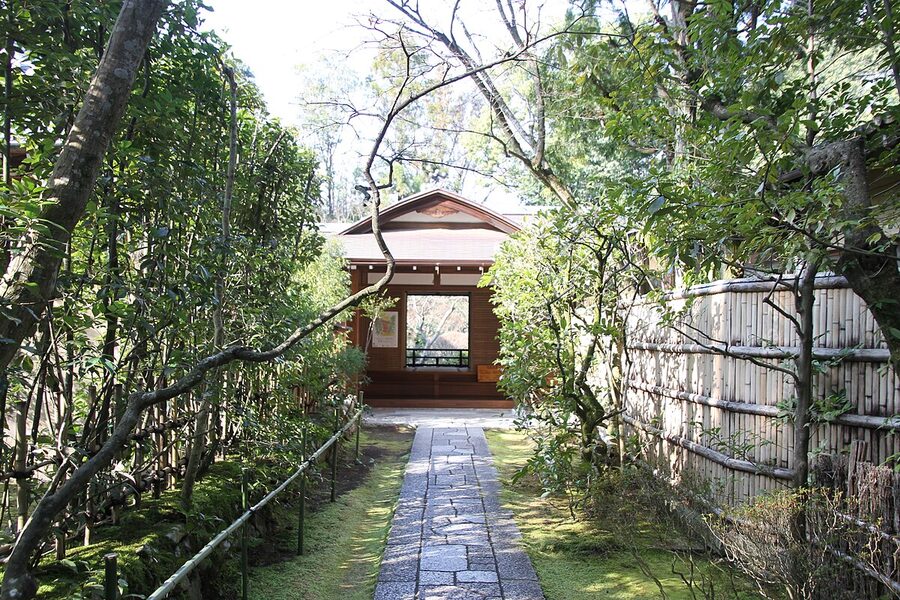
Access: fifteen-minute walk from Kitaoji station on the Karasuma subway line, then four hundred metres along the Daitoku-ji approach lane. Kōtō-in is the second sub-temple on the left. Admission is generally ¥500, though during the spring and autumn Special Viewings (March-May and November) the price goes up to ¥700 for the garden-plus-tea option. The tea option is worth it: you sit on the veranda overlooking the main garden with a bowl of matcha and a Hosokawa-family seasonal sweet, and you can stay as long as you like.
Two warnings. First, Daitoku-ji as a whole is a working Zen training monastery, and the sub-temples that are open to the public rotate. Kōtō-in is one of the more reliably open, but check the day-of-visit schedule before you go; the main temple office is at the south end of the complex.
Second, photography of the grave itself is requested-not-to-do. Plaques at the pagoda make this very clear. Photograph the approach, the garden, and the stone marker from a distance — do not photograph the grave itself or the stone lantern up close.
If you have two hours, the onward walk west along Kitaoji takes you to Jukkō-in, the sub-temple that contains the grave of Sen no Rikyū — Tadaoki’s tea master — and the connection between the two families, which is discussed in detail in that article, makes the pair of visits meaningful. Budget a full afternoon for the combined Daitoku-ji circuit.
2. Midono (味土野) — Kyōtango, northern Kyoto prefecture
Midono is the mountain hamlet where Tadaoki hid Gracia between 1582 and 1584. It is in the Tango peninsula, inland from the coastal city of Miyazu, about a three-hour train-and-bus journey from Kyoto station.
Once you arrive, what you actually see is a very narrow forested valley with three or four surviving houses, a steep footpath, a mountain waterfall, and a 1936 stone monument marking the location of the hiding residence. It is not a museum, there is no bus stop — it is simply a place you walk into, think about for half an hour, and walk out of.
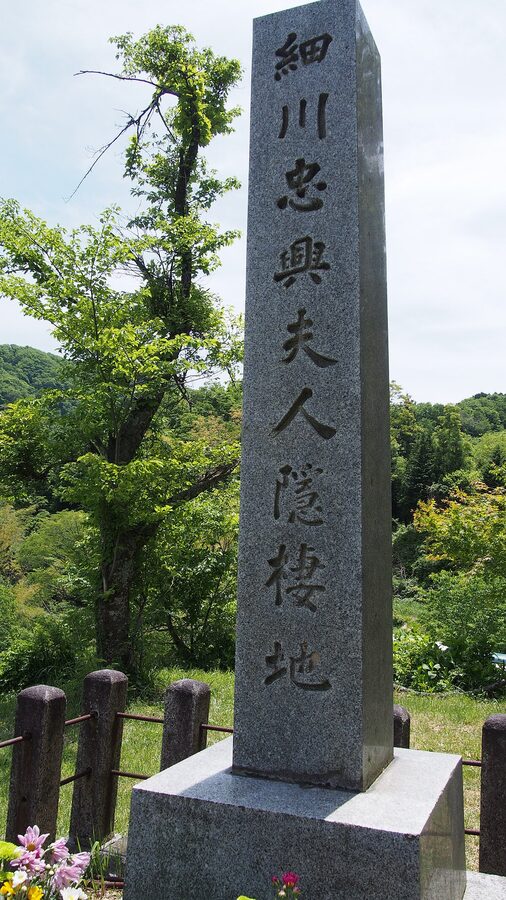
Access: KTR Tango Railway to Mine-yama Kunda station, then a taxi-or-bus twenty minutes into the mountains. There is one morning bus and one evening bus; if you miss the evening bus you are walking back to the station, which is not a short walk. If you have a rental car, drive it — the hamlet road is paved and perfectly fine, but narrow. Budget a half-day round trip from either Kyoto or Osaka.
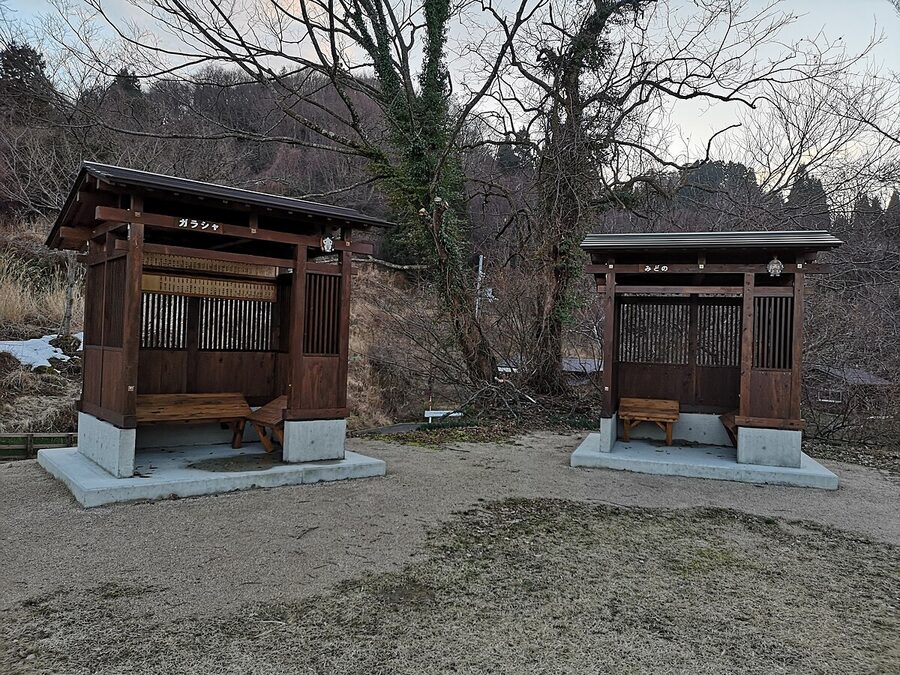
The nearby Midono Otaki waterfall is a two-minute walk beyond the monument, and is the only source of mountain water Gracia’s household would have had in 1582-1584. In late autumn there is no tourist anywhere. The walk between the monument, the shelters, and the waterfall takes forty minutes at a walking pace. If you want to put a layer of experiential understanding onto what a “mountain hiding” meant in Sengoku Japan — the cold, the isolation, the forest closing over the path — Midono is the best site in the country to do it.
3. Shōryūji Castle — Nagaokakyō, south of Kyoto (where she was married)
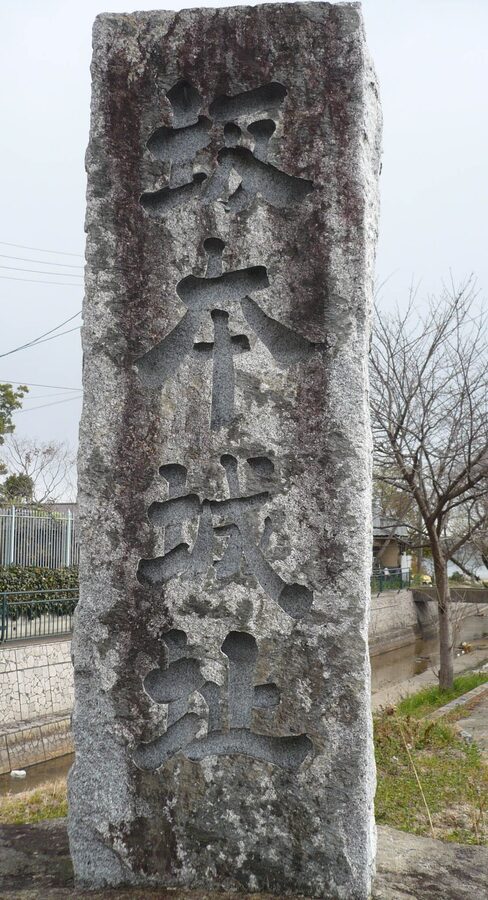
Shōryūji Castle (勝龍寺城) is the site of Gracia’s 1578 wedding to Tadaoki. It sits in Nagaokakyō city, on the JR Kyoto Line about twelve minutes south of Kyoto Station. The castle itself was minor-scale and was decommissioned in the early Edo period; the current reconstruction is a 1992 project by Nagaokakyō city, built as a park with an interpretive museum in the reconstructed gate-house. The keep replica is small, effectively a three-story museum tower, but the setting is pleasant, and the second-floor interpretive panels include a detailed reconstruction of the 1578 wedding ceremony with the original guest list.
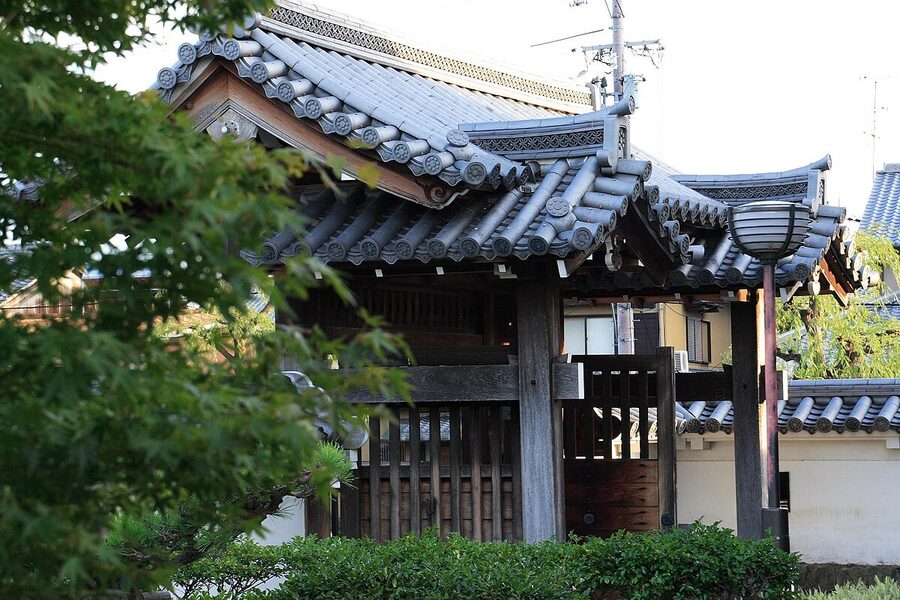
Access: JR Nagaokakyō station on the Kyoto Line, eleven-minute walk. Admission to the castle park is free; the gatehouse museum is ¥200. Budget forty-five minutes at the site.
If you are going on the second Sunday in November, the Gracia Festival parade starts at 10:30 and the streets around the castle are closed for it until about 15:00; buy a ticket for the reserved-seating tent at the castle lawn in advance, because the day itself fills up fast. The Gracia costume of the lead processional is borrowed from the Kyoto Fushimi Museum collection and is one of the better-researched Sengoku-period reconstructions you can see in public.
4. Taishō-ji and the Kumamoto family memorial
Taishō-ji (泰勝寺) is the Hosokawa family bodaiji in Kumamoto, at the edge of Suizenji Park east of Kumamoto Castle. Tadaoki’s son Tadatoshi, when he was transferred from Kokura to Kumamoto in 1632, brought the Hosokawa family memorial tablets with him and built Taishō-ji as the family’s new bodaiji. Four identical-sized gorintō five-ringed memorial stones sit in a row in the inner temple compound: Hosokawa Fujitaka and his wife, Tadaoki, and Gracia. Gracia’s stone carries the posthumous Buddhist title Shūrin-in Kaoku Sōgyoku Daishi (秀林院華屋宗玉大姫), which Tadaoki chose.
Access: Kumamoto Station to Suizenji-koen station on the tram line, then a five-minute walk into the park. Taishō-ji is at the back of Suizenji Park’s east side, sharing ground with the Izumi Shrine. Admission is free; budget forty minutes.
Combine it with Suizenji Garden (one of the three great Edo-period gardens) and then the full-day visit to Kumamoto Castle itself, which is a twenty-minute tram ride back west.
The Izumi Shrine, adjacent, deified Hosokawa Fujitaka, Tadaoki, Tadatoshi, and later Gracia herself as the resident kami of the Hosokawa line in the Meiji period. It is a Meiji-era innovation, 1878, not an old cult, but it gives you a sense of how the family continued to be understood a century and a half after Gracia’s death. She was, eventually, canonised twice — once by Rome’s informal beatification process (still technically pending; there is a 1981 petition from the Archdiocese of Tokyo) and once by a Shinto deification ceremony in Kumamoto. It is hard to think of another Japanese figure who managed both.
5. The Ecchui well and the Ōsaka Catholic sites
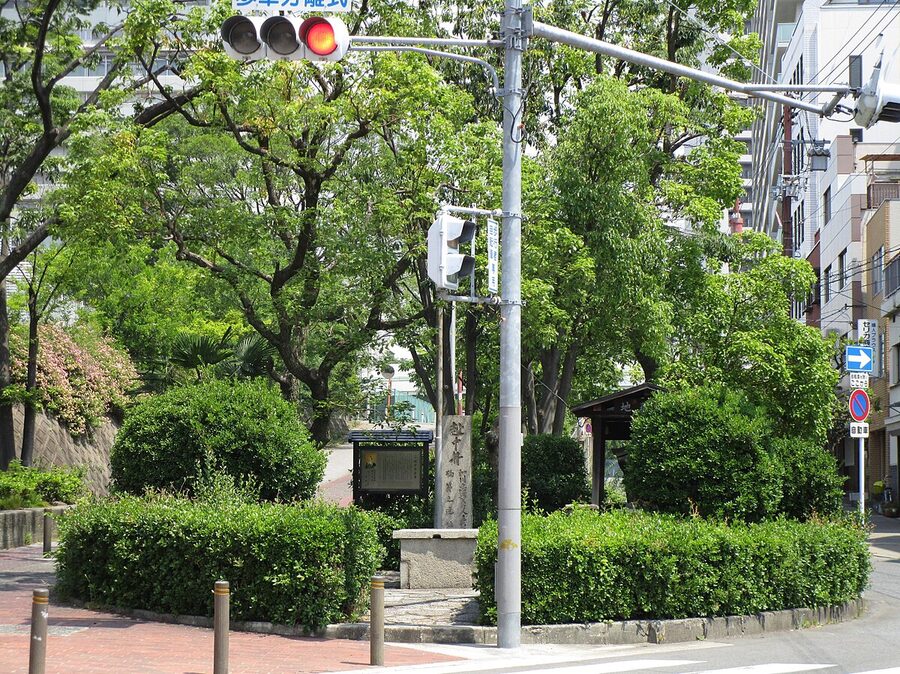
If you are in Ōsaka anyway, two small stops in the Chūō-ku / Higashiyodogawa-ku area. The Ecchui well (越中井), pictured earlier, is the preserved residential well from the Tamatsukuri Hosokawa mansion, on the modern Tamatsukuri-chō street. It is a two-minute walk from Ōsakajō-kōen-mae station.
The marker stone identifies the site as the “former residential well of the Hosokawa clan, home of Hosokawa Gracia 1584-1600”. The well itself is a small square-cut stone housing on the pavement edge; the whole site takes five minutes to see.
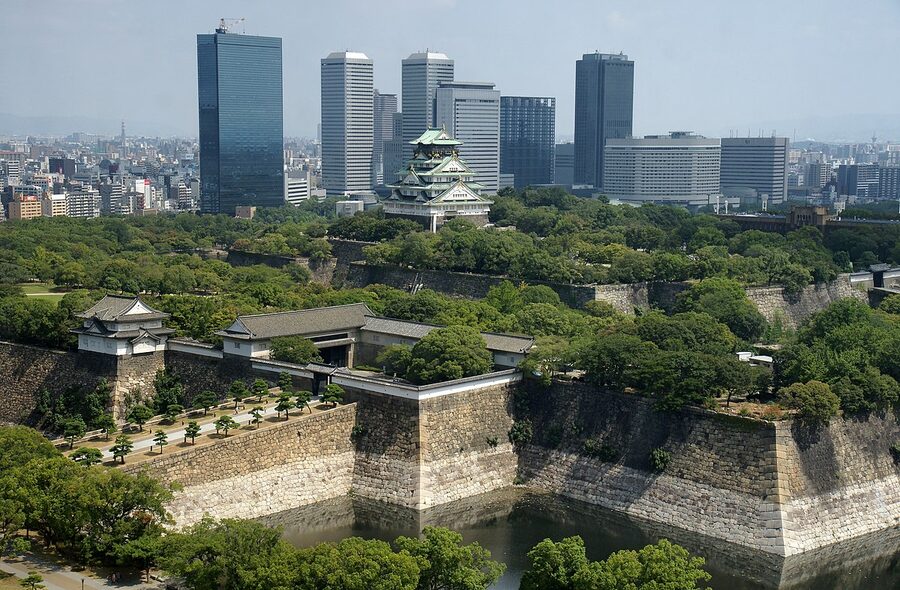
Sōzen-ji (崇禅寺), as discussed above, is the Pure Land temple in Higashiyodogawa where Tadaoki installed Gracia’s on-site memorial gorintō after 1610. It is a ten-minute walk from Higashiyodogawa station on the JR Kyoto Line. The temple is modest, working, and the Gracia gorintō sits in the north-east courtyard next to a head-mound for the Ashikaga shogun Yoshinori. If you do both of these with a visit to Ōsaka Castle (twenty-minute walk east) you can finish the trio in a single easy afternoon.
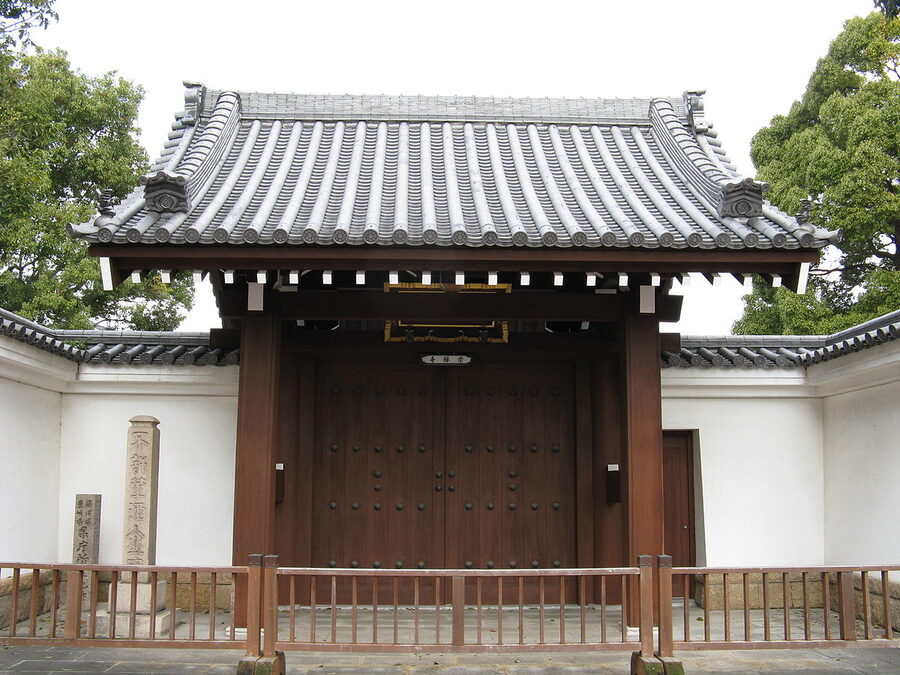
6. Akechi Jinja — Fukui
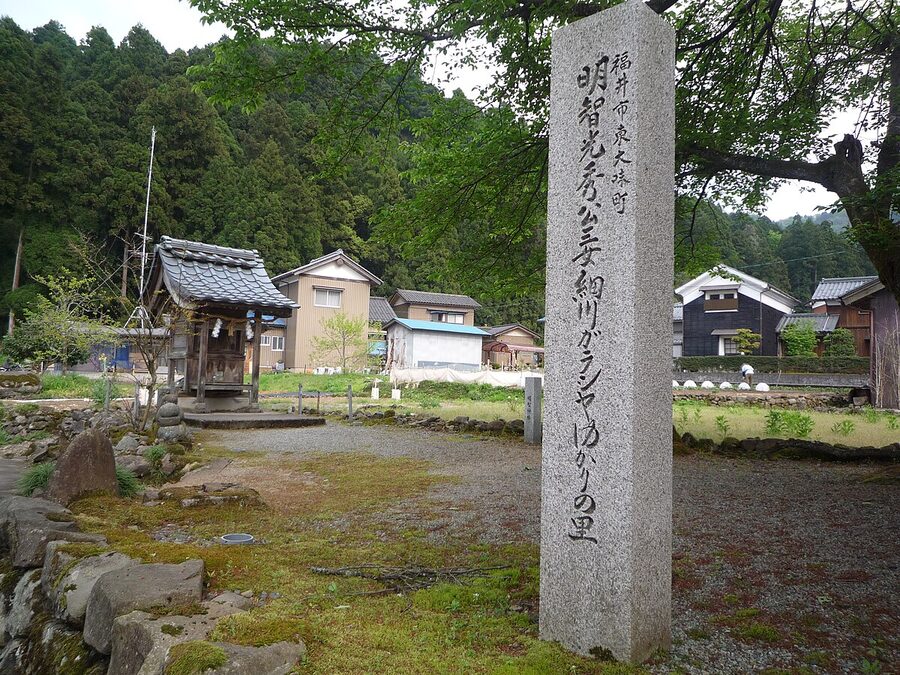
Akechi Jinja (明智神社), in eastern Fukui city, is a modest shrine at the former Akechi family residence site where Mitsuhide is believed to have lived before entering Nobunaga’s service, and where Gracia may have been born. The shrine is a Meiji-era foundation (1886) commemorating Mitsuhide and, informally, his daughter Gracia as the “celebrated daughter of this house”. It is the only Gracia-adjacent site in northern Japan; if you are in Fukui anyway, it is a twenty-minute bus ride from Fukui Station and can be combined with the Asakura Ichijodani castle-ruins park in the same afternoon.
A Note on the Imperial Line
There is a small genealogical curiosity that is worth ending on. Gracia’s eldest son Tadataka was disinherited by Tadaoki in 1600 (nominally because his own wife Chiyo had fled to the Maeda residence rather than die with Gracia), but Tadataka’s daughter married the Kyoto court noble Saionji Saneharu. The Saionji line intermarried into the Ogimachi line. From there, through six more generations of court marriages, the blood reaches the Meiji emperor — meaning that the current Japanese imperial family, and the living Emperor, carry Gracia’s DNA, and through her also Akechi Mitsuhide‘s.
This is not widely known in Japan, because the Akechi line is not something the Imperial Household Agency particularly celebrates. But it is in the genealogies. The man who killed Nobunaga is, several centuries and a few remarriages down the line, the current Emperor’s ancestor. Gracia, who in 1582 had to be physically hidden in a mountain hamlet because her father had just detonated the political order of Japan, is part of that line too, through a son she never knew would have a line at all.
Closing
If you are in Kyoto in November, go to the second-Sunday Gracia Festival at Shōryūji. Then, the next morning, take the subway to Kitaoji and walk into Kōtō-in through the maple-shaded approach path. The stone lantern at the end of it is her grave marker — the one Sen no Rikyū gave to Tadaoki, and that Tadaoki gave to her on his own deathbed forty-six years after she died.
It has sat in that courtyard continuously since, maintained for twelve generations by the Hosokawa family. She asked Ogasawara Shōsai to strike her down with a naginata because the alternative was to be taken hostage against her husband’s loyalty. The order of the strike was her own decision — the courage was timing, not nerve.
Her husband knew that; her tea master’s lantern on the grave knows it too. If you visit in late autumn, the maples in the Kōtō-in courtyard are turning, and if you stand next to the marker for a minute and think about 17 July 1600 — the name, the prayer, the naginata — you come out of Daitoku-ji into Kyoto afternoon sun feeling that you have come through something.


.jpg)

.png)


.jpg)


_Hosokawa_Gracia_haka.jpg)


.jpg)


_sanmon.jpg)
