On the twenty-eighth day of the second month of the nineteenth year of Tenshō, 21 April 1591 by the modern calendar, a seventy-year-old merchant’s son named Sen Sōeki sat on a mat in his Jurakudai tea room in central Kyoto and cut his own abdomen open with a short blade. Outside the compound wall, two thousand of Uesugi Kagekatsu’s soldiers stood in a cordon ordered that morning by Toyotomi Hideyoshi. The cordon was not there to make sure the condemned man went through with the act. It was there to make sure his students couldn’t ride in and save him.
Three of those students tried anyway. Maeda Toshiie spent most of the previous night begging Hideyoshi for clemency at Jurakudai’s audience chamber and was refused. Hosokawa Tadaoki and his father-in-law Furuta Oribe organised an armed intervention party; the Uesugi cordon turned them away at the compound gate.
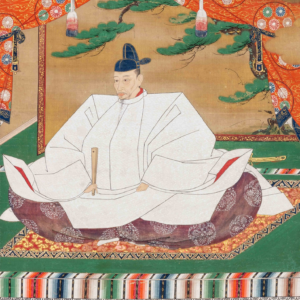
The old tea master inside the compound was the most powerful artistic figure in Japan. The man who had just ordered him to die was the most powerful political figure in Japan, and had been the tea master’s personal patron for exactly nine years.
When the head came off it was taken to Ichijō Modori-bashi on the Imperial Palace’s northern boundary and displayed on a pike. Above the head, Hideyoshi had a wooden effigy of Rikyū rigged so the effigy’s straw-sandalled foot stood directly on top of the severed neck. The tableau was not subtle. It was meant to communicate, in the one language a Sengoku populace could reliably read, that the regent of Japan had crushed a commoner whose aesthetic authority had rivalled his own political authority, and that nobody should get confused about which form of power outranked the other.
For the broader thousand-year context of the tea ceremony tradition Rikyū brought to its final form, see the companion piece on chadō. This article is the personal biography — the Sakai merchant childhood, the rise through Nobunaga’s and then Hideyoshi’s courts, the five or six theories about why the seppuku order came down, and the afternoon of 21 April 1591 itself. It is the story of how one of Japan’s great aesthetic minds was talent-spotted out of a fish-monopoly warehouse in Osaka and, sixty-nine years later, placed inside a Uesugi cordon in Kyoto with a short sword on a lacquer tray.
In This Article
- Tanaka Yoshirō, born Sakai 1522
- The Jōō apprenticeship and the Sakai merchant-tea circle
- Nobunaga, the Sansōshō trinity, and the meibutsu politics
- The Hideyoshi transition, 1582–1585
- The Golden Tea Room and the 1587 Kitano Ōchanoyu
- The 1589 Daitoku-ji Kinmōkaku gate
- Why the order came down — the six main theories
- The afternoon of 28 February 1591
- What Rikyū actually built
- Family scattered, three Senke schools founded
- Where to walk the Rikyū story today
- Sakai Rishō-no-Mori, Sakai city
- The Rikyū Yashiki-ato and Nanshū-ji, Sakai
- Tai-an at Myōki-an, Ōyamazaki
- Daitoku-ji and the Kinmōkaku gate, Kyoto Kita-ku
- Urasenke Konnichi-an, Kyoto Imadegawa
- Rikyū-ki memorial, 28 February each year
- The Raku Museum, Kyoto
- What he left behind
Tanaka Yoshirō, born Sakai 1522
The boy who would become Sen no Rikyū was born Tanaka Yoshirō (田中与四郎) in the eighth month of the second year of Daiei, in the merchant city of Sakai on the Osaka coast. His father Tanaka Yohei ran the family business under the trade-name Totoya (魚屋), “fish-shop” — a warehouse operation holding salted-fish monopoly rights plus contract storage for other merchants’ inventory. His mother was known under her Buddhist name Gesshin Myōchin. His younger sister Sōen was sent into a religious-adjacent tea-household line that eventually became one branch of the Hisada-ryū.
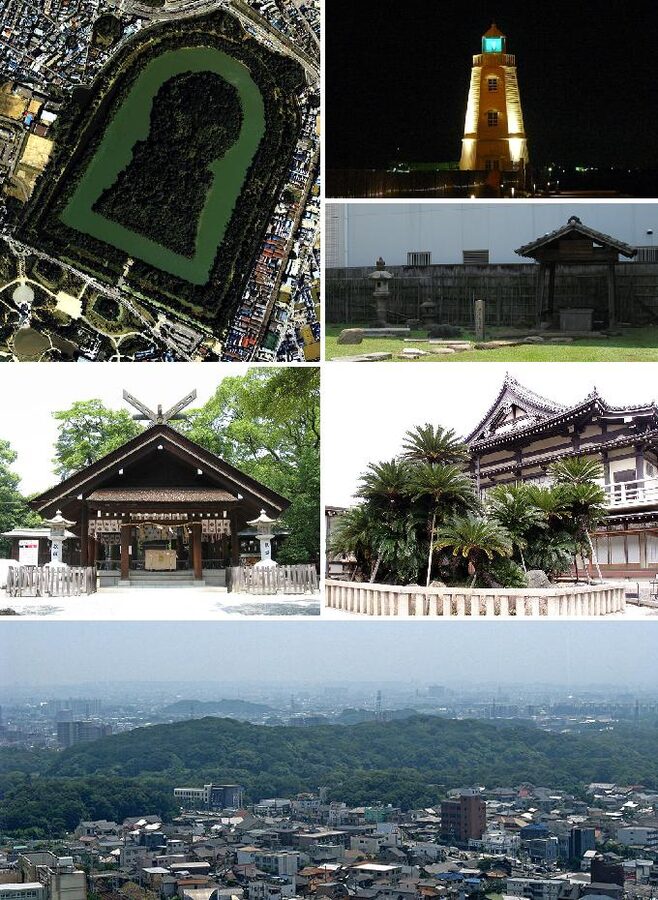
Sakai in the early 1500s was not a normal city by the standards of anywhere else in Japan. It was a walled, self-governing merchant republic on the Osaka coast, administered by a ten-man council of senior traders called the egōshū, with its own militia, its own ships, and a near-monopoly on the Ming-dynasty and Korean import trade. The Portuguese had started calling at the port in 1543 and the arquebus manufacturing industry had taken root there almost immediately. By the time Rikyū was a teenager, Sakai was producing the firearms that would, inside two generations, rewrite Japanese warfare.
The city’s merchant families ran a parallel cultural economy alongside the guns and the silk. Money bought tea utensils, tea utensils bought social weight, social weight bought political access, and the Tanaka-Totoya family sat comfortably inside this system. When Rikyū was nineteen, in 1540, his father died and his grandfather died within about a year of each other. The Ryokutai Bokuseki chronicle kept at the Fushin-an records him performing his grandfather’s seventh-year memorial (which puts the grandfather’s death at 1541) in such poverty that he could not afford the offerings, and wept while cleaning the grave-stone.
The poverty was structural, not personal. The Ōnin War aftershock had collapsed the old merchant-monopoly protection regimes, and the Sakai trading houses were going through a generational reset. The Tanaka family’s salt-fish monopoly rights held — Rikyū’s own death-inventory deed, written four decades later, still lists them — but the insurance cushion the grandfather’s generation had enjoyed was gone.
Rikyū started tea lessons at seventeen, almost certainly as a form of social survival as much as aesthetic inclination. Tea-competence was the merchant-class credential that opened the door to the city’s inner political circle, and he needed a door.
The Jōō apprenticeship and the Sakai merchant-tea circle
Rikyū’s first teacher was Kitamuki Dōchin (北向道陳), a relatively obscure Sakai tea master about whom not much else is known. Dōchin taught him the basic mechanical sequence — the choreography of kettle-to-bowl-to-guest that defined the pre-wabi tea of the 1540s — and introduced him, within about a year or two, to the man who would actually shape his career. That man was Takeno Jōō (武野紹鷗), a wealthy leather-goods merchant and student of the foundational wabi-cha theorist Murata Jukō.
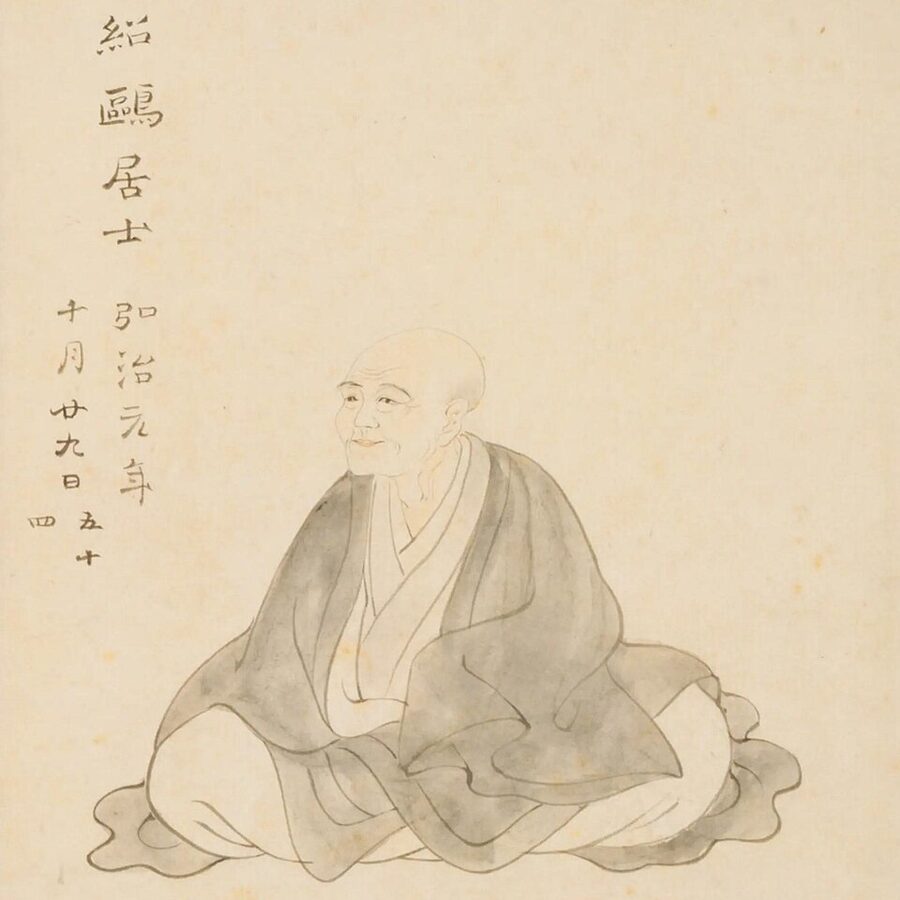
Jōō was the load-bearing middle generation of wabi-cha. Murata Jukō (1423–1502) had theorised the austere, native-material, deliberately-humble version of the ceremony in the late 15th century as an explicit contrast to the karamono Chinese-import luxury tea that dominated the Ashikaga court. Jōō inherited this theory in the 1530s and institutionalised it inside the Sakai merchant circle, pushing the tea rooms smaller, the bowls more irregular, the decorations sparser. By the time Rikyū became his student around 1542, Jōō was the single most influential tea theorist alive.

There is a minority-view question mark that scholars should note. The Yamanoue Sōji Ki — the most reliable contemporary tea chronicle, kept by Rikyū’s senior student Yamanoue Sōji — describes Rikyū’s second teacher as Tsuji Gensai (辻玄哉), not Jōō directly. Modern ja-wiki historiography treats this as evidence that Rikyū may have reached Jōō’s school through an intermediary rather than as a direct personal student, and that the later mythology of a Jōō → Rikyū direct line was amplified after the fact by the Fushin-an successor house.
For practical purposes the doctrine is Jōō’s. The exact contact mechanism is slightly fuzzier than the standard version admits.
Rikyū’s first securely-dated tea gathering is 27 February 1544. He was twenty-one, he invited the chronicler Matsuya Hisamasa and two others, and the bowl he used was the Shukō-chawan — a blue-tinged celadon that had technically failed as a proper green celadon in the kiln and had therefore been downgraded from its intended luxury tier. Jukō himself had owned and used this bowl, treating its kiln-failure as an aesthetic virtue. Rikyū’s choice of opening utensil was a statement; he was claiming the Jukō line as his own before he had any standing to make that claim.
By the 1550s Rikyū was running a substantial personal business alongside his tea practice. He sold the Jukō bowl to the daimyō Miyoshi Jikkyū around 1560 for a thousand kan — roughly a year’s cash income for a mid-sized castle town. The transaction is recorded in the Yamanoue Sōji Ki, and it is the earliest hard evidence of tea utensils as a genuine financial asset class.
By the time the Oda Nobunaga expansion reached Sakai in 1568-1569, Rikyū was one of the three most senior tea men of the city, with Imai Sōkyū and Tsuda Sōgyū, and had become a formal member of the egōshū merchant council that ran Sakai’s civic affairs.
Nobunaga, the Sansōshō trinity, and the meibutsu politics
Oda Nobunaga entered Kyoto in the ninth month of Eiroku 11 (October 1568) as the armed sponsor of the new shogun Ashikaga Yoshiaki. Sakai’s merchant republic declined to submit to the new regime on Nobunaga’s initial terms. Nobunaga’s response was direct; he surrounded the city in early 1569 and extracted a 20,000-kanmon tribute demand plus direct control of the port’s administration.
The merchant council capitulated. Sakai lost its independence and became part of Nobunaga’s direct-revenue domain.
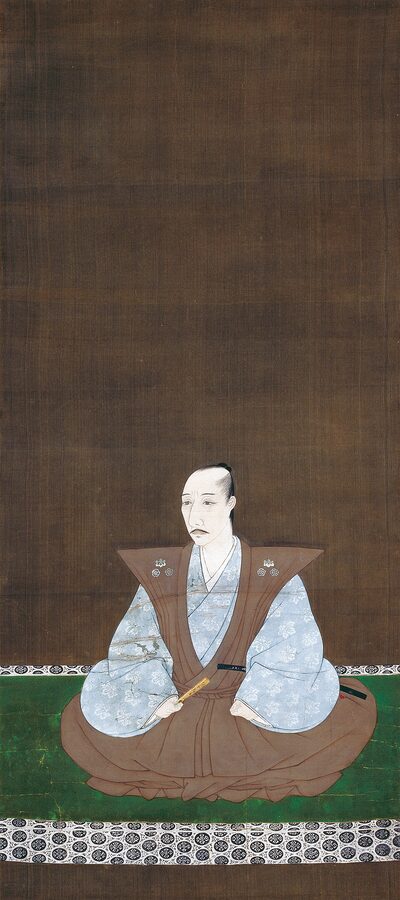
Part of Nobunaga’s Sakai arrangement was administrative; part of it was cultural. He pulled the three senior Sakai tea men — Imai Sōkyū, Tsuda Sōgyū, Sen no Rikyū — into his personal service as sadō, court tea masters. The three of them together came to be called the Sansōshō (三宗匠), the tea trinity. Imai was the senior; Tsuda was the wealthiest; Rikyū was the youngest and, in 1569, probably the least famous outside Sakai.
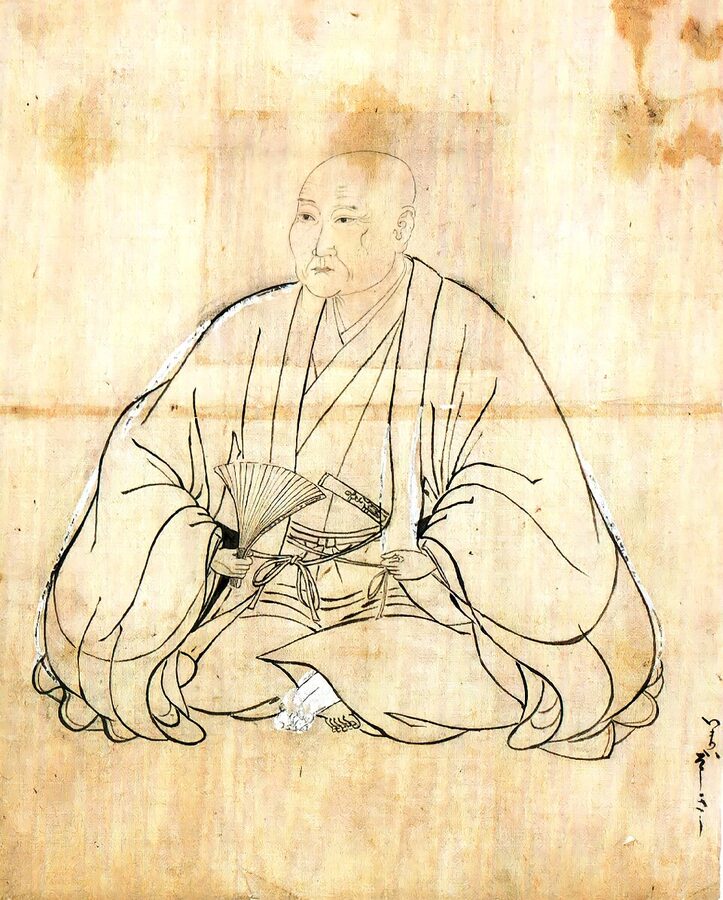
What Nobunaga actually wanted from the three men was not primarily tea-making competence. It was a valuation authority. Nobunaga had understood a political fact about Sengoku Japan that the Ashikaga court had half-understood and that Hideyoshi would later take to an extreme.
Famous tea utensils — called meibutsu — had a social weight and a political currency that in some circumstances exceeded their face value. A daimyō whom the warlord could not give another province could still be given a named tea bowl from the warlord’s hand. The social weight of that gift could substitute, usefully, for a land grant.
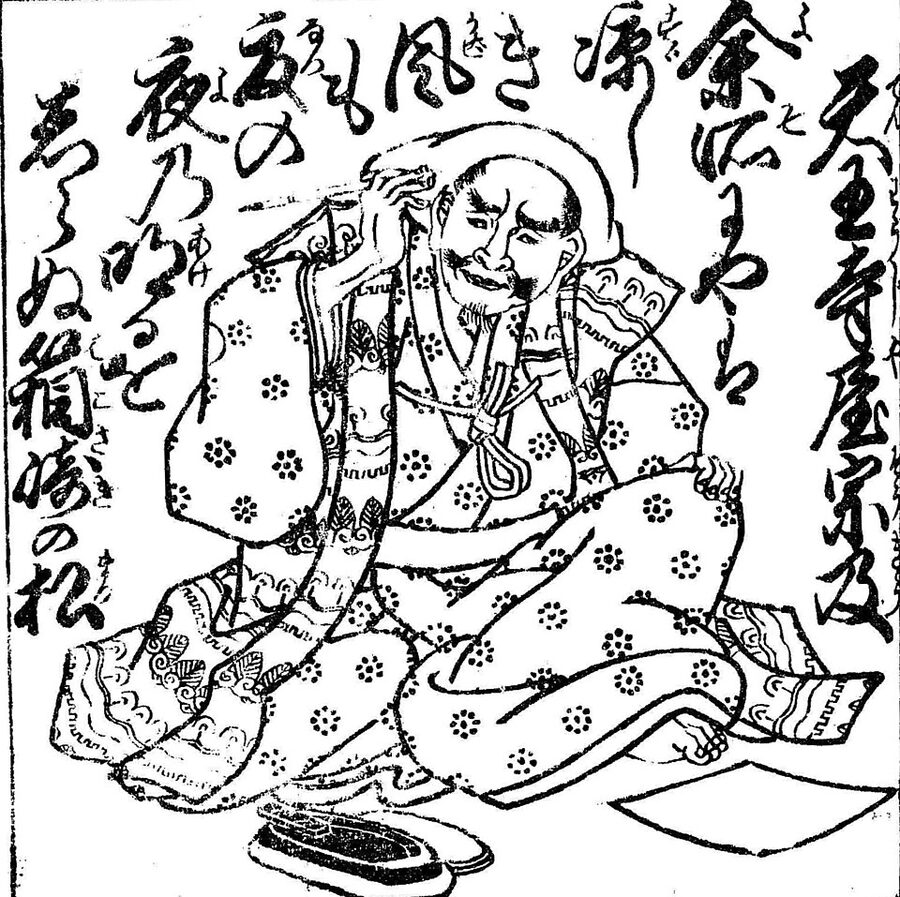
This political doctrine, formalised as ocha no yu goseidō (御茶湯御政道, “the tea-hot-water political doctrine”), required that someone decide what was a meibutsu and what wasn’t. The three Sakai tea masters were now those someones. Nobunaga sent them around the realm on utensil-accumulation missions; they evaluated, they catalogued, they added to the Oda collection. Rikyū’s role during the 1570s was as much accountant and authenticator as it was ceremonial host.
The collection-accumulation had violent edges. In 1577 the rebel daimyō Matsunaga Hisahide was trapped by Nobunaga’s forces inside his Shigisan Castle with the realm’s most famous tea kettle — the Hiragumo, “flat spider” — in his possession. Nobunaga offered Hisahide his life in exchange for surrender of the kettle. Hisahide, who had been tea-collecting himself for decades and understood the political economics of the gesture exactly, climbed to the top of his burning keep with the Hiragumo and detonated both the kettle and himself with explosives strapped to his waist.
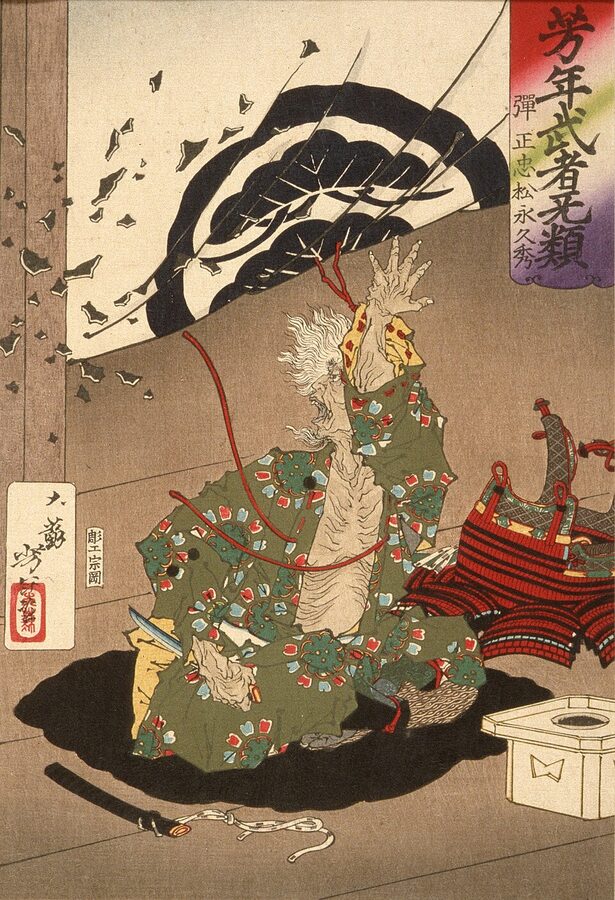
The Hisahide episode is a useful index of what the meibutsu politics looked like when it reached its extreme. A castle keep, a rebel warlord, a famous tea kettle, and an explosive demolition by the warlord who decided that destroying the object outranked surrendering it. Rikyū lived through this event as Nobunaga’s tea authenticator. By the time of the Honnō-ji Incident in the sixth month of 1582, when Akechi Mitsuhide killed Nobunaga, Rikyū was sixty years old, had served as tea authenticator for thirteen years, and had accumulated a personal reputation independent of the three-man trinity.
The Hideyoshi transition, 1582–1585
The Honnō-ji Incident detonated on 21 June 1582. Thirteen days later, at the Battle of Yamazaki, Hideyoshi killed Akechi Mitsuhide and succeeded to the Oda succession by the force of that single victory. Two months after Yamazaki, in the eighth month of 1582, Rikyū formally entered Hideyoshi’s service as personal tea master.
He was sixty; Hideyoshi was forty-six. Neither man, on the evidence of their surviving correspondence, thought the arrangement would last beyond a few years.
The first commission Hideyoshi gave Rikyū was a tea room. Rikyū spent roughly six months designing and building it, finishing in the third month of 1583. The building was the Tai-an at what became Myōki-an temple in Ōyamazaki — the only tea room surviving today that Rikyū definitely designed himself, now a National Treasure.
In a letter Rikyū sent to the fellow tea man Yabuuchi Jōchi on 14 November 1582, he complains that Hideyoshi has asked for something “troublesome”. The meiwaku koto phrase in the letter is almost certainly about the Tai-an commission.
“Troublesome” is doing a lot of work in that Jōchi letter. The Tai-an Rikyū ended up building was two tatami mats — roughly 3.3 square metres of floor space — with mud-plaster walls, a bamboo ceiling, and a nijiriguchi crawl-in entrance sixty centimetres square. A samurai guest had to leave his long sword on a rack outside and crawl in on his knees. The design was calculated; there was no weapon-sized space inside, and there was structurally no rank hierarchy inside either, because everyone was on the floor in the same six-square-metre cell.
An imperial regent entering this room had to crawl through the same sixty-centimetre hole that a fish merchant’s son did. Rikyū had, within six months of taking on the Hideyoshi commission, designed a structural architecture that denied the regime’s entire social grammar. Then he gave the keys to the regime. For the broader aesthetic context of the wabi doctrine the Tai-an embodied, see the chadō article; for present purposes the point is that this was the gift Rikyū gave his new patron, and the patron accepted it.
In the fifth month of 1583 Rikyū served as lead tea master at Hideyoshi’s gathering at Sakamoto Castle on Lake Biwa — his first official appearance in the role. The following year he built Hideyoshi a two-mat tea room inside the Osaka Castle’s interior garden district, with a bamboo-gate roji path leading to it. This is the moment the roji, the tea garden, became a standard formal element of the ceremony rather than just an access lane.
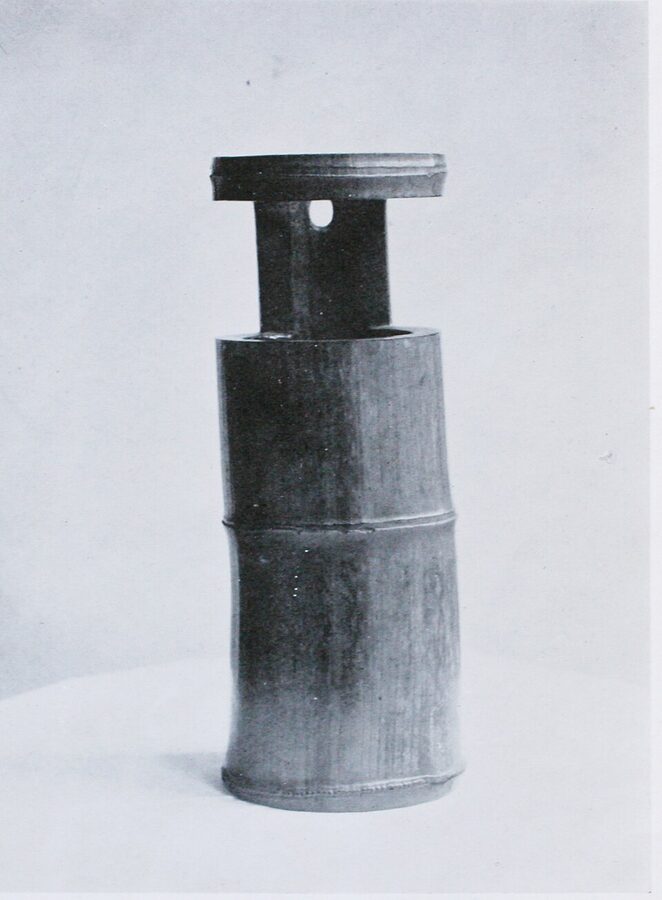
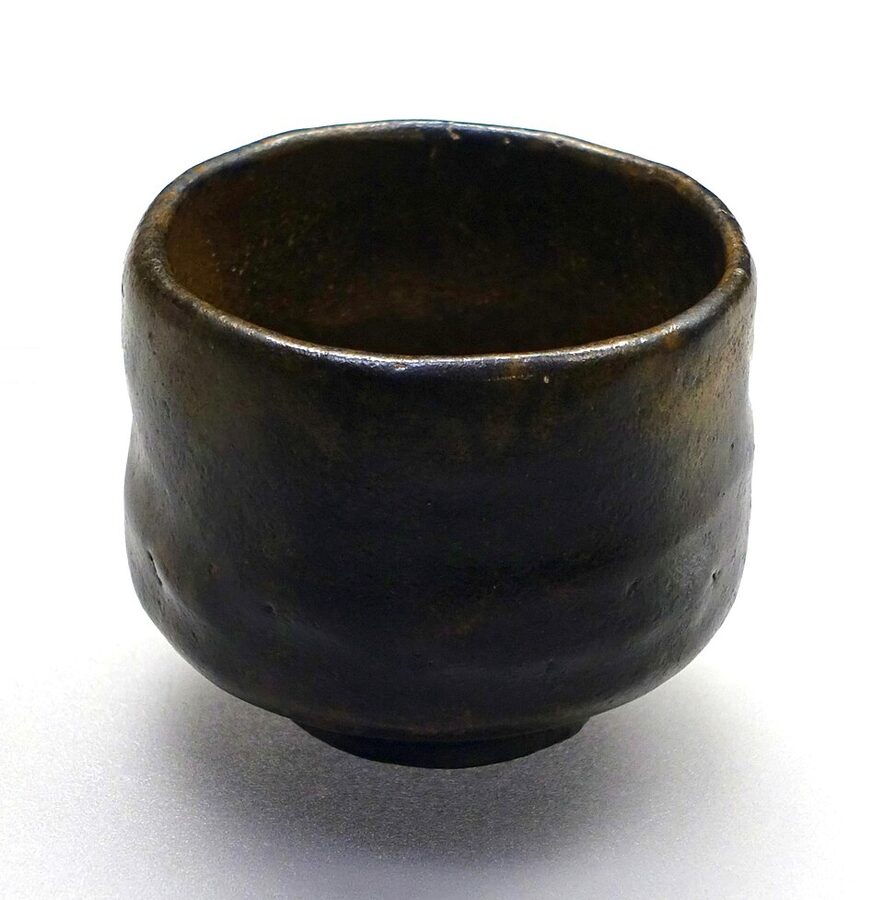
From 1584 onwards, the utensil innovations accelerate. Rikyū commissioned the Sakai-born ceramicist Chōjirō to produce hand-moulded, low-fired, deliberately irregular tea bowls; these became the raku-yaki ware that has descended in direct father-to-son succession at the Raku kiln for fifteen generations. He designed bamboo flower vases, bamboo tea scoops, the Banko iron kettles. Every gesture that would define wabi material culture took its canonical form in Rikyū’s personal workshop between 1583 and 1590, while his patron was simultaneously commissioning solid-gold tea rooms.
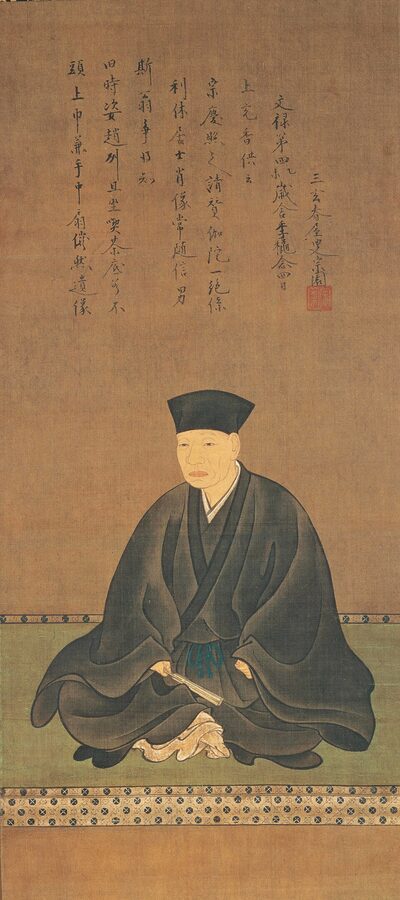
In the tenth month of Tenshō 13 (October 1585), Hideyoshi invited the retired Emperor Ōgimachi to a tea ceremony inside the Imperial Palace. Hideyoshi wanted Rikyū to serve the tea. A commoner could not physically enter the palace; the court’s entry rules were strict on this point. The solution was for the emperor to grant Rikyū a kojigo — a formal Buddhist-laic honorific title that conferred the rank required for palace entry.
The title granted was Rikyū (利休), and this is the name he has been known by for the subsequent four centuries. It was strictly speaking his for only the last six years of his life; for the previous forty-three years of tea practice he had been Sōeki. The etymology is debated.
The standard reading is “cast off worldly gain” (名利既休); a second reading is “let the sharp mind rest” (利心休せよ, don’t drown in your own talent); a third reads the characters as referring to an old, worn-down awl, the rōkosui, whose point has been blunted by use. The third reading is the one current scholars find most plausible. All three readings are Zen-appropriate self-effacements, which was the point of a kojigo title.
The Golden Tea Room and the 1587 Kitano Ōchanoyu
Hideyoshi built the Golden Tea Room in 1586. It was a portable three-mat structure with every surface gold-leafed, red-felt carpeted instead of tatami, and fitted with solid-gold kettle, gold caddy, gold stand. In January 1586 he had the whole thing re-erected inside the Imperial Palace and served tea to Emperor Ōgimachi out of it, with Rikyū acting as attendant.
The aesthetic idea could not have been further from the Tai-an’s mud-walled wabi cell. Rikyū produced the service flawlessly and then went back to his own two-mat mud-walled tea room and continued building in the opposite direction.
The two men held the two opposing aesthetics inside the same working relationship for roughly five years. The surface read of this was that Hideyoshi got the political theatre he needed while Rikyū got the patronage he needed to keep inventing. The deeper read was that Rikyū was slowly and systematically building a counter-aesthetic inside the Toyotomi regime — a second authority centre that operated on the regime’s own property, used the regime’s own budget, and relativised the regime’s entire social grammar through the simple expedient of making the regent crawl.
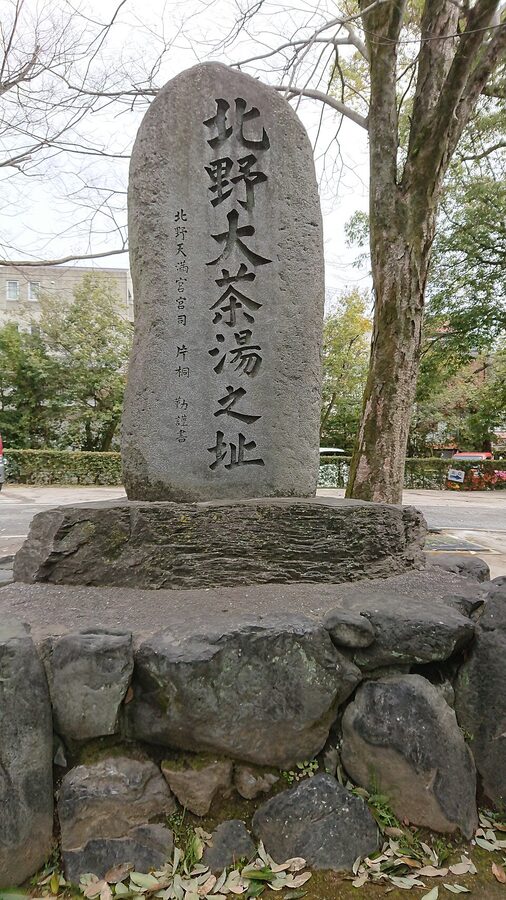
In the seventh month of 1587, Hideyoshi announced the largest public tea gathering in Japanese history. The event was called the Kitano Ōchanoyu (北野大茶湯), the Great Kitano Tea Gathering, and was scheduled for ten days starting the first of the tenth lunar month, 1 November 1587 by the modern calendar, at the Kitano Tenmangū shrine in north-west Kyoto. The public notices went up in Kyoto, Osaka, Sakai, and Nara, with a special directive sent to the Hakata merchant Kamiya Sōtan inviting the Kyushu tea community. Foreigners were explicitly welcomed (“those with tea-mind from the Chinese realm may also attend”).
The official instructions to attendees were unusually egalitarian. Anyone with any tea interest — samurai, merchant, artisan, peasant — could attend. Participants were told to bring one kettle, one dipper, one tea cup, and a rush mat to sit on. No class-based seating rules, no dress code.
Around a thousand tea stations went up in the Kitano pine grove on the first day of the gathering. The four master stations — Hideyoshi’s own Golden Tea Room plus the three Sansōshō stations (Rikyū, Imai Sōkyū, Tsuda Sōgyū) — drew lottery-allocated audiences of three to five participants per sitting.
The single most popular station that day was neither Hideyoshi’s nor any of the Sansōshō’s. It was the wabi station run by the itinerant tea hermit Hechikan (丿貫), a Kyoto tea-man of eccentric reputation who had built his station around a giant red-umbrella exterior-room arrangement that nobody else had thought of. Contemporary accounts say Hideyoshi personally walked over to inspect Hechikan’s station in the afternoon, was charmed, and ended up taking tea from him. This is the kind of detail that sounds like myth-making and, actually, isn’t; the Imai Sōkyū Chaji Ki independently corroborates the incident.
The gathering was scheduled to last ten days. It lasted one. On the morning of day two the entire festival was cancelled without explanation and never resumed. The official reason, announced a week later, was an uprising by peasants in Higo Province.
The real reason has been argued over for four centuries. The standard Edo-period explanation is that a peasant rebellion had in fact broken out in Higo and Hideyoshi needed to pivot. The 20th-century historian Nakamura Shūya suggests instead that the first-day attendance was substantially below Hideyoshi’s expectations, and that he cancelled the remainder to avoid nine further days of publicly visible under-performance.
A third theory, which circulated in Kyoto at the time and has never been disproved, is that Hideyoshi was told during the evening of day one that more Kyoto attendees had been impressed by Hechikan’s wabi umbrella than by his own Golden Tea Room, and was not prepared to sit through nine more days of aesthetic humiliation. For parallel context on mass Kyoto public events, see Gion Matsuri — the Ōchanoyu was on roughly that scale and sat in roughly that civic register. Whichever theory you prefer, the event is remembered as the largest single public tea gathering in Japanese history and the closest the discipline ever came to being a genuinely popular festival rather than an elite practice.
Rikyū’s position after Kitano was unambiguously senior. He was given a 3,000-koku stipend, a residence inside the new Jurakudai palace compound, and a formal role shaping the Jurakudai’s tea-garden design. The Kyushu merchant Kamiya Sōtan recorded being told by Hideyoshi’s brother Hidenaga, during a subsequent visit to Osaka Castle, that “for public matters, speak to me; for private ones, speak to Sōeki”. Rikyū was effectively Hideyoshi’s inner-circle civilian adviser at this point, on almost everything that wasn’t straight military strategy.
The 1589 Daitoku-ji Kinmōkaku gate
In 1589 the Daitoku-ji temple complex in northern Kyoto undertook a major rebuilding of its two-storey sanmon gate — the Kinmōkaku (金毛閣), “Golden Hair Pavilion”. The funding came overwhelmingly from Rikyū’s personal donation. The Daitoku-ji abbots, in conventional gratitude for a donor of this scale, commissioned a wooden statue of Rikyū and installed it on the second floor of the gate. The statue was about life-sized, carved in a standing pose, with straw sandals on its feet and a Zen staff in its right hand.
Donor statues above temple gates were entirely conventional in Rinzai Zen practice. The Jukō-Jōō tea lineage itself had done this at the same temple. The Kinmōkaku statue was, by the usual measures, an unremarkable thank-you to a major donor. It was, however, a statue of a commoner that anyone entering the temple, including the imperial regent, would physically pass underneath.
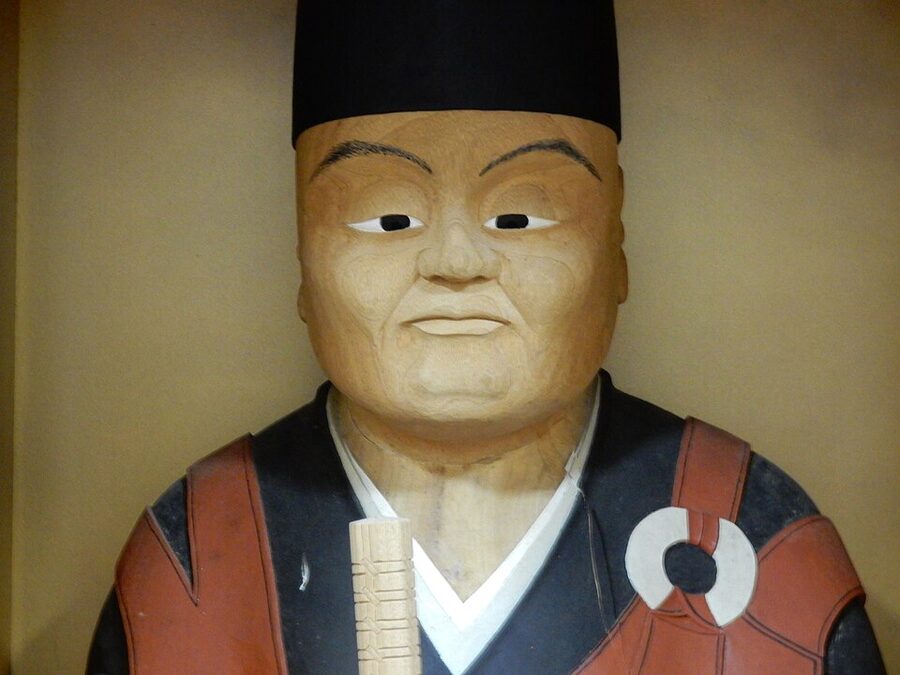
At the gate’s formal dedication ceremony, Rikyū asked the senior Daitoku-ji priest Shun’oku Sōen to compose a dedicatory verse. Sōen produced a short poem containing the line senmon banko ichiji ni kai (千門萬戶一時開), “a thousand gates and ten thousand doors opened in a single moment”. The phrase is classical Zen imagery about sudden enlightenment, but the “thousand” (sen, 千) is also the character of Rikyū’s surname, and a reading that treats Rikyū as the agent of the gate-opening is grammatically available. Hideyoshi’s intelligence network brought him this reading.
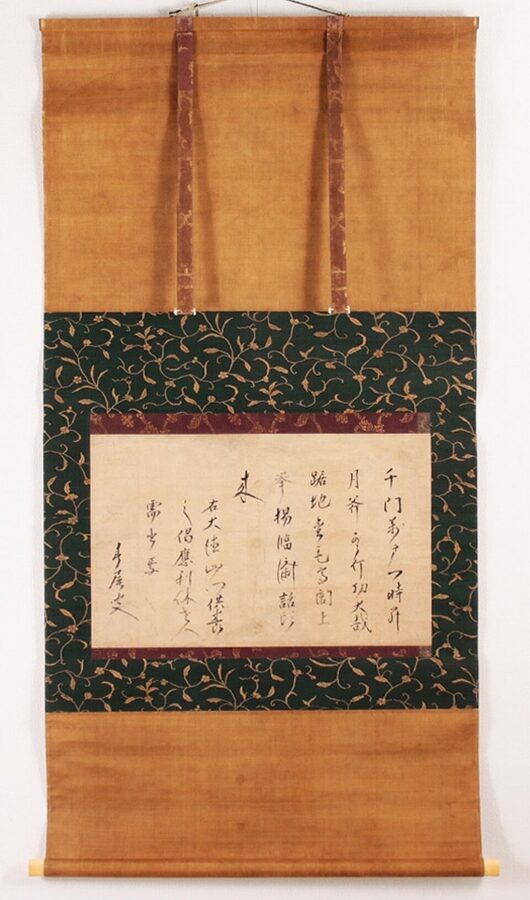
The statue and the poem sat at Daitoku-ji for roughly eighteen months with no immediate consequence. Rikyū continued to serve as Hideyoshi’s tea adviser; the relationship continued to function; the regime’s business continued.
In January 1591 Hideyoshi’s half-brother Toyotomi Hidenaga, the same Hidenaga who had told Kamiya Sōtan to speak to Sōeki about private matters, died. Hidenaga had been Rikyū’s single most important structural protector inside the Toyotomi court. Six weeks after Hidenaga’s death, on 13 February 1591, Rikyū was placed under house arrest at Sakai.
Why the order came down — the six main theories
The formal charges posted on a notice-board beside the displayed head named two crimes. One was the Kinmōkaku statue — the placing of a commoner’s wooden feet above the regent’s head. The other was profiteering on overpriced tea utensils. Neither charge explains anything.
Donor statues were conventional; utensil mark-ups were every senior tea master’s living, and there is no surviving evidence that Rikyū’s pricing was out of line with his peers’. Scholars have been arguing over the real cause for four centuries, and ja-wiki’s current catalogue of hypotheses runs to eleven. The six load-bearing ones are worth laying out.
The first theory is the official one, slightly modified: Hideyoshi did genuinely take offence at the statue-above-the-gate, and the official charge is therefore substantially the real charge. This is the theory that requires the fewest additional assumptions. The weakness is that the offence had been sitting above the temple entrance for eighteen months, and the detonation came six weeks after Hidenaga’s death, which is suspicious timing.
The second theory reads the order as the end-point of a court-faction war between Rikyū and the rising civilian administrator Ishida Mitsunari. Mitsunari was consolidating the Toyotomi civil bureaucracy through the late 1580s; Rikyū was the single most influential non-military voice in the inner circle. Mitsunari had a standard bureaucratic interest in removing that competing authority, and Hidenaga’s death opened the window.
Rikyū’s political-advisory role as “the private-matters person” was precisely the role Mitsunari wanted exclusively for himself. The evidence for this theory is entirely circumstantial but the circumstantial weight is considerable.
The third theory has Hideyoshi asking Rikyū for his daughter Osen as a concubine, and Rikyū refusing on the specific grounds that he did not want to be seen as having advanced his career on his daughter’s body. The refusal would have been humiliating to Hideyoshi; Hideyoshi was not a man who tolerated that kind of humiliation from a merchant. This theory appears first in the Kaiki chronicle kept by Matsui Yūkan and is corroborated indirectly by a passage in Hosokawa Yūsai’s tea-circle letters. It has never been definitively confirmed or denied.
The fourth theory is the Korean-invasion theory. Hideyoshi was in the planning stages of what would become the 1592 invasion of the Korean peninsula. Rikyū, whose Sakai merchant-network included heavy Korean-trade contacts who would be personally ruined by the invasion, was privately briefing Hideyoshi against the campaign.
Hideyoshi at some point decided he had heard enough of the objection. The evidence here is fragmentary but the economic interests are real; Sakai’s Korean-trade house had about 40% of its commercial relationships on the peninsula.
The fifth theory is the straightforward artistic-versus-political-authority theory. Rikyū had built, through the 1580s, a second and incompatible authority centre inside the regime. Hideyoshi killed the tea master not because of any specific offence but because the tea master’s aesthetic authority had grown to the point where it could not coexist with the regent’s political authority any longer.
The tea rooms the regent had to crawl into were the problem, not the statue above the temple gate. This reading treats the formal charges as rationalisation rather than cause.
The sixth theory is the crypto-Christian theory, which deserves mention because it appears in the Jesuit Frois correspondence but does not survive scholarly scrutiny. Four of Rikyū’s seven senior students were baptised Christians, including Takayama Ukon and Gamō Ujisato, and the Jesuit sources assumed Rikyū himself was a covert convert. Hideyoshi had formally expelled the Jesuits in 1587, so had Rikyū been a secret Christian, the seppuku order would fit the post-1587 expulsion pattern.
The ja-wiki consensus is that the Jesuit evidence is wishful thinking on the Jesuits’ part, and that the four-student cluster reflects Rikyū’s aesthetic appeal across the Japanese elite rather than any personal religious commitment. Still, the theory circulated at the time and is worth knowing about.
A seventh, weaker theory has Rikyū as a covert Tokugawa agent preparing to poison Hideyoshi’s tea at the request of Tokugawa Ieyasu. Nobody with scholarly credentials believes this one, but it is the version that the Edo-period popular literature preferred, probably because it flattered the eventual winners.
My own guess, and this is speculation rather than a defensible historical claim, is that the second and the fifth theories together cover most of what actually happened. Hidenaga’s death removed the protector. Mitsunari moved. The aesthetic-authority collision had been latent for years and now detonated because the structural counterweights had come off, and the formal charges picked up what was handy.
The afternoon of 28 February 1591
Rikyū was placed under house arrest at Sakai on 13 February 1591. For the next two weeks, his senior students ran interference. Maeda Toshiie, then second-ranked in the Toyotomi inner circle after Hideyoshi himself, petitioned personally for commutation of the sentence.
Hosokawa Tadaoki, who had been Rikyū’s direct student for over a decade, worked the same channel through Hidenaga’s widow and through the Hōjō surrender negotiators. Furuta Oribe — who was married to Hosokawa Gracia‘s sister-in-law and thus connected into the same faction — lobbied through the tea-circle networks.
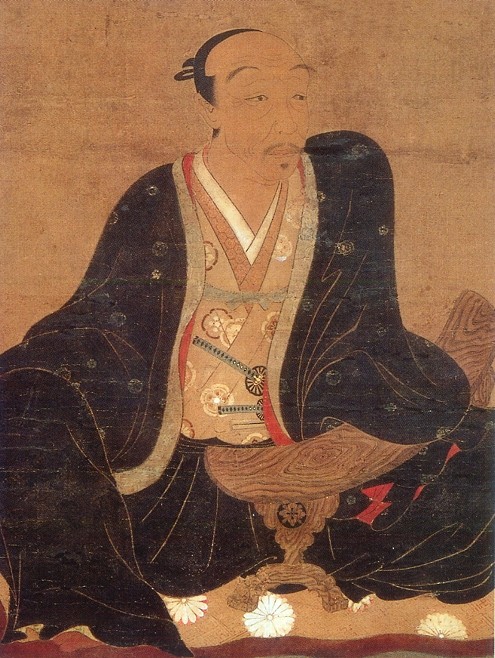
None of it worked. On 26 February 1591 Rikyū was recalled from Sakai to the Jurakudai compound in Kyoto. On 28 February, 21 April by the Gregorian calendar, he was ordered to commit seppuku in his own residence inside the compound, by sunset.
He was seventy years old. The order was delivered to him that morning by Hideyoshi’s chamberlain Yamana Zenshirō; the kaishakunin (second, the man who takes the head after the cut is made) was Iio Tsunaoki, one of Hideyoshi’s personal guards.
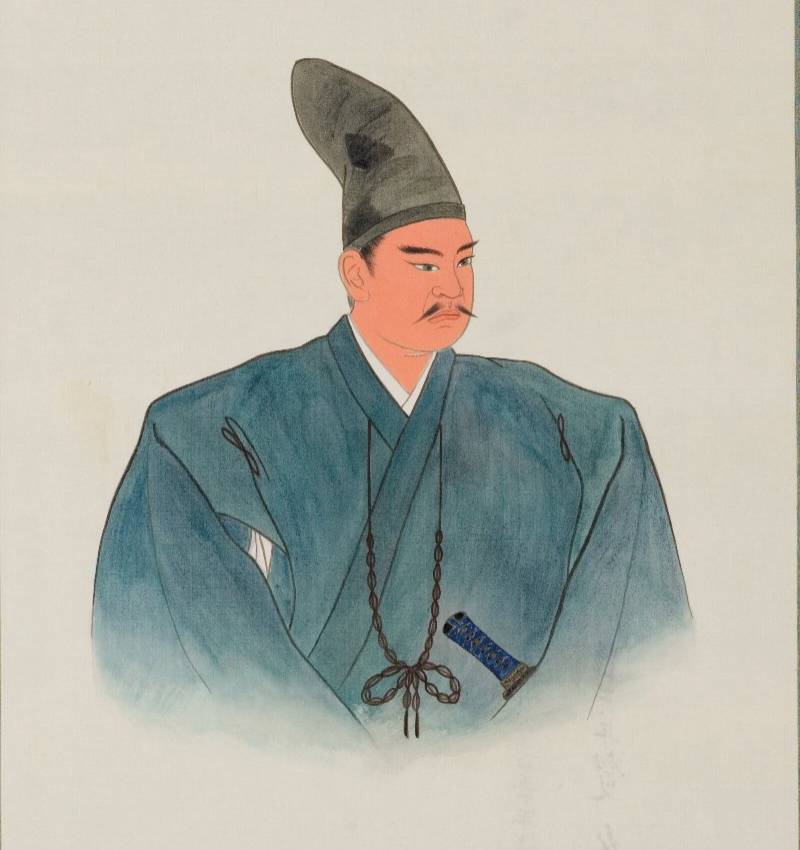
The Uesugi cordon went up around the Jurakudai compound by early afternoon. The Maeda, Hosokawa, and Furuta parties that had planned armed rescue were turned back at the compound’s outer gate by Uesugi troops under specific orders that no ally of the condemned was to be allowed through. Hosokawa Tadaoki, in the surviving account, rode up to the gate, was politely refused passage, and returned to his residence to sit through the afternoon. He did not cross swords with the Uesugi; nobody had the political latitude to actually start a civil war inside Kyoto over a tea master’s execution.
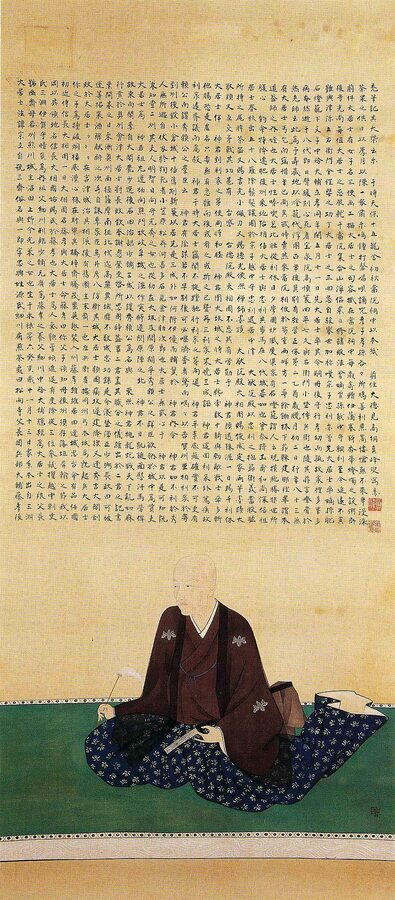
Inside the residence, Rikyū spent the afternoon preparing. According to the Chawa Shigetsu-shū chronicle compiled by Kusumi Soan, he bathed, changed into white under-robes, and composed his death poem — his jisei. The poem is roughly: “seventy years of life, tsū tsū, with this single jewelled sword I cut through both Buddha and the patriarchs; my pure gift to the heavens, ei.” The opening tsū tsū are onomatopoeic, pounding, and the closing ei is a vocal exclamation. It is a Zen gesture, not a protest.
When the Yamana messenger arrived to announce the hour had come, Rikyū reportedly remarked, with the composure of a man who had rehearsed the line, that he had lost the key to his tea room. He whisked one final bowl of tea. The utensil was a Chōjirō raku bowl that Hosokawa Tadaoki had given him as a gift years before; Rikyū passed the bowl back to Tadaoki’s agent as a bequest.
Then he knelt, opened his white under-robe, and put the short sword in. Iio took the head.
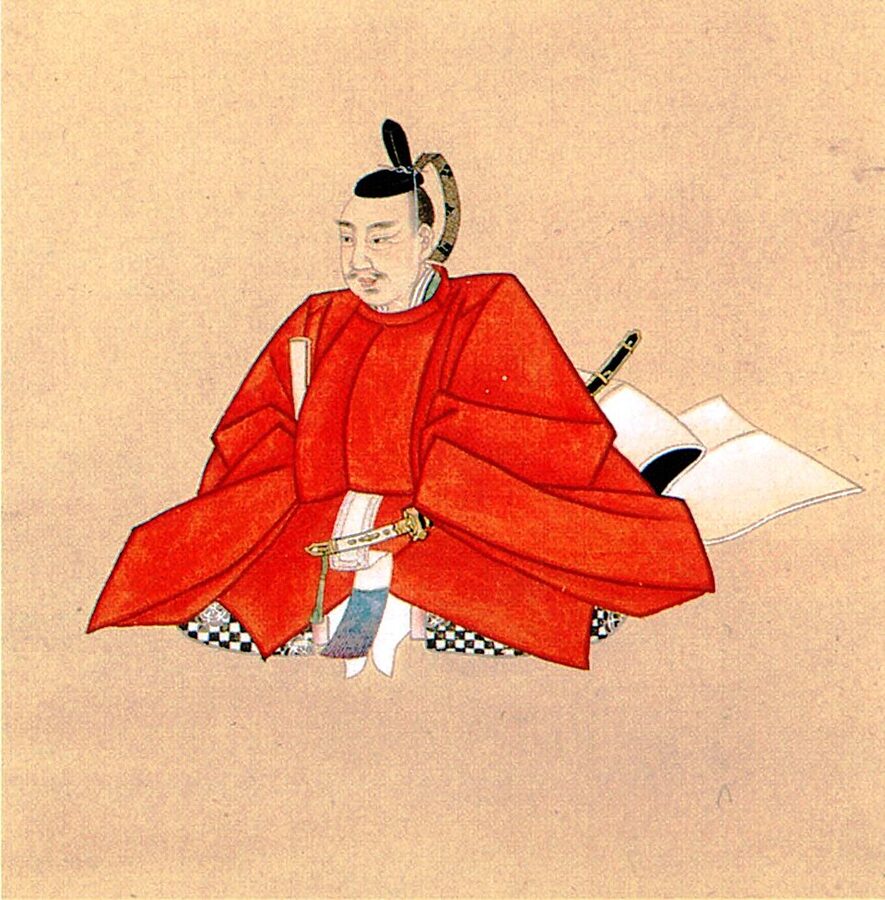
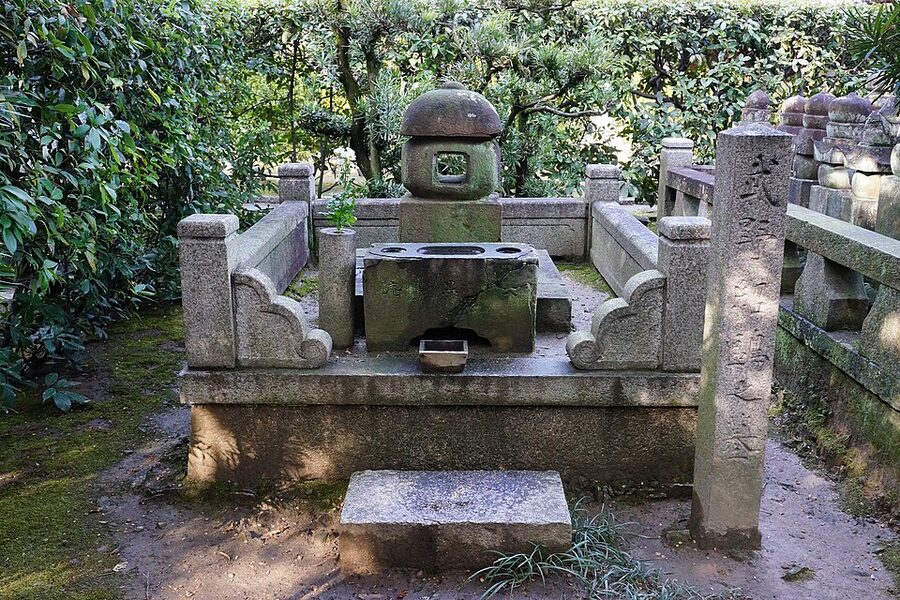
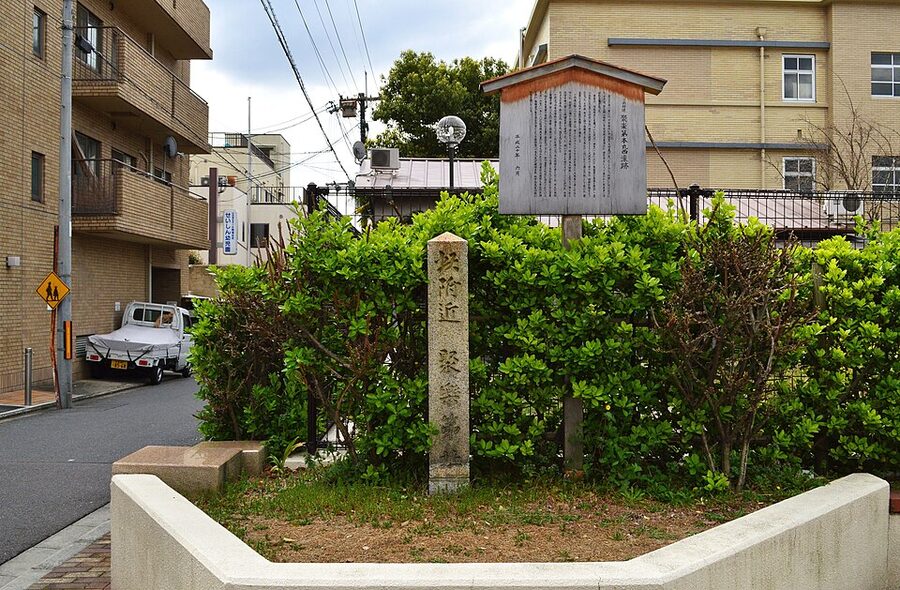
The head was taken to Ichijō Modori-bashi on the Imperial Palace’s northern boundary and displayed on a pike. The wooden Kinmōkaku statue, hauled down from the Daitoku-ji gate the week before, was rigged so its straw-sandalled foot stood directly on the severed neck. The tableau stayed up for three days. Rikyū was buried at the Jukō-in subtemple at Daitoku-ji; his grave is a modest stone in the Jukō-in cemetery, unmarked by a portrait or an inscription beyond his name.
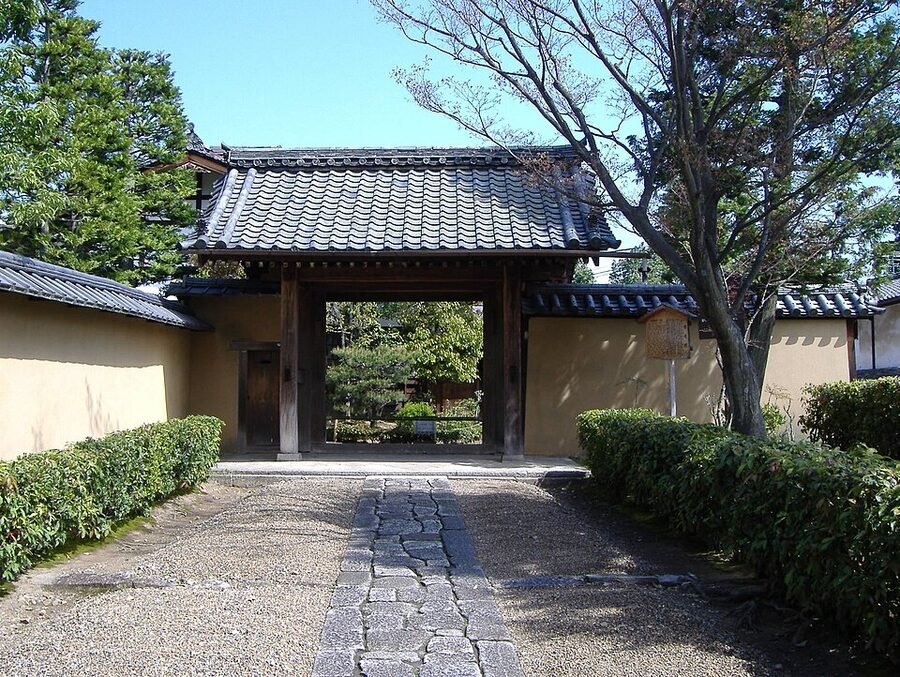
Hideyoshi had the Jurakudai-compound Rikyū-residence demolished within the week. What could be salvaged of the timber was distributed to senior students as keepsakes; Tadaoki incorporated a substantial portion into the Kōtō-in subtemple at Daitoku-ji, where the shoin reception room still uses those beams. Rikyū’s personal tea utensils were partially dispersed to the students who had tried to save him and partially held back by the Toyotomi treasury. The Kinmōkaku wooden statue was eventually recovered by the Urasenke family and is kept today at the Konnichi-an compound, with dust on the sandals and a serene wooden expression.
What Rikyū actually built
The surface legend has Rikyū as a minimalist who replaced gold with mud and Chinese celadon with Korean raku. This is true and it is shallow. What Rikyū did inside his forty-nine-year tea career, and particularly in the last decade of it, was a set of specific architectural, ceramic, and procedural innovations, each of which had a direct technical cost and each of which produced a downstream aesthetic compounding effect. The changes are worth enumerating because nobody before him had put them all together and nobody after him has successfully undone them.
The nijiriguchi crawl-in entrance is the most-cited but probably not the most important. A sixty-centimetre-square door meant every guest had to enter the room on hands and knees — no one could wear a long sword inside, no one could assert their standing-height physical presence, and the tatami floor was the only available social register. Rikyū did not invent the low entrance; peasant-hut tea rooms had had them for decades. He industrialised it as the standard for elite chashitsu, which is a different achievement.
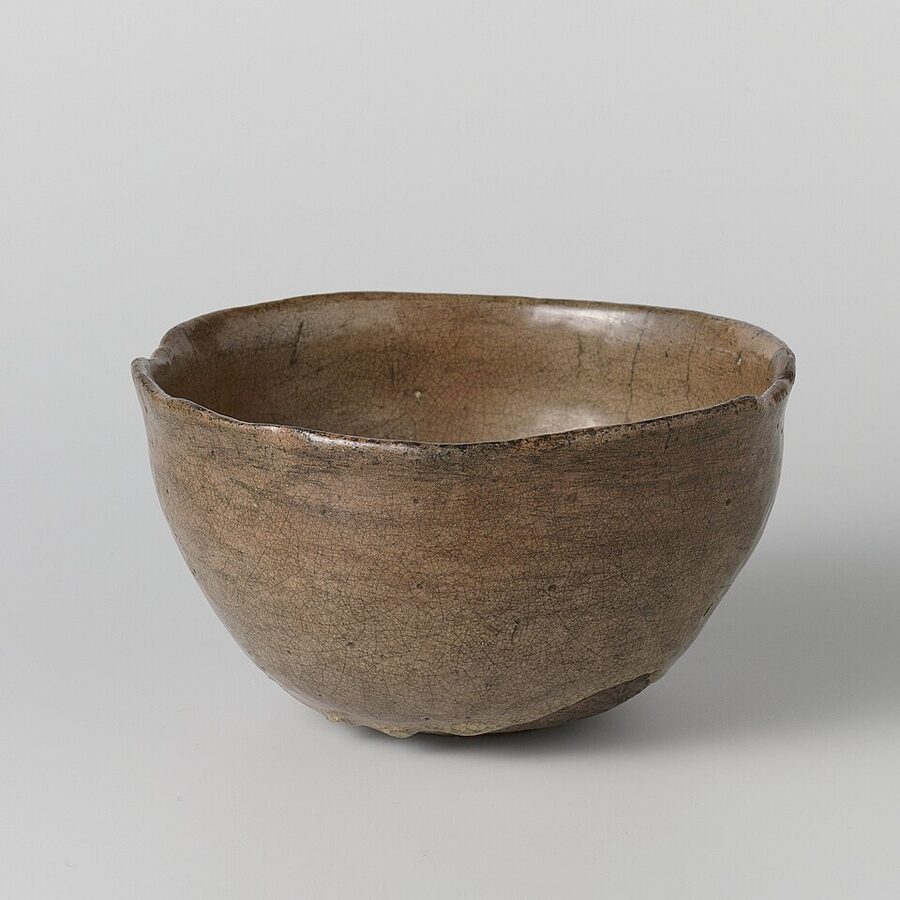
The two-mat (or smaller) tea-room standard was more structurally radical. Pre-Rikyū formal tea rooms were four-and-a-half tatami minimum; two-mat spaces were for commoners, if they existed at all. Rikyū took the two-mat wabi room out of the peasant-hut tradition and installed it as the new standard for elite chaji. For cross-reference on the physical tatami standard and how the mat sizes encoded social hierarchy, see the tatami article; the short version is that floor-area was explicit status, and Rikyū deliberately collapsed it.
The mud-plaster walls with straw-fibre inclusions replaced the lacquered shikkui white-plaster finish of Ashikaga-court tea rooms. The exposed bamboo ceiling replaced the concealed lattice. The tokonoma alcove shrank from a flush-painted display space to a small raised plank with one hanging scroll and one bamboo flower vase.
Each of these changes saved money, and each of them transferred aesthetic weight from ornament to proportion. This was calculated. Rikyū’s own personal utensil collection at his death contained items of enormous intrinsic value; the wabi austerity was a deliberate contrast against a wealth he personally possessed.
The Chōjirō raku-ware commission was not really about the bowls — it was about the principle of commissioning. Pre-Rikyū, tea bowls were received objects: Chinese imports, Korean imports, Jukō-era survivors. Post-Rikyū, they were commissioned from living Japanese craftsmen, signed by the maker, hand-moulded rather than wheel-thrown, individually named. The economic model behind Japanese artisan-crafts for the next four hundred years — named makers, hereditary workshops, named individual pieces — is directly traceable to the Rikyū-Chōjirō deal of the mid-1580s.
The roji tea-garden approach path became standard during the Osaka-Castle 1584 commission. The hakoya waiting bench, the dewy-grass stepping-stones, the low water-basin at which the guest performed a hand-and-mouth rinse before crossing the threshold — all of these were standardised by Rikyū and none of them were pre-existing. The tea-garden as a Japanese garden genre, with its specific vocabulary of stepping stones, stone water-basins, and deliberately-rustic shrubbery, is a Rikyū invention. For the broader context of Japanese garden design from which Rikyū drew and back to which his innovations flowed, see the Japanese gardens article.
The procedural innovation Rikyū’s own senior student Yamanoue Sōji cites as the most important is smaller and more technical. It is called hakobi-demae, “carried service”. Pre-Rikyū tea ceremonies began with the host’s utensils already arranged on a display stand (daisu) before the guests arrived. Rikyū moved to a version where the host carries each utensil into the room individually at the start of the sequence, places it, and carries it out at the end.
The change is almost invisible to a casual observer. Its consequence is that the tea-making becomes the dominant activity of the ceremony — the utensils are demoted from static display to functional instruments. Sōji argues this is Rikyū’s single most important technical contribution, and I find his argument convincing.
Family scattered, three Senke schools founded
Rikyū’s death came close to ending the Sen tea-lineage outright. His elder son Dōan (by his first wife Hōshin Myōju, who had died in 1577) and his son-in-law Shōan (who was also his second wife Sōon’s son by her previous marriage — a not-unusual Sengoku family structure) were both placed under house arrest immediately after the seppuku. Rikyū’s daughter Osen was sent to live with a Sakai relative. The Sen house was dissolved as a legal entity; the tea-utensil collection was partially confiscated and partially dispersed.
Four years later, in 1595, Tokugawa Ieyasu and Maeda Toshiie jointly petitioned Hideyoshi for clemency. Ieyasu’s specific interest was indirect: he had been increasingly aligned with the Sen-tea-circle students (Tadaoki, Oribe, Gamō Ujisato) and rebuilding the house would consolidate his Kantō faction within the Toyotomi orbit. Hideyoshi, whose earlier rage at the specific circumstances had cooled, granted the pardon.
Dōan took over the Sakai branch, which died out within a generation. Shōan rebuilt the Kyoto branch, and it is through Shōan’s son, Rikyū’s grandson Sōtan (1578-1658), that the surviving tea lineage comes down.
Sōtan is the figure who turns the near-extinction of 1591 into the three-school survival of the 17th century. He was raised initially as a monk at Daitoku-ji’s Shūon-an, returned to lay life in his twenties, and re-established the Sen tea house at Honpō-ji in Kyoto. Hideyoshi, by this point ageing and politically diminished, granted Sōtan three chests of Rikyū’s preserved utensils as a grandchild’s inheritance. Sōtan had four sons; the eldest, Sōsetsu, left to become a doctor, and the remaining three inherited the household and gradually split it into three institutional schools.
The second son Sōshu founded Mushakōji Senke, at the Kankyū-an tea house. The third son Sōsa founded Omotesenke, at the Fushin-an tea house — “front” because his was the forward Kyoto-street property. The fourth son Sōshitsu founded Urasenke, at the Konnichi-an tea house — “back” because his was the rear property.
All three schools teach Rikyū’s method; all three use iemoto grand-master succession; all three have kept the lineage unbroken in direct father-to-son (or adopted-son) transmission for four centuries. For the three schools’ current institutional details see the chadō article; for present purposes the point is that Rikyū’s death nearly ended the line and a series of specific post-1591 interventions by Ieyasu, Maeda Toshiie, and Sōtan preserved it.
Where to walk the Rikyū story today
The physical geography of Rikyū’s life runs across three cities — Sakai (where he was born and ran his family business), Kyoto (where he worked under Nobunaga and Hideyoshi and eventually died), and Ōyamazaki (where his one surviving tea room still stands). You can do the serious version of the trip in three days. What follows is the route, in the order I would walk it.
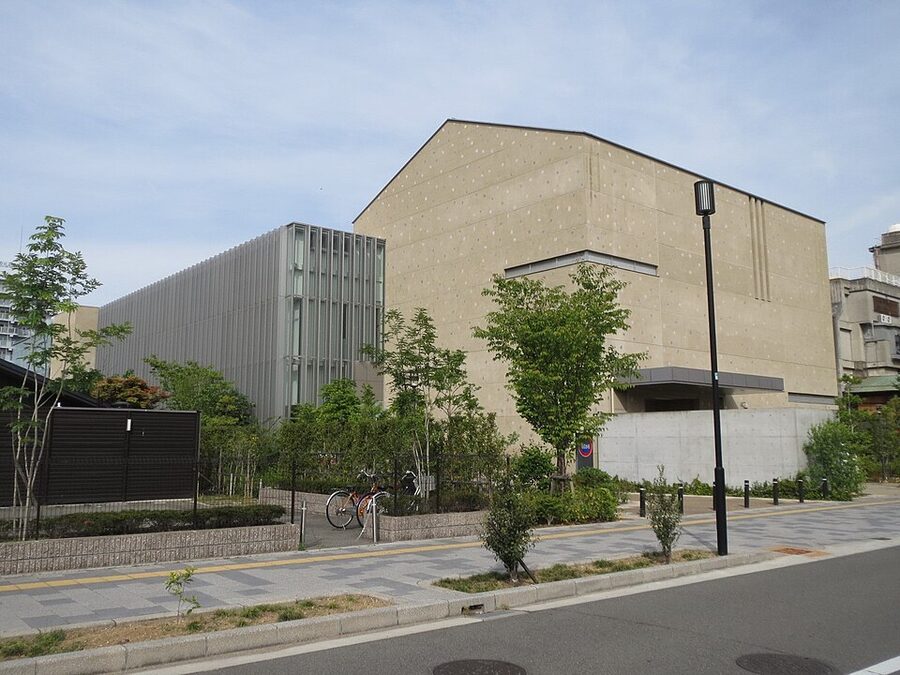
Sakai Rishō-no-Mori, Sakai city
The Sakai Rishō-no-Mori is the modern municipal interpretive centre devoted to Rikyū and Yosano Akiko (the Meiji-era poet also born in Sakai). It is a ten-minute walk from Sakai Station on the Nankai line and runs bilingual exhibits on both figures. The Rikyū wing has a reconstructed chashitsu, a rotating display of period utensils, and a ground-floor café that serves a properly trained formal tea for about 1,500 yen.
The staff are Urasenke-trained and will explain the protocols if you ask. This is the best single entry point to the Rikyū story for a first-time visitor.
The Rikyū Yashiki-ato and Nanshū-ji, Sakai
A short walk from the Rishō-no-Mori, in the Shukuin district of Sakai’s old merchant quarter, there is a stone marker where the Tanaka-Totoya family compound stood and where Rikyū was born. The site is a small garden around a surviving well — the Tsubaki-no-I, “camellia well” — which Rikyū used as his water source during his Sakai years. It is easy to walk past. The surrounding lanes hold a concentrated cluster of traditional Sakai confectioneries making kurumi-mochi, keshi-mochi, nikkei-mochi, some of them reportedly named by Hideyoshi himself.
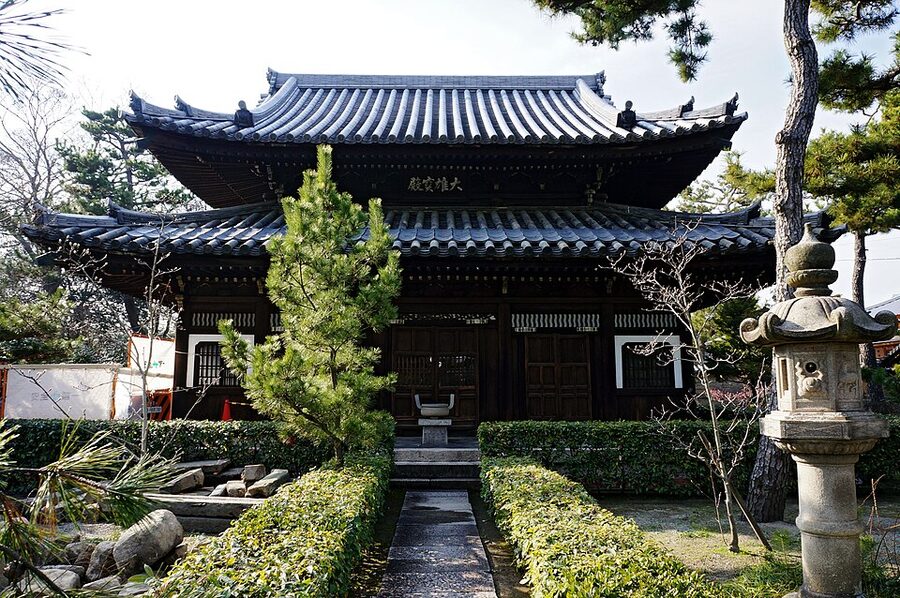
From the Yashiki-ato it is another short walk to Nanshū-ji (南宗寺), the Rinzai Zen temple where Rikyū studied Zen under the abbot Dairin Sōtō. Nanshū-ji was Sakai’s equivalent of Daitoku-ji — the city’s sister Zen complex, with tight organisational ties to the Kyoto mother house. Rikyū practised here through most of his Sakai years and the temple still holds a Rikyū-ki annual memorial on 28 February.
For a half-day in Sakai, walk the Rishō-no-Mori first, then the Yashiki-ato, then Nanshū-ji. The whole circuit is under three kilometres on foot.
Tai-an at Myōki-an, Ōyamazaki
The Tai-an at Myōki-an is the only tea house indisputably designed by Rikyū that still stands. It is in Ōyamazaki, on the old Sanyōdō road between Kyoto and Osaka, five minutes on foot from Ōyamazaki Station on the JR Kyoto line. National Treasure status was conferred in 1951.
Access to the interior is by advance written application only; the temple accepts a small number of viewing slots per year and prioritises serious tea students. Without booking, you can see the temple grounds, the exterior of the Tai-an (including the nijiriguchi entrance), and the reconstructed garden.
Interestingly for trip-planning, Ōyamazaki sits on the same rail line as the Battle of Yamazaki memorial site — the hillside where Hideyoshi killed Mitsuhide thirteen days after the Honnō-ji Incident is walking distance from the Tai-an. The two events are separated by exactly two months. It was the Yamazaki victory that made Hideyoshi’s succession possible, and it was the Tai-an that Rikyū built as his first commission for the new regime. The physical proximity of the two sites is not incidental.
Daitoku-ji and the Kinmōkaku gate, Kyoto Kita-ku
Daitoku-ji is the single most important address in the Rikyū story. It is the temple where he trained in Zen under Kokei Sōchin, where the Kinmōkaku gate is still standing (with the original second-floor statue now at Urasenke), where he is buried in the Jukō-in subtemple, and where the Kōtō-in subtemple built by his student Tadaoki contains architecture salvaged from his Jurakudai residence. The main temple complex is a ten-minute walk from Kitaōji Station on the Karasuma subway line.
Access notes are strict. The main complex grounds and the Butsuden are free to enter year-round. Jukō-in, which holds Rikyū’s grave, opens only during short spring and autumn public-opening weeks; the Daitoku-ji administration office at the main gate publishes dates in February and August.
Kōtō-in, with the relocated Jurakudai shoin, is normally open but its tea-room interior requires an additional appointment. Shinju-an, Daisen-in, and Ryōgen-in are the other tea-relevant subtemples and are open more regularly. Plan to spend at least half a day.
Urasenke Konnichi-an, Kyoto Imadegawa
The three Senke schools — Urasenke, Omotesenke, Mushakōji Senke — sit next to each other on a single Kyoto lane off Horikawa-Imadegawa, about ten minutes’ walk from Imadegawa subway station. All three are private residential compounds. The Urasenke Center building adjacent to Konnichi-an runs scheduled public demonstrations in English and Japanese; the Urasenke international office handles bookings and slots fill up two or three months in advance.
If you have the time to book one public demonstration during your Kyoto trip, this is the one. The Urasenke demonstration uses Rikyū-lineage utensils, runs for about ninety minutes, and includes the full formal sequence from entry to closing. The Omotesenke Fushin-an gate and the Mushakōji Senke Kankyū-an gate are sixty metres and about two blocks further down the same lane. Walking past all three in a morning is free; getting inside any of them without a serious introduction is not.
Rikyū-ki memorial, 28 February each year
The annual Rikyū-ki, the 28 February memorial for Rikyū’s death, is observed at both Daitoku-ji (in Kyoto) and Nanshū-ji (in Sakai). The Daitoku-ji service, run jointly by Urasenke and Omotesenke in alternating years, is the larger event; the Sakai service is smaller and more local, with the Sakai municipal authorities and the Rishō-no-Mori staff participating. The date is the old lunar calendar’s 28th of the second month, which in the modern Gregorian falls on 28 March (not 28 February).
Practically this is worth knowing if you are planning a trip. The Daitoku-ji 28 March Rikyū-ki opens Jukō-in’s gates to the public for one day specifically to allow a visitor stop at the grave. This is the one reliable day in the year when the grave itself is accessible without an additional appointment. If your dates can flex to put you in Kyoto on 28 March, do it.
The Raku Museum, Kyoto
The Raku Museum on Aburakōji street in central Kyoto, ten minutes’ walk from Imadegawa subway, is the family-run museum of the Raku kiln lineage. Admission is about 1,500 yen. It holds the single best-curated collection of original Chōjirō chawan that Rikyū commissioned during the 1580s workshop collaboration.
The collection rotates seasonally; the core first-generation Chōjirō bowls are on display roughly four months a year. Planning ahead is worthwhile.
If you are a tea student, or considering becoming one, do the Raku Museum after the Urasenke demonstration. The demonstration will put the utensils in functional context; the museum will show you what original Chōjirō pieces look like, which is a visual reference the demonstration cannot quite provide. The two together are the closest a non-specialist can come to understanding what Rikyū actually did with the bowl, as a specific physical object, over that ten-year workshop collaboration.
What he left behind
The most uncomfortable question about Rikyū is the one nobody likes to answer directly. Did he know, when he installed the statue over the Kinmōkaku gate and signed the dedicatory verse, exactly how the sequence was likely to end? Did he calculate the seppuku order into the design of his aesthetic life, the way he calculated the nijiriguchi into the Tai-an? The answer nobody can now have is the answer that would explain everything.
My own guess — and this is speculation, not a defensible historical claim — is that by 1589 he knew the collision was structural and could not be defused. He had taken wabi as far as it could be pushed inside a system ruled by a man who preferred gold tea rooms. One of the two aesthetics had to give.
The only one of the two who had been rehearsing his daily practice for forty years toward a disciplined form of giving was Rikyū. On the afternoon of 28 February 1591, he whisked one final bowl, returned the utensil to his student as a bequest, and put the short sword in with the composure of a man who had walked this sequence through in his head many times before.
Hideyoshi outlived him by seven years; he died at Fushimi in 1598 of what the surgeon’s log describes as chronic intestinal failure. The Korean invasion that Rikyū may or may not have privately opposed became the disastrous campaign everyone had warned it would be. The Toyotomi dynasty collapsed seventeen years after Rikyū’s death, when Tokugawa Ieyasu closed the account at the 1615 Osaka summer campaign.
The tea discipline Rikyū had finalised has outlived all of these events by four centuries. It is practised by four million people worldwide today.
If you are going to Kyoto for Rikyū, start at Daitoku-ji on 28 March and walk slowly. The Kinmōkaku gate is still there and you can stand under the second floor where the original wooden statue once stood. The grave in Jukō-in is a modest stone in a modest cemetery, and on the Rikyū-ki day it is accessible. The Kōtō-in shoin, built from the salvaged Jurakudai timbers, is still there too, with its two-mat tea room preserved in the same mud-walled register.
A fish-merchant’s son from Sakai designed these rooms four centuries ago and was ordered to die for having designed them too well. What he left behind is the discipline the collision produced. Go, kneel, receive the bowl. The merchant’s son built all of this, and none of it requires you to be a merchant’s son to understand what he meant.