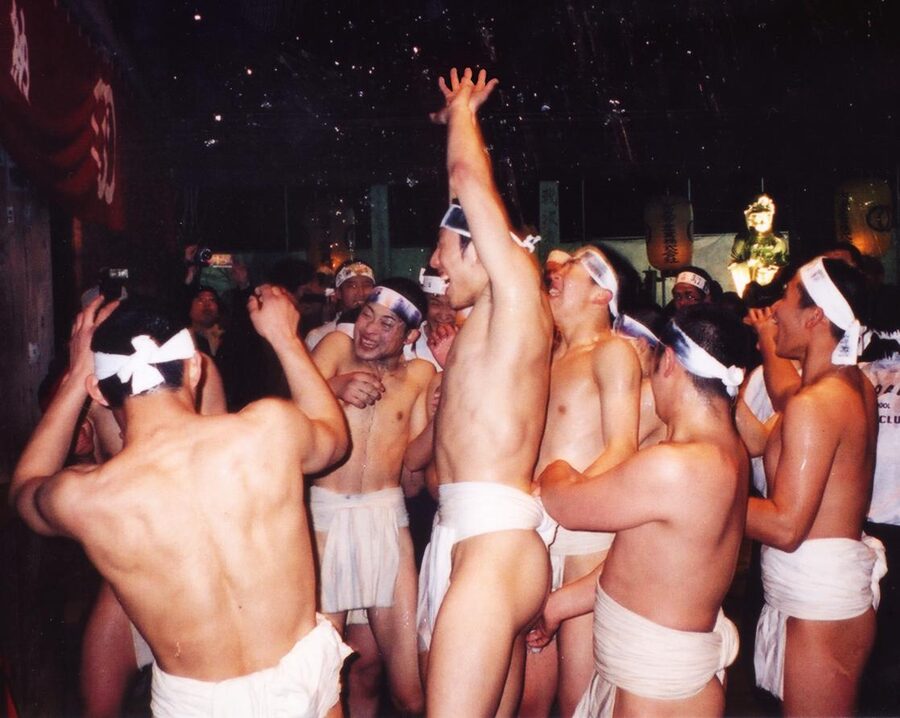
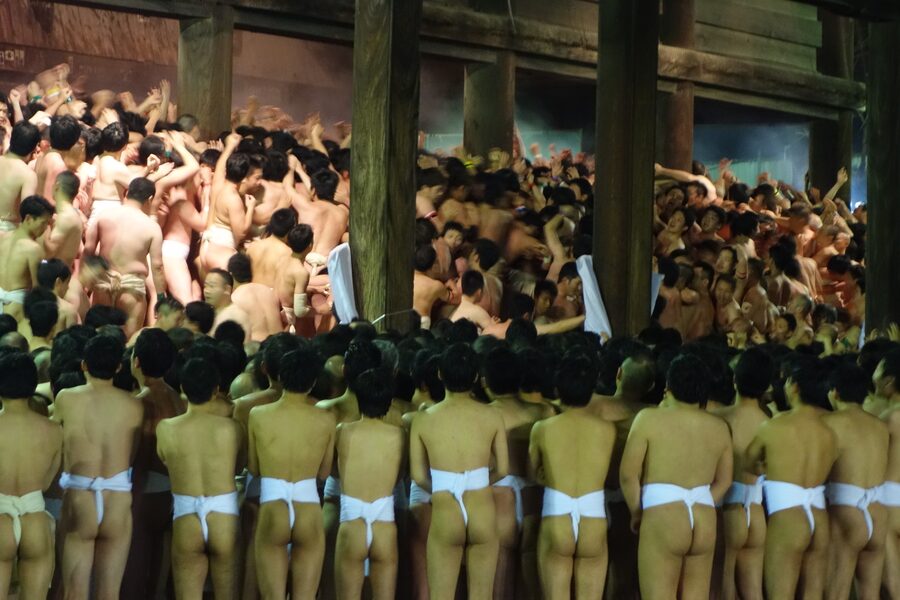
At ten o’clock on the third Saturday night of February, the lights inside the Main Hall of Saidai-ji Kannon-in go out. About 9,000 men in white cotton fundoshi loincloths are packed shoulder to shoulder on the polished wooden floor, having already plunged into freezing spring water to purify themselves. From a window four metres above their heads, a priest hurls two short cylinders of sacred wood into the steam rising off bare backs, and a 500-year-old contest for the year’s luck begins.
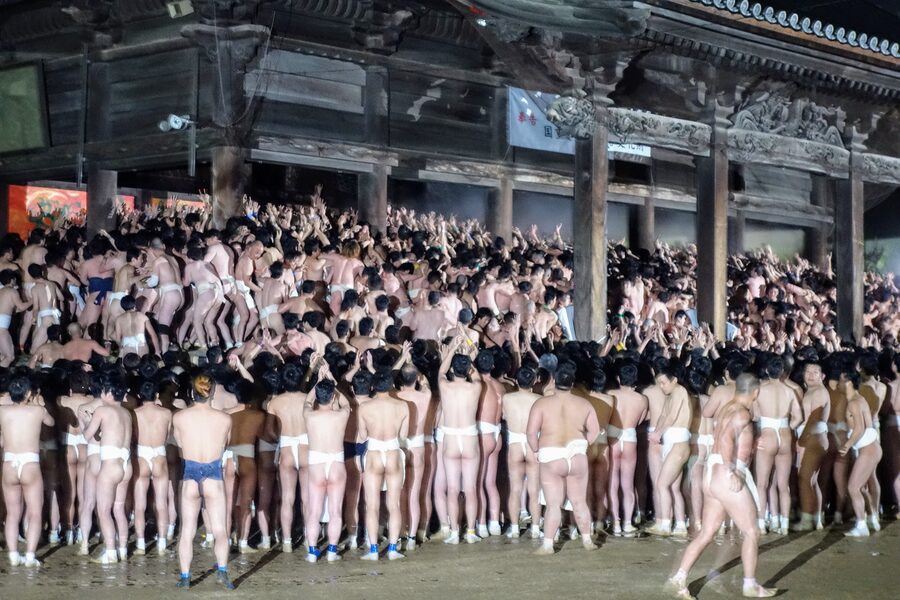
This is Saidai-ji Eyō (西大寺会陽), the most famous of Japan’s hadaka matsuri or “naked festivals,” and the one most foreign visitors mean when they use the phrase. I want to talk about it carefully in this piece, because the festival is not the spectacle it gets sold as in clickbait headlines. It is a Buddhist purification rite that has been performed almost without interruption since 1510, and the fundoshi loincloth that participants wear is religiously appropriate dress for what amounts to a winter misogi.
I will spend most of this guide on Saidai-ji because it is the headline event, but I will also walk you through the other regional hadaka matsuri you might encounter, including Konomiya in Aichi, the recently ended Sominsai in Iwate, and Wakamiya Hachiman in Ōita. If you are coming as a visitor, you will want to know logistics, dress code for spectators, and what 2024’s first inclusion of women actually changed. None of that is hard to plan around.
In This Article
- What “hadaka matsuri” actually means
- Saidai-ji Kannon-in: the temple behind the festival
- From paper charms to wooden sticks: the 1510 origin
- The shingi: what those two sticks actually do
- The night, hour by hour
- 2018 and 2024: women at Eyō
- Misogi: why the cold water matters
- Konomiya Hadaka Matsuri: the Aichi cousin
- Sominsai: the festival that ended in 2024
- Other regional hadaka matsuri
- The fundoshi: a brief practical history
- Travel logistics for spectators
- What to wear if you are spectating
- Photographing the festival
- Eating around Saidai-ji
- How Eyō fits into Japan’s festival year
- Practical FAQ
- What to take away
What “hadaka matsuri” actually means
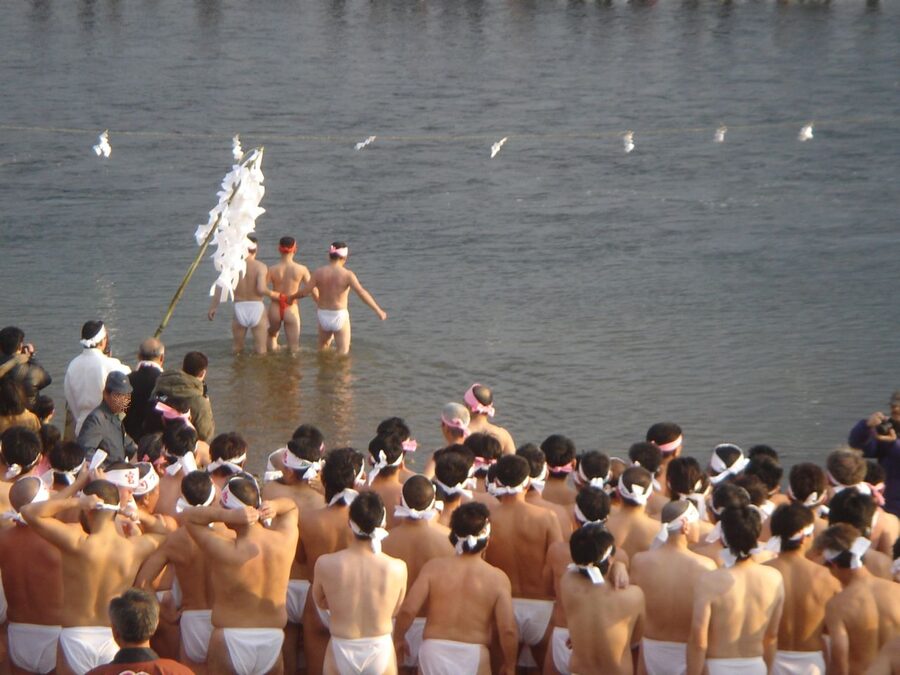
The word 裸祭り literally means “naked festival,” but the translation is misleading on its own. Participants wear a fundoshi (褌), a long strip of cotton wrapped between the legs and around the waist, sometimes paired with a short happi coat or white tabi socks. In Japanese religious practice this is not undress, it is ritual dress, in the same way that a sumo wrestler’s mawashi or an ama diver’s traditional kit is functional rather than scandalous.
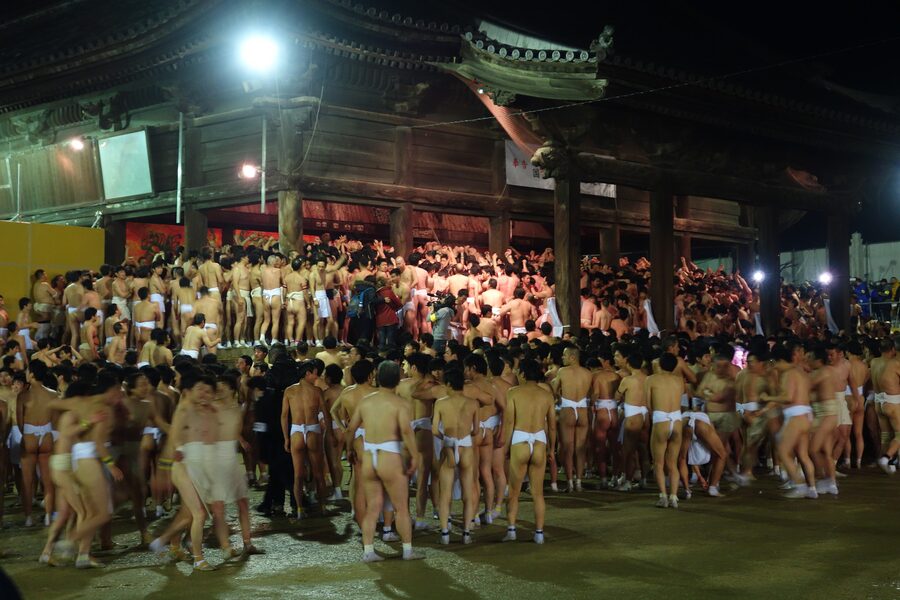
Hadaka matsuri are typically winter or early-spring rituals, concentrated in February and early March though scattered through the calendar. Their core function is misogi, the cold-water purification that returns a participant to a state symbolically equivalent to birth, free of the year’s accumulated misfortune. After the rinsing comes the contest, which usually involves grabbing or touching some object that distributes good fortune to whoever holds it longest.
You will find variants of this format from Iwate in the far north down to Kyushu in the south. The ritual logic is shared even when the specific object being grabbed is different. At Saidai-ji it is two wooden sticks called shingi, at Konomiya it is the body of the shin-otoko, and at the now-discontinued Sominsai in Iwate it was a sack of paper amulets that participants would tear apart over a two-kilometre stretch of snow.
Saidai-ji Kannon-in: the temple behind the festival
To understand Eyō you have to start with the temple. Kinryōzan Saidai-ji Kannon-in is a Shingon Buddhist temple in the eastern part of Okayama City, founded according to legend in the mid-8th century. The story goes that Princess Fujiwara Minataru of Suō Province commissioned a Senju Kannon (thousand-armed Kannon) statue around 751, intending to take it to Kamakura. When her boat stopped in what is now Okayama, the statue refused to be moved, and a temple was built around it on the spot Kannon had chosen.
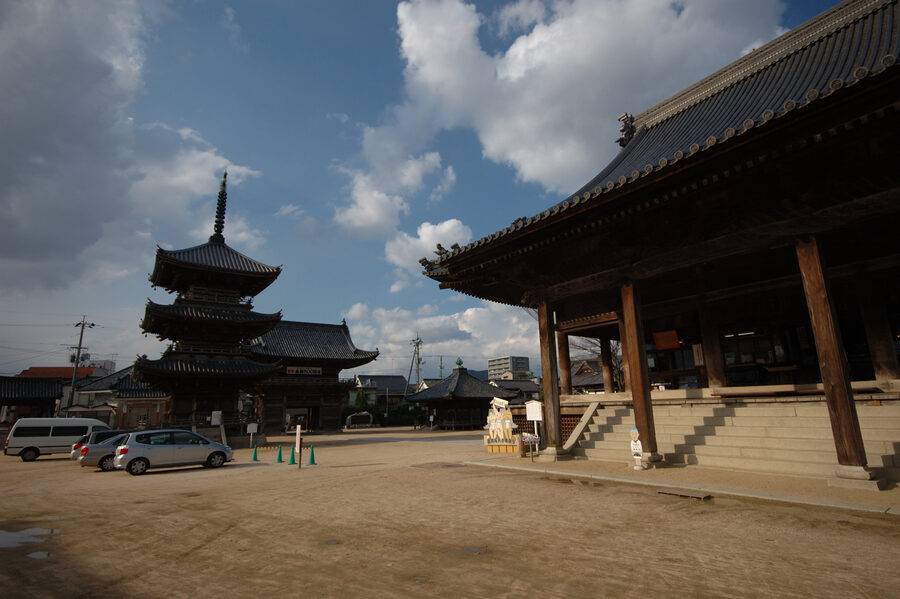
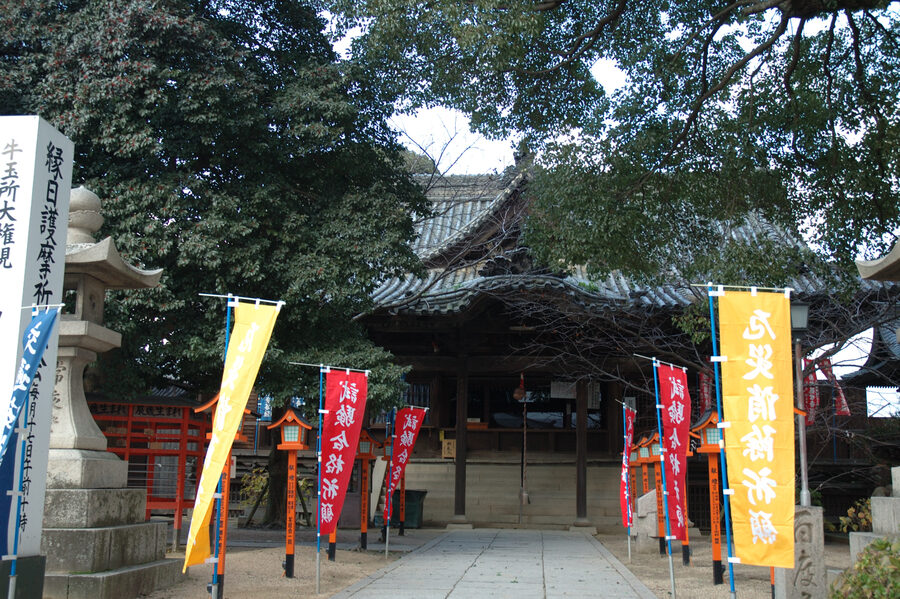
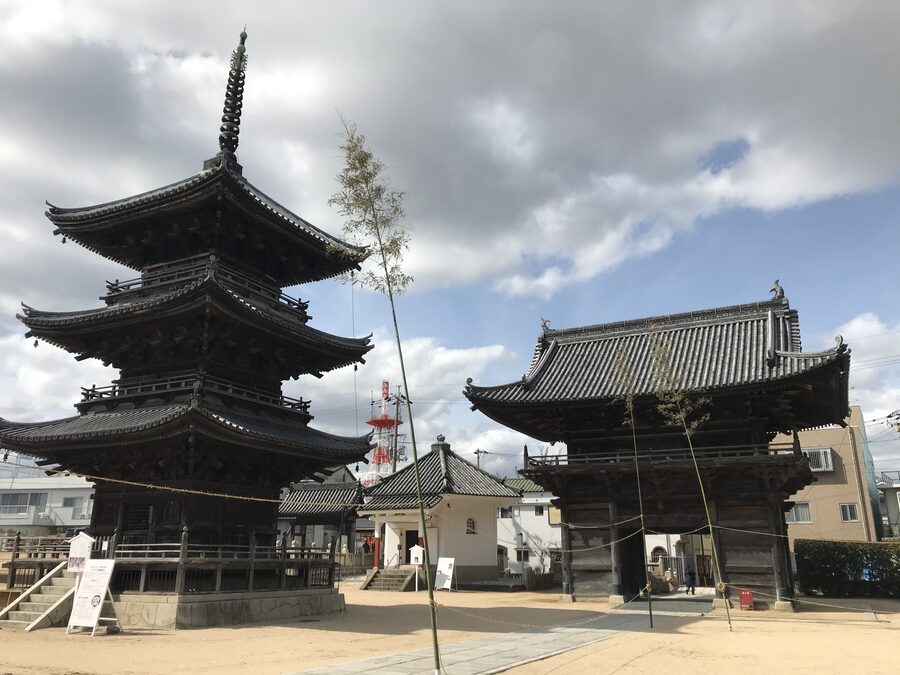
The temple is one of the head temples of the Kōyasan Shingon school and serves as the Kinryōzan Saidai-ji that gives the surrounding district its name. It has the standard Shingon architectural inventory you would expect, including a Main Hall (Hondō) that doubles as the Eyō stage, a three-storied pagoda, gates, and a small Shinto shrine on the precinct called Konpiradaigongen, a pre-Meiji holdover from when shrine and temple were not so neatly separated.
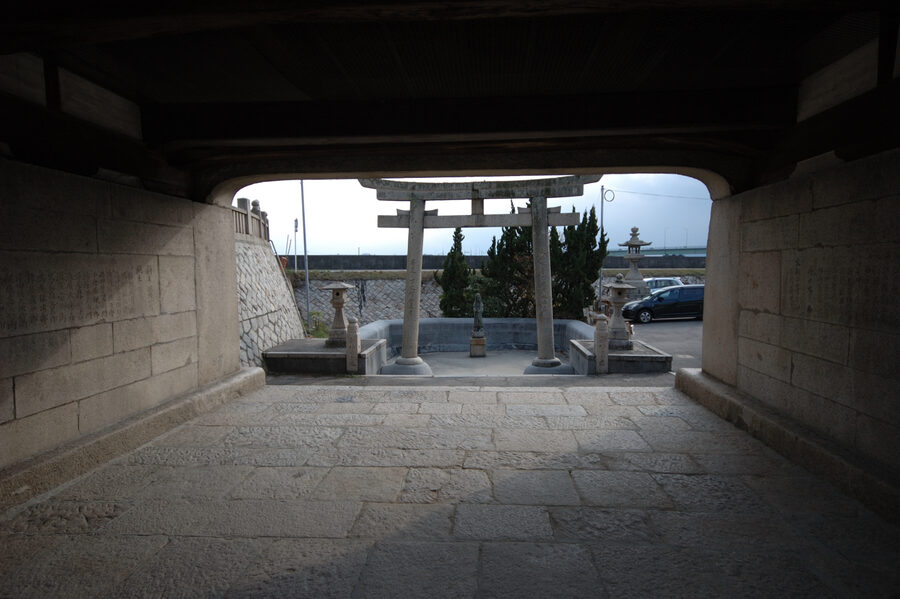
The piece of the precinct most relevant to Eyō is the koritoriba (垢離取場), a stone-rimmed purification area where participants douse themselves with cold water before entering the Main Hall. It is in a quiet corner of the grounds and unremarkable on most days. On Eyō night it becomes the busiest spot in Okayama Prefecture for about ninety minutes.
From paper charms to wooden sticks: the 1510 origin
Eyō dates to 1510, when the chief priest of Saidai-ji distributed paper protection charms called gō (牛玉) by tossing them out of the Main Hall window to worshippers gathered outside. The charms were considered exceptionally powerful, and over time the crowds grew large enough that fights broke out over who caught them. Wet paper does not survive a scrum, and so the temple eventually swapped the charms for solid wooden cylinders called shingi (宝木).
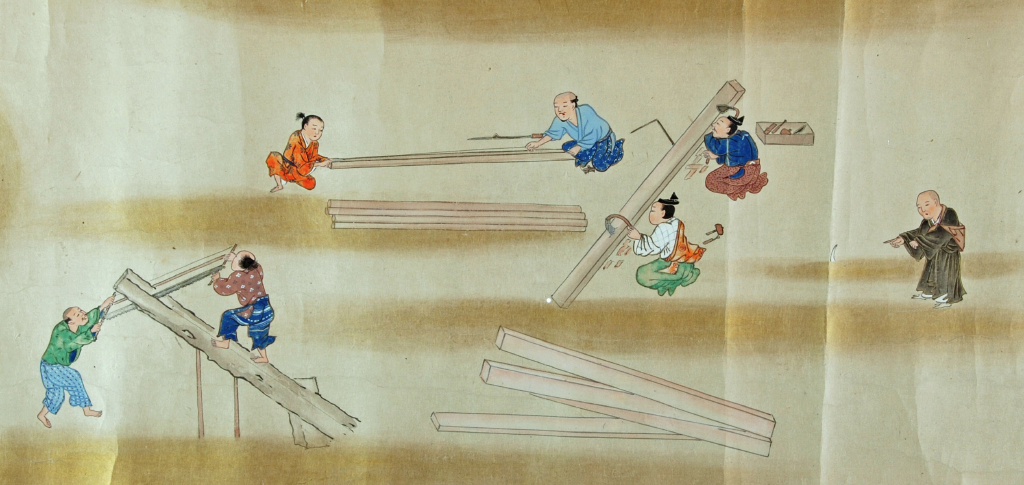
The shingi are a pair of identical sticks, roughly 4 cm in diameter and 20 cm long, cut from sacred wood and prayed over by the temple’s priests for two weeks before the festival. By the Edo period the contest had taken on its current shape, with participants stripping down for mobility and the fundoshi becoming the de facto uniform. The temple has held the festival in some form every year since, with rare exceptions for war and pandemic.
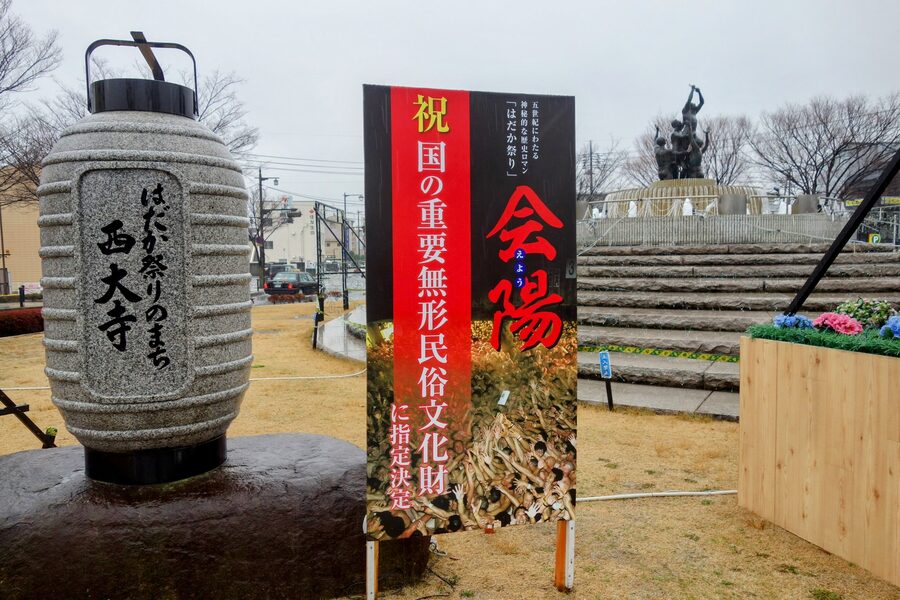
The 2021 edition was significantly scaled back due to COVID-19, with only a small number of designated participants allowed inside and the public shut out. The festival returned to full scale in 2023 and is now back to its usual ~9,000-participant size. It was designated an Important Intangible Folk Cultural Property by the Japanese government in 2016, putting it in the same protected category as Aomori’s Nebuta Matsuri and other major regional festivals.
The shingi: what those two sticks actually do
If you pick up only one piece of vocabulary from this article, make it shingi (宝木, “treasure wood”). These are the prize. Two of them are released into the crowd at midnight, and the men who manage to grasp them and carry them out of the south gate of the Main Hall, then plant them upright in a barrel of rice at the festival office, are declared fuku-otoko (福男, “lucky men”) for the year.
The fuku-otoko status carries real weight in Okayama Prefecture. Past winners have included business owners, prefectural officials, and athletes, and their names go on a list maintained by the temple. Sponsorship is allowed, which means a winner who works for a company often shares the title with a corporate patron whose name then circulates with the lucky-man designation for a year.
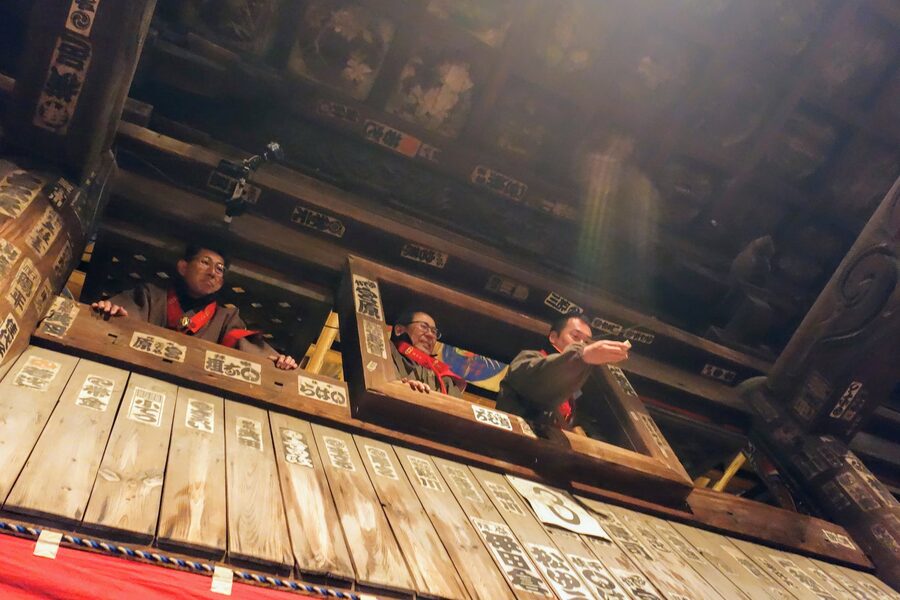
Alongside the two shingi, the priests also scatter about 100 smaller wooden tags called shōgi or kushigo into the crowd as consolation prizes. These confer lesser blessings and are far more numerous, which means a participant who came to Eyō for the spiritual side rather than the championship has a real chance of going home with something.
The shingi themselves stay with their finders only briefly. After the contest the sticks are returned to the temple and become the seed for the following year’s pair, in a quiet continuity ritual that I find more moving than the chaos of the night itself. Whatever luck the wood holds is recycled and renewed every February, the same two sticks symbolically passing through hands for half a millennium.
The night, hour by hour
The actual festival is structured more carefully than its reputation suggests. Things begin in the late afternoon, with prayers and offerings inside the Main Hall and a steady stream of participants registering at the temple office. By 7:30 PM the streets outside are full, food stalls are smoking, and the first groups of fundoshi-clad men begin their walk to the koritoriba.
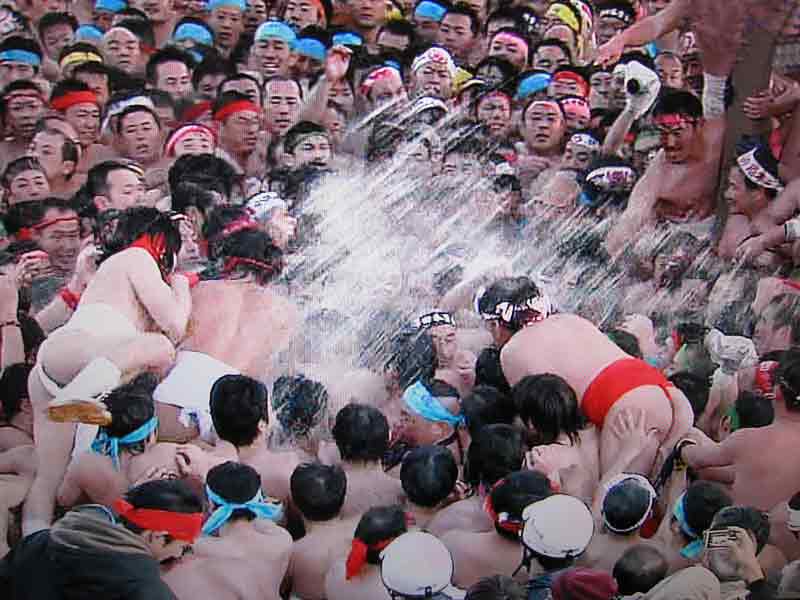
Around 9:00 PM the cold-water purification begins in earnest. Each participant pours buckets of icy spring water over himself in the koritoriba before entering the Main Hall, where the heat from already-purified bodies has made the floor slick. Outside the temperature is usually within a few degrees of freezing, sometimes well below it if there is wind off the mountains.
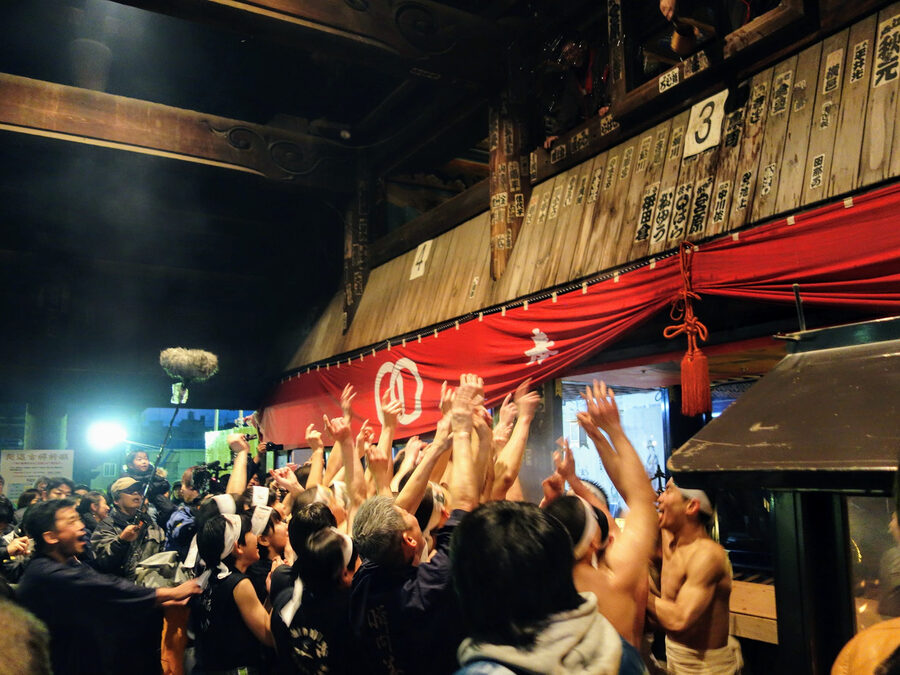
By 10:00 PM the Main Hall is full. The lights stay on for a final round of chanting, and at some point in the next two hours the temple cuts them, plunging the space into total darkness lit only by the reflections of camera lights from outside. About 100 smaller shōgi tags are thrown first as warm-up. Then the priest steps to the Ofuku-mado window and releases the two shingi.
What happens next is roughly five minutes of contained chaos and another ten of slower, surging movement as the men holding pieces of the prizes try to push toward the south gate. Anyone who reaches the gate with a stick still in his hands sprints to the festival office, pins the stick into a barrel of unhulled rice, and is officially the year’s fuku-otoko. The remaining participants gradually disperse, often back to the koritoriba for one more rinse before changing into street clothes.
2018 and 2024: women at Eyō
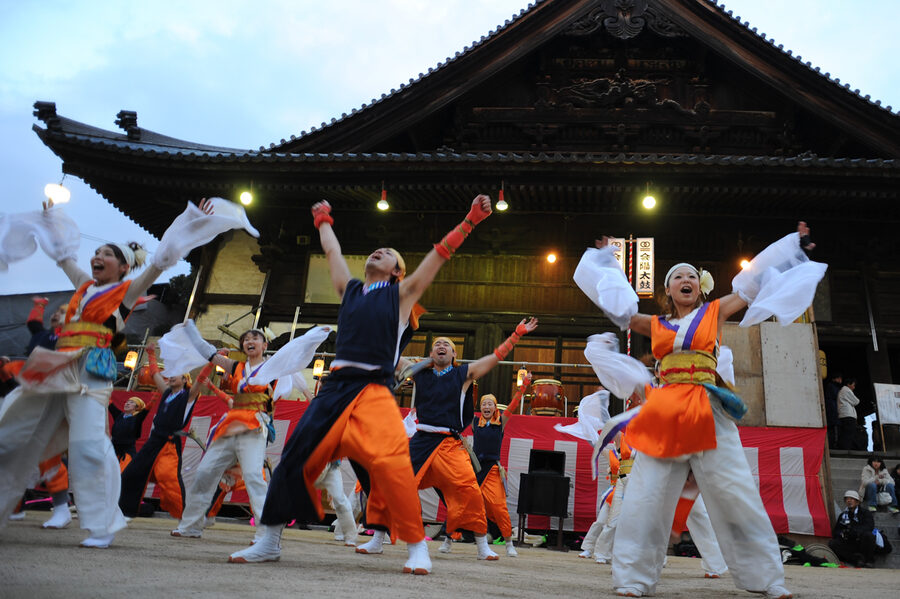
The festival was male-only for almost its entire 500-year history. That changed gradually, and the change is worth understanding correctly because it is often misreported. In 2018 the temple began experimenting with a women’s participation track that included roles like drumming and prayer-leading, but did not yet include entering the Main Hall during the shingi contest itself.
The major shift came in February 2024, when 30-plus women were permitted to participate as a team carrying their own bamboo-wreath obangō (お藩号), a separate ceremonial bundle that they offered at the Main Hall ahead of the male-only stick-grabbing finale. The women wore traditional happi coats rather than fundoshi and their participation was an offering, not a contest. It was nonetheless the first time women had crossed the threshold of the Main Hall in a participatory capacity since 1510.
The temple framed the change as a return to inclusivity rather than a break with tradition. There is historical precedent: the original 1510 distribution was open to anyone who could grab a paper charm, and the male-only convention developed gradually as the contest got rougher. The 2024 obangō team has continued in 2025 and 2026, with attendance growing each year.
Misogi: why the cold water matters
If you want to understand why anyone would do this voluntarily, you have to understand misogi (禊). Misogi is a Shinto and Buddhist purification rite that uses cold water (and sometimes waterfalls, rivers, or the sea) to wash away spiritual impurity and reset the practitioner to a clean state. It long predates Eyō and survives in many forms today, from the daily ablutions at major shrines to specialised ascetic retreats at sacred waterfalls.
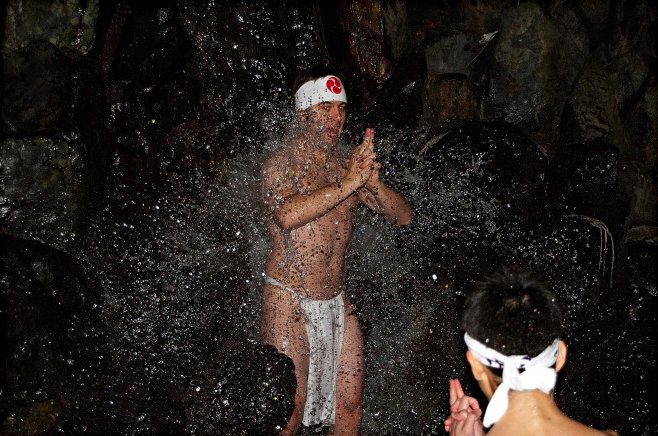
The fundoshi is part of the religious logic. The participant strips to the loincloth because clothing is considered to hold accumulated impurities, and a body in fundoshi is the closest acceptable approximation of the unclothed state of birth without violating public modesty. The cold water then completes the symbolic return to a clean baseline, after which the practitioner can approach the sacred without bringing impurity into it.
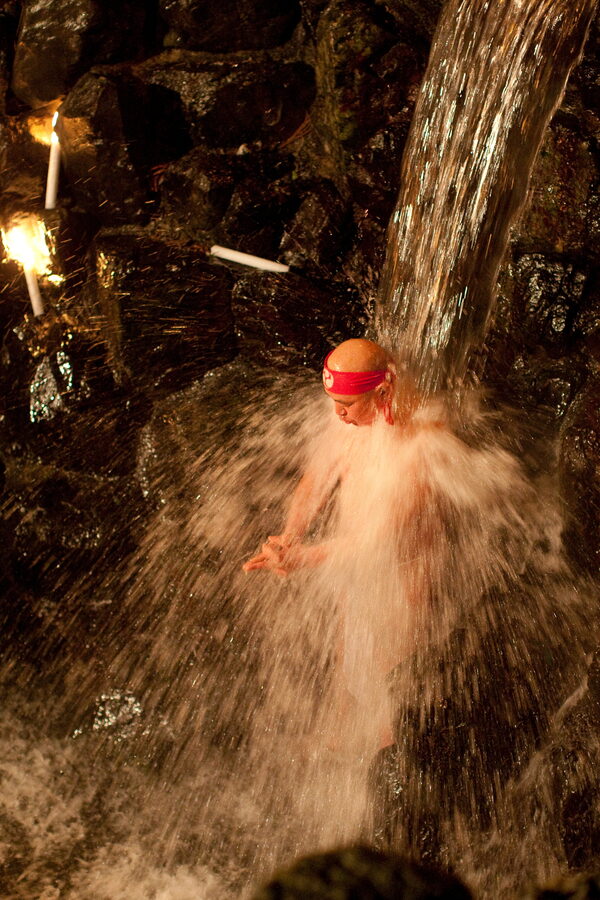
This is the framework that makes Eyō make sense. The 9,000 men in fundoshi are not staging a spectacle, they are collectively performing a misogi at scale, and the shingi contest is a focused mechanism for distributing the resulting blessing. If you watch the festival with this in mind, the boisterousness inside the hall reads less as a brawl and more as the kind of intense communal effort you see in the rougher parts of Gion Matsuri in Kyoto, where men carry mikoshi at a sprint.
Konomiya Hadaka Matsuri: the Aichi cousin
The other widely-known hadaka matsuri is Konomiya (国府宮はだか祭) at Owari Ōkunitama Shrine in Inazawa City, Aichi Prefecture. It is held on the 13th day of the first lunar month, which usually falls in February or early March, and like Eyō it has been in continuous operation for well over a thousand years. The shrine traces the rite to 767 CE, when it was conducted as a province-wide purification against epidemics during the Nara period.
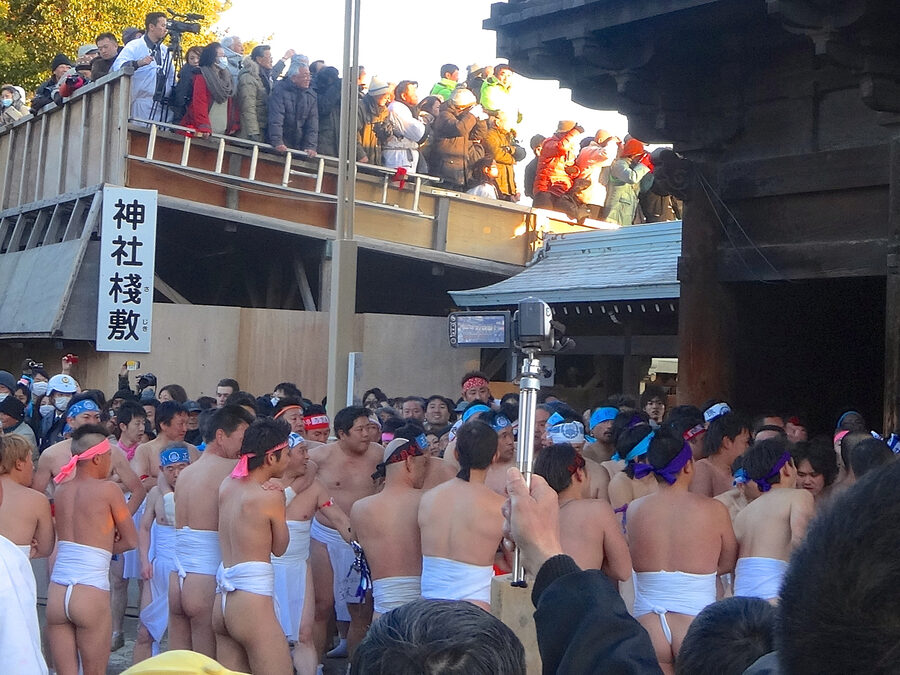
The Konomiya format is different from Saidai-ji. There is no shingi to grab. Instead, a single young man is selected each year as the shin-otoko (神男, “god-man”), the local who absorbs everyone else’s misfortune for the next twelve months. He walks from a designated location to the shrine on festival day, and the participants try to touch him as he goes, on the theory that contact transfers their bad luck onto him.
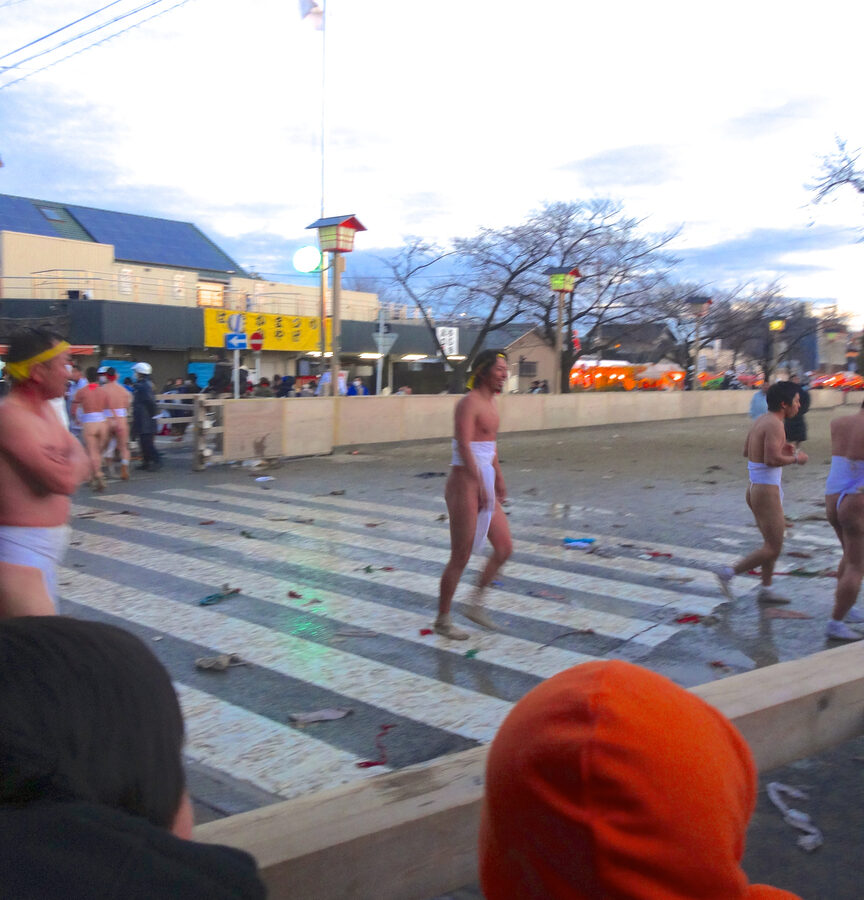
After the shin-otoko reaches the shrine, all the absorbed misfortune is sealed into a black mochi made from rice and the ash of burned omamori, and the mochi is buried in a designated forest location to keep the bad luck contained. The shin-otoko himself spends the days afterward in seclusion, recovering from a role that is genuinely physically demanding.
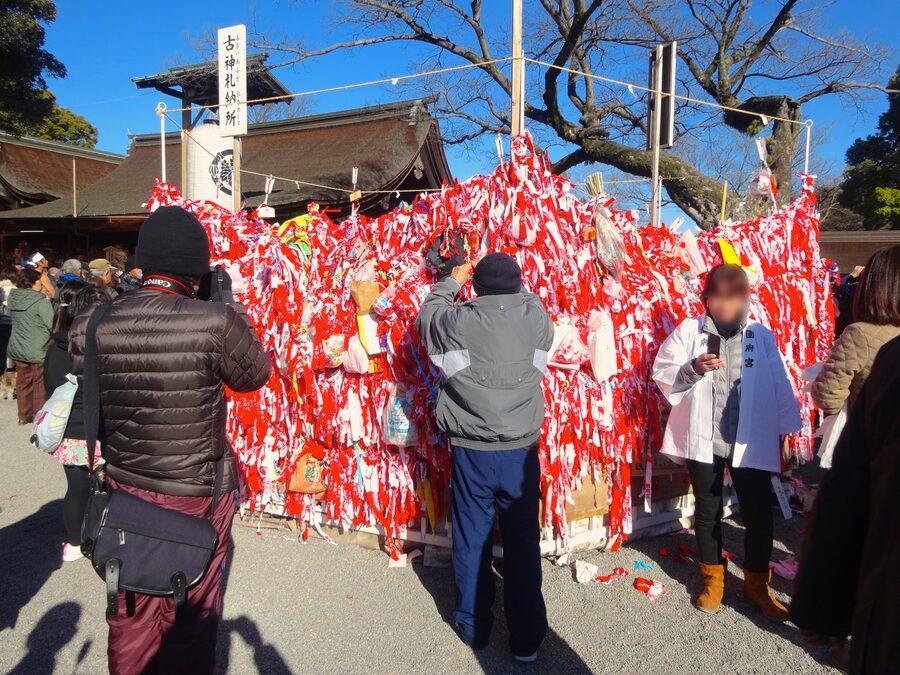
Konomiya allowed female participation for the first time in 2024. On 22 February that year, 41 clothed women carried bamboo offerings called naoizasa to the shrine, marking the first formal women’s role in the rite’s recorded history. As at Saidai-ji, this was an addition rather than a replacement, and the male shin-otoko ceremony continued unchanged.
Sominsai: the festival that ended in 2024
Iwate Prefecture’s Sominsai (蘇民祭) at Kokuseki-ji temple is the third leg of what tourists used to call Japan’s three great naked festivals. I am writing about it in past tense because Kokuseki-ji’s chief priest announced in 2024 that the temple could no longer sustain the rite, and the February 17, 2024 edition was the festival’s last after more than 1,000 years.
The Sominsai format was its own thing entirely. The festival ran for most of the night and culminated with hundreds of fundoshi-clad participants pursuing a somin-bukuro, a sack of small hexagonal wooden talismans, across roughly two kilometres of snowy terrain. Whoever was still holding the bag at the end took home what was left of the talismans, and the rest were scattered along the route as consolation.
The decision to end Sominsai came down to demographics. Iwate has been losing young people to the cities for decades, and the rural parishes that once supplied participants and volunteer staff simply could not field a viable festival anymore. Kokuseki-ji has replaced the night with smaller prayer ceremonies and other ritual continuities, but the running, the snow, and the sack are gone. It is worth understanding this when planning travel: if you read older guides that list “the three great hadaka matsuri,” that list is now down to two.
Other regional hadaka matsuri
The two big ones plus Sominsai’s ghost are not the whole picture. Hadaka matsuri are spread across Japan in dozens of local variants, and most of them are healthy. Wakamiya Hachiman in Bungotakada, Ōita Prefecture, holds a November rite where fundoshi participants cross a river carrying a giant burning torch.
Doya Doya at Shitennō-ji in Osaka is a January contest for cow-god amulets. Ohara in Chiba runs a September fishing-village version that combines naked procession with mikoshi-into-the-sea.
If you live in Japan and want to watch a hadaka matsuri without travelling far, your best bet is to check whether your local shrine has its own version. Many do, and the smaller ones are easier to attend as a respectful spectator without getting in anyone’s way. Tokyo has Ikenoue Misogi Matsuri in Setagaya; Fukushima has Hayama-gomori at Kuronuma Shrine; Niigata has Bishamon Naked Push, designated Important Intangible Folk Cultural Property in 2018.
What unites them all is the cold-water purification followed by some form of group physical exertion that distributes a blessing. The specifics are wildly local, the underlying logic is shared, and most of these festivals coexist with the larger calendar of summer events like the floats of Tsushima Tennō Matsuri as part of a year-round Japanese ritual rhythm rather than competing with it.
The fundoshi: a brief practical history
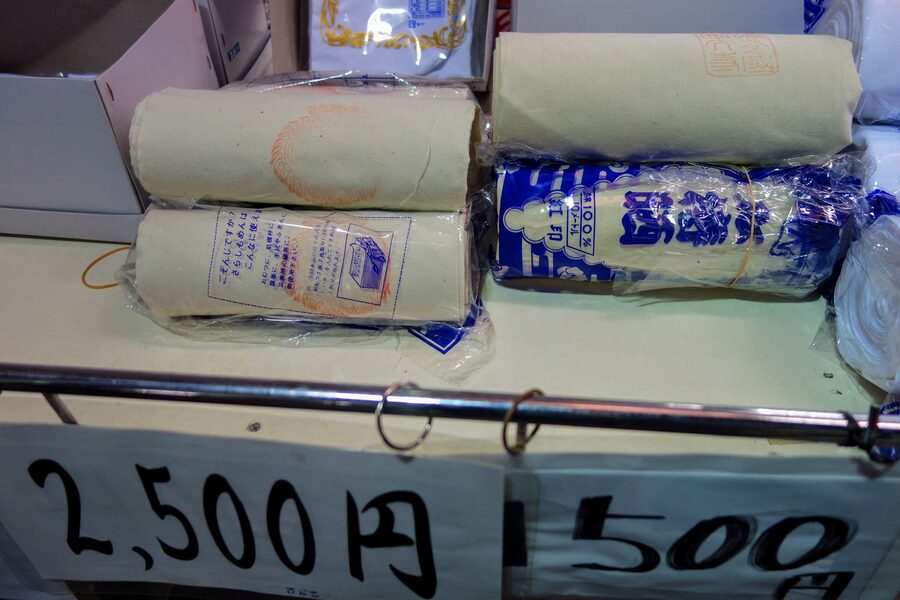
Since the loincloth is the festival’s single most photographed element, it is worth taking a minute on the garment itself. The fundoshi (褌) is a long narrow strip of cotton, typically a metre and a half by 30 centimetres, that wraps between the legs and around the waist with the ends tied off either at the side or in front. There are several styles, the most common at hadaka matsuri being the rokushaku (六尺), a longer six-foot version that allows for a more secure wrap.
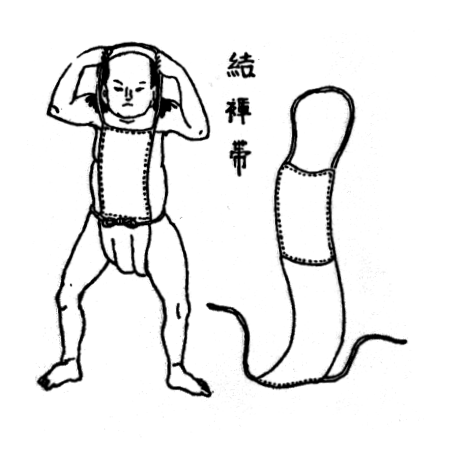
For most of pre-modern Japanese history the fundoshi was the standard male undergarment, worn by samurai, farmers, fishermen, and labourers alike under whatever outer clothing their station required. Women had their own equivalents, and the Wikimedia archive includes 1930s photographs of female ama divers in fundoshi-style work kit. The garment fell out of everyday use after Western-style underwear arrived in the late 19th and early 20th centuries.
What survived was the ritual and athletic context. Sumo wrestlers wear the closely-related mawashi, and festival participants at hadaka matsuri wear the fundoshi proper.
A small modern subculture wears it as fashion or swimwear, and you can buy them in quite striking colours, but at Saidai-ji and Konomiya the only acceptable colour is white. The temple sells them at the entrance for participants who do not bring their own.
Travel logistics for spectators
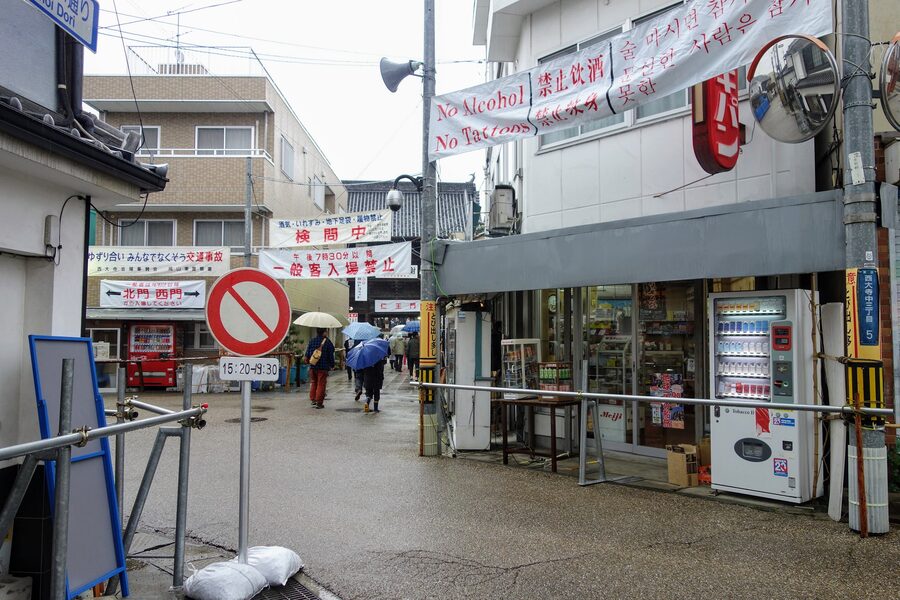
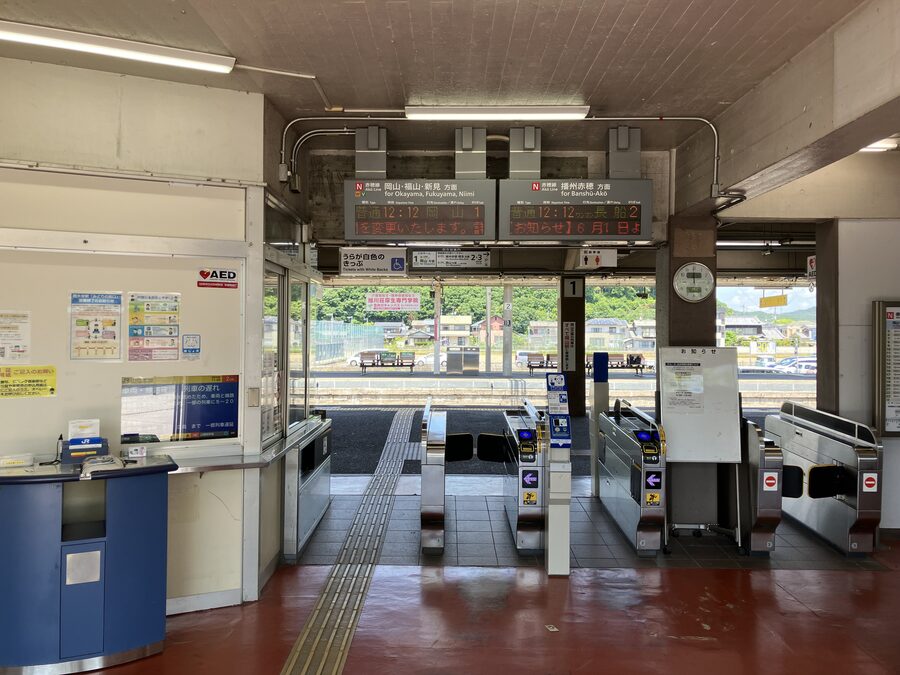
If you are coming as a spectator rather than a participant, the good news is that Saidai-ji is easy to reach. The temple is in the eastern suburbs of Okayama City and is served by JR Saidaiji Station on the Sanyō Main Line, about 25 minutes by local train from JR Okayama Station. From the station’s south exit, the temple is roughly a 15-minute walk along Gofuku-dōri street, which on festival night is lined with food stalls and banners.
Okayama itself is easy to reach as a base. Shinkansen trains stop at JR Okayama Station from both Tokyo (about 3 hours 15 minutes) and Osaka (about 45 minutes), and the city’s central area has a reasonable spread of business hotels at standard Japanese mid-range prices. If you are coming for one night specifically for Eyō, a hotel close to JR Okayama is more practical than one in Saidai-ji proper, since the festival ends after midnight and Saidai-ji’s local accommodation is limited.
The Eyō Memorial Hall (会陽記念館) sits next to the temple and is open year-round. It houses past shingi, photographs from previous festivals, and a permanent exhibition on the rite’s history. I would suggest visiting it before the festival itself, even on festival day, because it gives you the context that turns the night from a confusing scrum into a coherent ritual you can read.
What to wear if you are spectating
Mid-February in Okayama is cold but not extreme, with average lows around 1-2°C and highs around 9°C. The festival night specifically is usually colder than average because the contest happens after midnight and you may be standing outside for hours. I would dress for skiing rather than for a normal winter night out, with thermal base layers, an insulated mid-layer, a waterproof outer shell, and good boots.
The viewing situation depends on where you stand. If you want to be inside the Main Hall as a non-participating observer, you cannot, the hall is reserved for fundoshi-clad registered men plus the obangō team. Spectators view from the outer precinct, the windows of the surrounding buildings, and the streets along the procession route, all of which are open-air.
Bring earplugs if you are sensitive to noise. The drumming starts hours before midnight and is genuinely loud, especially if you find a good spot near the koritoriba. Hand warmers and a small flask of something hot help more than I can adequately convey at three in the morning when the festival has wrapped up and the trains have not yet started running.
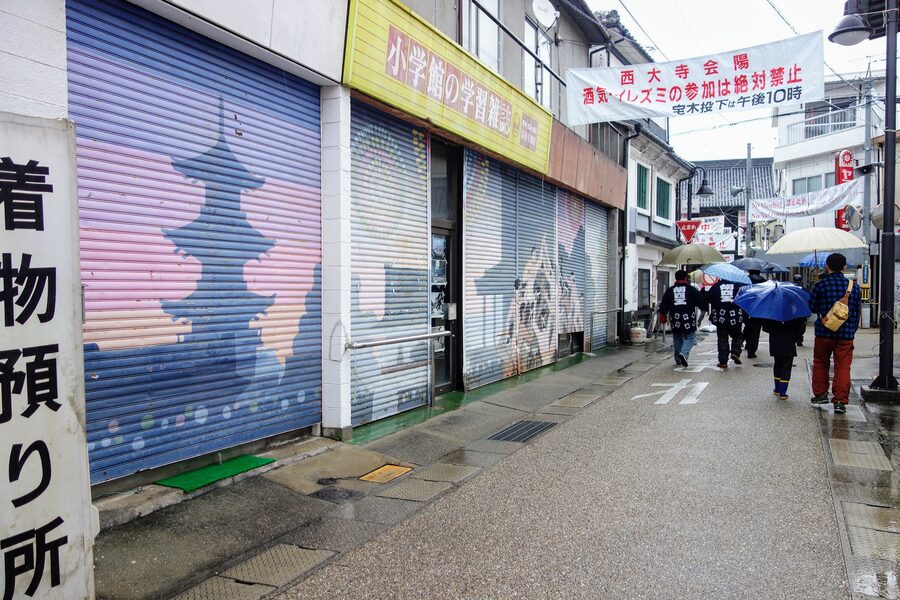
Photographing the festival
If you are a photographer, Saidai-ji Eyō presents serious technical challenges and one significant ethical one. The technical issue is light. The hall is intentionally dark for the climactic shingi throw, and any flash photography is forbidden inside the precinct. You will be working with whatever ambient light there is, plus the firelight from the koritoriba and any lights from the broadcast cameras the temple has authorised.
The ethical issue is consent. Participants are in a religious rite, not a fashion shoot, and many of them do not want their faces in tourist photo galleries. The temple’s official position is that respectful photography is fine, but identifiable close-ups of individual participants without permission are not. Wide shots and silhouettes are easier to defend than zoom-ins, and you should always assume that any participant near the koritoriba might prefer not to be photographed at all.
If you want clean, well-composed photographs without any of these constraints, the Eyō Memorial Hall sells beautiful prints from the temple’s official photographer. They are reasonably priced, the lighting and composition are far better than you will manage as a freezing tourist at midnight, and buying them supports the festival itself. I have seen some of the best Eyō images of the past decade come out of that gift shop.
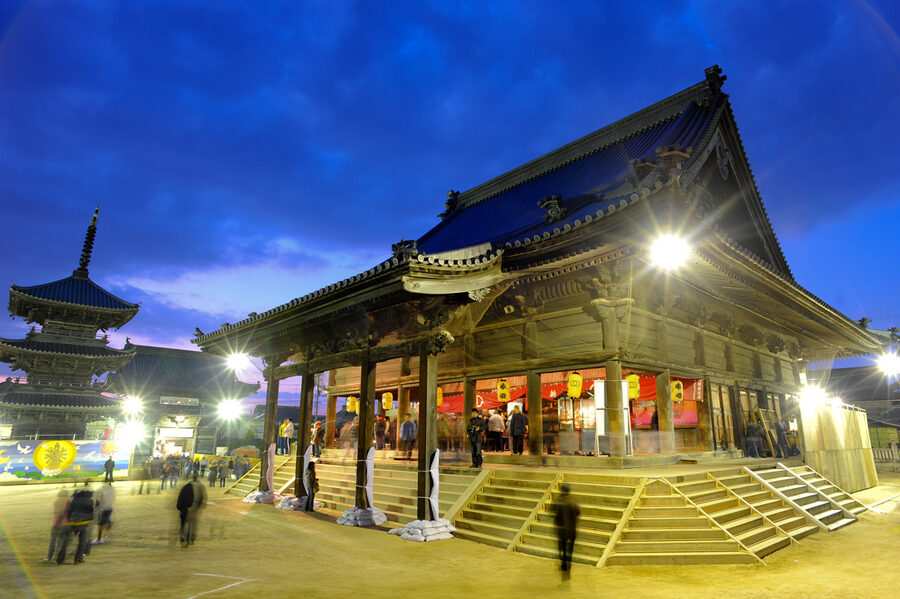
Eating around Saidai-ji
Okayama is a serious food prefecture, and the area around Saidai-ji has its own specialities even outside the festival period. Bara-zushi, a sushi-rice dish topped with seafood and vegetables, is the regional speciality and turns up in most festival-night stalls. Demikatsu-don, a tonkatsu rice bowl drowned in demi-glace sauce, is an Okayama City original that you will find in the cheap restaurants near JR Okayama Station.
The Saidai-ji area itself has a small cluster of izakaya that stay open late on festival night to feed both finished participants and dispersing spectators. They are not formal places. Expect a counter, a hot plate, and an old proprietor who has been pouring sake on Eyō night for thirty years and does not need a menu translated. The food is the kind of solid Japanese pub food that tastes especially good at 1 AM in February.
If you want a more formal sit-down meal earlier in the day, JR Saidaiji Station’s surrounding blocks have a few decent ramen and udon shops. Okayama is also famous for its peaches in summer and shaved ice with peach syrup, neither of which is in season for the festival, but worth filing away if you visit the prefecture again in July.
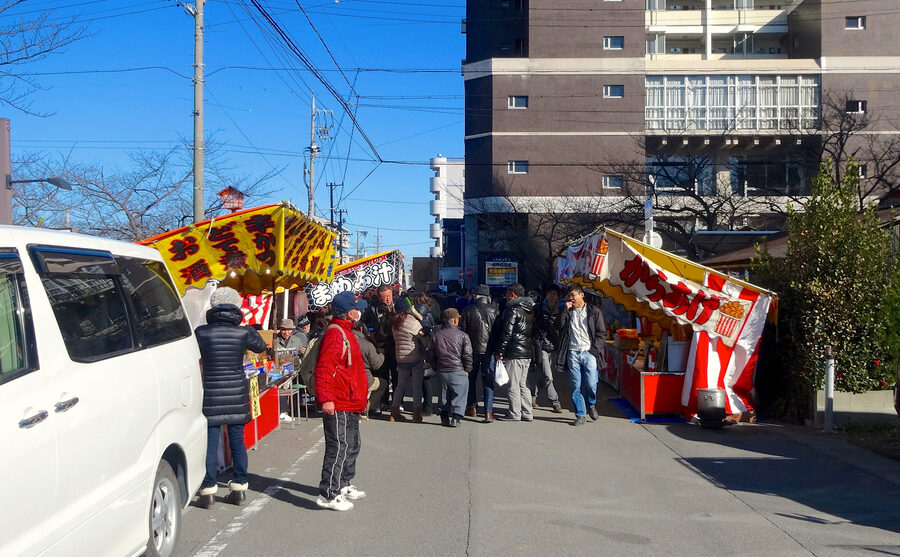
How Eyō fits into Japan’s festival year
Saidai-ji Eyō sits in the deep-winter slot of the Japanese festival calendar, alongside Sapporo Snow Festival and the various setsubun rites that mark the official end of winter in early February. It serves a function that most cultures need somewhere in their year, a kind of shared physical effort that resets accumulated impurity and prepares the participants for spring.
That ritual logic links it to traditions you might know from quite different contexts. The discipline and focus required of a participant resembles what you find in the Japanese tea ceremony, where every gesture is precisely placed and the cumulative effect is meditative. The temple-as-destination angle puts it in the same conversation as Toyokawa Inari and other religious-festival sites where the trip itself is part of the merit.
You can also draw a clean line from Eyō to the Edo-period restrictions that shaped so much of pre-modern Japanese travel. Festivals like this one developed inside a regulated society where movement was constrained by the sankin kōtai alternate attendance system, and where local rituals served as one of the few legitimate reasons for ordinary people to congregate in large numbers. Eyō survived precisely because it was the kind of folk practice the bakufu was happy to leave alone.
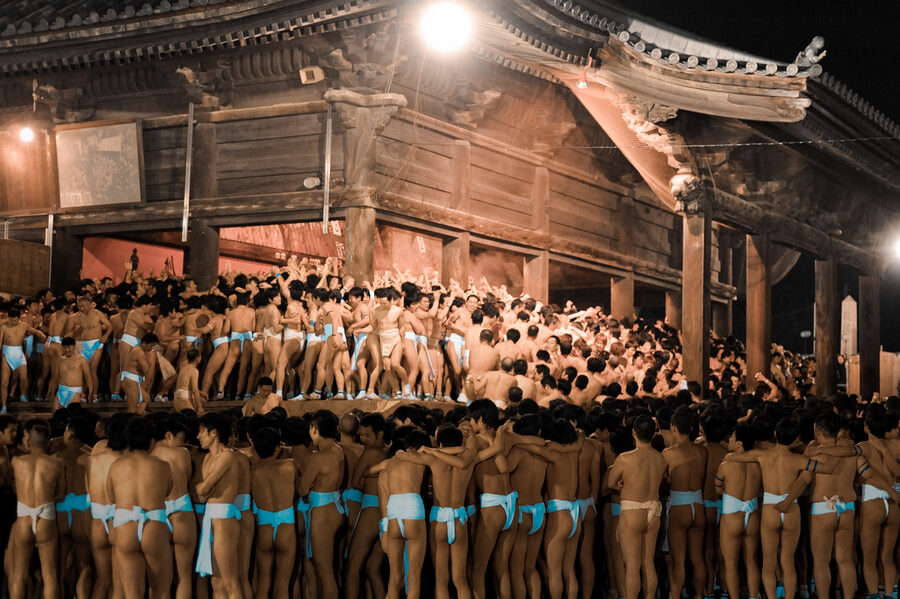
Practical FAQ
A few questions come up reliably whenever I tell people I have visited Eyō. The first is always: are foreigners allowed to participate? The answer is yes, with the same rules that apply to anyone else.
You must be male, sober, free of visible tattoos (or covered by approved athletic tape), wear a temple-issued or temple-approved fundoshi and white tabi, and be inside the Main Hall before the cut-off time. Registration is at the temple office on the day.
The second question is about whether you need a ticket. There is no admission fee for spectators on the public side of the precinct, and the streets are open. Participation has a small registration cost that includes your fundoshi and tabi, which the temple does not advertise as a “ticket” but is functionally one. Reserved viewing spots inside the temple’s authorised vantage points are bookable through the festival office in advance.
The third is about whether the festival has been continuous for 500 years. Mostly yes, with disruptions in wartime and during the most severe phase of COVID-19 in 2021. The 2024 women’s participation is a modern addition rather than a revival, since the historical evidence does not support a substantial earlier women’s role beyond the early decades when paper charms were thrown. The temple has been quite candid about this in its official communications.
What to take away
Saidai-ji Eyō is one of those Japanese rituals that is easier to mock from a distance than to understand up close. Strip away the headlines about “naked” festivals and what you have is a 500-year-old Buddhist purification rite that has weathered war, modernity, pandemic, and demographic decline, and that still draws around 9,000 participants and tens of thousands of spectators every February. The fundoshi is religious dress, the cold water is a real ascetic practice, and the two sticks are the year’s luck distilled into a 20-centimetre object.
If you decide to attend, attend respectfully. Watch the koritoriba purification rather than just the midnight grab. Read the rules on the banners and follow them.
Do not photograph participants’ faces in close-up without consent. Buy the official prints from the Memorial Hall if you want clean images. Eat the bara-zushi, and take the last train back to Okayama or accept that you are walking some of it.
And if you cannot get to Saidai-ji this year, Konomiya at Owari Ōkunitama Shrine in Aichi runs roughly a week or two later, on the 13th day of the first lunar month, and is easier to reach from Tokyo on a same-day shinkansen round trip. The shin-otoko version is a different rite from Eyō but cousin to it, and the same misogi logic powers both. Either one will give you something you cannot get from any other corner of the festival calendar.
The next Saidai-ji Eyō falls on the third Saturday of February the year you read this. If you are in Japan and you can get to Okayama, I would tell you to go. If you cannot, the Konomiya alternative on the lunar 13th is the realistic substitute. Either way, you will leave with a clearer understanding of what Japanese folk religion looks like when it is conducted at full scale by people who genuinely believe the ritual works, which is the only context in which any of this makes sense at all.