Stand in front of a skilled hakama-wearer and watch their feet. You cannot. A good hakama, cut to its traditional length and worn properly, turns your lower body into a moving cone of fabric that begins under the ribs and ends a finger’s breadth above the ankle. You can see the wearer step, eventually, because they arrive somewhere they were not before. You cannot see the mechanics of the step — the shift of weight onto the lead foot, the micro-bend of the back knee that telegraphs direction, the tension of the calf that says “here it comes.” Aikido instructors explain this out loud to new students. The hakama is worn, the ja.wiki entry for 袴 states plainly, so that the opponent cannot read the movement of the knee. It is a strategic garment dressed up as a pair of trousers.
I find this the most honest single line anyone has written about Japanese formal wear. The ceremonial layer came later. The combat layer was there first. The seven deep pleats on a proper men’s hakama — five in front, two in back, arranged in that subtly asymmetric way Japanese aesthetics likes — are not decoration. They are volume management, so that the fabric has somewhere to go when the leg shifts. The trailing length, the stiff trapezoidal koshi-ita panel at the back, the four long himo that wrap twice around the waist and tie in a knot the wearer cannot quite see — every one of those is function first, and ceremony afterwards. You understand the hakama correctly if you start from the fact that a samurai who could not hide his footwork was a samurai who did not last long.
In This Article
- The anatomy of a hakama, honestly described
- The courtly ancestors — when trousers were tied at the ankle
- The samurai claim it, and the kamishimo is born
- The naga-bakama — trousers with a built-in anti-assassination clause
- The working hakama — Portuguese loans and mountain cuts
- Meiji erases it, a woman in Gifu saves it
- Where it still is — the small list of living contexts
- Shichi-Go-San — the five-year-old’s first pair
- Where to see hakama today
- Gōshi Gaisha Sendaihira — the last maker in Sendai
- Jissen Women’s University, Tokyo — where Shimoda’s hakama lives
- Meiji Jingū, Tokyo — to watch miko in hi-no-hakama
- Kongō Nohgakudō, Kyoto — naga-bakama on stage
- Any kendo or aikido dojo in your area
- Closing thought — the trousers that still hide the feet
The anatomy of a hakama, honestly described
The hakama is, at its simplest, two trapezoids of fabric joined down the sides from the hips, with the bottom half of each trapezoid sewn into what the Japanese call a kyurotto skirt — a culotte, divided into legs below the knee but voluminous and loose everywhere else. The ja.wiki entry calls this the umanori style, literally “horse-riding,” and that is not a romantic flourish — this is the cut designed so you can sit astride a horse without the skirt binding across the saddle. There is a separate, later, undivided version called the andon-bakama (lantern-hakama, so named because it hangs from the waist like a paper lantern), but when Japanese people say “hakama” without qualifying, they mean the divided umanori.
The front panel carries the pleats. Five of them, arranged two-on-the-right and three-on-the-left, which is the asymmetry Japanese tradition accepts without ever quite explaining. The back panel carries no pleats — instead it has a stiff trapezoidal piece called the koshi-ita sewn into its upper edge, which sits against the small of the back and gives the garment its posture. Below the koshi-ita, on the inside, is a small spoon-shaped piece of wood or bone called the hera or hakama-dome, which is tucked into the obi underneath and locks the whole structure into place. Four long cloth ties — himo — come out of the corners of the front and back panels. The front himo are exactly twice the length of the back himo, because the front set wraps around the body twice before being brought back to tie off, while the back set simply crosses the front knot once and finishes.
Every one of these details is load-bearing in a way that the Western eye tends to miss on first look. The five-pleat front creates enough fabric volume that the leg can step a full stride without the weave binding at the knee; the two-pleat back stays flatter because the back of the leg needs less room to extend. The koshi-ita is rigid on purpose — it keeps the back of the trousers from sagging, which both preserves the silhouette and prevents a fold of cloth falling on the sword hilt tucked into the obi. The four-himo system is not decorative either: you can sit, kneel, ride, or fight in a correctly-tied hakama without it loosening, because the two layers of wrap plus the back cross-over distribute the tension around the waist rather than concentrating it on a single knot. The Japanese spent several centuries refining this. It shows.
The courtly ancestors — when trousers were tied at the ankle
Before the samurai claimed the hakama for their formal dress, it belonged to the court. The earliest versions we have iconographic evidence for come from the Nara period in the eighth century, already split into two distinct garments worn at the same time: an underlayer called ōguchi-bakama in bright red, tied off on the left side of the waist with a closed crotch, and an overlayer called uenobakama in white with an open fly, tied on the right. You can see both together in the elaborate sokutai costume that court nobles wore during formal audiences, which the Imperial Household Agency still uses today for certain ceremonies. Red underneath, white on top, opposite ties — this was the full-dress uniform of a Heian courtier, and it stayed essentially unchanged from the 700s through the Taira-Minamoto conflicts.
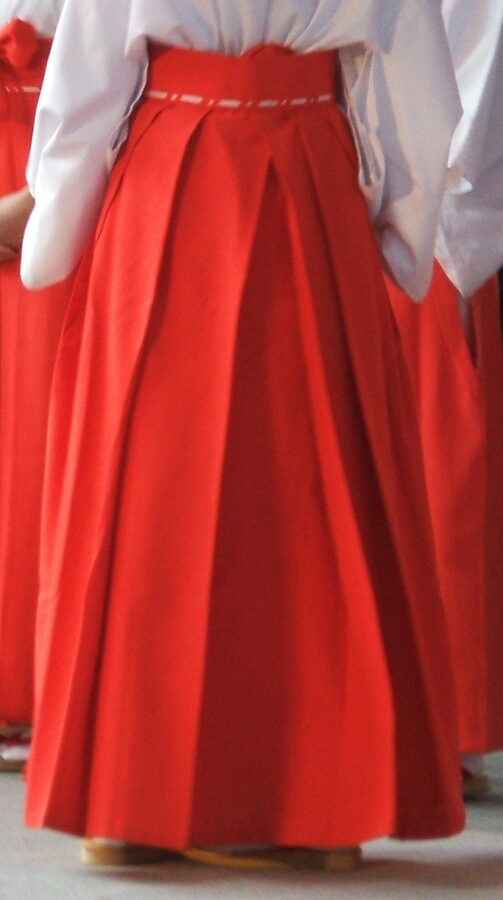
The more distinctive courtly variant was the sashinuki, sometimes written nu-bakama, which had a cord run through the hem of each leg and pulled tight at the ankle. This created a visibly ballooning silhouette that hung in loose folds below the knee, exposed the foot, and made walking deliberate rather than brisk. The earliest sashinuki had four panels of fabric; later, more formal versions went up to six, because you needed that much extra volume for the correct amount of billow. Heian aristocrats wore them for leisure and semi-formal occasions, pairing them with the various hō, kariginu, or suikan upper garments depending on rank and setting. The shrine maidens you see today at Shinto shrines — the miko in bright red hakama — inherit this specific lineage. Their outfit is essentially a simplified Heian court woman’s costume, modernised a few centimetres here and there but still recognisably the thing Murasaki Shikibu would have seen walking past her at Kyoto’s palace.
The samurai claim it, and the kamishimo is born
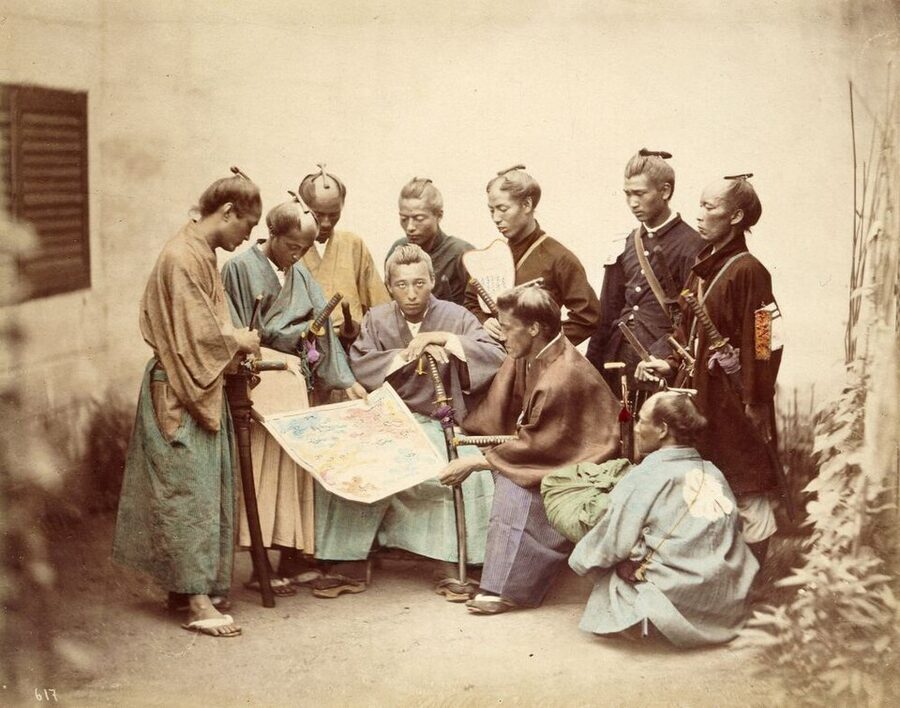
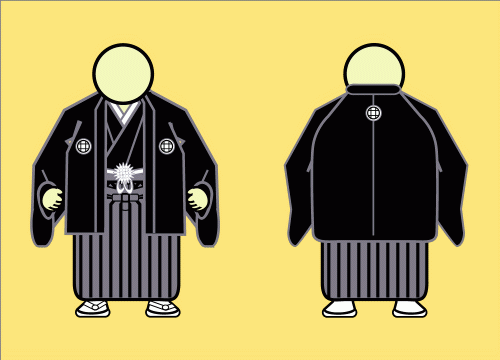
The samurai did not invent the hakama. They absorbed it. As the warrior class displaced the court during the Kamakura and Muromachi periods, they took the lower-half garment that the aristocracy wore for formal wear and attached their own upper-half garment to it. The result, finalised into a standard uniform during the Edo period, was the kamishimo — written 上下 or 裃, literally “above-below” — a complete formal outfit that paired a kimono underneath, a hakama on the bottom, and on top a sleeveless jacket with rigid, almost aggressively exaggerated shoulders called a kataginu. The kataginu’s shoulders look cartoonish in period drama because they were designed to look cartoonish: they project outward roughly a hand’s width beyond the actual shoulder, pressed flat with starch or lightweight wooden battens sewn into the seam, to create the visual outline of a man who is much wider and more imposing than he really is.
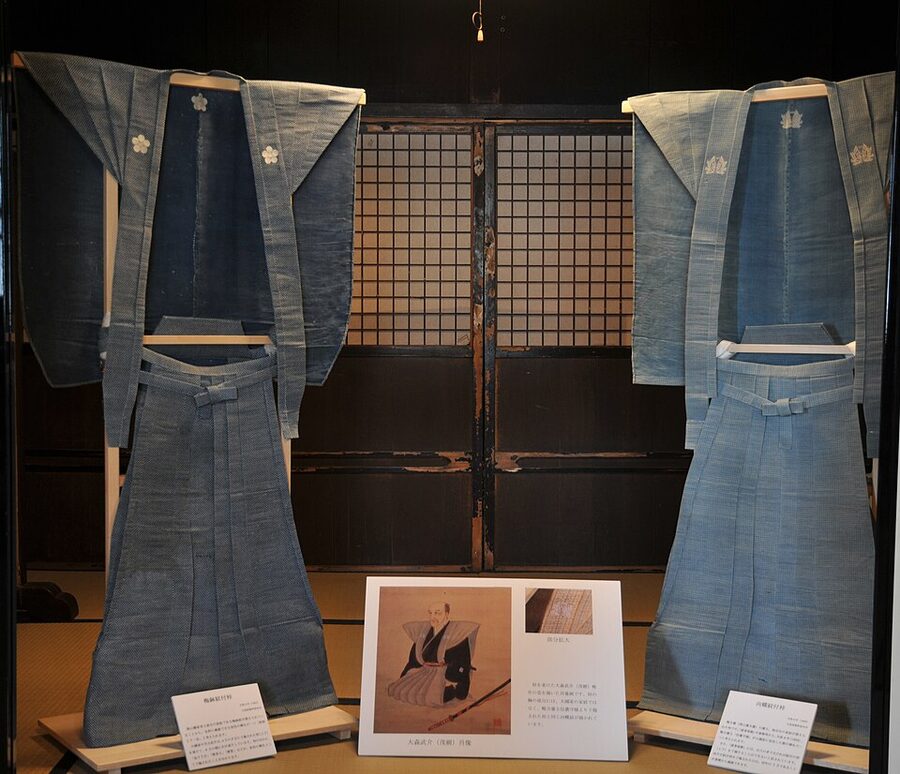
The kamishimo became the standard uniform for two and a half centuries of samurai life. An Edo-period retainer reporting to his lord’s audience chamber wore kamishimo. A rural samurai going to town to pay respects to the regional daimyō wore kamishimo. The retainers who accompanied Sassa Narimasa and the other Sengoku survivors to Hideyoshi’s court wore kamishimo, and the men who walked behind Tokugawa Tsunayoshi in his ceremonial processions wore kamishimo. The material signalled rank — senior daimyō in pure silk with their crests woven into the fabric, mid-rank samurai in patterned silks, and lower-rank retainers in striped cotton. But the cut was the same from the shōgun down to the village magistrate. This is rare in world costume history, where formal wear usually diverges sharply between court and provincial elite. In Edo Japan, the outline stayed uniform; only the cloth told you who you were looking at.
Under the kamishimo sat the hakama, and the hakama for this purpose was almost always made of sendaihira — striped silk from Sendai, which I’ll come back to when we get to where to visit. At this level of formality, the stripes were narrow and sober: black on navy, grey on charcoal, sometimes white on silver. A samurai did not wear bright colours to work. He wore colours so restrained that you had to stand within arm’s reach to see the pattern at all, and that was the point — understatement was itself a status marker, because only someone confident of his position could afford to dress below the eye’s notice.
The naga-bakama — trousers with a built-in anti-assassination clause
And then there is the naga-bakama, which is the garment that convinced me Japanese formal wear is genuinely weirder than the rest of the world gives it credit for. When a samurai was granted audience at the shōgun’s court in Edo, or at certain senior daimyō courts, he was sometimes required to wear a special variant of hakama with a train one to two feet longer than his actual leg. The extra cloth trailed behind him as he walked, bunching under his feet if he moved too quickly, forcing him to shuffle deliberately across the tatami and turn with slow, broad sweeps of the leg. You could not run in a naga-bakama. You could not draw a sword cleanly. You could not lunge. You could barely keep your balance standing up from seiza.
That was the point. The naga-bakama was never meant to be worn on the battlefield or even in normal castle duty. It was ceremonial wear for audiences, and the ceremony was specifically designed to make sudden violence impossible. A samurai approaching the shōgun in naga-bakama was a samurai who could not physically assassinate the shōgun, because by the time his legs had untangled enough to close the distance, the retainers on either side would have stopped him. The shōgun’s audience chamber had a formal distance between dais and supplicant that was calibrated exactly to the shuffling speed of a man in naga-bakama. This is sartorial security theatre, in the same way that removing your shoes at a ryokan is partly ritual and partly a practical way of confirming you are not carrying a weapon. The difference is that the naga-bakama put its security logic directly into the garment rather than the surrounding protocol.
You can still see the naga-bakama in Noh theatre and in kabuki, where certain high-rank roles still call for the extended train. The shite-kata actor in a full-dress Noh performance wears a naga-bakama that looks, from the audience, as if the actor is gliding across the stage without moving his feet at all. That visual effect — footwork completely hidden, body seeming to float — is the same effect that makes a standard hakama functionally concealing in martial arts. Noh preserved it because Noh preserved everything, not because Noh found it aesthetically interesting. The Noh theatre’s repertoire froze in the 15th century, which means its costume conventions are a window into the formal wear of the warrior class two centuries before the kamishimo was standardised. It is one of the rare places in Japan where you can watch something be worn the way it was worn before anyone alive remembered.
The working hakama — Portuguese loans and mountain cuts
Hakama was never solely formal. The same category covers at least a dozen regional work-wear variants, all of them pre-modern, all of them designed for specific terrain. The mountain hakama — yamabakama — was looser at the waist and narrower at the leg, cut for forest and field work where you needed freedom through the hip but no excess cloth to snag on undergrowth. A regional variant called tattsuke or kyahan, sometimes also called iga-bakama because the Iga ninja favoured it, added sewn-in leggings below the knee so the calf was protected and the bottom of the trouser could not ride up when you ran. Farmers in the far north wore yukibakama, a snow-variant with drawstring ankles to keep snow out. Women in farm country wore monpe, the gathered work trouser that the wartime government later standardised as compulsory female dress during 1944-45 — a history the ja.wiki entry notes with unusual bluntness, calling the wartime monpe “over-promoted as standard female clothing.”
The strangest variant is the karusan-bakama, which is the only piece of Japanese traditional dress I know of that borrows directly from Portuguese trousers. When Portuguese traders arrived in Kyushu in the sixteenth century, some of them wore trunk-hose — a ballooning, padded short trouser popular in Renaissance Europe, cinched tight at the knee with a sewn cuff. Japanese observers at the southern ports copied the silhouette, attached a Japanese waist and himo system to it, and produced a domestic version called karusan, which is a transliteration of the Portuguese word calção, meaning short trousers. The kanji, 軽衫, is ateji, a sound-only approximation with no etymological meaning. Japanese Christians favoured the karusan in the late sixteenth century, samurai wore them as informal field dress into the early seventeenth, and by the Edo period they had trickled down to townspeople and become a staple of kabuki stage costume. You can see them clearly in genre screens from the period — short, puffy trousers tapered at the knee, paired with an otherwise normal kimono top. It is one of the few garments in Japanese dress history with a documented European parent.
Meiji erases it, a woman in Gifu saves it
The hakama should have disappeared in the Meiji Restoration. It nearly did. When the new government abolished the samurai class in 1871 and the subsequent edicts banning topknots and swords reached the provinces, Japanese men adopted Western clothing for official duties at a speed that shocked European visitors. Army and navy officers wore European-cut uniforms. Government ministers wore frock coats. Bankers wore trousers and waistcoats. Within fifteen years of the Restoration, the kamishimo was essentially dead as everyday formal wear — replaced by the black suit and waistcoat of a European civil servant. The hakama survived in a handful of restricted contexts: Noh and kabuki stage, Shinto priesthood, certain martial arts schools. It was becoming a museum garment.
Then, in the 1880s, a former lady-in-waiting to the Meiji Empress named Shimoda Utako decided to open a school for girls. Shimoda had been born into a samurai family in Iwamura, Gifu, she was from the mountainous interior of the country where the old forms had clung on longest, and during her years at court she had absorbed the full repertoire of female palace dress, including the Heian-descended hakama that court women still wore for formal duties. When she turned to founding schools, she applied her court training directly to the problem of what middle-class girls should wear in a classroom, where they needed to sit in chairs, read at desks, stand up and speak, and, radically for the period, take part in physical education. Kimono alone did not work: the long skirt bound the legs. Western dress did not work either in Shimoda’s judgement: corsets were restrictive and cumbersome, and she had seen enough of Western life on her 1893-95 European tour to have specific criticisms. Her answer was to take the court women’s hakama, simplify its cut, and make it the uniform of the Kazoku Jogakkō and later the Jissen Jogakkō — her own women’s school, which survives today as Jissen Women’s University.
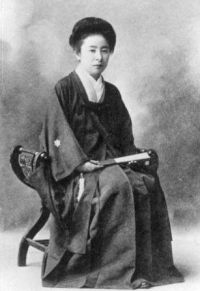
What Shimoda chose was not the divided samurai umanori hakama but the undivided andon-bakama, the skirt-style variant that hung like a lantern. This was a deliberate piece of design thinking on her part: the undivided cut was easier to sit in on a Western classroom chair, it didn’t catch the shoes when walking on wooden corridors, and it solved the period’s main concern about women in trousers — namely, that divided garments were seen as male and therefore improper. She styled the andon-bakama in solid colours, in bolts of deep maroon and forest green, and paired it with a hifu overcoat and a plain kosode underneath. The result was a uniform that felt traditionally Japanese to conservatives, practical enough to progressives, and distinctive enough that the school girls who wore it became a recognisable urban figure in Meiji Tokyo. By the mid-1890s, photographs show Japanese female students from several unrelated schools wearing recognisable variants of Shimoda’s design.
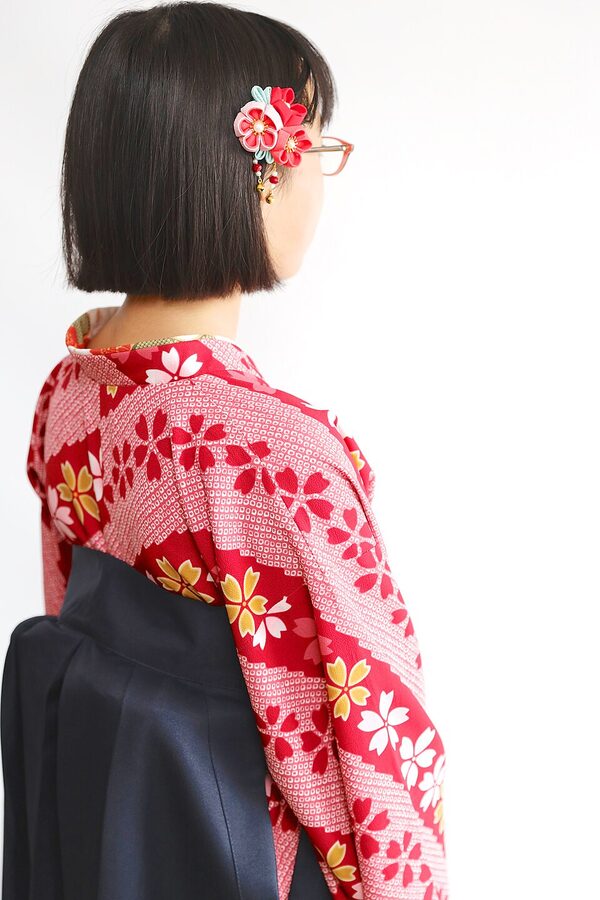
From schools, the hakama leaked into female teaching staff — teachers in kimono-and-hakama became the iconic image of the Meiji and Taishō educator, and that image is still what floats behind the back of the Japanese mind when you say the word jokyōshi. From there it migrated to graduation as a single-occasion formal, and from graduation it stayed there. Today, female Japanese graduates wear hakama almost universally for the university graduation ceremony, and in the last decade the practice has crept down into small numbers of elementary-school graduations as well. I’ve watched it happen in Sapporo, where my niece graduated primary school in a rented hakama last year. The structure she wore — andon cut, solid colour, paired with a patterned kimono — is the outfit Shimoda Utako put together in 1899 for a class of about forty girls in downtown Tokyo. Almost nothing about it has changed.
Where it still is — the small list of living contexts
The hakama survives in six contexts in modern Japanese life, and knowing the list is useful because it tells you exactly where to look if you want to see it worn properly by people who actually need it for what they’re doing. Those six are: martial arts practice (aikido, kendo, iaido, kyūdō, naginata), Shinto priesthood and shrine-maiden duty, Noh and kabuki performance, formal weddings for the groom and immediate male relatives, university and increasingly some elementary graduation ceremonies, and certain categories of imperial household function. Outside of those six, you will almost never see a hakama on an actual person in Japan. The garment is not everyday wear. It has not been everyday wear since about 1920.
Martial arts is where you’re most likely to encounter one worn casually by someone you can talk to. Aikido dojos expect a hakama as part of the training uniform once you reach shodan rank, and kendo dojos do so from the start. The practical reason, beyond the knee-concealment I opened with, is that the seven pleats of a traditional hakama correspond in some dojo traditions to the seven virtues of the samurai — jin (benevolence), gi (rectitude), rei (etiquette), chi (wisdom), shin (sincerity), chū (loyalty), kō (filial piety). That ascription is likely apocryphal and certainly not canonical, but instructors teach it anyway because it gives students something to hold onto while they are struggling through the forty-five minutes it takes to learn the correct tie. Watching a kendo yūdansha put a hakama on at the start of a practice — obi knot first, front himo crossed over once at the front and once at the back, koshi-ita settled against the spine, rear himo tied in a jūmonji cross — is watching a piece of living tradition that has been transmitted continuously since the Edo period.
Shichi-Go-San — the five-year-old’s first pair
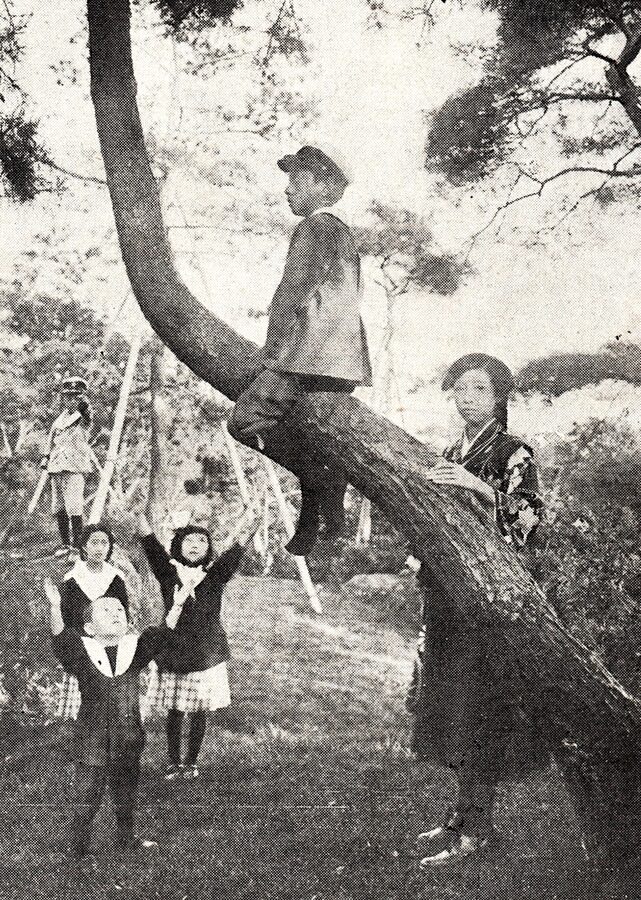
The seventh context I didn’t list, because it’s a bit of a stretch, is Shichi-Go-San — the coming-of-age observance for children aged three, five, and seven, held every November 15th. The five-year-old son in a traditional family receives his first hakama on this day. His parents dress him in a miniature kamishimo — kataginu with the wing-shaped shoulders, hakama cut to his leg length — and take him to a local shrine to be blessed. Photographers specialising in Shichi-Go-San rent out full outfits for the occasion, and the shrine courtyards of Meiji Jingu, Yasukuni, and the major Kyoto shrines fill up on the nearest convenient weekend with tiny samurai in training. The Meiji-era ja.wiki entry traces this ceremony back to a medieval rite of passage called hakamagi, the putting-on-the-hakama ceremony, that dates to the Heian period and which the samurai families continued through the Edo era. The modern November 15th date and the age-5 specification are an Edo-period codification, but the underlying ritual predates that by several centuries.
Where to see hakama today
Gōshi Gaisha Sendaihira — the last maker in Sendai
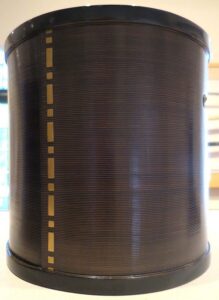
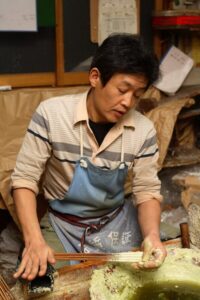
If you only visit one hakama-related site in Japan, make it this one. Gōshi Gaisha Sendaihira, the formal company name is written 合資会社仙台平, is the single remaining workshop producing seigo-sendaihira, the Important Intangible Cultural Property-designated silk cloth used for the most formal class of hakama. Every silk hakama you see at the imperial New Year audience, at senior sumo retirement ceremonies, and at the Grand Shrine of Ise’s formal rituals was woven at this one workshop, in a residential neighbourhood of Negishi-chō in Sendai’s Taihaku ward. The workshop descends from weavers brought to Sendai by Date Tsunamura, the fourth Sendai daimyō, in the late seventeenth century, who imported the skills from Kyoto specifically to produce hakama cloth for the domain’s retainers. Three centuries later, it’s still the same workshop.
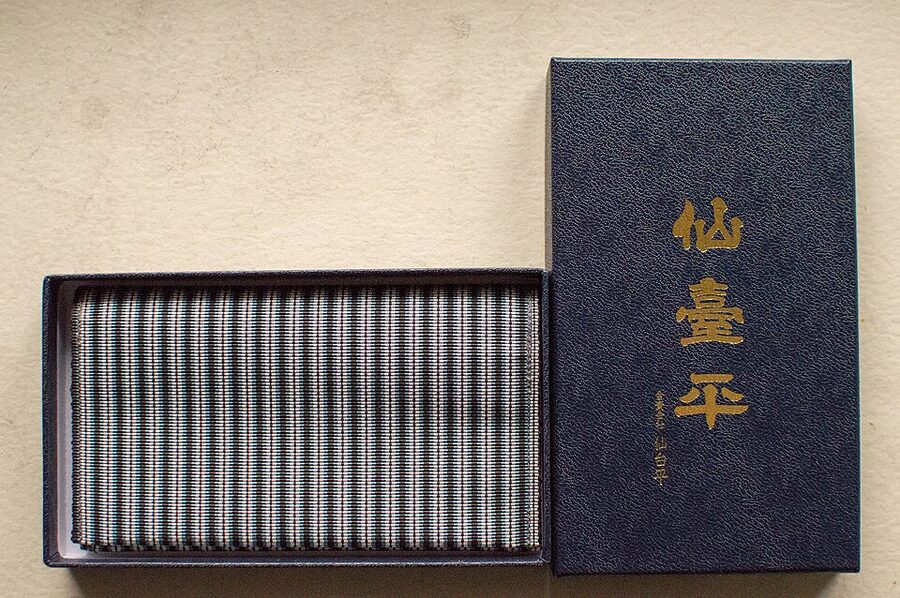
The technical description is worth knowing before you go. Sendaihira uses nerigoto (degummed silk) for the warp and raw silk for the weft. The weft thread is wet before weaving and beaten into the warp twice — the futadauchi technique — which compresses the fabric to an unusual density. For the top-grade seigo variant, both warp and weft are wet and beaten four or five times. The result is a silk so dense it almost feels like worsted wool, with an understated metallic lustre that you can only see when the light hits it at about fifteen degrees from horizontal. The stripes are woven in, not printed, so they hold their sharpness even after decades of wear. A good sendaihira hakama from this workshop, the kind a Japanese man buys for his wedding, costs the equivalent of three or four months’ salary for a middle-class office worker. It is intended to last his entire life.
The workshop runs by appointment and does not advertise itself as a tourist site. The honest way to visit is to call ahead in Japanese, explain that you’d like to see the weaving floor, and offer to be there at a time that suits them. I’ve known several foreign hakama-wearers who’ve made the pilgrimage this way and been received with the kind of welcome you get when the hosts realise you understand what they are actually doing. The showroom has finished bolts and completed hakama you can handle; the upstairs floor has two or three looms operating at any given time. Sendai itself is a comfortable two-hour shinkansen ride from Tokyo Station, and the Taihaku ward is about fifteen minutes by taxi from Sendai Station. Build the visit into a trip that also takes in the Date Masamune memorial sites at Zuigan-ji and Zuihōden — both of which are directly connected to this weaving tradition. The lord who imported the Kyoto weavers was Masamune’s great-great-grandson.
Jissen Women’s University, Tokyo — where Shimoda’s hakama lives
Shimoda Utako’s school, Jissen Jogakkō, is today Jissen Women’s University, with its main campus in Hiroo in Tokyo’s Shibuya ward. The campus keeps a small archive and research institute, the Shimoda Utako Institute for Women, which preserves the founder’s papers, her original school uniforms, and photographs of the 1890s classes that first wore the reformed hakama. The archive is academic rather than touristic, but they’ve been known to accommodate visitors who make an appointment through the international office and express a research interest. The Hiroo campus is a six-minute walk from Hiroo Station on the Tokyo Metro Hibiya Line, which puts it within fifteen minutes of Roppongi or Ebisu.
A more accessible related site is the Edo-Tokyo Museum (currently closed for renovation through late 2026 at time of writing — check before visiting) or the Tokyo National Museum’s Heiseikan annexe, both of which rotate exhibits on Meiji-era dress reform and include Shimoda-related material in permanent holdings. The Heiseikan is at Ueno Park, a ten-minute walk from Ueno Station, and the third-floor ethnology galleries have displayed Jissen-style uniforms in several past exhibitions. If you want to actually see a hakama from this transitional period, these are the two places most likely to have one on view.
Meiji Jingū, Tokyo — to watch miko in hi-no-hakama
The most tourist-accessible place to see hakama worn by someone whose daily job is to wear one is Meiji Jingū in Harajuku. The shrine employs dozens of miko at any given time, most of them young women in the middle of their two-year post-high-school shrine apprenticeships. They wear the full traditional outfit — white kosode on top, crimson hi-no-hakama on the bottom, hair tied in the characteristic mizuhiki ornament at the back — and they do so as genuinely everyday workwear, not tourist costume. The morning shift opens the shrine around 5am and you can usually see miko crossing the courtyard to the inner sanctum from about 7am onwards. Weekend weddings, which Meiji Jingū hosts at a rate of ten or twelve per Saturday in spring, bring out more formal miko duties, including the ritual circulation around the bride and groom during the actual ceremony. This is the single easiest place in Tokyo to watch a red Heian hakama in contemporary motion.
Getting there: Harajuku Station on the Yamanote Line, north exit, follow the crowd across the small bridge and under the giant torii. The courtyard is a ten-minute walk from the station. Entry to the shrine precinct is free; the inner gardens are a separate 500-yen ticket that’s worth it only in iris season. For miko-watching, the outer courtyard in front of the main hall is sufficient.
Kongō Nohgakudō, Kyoto — naga-bakama on stage
To see the full naga-bakama, the one-to-two-foot train version that made samurai audiences physically impossible to rush, you need to go to a Noh theatre and catch a high-formal performance. The Kongō Nohgakudō on Karasuma-dōri in central Kyoto is one of the five principal Noh schools’ home stages, and it runs a regular schedule of daytime performances by the Kongō family troupe. The naga-bakama appears in certain warrior-mono plays — Atsumori, Tamura, Yorimasa — where the protagonist is a court-attached samurai and the costume demands the extended train. The effect on stage is uncanny: the shite-kata appears to glide rather than walk, the feet completely hidden under the trailing cloth, the movements slow and absolute in the way that only Noh movements can be.
Tickets run ¥3,000 for cheap seats to ¥8,000 for front centre. English subtitles on tablet rental are standard at Kongō. The theatre is a fifteen-minute walk from Karasuma-Oike Station on the Karasuma and Tōzai subway lines, or a pleasant thirty-minute walk up Karasuma-dōri from Kyoto Station. Check the schedule at the theatre’s official website — the high-formal warrior plays are usually scheduled in rotation across spring and autumn, not continuously.
Any kendo or aikido dojo in your area
The simplest place to see hakama as a working garment is any martial arts dojo in Japan that welcomes observers. Most kendo, aikido, iaido and naginata dojos hold open practice sessions, usually in the evenings, and most are happy to let a quiet foreign visitor sit on the benches and watch for an hour. Ask at your accommodation for a local dojo, or look up the Japan Karate-do or Aikikai websites for the dojo nearest where you’re staying. A 90-minute evening practice will give you more understanding of how the hakama actually moves on a human body than any museum visit ever will. The way the fabric closes and opens at the step, the way the koshi-ita holds the waist straight as the practitioner turns, the way the front pleats create a visual smoothness that hides all the underlying mechanics — you cannot get this from a static display.
It’s also the context in which hakama-wearing is still being transmitted. The eighty-year-old sensei tying the hakama onto a nervous thirteen-year-old white belt is doing exactly what an eighty-year-old samurai would have done for his grandson in 1820. Three hundred years of unbroken practical knowledge passes across the dojo floor in about three minutes. The eighty-year-old doesn’t think of it as preservation. He thinks of it as getting the kid ready for practice. This is how traditions actually survive — not in museums and certainly not in books, but in the small ritual moments when someone who knows how to do a thing shows someone else, for the first time, how the knot goes.
Closing thought — the trousers that still hide the feet
Back where we started. The first time you see someone properly tied into a hakama, standing quiet at the edge of a dojo or waiting to walk on at a Noh performance, you notice how much of the body the garment removes from view. The legs are gone. The feet are gone. The step is gone. What’s left is the upper body — face, shoulders, hands, torso — and that’s the part of the human being that a Japanese aesthetic has always said matters. The samurai who commissioned these trousers eight hundred years ago understood this well: footwork is what betrays intention, and intention is what the enemy reads. Hide the footwork and you hide yourself, and the person across the chamber from you cannot tell whether you are about to bow, step forward, reach for your sword, or stand still. That is the hakama’s first and last secret. Everything else — the pleats, the silk, the stripes from Sendai, the red of a miko’s skirt, the sweep of a bride’s train at her wedding — is decoration that accrued on top of that one original, useful piece of tactical thinking. A garment is rarely as old as this one and still doing the job it was first cut for.
If you’ve come this far, you might also want to read my piece on tatami, which covers the floor surface the hakama was designed to move across silently, or on ranma transoms, which shaped the rooms the hakama was worn in. For the samurai context, start with Sassa Narimasa, one of the Sengoku men who wore this garment into actual battle, and for the culture that gave the hakama its reformed modern life, read the piece on traditional Japanese candles, which survived the same Meiji modernisation through the same kind of stubborn workshop-by-workshop transmission.