
Traditional Japanese candles are not made from paraffin. They are not made from beeswax or palm wax or any other material a Western candle shopper would recognise. They are made from the pressed berries of the Japanese wax-sumac tree (Toxicodendron succedaneum, local name haze-no-ki, 殉の木), rendered into a vegetable wax called mokurō that has a melting point about ten degrees higher than paraffin, burns without smoke, produces a larger and more stable flame than any petroleum-based candle, and has been in continuous production in the same handful of workshops for roughly four hundred years.
Japanese candles — warousoku (和蚊熟, “Japan-style candle”) — are a more specialised craft than any of the other household-traditional items on this site. There are maybe twenty-five active warousoku workshops in Japan today; the combined annual output is something under half a million candles, almost all destined for Buddhist temples and shrines where the specific combustion properties of mokurō wax are required for ritual use. The product is beautiful and the craft is genuine, but unlike tatami or kawara, warousoku is not part of most modern Japanese households’ direct experience. You have to go looking for it.
In This Article
- The Haze Wax Problem
- The Wick
- The Dipping Process
- Painted Candles
- The Surviving Workshops
- Where to visit and buy warousoku
- 1. Uchiko — Ehime, Shikoku
- 2. Kyoto Shimogyo district (Matsumoto Shoten)
- 3. Hida-Furukawa — Gifu (Mishimaya)
- 4. Nanao — Ishikawa (Takazawa)
- 5. Hirata Folk Art Museum — Takayama, Gifu
- The Larger Flame
The Haze Wax Problem
The material choice is the root of everything else about warousoku. Mokurō is obtained by steaming and pressing the small black-red berries of the Japanese wax-sumac (haze-no-ki), a tree of the sumac family that grows wild across Kyūshū and southern Honshū and is cultivated commercially in the warmer southern prefectures. Each berry yields about 15% of its weight as pressed wax. A mature haze-no-ki tree produces roughly 3-5 kilograms of wax per year. The wax is a creamy white solid at room temperature, melts at 53-56°C (well above paraffin’s 46°C), has a mild herbal smell, and produces a pale yellow flame when burned.
The haze-no-ki cultivation industry is small and shrinking. At its Edo-period peak, roughly 1700-1850, the Kyushu wax-tree plantations produced about 8,000 tonnes of mokurō per year, supporting candle-makers, metal-polish producers (mokurō is an excellent metal surface-finisher), and the wax-figurine industry. Contemporary production is around 150 tonnes nationally, concentrated in Fukuoka and Nagasaki prefectures, grown mostly by elderly farmers whose operations are not being passed to the next generation. The warousoku industry’s long-term sustainability depends on whether the haze-no-ki farmers survive to 2050, which is not assured.
The practical effect of the material on the finished candle is specific. Mokurō burns cleaner than paraffin because it has a lower carbon-to-oxygen ratio in its fatty-acid composition; the flame produces almost no soot and very little smoke. It also burns hotter — a warousoku flame reaches about 1,300°C, roughly 150°C above a standard paraffin candle — which means that for a given candle diameter the flame is larger, brighter, and more stable. A 15-millimetre diameter warousoku produces a flame comparable in size to a 25-millimetre paraffin candle. Buddhist ritual practice, which requires a specific intensity of candle light for proper altar illumination, has stayed with warousoku rather than switching to paraffin because the light quality is measurably different.
The Wick
The Japanese candle’s wick is as unusual as its wax. A Western paraffin candle uses a solid braided-cotton wick. A warousoku uses a composite wick: a bundle of dried tokusa rush grass (the same igusa-like rush used for tatami mats) wrapped in a thin spiral of washi paper, bound into a tight cylinder 3-5 millimetres in diameter. The rush-and-washi wick is hollow in the centre.
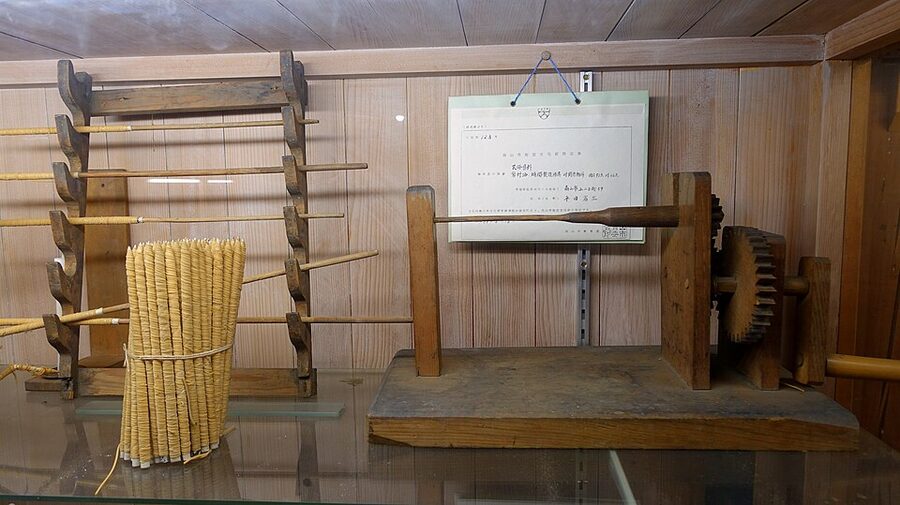
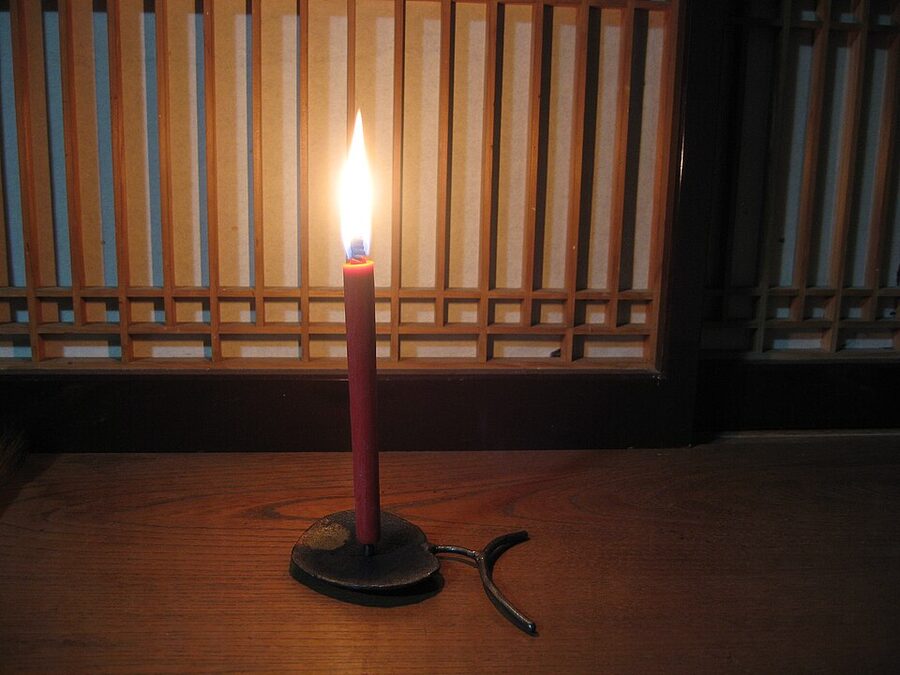
The hollow is the key design feature. A solid cotton wick burns from the tip down, producing a compact flame above the wick surface. A hollow rush-and-paper wick does something different: air is drawn up through the hollow centre of the wick as the flame burns, producing a chimney effect that increases the oxygen supply to the combustion zone. The result is a flame that is taller, broader at the base, and less susceptible to being blown out by a casual breath or draft. A lit warousoku in a temple hall can survive a moderate wind that would extinguish an ordinary candle immediately. The effect is not subtle; it is one of the specific reasons Buddhist ritual practice has kept the warousoku form.
The downside of the hollow-wick design is that the wick does not self-consume — it gets longer as the wax below it burns down, rather than disappearing into the flame. Warousoku require periodic wick-trimming during burn, using a specific tool called a shinkiri-basami (芯切り鏡子, “wick-cutting scissors”). A ritual tender in a temple walks the hall every ten or fifteen minutes trimming the wicks on all the lit candles. In domestic use this is inconvenient, and it is one of the reasons warousoku never fully competed with paraffin in the home-use market.
The Dipping Process
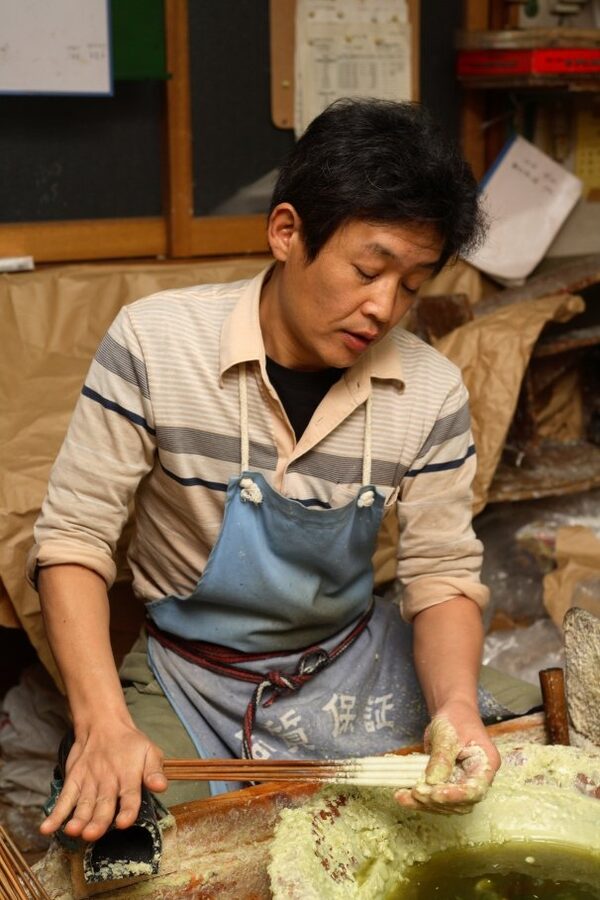
The conventional warousoku manufacturing method is hand-dipping. The wick is mounted vertically on a wooden stave, the stave is held above a shallow pot of melted mokurō at roughly 80°C, and the wick is dipped into the wax, held in it for about three seconds, then lifted out and allowed to cool for about two minutes. The thin coat of wax that adhered to the wick solidifies. The operation is repeated 40-60 times, each dip adding roughly a millimetre to the candle’s diameter.
This sounds simple but is technically demanding. The wax temperature has to stay within a 3-degree window; too cool and the wax does not adhere, too hot and the previous layer remelts. The cooling time between dips has to be calibrated to the ambient workshop temperature, which means the process takes longer in winter than in summer. The wick must be kept perfectly vertical or the candle builds up asymmetrically and burns unevenly. A skilled artisan produces about 300-500 candles per day across a range of sizes; a beginner produces maybe 50 and a third of them fail quality control.
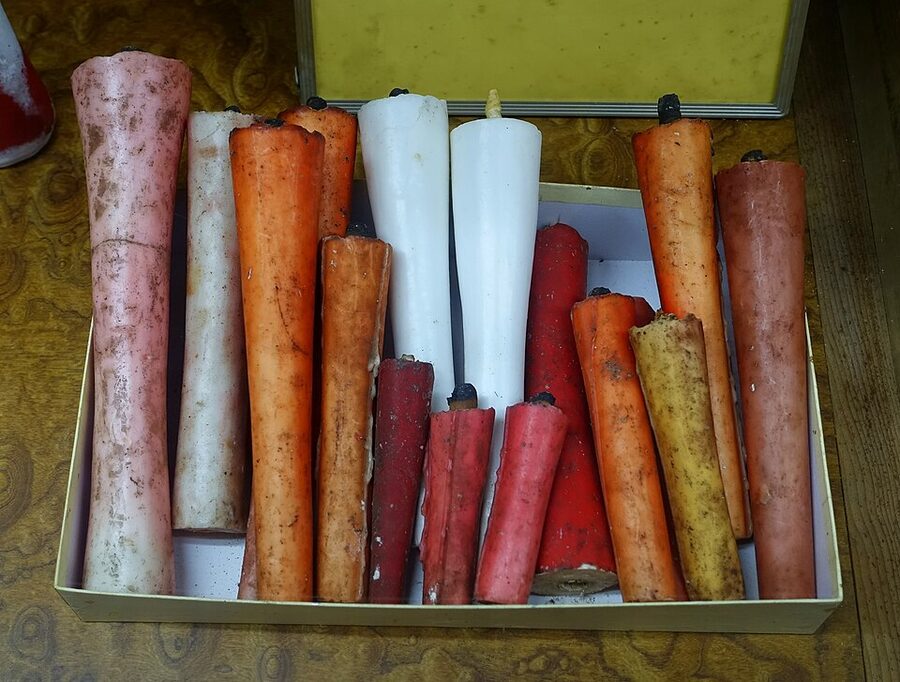
The final shape of the finished warousoku is traditionally cylindrical but slightly flared toward the top — the characteristic ikarigata (镐形, “anchor form”) silhouette, thicker at the head than at the base. The reason for the flare is functional: as the candle burns down, the wax at the top melts and flows slightly down the sides before re-solidifying; the flared head compensates for this downward flow and keeps the burning surface more or less flat. A well-made warousoku burns evenly from top to bottom without producing the dripping wax-rivulets that a cylindrical paraffin candle produces.
Painted Candles
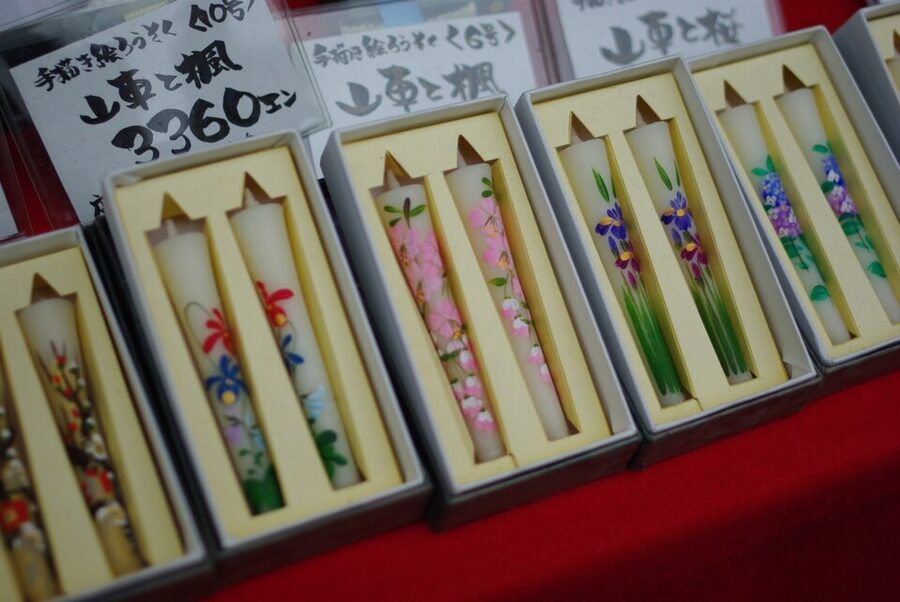
Within the warousoku tradition there is a high-end subcategory called e-rousoku (絵蚊熟, “painted candles”) — candles hand-painted with floral or seasonal motifs and used for specific Buddhist festival observances. E-rousoku are particularly associated with two production regions: Aizu in Fukushima, and Nanao on the Noto peninsula of Ishikawa. Each region has its own stylistic conventions. Aizu e-rousoku favour soft watercolour palettes and seasonal plant motifs; Nanao e-rousoku use brighter saturated colours and classical design motifs.
The painting is done after the main dipping process is complete, with mineral-pigment paint applied over a primer coat of white mokurō. The paint is mixed with rice starch to help it adhere to the waxy surface. Each candle is painted individually; a skilled painter produces 15-20 per day at the mid-market end, far fewer for premium commissions. A standard 15-centimetre e-rousoku retails in 2024 for around ¥1,500-3,000; larger ceremonial sizes for specific temples can run to ¥10,000 or more.
The specific Aizu tradition, sometimes called Aizu-e-rousoku, has been going since the mid-Edo period and is officially designated a traditional craft (dentō-teki kōgei-hin, 伝統的工芸品) by the Japanese government. The Nanao tradition is younger but has been similarly recognised. Both regions have about half a dozen active workshops and take apprentices at a rate that roughly matches generational turnover. Neither tradition is growing but neither is visibly dying.
The Surviving Workshops
Four regional workshops are particularly worth knowing about if you are seriously interested in warousoku:
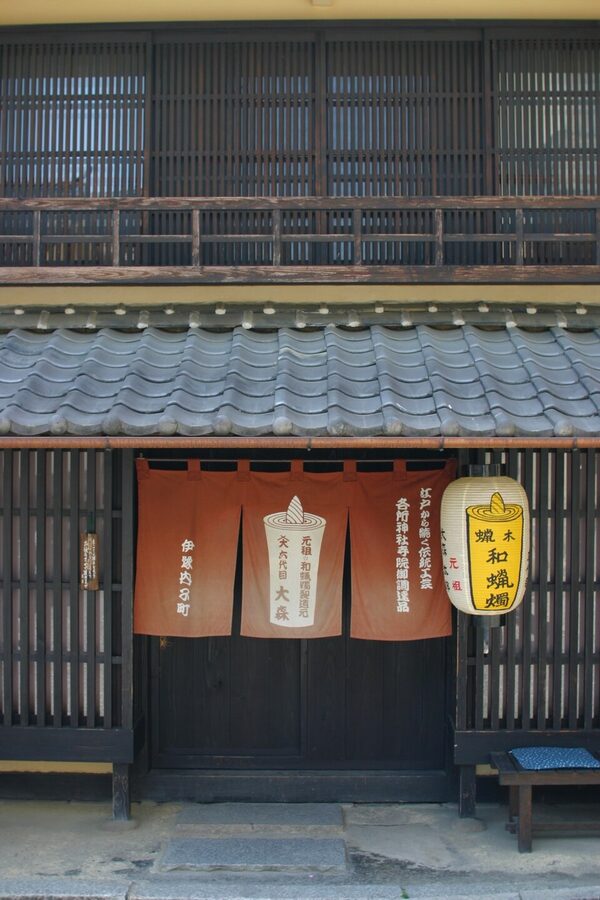
Ōmori Warousoku-ya, Uchiko (Ehime) — a seven-generation family workshop in the preserved Edo-period merchant district of Uchiko on Shikoku island. The current head is Ōmori Kikio (born 1957), a seventh-generation warousoku-shi who apprenticed under his father from age fifteen and has been running the workshop since 1985. He takes one apprentice at a time; the current apprentice, his nephew, started in 2019 and will take over when Ōmori retires around 2030. The shop is open to visitors most days; you can watch the dipping process and buy candles directly.
Matsumoto Shoten, Kyoto — the oldest continuously-operating warousoku workshop in Japan, founded in 1597 at its present site in the Shimogyo district of Kyoto. Seventeen generations of the Matsumoto family have run the workshop; the current head is Matsumoto Takashi (born 1962), the seventeenth generation. Matsumoto Shoten supplies warousoku to the major Kyoto temples — Nishi-Honganji, Higashi-Honganji, Chōin-in, Kiyomizu-dera — and has done so for most of its 429-year history. The shop is small; the production is small; the prices are not small. Premium e-rousoku at Matsumoto retail for ¥5,000-20,000 per candle. The workshop is open by appointment.
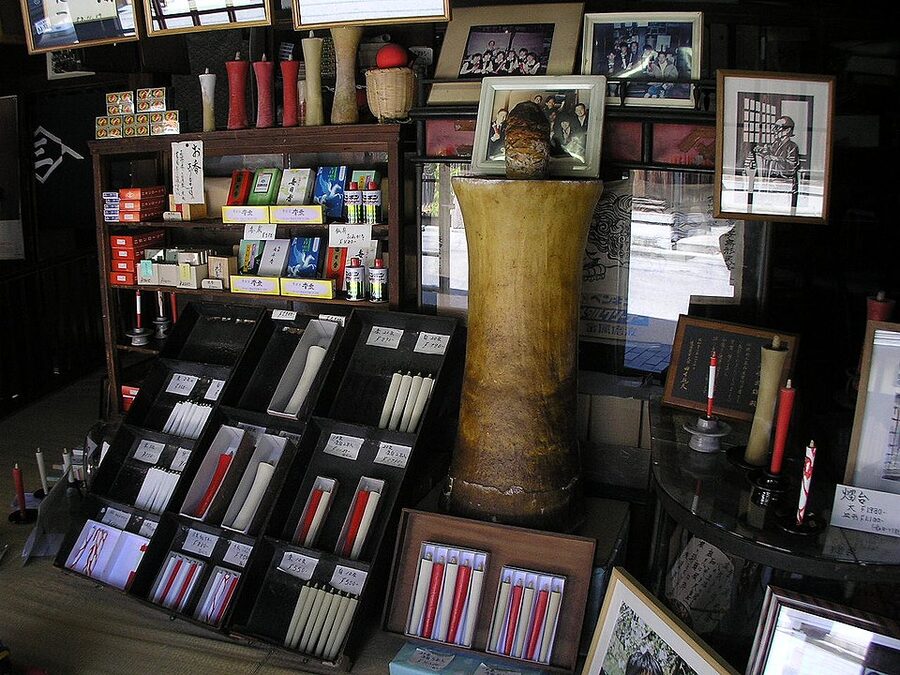
Mishimaya, Hida-Furukawa (Gifu) — a fourth-generation workshop in the well-preserved merchant district of Hida-Furukawa. Mishimaya is the easiest of the four to visit as a casual tourist; the shop sits directly on the main tourist walking street, the prices are mid-market-reasonable, and the family runs informal Saturday-morning candle-dipping workshops for visitors who want to try the craft themselves (¥3,500 per person, two-hour session, book one week ahead).
Takazawa Candle, Nanao (Ishikawa) — the headline Nanao e-rousoku producer on the Noto Peninsula. The Takazawa family has run this workshop since 1892; the current head is the seventh generation. Takazawa is probably the highest-reputation workshop for painted e-rousoku in Japan; their candles are regularly commissioned for imperial-household and Kyoto-court Buddhist observances. The workshop is small and the retail shop is in the Nanao town centre. After the January 2024 Noto Peninsula earthquake the workshop was temporarily closed but has been operating again since late 2024.
Where to visit and buy warousoku
Five sites across the country cover the craft’s geography.
1. Uchiko — Ehime, Shikoku
Uchiko is a preserved Edo-period merchant town in Ehime prefecture, on Shikoku island. The main Omachi-dōri street has about fifteen traditional craft shops along its half-kilometre length; Ōmori Warousoku-ya is about halfway along on the east side. The town is ninety minutes by JR from Matsuyama, the prefectural capital, and combines well with a visit to the Matsuyama castle and the Dogo-onsen hot spring district. Allow a half-day for the town. The Ōmori shop is open 09:00-17:00 daily, closed Mondays.
2. Kyoto Shimogyo district (Matsumoto Shoten)
Matsumoto Shoten is about twenty minutes’ walk south of Kyoto Station in the Shimogyo district, which was the main Kyoto merchant area in the Edo period and has kept much of the original street plan and several original-period buildings. The workshop is at a specific address (下京区面波雨大西ノ町); the shop is best visited by appointment because the family handles the workshop and the retail counter themselves and has limited walk-in availability. Book through their website (www.matsumoto-shoten.com) or by phone one week ahead.
3. Hida-Furukawa — Gifu (Mishimaya)
Hida-Furukawa is a preserved merchant town in the Hida mountains of northern Gifu prefecture, about ninety minutes by train north of Takayama. The town is small (population 30,000), walkable in an afternoon, and combines a number of traditional craft shops along a single main street. Mishimaya is at the intersection of the main street and the canal. The Saturday-morning candle-dipping workshops are the easiest hands-on warousoku experience available to visitors anywhere in Japan; book ahead via the town’s tourism office.
4. Nanao — Ishikawa (Takazawa)
Nanao is on the Noto Peninsula, about ninety minutes from Kanazawa by the JR Nanao line. The Takazawa Candle workshop is in the town’s old mercantile district, which was badly damaged in the January 2024 earthquake but has been largely rebuilt by early 2025. The shop is open most days; production is limited and the inventory can run short during Buddhist festival seasons (mid-August, late March). Combine with a visit to Wajima for lacquerware and the Gojinjo Taiko drum troupe.
5. Hirata Folk Art Museum — Takayama, Gifu
If you want the museum-grade overview rather than a live workshop, the Hirata Folk Art Museum (主太古政記念館) in the historic Sanmachi district of Takayama has the best single public collection of warousoku-related tools and period candles. The museum occupies a 1763 merchant house; the warousoku section is on the second floor alongside the candle-wick machinery shown earlier in this article. Admission ¥300. Allow ninety minutes.
The Larger Flame
Warousoku is one of the most specialised and least-visible surviving Japanese traditional crafts. It has essentially no international retail presence; the export market is tiny; the product has no obvious foreign-consumer application unless you are specifically interested in Japanese Buddhist ritual culture or in the candle as a craft object. Most tourists to Japan do not encounter warousoku at all. If you see one, it will be at a temple altar, burning quietly, and you will probably not notice the flame is a different shape until someone points it out.
Once you do notice, it is a fixed piece of sensory memory. The flame is bigger than you expect and stiller. The wax does not drip. The candle does not smell of paraffin. It makes the light inside a Japanese temple interior do something specifically Japanese-feeling that a Western paraffin candle does not quite manage. After you have seen a warousoku lit, you notice when a temple is using modern substitute candles and when it is using the real thing. Some of the bigger modern Japanese temples economise with paraffin for high-volume daily observances and keep warousoku for the major festival occasions; a well-informed visitor can tell the difference at thirty paces.
Compared to the other traditional crafts covered on this site — tatami, kawara, ranma, hibachi — warousoku is the smallest by market size and the narrowest by surviving-user base. It is also, in some ways, the most specific: the product is genuinely different from its industrial substitute; the difference is perceivable; the craft has held its specifications because the temple-use market will not accept substitutes. If you are going to visit one of the warousoku workshop towns, go to Uchiko or Hida-Furukawa — those are the most accessible and the most rewarding as day-visits. Light a warousoku in a dim room when you get home. Notice how the flame moves differently. That is the craft working the way it is supposed to work.

.jpg)


