The first time I saw a karakuri doll on a Takayama yatai, the thing that stopped me cold was that it was 1720s technology and it was performing kabuki. No electricity, no remote control, not a single battery anywhere in the float. The puppet bowed, drew a fan, danced a few measured steps across a wooden bridge, and then transformed into a lion. Inside the doll’s torso, whalebone springs were unwinding through threaded brass rods turning carved cams, and nine men below were tugging thirty-six threads in synchronized timing they had memorized as children.
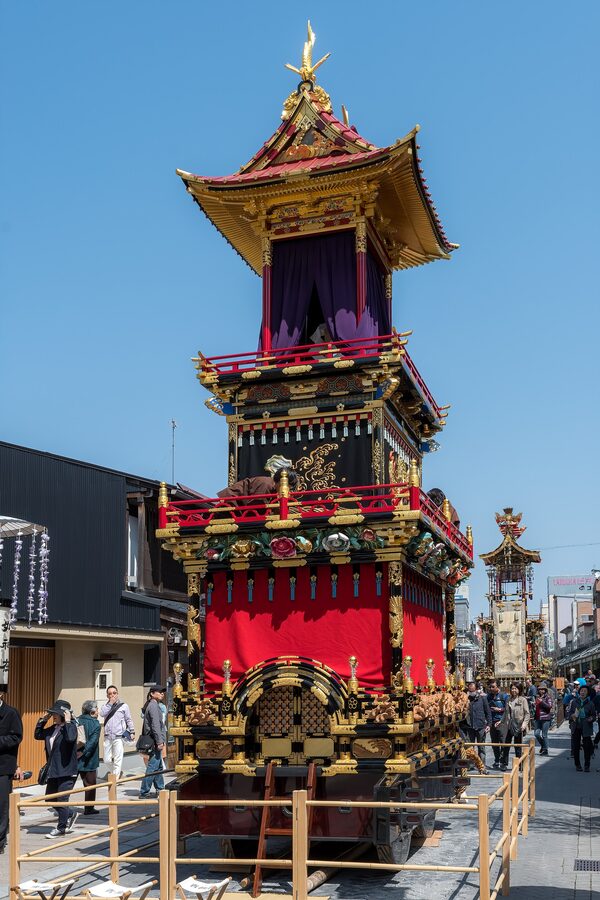
This is the Takayama Matsuri. Twice a year, in a mountain town that the Tokugawa shogunate ruled directly, twenty-three towering wooden floats roll out of their permanent stone-and-timber storehouses and grind through narrow merchant streets. Three of them perform a mechanical theatre that has been running unchanged since the 1700s.
I want to walk you through what is actually happening up there on the upper deck of those floats, and why a town of forty thousand people in the Hida mountains ended up with one of the most technically baffling pieces of pre-industrial art in Japan. You will leave knowing exactly which yatai do what, when to go, and why UNESCO put this festival on its 2016 list of intangible cultural heritage alongside Kyoto’s Gion Matsuri.
In This Article
- Two festivals, one town, twenty-three floats
- Why this town, of all towns
- What a yatai actually is
- The twelve spring yatai
- The eleven autumn yatai
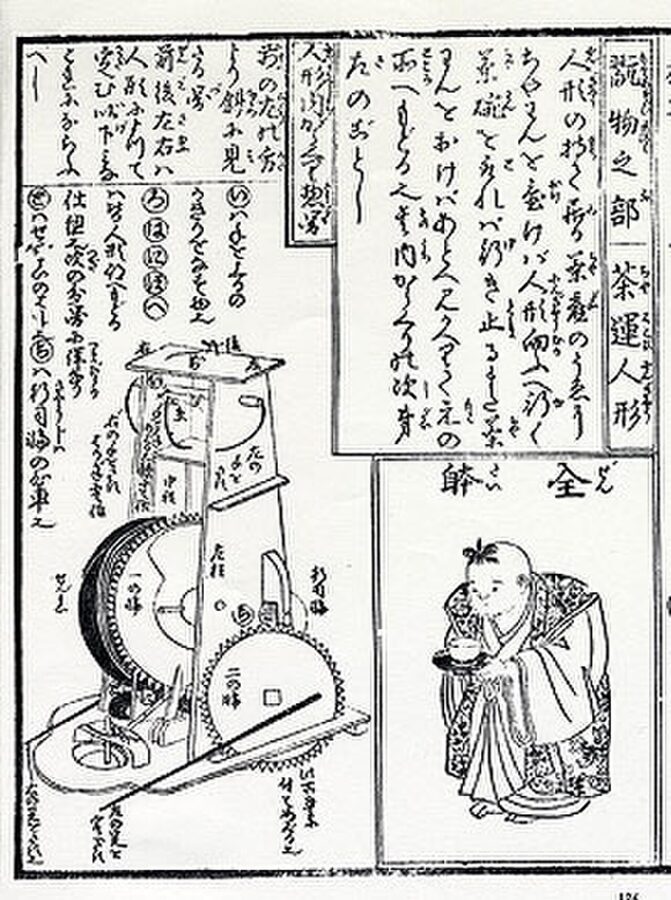
- The karakuri, and how they actually work
- The night festival
- The mikoshi processions
- What the music tells you
- UNESCO and the 2016 inscription
- The Yatai Kaikan, where the autumn floats live year-round
- Sakurayama Hachimangu, the autumn home shrine
- Takayama Jinya, the magistrate’s office
- The old town, sake, and what to eat
- Shirakawa-go, an hour west
- Getting there and timing
- The longer pattern this fits into
- If you only have one day
- One small thing about the karakuri I keep thinking about
- Practical references
Two festivals, one town, twenty-three floats
People say “Takayama Festival” as if it is one event. It is not. It is two festivals at two different shrines on two different sides of town, six months apart, with two separate rosters of yatai and two separate guilds of neighborhood crews who have been hauling the same floats since their great-grandfathers’ time.
The spring festival is called Sanno Matsuri (山王祭). It runs every year on the 14th and 15th of April and belongs to Hie Shrine, which the locals also call Sanno-sama, on the south side of town. Twelve yatai roll out for this one. Three of them perform karakuri.
The autumn festival is Hachiman Matsuri (八幡祭), held on the 9th and 10th of October at Sakurayama Hachimangu Shrine on the north side. Eleven yatai turn out, and only one of them performs karakuri, a single but jaw-dropping show on a float called Hotei-tai.
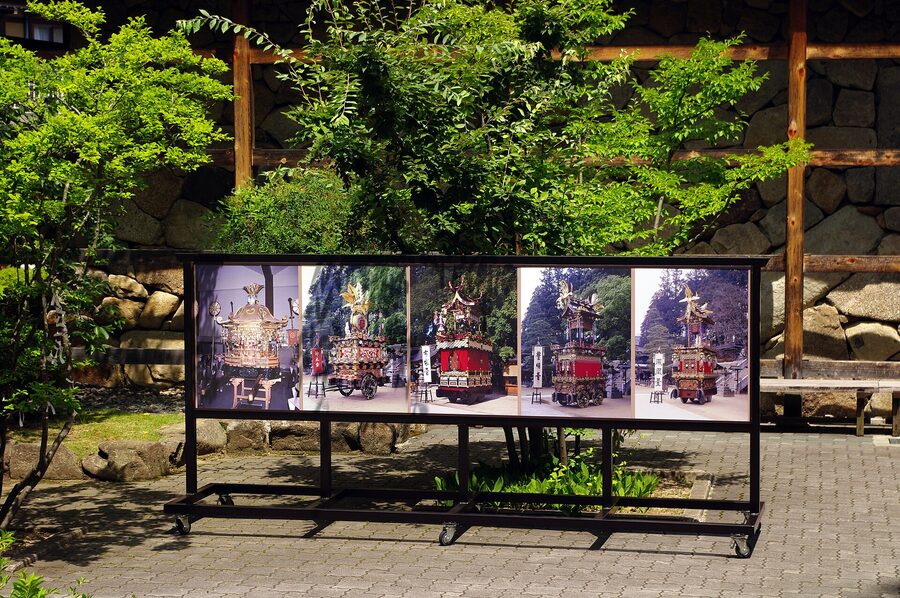
The split is not arbitrary. South Takayama is Hie Shrine’s territory and produces the spring crews. North Takayama answers to Hachimangu. You belong to one shrine or the other depending on which side of the river your house sits on, and the float your neighborhood owns has been pulled by men from your street for somewhere between two and three centuries.
Both shrines run a procession of mikoshi (portable shrines) through their territory on day two, with sacred-music ensembles, lion dancers, and people in Edo-period costume escorting the deities. The yatai parade is the spectacle, but the religious heart of the festival is the mikoshi tour, which is called Gojunko in spring and Goshinko in autumn.
Why this town, of all towns
You should know one thing about Hida-Takayama before you understand the festival, because everything about the floats traces back to it. Hida Province was special.
By the Nara period, the eighth century, the central court was struggling to extract any meaningful tax revenue from this remote, mountainous, snow-buried corner of central Japan. Hida had no rice fields worth taxing. What it had was wood, and people who knew what to do with wood.
So the court did something almost unheard of in the Japanese tax system: it formally exempted Hida from grain tax and instead required the province to send carpenters to the capital. Two craftsmen at a time, for fixed terms of service. The position became an official court appointment with a name: Hida-no-takumi (飛騨工), the Hida craftsman.
The Hida-no-takumi system ran from the eighth century into the Heian period. Carpenters from this one province built temples and palaces in Nara and Kyoto for hundreds of years, and the tradition of high-end woodworking became hereditary in Takayama. By the time the Edo period started, “Hida carpenter” was a recognized brand the way “Damascus steel” was a brand.
Then came the second twist. In 1692, the Tokugawa shogunate decided Hida’s forests and silver mines were too valuable to leave to a vassal lord. The shogunate took direct control, making Hida tenryo (天領), shogunal territory governed by a magistrate sent from Edo.
This was rare. Most of Edo-era Japan was under one of the roughly three hundred daimyo families. If you want a sense of how unusual it is for a domain to skip the daimyo system entirely, you can read about the alternate-attendance regime that bound the rest of the country in my piece on sankin-kotai.
So you had a town of master carpenters, no daimyo, no castle-town hierarchy, and a magistrate who reported straight to Edo. The town’s merchant class kept the wealth that would have flowed to a samurai overlord elsewhere. They put it into the festival.
What a yatai actually is
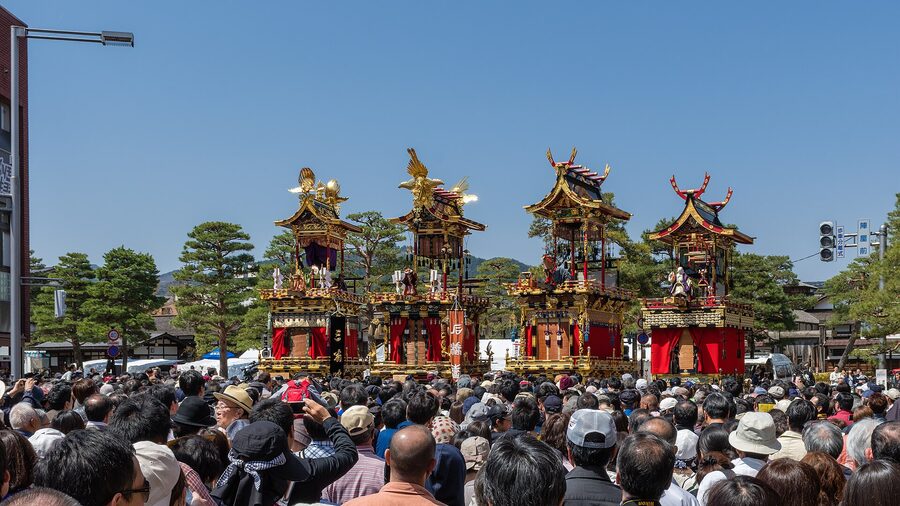
The word yatai (屋台) literally means “roof on a stand,” and on Japanese festival nights it usually points to a food stall. In Takayama it means something very different. A Takayama yatai is a three-storey wheeled wooden tower somewhere between five and eleven meters tall, weighing two to three tonnes, built without a single nail in the load-bearing structure.
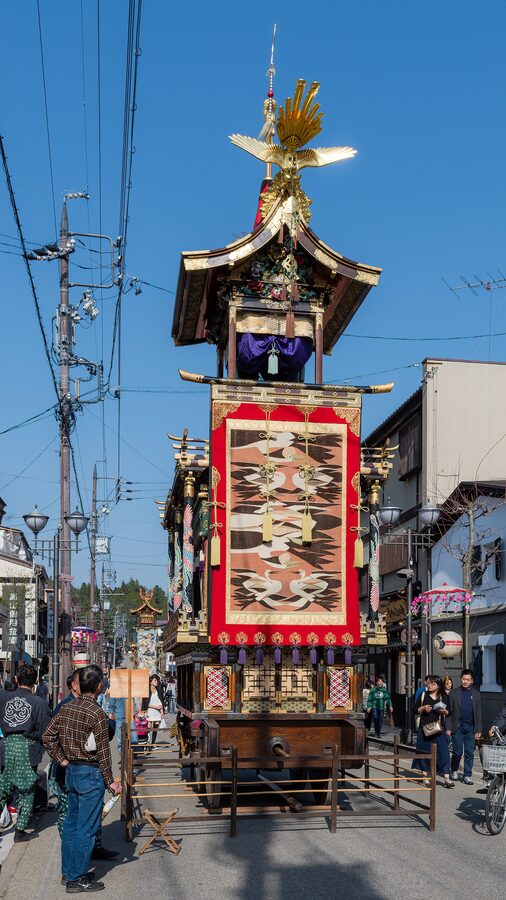
Each float has three decks. The lower deck holds the wheels, the brake operators, and the men whose job is to lift one wheel an inch off the ground at intersections so the entire float can pivot in place. The middle deck is the shrine room, holding small gilded carvings and sometimes a brazier. The upper deck holds the karakuri stage or the sacred figure the float is named for.
The carving on a Takayama yatai is the most concentrated display of Edo-era woodwork you can see outside a temple. Gilded panels, lacquered roof beams, embroidered cloths, dragons writhing across the cornices, phoenixes spreading wings under the eaves.
Each yatai is named for what it shows. Houo-tai is the phoenix float. Ryujin-tai is the dragon-deity float. Kirin-tai is the float with the qilin, the Chinese chimera.
Each name carries its own iconography, and each carving was commissioned from a specific Edo-period workshop whose books still survive in the town archive.
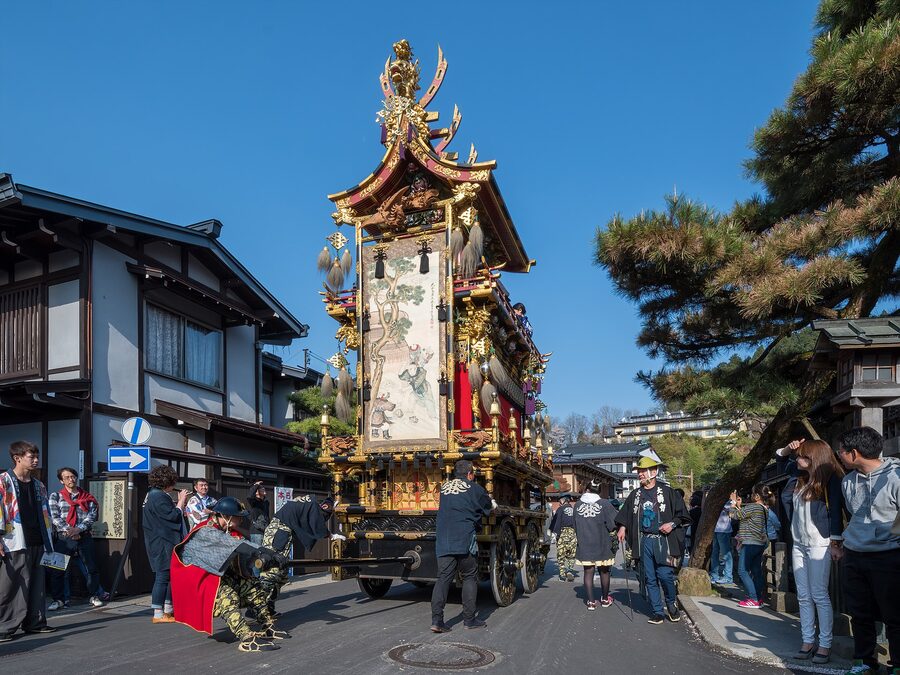
The floats are kept in their own purpose-built storehouses called yatai-gura (屋台蔵), one per neighborhood. These are stone-and-timber structures, often two storeys, with a sliding panel front that opens into the street. The float lives there year-round. On the morning of festival day, the door slides open, men in matching happi coats walk it out by hand, and three sleeping centuries of decorative carving roll into the daylight.
The twelve spring yatai
I find it worth knowing the floats by name, because once you can identify them, the procession stops being a parade and starts being a roster of personalities. Here are the twelve floats of the Sanno Matsuri.
Kagura-tai (神楽台) leads the procession. It is the oldest spring float, plain by Takayama standards, and it carries the sacred drum that opens the festival.
Sanbaso (三番叟) carries a karakuri doll that performs an elderly Noh dance with a folding fan. Kirin-tai (麒麟台) shows the qilin, a scaled chimera. Shakkyo-tai (石橋台) holds the second karakuri performance, a female figure who transforms onstage into a lion. Godai-san (五台山) is named for the Chinese sacred mountain.
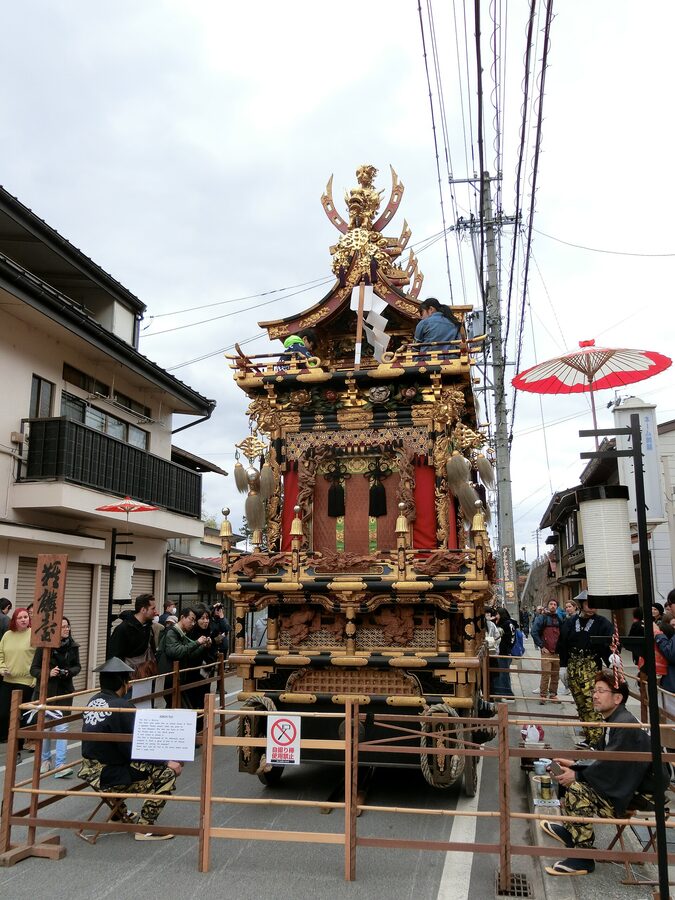
Houo-tai (鳳凰台) is the tallest spring float at 11.74 meters and shows the phoenix. Ebisu-tai (恵比須台) is dedicated to Ebisu, the laughing fisherman god of commerce. Ryujin-tai (龍神台) carries the third karakuri performance, in which two child puppets battle a dragon deity and the dragon emerges from a giant pot. Kongo-tai (崑崗台) is named for the Kongo mountain in Chinese myth.
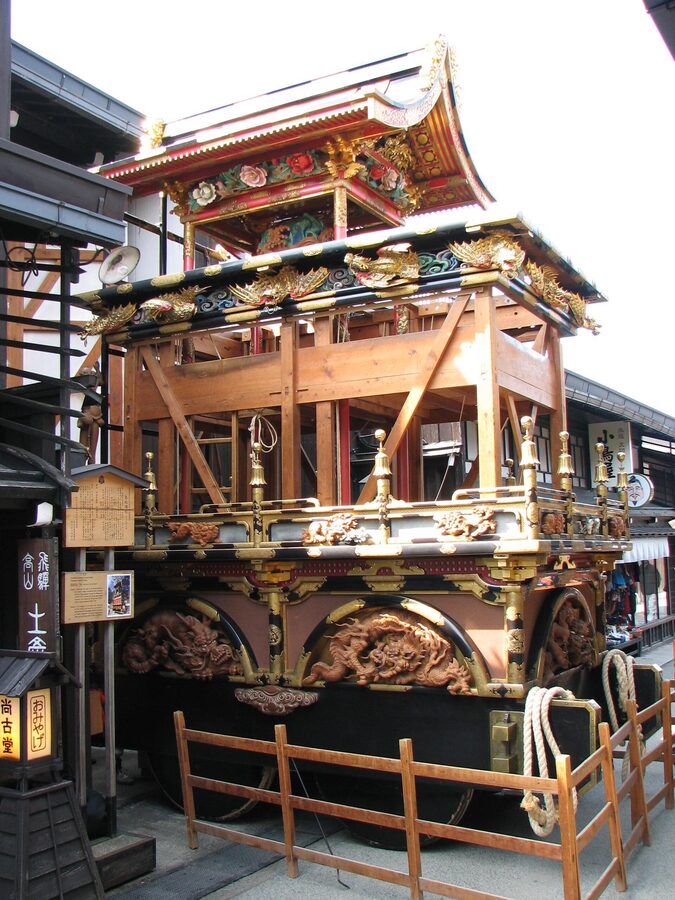
Kinko-tai (琴高台) is named for a Taoist sage who rode a giant carp. Daikoku-tai (大国台) belongs to Daikoku, the god of the kitchen and good fortune. Seiryu-tai (青龍台) is the only float in the festival with an irimoya-style hipped-and-gabled roof, which marks it out the moment it appears in the street.
The eleven autumn yatai
The Hachiman Matsuri roster is shorter but just as old, and one of the eleven floats houses what most karakuri specialists consider the single most sophisticated festival mechanism still operating in Japan. Here is the autumn lineup.
Kagura-tai (神楽台) leads, just like the spring procession, but it is a different float owned by a different neighborhood. Hotei-tai (布袋台) is the float you have come to see if you have come for the karakuri.
Kinpo-tai (金鳳台) shows a gilded phoenix. Daihachi-tai (大八台) is named for a legendary giant. Kyuho-sha (鳩峯車) shows a dove on its peak.
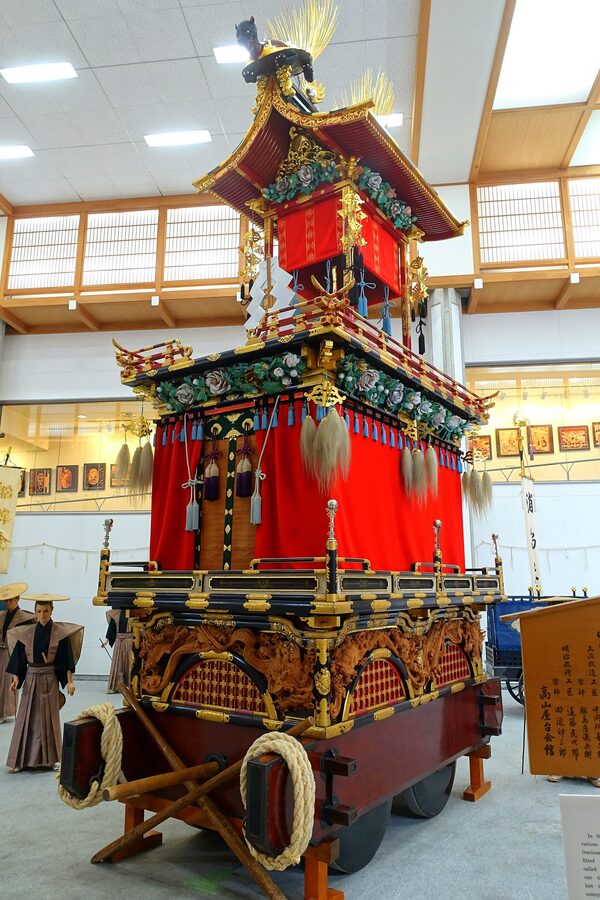
Jinma-tai (神馬台) carries a sacred horse figure. Sennin-tai (仙人台) shows a Taoist sage. Gyojin-tai (行神台) is named for a wandering deity.
Hoju-tai (宝珠台) carries the wish-fulfilling jewel. Homei-tai (豊明台) is one of the most heavily gilded floats in either festival. Houo-tai (鳳凰台) closes the autumn roster, sharing a name with its spring cousin but carrying a completely different phoenix.
The karakuri, and how they actually work
This is the part where I will lose my objectivity, because the Hotei-tai karakuri is one of the strangest objects I have ever stood in front of. It is a piece of theatre that has been running on the same sequence of cams since approximately 1810, performed live, in the open air, with no rehearsal, in front of two thousand people, and it has not missed a cue.
Here is what the Hotei-tai performance looks like. On the upper deck of the float, behind a small painted screen, sits the figure of Hotei, the round-bellied god of contentment. Two child puppets enter from either side.
They walk to a pair of matching gold fans. They each pick up a fan. They walk along a curved beam toward a cloud bridge, then leap.
The leap is the physically impossible part: each child puppet jumps from its own beam onto the higher tier of the float, lands on a moving platform, somersaults, and arrives on Hotei’s shoulder. From the children’s hands, paper banners unfurl that read 寿 (long life) and 福 (good fortune).
The whole sequence runs about eight minutes. Nine puppeteers are sitting inside the float pulling thirty-six fine silk threads. The threads run up through the float’s interior, over carved bone pulleys, through bamboo guides, and into the puppets through holes the size of a sesame seed. Beneath the puppets, the platforms they stand on are driven by hand-cranked threaded rods that translate rotary motion into the slow, controlled lift that lets a doll appear to walk on a cloud bridge.
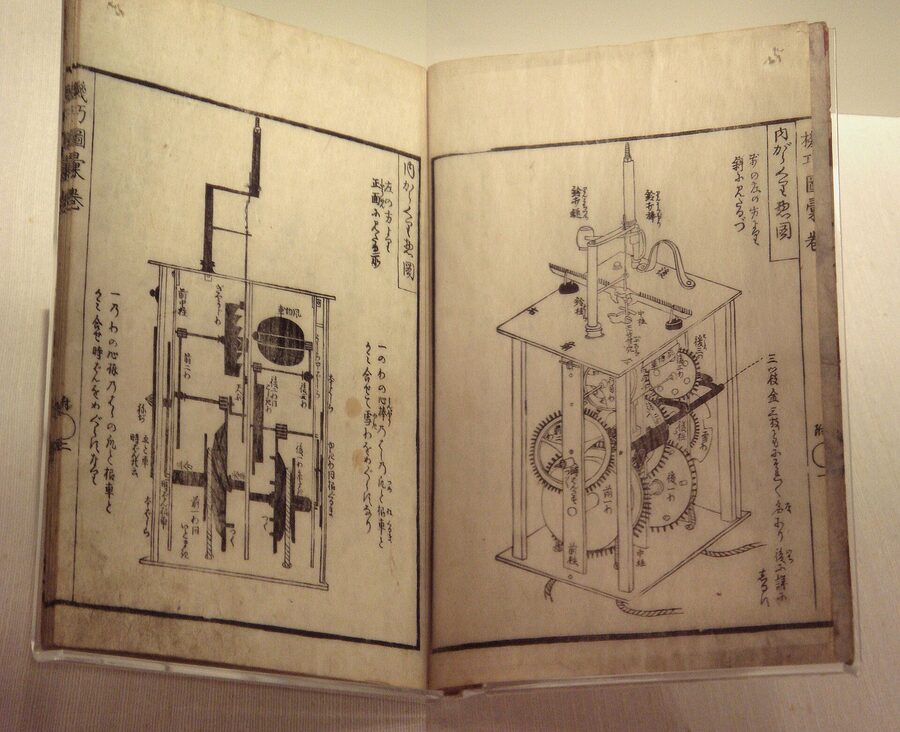
Some of the cam-driven motion is automatic. Inside the karakuri there are coiled springs made of whalebone (specifically right-whale baleen, which has a flex profile no modern material has matched), and these springs power small rotary cams that drive the puppet’s nodding, blinking, and finger-curling motions. The whalebone is irreplaceable. When a spring breaks, the float crew has to source baleen from antique stockpiles, because steel and other whale species’ baleen will not fold the same way and will eventually crack the cam mechanism.
The wider technology came out of European clock-making, which arrived in Japan in the early 1600s with Portuguese and Dutch traders. By the late seventeenth century, Japanese craftsmen had translated the gear, the cam, and the escapement into bamboo, brass, and whalebone analogues. The first published handbook on this kind of automation was Hosokawa Hanzo’s Karakuri Zui in 1796, which preserved exact cutaway drawings of the mechanisms.
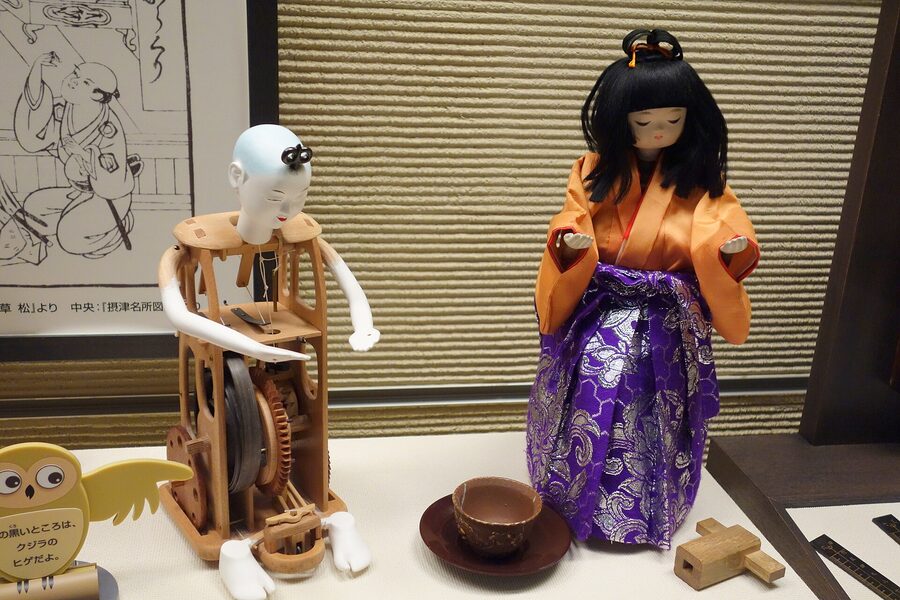
The three spring-festival karakuri are slightly different in style. Sanbaso’s puppet performs a Noh-derived elderly figure waving a fan, a meditative slow performance that can last twenty minutes.
Shakkyo-tai stages a kabuki-derived sequence in which a young female figure does a measured dance, then suddenly transforms into a lion (the costume rolls inside-out from a hidden pleat) and the music shifts into a wild tempo. Ryujin-tai is the most dramatic: two child puppets fight a dragon deity who emerges from a giant ceramic pot. The pot itself opens, the dragon rears up, and it wraps around one of the children before being subdued.
None of this requires electricity, batteries, or motors. All of it has been performed unchanged since the early 1800s.
If you want to compare this with another mechanical-precision art form that the Edo period elevated to a religious discipline, the closest cousin is the choreography of the Japanese tea ceremony, where every gesture is timed to a fixed sequence and every utensil sits within a rehearsed millimeter of its mark.
The night festival
You can see the karakuri only by daylight, because the puppeteers need natural light to control the threads. But there is a second festival inside the festival, and it happens after sundown.
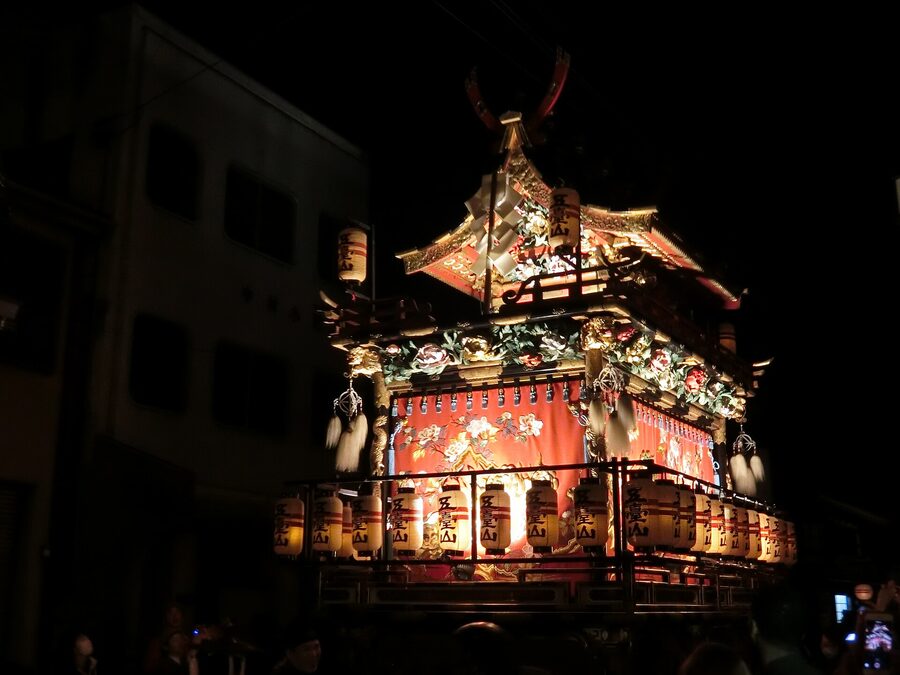
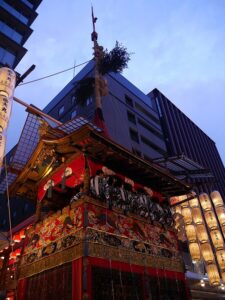
On the eve of the second festival day in both spring and autumn, the yatai run a yomatsuri (夜祭), a night procession. Each float is hung with around a hundred chochin paper lanterns, lit individually by candlelight. The crews, in matching black happi coats, pull the floats slowly through the old town. Flute and drum ensembles walk alongside.
The lanterns produce a quality of light that LED replacements cannot duplicate. Real candle flame flickers, throws shadow, and turns red where the rice paper has yellowed with age. From thirty meters away the lit floats look like glowing hills.
The whole procession moves at walking pace, two kilometers an hour, and the only sounds are the wheels grinding on the cobbles, the wood creaking, and the music. I have stood in this crowd at minus three degrees in October, and the cold becomes irrelevant after about ten minutes.
The yomatsuri is the closest direct comparison Takayama has to its UNESCO sister festival in Kyoto. If you have read my piece on Gion Matsuri, the Kyoto plague-response festival with its yamaboko floats, you already know the visual language. UNESCO co-listed both in 2016 under “Yama, Hoko and Yatai float festivals,” a category covering thirty-three festivals across Japan.
The mikoshi processions
Floats are spectacle. The actual religious work of the festival is done by the mikoshi, the portable shrines that carry the deity through the streets so that everyone in the parish receives a blessing.
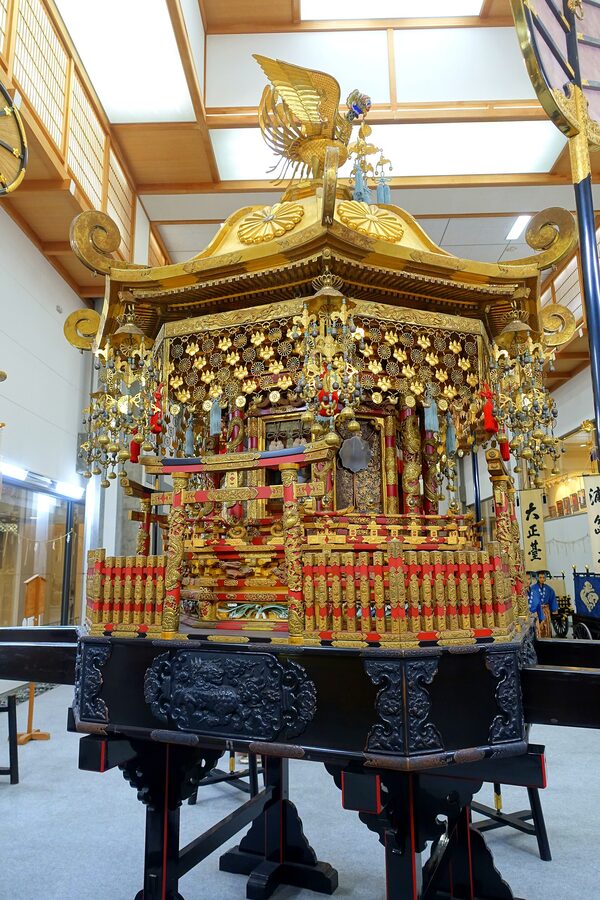
In spring this is called Gojunko (御巡幸). In autumn it is Goshinko (御神幸). Both follow the same pattern. A team of carriers shoulders the mikoshi at the shrine, the priest performs an opening rite, and the procession winds through the parish for three or four hours, stopping at appointed places where neighborhood representatives bow and offer sake.
The escort is what makes this striking. Walking ahead of the mikoshi are tokeiraku (闘鶏楽) musicians, an ensemble unique to Hida that combines a bell-rimmed drum with a striking-rhythm pattern said to imitate fighting roosters. They wear red and white.
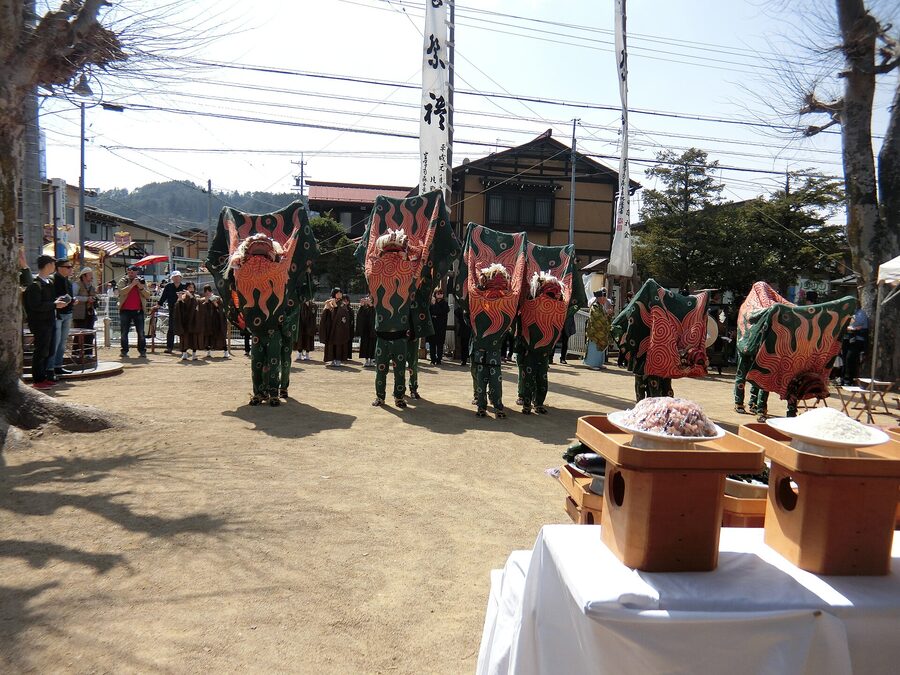
Behind them come shishimai lion dancers, then sword-bearers in Edo-period costume, then sacred-branch carriers, then the mikoshi itself, then the magistrate’s officials in black hakama. The full procession is roughly two hundred people.
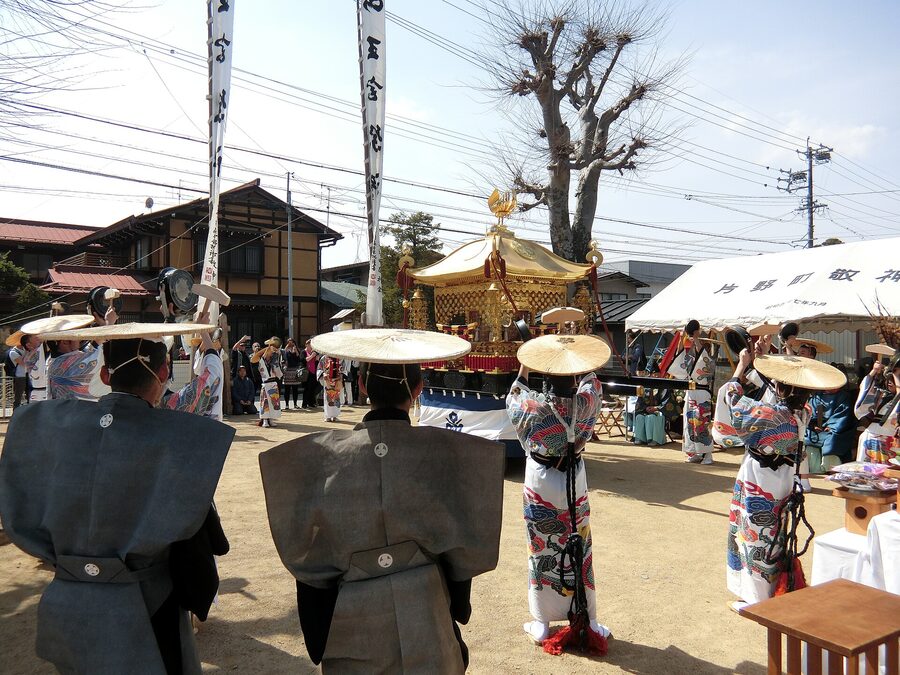
The mikoshi parades are slower than the yatai parade, with longer ceremonial pauses, and you have to know where to stand to catch the better stops. Hie Shrine and Sakurayama Hachimangu both publish parade routes a week before the festival, and asking your ryokan staff is the easiest way to time it.
What the music tells you
I want to spend a paragraph on the music because it is doing more work than people notice. There are three distinct ensembles operating during the festival, and each one signals a different kind of action.
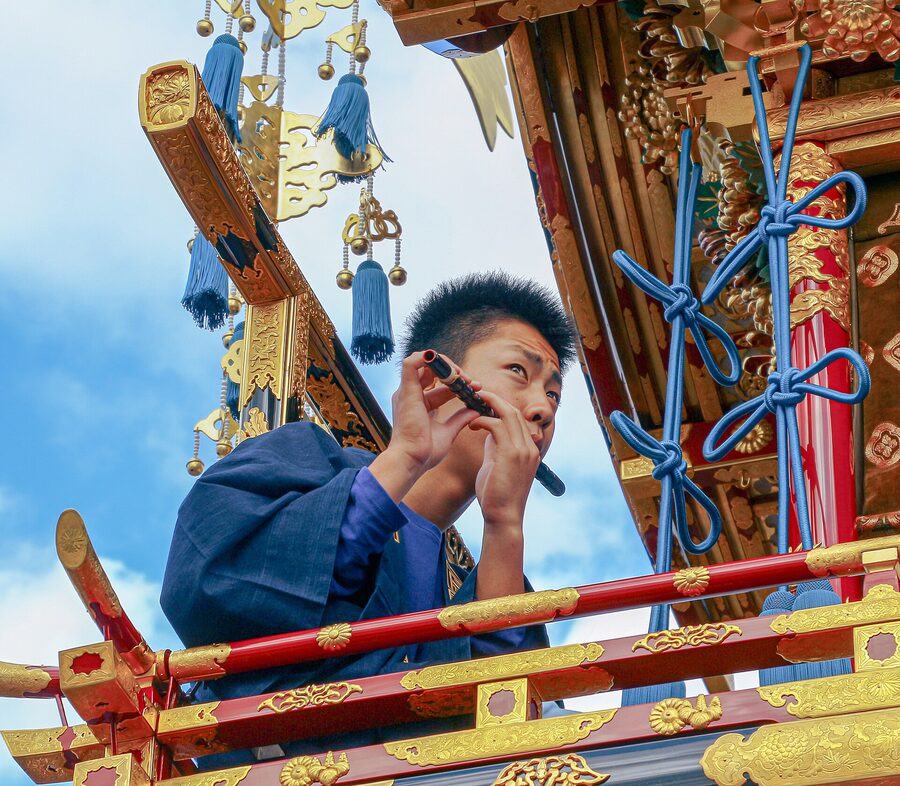
The float ensemble plays from inside the yatai, on flute and small drum, and the melody you hear depends on what the float is doing. There is a starting tune, a moving tune, a stopping tune, and a karakuri-performance tune. If you stand on Sannomachi and close your eyes, you can tell which of the three karakuri is currently performing without even looking, because each of the three has its own theme.
The tokeiraku music belongs to the mikoshi procession only and you will not hear it near a yatai. The shishimai lion-dance music is its own third tradition, faster, with a clattering wood-on-wood rhythm and a different flute tuning. The lion dance happens at fixed shrine stops and at the residence of the head priest.
UNESCO and the 2016 inscription
In November 2016, UNESCO added the Takayama Festival to its Representative List of the Intangible Cultural Heritage of Humanity, under the umbrella designation “Yama, Hoko, Yatai float festivals in Japan.” The umbrella covers thirty-three regional festivals, including Kyoto’s Gion Matsuri, Tsushima Tenno Matsuri in Aichi, and the floating-float Tsushima festival I wrote up in this earlier piece on the river floats.
The UNESCO inscription was not just decorative. It came with two practical effects.
The first is funding: the Japanese national government now matches local subsidies for float restoration, and Hida no takumi carpenters have been hired to repair the older floats. The second is research access. Several of the floats have been documented in detail by the Tokyo National Research Institute for Cultural Properties, and the karakuri mechanisms have been three-dimensionally scanned for the first time.
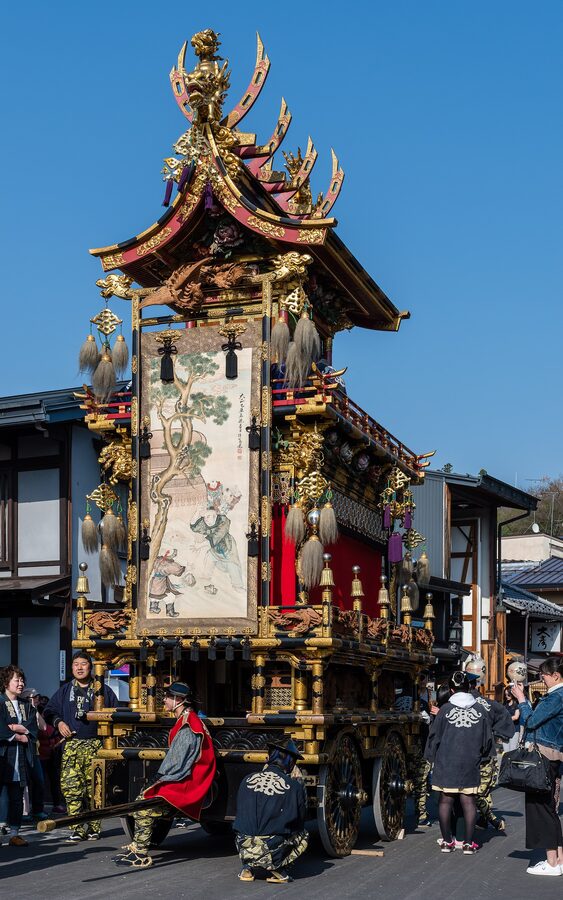
The first generation of carpenters trained under the new restoration program have begun retiring. The current crews are training their successors with a combination of the old apprentice system and three-dimensional scan-and-replicate techniques, which is the kind of contradiction that only the Japanese craft world produces.
The Yatai Kaikan, where the autumn floats live year-round
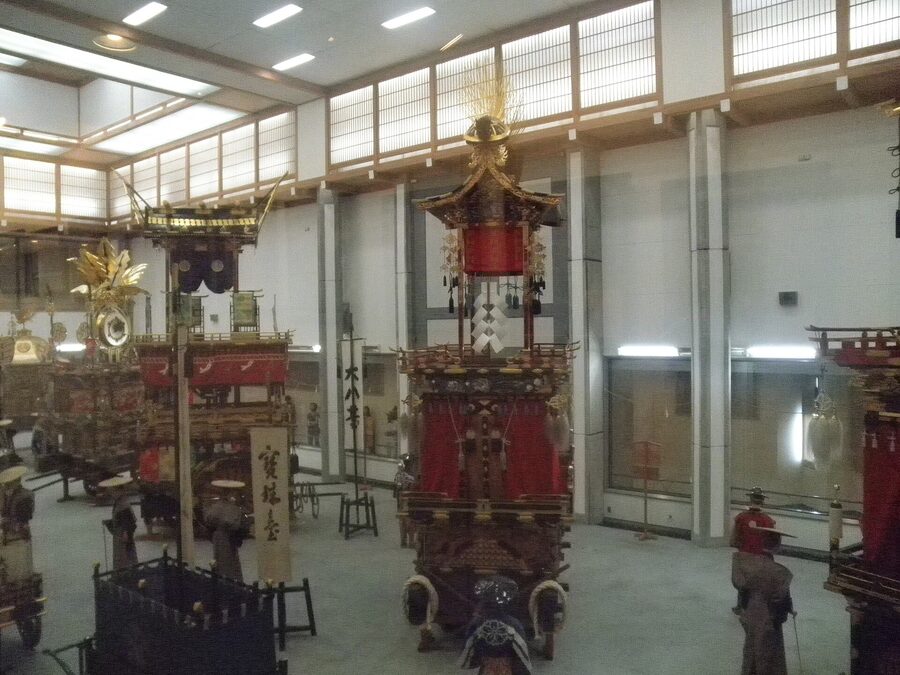
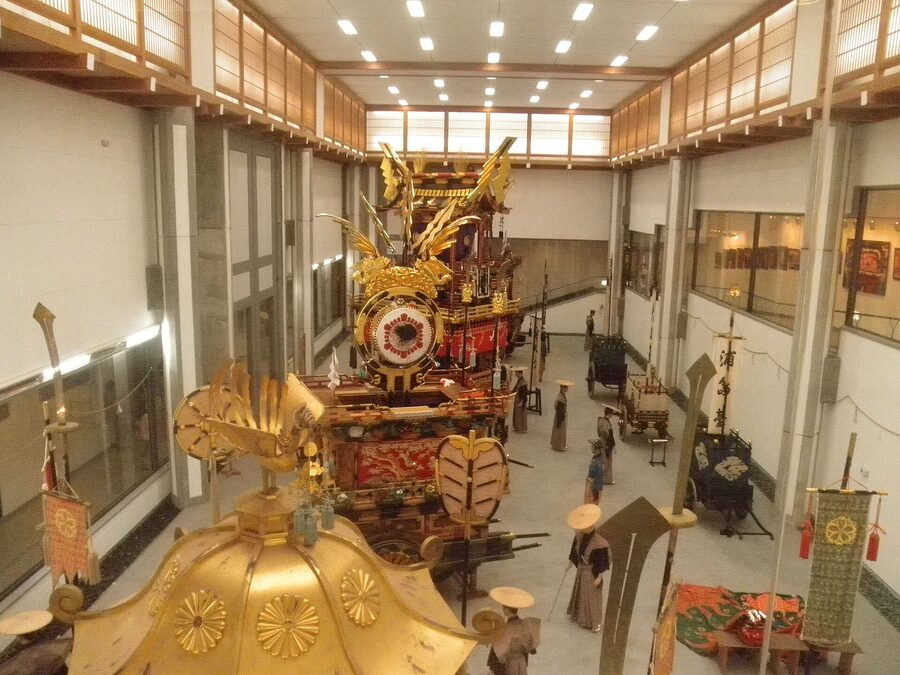
If you cannot make it to either festival, there is still a way to see four of the autumn yatai. The Takayama Yatai Kaikan (高山祭屋台会館), the Festival Float Exhibition Hall, sits next to Sakurayama Hachimangu Shrine and rotates four of the eleven autumn yatai through its display floor every six months.
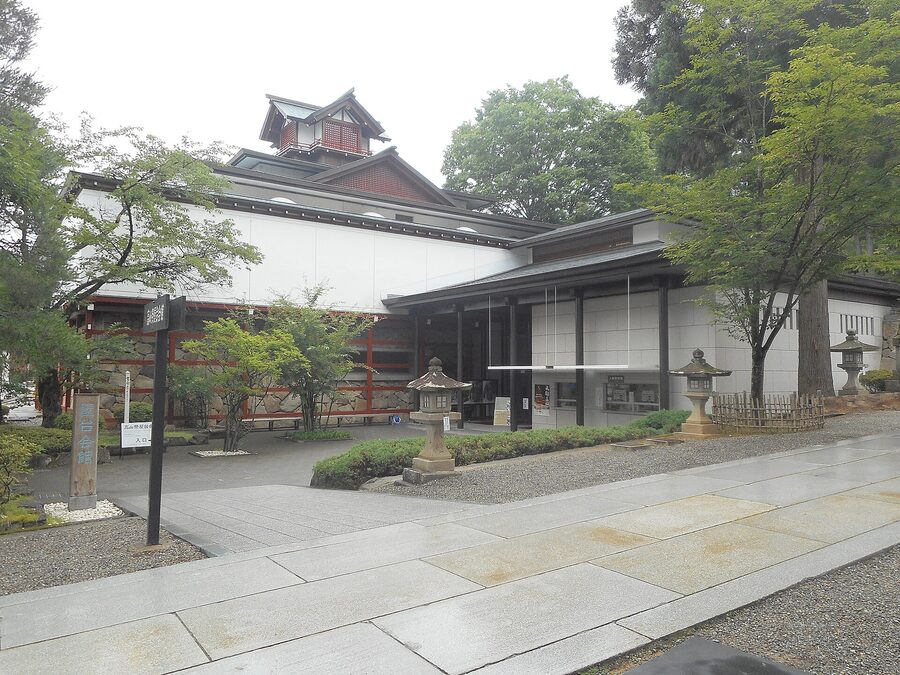
The hall opens daily, 8:30 to 17:00 from March to November, and 9:00 to 16:30 in winter. Admission is 840 yen as of my last visit. They rotate the four floats on display in spring and autumn so you can theoretically see all eleven if you visit twice in the same year.
What the Yatai Kaikan does that the festival cannot is let you stand still next to a float. During the actual festival, the crowd moves you along whether you want to or not, and you cannot get within four meters of a yatai once the procession has started. In the hall, you can walk under the carving, look up at the karakuri stage, and get close enough to read the carved kanji on the ribbon panels.
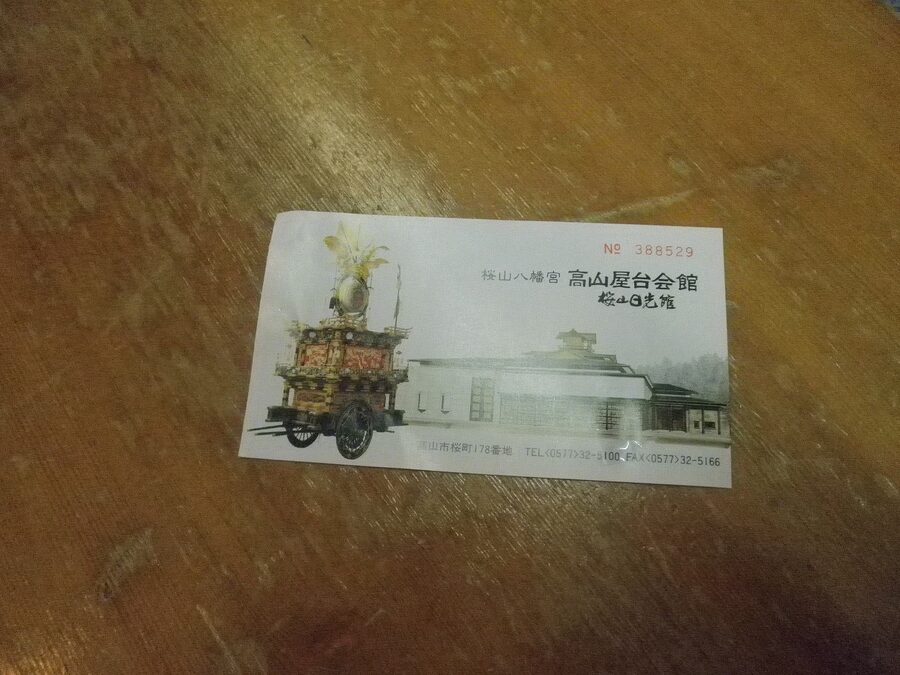
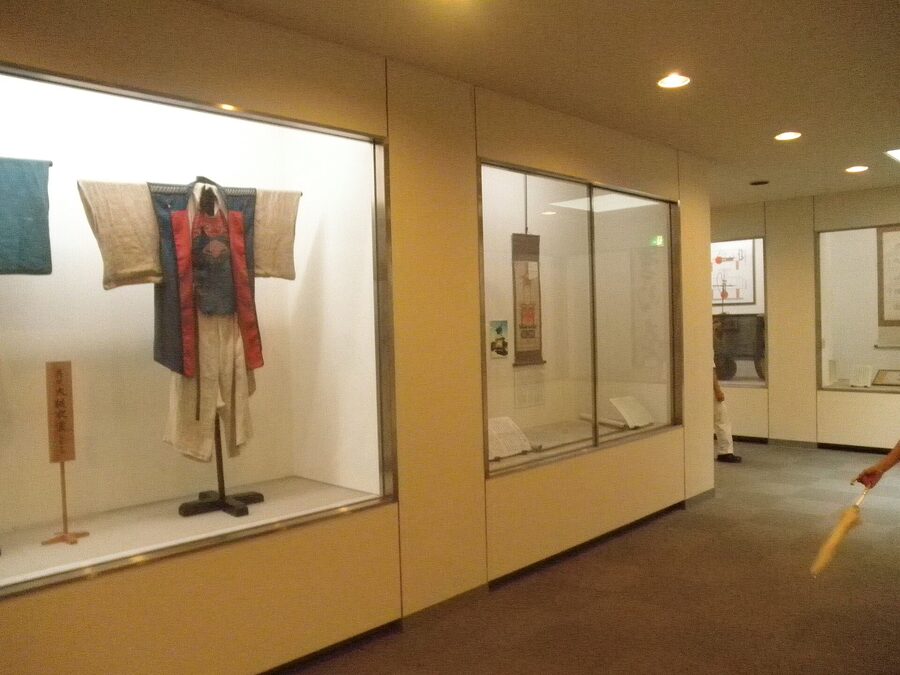
The Yatai Kaikan also has a few smaller-scale exhibits about the carpentry, the spring mechanisms, and the lacquer process. There is a karakuri-puppet demonstration room a few blocks away in a separate facility, where small-scale dolls perform on a tabletop stage during the day. That separate facility is the Karakuri Museum on Sannomachi.
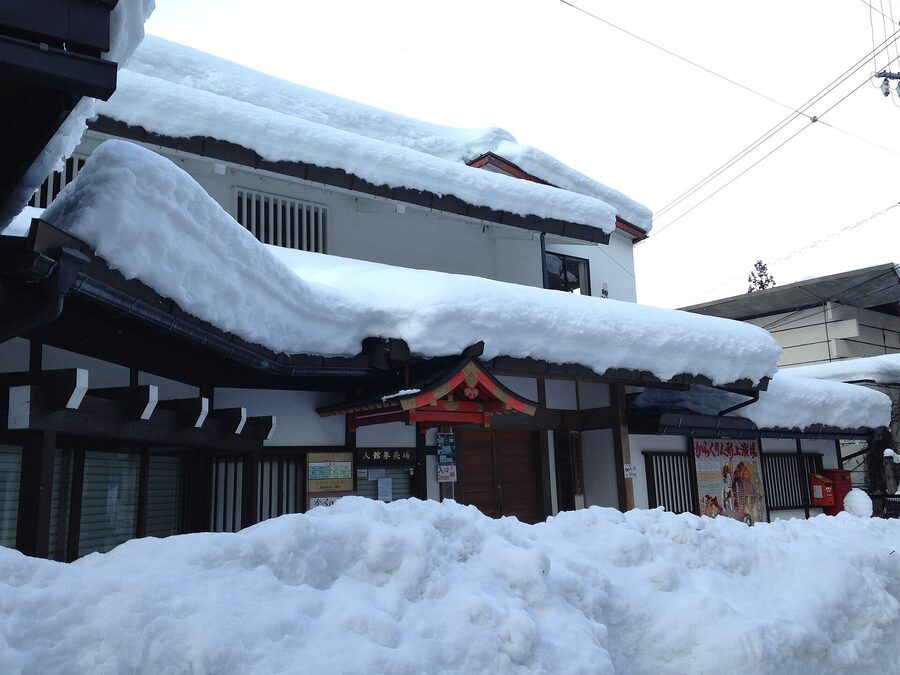
The four autumn floats currently in rotation at the Yatai Kaikan rotate roughly every six months, so if you go twice with a half-year gap, you can see eight of the eleven autumn yatai in a single calendar year. The other three live in their neighborhood storehouses and only emerge for the festival itself.
Sakurayama Hachimangu, the autumn home shrine
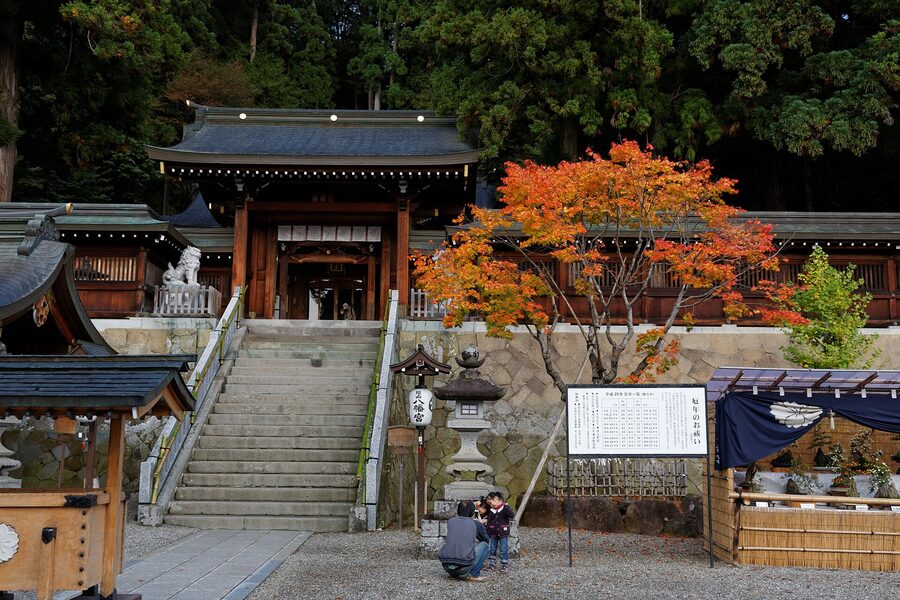
The autumn festival’s home shrine sits on a small wooded hill in the north end of town, accessible by a steep stone staircase that turns into a switchback through cedar trees. This is Sakurayama Hachimangu (桜山八幡宮), and it is the older of the two festival shrines.
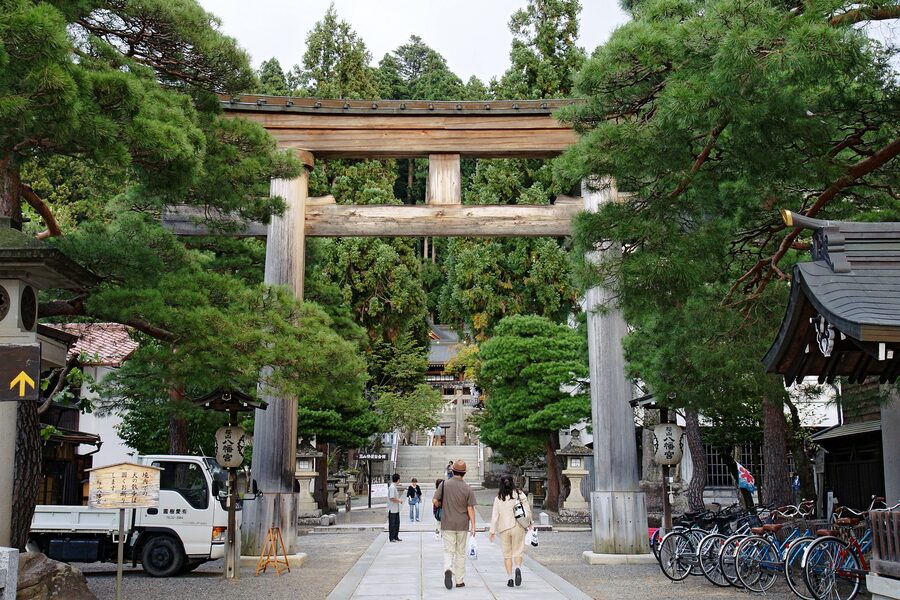
Founded in legend by an early imperial expedition, the shrine is dedicated to Hachiman, the kami of archery and protection. The current main hall dates to the late Edo and early Meiji periods. The shrine grounds include a small museum of festival artifacts and an exhibit of one-tenth-scale replicas of the Nikko Toshogu carved panels, which is the kind of curatorial decision only Takayama would make.
The shrine connects to the Yatai Kaikan through a covered breezeway. You can do both in a single visit. If you arrive on festival day, the procession ends at the shrine’s main steps, and the mikoshi is carried up to the main hall in a final rite that closes the day.
Takayama Jinya, the magistrate’s office
You should know one more building if you want to understand why the festival exists. Takayama Jinya (高山陣屋) is the only surviving Edo-period magistrate’s office in Japan. This is where the Tokugawa shogunate’s appointed governor of Hida lived and worked, every year from 1692 to 1868.
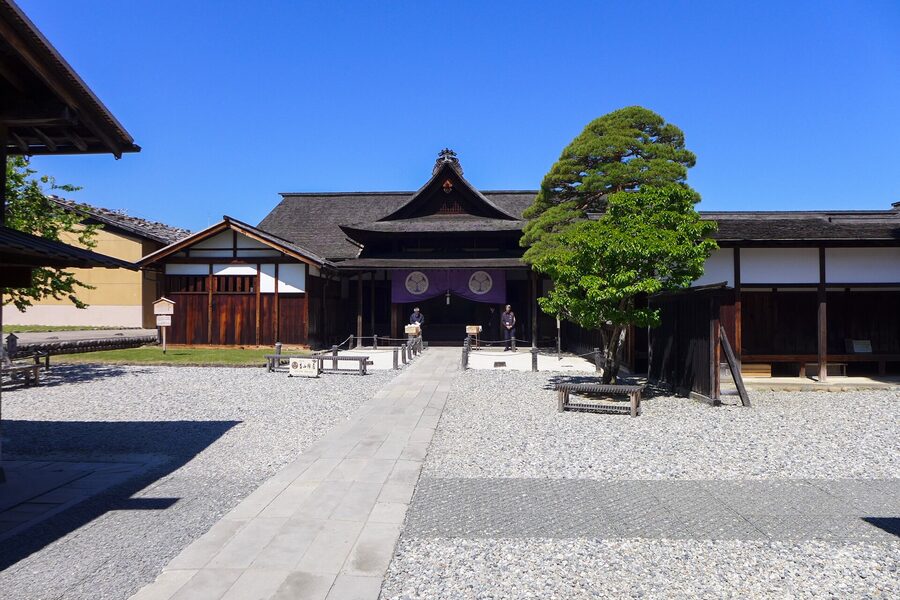
Walking through the Jinya you can see the tax-rice storehouse, the room where rice was measured into bales, the magistrate’s audience chamber, and the kitchen. The wood is darker than the merchant houses in the old town. Hida-no-takumi carpenters built it in the same style as the smaller administrative buildings still scattered through the rural Hida hills.
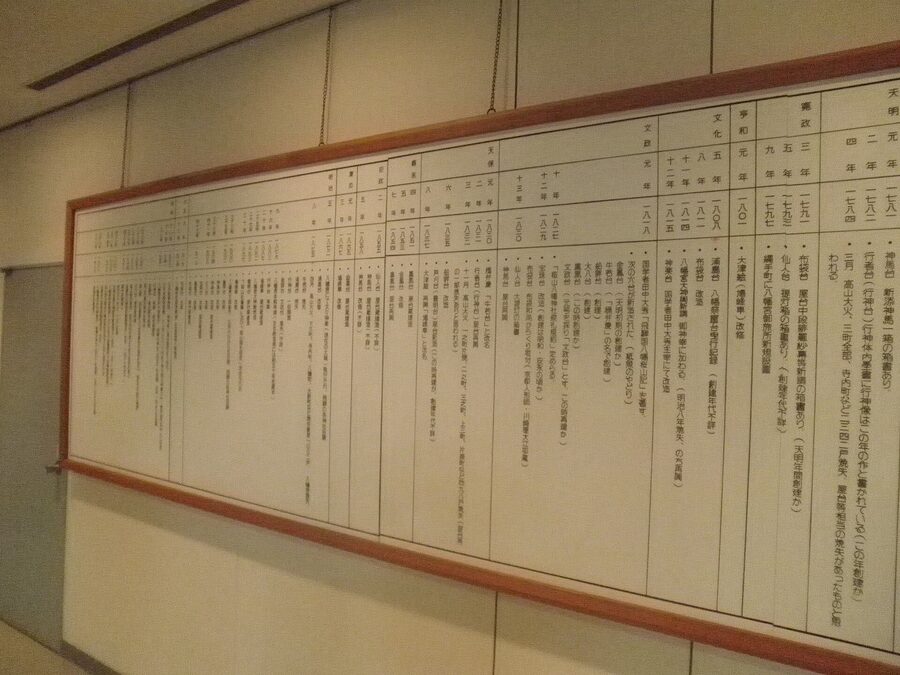
The connection to the festival is direct. The magistrate’s office maintained the official records of the yatai, approved float reconstructions, and adjudicated disputes between neighborhood crews. When a float caught fire in the late Edo period, the Jinya kept the rebuilding records, which is one reason historians know to the year when each float was last reconstructed.
The shogunate’s interest was administrative; the wealth that paid for the carving was the merchants’. The Jinya was the place where those two systems met.
If you want to read about the broader patronage system that made the Edo period the golden age of mechanical arts, my piece on Tokugawa Tsunayoshi covers the shogunal interest in craft that fed forward into the karakuri and yatai workshops.
The old town, sake, and what to eat
You will not spend twelve hours straight watching floats. So I want to send you out into the old town between processions, because Takayama as a place is excellent and most visitors miss the smaller things.
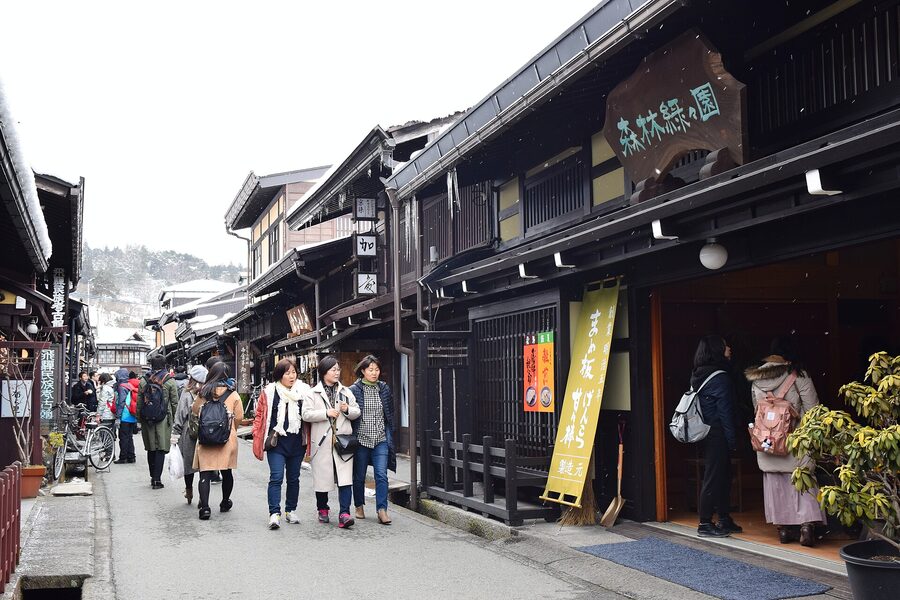
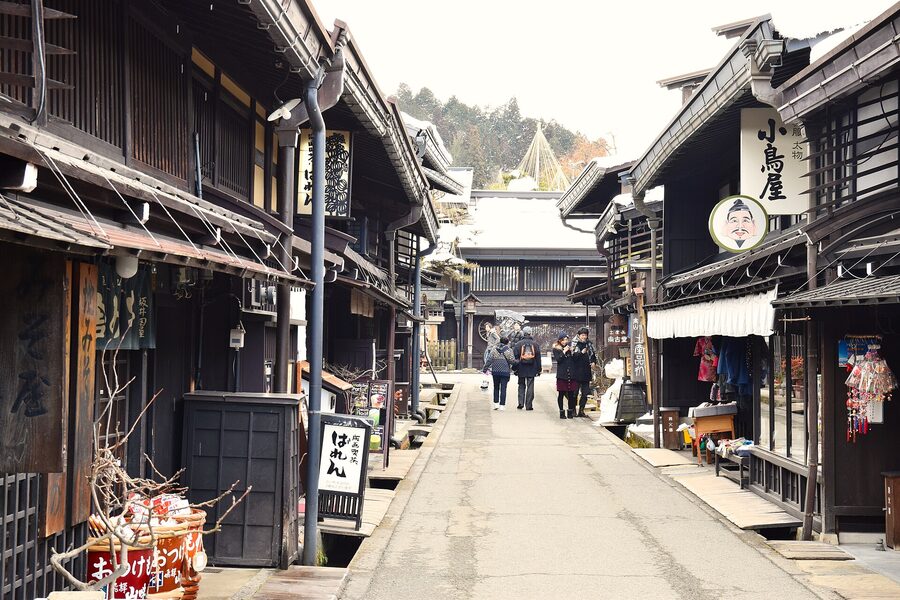
The Furui Machi-nami (古い町並) is the preserved merchant district, three parallel streets called Ichinomachi, Ninomachi, and Sannomachi. The dark wooden facades, the lattice windows, the cobbles, the cedar-bough sake brewery signs: this is the same streetscape that the festival floats have rolled through for two hundred and fifty years. Most of the houses were built in the late Edo and early Meiji periods, and many are still owner-occupied or run as small shops by the same families.
The town has six working sake breweries, all on the same few blocks. They each hang a sugitama (cedar ball) outside their door. A fresh green ball means newly pressed sake from that winter; a brown ball means the brew is mature. Most breweries open their tasting rooms during festival days, and a typical tasting flight is three or four small cups for a few hundred yen.
The food you must eat in Takayama is Hida beef. This is a Wagyu line raised in the Hida hills, with marbling that rivals Kobe and a slightly punchier grass-fed flavor because the cows graze longer at altitude. Hida beef is typically served as nigiri sushi (yes, raw beef sushi is a thing here, and yes you should try it), as a skewer grilled over charcoal, or as a sit-down hoba miso plate where the beef sits on a magnolia leaf over a small charcoal stove and cooks at the table.
The other regional specialties are mitarashi dango, slightly bitter rice dumplings glazed with soy and grilled, and gohei mochi, flat rice cakes painted with a sweet walnut-miso glaze. Both are walking-around snacks in the old town. There are also crystallized sake-lees pickles, mountain vegetables called sansai, and Hida soba.
Shirakawa-go, an hour west
If you have come this far into the Hida mountains, the trip you want to add is Shirakawa-go (白川郷), about an hour west of Takayama by direct bus. This is a UNESCO World Heritage village, listed in 1995, twenty-one years before the festival itself was inscribed. The two listings are different things (Shirakawa-go is built heritage, the festival is intangible), but they cover the same cultural region and the same tradition of self-built mountain craft.
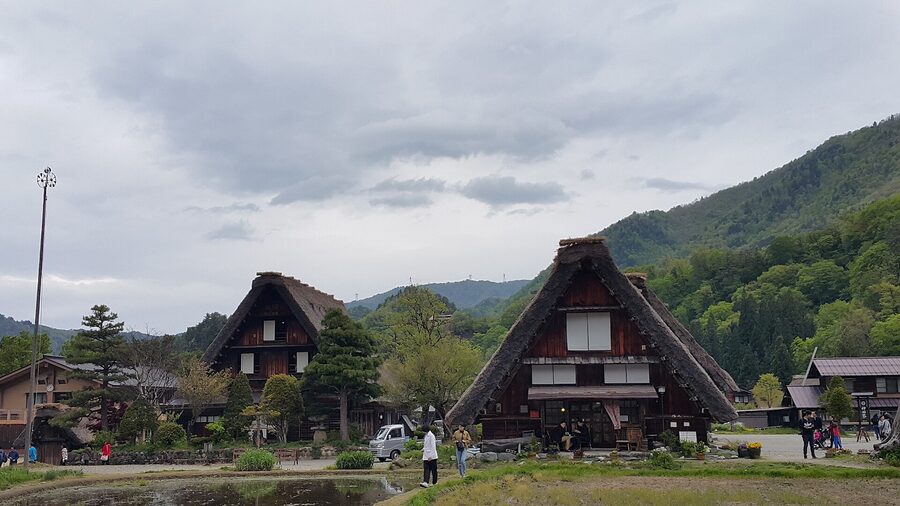
Shirakawa-go is famous for gassho-zukuri (合掌造), a thatched-roof farmhouse style with steep sixty-degree pitched roofs that imitate hands joined in prayer (gassho). The pitch is functional. The roof has to shed seven feet of winter snow without collapsing, and the steeper the pitch, the easier the snow slides. The roofs are rebuilt by communal labor every thirty to forty years, with the entire village turning out to thatch a single roof in two days.
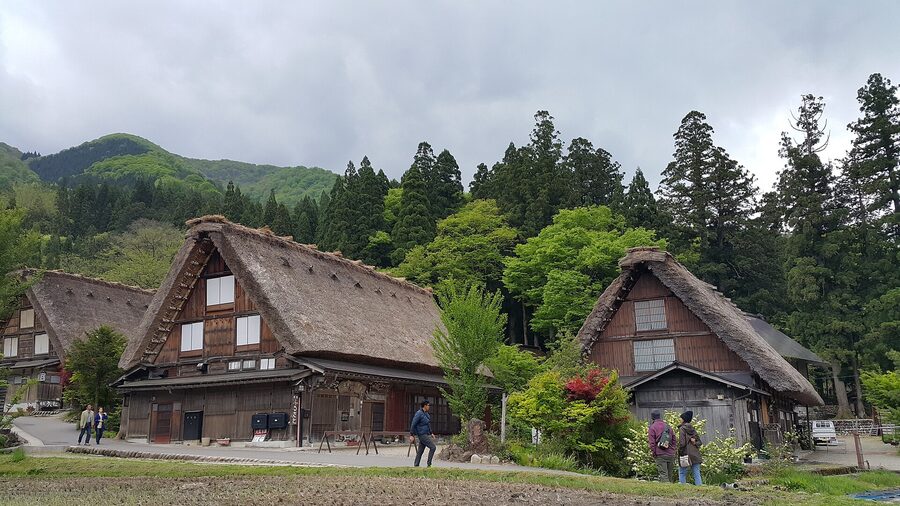
The village’s economy in the Edo period was silk and gunpowder. Silkworms were raised in the attics of the houses, where the steep roof allowed for a four-storey ventilated drying loft. The gunpowder was made from the saltpeter in the silkworm waste under the attic floorboards. This is one of the more startling supply chains in Edo-era Japan, and the houses you see today were physically designed around those two industries.
You can do Takayama and Shirakawa-go as a single overnight trip if you stay one night in Takayama and bus out to Shirakawa-go for half a day. The Nohi Bus runs hourly from Takayama bus station and takes 50 minutes to the village.
Getting there and timing
The fastest route into Takayama from Tokyo is by shinkansen to Nagoya (about 100 minutes) and then transfer to the Wide-View Hida limited express, which runs through the Kiso valley and into the Hida mountains in another two hours and twenty minutes. From Osaka, the same Wide-View Hida runs direct from Osaka Station once daily, taking just under four and a half hours. There is also a direct bus from Shinjuku that runs about five and a half hours but costs roughly half the train fare.
If you are coming for the festival, book your accommodation a year ahead. Takayama has roughly four thousand hotel rooms and ryokan beds in the entire town, and the festival fills them within hours of opening. Festival weekends in spring and autumn are the busiest days of the local calendar, more than the new year, more than the autumn foliage.
Off-festival, the town is a normal mountain destination. You can usually book a room two or three weeks ahead and have your pick. The autumn foliage in the surrounding hills runs from mid-October to early November, which means an October 9-10 festival visit can be combined with a foliage tour the following week.
Weather in April is cool, often single digits in the morning, climbing to mid-teens by afternoon. Bring layers and a good waterproof shell because spring rain in the Hida mountains is a serious thing. October is colder, low single digits at dawn, with a real chance of frost. Both festivals run rain or shine, and the karakuri performances run only in dry weather; if it rains, the puppet shows are canceled to protect the threads and the lacquered figures.
The longer pattern this fits into
I want to step back for one paragraph and say what the Takayama Matsuri is, in the broader pattern of Japanese festivals. There is a Japanese category called yama-hoko-yatai, which UNESCO formalized in 2016. These are festivals built around towering wheeled wooden floats decorated to a sumptuous standard.
The two most famous are Kyoto’s Gion Matsuri and Takayama’s two festivals. Within that category, Takayama is unique in two ways: it has karakuri performances that other yama-hoko festivals do not, and it grew out of a town with no daimyo, run by merchants under direct shogunal supervision.
The carving tradition that produced these floats is the same Hida-no-takumi line that built temple roofs in Nara and palace beams in Kyoto. It is the woodworking equivalent of the parallel art forms I covered in my piece on the great gardens of Japan. Both traditions are about controlled, almost mathematical artisanship that took the Edo-period merchants’ wealth and made it permanent.
If you only have one day
The minimum viable Takayama Matsuri trip is one full day, ideally the second day of either festival because that is when both the day procession and the night yomatsuri run. Here is what I would do.
Arrive in Takayama by 9 am on day two. Walk straight to whichever shrine is hosting (Hie in spring, Sakurayama Hachimangu in autumn). Watch the morning karakuri performance, which usually runs around 10 am and again around noon. Then break for lunch in the old town: Hida beef nigiri at one of the Sannomachi sushi counters, with a tasting flight at one of the sake breweries.
By mid-afternoon, do a slow walk through the Furui Machi-nami, then the Yatai Kaikan if you have not already, then Takayama Jinya. Be back in the old town for the yomatsuri night procession, which lights up around 6 pm and runs for a couple of hours. Eat dinner late, after the procession; the town’s restaurants stay open later than usual on festival nights, and the post-procession crowd at a hoba miso restaurant is half the experience.
If you can stay two nights, add a half-day for Shirakawa-go, and you have completed what I would call the full Hida loop.
One small thing about the karakuri I keep thinking about
I want to close on a single observation, because it is the thing about this festival that I find unanswerable.
The Hotei-tai karakuri has been performing the same eight-minute show since approximately 1810. The thirty-six threads have been the same configuration. The cams have been the same shape.
The whalebone springs have been replaced from the same baleen stockpile, kept in a sealed wooden chest that the float crew passes from generation to generation. The puppeteers train as children and start performing in their teens.
By the time a puppeteer dies, he has performed this show roughly four hundred times. There are roughly two hundred and ten years’ worth of recorded performances, so the show has run somewhere around forty-two hundred times, on the same float, with the same script.
You can sit in the audience knowing exactly what is going to happen, because it has happened in this same way more than four thousand times. And it still works. The puppets still look as if they decide each motion in real time. The transformation from a child puppet into a banner-bearer perched on Hotei’s shoulder still draws a gasp out of the crowd.
That gasp is the festival’s actual currency. Not the carving, not the gold leaf, not the lacquer, not even the lanterns. The gasp is what the crew works the whole year for. They roll the float out of its yatai-gura at 5 am on the festival morning, they spend three hours arranging the threads and tuning the springs, they do a full rehearsal at 8 am inside the float, they perform the public show at 10 and 12, and the only thing they are watching for is whether the audience reacts on cue.
If you go, watch the puppeteers’ faces during the performance. They sit below the upper deck, mostly hidden, but you can see them through the float’s railing if you stand at the right angle. The look is concentration.
They are listening to the crowd through their own performance, calibrating each thread-tug by the audience’s reaction. This is not animation. This is live performance done with a four-thousand-times-rehearsed mechanism, and the small adjustments are still entirely human.
That is what UNESCO is preserving. Not the float. The performance.
Practical references
Festival dates: April 14-15 (spring, Sanno Matsuri at Hie Shrine) and October 9-10 (autumn, Hachiman Matsuri at Sakurayama Hachimangu). Both run rain or shine, except the karakuri performances, which cancel in heavy rain. The Yatai Kaikan opens daily from 8:30 to 17:00 from March to November, 9:00 to 16:30 in winter, admission 840 yen.
From Tokyo: shinkansen to Nagoya, then the Wide-View Hida limited express to Takayama Station, total travel time around four hours. From Osaka: direct Wide-View Hida from Osaka Station, four and a half hours. Book accommodation no later than the previous summer for festival dates.
If you go and you plan to compare with another major float festival, my piece on Kyoto’s Gion Matsuri covers the other UNESCO-listed yama-hoko festival, which is the obvious sister event. The Hida-no-takumi tradition that built these floats was the same lineage of carpenters who shaped the Edo society described in my piece on the sankin-kotai system.
For the broader Edo patronage of mechanical and craft arts, see my piece on Tokugawa Tsunayoshi. For parallels to the same kind of mathematically precise traditional art form, the obvious cousin is the tea ceremony, and the long tradition of pre-industrial Japanese craft is covered in my survey of the great gardens of Japan.
If you have already read about the floating-float festival in Tsushima Tenno Matsuri, the comparison with Takayama’s wheeled-yatai tradition is the clearest study in regional adaptation that Japan offers.