
Eighty per cent of the cherry trees you see flowering in Japan in April are the same tree. Not the same species, not the same cultivar — the same individual. A single seedling, selected in the Somei village of Edo sometime in the 1840s or 1850s, propagated by graft for the next 180 years onto stocks planted in every prefectural park, every railway-station plaza, every school yard and riverbank from Kagoshima to Hokkaidō.
It is called Somei-Yoshino (染井吉野), and it is a clone. The entire rhythm of the Japanese spring — the weather-forecast front that begins in Okinawa in January and ends in Hokkaidō in May, the office welcome parties, the school-entrance photographs, the week-long national mood — is built around the simultaneous flowering of tens of millions of genetically identical trees whose common ancestor is one unnamed sapling that a gardener in a northern Tokyo nursery picked out of a grafting bed.
I find this easier to say than to quite believe. On the day I first stood on the upper slope of Yoshino-yama in Nara and looked down at the thirty thousand mountain cherries in the valley — the yamazakura, the wild and varied and slightly scruffy native species that Japanese poets sang about for a thousand years before Somei-Yoshino existed — the contrast with the monoculture of a Tokyo park was disorienting.
Yoshino is what Japanese hanami looked like before the Meiji period. The rest of the country is what it has looked like since. Both are beautiful. They are not, however, the same thing.
In This Article
- What sakura actually is, which is not one thing
- 812 CE, Saga-tennō, and the first imperial cherry party
- Kamakura, Muromachi, and the samurai century
- Hideyoshi at Yoshino, 1594, and Daigo-ji, 1598
- Edo, Yoshimune, and the republic of cherry-viewing
- Somei village, 1850, and the accident of a clone
- The 1912 Washington gift, and what Japan sent back
- Sakura-zensen and the shortening week
- Where to see the cherries today
- Yoshino-yama, Nara — the Hideyoshi mountain
- Hirosaki Park, Aomori — the Tohoku-scale castle cherry
- Takatō Park, Nagano — the small-petal Koigan-zakura
- Chidorigafuchi and the Edo Castle moats
- Meguro River, Nakameguro
- Maruyama Park and Kyoto’s philosopher’s path
- Daigo-ji, 2 April — the Hideyoshi re-enactment
- Komagome, Toshima — the Somei village marker
- Washington D.C., Tidal Basin — the 1912 gift
- Other places worth the detour
- A note on what you are looking at
What sakura actually is, which is not one thing
Sakura (桜) is not a species. It is a loose Japanese word for the flowering members of the genus Cerasus, or Prunus subgenus Cerasus depending on which taxonomy you accept — the two competing systems sit unreconciled in the botanical literature, with European and North American authors generally using Prunus and Japanese, Chinese and Russian authors since 1992 generally using Cerasus after Hideaki Ōba’s University of Tokyo paper. There are about a hundred wild species in the group. Japan holds eleven of them natively, ten if you exclude the southern Kanhi-zakura (Cerasus campanulata) which may have been introduced and naturalised rather than being a true native.
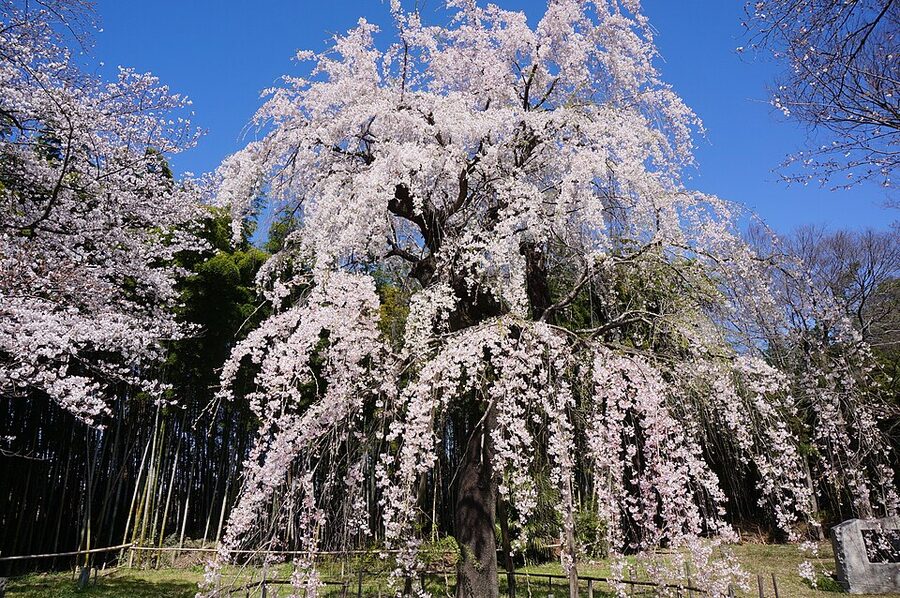
From those native wild species the Japanese have, over twelve centuries of selection and grafting, produced somewhere between two hundred and eight hundred named cultivars, depending on who is counting. The Forestry and Forest Products Research Institute’s 2014 DNA survey of 215 Japanese cultivars found that most of them trace back to the Izu Islands endemic Ōshima-zakura (Cerasus speciosa) — the species that mutates most readily into the double-petalled, large-flowered, fragrant forms that the eye gravitates to. The Sato-zakura group — the named garden cultivars like Kanzan, Ichiyō, Fugenzō, Ukon — are almost all Ōshima-zakura hybrids. The great weeping cherry, Shidare-zakura, is a pendulous form of the wild Edo-higan.
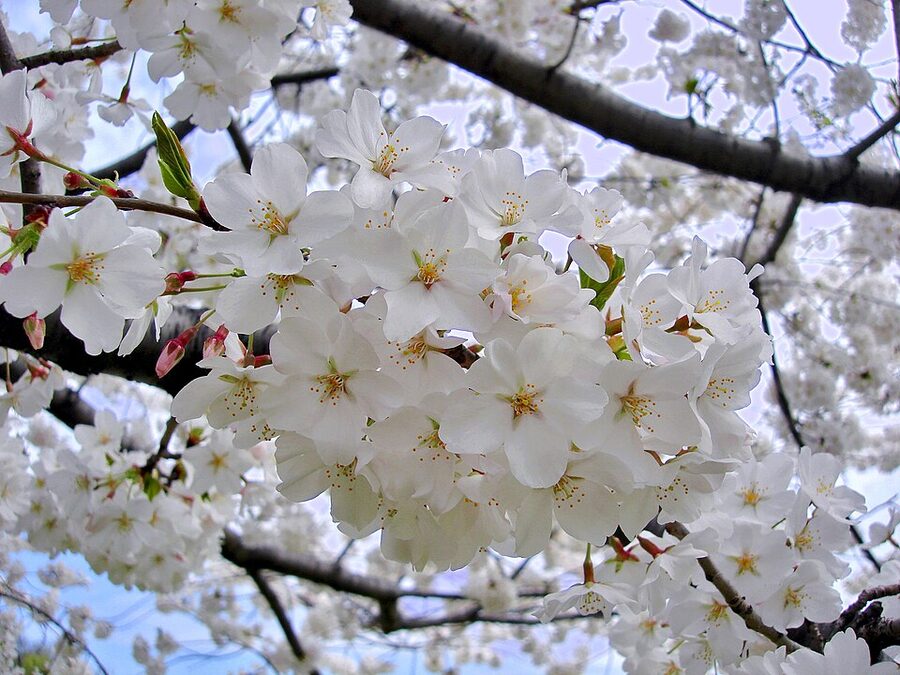
The Somei-Yoshino that dominates the modern landscape is a specific interspecific hybrid — Cerasus × yedoensis ‘Somei-yoshino’ — whose mother is Edo-higan and whose father is Ōshima-zakura, or, in the more recent DNA-sequenced reading, a cross between Ōshima-zakura and Yamazakura. The 2014 nuclear SSR analysis places the contributions at roughly 47% Edo-higan, 37% Ōshima-zakura and 11% Yamazakura. The Kazusa DNA Research Institute’s 2019 full-genome sequencing confirmed a single hybridisation event roughly a century before the cultivar’s commercial launch. In other words: every Somei-Yoshino alive today descends, by graft, from one single tree that emerged from one single seed sometime around 1820-1850 in the Tokyo area.
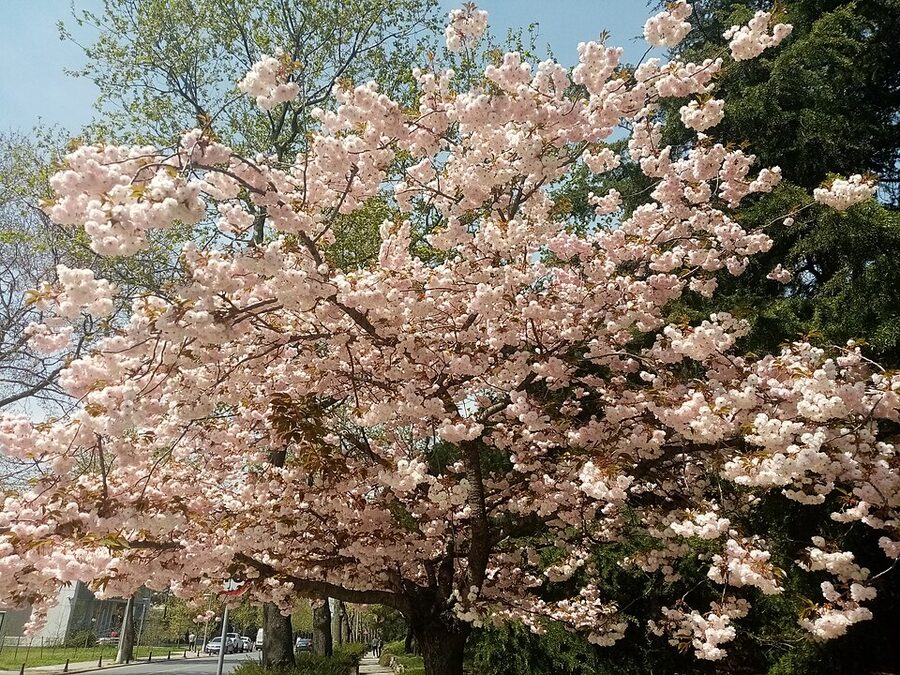
The consequence of that clonal reality is the famous simultaneity. Because every Somei-Yoshino in a given microclimate is genetically identical, they all wake from dormancy on the same day and open their flowers within the same 48-hour window. A whole park goes from bare to white overnight.
Eight days later, the petals start to fall. Two weeks after bud-break the leaves are out and the show is over for the year. Japanese wild species, left alone in Yoshino-yama or on a Kyushu hillside, stagger their flowering over a much longer period — individuals vary genetically, microclimates vary, and you get a three or four-week rolling front.
The Somei-Yoshino show is a national stopwatch. That is the engineering achievement of the Meiji-era nurserymen who propagated it, and it is also, as I will come to, the reason modern Japanese spring is so short.
812 CE, Saga-tennō, and the first imperial cherry party
Hanami (花見), “flower viewing”, did not begin with cherry blossoms. It began with plum (ume, 梅). The Nara-period court, absorbing Chinese Tang-dynasty literary fashion, held its flower-viewing parties under plum trees. The Man’yōshū, compiled around 759, includes 110-odd poems about plum blossom and only 43 about cherry. When an 8th-century aristocrat wrote “flowers” in a poem he meant plum. The cherry was there in the landscape but it was not yet the flower.
That shifted in the early Heian period, and the shift has a specific date and a specific actor. The Nihon Kōki, the fourth of the six official chronicles of the early imperial court, records that on the 12th day of the 2nd lunar month of the 3rd year of Kōnin (what the modern calendar gives as 28 March 812), the Emperor Saga (嵯峨天皇) held a hana no en, a “flower banquet,” at the Shinsen-en (神泉苑) imperial garden south of the Kyoto palace. The chronicle says the flower was a cherry. The year before, Saga had taken a particular liking to the cherries growing at Jishu Jinja, the small shrine on the grounds of Kiyomizu-dera, and he had ordered that cherry boughs from that shrine be sent to the palace every year. In 831 cherry-viewing was made a fixed annual event in the court calendar. By the time the Kokin Wakashū was compiled in the early 10th century, plum had been eclipsed; the new collection held 70 poems on cherry against 18 on plum. “Flowers” now meant cherry, and it has meant cherry ever since.
Saga’s banquet of 812 CE is also the opening entry in what turns out to be the longest continuous phenological dataset in the world. Starting from that year, the imperial chronicles and various monastery records kept track of the date cherry trees flowered at the court, then at Kamigamo, Daitoku-ji, and a dozen other Kyoto sites. The tradition continued essentially unbroken through the Heian, Kamakura, Muromachi, Edo and Meiji periods.
Yasuyuki Aono at Osaka Prefecture University reconstructed the full 1,200-year record from those sources in the 2000s. It is now the primary dataset modern climate scientists use to chart the medieval warm period and the Little Ice Age on the Japanese archipelago — the cherries’ flowering date is directly sensitive to the preceding winter’s temperature, and the Kyoto series shows the medieval optimum flowering ten to fourteen days earlier than the 17th-century low. It is a remarkable secondary application of the original record: priests writing down when the emperor’s cherry bloomed in order to pick an auspicious date for a banquet have turned out to have been logging spring air temperature for a thousand years, and we can now read it back.
Shinsen-en is still there. Most of it is gone — the lake that Saga’s barges floated on was drained in the Momoyama period when Hideyoshi’s men flattened the ground for what became Nijō Castle, and the current garden is about a twentieth of the Heian original. But the pond remains, and the central hall remains, and the cherries in the courtyard in early April are direct descendants of the ones Saga’s gardeners planted. It is a five-minute walk north of the Shijō-Ōmiya junction and gets almost no tourist traffic. I recommend going there with the Nihon Kōki entry in mind and sitting for an hour.
Kamakura, Muromachi, and the samurai century
Hanami as a court ritual was elite by construction. The Heian nobility were the only people with the leisure, the gardens, and the poetry to sustain it. As the Heian imperial system gave way to the Kamakura bakufu from 1185 onward, with the centre of political gravity shifting east to Minamoto no Yoritomo’s new headquarters, the custom began to diffuse outward, first to the samurai aristocracy who were adjacent to the court and then, more slowly, to provincial warrior households.
The essayist-monk Yoshida Kenkō captures a moment of this transition in the Tsurezuregusa, written roughly 1330-1332. In section 137 he distinguishes between the refined hanami of the court nobleman, who will write a poem and leave, and the coarse hanami of the “provincial rustic” who drinks too much and ties branches to his horse. Kenkō is being a snob. The useful point is that by the early 14th century hanami had clearly reached the provinces; otherwise there would be nothing for him to complain about. His grumbling is evidence that the practice had escaped.
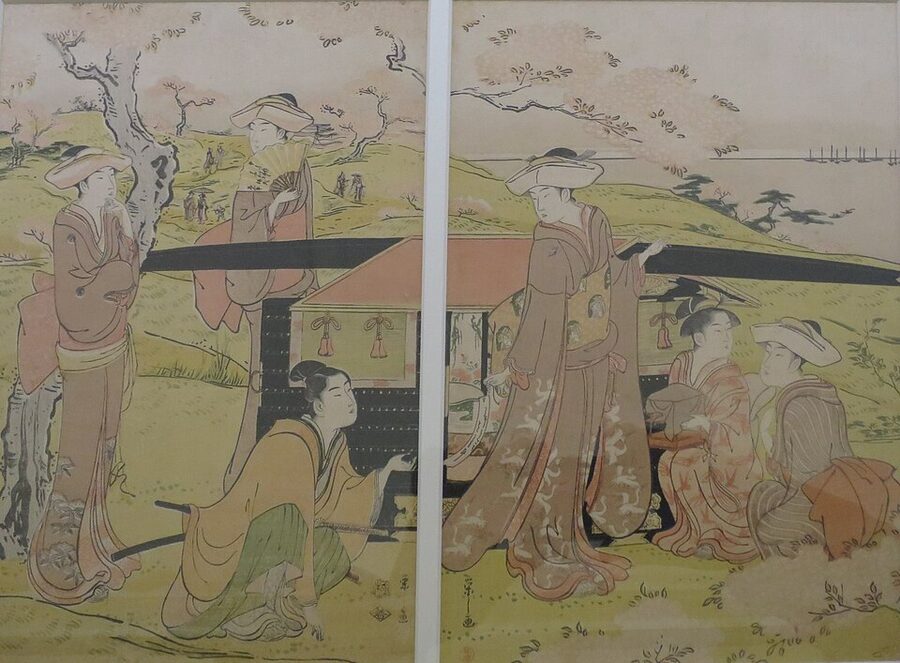
It is in the Muromachi period (1336-1573) that the sato-zakura group, the hybrid garden cultivars based on Ōshima-zakura, begin to be selected and named, mostly out of temple gardens and daimyō pleasure parks in the Kantō and around Kyoto. This is also when cherry-blossom imagery becomes one of the durable subjects of Muromachi ink painting, Noh costume embroidery, and the new medium of fusuma-e, the painted sliding screens that the rising warrior class put up in their shoin-style residences. The flower was by then an unambiguous political signifier. A samurai compound without cherries was a compound that had not yet arrived. The connection to warrior ethics — the short brilliant life, the cherry petals falling at the height of their beauty — had not yet been articulated in the form it would take from the late Edo period onward, but the visual vocabulary was being assembled.
The form of the samurai pleasure-garden that housed these Muromachi cherries would, a few generations later, become one of the stabilised genres of Japanese gardens — the chisen-style pond gardens with a cherry bank on the far side, designed to be viewed from a shoin room across the water. Ginkaku-ji has a version of this; so did the original Muromachi-period layout of Rokuon-ji before Ashikaga Yoshimitsu rebuilt it as Kinkaku. In those settings hanami was continuous with the rest of the garden’s aesthetic programme: the cherries were seasonal punctuation in a year-round composition, not the entire point of the space.
Hideyoshi at Yoshino, 1594, and Daigo-ji, 1598
The two most famous hanami in Japanese history are both Toyotomi Hideyoshi‘s, held four years apart near the end of his life. Hideyoshi is not a subtle man in the historical record and his cherry-viewing parties are not subtle either. Taken together they are the moment when hanami transitions from court custom to public political spectacle, and they set a tone that the Edo-period shogunate and then the Meiji state would each, in their different ways, learn to use.
The Yoshino-no-Hanami of Bunroku 3, 1594, was the larger of the two. Hideyoshi had by then unified the country, ejected the European Jesuits (with caveats), launched the first Korean invasion, and was eighteen months out from the Hidetsugu succession crisis he would engineer and regret. In the spring of 1594 he went to Yoshino-yama in Nara Prefecture — the mountain already famous for its thirty thousand wild yamazakura — with an escort of roughly 5,000 retainers, including his brother Hidenaga, his nephew Hidetsugu, Tokugawa Ieyasu, Maeda Toshiie, Uesugi Kagekatsu, and a Who’s-Who of the post-Komaki-Nagakute balance-of-power elite. The party stayed five days. There was poetry and there was Noh and there was an ostentatious amount of drinking. The surviving attendee diaries record it as the largest hanami that had ever been held, by a wide margin.
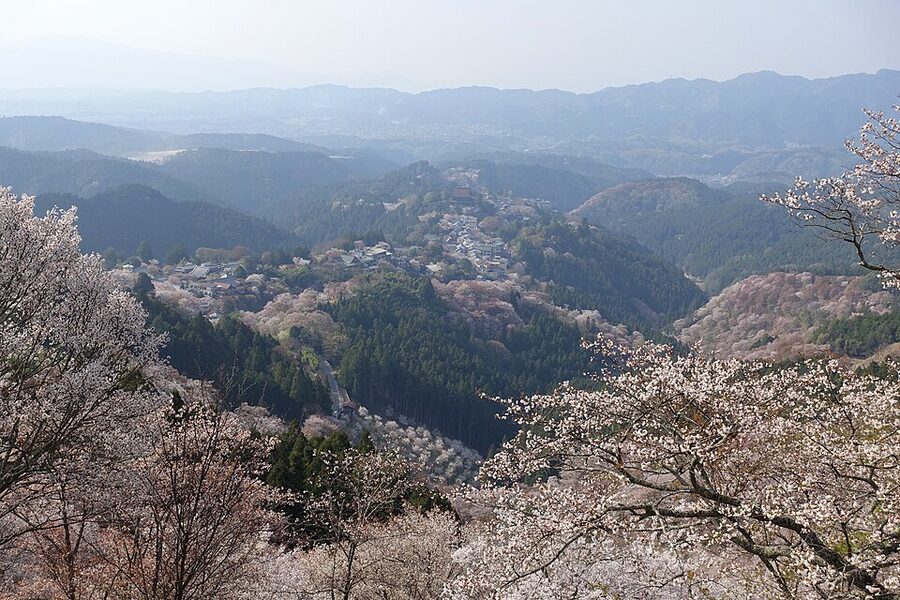
It rained for the first three days. This is documented, the famous “Hideyoshi’s cherry rain” anecdote, and the record has Hideyoshi, increasingly irritable, at one point threatening to order Yoshino-mikumari-jinja demolished if the weather did not clear. It cleared on day four. The temple’s abbot, a monk named Giensha Jōzen, is said to have prayed continuously through the night; Hideyoshi made a substantial donation to the temple on departure.
Whether the prayer worked or the front simply passed is something a meteorologist would have to decide. The incident is one of the stories Japanese schoolchildren still learn in the section of the curriculum that covers Hideyoshi’s character, and the mix of petulance, showmanship and thin-skinned superstition in it is representative.
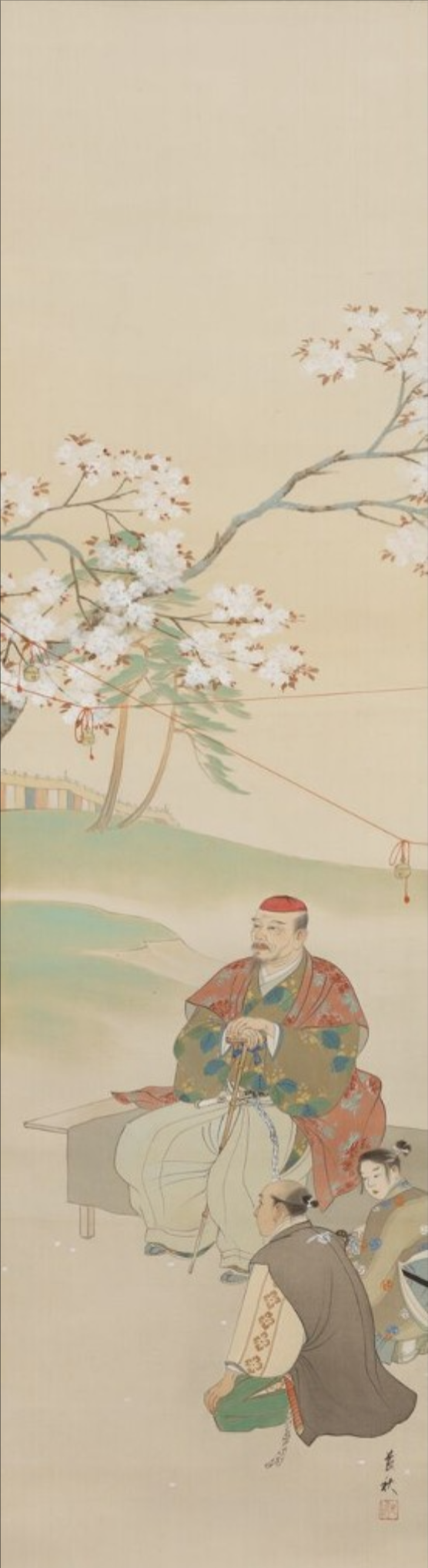
The Daigo-no-Hanami of Keichō 3 — 15 March 1598 by the lunar calendar, roughly 20 April by the modern one — was smaller in raw scale but bigger in dramatic weight. Hideyoshi would be dead by August. He held the event at Daigo-ji, the Shingon-sect temple in the hills southeast of Kyoto, and he had the grounds prepared specifically for the occasion: 700 cherry trees brought in from Yoshino and Kinai, eight tea-ceremony pavilions set up along the approach path, and a new palace (Sanbō-in) built at the Daigo temple complex to host the core party.
The guest list was quite different from 1594. There were about 1,300 attendees, overwhelmingly women — Hideyoshi’s wife Kita-no-Mandokoro, his consort Yodogimi, his young son Hideyori, the widows of Oda Nobunaga, and the wives of all his ranking daimyō. The reading most historians now give the event is that it was staged as a public gesture of Toyotomi-household solidity at a moment when Hideyoshi knew his own time was short and his five-year-old heir was about to inherit a sprawling regime without him.
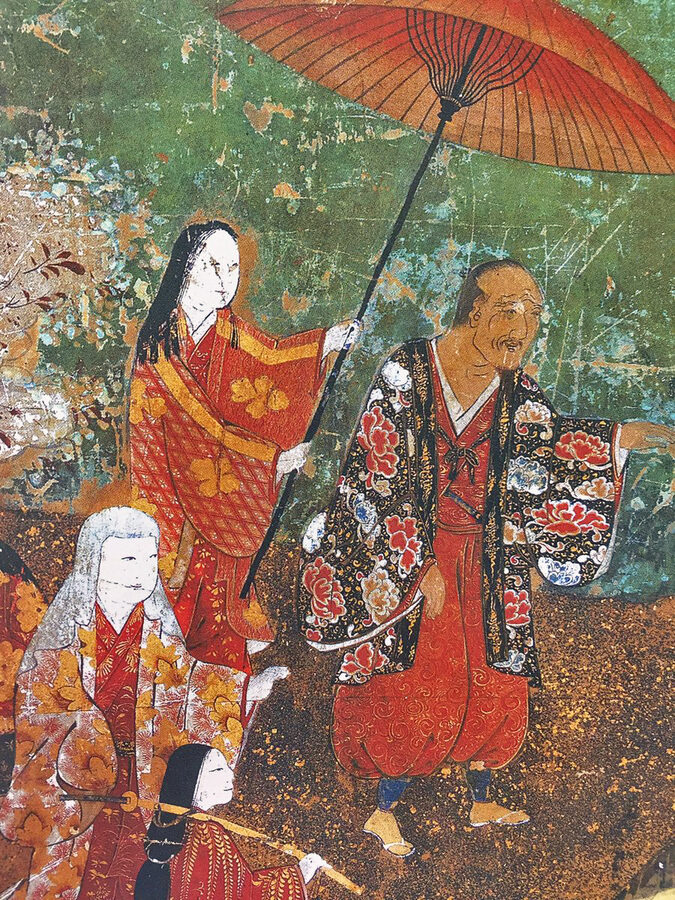
Daigo-ji now re-enacts the Daigo-no-Hanami every year on 2 April — a costumed procession of 1,300 participants in full Momoyama-period dress, walking the approach road from the Niō-mon gate up to Sanbō-in as Hideyoshi’s party did. It is one of the better pieces of living history in western Japan. If you are in Kyoto in early April and have any interest in Momoyama material culture or in Japanese tea ceremony — which in 1598 was in its late-Rikyū phase, with Hideyoshi still digesting the fact that he had ordered Sen no Rikyū to commit suicide seven years earlier — the Daigo walk is worth the detour out to Yamashina.
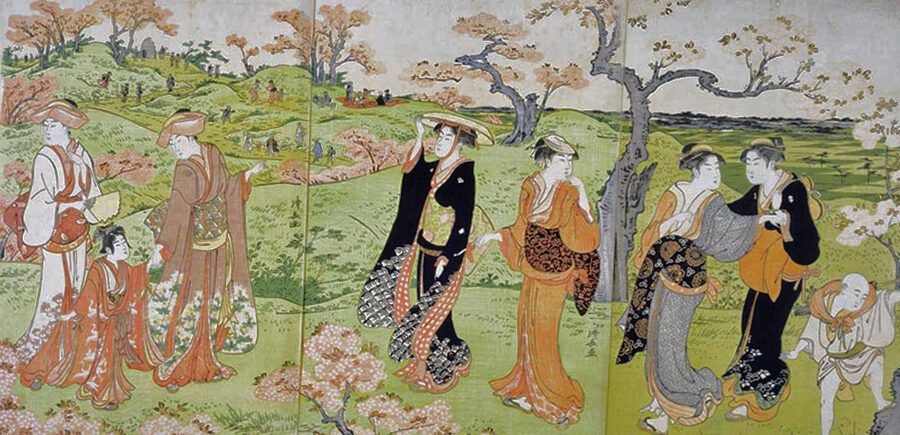
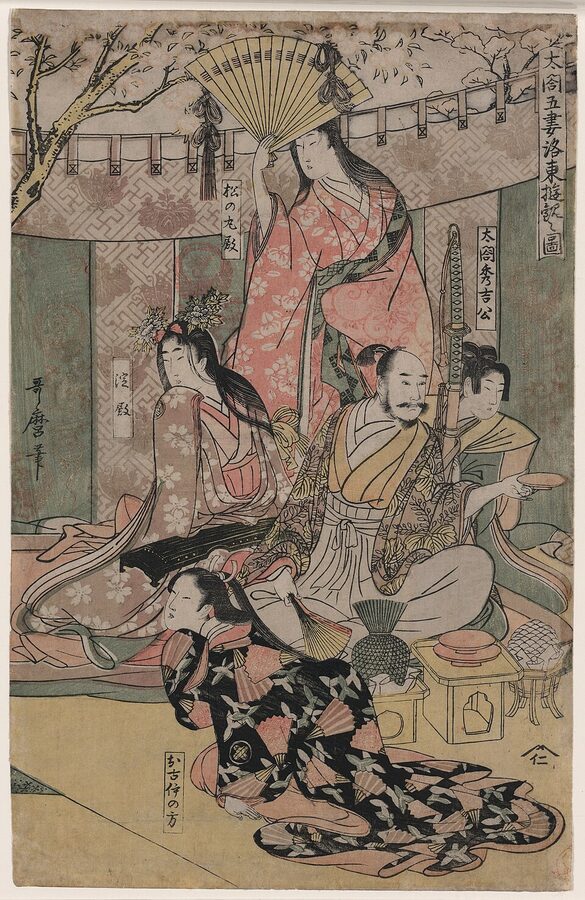
There is a Kitagawa Utamaro ukiyo-e of the scene that hangs in the Kimbell Art Museum in Fort Worth, painted around 1803. The Utamaro version is a piece of retrospective imagination, he was working 200 years after the event, and the figures in it look more like late Edo courtesans than Momoyama noblewomen, which is part of the point. By 1803 the Daigo-no-Hanami had become a cultural meme, a reference point for the maximum form of aristocratic leisure, the way a later European painter might reach for Versailles. It is one of the moments when a specific historical hanami becomes a genre.
Edo, Yoshimune, and the republic of cherry-viewing
The next shift, and it is the decisive one for what modern hanami actually looks like, happens in the 18th century under the eighth Tokugawa shogun, Yoshimune. By this point Edo was a city of a million people, the largest agglomeration in the world. The daimyō had been rotating through on sankin-kōtai for a hundred years; their compounds were full of private cherry gardens that the public could not enter. Yoshimune, whose general governance style was to direct public energy outward into carefully-planned release valves, decided to plant cherry trees at several sites outside the city centre and encourage the common population to go hold picnics there.
In 1720 he ordered cherry planted at Asukayama in what is now Kita-ku, along the Sumida River embankment at Mukōjima, and at Gotenyama overlooking the bay in Shinagawa. The trees were partly a piece of disaster-management logic — he had restarted the shogunal hawking hunts, which damaged peasant fields, and he calculated that letting hanami crowds trample through the same areas would give the farmers an offsetting seasonal income from selling food and sake. The cynical reading and the generous reading of Yoshimune-era urban planning both converge here: the man invented mass cherry-viewing as public entertainment, and he did it for a mix of reasons that included both civic pacification and the protection of agricultural income.
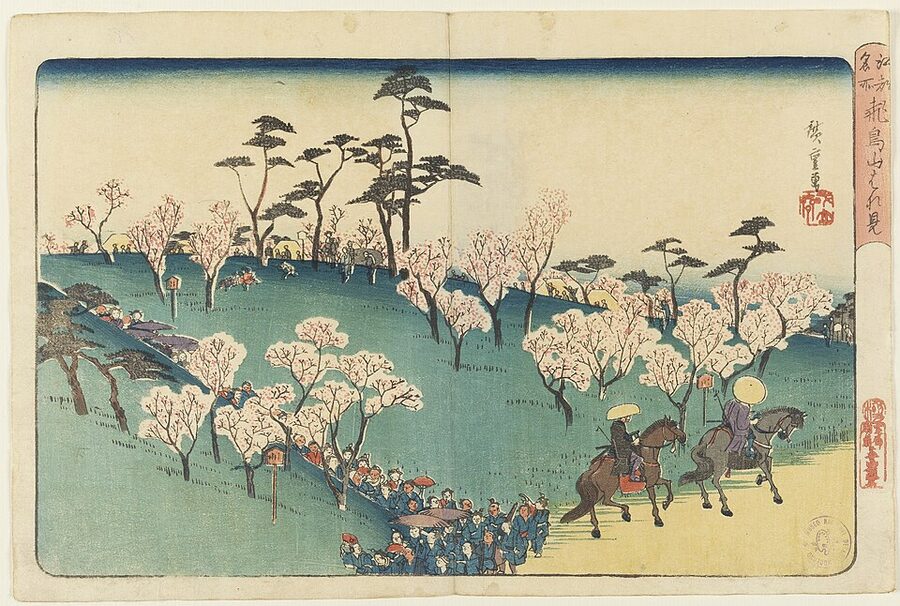
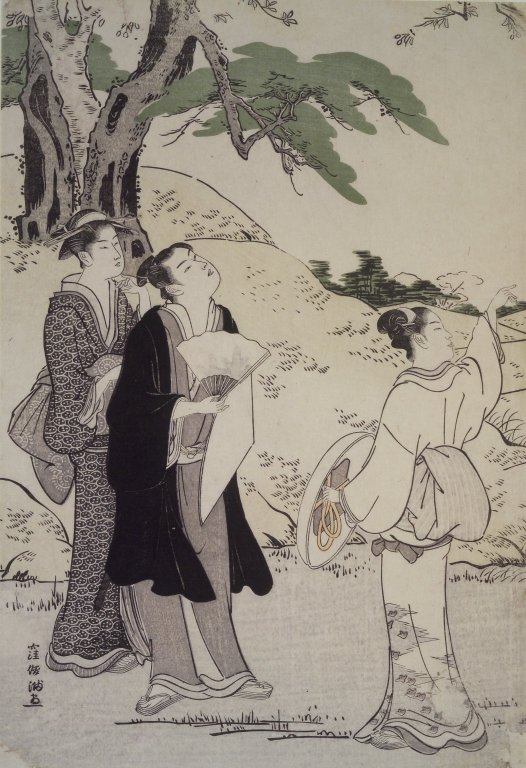
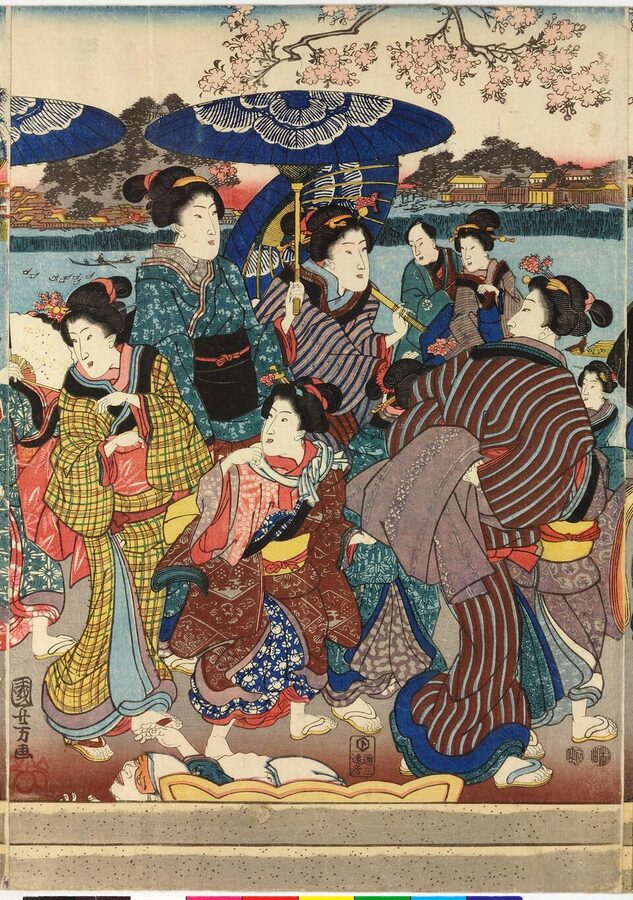
What the Edo commoners did under the new cherries was, within a generation, recognisable as modern hanami. Kenkō’s refined courtiers with their poetry had been replaced by labourers with bento boxes, young women in “flower clothes” (hana-goromo), itinerant shamisen players renting instruments at the picnic site, and improv street theatre where anyone could join. A set of rakugo bits — Nagaya no Hanami, Atamayama, Hanami no Adauchi — dates from this period and records the popular character of the event: boozy, cheerful, slightly chaotic, mostly good-natured. The line between refined hanami and vulgar hanami that Kenkō was so anxious about had, by the 1780s, been resolved in favour of the vulgar.
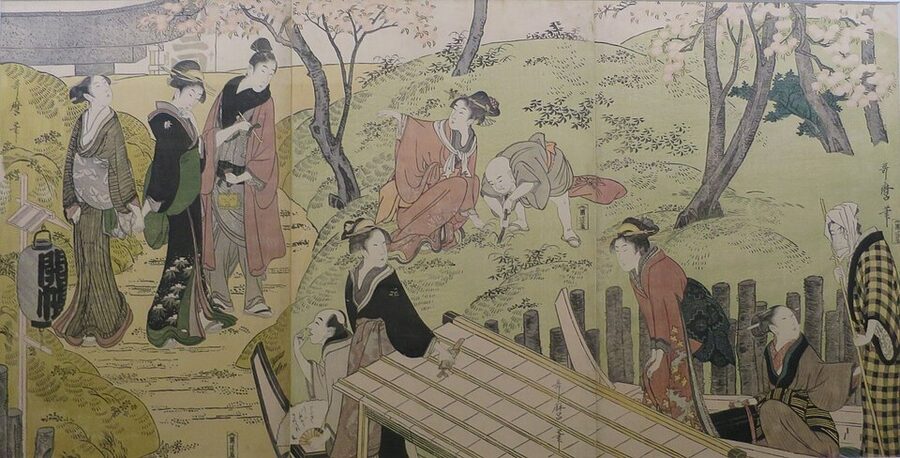
It was also in the Edo period that the proverb hana yori dango, “dumplings rather than flowers”, enters the language. The phrase teases the honesty of what most people are really doing at a cherry-viewing party: they are there for the food, and the flowers are decoration. The sweet pink-white-green hanami-dango rice dumplings on skewers that you still see at train-station kiosks in April are an Edo commoner invention, as is the sakura-mochi — the pink sweet rice cake wrapped in a pickled cherry leaf, first sold by a teahouse at the Chōmeiji temple on the Sumida bank in 1717. The daimyō on sankin-kōtai residence in Edo adopted some of this popular food culture into their own more formal hanami, and the line between classes in the city was blurrier at the picnic than at the Edo Castle audience hall.
Somei village, 1850, and the accident of a clone
The Somei (染井) of Somei-Yoshino was not a rural provincial place. It was a specialised gardening district in northern Edo — present-day Toshima-ku, in the area around Komagome and Sugamo — where a community of hereditary ueki-ya (植木屋), professional gardeners, ran commercial nurseries that supplied plants to the great daimyō residences nearby. These included the Rikugi-en garden of the Yanagisawa family, the Mito domain’s Koishikawa Kōrakuen, and a dozen other named daimyō gardens. The Somei gardeners were the Edo-era floristry industry. They grafted, they bred, and they traded named cultivars commercially.
Somewhere in that nursery bed, in the first half of the 19th century, a single seedling appeared that caught a gardener’s eye. It flowered before its leaves came out, inheriting Edo-higan’s forward habit, but the flowers were much larger and paler than ordinary Edo-higan, inheriting the Ōshima-zakura parent’s showier bloom. It grew fast, again the Ōshima line, and took graft readily.
The gardeners began selling it commercially under the name “Yoshino-zakura” (吉野桜), trading off the brand of the famous Nara mountain. The 2019 radiocarbon work at the Tree Health Research Society dated the Kaiseizan Park tree in Kōriyama, Fukushima, planted 1878, as the oldest surviving Somei-Yoshino in existence; earlier records of commercial sale go back to at least 1844 (the Sumida-tei planting by a Susaki-village nurseryman named Udagawa Magobei), with references to “Yoshino-zakura” as a commercial item in Edo nursery catalogues from the 1850s on.
The name “Yoshino-zakura” turned out to be a problem. When the botanist Fujino Yorinaga surveyed the cherries of the new Ueno Park in 1900, he realised the tree the Edo nurserymen had been selling under that name was not the yamazakura that was dominant on Yoshino-yama at all but a distinct hybrid. He renamed it “Somei-Yoshino” in the Japanese Horticultural Journal that year, honouring the nursery village of its commercial origin. The following year Matsumura Jinzō gave it the formal Linnean name Prunus yedoensis. In 1916 Ernest Henry Wilson at the Arnold Arboretum demonstrated that it was in fact a hybrid — Prunus × yedoensis — of Edo-higan and Ōshima-zakura. The 1995 DNA work of Innan et al. established the clonal reality: every Somei-Yoshino in Japan was descended by graft from a single common ancestor, propagated vegetatively across the whole country.
The Meiji propagation happened fast. Once the tree was in the Tokyo nursery stream it was ideal for the new public parks the Meiji government was creating. It grew quickly, an important consideration for a ministry that wanted visible cherry groves in ten years rather than fifty, and it flowered spectacularly from quite young.
The Meiji-era mass plantings at the Imperial Palace moat, at the new military academies, at schools and at public parks were overwhelmingly Somei-Yoshino. When Japanese emigrants and diplomatic corps gifted cherry trees abroad in this period, they were usually Somei-Yoshino by default. By 1945 — when the Edo-era daimyō gardens, many of which had held collections of the older named cultivars, had been cut down for firewood during the war — Somei-Yoshino was effectively the country’s only remaining cherry, which is the 80% figure you read in the modern literature.
The Toshima-ku gardener Takagi Magoemon is the quiet counter-figure in this story. Around 1886, as the Edo cultivar collection was being logged and dispersed, Takagi collected 84 of the named Edo cultivars into his own garden in Komagome and preserved them privately. In 1910, when the Arakawa embankment was being landscaped, he contributed cuttings of 78 of them to form a mile-long row of mixed named cultivars along the river.
The Arakawa planting became the germplasm bank from which the 20th-century recovery of the named cultivar collection was later reconstructed. Without Takagi most of the Edo-period garden cherries would have gone extinct. The man is in no way a household name and his little memorial marker in Somei is easy to miss. It is worth finding.
The 1912 Washington gift, and what Japan sent back
On 27 March 1912, Helen Taft, wife of the sitting American president, and Viscountess Chinda, wife of the Japanese ambassador, stood on the north bank of the Tidal Basin in Washington D.C. and planted the first two of 3,020 Japanese cherry trees, a gift from the mayor of Tokyo, Ozaki Yukio, to the city of Washington. The original planting was overwhelmingly Somei-Yoshino, with about 180 trees of other cultivars (Kanzan, Ichiyō, Fugenzō, Ariake, Fuku-rokuju, Gyōikō, Shirayuki, Taki-nioi, Jōnioi, Surugadai-nioi, Washino-o, Ukon, Mikuruma-gaeshi) interleaved. The two original Taft-Chinda trees are still there — they are labelled.
The gift was the second attempt. The first shipment of 2,000 trees had arrived at the Port of Seattle in January 1910, been inspected by the USDA Bureau of Entomology under the plant pathologist Flora Patterson, and been found to be heavily infested with root-knot nematodes, a fungal disease, and at least six species of scale insect. President Taft ordered the entire shipment burned.
The Japanese side absorbed the diplomatic loss with impressive grace, Ozaki’s response was that if they were going to send a gift they would send a proper one, and replacement trees were propagated specifically for the second attempt, with the Agricultural Research Institute at Kōishikawa applying the strictest phytosanitary standards then available. The 1912 shipment arrived clean.
The reciprocal gift, in 1915, was flowering dogwood — Cornus florida — from Washington to Tokyo. Fifty trees went. Most of them have died; there are a few survivors in the gardens of the Tokyo National Museum in Ueno and at the Koishikawa Botanical Garden. The symmetry of the exchange is less well-known on either side than it probably ought to be. The annual National Cherry Blossom Festival in D.C., which runs for about four weeks every March and April and draws roughly 1.5 million visitors, is now one of the largest Japan-themed public events outside of Japan; it is larger, by headcount, than any single hanami gathering in Tokyo.
Ozaki Yukio himself lived to be a hundred and retained, to the end, a sardonic view of his own contribution. Asked late in life what he thought of the Washington cherries, he is reported to have said they had done more for Japanese-American friendship than he had done in his sixty-three years as a politician. That is a claim one could argue with, given that Ozaki was the lone Japanese parliamentary voice publicly opposed to the militarisation of the 1930s. But he did not say it lightly and he said it after Pearl Harbor.
Sakura-zensen and the shortening week
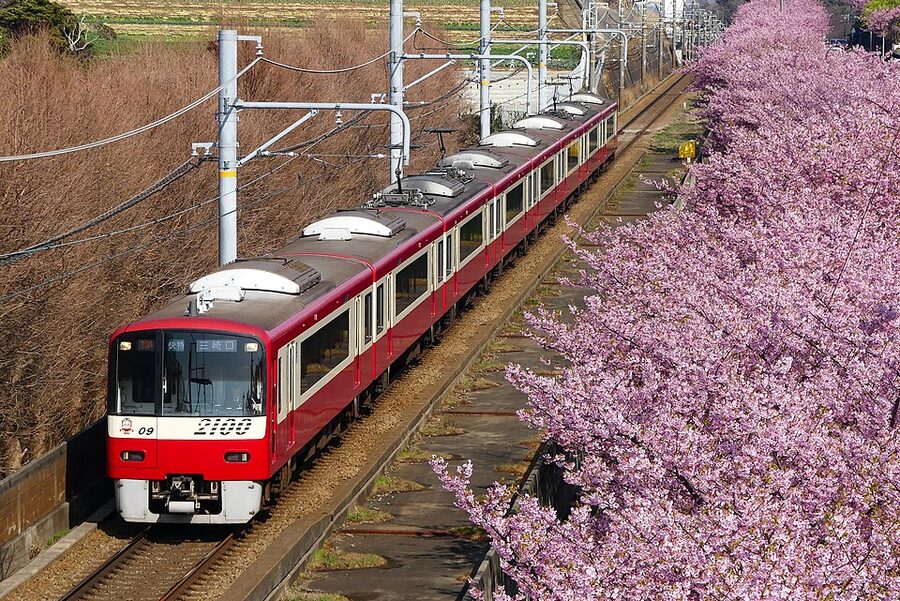
The sakura-zensen (桜前線), the “cherry-blossom front,” is a Japan Meteorological Agency product. The JMA began issuing formal flowering forecasts in 1953 — first for Tokyo only, then rolling the system out to cover the whole country by the 1960s. The mechanism rests on designated hyōhon-boku, “sample trees” — individual trees at specific JMA weather stations (58 of them nationwide in the current system) that are observed through the bud-break window by meteorologists checking every morning. Opening is declared when five or six flowers on the sample tree have opened; full bloom is declared when 80% of the buds have opened. The data are aggregated and fed into a national map that shows the contour line of opening dates — the line advances from Okinawa in late January, reaches Kyushu in late March, the Kantō in early April, and Hokkaidō in early May.
The sample trees are, with three exceptions, Somei-Yoshino. Okinawa uses Kanhi-zakura (the tropical-adapted cold-phobic species) because Somei-Yoshino will not chill-break there. Northern Hokkaidō uses Ezo-yamazakura and, further east still, Chishima-zakura, because Somei-Yoshino will not survive the climate. The national uniformity of the Somei-Yoshino reference tree, the fact that the same cultivar can be the standard from Kagoshima to Sapporo, is what makes the sakura-zensen physically possible. You cannot run a continental-scale phenological front on a wild species with regional genetic variation; you can run it on a clone.
The week-long window is a cultural pressure that is easy to underestimate unless you have lived in Japan through a cherry season. The country runs roughly thirty million domestic person-trips in the two-week national hanami peak. Hotels are booked out a year in advance in Kyoto. Flights in and out of Narita, Haneda and Kansai move at peak capacity. Offices schedule kangeikai (welcome parties) and sōbetsukai (farewell parties) around the forecast. Schools time their entrance ceremony photos to the forecast. Train stations put up announcement boards. Beer companies release seasonal pink-canned product lines that stop being manufactured on 15 April. Convenience stores stock special bento sets. The weight of the cultural apparatus around the seven-day window is extraordinary, and it is being placed on the specific phenological quirk of a single 19th-century clone.
There is some concern about the Somei-Yoshino stock that has crept into the forestry literature in the last two decades. The monoculture is, in the plant-pathology sense, exposed: every tree has the same genotype, so a pest or a fungus that can cross the Somei-Yoshino immune threshold will be able to take the whole country’s cherries at once. The tengu-su (witch’s broom) fungal infestation in particular has been spreading since the 1990s.
There are also the usual ageing-clone problems — the Somei-Yoshino individual lifespan is about 60-80 years, much shorter than wild Edo-higan, and mass plantings from the 1945-1965 reconstruction era are now entering senescence together. Mie Prefecture’s Tomoyama Park experiment of interplanting alternate cultivars — Kawazu-zakura, Yoshino-zakura, Shidare — is one of the more visible pilots for a post-monoculture succession strategy. Whether Japan will still be an 80%-Somei-Yoshino country in 2100 is genuinely an open question.
Where to see the cherries today
I have tried to organise this travel section by the quality of the site rather than the size of the crowd, and to note where the historical hanami references earlier in the article can be met on the ground. If you are planning a cherry trip to Japan for the first time, my single piece of practical advice is: pick one or two places and go hard on them rather than trying to pinball across the country. The front only moves a hundred kilometres a day and you will not beat it. Pick a base and let the flowering come to you.
Yoshino-yama, Nara — the Hideyoshi mountain
If you only go to one cherry site in Japan, this is the one I would recommend. Yoshino-yama holds about 30,000 mainly-yamazakura wild cherries on four ridges — Shimosenbon, Nakasenbon, Kamisenbon, Okusenbon — that flower in staggered sequence over about ten days from the bottom up, so the viewing window is two to three times as wide as anywhere else in the country. The character of the flowering is completely different from a Somei-Yoshino show: variegated rather than uniform, the colour ranging from white through pale pink to deep red in individual wild trees, and the leaves coming out with the flowers rather than after them. This is what Saga Emperor saw in 812 CE. This is what Hideyoshi brought his 5,000 men to in 1594.
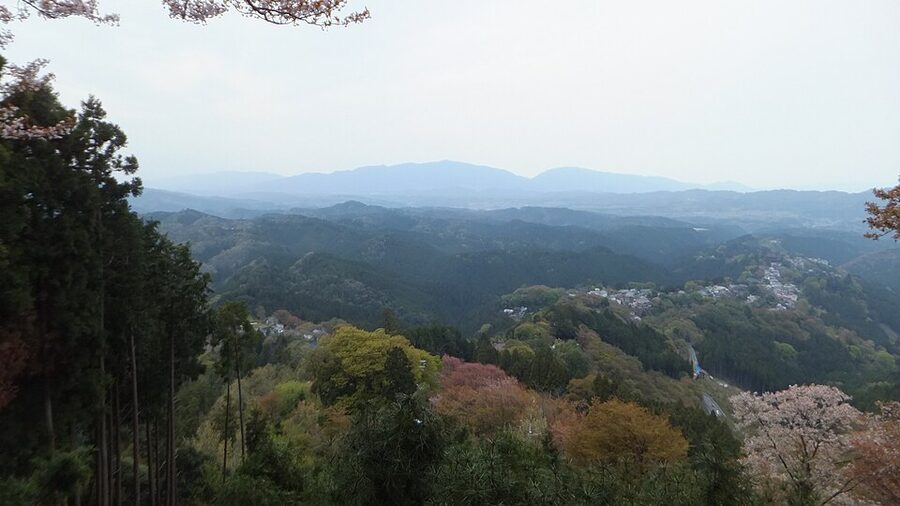
The practical logistics: Yoshino is 100 km south of Kyoto and reached via the Kintetsu Yoshino Line from Abeno-bashi in Osaka or from Kashihara-jingū-mae via a change. The station is Yoshino (not to be confused with Yoshino-guchi). A ropeway and a shuttle bus system carry you from the valley floor up to the Shimosenbon level; the Nakasenbon and upper walks are on foot.
Stay a night at one of the ryokan strung along the ridge if you can, Hōzen-ji Manko-tei is the best of the old Buddhist lodging halls, because the mountain empties out after the 5pm day-tripper buses leave and the early-morning Kamisenbon view with nobody else on the trail is the best reason to have come. Peak flowering is typically the last week of March to the first week of April at Shimosenbon and about ten days later at Okusenbon.
Hirosaki Park, Aomori — the Tohoku-scale castle cherry
Hirosaki has 2,600 cherry trees in the grounds of the castle and along the moat — mostly Somei-Yoshino, but with a significant collection of Shidare, Kanzan and Yaezakura varieties — and is the largest and best-organised cherry festival in northern Japan. The trees are old, many of them Meiji-era plantings, and the gardeners use a savage pruning regime borrowed from apple-tree care (Aomori is Japan’s apple prefecture) that leaves the trunks visibly cut-and-scarred but produces a very dense bloom. The effect in full flower is that the castle moat looks solid pink — the layer of fallen petals on the water (hanaikada, “flower rafts”) is three fingers thick.
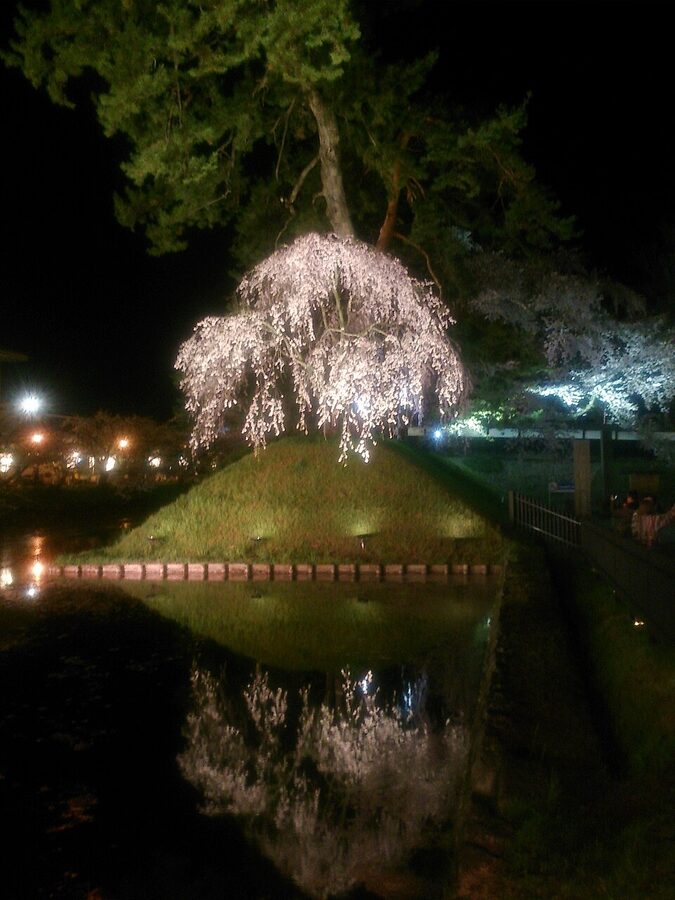
The park is a ten-minute walk north of the Hirosaki Castle donjon; the castle grounds themselves are free, the inner bailey costs 320 yen, and the night-illumination at peak bloom is one of the serious photographic events of the Japanese year. Hirosaki is a Shinkansen journey of roughly three hours from Tokyo via Shin-Aomori — expensive but straightforward. The ryokan supply is thin and books out; if you can only get a hotel in Aomori City, there is a JR local train that runs down to Hirosaki in about 50 minutes and that is a perfectly usable fallback.
Takatō Park, Nagano — the small-petal Koigan-zakura
Takatō is in the Ina Valley about two hours south of Matsumoto by car. The park is a restored castle site, not much of the fortification remains, and the cherry-specific distinction is that the Takatō trees are a regional variant, Takatō-kohigan-zakura, of the Kohigan wild species. The flowers are small, about 2 centimetres in diameter, and they are notably deeper pink than Somei-Yoshino — almost coral.
There are about 1,500 of them on the ridge, and the effect from the far side of the moat is a saturated pink lattice against the raw earth colours of the ruined earthwork embankments. The locals call this specific regional colour tenka-ichi (天下一), “number one under heaven.” It is, to my taste, the most striking single cherry colour in Japan.
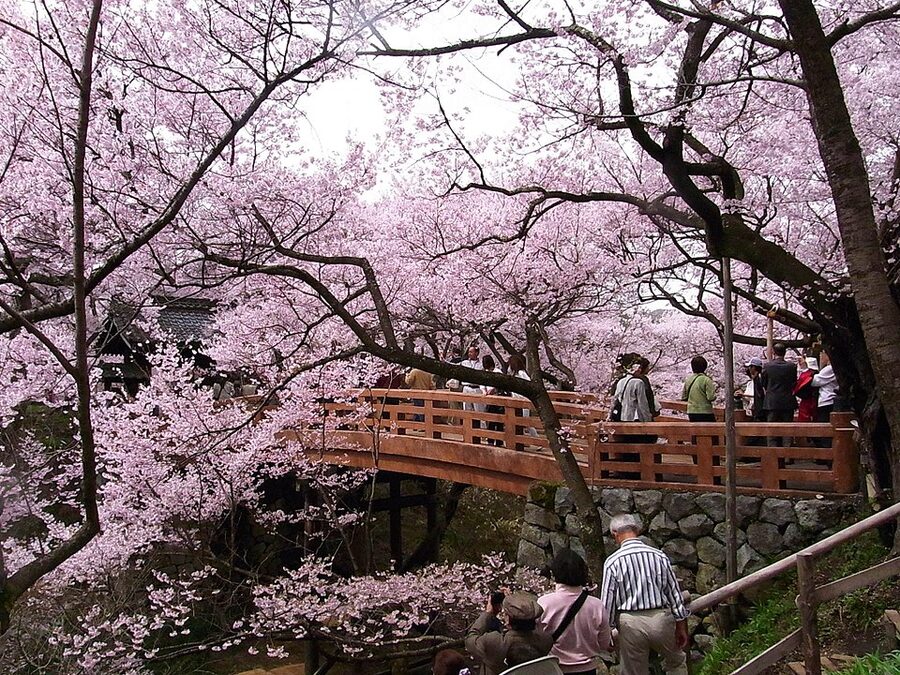
Access is awkward and this is one of the reasons the crowds, while heavy, are not Kyoto-heavy. The Iida Line JR station Inashi is nearest; a local bus takes 25 minutes to the park entrance. If you are based in Matsumoto, which I recommend anyway, the car drive down the Chūō Expressway is about two hours. Peak flowering is mid-April, usually a week after the Kantō peak. Pair with a loop through the Ina Valley soba country.
Chidorigafuchi and the Edo Castle moats
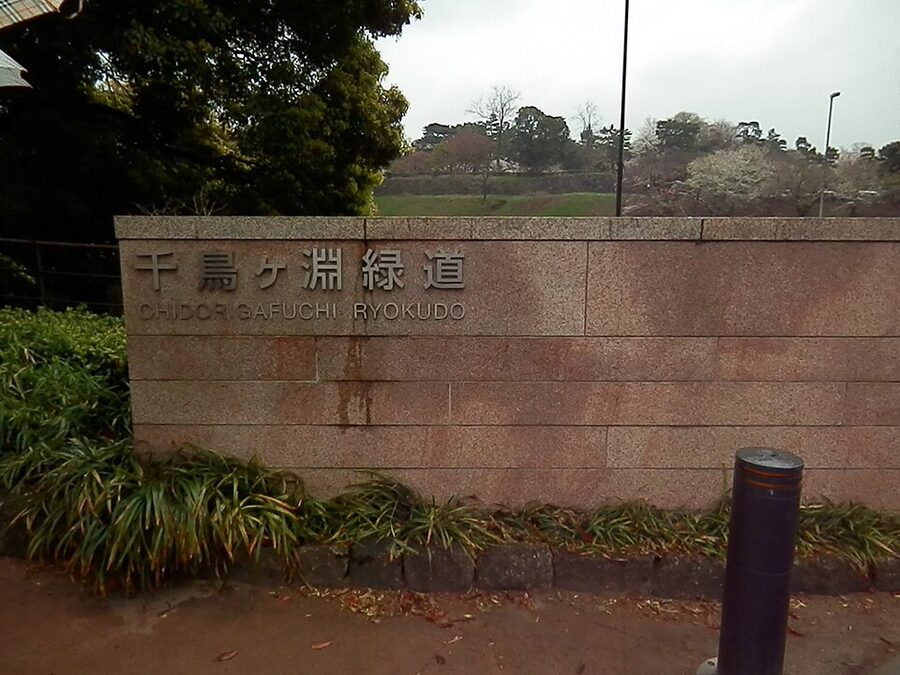
The western moat of the Edo Castle enceinte, now the Imperial Palace outer grounds, is the best central-Tokyo hanami venue, by a margin. About 260 cherries line the moat between Chidorigafuchi and Kudanshita. The trees are old Meiji plantings; the angle of the water below and the stone-faced moat walls on either side create a tunnel of blossom unique to the site. The boat rental operation at the Chidorigafuchi south entrance lets you rent a two-person rowboat for about 800 yen per half-hour and work your way along the moat under the overhanging branches — the best available way of seeing central-Tokyo hanami without a phone in front of someone’s face.
Crowds are manageable at 7am and terrible by 10am. The park is illuminated in the evenings through the peak, with about 130 lanterns hung along the promenade. Access is via Kudanshita Station (Hanzōmon, Tōzai, Shinjuku lines); exit 2 puts you at the north entrance of the moat. This is five minutes on foot from the Budokan and fifteen minutes from Yasukuni Shrine, which is also one of the JMA’s Tokyo sample-tree sites — you can go and see the actual tree whose opening triggers the national front for the city, though it is not labelled.
Meguro River, Nakameguro
The Meguro River cherry walk — four kilometres of Somei-Yoshino along both banks between Ikejiri-Ōhashi and Meguro, with 800 trees in total — is the best evening hanami in Tokyo. The rhythm of the walk is different from Chidorigafuchi: the river is narrower, the channel is lower, and the trees arch over the water from both sides to meet in the middle, creating a continuous covered gallery. The Nakameguro bridges have paper-lantern illumination in the evenings through the ten-day peak.
It is intensely crowded, tens of thousands of people along the walkway on a Saturday evening, but the linear shape of the site means you can walk upstream for twenty minutes and find yourself in a quieter stretch. Access: Nakameguro Station, Hibiya line and Tōkyū Tōyoko line; the cherries begin at the station exit.
Maruyama Park and Kyoto’s philosopher’s path
Kyoto does hanami differently. The Somei-Yoshino crowds concentrate at Maruyama Park — the city’s large commoner park east of Yasaka Shrine, where the annual centrepiece is the Gion-shidare, a famous weeping cherry about 12 metres tall that is lit after dark and draws crowds so dense that the park installs temporary traffic barriers. It is a worthwhile thing to see once. The better Kyoto hanami, for my money, is on the Philosopher’s Path (Tetsugaku-no-Michi) — the two-kilometre canal-side walk from Ginkaku-ji south toward Nanzen-ji, where 400 Kantō-transplanted Somei-Yoshino line the canal edge and the density of tourist-free temple precincts on either side lets you step off the trail at any of a dozen points into a more contemplative setting. The calendar coincides with the Gion Matsuri-related preparatory rites at Yasaka, so you can combine the two currents of the Kyoto ritual year in a single afternoon.
Daigo-ji, 2 April — the Hideyoshi re-enactment
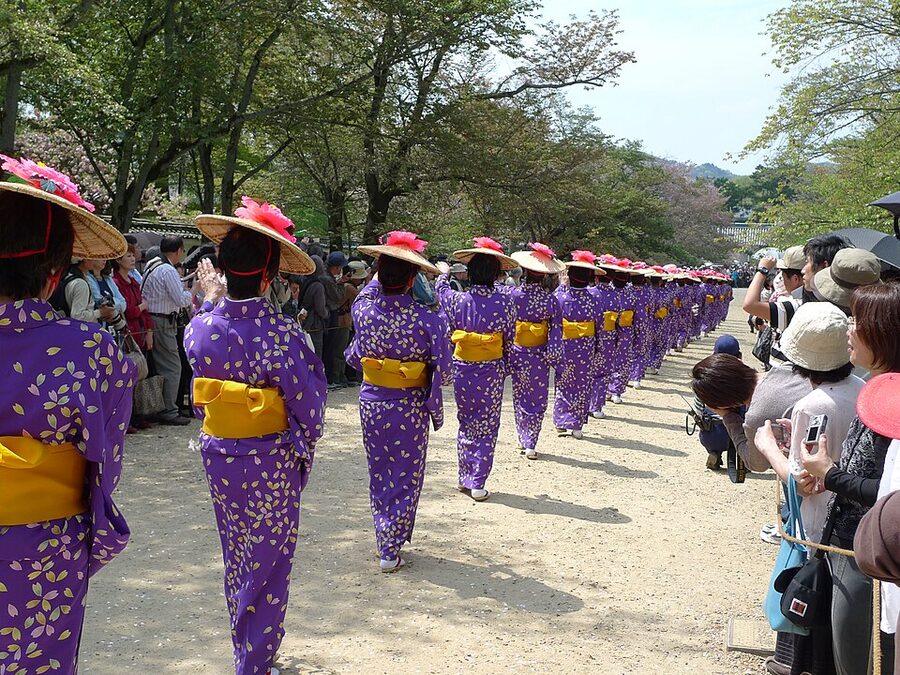
If your Kyoto dates overlap with 2 April, go to Daigo-ji. The Hōtaikō Hanami Gyōretsu (豊太閤花見行列) is the temple’s annual re-enactment of the 1598 Daigo-no-Hanami — 1,300 participants in costumed procession up the approach road from the Niō-mon to Sanbō-in, with actors playing Hideyoshi, Kita-no-Mandokoro, Yodogimi, and the ranking daimyō of the period. The procession walks at a slow ceremonial pace; the whole thing takes about two hours. For anyone interested in Momoyama material culture, the accuracy of the costume reconstruction is better than you expect — the temple has been running the event since 1955 and the research iteration has compounded.
The temple itself — Sanbō-in, the Bentendō, the Godaidō — is worth a full afternoon independent of the procession. Access: Daigo Station on the Tōzai line; 10 minutes’ walk. The temple admission is 1,500 yen on hanami days. Plan to combine with the Sanbō-in garden, which Hideyoshi designed personally in 1598 and which is a National Special Place of Scenic Beauty.
Komagome, Toshima — the Somei village marker
For readers who find the Somei-Yoshino origin story as interesting as I do, there is a small memorial stone at Somei Reien (染井霊園), the Toshima municipal cemetery at Komagome, marking the approximate site of the Edo-era nursery village. The stone says simply “染井吉野発祥之地” — “birthplace of Somei-Yoshino.” There are fifty-odd cherries in the cemetery grounds, a mix of cultivars, including several Somei-Yoshino that the Toshima gardeners planted in the 1980s as living memorials.
It is a cemetery with working grave visits; behave accordingly. Access: Komagome Station, Yamanote Line, four minutes on foot. Nobody else will be there.
Washington D.C., Tidal Basin — the 1912 gift
Not Japan, but the terminus of one of the threads in this article. The 2-mile walk around the Tidal Basin under the 3,020-odd Somei-Yoshino descendants of the Ozaki 1912 shipment is the largest single stand of Japanese-cultivar cherries outside of the country. The National Park Service marks the two original Taft-Chinda trees; they are on the north bank near 17th Street NW.
The peak bloom date moves between late March and early April and is extensively forecast by the NPS phenology unit. If you are an American reader with plans to go to Japan for hanami, going to the Tidal Basin first is useful calibration — you will see the rhythm of Somei-Yoshino flowering (eight days of peak, one week of falling petals) in advance of the Japanese trip and will understand what the forecast is forecasting.
Other places worth the detour
A short compressed list of venues that did not make their own H3 section but are worth noting. Himeji Castle has about 1,000 cherries on the main enclosure grounds, flowering with the castle keep’s white plaster walls behind them — the contrast is exactly what the castle was built for aesthetically, and it is one of the more photographed views in western Japan. Matsumoto Castle has a smaller stand but the black keep walls make the cherries read differently again.
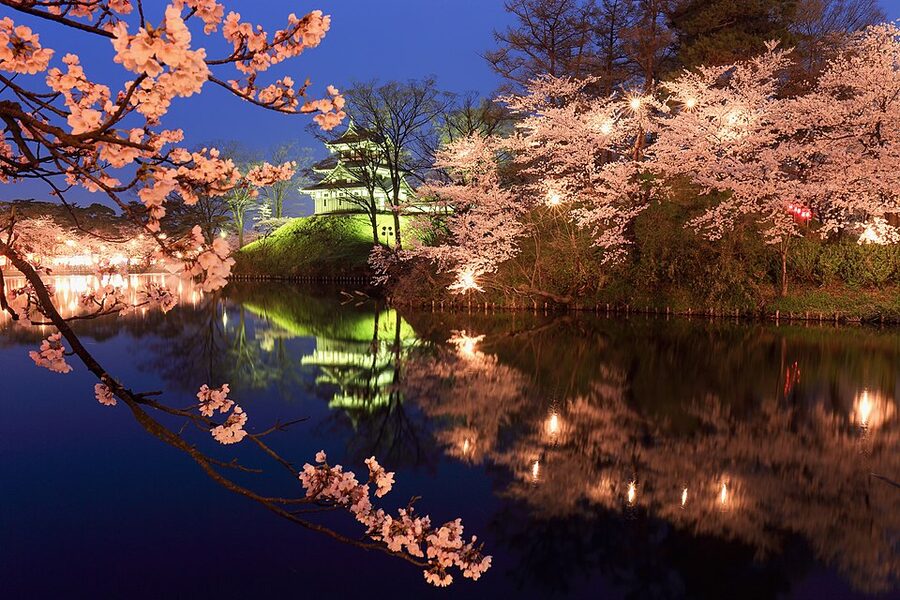
Kumamoto Castle is mid-reconstruction but the Sakura-no-Baba approach road is named for its row of cherries and was Katō Kiyomasa’s design. Inuyama Castle has a river-front cherry promenade along the Kiso. Takada Castle Park in Jōetsu, Niigata — about 4,000 cherries with night illumination — is the third of Japan’s “Big Three” night cherry venues along with Hirosaki and Ueno.
Heian-jingū in Kyoto holds a collection of Shidare-zakura in its southern garden that are staggered a week later than the city-centre Somei-Yoshino bloom and are a useful contingency venue if you have arrived in Kyoto just after the peak.
A note on what you are looking at
I said at the top that I find the clonal reality of Somei-Yoshino easier to say than to fully believe, and I have not changed my mind in the course of writing this. The instinct on seeing the two-kilometre gallery of identical trees at Chidorigafuchi is that you are looking at a wild phenomenon, something the country simply has, rather than a 19th-century horticultural artefact whose every twig is downstream of one man’s grafting knife.
The proportion of Japanese spring that has been engineered by a small number of specific gardeners over a specific 180-year window, and then deployed nationally by a specific set of Meiji-era state apparatuses, is much higher than the rhetoric of “ancient Japanese tradition” around hanami tends to admit. The flower is old. The particular tree is very new.
The old forms do persist. Yoshino’s yamazakura are the same wild species the Heian emperors wrote about, and the 1,200-year Kyoto phenological record runs in an unbroken line from 812 CE. The tea ceremony in its current Urasenke-Omotesenke form grew up alongside hanami over the same thousand-year span. The chisen-style Japanese gardens where the Heian court first held their flower-banquets are still built, and the current crop of temple-garden designers still plant cherries on the far bank of the pond because that is the correct place to put them. The continuity is real; I am not arguing against it.
But when you stand under the cherry trees on a Tokyo weekend afternoon, what you are actually looking at is an object that was invented, marketed, and propagated in the 19th century by a group of Edo-period commercial gardeners whose names are not household words — Takagi Magoemon, Udagawa Magobei, the anonymous Somei apprentices who grafted the first 500 examples — and distributed across the archipelago as a coordinated national programme by a Meiji state that wanted visible symbols of modern Japaneseness. It is an astonishingly successful piece of applied botany. It is also, on any honest reading, more like the Eiffel Tower than like Mount Fuji: an object of national affection whose specific current form is a choice someone made. Once you have seen it that way you cannot entirely unsee it.
The way to meet all three of these layers — the Heian layer, the Edo layer, the Meiji-clonal layer — in the same trip is to go to Yoshino for the yamazakura, then to Daigo-ji on 2 April for the Momoyama re-enactment, then to Chidorigafuchi or Ueno for the Meiji state plantings. A five-day itinerary timed to any of the middle weeks of April will catch all three. Book the Yoshino ryokan early, skip the Kyoto centre hotels (overpriced and full), and do not try to add more than those three venues.
The flowers will be finished before you are, which is, on the thousand-year view of this flower, the entire point of the exercise, and the bit that Saga’s courtiers and Kenkō’s provincial rustics and Hideyoshi’s retainers and Yoshimune’s labourers and the Meiji nurserymen and the Washington Park Service rangers and every one of the Somei gardeners whose names we do not know have all agreed on. The eighty per cent clone does not change the honesty of that agreement. It only changes the means.
The seven-day window still turns. You turn with it, or you miss your year’s flower. Go and find the hackberries under the blossom. Do not linger past when they fall.


.jpg)


_(BM_2008,3037.20315).jpg)


