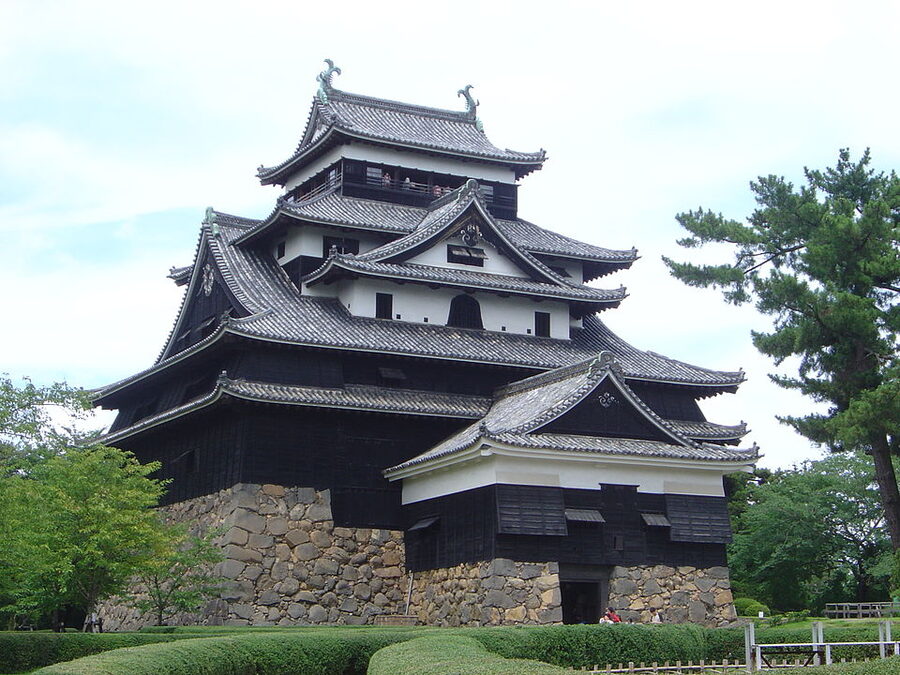
In 1875, a local Matsue man named Takagi Gonpachi walked into a Meiji government property auction and paid 180 yen for a castle. It was roughly two weeks’ wages for a middling clerk at the time, and the only condition attached was that he would not tear down the tenshu. He did not. That single decision, combined with a matching donation from a wealthy Izumo farmer named Katsube Motouemon, is the reason you can still stand inside the black-planked keep above Lake Shinji today and climb a staircase so steep you instinctively grab the handrail with both hands.
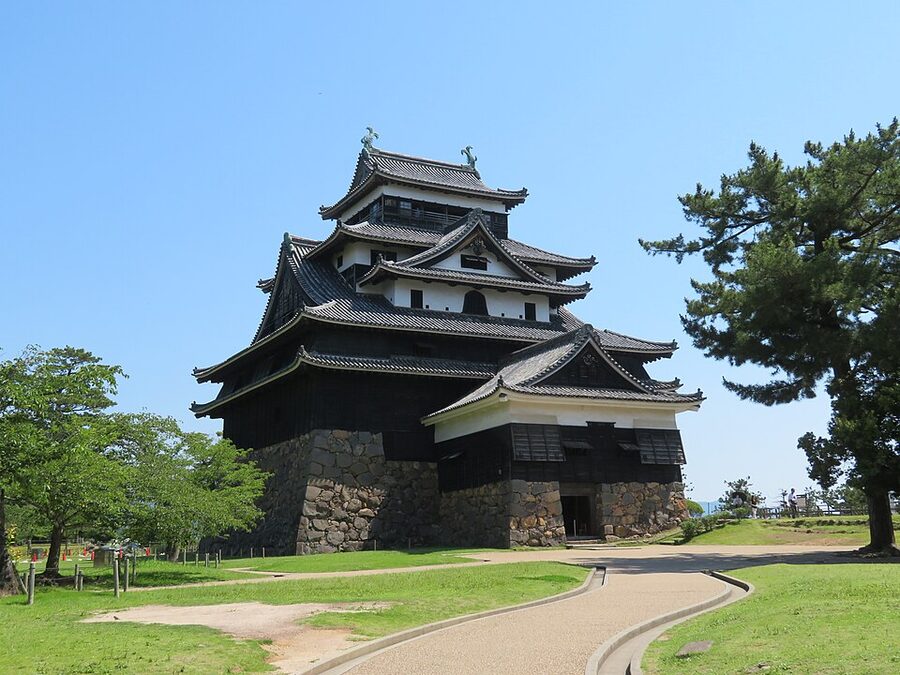
I went to Matsue expecting a quieter version of Himeji. What I found was the opposite of Himeji in almost every way that matters. The tenshu is black instead of white. The town is small instead of sprawling.
The approach is walking distance from the train station instead of a tourist cavalry charge. The story of how it survived the Meiji demolition wave is far stranger than anything you will read on the panels at most castles.
This is the complete story of the castle they call Chidori-jō, the Plover Castle, for the bird-shaped gables stacked up its black flanks. It is the story of a Sekigahara veteran who built it, a Tokugawa grandson who kept it, a foreign writer who mythologised it, and a farmer and a former retainer who saved it for 180 yen. I will take you through the construction, the architecture, the near-demolition, the belated 2015 elevation to National Treasure status, and what you should actually do if you spend a day there yourself.
In This Article
- The founder: Horio Yoshiharu and the 240,000-koku reward
- Construction, 1607 to 1611
- Why they call it Chidori-jō, the Plover Castle
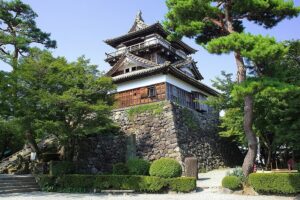
- The architecture: five storeys, six levels, and the black-plank cladding
- The Horio line runs out, 1633
- The Matsudaira arrive, 1638 to 1871
- The Meiji demolition wave and the 180-yen rescue
- National Treasure, finally, in 2015
- Lafcadio Hearn and the Matsue myth
- The Horikawa moat boat tour
- Shiominawate and the samurai residence street
- Lake Shinji, the castle’s front garden
- Matsue in context: how it ranks against the other eleven originals
- How to get to Matsue and plan a day
- Practical notes on visiting the keep
- Closing thoughts: why Matsue matters
The founder: Horio Yoshiharu and the 240,000-koku reward
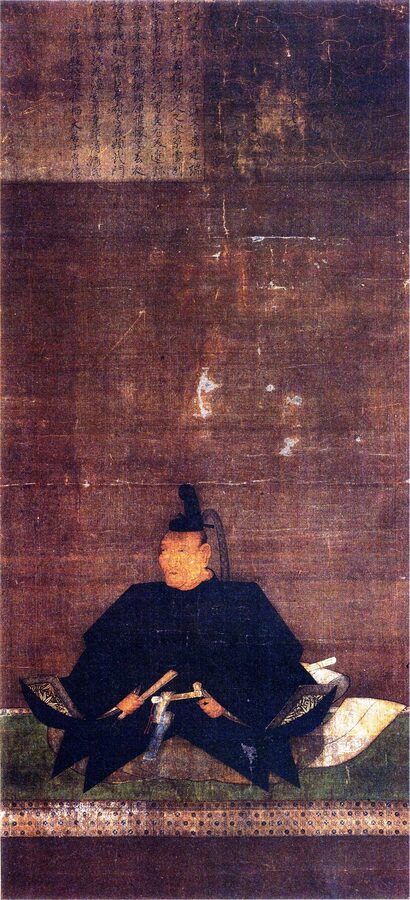
Horio Yoshiharu was born in 1542 in what is now Aichi Prefecture, the same cradle that produced his first employer Oda Nobunaga and most of the men who eventually ruled Japan. He was a Toyotomi loyalist for most of his career. He served at the Siege of Inabayama in 1567, at the Battle of Shizugatake in 1583, at the Kyushu campaign in 1587, and at the Siege of Odawara in 1590, which is where he earned his first proper domain of 120,000 koku at Hamamatsu.
The pivot point for Matsue Castle was the Battle of Sekigahara in 1600. Yoshiharu did not actually fight in the battle himself because he had injured himself killing a disloyal retainer named Kaganoi Shigemochi at Chiryū a few weeks earlier. His son Tadauji fought on the Tokugawa right wing in his place, and that service was enough. When the domains were redistributed after the battle, Tokugawa Ieyasu gave the Horio family a massive upgrade to 240,000 koku of Izumo Province.
The Horio arrived at an existing fortress, Gassan-Toda, which sat on top of a mountain about 30 kilometres inland. It was a classic medieval yamajiro, hard to attack and hard to live in. Yoshiharu decided it was also hard to administer a 240,000-koku agricultural and shipping economy from a peak that took two hours to climb.
His solution was to move the whole political centre of the province onto the lakeshore. He picked a low hill called Kameda-yama, wedged between Lake Shinji to the west and Lake Nakaumi to the east, with river access to the Sea of Japan. From this hill a daimyō could see every boat moving on the rice-transport routes. He could also tax them.
Construction, 1607 to 1611
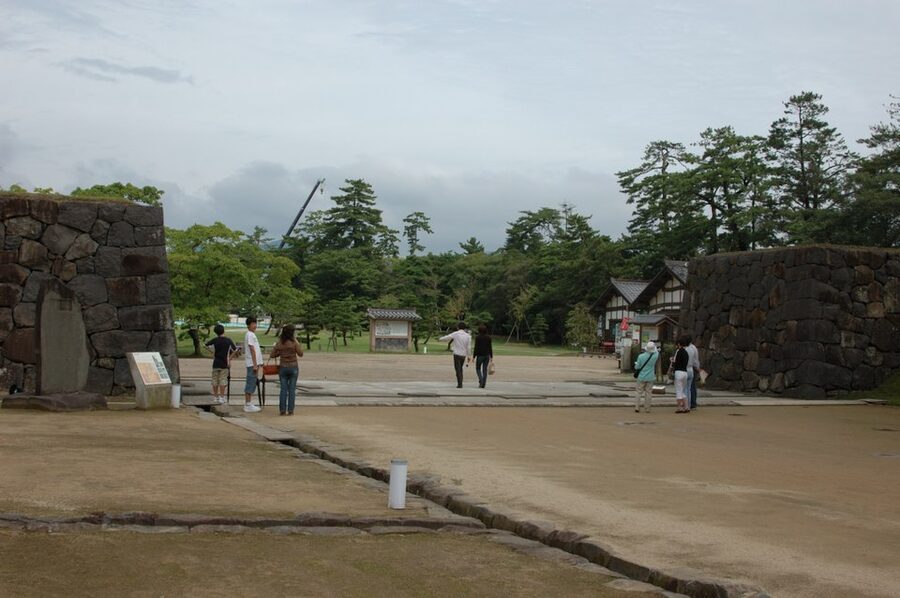
Construction started in 1607 and took four years. That is fast by the standards of a five-storey keep on a greenfield site. Himeji took eight years for its main expansion, and Kumamoto Castle took seven under Katō Kiyomasa. Yoshiharu was already 65 when work began, and I suspect the timeline reflected his own mortality as much as the skill of his engineers.
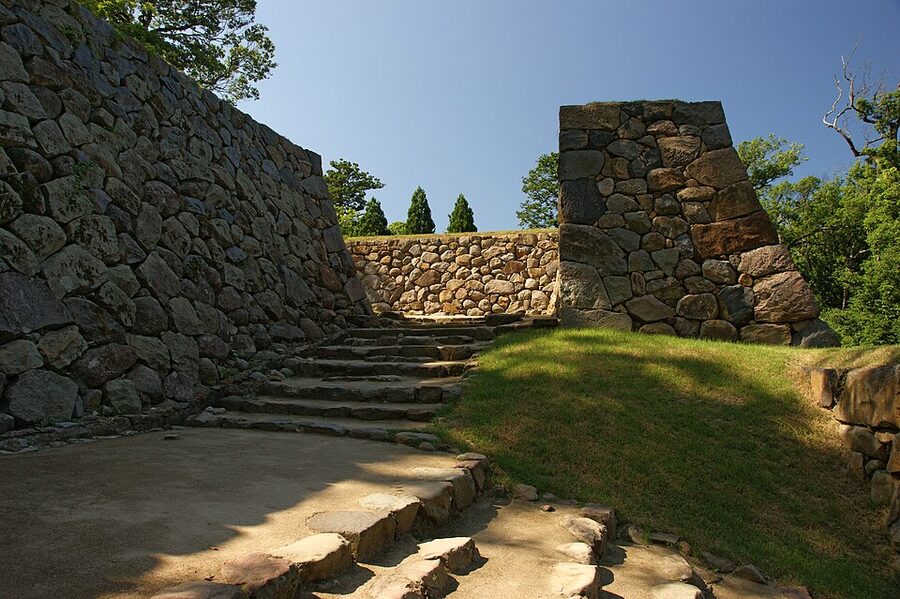
The material used for the ishigaki, the stepped stone base, is a local chert from the nearby mountains. You can see it up close if you walk the outer loop of the Ninomaru, and you can still see the stonecutters’ marks on the bigger blocks. The style is nozurazumi, the irregular wild-fit method, which is an older and more earthquake-resistant technique than the neat cut-stone look you see at later Edo-period sites.
The superstructure is timber. Pine columns, cedar wall panels, cypress roof beams, and the iconic black exterior planks. The black is not paint.
It is lacquer applied to thin pine boards that were then nailed directly onto the outer walls, with the nail heads hidden under a second layer of plank. The lacquer had to be reapplied every 15 to 20 years, which was expensive, which is why most plank-walled castles were eventually converted to white plaster.
Yoshiharu never saw the castle finished in any real sense. Construction completed in 1611, and he died in July of that same year at 68. The formal completion ceremony was held by his grandson Horio Tadaharu, who had technically been head of the clan since Yoshiharu’s son Tadauji died young in 1604.
For the old man, the move from Gassan-Toda to Matsue was his final career act. A proof-of-work monument to a man who had made the right bet at Sekigahara.
Why they call it Chidori-jō, the Plover Castle
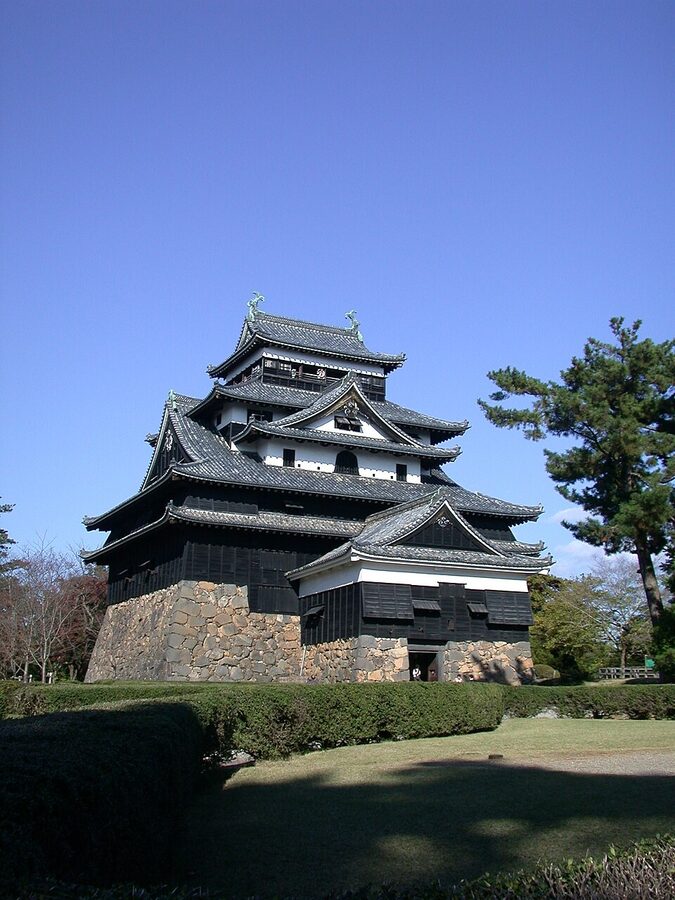
The formal name of the castle is Matsue-jō. The nickname every local uses is Chidori-jō, the Plover Castle. The word chidori refers to the chidori-hafu, the small triangular dormer gables that break up the roofline at multiple levels. Matsue has them stacked in pairs down the south face, and the local convention was that the silhouette resembled a flock of plovers in flight.
A note on that: the current keep has fewer decorative gables than it did when Yoshiharu built it. A major restoration between 1738 and 1743 under the Matsudaira simplified several of the upper-storey dormers, probably because the original carpentry had started to rot and replacement was cheaper than repair. This is one of the stranger continuities of the castle. The nickname predates the current roofline.
The other nickname you occasionally hear is Unagi-jō, the Eel Castle, which is probably a joke about the black colour. I have only ever heard it from one Matsue taxi driver, who may have been pulling my leg.
The architecture: five storeys, six levels, and the black-plank cladding
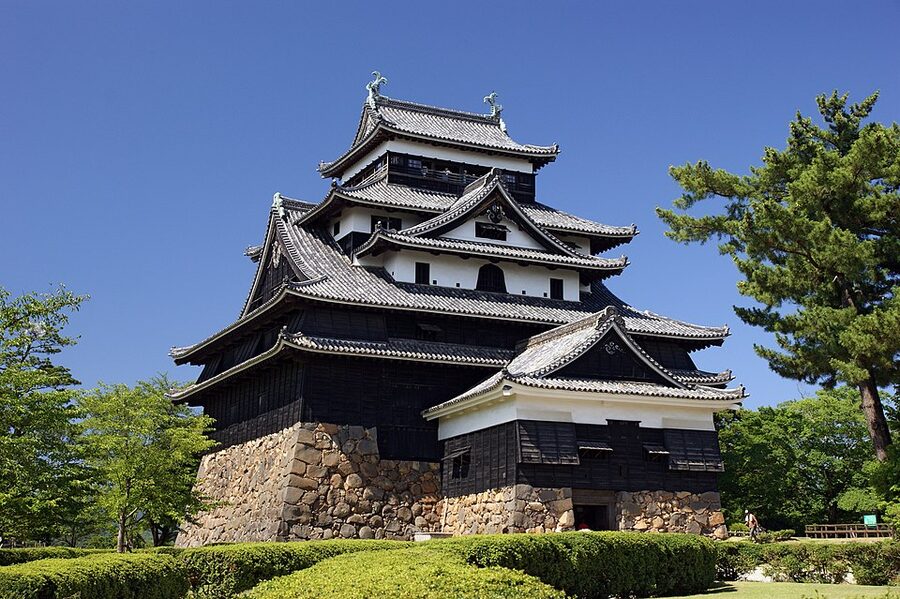
The tenshu is officially five storeys from the outside and six levels from the inside. The discrepancy is because one floor is hidden under the roofline to function as a defensive mezzanine. The keep is 30 metres tall from the top of the ishigaki to the shachihoko ornaments at the ridge, which makes it the third-tallest original tenshu in Japan. It is also the second-largest by floor area at the base.
The footprint at the base is roughly 12 ken east-to-west by 10 ken north-to-south, or about 22 metres by 18. The walls are timber-framed with an outer cladding of shiplap pine planks, and the whole surface is coated in black lacquer. There is no plaster at all on the exterior. It is a fortress built as if it were a large piece of furniture.
Defensively, the tenshu has eight ishi-otoshi, the stone-dropping ports that let a garrison dump rocks and boiling liquids onto attackers who had made it to the base. Most are on the second-storey overhang. There are also mawari-engawa, wrap-around wooden balconies on the upper storeys, which would have let defenders shoot down along the outer walls.
I always find these theatrical. By the time Matsue was finished the Tokugawa peace had begun and the last real castle siege in Japanese history was thirty years in the future.
The interior staircase deserves its own paragraph because it is the thing most visitors talk about afterwards. The treads are genuinely steep, the rises are genuinely tall, and the whole thing is polished wood that has been walked on for four centuries. It is not dangerous but it is slow going if you do not have confident knees.
There is a small lift for mobility-access visitors at the rear of the keep, but it only goes to the first internal level. Everything above is the staircase. The top storey has windows on all four sides and a view that on a clear day runs from Lake Shinji to the Nakaumi brackish lagoon, which gives you a proper sense of why Yoshiharu chose this hill.
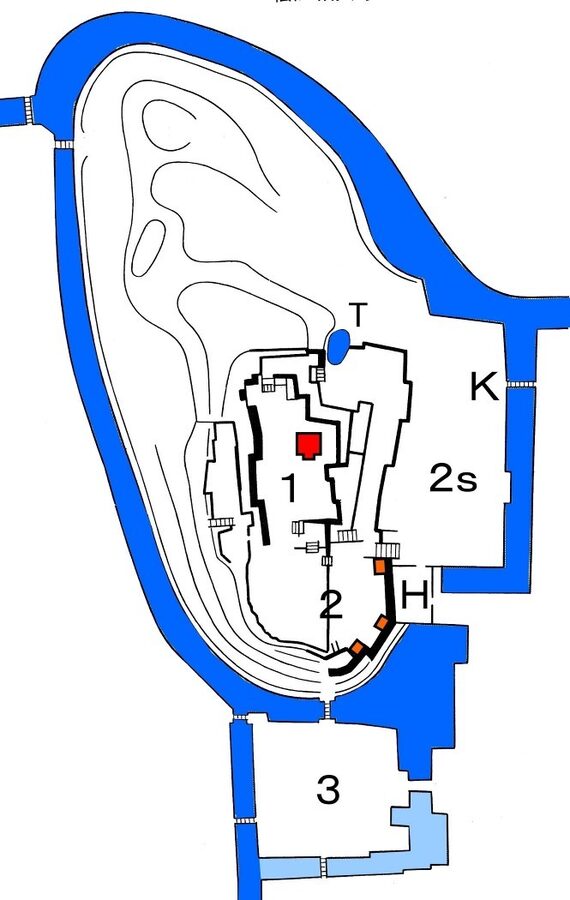
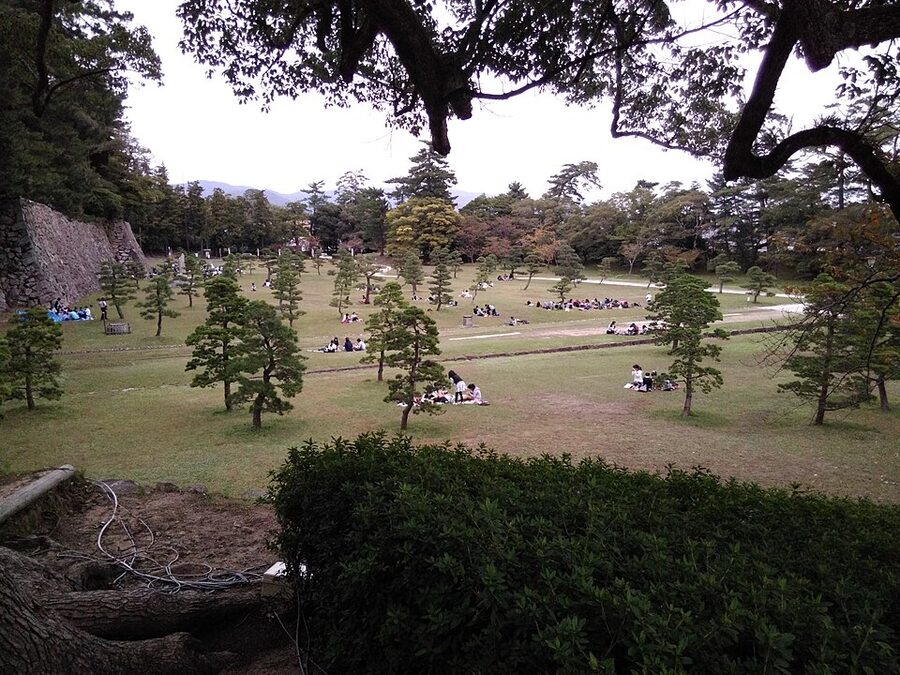
The overall layout is a standard concentric plan. The honmaru sits on the hilltop with the tenshu at its north-west corner. The ninomaru sits one level down on the south and east, with the former residential palace buildings that have since been demolished. The sannomaru was further down again, and that is now the prefectural office grounds.
The inner moat runs around the base of the honmaru hill. It is fed from Lake Shinji via small canals and holds water year-round. The outer moat, the Horikawa, is the one that the tour boats run on, and it still traces most of its original Edo-period course through the old samurai districts.
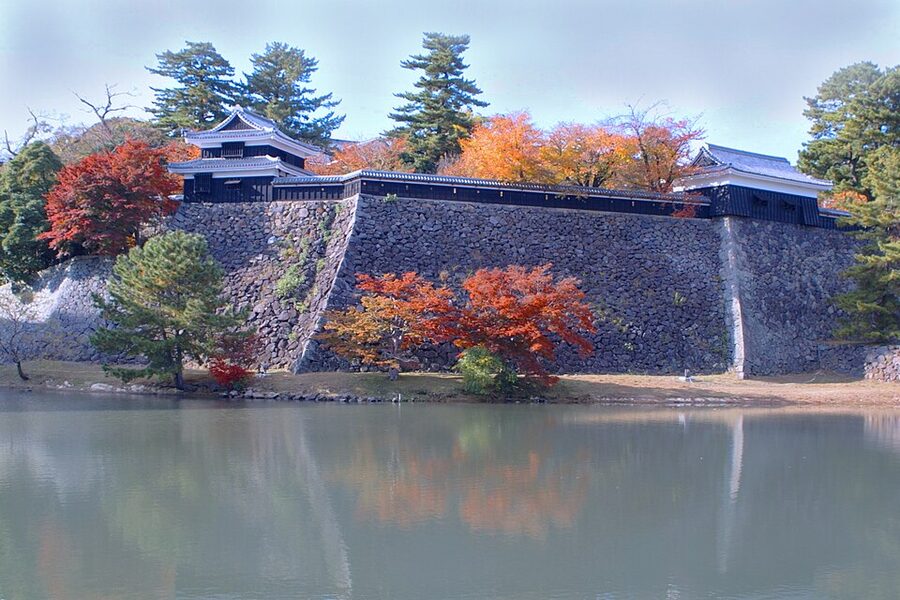
Three of the turrets you see today are 2001 reconstructions. The Taiko-yagura (drum tower), Naka-yagura (middle tower), and the connecting wall were rebuilt using traditional joinery by a team that studied the period timber manuals carefully. I cannot tell them apart from the original keep without reading the panels, which is a compliment.
The Horio line runs out, 1633
Horio Yoshiharu’s grandson Tadaharu was the second daimyō of Matsue. He ruled for 22 years after the old man’s death. And then, in 1633, he died without a male heir. The Tokugawa shogunate took the domain back in a procedure called kaieki, the confiscation of a daimyō family that has failed to produce a succession.
You can rank it alongside the fate of the Katō of Kumamoto, who were dispossessed under slightly more political pretences a year later. The shogunate of the early 1630s was ruthless about domain reassignment. The Horio had given the Tokugawa a loyal Sekigahara vote, built an expensive castle, and organised a working province. That was not enough when the bloodline failed.
The intermediate lord was Kyōgoku Tadataka, installed in 1634 and dead by 1637. The Kyōgoku were another old warrior family with thin male lines, and Tadataka left no male heir of his own. The shogunate took the domain back again four years later.
Izumo Province had now lost two sets of lords in less than a decade. The Tokugawa decided to plant one of their own.
The Matsudaira arrive, 1638 to 1871
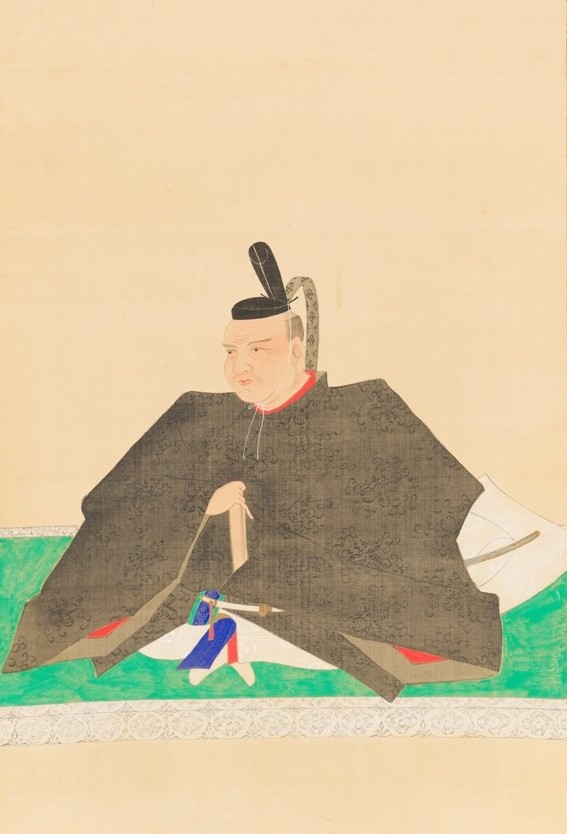
Matsudaira Naomasa moved into Matsue in 1638 on the orders of the third shogun Tokugawa Iemitsu. He came from the Matsumoto domain with a revised koku rating for Izumo of 186,000, which was smaller than the original Horio grant but more realistic given the actual taxable output of the province.
The logic of the posting was typical Edo politics. The Matsudaira of Echizen were a cadet branch of the Tokugawa, close enough by blood to count as reliable shimpan (related-house) daimyō, but far enough from the succession to pose no threat. Planting them in the San’in region locked down a strategically important stretch of the Sea of Japan coast without strengthening any potentially rival lineage.
Naomasa was a competent administrator in the standard early-Edo mould. He reorganised the domain finances, encouraged the tea ceremony and the local Fumai school, and commissioned the first serious maintenance cycle on the tenshu. He also founded Gesshōji temple as the Matsudaira family mausoleum, although the site had been a temple before his arrival.
The Matsudaira held Matsue for ten generations, from 1638 all the way to the abolition of the han system in 1871. Matsudaira Sadayasu was the last daimyō and surrendered the domain to the Meiji government peacefully. Most of what a visitor thinks of today as the character of Matsue, the tea culture, the unadorned wagashi sweets, the garden-loving samurai residential district of Shiominawate, is Matsudaira-era inheritance.
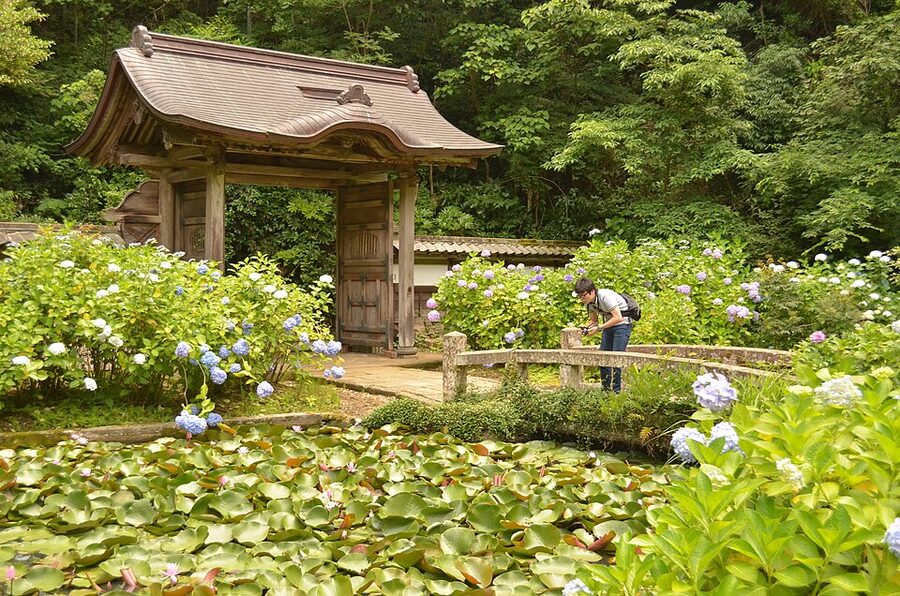
Gesshōji is worth a visit even if you do not care about the Matsudaira. The moss gardens are older than the clan itself and were maintained by a succession of specialist Rinzai Zen monks commissioned specifically for the task. Nine consecutive lords are buried in individual gated mausoleum-courts behind the main hall. The tenth, Sadayasu, died after the 1871 abolition and is buried elsewhere.
The Meiji demolition wave and the 180-yen rescue
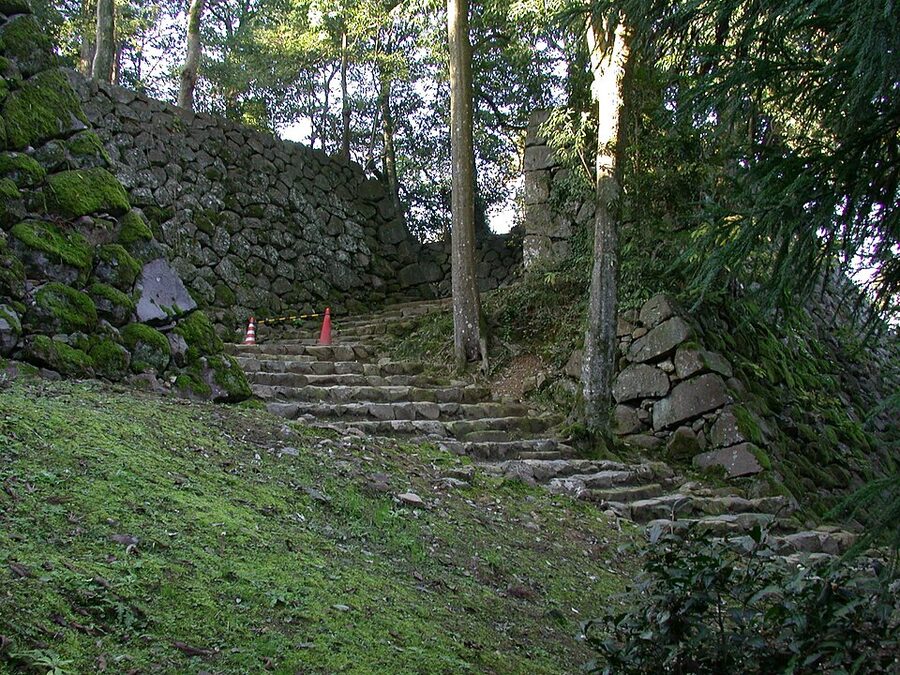
The Meiji Restoration of 1868 ended the han system and stripped the samurai class of its reason to exist. The 1871 abolition of the domains turned the old daimyō castles into surplus government property. In 1873 the new national government issued the Haijō Rei, the Castle Abolition Order, which declared roughly 150 castles across Japan to be obsolete military sites scheduled for demolition and sale.
Matsue was on the demolition list. The auction of the buildings was held in 1875. The honmaru palace went first and was torn down for timber salvage.
The outer turrets went next. The tenshu itself was advertised at 180 yen for the timber value alone.
A former Matsue samurai named Takagi Gonpachi put up the 180 yen. A wealthy farmer from Izumo named Katsube Motouemon put up a matching amount. Together they paid the government for the right to leave the building standing.
The deal was formally styled as a purchase but in practice it was a protection payment. It saved one of the most architecturally important buildings in the country.
I have tried to find out more about Takagi. The sources are thin. He was a mid-ranking ex-retainer of the Matsudaira, he had enough liquid savings in 1875 to cover the equivalent of a couple of months of middle-class income, and he apparently considered the castle important enough to spend it.
Katsube is a slightly better-documented figure, a wealthy landowner whose descendants still live in the area. Neither of them was a Meiji-era celebrity. They were two locals who noticed that the country was about to lose something they valued and put their own cash on the line.
It is worth remembering how close the loss call was across the country. Of the 150 castles on the Meiji demolition list, only 12 original tenshu survived. The others were either torn down immediately, lost to the Second World War (Hiroshima, Nagoya, Okayama, Fukuyama), or lost to later fires and earthquakes. The twelve survivors are Hirosaki, Matsumoto, Maruoka, Inuyama, Matsue, Bitchu-Matsuyama, Himeji, Hikone, Marugame, Uwajima, Matsuyama, and Kōchi.
Every one of those twelve has a near-loss story of its own. Hirosaki had its keep literally moved by hand onto new foundations. Maruoka was flattened by a 1948 earthquake and rebuilt from its salvaged components.
Hikone was saved only because the Meiji emperor personally intervened during an 1878 inspection. Matsue’s version is more democratic and more obscure. Two private citizens found 360 yen and an act of will.
National Treasure, finally, in 2015
Matsue Castle was classified as an Important Cultural Property in 1950 and 1955 through two separate designations, but it was not elevated to National Treasure status until 8 July 2015. That made it the fifth and most recent of the twelve original tenshu to receive the classification, after Himeji (1951), Matsumoto (1952), Inuyama (1952), and Hikone (1952). For sixty-three years Matsue was the odd one out.
The reason it took so long is documentary. To qualify for National Treasure status, the Agency for Cultural Affairs required cast-iron evidence that the keep was a genuine Keichō-era construction rather than a later rebuild. The other four keeps had survived with their original inscribed beams or construction documents intact. Matsue’s own paperwork had gone missing during the Horio-to-Matsudaira transition in the 1630s.
The missing piece turned up in 2012. During a routine survey of Matsue Jinja, a small shrine on the castle grounds, researchers found a wooden prayer tablet inscribed “Keichō 16, first month, auspicious day.” Keichō 16 is 1611 in the Western calendar. First month is January. This was the votive board dedicated at the moment the keep was consecrated, hidden under the eaves of the shrine for four centuries, and precisely the legal proof that had been missing.
The find was announced formally in 2013. The National Treasure promotion followed two years later. There is a small exhibit of the tablet itself on the ground floor of the tenshu, which is worth a careful look before you climb.
Lafcadio Hearn and the Matsue myth
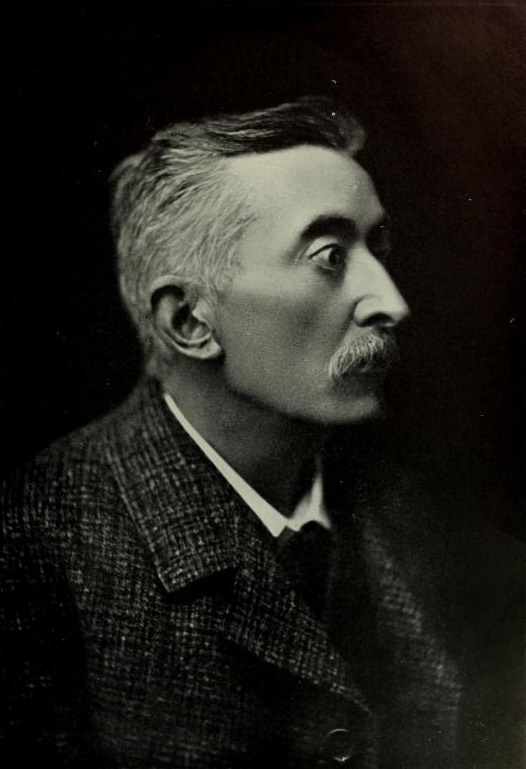
Lafcadio Hearn landed in Matsue on 30 August 1890 with a teaching contract at the Shimane Prefectural Common Middle School and the attached Normal School. He had been in Japan less than six months, had no Japanese language, and had been placed in a Sea of Japan port town in late summer with a January winter ahead of him. The posting was arranged through the linguist Basil Hall Chamberlain, a family friend who understood Hearn needed structure.
The fifteen months he spent in Matsue, from August 1890 to November 1891, became the seed of his later career. He married Koizumi Setsuko, the daughter of an impoverished local samurai family, in a civil ceremony that eventually gave him Japanese citizenship. They had four children together. He kept a small house on the inner moat whose timber and garden are still intact today.
The reason Hearn matters for the Matsue story is that he is almost single-handedly responsible for the Anglosphere’s image of pre-modern Japan. His 1894 book “Glimpses of Unfamiliar Japan” was a sustained attempt to describe the texture of daily life in a small San’in castle town before the Meiji industrial wave arrived properly. It was read by generations of European and American scholars, and its atmosphere underlies almost every later English-language treatment of traditional Japan.
He left Matsue in November 1891 because the winters destroyed his bronchial health. He took a teaching job in Kumamoto, then moved to Kobe, then finally to Tokyo, where he died of heart failure in 1904 at the age of 54. None of the later postings produced books as good as the Matsue ones. The light in his best prose is specifically the Lake Shinji light.
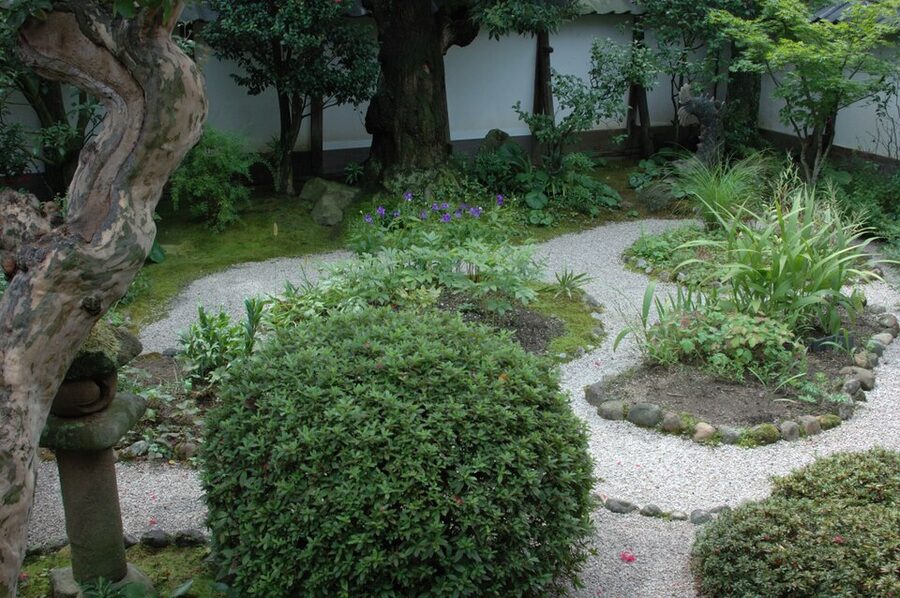
His former residence is now a museum with the original tatami rooms, his writing desk, and a small garden with a stone lantern he refers to by name in his essays. The Lafcadio Hearn Memorial Museum next door holds his manuscripts and a handful of his personal effects. Entry to both is a combined ticket that also includes the castle. It is worth an hour.
The Horikawa moat boat tour
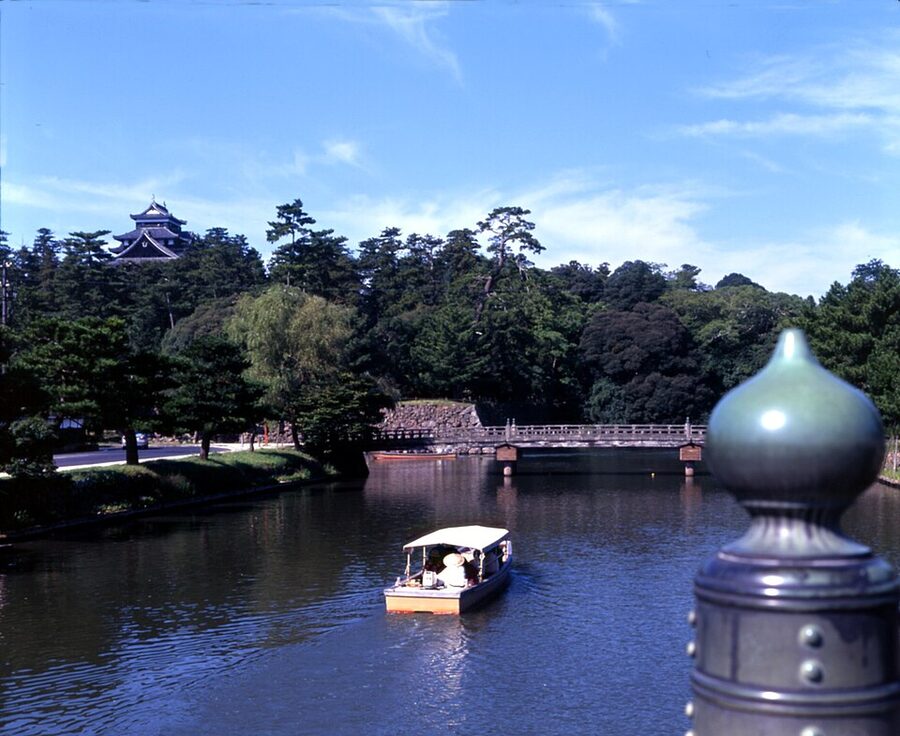
The single best thing to do in Matsue after climbing the tenshu is the Horikawa moat boat tour. It is a 50-minute guided cruise around the outer moat in a small roofed punt, with three boarding points and a hop-on, hop-off ticket that is valid all day. The boats run every fifteen minutes from 9am to about 5pm depending on the season.
The circuit passes under sixteen bridges. Four of them are too low for the canvas roof at normal water level, so the boatman pulls a lever and the whole roof drops six inches with a pneumatic hiss. Everyone on board has to duck simultaneously. It sounds ridiculous and it is genuinely one of the most pleasurable five-second moments in Japanese tourism.
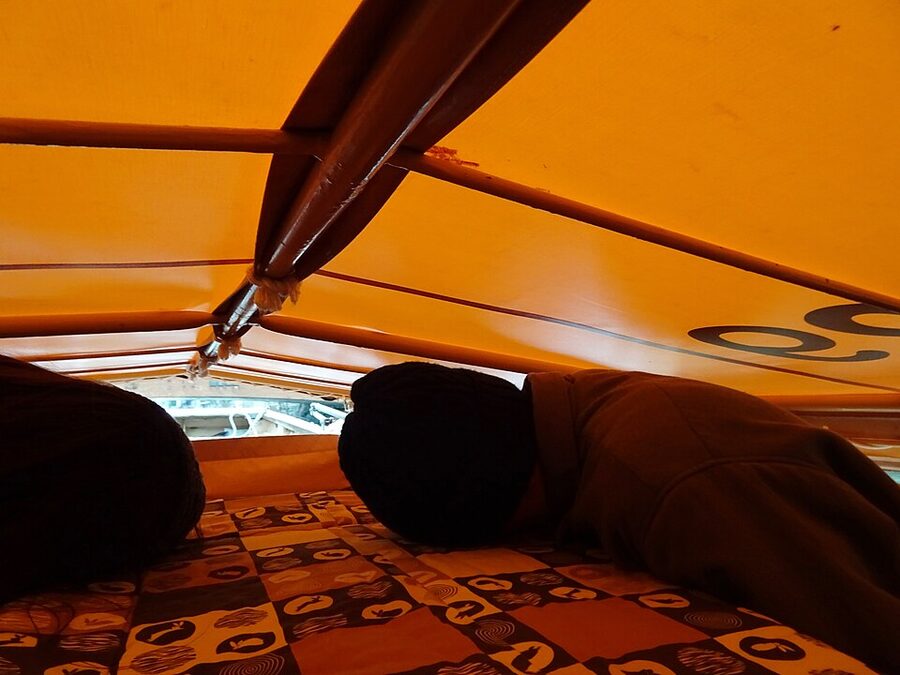
The guides are worth paying attention to even if your Japanese is basic. They point out samurai residence walls, machi-ya merchant houses, and the original ishigaki pavings. In spring and autumn the tour includes a brief stop at a willow-lined stretch where you can see the tenshu framed between two pedestrian bridges. In winter the boats run with kotatsu charcoal heaters under the blanket over the passengers’ knees, which is the correct way to experience a Japanese winter canal.
My recommendation if you have half a day: do the boat tour first, climb the tenshu second. The boat gives you the geography of the whole castle town and you can spot the places you want to walk back to on foot afterwards. Going in the opposite order works too but the castle view from the boat is better if you have not yet seen the tenshu up close.
Shiominawate and the samurai residence street
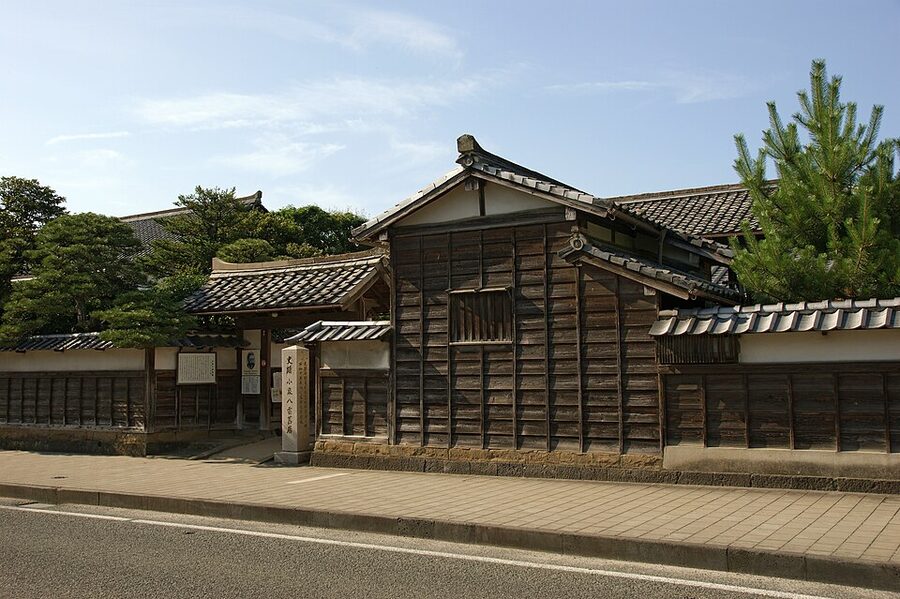
Shiominawate is the one-kilometre stretch along the north face of the inner moat, lined on its outer side with mid- and upper-rank samurai residences. The walls are white plaster with tile copings and black gates, and the district survived the Meiji demolition wave intact because it was residential rather than military. Today it functions as a linear open-air museum.
Three buildings on the street are open to the public. Hearn’s former house is one. The Buke Yashiki samurai residence, once occupied by a mid-rank Matsudaira retainer family called the Shiomi, is another. The Meimei-an teahouse, built in 1779 for the tea-obsessed seventh Matsudaira lord Matsudaira Harusato, is the third.
If you have any interest in the Japanese tea ceremony, Meimei-an is one of the handful of extant Edo-period daimyō tea rooms still in place. Matsudaira Harusato, usually known by his tea name Fumai, was one of the great patrons of the Enshū school of tea and his personal taste shaped the local wagashi tradition. You can still buy Fumai-style sweets at shops on the road between the teahouse and the castle.
Lake Shinji, the castle’s front garden
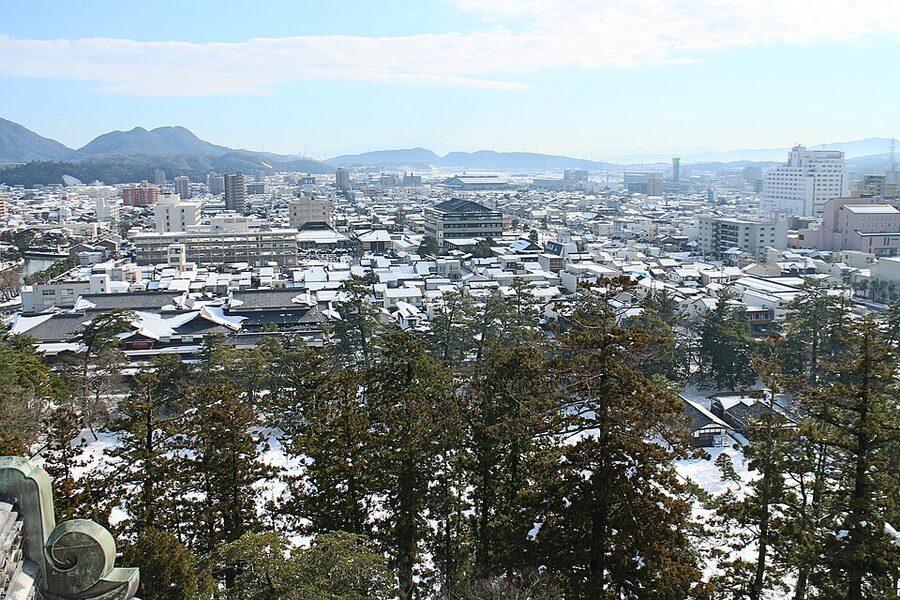
Lake Shinji is the seventh-largest lake in Japan by surface area and the only brackish-water lake of any size in the country. It is connected to the Sea of Japan via the Nakaumi lagoon and the Sakai Channel, which means it gets a daily pulse of salt water and a steady freshwater input from the Hii River. The unusual chemistry supports the Shinjiko Shichi-chin, the Seven Delicacies of Lake Shinji.
The seven are perch (suzuki), eel (unagi), shrimp (moroge-ebi), carp (koi), whitebait (shira-uo), smelt (amasagi), and the Yamato shijimi clam. You can eat all seven at the better Matsue restaurants, although in practice the shijimi clam miso soup is the one most locals will serve you without being asked. It is part of the civic DNA.
The other lake attraction is the sunset. Lake Shinji runs east-to-west with a low western horizon, so the sun sets directly across the water almost every evening. Yomegashima, a small wooded island with a single torii gate, sits in the line of sight from the main Matsue lakeshore promenade. The island appears in half a dozen classic Japanese sunset photos and is framed in a way that is honestly difficult to take a bad picture of.
I watched the sun go down from the Shimane Art Museum promenade in late September. It took about fifteen minutes from first colour to full dark. The lake has no appreciable swell so the reflection is a mirror. If you time your day to be on the lakeshore between thirty and fifteen minutes before sunset, you will have earned the single best free view in the San’in region.
Matsue in context: how it ranks against the other eleven originals
I have now been to most of the twelve original tenshu of Japan. Ranking them is a pub-argument industry of its own and every one has a partisan constituency. But since I am writing the piece I will put the case for Matsue plainly. It is in the top three.
Himeji is objectively the most impressive structure, the white heron, the UNESCO site, the scale is genuinely operatic. Matsumoto is the best balance of setting and size, with the Alps for a backdrop and the classic black-and-white twin keep. Then there is Matsue, which loses on pure scale but wins on authenticity of surrounding context.
Matsue is the only one of the twelve where the castle, the intact samurai residence street, the preserved moat boat network, and the clan mausoleum are all still physically connected. Himeji has a castle but the surrounding town is mostly postwar rebuild. Matsumoto has a gorgeous keep but the moats have been mostly filled in. Hikone comes closest to Matsue in terms of context preservation but has lost more of its outer complex.
Against its direct architectural siblings, Matsue comes out well too. Hirosaki is the oldest single piece of castle woodwork still standing but the keep is physically small (three storeys) and was moved off its original foundations during an 1811 reconstruction. Inuyama is the oldest tenshu by original footprint but is even smaller and sits on a cramped site. Maruoka, the smallest of the twelve, had to be rebuilt from rubble after the 1948 Fukui earthquake.
The one that Matsue most directly competes with is Bitchu-Matsuyama, the only mountain original. Bitchu-Matsuyama has a more dramatic setting on a 430-metre peak but a physically smaller keep. If you can only see one San’in original, the honest answer depends on whether you prefer drama of site (Bitchu-Matsuyama) or drama of town context (Matsue). I prefer Matsue.
How to get to Matsue and plan a day
Matsue is reached from Tokyo in about three and a half hours by air (Izumo Airport, 40 minutes from the city by limousine bus) or about seven hours by Shinkansen plus limited express (Tokyo to Okayama by Nozomi, Okayama to Matsue by the Yakumo limited express through the mountains). From Osaka the split is about the same. From Hiroshima there is a direct bus across the Chūgoku mountain range that takes three hours.
The most scenic approach is the Yakumo limited express from Okayama. The line climbs through the Chūgoku range, threads along several river gorges, and then drops to Matsue with a first view of Lake Shinji from the train window as you approach the station. It is a 2.5-hour ride and it runs every hour during the day.
From Matsue Station the castle is a 25-minute walk or a short bus ride on the Lakeline city loop bus. The loop stops at every sight that matters and a one-day pass is 500 yen. If you have only one day, the efficient circuit is: station, castle tenshu (2 hours), boat tour (1 hour including boarding wait), Shiominawate walk and Hearn residence (1 hour), lunch, Gesshōji (1 hour), lakeshore sunset (30 minutes), back to station.
If you have two days, add a morning trip to Izumo Taisha, the grand shrine 45 minutes west by the Ichibata Electric Railway. If you have three days, add a half-day trip up to Gassan-Toda, the old mountain castle that Yoshiharu abandoned to build Matsue. The climb takes an hour each way and the summit views across the plain are how the early Horio would have seen their new domain in 1600.
Practical notes on visiting the keep
The tenshu itself is open 7am to 6:30pm from April to September, and 8:30am to 5pm from October to March. Entry is 680 yen for the castle only, or a combined 1,100-yen ticket that includes the Buke Yashiki samurai residence and the Lafcadio Hearn residence. The combined ticket is almost always the right choice.
Shoes come off at the entrance. You are given a plastic bag to carry your footwear in with you as you climb. The floors inside are polished wood, cold in winter, cool in summer, and there is no heating. Wear socks you do not mind wearing in a 400-year-old building.
The top storey is the reason you climbed. You get a 360-degree view across Lake Shinji to the west, the city centre to the south, Lake Nakaumi and the distant Sanin peaks to the east, and the Shimane Peninsula to the north. The viewing windows are unglazed so in winter the wind comes straight through. Staying on the top storey longer than ten minutes in January is a mild endurance sport.
The single best thing about the keep, for me, is not the view. It is the smell. Four hundred years of lacquered pine, cypress, beeswax, and human foot traffic produce an indoor air quality that you will not encounter in any reinforced-concrete castle replica. Stand on the fourth level, close your eyes, and breathe.
Closing thoughts: why Matsue matters
Japan has a lot of castles, most of them concrete reconstructions from the 1950s and 1960s. What it has very few of is coherent, unrestored, surviving castle towns. Matsue is one.
The black tenshu, the samurai street, the boat network, and the clan mausoleum are all physically the same objects that the Matsudaira daimyō knew in the 1700s, preserved together as a single functioning ensemble. You cannot buy that. You can only inherit it.
The ensemble exists because specific people in specific moments refused to let pieces of it disappear. Horio Yoshiharu decided in 1607 to pivot his new domain off a mountain fortress onto a lake shore. Matsudaira Naomasa decided in 1638 to take the Tokugawa appointment seriously and invest in civic culture.
Takagi Gonpachi and Katsube Motouemon decided in 1875 to cover the 180-yen price before the wreckers arrived. The 2012 researchers decided that a weathered prayer tablet in a shrine loft was worth reading carefully. Each step was contingent.
My recommendation for anyone planning a San’in trip: give Matsue two nights. One full day for the castle, the boat, the samurai street, the Hearn residence, and a lakeshore sunset. A second day for Gesshōji, Izumo Taisha, and either Gassan-Toda or the Adachi Museum of Art.
Eat the shijimi clam miso. Drink the local Ochin shochu. Walk Shiominawate after dark, when the plaster walls glow pale blue under the moonlight.
Climb the interior staircase slowly. Stop on every level. Lean on the handrail at the mezzanine and listen to the sound of the building breathing. Then go up to the top, look west across Lake Shinji, and remember that the view would not exist at all if a former retainer with 180 yen in his savings book had not walked into a Meiji auction house in 1875 with a plan.