Azuchi Castle existed for six years. Nobunaga’s carpenters finished the seven-storey tenshu in the fifth month of 1579. His retainer Akechi Mitsuhide killed him at Honnō-ji in the sixth month of 1582, and by the time the flames on the summit died down two weeks later the building was gone. Six years, from ribbon-cutting to ash. No other building in Japanese history has had a shorter useful life and a longer afterlife. Every Japanese castle tenshu you have ever climbed — Himeji, Matsumoto, Hikone, Inuyama, the rebuilt Osaka, the rebuilt Nagoya, the rebuilt Kumamoto — is a design descendant of the thing that stood on this Lake Biwa hilltop between 1579 and 1582. The architectural word for “castle keep” in Japanese, tenshukaku (天守閣), is itself a word Nobunaga’s carpenters effectively coined at Azuchi. What Japan calls a castle today is what Nobunaga built on this mountain, and then lost.
I keep coming back to Azuchi because the site itself refuses to let you pretend it’s just a ruin. You walk up the broad stone staircase — six metres wide, 180 metres straight, demolishing every rule of defensive castle approach that the preceding four centuries had laid down — and you realise you are walking on Nobunaga’s political declaration in stone. He did not build a fortress. He built an address. This was the place from which, if things had gone differently, Japan would have been ruled. What happened instead was that one of his own retainers burned it, and the unification project passed to Hideyoshi, and Azuchi was abandoned within three years of its construction and pulled to pieces within five. The foundations are still there. The skeleton is still there. The 46-metre seven-storey gold-leafed octagonal tenshu that sat on top of those foundations and changed Japanese architecture forever is not.
In This Article
- Nobunaga’s moving headquarters — Nagoya, Kiyosu, Komaki, Gifu, Azuchi
- Why Mount Azuchi — and what was there before
- Building the thing — 1576 to 1579
- What was new — and why it changed Japanese architecture
- Luis Frois walks the interior
- 1582 — the six days that burned the castle
- What the archaeologists have found — 1940 to present
- The strange pluralisation of the Azuchi reconstruction
- Where to visit Azuchi today
- Azuchi Castle Ruins Park (the actual site)
- Nobunaga no Yakata (the full-scale reconstruction)
- Shiga Prefectural Azuchi Castle Archaeological Museum
- Sōkenji and the surviving 16th-century buildings
- Ise Sengoku Jidai Mura — the full-scale outdoor reconstruction
- Getting to Azuchi
- A building that existed for six years
Nobunaga’s moving headquarters — Nagoya, Kiyosu, Komaki, Gifu, Azuchi
To understand why Azuchi exists, you have to look at the preceding twenty-five years of Nobunaga’s headquarters shuffling. He was born at Nagoya Castle in 1534 and inherited it from his father at seventeen. He moved his main base to Kiyosu Castle in 1555 after eliminating his uncle Nobutomo. In 1563 he built Komaki Castle, a new-site fortress fifteen kilometres north-east of Kiyosu, specifically engineered as the forward operating base for the Mino campaign — Komaki was the first castle in Japan where the yamajiro (mountain-castle) tradition started being modified toward a combined administrative-residential function. Then in 1567, after taking Inabayama from the Saitō, he moved to Gifu Castle and renamed both the mountain and the town. Each of these moves happened within a day’s ride of the last. Each moved the headquarters a little further west, a little closer to Kyoto, a little further into the strategic crosshairs.
The pattern is worth noticing. Nobunaga did not treat a headquarters as a permanent thing. He treated it as a temporary political address, to be replaced the moment circumstances dictated. Nagoya was home. Kiyosu was a replacement clan seat. Komaki was a staging ground. Gifu was the declaration — the place from which Tenka Fubu started going out on his letters. Azuchi was the culmination. By 1575 Nobunaga had crushed the Asakura and Asai at Anegawa, destroyed the Takeda cavalry at Nagashino, driven the Ashikaga shogun from Kyoto, and was openly running a unification campaign with no serious military peer west of the Ibuki range. Gifu had stopped being the right base. It was too far east, too far from the capital, too far from the Lake Biwa transport corridor. What he needed was a place from which he could, literally, watch the roads into Kyoto.
Why Mount Azuchi — and what was there before
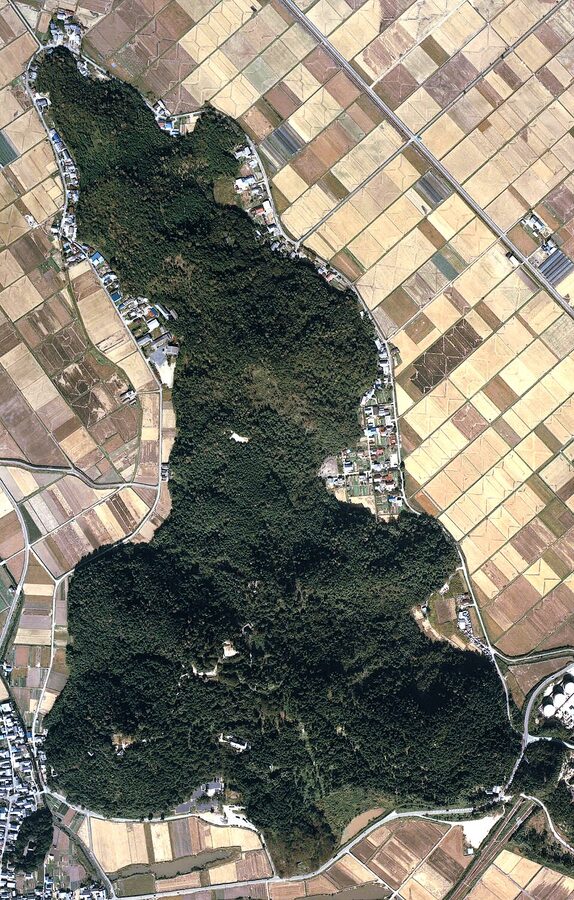
Mount Azuchi is an unimpressive hill by the standards of the mountain castles that preceded it. Gifu’s Mount Kinka rises 329 metres. Kasagi sits at 289. Chihaya, the famous Kusunoki fortress, is built at 634 metres. Azuchi-yama is 199 metres, and that’s counting from lake level. A child could climb it in an hour. The entire mountain fits comfortably inside what is now the northern edge of Ōmihachiman City in Shiga Prefecture. For a man who had spent a decade headquartered on top of a 329-metre chert spike specifically because no enemy could take it by frontal assault, moving to Azuchi looked, on paper, like a downgrade.
That impression is wrong, and it’s wrong in a way that gets at what Azuchi was for. The mountain wasn’t chosen for defensibility. It was chosen for visibility, both outward and inward. Outward: from the summit you can see the entire east shore of Lake Biwa, the Nakasendō highway leading north-east toward Gifu, the Tōkaidō highway leading south-west toward Kyoto, and on a clear day the ridge of Mount Hiei standing between you and the capital. Inward: from fifteen kilometres away in any direction, the castle on top of the mountain is visible. That was the point. Nobunaga wanted everyone on the Kyoto-bound highway, every boat captain on Lake Biwa, every traveller heading for the Hokuriku via the Kōtō corridor, to see the thing and know who it belonged to. The Sengoku castle had been a fortress that announced itself by being taken. The Azuchi castle was a building that announced itself by being there.
The site had a prior history that Nobunaga understood and probably exploited. Mount Azuchi had been a subsidiary fortress of the Rokkaku clan, the shugo governors of Ōmi Province, who ran their main base from Kannonji Castle, six kilometres south-east on the next ridge. When Nobunaga broke the Rokkaku power in the late 1560s, Azuchi came with the territory. Nobunaga’s total-masonry construction model at Azuchi almost certainly learned from Kannonji, which had been one of the earliest Japanese yamajiro to use extensive stone walls. He was not inventing from scratch. He was taking a regional fortress tradition and scaling it to national-capital level, using the Rokkaku’s own anō-shū stonemasons — the hereditary stonework guild from Anō village, two kilometres west of Mount Hiei — who would after Azuchi go on to cut the stones for every major castle built in Japan for the next hundred years. Azuchi is where the anō-shū became the national guild.
Building the thing — 1576 to 1579
Construction began in the first month of 1576 (Tenshō 4), and the Shinchō Kōki records the supervisory assignments in a form almost unique for a 16th-century Japanese building project. Nobunaga, who had a horror of organisational ambiguity, gave every part of the build a named retainer to answer for it. Niwa Nagahide was sōbugyō, chief construction overseer — the man responsible for the whole thing. Kimura Takashige handled fushin, the earthworks and structural framing. Okabe Mataemon was daiku-tōryō, master carpenter — the designer, in our sense. Hashiba Hideyoshi (the future Toyotomi) was nawabari-bugyō, responsible for the layout geometry of the castle’s walls and moats. Nishio Yoshitsugu, Ozawa Rokurōzaburō, Yoshida Heinai, and an “Ōnishi” whose full name is not preserved held the ishi-bugyō commissions, each responsible for procuring and placing a category of stonework. Ogawa Sukeyoshi, Horibe Sanai, and Aoyama Sukeichi were the kawara-bugyō, roof tile commissioners. Every phase had a name on it. Every name answered, ultimately, to Niwa, and Niwa answered to Nobunaga.
The scale of the work was without precedent. The Shinchō Kōki describes work-parties going up the mountain continuously from early 1576 through the fourth month of 1579, and there is one episode, recorded with particular vividness by Ōta Gyūichi, that says as much about the project as any architectural drawing could. Hideyoshi’s people were trying to haul a single stone up from the valley between Kannonji-yama and Chōmei-ji-yama, south-east of the building site. The stone was nicknamed Jaishi, Serpent Stone, and was reckoned at five ken (about ten metres) in length and around thirty thousand kan (about 112 tonnes) in weight. They assembled a work-party of, in the chronicler’s phrase, a crowd so large that “day and night the mountain and valley moved as one.” Partway up the slope the drag-rope snapped. The stone slid sideways and crushed one hundred and fifty of the men pulling it. The survivors finished the job. The Serpent Stone, supposedly, was carried to the summit and incorporated somewhere in the walls. Every archaeological dig since 1989 has failed to find it.
The tenshu itself — the central keep, the building everyone was actually there to see — was built in what Japanese castle scholars call the bōrō-gata (watchtower-style) tradition, five external storeys over six internal floors and one underground level. Everything about its dimensions was a record for its era. The Shinchō Kōki and Ōta Gyūichi’s separate Azuchi Diary give the base as 17 ken east-west by 20 ken north-south (roughly 33 by 39 metres), and the total height as thirty-two jō (about 46 metres, though some modern reconstructions have it closer to 38). Neither number had been reached before in Japan. The upper floor was octagonal — eight-sided, with windows on every face — and was entirely gilded on the outside with gold leaf. The sixth-floor external walls were vermillion lacquer. The fourth and fifth floors were finished in a black lacquer so deep that the ja.wiki entry quotes one Edo-period observer calling it “a blackness that drew in sky.” Inside, every wall and every pillar was covered in gold-ground murals painted by Kanō Eitoku on direct commission from Nobunaga — the largest gold-background mural commission in Japanese art history to that point. And buried underneath the building, at the geometric centre of the basement, was a small Buddhist reliquary pagoda that the upper-floor pillar line never reached — Nobunaga’s architects had deliberately omitted the central core pillar that every Japanese high-rise building had ever used before, because there was a stūpa in its place.
What was new — and why it changed Japanese architecture
I want to slow down here because this is the core of why Azuchi matters. Every castle tenshu built in Japan after 1580 — and there are between fifty and a hundred still standing, rebuilt, or documented, depending on how you count — traces its design DNA directly to this building. The innovations that Okabe Mataemon put into the Azuchi tenshu became the default, within a decade, for how a Japanese castle keep was built. Five of those innovations deserve specific mention, because each one was unprecedented.
First, the full-masonry foundation. Earlier Japanese mountain castles had used stone-and-earth walls in patches, with the primary residential buildings sitting on compacted earth platforms. Azuchi was the first castle whose entire main citadel stood on dressed granite block walls stacked without mortar — a technique the Anō stonemasons raised to an art by fitting massive, irregular granite blocks together through pure three-dimensional geometry. Walls from 5.5 to 6.5 metres thick, joints so close that a grass blade could not slip between them. This technique, nozura-zumi (randomly fitted stonework), became the signature style of Japanese castle masonry for the next two centuries. If you have ever stared at the walls of Himeji and wondered how the stones fit without mortar, you are looking at the inheritance of what the Anō stonemasons perfected at Azuchi in 1576-1579.
Second, the tenshu as architectural statement. Before Azuchi, the defensive tower in a Japanese castle was the yagura — a watchtower, usually three or four floors high, unplastered, strictly functional. Azuchi’s tenshu was seven floors, centre-of-site, visible from thirty kilometres away, gilded on top, and laid out as if it were a residence combined with a throne room combined with an art gallery. The Jesuit Luis Frois, who visited in 1581 and left the most detailed outsider account of the interior, called it “a building more magnificent than anything we have seen in Europe.” He meant it. The base-residence-plus-yagura model Nobunaga had used at Gifu was replaced at Azuchi with a single integrated seven-storey monumental building, and every castle keep built in Japan after 1580 followed this integrated-monument pattern.
Third, the European design influence — probably. This is the part modern scholars argue about. Naitō Akira, in his 1976 reconstruction based on the Kaga-domain “Tenshu-shizu” diagrams, identified an architectural feature that was, for 1576, genuinely peculiar in Japan: a four-storey interior atrium, open at the centre, rising from the underground level to the ceiling of floor four. This is not how Japanese high-rise buildings had traditionally been built. It is, however, almost exactly how contemporary European cathedrals were built, with an open nave void rising the full height of the building. Nobunaga had by 1576 hosted multiple Jesuit missions, had seen Frois’s architectural sketches, and was on good terms with Alessandro Valignano. Naitō concluded that Nobunaga had directly specified the atrium as an architectural instruction to Okabe, modelled on missionary descriptions of European church interiors. The architectural historian Miyakami Shigetaka has challenged this on the grounds that the documentation is inconclusive, and the question is not settled. But the atrium is in the drawing. And its pagoda-stupa at the atrium floor matters here too — that single detail, the religious reliquary at the heart of the building, is entirely inconsistent with European church design and entirely consistent with Shinto-Buddhist Japanese pagoda cosmology. What Nobunaga seems to have built, if Naitō is right, is a Japanese pagoda wrapped around a European cathedral. I know of nothing like it anywhere else in world architecture.
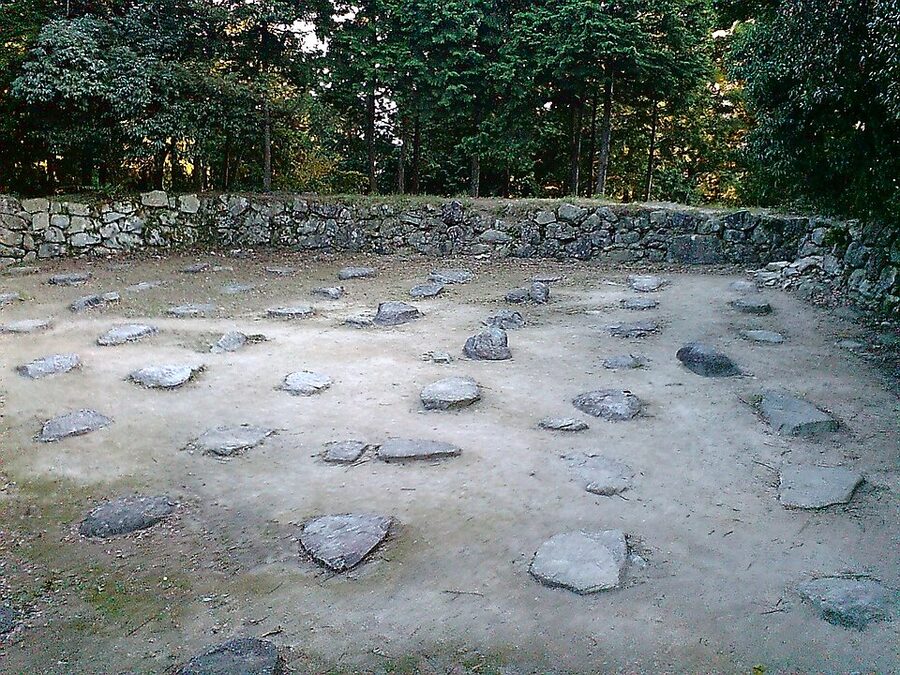
Fourth, the political-residential hybrid. Traditional castle keeps were defensive. Traditional residences were at the base. Nobunaga put both in the same building, with his personal living quarters on floors four and five and ceremonial audience spaces on floors one to three. The top-floor eight-sided chamber was his private observation and meditation space, gilded to catch lamplight at night and sunlight at dawn. The ja.wiki entry notes something I find striking: the foundation-stone survey of the Hommaru (main bailey) building revealed that its interior post-spacings match those of the Imperial Seiryōden palace in Kyoto almost exactly. A detail I believe has been credibly read as Nobunaga preparing to host the Emperor at Azuchi on a planned 1583 imperial visit — a visit that never happened because Nobunaga was murdered in 1582. This was a building designed for Nobunaga to be kanpaku (imperial regent) or possibly shōgun or possibly something even less well-defined, with the Emperor in visiting residence underneath. The architectural scholar Miyakami has been careful to flag this as inference rather than demonstration, but the post-spacings are the post-spacings, and they do not come from a domestic warlord’s residence.
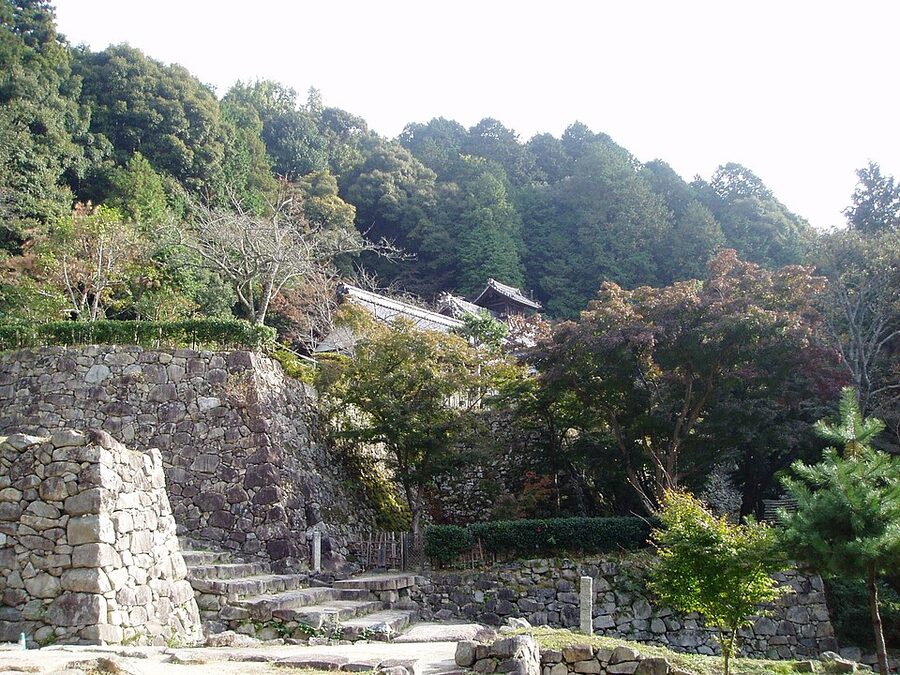
Fifth, and this is the part I find quietest and most interesting — the integrated temple complex. Every Japanese castle of any serious size had a chinjusha (protective shrine) and often a small chapel. Azuchi was the only Japanese castle in history that incorporated an entire full-temple complex, with pagoda and residential buildings for monks, inside its defensive precinct. Sōkenji (摠見寺) was built on the south-west slope of the castle site during the construction phase, with the specific instruction that the access road from the south-west bailey (the Dodobashi-guchi) had to pass through the temple compound before reaching the castle proper. Ordinary visitors had to walk through Sōkenji to get to see Nobunaga. This was not incidental. Nobunaga was making a specific theological-political claim about his own position: that the warlord unifying Japan was to be approached through a Buddhist temple specifically, and that the temple and the castle were not separable. The Niō-mon gate and the three-storey pagoda of the original Sōkenji still stand on the hillside today. Nothing else of the castle does.
Luis Frois walks the interior
Two years into the castle’s use, in the summer of 1581, the Portuguese Jesuit Luis Frois made his famous climb. He had known Nobunaga for over a decade by this point — had met him first in Kyoto in 1569, had corresponded regularly through the 1570s, and had, in the middle of the Azuchi construction period, been granted permission to open a Jesuit house and chapel inside Nobunaga’s new castle town. Frois’s letters from this period are our closest thing to a walk-through. He describes the external appearance of the tenshu from the valley floor as “surpassing anything in our European cities for size and ingenuity,” with gold leaf visible on the upper floor glowing in the late-afternoon sun.
Inside was where Frois ran out of superlatives. He describes floors of black lacquer “so smooth and so deep that a man’s face appeared in it as in still water.” He describes walls painted in gold-ground murals of tigers, dragons, pine trees, Confucian sages, and Chinese immortals, all executed at scale that he said made European palace interiors seem miniature. He specifically flags the paintings of Confucius and the Confucian sages on the third floor as an observation — Frois, as a Catholic missionary, had theological reasons to be alert to non-Christian religious imagery in a man he was trying to convert, and he reads the Confucian iconography as evidence that Nobunaga’s political theology was shifting from pure Sengoku warlord posture toward something that looked more like the Confucian model of a sage-king ruling an ordered realm. Frois’s conclusion is careful and important: Nobunaga, by 1581, had stopped thinking about himself as a warlord unifying by force and had started thinking about himself as a legitimate ruler of a unified state.
Frois was also permitted to visit the Azuchi Seminary, the Jesuit theological school Nobunaga had allowed to be established within the castle town. The seminary, which Nobunaga subsidised and which operated 1580-1582 before being destroyed along with the castle, educated about twenty Japanese and a handful of European students in classical European scholastic method. One of its students, Julian Nakaura, would later become one of the four members of the 1582 Tenshō Embassy to Rome, the first Japanese mission to Europe. The embassy carried with them, as a diplomatic gift from Nobunaga to Pope Gregory XIII, a six-panel folding screen called the Azuchi-yama-zu byōbu painted by Kanō Eitoku specifically to depict the castle and its town. The screen reached the Vatican and was displayed for some decades, then disappeared from the Vatican collections and has never been found. Italian-language researchers have been searching Vatican storage, Tuscan monasteries, and provincial Italian collections since the 1970s. In 2005 the Azuchi Town history committee travelled to Rome, presented Pope Benedict XVI with a miniature copy of the lost screen reconstructed by the artist Ōno Toshiaki, and formally requested Vatican assistance in the search. No screen has surfaced. If it ever does, our reconstruction of what the tenshu actually looked like will change more in a day than it has changed in the last 444 years.
1582 — the six days that burned the castle
On the second day of the sixth month of Tenshō 10 (21 June 1582 in the Western calendar), Akechi Mitsuhide turned his army against Nobunaga at Honnō-ji in Kyoto and killed him. Azuchi Castle was at this moment not occupied by Nobunaga, he was in the capital, and its defence had been left in the hands of Gamō Katahide, Nobunaga’s Ōmi overseer, and his son Gamō Ujisato. Akechi’s army approached Azuchi within forty-eight hours of Honnō-ji. The Gamō father and son did two things in rapid succession. First, they evacuated Nobunaga’s surviving family — his wife, his children, the concubines — to the Gamō family’s own stronghold at Hino Castle, thirty kilometres south-east. Then they withdrew the garrison, abandoning Azuchi without resistance. Akechi’s forces walked in and occupied the castle.
This is where the sources start disagreeing. What is certain: Akechi was defeated by Hideyoshi at Yamazaki on the thirteenth day of the sixth month (2 July 1582). Akechi himself was killed in flight two days later. On the fifteenth day of the sixth month (4 July 1582), Azuchi Castle, or at least the tenshu and the immediately adjacent Hommaru buildings, caught fire and burned to the ground. The Kanemi Kyō-ki, a Kyoto aristocrat’s diary, records the fire date with reasonable certainty. What it does not record, and what the other contemporary sources all disagree on, is who lit it.
Five theories have been argued seriously by Japanese historians over the last century. One: Akechi’s retreating forces burned the castle deliberately as they fled after Yamazaki (the Hideyoshi-ki and Taikōki versions). This is almost certainly wrong, because Akechi Hidemitsu, the retainer who had been holding Azuchi, was by the 15th already besieged in Sakamoto Castle across the lake and provably not near Azuchi on the burning day. Two: Oda Nobukatsu, Nobunaga’s second son, arriving from Ise with a scratch force to try to secure his late father’s assets, torched the castle himself. This is the Luis Frois version in the Jesuit annual report, and Frois attributes it to Nobukatsu’s “foolishness and lack of judgment,” which is the kind of line a Portuguese priest writes when he is unimpressed with the heir. Three: the Gamō family, while evacuating, set fires in the castle town that spread upward to the tenshu. Four: looters and bandits arriving in the chaos after Akechi’s defeat deliberately torched the building while taking what they could. Five: a lightning strike. The historian Takayanagi Mitsutoshi favoured theory two (Nobukatsu). The historian Hayashiya Tatsusaburō favoured theory four (looters). The historian Atsuta Kō also favoured theory four. The evidence on theory three has recently been challenged by the excavation data — the burn signatures are concentrated in the main citadel, not the castle town, which is inconsistent with a fire spreading upward from below. My reading, for what it is worth, is that theory four is most consistent with the physical evidence and theory two is most consistent with the political logic, and Frois as a contemporary witness with access to Azuchi survivors probably had better information than anyone else who wrote anything down. But no one knows.
What matters politically is what happened next. Oda Hidenobu, Nobunaga’s grandson by his eldest son Nobutada, was declared heir at the Kiyosu Conference of late June 1582, and was installed in the surviving Ni-no-maru (second bailey) of Azuchi, which had escaped the fire. Hidenobu was three years old. The castle functioned in this reduced form — tenshu gone, second bailey still standing, a trickle of administrative business being conducted — for another two and a half years. Then in 1585, Hideyoshi’s nephew Toyotomi Hidetsugu decided to build a new castle at Hachiman-yama, four kilometres south-west. The decision to move the administrative centre to Hachiman was also the decision to abandon Azuchi. The remaining buildings were pulled down that year. The castle town, which had held 5,000 people at its peak in 1581, decamped to the new Hachiman-yama site and became, over the next generation, the merchant town of Ōmi-Hachiman. Azuchi itself went back to being a quiet agricultural village at the foot of a ruined hill. It remains one today.
What the archaeologists have found — 1940 to present
The archaeology of Azuchi has happened in two long phases with a long interval between them. The first phase, 1940-1942, was run by the prefectural government during a general restoration project on the stone staircases and foundation walls, and yielded the first modern field drawings of the site layout. These drawings, published by Shiga Prefecture in 1942 as part of their Historic Site Survey Reports, are still the baseline for every subsequent discussion of the castle’s ground plan. The second phase, the Shiga Prefecture’s “Twenty-Year Plan for Investigation and Maintenance,” ran from 1989 to 2009, and is what has given us the detailed understanding we now have of the complex.
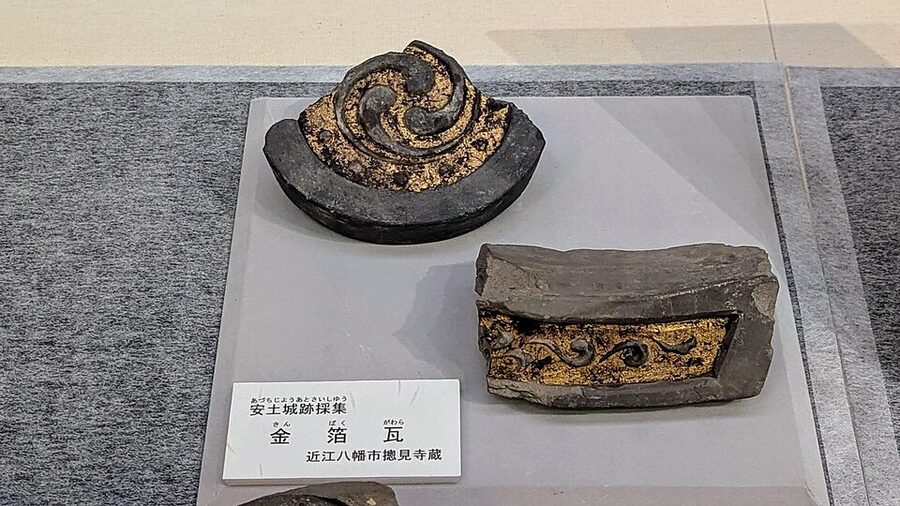
The 1989-2009 dig found a series of things that each rewrote some piece of the castle’s history. In 1996 they found, in the excavation of the former grain-store (米蔵, komekura) area, a near-complete gold-leafed shachi-gawara — the ornamental roof-tip tile in the shape of a tiger-fish finial. Before 1996 no complete example of an Azuchi gold-leaf tile existed in any museum. This one was recovered from what had clearly been the tile store adjacent to the tenshu, smashed but largely reassemblable. In 1998 the dig below the tenshu foundation recovered fragments of the burn layer, including ornamental metalwork, cooking utensils, flower vases, wall-plaster residue, and further gold-leaf tiles — together these provided the first direct material evidence of what the building’s interior had contained. In 1999 came the discovery that the Hommaru main residence building had a floor plan identical to the Imperial Seiryōden palace in Kyoto. This was, in its way, the biggest find of the entire project, because it was the first hard evidence that Nobunaga had been preparing the castle for an Imperial visit — that is, that he had been preparing in 1580-1582 to receive the Emperor on Azuchi’s own ground.
The twenty-year plan was officially completed in 2009, but by that point Shiga Prefecture’s budget had run out and only about 20% of the total protected area (roughly 17 hectares out of 85) had been fully excavated. Shiga Prefectural Archaeological Research Centre has estimated that fully investigating the remaining area would require another 50 to 100 years at current funding levels. In 2022, however, Shiga launched a new project nicknamed “The Reiwa Great Investigation” (令和の大調査) targeted specifically at the 450th anniversary of the castle’s construction in 2026. The first-year results were announced in December 2024: the Hommaru toritsuki-dai (entry platform) east of the tenshu had contained a previously unidentified building measuring about 9.5 metres east-west by 17.5 metres north-south. Further results are being published on a rolling basis through the 450th anniversary year, which is 2026. I have been told by the Shiga Archaeological Research Centre’s outreach office that the Reiwa project plans include at least the possibility of a full reconstruction of the tenshu itself, depending on what the excavation turns up. Watch the space. Japan has not tried to rebuild a great castle from the foundations up in a century.
The strange pluralisation of the Azuchi reconstruction
Because the original is gone and the reconstruction proposals are so varied, something unusual has happened in the last forty years: several different parts of Japan now have their own different Azuchi Castle reconstructions, and each one reflects a slightly different theory of what the original looked like. There are currently three serious full or partial reconstructions you can visit, plus a handful of museum-scale models. I have been to all three, and they are strikingly different from one another — which is, if you think about it, the exact condition you would expect when a single famous building is extrapolated from fragmentary evidence by three independent scholarly groups.
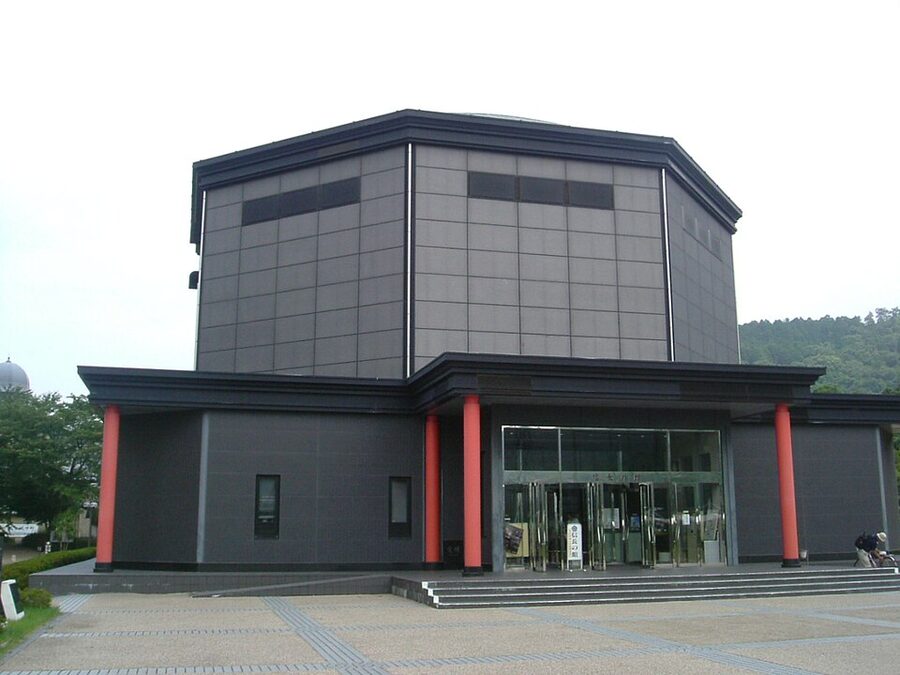
The Nobunaga no Yakata museum in Azuchi town itself, built in 1992 for the Seville Expo, houses a full-scale reconstruction of the upper two floors of the tenshu (floors five and six), based on Naitō Akira’s 1976 proposal. The reconstruction is indoors, climate-controlled, and uses traditional building techniques: authentic black lacquer, real gold leaf, actual Kanō-school copies of the original murals. You walk up a flight of stairs and come out into what is, physically, what a Sengoku-era ambassador would have stepped into on the fifth floor of the tenshu in 1580. It is the most architecturally serious of the three reconstructions and the one I recommend if you have time for only one.
The Ise Sengoku Jidai Mura theme park in Ise, Mie Prefecture, about 100 kilometres south of Azuchi, contains a full-scale exterior reconstruction of the entire tenshu building, based on a different reconstruction proposal (Miyakami Shigetaka’s 1994 version). This one is outside, weathered, and visible from several kilometres away across the plain. Because it reflects the Miyakami proposal rather than Naitō’s, the building has slightly different proportions — the upper octagonal floor is more contained, the lower floors are slightly smaller, the overall silhouette is a little less gilded. For a traveller trying to understand what the original looked like, the Ise reconstruction gives you the outside-view that Mount Azuchi itself does not — you can stand at the base, walk around the building, look up at the top floor, and approximate the experience of approaching the real thing from below in 1580.
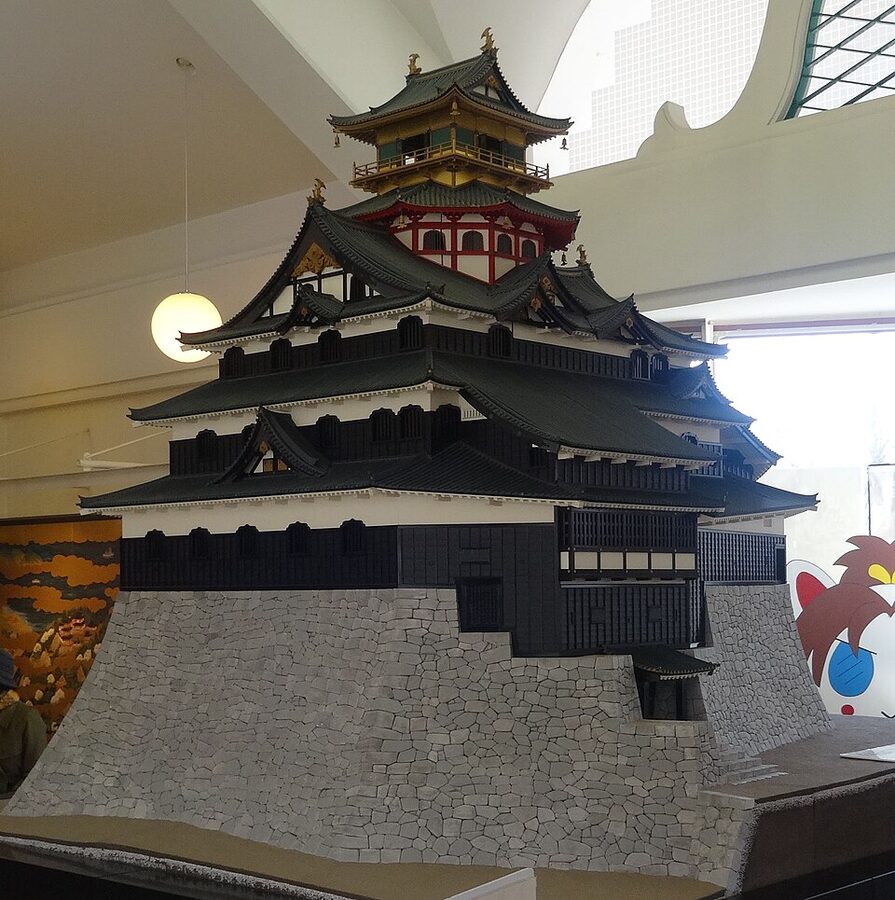
The Shiga Prefectural Azuchi Castle Archaeological Museum, next door to Nobunaga no Yakata, houses a 1/20 scale restoration model of the entire seven-storey tenshu, plus the archaeological artefacts from the 1989-2009 dig — the gold tiles, the wall plaster fragments, the charcoal residue, the bronze fittings. This is where you go for the detail. The scale model is built to Naitō’s specifications, and if you compare it to the Ise full-scale structure you can see the places where the two reconstructions genuinely disagree — particularly around the shape and proportion of the octagonal top floor and the position of the dormer windows.
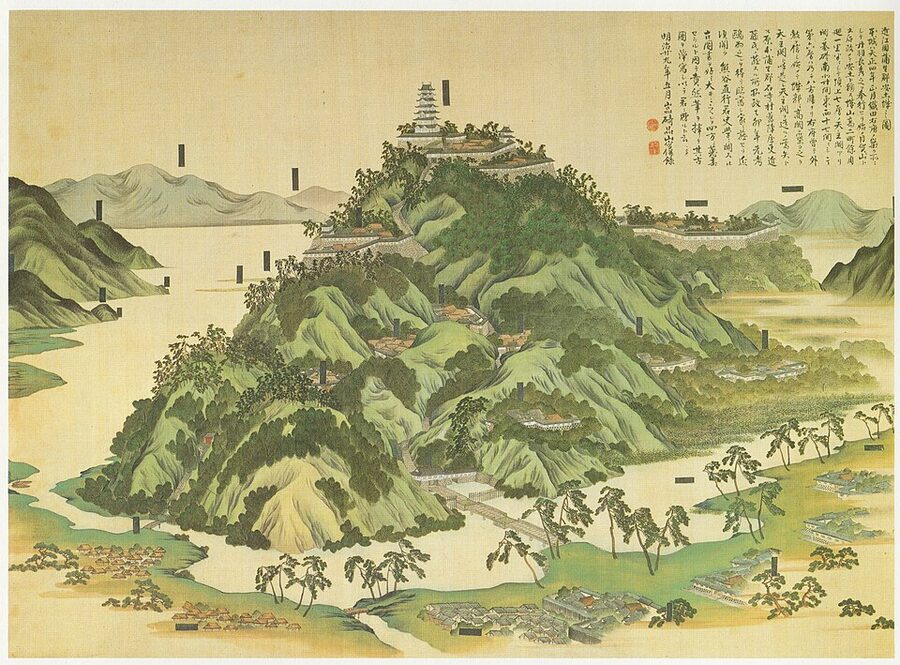
My own view, after looking at all three, is that the full truth is somewhere between the Naitō and Miyakami reconstructions, and that neither one is quite right about the detail of the lacquer-and-gilding scheme. The Iwasaki Ōu 1855 painting of the castle, showing an explicitly five-storey structure with eight-sided top floor and a red sixth floor, is probably closer to the real silhouette than either Naitō or Miyakami. But Iwasaki was working from secondary sources himself, and the sources disagree. What all three reconstructions demonstrate convincingly is that this was, beyond reasonable doubt, a building on a scale and level of ornamentation that had never been built in Japan before and has not really been matched since.
Where to visit Azuchi today
Azuchi Castle Ruins Park (the actual site)
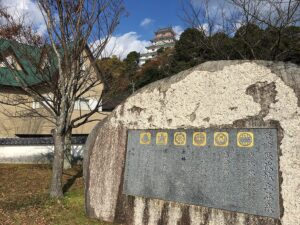
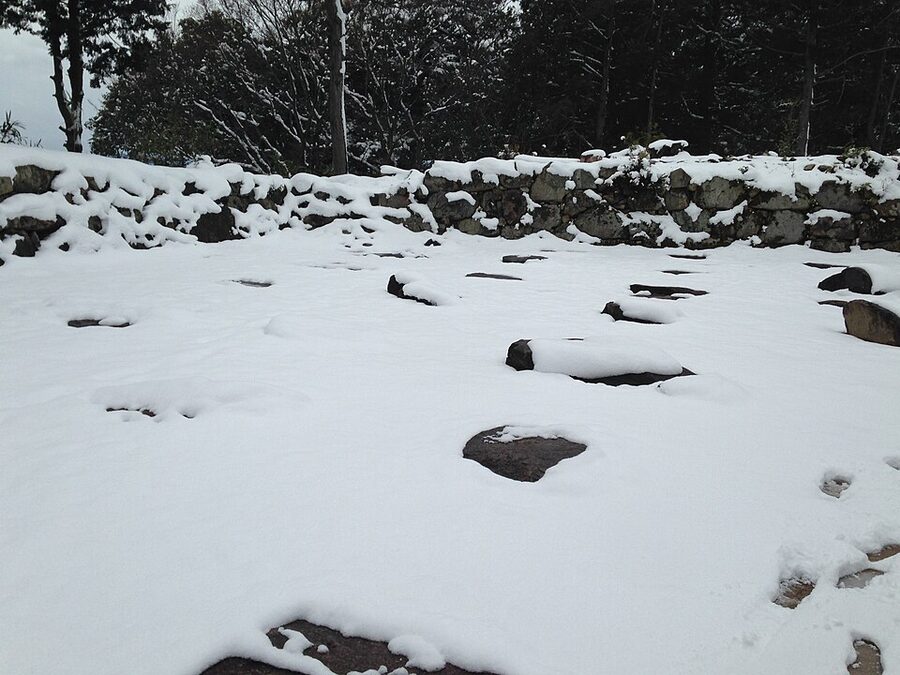
The castle site itself is a National Special Historic Site and a Type 1 Special Zone of the Lake Biwa Quasi-National Park — layered protection that means the archaeological substance is genuinely preserved. You enter through the modern visitor gate at the south-east foot of the hill, walk past the old Ōtemon (main gate) foundations, and climb the famous Ōte-michi, the Main Road up the hill, which is the six-metre-wide straight staircase that violates every defensive castle convention I mentioned earlier. The stairs are uneven and old; if you have any knee trouble, go slowly. About halfway up on the east side you pass the excavated foundation of the putative Hashiba Hideyoshi residence, and a little further on the putative Maeda Toshiie residence — both named in the Shinchō Kōki as retainer houses at that general location, both confirmed by the 1989-2009 excavation. At the top of the main ascent you reach the Black Iron Gate (Kuroganemon) foundations, and beyond them the Hommaru and the tenshu platform itself.
Practical detail: the entry fee of ¥700 (¥200 for children) is collected by Sōkenji, which has been the site’s formal custodian since the castle was abandoned. Opening hours are effectively from sunrise to an hour before dark; there is no official closing time but the ticket gate usually stops selling at 4:30pm. The full circuit — in the gate, up the Ōte-michi, around the tenshu platform, down the west side through Sōkenji’s grounds, past the surviving Niō-mon and pagoda, back to the base — takes about two hours at a normal walking pace. Wear actual walking shoes. The stones are worn smooth by 450 years of use and become treacherous in rain. There is no food on the mountain. Carry water in summer.
Nobunaga no Yakata (the full-scale reconstruction)
Nobunaga no Yakata, formally the “Azuchi Castle Tenshu Nobunaga’s Hall”, is a fifteen-minute walk north-east of the castle ruins, along the prefectural road that runs past Azuchi Station. This is the indoor museum that houses the full-scale reconstruction of floors five and six of the tenshu, using authentic lacquer and gilding. The building is purpose-built to hold the reconstruction at correct height — so from the outside it looks oddly tall for a modern museum. Inside, you pay admission, walk up a flight of stairs, and emerge into what is, as close as we can physically approximate, Nobunaga’s private fifth-floor chamber.
I said earlier this is the one to see if you have time for only one. I meant it. The lacquered floors are the point. Luis Frois described them as reflecting light “like still water.” They do. The Kanō-school wall murals — tigers, dragons, pines, Confucian sages — are full-scale copies based on surviving drafts of the originals, executed by Kyoto temple-artist ateliers in the late 1980s. The gold leaf is real, applied by Kanazawa craftsmen using the same technique used in the 1576-1579 original. If you stand in the middle of the reconstructed fifth-floor chamber for a few minutes at the right time of day — early morning, when direct light comes in through the east-facing windows — you get something close to what Frois was trying to describe when he ran out of superlatives. Entry is ¥610, open 9:00-17:00, closed Mondays and the week of new year.
Shiga Prefectural Azuchi Castle Archaeological Museum
Next door to Nobunaga no Yakata, sharing the same prefectural cultural campus, is the Shiga Prefectural Azuchi Castle Archaeological Museum (滋賀県立安土城考古博物館). This is where the actual dig artefacts live — the gold-leaf roof tile fragments from the 1996 and 1998 excavations, the burn-layer charcoal samples, the Kanō-school mural draft fragments, the 1/20 restoration model, and a very substantial exhibition of Azuchi-Momoyama period material culture in general. The museum also has a serious prehistory section covering the Jōmon-era shell middens around Lake Biwa, which is unexpectedly good if that is at all a thing you are interested in. Allow ninety minutes minimum. Entry is ¥500, open 9:00-17:00, closed Mondays.
What I would do, logistically: do the castle ruins in the morning while it is cool and you have energy for the climb, do Nobunaga no Yakata before lunch so you see the fifth-floor chamber with morning light coming through, break for lunch at one of the Ōmi-beef restaurants along the main Azuchi street, and spend the afternoon at the Archaeological Museum reading the excavation displays with the morning’s walk still in your legs. You will understand the site by the end of the day in a way that no single visit to any of the three locations alone would give you.
Sōkenji and the surviving 16th-century buildings
Sōkenji (摠見寺) deserves a separate visit, not just an on-the-way-down pass-through. The temple holds the only two pieces of standing architecture that survive from Nobunaga’s Azuchi — the Niō-mon gate (Important Cultural Property, late 1570s) and the Three-Storey Pagoda (Important Cultural Property, late 1570s). Both were relocated from their original positions on the upper castle hill down to Sōkenji’s current site on the south-west slope during the Edo period, but the buildings themselves are originals. The Niō-mon has wooden Niō guardian statues inside that are contemporary to the building. The pagoda is hidden from most visitor routes, you have to take the alternate south-west descent path from the tenshu platform to reach it, and is one of the very few surviving late-Sengoku-period wooden pagodas left in Japan.
The temple’s main hall is open for special visits on Sundays and holidays between April and November. Entry to the main hall costs an extra ¥1,000 on top of the ¥700 castle-site fee; it is closed in bad weather. I have been to the main hall once, on a very quiet October morning, and it contains the temple’s treasure of documents from the Nobunaga period — original letters, records of the 1579 Azuchi Religious Debate (the Nichiren-Jōdo sect theological dispute that Nobunaga stage-managed as a way of consolidating Pure Land support against his Ikkō-ikki enemies), and a small collection of personal objects from Nobunaga’s own hand. The letter collection is the thing. If you can time a visit to hit the Sunday opening, do.
Ise Sengoku Jidai Mura — the full-scale outdoor reconstruction
Ise Sengoku Jidai Mura, the “Ise Warring States Village”, is a Sengoku-themed park outside Ise City, Mie Prefecture, about 140 kilometres south-east of Azuchi. It contains a full-scale exterior reconstruction of the Azuchi tenshu built in 1993 to Miyakami Shigetaka’s reconstruction spec. I am aware that mentioning a “samurai theme park” can sound like I am pointing you at a tourist trap. It isn’t quite. The reconstruction itself is serious — built with traditional timber-framing technique, fitted with period-accurate tile roof, properly painted with a reconstructed version of the vermillion-and-gold external scheme. The theme-park wrapping around it is a bit much if that’s not your cup of tea, but the building itself is the building itself.
Practical: Ise Sengoku Jidai Mura is not combinable with a day in Azuchi — it is a separate trip from Nagoya or from Ise itself. I would go only if you are already in Mie for Ise-jingū or the Shima peninsula. Entry is ¥3,900. Opening hours 9:00-17:00 year-round. If you want to see a full-scale exterior of an Azuchi tenshu reconstruction, this is your only current option; it is also the reason the park exists.
Getting to Azuchi
Azuchi Station is on the JR Biwako Line (East Tōkaidō local train) about 35 minutes from Kyoto and about 70 minutes from Maibara, the Shinkansen transfer station. From Tokyo: take the Tōkaidō Shinkansen to Maibara (2h15), then the Biwako local to Azuchi (17 minutes, three stops). From Osaka or Kyoto: JR Biwako/New-Rapid Service to Azuchi, no transfer needed. The castle site is a 20-minute walk from Azuchi Station — head north along the main road, through the old town, past the unremarkable-looking Azuchi Castle Castle Hall archive (the Azuchi-jō Jōkaku Shiryōkan, worth a twenty-minute stop if you like small local museums) and then another ten minutes to the hill. Nobunaga no Yakata and the Archaeological Museum are another ten minutes further on, in a separate cultural-complex precinct called Bungei-no-sato. You can walk from Azuchi Station to all three sites; renting a bicycle from the station saves time and is flat.
If you are planning a Nobunaga-themed trip through the Kansai-Chūbu corridor, the ideal sequence is Kanazawa (for Maeda-family context and the old Kaga Hundred-Thousand-koku landscape) → Gifu (for the pre-Azuchi tenka-fubu period) → Azuchi (for the final stage) → Kyoto (Honnō-ji and Daitoku-ji, for the end). All four are within half-day transfers of each other. The whole circuit can be done in five days, comfortably; four if you push. Stay in Kyoto on the front and back ends — there are no serious traveller hotels in Azuchi itself, only a few minshuku — and do Azuchi as a long day-trip from a Kyoto base. Go out on the first train, be climbing the Ōte-michi by 9am, be in Nobunaga no Yakata by lunch, finish the Archaeological Museum at 4pm, be back in Kyoto for dinner.
A building that existed for six years
When you are standing on the tenshu platform at the top of the ruined hill, at four in the afternoon on a quiet spring day, with nothing between you and Lake Biwa to the west and the Nakasendō corridor to the east, you can see almost exactly what Nobunaga saw when the building was finished in 1579. The water is still there. The mountains are still there. The road, widened now and paved now and running trains now, is still there. What is gone is the 46-metre gilded seven-storey octagonal tenshu that was supposed to be the point of it all. It stood here for six years. It was then burned, probably by a looter in a week of political chaos, and the unification project that it was the architectural expression of passed, within three weeks of its burning, to a different warlord, who moved his capital to Osaka and never looked back. Azuchi Castle went from ribbon-cutting to abandoned site in nine years and to agricultural village in fifteen. No other building in Japanese history has had that arc.
And yet every Japanese castle keep built afterwards — including the ones that are right now tourist landmarks in Himeji, Matsumoto, Hikone, Osaka, Nagoya, Kumamoto, Matsue, Matsuyama — is, in lineage, a direct descendant of what Okabe Mataemon and his team built on this mountaintop in those three summers between 1576 and 1579. The Anō stonemasons went on to cut stone for every one of them. The lacquer-and-gilt technique was refined through the 1580s and 1590s at Hideyoshi’s Osaka and Fushimi. The bōrō-gata watchtower form was copied out and rebuilt at every new daimyō seat the Tokugawa approved. The Hommaru-Seiryōden post-spacing pattern appeared in every castle that anticipated an Imperial visit. Azuchi invented the Japanese castle. Azuchi is also the only Japanese castle whose original form survives only in the chronicles of the man who built it, the letters of the Portuguese Jesuit who walked its floors, and a handful of gold-leafed tile fragments in a glass case next to the road.
If you are travelling to the Kansai region anyway, stop at Azuchi for a day. The Shiga prefectural trains run at fifteen-minute intervals. The Ōte-michi takes half an hour to climb at a steady pace. The reconstructed fifth floor at Nobunaga no Yakata is a reliquary of what the interior looked like. The ruins at the top of the hill are a reliquary of what happened to it. Do not skip the pagoda on the way down; it is the only piece of standing 1570s architecture on the mountain. If you have the time and the inclination, visit the Ise replica afterwards to see the silhouette, and the Archaeological Museum before to see the material culture. And if the 2026 Reiwa investigation turns up what Shiga Prefecture hopes it does, you will be able to come back before the end of the decade and see what the 46-metre tenshu actually looked like, rebuilt on its original foundations, for the first time since 4 July 1582.
For the deeper context around what Azuchi meant as a political address, see my pieces on Gifu Castle — the previous headquarters, from which Nobunaga staged the move — and on Saitō Dōsan, whose fortress Nobunaga inherited and improved before he felt ready to take the next step west. The battle that consolidated Nobunaga’s power before he built Azuchi was Nagashino in 1575, which broke the Takeda cavalry and turned Nobunaga from a rising warlord into the unrivalled power of central Japan. The betrayal that ended his life at Honnō-ji was led by Akechi Mitsuhide, whose Sakamoto Castle across Lake Biwa from Azuchi is itself a partial-reconstruction site worth a visit. And the man who absorbed Nobunaga’s unification project after the fire was Hideyoshi, whose own Osaka Castle — built 1583, immediately after he decided not to rebuild Azuchi — was in its own way the direct architectural child of the building that had just burned.