
In the summer of 869, a plague was moving through Heian-kyō and nobody knew how to stop it. Fujiwara-era court physicians had run out of palliatives. The Imperial Household Ministry had run out of amulets. So on the recommendation of an Onmyō-dō diviner named Urabe Hiramaro, the court ordered sixty-six halberds erected at the Shinsen-en garden, one for each province of the realm, to gather the disease-bearing spirits into the blades, and they sent three portable shrines out from the same garden to parade the newly-settled gods back through the capital. That was the first Gion Goryō-e. It is also, by the uninterrupted counting of Yasaka Shrine and the Kyoto city archives, the same ceremony that now runs every July in Kyoto as Gion Matsuri. In 2019 the festival celebrated its 1,150th anniversary. It is the oldest continuously-observed public event in Japan.
I keep coming back to Gion Matsuri for a reason that took me a while to articulate. It is not the yamaboko floats, magnificent though they are — thirty-three of them, some five storeys tall, wheeled through the city centre on two days in July. It is not the 400,000 people who crowd the Yoiyama evenings. It is the architecture of continuity: the fact that a specific ritual response to a specific 9th-century crisis has been maintained, through civil wars and fires and a pandemic, by the same town blocks, using the same craft families, to the same musical tempo. You can stand at the Shijō-Karasuma intersection on 17 July and watch the Naginata-hoko come round the corner, and what you are watching is, essentially unchanged in shape, what Sugawara no Michizane’s generation watched. That is a very short list of things in the world.
In This Article
- What Gion Matsuri actually is
- Heian-kyō, 869 CE, and the halberds in the garden
- The 14th-century floats, the Ōnin War, and the 1500 revival
- Edo-period patronage and the near-death under Meiji
- UNESCO, 2009, and the Yama-Hoko-Yatai group
- The thirty-three floats
- Yoiyama — the three evenings before
- 17 July — Saki-matsuri and the corner turn
- 24 July — Ato-matsuri and the return
- Where to see it — planning a visit
- Yasaka Jinja — the shrine at the heart of it
- Shinsen-en — the 794 CE origin site
- Naginata-hoko’s Yoiyama site — Shijō-Karasuma intersection
- Saki-matsuri viewing — 17 July
- Ato-matsuri viewing — 24 July
- Kuji-tori-shiki — 2 July at Kyoto City Hall
- Getting to Kyoto and staying
- Closing — the month that keeps recurring
What Gion Matsuri actually is
Gion Matsuri (祇園祭) is the summer festival of Yasaka Jinja (八坂神社) — the great Kyoto shrine at the foot of Higashiyama that, before the Meiji separation of Shintō from Buddhism, was known as Gion-sha and ran under the authority of the Tendai monastery on Mount Hiei. The festival’s older name is Gion Goryō-e (祇園御霊会), the “Gion spirit-appeasement rite,” and that is essentially what the ceremony still is. The modern festival runs for the whole month of July, with preparatory rites scattered through the calendar; the two public climaxes are the Saki-matsuri (先祭, “earlier festival”) procession on 17 July and the Ato-matsuri (後祭, “later festival”) procession on 24 July.
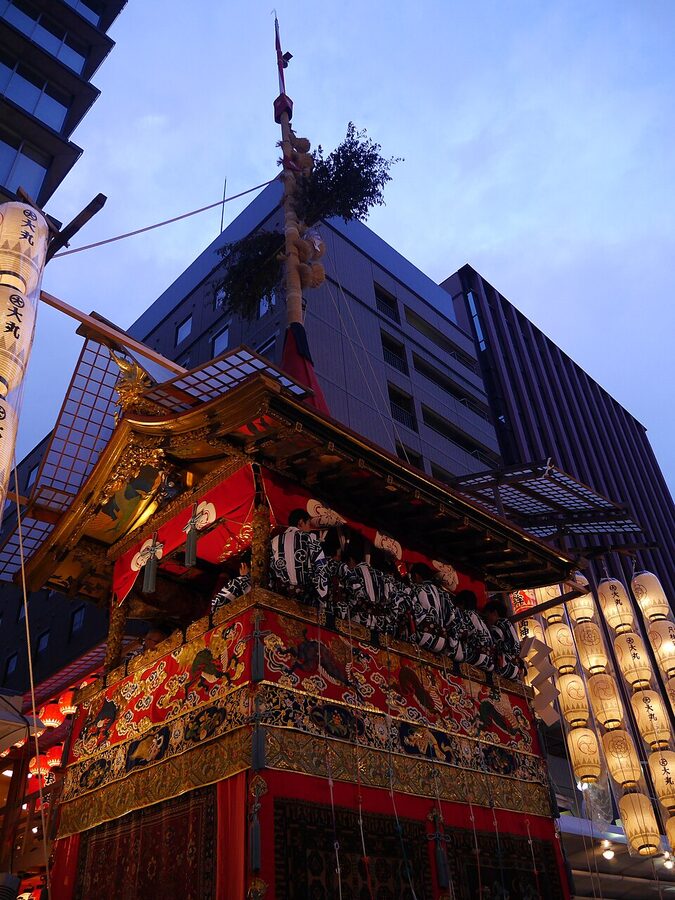
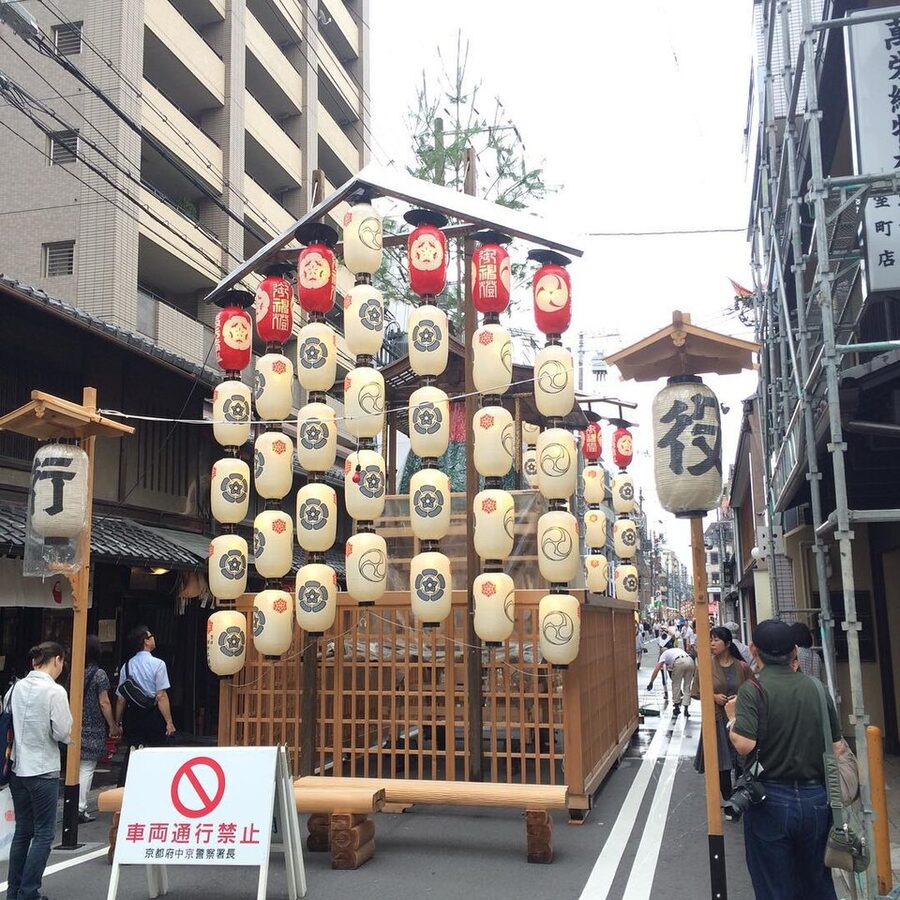
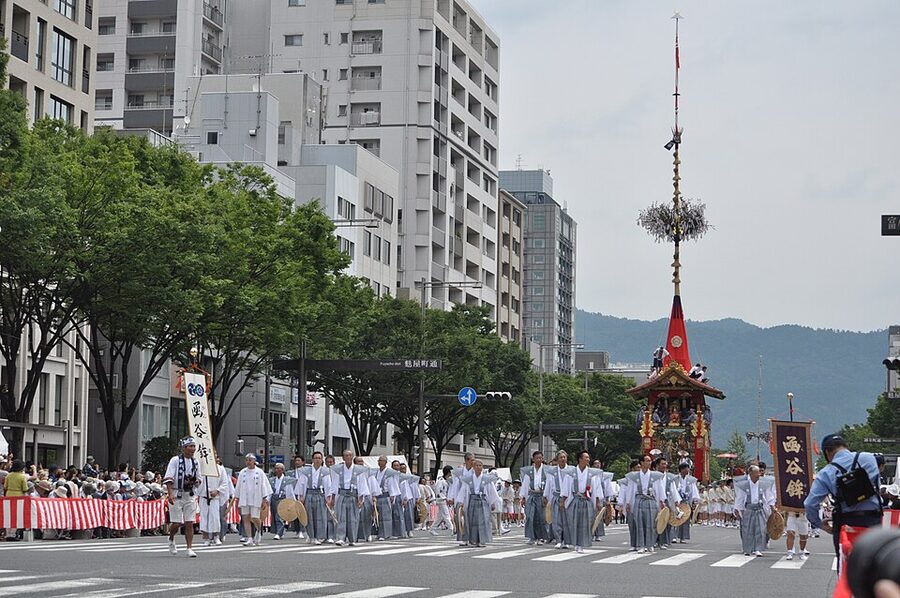
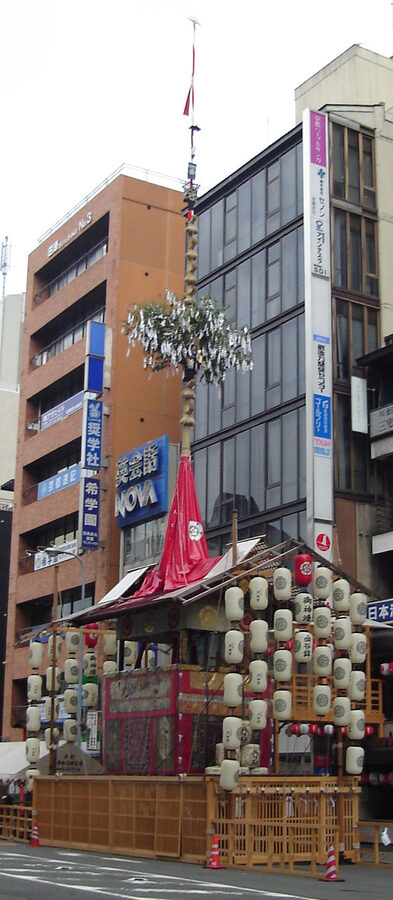
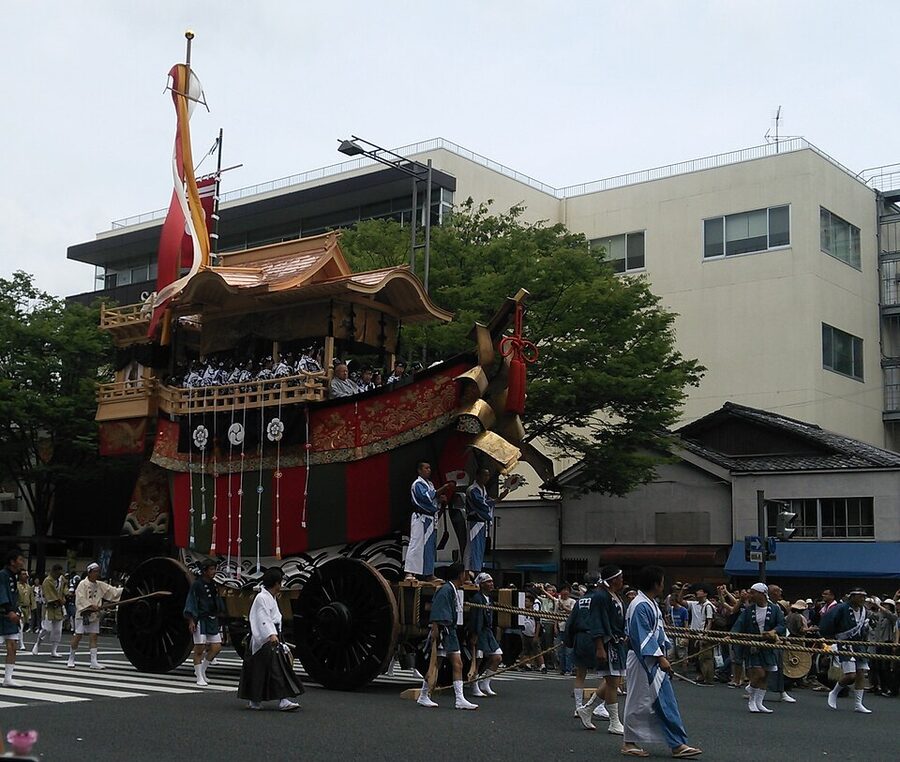
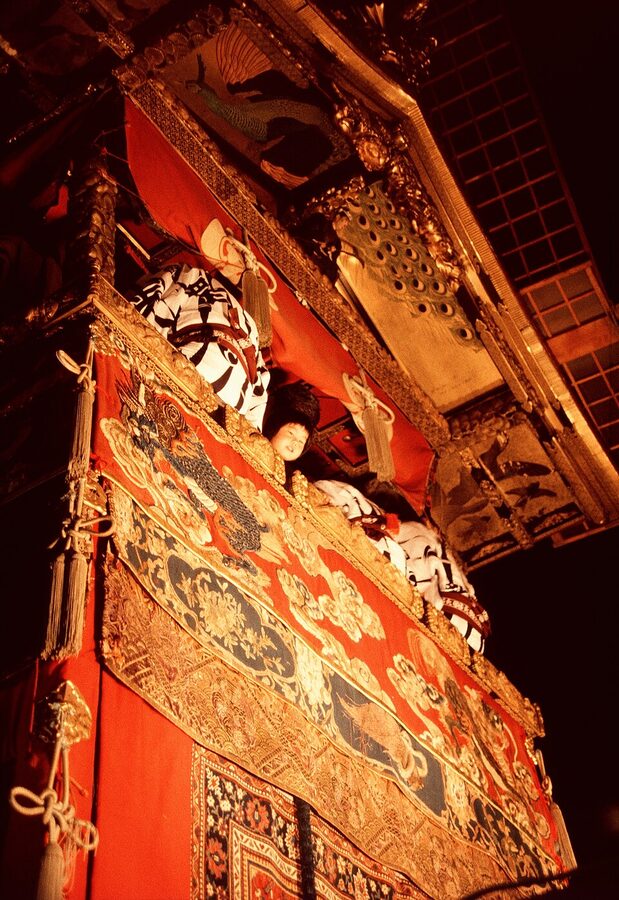
The thing the crowds come for is the yamaboko-junkō — the procession of thirty-three tall, lacquered, tapestry-hung wooden floats through the grid of central Kyoto. Nine of the thirty-three are hoko, large spear-shaped floats up to 25 metres tall and weighing around 12 tonnes apiece, rolled on man-sized wooden wheels. Twenty-four are yama, smaller mountain-shaped carriages, some wheeled and some carried. Each belongs to a specific Kyoto neighbourhood — not in the abstract, but to a particular couple of streets and a particular group of families who own the float, maintain it in a town storehouse across the eleven non-festival months, rebuild it for July, and dress it in heirloom tapestries that in some cases are 16th-century Belgian or Persian pieces acquired by merchants on the silk route.
The other thing that happens, less photographed but theologically the whole point, is the mikoshi-togyo, the transfer of three portable shrines from Yasaka to the Ōtabisho (御旅所) provisional shrine on Shijō Avenue on the evening of 17 July, and their return the evening of 24 July. During the seven intervening nights, the gods of Yasaka — Susanoo-no-mikoto, his consort Kushinada-hime, and their eight children — live in central Kyoto rather than up on Higashiyama. The yamaboko processions clear the streets for them. If you asked the Yasaka priests what the festival is for, they would say: the floats are the clearing; the mikoshi is the visit.
Heian-kyō, 869 CE, and the halberds in the garden
Plague was a specific Heian-era anxiety. The new capital, founded at Heian-kyō in 794, had been laid out on a drained wetland, which meant the summers ran humid and mosquito-heavy. The population concentration was the highest in the country, the drainage system routinely mixed with the drinking water, and by the middle of the 9th century the city was cycling through smallpox, dysentery, measles, and what contemporary records call warawa-yami — “children’s shivering,” which was almost certainly malaria. Compounding this, the country had just survived the Jōgan earthquake of 869, the Jōgan Fuji eruption of 864 which sent lava down the mountain’s north face for months, and a general sense that the spirit realm was out of balance. The Onmyō-dō diviners of the court attributed it to the angry souls of the politically wronged — chief among them Prince Sawara, starved to death a century earlier in the Fujiwara no Tanetsugu affair.
The 869 remedy was a goryō-e, a spirit-appeasement ceremony, and the specific mechanism is worth understanding because the whole later logic of the festival flows from it. Urabe Hiramaro erected sixty-six halberds at the Shinsen-en imperial garden south of the palace. Sixty-six was the number of provinces in Japan at the time. Each halberd was declared the vessel for the malignant spirits of one province. Three portable shrines were then paraded from the garden through the city and back, carrying the enshrined presence of Gozu Tennō — a syncretic plague-deity identified, in the Buddhist reading, with Yakushi Nyorai and, in the Shintō reading, with Susanoo. The ceremony was understood to gather the disease-bearing wrath of the whole country into the blades, appease the god who governed it, and expel the sickness from the capital. The plague did, by the chroniclers’ reckoning, abate.
Whether the plague in fact abated for epidemiological reasons or because the summer of 870 simply ran drier is a question modern historians can argue about. What matters is that the Heian court recorded the sixty-six halberds as having worked. From 970 onward, the Gion Goryō-e was held annually rather than in response to specific outbreaks. By the mid-Heian period it was one of the fixed events of the imperial ritual calendar. The centre of gravity had by then shifted from Shinsen-en to the site of the present Yasaka Shrine, which Gozu Tennō had been re-enshrined at in 876 after a transfer from Harima Province. For the next six hundred years, the ceremony remained essentially what it had been in 869 — mikoshi out, mikoshi back, public ritual in between — and for that whole span the belief in Gion-style appeasement spread from Kyoto to branch shrines across the country, which is why most Japanese cities today have a “Gion” or “Tennō” shrine of some kind.
The 14th-century floats, the Ōnin War, and the 1500 revival
The yamaboko themselves, the floats that give the festival its visual identity today, are a later accretion. The earliest clear reference is in Hanazono Tennō Shinki, the private diary of the retired Emperor Hanazono, entry for 24 July 1321. Hanazono notes that a hoko — then a pole-like structure, not yet a wheeled float — was surrounded by drummers performing a fūryū dance in the street. Through the 14th century, merchants and artisans in the Shijō-Muromachi district began adding to these pole-floats: decorative canopies, then platforms for a child dancer, then — fusing with small mountain-mimic carriages called tsukuriyama that depicted scenes from Noh plays — the compound “yama-hoko” form that survives. By the mid-Muromachi period, the processional structure we now recognise was in place.
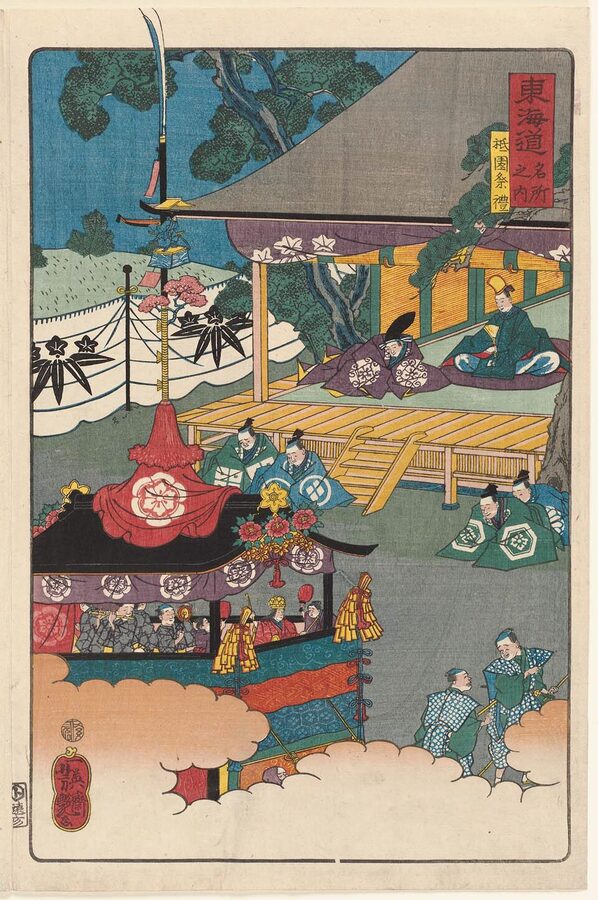
Then the Ōnin War broke out in 1467, and central Kyoto burned for eleven years. The fighting was urban — street by street, neighbourhood by neighbourhood — and the Shijō-Muromachi merchant district that owned the yamaboko was directly in the path of it. The floats were destroyed or dispersed. The festival itself lapsed for the full duration of the war and for two decades after; between 1467 and 1500, the Gion Goryō-e was not held as a procession, only as the internal Yasaka shrine rites. The line that later commentators return to is that during these thirty-three years, the shrine itself kept the festival going, but the city around it had forgotten how to do its own half.
The 1500 revival is one of the founding stories of the modern festival, and it is, importantly, not a samurai-led revival but a townspeople’s revival. By the Meiō era, Kyoto was rebuilding. The Shijō-Muromachi merchants petitioned the Muromachi shogunate to allow the procession to resume. Matsuda Buzen-no-kami Yoriaki, a Bakufu commissioner, was assigned to oversee the restoration. He tracked down “old men” (korō) who still remembered the pre-Ōnin floats and took down their testimony — the resulting document, the Gion-e Yamaboko no Koto, is our only record of the sixty pre-war floats (32 Saki, 28 Ato), several of which were never rebuilt. To settle the disputes over procession order that had exploded as neighbourhoods rebuilt their floats in different sequences, Yoriaki held the first Kuji-tori-shiki, a ceremonial lottery, at his own residence. The lottery still happens. It still settles the procession order. It is now held, every 2 July, at Kyoto City Hall, with the mayor playing Yoriaki’s part in full Muromachi costume.
The 1500 revival fixed two other things that still define the festival. First, Yoriaki wrote the participation of the townspeople (machishū) into the ceremony as a right rather than a courtesy — the floats belong to the neighbourhoods, not to the shrine or the shogunate. The shrine provides the gods and the mikoshi; everything wheeled belongs to the streets. Second, the number and identity of the floats began to calcify. The 33 we see today are a somewhat-reduced version of the 60 that existed before the Ōnin War, and over the subsequent five centuries specific floats have gone missing and been revived with long interruptions — Takayama went dark for 193 years and was rebuilt in 2022, Ōfune-hoko for 150 years and revived in 2014. But the broad shape of the procession has been, since roughly 1500, what it is now.
Edo-period patronage and the near-death under Meiji
Under the Tokugawa, the festival entered what was in some ways its golden age. The Edo-period shogunate, conservative about public ritual, protected the ceremony as an Important Custom of the Capital and insured it administratively through the Kyoto Shoshidai. Merchants, now flush with the early-modern economic boom, poured resources into their floats. The mae-kake and dō-kake tapestries we still see — Flemish verdure hangings, Persian rugs, silk Chinese embroideries — were mostly acquired in the Genroku and Kyōhō eras through the Nagasaki trade. Funa-hoko’s 17th-century Belgian tapestry, Kanko-hoko’s Ming-dynasty embroidery, Tsuki-hoko’s Indian kalamkari — these are real museum pieces that go outside, in July, under possible rain, every year.
Three fires defined the Edo-period shape of the festival. The 1708 Hōei fire burnt substantial parts of the city, but the floats of that era were still relatively simple and were rebuilt within a few years. The 1788 Tenmei fire was worse — Kanko-hoko alone took fifty years to restore. The 1864 Kinmon Incident, a failed coup by the Chōshū domain that led to a massive central-Kyoto fire, gutted more than half the floats. Only Naginata-hoko, Kanko-hoko, Tsuki-hoko, Iwato-yama, Arare-tenjin-yama, Hakuga-yama, and Hōshō-yama came through unscathed. Kikusui-hoko went dark, Ōfune-hoko went dark, Ayakasa-hoko went dark, Tōrō-yama went dark, Shijō-kasa-hoko went dark. Several of these lay in storage for more than a century before being rebuilt.
The Meiji Restoration was the harder blow, paradoxically. The shogunate-era funding model for the floats was the kiseichō system — specific Kyoto neighbourhoods were assigned as support-blocks to each float and paid a seasonal tithe in cash and labour. Meiji dismantled it. Overnight, thirty-three floats that had been running on a 200-year-old subscription model had no funding. Several went dormant; a few were sold for scrap. What saved the festival was the same thing that made it in the first place — the Kyoto townspeople simply refused to let it fail. Neighbourhood preservation societies (yamaboko hozon-kai) were established ad hoc in the 1870s and 1880s to raise private money, maintain the floats, and organise the processions. Those preservation societies are the bodies that still run the yamaboko today. The Edo-era centralised system is gone; the medieval decentralised one quietly reappeared and has operated for 150 years without serious modification.
The 20th century introduced new disruptions. Cholera outbreaks in 1886, 1887, and 1895 forced cancellations. The Second World War forced a break between 1943 and 1946 — only four full years, which in the scope of 1,150 years is slight but at the time felt existential. The postwar return was incremental: Naginata-hoko first in 1947, then Tsuki-hoko, then the yama. The Meiji-era fused single parade of Saki and Ato was kept through 1966-2013 as a transport-efficiency measure, meaning an entire generation of Kyoto residents grew up seeing all thirty-three floats go past once on 17 July. Then in 2014, largely driven by the revival of Ōfune-hoko after 150 years’ absence, the Ato-matsuri was restored as a separate event on 24 July. The festival that runs today is, in that sense, both the oldest version and the most recently rebuilt.
UNESCO, 2009, and the Yama-Hoko-Yatai group
On 30 September 2009, the UNESCO Intergovernmental Committee for the Safeguarding of the Intangible Cultural Heritage, meeting in Abu Dhabi, added the Kyōto Gion-sai no Yamaboko Gyōji, the yamaboko events of the Kyoto Gion Festival, to the Representative List of the Intangible Cultural Heritage of Humanity. Nine years later, in 2018, the listing was expanded to cover 33 separate Japanese float festivals under the umbrella designation Yama, Hoko, Yatai, float festivals in Japan. The Kyoto Gion Matsuri is the lead entry in that group. Its UNESCO-sister entries include the Owari Tsushima Tennō Matsuri (which is to Nobunaga’s Aichi what Gion is to Kyoto), the Takayama Matsuri, the Chichibu Night Festival, and the Nagahama Hikiyama Matsuri.
The UNESCO listing does not add legal protection that wasn’t already in place. All thirty-three of the Kyoto yamaboko are already Important Tangible Folk Cultural Properties under Japanese law (designated in 1962), and the ceremony itself is an Important Intangible Folk Cultural Property (designated 1979). What the UNESCO status does is open the festival to international preservation funding, particularly for craft-skills training — the specific carpentry joint that assembles the funagata framing of a hoko, the silk-knotting pattern of the shimenawa ceremonial ropes, the tuning of the Gion-bayashi bell. These are the skills whose intergenerational transmission UNESCO is underwriting. The floats themselves would have been preserved in any scenario; it is the knowledge of how to rebuild them that needed the extra support.
The Tsushima entry I just linked to is worth a word because the two festivals share more than the UNESCO bracket. The Aichi ceremony’s boats descend, conceptually, from the same 9th-century Shinsen-en halberds — Tsushima’s six boats carry the same spirit-expulsion logic that the Kyoto mikoshi carries on land. If you read the Tsushima article and then the Gion one, what you are reading is two branches of a single 1,150-year-old ritual family — one that kept to the water and one that took to the streets. They are the surviving flagships of the practice.
The thirty-three floats
A census of the floats, since it is the question every visitor eventually asks. Twenty-three of the thirty-three go out on 17 July for the Saki-matsuri; ten go out on 24 July for the Ato-matsuri. Nine are hoko — the large wheeled spear-floats that dominate the Saki procession. Twenty-four are yama — the smaller mountain-carriage floats, some of which now have wheels (most were converted over the 20th century; Kakkyo-yama was the last, in 1972) and some of which are still carried on the shoulders of about forty men.
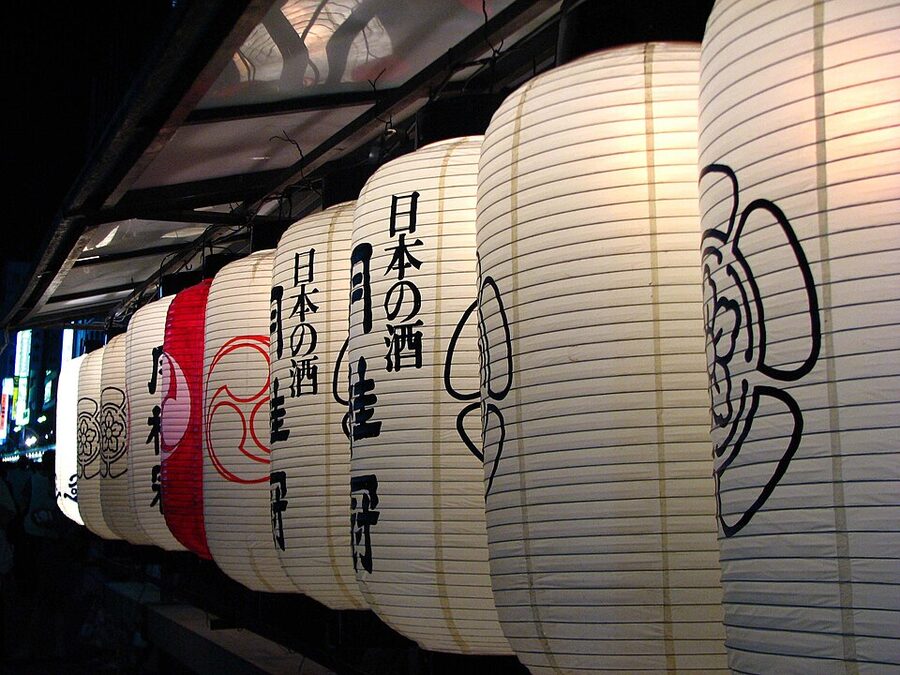
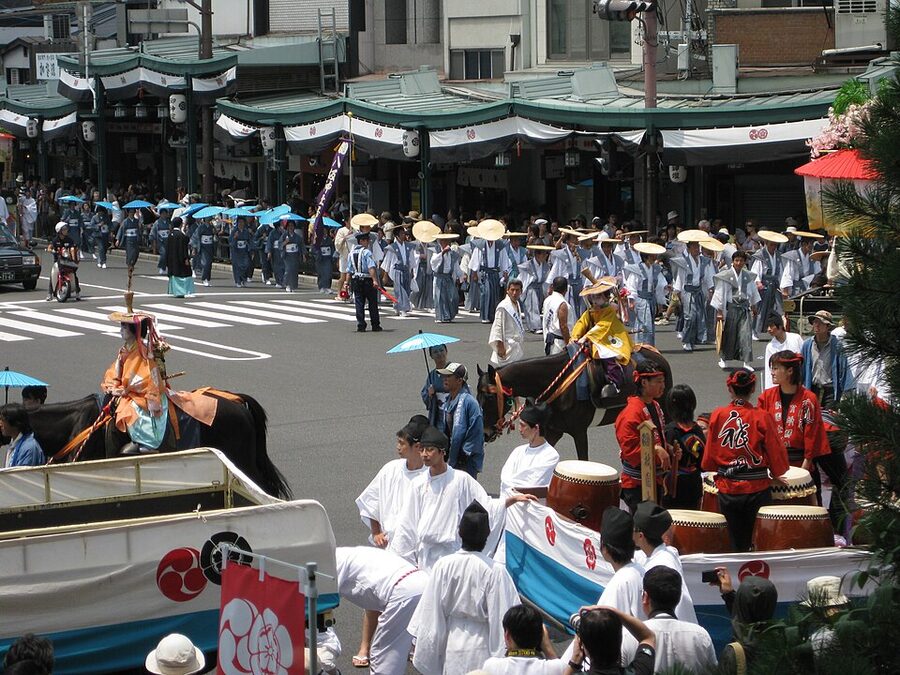
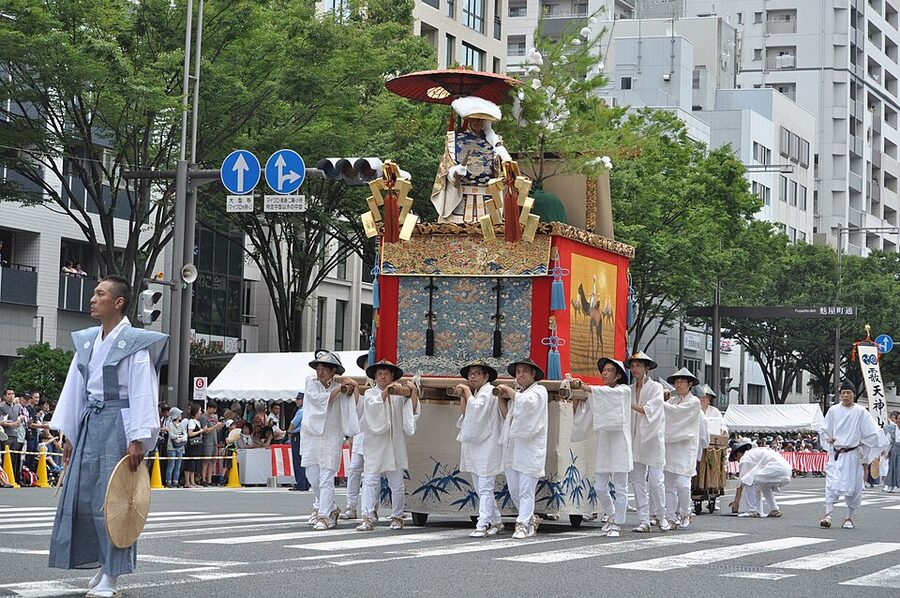
The lead float of the Saki-matsuri is Naginata-hoko (長刀鉾), and its position is non-negotiable. Since at least the 1500 revival it has been designated kuji-torazu, “not subject to the lottery”, meaning the annual Kuji-tori-shiki fixes its spot as first. It is the only float with a live child rider, the chigo, selected from a Kyoto family in rotation and held sacred for the duration of July (during which he is forbidden to touch the ground, and his mother and sisters are not permitted near him). Naginata-hoko is also the only float where the chigo performs the shimenawa-kiri — the cutting of a ceremonial rope strung across Shijō Avenue to formally open the Saki-matsuri route. The cutting is live on NHK every year. It is the festival’s most recognisable moment.
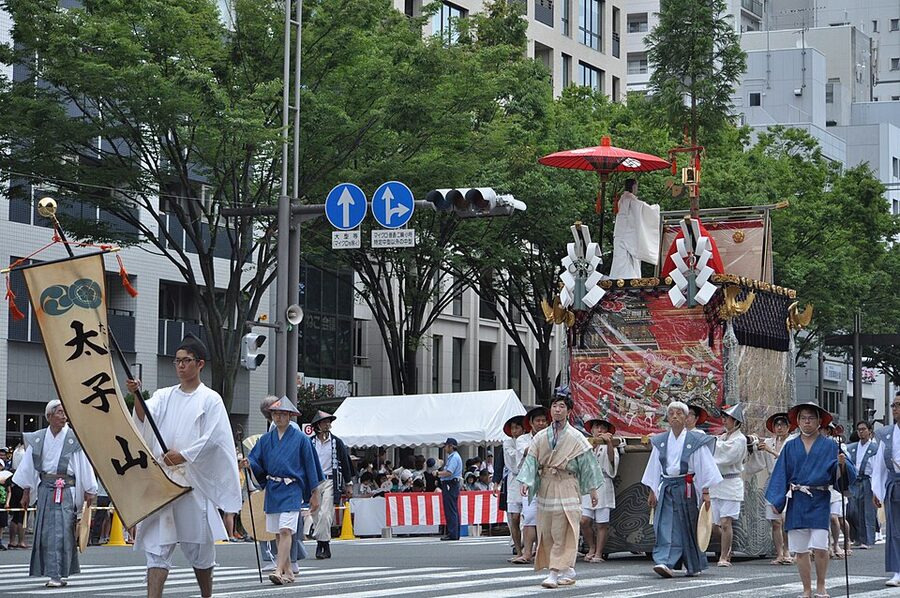
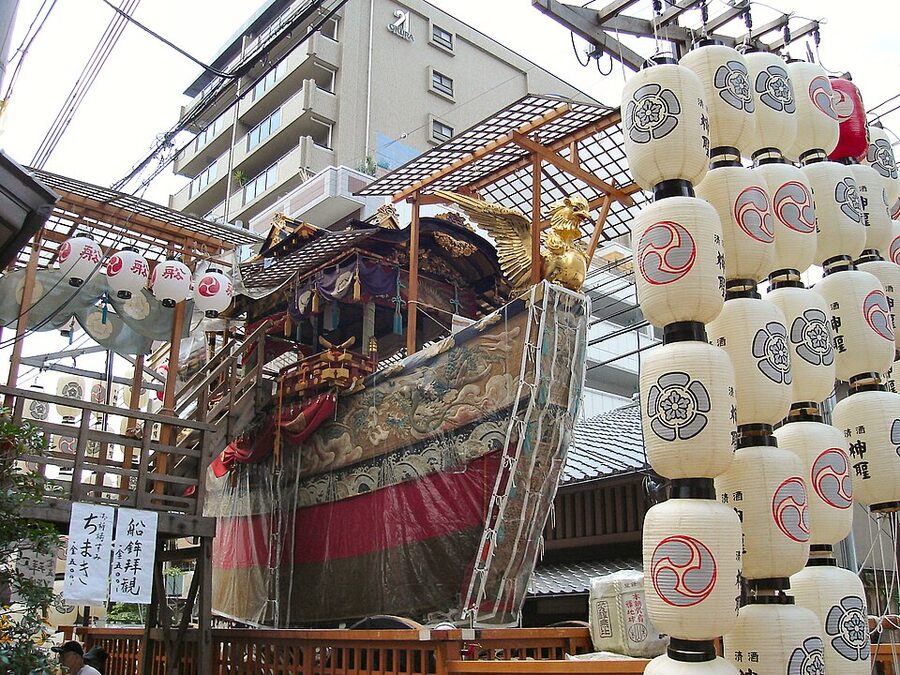
The other kuji-torazu floats, the ones whose order is fixed, include Hakurakuten-yama (fifth in the Saki-matsuri), Hōka-hoko (21st, traditionally second-last), Iwato-yama, and Funa-hoko (23rd, the last Saki-matsuri float, always). Funa-hoko (船鉾) is itself a landmark — a float built in the shape of a full ship with prow, sails, and rigging, commemorating Empress Jingū’s legendary invasion of Korea. It has a 17th-century Flemish tapestry on the stern. For a long time it was the only ship-float, until Ōfune-hoko, the Ato-matsuri’s lead ship-float, returned in 2014.
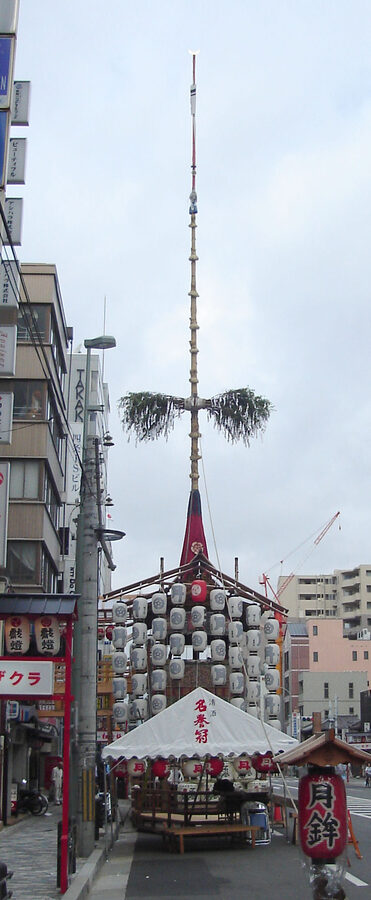
Three other hoko are reliably recognisable from the ground. Kanko-hoko (函谷鉾) carries the classical-Chinese reference to the Han-era minister who outwitted his enemies at the Hangu Pass; its musicians’ ensemble is considered the finest-trained of the festival’s twenty-four hoko-bayashi. Tsuki-hoko (月鉾), “Moon Hoko”, is topped with a brass crescent and is usually third or fourth in the procession, depending on the lottery. Kikusui-hoko (菊水鉾) was dark for 88 years after the 1864 fire, returning only in 1952 in a provisional form and 1953 in its full rebuilt form.
The yama are the more variable half of the procession and the half that foreign visitors tend to miss. They are smaller, usually a single platform with a life-size doll of a Noh-play character or a historical figure, and they carry less musical apparatus. But they are also the older form. The mountain-carriage predates the wheeled hoko by a century. Minami-kannon-yama, in the Ato-matsuri, is one of the best-preserved yama and carries a Bodhisattva statue in full period robes; Ashikari-yama depicts a fable of a lost wife found cutting reeds; Kakkyo-yama carries the grim Chinese story of a man who buried his son alive for lack of food, which sounds unfestive but is what the Chinese moral canon included. The yama tend to specialise in these precise Noh-play moments, which is why their tableau don’t change year to year.
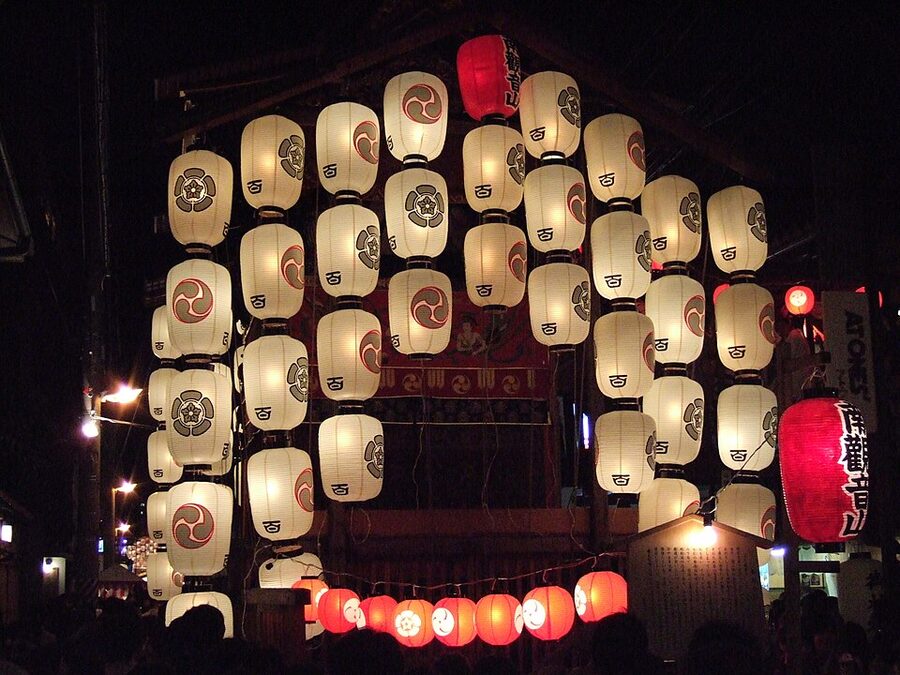
The Ato-matsuri’s lead float, since its 2014 revival, is Ōfune-hoko (大船鉠) — another ship-float, built as the counterpart to the Saki-matsuri’s Funa-hoko. Ōfune-hoko was destroyed in the 1864 fire and laid dormant for 150 years. The neighbourhood’s reconstruction campaign ran from 1996 to 2014, raised over ¥500 million, and rebuilt the float from historical drawings and a single surviving model. The 2014 revival pairs with the Ato-matsuri’s own revival as a separate procession, the one paid for the other, and Ōfune-hoko is now the Ato-matsuri’s kuji-torazu lead, playing on 24 July the role that Naginata-hoko plays on 17 July.
Yoiyama — the three evenings before
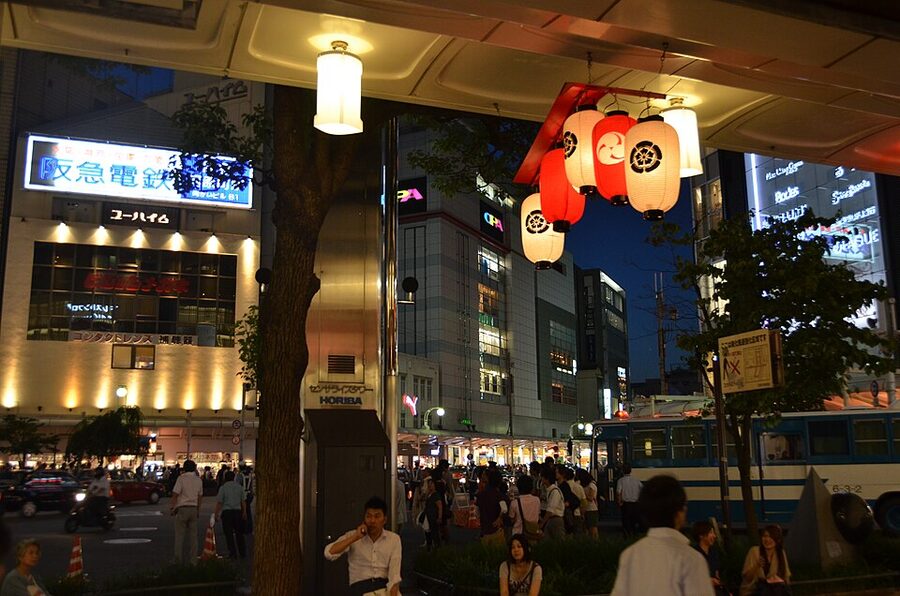
If you have only one evening in Kyoto in July and you want the festival experience rather than the parade, come on 15 or 16 July for Yoiyama. The term covers the three evenings preceding the Saki-matsuri procession: Yoi-yoi-yoi-yama (14 July), Yoi-yoi-yama (15 July), and Yoi-yama proper (16 July). All twenty-three Saki-matsuri floats are assembled by this point, standing in the streets of the Shijō-Muromachi-Karasuma quarter, lit by paper lanterns from about 6 pm until midnight. The main streets around them are closed to cars. Estimates for 16 July hit around 400,000 people in the quarter over the course of the evening, concentrated between Shijō and Sanjō, Karasuma and Horikawa.
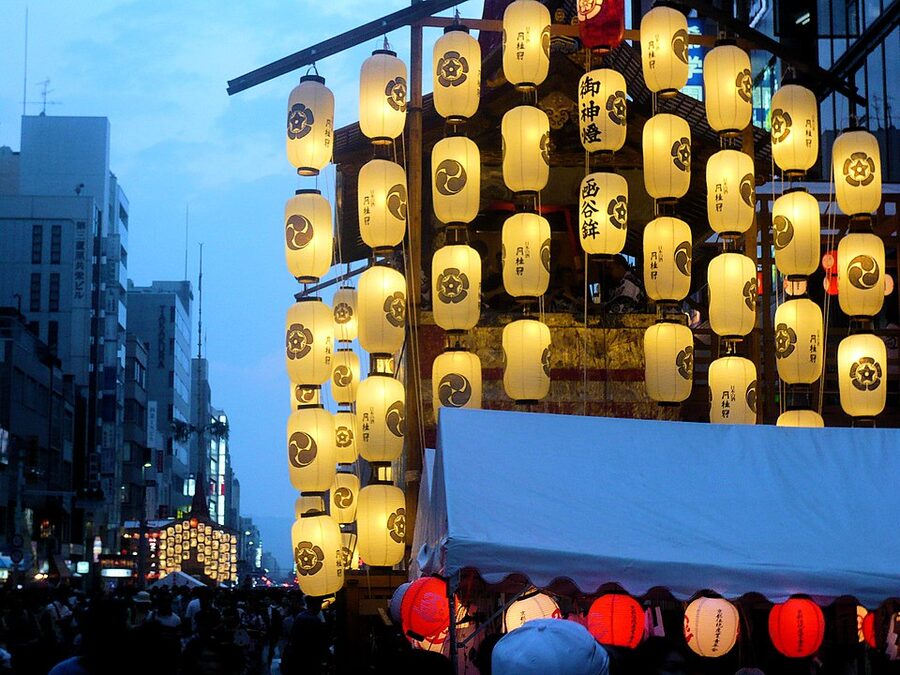
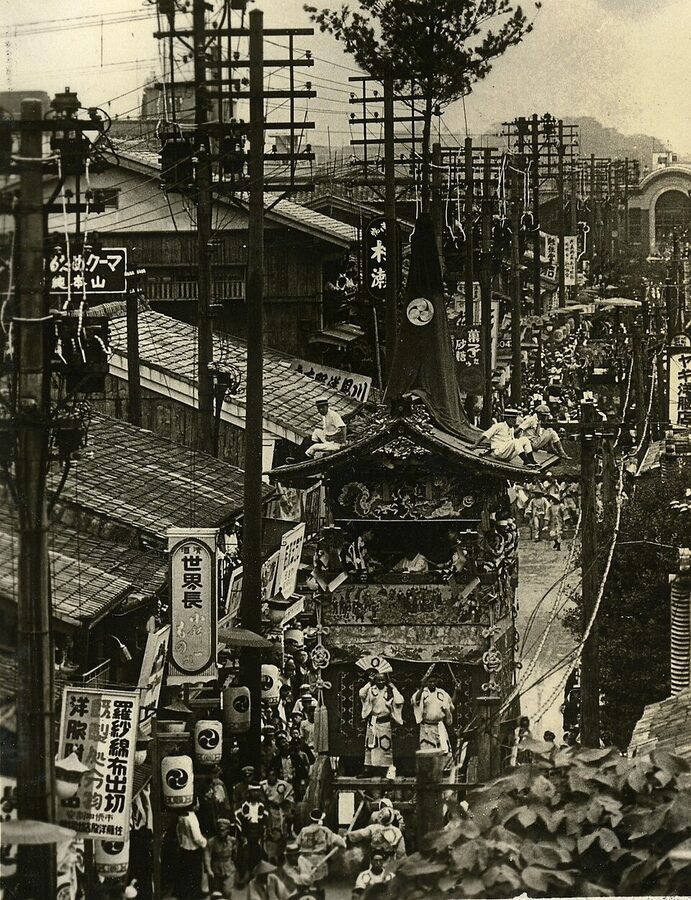
The distinctive Yoiyama practice — the thing that makes it different from a standard Japanese yomise night market — is the opening of the kai-sho, the neighbourhood storehouses belonging to each float. Each yamaboko-chō has its own storehouse, typically a ground-floor stone-built structure on the neighbourhood’s corner, where the float’s tapestries, ornaments, and bayashi instruments are kept for eleven months of the year. During Yoiyama, these storehouses are open to the public. You can walk in, see the spare parts and past-era pieces, look at the current year’s bayashi instruments, and pick up the float’s chimaki charms. Some neighbourhoods also open their private houses to show the Byōbu folding screens and scroll paintings that families have kept for generations. This is the “moving museum” aspect of the festival at its most intimate — you are walking through Kyoto merchant households’ Edo-period art collections, in streetwear, with a paper lantern bought from the corner stall.
The chimaki are the other Yoiyama detail worth explaining. These are bamboo-leaf-wrapped bundles of grass, sold from the storehouses of each float for 1,000 yen or thereabouts, that you hang on your front door as an annual charm against disease. Each float’s chimaki carries a slightly different blessing — Naginata-hoko’s is considered the strongest all-purpose protection; Kikusui-hoko’s is specialised to longevity; Ashikari-yama’s is sold particularly to those looking for a missing person or wanting to rebuild a relationship. The chimaki economy is substantial, each float sells around ten thousand per Yoiyama, and it is the primary revenue source that keeps the neighbourhood preservation societies funded. When you buy one, you are not buying a souvenir; you are paying next year’s lashing-rope bill.
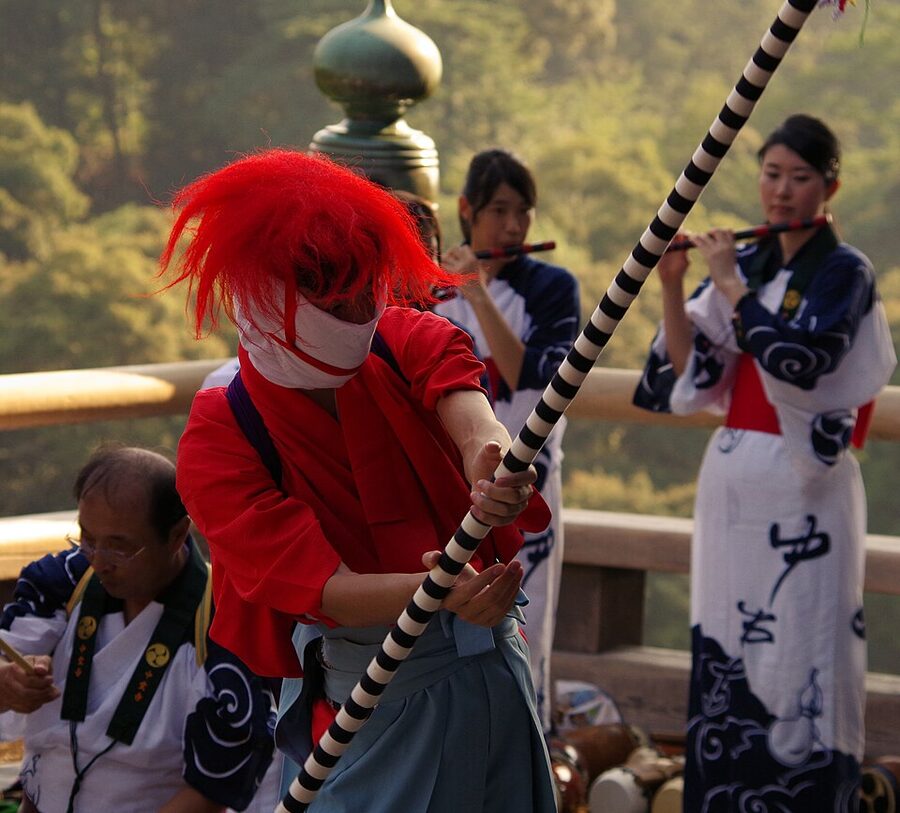
17 July — Saki-matsuri and the corner turn
The Saki-matsuri procession begins at 9 am sharp on 17 July. The twenty-three Saki floats line up in their Kuji-tori-shiki-determined order on Shijō Avenue, between Karasuma and Horikawa. At approximately 9:00, the chigo on Naginata-hoko performs the shimenawa-kiri, one clean cut of a ceremonial rope strung across the street, and the procession begins moving east. The route runs Shijō Karasuma → Shijō Kawaramachi → Kawaramachi-Oike → Shinmachi-Oike. The total distance is about 3.5 kilometres. The procession takes roughly three and a half hours — the last float clears the Shinmachi-Oike terminus around 1 pm.
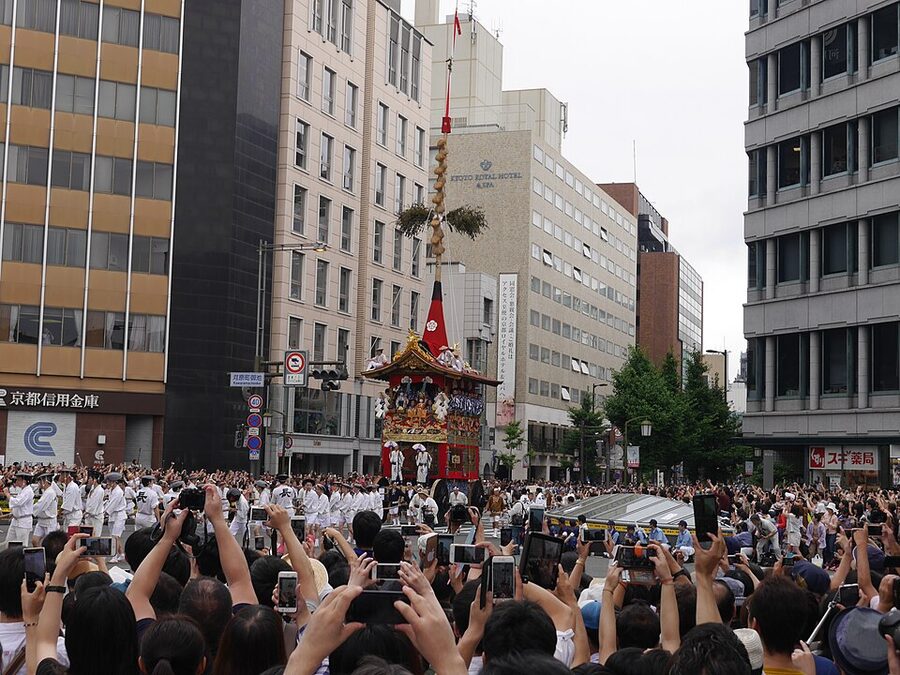
The moment of the procession everybody waits for is the tsuji-mawashi — the corner turn. The large hoko don’t have a steering mechanism. They are effectively square boxes on four fixed wheels. To turn them, a crew of ten men slides thin bamboo strips wetted with water underneath the outer pair of wheels and, on the ondotori‘s count, the whole crew of thirty-plus pullers yanks the float sideways over the bamboo. The float pivots about forty-five degrees. The crew drags it another few metres. Repeats. A full ninety-degree turn takes about ten minutes and three separate slides. The two corners everyone photographs are Shijō-Kawaramachi (the first major turn, about 9:35 am) and Kawaramachi-Oike (the second, about 10:30 am). Miss nothing else, but find a spot for at least one of these.
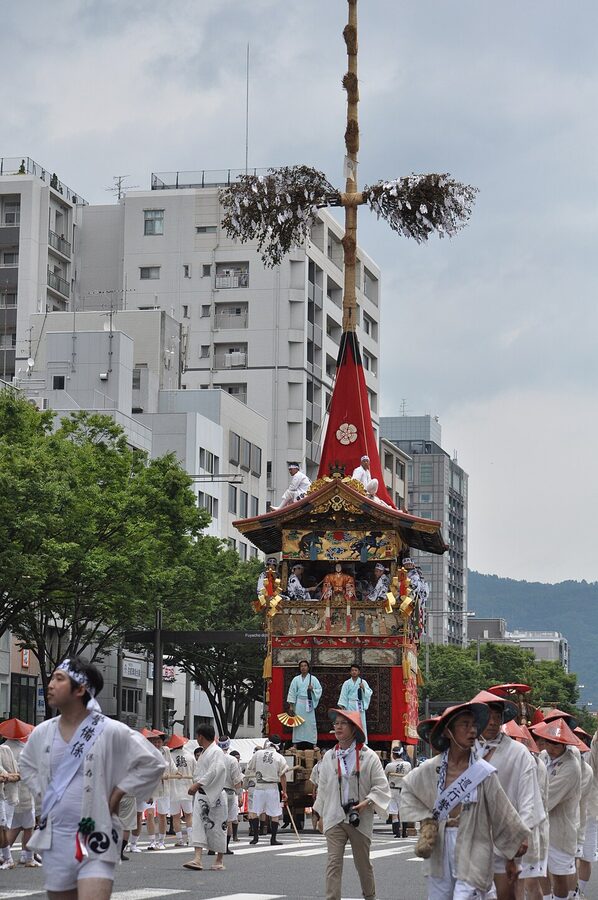
On the evening of 17 July, the first half of the festival’s actual spiritual purpose takes place. The three Yasaka mikoshi — Naka-goza for Susanoo, Higashi-goza for Kushinada-hime, Nishi-goza for the eight children — depart from the shrine’s main hall and are carried through Higashiyama and down across the Kamogawa to the Ōtabisho on Shijō Avenue. Each mikoshi is borne by a dedicated mikoshi-kai of around eighty men, in short coats and white headbands, chanting hoitto hoitto. The procession takes about four hours. The mikoshi arrive at the Ōtabisho around 10 pm. They stay there for seven nights.
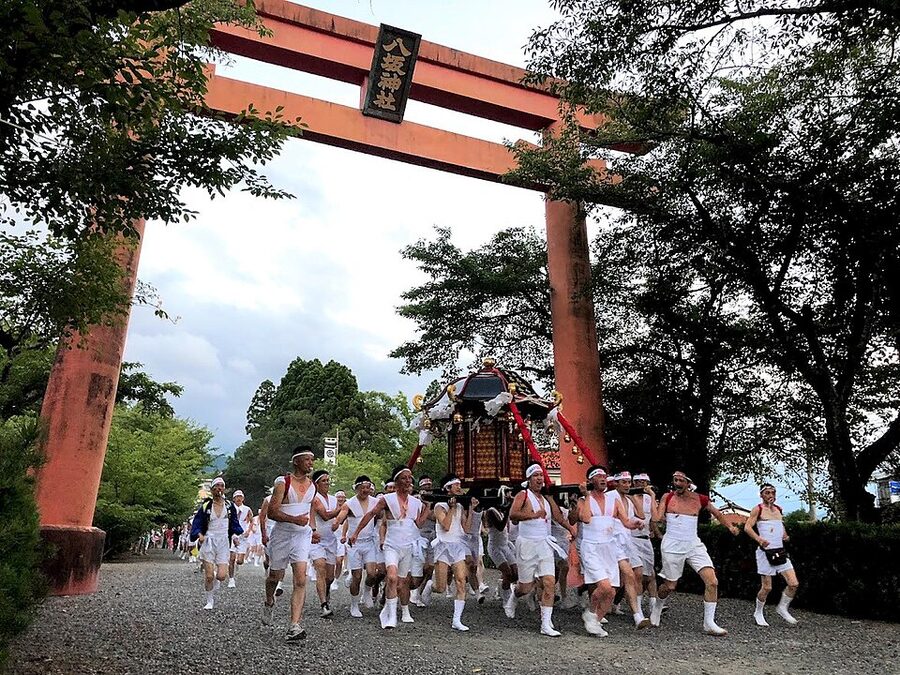
24 July — Ato-matsuri and the return
The Ato-matsuri on 24 July is a smaller, quieter event than the Saki-matsuri — ten floats rather than twenty-three, perhaps a third the crowd. It runs the reverse route: Karasuma-Oike start at 9:30 am, east on Oike, south on Kawaramachi, west on Shijō, ending at Shijō-Karasuma. The lead float is Ōfune-hoko, restored in 2014; it includes Kita-Kannon-yama, Minami-Kannon-yama, Hashi-benkei-yama, Kuronushi-yama, Jōmyō-yama, Taka-yama (revived 2022 after 196 years’ absence), and the others. Because the procession is smaller and the crowd less dense, this is genuinely the better day to see individual floats in detail, to photograph tapestries in good light, to ask the crew a question. The Ato-matsuri is my preferred procession for anyone who has the flexibility to choose.
On the evening of 24 July, the mikoshi go home. The three portable shrines depart the Ōtabisho and retrace their route back to Yasaka. The return procession is called Kankō-sai. The three mikoshi travel separately — each taking its own route through the Higashiyama neighbourhoods, calling at sub-shrines en route, gathering at a designated point around 10 pm to cross the Kamogawa together and climb the last stretch back to the main shrine. By midnight, they are back in Yasaka’s inner sanctuary, and the gods who have spent a week in the merchant city of Kyoto are returned to the hillside shrine. The formal festival is over, though the final ceremonies — the Nochi-no-mikoshi-arai on 28 July, a ritual cleansing of the Naka-goza mikoshi in the Kamogawa — run to the end of the month.
Where to see it — planning a visit
Yasaka Jinja — the shrine at the heart of it
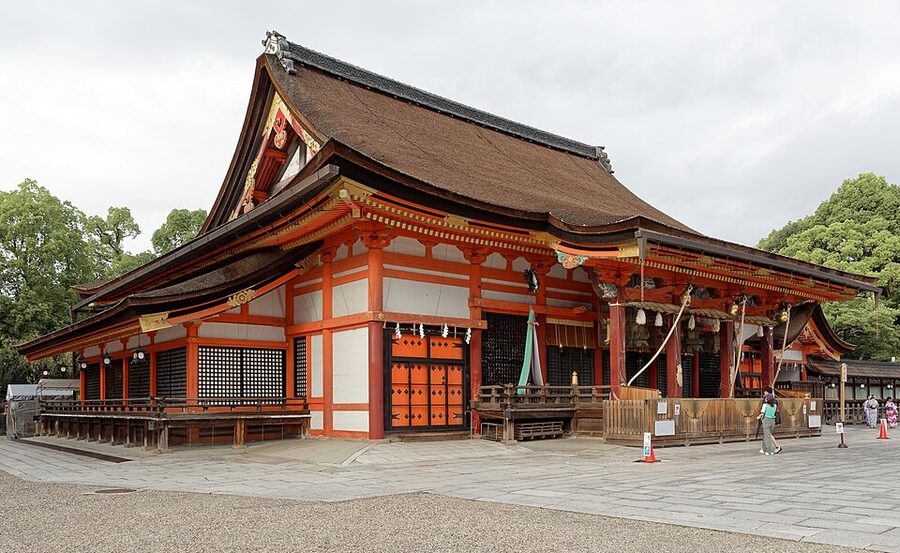
Yasaka Shrine sits at the east end of Shijō Avenue, where the street meets Higashiyama and the paved grid of central Kyoto gives way to the temple district. The shrine is free to enter, open 24 hours, and has been the anchor of Gion Matsuri since 876. The Main Hall (Honden) is a 1654 Tokugawa-era reconstruction in a distinctive roof-style called Gion-zukuri, where the main-hall and worship-hall share one continuous roof; it is a National Treasure.
The shrine is busiest on the evening of 17 July (mikoshi-togyo departure) and the evening of 24 July (mikoshi return), but worth a visit at any point during July. Off-festival, the adjacent Maruyama-kōen park is a reasonable picnic ground in cherry-blossom season. For Gion Matsuri purposes, if you want to see the mikoshi leave from the gate itself, arrive at the South Gate (Minami-rōmon) by about 5 pm on 17 July; the gate closes to general traffic during the ceremony. The precinct is otherwise accessible throughout.
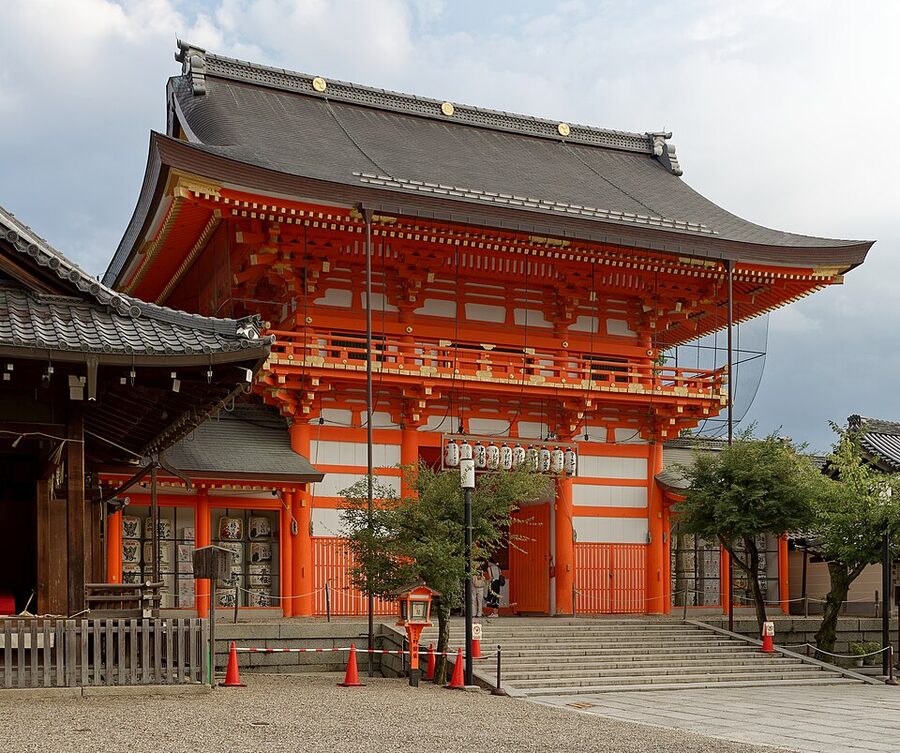
Getting to Yasaka: Keihan Gion-Shijō Station is a 7-minute walk; Hankyū Kyoto-Kawaramachi is 10 minutes. If you are walking from central Kyoto hotels, head east on Shijō Avenue and you cannot miss it. Entry is always free.
Shinsen-en — the 794 CE origin site
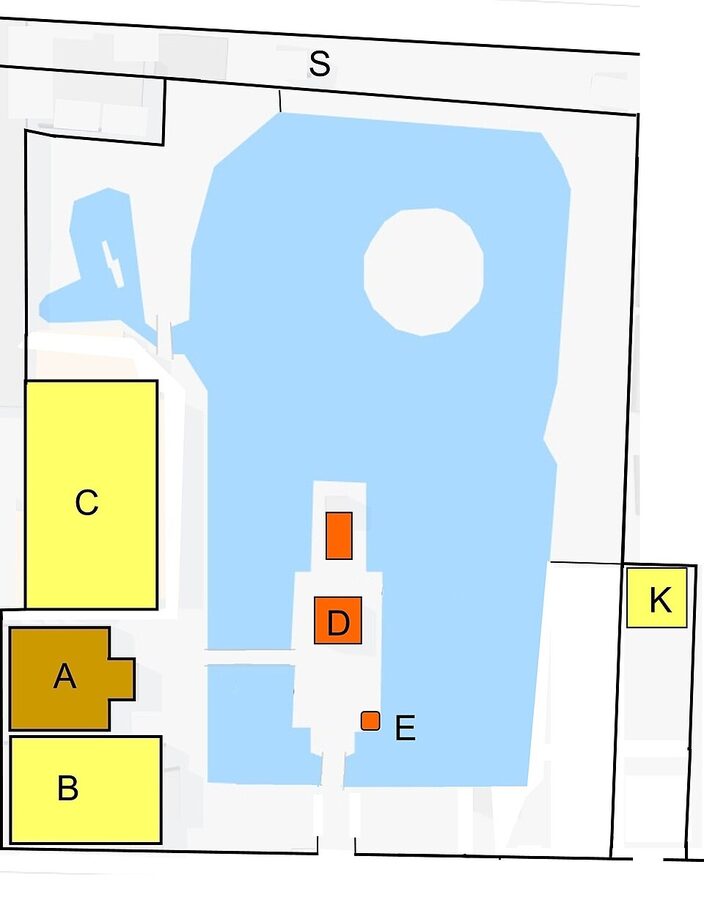
Shinsen-en (神泉苑) is an easily-overlooked temple garden a block south of Nijō Castle in Nakagyō-ku, and it is, historically, where Gion Matsuri was born. The imperial garden was laid out in 794 as part of the founding of Heian-kyō; in 869 it was the site of the sixty-six halberds that constituted the first Gion Goryō-e. The garden is now one-twentieth of its Heian size, Tokugawa Ieyasu flattened most of it to build Nijō Castle in 1603, but the central pond is original, the stone bridge is where the Heian court would have stood during the rites, and a small sub-shrine to Gozu Tennō stands on the southern edge.
Most Kyoto travel guides skip Shinsen-en. It is a fifteen-minute walk from Nijō Castle and gets the leftover-time slot, if at all. For Gion Matsuri purposes it is arguably the single most important site — more so than the parade route, more so than even the shrine — because this is where the 1,150-year continuity starts. The garden is generally empty; even during the July festival period, perhaps fifty people pass through per day. Entry is free. There is a small café on the grounds that serves matcha and tea-rice.
Getting there: Shijō-Ōmiya Station on the Hankyū Kyoto Line is a 7-minute walk north-east; Nijō Station on the JR San-in Line is a 10-minute walk south-west. The garden is open 7 am to 8 pm year-round. Free entry.
Naginata-hoko’s Yoiyama site — Shijō-Karasuma intersection
If you cannot be in Kyoto on the procession days, aim for the Yoiyama evenings 14-16 July. The heart of it is the Shijō-Karasuma intersection. Naginata-hoko’s home block is on the south-west corner; Kanko-hoko is two blocks west. The whole Shijō-Muromachi-Karasuma-Sanjō quadrangle is closed to traffic from about 6 pm. The floats stand fully assembled and lit; the neighbourhood houses open their ground-floor rooms to show family heirlooms; stalls sell chimaki charms, grilled corn, shaved ice, and cold amazake. The crowd peaks between 8 and 10 pm. Go earlier if you can — around 6:30 pm you can actually walk between the floats without queuing.
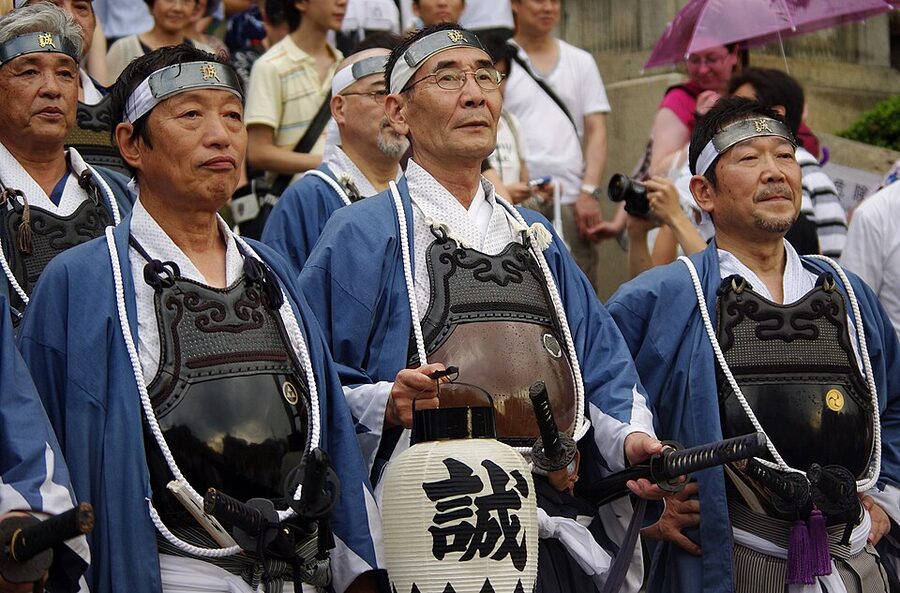
Getting there: Shijō Station on the Karasuma subway line exits directly into the intersection. From Kyoto Station it is 4 minutes on the subway. Don’t drive; the quarter is closed to cars for all three Yoiyama evenings.
Saki-matsuri viewing — 17 July
The three best standing positions for the 17 July procession are: (1) Shijō-Karasuma itself, for the 9 am start and the shimenawa-kiri; (2) the Shijō-Kawaramachi corner, for the first tsuji-mawashi turn around 9:35 am; (3) the Kawaramachi-Oike corner, for the second turn around 10:30 am. Paid grandstand seating is available on Oike between Kawaramachi and Teramachi — booked through the Kyoto City Tourism Association website, roughly ¥5,000 for a reserved seat. Free standing-room along the whole route is first-come; the prime corners fill up by 7 am.
Practical notes. Arrive two hours before the start for any decent standing spot. Bring water — Kyoto in mid-July is 34-36°C by 10 am, often higher. Bring a hat. The procession moves at walking pace and you will be standing still for two to three hours. The paid seats on Oike include a roof and are worth the ¥5,000 if you are there for the spectacle rather than the atmosphere. For the mikoshi-togyo in the evening, the best standing spot is the Shijō-Ōhashi bridge; the mikoshi cross the Kamogawa at approximately 8:30 pm.
Ato-matsuri viewing — 24 July
For the Ato-matsuri on 24 July, the best positions are (1) Karasuma-Oike at 9:30 am for the start, with Ōfune-hoko leading; (2) Kawaramachi-Oike for the turn at approximately 10 am; (3) Shijō-Kawaramachi for the procession’s final corner at about 10:45 am. The crowds are roughly a third of the Saki-matsuri numbers, which means you can get a decent standing spot forty-five minutes before a turn rather than two hours. Paid seating is available but is not necessary unless you specifically want the shaded grandstand.
A tactical note for photography. The Ato-matsuri runs in the opposite direction to the Saki-matsuri, which means the morning light hits the floats’ western-facing tapestries on the Kawaramachi leg — the hanging textiles that on 17 July are backlit and hard to photograph are, on 24 July, lit from the side. For readers concerned with the visual textiles of the floats rather than the procession atmosphere, this is the day to come.
Kuji-tori-shiki — 2 July at Kyoto City Hall
For the historically-minded, the lottery drawing that determines the procession order is held at Kyoto City Hall on 2 July at 10 am. The public can attend by lottery application — a reply-paid postcard, available through the Kyoto City Tourism Association, submitted in May. Around a hundred public seats are drawn. The current mayor wears Muromachi-era kariginu court dress and plays Matsuda Yoriaki’s 1500 role, conducting the ritual exactly as it was recorded in the Shikijō Kōsakimonsho. Even if you don’t get a seat, the procession of float representatives entering City Hall in the morning is worth watching from the street outside.
Getting to Kyoto and staying
Kyoto is two hours twenty from Tokyo on the Tōkaidō Shinkansen, forty-five minutes from Shin-Osaka. Hotel prices over the festival week are substantially elevated — budget business-hotel chains (Toyoko Inn, APA, Route Inn) that normally run ¥7,000-8,000 will clear ¥18,000 or more for nights of 14-17 July. Book in March. Machiya vacation rentals fill by early spring. The practical workaround, if you have missed the Kyoto booking window, is to stay in Osaka and commute — Shin-Osaka-to-Kyoto is twelve minutes on the Shinkansen, and Osaka hotel rates over the same week remain close to normal.
What to combine with. The festival pairs naturally with a Kyoto-centric history itinerary; in practical terms, the weeks before and after are a good window for the Akechi Mitsuhide sites in western Kyoto (Kameyama Castle, Shōryū-ji temple), for the Hideyoshi connections at Hōkoku-jinja and Juraku-dai, and for Kyoto tea-ceremony experiences at the Ura-Senke and Omote-Senke schools (which, incidentally, overlap materially with Gion-bayashi patronage networks — several of the great Kyoto tea families are also yamaboko sponsors). If you have the time to extend east, the Tsushima Tennō Matsuri in late July in Aichi is the UNESCO sister event and is two hours west of Kyoto by Shinkansen — a Kyoto-Aichi festival double is doable for those willing to build it.
Closing — the month that keeps recurring
One thing I would say, having watched Gion Matsuri from several different vantage points over the years, is that the Yoiyama evenings are the ones that stay with you. The parade is magnificent, in a civic-theatre way — you go, you stand, you clap at the tsuji-mawashi, you see the sixteenth-century tapestries in the sunlight, you understand why UNESCO wrote the whole thing down. But the Yoiyama evening when you are walking through Muromachi Street with a chimaki in your hand, past the open door of a storehouse where a neighbourhood’s bayashi musicians are practising a piece their great-grandfathers played, while a merchant’s wife sits at the window showing a folding screen that has not been out of its storage room since the previous July — that is the festival in its living form, not its theatrical form. That is why the ceremony has survived 1,150 years. Because it is not only performed; it is also, every July, inhabited.
The sixty-six halberds in the Shinsen-en garden were the original point. One for each province, one god to receive the malignant spirits, three mikoshi to parade the expulsion through the city. That structure is still there, overlaid with 1,150 years of merchant-town accretion and Edo-era silk tapestries and UNESCO funding — but the shape is the same. It is a provincial disease-expulsion ritual, carried out in a national capital, in the muggiest month of the year, because that is when plagues used to strike. When you stand at the Shinsen-en pond in the quiet at the end of July and the last mikoshi has returned to Yasaka and the floats are back in their storehouses for another eleven months, what you are looking at is the place where the entire apparatus began, still unguarded, still free to enter, and still expecting to be called on again next year.
If you are in Kyoto in July, clear a day for the procession and, if you can, two evenings for Yoiyama. If you can only have one evening, make it 15 July — one day before the peak crowds, all the floats assembled, the neighbourhood houses open, the chimaki still available. Buy one and take it home. You will hang it on your door, and it will hang there for eleven months, and next summer, at exactly the right time, you will begin to think about coming back.


_lanterns_(189742871).jpg)


.JPG)

.jpg)


.JPG)


