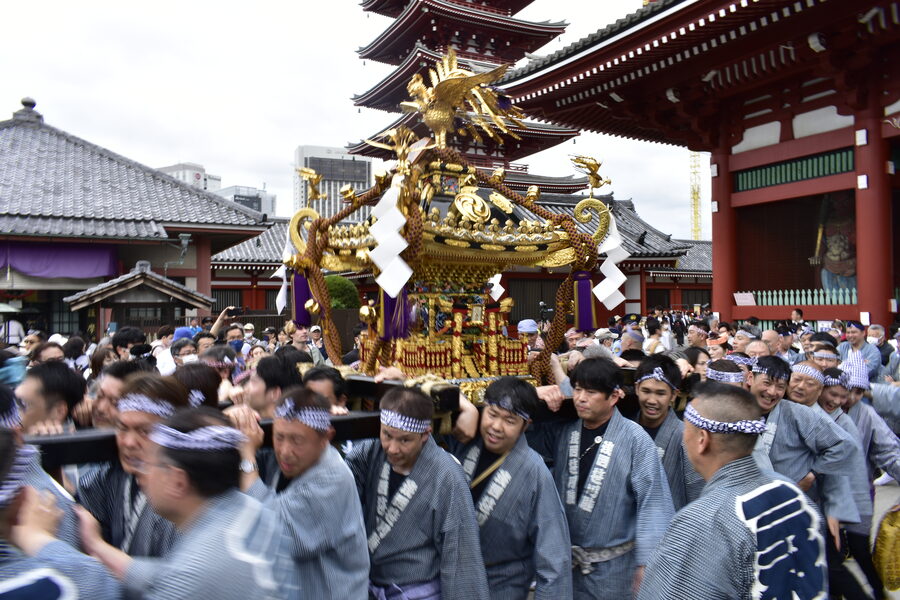
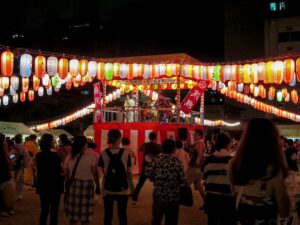
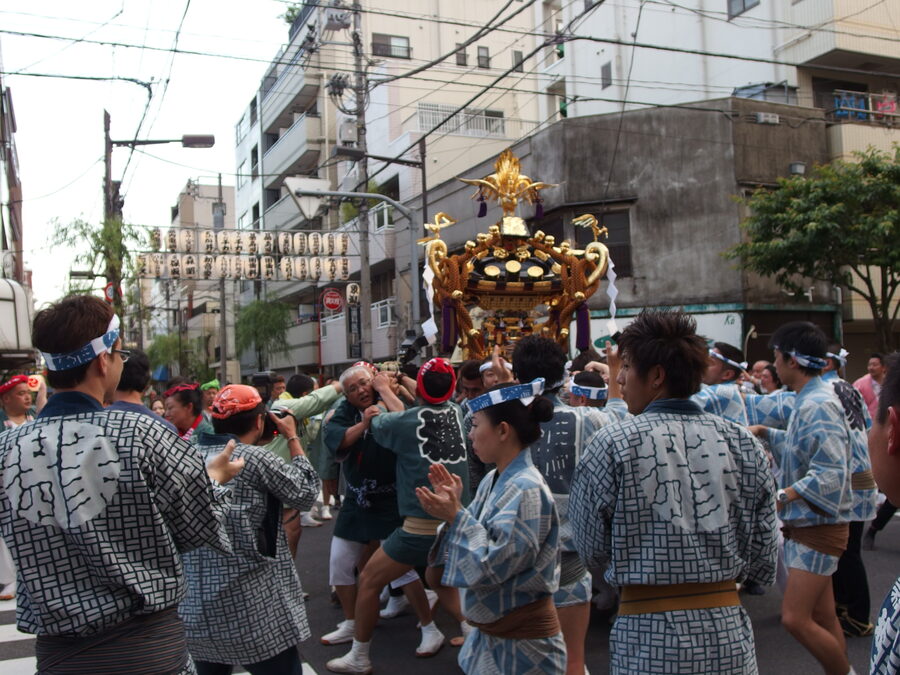
Roughly 100 mikoshi from 44 different town associations in Asakusa pour into the streets over a single weekend in May, and somewhere between 1.5 and 2 million people pack themselves around them to watch. That is what the Sanja Matsuri (三社祭) actually is, in numbers. It is also the festival where, until very recently, you could see otherwise-hidden full-body yakuza tattoos in newspaper photographs the next morning, because the bearers stripped down to fundoshi and went up onto the rooftops of their own portable shrines.
The festival is held every year on the third weekend of May, hosted by Asakusa Shrine, the Shinto shrine that sits one stone-paved courtyard east of Senso-ji. The shrine is dedicated to three men: two fishermen brothers, Hinokuma Hamanari and Hinokuma Takenari, and their lord, Hajino Nakatomo. According to legend, on March 18, 628 CE, the brothers pulled a small statue of the bodhisattva Kannon out of the Sumida River in their net, and Hajino later turned his house into the temple that became Senso-ji. So the Sanja, which means “three shrines,” is a festival to the men who founded the temple next door.
I am writing this in late April, three weeks before the 2026 Sanja Matsuri opens on the morning of Friday, May 15. If you are anywhere near Tokyo on the third weekend of May, you should go. This is the most concentrated burst of Edo street life that has survived from the seventeenth century, and the way it works is unusually open to outsiders.
In This Article
- What the Festival Actually Is
- The 628 CE Founding Myth
- Asakusa Shrine, Not the Temple
- The Friday Opening: Daigyoretsu and Binzasara
- Saturday: 100 Mikoshi from 44 Town Associations
- The Sunday Climax: The Three Honmikoshi
- The 1872 Ban
- The 1945 Firebombing and the Postwar Revival
- Tattoos, Yakuza and the 2007 Incident
- The Three Great Festivals of Tokyo
- What a Mikoshi Actually Is
- The Ujiko System
- Comparing Sanja to Other Major Matsuri
- How to Get to Asakusa
- Where to Watch
- What to Bring, What to Wear
- What Not To Do
- The Rest of Asakusa
- The Wider Festival Year
- Where Sanja Sits Today
- Practical Summary
What the Festival Actually Is
Sanja Matsuri is one of the Three Great Festivals of Tokyo (江戸三大祭, Edo san-dai matsuri), grouped with the Kanda Matsuri at Kanda Myojin and the Sanno Matsuri at Hie Shrine. Of the three, Sanja is widely considered the wildest, because it is the only one where the bearers run through narrow shopping streets shoulder-to-shoulder and the mikoshi are bounced violently in the air. The other two are stately processions; Sanja is contact sport.
The festival runs Friday afternoon through Sunday evening, with the third Sunday of May as the climax. Friday is opening rituals and a costumed parade through Nakamise. Saturday is when the 44 town associations parade their own neighbourhood mikoshi. Sunday is when the three big honmikoshi (本社神輿), each weighing about a ton and carrying the spirit of one of the three founding deities, leave Asakusa Shrine at six in the morning and don’t return until eight in the evening.
That schedule has been stable since the postwar revival, with one major break: the entire Sunday honmikoshi procession was suspended in 2008 in response to a 2007 incident I will get to later. The three honmikoshi are now carried under tighter rules than they used to be, but they are still carried.
The 628 CE Founding Myth
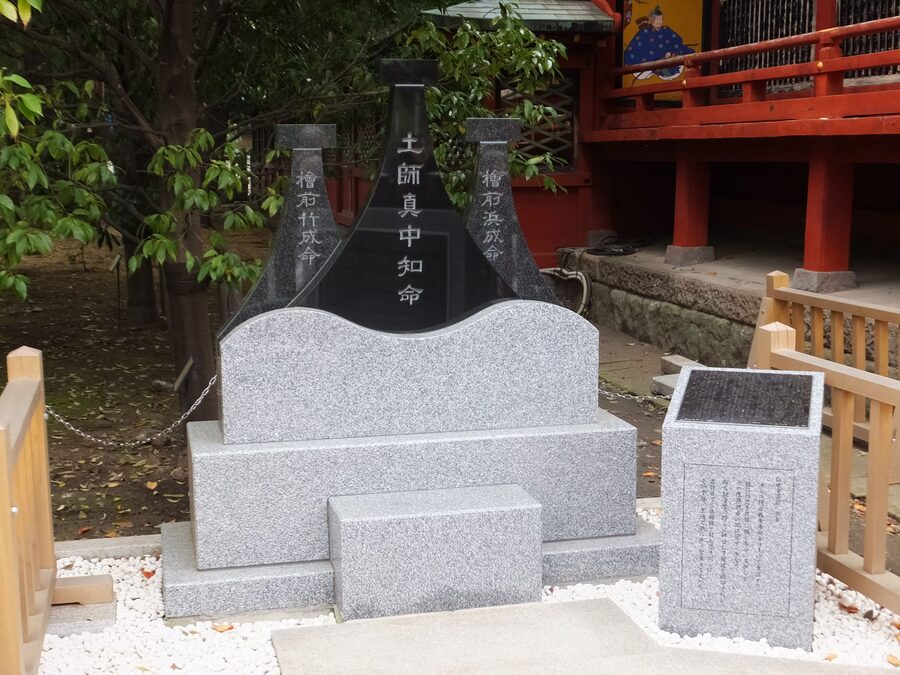
The Sanja origin story sits in a single morning of legend. On the eighteenth of the third month of 628 CE, two fishermen, the brothers Hinokuma Hamanari (檜前浜成) and Hinokuma Takenari (檜前竹成), were working their nets in the Sumida River. They pulled up a small statuette of Kannon, the bodhisattva of compassion.
They dropped it back into the water. They cast again. They pulled up the same statuette.
The story is that they took the figure home and showed it to the local headman, Hajino Nakatomo (土師真中知), who recognized it as Kannon and explained who Kannon was. Nakatomo persuaded the brothers to convert to Buddhism, then converted his own home into a small chapel where the statuette was enshrined. That chapel grew, over the next two centuries, into Senso-ji. The same statuette is, in theory, still inside the inner sanctuary of Senso-ji today, though it has not been shown to the public for over a thousand years.
That is the founding of Senso-ji. The Sanja Matsuri honours not Kannon but the three men who handled the statuette: the two brothers who pulled it from the river and the lord who recognized it. They are not gods of war or harvest; they are just three Edo-period commoners who, the story says, helped bring Kannon to Asakusa. The Shinto shrine that holds them, Asakusa Shrine, is sometimes called Sanja-sama (三社様), Lord of the Three Shrines, on that account.
Asakusa Shrine, Not the Temple
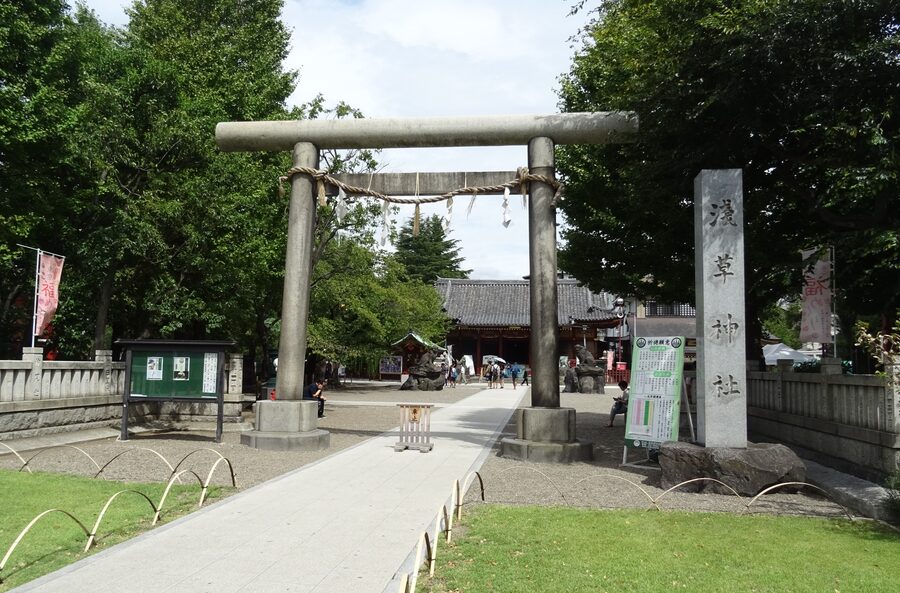
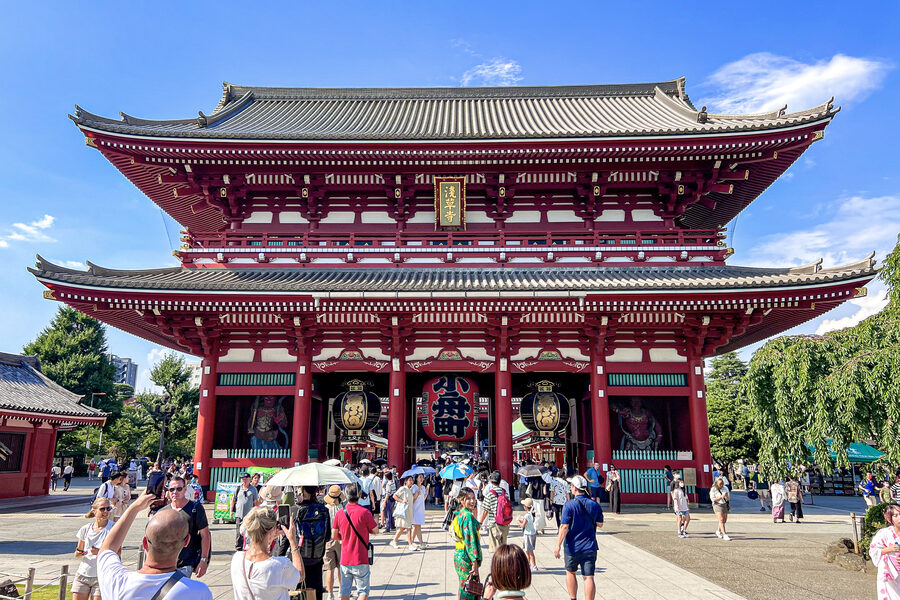
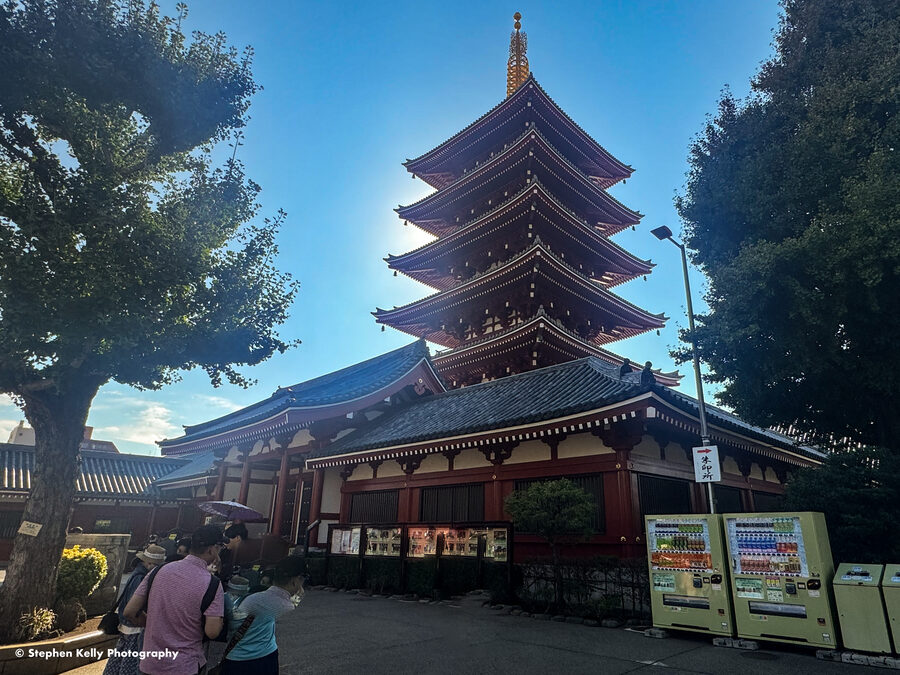
One of the things that confuses first-time visitors is that the festival belongs to Asakusa Shrine, not Senso-ji. The two are next-door neighbours. If you walk straight through Senso-ji from the Kaminarimon, past the Hozomon, past the main hall and the five-storey pagoda, the shrine is on your right, behind a stone torii.
It looks small compared to the temple. It is, by any measure, much less famous.
The reason the shrine and the temple sit side by side is that, until 1868, Japan ran on a syncretic system where Buddhism and Shinto shared the same compounds and often the same deities, an arrangement called shinbutsu shugo (神仏習合). The Hinokuma brothers and Hajino were enshrined as kami at the shrine, while the Kannon statuette they fished up was venerated as a Buddhist image at the temple. Same story, two religious frames, no contradiction.
That coexistence ended in 1868 when the new Meiji government issued the shinbutsu bunri (神仏分離) edict separating Shinto from Buddhism. Asakusa Shrine and Senso-ji were forcibly distinguished. The shrine kept the three deities; the temple kept the Kannon.
The Sanja Matsuri, which had been a joint shrine-temple festival, became a Shinto-only event. It is one of the cleanest examples in Tokyo of an artificial nineteenth-century religious split that everyone in town has politely ignored ever since.
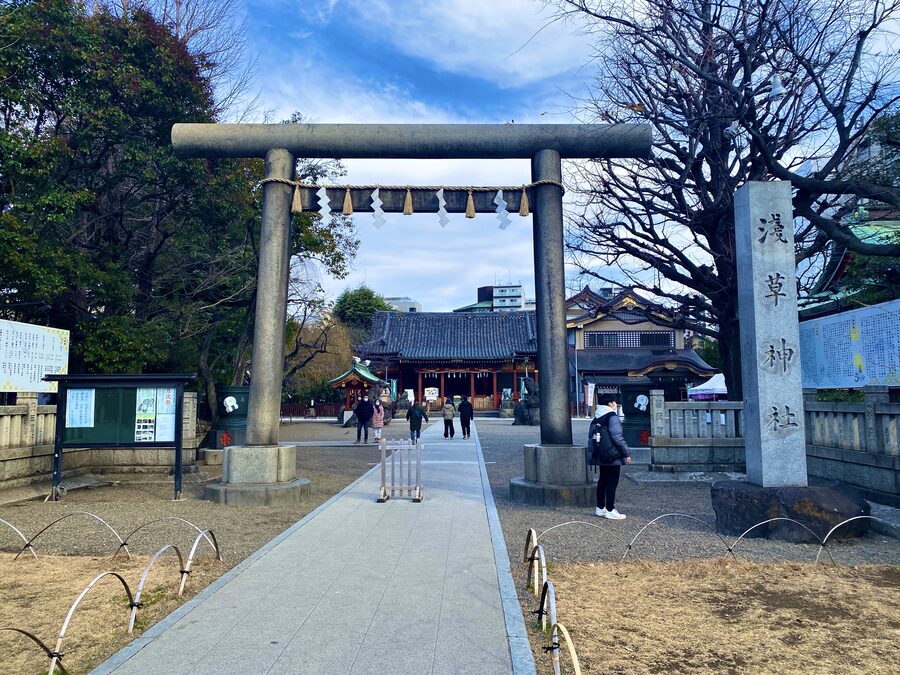
I find the survival of Asakusa Shrine through the war remarkable, because almost everything else around it is post-1950 reconstruction. Senso-ji’s main hall, the five-storey pagoda, the Hozomon, the Kaminarimon, all of those were rebuilt between 1958 and 1973. The shrine, with its 1649 honden, is still the original structure that Tokugawa Iemitsu’s grandson Tsunayoshi would have known.
The Friday Opening: Daigyoretsu and Binzasara
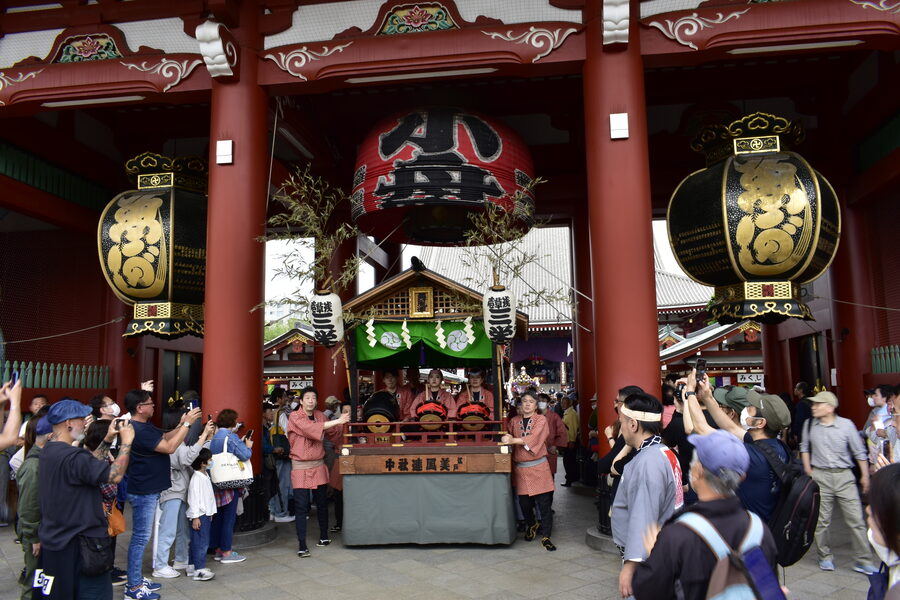
The festival opens on Friday afternoon with the Daigyoretsu (大行列), a costumed grand parade. Around one in the afternoon, a column of geisha, traditional dancers, miko (shrine maidens), shrine officials and city dignitaries leaves Yanagi Dori and walks west to the shrine. The procession includes white heron dancers, a phoenix-mounted palanquin and a column of musicians. It is, intentionally, a show piece.
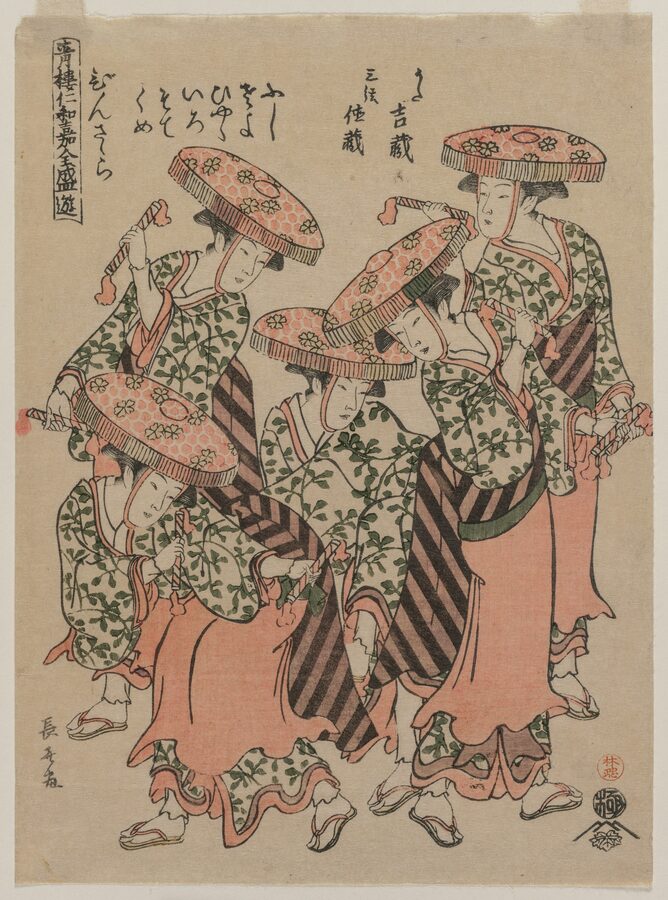
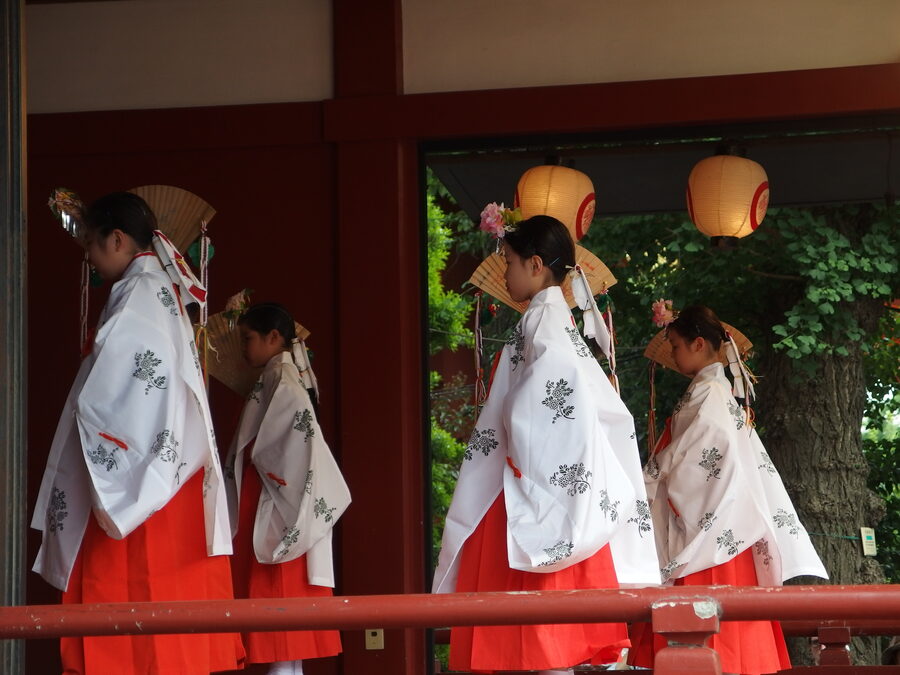
What I always go to see is the binzasara dance, formally the binzasara-mai (びんざさら舞), performed at Asakusa Shrine that same Friday afternoon as a rite for a good rice harvest. Binzasara is an Important Intangible Folk Cultural Property of Japan and the Sanja performance is one of the only times you can see it. The instrument it is named after is a wooden clapper made of about 108 thin strips of cypress, hinged with cord; you flex it, the strips ripple, and you get a chattering rattle that sounds like a cricket field at dusk.
The form is older than Sanja itself. Binzasara grew out of dengaku, the rice-paddy entertainments that fed into Noh theatre in the fourteenth century, so this is one of the oldest types of Japanese performance still on a calendar. The dancers wear bird-like hats with long beaks and trail tassels, and they spin in a slow, intricate circle while the binzasara rattles. If you make Friday afternoon, this is the thing to catch.
Saturday: 100 Mikoshi from 44 Town Associations
Saturday is the day of the district mikoshi. Asakusa is divided into 44 chokai, town associations, each of which fields its own portable shrine. Most chokai actually own multiple mikoshi: an adult, a children’s, sometimes a women’s, sometimes a small “ko-mikoshi” for the eight-year-olds. By the time the count gets done, you end up with roughly 100 mikoshi out on the streets between noon and dusk.
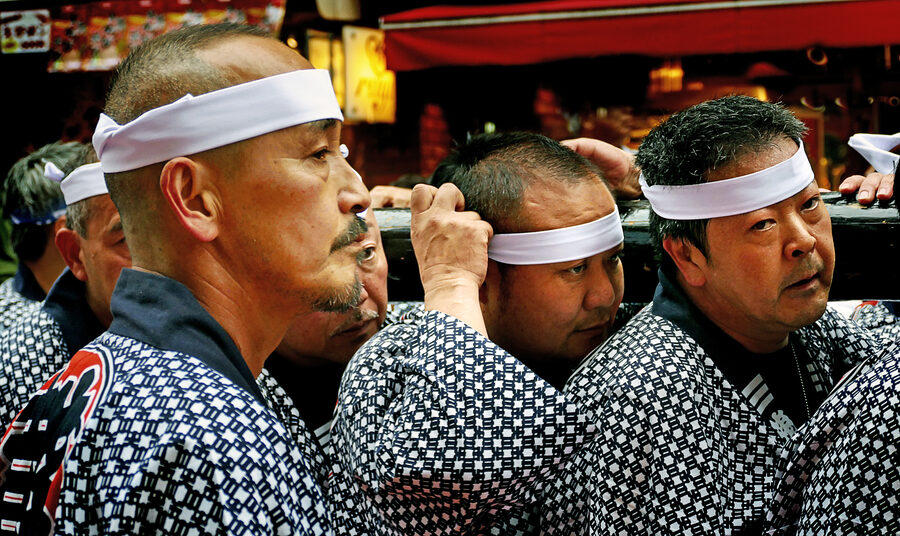
The procedure is set. Around noon, each chokai assembles at its own neighborhood gathering point, dressed in matching happi coats with the ward name dyed into the back. The shrine priest comes around, blesses each mikoshi and transfers a small portion of the kami’s spirit into it.
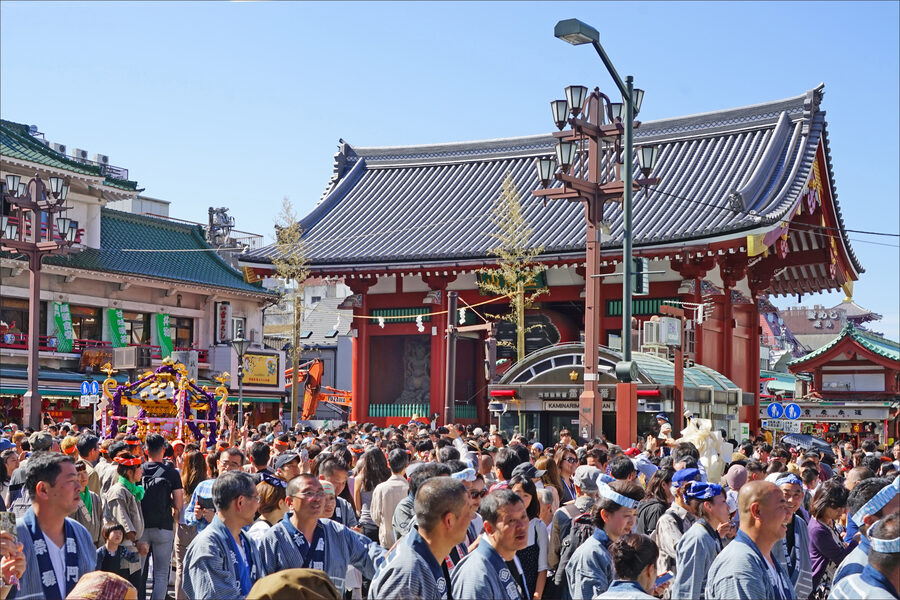
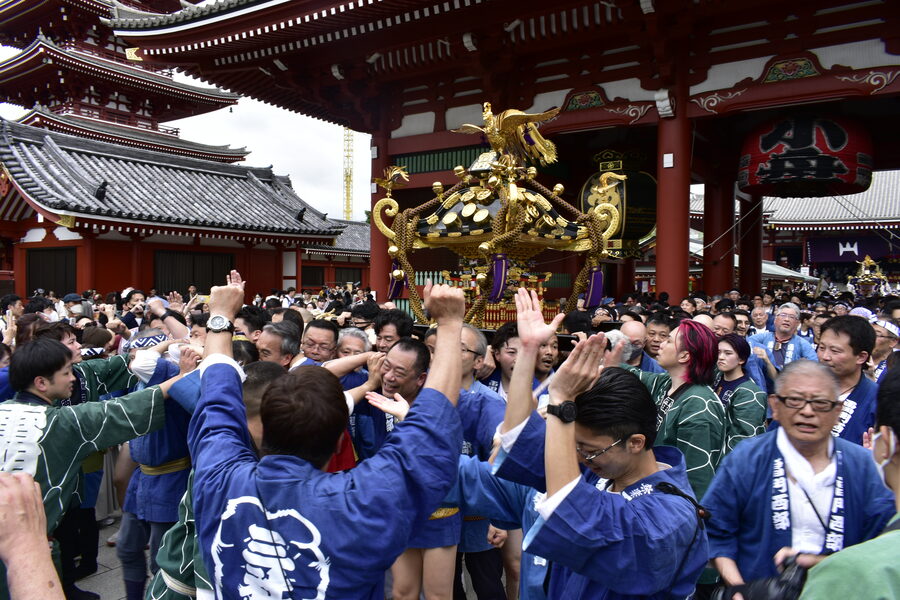
The bearers shoulder the mikoshi. They walk a route through their own ward, then converge through the afternoon on Senso-ji’s main precinct, where all the chokai gather and the mikoshi are bounced together in front of the main hall in a kind of mass salute.
Watching the convergence is the closest you will come, in modern Tokyo, to seeing the Edo neighbourhood ward (cho) as a living unit. The chokai system is older than the city of Tokyo. It is older than Tokyo as a name, since the city was Edo until 1868. Every man and woman shouldering a Saturday mikoshi is doing so as a member of a hyper-local social organization that has, in some cases, run continuously since the seventeenth century.
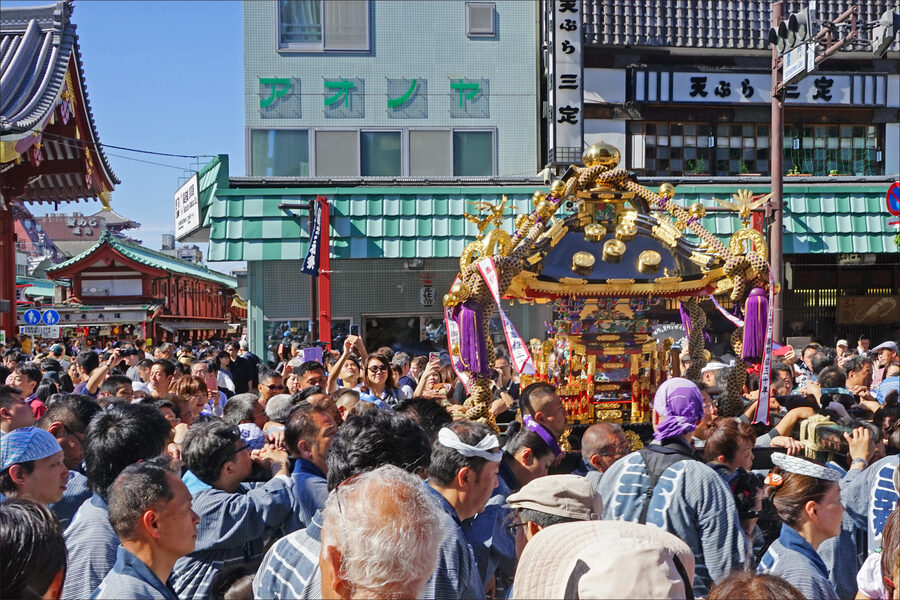
Note the gendered shift. Until the postwar period, only men shouldered mikoshi at Sanja. Today many chokai field women’s mikoshi, and you will see mixed teams routinely.
The festival takes pride in this; the spirit of the kami, by Shinto logic, doesn’t care about your gender. Bear shoulders are bear shoulders.
The Sunday Climax: The Three Honmikoshi
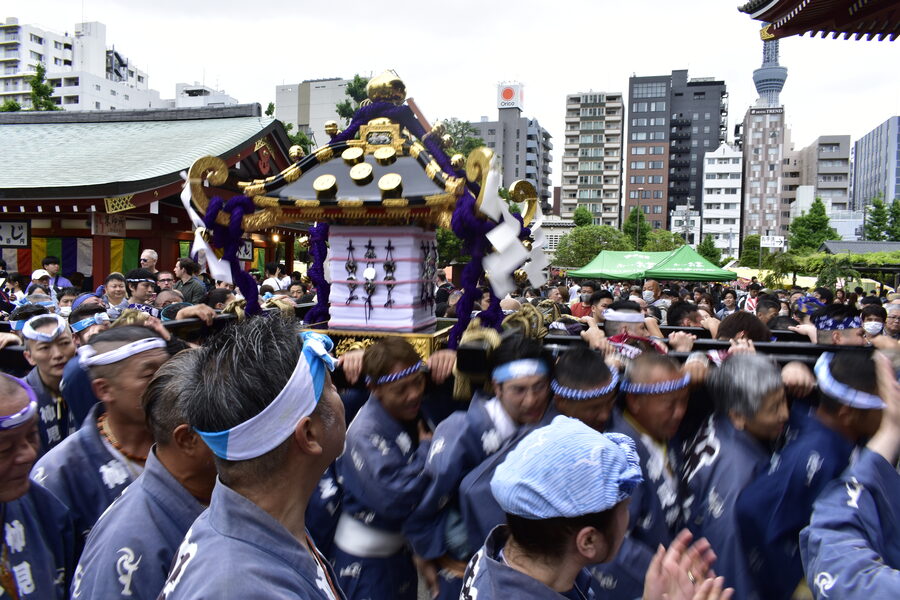
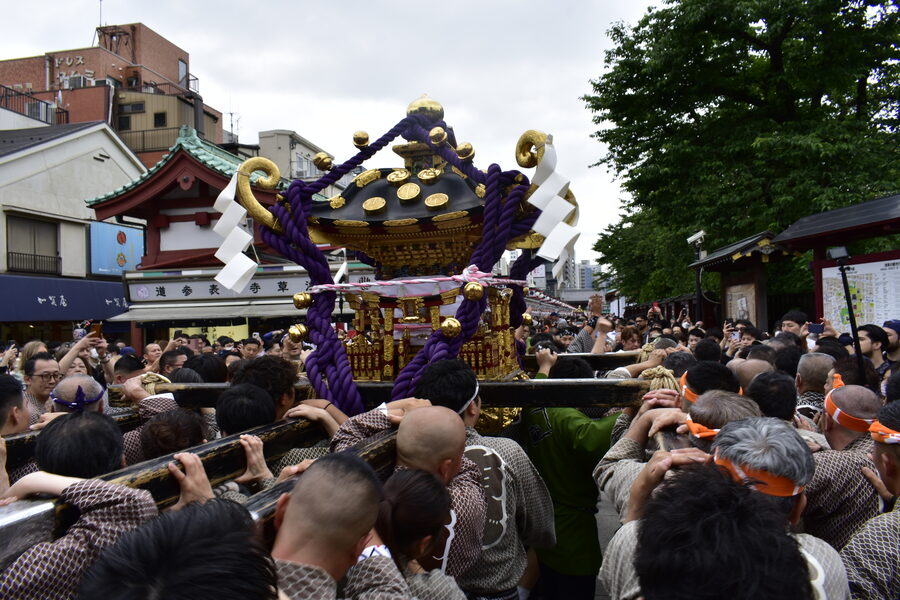
Sunday is for the three honmikoshi. These are not chokai mikoshi. They are the property of Asakusa Shrine itself, and they each carry the spirit of one of the three Sanja deities. Each weighs about a ton; each cost the equivalent of around 40 million yen to build; each requires roughly forty bearers properly distributed under the poles, with rotation crews of another eighty waiting on the kerb.
The three depart Asakusa Shrine at six in the morning of the third Sunday in May. They split up and tour the entire district through the day, each visiting different chokai zones, before returning to the shrine at around eight in the evening. That is fourteen hours of more or less continuous shouldering. The bearers who do this are professionals in everything but pay; many have been carrying since they were children, and their fathers and grandfathers carried before them.
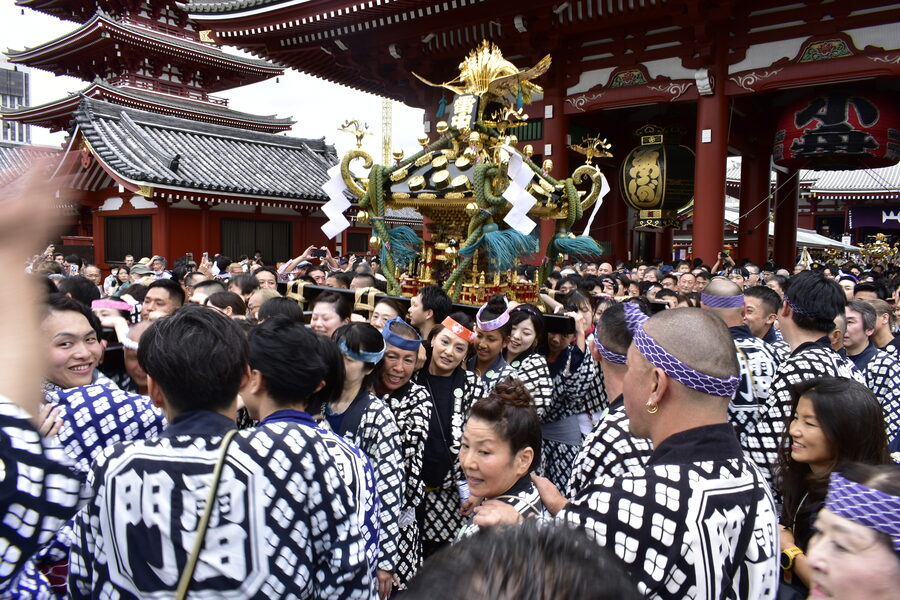
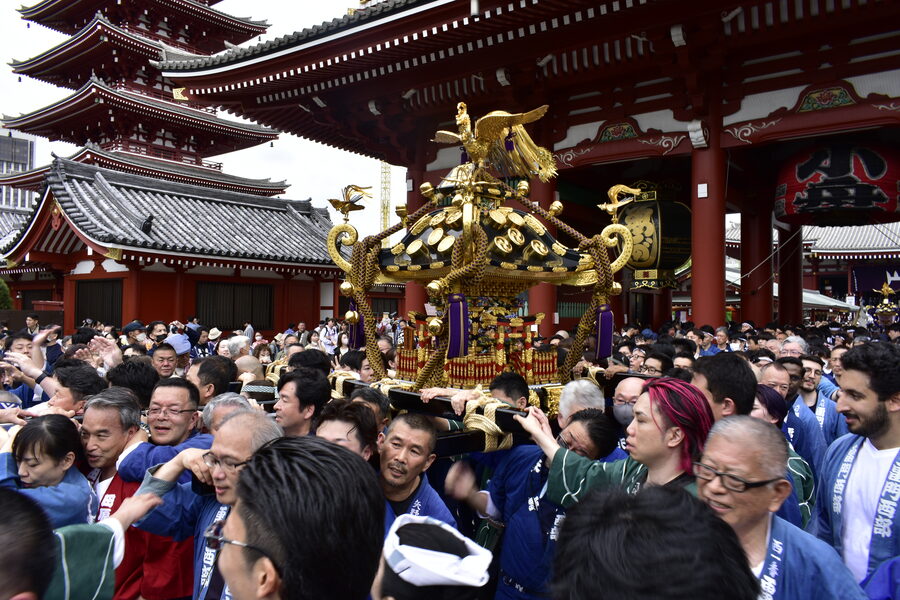
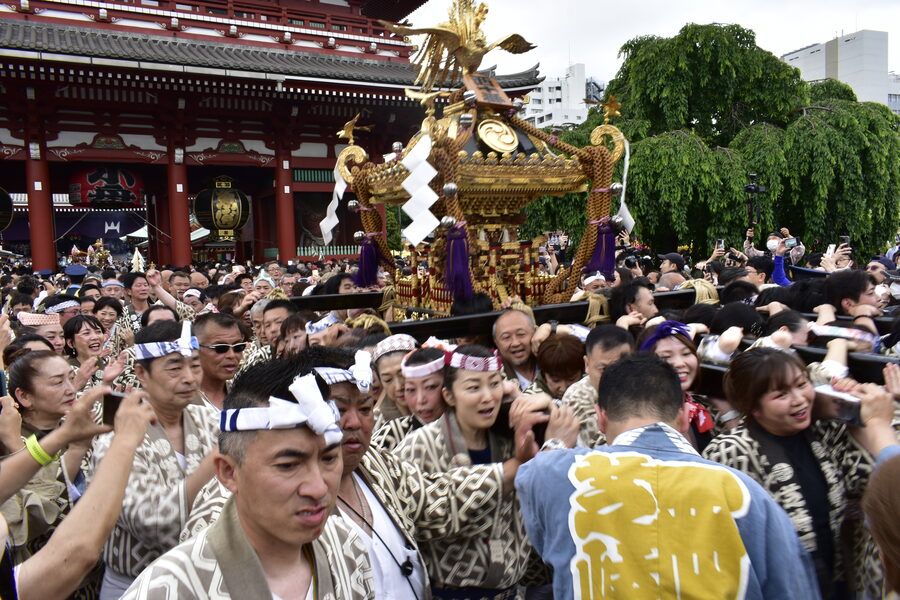
The sound is the giveaway. The Edo-style Sanja chant is “soiya, soiya,” not the gentle “wasshoi” of milder festivals. It is a fast, stamping, two-syllable bark, and the bearers will time it so the mikoshi bounces violently on every “ya.” If you stand near the route, the air pulses; the lacquered shrine swings; the gold roof-finial flashes, and then the whole thing pivots and disappears down the next alley.
The 1872 Ban
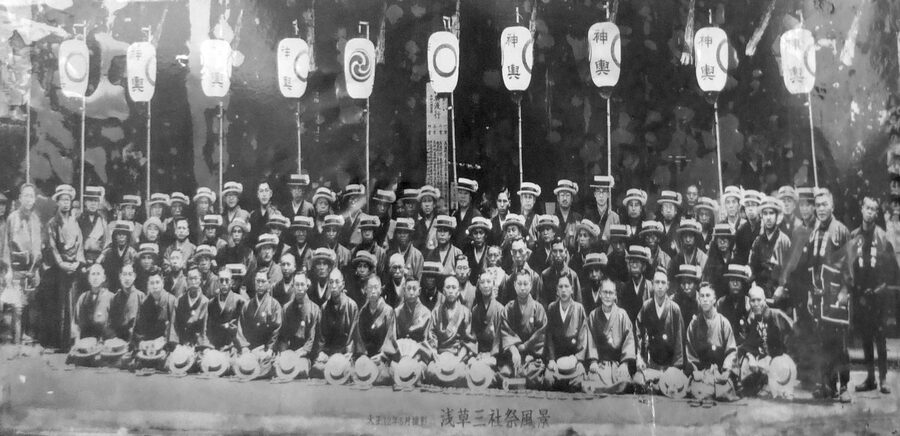
The Meiji Restoration was not kind to the Sanja. In 1872, the new central government, which had been suspicious of large local festivals as Edo-period throwbacks, banned the Sanja Matsuri’s mikoshi processions outright. The festival was scaled down to a single day on May 17 and 18 each year and stripped of much of its ritual. Town associations were not allowed to compete, parade routes were restricted and the Daigyoretsu was suspended.
The reasoning was political. Edo had been the seat of the Tokugawa shogunate for two and a half centuries, and the Edo townsfolk’s loyalties were not necessarily transferable to a Meiji emperor in Kyoto. Big chokai-organized festivals were an obvious channel for resistance, gambling and tattoo gangs, all of which the new state was trying to suppress. The Sanja, as the loudest of the Three Great Festivals, was an easy target.
The ban was eased over time, and the festival recovered through the late nineteenth and early twentieth centuries, but it was never quite the same. The pre-1872 Sanja, you should understand, included entertainments, sumo, kabuki tie-ins and a much rowdier bearer culture; the modern festival is a partial reconstruction. The third-Sunday-in-May timing, the weekend format and the three-honmikoshi convention you see today are all twentieth-century revisions.
The 1945 Firebombing and the Postwar Revival
March 9 to 10, 1945, the night of the Tokyo air raid, was catastrophic for Asakusa. The B-29 incendiary attack killed more than 100,000 people and burned out most of the eastern lowland of the city, including all of central Asakusa. Senso-ji’s main hall, Hozomon, Kaminarimon and pagoda all went; the only buildings to survive in the temple precinct were the Niten-mon gate and Asakusa Shrine itself.
The Sanja’s seven pre-war mikoshi were all destroyed. The festival was effectively dead. Nobody knew when, or whether, it would come back.
The chokai organized the revival themselves. The 44 town associations pooled donations and commissioned new honmikoshi: two were ready in 1950 and a third in 1952. The first postwar Sanja, which most accounts treat as the proper restart, was the May 1952 festival.
It was much smaller than the prewar version. It grew, year on year, as Tokyo grew, and by the late 1970s it was drawing the kind of seven-figure crowds it draws today.
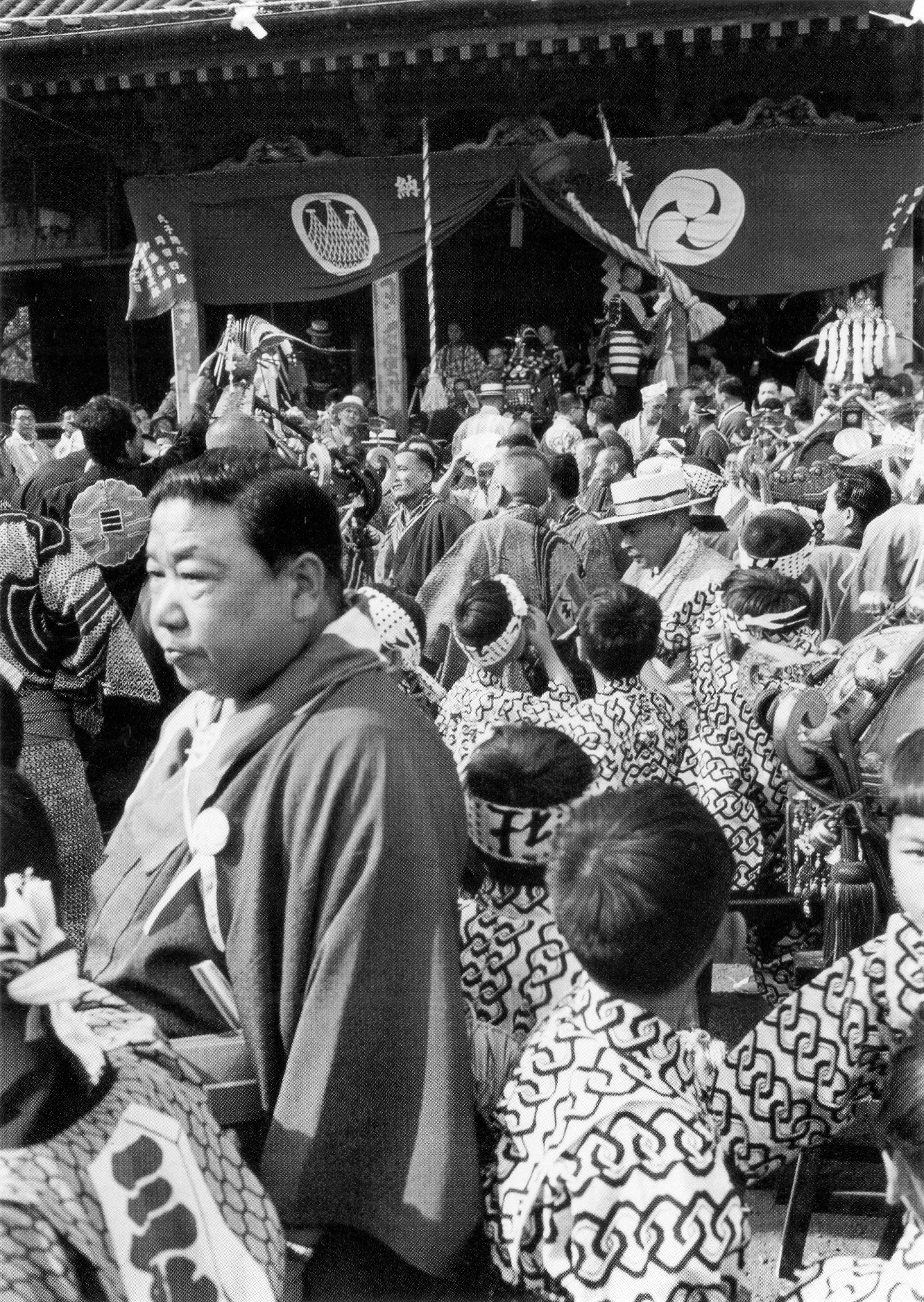
Kimura Ihei, who took the photograph above, was one of the great documentary photographers of the Showa period. He shot Asakusa repeatedly through the 1940s and 1950s, and his Sanja series is the closest thing you can find to a visual record of the festival’s resurrection. If you ever see a Kimura print exhibition in Tokyo, the Asakusa pictures are worth standing in front of.
Tattoos, Yakuza and the 2007 Incident
Now to the part of the festival every guidebook talks around. Sanja has a long, public association with the Tokyo underworld. Many of the men who shoulder mikoshi for prominent chokai are members or former members of yakuza syndicates, and at Sanja they traditionally do so without shirts, displaying the elaborate full-body irezumi tattoos that are normally hidden under street clothes.
This is not a rumour; it is on the record. A 2007 internal report by Tokyo’s Metropolitan Police indicated that around 70% of the roughly thirty mikoshi-carrying groups had members of yakuza organizations among their senior leaders. Tattoo bans at Japanese onsen and gyms exist precisely because Japanese yakuza traditionally wear full sleeves and back-pieces; at Sanja, those bans don’t apply. For one weekend the bearers and the police observe a tacit truce.
I am not romanticizing this. The yakuza presence is one reason the festival has had to tighten controls. The 2007 Sanja saw an incident in which mikoshi bearers, fired up by alcohol and crowd pressure, climbed up onto the roof of one of the three honmikoshi while it was being carried, an act forbidden by Asakusa Shrine because it disrespects the kami inside. Multiple bearers were photographed standing on the shrine; some were tattooed; the photographs ran in the Tokyo papers the next morning.
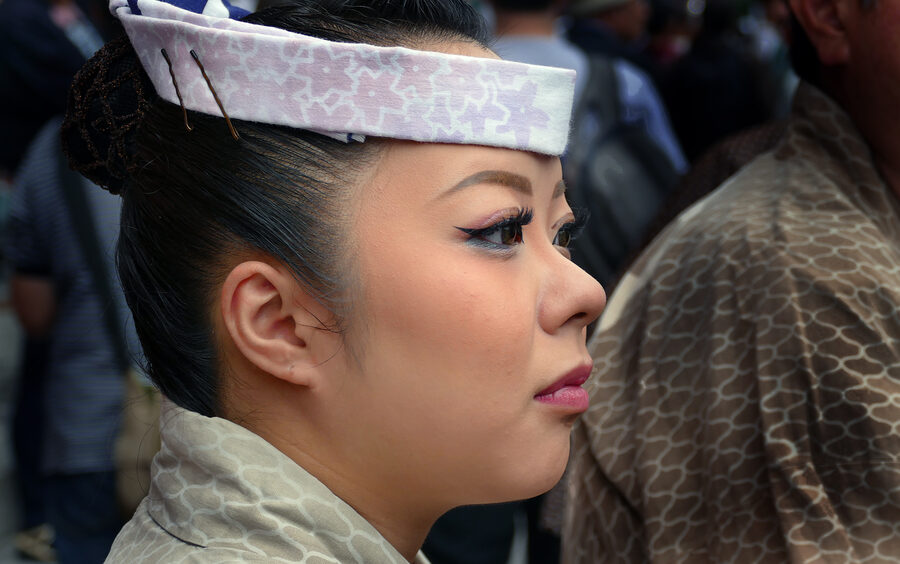
The shrine’s response was fast. For the 2008 festival, the Sunday honmikoshi procession was cancelled outright, the first cancellation since the war. Asakusa Shrine then negotiated with the chokai and the police on a new set of rules: bearers would have to register, conduct codes would be enforced, climbing on shrines would result in lifetime bans for the chokai involved. The honmikoshi resumed in 2009 under the new system, and have run since under tighter discipline.
The tattoo question has not gone away, but it has shifted. Bearers can still strip to fundoshi and bear the mikoshi shirtless; they are simply no longer allowed to climb on top of one. The custom of partial undress remains. If you go to Sanja, you will see tattoos, and you should regard the sight as part of an Edo street tradition that even the Meiji government couldn’t quite kill.
The Three Great Festivals of Tokyo
For context, here is how Sanja sits within the larger Edo san-dai matsuri grouping. The Kanda Matsuri at Kanda Myojin Shrine, in mid-May, is run as a procession of huge palanquins through Otemachi and the financial district; the Sanno Matsuri at Hie Shrine, in mid-June, processes through Akasaka and the area around the Imperial Palace and was historically the official festival of the Tokugawa shogunate. Both run in odd or even years on alternation; Sanja runs every year.
The three were ranked by the Edo townsfolk by social class. The Sanno was the shogun’s festival, watched from the castle. The Kanda was the merchant festival, of the prosperous Edo townsmen.
The Sanja was the festival of Asakusa, which under the shogunate was the entertainment district, the theatre district and the redlight district, and which is still the most working-class of the three. Of the three, it is the Sanja that retains most of the rough edge.
If you are interested in how Edo political life shaped these festivals, the framework is one I have written about elsewhere on this site. The shogunate centralized everything around Edo Castle and used the sankin-kotai alternate attendance system to keep daimyo families pinned in the city; the result was that Edo grew into a million-person metropolis with its own distinctive merchant and commoner culture. The Sanja, the Kanda and the Sanno are the festival face of that culture, scaled to three different social levels.
What a Mikoshi Actually Is
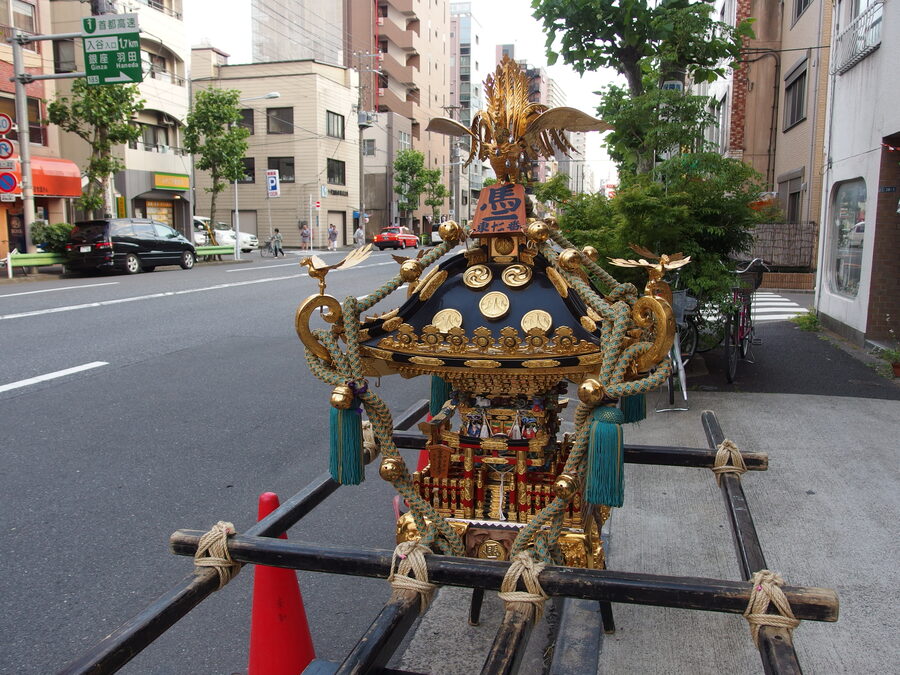
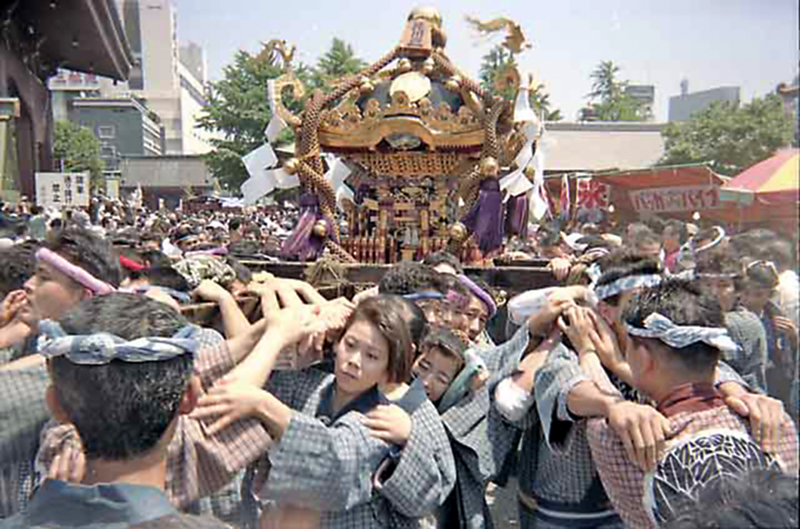
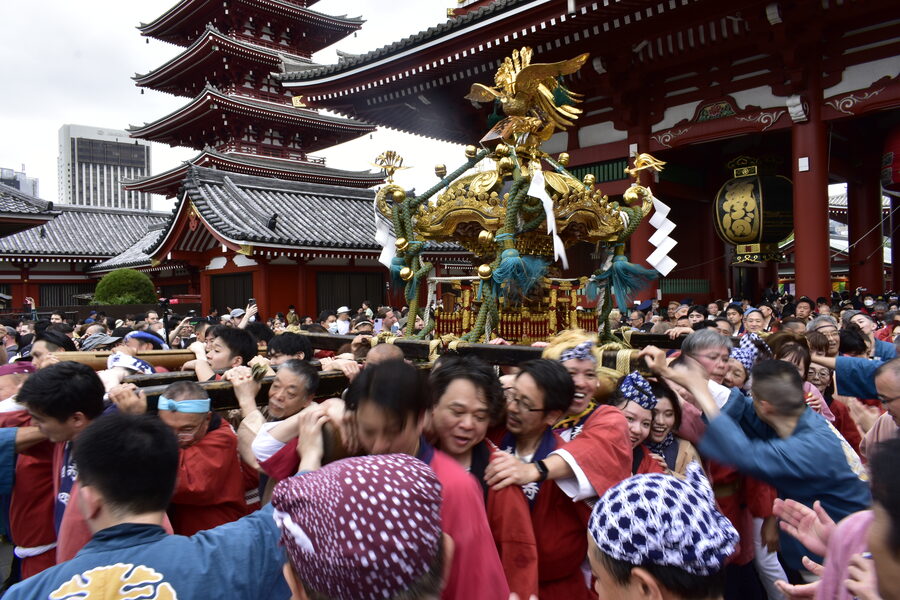
Worth pausing on the mikoshi itself. The word means, very literally, “honourable seat-on-shoulders” or “honourable palanquin,” and a mikoshi is a portable Shinto shrine, a wooden box built like a miniature Japanese temple, gilt and lacquered, with a roof, finials, doors and a beam structure for shoulders. Inside is the kami: a part of the spirit of the deity, transferred from the main shrine for the duration of the festival, residing in a sacred object (often a bronze mirror) sealed in the inner chamber.
The first recorded mikoshi date to 749 CE, when the deity Hachiman was carried in a portable shrine from Kyushu to Nara to attend the consecration of the Great Buddha at Todai-ji. The technology spread from there. Most of Japan’s major Shinto festivals involve mikoshi processions; Sanja is among the most ambitious because of the sheer number, the size of the honmikoshi and the violence of the bouncing.
The bouncing is not random. There is a theological idea in older Shinto that the kami enjoys being shaken vigorously, because vigorous motion amplifies its energy and pleases it; that is why the bearers chant “soiya, soiya” rather than the gentler “wasshoi,” and why, when a chokai gets really keyed up, they will lift the mikoshi as high as they can and drop it into a pulse rhythm. From the deity’s point of view, in theory, this is a good time.
The Ujiko System
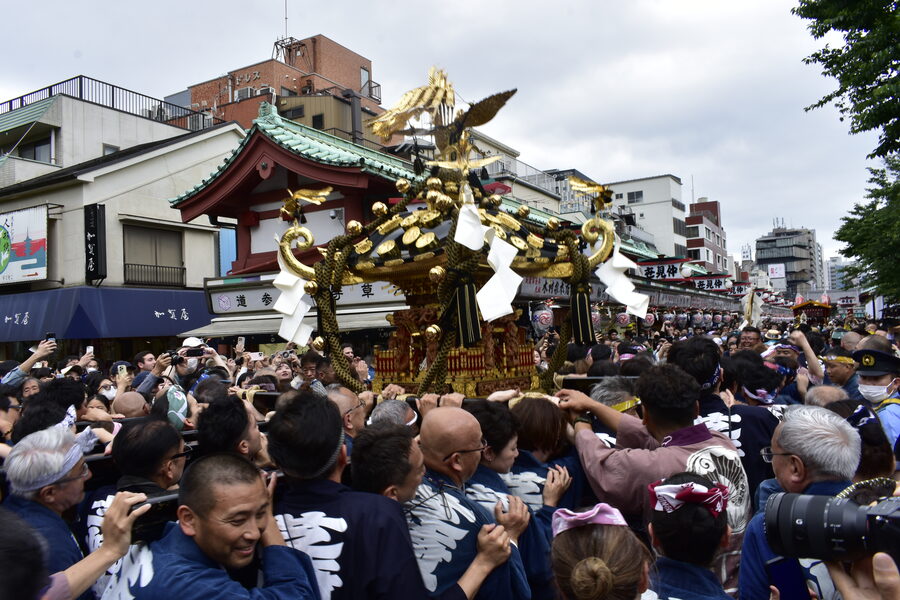
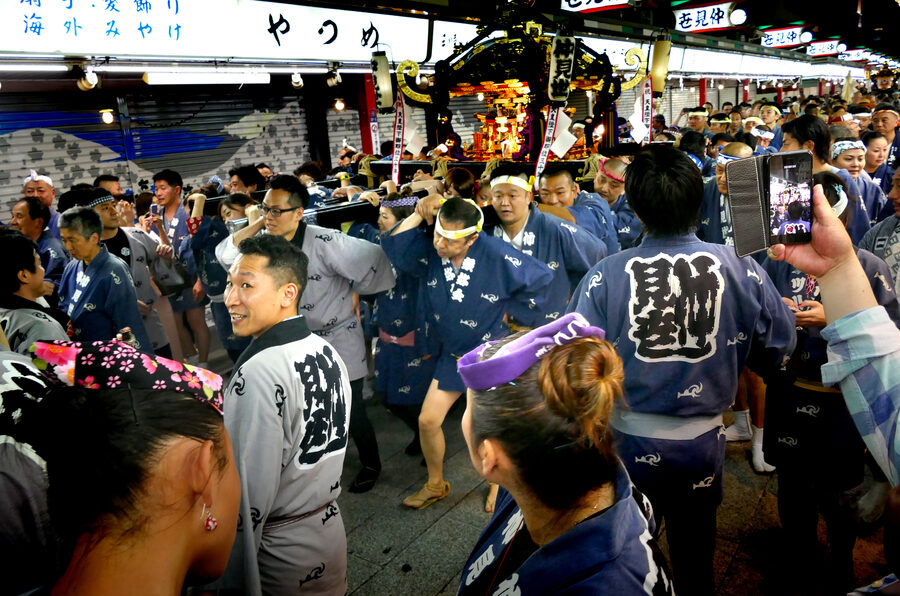
The ujiko (氏子) parishioner system is the social structure underneath the festival. An ujiko is, formally, anyone born within the geographic territory historically considered the parish of a specific shrine. For Asakusa Shrine, the ujiko zone is the same set of 44 chokai whose mikoshi parade on Saturday. If you were born and raised in those wards, you are, by tradition, an ujiko of Asakusa Shrine, regardless of whether you ever set foot in it the rest of the year.
The system is a thousand years old in concept and several hundred years old in its current Edo form. Ujiko members are expected to support their shrine financially, to attend its rites and, at festival time, to provide labour. Mikoshi bearers are, almost without exception, ujiko of the shrine whose mikoshi they carry. Outsiders can sometimes join with permission, but the chokai jealously guard their bearer slots, because shouldering is honour.
What this means in practice is that if you watch a Sanja honmikoshi go past, the forty bearers under the poles are all from Asakusa, all from the 44-chokai zone, and most of them have known each other since elementary school. The festival is a public ritual, but it is also an internal Asakusa event: the chokai are demonstrating their numbers, their organization and their loyalty to the shrine in front of two million strangers.
Comparing Sanja to Other Major Matsuri
Worth comparing this to other Japanese festivals you may know. The contrast tells you what kind of festival Sanja is.
The closest analogue inside Tokyo is the Kanda Matsuri, which I mentioned. Outside Tokyo, the comparison most people make is to the Gion Matsuri in Kyoto, which runs through July. Gion is grander, older, and more visually elaborate, with its towering yamaboko floats; it is also more processional, slower and more ritualized than Sanja.
Gion is a Heian aristocratic court festival; Sanja is an Edo merchant-and-commoner festival. Both are important, but they are completely different temperaments.
For float-style festivals more comparable in feel, look at the Tsushima Tenno Matsuri, where giant lantern-lit floats are pushed onto rivers and ponds. That festival is rural and water-based, where Sanja is urban and street-based, but the bearer-and-team energy translates. If you have been to either, you will understand the social dynamic of Sanja before you even arrive.
If you happen to find yourself comparing Tokyo’s spring festival cycle, the other obvious touchpoint is the cherry-blossom hanami season, which peaks at Senso-ji about six weeks before Sanja. The Asakusa neighbourhood you walk through during late-March hanami is the same neighbourhood you walk through for Sanja, except in May it is louder, sweatier and full of mikoshi instead of picnic blankets.
How to Get to Asakusa
The festival is hosted at Asakusa Shrine, which sits behind Senso-ji at 2-3-1 Asakusa, Taito City, Tokyo. The simplest access is from Asakusa Station, served by the Tokyo Metro Ginza Line, the Toei Asakusa Line, the Tobu Skytree Line and the Tsukuba Express. From Tokyo Station the Ginza Line trip is around 17 minutes; from Shinjuku, allow about 35 minutes via Marunouchi-and-Ginza Line or via the Toei Shinjuku Line and a transfer.
If you are coming in for the festival weekend, leave at least an hour of margin on top of your usual Tokyo travel time. The trains around Asakusa are packed throughout Sanja weekend, especially Saturday and Sunday afternoons, and the streets between the station and the shrine become a slow shuffle. The walk is normally five minutes; in May it can take twenty.
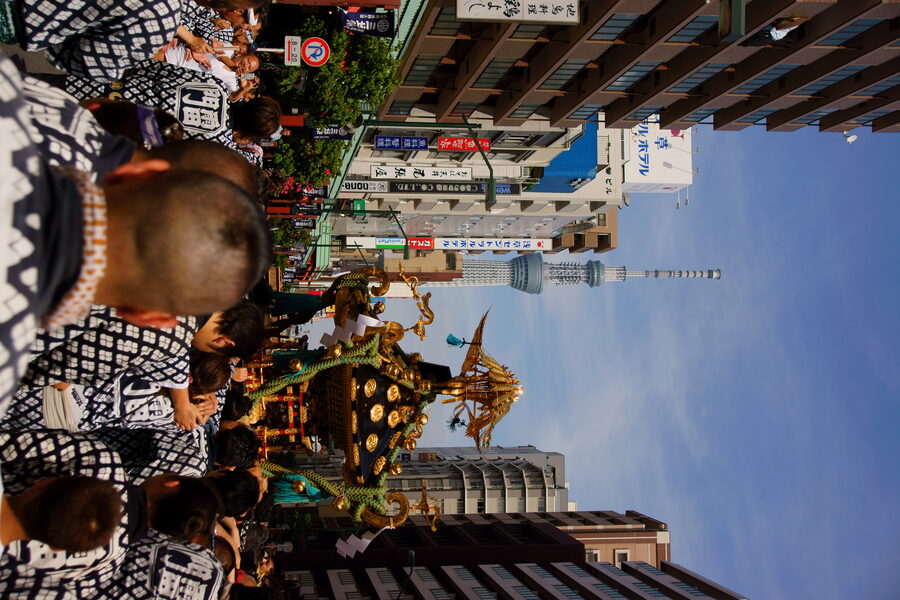
I usually use Tobu Asakusa Station, because the exit puts you out on the Sumida River side and gives you a moment to get oriented before walking up Kaminarimon-dori toward the gate. From the same exit, you can see the Tokyo Skytree across the river, and on a clear day the contrast between the festival and the skyline is striking.
Where to Watch
You have several choices, and they reward different temperaments.
Kaminarimon, the Thunder Gate, is the obvious tourist-grade viewing point. The big red lantern, the wind and thunder gods either side, the column of bearers stamping under the gate; that is the shot you have probably seen on travel posters. The downside is that everybody else has the same idea, so if you want to stand inside Kaminarimon during a procession you need to be in position by mid-morning Saturday or early afternoon Sunday.
Nakamise-dori, the long shopping street between Kaminarimon and Hozomon, is a tighter, more intense option. The mikoshi can barely clear the souvenir shops on either side, and the chant bounces back from the painted shop fronts. The pictures are harder; the experience is better. I would push first-time visitors here over Kaminarimon.
The Asakusa Shrine courtyard itself is the best Saturday-afternoon spot, because all the chokai eventually converge here. You can stand against the side fence and watch ten different mikoshi go by within an hour, each with its own ward colours. By the late afternoon you will have seen most of the 44 town associations represented in some form.
What to Bring, What to Wear
This is street-level Tokyo in mid-May. Daytime temperatures sit between 20 and 25 degrees Celsius, and the festival is mostly on hot pavement. Wear breathable layers, walking shoes you can stand in for six hours, and bring a hat. There is no shade on Nakamise-dori unless you wedge yourself under a shop awning, and the awnings are taken.
Bring water. The chokai often have water tables for their bearers, but as a spectator you are responsible for your own hydration; vendors along Kaminarimon-dori will charge you Tokyo-festival prices for a 500 ml bottle. Cash works at most stalls; some now take IC card, but I would not bet your sushi-stall purchase on it.
Carry a thin towel or tenugui in your back pocket. You will use it. You can also buy festival-branded tenugui at most chokai welcome tables, and they make better souvenirs than the Senso-ji shop magnets.
Phone-camera battery is the other one. The Sanja moves fast; you will be photographing more than you intended. I would carry a small power bank.
What Not To Do
Don’t try to touch the mikoshi. Bearers will react badly and fast; the mikoshi is a sacred object, and outsiders putting their hands on it counts as interference. If you want to participate in the bearing, that is a separate conversation involving formal application to a chokai a year in advance, sponsorship by an existing member and a permitted-bearer registration since the post-2007 rules.
Don’t stand in the road. The chokai marshals will be moving in front of and behind every mikoshi, and they will physically wave you onto the kerb. They are not being rude; they are doing the job that prevents the festival from becoming a 1923 Sanja photo of trampled spectators.
Don’t bring drone equipment. Drone flying is illegal in central Tokyo without permits, and Sanja in particular is a registered no-fly event. The shrine has been clear about this since 2017.
Don’t try to interview yakuza-looking bearers about their tattoos. They will, at best, laugh at you. At worst they will be polite, but their kumicho will not be, and the chokai will close around them.
Don’t drink heavily. Bearers will absolutely drink, but they have an organizational structure absorbing them. As a tourist drunk on the Sanja, you become a logistical problem, you become a danger to other spectators, and you make a spectacle of yourself in front of two million people. Have a beer; don’t have ten.
The Rest of Asakusa
If you have a second day in Asakusa around the festival, there is a lot to do that has nothing to do with Sanja. Senso-ji itself is open during the festival; the main hall and the pagoda are reconstructions but the precinct is among the most atmospheric in central Tokyo. The Nakamise shopping street has been here, in some form, for over three hundred years.
The Asakusa Shrine compound itself is worth a closer look outside festival hours. The 1649 honden is, as I noted earlier, a survivor of the firebombing and one of the few original Edo-period structures left in this part of Tokyo. The painted ceiling panels in the haiden are worth the neck strain.
Sumida-koen, the river park along the Sumida embankment, is the one place I always go when I want to escape the Sanja crowd for an hour. You can see Tokyo Skytree directly across the river, you can see commuter ferries running, and you can sit on a bench and not be touched by anybody for the first time all day.
The Wider Festival Year
For visitors thinking about a trip framed around festivals, Sanja is one of three major late-spring options. Sanja in Asakusa runs the third weekend of May. The Kanda Matsuri at Kanda Myojin runs in mid-May in odd-numbered years.
The Sanno Matsuri at Hie Shrine runs in mid-June in even-numbered years. With careful timing, you can theoretically see two of the three on the same Tokyo trip.
Outside Tokyo, late spring through early autumn is the densest stretch of the Japanese matsuri calendar. The Aoi Matsuri in Kyoto is May 15. Gion in Kyoto runs all of July. The Tenjin Matsuri in Osaka runs late July.
The summer festival circuit ends with Awa Odori, Tanabata-related events and the Aomori Nebuta in early-to-mid August. If you are planning a multi-festival trip, sit down with a calendar in advance; the windows are tight.
What sets Sanja apart inside that wider calendar is the directness. There are no sealed-off floats, no roped-off priests, no big distance between the religious procession and you. Mikoshi pass within arm’s length, sometimes within finger’s length, and you breathe the same humid air as the bearers. The Aoi in Kyoto is filmable from a chair; the Sanja is something you have to be inside.
Where Sanja Sits Today
The festival is now a balancing act. The shrine has to honour an Edo-period ritual structure that depended on the chokai system. The chokai have to balance their long-standing quiet relationships with yakuza networks against the post-2007 enforcement environment.
The Tokyo police have to keep a 1.5-to-2-million-person event safe without smothering it. So far they all seem to manage.
Crowd numbers are creeping back to pre-pandemic levels. The 2017 estimate was 2,030,000 over three days, slightly above the 1.5-to-2-million range usually quoted. 2020 and 2021 were drastically curtailed by COVID; 2022 was a small-format restart; 2023 onwards have been close to full scale. By the 2025 figures, attendance was back into the higher band.
That trend is good, but the festival’s character will only survive if visitors take it seriously. Sanja is not a tourist show. It is one of Tokyo’s last working pieces of pre-Meiji urban culture, kept alive by 44 neighbourhood associations who have organized themselves into a single weekend for nearly four hundred years.
Treat it like that, and the festival rewards you. Treat it like a parade, and you miss the point.
Practical Summary
If you want one paragraph to plan around, here it is. The 2026 Sanja Matsuri runs Friday May 15 to Sunday May 17 at Asakusa Shrine, behind Senso-ji in Taito City. Friday afternoon is the Daigyoretsu and binzasara dance.
Saturday is the 100 chokai mikoshi, noon onwards, with convergence at Senso-ji from late afternoon. Sunday is the three honmikoshi, departing the shrine at 6 AM and returning at 8 PM. Free to attend, no tickets. Get there by Tokyo Metro Ginza Line, Toei Asakusa Line, Tobu Skytree Line or Tsukuba Express to Asakusa Station, allow extra time for crowds, watch from Nakamise-dori or the shrine courtyard, and do not touch the mikoshi.
If you want one piece of advice: go on Saturday. Saturday is the chokai day, the day with the most mikoshi out at once and the loosest crowd. Sunday’s honmikoshi are visually striking but harder to get close to, and Friday is more ceremonial than energetic. Saturday is the festival as the people of Asakusa actually live it, and Saturday is the day I would want a first-timer to see.
Two weeks from now, the chokai are already gathering equipment. The bearer training sessions started in March. The mikoshi are coming out of storage and being inspected. Asakusa is winding up.
By the morning of May 15, the streets I have been describing will be physically transformed, in the way a city only is when its oldest neighbourhood-level institutions decide to take over for a weekend. I plan to be there. If you are anywhere within a long train ride, you should plan on it too.