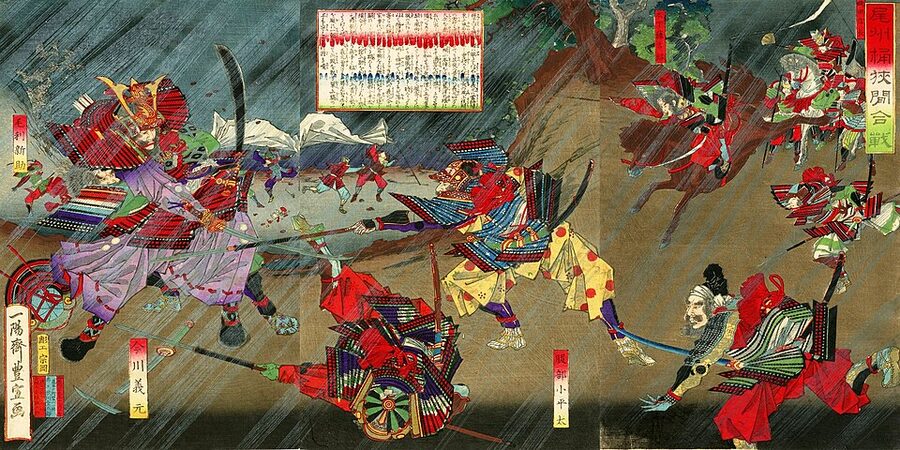
On the morning of 19 May 1560 — the 12 June in the Gregorian calendar, though the Japanese sources will always give you the lunar date — a regional daimyō named Imagawa Yoshimoto was sitting on a low hill in central Mikawa Province, eating lunch. He had 5,000 men with him at the command post. Around 20,000 more were deployed across the surrounding valleys, converting recently-captured border fortresses into permanent positions. His campaign against the minor Owari-based Oda clan, three days old, was going exactly as planned: two Oda frontier fortresses, Marune and Washizu, had fallen at dawn; his advance force had resupplied the besieged Ōdaka Castle; his vanguard under his prize retainer Matsudaira Motoyasu (who would later become Tokugawa Ieyasu) was pushing west into what was now, essentially, his territory. Yoshimoto was 42 years old, the undisputed ruler of 900,000 koku of productive land across three provinces (Suruga, Tōtōmi, and Mikawa), and the head of the Imagawa clan — one of the oldest and most politically-connected families of the 16th-century samurai aristocracy. He would be dead by mid-afternoon.
The killing was done by an Owari warlord 16 years younger, with somewhere between 2,000 and 3,000 men, who had spent the previous night at his home castle in Kiyosu doing absolutely nothing in response to Yoshimoto’s advance. When the report of Marune’s fall came in at 4am on 19 May, this younger warlord — Oda Nobunaga, 26 years old, five years into a contested succession as head of the minor Oda branch in northern Owari — woke up, put on his armour, danced the short Kowakamai piece Atsumori (specifically the verses about the brevity of human life in the 50-year span of the realm under heaven), ate rice standing up, mounted his horse, and rode out of Kiyosu Castle with five personal attendants while the rest of his army scrambled to follow. Nine hours later he struck Yoshimoto’s headquarters in a thunderstorm, killed the commander personally through his vassal Mori Shinsuke, and collapsed the Imagawa military position in central Japan within a single afternoon. This is the Battle of Okehazama. It is the foundational moment of the late-Sengoku unification process, the origin of Nobunaga’s historical reputation, and the specific event that converted Tokugawa Ieyasu from an Imagawa hostage into an independent warlord. Every major political development of the next 55 years, from Sekigahara backward through every campaign, traces to Okehazama.
In This Article
- Yoshimoto, his army, and the Owari campaign
- Dawn, 19 May — Marune and Washizu fall
- Atsuta, Zenshō-ji, and the march
- The rain, the strike, the head
- The consequences — Ieyasu goes home, the Imagawa fall
- Why Okehazama matters — the surprise, the gamble, the improvisation
- Where to visit the Okehazama battlefield
- Okehazama Kōsenjō Park, Toyoake
- Okehazama-Kassen Gassen-hi, Midori-ku Nagoya
- Atsuta Shrine and Kiyosu Castle — the morning of 19 May
- Sumpu Castle and Shimizu — the Imagawa side
- Closing — the 42-year-old on the hill
Yoshimoto, his army, and the Owari campaign
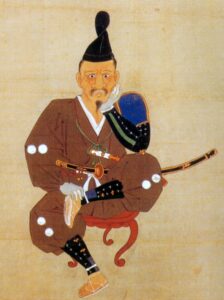
To understand why the outcome at Okehazama was historically unusual, you need to understand how the forces compared going in. Imagawa Yoshimoto was, in spring 1560, genuinely the most powerful daimyō in central Japan. His territory included all of Suruga Province (modern eastern Shizuoka, the Mount Fuji flank), all of Tōtōmi Province (western Shizuoka, around the Hamana lagoon), and all of Mikawa Province (modern eastern Aichi, around Okazaki). He held the Imagawa hereditary court rank of Jusanmi (Junior Third Rank at court), he was a second cousin of Emperor Ōgimachi, and he was linked through his mother to both the Hōjō clan of Sagami and the Takeda clan of Kai in a three-way alliance — the Kōsō Sanpō Dōmei — that had been signed in 1554. Within central Japan, there was no daimyō Yoshimoto could not personally outweigh in political legitimacy, family lineage, and military force.
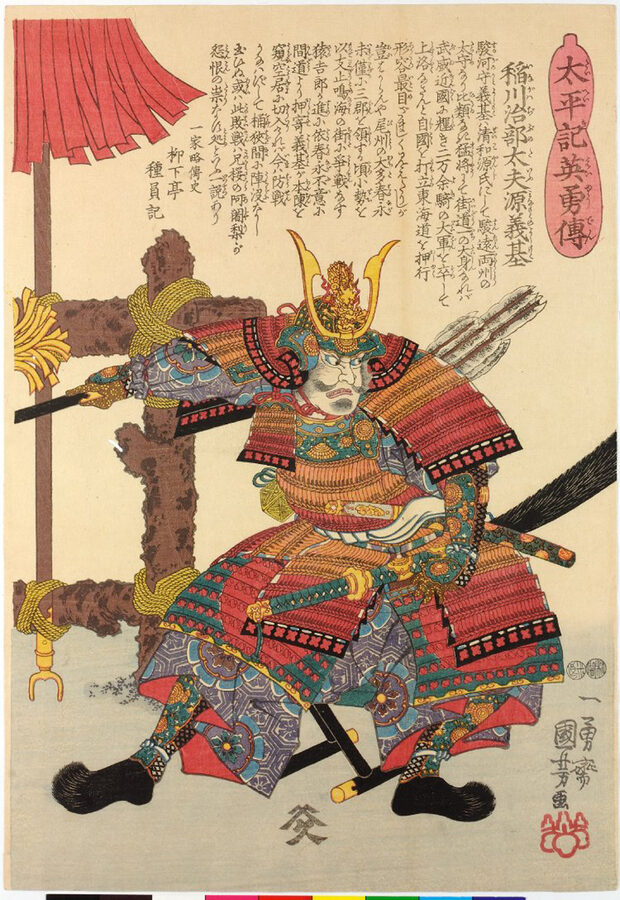
The size of the Owari campaign’s forces is debated, because no Imagawa military rosters have survived. The Shinchō Kōki says 45,000 men; Kōyō Gunkan says “20,000-plus”; the 19th-century Tokugawa Jikki says 40,000; most modern Japanese historians settle on around 25,000 as the most-defensible aggregate estimate. Some recent revisionists, working from the Taikō Kenchi land-value data of the late 16th century to reconstruct Imagawa’s maximum sustainable field force, have argued the number may have been lower — possibly 15,000-18,000 — with the higher figures including the logistics train and recently-absorbed local fighters who joined the column as it passed through. Either way, what’s clear is that the Imagawa had a substantial numerical advantage over whatever Nobunaga could field, and that Yoshimoto was not treating the Owari campaign as a high-risk operation. He had deployed his army for sustained occupation rather than a decisive battle, which is why so many of his men were dispersed across multiple positions on 19 May.
Nobunaga’s force was considerably smaller and more concentrated. The Shinchō Kōki gives Nobunaga roughly 3,000 men total in Owari, but this includes garrison forces held elsewhere; the actual deployable mobile force was probably closer to 2,000 — the 2,000-man column that gathered at Zenshō-ji fortress by late morning on 19 May. Owari in 1560 produced approximately 400,000 koku of rice; Nobunaga controlled approximately half of this directly, with the rest still in the hands of rival branches of the Oda clan who had not yet fully accepted his succession. The Oda vs Imagawa ratio in mobilisable force was probably 1-to-10 in Yoshimoto’s favour. In standard Sengoku military logic, Nobunaga should have either surrendered, fled to the Mino border, or dug into Kiyosu Castle for a siege. He did none of these. He went looking for Yoshimoto personally.
Dawn, 19 May — Marune and Washizu fall
The campaign opened on 12 May 1560, when Yoshimoto’s main army marched out of Sumpu (modern central Shizuoka) for the Owari border. The force reached Yoshida Castle in eastern Mikawa by 15 May, Ōkuma-jō by 17 May, and Kutsukake Castle — the forward operating base for the Owari operation, at modern Toyoake just east of Nagoya — on the evening of 18 May. Yoshimoto’s plan for 19 May was straightforward: push the Matsudaira vanguard west to resupply Ōdaka Castle (which had been besieged for months by Oda frontier fortresses), reduce the Oda-held Marune and Washizu forts that blockaded the route, and secure the eastern-Owari corridor for further advances. This was a standard incremental-territorial-expansion campaign, which is how the Imagawa had built up their three-province bloc over the previous twenty years.
The dawn phase of the 19th went exactly to plan. Matsudaira Motoyasu’s 2,000 Mikawa troops had already resupplied Ōdaka Castle during the night of 18-19 May; at 3am, Asahina Yasutomo’s force attacked Washizu fortress while Matsudaira’s men hit Marune. Both Oda garrisons were outnumbered and both fought to the end. Marune’s commander Sakuma Morishige died leading a last-stand sortie out of the main gate around 6am. Washizu held until about 7am when its commander Iio Sadamune was killed during a rampart defence — his deputy Oda Hidetoshi also died in the fighting, but a third officer, Iio Naokiyo, escaped and made it back to Nobunaga’s lines with the report. By 8am on 19 May, both forward Oda fortresses were destroyed and the Imagawa army controlled the entire Ōdaka approach route. The news reached Nobunaga at Kiyosu Castle between 4 and 5am, via the Iio Naokiyo messenger. The Shinchō Kōki records Nobunaga’s reaction word for word:
“The lord sprang up and called for his hōrai (ceremonial meal tray). He danced the Atsumori verse of the Kowakamai. ‘Everything within the realm under heaven is merely a dream, fifty years compared to the eternal sky, one short life, one vanishing dream.’ He drank a cup of sake. He put on his armour. He ate standing up, with his attendants still half-dressed. Then he rode out from Kiyosu with only five personal attendants.”
This dance-before-battle detail has become the single most-quoted moment in Nobunaga’s biography. The Atsumori verse he chose was not random: Atsumori was a 17-year-old Taira warrior killed at the Battle of Ichi-no-Tani in 1184, whose death is the subject of one of the most famous Noh plays and whose status in the Japanese poetic imagination is specifically “the young man who died too soon.” By dancing Atsumori before riding to Okehazama, Nobunaga was signalling that he understood he might not return. Atsumori also happened to be about the same age Nobunaga was at Okehazama — a reinforcing parallel the Edo chroniclers liked very much. Whether or not the dance actually occurred exactly as described, the fact that it was recorded within a few decades of the event by Nobunaga’s own chronicler Ōta Gyūichi gives it unusual historical weight.
Atsuta, Zenshō-ji, and the march
Nobunaga rode the 20 kilometres from Kiyosu to Atsuta Shrine in about three hours, arriving at approximately 8am. His five-man escort had gradually grown as household retainers caught up on the road; by the time he reached Atsuta, the column numbered maybe 500. At the shrine — Atsuta-jingū, the second-most-important imperial shrine in Japan after Ise, which housed the Kusanagi sacred sword — Nobunaga made offerings, prayed, and paused for most of the morning while the rest of his army converged. The delay was strategic: the remaining 1,500 men needed to march from Kiyosu-area villages, and Nobunaga could not advance further east until the main column caught up. From Atsuta he could also observe the black smoke rising from the burning Washizu and Marune fortresses, confirming that those positions had fallen.
By 10am Nobunaga’s full 2,000-man force was at Zenshō-ji fortress — one of the Oda siege positions around Narumi Castle, about 10 km east of Atsuta. This is the point where the traditional account diverges into two reconstructions. The surprise-attack version (the “奇襲説,” derived primarily from the Shinchō Kōki‘s most-quoted passages) says Nobunaga dispatched Sakuma Nobumori with 500 men to hold Zenshō-ji as a decoy, and marched the remaining 1,500 east through the back country to strike Yoshimoto’s headquarters from an unexpected angle. The frontal-attack version (the “正面攻撃説,” based on later passages in the Shinchō Kōki itself and on the Mikawa Monogatari) says Nobunaga marched the full 2,000 straight forward through the main road to Nakajima fortress, advancing openly against the Imagawa positions.
Modern Japanese historians are roughly split on which account is correct. Fujimoto Masayuki’s 2003 reconstruction argues for frontal attack on the logic that the surrounding terrain (small ravines, rice paddies, swampy ground) made the flanking manoeuvre physically impractical in the timescale available. Fujita Tatsuo’s 2010 revision argues the opposite — that the flanking route, via Ishiseki and the rear slope, is the only way the timing works. What both accounts agree on is that, whatever route Nobunaga actually took, his 2,000-man column was approaching Yoshimoto’s command position by about noon on 19 May 1560, and that Yoshimoto’s headquarters forces were significantly smaller than the main Imagawa army spread across the surrounding valleys. Yoshimoto’s personal guard at the command post was 5,000 — which meant Nobunaga was attacking at a 1-to-2.5 force ratio, not the 1-to-12 ratio against the entire Imagawa deployment. This is the tactical-numerical realisation Nobunaga had made and Yoshimoto had not.
The rain, the strike, the head
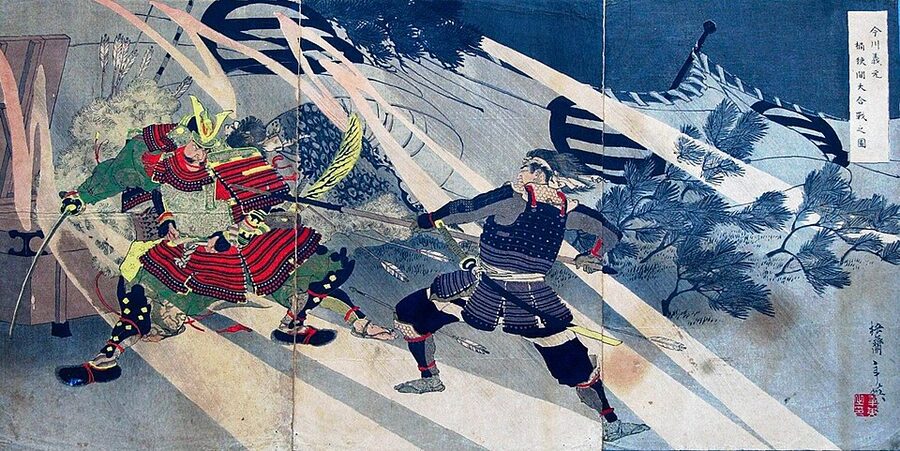
The decisive phase of the battle happened in less than an hour, between roughly 1pm and 2pm on 19 May 1560. At around 1pm a sudden violent thunderstorm broke out over the Okehazama valley. The Shinchō Kōki describes visibility dropping to “less than the length of a spear” and refers to the precipitation as ishi-mizu-majiri — “stones mixed with water,” which is the standard Japanese phrase for hail. The cloud cover and visibility were bad enough that Yoshimoto’s headquarters, on the Okehazama-yama hill, could not see more than a few hundred metres in any direction. Yoshimoto’s personal retinue was partially out of armour — some had dismounted, some were eating, the atmosphere around the command post had the character of a victory lunch rather than a front-line position. This is exactly when Nobunaga’s 2,000-man strike force came out of the rain.
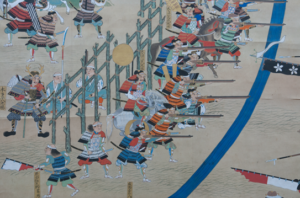
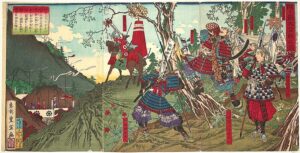
The initial contact was at the outer picket line of Yoshimoto’s command company. The first Oda troops to engage were probably a 30-man advance party under Sasa Masatsugu and Senshū Shirō, who had pushed forward from the main column to test the position. These 30 hit the Imagawa pickets and were immediately overwhelmed — Sasa and Senshū both died in the opening skirmish. But their attack functioned as an alarm, and the main Oda column of approximately 2,000 men followed them in within minutes. The Imagawa headquarters company, caught partly undressed and with no organised defensive formation, dissolved almost immediately. The forward pickets fell back on the main command post. Yoshimoto, realising what was happening, ordered a general retreat and mounted his horse — his koshi (palanquin) was abandoned at the command tent — and attempted to cut back to safer ground with 300 personal guards around him.
The retreat did not succeed. The terrain, swampy rice-paddy ground in the rain, reduced the horses’ pace. Yoshimoto’s personal escort was systematically whittled down by the pursuing Oda column through five successive engagements, each of which stripped off another group of guards. By the fifth engagement, Yoshimoto was left with approximately 50 men around him and the Oda horseback guards had caught up. Two specific Oda samurai closed with Yoshimoto personally. The first, Hattori Kazutada, struck first with a spear — Yoshimoto drew his wakizashi and cut Hattori’s knee, stopping him. The second, Mori Shinsuke (age 24, a relatively junior Oda retainer), closed through the rain, wrestled Yoshimoto off his horse, pinned him to the ground, and took his head. Yoshimoto in his final moment bit off Mori Shinsuke’s left index finger, which Mori carried for the rest of his life as proof of who had killed the most powerful daimyō in central Japan. The Mizuno Katsunari Oboe-gaki records the finger-biting detail as an eyewitness account from Hattori Kazutada, who was on the ground bleeding through his knee when it happened.
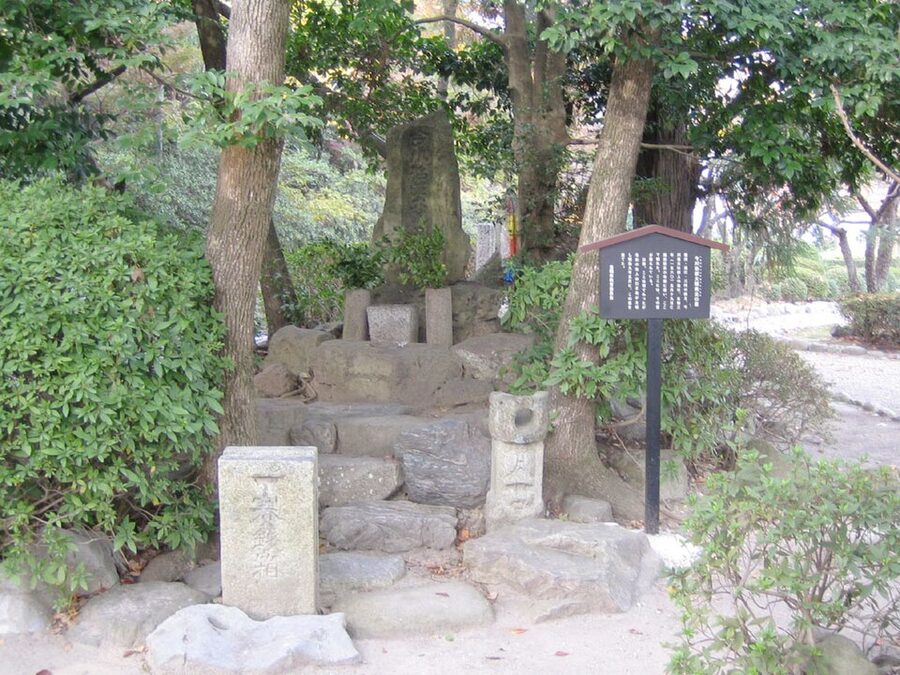
With Yoshimoto dead, the Imagawa collapse was immediate. Word of the commander’s death spread through the surrounding deployments within an hour, and the army, which was spread across multiple positions and could not form a coherent line, simply dissolved. Individual commanders retreated toward Sumpu on whatever routes they could find. Casualties on the day, per the Okehazama Gassen Uchijini-sha Kakiage (the Ryōfuku-ji temple record), came to 2,753 Imagawa dead and 990 Oda dead. The Oda total included 272 men from a small Sasaki (Rokkaku) Ōmi contingent who had fought as allies — though this is disputed, and some researchers regard the Sasaki presence as a later interpolation. The 8-to-1 casualty ratio is only partially a measure of Oda tactical success. Most of the Imagawa dead died in the post-collapse retreat rather than in the main engagement itself, when cohesive formations broke down and individual soldiers were cut down running through the rain-soaked fields toward presumed safety.
The consequences — Ieyasu goes home, the Imagawa fall
The immediate strategic consequence was the collapse of the Imagawa political bloc. Yoshimoto’s son Ujizane inherited the clan, but Ujizane was 22 years old and, fairly or unfairly, widely regarded by his own retainers as a less capable commander than his father. The Mikawa vassals, led by Matsudaira Motoyasu (the future Ieyasu), used the week after the battle to return to their home castles and reconstitute their independence. Motoyasu had been at Ōdaka Castle with his 2,000-man Mikawa force when Yoshimoto died — they took most of that week to confirm the death and plan their next move. On 23 May 1560, Motoyasu formally entered Okazaki Castle (the former Matsudaira stronghold, which had been under Imagawa administrative control for two decades) with the statement “if the castle is abandoned, I shall take it up,” and did not return to Imagawa service.
Two years later, in 1562, Motoyasu formally signed the Kiyosu Alliance with Nobunaga — the military alliance that would hold continuously until Nobunaga’s death in 1582 and which is the specific political arrangement that made both men’s subsequent careers possible. From the 1562 Kiyosu Alliance derived the coordinated Nagashino campaign of 1575 against the Takeda, the joint Komaki-Nagakute response of 1584 to Hideyoshi’s expansion, and ultimately the Tokugawa position at Sekigahara in 1600. All four of these events are directly traceable to Okehazama, in the sense that none of them would have occurred had Yoshimoto survived the afternoon of 19 May 1560.
For Nobunaga, Okehazama’s consequences were equally transformative. Before the battle he was a contested succession-claimant who held roughly half of a minor province. After the battle he was the man who had killed Yoshimoto, and regional chronicles in Mino, Kai, and Echigo all noted the political significance within weeks. The younger branches of the Oda clan that had resisted his succession quickly accepted it. Within three years, Nobunaga had consolidated Owari entirely; within seven years, with the Kiyosu Alliance securing his Mikawa flank, he had taken Mino and Gifu Castle; within ten years, he was moving on Kyoto and issuing letters under the Tenka Fubu seal. None of that was possible before 19 May 1560. Almost all of it followed naturally after.
Why Okehazama matters — the surprise, the gamble, the improvisation
Japanese military historians have argued about Okehazama for four centuries, and the contemporary academic consensus has moved away from the traditional “brilliant surprise attack” framing toward a more nuanced reading. The modern view is that Nobunaga’s success was the product of three distinct factors, of which surprise was probably the least important. The first was intelligence: Nobunaga clearly knew where Yoshimoto’s specific headquarters was located, which is more than Yoshimoto knew about Nobunaga’s movements. The second was the weather: the 1pm thunderstorm was a genuine stroke of luck that converted a risky approach into a decisive strike. The third, and most important in the revisionist reading, was the improvised recognition of opportunity. Nobunaga did not plan the battle on 19 May. He planned to respond to whatever Yoshimoto did and then take whatever opportunity the tactical situation generated. When the opportunity appeared, a lightly-defended headquarters company momentarily isolated in a rainstorm, he took it without hesitation.
What this reading implies is that Okehazama was not a triumph of pre-planned genius but a triumph of operational reactivity. Nobunaga’s career afterward would continue this pattern — Kanegasaki 1570, Nagashino 1575, the Ishiyama Honganji campaigns — where the decisive action was less a single brilliant plan and more a willingness to move faster and more committedly than his opponents expected. The Atsumori dance at dawn on 19 May has become the symbol of this. Nobunaga chose, when the Washizu news arrived, not to analyse and hesitate but to commit immediately to a course of action that might or might not work. It worked. Most of his later career’s distinctive decisions follow this same decision architecture.
Okehazama also changed what Japanese warfare looked like for the rest of the Sengoku period. Before 1560, Japanese regional warfare had been a slow, territorial, incremental business — small sieges, border raids, multi-season campaigns with negotiated conclusions. Okehazama demonstrated that a single rapid strike at a commander’s person could undo decades of patient territorial consolidation in a single afternoon. Every subsequent major Sengoku battle — including, ultimately, Sekigahara 40 years later — was shaped by the awareness that command-destruction was a legitimate tactical objective. The fortification patterns changed: lords began building multiple layered guard rings around their personal positions. The intelligence patterns changed: scouts were specifically tasked with locating command posts rather than counting overall force numbers. The whole grammar of warlord personal risk management altered. Yoshimoto’s specific catastrophe became the template for everything subsequent Japanese military commanders would try not to replicate.
Where to visit the Okehazama battlefield
Okehazama Kōsenjō Park, Toyoake
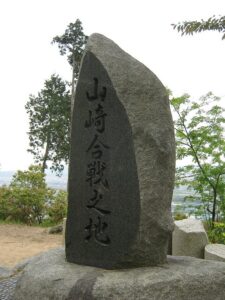
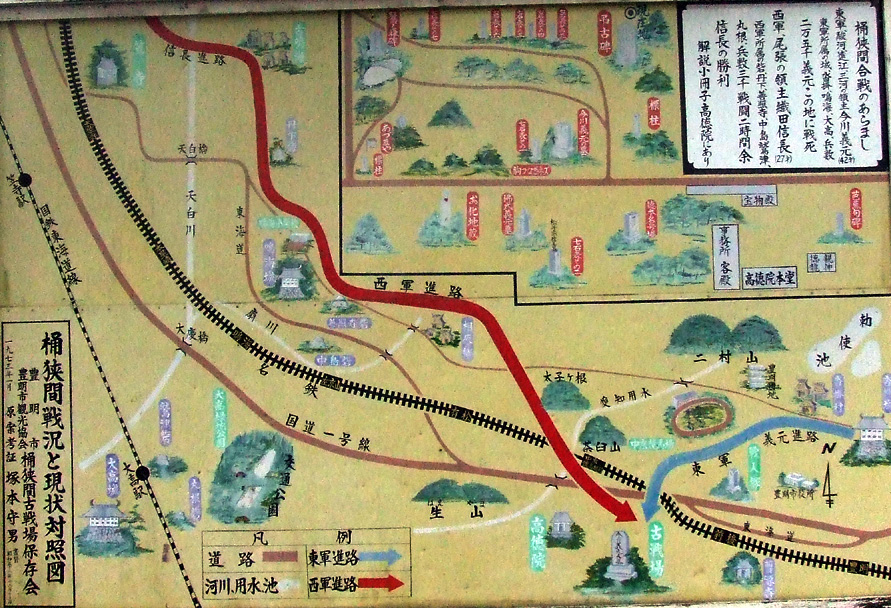
The definitive Okehazama site is the Okehazama Kōsenjō Park (桶狭間古戦場公園) in Toyoake city, Aichi Prefecture — a small, well-signposted public park covering the approximate area of Yoshimoto’s final stand. The park has Yoshimoto’s grave monument (the Imagawa-ke Sōshū Ryō-ka), stone markers identifying the command-post location, the death-of-Yoshimoto spot, and the Mori Shinsuke striking-point, plus a small museum-kiosk with battle chronology displays and replica armor. The annual Okehazama Kosenjō Matsuri festival is held on the first Saturday-Sunday of June and features period-dress reenactments, a formal memorial ceremony at Yoshimoto’s grave, and, characteristically for Toyoake, a fair amount of hot food and cold beer.
Getting there: Zengō Station on the Meitetsu Nagoya Line, 20 minutes east of Nagoya; the park is a 15-minute walk from the station. Free, always open. Most foreign visitors miss Okehazama on their Nagoya itineraries, which is probably the single biggest gap in the standard central-Japan Sengoku tourist circuit. Budget an hour here, or two if you want to walk the full signposted historical route including the retreat-path markers down to the Tanjaku-ga-kubo lowland (where Yoshimoto was actually caught).
Okehazama-Kassen Gassen-hi, Midori-ku Nagoya
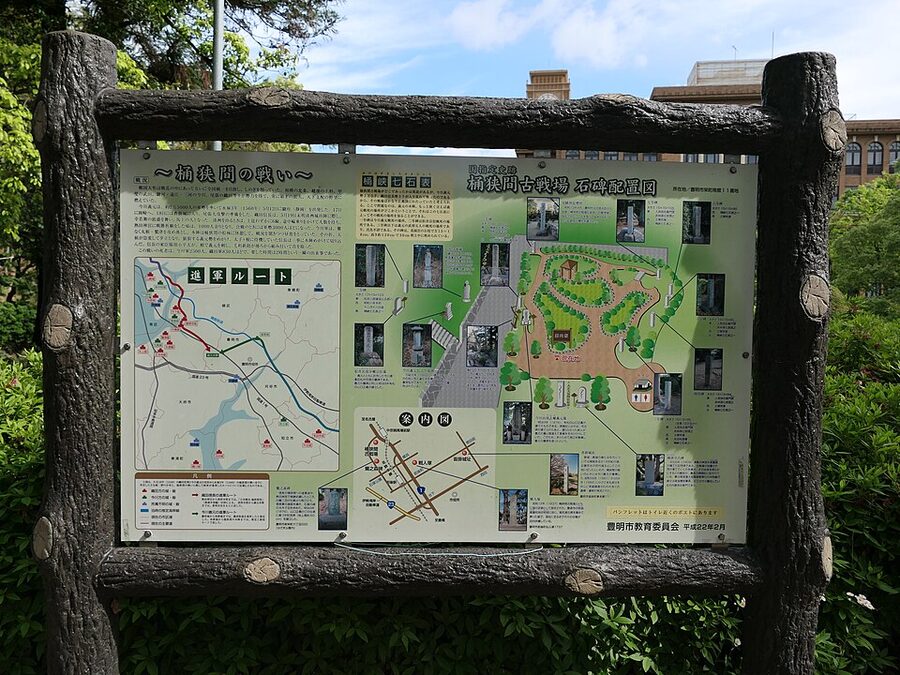
There’s a second major battlefield monument site — this one in Midori ward of Nagoya City, about 3 kilometres west of the Toyoake park. The Okehazama-Kassen Gassen-hi site at Nagoya marks the western edge of the battlefield, where the Oda strike force made its initial contact with Imagawa pickets. The site has its own stone memorial, an information pavilion, and several additional commander-position markers, and is adjacent to the Okehazama Battlefield Park with clearly-marked walking routes connecting to the Toyoake side.
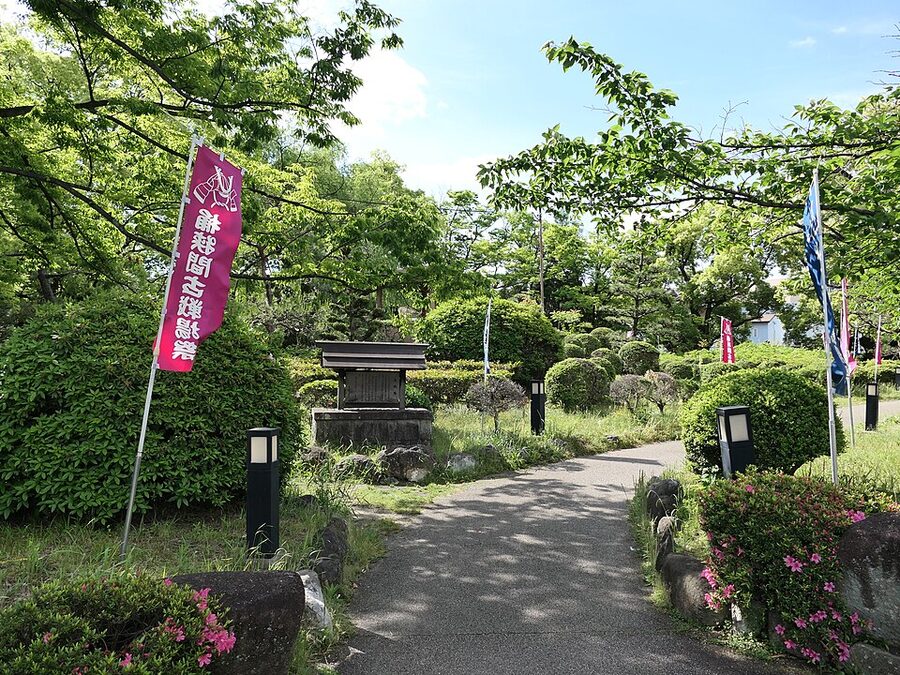
The Toyoake and Nagoya battlefield parks are connected by a local walking route that’s signposted in both directions — about a 45-minute walk between the two, along a mixed modern-suburban and preserved rural path. Combining both sites into a full-day visit covers all the historical markers in the correct geographic sequence (west-to-east from the Oda approach vector to the Imagawa collapse zone), and is the best way to get a physical sense of the battle’s terrain. Wear decent shoes — parts of the route are uneven.
Atsuta Shrine and Kiyosu Castle — the morning of 19 May
Two sites connected to the morning phase of the battle are worth including on a full Okehazama circuit. Atsuta Shrine — Atsuta-jingū — is where Nobunaga paused for offerings between 8am and 10am on 19 May 1560 while his army caught up with his forward column. The shrine is in Atsuta ward of Nagoya, 15 minutes from Nagoya Station by the Meitetsu Nagoya Main Line. It’s a major imperial shrine (second in ancient rank only to Ise) and houses the Kusanagi sacred sword — one of the three Imperial Regalia. The specific grove where Nobunaga is supposed to have prayed is still identifiable. The shrine is free, always open, and pairs well with a visit to the adjacent Atsuta Atsushin Museum (¥300).
Kiyosu Castle, the tower Nobunaga rode out of at dawn on 19 May 1560, is preserved as a reconstructed modern castle with a small museum focused on Nobunaga’s Owari-period career. The castle itself is a 1989 concrete rebuild, but the moat layout and some outer foundations are from Nobunaga’s era. Open 9am-4:30pm, closed Mondays; ¥400 admission. Access is via Kiyosu Station on the JR Tōkaidō Main Line, 12 minutes west of Nagoya. Kiyosu pairs naturally with Okehazama for a two-site morning-to-afternoon itinerary: you can visit Kiyosu in the morning to see where Nobunaga’s day began, then move east to Atsuta for the mid-morning phase, then to the Okehazama sites for the afternoon.
Sumpu Castle and Shimizu — the Imagawa side
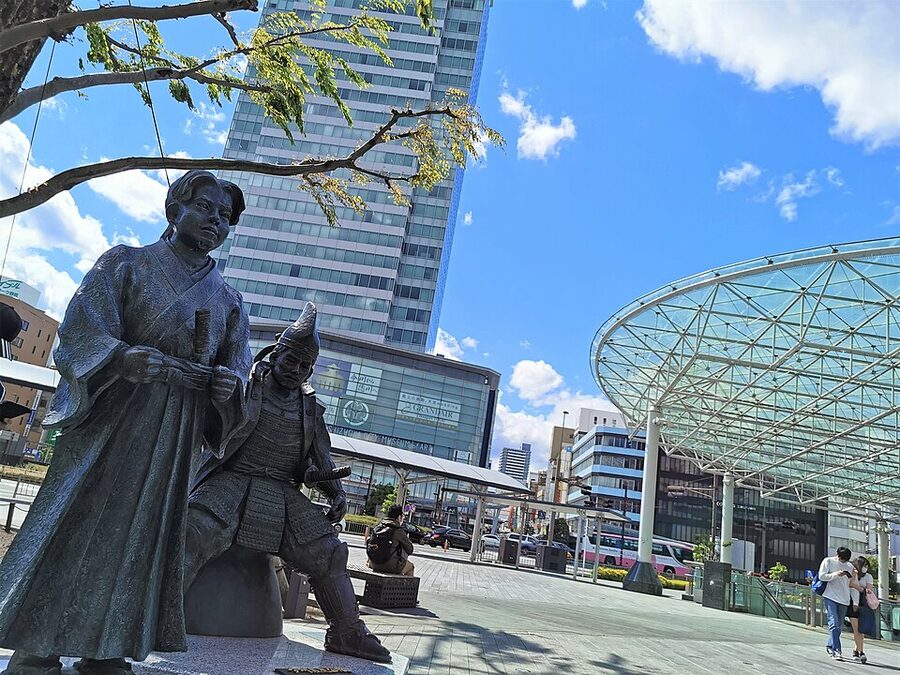
For a more-specialised trip covering the Imagawa side of the story, Sumpu Castle in central Shizuoka (2 hours from Tokyo by Shinkansen) is the former Imagawa capital from which Yoshimoto marched out on 12 May 1560. The castle grounds are now Sumpu Castle Park, with a modest museum and the restored east gate. The broader Shizuoka city area has multiple Imagawa-family memorial sites including Zuiryū-ji temple (the Imagawa family’s bodai-ji), the historical residence of Imagawa Ujichika, and the Sumpu History Museum which runs rotating exhibits on the Imagawa family and their territorial-expansion campaigns. Combine with Shizuoka Shimizu ward for the Yoshimoto statue at Shimizu Station. The Shizuoka side is the most complete set of Imagawa-related sites in Japan and is worth a full day for anyone specifically interested in the Imagawa rather than the Oda side of the narrative.
Closing — the 42-year-old on the hill
Walking the Okehazama battlefield today — Toyoake in the morning, the Nagoya side in the afternoon, the two parks connected by the marked path across what used to be rice paddies — the thing you notice is how easy it would have been to plan differently. The command post was on a modestly-elevated hill with clear surrounding sight-lines on a non-stormy day. The supporting forces were within 3-4 kilometres in most directions. A competent general in a competent position could have reinforced the headquarters within 30-45 minutes of an alarm. What converted Yoshimoto’s normal situation into a fatal one was the specific combination of momentary complacency (victory-lunch atmosphere), specific terrain (rain-soaked mud that slowed the retreat), specific weather (the 1pm thunderstorm that blinded the defenders), and specific opposing aggression (Nobunaga’s willingness to commit to a rapid strike without further planning). Each factor on its own would not have killed him. All four together did.
And the consequences radiated outward for decades. The 22-year-old Matsudaira Motoyasu, eating lunch at Ōdaka with 2,000 Mikawa retainers when word of Yoshimoto’s death reached him, broke ranks and walked his clan back into political independence. The 26-year-old Nobunaga, covered in rain and his own blood-splatter from the personal combat around the command post, rode back to Kiyosu with the enemy commander’s head wrapped in cloth. The 22-year-old Imagawa Ujizane, at Sumpu waiting for the victory reports, began within hours the gradual administrative collapse that would end his clan within 12 years. Every subsequent major political development in the Sengoku and early Edo period — the Oda-Matsudaira alliance, the Takeda wars, the Hideyoshi unification, Sekigahara, the Tokugawa shogunate — traces through this one afternoon. The 42-year-old on the hill, eating lunch in anticipated victory, stopped being alive at approximately 2pm on 19 May 1560; with him, the political order of central Japan stopped being what he had thought it was. Everything after that was someone else’s problem to organise.
For the connected reading, my companion pieces on this site are: Gifu Castle, where Nobunaga finally declared Tenka Fubu seven years after Okehazama; Toyotomi Hideyoshi, the young foot-soldier Tokichirō who accompanied Nobunaga’s column to Okehazama and would unify Japan two decades later; Saitō Dōsan, whose 1556 death in Mino had created the earlier power vacuum that set up Nobunaga’s Mino campaign; and Honda Tadakatsu, the 12-year-old Matsudaira retainer who fought his first battle at Ōdaka on 18 May, the night before Yoshimoto’s death. For the specific campaigns that flowed from Okehazama, see Mikatagahara, Nagashino, and Sekigahara.