The Battle of Komaki-Nagakute is the one engagement Tokugawa Ieyasu ever fought directly against Toyotomi Hideyoshi. It lasted seven months in the spring and summer of 1584, never produced a decisive collision between the two principal armies, and ended in a diplomatic settlement that delivered Hideyoshi the political position he wanted and left Ieyasu with his domain intact. In conventional accounting the campaign is a draw. In practical accounting it is the engagement that preserved the Tokugawa as an independent house for the next sixteen years, which is long enough to be at Sekigahara, and it did so by establishing a specific piece of information both commanders would carry for the rest of their lives: that Ieyasu could not be destroyed by force.
Hideyoshi had about 100,000 men in the field at peak across the campaign. Ieyasu had about 35,000 including allied contingents. Hideyoshi could not bring the larger army to bear because Ieyasu would not give him an open-ground collision, and Hideyoshi’s one attempt to force the issue by sending a raiding column around the Tokugawa flank ended with the raid column destroyed at Nagakute on 16 April 1584. That four-hour engagement is the part of the campaign most military history books focus on. It was the only piece of real combat. It was also the decisive data point underneath the entire subsequent peace negotiation.
In This Article
- After Honnō-ji and Shizugatake
- The Oda Nobukatsu Problem
- The Komaki Stalemate
- Ikeda’s Raid
- The Battle of Nagakute
- What Hideyoshi Learned
- The Peace
- Where to visit the Battle of Komaki-Nagakute today
- 1. Nagakute Historic Battlefield Park — Nagakute city, Aichi
- 2. Chinoike Park and the Kill-zone Memorials — Nagakute city
- 3. Komaki Castle — Komaki city, Aichi
- The Argument
After Honnō-ji and Shizugatake
To understand why Ieyasu ended up on the wrong side of Hideyoshi, you have to track the succession politics of the twenty-four months between Nobunaga’s death at Honnō-ji in June 1582 and the start of the Komaki campaign in March 1584. Hideyoshi, who had been the Oda western-front commander at Nobunaga’s death, moved faster than anyone else to establish himself as the de facto heir to the Oda political position: he crushed the assassin Akechi Mitsuhide at Yamazaki in 1582, outmanoeuvred Shibata Katsuie at Shizugatake in 1583, and by the autumn of 1583 controlled the former Oda capital at Kiyosu and most of the former Oda heartland.
The piece he did not control was the succession legitimacy question. Nobunaga had two surviving sons: Nobukatsu, the eldest, who held Ise province; and Nobutaka, the second son, who had been aligned with Shibata at Shizugatake and had been forced to commit seppuku after the defeat. That left Nobukatsu as the only adult male Oda heir. Hideyoshi’s political strategy was to pay Nobukatsu the minimum ceremonial respect required and then gradually marginalise him. Nobukatsu understood this and was not happy about it. By the winter of 1583-84 he was actively looking for a coalition partner who could help him resist Hideyoshi.
Tokugawa Ieyasu was the only available candidate. Ieyasu’s own position at this point was curious: he had been Nobunaga’s oldest and most trusted external ally, he had not been at Shizugatake (which kept his hands clean of the Hideyoshi-Shibata fight), and he had an unbroken domain of about 750,000 koku across Mikawa, Tōtōmi, and Suruga provinces with a 30,000-man retainer corps. If Nobukatsu could pull him into a coalition against Hideyoshi, the succession politics of the entire country could be reopened. In March 1584 Nobukatsu sent emissaries to Hamamatsu. Ieyasu agreed to the alliance.
The Oda Nobukatsu Problem
The immediate trigger for open war was Nobukatsu’s execution of three senior Oda retainers on 6 March 1584 on suspicion of being Hideyoshi’s agents inside his household. Two of the three probably were, though the evidence is not conclusive. Whether the suspicions were founded or not, the executions made diplomatic reconciliation impossible; Hideyoshi had to respond, and Nobukatsu had to continue the escalation. On 13 March Ieyasu mobilised his domain army and moved west into Owari province to support Nobukatsu. On 27 March Hideyoshi left Osaka with the main Toyotomi army — eighty thousand men in the first wave, more coming — and marched east to confront them.
The two armies met in the Owari-Mino border area in early April. Ieyasu and Nobukatsu established their main positions at the Komaki-yama fortifications — a set of low hills that the Oda had previously used as a temporary command position during the 1560s, about twenty kilometres north of what is now Nagoya. Hideyoshi set up his main camp at Inuyama and Gakuden, a few kilometres north of the Tokugawa line. The two positions were in eye-contact. Neither side had the immediate tactical advantage. A stalemate that would last most of the next three months settled into place.
The Komaki Stalemate
For most of April and May 1584 the Komaki-Nagakute campaign was positional. Hideyoshi tried three times in the first three weeks of the confrontation to lure Ieyasu into an attack on the Toyotomi lines — minor skirmishes at the forward strongpoints, probing attacks against the Komaki main position, calibrated provocations at the Tokugawa forward pickets. Ieyasu refused to engage each time. His position was that the Tokugawa would hold their line, let Hideyoshi’s eighty thousand try to come and dig them out, and let the expense of an eighty-thousand-man army in the field run out the Toyotomi side first. It was the exact opposite of the decision he had made at Mikatagahara in 1573, and it was correct.
By early April Hideyoshi had understood that Ieyasu was not going to be drawn out. His senior staff meeting of 8 April discussed three strategic options: force a direct frontal assault on Komaki-yama (rejected as too expensive), lift the siege and go home (rejected as politically unthinkable), or bypass the Tokugawa line with a raid column around the Tokugawa flank to threaten the Tokugawa rear at Okazaki Castle. The third option was discussed and initially rejected. Then Ikeda Tsuneoki, who was Hideyoshi’s uncle-in-law through a previous marriage and one of the more ambitious senior Toyotomi retainers, personally volunteered to lead the raid. Hideyoshi reluctantly agreed, but with the explicit condition that Ikeda stay close to Toyotomi support and abandon the operation if the Tokugawa detected it.
Ikeda’s Raid
The raid force assembled between 6 and 8 April in four separate columns for a total of about twenty thousand men. The column commanders were Ikeda Tsuneoki (alias Shōnyū) with the first; his son Ikeda Motosuke with the second; Mori Nagayoshi, Tsuneoki’s son-in-law, with the third; and Hideyoshi’s nephew Hashiba Hidetsugu — then seventeen years old, in his first independent command — with the fourth and largest, at around eight thousand men. The plan was to march southwest overnight, bypass the Tokugawa line to the south, attack Okazaki Castle at dawn on 10 April, and force Ieyasu to abandon Komaki-yama to come back and defend his provincial capital.
Ieyasu was informed of the raid around dusk on 8 April by Tokugawa scouts who had picked up the Toyotomi troop movements at their staging area at Mikuni-zuka. This was earlier than Hideyoshi’s planning had assumed. Ieyasu sent the intelligence to his senior staff, had a fast strategic conference in his field tent, and made the specific decision to not withdraw to protect Okazaki but instead to shadow the Ikeda column south and attack it from behind on the march. The Tokugawa counter-move was about 9,500 men under Ii Naomasa, Okubo Tadayo, and Ieyasu himself. They left Komaki-yama at midnight on 8 April. By dawn on 9 April they were a day’s march south and slightly east of the Ikeda column, in position to intercept.
The Battle of Nagakute
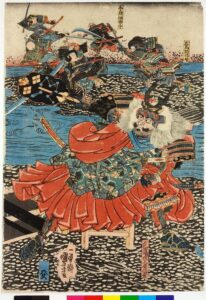
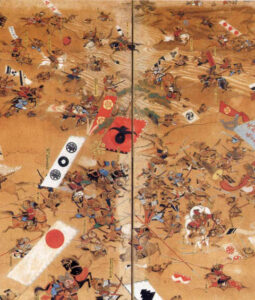
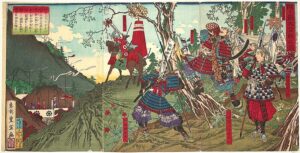
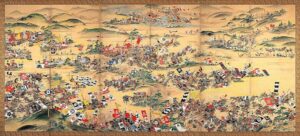
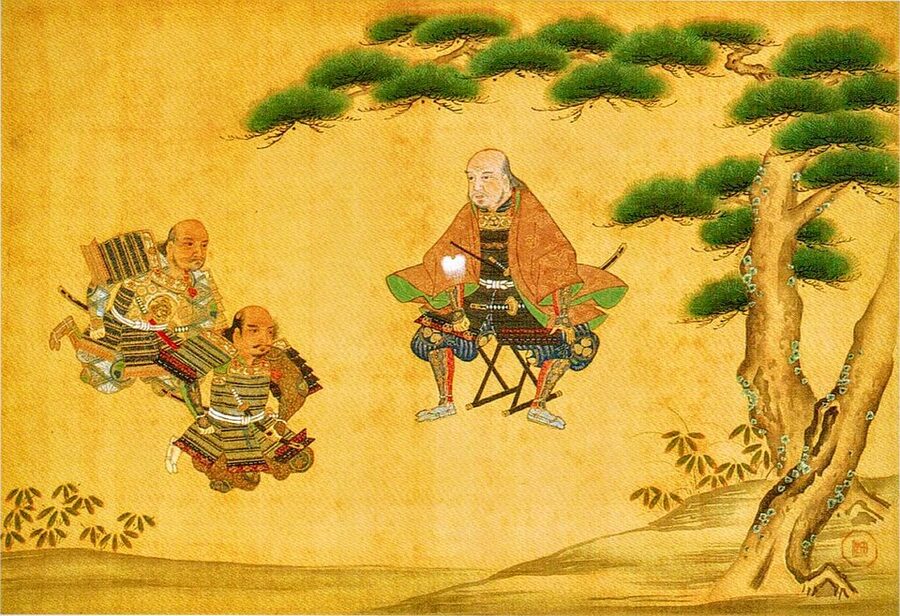
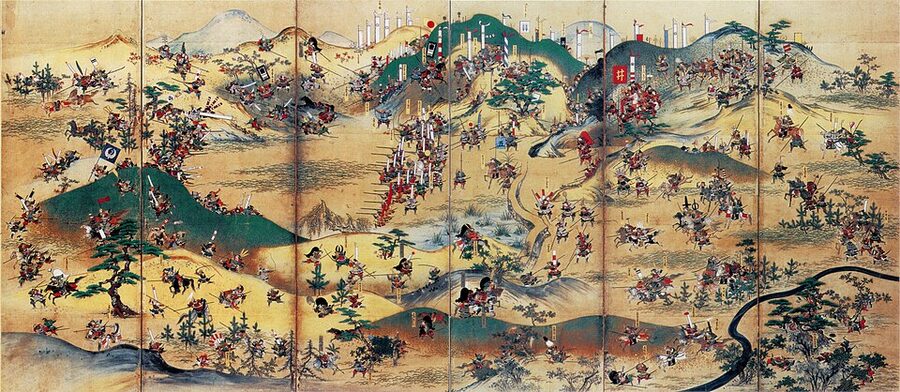
The collision happened at Nagakute, about twelve kilometres south-east of Nagoya, at around 7 am on 16 April 1584. The Ikeda rear column under Ikeda Tsuneoki — about five thousand men, travelling east along the Okazaki road with the Hashiba Hidetsugu column behind him — was hit head-on by the Tokugawa vanguard under Ii Naomasa. Ikeda’s forward units held for the first twenty minutes, then collapsed; the Tokugawa main body under Ieyasu himself arrived from the north at about 7:30 am and enveloped the Ikeda position. The fight turned quickly into a killing-field. Ikeda Tsuneoki’s personal guard was wiped out; Tsuneoki himself was killed by a shot from a Tokugawa arquebus around 8:15 am. His son Motosuke was killed fifteen minutes later leading a counter-charge. Mori Nagayoshi, Tsuneoki’s son-in-law and one of the most formidable young Toyotomi commanders, was killed around 9 am trying to extract the survivors.
Hashiba Hidetsugu, seventeen years old, running the rear Toyotomi column, panicked. He had been riding at the head of the eight-thousand-man column expecting a quiet march to Okazaki; he suddenly had three of his senior commanders dead, the vanguard destroyed, and a Tokugawa force of unknown size in contact to his front. He ordered a retreat, lost cohesion in the attempt, and spent most of the morning scrambling north-west in flight. The Hashiba Hidetsugu column was the Toyotomi nepotism project that Hideyoshi had sent out as an experience-building exercise for his nephew; by 11 am on 16 April about two thousand of the eight thousand men in it were dead or deserting. Hidetsugu himself survived, with his military reputation permanently compromised. The episode would be used against him nine years later during the Hideyoshi-Hidetsugu succession crisis of 1591-95.
By noon the battle was over. The Tokugawa had taken about five hundred casualties, most from the Ikeda counter-charges. The Toyotomi had lost around two thousand five hundred men, including three senior commanders, and had failed to reach Okazaki. Ieyasu ordered a strategic withdrawal back north to Komaki-yama before Hideyoshi’s main force could come south to catch him in turn. By 18 April he was back in the original Komaki position. The stalemate resumed.
What Hideyoshi Learned
The important consequence of Nagakute was not the tactical casualty ratio or the loss of territory, there was no territory change of hands, but the revision in Hideyoshi’s mental model of Ieyasu. Before 16 April, Hideyoshi had been operating on the assumption that Ieyasu was a capable but second-tier commander who could be managed by superior numbers and political pressure. After 16 April, he understood something different: that Ieyasu would react to flanking movements faster than the flanking movements could complete, that he could detach and re-attach his forces without losing coherence, that his intelligence network had caught the Ikeda raid within hours of the decision to launch it. Ieyasu was not a second-tier commander. He was a first-tier one, operating with fewer resources, on defensive ground of his choosing, and he was not going to be rolled over by weight of numbers.
Hideyoshi shifted his strategy accordingly. From mid-May 1584 he stopped trying to force a decisive engagement and began instead to grind Oda Nobukatsu down separately. Nobukatsu’s Ise province was held by a 10,000-man Tokugawa-allied force but had no independent retainer depth; Hideyoshi’s much larger army could, and did, pick off Nobukatsu’s forward castles one at a time across the late spring and summer. Kameyama Castle fell in June, Ōno Castle in August, Nagashima Castle in early November. By November 1584, Nobukatsu had lost roughly two-thirds of his ancestral domain and had no strategic path to recovery.
The Peace
On 11 November 1584, Oda Nobukatsu signed a separate peace with Hideyoshi without consulting Ieyasu. The terms: Nobukatsu kept about 600,000 koku of his original domain (down from 1,200,000 before the war), acknowledged Hideyoshi as head of the former Oda confederation, and sent a son as a ceremonial hostage to Osaka. The separate peace was a political disaster for Ieyasu: the Oda legitimacy case that had been the whole reason for his involvement in the war had just evaporated. He had no further reason to continue the campaign, and Hideyoshi was now free to bring the full Toyotomi army east against a Tokugawa-only coalition.
Ieyasu made his own settlement. Across the winter of 1584-85 he sent formal envoys to Osaka; the terms were negotiated by Hideyoshi’s secretary Ishida Mitsunari and Ieyasu’s chief diplomat Honda Masanobu. Ieyasu agreed to acknowledge Hideyoshi’s primacy, to recognise the Toyotomi succession, and to send his second son Ogimaru (later known as Yuki Hideyasu) as a hostage-adoptee to Hideyoshi’s household. In return he kept his 750,000-koku domain intact, his retainer structure unchanged, and, a subtle but important detail, retained the right to refuse future Toyotomi military summons on the basis of “domestic considerations”. He would use that retention clause six years later during the Hideyoshi-Kūshū campaigns and again during the Korean campaigns of the 1590s.
The post-Komaki settlement set the Hideyoshi-Ieyasu relationship for the remaining thirteen years of Hideyoshi’s life. Ieyasu served as a senior Toyotomi vassal, participated in the campaigns he was required to participate in, built up his domain carefully, and waited. He had established at Nagakute that he could not be destroyed in battle; he had established in the subsequent negotiation that he could not be absorbed politically. Hideyoshi on his deathbed in 1598 named Ieyasu the chief of the five-regent council that was supposed to govern for his son Hideyori. Within two years of the deathbed, Ieyasu had used that chairmanship to organise the Sekigahara campaign that would end the Toyotomi regime and found the Tokugawa one. None of that is possible without the Nagakute result in 1584. The Toyotomi could not eat the Tokugawa. Everything else followed.
Where to visit the Battle of Komaki-Nagakute today
The battlefield is on the north-east edge of modern Nagoya, reachable as a day trip from Nagoya Station. Two main sites plus the preserved Komaki Castle keep.
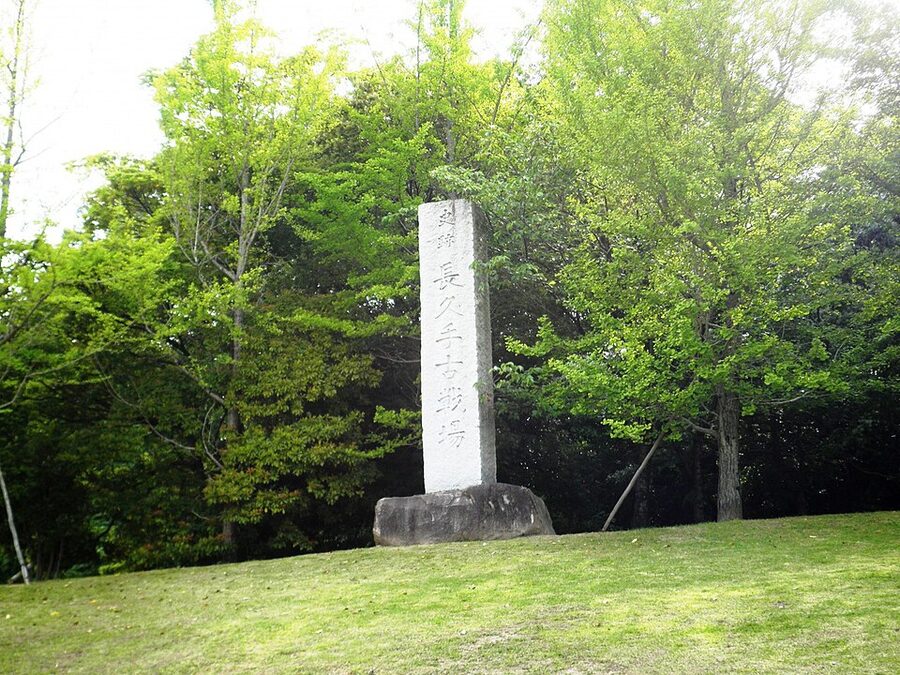
1. Nagakute Historic Battlefield Park — Nagakute city, Aichi
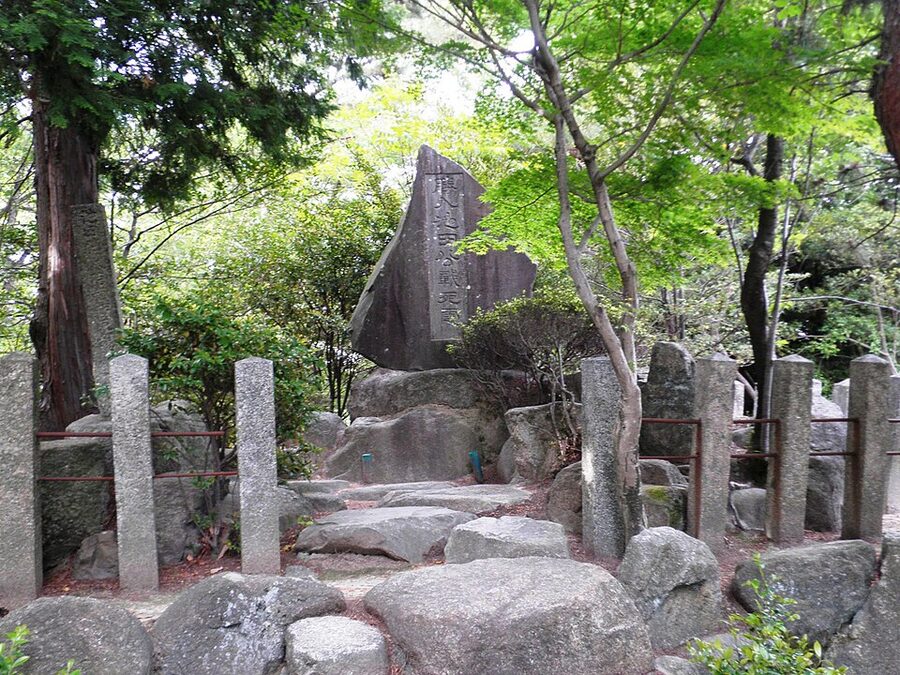
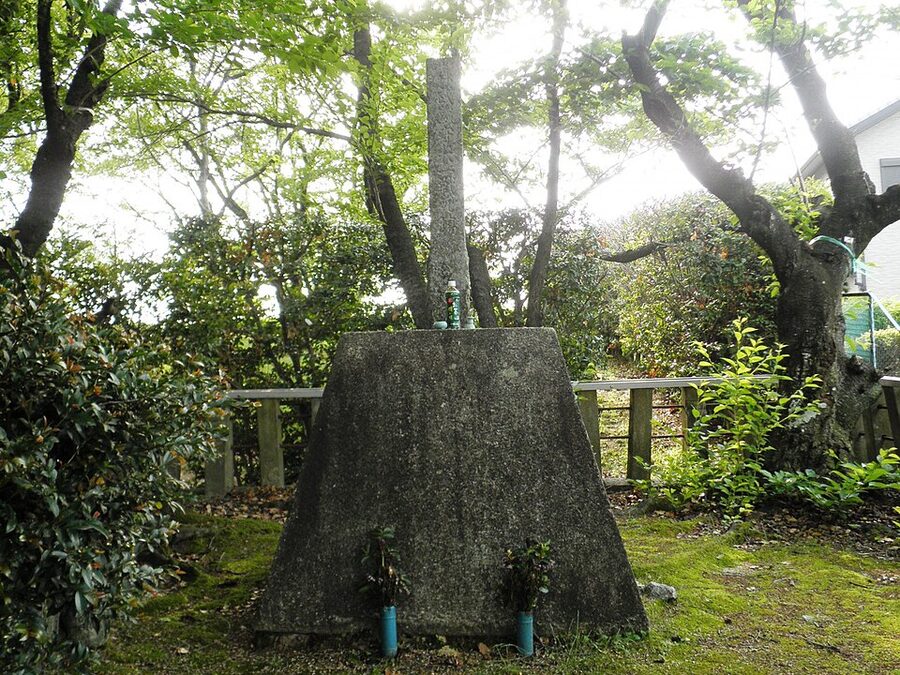
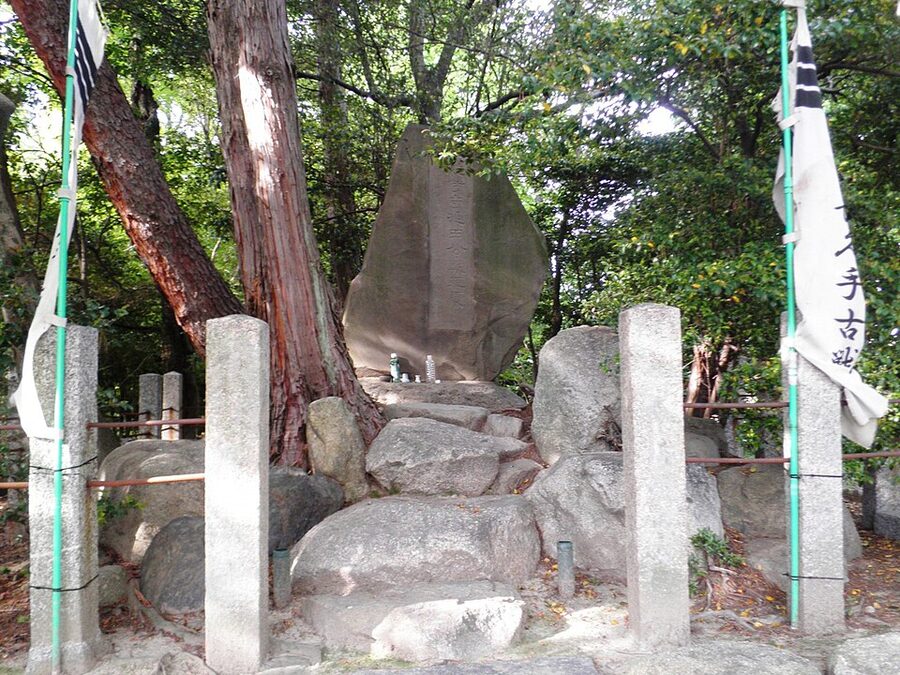
The central Nagakute battlefield is preserved as a ten-hectare historic park with walking paths, interpretive signs, and the three main commander-grave mounds — Shōnyū-zuka (Ikeda Tsuneoki), Shōkurō-zuka (Motosuke), and Musashi-zuka (Mori Nagayoshi). The Nagakute City Museum of History and Folklore is adjacent and has a detailed permanent exhibit on the battle, including a scale diorama showing the morning-to-noon progression of the engagement and a full-size replica of Ieyasu’s field-command tent. Entrance is ¥300 for the museum, free for the battlefield park.
Access: Linimo maglev from Fujigaoka Station (on the Tokyo-Nagoya Higashiyama subway line) to Historic Battlefield Park station; five-minute walk from the station. Allow three hours. Best in late October through early November for leaf colour.
2. Chinoike Park and the Kill-zone Memorials — Nagakute city
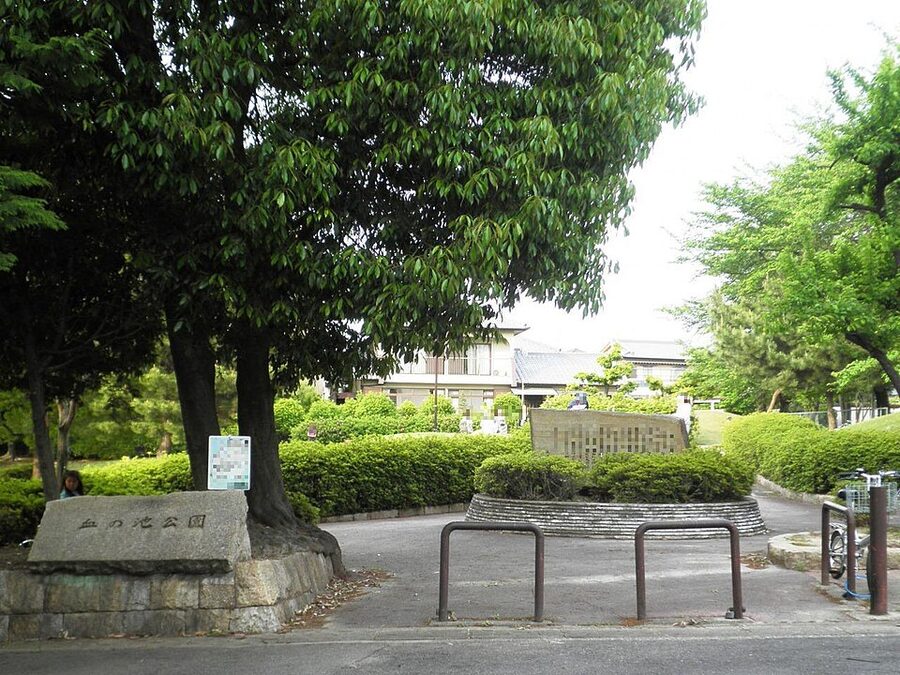
Chinoike (血池) Park, the “pond of blood” memorial, is about a kilometre west of the main battlefield park. It commemorates the main killing-field where the Ikeda rear column was destroyed. The park is small, quiet, and largely unvisited; most tourists stop at the main battlefield and miss this site. If you are seriously into the battle, this is the emotional centre. The pond that gave the park its name was drained in 1908 for city construction, but a small replacement water feature marks the approximate location. Allow thirty minutes.
3. Komaki Castle — Komaki city, Aichi
Komaki Castle, the main Tokugawa-Oda forward position during the stalemate phase, is preserved as Komaki-yama Park, about twenty kilometres north of Nagakute. The main keep is a 1968 concrete reconstruction but the Oda-era earthworks and the defensive ditch system are intact and walkable. The Komaki City Museum inside the keep has a permanent Komaki-campaign exhibit and a rotating loan display from the Tokugawa Art Museum of Ieyasu campaign materials. From the castle summit you can see all the way south to the Nagakute battlefield on a clear day. Admission ¥200. Allow two hours.
Access: Meitetsu Komaki line to Komaki Station, then twenty-minute walk. If you are doing the full battlefield tour, Komaki in the morning and Nagakute in the afternoon fit into a single day.
The Argument
Komaki-Nagakute is the battle Japanese political-military historians point to when they want to distinguish between tactical outcomes and strategic outcomes. Tactically, Hideyoshi won the campaign: he lost the Nagakute engagement but he took Oda Nobukatsu’s territory, imposed the peace settlement he wanted, and emerged as the acknowledged head of the former Oda confederation. Strategically, Ieyasu won: he came out with his domain intact, his retainer corps loyal, his military reputation permanently enhanced, and a specific political understanding with Hideyoshi that would protect him for the next sixteen years. The two outcomes are not in contradiction; they are what happens when a campaign settles a political argument about relative strength without actually determining which side has more men.
Compare to the Shizugatake engagement of the year before. Shizugatake was decisive: it settled succession politics by killing or forcing the suicide of the opposing senior commander. Komaki-Nagakute was the opposite: it settled succession politics without killing anyone important on the winning side. The settlement held because both sides had gained accurate information about each other’s capabilities and neither side had an obvious path to a better outcome. That is a rare pattern in the Sengoku period. It recurs at Sekigahara sixteen years later in a mirror image: Ieyasu wins decisively then, because the political information he gathered at Komaki-Nagakute told him Hideyoshi’s successors would fight a pitched battle they could not win.
If you are in Nagoya anyway, take the Higashiyama subway to Fujigaoka, then the Linimo to Historic Battlefield Park station. Walk the Nagakute park. Find the three grave mounds. Read the signage. Then take the bus or train north to Komaki, climb the castle mound, and look south across the plain. The distance between Komaki-yama and Nagakute is about twenty-five kilometres — a long overnight march for a column of twenty thousand men. Ikeda Shōnyū made that march on the night of 8 April 1584 expecting to reach Okazaki by dawn on 10 April. He never made it past Nagakute. The field he is buried in is the field where the Tokugawa regime was politically guaranteed. The rest — the loyalist holdouts, the Korean campaigns, the gradual consolidation — was execution. The decision was made here.