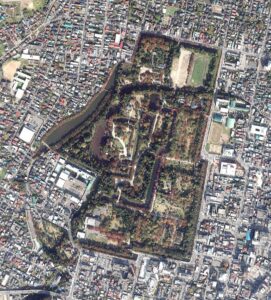
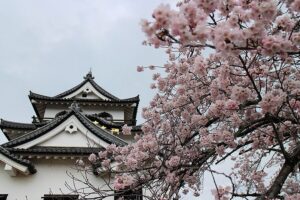
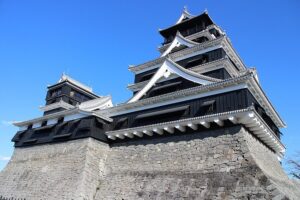
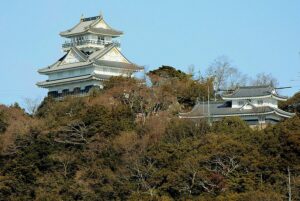
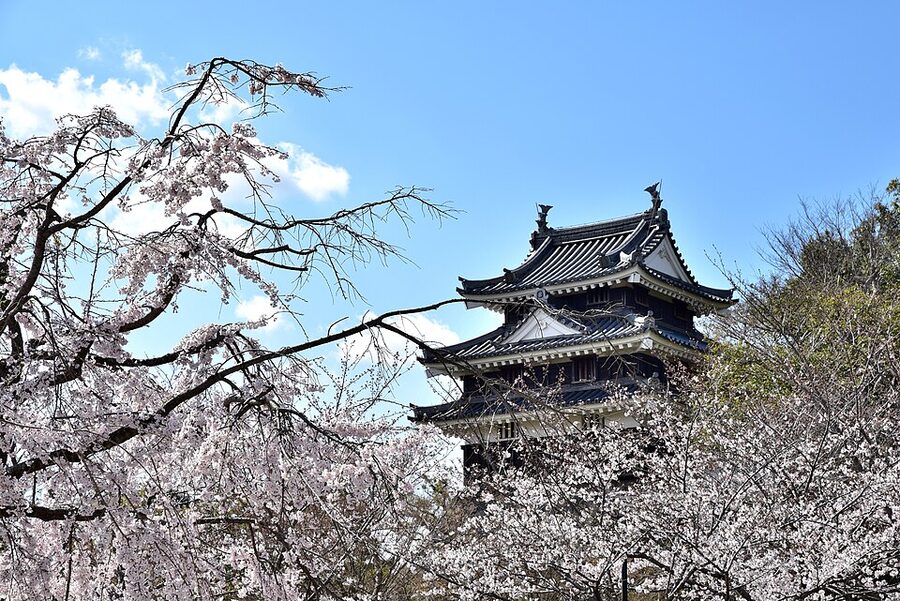
Nishio Castle is the castle in the other matcha capital. Most English-language Japan coverage of matcha green-tea culture stops at Uji in Kōto prefecture, which has been Japan’s headline matcha producer since the 12th century. The second-largest producer, responsible for roughly 20% of the country’s ceremonial matcha output and 30% of the culinary grade, is the small city of Nishio in southern Aichi, two hundred and fifty kilometres east of Uji. Nishio has been running its matcha industry since 1271, making it older than most things in Uji. And it has a castle, hidden in plain sight at the centre of the modern city, that is the reason the matcha industry took root here.
This is a short article by the standards of this site. The castle is compact, the history is intermittent, and the main reason to go is not actually the castle itself but the way the castle enabled the tea industry that surrounds it. The combination is unusual in Japan. Most tea-producing regions grew their industries outside any political centre; most castle towns of comparable size have no tea-growing legacy at all. Nishio has both, and the overlap is why the city works as a travel destination.
In This Article
- A 13th-Century Mountain Post
- The Matsudaira Era
- The Tokugawa Domain
- The Demolition and the Reconstruction
- The Matcha Connection
- Where to visit Nishio Castle today
- 1. Nishio Castle Park and Municipal Museum
- 2. The Nishio Tea Culture Museum and matcha shops
- 3. The Yahagi River tea fields and Jissō-ji temple
- The Quiet Castle
A 13th-Century Mountain Post
The original castle was founded in 1221 by Ashikaga Yoshiuji (足利義氏), a provincial governor of the early Kamakura period who had been given Mikawa province by the second shogun Minamoto no Yoriie as part of the standard Kamakura-era reward-fief distribution. Yoshiuji was a minor figure in the Ashikaga lineage; the Ashikaga clan itself would not become politically significant for another century, and the 1221 castle was a small regional fortification meant to hold the area around the Yahagi River for the provincial government. The name at this point was Nishi-jō (西条城), “West Article Castle”, referring to its position on the western road of the local Mikawa administration grid.
The early castle was destroyed and rebuilt at least four times between 1221 and 1530, during the various political upheavals of the Muromachi-to-Sengoku transition. The physical traces of these earlier structures are gone; the site itself is the only continuity. What is visible today is entirely a 16th-century-onward castle, beginning with the reconstruction under the Sakai clan during their brief tenure as provincial governors in the 1540s.
The Matsudaira Era
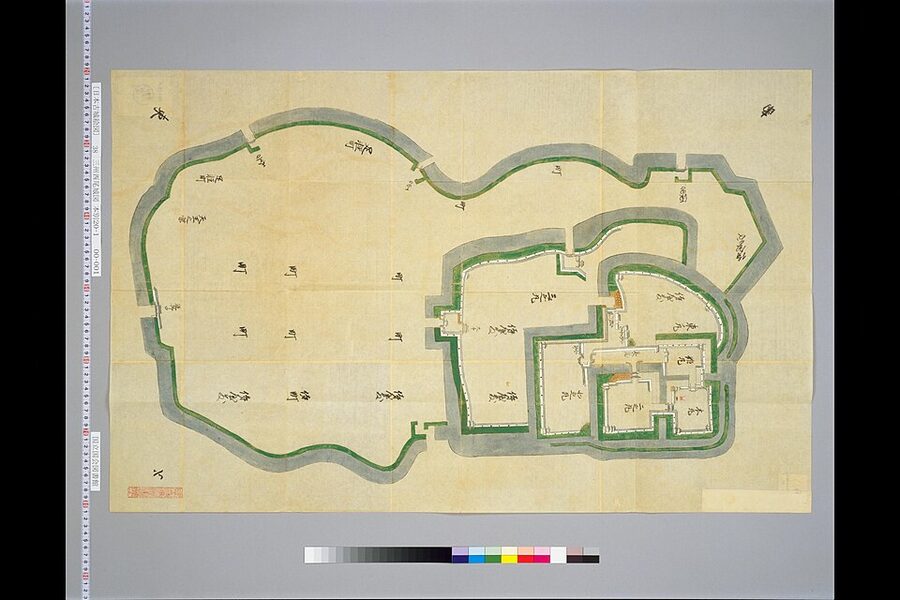
Nishio came under Matsudaira-clan control in 1556 when Matsudaira Hirotada — the father of Tokugawa Ieyasu — pacified southern Mikawa during his brief ascendency as clan head. The castle was useful as a forward defensive position on the Imagawa-facing border, and the Matsudaira invested in it accordingly: stone-faced earthworks replaced the earlier wooden palisades, a proper three-storey main keep was added in 1565 under Ieyasu’s own direct administration, and the defensive moat system was expanded to its full Edo-era dimensions.
Ieyasu used Nishio in the 1570s campaigns against the Takeda clan and in the Komaki-Nagakute campaign of 1584. It was never besieged in a major engagement. Its role was as one of a string of Matsudaira/Tokugawa forward posts along the Mikawa coastal plain, and as a rear-echelon logistical base during the campaigns further west. When Ieyasu was transferred east to the Kantō in 1590 as part of Hideyoshi’s post-Odawara reshuffling, he took the Mikawa clan with him; Nishio was handed briefly to the Tanaka clan and then, after the Sekigahara settlement of 1600, formally established as an independent Tokugawa-aligned domain.
The Tokugawa Domain
The Nishio domain went through an unusually large number of ruling families during the 268 years of the Tokugawa era. The Honda clan ran it 1601-1615; the Matsudaira Iechika branch 1615-1649; the Ōkubo 1649-1672; the Honda again 1672-1688; the Matsudaira Narimochi branch 1688-1705; the Ōgyū Matsudaira 1705-1871. Each transfer carried a change of domain size — the Nishio domain was valued at anywhere between 20,000 and 60,000 koku at different points in its history — and each new lord rebuilt parts of the castle. The inconsistency in ruling family is the main reason Nishio never developed a strong single-family cultural brand the way, for example, the Mito Tokugawa did at Mito Castle two hundred kilometres east. There was no stable patron for long enough to build a tradition.
What Nishio did develop over this period, separately from the castle’s political history, was its tea industry. The first formal tea-cultivation record in the area is from 1271, when the Jishu Buddhist priest Seiiō planted tea at Jissō-ji temple about three kilometres east of the castle site. By the 1500s there were commercial tea farms across the Yahagi River plain around Nishio. In 1620 the Honda-period Nishio domain made tea a specified domain product and started sending ceremonial matcha to Edo as part of its annual tribute. Unlike at Uji, where matcha production was concentrated in a small number of large ritually-sanctioned tea houses patronised directly by the imperial court, Nishio matcha was a domain-industrial product, farmed by tenant farmers across dozens of small fields, processed at domain-licensed milling houses, and sold commercially to Edo shops for use in the city’s rising middle-class tea-ceremony culture.
The economic side of this is why Nishio matters for Japanese agricultural history. Uji matcha is the ceremonial-court product that everyone has read about; Nishio matcha is the commercial product that actually kept the Edo tea-ceremony economy running for two and a half centuries. When the Meiji restoration came in 1868 and the court-patronage system collapsed, the Uji producers went through a brutal thirty-year adjustment before settling into a reduced luxury market. The Nishio producers, who had already been running an open commercial market for two centuries, simply continued. By 1900 Nishio was producing more matcha by volume than Uji, and the gap has held roughly constant since.
The Demolition and the Reconstruction
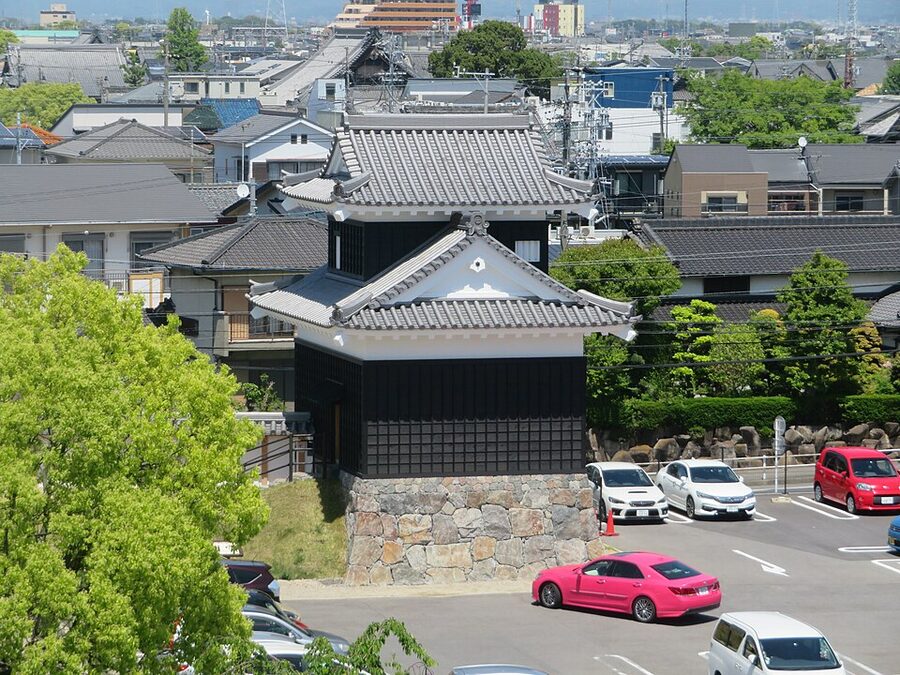
The castle was formally abolished on 14 July 1871 as part of the Meiji government’s haihan-chiken (廃藤置県) policy that dissolved the domain system in a single administrative action. The main keep was dismantled; the outer walls were levelled; the moats were filled in and the land sold for tax revenue. Most of the castle site became a public park in 1883. One of the two yagura towers survived Meiji-era demolition and stood in the park grounds until 1943, when it was demolished for scrap metal during the war. Between 1943 and 1996, the castle site was a flat open park with no surviving structures.
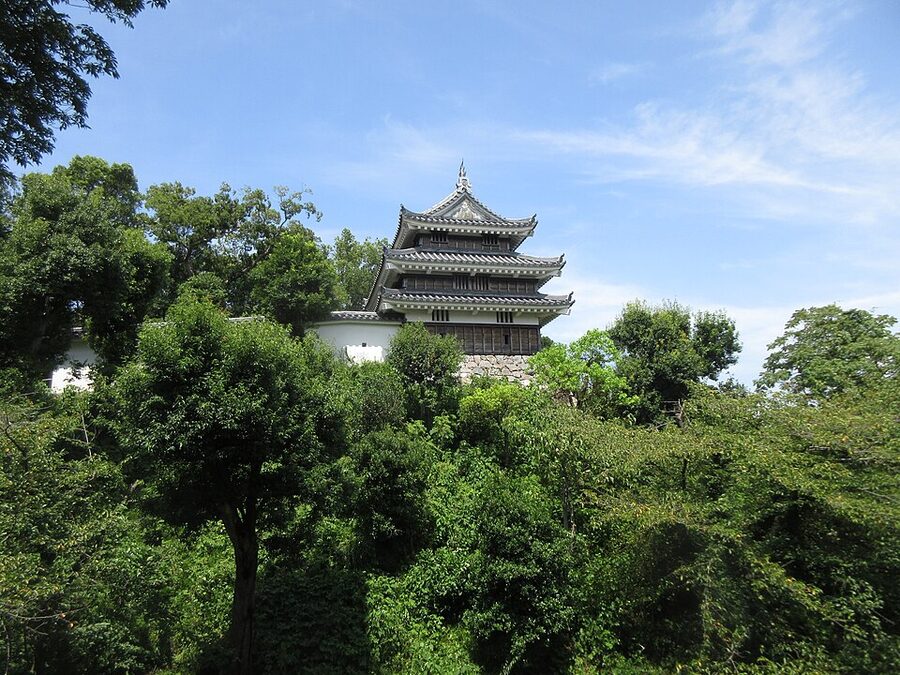
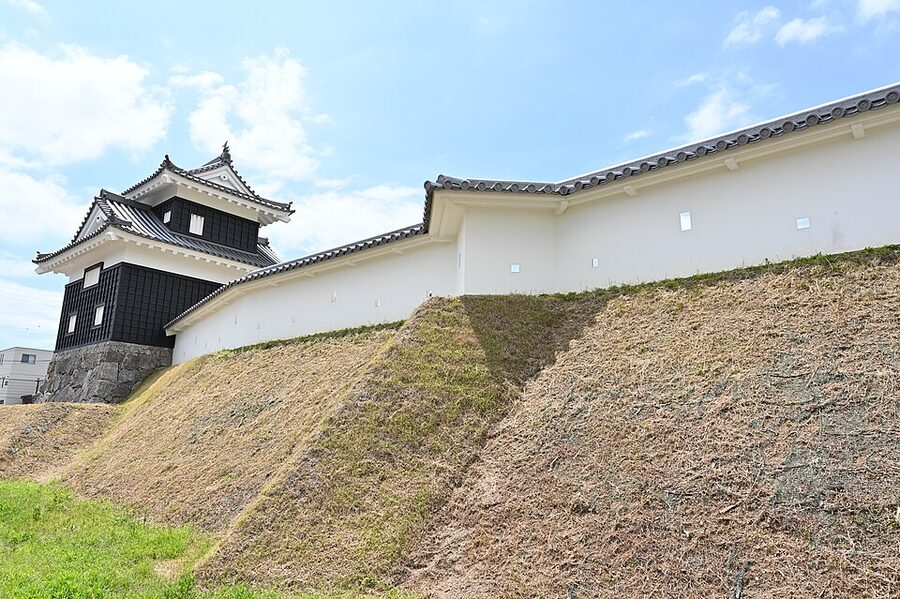
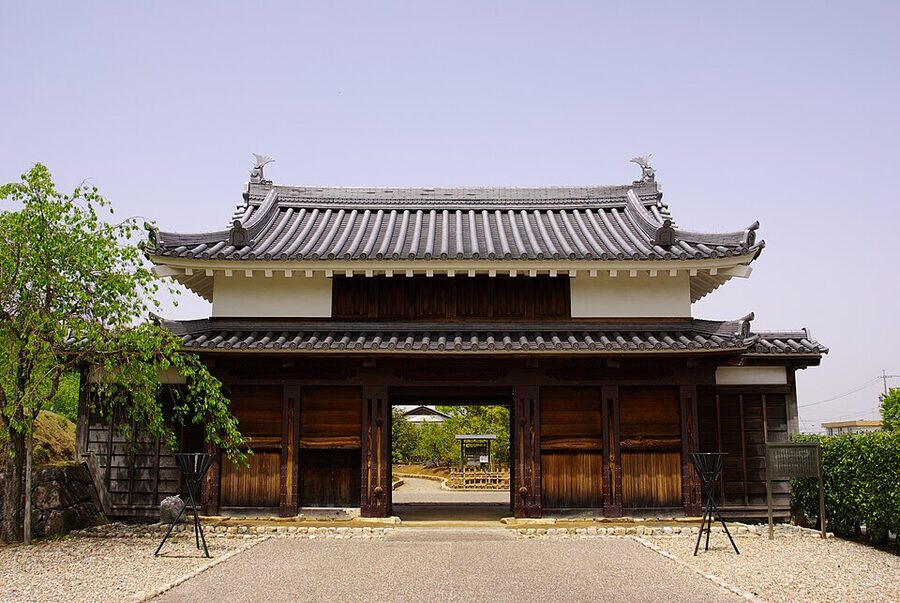
The 1996 reconstruction was funded partly by Nishio city and partly by the local tea-industry association, specifically to create a tourism anchor that would draw matcha visitors to the town centre rather than straight out to the tea farms. The main yagura was rebuilt that year, the main gate in 2004, and the Ushitora corner yagura in 2020 — a twenty-four-year staged reconstruction completed by the end of the Reiwa 2 fiscal year. None of this is original Edo-period construction. All of it follows the original plans. The reconstruction-quality argument applies: if you want to see an original Edo-era castle, go to Himeji or Matsumoto; if you want to see a town’s relationship with its own history, the Nishio reconstruction is the point.
The Matcha Connection
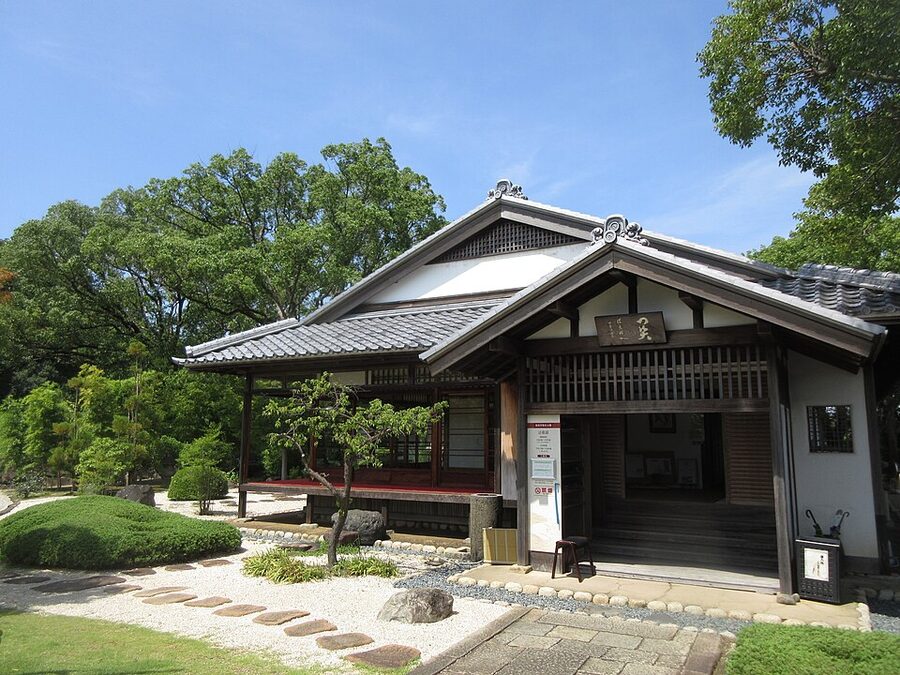
What makes Nishio Castle worth a visit rather than a pass-through is the way the reconstructed castle grounds sit on top of the still-running tea economy. The Kyū Konoe-tei tea pavilion is inside the castle grounds. The Nishio Tea Culture Museum is three blocks south. The main commercial matcha streets — Matsuka-chō and Teramachi, where most of the old tea milling houses have survived as shops — are five minutes’ walk from the castle gate. And the tea farms themselves begin on the north bank of the Yahagi River about two kilometres north-east.
The walkable distance matters because it creates a type of visit you cannot have in Uji or in most other historical-tea towns. You can start at the castle, walk to the tea-culture museum, stop for a bowl of formal matcha at the Kyū Konoe-tei pavilion, browse the shops, and end at the Yahagi riverside tea fields within a single afternoon, all without a car, all in walking-street conditions. The scale is the whole point. Nishio is a working tea town of about 165,000 people; it has a castle; the castle and the tea industry have been adjacent for four hundred years. If you have read about matcha in English-language tea books and want to see what the production side actually looks like, this is the accessible version.
Where to visit Nishio Castle today
1. Nishio Castle Park and Municipal Museum
The castle grounds are open as a public park from sunrise to sunset; admission free. The main yagura tower houses the Nishio City Historical Museum, which is ticketed (¥200 adults) and covers the castle’s Edo-period ruling families, the local tea industry, and a small archaeological display from the 1992-94 excavation of the inner bailey foundations. The Kyū Konoe-tei tea pavilion can be rented for private tea ceremonies through the Nishio Tea Culture Association (advance reservation required, around ¥3,000 per person for a 45-minute ceremony).
Access: Meitetsu Nishio line to Nishio Station, then a ten-minute walk north. From Nagoya Station the full journey is about sixty minutes. Allow two to three hours for the castle plus museum.
2. The Nishio Tea Culture Museum and matcha shops
The Nishio Tea Culture Museum (西尾茶文化規明館, Nishio Chabunka Shiryokan) is three blocks south of the castle at the corner of Sakurachō and Honmachi. Admission ¥300. It covers the industrial history of Nishio matcha with a strong focus on Edo-period tools, including original stone hand-mills used in domain-licensed tea houses and a reconstructed 1830s tea-drying shed. The permanent exhibit on the Meiji-era commercial transition is the best thing in the museum.
The walkable matcha-shop streets — Matsuka-chō and Teramachi — run south from the museum. There are about fifteen active matcha shops along the two streets, most of which offer on-site matcha drinks and wagashi. If you want the oldest continuously-operating shop, it is Aiya Matcha-ten (ℒ茶屋) on Teramachi, which has been milling matcha on the same premises since 1888. The shop sells tins of their mid-grade ceremonial matcha for around ¥2,500 per 30g tin, which is about a third the price of the equivalent Uji product.
3. The Yahagi River tea fields and Jissō-ji temple
The tea farms themselves begin on the north bank of the Yahagi River, about two kilometres north-east of the castle. Most are closed to general tourism but Nishio Tea Village (西尾茶の郊), a cooperative operation run by the tea-industry association, offers public walking tours during the April-May new-leaf season for around ¥1,500 including a tea-picking demonstration and a bowl of their own on-site matcha. The tour is in Japanese only; they have an English audio-guide available on request.
Jissō-ji temple (実相寺), the Jishu Buddhist temple where the 1271 tea plantings happened, is about three kilometres east of the castle. The temple is small and mostly unvisited; the main reason to make the detour is the stone memorial on the east side of the grounds that marks the original 1271 planting site and has a copy of the foundation letter of the Nishio tea trade. Allow forty minutes including bus time from the castle.
The Quiet Castle
Nishio Castle is not one of the great Japanese castles and nobody pretends it is. The Edo-period military-architecture rankings put it in the middle of the third tier. It was never besieged in a decisive engagement. The domain it anchored was never politically important. The ruling families came and went too quickly to build a durable cultural brand. As a piece of historical infrastructure it is inconsequential.
But the combination — a working tea town, a modest castle, an industrial history that quietly overtook the famous one — is interesting in a way the ranked castles are not. Uji’s matcha culture is preserved partly as a luxury tourist product; Nishio’s matcha culture is preserved because it is still what most people in the city do for a living. The castle is the administrative memory of the domain that licensed the early tea industry and kept it running through the 19th-century transitions. It is not the point of visiting Nishio; the matcha is the point of visiting Nishio. The castle is the thing that makes the matcha story make sense.
If you are going to Aichi for the Komaki-Nagakute battlefield or the Tokugawa Art Museum in Nagoya, add a day to your itinerary for Nishio. Take the Meitetsu line south to Nishio Station in the morning. Walk the castle grounds. Have a formal matcha at the Konoe-tei pavilion. Walk down Teramachi to Aiya Matcha-ten and buy a tin of their mid-grade. Take the bus to the Yahagi river tea fields if the new-leaf season is running. Then catch the Meitetsu back to Nagoya for the evening. The day is low-key. It will teach you something about Japanese tea-economy history that you will not learn at Uji. The castle is small. The tea shops are not.