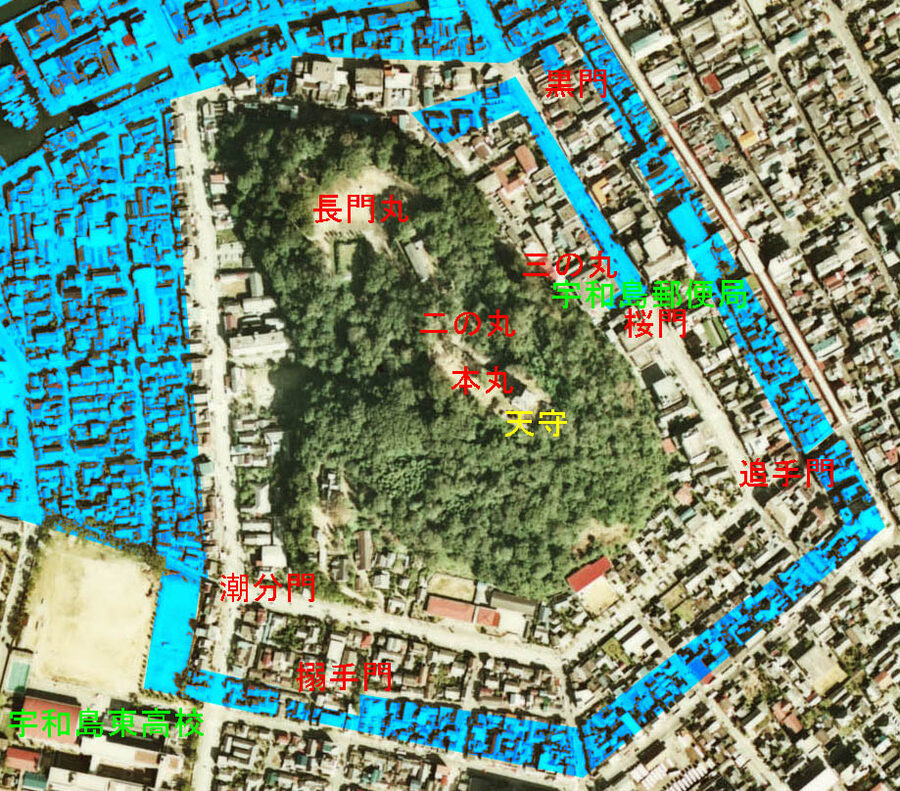
Tōdō Takatora built twenty-plus castles across a forty-year career, and only two of them are pentagons. The other eighteen are rectangles, squares, or the usual irregular polygons that follow the shape of the hill underneath. But at Imabari in 1604 and at Uwajima starting in 1596, Takatora drew five-sided concentric baileys that look, on an aerial photograph, like someone has flattened a misshapen star.
The asymmetry is deliberate. If every side of a castle is the same length, an attacker standing outside the walls can triangulate the distance from the corner yagura to the tenshu using simple geometry — count paces along two walls, and you know how far an arrow has to fly to reach the keep. If the five sides are different lengths, the math collapses. You cannot see the tenshu from outside the outer wall, and once you are inside the outer wall, your sightlines across the bailey are wrong for every instinct a sixteenth-century besieger brings to the problem.
Takatora was the highest-paid castle designer of the early Edo period. By the time he designed Uwajima he had already built Toyotomi Hideyoshi’s Kishu campaign forts, supervised the walls at Osaka, renovated Ieyasu’s Kyoto residence, and taken personal command of a naval squadron during the Korean invasions. His salary when the Uwajima commission started in 1596 was 70,000 koku — a daimyo-level income that Hideyoshi had granted him specifically to guarantee he would not defect to anyone else.
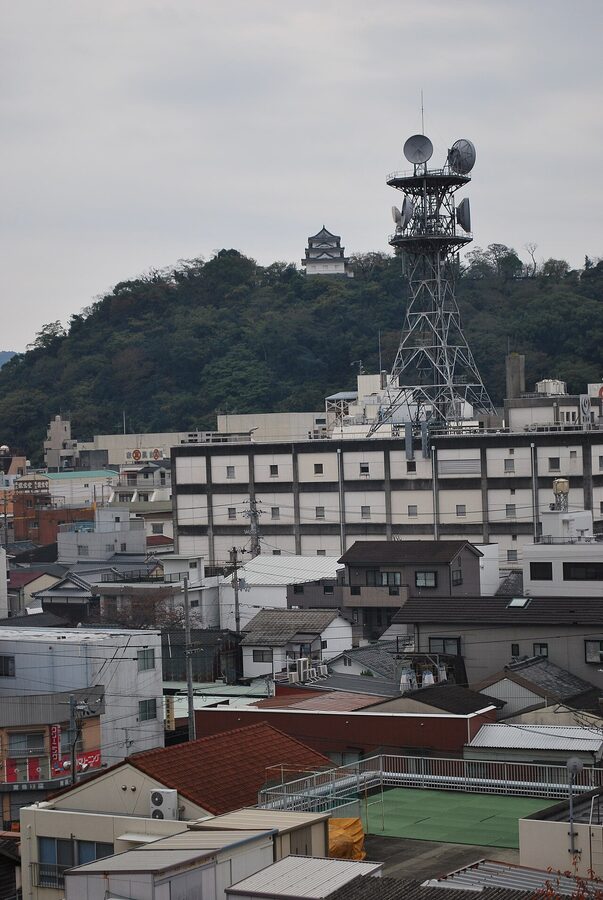
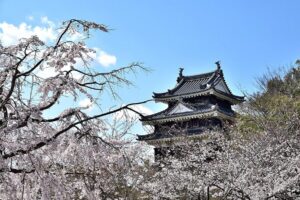
Uwajima Castle (宇和島城, Uwajima-jō) is the result. It stands today on a small wooded hill in the middle of Uwajima city in southern Ehime Prefecture, looking out over the bay where pearl farms still float on the same water that used to be Takatora’s outer moat. The current tenshu is a 1666 rebuild, Takatora’s original stood for only sixty years before lightning burned it down, but the pentagon plan, the ishigaki, and the five-sided stone skeleton underneath are all the designer’s original work.
In This Article
- What Uwajima Castle is and where it sits
- Tōdō Takatora: the master castle designer
- 1596–1601: the original construction
- The pentagon plan and why it matters
- The sea-moat concept
- 1608: Takatora leaves, Tomita arrives
- 1614: Date Hidemune inherits the domain
- 1662: lightning strikes the original tenshu
- The hidden gun racks
- The Date dynasty: nine generations, 257 years
- Meiji survival and the Important Cultural Property designation
- The ishigaki: a course-by-course signature
- The gate sequence — Ichimon, Sanmon, Kaminari
- Visiting today: the walk up, the view down
- Uwajima the city: pearls, Taga Shrine, ushi-oni
- How Uwajima fits among the twelve originals
- Getting there
- Why I think Uwajima is underrated
What Uwajima Castle is and where it sits
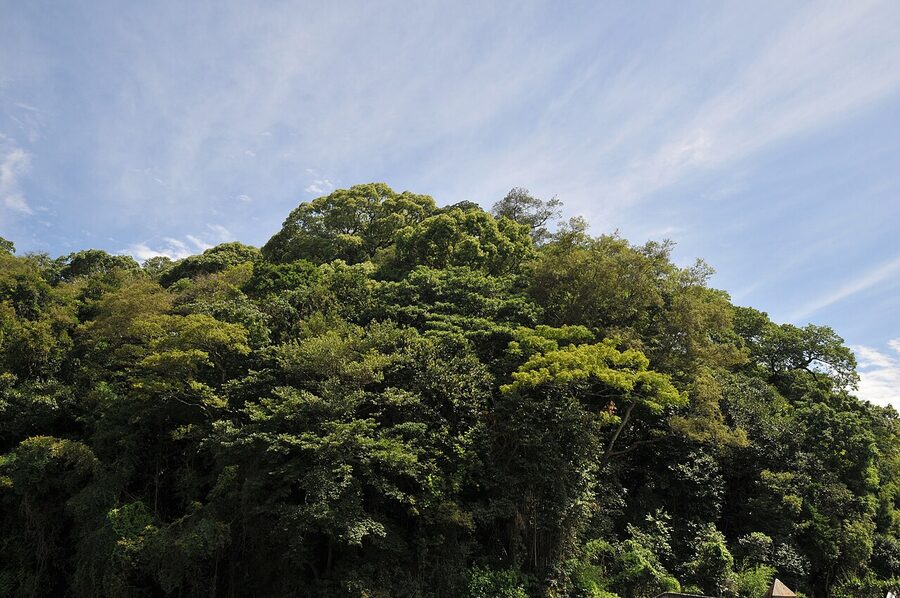
Uwajima sits at the southwest tip of Shikoku, on a long sheltered inlet cut deep into Ehime’s southern coast. The castle hill rises roughly 80 metres above the modern city and about 70 metres above the original sixteenth-century shoreline — which is closer to the hill than it looks today, because everything you walk on between the castle and the JR station is reclaimed land laid down during the Meiji, Taishō, and early Shōwa eras.
The castle type is hirayama-jō — a hill castle, the middle category between a mountain castle (yama-jō) and a plain castle (hira-jō). Takatora specifically preferred hill castles because he wanted elevation for the tenshu but direct water access at the base for supply and escape. The Uwajima hill is low enough that he could run outer walls right down into the tidal zone; on early-Edo maps the inlet penetrates most of the way around the castle, so that three of the five outer sides have salt water as their effective moat.
Today that inlet is all filled in. The western foot of the hill, where the wharves once sat, is now a bus depot. The southern flank is a residential neighborhood. Only the northern slope still has water near it, and even that has been straightened into a fishing harbor.
The surviving compound is small by castle-tour standards, you can walk the whole thing in an hour, but the key structures are all in place. The tenshu, the ishigaki on all five sides, two surviving gates (the Noboritachi-mon and the inner ōte approach), and the excavated foundations of about eight other yagura and gate sites. The Ōtemon main gate that greeted visitors for 270 years burned in the 1945 air raids, and unlike Iyo-Matsuyama up the coast it has not been rebuilt.
Tōdō Takatora: the master castle designer
To understand Uwajima you have to understand Takatora. He was born in 1556 in Ōmi Province into the Tōdō family, which was a minor warrior household with a landholding so small — 80 koku, roughly enough rice to feed eight people for a year — that Takatora joined the Azai clan as a common footsoldier at age fifteen. He was enormous. Contemporary records put him at close to 190 centimetres tall, which in sixteenth-century Japan was so unusual that it became part of his identity.
His first battle was Anegawa in 1570, fighting for Azai Nagamasa against Oda Nobunaga and Tokugawa Ieyasu. The Azai lost, and Takatora spent the next several years drifting through junior positions with various Oda-aligned lords until he caught the eye of Hashiba Hidenaga, Hideyoshi’s younger half-brother, around 1576. Hidenaga paid him 300 koku as a personal retainer, which is when his career began climbing seriously.
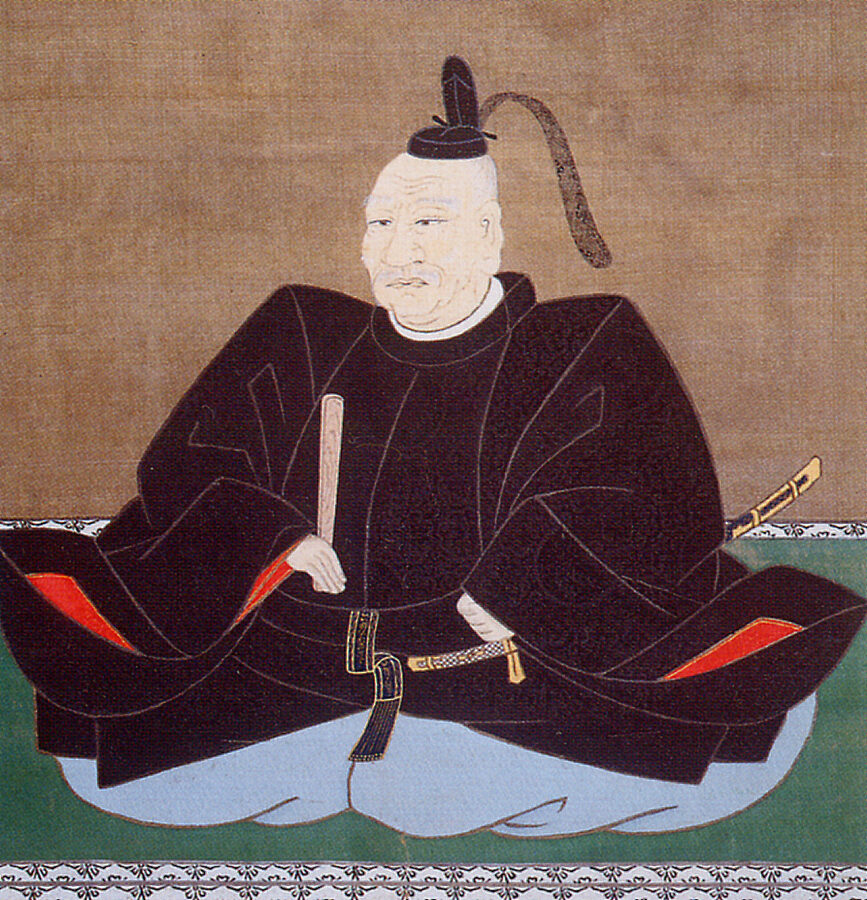
Under Hidenaga he fought at Takeda Castle in Tajima (1577), the Miki siege (1580, where he killed the enemy commander Kago Rokuroemon in single combat), and the Battle of Shizugatake in 1583. By 1585 he held 10,000 koku in Kishu after the campaign against the Negoro and Saiga monk-warriors. He was, by thirty, a daimyo — a small one, but nominally in the same category as the great names.
The move from fighter to builder happened during Hideyoshi’s Korean invasions (1592 and 1597). Takatora commanded naval transports, designed fortified beachhead camps, and took charge of the stonework reinforcement at Fushimi Castle when Hideyoshi hauled him home in 1593. By the time Hideyoshi died in 1598, he was running 70,000 koku in Iyo-Uwajima and had a reputation as the best fortification designer alive. Hideyoshi would have known this — the construction of the outer walls at Osaka was partly Takatora’s work.
Then 1600. At the Battle of Sekigahara in October, Takatora, technically a Toyotomi-appointed daimyo, sided with Ieyasu’s Eastern Army and fought against Ōtani Yoshitsugu on the western flank. It was the correct political bet. Ieyasu won, and Takatora’s post-battle reward was the whole of Iyo-Imabari at 200,000 koku — nearly triple his previous holdings.
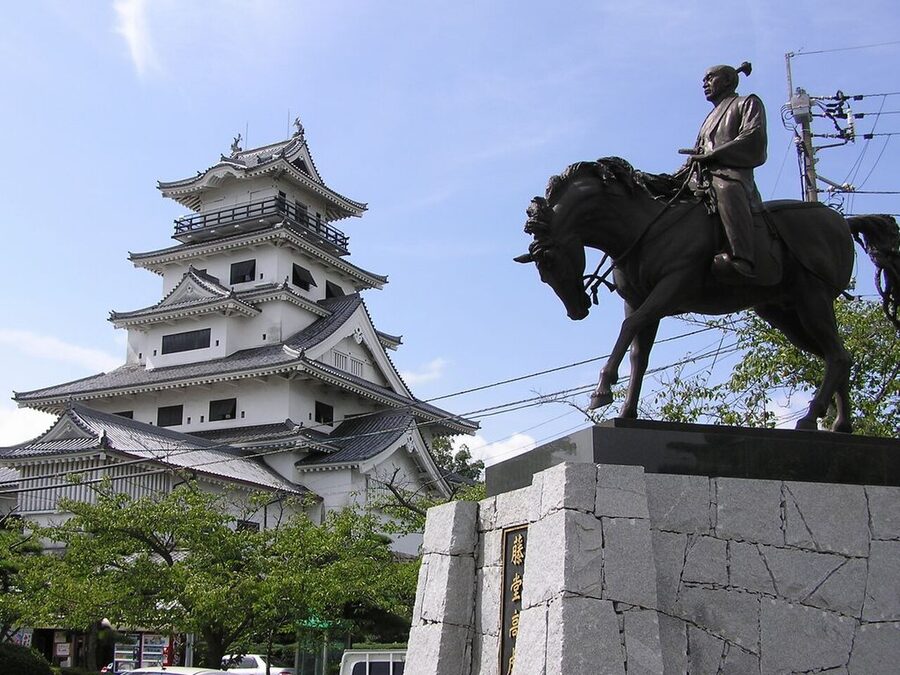
What followed is one of the more remarkable careers in Japanese architecture. Takatora was hired — sometimes as daimyo, sometimes as consulting specialist — on Edo Castle, Wakayama Castle, Imabari Castle, Iga Ueno, Sasayama, Tanba Kameyama, Nijō Castle in Kyoto, and the stone walls of Kumamoto Castle. The traditional figure is twenty castles; modern inventories sometimes get closer to thirty when you count renovations. No other individual designer in Japanese history has a résumé close to it.
1596–1601: the original construction
Takatora took over the existing fortification at Itajima on the Uwajima inlet in 1596 and rebuilt it essentially from zero. The work lasted five years. The site had been a fortified post under the local Saionji family since the fifteenth century, but Saionji Kinhiro had been forced into exile by Chōsokabe Motochika’s 1584 conquest of Shikoku, and by the time Takatora arrived the remaining structures were more than a decade derelict.
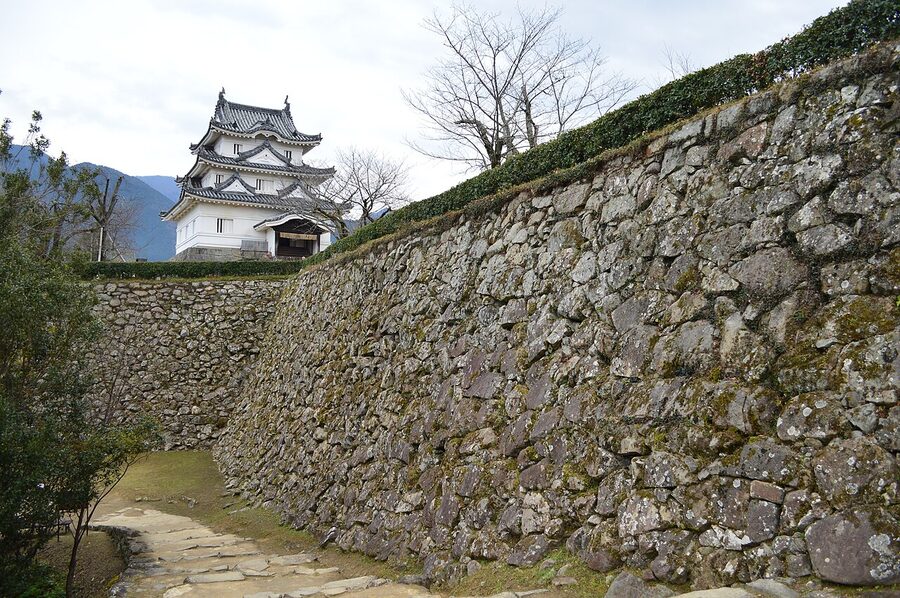
The construction programme involved cutting back most of the natural hill to create five bailey levels, laying ishigaki on every exposed face, and linking the baileys with narrow zigzagging gate sequences designed to break up any attacking column. The pentagon is the signature innovation, but the zigzag approach is where you feel Takatora’s thinking as a visitor. The inner and outer routes both force you through three consecutive right-angle turns under covered yagura — each turn is an arrow-volley kill box, and each turn is tight enough that you cannot see what is waiting on the other side.
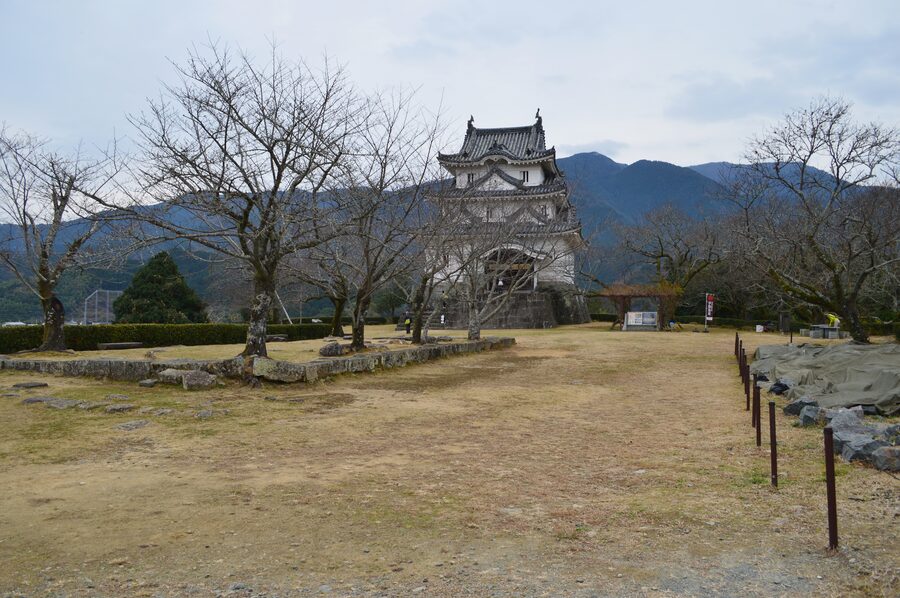
The original tenshu that Takatora built in 1601 was smaller than the one you see today. It followed a fukugō-shiki bōrō-gata format — a composite watchtower-style keep, meaning the top storey sat above a multi-roofed lower base rather than rising as discrete identifiable storeys. This is early Momoyama-style construction, and most tenshu built before 1620 followed some version of it. The 1601 keep had an unusual feature, though: Takatora moved the top watchtower component from Kagomori Castle, a dismantled coastal fort a few kilometres away, and reused it as the upper part of the new Uwajima keep.
He did similar things across all his castles. Reuse of watchtower components was a Takatora trademark, and so was the cost control it implied. Hideyoshi paid for the Uwajima construction out of the domain’s general revenue, but Takatora managed the budget personally and the surviving financial documents show he was unusual among daimyo-engineers for running projects under quota. This is probably why Ieyasu kept hiring him after 1600 — Takatora’s castles held, and they held for a reasonable price.
The pentagon plan and why it matters
There are only two Japanese castles with a pentagon bailey plan: Uwajima and Imabari. Both are Takatora’s work. Both are on the Seto Inland Sea coast. Both use essentially the same formula — a hill or low rise, five irregular-length outer walls, water moats on the seaward faces, and a single tenshu near the center of the innermost bailey.
The standard Japanese castle plan before Takatora was either concentric (rinkaku-shiki) or spiral (rasen-shiki), with the inner baileys stacked inside outer baileys in roughly concentric rings. Both forms are predictable. You can look at the outer wall and estimate the inner wall’s distance from it with reasonable accuracy because the shape repeats. The pentagon breaks this because the distance from any outer wall to the tenshu is different depending on which wall you are standing on.
In practice this matters for artillery. Arquebus fire in the late sixteenth century was effective at about 100 metres, but Portuguese-style cannons that Hideyoshi imported during the 1590s could reach 400 metres. For a besieger to land a cannon shot on a tenshu from outside an outer wall, they needed to know the distance precisely.
At a symmetric castle you paced along the walls and the geometry worked. At Uwajima, pacing one wall gave you a false figure for every other wall — the pentagon broke the triangulation that every siege manual of the era assumed.
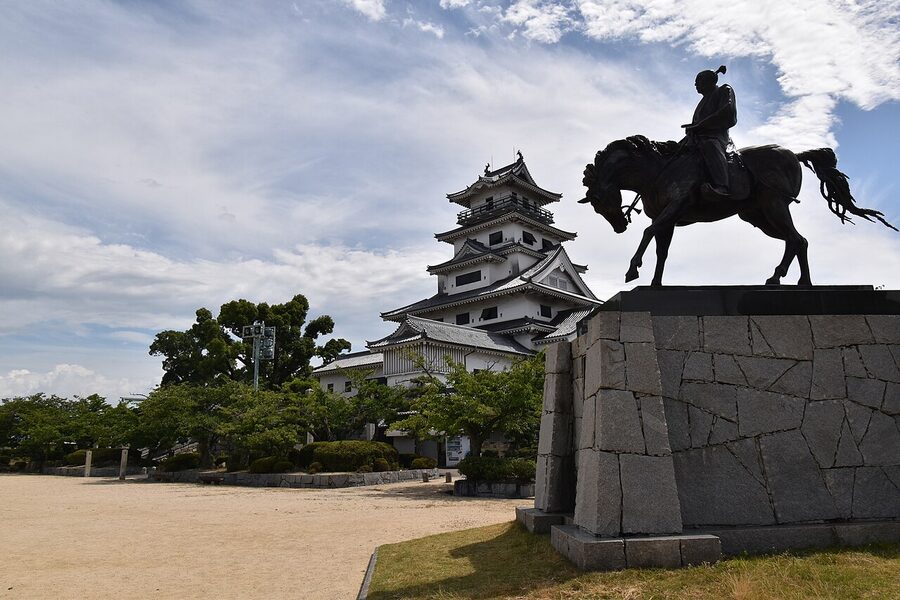
Takatora did not invent the pentagon plan — there are European bastion-traced pentagons from the same decade, and he may have heard about them through the Jesuit missions at Nagasaki — but he was the first to implement it in Japan. Nobody copied him. Every other Edo-period castle that got built in the next two hundred years reverted to the concentric or spiral formula. The pentagon was a one-designer innovation, and when he died in 1630 the knowledge died with him.
The sea-moat concept
The other Takatora signature at Uwajima is the tidal sea moat. Three of the five outer walls originally dropped straight into the inlet — no earthen glacis, no wet moat excavated separately, just ishigaki wall going down into salt water. At high tide the wall base was underwater. At low tide it was exposed on a tidal mudflat that was impossible to cross in armor.
This was a conscious borrowing from coastal Korean fortification that Takatora had seen during the 1590s invasions. The Korean castles on the southern coast — at Ulsan, Sacheon, Namwon — had walls that dropped straight to the sea on the harbor side. Takatora copied the principle but inverted the scale: Korean coastal forts were defensive outposts, and he was using the technique for a daimyo residence.
The sea-moat concept shows up at four Takatora castles — Uwajima, Imabari, Tsu, and Nijō. Tsu and Nijō are inland, so their “sea moats” are actually wide wet moats filled from local rivers; the inspiration is the same even if the water is fresh. At Uwajima and Imabari the connection is literal: the moat water is ocean water, and the tide visibly rises and falls against the foundation stones.
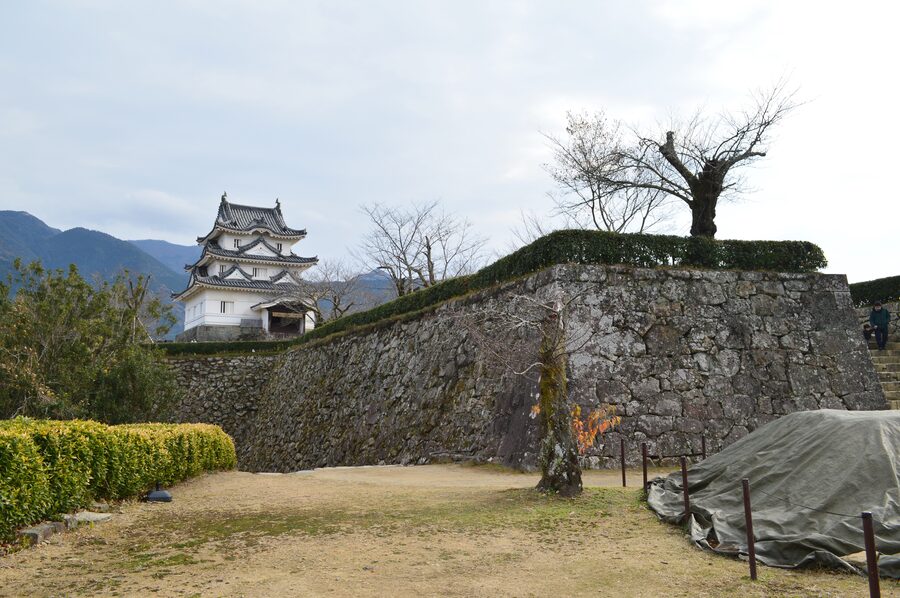
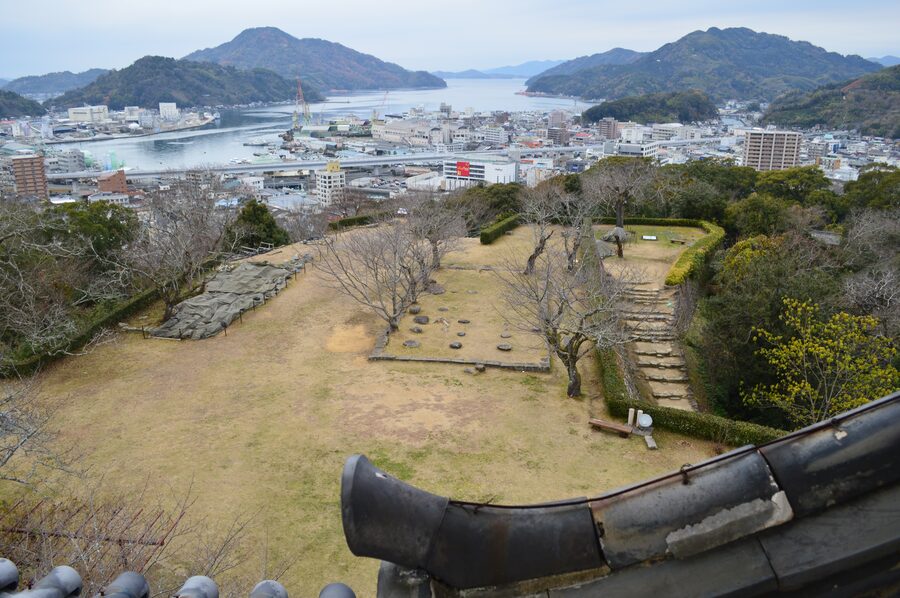
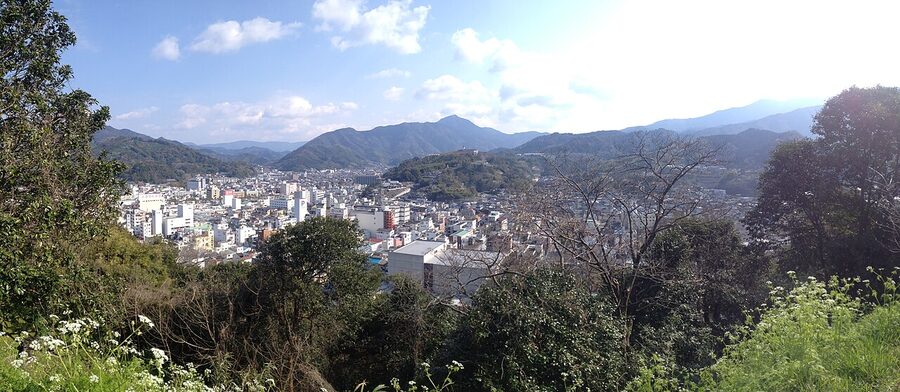
The surviving waterline at Uwajima is now roughly 300 metres from the outer ishigaki because of successive Meiji and Shōwa reclamation projects, but on late-Edo maps the outer north wall and the outer west wall are drawn with the waterline touching the stones. If you stand on the castle hill today and look down at the city between you and Uwajima Bay, you are looking at what used to be a sixty-hectare saltwater moat.
1608: Takatora leaves, Tomita arrives
Takatora did not stay at Uwajima. In 1608 Ieyasu transferred him to Tsu Domain in Ise Province — a larger, more strategically valuable posting at 320,000 koku — and ordered an exchange with Tomita Nobutaka, who had been the daimyo of Tsu at 50,000 koku. The swap left Uwajima in Tomita hands while Takatora spent the rest of his life on shogunal projects.
Tomita’s tenure lasted barely five years. In 1613 he lost the domain through a court case involving his wife’s family — the details are obscure but essentially a succession dispute that Ieyasu used as grounds for confiscation. Tomita was stripped of Uwajima and reassigned to a much smaller holding elsewhere. The domain reverted to direct shogunal administration while the next awardee was decided.
That awardee would turn out to be an unusual choice — a son of the most famous one-eyed daimyo in Tōhoku, granted a domain 1,400 kilometres from his father’s home.
1614: Date Hidemune inherits the domain
In the spring of 1614, following the Osaka campaign’s winter phase, Tokugawa Hidetada granted the 100,000-koku Uwajima Domain to Date Masamune, the Sendai daimyo. Masamune immediately transferred the grant to his eldest son, Date Hidemune. The arrangement was unusual for two reasons: Hidemune was a legal minor inheriting in an adult’s name, and he was illegitimate.
Hidemune was born in 1591 to a concubine named Iisaka no Tsubone, not to Masamune’s principal wife Megohime. Because Masamune’s later sons with Megohime outranked him by birth, Hidemune could not inherit the main Sendai line. But he was still Masamune’s firstborn, and Masamune clearly felt an obligation. By negotiating with the shogunate for a separate domain in his son’s name, Masamune effectively created a branch house that would remain Date clan territory for the next 257 years.
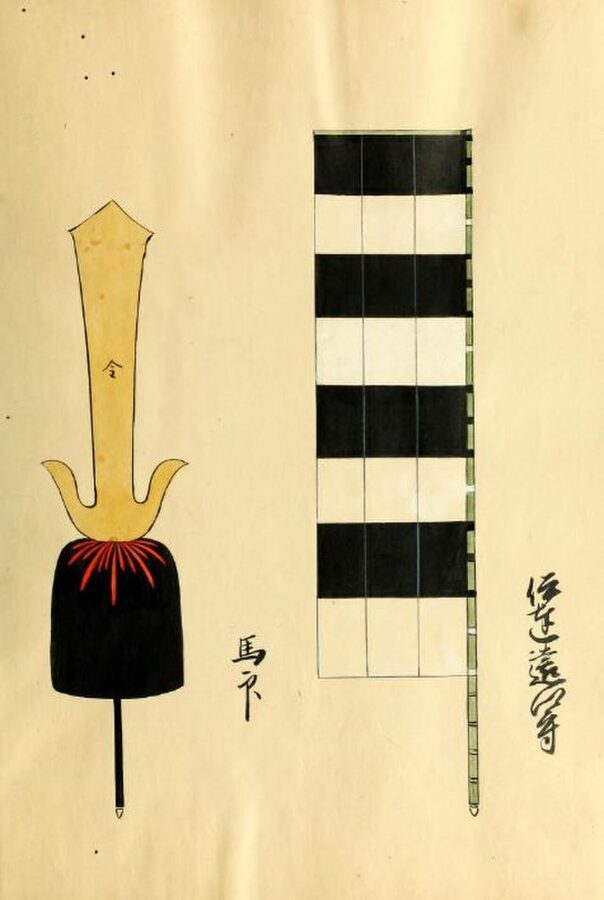
Hidemune arrived in Uwajima in late 1614, at the age of twenty-three. He spent the winter preparing for what everyone knew was coming — the summer siege of Osaka Castle, where Hideyoshi’s heir Toyotomi Hideyori was making his last stand against Ieyasu. Hidemune led the Uwajima contingent in the 1615 summer campaign, fighting under his father’s overall command. His performance was respectable but not distinguished; he was a Tōhoku-raised inland soldier suddenly commanding a small Shikoku army, and the transition took time.
When Osaka fell on 8 June 1615 and the Toyotomi line was extinguished, Hidemune returned to Uwajima to rule a domain that would see no more warfare for 253 years. He settled into the castle, confirmed his daimyo status with the new shogun Tokugawa Hidetada, and set about the long administrative career that would define his reign. He ruled until 1657, retiring at age sixty-six and handing the domain to his son Date Munetoshi.
1662: lightning strikes the original tenshu
Takatora’s 1601 keep stood for sixty-one years. On a summer night in 1662, the second year of Kanbun, a lightning bolt hit the top storey of the tenshu and started a fire that the castle’s fire-suppression corps could not contain. By dawn the upper two storeys were gone, the foundation timbers were charred through, and the tenshu was beyond repair. The loss was total.
Date Munetoshi, who had succeeded his father in 1657, faced a difficult decision. The shogunate’s “one castle per province” rule (ikkoku-ichijō-rei) was still in effect, and any rebuild would need Edo approval. The expense would come out of domain reserves, not shogunal coffers. And the rebuild would happen during the Kanbun economic downturn, when rice prices were falling and daimyo income was shrinking across the country.
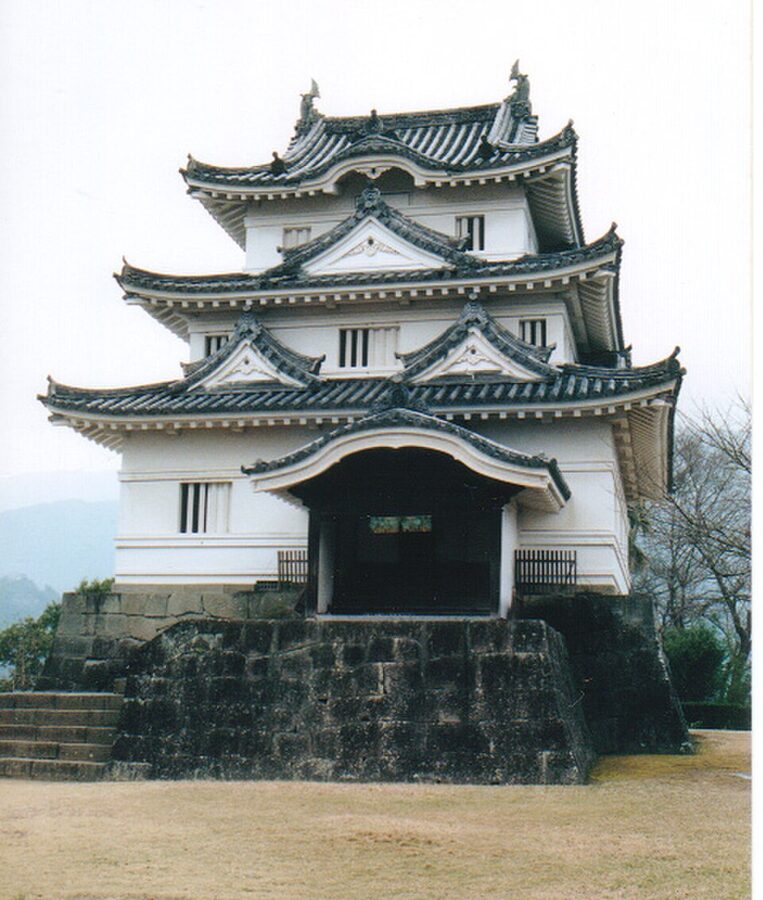
Munetoshi chose to rebuild, but smaller. The 1666 replacement tenshu that still stands today is a three-storey independent tower-style keep (dokuritsu-shiki sōtō-gata), not the Momoyama-period composite watchtower that Takatora had built. The architectural style had changed. By 1666 the preferred tenshu format was cleaner, more vertical, with three or four independent storeys stacked above a single base rather than a watchtower grafted onto a multi-roofed lower building.
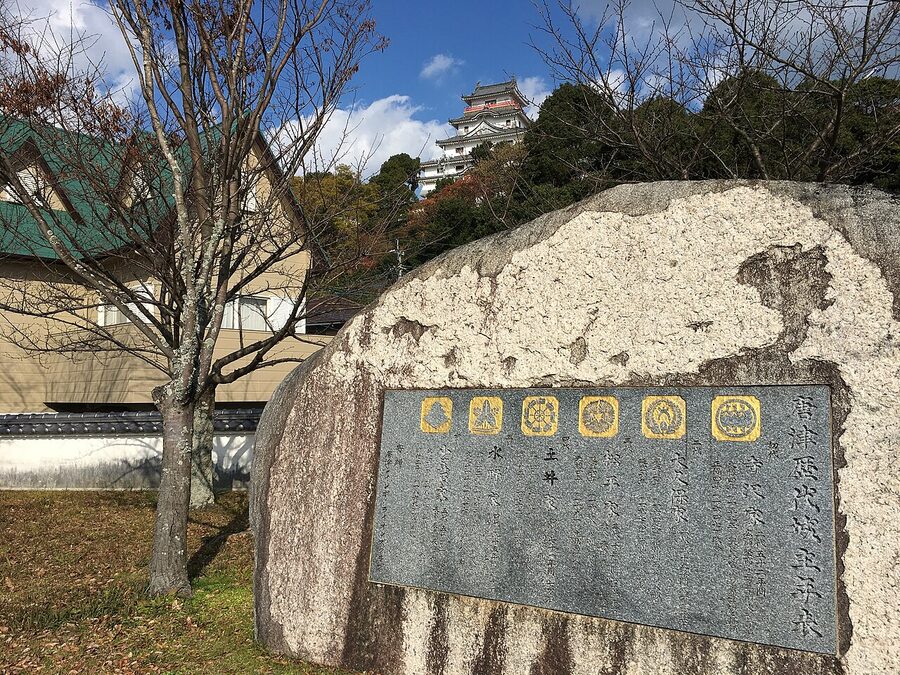
The tenshu you see today is this 1666 keep. It is small by Japanese castle standards, the base is only nine metres square and the total height is about sixteen metres from ground to ridgepole, but the proportions are unusually refined. The three storeys step in progressively, each one a little smaller than the one below, with ornamental gables (chidori-hafu and kara-hafu) on each storey’s south face. The white plaster walls are original pigment, repainted in the same formula for 360 years.
Inside, the tenshu has the quiet dimensions of a samurai residence rather than a fortress. The ground floor is one open room with a ceiling just over two metres. The second floor is the same plan, a little smaller. The third floor is the viewing platform, where you can see across the bay to the pearl farms and south along the Uwajima coast.
The hidden gun racks
For all its visual refinement, the 1666 tenshu has a surprising defensive detail. At waist height below each second-storey window there is an installed wooden rack — a teppō-gake — designed to hold two or three matchlock arquebuses upright, ready to fire through the window slit without having to be lifted off the floor. You do not see the racks from outside, and most visitors do not notice them from inside either unless a guide points them out.
The racks are original 1666 fittings, not later additions. Date Munetoshi’s builders were preparing a peacetime keep that could be turned into a defensive stronghold if the situation required it. By the 1660s no castle had been successfully besieged in Japan for forty-five years, but the Date family in Tōhoku and Uwajima had both watched the shogunate confiscate daimyo domains on trivial technical grounds throughout the early Edo period, and they built defensively just in case.
This is the detail that I think separates the Uwajima tenshu from most of the other eleven originals. It looks like a Buddhist temple from outside. But the interior was fitted out for combat that never came.
The Date dynasty: nine generations, 257 years
Between Hidemune’s arrival in 1614 and the abolition of the domain in 1871, the Date family held Uwajima through nine generations. The dynastic list runs: Hidemune (r. 1614–1657), Munetoshi (1657–1693), Muneoki (1693–1708), Murayoshi (1708–1735), Muratoki (1735–1763), Muranaga (1763–1791), Munenori (1791–1844), Munenari (1844–1858), and Munetoki (1858–1871).
Most of these reigns were quiet. The fifth daimyo, Muratoki, was the first to push for domain educational reform — he established the Naitokukan school in 1748, one of the earlier domain academies in Shikoku, and he introduced a commercial monopoly system to consolidate rural tax revenue. The sixth daimyo, Muranaga, built on those reforms and produced a generation of retainers who could run domain finance competently. By the late eighteenth century Uwajima was operating in the black, which is more than many Shikoku domains could say.
The big name on the list is the eighth daimyo, Date Munenari (r. 1844–1858, and effectively still running the domain through advisors until his death in 1892). Munenari became one of the shimei — the “four wise lords” of the late Tokugawa period, alongside Shimazu Nariakira of Satsuma, Matsudaira Shungaku of Fukui, and Yamauchi Yōdō of Tosa. Together the four pushed hardest for political reform in the 1850s and 1860s, and Munenari personally was one of the first daimyo to push for the shogunate to open negotiations with the Western powers after Perry’s 1853 arrival at Uraga.
Munenari hosted dissident intellectuals at Uwajima, including Takano Chōei, who was a fugitive from shogunal punishment. He also sponsored early industrial projects — a gun foundry, a steam-engine workshop — that foreshadowed Meiji industrialisation. After the Restoration in 1868 he served as Foreign Affairs Minister in the new Meiji government, although he retired in 1871 with the abolition of the domain system.
Meiji survival and the Important Cultural Property designation
When the han system ended in 1871 and the castles across Japan were ordered demolished or converted to military barracks under the 1873 haijō-rei abolition edict, Uwajima came within weeks of being torn down. The domain’s last administrator, a former Date retainer named Kimura Hisakichi, negotiated with the Meiji Home Ministry to have the tenshu, the Noboritachi gate, and the central ishigaki preserved as a former daimyo residence rather than demolished as a military installation.
That negotiation saved the castle. Many Japanese castles were demolished in the 1870s and 1880s — Osaka’s tenshu, Nagoya’s outer baileys, the whole of Takada Castle — and Uwajima was nearly on that list. Instead the tenshu was preserved as cultural property, and the outer compound was converted to a public park in 1892.
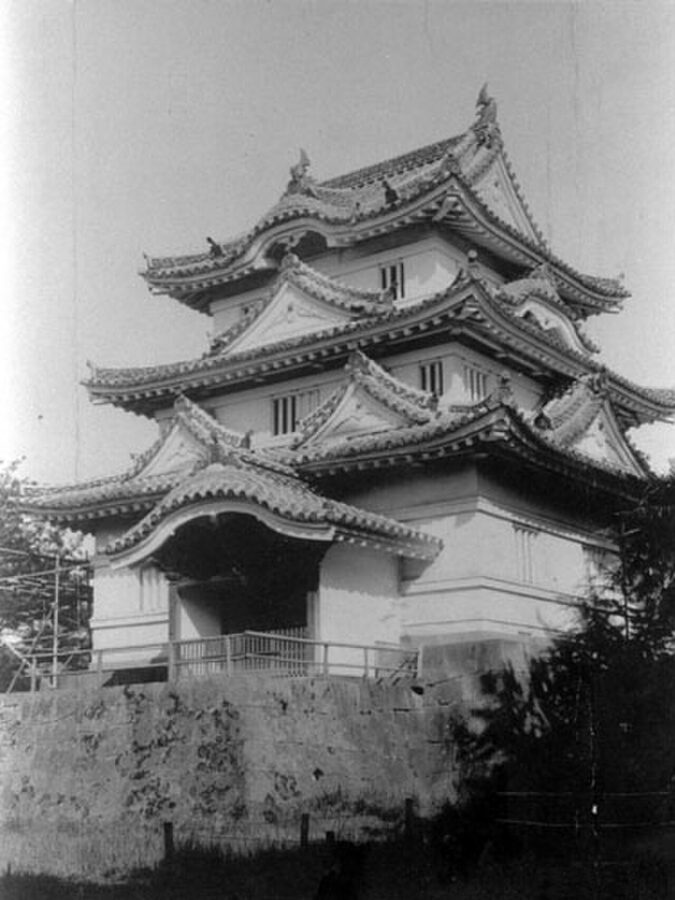
The 1937 designation of Uwajima Castle as a National Historic Site under the prewar heritage law was followed by the more consequential 1950 Important Cultural Property designation of the tenshu itself. The 1950 designation was part of a broader legal framework that eventually produced the list of twelve surviving pre-Meiji tenshu — Uwajima, Matsumoto, Himeji, Hikone, Maruoka, Matsue, Hirosaki, Inuyama, Bitchū-Matsuyama, Marugame, Iyo-Matsuyama, and Kōchi.
The Ōtemon main gate did not make it. It burned during American air raids in the final weeks of the Pacific War in 1945, along with a portion of the Noboritachi yagura. The gate site has been marked but not reconstructed, and the Noboritachi yagura was repaired to Edo specification in 1965.
The ishigaki: a course-by-course signature
I want to come back to the stone walls, because the ishigaki at Uwajima is one of the most varied surviving examples of Takatora’s technique. Japanese castle ishigaki comes in three broad styles.
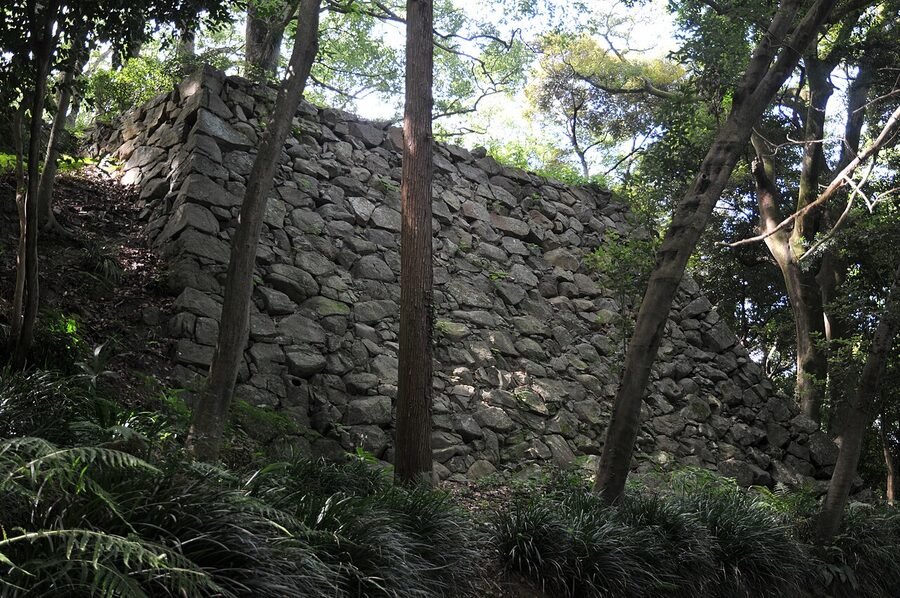
Nozura-zumi is roughly piled field stones, unshaped and laid by eye — the oldest and most primitive style. Uchikomi-hagi is roughly shaped stones with small wedge-stones filling the gaps, the middle category. Kirikomi-hagi is precisely cut ashlar blocks laid with no mortar in between, the most refined and most labor-intensive.
Most castles use one style consistently. Himeji is almost entirely uchikomi-hagi, Edo Castle is kirikomi-hagi, and even mixed walls at Kumamoto stay within a single style per bailey.
Takatora’s Uwajima mixes all three on the same walls, sometimes within the same course, with the style changing as you walk around the perimeter. The north wall of the honmaru is half rough nozura-zumi (1601 original) and half wedged uchikomi-hagi (1666 rebuild repair). The ōte-guchi gate corner is tight kirikomi-hagi, and the Shikibu-maru outer face is loose nozura-zumi that has barely been touched in 425 years.
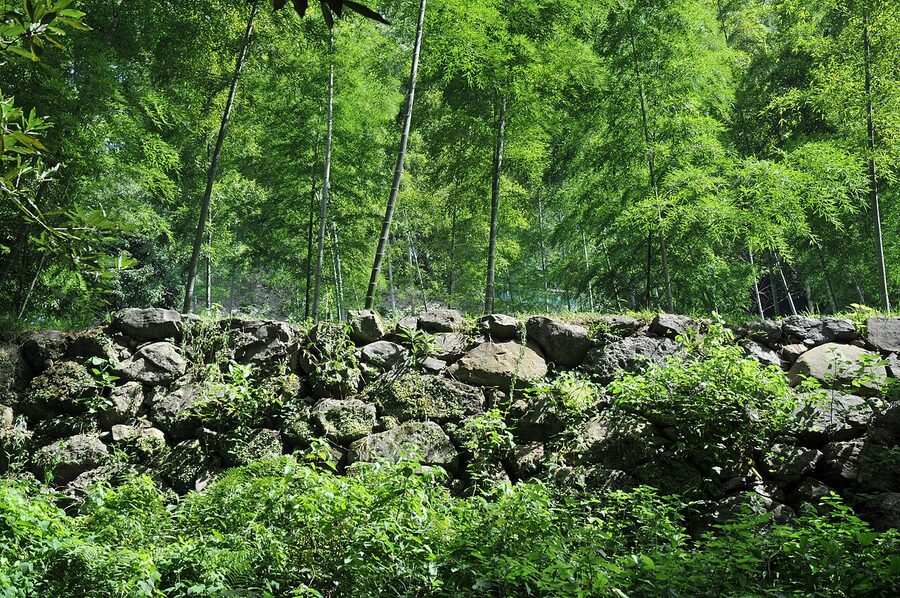
The variation is intentional. Takatora ran a multi-site construction programme across western Japan from 1596 onwards, and each bailey at Uwajima was built by a different crew from a different prefecture. Some crews preferred rough piling, some preferred wedged fill, some preferred tight ashlar. Takatora let each crew work in its own style rather than forcing uniformity, which is why the walls read almost like a portfolio of Japanese stonemasonry from around 1600.
If you walk the perimeter today it takes about thirty-five minutes and you pass through all three styles twice. The Noboritachi-mon approach has the tightest ashlar work. The Daiemon-maru southern corner has the most dramatic uchikomi-hagi slope. The outer north wall is where Takatora left the roughest stones unaltered.
The gate sequence — Ichimon, Sanmon, Kaminari
The surviving gate record at Uwajima reads like an inventory of demolished architecture. The full Edo-period approach had seven gates between the outer moat and the honmaru: the Ōtemon at the outer shore, then the Ichimon (first gate), Ninomon (second), Sanmon (third), Kaminari-mon (thunder gate), Idomaru-mon, and finally the Noboritachi-mon at the base of the tenshu platform.
Only the Noboritachi-mon survives. Everything else is stone footprint and interpretive signage. But the footprints are preserved, the stones are numbered, and you can walk the original sequence on the original paving — a seven-gate defense-in-depth corridor that forced any visitor through three right-angle turns and four compression points between the coast and the keep.
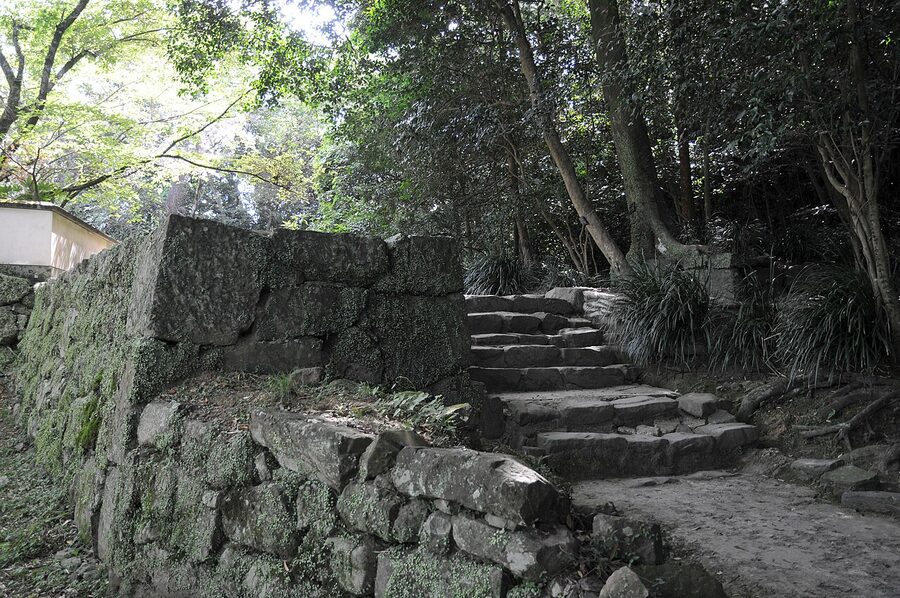
The Kaminari-mon was the most impressive of the lost gates. Built in 1604 with a multi-storey watchtower (yaguramon) riding its lintel, it stood at the sharpest of the three approach turns and was the gate where the Takatora defensive plan really started to squeeze the visitor. Contemporary records describe it as dark, the overhanging yagura blocked the sky, and intentionally narrow so that only one fully-armed samurai could pass at a time.
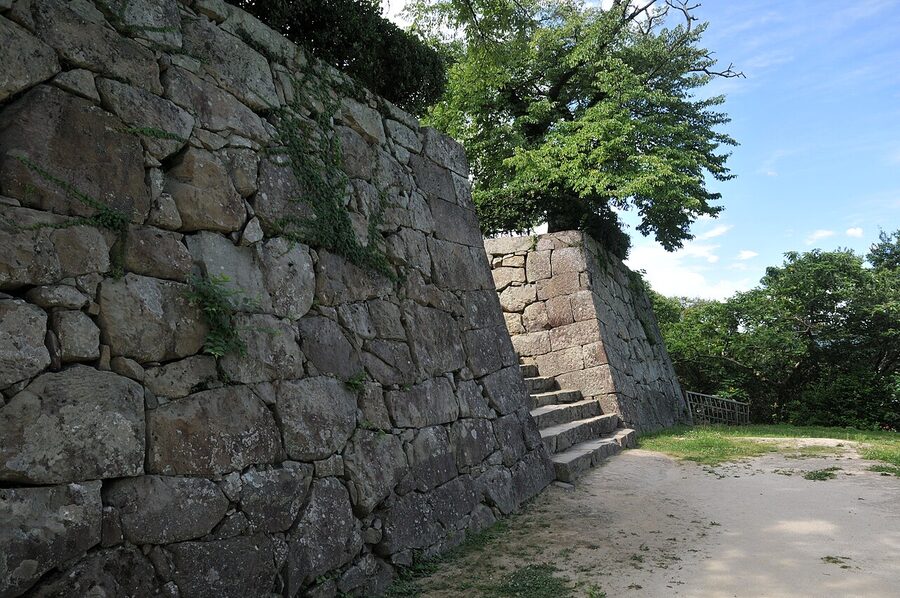
Visiting today: the walk up, the view down
The castle park is open every day from 09:00 to 16:30, with the tenshu interior accessible for a modest admission fee. You enter from the Noboritachi-mon on the eastern side of the hill, climb roughly 120 metres of ishigaki steps through three switchbacks, and reach the honmaru in about twenty minutes. The climb is moderate — pensioner grandmothers do it, and I have watched them overtake me on the steeper sections.
The alternative approach from the west, through the former Idomaru-mon site, is longer and more gradual. Most visitors use the east approach up and the west approach down, which means you walk the complete Edo-period defensive sequence in both directions. I recommend the same.
Inside the tenshu you can go up all three storeys, with an exhibit of Edo-period domain artifacts on the ground floor and a short display on Takatora’s broader architectural career on the second. The third storey is the viewing platform. From the top you can see the entire Uwajima plain, the pearl farms floating in the bay, the distant peninsula of Uwajima-shi that ends in the Ehime-Kōchi prefecture border.
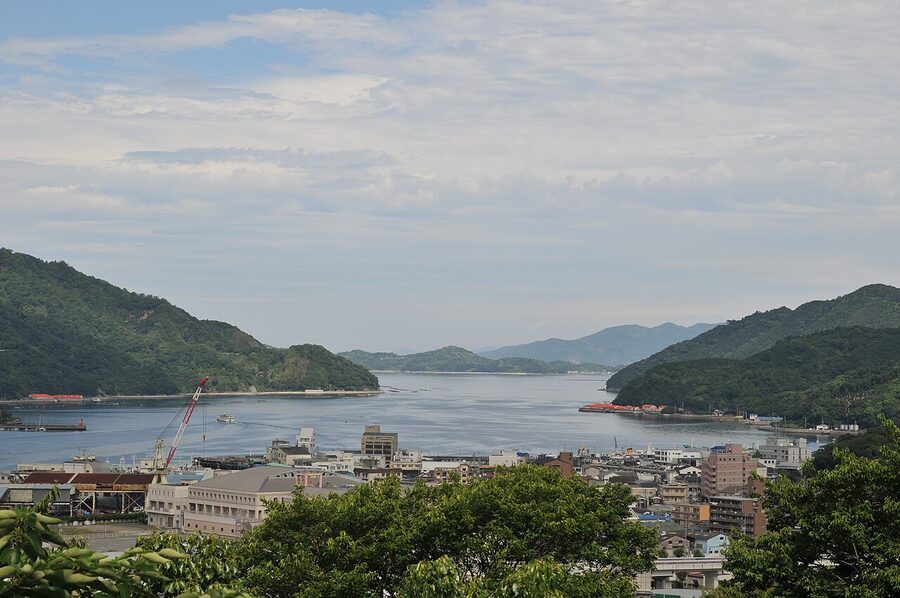
If you are timing your visit with the annual cherry-blossom season (late March to early April in Uwajima), the park around the honmaru holds about sixty Yoshino cherry trees and the tenshu frames nicely from the northwest approach. Night illumination runs from the first week of April for about ten days, and the tenshu is lit gold against the black hill — the same kind of night-lighting setup that other original-twelve castles use.
Uwajima the city: pearls, Taga Shrine, ushi-oni
The castle is embedded in a city that has its own strong identity. Uwajima has been a pearl-farming center since the 1930s, and even now the bay in front of the castle holds the pearl-raft floats you can see from the tenshu. The industry was pioneered locally by Mikimoto-affiliated firms and still produces a substantial fraction of Japan’s domestic freshwater and Akoya pearl output.
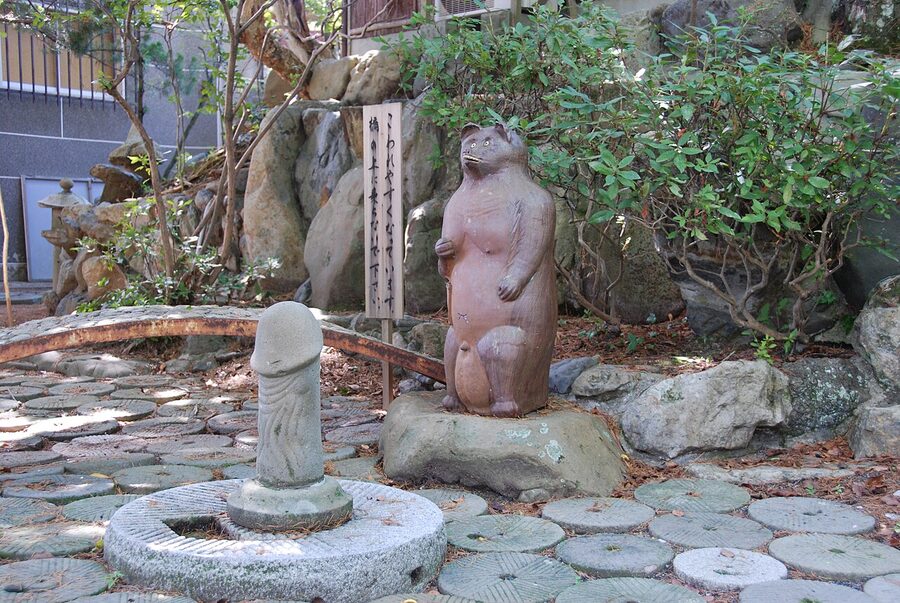
Ten minutes’ walk south of the castle is Taga-jinja (多賀神社), one of Japan’s most famously frank fertility shrines. Taga sits in a quiet residential neighborhood and maintains a collection of explicitly sexual votive offerings — wooden carvings of male and female genitalia, donated by couples hoping for children or by businesses hoping for prosperity — along with a three-storey museum that houses an internationally recognised collection of erotic folk art. The shrine has been on this site since the Heian period, which is to say it predates the castle by about six hundred years.
The other distinctive Uwajima institution is the ushi-oni (牛鬼) — a demon-bull effigy that is paraded through the streets during the annual Wareimatsuri festival every July. The ushi-oni is a twenty-metre-long construction of red cloth over a wooden frame, with a bull’s head and demon horns at the front and a waving tail at the back. It takes about fifty participants to carry. The festival originated as a Date-clan event in the early Edo period and still draws most of the city population into the streets for three days each summer.
There is a Date Museum (Date Hakubutsukan) adjacent to the castle hill, in the former Ninomaru residence, where most of the domain’s surviving armor, correspondence, and ceremonial objects are displayed. Admission is separate from the castle. I recommend combining the two in a single morning — museum first, castle second, lunch of Uwajima-style tai-meshi sea-bream rice afterwards.
How Uwajima fits among the twelve originals
Of the twelve surviving pre-Meiji tenshu in Japan, Uwajima has a peculiar position. It is one of the four smallest keeps — alongside Maruoka, Bitchū-Matsuyama, and Marugame — and one of the three with a three-storey tenshu (with Maruoka and Marugame). It is also the only one with a pentagon outer plan, and the only one whose sea moat was tidal seawater.
Compared to the showpiece castles the scale is modest. Himeji’s main tenshu is 46 metres tall; Uwajima’s is 15. Matsumoto’s tenshu complex is a five-building linked keep; Uwajima’s is a single tower.
Hikone has more surviving Edo-period outbuildings, and Uwajima has only the Noboritachi-mon gate. On the metrics most castle-tourism books use, Uwajima looks minor.
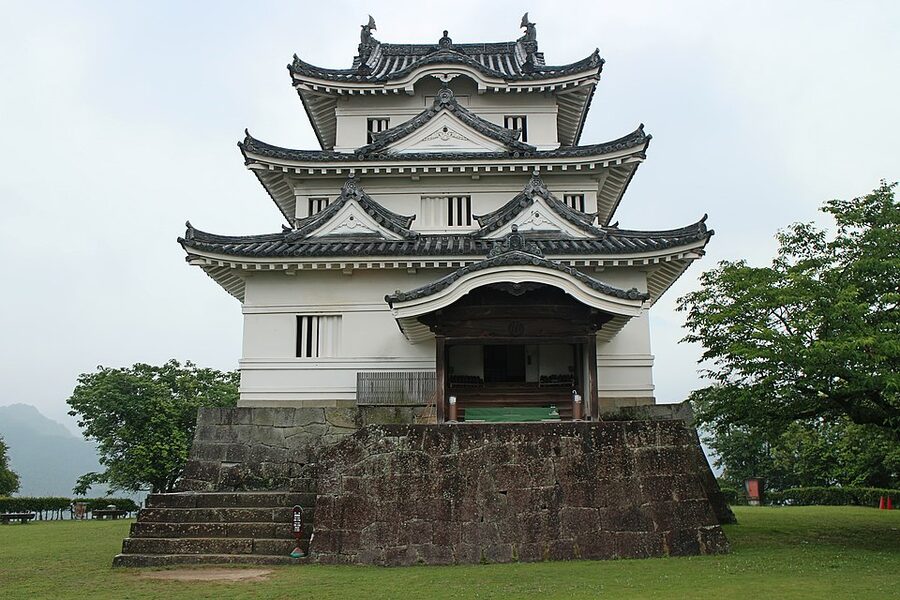
But the categories matter here. Uwajima’s historical significance is not about scale. It is about being the most intact surviving example of Takatora’s innovative fortification practice, which is the practice that half the other castles on the original-twelve list were influenced by in one way or another. Kumamoto‘s ishigaki is Takatora-informed; Iyo-Matsuyama‘s linked-keep arrangement borrows from Takatora’s Imabari design; Marugame‘s multi-tier stone-wall sequence echoes Takatora’s layered defense principle.
You cannot understand the Edo-period Japanese castle without understanding Takatora, and you cannot see Takatora’s work more completely preserved anywhere than at Uwajima. That is the argument I would make for prioritising the visit.
Getting there
Uwajima is at the end of the line from both directions. From the east you take the JR Yosan line out of Matsuyama — it is a two-and-a-half hour slow-train ride along the southern Ehime coast, with views of the Uwajima sea all the way down. From the south you come up on the JR Yodo line from Kōchi, which takes a little over three hours through some of the most remote mountain country in Shikoku.
From either direction Uwajima Station is a twenty-minute walk east of the castle hill. There is no closer station. A city bus runs from the station to the Taga Shrine neighborhood and continues past the castle’s western approach, but the walk through Uwajima’s residential streets is the better option if you have the time.
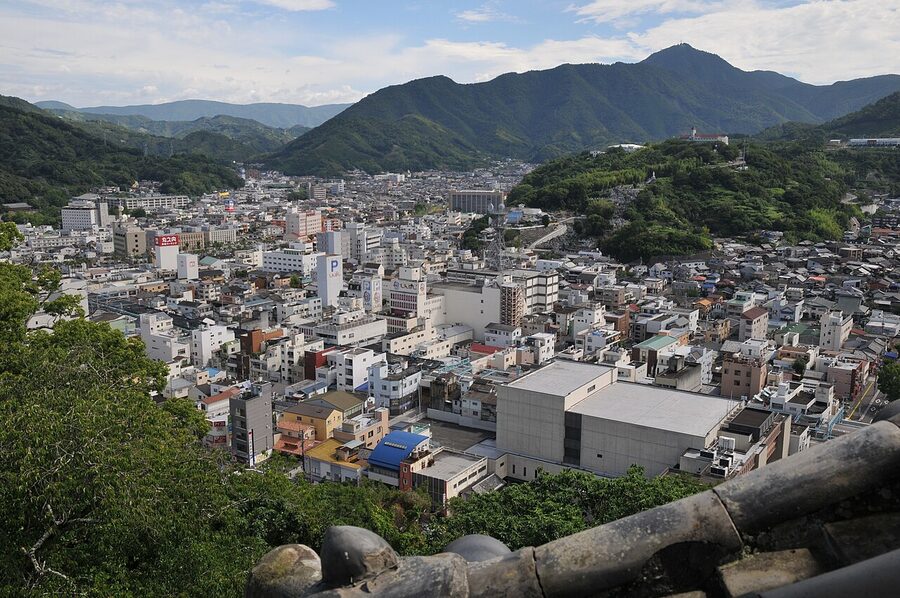
If you are flying in, the closest airport is Matsuyama (MYJ), with roughly ten daily ANA and JAL services from Tokyo-Haneda, about 80 minutes each way. From Matsuyama the bus to Uwajima is about two hours along the coastal highway, or you can take the same JR Yosan slow train. The scenic choice is the train.
Overnight in Uwajima is possible — the city has a couple of business hotels near the station and a traditional ryokan or two up the hill near Taga Shrine. Most visitors do Uwajima as a day trip from Matsuyama, which is workable if you leave Matsuyama before 09:00 and get back by 19:00, but the Uwajima evening atmosphere is worth an overnight if you have the schedule for it.
Why I think Uwajima is underrated
Most castle-tourism ranking pieces put Uwajima somewhere around seventh or eighth among the twelve originals — behind Himeji, Matsumoto, Inuyama, Hikone, Iyo-Matsuyama, and usually Kōchi as well. I think that ordering is wrong, and I think it is wrong for a specific reason: most rankers are comparing keep sizes and complex scales, which favors the big castles, and they are missing the architectural significance of what Takatora actually did at Uwajima.
The pentagon plan is a unique surviving artifact of Japanese fortification innovation. The sea-moat remnant is one of the only places you can still see how a tidal-inlet castle related to its water supply. The ishigaki variation is a portfolio of 1600-era stonemasonry techniques on a single monument. The 1666 tenshu, with its hidden gun racks and its three-gable facade, is the clearest example in Japan of how the post-Sengoku peacetime keep evolved toward ornamentation while retaining defensive capability.
And the Date dynasty continuity for 257 years at a single site, the same family ruling from Hidemune’s arrival in 1614 through Munenari’s Meiji ministry in 1871, is a kind of social-political continuity that is genuinely rare in Japanese political history. Most daimyo domains saw more family turnover than that.
If you are building a Shikoku castle itinerary, Uwajima pairs most naturally with Imabari on the same coast — the two pentagons by the same designer, the matched sea-moat pair, the architectural one-two that lets you see a single designer’s consistent signature across two decades. After those, Iyo-Matsuyama and Marugame complete the Ehime-Kagawa castle loop, and you can do the whole thing in three or four days if you are moving briskly.
For the castle tenshu alone — the keep, the climb, the view — I put Uwajima in the top five of the twelve originals. Not because it is the largest, but because the story attached to it is the most legible.
You can stand in the honmaru and feel Takatora’s design logic. You can walk the Noboritachi-mon and feel how the defensive corridor compresses. And you can sit on the top floor of the tenshu with the Uwajima Bay wind coming through the window slits and understand, physically, why this keep survived when so many of its peers did not.
That is the real argument for Uwajima. Not that it is impressive, though it is, but that it is comprehensible in a way that the bigger castles are not. You can see the whole thing in a morning, you can read the whole story from a single hillside, and you can leave understanding how a single architect changed Japanese fortification forever.