On New Year’s Day 1784, the first day of the fourth year of Tenmei, a lightning bolt hit the tenshu of Iyo-Matsuyama Castle and set the keep on fire. The fire took the main tower, the connecting passages, and several adjoining turrets before the garrison could do anything about it. What nobody knew at the time was that the rebuild would not arrive for seventy years.
The Matsudaira daimyo in charge were broke. The domain’s cotton crop was failing in the humid Iyo basin, the silver mines at Beshi up in the mountains had been handed to the Sumitomo merchants decades earlier, and the shogunate was leaning on every daimyo in the western provinces for Osaka credit repayments. The castle had been Iyo-Matsuyama’s identity since 1602. For seven decades the inner bailey held a ruin where the tenshu used to be.
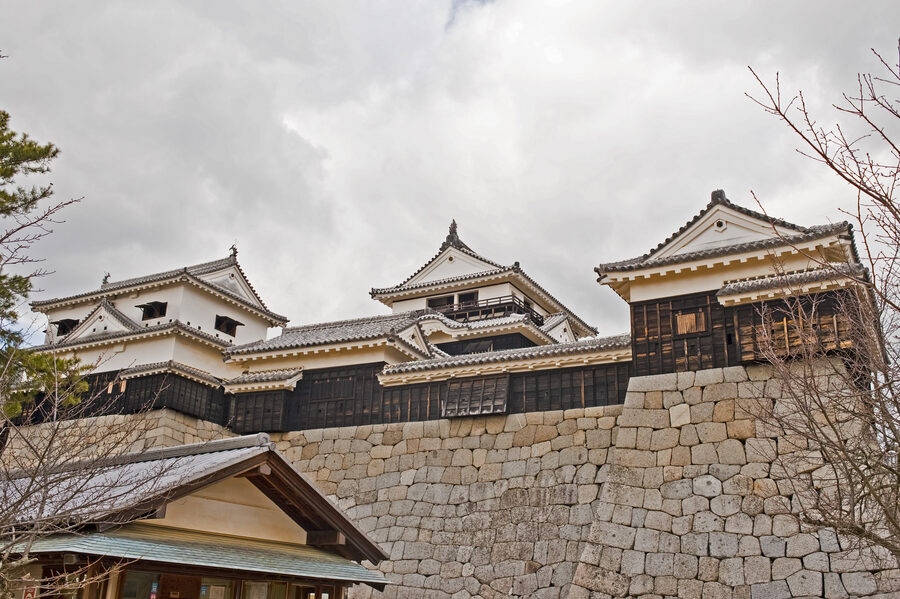
In the first year of Ansei, on 8 February 1854, the twelfth Matsudaira daimyo, Katsuyoshi, finally finished putting the keep back up. He managed it just fourteen years before the Meiji Restoration ended daimyo rule altogether. That timing is what makes Iyo-Matsuyama the strangest name on the list of Japan’s twelve surviving original-construction tenshu — because the keep you climb today was built only 171 years ago, which is by a century the newest “original” in the country.
I want to unpack what that actually means, because the shorthand “one of the twelve originals” flattens some real history here. Iyo-Matsuyama is not a Sengoku relic the way Inuyama is. It is the last pre-Meiji castle keep ever built in Japan. That is a different kind of original, and I think a more interesting one.
In This Article
- What Iyo-Matsuyama Castle is and where it sits
- Katō Yoshiaki — the founder you have probably not heard of
- 1602–1627: the original five-storey construction
- 1627–1634: the short Gamō interregnum
- 1635 onwards: fifteen generations of Hisamatsu-Matsudaira
- Renketsu-shiki: the linked-keep architecture
- The Nohara-yagura — the keep’s oldest surviving structure
- 1 January 1784: the Great Fire
- 1854: Matsudaira Katsuyoshi finishes the rebuild
- Meiji survival and the twentieth-century catastrophes
- Comparing Iyo-Matsuyama to the other eleven
- Visiting the castle today
- Dōgo Onsen, Sōseki, and the literary afternoon
- Practical planning
What Iyo-Matsuyama Castle is and where it sits
Iyo-Matsuyama Castle (伊予松山城, Iyo-Matsuyama-jō) sits on the summit of Mount Katsuyama, 132 metres above the Matsuyama plain in central Ehime Prefecture on the island of Shikoku. The “Iyo” prefix is always attached in scholarly writing because there is another Matsuyama Castle, a ruined Muromachi-era hilltop fort in Nara Prefecture, and a third, Bitchū-Matsuyama, up in Okayama. Locally, in Matsuyama city, nobody uses the prefix. It is simply Matsuyama-jō.
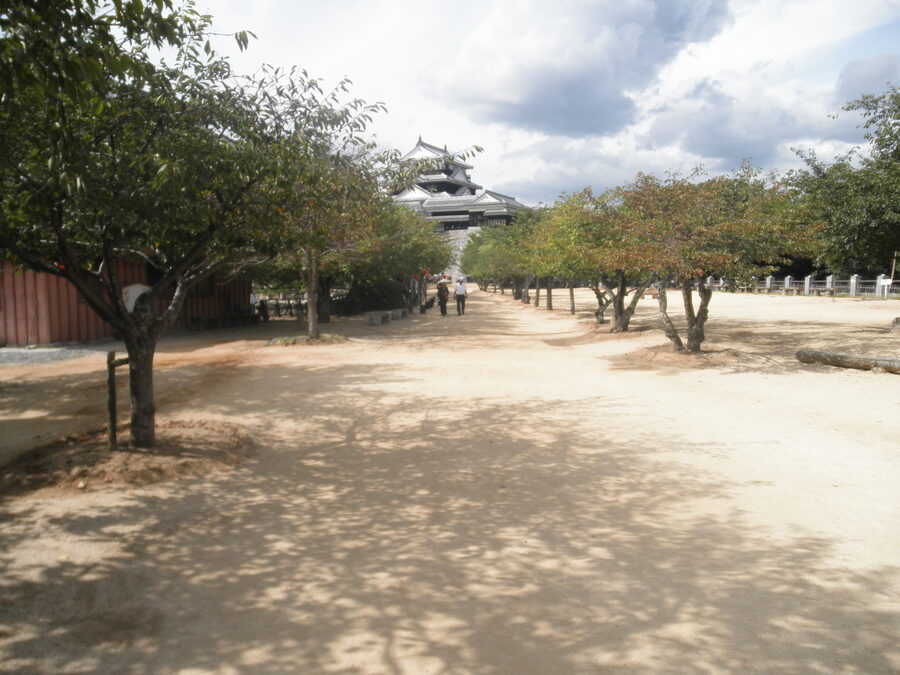
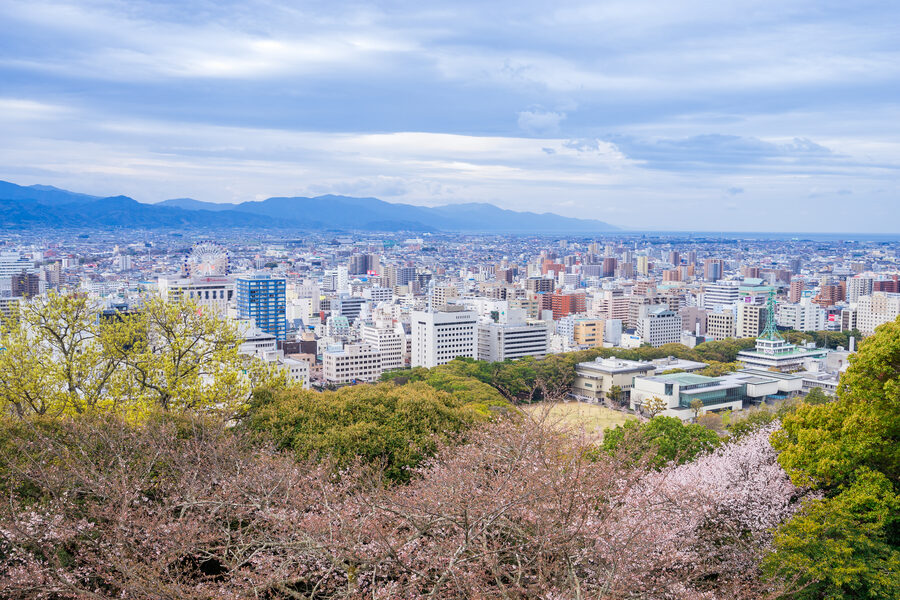
The type is a hirayama-jō — a hill castle as distinct from a mountain castle (yama-jō) or a plain castle (hira-jō). Katsuyama itself is a single isolated rise in the middle of what is otherwise flat reclaimed rice country, so the castle dominates the city for miles in every direction. You can see the keep from the Dōgo Onsen district three kilometres east and from the harbour six kilometres west, and at night it is floodlit gold against the dark hill.
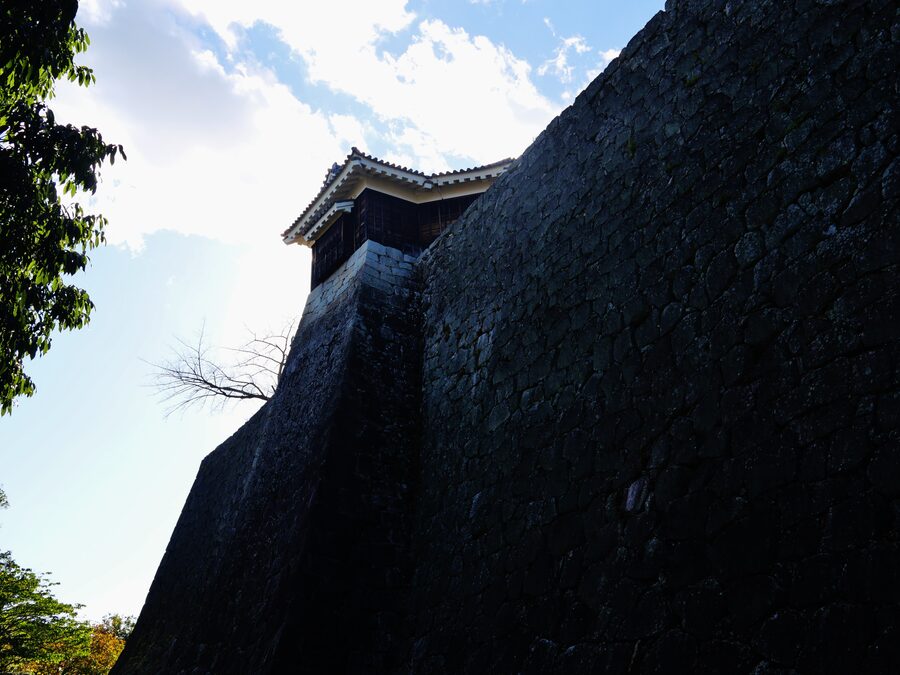
The complex is enormous by Japanese castle standards. The hon-maru alone is 400 metres long, the ni-no-maru is another 300 metres across, and the ishigaki stone-wall circuits on the outer perimeter measure nearly two kilometres. Twenty-one structures are designated Important Cultural Properties, and another nine carry the secondary Registered Tangible Cultural Property classification since 2019. That is more surviving original-period structures than any other castle in Japan except Himeji.
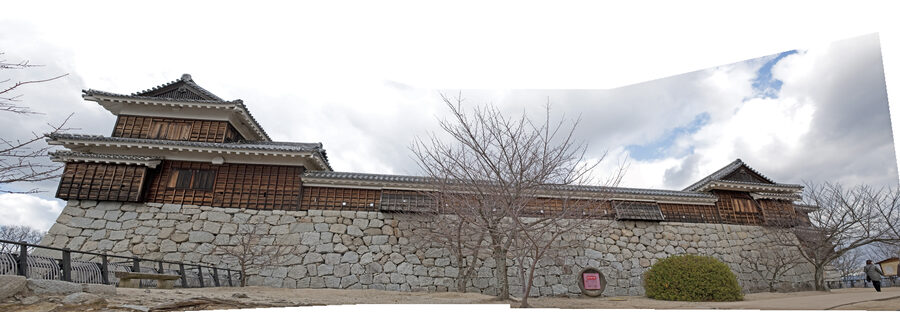
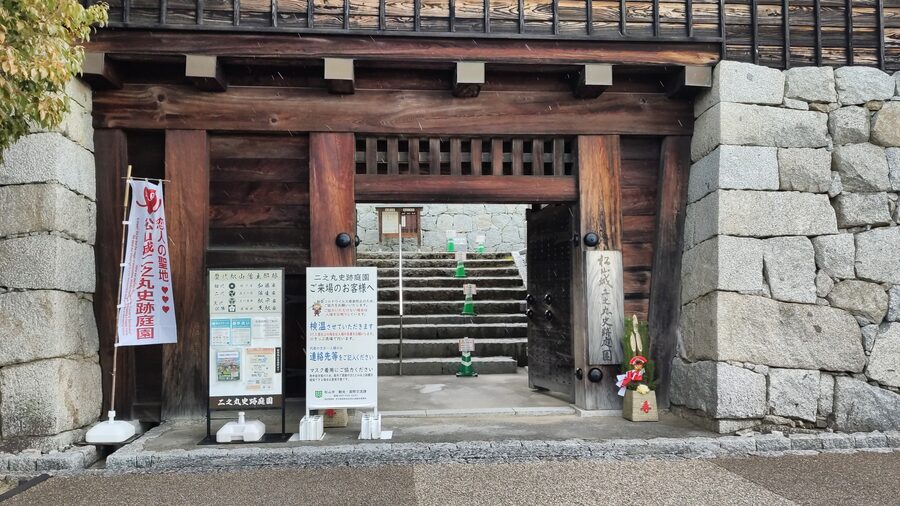
The hilltop is reached today by a ropeway and a parallel chairlift that both opened in 1955 and 1966 respectively; I come back to the ride later because I have strong opinions about which one you should take. You can walk up too, on the old approach path through the Kuromon-guchi and San-no-mon gates, and most serious visitors do — it is a fifteen-minute climb on a mix of ishigaki steps and switchback trail. I recommend walking up and riding down, which is the exact opposite of what the ropeway ticket agents will suggest.
Katō Yoshiaki — the founder you have probably not heard of
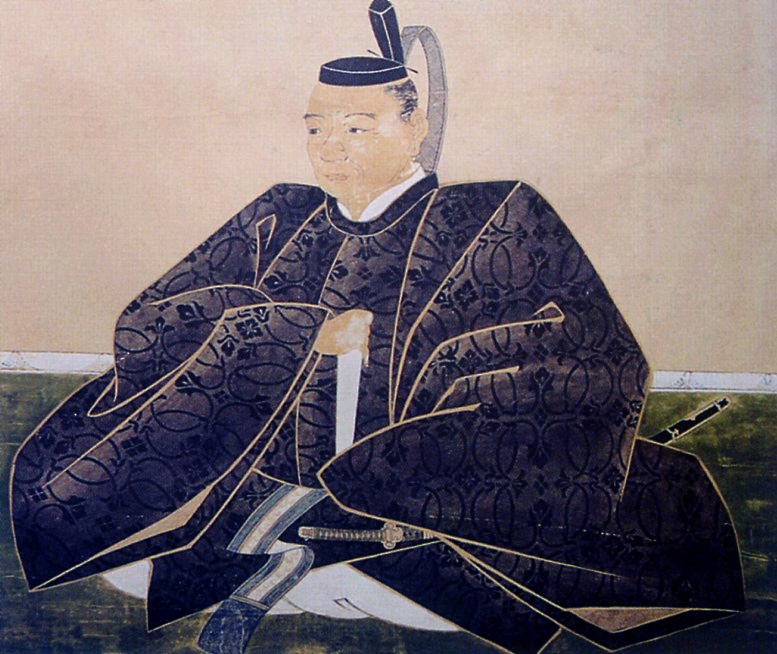
The man who chose Mt. Katsuyama and began construction in 1602 was Katō Yoshiaki (加藤嘉明), a fighting general who spent most of his career in the top tier of Hideyoshi’s inner circle but never quite broke into the household-name bracket that his contemporary Katō Kiyomasa occupies. Which is strange, because the two of them fought side by side as two of the shichi-hon-yari, the Seven Spears of Shizugatake, in the 1583 battle that confirmed Hideyoshi as Oda Nobunaga’s political successor.
Yoshiaki was born in 1563, the son of a minor vassal of the Mikawa-based Matsudaira. He joined Hideyoshi’s service as a foot soldier in his teens and earned his first independent command during the siege of Shizugatake, where he and the other six Spears broke through Shibata Katsuie’s northern flank. Hideyoshi rewarded him with 3,000 koku afterwards — a modest start but enough to establish him as a retainer with a name.
By 1585 he held 10,000 koku at Ōshima in Awaji, and he fought through the whole of Hideyoshi’s consolidation campaign afterwards — Kyushu in 1587, Odawara in 1590, and then the two disastrous invasions of Korea in 1592 and 1597. During the Korean expeditions Yoshiaki specialised in naval operations; he commanded a flotilla of converted Japanese cargo ships along the southern Korean coast and took part in several of the early victories before the Korean navy under Yi Sun-sin wiped most of the Japanese fleet out. He was one of the generals who made it home alive.
After Hideyoshi died in 1598, Yoshiaki was part of the group of seven generals — alongside Kiyomasa, Fukushima Masanori, and Asano Yoshinaga — who moved openly against Ishida Mitsunari and forced him into retirement at Sawayama. That faction fight is the one that Ieyasu eventually brokered, and it is the move that defined which side most of the Seven Spears would take when Sekigahara came around in 1600. Yoshiaki went east with Kiyomasa, Asano, and the rest; Mitsunari kept some of the old Toyotomi-loyal generals for the Western Army, but the Seven Spears vote was unanimous for Ieyasu.
At Sekigahara itself on 21 October 1600 Yoshiaki commanded a brigade of 3,000 men on the Eastern Army right wing, next to Kuroda Nagamasa’s contingent. His force made the initial charge against the Ishida central command at around 11am; the battle was over by early afternoon. Ieyasu’s post-Sekigahara reward distribution doubled Yoshiaki’s landholdings from 100,000 koku at Masaki in Iyo to 200,000 koku for the whole Iyo-Matsuyama domain — which is a serious upgrade, roughly equivalent to what Ieyasu gave Ii Naomasa after Sekigahara and a little less than what Hideyoshi’s old allies in Kyushu kept.
1602–1627: the original five-storey construction
Yoshiaki moved his seat from Masaki to the new site in 1602, the year after the Sekigahara reward. He chose Mt. Katsuyama because it was the only defensible rise on the Matsuyama plain and because the existing castle town at Masaki had no room to expand. The construction plan was ambitious: a linked-keep complex on the summit with three subsidiary keeps radiating off a central five-storey main tenshu, ringed by the largest ishigaki stone-wall circuit of any hilltop castle in western Japan.
Building it took twenty-five years. Yoshiaki spent most of that period conscripting labour from every Iyo village within ten ri of Matsuyama, importing ishiku stonecutters from Kii and Ise, and negotiating timber contracts with the Tosa forest estates on the far side of Shikoku. The original documents call for 800 specialist artisans on site at any given time, plus a rotating labour pool of around 4,000 peasant conscripts. The stone circuit alone took eighteen years to finish.
The name “Matsuyama” (松山, “pine mountain”) was officially registered in October 1603. Before that the hill had been called Katsuyama, which is the name it still carries for the natural feature itself. The castle and the town around it took the Matsuyama name. Katsuyama stayed as the mountain, the ropeway, and the ward boundary; the city became Matsuyama, and when Ehime Prefecture was organised in 1872 the prefectural capital inherited that name too.
Here is the strange part of Yoshiaki’s Matsuyama story: he never finished the castle. In 1627, with construction in its twenty-fifth year and the five-storey tenshu only three floors up, the shogunate ordered him to transfer to the Aizu domain in northern Honshu. The reason given in the Tokugawa records was “strategic rebalancing after the Shimabara situation”, the early signs of the Christian unrest in Kyushu that would explode into the Shimabara Rebellion a decade later, but modern scholars suspect it was also about keeping senior Shizugatake veterans out of Shikoku, where Chosokabe loyalist sentiment still ran high.
The transfer was an upgrade on paper — Aizu was 400,000 koku, twice Iyo-Matsuyama’s 200,000 — but it meant leaving the castle he had spent twenty-five years building. Yoshiaki died four years later in 1631, at age 68, in Edo rather than Aizu. His son Akinari inherited Aizu but was stripped of it in 1643 for misgovernment; the Katō main line was essentially finished by the 1640s.
1627–1634: the short Gamō interregnum
The shogunate’s replacement for Yoshiaki was Gamō Tadatomo, heir to the older Gamō Ujisato line that had held Aizu before the Katō arrived. Tadatomo was given Iyo-Matsuyama with its 200,000-koku holding and the half-finished castle complex on Katsuyama. He spent seven years in Matsuyama and finished the five-storey main tenshu that Yoshiaki had started — the original height, before any of the later changes.
Tadatomo also completed the Ninomaru bailey, laid out the retainer residences around the base of the hill, and began the first version of the ishigaki along the outer perimeter. In architectural terms he was doing most of the finishing work — Yoshiaki had done the conceptual layout and the hard ground-breaking, but a lot of the actual building happened under the Gamō.
Tadatomo died in 1634 with no male heir. The Gamō main line ended with him. The shogunate — Tokugawa Iemitsu at this point, with the succession question now a recurring headache — moved quickly to prevent the domain falling to a disputed cadet branch, and the following year assigned Iyo-Matsuyama to Matsudaira Sadayuki, a cadet of the Hisamatsu-Matsudaira line that Ieyasu had created for his half-brother Hisamatsu Sadakatsu.
1635 onwards: fifteen generations of Hisamatsu-Matsudaira
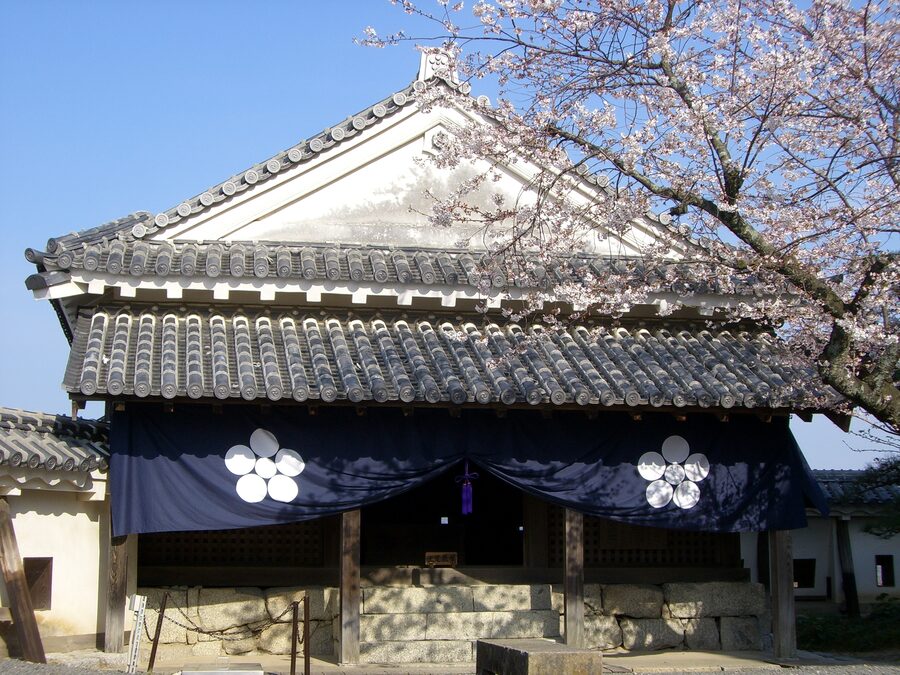
The Hisamatsu-Matsudaira held Iyo-Matsuyama from 1635 to the Meiji Restoration in 1868 — fifteen generations, 233 years. They were a shinpan daimyo house, one of the branches classed as direct Tokugawa relatives because the founder Hisamatsu Sadakatsu was Ieyasu’s maternal half-brother (same mother, Odai-no-Kata, different father). That kinship gave them unusual shogunate latitude; the Iyo-Matsuyama branch retained its 150,000-koku holding without a single domain reshuffle through the entire Edo period.
Sadayuki, the first Matsudaira at Matsuyama, reduced the main tenshu from five storeys to three in 1642. The official explanation at the time was structural, the five-storey tower built on top of the original cramped hilltop footprint was causing ishigaki subsidence, but the subtext was financial. Five-storey keeps were expensive to maintain, and the Hisamatsu-Matsudaira were coming into a domain with a smaller kokudaka than the previous two holders. Dropping two floors saved them a recurring maintenance bill.
That 1642 three-storey rebuild is the design the 1854 reconstruction would later reproduce. So when you climb the current tenshu, the building you are inside is an 1854 copy of a 1642 downsize of what Yoshiaki originally conceived as a 1602 five-storey flagship. Three design iterations, 252 years, one footprint.
Renketsu-shiki: the linked-keep architecture
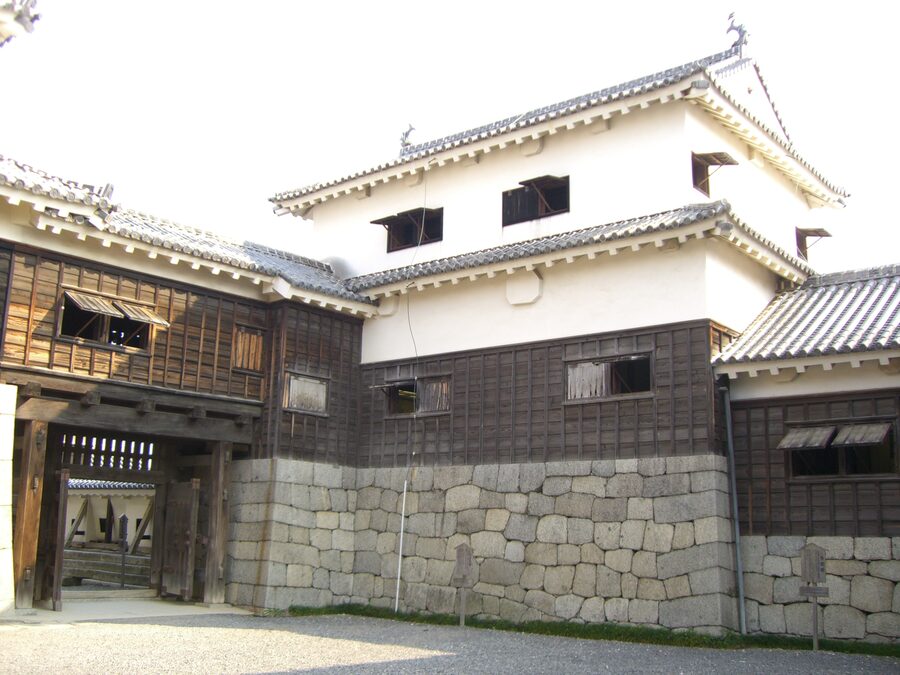
The design classification that architects use for Iyo-Matsuyama is renketsu-shiki (連結式), which translates as “linked-composite style”. It means the main tenshu is connected to smaller subordinate keeps by enclosed corridor-turrets (watari-yagura) that you can walk along without going outside. At Iyo-Matsuyama the central main keep is joined to three smaller keeps — a ko-tenshu to the north, and two corner yagura on the north-east and south-west — via three watari-yagura corridors that enclose the hon-maru plaza on three sides.
This is a rare layout. Of the twelve surviving original tenshu, only Iyo-Matsuyama and Himeji use renketsu-shiki at any scale, and Himeji’s version is more elaborate — it has five smaller keeps linked to the main tenshu in a square around a central courtyard. Iyo-Matsuyama is simpler but the logic is identical: the linked corridor means a small garrison can hold the whole keep complex from any single position, and attackers can be cut off from retreat at any of the corner turrets if they breach one of the entry gates.
The other nine original-twelve keeps are either single standalone towers (the dokuritsu-shiki type, like Inuyama and Maruoka) or have only one linked subordinate keep (rengō-shiki, like Matsumoto). Iyo-Matsuyama sits alongside Himeji as one of only two fully-linked survivors. If you care about defensive architecture, that makes Matsuyama and Himeji the two castles on the twelve-originals list you actually have to see together.
The Nohara-yagura — the keep’s oldest surviving structure
Tucked into the north-west corner of the hon-maru is a small, blocky, two-storey mud-wall turret that almost everyone walks past without looking at twice. This is the Nohara-yagura. It is the oldest surviving structure on the site, a direct Yoshiaki-period build from the 1610s, and it is architecturally more interesting than the main keep, because it is one of only four or five surviving dozo-gata (土蔵形, “warehouse-type”) turrets in the whole of Japan.
The dozo-gata style is an early-Edo hybrid between a samurai turret and a rice warehouse. The exterior walls are thick earthen plaster fireproofed to the same standard used on shogunate rice godowns, but the interior is laid out like a proper yagura with loopholes, drop-stone hatches, and a fortified ground-floor entrance. This was Yoshiaki hedging against a very specific risk — fire, from incendiary arrows or from a castle-town blaze spreading up the hill. The dozo-gata turrets could be sealed shut and they would not burn.
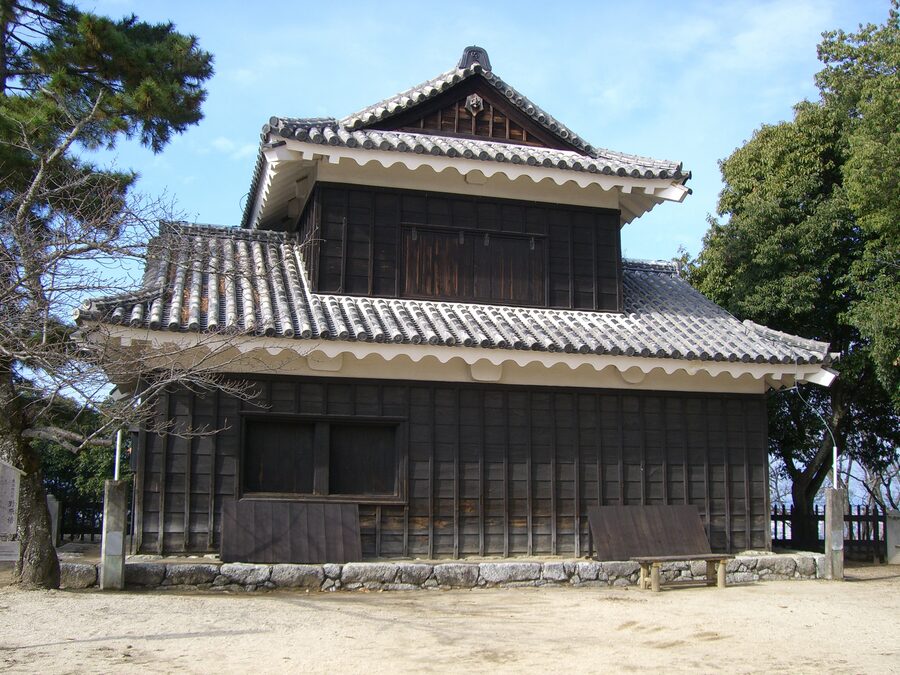
The Nohara survived the 1784 lightning fire because it was far enough from the main keep complex that the flames did not reach it. It survived the Meiji demolition orders because the Matsuyama authorities convinced the Land Tax Reform commissioners that the mud walls were a storage resource, not a military facility. It survived the 1933 arson incident that took nine other wooden structures because its brick-thick plaster walls were essentially flameproof. It survived the 26 July 1945 American air raid on Matsuyama that destroyed eleven structures at the castle, because the incendiary bombs that hit it that night burned out against the dozo plaster without igniting the timber frame inside.
It is, honestly, the thing on the hill I would save if I could only save one. The 1854 keep is a beautiful rebuild but it is a rebuild. The Nohara is the Yoshiaki-period structure that nobody rebuilt and nothing could destroy.
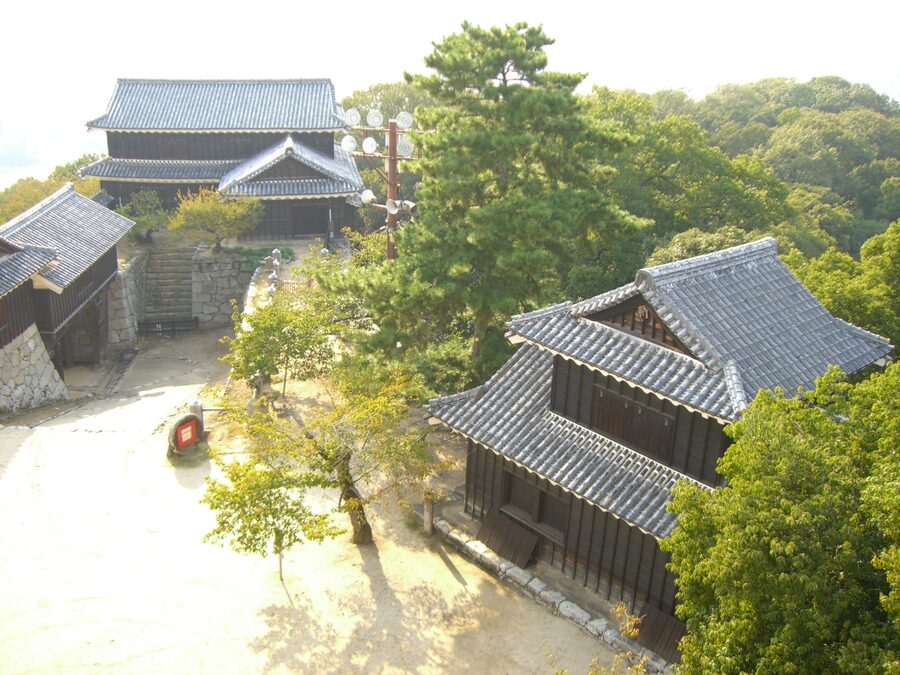
1 January 1784: the Great Fire
The lightning strike came in the early hours of 1 January 1784, the first day of the fourth year of Tenmei. It was a winter storm, unusual in timing but not unprecedented for the Seto Inland Sea region, and the bolt hit the south-west ridge of the main tenshu. The timber frame was dry and the fire spread fast. Within two hours the main keep, the north watari-yagura, the ko-tenshu, and the south-east connecting corridor were all burning.
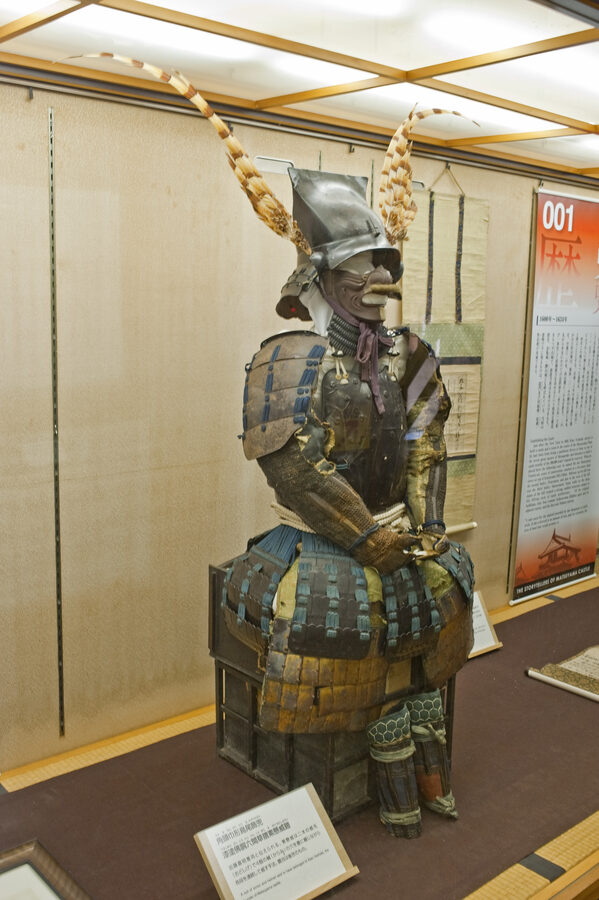
The garrison saved what it could. They got the armour collection out, the banner flags, the document archive — most of that material made it to the ni-no-maru and is the reason you can still read detailed records of the pre-1784 building. They could not save the keeps themselves.
By noon on 1 January the central complex was a smoking ruin on the hilltop. Three years later in 1787 the domain had cleared the debris and stabilised the foundations; the actual rebuild took another sixty-seven years to begin in earnest.
The reason was money, as I mentioned in the opening. The tenth Matsudaira daimyo, Sadanaka, was running a domain with chronic deficit — cotton-crop failures in the 1770s and 1780s, rice-price crashes during the Tenmei famine years, shogunate loan repayments that never let up. A proper keep reconstruction was estimated at 15,000 ryō minimum; the annual budget surplus after expenses was running at around 800 ryō when it existed at all. The rebuild had to wait for a generation that could afford it.
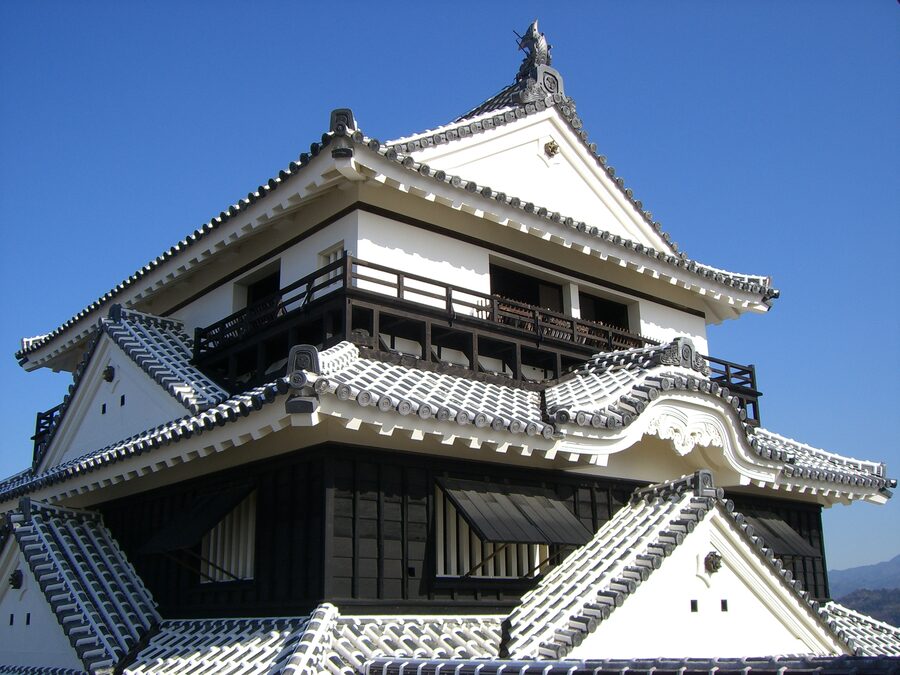
1854: Matsudaira Katsuyoshi finishes the rebuild
The twelfth Matsudaira daimyo was Katsuyoshi, and he was the one who finally got the keep back up. His tenure covered 1837 to 1856, and the domain finances had improved just enough by the 1840s — partly through a domain monopoly on Iyo citrus exports, partly through a regional cotton-trade boom that followed the lifting of shogunate sumptuary laws in 1841 — to make the rebuild possible at last. Construction began in 1849 and the tenshu was formally completed on 8 February 1854.
That date matters. On 8 July 1853, seven months before the tenshu was finished, Commodore Matthew Perry sailed his Black Ships into Uraga Bay and the old shogunate’s isolation policy collapsed. When the scaffolding came off Katsuyoshi’s new keep in February 1854, it came off into a political world that was already in the first phase of what would become the Bakumatsu crisis. By the time the Meiji Restoration abolished daimyo rule in 1868, Katsuyoshi’s keep was only fourteen years old.
Nothing else like it was ever built in Japan. The castle-building era was over: the shogunate’s Restoration-period government banned new castle construction in 1869, the Meiji government issued the Castle Abolition Edict in 1873 that ordered most existing castles demolished, and the technical skill required to build a traditional tenshu on Edo-period engineering standards died out during the Taishō period as the last old-school carpenters retired. Katsuyoshi’s 1854 build is the last time that skill was put to use at original scale on a working castle.
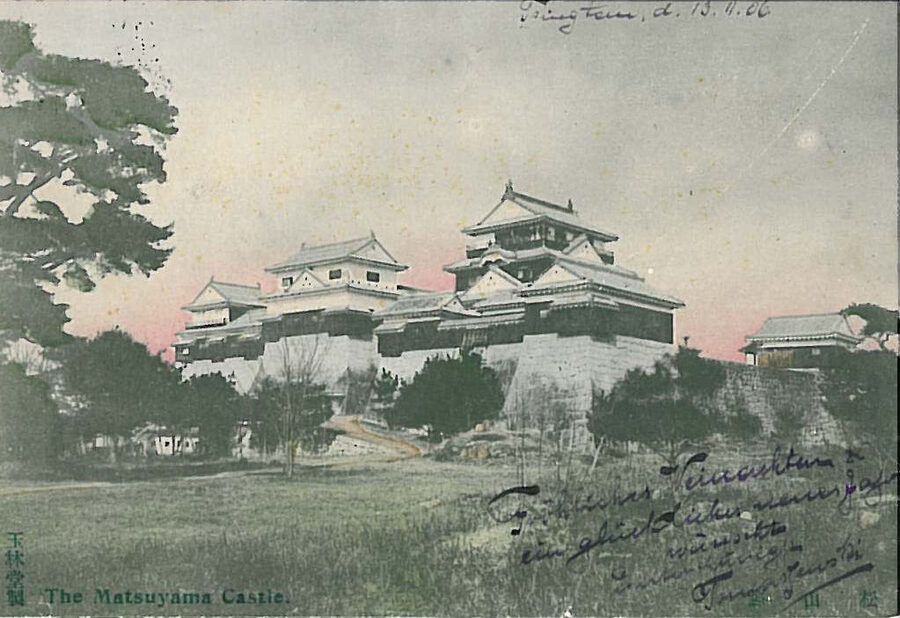
Meiji survival and the twentieth-century catastrophes
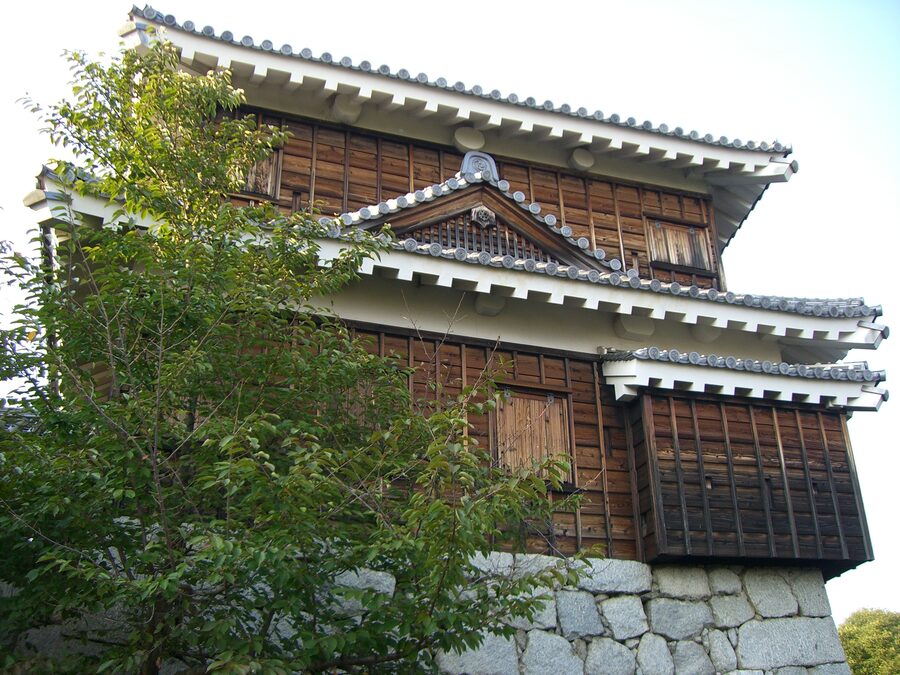
The Castle Abolition Edict of 1873 classified every remaining daimyo castle in the country as either “preserved” or “scheduled for demolition”. Most were marked for demolition, about 120 of them, and the Matsuyama Matsudaira were among the daimyo who lost their castle’s outer defensive circuit, most of the retainer residences at the foot of Katsuyama, and all of the ni-no-maru interior buildings except the gate. But the hon-maru complex was preserved. The main keep, the linked small keeps, the watari-yagura corridors, and most of the inner kuruwa stayed up.
The reason it survived is usually given as: Matsuyama was an active military garrison in the 1870s and the army wanted the castle hill. The Imperial Japanese Army’s Iyo garrison was based at the foot of Katsuyama from 1873 onwards and used the hon-maru for exercises and signal-tower work until 1896. The keep complex was classified as military infrastructure rather than cultural heritage, which paradoxically protected it from the demolition orders that were wrecking castles elsewhere in the country.
When the army left in 1896, the site was transferred to the Ehime Prefecture parks department. In 1874 the hon-maru had already been opened to the public as Matsuyama Park — one of the earliest castle-to-public-park conversions in Japan. The Imperial Household Ministry surveyed the complex in 1931 and listed twenty-one structures as National Treasures (a category that was renamed Important Cultural Properties under the 1950 reform). By 1935 the full designation was in place.
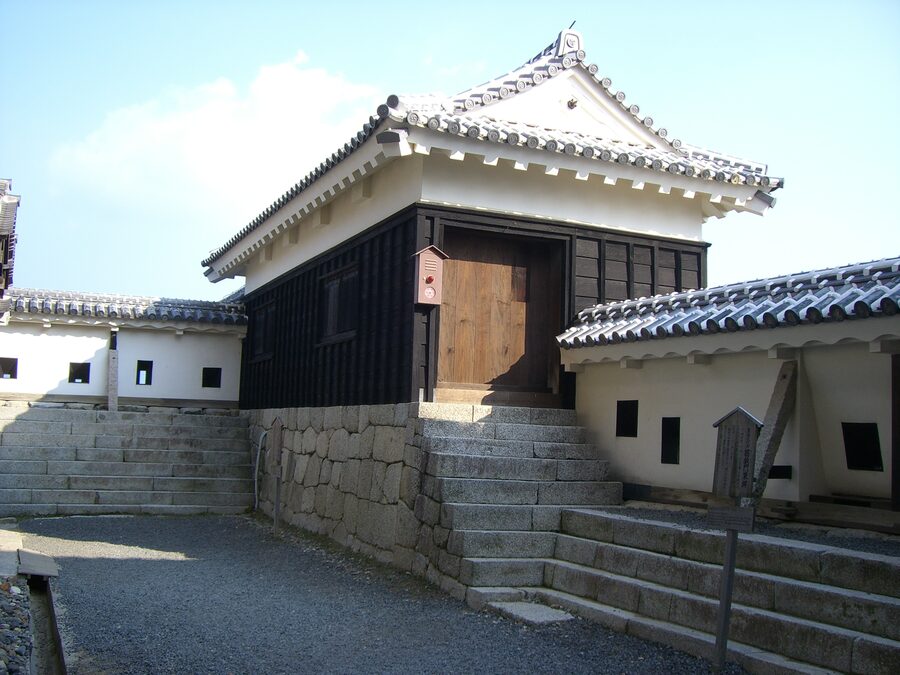
The castle then lived through three near-catastrophes in the early twentieth century. On 9 July 1933 an arson attack on the north-west kuruwa burned out nine wooden structures. On 26 July 1945 an American B-29 firebombing raid on Matsuyama city hit the castle hill and destroyed eleven additional buildings — the lower-bailey rest houses, some of the outer watari-yagura, and the old Kuromon gate on the main approach. On 27 February 1949 a fire in the Tsutsu-mon gate complex took three more structures.
The postwar reconstruction programme began in 1958 and ran through 1968, and it put twenty-two of the lost buildings back up using the surviving Edo-period drawings and the 1930s archival photographs. Those rebuilt structures are not Important Cultural Properties, ICP status requires original fabric, but they are archaeologically faithful copies, and the hon-maru today looks substantially as it did in 1854 after the Katsuyoshi rebuild was complete.
Comparing Iyo-Matsuyama to the other eleven
The “twelve originals” shorthand bundles together a set of castles that are honestly not very similar to each other, and Iyo-Matsuyama sits at one end of the range in several dimensions. It is the newest — 1854 build, 171 years old. It is one of the largest by overall surviving footprint — twenty-one ICP structures, second only to Himeji‘s eighty-two. And it is, along with Himeji, one of only two renketsu-shiki linked-keep complexes in the group.
The oldest of the twelve by certain architectural dating is probably Inuyama at around 1601, though the dendrochronology dispute with Maruoka is not fully settled. The smallest is Maruoka at 12.5 metres square. The tallest is Matsumoto‘s daitenshu at 29 metres. The most whitewashed is Himeji; the most black-walled is Matsumoto. Hikone, Matsue, and Hirosaki each have their own peculiarities.
Where Iyo-Matsuyama fits in this range is roughly: the most architecturally complete of the surviving twelve, because the renketsu-shiki layout is fully present rather than partial; the youngest by a clear margin; and the one with the most attached Edo-period outbuildings still standing. If you are doing a tenshu-hunting trip and you want the single best-preserved defensive complex rather than the oldest single tower, Iyo-Matsuyama is probably your target. Himeji is bigger and older but much more restored. Bitchū-Matsuyama up in Okayama is smaller and more isolated. Iyo-Matsuyama hits a sweet spot between original fabric and survival of layout.
Visiting the castle today
The castle is open seven days a week, 9:00 to 16:30 in winter and 9:00 to 17:30 in summer, with last keep entry thirty minutes before closing. Admission to the hon-maru and the keep is ¥520 for adults and ¥160 for children. The ropeway round-trip from the base is another ¥520 for adults; the chairlift, which runs alongside the ropeway on a parallel cable, is the same price. A combined keep-plus-ropeway ticket is ¥1,040, which is the sensible option.
Getting to the castle base from Matsuyama station is a five-minute tram ride on the Iyotetsu Shiro-line, the streetcar network that threads through central Matsuyama, to the Okaido stop. From Okaido it is a 400-metre walk north through the covered shopping arcade to the base of the ropeway station. If you are coming from Dōgo Onsen the tram ride is fifteen minutes on the same Shiro-line, direct, no transfer.
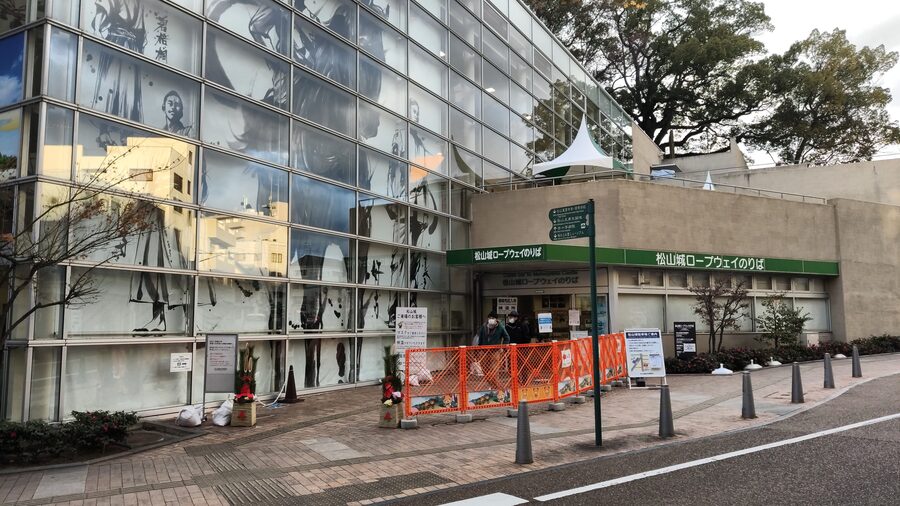
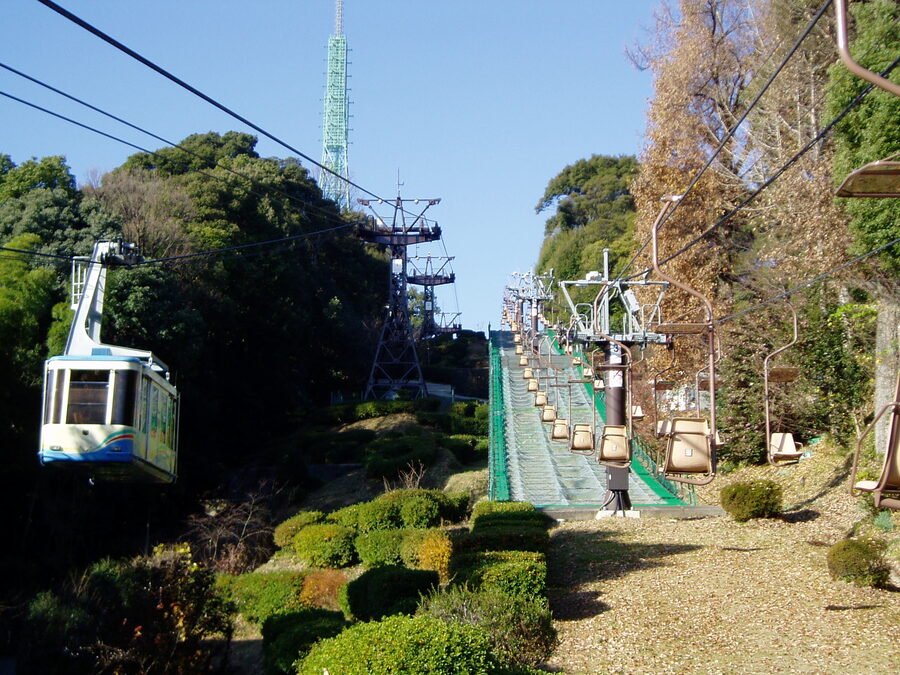
My recommendation on the ropeway versus chairlift question: take the chairlift up and the ropeway down. The chairlift is an open single-person seat and the ride up the hill takes six minutes at a slow cable pace; the views of Matsuyama unfolding below you are better from an open chair than from a glass-walled cabin, and the air is quieter. Coming down, the cabin ropeway is faster and the lower temperature on the hilltop at closing time means you will be glad of the enclosed space. Fifteen minutes up, three minutes down, both ways.
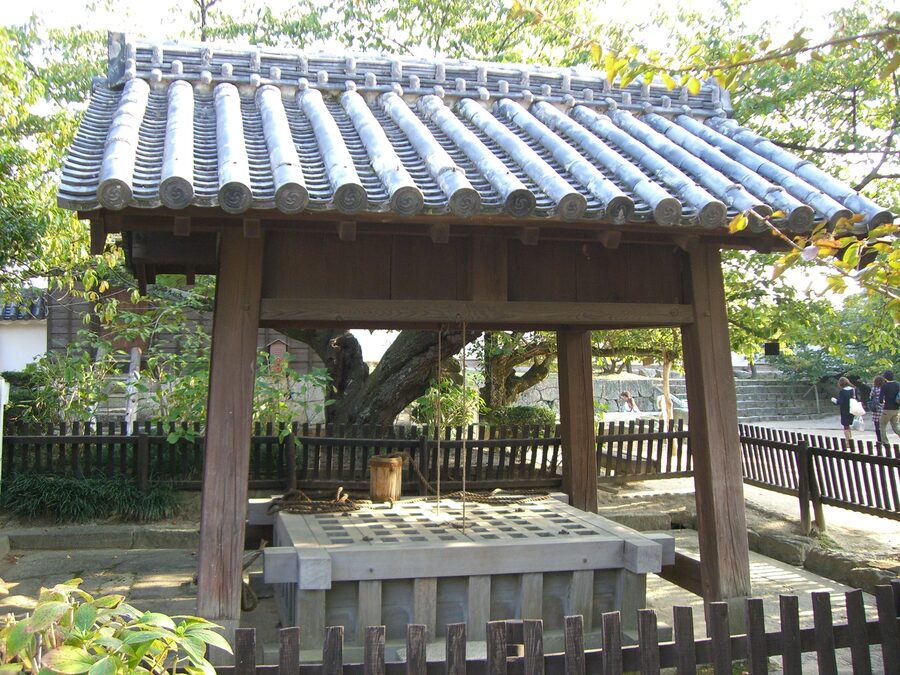
On top you have two hours of walking to do if you want to see everything. The core keep circuit — up through the San-no-mon gate, into the main tenshu, across the watari-yagura into the ko-tenshu, down through the Tatsumi-yagura, back to the hon-maru plaza — takes about ninety minutes if you read the plaques. Add another half-hour for the Nohara and Inui yagura on the north-west corner, which most of the tour groups skip. The whole hon-maru circuit including the well and the outer ishigaki is about three kilometres of walking on uneven stone steps.
Dōgo Onsen, Sōseki, and the literary afternoon
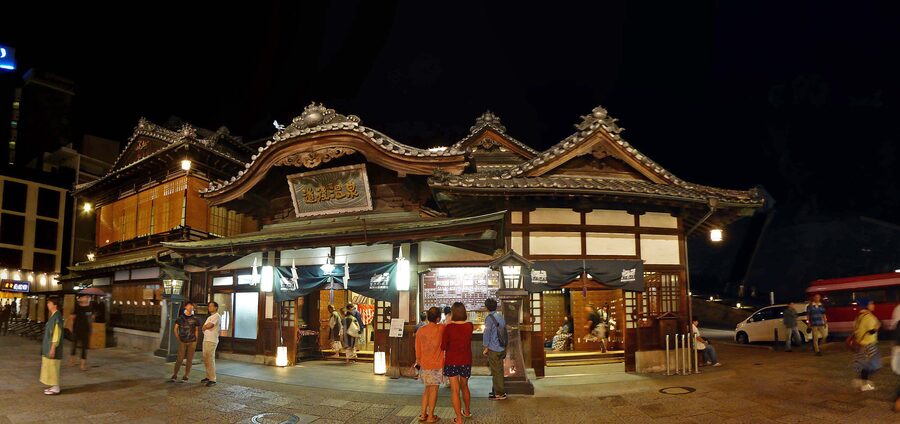
Three kilometres east of the castle is Dōgo Onsen, which claims to be Japan’s oldest continuously-used hot spring. The legendary date of first use is 596 CE, during the reign of Empress Suiko; the archaeology pushes that back further to the third-century Kofun period, which would make Dōgo one of the oldest continuously operating bath complexes anywhere in the world. The current Honkan building, the three-storey wooden bathhouse with the upturned-eaves roof and the egret weathervane on top, went up in 1894, late-Meiji period.
Natsume Sōseki lived in Matsuyama for one year in 1895 as a newly-appointed middle-school English teacher, and he used the Dōgo Honkan every week. His novel Botchan (1906) is set in Matsuyama with Dōgo as a recurring location, and the top-floor bath at the Honkan — the Yushinden, a special room that Emperor Meiji used in 1899 — has a preserved Sōseki corner with his bathing towel and a small display of his Matsuyama-period letters. The literary baggage of this particular onsen is heavier than the building itself, which is saying something because the building is splendid.
Matsuyama’s other major literary figure is Masaoka Shiki, who was born in the city in 1867 and is considered the founder of modern haiku. Shiki Memorial Museum is in the Dōgo Park precinct next to the onsen, and the Shiki walking trail connects the museum, the castle, and the poet’s birthplace house in a three-hour loop. If you have a whole day for Matsuyama, which I think you should allow, the castle in the morning, Dōgo bath at lunch, Shiki museum in the afternoon is the right order.
The specific ritual for Dōgo is: change into the yukata provided with the ticket; take the Kami-no-yu (upper bath) rather than the Tama-no-yu (lower bath) — the water in the upper bath is hotter and the room is older; pay the ¥610 standard admission, not the ¥1,550 premium ticket which includes tea and senbei in a second-floor resting room of limited cultural interest; wash thoroughly before entering the pool, not in it. Elderly men from the neighbourhood use the Honkan every day and will give you disapproving looks if you skip any of the stages.
Practical planning
How long to give Matsuyama: one full day minimum, two is better. A one-day itinerary is castle morning (four hours including the ropeway), Dōgo bath plus lunch at the onsen district (two hours), and either the Shiki museum or the Bansuisō western-style villa in the afternoon (two hours). A two-day itinerary adds the Ishite-ji temple complex, which is temple 51 on the Shikoku 88-temple pilgrimage and the most interesting Buddhist site in the city by a wide margin.
Where to stay: the Dōgo Onsen district has about 40 ryokan and hotels ranging from the premium (Funaya, around ¥35,000/night) through the mid-range (Taikeien, around ¥18,000) to the budget onsen guesthouses (¥8,000 or so). I prefer staying near the Dōgo Honkan rather than near the castle because the onsen district is quieter in the evening and the tram line back to the castle base is direct. The tram runs until 22:30.
When to visit: the three best windows are first week of April for sakura, first two weeks of November for autumn colour on the Katsuyama pines and maples, and the two weeks straddling New Year for the classical ceremonial events — including a re-enactment every 1 January of the 1784 lightning-fire memorial, which is a quiet domain-Shinto ritual held in the ni-no-maru and worth seeing if you are in the city on New Year’s Day. Summer is hot and humid. Rainy season in June is the worst time; cloud sits on Katsuyama for days.
Access from elsewhere on Shikoku: Matsuyama is 2h40 from Takamatsu by the JR Yosan line, 4h from Kōchi via Oboke, and 3h20 from Uwajima via the southern Yosan. If you are doing a four-original-tenshu Shikoku circuit — Marugame, Iyo-Matsuyama, Uwajima, Kōchi — Matsuyama is your anchor. It has the best airport connections (Narita, Haneda, Kansai, and a ferry link to Hiroshima), the largest hotel inventory, and the longest opening season for the castle itself.
One last note on the “twelve originals” question. If you meet the purist argument that Iyo-Matsuyama should not count — because 1854 is too recent, because the Meiji Restoration was fourteen years away, because the design is a conscious historicist copy rather than a continuous Edo original — I understand the logic. But I think the argument loses.
The keep is pre-Meiji, built to Edo engineering standards, using Edo-period carpentry and Edo-period materials, under a daimyo commission in a castle-town domain. That is what the “original twelve” list is for. Matsuyama is in.
And it is also, still, the last pre-Meiji tenshu ever built in Japan, a keep that went up against a rising tide of Westernisation and isolationist collapse, completed seven months after Perry’s Black Ships, in a castle town that did not yet know its world was about to end. That is the story I came for when I first walked up the hill. Seventy years of ruin, one determined daimyo, 171 years on the skyline, and a hon-maru plaza that still fills with cherry blossom every April the way it did the year Katsuyoshi cut the ribbon. There is no other castle in Japan quite like it.