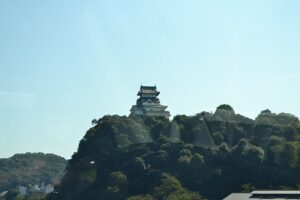
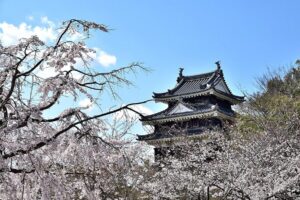
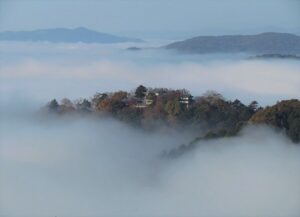
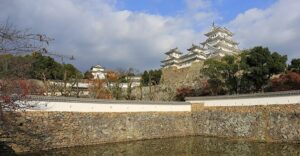
Twelve original tenshu keeps survive in Japan, and every single one of them has lost something. Himeji kept its keep but the Meiji army dismantled its palace. Hikone kept its keep but the palace is gone. Kōchi is the only castle on the list that kept both, and that one fact is the reason the hilltop above the Kagami River deserves a full day of your Shikoku itinerary.
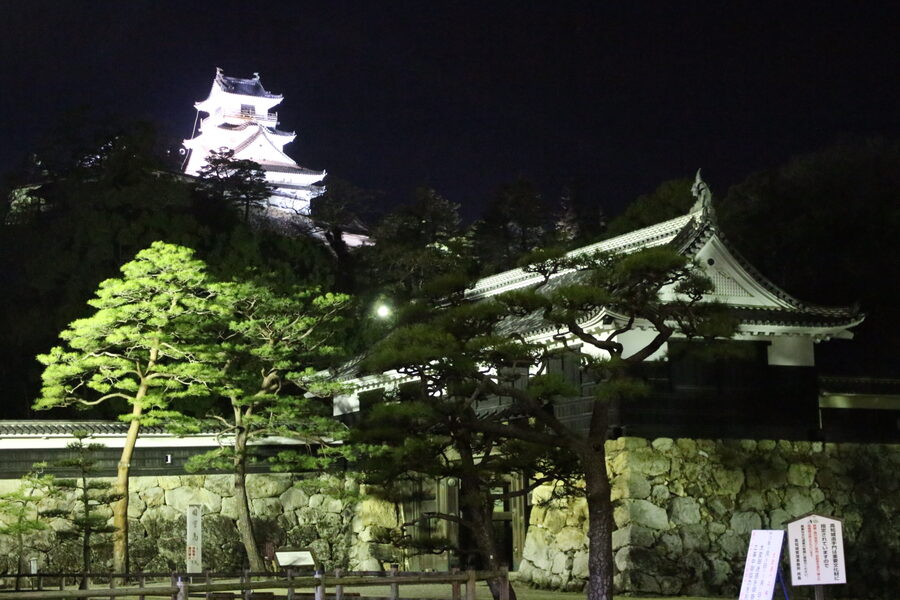
I went to Kōchi expecting another tenshu-only day. You turn up at the gate, you pay your 420 yen, you climb the ishigaki, you take the photos from inside the keep, and you leave. What I got instead was two buildings connected by a genuine 18th-century passage, and an hour in the palace that completely rearranged how I think about the whole 12-list.
This article is the long version of the Kōchi story. You get the frugal-wife legend that bankrolled the founder’s rise, the 1601 start and the 1611 completion, the 1727 fire that nearly erased everything, and the 1749 deliberate replica-rebuild that preserved a shape already a century old. You get the last Yamauchi lord who wrote to the shōgun in 1867 telling him to resign, and the Meiji-era sequence of near-demolitions that the palace somehow kept surviving. You also get the practical visitor logistics so you can spend a sensible day in Kōchi yourself.
In This Article
- What makes Kōchi the only one
- The founder, Yamauchi Kazutoyo, and the horse that bought a province
- Kakegawa to Tosa: the Sekigahara reward
- Choosing the site and the first construction, 1601 to 1611
- The 1727 fire and the replica rebuild of 1749
- Reading the architecture: gables, balconies, and the top-floor tō-gō
- Inside the honmaru palace
- The Ōte-mon, the only surviving original main gate
- Yamauchi Yōdō and the end of the shogunate
- The Meiji survival story
- Sakamoto Ryōma, Tosa, and the revolutionary hometown
- Katsu Kaishū, Ryōma, and the Tosa intellectual export
- Visiting Kōchi Castle today
- The rest of the Kōchi day
- Where Kōchi ranks among the twelve
What makes Kōchi the only one
The Japanese castle world has a shortlist called the twelve original keeps, or genzon tenshu. These are the only tenshu buildings in Japan that have survived since before the Meiji Restoration in their original timber. Everything else you see at Osaka, Nagoya, Kumamoto, Okayama, Hiroshima is a 20th-century concrete reconstruction, usually built on the original stone base but not from the original building.
The list is Himeji, Matsumoto, Inuyama, Hikone, Matsue, Maruoka, Bitchū-Matsuyama, Hirosaki, Marugame, Uwajima, Iyo-Matsuyama, and Kōchi. Eleven of these castles retain the tenshu keep and nothing else of the original inner-bailey buildings. At Kōchi you get the tenshu plus the full original honmaru palace, plus the Ōte-mon main gate, plus the Kuroganemon and several other original turrets.
Fifteen individual buildings at Kōchi Castle are designated Important Cultural Properties of Japan. That is by some distance the most intact set of original castle structures in the country. Himeji, which people generally assume is the most preserved, has a larger tenshu and more outer turrets but no surviving palace at all.
The reason this matters if you are visiting is simple. At every other original castle, the tenshu is the entire indoor experience. At Kōchi, the tenshu is maybe a third of it.
The founder, Yamauchi Kazutoyo, and the horse that bought a province
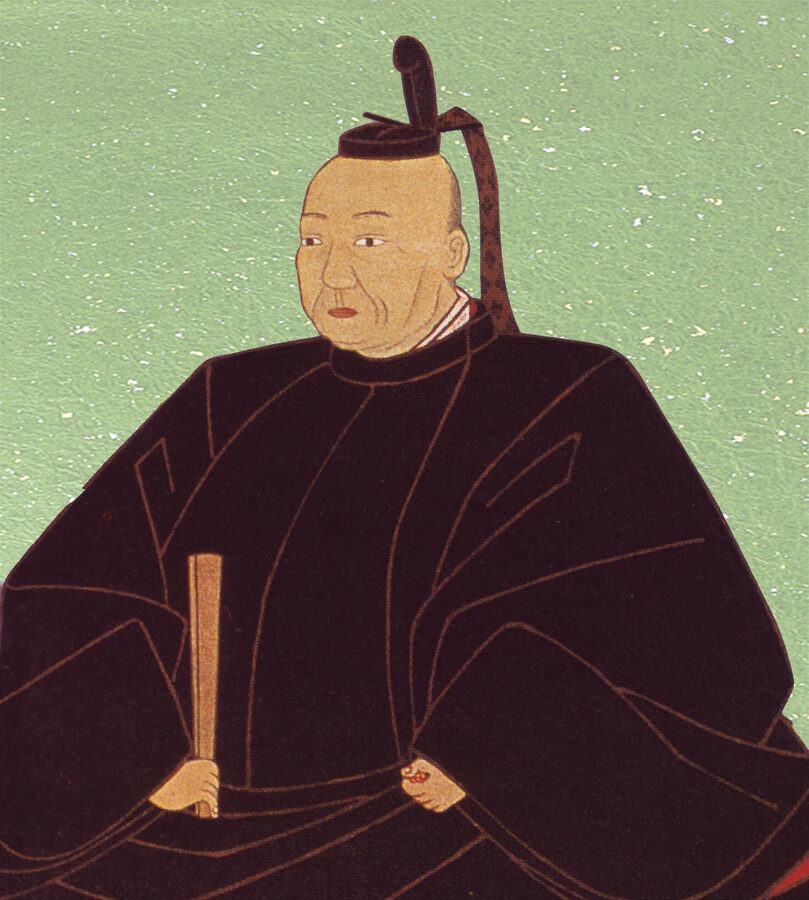
Yamauchi Kazutoyo was born around 1545 in Owari Province, which is the same corner of modern Aichi that produced Oda Nobunaga, Toyotomi Hideyoshi, and Tokugawa Ieyasu. His father was a mid-ranked retainer of the Iwakura Oda branch, a side-line loser in the Oda family civil war, and when the other branch won Kazutoyo’s father was killed and the family lost everything. He grew up as a wandering minor samurai looking for work.
He eventually found that work under Hideyoshi, who in the 1570s was building a personal retinue around the Oda push north. Kazutoyo fought at Anegawa in 1570, at Yamasaki in 1582, at Shizugatake in 1583, and at Komaki-Nagakute in 1584. None of these battles made him famous, but each one moved him up a grade.
His real career accelerator was his wife, Chiyo, who he married around 1573. The family was poor by samurai standards, on the order of 400 koku in rice stipend, which is barely above foot-soldier level.
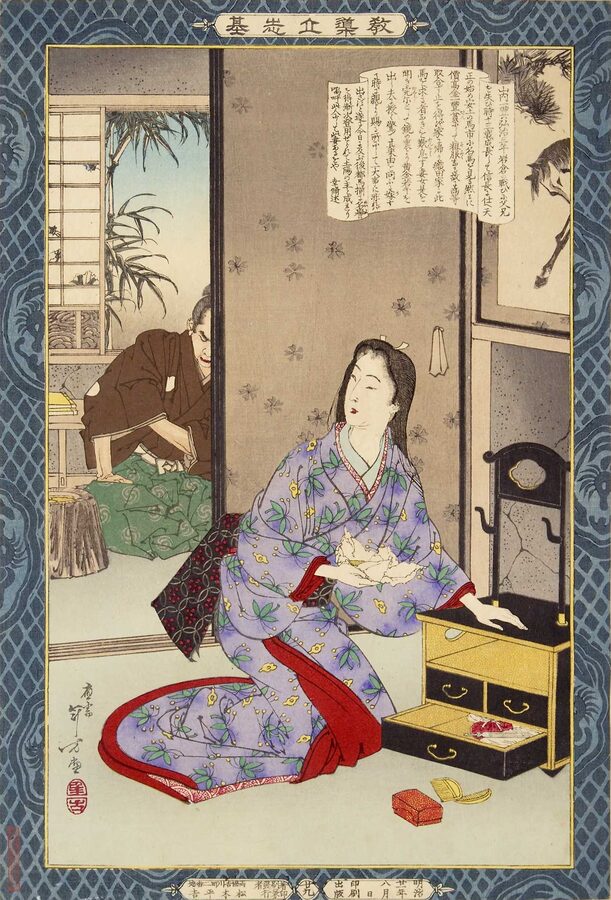
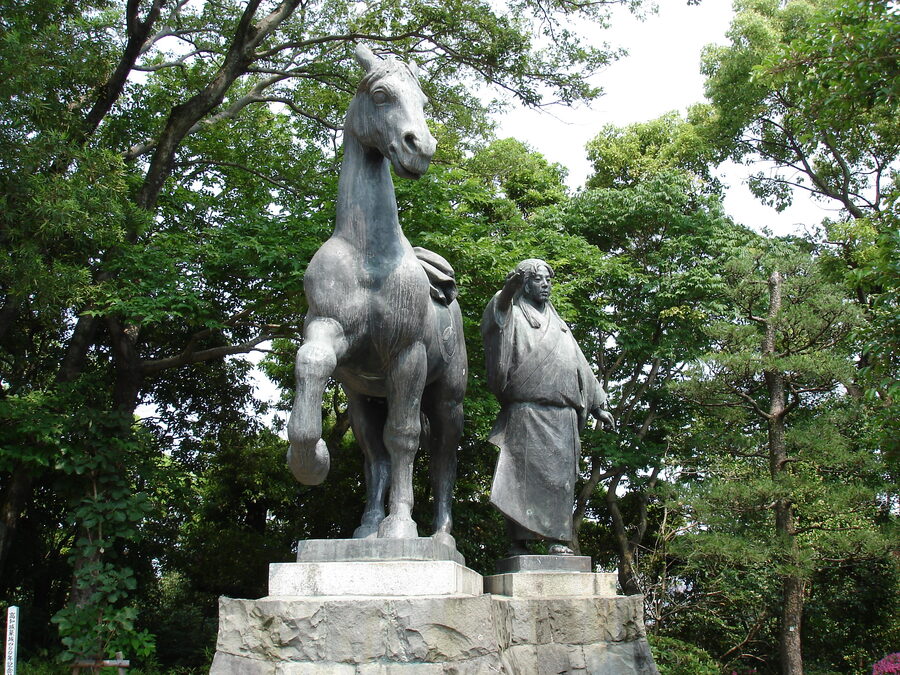
The famous story runs like this. A travelling horse merchant came through the area with a magnificent stallion, the kind of horse that a 400-koku samurai could not afford and that his Hideyoshi-level superiors would notice at a troop review. Kazutoyo wanted the horse. Kazutoyo did not have the money.
Chiyo, according to every version of the story, had been quietly putting aside a small emergency fund her mother had given her when she married. The sum was usually cited as ten ryō, which was enough for the horse. She went and got the coins, tied them in a cloth, and handed them to her husband without saying what they were for.
Kazutoyo bought the horse. The next parade in front of Hideyoshi went exactly the way you would expect. The warlord noticed the horse, asked who owned it, and Kazutoyo was promoted. The story is almost certainly embellished, but it is the kind of story a samurai family needed in its founding myth, and by the Meiji period it was taught to schoolchildren across Japan as a lesson in thrift.
Kakegawa to Tosa: the Sekigahara reward
By 1590, after the Siege of Odawara and Hideyoshi’s redistribution of the east, Kazutoyo was the lord of Kakegawa Castle in Tōtōmi Province at 50,000 koku. That was no longer foot-soldier territory. Kakegawa was a strategic road station on the Tōkaidō between the old Imagawa lands and the Oda-Toyotomi east, and Hideyoshi used it to park men he trusted but wanted to watch.
When Hideyoshi died in 1598 and the country split into factions, Kazutoyo made the decisive call of his career. He sided with Ieyasu against Ishida Mitsunari and the Toyotomi loyalists. That alignment was dangerous because his old patron had made him, but it was the right bet.
The most famous Kazutoyo moment of this period happened at a war council in Oyama in July 1600. Ieyasu was trying to get the eastern daimyō to commit fully to marching west. Kazutoyo stood up and offered his Kakegawa Castle to Ieyasu outright as a staging base, telling Ieyasu he could use it for supplies, for garrisoning troops, or as a fallback.
The offer was unusual because Kakegawa was not Ieyasu’s to take. Kazutoyo was, in effect, betting his entire domain on the Eastern victory. Several other daimyō in the room, seeing the gesture, matched it. The council closed with the east fully committed.
Kazutoyo then fought at the Battle of Sekigahara on 21 October 1600 on the Eastern right wing, in a supporting role. After the Eastern victory, Ieyasu spent months redistributing the old Toyotomi-aligned domains. Tosa Province, held by the Chōsokabe clan on the Shikoku side of the Inland Sea, was confiscated because the Chōsokabe had bet the other way.
Kazutoyo got Tosa. The assessment was 202,600 koku initially, later rounded and re-assessed up towards 240,000 koku, which was nearly a fivefold increase on his Kakegawa holding. He was 55 years old.
The reward mattered for two reasons beyond the rice yield. First, Tosa was a Toyotomi-loyal province under the outgoing Chōsokabe, so moving a trusted Tokugawa ally in was politically necessary. Second, Tosa was big. The province covers most of modern Kōchi Prefecture, stretching from the Ashizuri peninsula in the south-west to the Murotō cape in the east, with roughly 200 kilometres of coastline.
That scale brought problems along with the prestige. The previous Chōsokabe lords had built up a fierce local warrior class of gōshi, country samurai who owned their own land and answered to nobody in particular. Kazutoyo arrived with about 1,000 Yamauchi retainers from Kakegawa, a tiny force by Tosa standards, and spent his first two years in the province negotiating and occasionally suppressing the existing gōshi.
Choosing the site and the first construction, 1601 to 1611
Kazutoyo arrived in Tosa in 1601 and inherited a provincial-capital problem. The existing Chōsokabe seat was at Urado, south of modern Kōchi on a peninsula jutting into the bay. It was a good defensive position and a bad administrative one, because the flat farmland, the rice-producing wealth of the province, was inland along the Kagami and Enokuchi rivers.
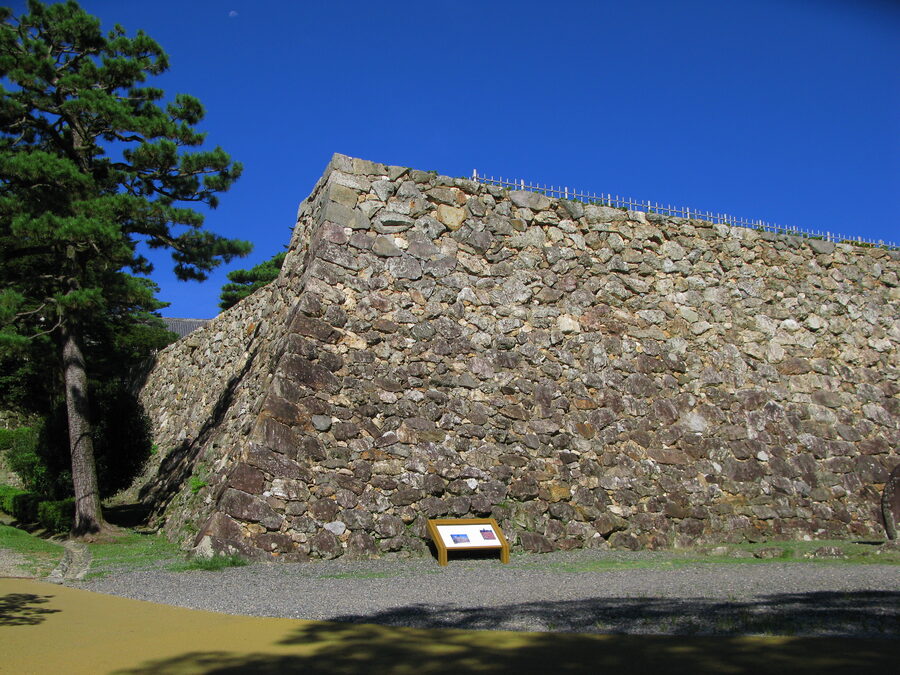
He spent a few months at Urado assessing options and then picked a low hill called Ōtakasaka or Ōtakasa, roughly 44 metres above the river plain, at the confluence of the Kagami and Enokuchi. The hill had been occupied in the medieval period by a small fort, and the site had already been named Kawanakayama, “the mountain between the rivers”.
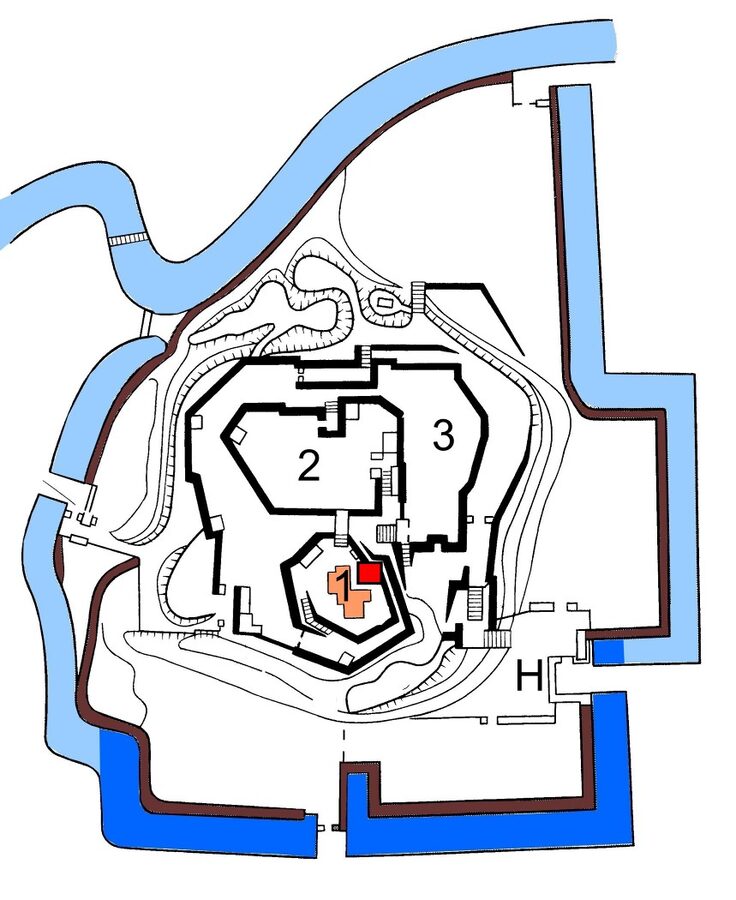
Construction began in 1601 and proceeded in two overlapping phases. The honmaru at the top of the hill, the tenshu, the inner gate system, and the Ōte-mon main gate at the base were built first and completed by 1603. The outer ninomaru, sannomaru, and moat system took another eight years and were not finished until 1611.
Around 1611, Kazutoyo’s grand-nephew Tadayoshi renamed the hill and the castle together. Ōtakasaka lost its name. The castle became Kōchi-jō, Kōchi Castle, derived from the Buddhist name Kōchi-san. The city that grew around it eventually absorbed that name.
Kazutoyo himself did not see much of this. He died in 1605, only four years into his Tosa reign and six years before the outer castle was finished. Because he and Chiyo had no surviving children, the domain passed to his nephew Yamauchi Tadayoshi, and the Tosa lineage continued from there for another fourteen generations.
Chiyo outlived her husband by twelve years and spent the Kōchi construction finale in a supervisory role. She took the Buddhist name Kenshōin after her husband’s death, which is how she appears in later portraits. The domain records credit her with brokering the formal compromise between the incoming Yamauchi retainers and the displaced Chōsokabe gōshi, a settlement that more or less held for 270 years.
The 1727 fire and the replica rebuild of 1749
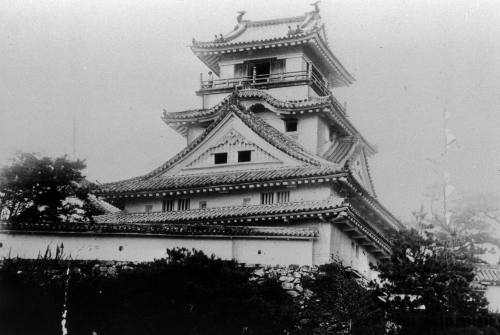
The early 18th century had a run of urban fires in Japanese castle towns, and Kōchi was unlucky enough to catch one of the bad ones. On a winter day in the fourth year of the Kyōhō era, equivalent to 1727, a fire broke out in the castle precinct and spread through the upper buildings. By the time it was out, almost every major structure at Kōchi Castle had burned.
The honmaru palace was gone. The tenshu was gone. The major turrets were gone. The only substantial structure that survived the 1727 fire was the Ōte-mon main gate at the base of the hill, which had been built in 1663 and stood far enough down the slope that the flames never reached it.
The Yamauchi at the time was Toyonobu, the seventh-generation lord. He had inherited the domain in 1725 and was only two years into his reign when his capital burned. The reconstruction decision was unusually precise. Rather than modernise the castle to the 18th-century fashion of squat connected-keep complexes, Toyonobu ordered his architects to rebuild the tenshu as a deliberate replica of the 1601 Kazutoyo original.
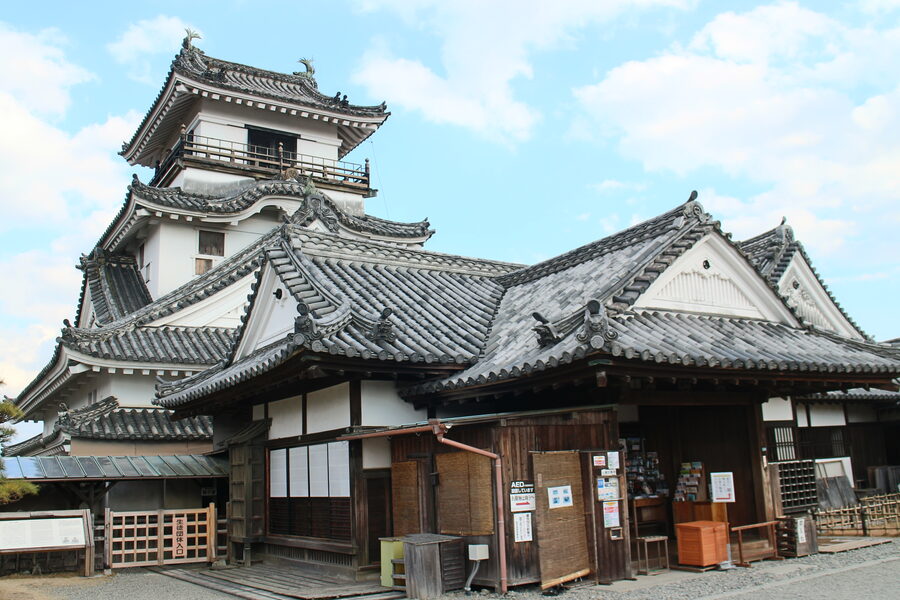
That decision is the single most important fact in Kōchi Castle’s architectural history. It means the tenshu you are looking at today is 1749 wood shaped to early-Edo aesthetics, not mid-Edo ones. The architects had access to drawings, to surviving foundation measurements, and to men who remembered the pre-fire building from their own youths.
Construction of the new tenshu finished in 1749, with full rebuild completion of the honmaru palace and the Kuroganemon iron gate following shortly after into the early 1750s. The whole project took about 22 years, and Toyonobu’s son Toyochika saw the end of it.
The Kōchi domain accounts for the rebuild survive, and they are brutal. The castle restoration absorbed somewhere around 20 per cent of the domain’s total rice revenue for two decades. The village farmers paid the bulk of it through surcharged land tax, and the surviving Tosa records show a run of peasant petitions complaining about the rebuild costs.
The reconstruction draughtsmen drew on two sources. There were measured drawings of the 1601 tenshu kept in the domain archive, which had survived in a separate storehouse that the fire did not reach. There were also elderly retainers who had climbed the old keep as children in the 1680s and who could describe the internal staircases and the top-floor balcony from memory.
The result is that the 1749 tenshu keeps features that no 1749 architect would have chosen on a blank sheet of paper. The exposed top-floor balcony was one of them. The deliberately asymmetric gable placement was another, since by 1749 the fashion had moved to symmetrical composite keeps that placed identical gables on opposing faces for visual balance.
Reading the architecture: gables, balconies, and the top-floor tō-gō
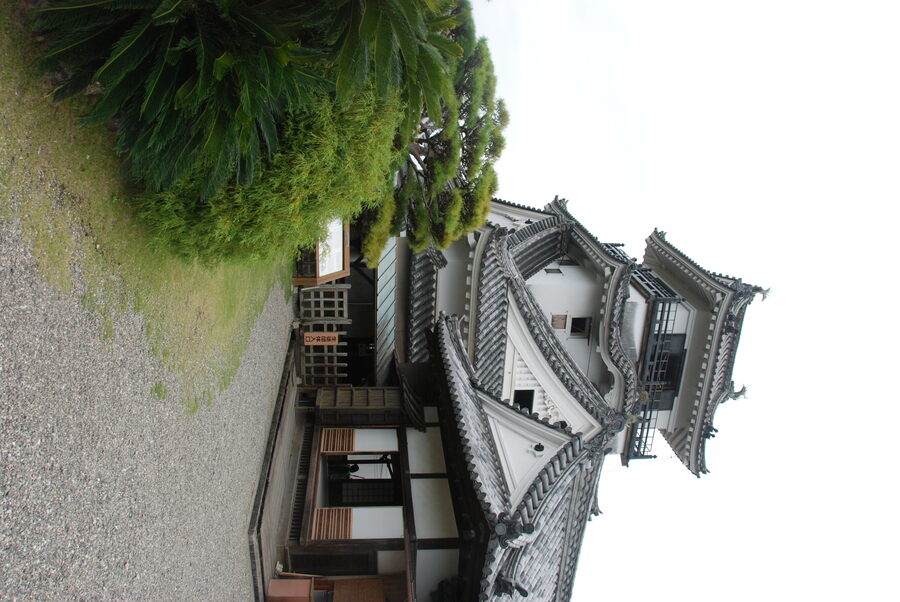
The tenshu is four stories on the outside and three stories on the inside. The discrepancy comes from the internal double-height rooms on the first and top floors, which is a common Edo trick to create ceremonial space without adding visible stories to the facade. The building stands 18.5 metres from ishigaki base to roof ridge, which is small by Himeji or Matsumoto standards.
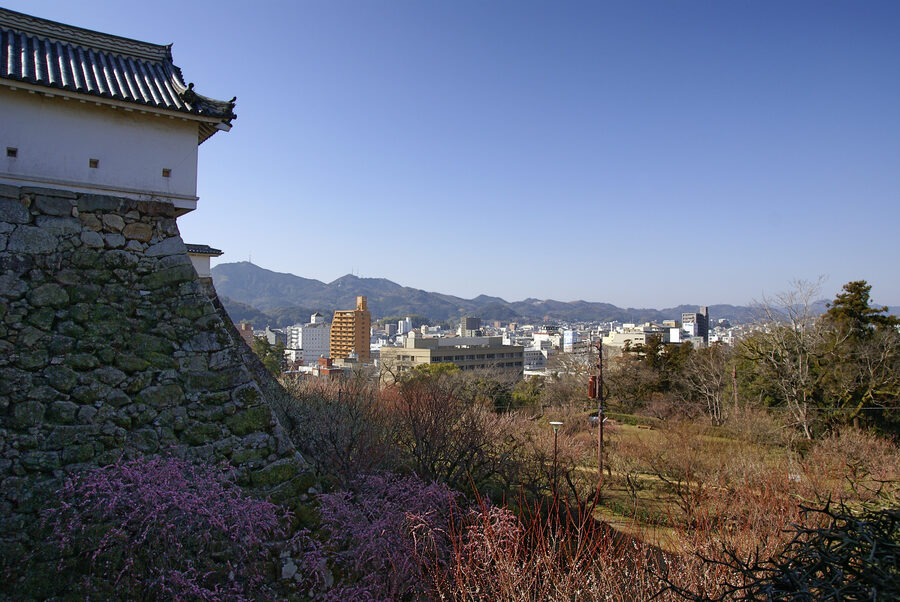
What separates Kōchi visually is the top-floor balcony, called the kōran or sometimes the tō-gō. It runs all the way around the fourth story as an open wraparound walkway, protected only by a waist-high wooden railing. You can step out onto it when you visit, and the view covers most of central Kōchi from the Pacific to the inland mountains.
That feature is archaic by 1749 standards. When Kazutoyo built the original around 1601, open top-floor balconies were still fashionable on large keeps. By the mid-Edo period most architects had abandoned them because they were indefensible in a siege and expensive to weatherproof.
You see open top-floor railings at Inuyama and at Kōchi, and almost nowhere else on the original-twelve list. The Kōchi balcony is the larger and more prominent of the two.
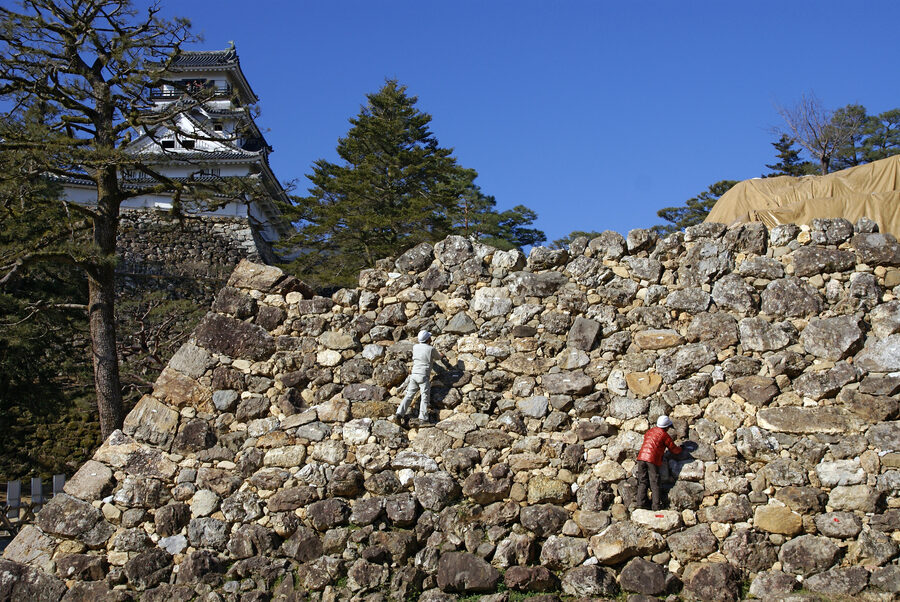
The gables are the second signature feature. Kōchi uses a mix of chidori-hafu, the small triangular “plover” gables that give Matsue its nickname, and irimoya-hafu, the larger hip-and-gable pediments that mark the major vertical bay. The arrangement is asymmetrical by design, which is a hallmark of early-Edo keep aesthetics.
If you walk around the base of the tenshu you can count three chidori-hafu on the north face and two on the south, with an irimoya-hafu capping the third story on every cardinal face. The roof timbers are cedar. The gable end-caps are tile.
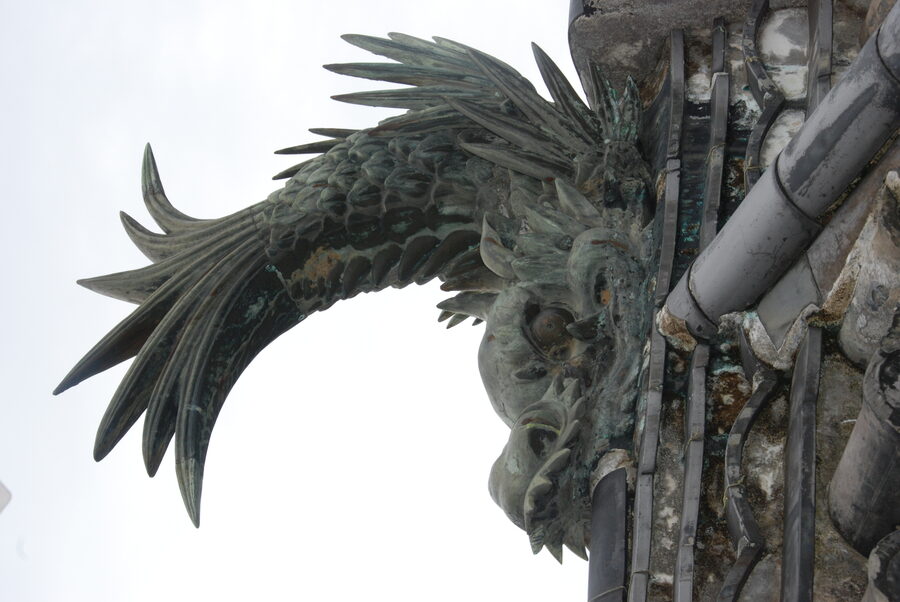
Inside the honmaru palace
The honmaru palace, known formally as the Kaitokukan, was rebuilt alongside the tenshu in the 1747 to 1749 push. It sits at the same elevation as the keep, connected to it by a short covered passage. The plan is classic late-Edo shoin: fifteen rooms of varying size, mostly between 6 and 12 tatami, arranged along a central corridor with a genkan entrance at one end and lord’s private quarters at the other.
The main ceremonial room is the Jōdan no Ma, the upper-tier room, which has a raised tatami floor roughly 10 centimetres above the adjoining room. That step was where the daimyō sat during formal audiences. Retainers sat on the lower level; the lord occupied the higher.
The transoms between rooms are carved with dragons, cranes, and pine trees. The carving is attributed to a Tosa artisan named Takechi Jinshichi. His name is on a dedication plaque still visible in the hiroma, the main hall, and the work is unusually high quality for a provincial 18th-century building.
The fusuma paper paintings are mostly modern replacements, done in the 1960s during the major post-war restoration. The surviving panels from the Edo period are displayed under glass in the tenshu itself. You can identify them by the muted colour palette, which is what 260 years of sun exposure does to mineral pigments.
One detail I want you to look for in the palace is the storage cupboard beside the Jōdan no Ma. It is a tansu-style built-in with sliding wooden doors, and it was designed to conceal a pair of naginata and a set of short swords. The daimyō could reach in from his seated position and grab a weapon without breaking the formal ceremony of the audience.
That kind of hidden-weapon fitting was standard in daimyō-level shoin architecture across Japan. It is rare in surviving examples because the palaces themselves have nearly all been demolished. The Kōchi cupboard is one of the few places you can see the fitting in its original position with the original timber grain still intact.
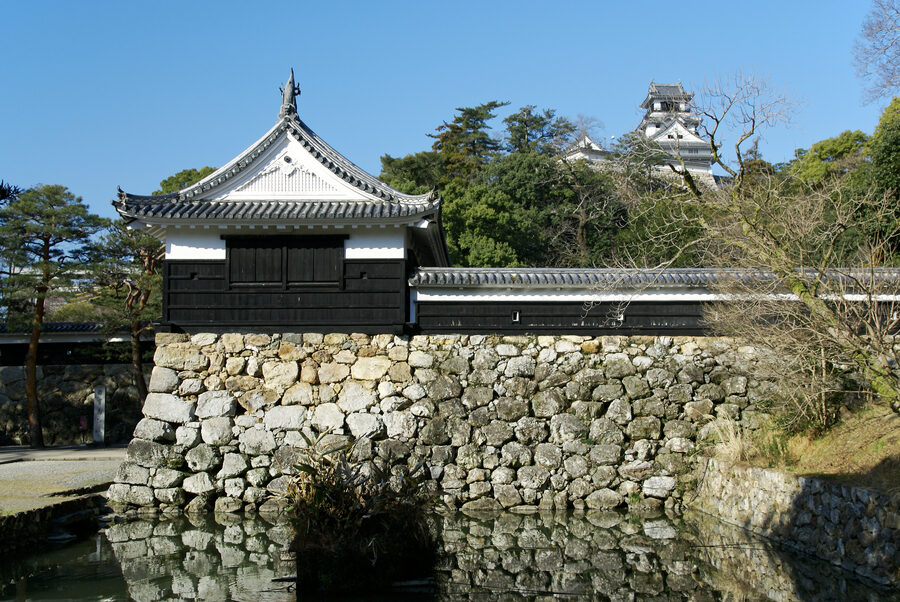
The Ōte-mon, the only surviving original main gate
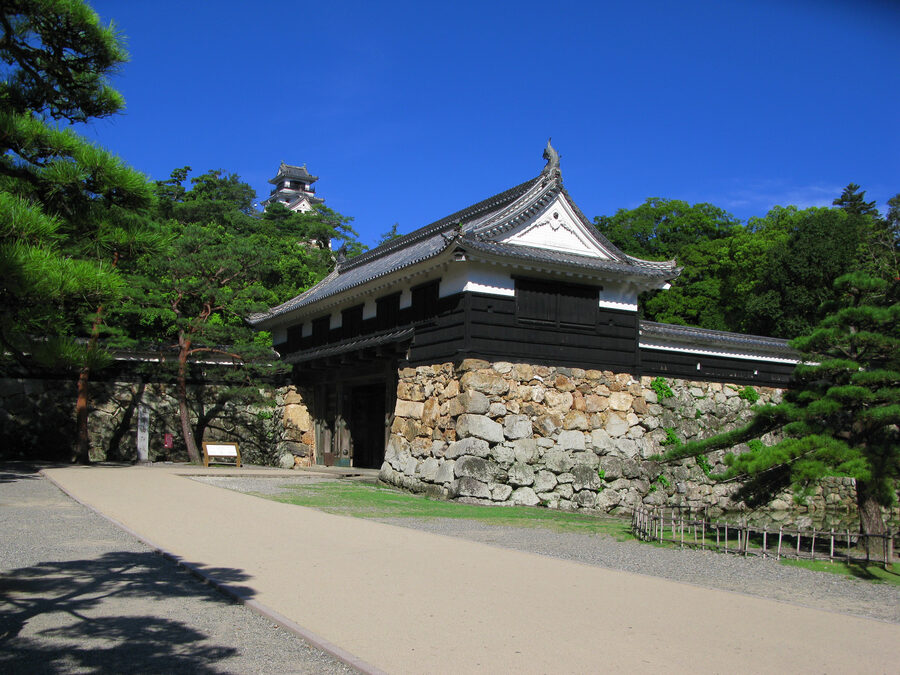
The Ōte-mon, the main gate at the base of Ōtakasaka, deserves its own paragraph. Most of the twelve original-tenshu castles have lost their main gates. Himeji’s current Ōte-mon is a 1938 reconstruction and Inuyama’s original gate was demolished in the Meiji period.
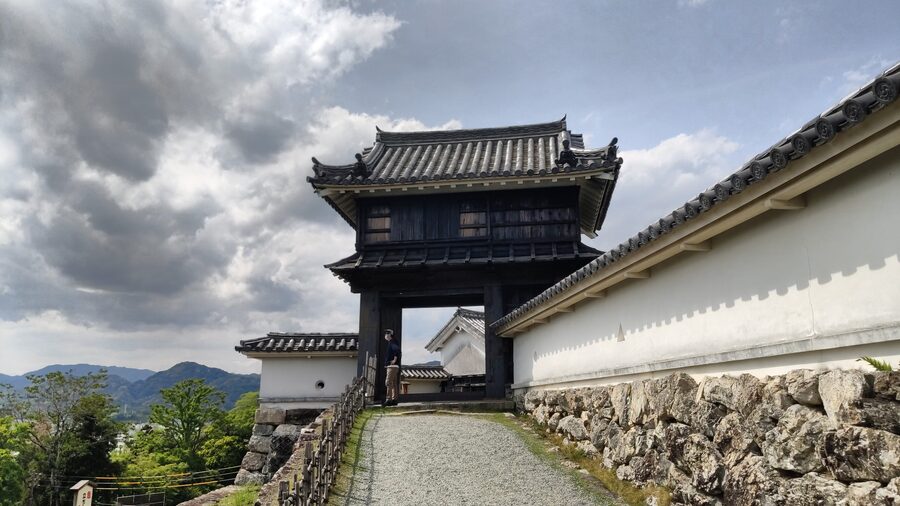
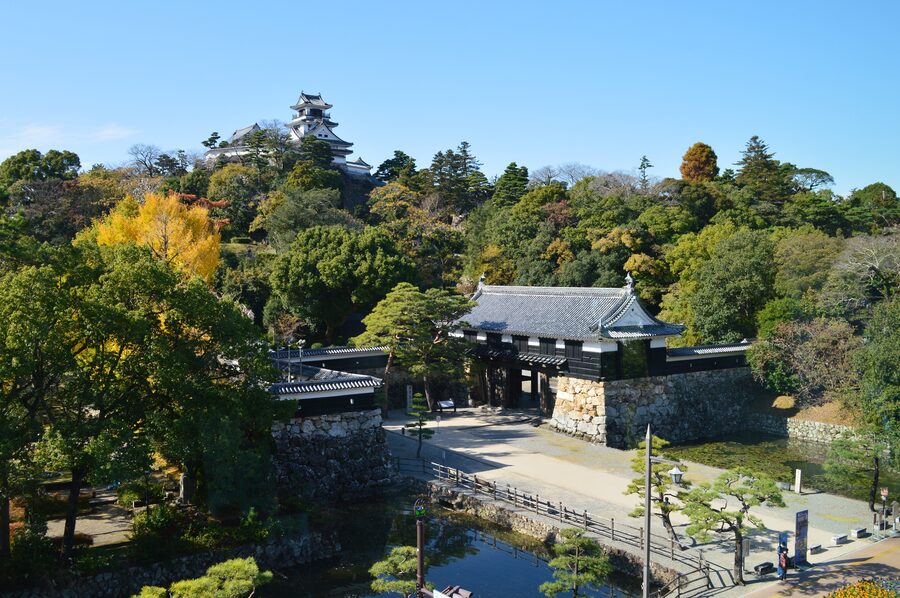
Kōchi’s Ōte-mon was built in 1663 and has stood continuously since. It is a classic yaguramon two-storey gatehouse with stone side walls and a timber upper chamber that once housed the duty watch. The wood you see in the lintel beams is the original Edo-period material.
This is the gate you walk through for free on your approach to the ticket booth. The paid-entry zone begins higher up the hill at the Kuroganemon. You can, in other words, spend half a day at Kōchi Castle without paying anything, if you are willing to stop at the outer-bailey level.
Yamauchi Yōdō and the end of the shogunate
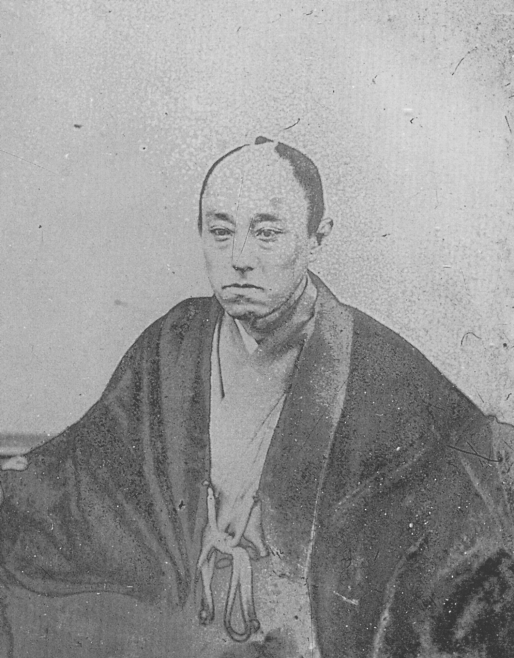
The fifteenth Yamauchi was Toyoshige, who used the art name Yōdō after his retirement. He was born in 1827 to a branch family and was adopted into the main Tosa line in 1848 when the previous lord died childless. He was 21 when he took over the domain and 32 when he formally retired from daimyō status in 1859, though he continued to dominate Tosa politics from behind the scenes.
Yōdō is one of the strange figures of the bakumatsu period. He was a Tokugawa loyalist by temperament and by family tradition, but he also ran one of the most radical political scenes in Japan. Tosa produced disproportionately many of the anti-shogunate activists of the 1860s, including Takechi Hanpeita and Sakamoto Ryōma.
In 1862 the radical faction inside Tosa had the domain’s chief administrator, Yoshida Tōyō, assassinated on a rainy Kōchi street. Yoshida was Yōdō’s mentor and chosen policy hand. The killing triggered a Tosa crackdown that eventually ended with Takechi Hanpeita’s forced suicide in 1865.
Yōdō’s most famous act came two years later. In October 1867 he sent a memorial to Tokugawa Yoshinobu, the fifteenth and final Tokugawa shōgun, urging him to voluntarily return political authority to the emperor. The argument was pragmatic.
Yōdō told Yoshinobu that a Satsuma-Chōshū military push was inevitable, that a civil war would destroy everyone, and that an orderly resignation would let the Tokugawa family keep its lands and dignity. Yoshinobu took the advice. On 9 November 1867 he issued the Taisei Hōkan, the return of power to the throne, and the 265-year Tokugawa shogunate ended without a single major pitched battle west of Edo.
The fact that Yōdō wrote this advice from Kōchi Castle, looking out from the same top-floor balcony you can stand on today, is one of the reasons I find this building unusually weighty. The Meiji Restoration was conceived and planned in Kyoto and Edo, but a significant slice of its diplomacy ran through this hilltop.
Yōdō’s drinking deserves a footnote. He styled himself Gei-kai Sūjun, the “drunken old man of the whale sea”, which was a pun on the Tosa coast’s whaling reputation and his own reputation for heavy sake intake. He genuinely drank, often and heavily, but he also used the cultivated image strategically to disarm rival daimyō and to give himself plausible deniability when radical retainers pushed positions he secretly sympathised with.
The other side of Yōdō was serious scholarship. He patronised the kokugaku school of Japanese literary study, corresponded with bakufu intellectuals, and commissioned a major domain encyclopaedia project. His personal library at Kōchi ran to several thousand volumes, many of which are now in the Tokyo National Diet Library archive.
The Meiji survival story
The Meiji Restoration ended the domain system in 1871. The Yamauchi family was retired from political authority, awarded the new kazoku nobility rank of marquis, and relocated most of its active household to Tokyo. Yōdō himself died the following year at age 45, officially of cirrhosis from decades of heavy drinking, which he had embraced as a deliberate public pose.
The new Meiji army inherited the castle. In 1873 the government issued the haijōrei, the castle abolition order, which classified every surviving castle in Japan into two groups: those to be kept for military use, and those to be demolished and sold for scrap. Kōchi was slated for military retention at first, which is the only reason the initial demolition wave did not touch it.
By the 1880s the army had decided Kōchi was not militarily useful. The castle was released to Kōchi Prefecture as civic property. Most of the outer buildings were progressively demolished for land reuse in the 1890s and 1900s.
The honmaru, however, was kept. Local advocacy from Kōchi residents, combined with the practical fact that the hilltop was hard to repurpose for anything else, meant the honmaru palace and the tenshu survived into the 20th century. In 1934 both structures, plus the Ōte-mon, the Kuroganemon, and several turrets, were designated as Important Cultural Properties under the 1929 national preservation law.
The designation came just in time for the war. On 4 July 1945 an American B-29 raid struck Kōchi city and levelled roughly two-thirds of the central urban area. The raid targeted the rail yards and harbour south of the castle; the hilltop caught incendiaries but the fires were contained before the palace or keep burned.
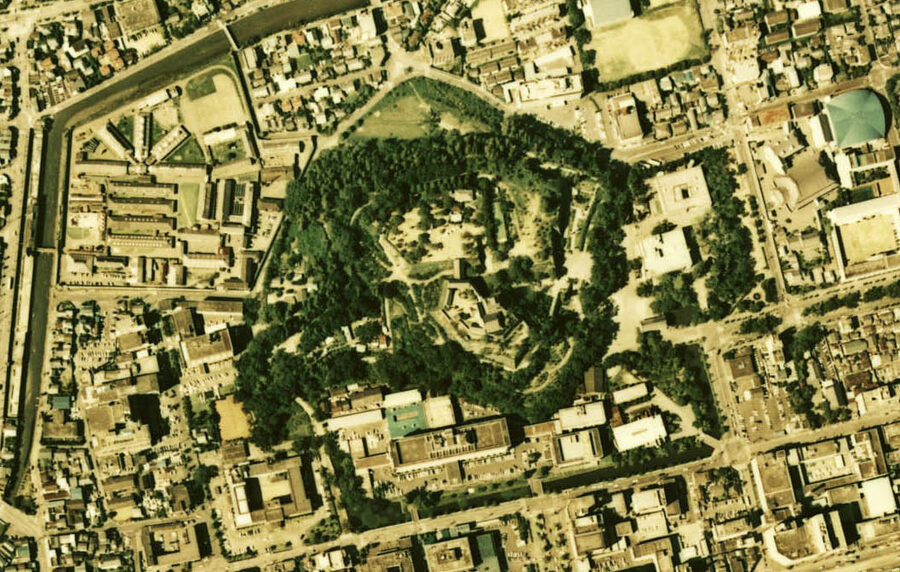
A major restoration was commissioned between 1948 and 1959 that addressed war damage, decades of minor weathering, and some structural weakness in the palace floor joists. The work was careful and mostly reversible, in line with the 1950 national cultural property law.
Further preservation work on the Ōte-mon and Kuroganemon followed in the 1960s and 1970s. In 2014 the National Historic Site designation that had covered the honmaru since 1959 was expanded to cover the full surrounding park, which is the reason the sannomaru ishigaki walls are now also legally protected.
Sakamoto Ryōma, Tosa, and the revolutionary hometown
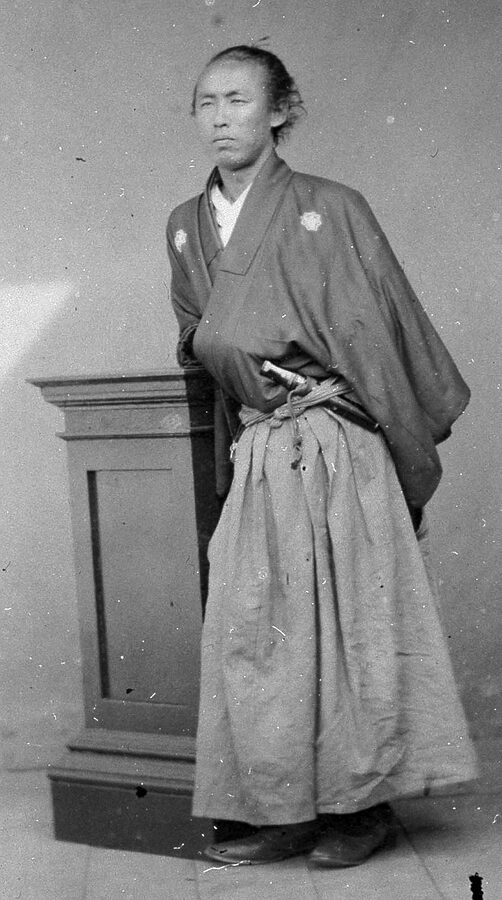
Sakamoto Ryōma was born in Kōchi on 3 January 1836, in a gōshi or country-samurai household roughly a kilometre east of the castle. His family had bought their samurai status using wealth accumulated from a sake brewery and a pawnshop, which placed them at the very bottom of the Tosa warrior hierarchy.
He received the standard lower-samurai upbringing, spent time at a local swordsmanship school, and then travelled to Edo in 1853 for advanced fencing training at the Hokushin Ittō-ryū dojo. That same year the Perry squadron arrived in Edo Bay, and Ryōma’s political radicalisation began.
He deserted Tosa in 1862, which was a capital offence under domain law. He spent the next five years as a stateless ronin operating through Kyoto, Osaka, Nagasaki, and Kagoshima. In 1866 he brokered the Satsuma-Chōshū Alliance between the two domains that would overthrow the shogunate two years later.
Ryōma was assassinated in Kyoto on 10 December 1867, a month after Yōdō’s Taisei Hōkan advice triggered the shōgun’s resignation. He was 31. The assassins were almost certainly shogunal enforcers from the Mimawarigumi, but the case has never been formally closed.
Today, Ryōma is the ghost that haunts Kōchi. His birthplace is a small memorial hall with a plaque and a replica well. His statue stands at Katsurahama beach, 8 kilometres south, looking out over the Pacific in the direction of the foreign-trade ports. His death mask is in the Kyoto National Museum, but his swords are in the Kōchi prefectural museum a short walk from the castle.
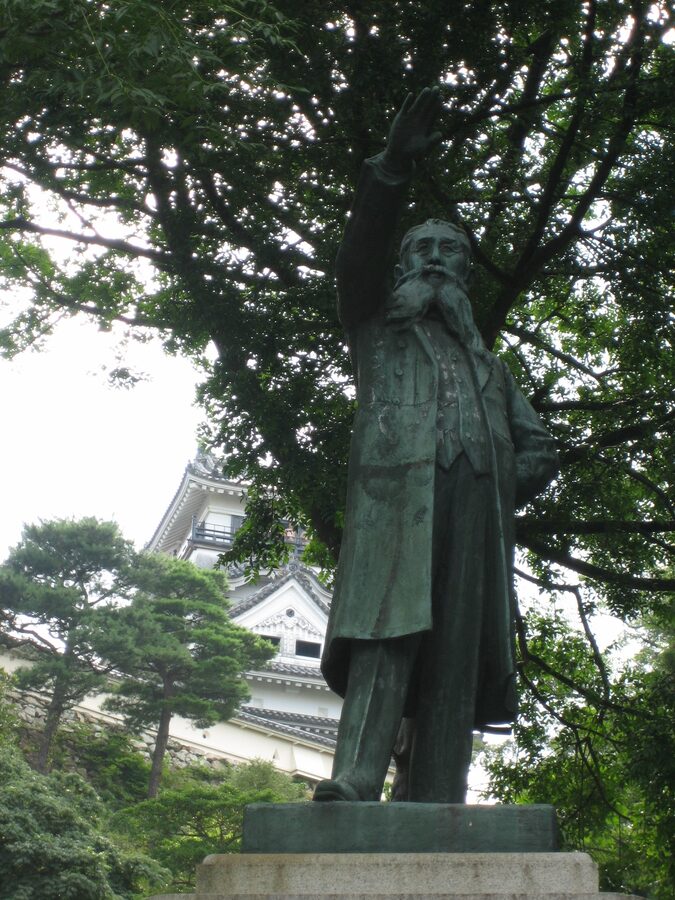
The deeper pattern is that Tosa as a whole produced an unusual concentration of radical Meiji-era political activists. Sakamoto, Nakaoka Shintarō, Itagaki Taisuke, Gotō Shōjirō, Iwasaki Yatarō, who founded Mitsubishi. All were Tosa men, and most were born within a few kilometres of Kōchi Castle.
The reasons are debated. Some scholars credit the gōshi system, which created a large class of educated but frustrated lower samurai. Others credit the peripheral geography, which left Tosa loosely supervised by the shogunate.
Still others credit Yōdō’s own tolerance for intellectual dissent, even when that dissent eventually cost him his mentor. My own guess is that all three factors compounded. Tosa was big enough, rich enough, and peripheral enough to host a real intellectual counter-culture, and the Yamauchi court had the kind of semi-tolerant politics that let that culture breathe rather than crushing it outright.
Katsu Kaishū, Ryōma, and the Tosa intellectual export
Ryōma’s political transformation came through his relationship with Katsu Kaishū, the Tokugawa navy commander who was trying to modernise the shogunal fleet in the early 1860s. Ryōma initially approached Kaishū in 1862 intending to assassinate him on behalf of the anti-foreigner faction. That meeting did not go as planned.
Kaishū apparently talked for an hour about steam propulsion, navigational charts, and the inevitability of Japan joining the world maritime order. Ryōma became his student instead of his killer. Within a year Ryōma was helping run Kaishū’s small naval training academy in Kobe, which is where he met most of the shogunate-reformist samurai he would later organise into the Satchō Alliance.
The pattern is specifically Tosa. Iwasaki Yatarō, the founder of Mitsubishi, used a similar trick on an international scale. He took Kaientai, the Tosa-affiliated shipping company Ryōma had founded, and converted it into a commercial shipping line after Ryōma’s death. That line became Mitsubishi Shipping, which became Mitsubishi as a whole, which is now one of the largest corporate conglomerates in Asia.
So when you stand at Kōchi Castle looking out over the city, you are looking at the visible seam between feudal Japan and industrial Japan. The Yamauchi lord on the hilltop represented one side; the lower-samurai-turned-revolutionary in the streets below represented the other. Both were speaking the same Tosa dialect.
Visiting Kōchi Castle today
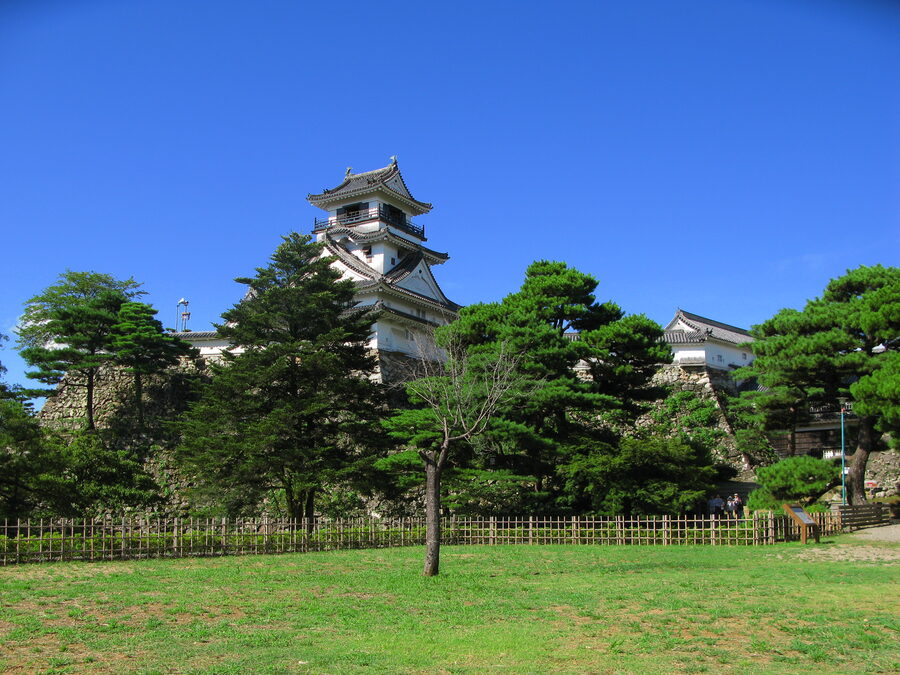
You get to Kōchi city from Tokyo by flying into Kōchi Ryōma Airport, which is named for you-know-who, or from Okayama on the Nanpū limited-express train, which is about two and a half hours through the Shikoku mountains. The airport is 30 minutes by bus from the city centre. The castle is another 15 minutes on foot from the main train station.
Admission to the keep and palace interior is 420 yen for adults as of 2024, with children under 18 entering free. Opening hours are 09:00 to 17:00, last entry 16:30, with a slightly extended summer schedule. The castle grounds outside the paid zone, including the Ōte-mon gate and the sannomaru ishigaki, are open 24 hours and free.
Plan about two hours for a normal visit. The entry queue is short even in weekend peak season because the building footprint absorbs visitors well. The ishigaki climb from the Ōte-mon to the palace takes about 15 minutes at a casual pace, with several shaded landings along the way.
The tenshu interior has steep original-Edo staircases that require both hands on the rails. Socks or soft-soled shoes are mandatory; the entry desk provides free shoe bags. The fourth-floor balcony has a waist-high railing that is about 200 years old, so do not lean on it aggressively.
The rest of the Kōchi day
You would be underusing the trip if you only did the castle. Central Kōchi is set up for a walking day that moves between four or five adjacent sites, all within a kilometre or so of each other. I will give you the order I used, which is castle first, market second, bridge third, Ryōma sites fourth, and Katsurahama for the Pacific sunset.
Hirome Ichiba is an indoor covered market five minutes’ walk east of the Ōte-mon. It opens at 10:00 and closes around 23:00, and it functions as Kōchi’s unofficial food court. There are about 60 stalls selling local Tosa specialities, including katsuo no tataki, seared bonito tuna sliced like sashimi, which is the thing everyone orders.
You buy your food at whichever stall catches your eye, sit at one of the long shared tables with a bottle of Tosa-tsuru sake, and eat. The turnover is fast and the dishes are genuinely good. Expect to spend about 2,000 yen for a serious lunch.
Harimaya-bashi is a famous little red bridge about ten minutes’ walk south of the market. It appears in a 19th-century folk song about a Tosa Buddhist priest who was caught buying a hairpin for a woman, which broke his vows and triggered a minor local scandal. The bridge you see today is a 1998 reconstruction because the original was demolished for road widening, but the song keeps the location on every tourist map.
Sakamoto Ryōma’s birthplace, marked with a small plaque and a public garden, is about a kilometre east of the castle. It takes ten minutes on foot or three by tram on the Gomen-line route. The site does not have a building; there is only the plaque and the symbolic well.
The Kōchi Prefectural Sakamoto Ryōma Memorial Museum is on Katsurahama headland, about 8 kilometres south by bus. This is the proper Ryōma museum with his letters, clothing, and one of his personal swords on display. You should plan about an hour for it plus the bus ride each way.
Katsurahama beach itself, below the museum, has a 5-metre bronze statue of Ryōma looking out over the Pacific. The statue was erected in 1928 using donations from local schoolteachers, and it is the most photographed object in Kōchi Prefecture after the castle. Sunset from the headland is the standard closer for a Kōchi day.
Where Kōchi ranks among the twelve
This is the personal-opinion section. Having now been to nine of the twelve originals, including Himeji, Matsumoto, Hikone, Inuyama, Matsue, Maruoka, Hirosaki, Bitchū-Matsuyama, and Kōchi, I can rank them by how much of the original experience actually survives at each site.
Himeji is the biggest and the most visually striking, but you are queuing for a building with almost no original inner-bailey context. Matsumoto’s silhouette is the most dramatic in Japan but the interior is sparse. Hikone has the prettiest setting on Lake Biwa. Matsue’s black planks are unique among the list.
Kōchi is the one where you walk away with the fullest understanding of what a daimyō actually lived in. The tenshu is smaller than Himeji and less photogenic than Matsumoto, but the combination of original keep, original palace, original main gate, and original iron gate is the closest thing Japan has to a complete surviving early-Edo castle complex.
If you are building a twelve-castle itinerary for yourself, put Kōchi toward the end of the trip rather than the beginning. The palace tour recontextualises everything you have already seen at the tenshu-only sites. It will not feel the same after Kōchi.
The Yamauchi were a middling family of Sengoku-period survivors. Kazutoyo and Chiyo bought their way up with one well-timed horse and one well-timed Sekigahara alignment. Their descendants ruled Tosa for 270 years, survived one catastrophic 18th-century fire, and at the final crisis in 1867 chose peaceful dissolution over civil war. The building on top of Ōtakasaka is where that entire arc was lived, and it is the only castle in Japan where you can walk through all of it in one morning.