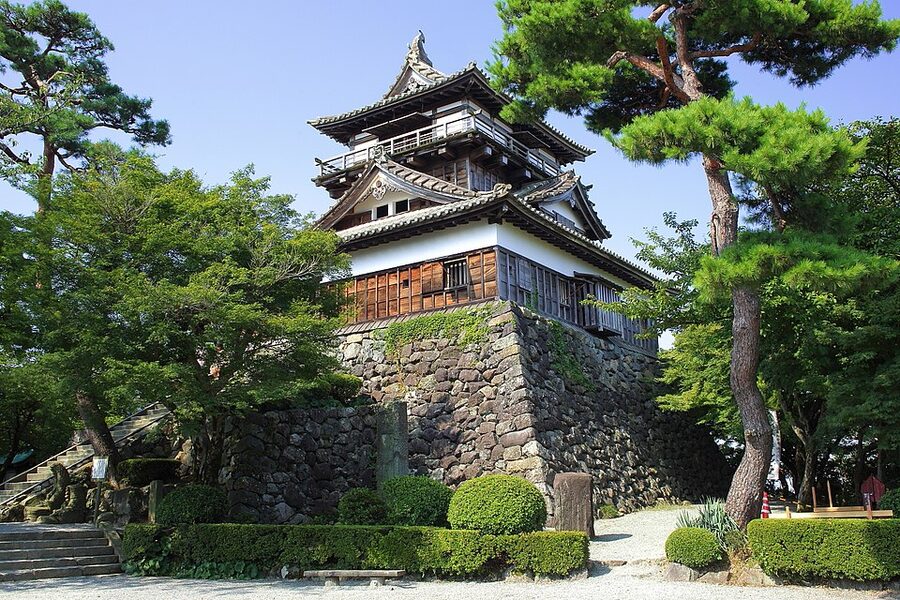
At thirteen minutes past four on the afternoon of 28 June 1948, a Monday, the Fukui plain buckled. The epicentre was directly under the town of Maruoka. Within thirty seconds the tenshu of Maruoka Castle — which had been standing on its chert-block ishi-gaki foundation since the early seventeenth century, and which had been listed as a National Treasure for fourteen years under the 1929 preservation law — came straight down.
The stone base went first; the timber keep above it followed. Three thousand seven hundred and sixty-nine people in Fukui Prefecture died that afternoon, and in the three towns closest to the epicentre — Kanazu, Maruoka, and Harue — more than ninety-five per cent of the houses were flat. The keep that had been there for three hundred and twenty years was a heap of recoverable timber on the slope below the honmaru.
Seven years later, in 1955, the town of Maruoka finished putting the tenshu back up. The carpenters had sorted the rubble floor-by-floor, catalogued every structural member they could salvage, and reassembled the keep on a reinforced-concrete core with seventy per cent of the original pillars and about sixty per cent of the original beams re-set in their original positions.
The sacrifice was the National Treasure designation. The 1950 Cultural Properties Law, passed two years after the quake, re-classed the reassembled keep as an Important Cultural Property one tier down, because the building that was going up in 1955 was not, strictly, the building that had stood in 1934. What you climb at Maruoka today is the only one of Japan’s twelve surviving original-construction tenshu that has been completely disassembled and rebuilt from its own parts. It is a ship-of-Theseus castle, and the wood in it is mostly early-Edo.
In This Article
- What Maruoka Castle actually is
- 1576 — Shibata Katsutoyo builds the first Maruoka castle
- 1582-1583 — the falling-out with Katsuie, and Shizugatake
- 1600-1612 — Sekigahara, the Yūki Hideyasu transfer, and the Imamura interregnum
- The Kan’ei rebuild — the 1628 tenshu that is still standing
- 1695 — the Honda disgrace and the Arima takeover
- 1871-1934 — Meiji demolition, municipal purchase, and the pre-war National Treasure listing
- 28 June 1948 — the Fukui earthquake
- 1948-1955 — the seven-year rebuild
- The reconstruction debate — is it “original” or is it “rebuilt”?
- Where Maruoka sits in the twelve
- Where to visit Maruoka today
- Maruoka Castle (Kasumi-ga-jō Park) — the main precinct
- Maruoka Castle Historical Reference Museum
- Ichijōdani Asakura-clan ruins
- Eihei-ji — Sōtō Zen head temple
- Getting there — Fukui Station, Awara-yunomachi, or Maruoka Station
- Closing — the ship of Theseus on a chert base
What Maruoka Castle actually is
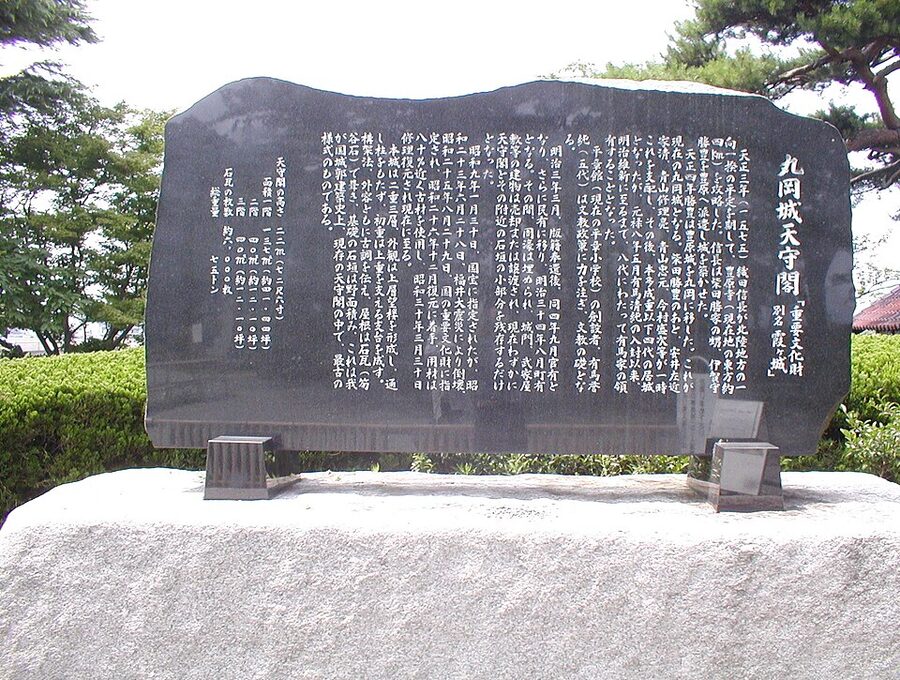
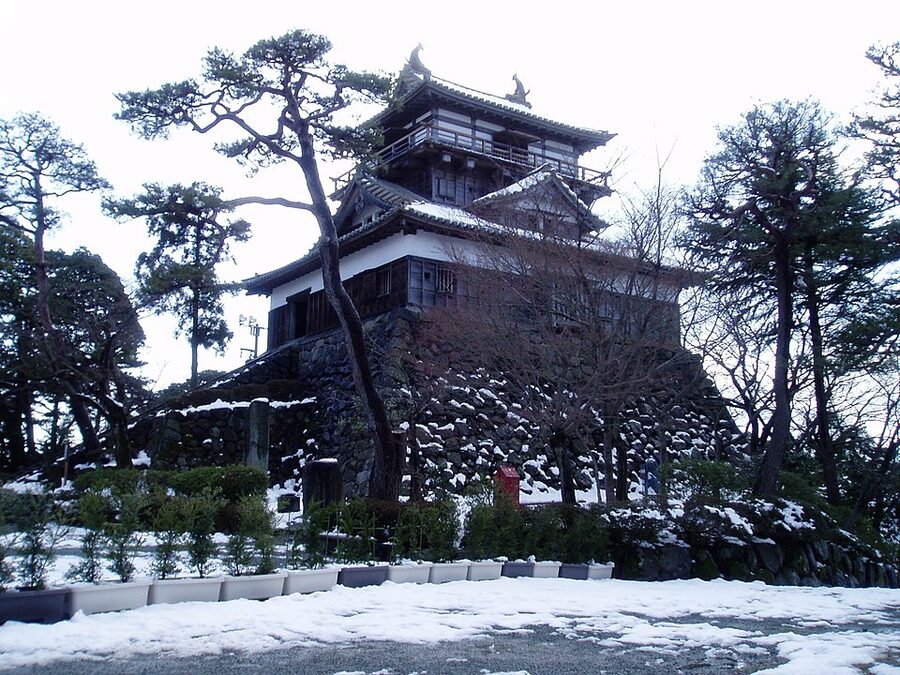
Maruoka Castle (丸岡城, Maruoka-jō) is a hirayama-jō, a low-hill castle rather than a mountaintop one, on a small independent rise at the eastern edge of the Fukui plain, about eleven kilometres north-east of Fukui city centre. Its alternative name is Kasumi-ga-jō (霞ヶ城, “Mist Castle”), from a legend that when an enemy approaches the keep a great serpent breathes fog and hides it. You will see the Kasumi branding everywhere in the town. The park the castle sits in is called Kasumi-ga-jō Park and the sakura festival is the Kasumi-ga-jō Festival.
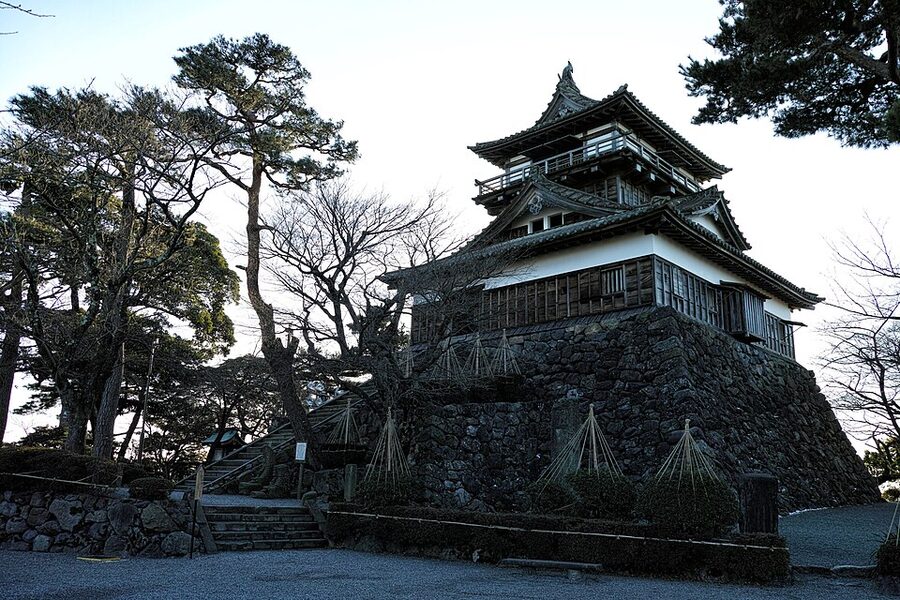
The keep itself is 12.5 metres along the base by 11 metres in the other direction, and rises to about 17 metres total from the stone base to the ridge. The official classification is dokuritsu-shiki bōrō-gata ni-jū san-kai, “independent-style watchtower two-roof three-storey”, meaning a two-roof exterior profile wrapping three interior floors, set as a single standalone keep without attached annex turrets. It is the smallest of Japan’s twelve surviving original-construction tenshu by footprint.
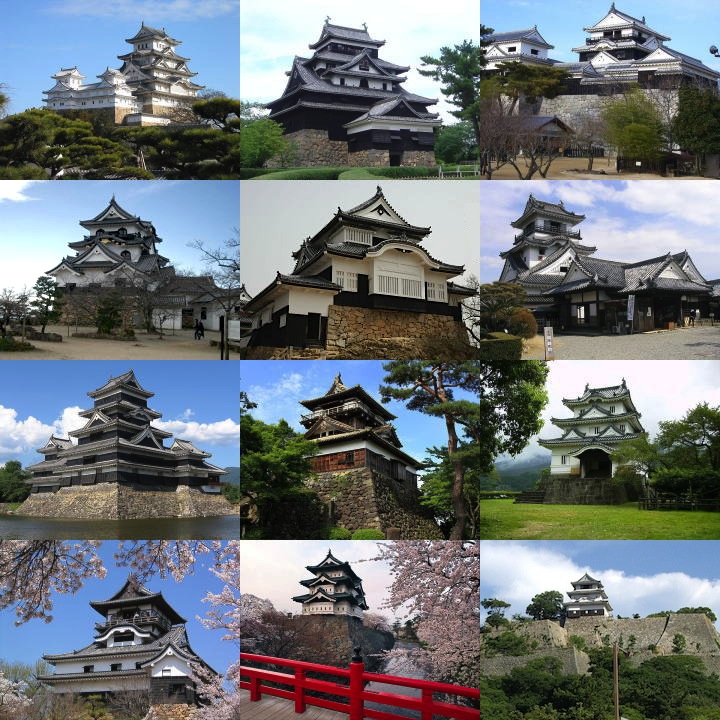
For context, Inuyama is 19 metres tall with a four-storey interior, Matsumoto’s daitenshu is 29 metres with five, and Himeji is 46 metres with six. Maruoka is compact. The design intent was a watchtower, not a residence.
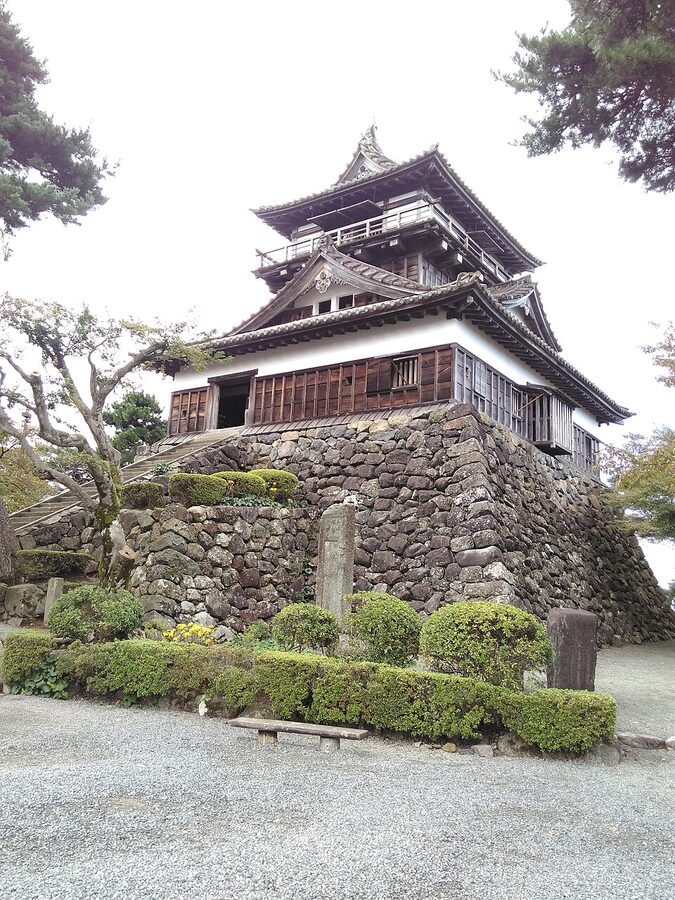
The keep was described for most of the twentieth century as the oldest surviving original-construction tenshu in Japan. The dating claim was a traditional one, tied to a 1576 foundation by Shibata Katsuie’s nephew Shibata Katsutoyo, and the architectural features — the archaic bōrō-gata watchtower form, the hole-dug post construction, the rough nozura-zumi stone base — all pointed at a Momoyama-period or earlier date. It was a partisan dispute between Maruoka and Inuyama for most of the postwar period, and the Maruoka signage confidently said “oldest” until roughly 2019.
The Maruoka City Board of Education appointed a research committee in 2015 and the committee reported on 26 March 2019. Its conclusion was that the current tenshu was not built in 1576. It was built in the Kan’ei era — specifically, around 1628 — under the Honda family, on the site of an earlier Shibata-era keep that had either been demolished or substantially replaced.
The dendrochronology did not support the 1576 claim, and the architectural details that had been used to argue for a Momoyama date turned out to be consistent with early-Edo revivalist construction. This is the city’s own finding, and it has been quietly accepted since. The 2019 result unwound the “oldest” claim at Maruoka rather decisively. Inuyama now holds that title, such as it is — and Inuyama’s own claim rests on a 2019 dendrochronology that is not the final word either.
1576 — Shibata Katsutoyo builds the first Maruoka castle
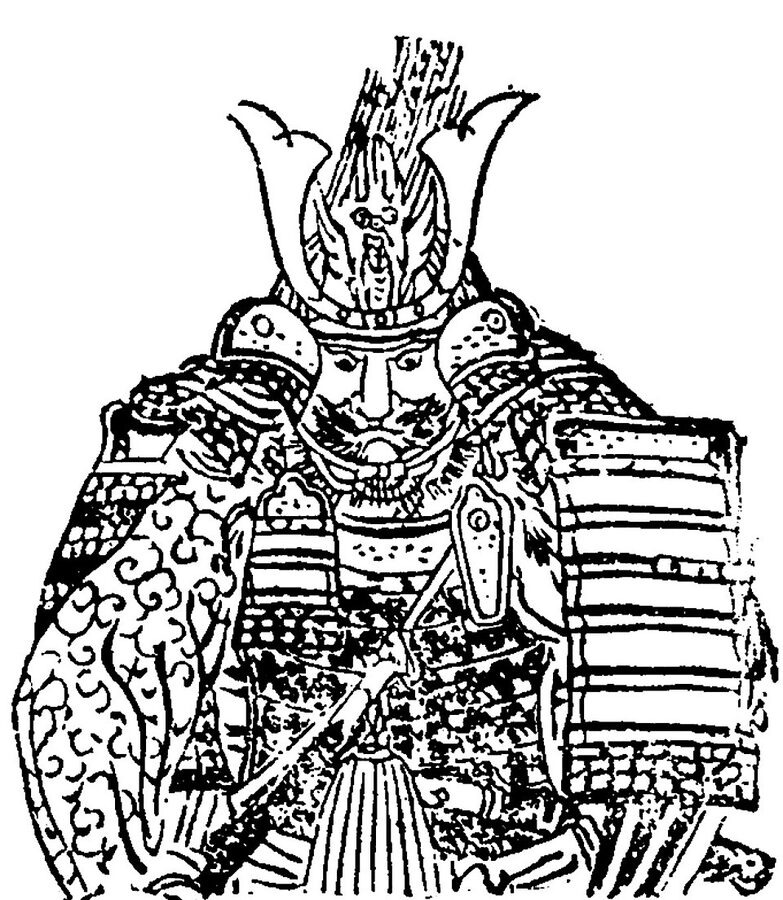
Maruoka’s first fortification on its current hill went up in the third year of the Tenshō era (1575), when Oda Nobunaga finished suppressing the Ikkō-ikki uprisings in Echizen Province and redistributed the pacified land among his senior retainers. Shibata Katsuie took the bulk of Echizen, built his seat at Kita-no-shō (modern Fukui city), and assigned the secondary Sakai-plain district to his nephew and adopted son Shibata Katsutoyo. Katsutoyo was first given Toyohara Castle, a few kilometres east; the following year, in 1576, he relocated to an independent hill on the flat plain and built a new castle there. The new site was Maruoka.
Katsutoyo himself is an under-written figure. His biological father was one of Katsuie’s senior vassals — sources give either Yoshida Jihei or Shibukawa Hachiemon; the Japanese chronicles do not agree — and his mother was Katsuie’s older sister. When Katsuie found himself without a legitimate son in his middle years, he adopted his sister’s boy as heir.
The Buke Jiki records that Katsutoyo held 45,000 koku at Maruoka, which is a substantial middle-rank domain by Sengoku standards. He was junior to his cousin Sakuma Morimasa in Katsuie’s retinue — a slight Katsutoyo resented throughout his career and which contributed to later events that deserve their own section.
The castle Katsutoyo built in 1576 was not the tenshu you climb today. What he put up, on the available evidence, was a smaller Sengoku-style fort — a basic residence-and-yagura complex on the hill, ringed by a wooden palisade and a modest moat. No part of that construction survives.
The archaeological and dendrochronological evidence for the current keep points firmly at the Kan’ei era (1624-1644), under the later Honda regime. The 1576 Shibata foundation is historically real, there was a castle on the Maruoka hill from that year, but the building that is there now is not it.
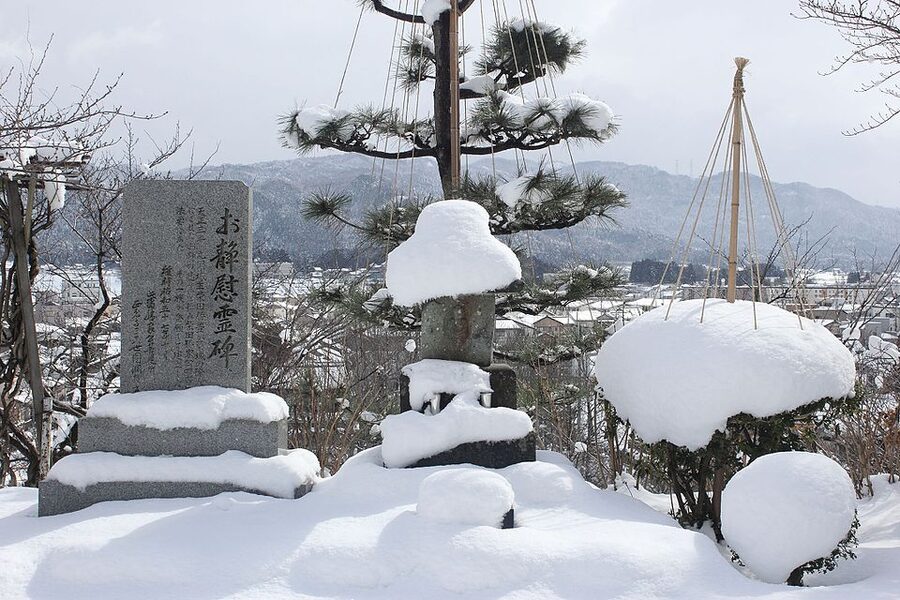
There is also the O-shizu hitobashira legend, which I will include but not vouch for. When Katsutoyo’s builders were assembling the stone base for the tenshu in the 1570s, the story goes, the stones kept collapsing no matter how carefully they were laid. The retainers decided a human pillar was required.
A one-eyed widow in the castle town named O-shizu volunteered, on condition that Katsutoyo take her son into samurai service. The stones were set around her and she was crushed, the construction succeeded, and Katsutoyo never made her son a samurai because he was transferred out of Maruoka before he could. Her vengeful spirit is said to cause heavy rain in early April — the “rain of O-shizu’s tears”, O-shizu no namida-ame — when the moat algae is cut.
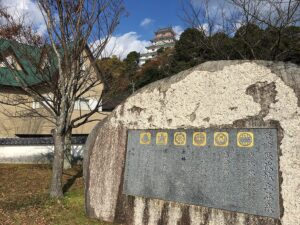
The Shōwa-era restoration survey found no evidence of a human pillar in the foundation. A memorial stone to O-shizu nonetheless stands on the castle grounds.
1582-1583 — the falling-out with Katsuie, and Shizugatake
Katsutoyo’s tenure at Maruoka lasted six years. In June 1582 Oda Nobunaga was killed at Honnō-ji by Akechi Mitsuhide, and the Kiyosu Conference that redistributed the Oda lands in the following month handed Katsutoyo something he had not asked for: Nagahama Castle in northern Ōmi Province, which had been Hashiba Hideyoshi’s former seat and which Katsuie had just pried loose from Hideyoshi in the political settlement. Katsutoyo was moved out of Maruoka and installed at Nagahama as a forward base for any future Shibata operation against Hideyoshi. The replacement castellan at Maruoka was a Shibata retainer named Yasui Ieki.
The move was a mistake from Katsuie’s perspective. By the time Katsutoyo reached Nagahama he had developed what the Tenshō-ki chronicle calls “deep resentment” of Katsuie’s favouritism toward cousin Sakuma Morimasa, and he was already in ill health. There is also the sore point of Katsuie having produced a biological son, Shibata Katsutoshi, in his later years — an event which displaced the adopted Katsutoyo from his position as designated heir and which the Japanese sources suggest rankled badly.
When Hideyoshi besieged Nagahama in December 1582 with a substantial army, Katsutoyo did not put up any serious resistance. He surrendered the castle within weeks, and by spring 1583 he was in Kyoto under Hideyoshi’s medical care.
The Battle of Shizugatake was fought on 21 April 1583. Katsutoyo was not there. He was in Kyoto at the Tōfuku-ji, dying of his long illness — tuberculosis, probably, on the symptoms the sources describe — and he sent two of his senior retainers, Yamaji Masakuni and Ōgane Tōhachi, to command his men in the battle.
They fought on Hideyoshi’s side, against Katsuie. Five days before Shizugatake was fought, Katsutoyo died. His defection to the uncle who had adopted him is taken in the Tenshō-ki as one of the clearest signals the Shibata faction was fragmenting before the battle began.
Katsuie himself was burned alive at his castle at Kita-no-shō three days after Shizugatake, along with his wife Oichi — Nobunaga’s sister, whom he had married the previous year. Their three daughters survived and are another story entirely.
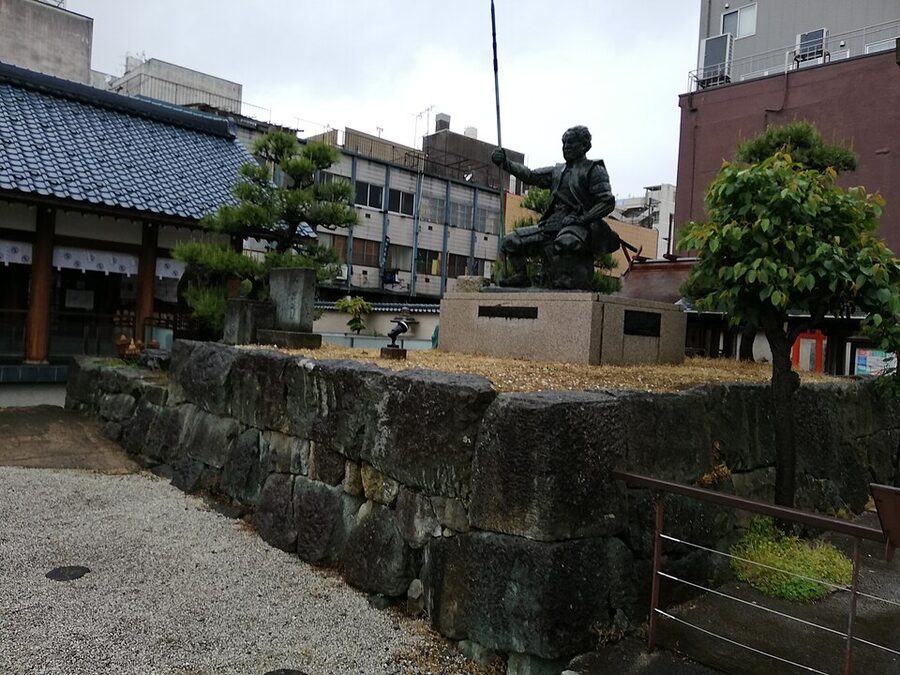
Maruoka passed to Niwa Nagahide after Shizugatake, as part of the redistribution of Echizen from the defeated Shibata to the winning faction. Niwa installed Aoyama Munekatsu as castellan. When Niwa died in 1585 and his son Niwa Nagashige was stripped of his holdings by Hideyoshi, Aoyama was promoted — Hideyoshi kept him on at Maruoka as a direct retainer, raising the domain to 20,000 koku.
The Aoyama family held Maruoka through the 1590s and into 1600. They made their one decisive bet at Sekigahara, and they made it wrong.
1600-1612 — Sekigahara, the Yūki Hideyasu transfer, and the Imamura interregnum
Aoyama Munekatsu backed the Western Army at Sekigahara in October 1600. Ishida Mitsunari’s coalition lost the day, the Aoyama were stripped of Maruoka on Tokugawa Ieyasu’s orders, and Echizen Province was handed en bloc to Ieyasu’s second son Yūki Hideyasu as a direct Tokugawa domain. Hideyasu installed one of his personal retainers, Imamura Morinaga, at Maruoka with 26,000 koku. The Imamura tenure was short and undistinguished — twelve years as a Fukui-han subordinate holding, ending in 1612 when Imamura was caught up in an internal Fukui-han succession dispute known as the Echizen Sōdō.
The Echizen Sōdō was a factional fight between Hideyasu’s son Matsudaira Tadanao and a senior retainer named Kuramichi. It was complicated and not worth unpacking here; what matters for Maruoka is that Imamura lost his patron’s favour, was dismissed from his post at Maruoka, and the shogunate in Edo decided to detach Maruoka from Fukui-han and elevate it to a daimyō-level independent domain under direct Tokugawa oversight. The man they sent to take it over was Honda Narishige, son of Ieyasu’s trusted retainer Honda Shigetsugu, installed with a 43,000 koku stipend. Narishige was the first true Maruoka-han daimyō, and the Honda family ran the castle for the next eight decades.
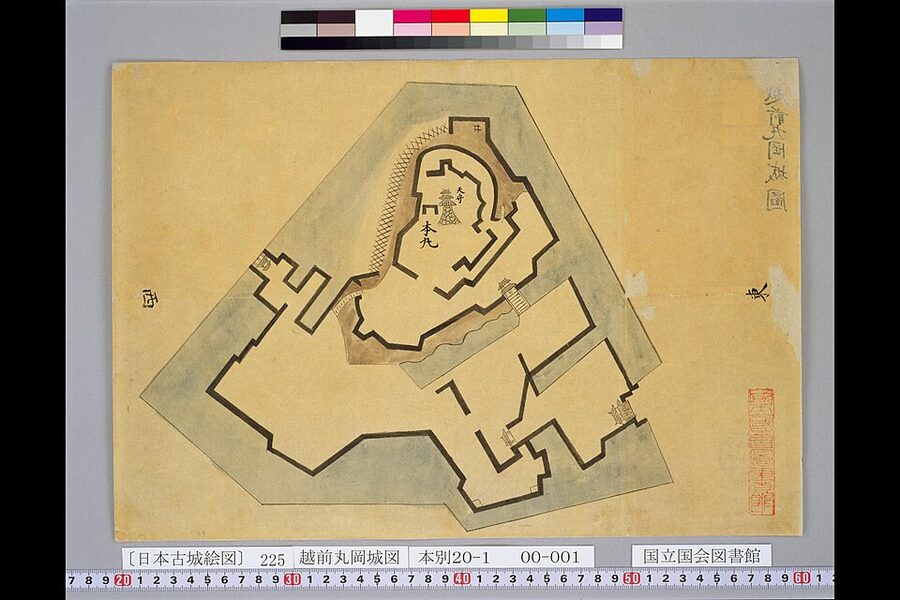
Narishige built distinguished military service at the winter and summer sieges of Ōsaka in 1614 and 1615 — Ieyasu’s final campaigns to extinguish the Toyotomi. For his contribution at the summer siege in 1615 his stipend at Maruoka was raised from 43,000 to 46,300 koku. This is the credit he was banking for the Honda family during what was effectively the last conventional Tokugawa campaign; after Ōsaka, the country entered the long peace and military credit of that kind stopped being available. The Honda held Maruoka on their Ōsaka-summer ticket for the rest of the Edo period.
The Kan’ei rebuild — the 1628 tenshu that is still standing
Sometime between 1624 and 1628 — the first four years of Shogun Iemitsu’s reign, the early part of the Kan’ei era — Narishige’s people demolished whatever was left of Katsutoyo’s 1570s keep and built the tenshu you climb today. The 2019 Maruoka City research committee report identified the construction window on the combined evidence of architectural details (specifically, the use of hottate-bashira dug-post construction survives, but the beam-joinery and roof framing are early-Edo workmanship) and dendrochronology on structural timbers. The tenshu went up while Narishige was still on active military service at Ōsaka, and the kokudaka raise in 1624 almost certainly bankrolled it.
The design Narishige’s carpenters followed was deliberately archaic. The bōrō-gata watchtower form, the small square footprint, the skirt-roof over a wider stone base, the steep internal staircases — all of these were Momoyama-era idioms that had gone out of general use in castle construction by the 1620s, replaced by larger unified sōtō-gata designs like those at Himeji or Matsumoto. Narishige’s keep is a conscious throwback.
The most likely explanation is that the Honda wanted a keep that would not look out of place next to the Shibata-era original — a legibility of succession rather than a cultural innovation. The 1576 Katsutoyo keep probably looked very like the 1628 Honda one.
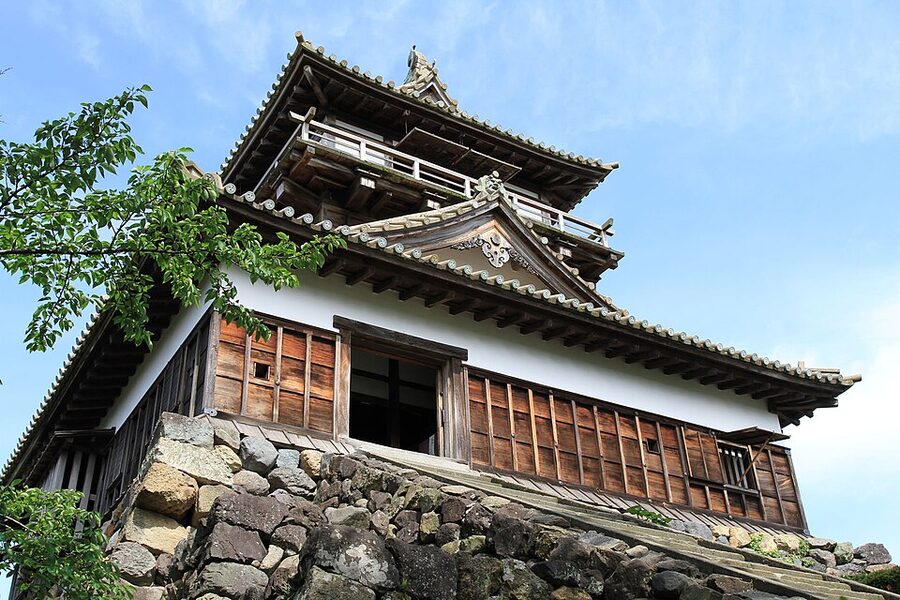
The roof tiles Narishige’s carpenters used were not clay. They were carved from Shakudani stone, a local Echizen igneous rock that is weather-resistant, heavy, and, crucially, does not need replacing on the same schedule as a standard kawara roof. Fukui’s winters are severe by Honshū standards.
The Japan Sea side of the main island gets heavy snowfall, and clay-tile roofs on castles in this climate routinely crack through freeze-thaw cycles. Stone tiles cost more up-front and are a nightmare to lift into place — Shakudani stone is 2.5 times denser than fired clay — but once they are set they stay set.
The 1948 earthquake knocked them off the ridge, of course. They were replaced in the 1955 rebuild with tiles from a quarry at Takigahara in Ishikawa Prefecture.
Narishige died in 1647 and his son Shigeyoshi took over. Shigeyoshi and his son Shigemasu between them completed the outer fortifications, the jōkamachi castle-town grid below, and the full pentagonal moat system. The castle was finished, on the internal Honda-family reckoning, sometime in the early Shōhō era, around the 1645-1648 window. By that point the Kan’ei-era keep had been in place for two decades and was already the architectural anchor of the Maruoka-han settlement.
1695 — the Honda disgrace and the Arima takeover
The Honda line at Maruoka ran four generations. Narishige, Shigeyoshi, Shigemasu, and Shigemasu’s son Shigemasa — spelled with different characters than Shigemasu, which is a point of confusion in the Japanese sources. Shigemasa was an alcoholic.
By the 1690s the administration of Maruoka-han was so mismanaged that a faction of the retainers filed a formal petition with the shogunate complaining of Shigemasa’s incompetence. The resulting crisis, known as the Maruoka Sōdō of 1695, was adjudicated in Edo. The shogunate’s ruling went against Shigemasa: the Honda were stripped of Maruoka, and Shigemasa himself was retired to a minor stipend under house arrest.
The replacement was Arima Kiyosumi, transferred in from Itoigawa-han in Echigo Province with a stipend of 50,000 koku. The Arima were a branch of the Arima Harunobu line — the Christian daimyō Arima Harunobu of Shimabara, executed by the Edo shogunate in 1612 for involvement in a bribery scandal. By the 1690s the branch was safely Buddhist and politically rehabilitated.
The Arima held Maruoka for eight generations, from 1695 to the sankin-kōtai system’s abolition in 1871. They were mid-rank hereditary daimyō doing their Edo rotation through the regional Hokuriku route, not direct to the capital, and they maintained the castle without significantly altering it.
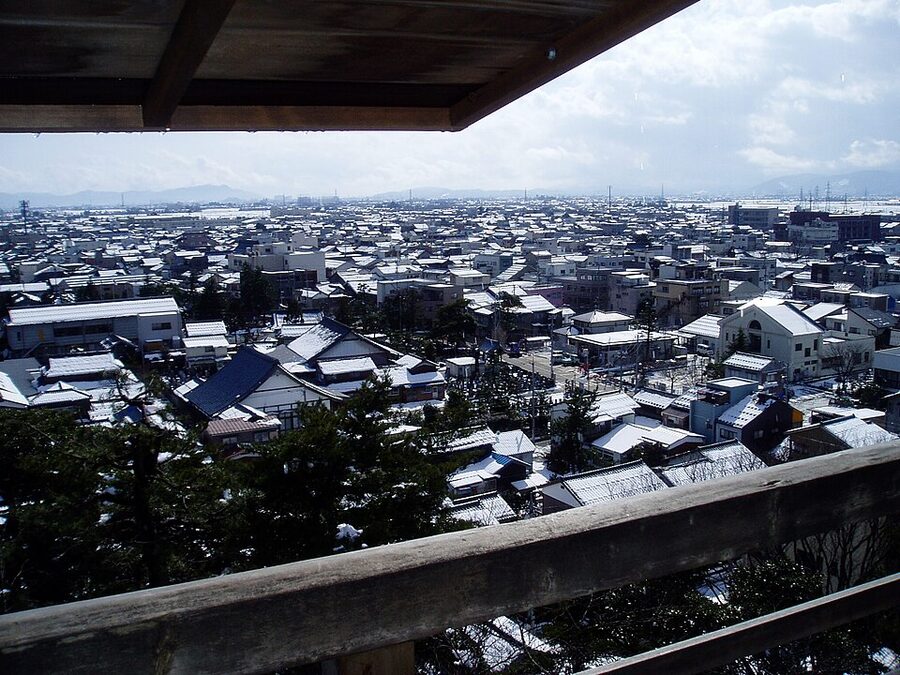
One Arima-era note worth keeping. On 26 February 1858 an earthquake (the Ansei Hida earthquake) hit the region; the tremor took down the yagura and tamon wall-sections of Maruoka Castle, though the tenshu itself survived. This is the one Edo-era structural failure on the castle’s record.
The Arima rebuilt the damaged sections over the following decade and the castle entered the Meiji Restoration substantially intact. It was one of the few castles in Hokuriku to do so — the earthquakes, fires, and administrative demolitions of the 1850s-1870s killed most of them.
1871-1934 — Meiji demolition, municipal purchase, and the pre-war National Treasure listing
The Meiji Restoration hit Maruoka the way it hit almost every Edo-period castle in Japan. The 1871 haihan-chiken edict abolished the feudal domains, Maruoka-han was reconstituted as the short-lived Maruoka Prefecture (which was shortly merged into Ashiba, then Fukui Prefecture), and the physical castle was the next item on the list. The 1873 Castle Abolition Edict condemned almost every fortification in the country to demolition or sale.
At Maruoka, the walls, the outbuildings, the yagura turrets, the gates, and the residential quarters were all dismantled, auctioned off to local buyers, or, in a few cases, relocated as temple buildings. Two of the original castle gates survive in private hands today: one at Kōzen-ji temple in Komatsu, Ishikawa, and one at Renshō-ji temple in Awara, Fukui.
The tenshu itself would have gone too, if the town of Maruoka had not bought it. In 1901 the municipality purchased the keep and the surrounding grounds from the prefectural government — the transaction is documented in the Meiji administrative record, though the price paid has not survived in the Sakai-shi archive — and designated the site a public park. The pentagonal moat was gradually filled in between the late Taishō and early Shōwa eras. What remained by the early 1930s was the keep, the stone base under it, and a handful of open park grounds.
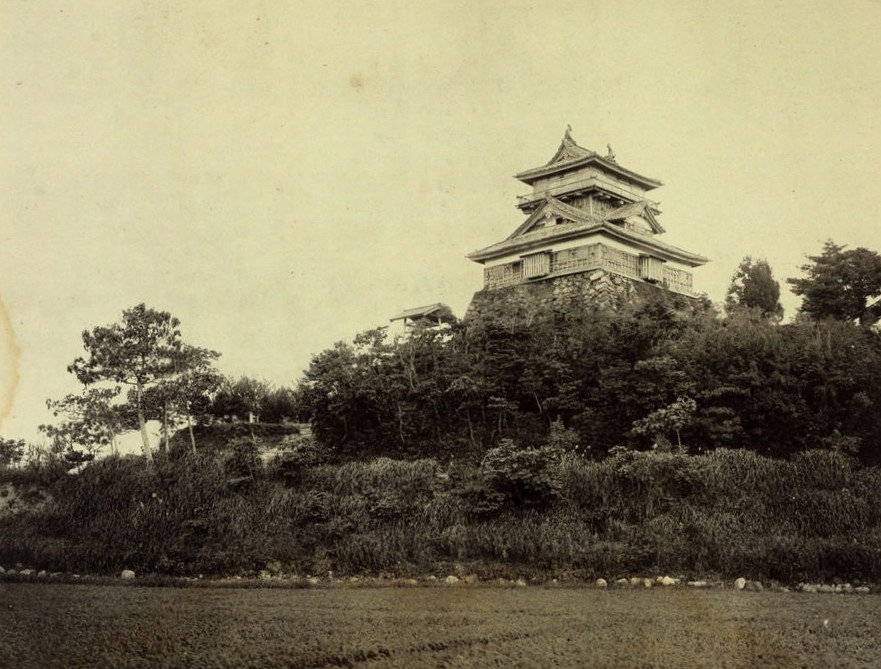
The 30 January 1934 designation as a National Treasure under the old 1929 National Treasures Preservation Law was the formal recognition that Maruoka was one of the surviving pre-modern keeps worth saving. The 1929 law was a pre-war instrument that applied to “buildings and structures of exceptional historical or artistic value”; the post-war 1950 Law for the Protection of Cultural Properties would replace it with a tiered system (National Treasure, Important Cultural Property, Tangible Cultural Property).
In 1934 the tier distinction did not yet exist. Maruoka, Inuyama, Matsumoto, Himeji, and the other surviving original tenshu were all designated at the same top level that year. The status would matter later, after the 1948 earthquake forced a reclassification none of the other keeps needed.
28 June 1948 — the Fukui earthquake
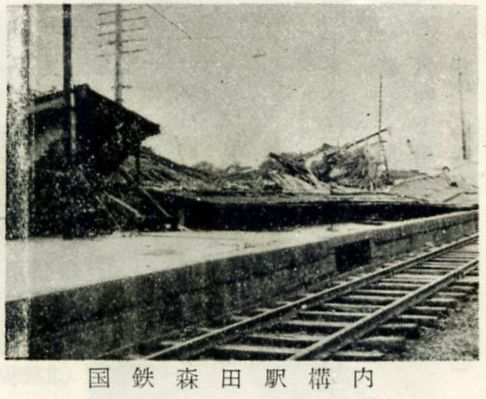
The Fukui earthquake struck at 16:13:28.8 local time on 28 June 1948. The epicentre was roughly ten kilometres north-north-east of Fukui city centre, in what is now the southern fringe of Sakai city — meaning directly under the towns of Maruoka and Harue. The magnitude was 7.1.
The depth was shallow — 15 kilometres, possibly less. The shindo intensity in Maruoka and Harue was 6 on the seven-step pre-1949 Japanese intensity scale, and in some reconstructed modified-Mercalli assessments from the 2018 Tokyo University review the epicentral intensity was closer to MM X.
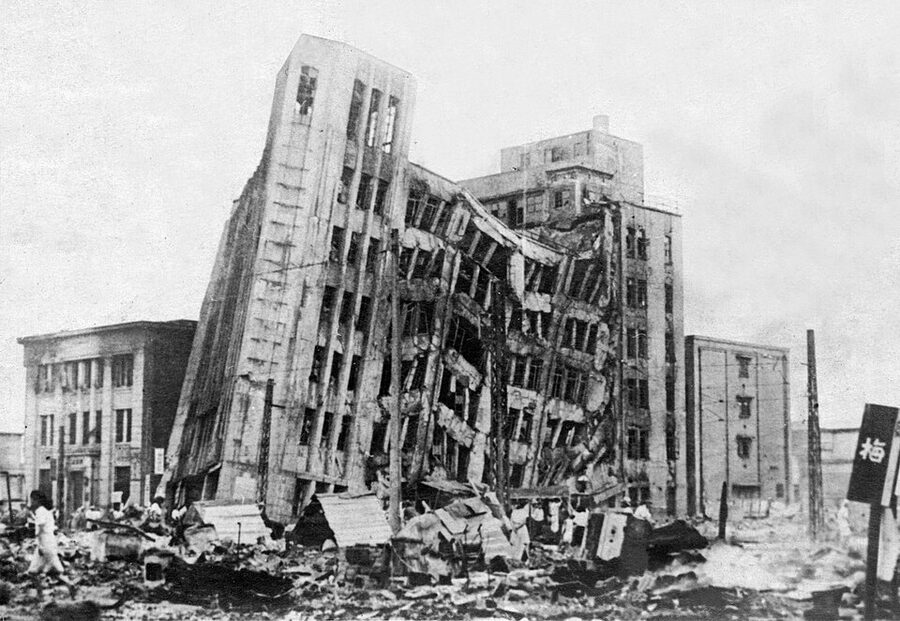
The death toll on the prefecture-wide count was 3,769. In the three towns closest to the epicentre — Kanazu, Maruoka, and Harue — the full-collapse rate of civilian housing exceeded 95 per cent. Fukui City itself, which had been rebuilt from the 19 July 1945 American incendiary bombing and was still three years into that reconstruction, went down again: the city had a full-collapse rate of 79 per cent and was then hit by a secondary firestorm that burned out about a sixth of the city’s remaining footprint.
The town of Maruoka lost most of its jōkamachi castle-town grid. Houses that had been on the Arima-era street plan since the 1700s went flat in thirty seconds.
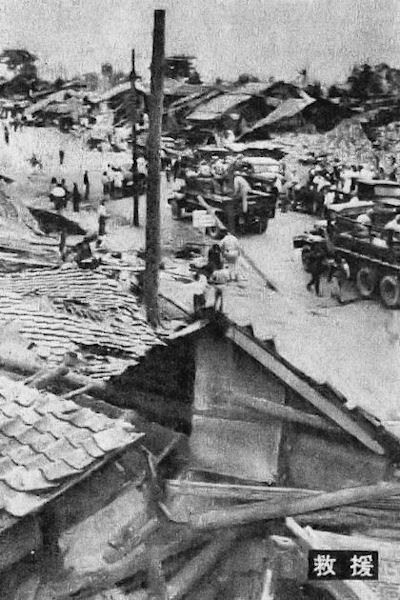
The Maruoka tenshu came down early in the sequence. The chert-block stone base, which had been set in nozura-zumi rough-pile masonry without mortar, the technique Katsutoyo’s people had used in 1576 and which the Honda builders had re-used on the 1628 keep, was not strong enough to carry the shear loads the quake applied.
The base slumped, several courses of stones slid off the north and west faces, and the tenshu above it rotated sideways and fell. Almost all of the structural timbers ended up on the slope to the north-east of the honmaru. The carp-tile shachihoko on the ridge were recovered as fragments; the Shakudani stone roof tiles broke on impact but were mostly salvageable.
1948-1955 — the seven-year rebuild
The decision to rebuild was taken by the town of Maruoka in late 1948, but nothing happened for the first three years. The prefecture and the municipality were bankrupt, the country was on occupation rations, the site was triaged behind housing and infrastructure, and the carpentry skills required to reassemble a Kan’ei-era bōrō-gata tenshu were not on anyone’s immediate payroll. What Maruoka did do in 1948-1951 was move all the recoverable material off the collapse slope, sort it floor-by-floor on open ground near the honmaru, catalogue each salvageable structural member, and tarp it against further weather damage. This inventory work is what made the later rebuild possible.
The 1950 Law for the Protection of Cultural Properties arrived in that interval. It replaced the old 1929 National Treasure framework with a two-tier system: full National Treasures (Kokuhō) at the top, and Important Cultural Properties (Jūyō Bunkazai) below them. The new law reclassified every pre-1945 National Treasure into one of the two tiers. The surviving original tenshu were assessed one by one. Himeji, Matsumoto, Matsue, Inuyama, and Hikone kept full National Treasure status. Maruoka, because the tenshu was at that point a pile of sorted timber on the ground, could not be listed at the top tier. It was re-classed as an Important Cultural Property. The 1955 rebuild was completed in the lower designation and has never recovered the higher one.
Construction restarted in earnest in 1952 under the supervision of the Fukui Prefecture Cultural Properties Division, with additional oversight from the national Cultural Properties Protection Committee in Tokyo. The lead architect was Fujioka Michio, the same Fujioka who would later oversee the 1961-65 Inuyama dismantle-and-repair, and his working method was to rebuild the stone base first, on a new reinforced-concrete internal frame, and then re-set the Kan’ei-era timbers on top of it one by one. Each salvaged pillar and beam was checked for structural integrity, and the pieces that had to be replaced were re-milled from Echizen cedar to the original dimensions. The final tally was about seventy per cent of the original pillars and sixty per cent of the original beams re-installed in their original positions.
There is exactly one visible compromise in the rebuild. The top-floor windows on the original keep were sliding-door shutters — a Kan’ei-era detail that Fujioka’s team could not confidently reconstruct from the 1910 and 1930s photographic record, because the sliding-door mechanisms had been inside the window frames and were not visible on exterior photographs. The rebuild replaced them with push-up wooden shutters (shitomi-do) of the kind used on most other original tenshu of the period. This is the one “wrong” detail on the present-day keep, and the 2019 research committee recommended flagging it in the castle’s on-site signage. The rest is a faithful Kan’ei-era restoration with concealed twentieth-century internal reinforcement.
The tenshu reopened in the spring of 1955 after seven years of inventory, sorting, foundation work, and timber re-setting. It was the first post-war Japanese reconstruction of a full-scale pre-modern wooden keep from salvaged materials, and it set the template for later dismantle-and-repair campaigns at Matsumoto (1950-1955), Inuyama (1961-1965), and Himeji (1956-1964). None of the later projects had to deal with a complete collapse. Maruoka was the extreme case, and the lessons from Maruoka — the sorted-timber inventory, the reinforced-concrete internal frame, the photographic-record reconstruction of lost details — are what made the later work possible.
The reconstruction debate — is it “original” or is it “rebuilt”?
There is an ongoing argument in the Japanese castle-history community about whether Maruoka should count as one of the twelve original-construction tenshu or not. The case for counting it is that the 1955 rebuild preserved seventy per cent of the original pillars and sixty per cent of the original beams in their original positions, and that the building you climb today is substantially the Kan’ei-era keep with concealed twentieth-century reinforcement. The case against is that the keep has at one point been completely disassembled, that the sacrifice of National Treasure status in 1950 was an official acknowledgement of that discontinuity, and that any building put back up on a new reinforced-concrete core is a reconstruction rather than a survivor. I find myself on the “counting” side.
The honest way to put it is that Maruoka is the only one of the twelve originals where the question can even be asked. The other eleven have all had dismantle-and-repair campaigns at various points — Matsumoto in the 1950s, Inuyama in the 1960s, Himeji in the 2000s — but none of them has been taken down to the ground by an external event and reassembled from the rubble. That is the specific case for Maruoka, and it is why the signage at the castle today reads “1948 fukkyū” (復旧), “restored after disaster”, rather than “original”. The word choice is careful. The Maruoka museum is also careful not to over-claim.
The parallel debate over the oldest-tenshu question is separate and mostly settled. Maruoka, on the 2019 research committee finding, was built in the Kan’ei era around 1628 — which makes it younger than the current consensus for Inuyama (1585-1588 on dendrochronology of the upper floors, possibly older on the lower) and younger than Matsumoto (1592-1594 on the Ishikawa Kazumasa build). The “oldest tenshu” partisanship from Maruoka’s 2000s signage is no longer warranted, and the museum and tourism materials have quietly updated. What Maruoka is instead is the smallest of the twelve, the only one ever totally reassembled, and the one that has the single strongest 1948-earthquake story.
In 2013 Sakai city launched a formal campaign to restore the keep to National Treasure status, and in 2017 a private-sector citizens’ association joined the effort. The 2019 research committee’s dating finding, that the keep is Kan’ei-era rather than 1576, was commissioned as part of that campaign, on the premise that a solid Kan’ei date might actually strengthen the NT case more than a contested Momoyama one. Whether Agency for Cultural Affairs in Tokyo eventually upgrades the designation is an open question. The agency is in no hurry, and the 1948 disassembly remains a procedural obstacle.
Where Maruoka sits in the twelve
I keep coming back to the Hokuriku problem. Maruoka is the only surviving original-construction tenshu in the Hokuriku region of Japan — the Japan-Sea-side band of prefectures that runs from Niigata through Toyama, Ishikawa, and Fukui. Every other original-twelve castle is on the Pacific side or in the Shikoku / San’in inland zone. There should be more. The Hokuriku region had major castles at Kanazawa (Maeda), Toyama (Sassa), Takaoka, and Fukui-Kita-no-shō (Shibata-then-Matsudaira) through the Sengoku and early Edo periods, and by the seventeenth century the region had dozens of full-scale daimyō-level keeps. Almost all of them were destroyed in fires, earthquakes, the 1873 demolition edict, or twentieth-century bombing campaigns. Maruoka is the last one standing.
That is mostly geographical accident. Hokuriku winters are hard on wooden architecture, the region is seismically active (the 1858 Ansei event, the 1948 Fukui event, the 2007 Niigata-Chūetsu-oki event, and the 2024 Noto Peninsula event are all on the same broader zone of active faults), and the twentieth century was particularly unkind — Toyama Castle burned in the American bombing of August 1945, Kanazawa Castle’s surviving tenshu was lost earlier in the Edo period to a lightning fire, and Fukui city’s Kita-no-shō site was used as a prefectural administrative building and never rebuilt. Maruoka survived because it was a compact small keep on an independent hill that happened to sit in a town small enough to escape wartime bombing and large enough to mobilise the 1901 municipal rescue of the building.
If you want the regional context, the Hokuriku castle circuit, what you can still visit, runs Kanazawa (rebuilt partial walls and turrets, no original keep), Toyama (modern concrete replica, mid-Shōwa vintage), Inuyama (not Hokuriku strictly, but the nearest surviving original tenshu on the Tōkaidō side), Maruoka (this one), and the Ichijōdani Asakura ruins (burnt by Nobunaga in 1573, no keep to see, but a reconstructed jōkamachi). Of those, Maruoka is the only one with an actual surviving keep you can climb. The Hokuriku Shinkansen runs within half an hour of all of them. If you are doing a Japan Sea trip and you want to see what Sengoku-to-Edo military architecture actually looked like in this region, Maruoka is the only option.
Cross-region, Maruoka is closest in spirit to Inuyama. Both are small bōrō-gata keeps of the transitional Momoyama-to-Edo period, both sit on compact stone bases, both have had their dating claims disputed by dendrochronology in the 2010s. Inuyama is on a clifftop above a major river; Maruoka is on a small inland hill on a plain. Inuyama is bigger and more militarily positioned; Maruoka is smaller and more domestically scaled. If you are castle-hopping and only have time for one of the two, pick Inuyama for the view and the Naruse-family 2004 ownership story, Maruoka for the earthquake-and-rebuild story and the Hokuriku winter-climate character.
Where to visit Maruoka today
Maruoka Castle (Kasumi-ga-jō Park) — the main precinct
The castle is open from 8:30 to 17:00 daily, with last entry at 16:30. The admission fee is ¥450 for adults and ¥150 for children, and the ticket includes entry to the Maruoka Castle Historical Reference Museum across the park. Credit cards are accepted at the ticket window as of the 2024 upgrade. There is a small on-site café — Ippitsu-keijō Chaya, named for the famous Honda-era short letter — serving matcha and sakura mochi from roughly April to October.
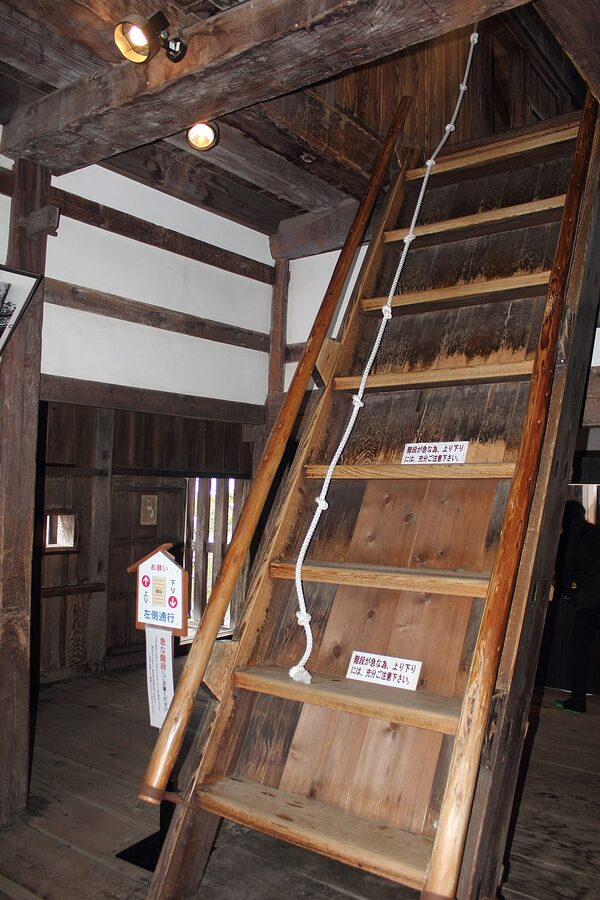
The climb itself is about six minutes from the ticket window to the top floor. The staircases are the steep ones, 60 to 67 degrees, and the upper-floor ceiling heights are under 170 centimetres in places. If you are over six feet tall you will bump your head; I did. The top floor has a wraparound observation band but no exterior walkway (unlike Inuyama’s) — you look through the push-up shitomi-do windows rather than stepping outside. The view is east across the Sakai plain toward the Hakusan range on a clear day, and is worth the stairs.
Maruoka Castle Historical Reference Museum
Across the park from the tenshu, the reference museum is the place to see the 1948 earthquake material. The central exhibit is the structural-timber inventory from the 1948-1951 sort — a sample of the original Kan’ei-era beams that were recovered from the collapse slope and laid out on the rebuild slab for cataloguing. Several pieces have the 1955-era inventory numbers chalked onto them still. There are also pre-collapse photographs of the keep from the 1900s, 1930s, and the Shōwa-era prefectural archive, some of which are the specific reference images Fujioka Michio’s team used for the rebuild.
The secondary displays are on the Shibata-Honda-Arima succession, the Ōsaka-siege Honda Narishige material, and the Arima-family Christian-ancestry connection to Shimabara. Signage is in Japanese with partial English glosses. The museum is compact and takes about thirty minutes to work through carefully. It is included in the ¥450 castle ticket.
Ichijōdani Asakura-clan ruins
Thirty minutes south of Maruoka by car (or a JR/bus combination that takes about an hour) is the Ichijōdani Asakura-clan ruins site — the jōkamachi of the Asakura daimyō family, burnt to the ground by Oda Nobunaga after the Battle of Anegawa campaign in 1573 and preserved as a flat archaeological site ever since. The Asakura were the Sengoku-period rivals of the Maeda and the Shibata in Hokuriku politics, and their destruction by Nobunaga is what cleared the way for the Shibata-era Echizen settlement that put Katsutoyo at Maruoka.
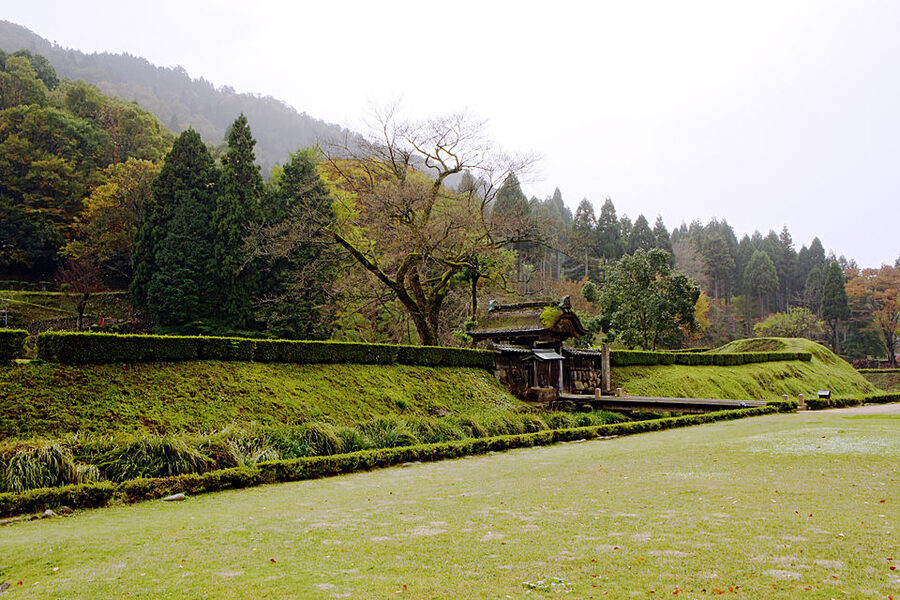
The Ichijōdani site is UNESCO-adjacent — it is a designated Special Historic Site and Special Scenic Area under Japanese law, which is the domestic equivalent — and has a reconstructed samurai manor with a karamon gate, a roji garden walk, and a visitor museum that opened in its current form in 2022. Entry to the main site is ¥330; the museum is ¥700. The combination is a half-day, and it pairs naturally with Maruoka if you are basing the trip in Fukui for two nights. For the broader Asakura-clan context, see the Battle of Anegawa article — Anegawa is the campaign that broke their back in 1570.
Eihei-ji — Sōtō Zen head temple
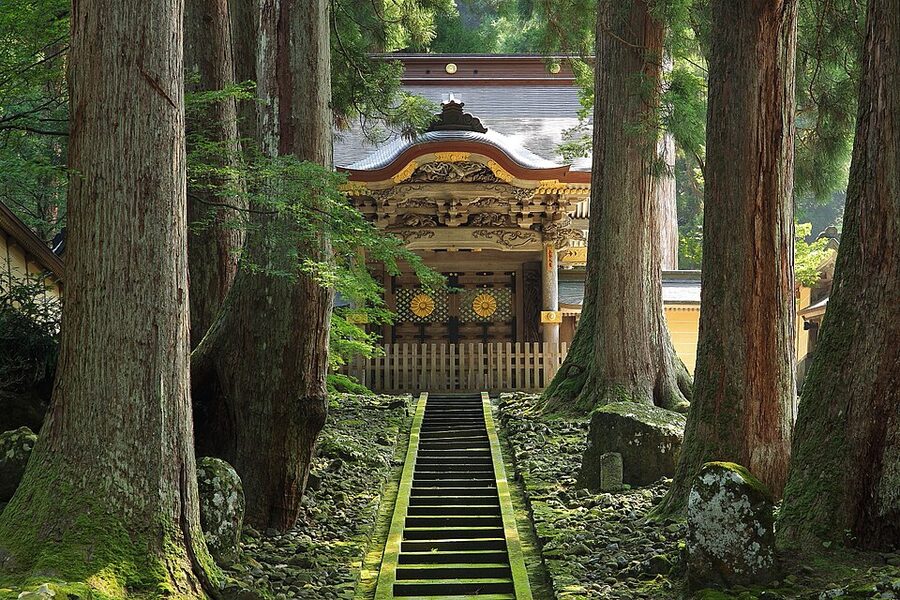
Thirty minutes east of Maruoka by car is Eihei-ji, the head temple of the Sōtō Zen sect, founded by Dōgen Zenji in 1244. Eihei-ji is a working monastery, there are usually around two hundred resident monks in training, and parts of the complex are open to day visitors. The admission fee is ¥700 and there is a separate fee for the overnight lay-practitioner programme (which requires advance booking and an early-morning zazen session). The architectural interest is the wooden seventh-to-nineteenth-century buildings, the Chokushimon Imperial messenger gate, and the cedar-forest mountain setting.
Eihei-ji is not directly related to the Maruoka story, it is a Zen monastery in the same prefecture, but it is the standard Fukui day-trip pairing, and if you are visiting Maruoka for half a day you will probably want to add Eihei-ji in the afternoon. The route works either direction: Maruoka in the morning, drive to Eihei-ji for lunch and a mid-afternoon temple walk, return to Fukui Station by 17:00. There are Keifuku buses that run the same route in about two hours.
Getting there — Fukui Station, Awara-yunomachi, or Maruoka Station
The Hokuriku Shinkansen opened the Tsuruga extension in March 2024, which means Fukui is now directly reachable from Tokyo in about three hours (via Kanazawa) or from Osaka via the Thunderbird express to Tsuruga and then one stop on the Shinkansen. From Fukui Station, the most direct route to Maruoka is the Keifuku Bus line 31 (Maruoka-sen) or line 36 (Kenritsu-byōin Maruoka-sen), both of which take about 40 minutes and stop at the “Maruoka Castle” bus stop directly below the honmaru.
An alternative approach is via Awara-yunomachi Station on the Hokuriku Shinkansen (one stop north of Fukui), from which Keifuku Bus lines 86 and 87 run to Maruoka in about 30 minutes. This is the option if you are combining a Maruoka visit with a stay at the Awara Onsen hot-spring resort — Awara is one of the three major Hokuriku onsen towns and has a full complement of ryōkan. The slowest but scenic option is via Hapi-Line Fukui rail (the old Hokuriku Main Line, spun off from JR West in March 2024) to Maruoka Station, then a one-kilometre walk or short bus ride to the castle. The walk takes about fifteen minutes on foot and crosses the site of the 1948 Morita Station collapse, which is commemorated with a small marker by the line.
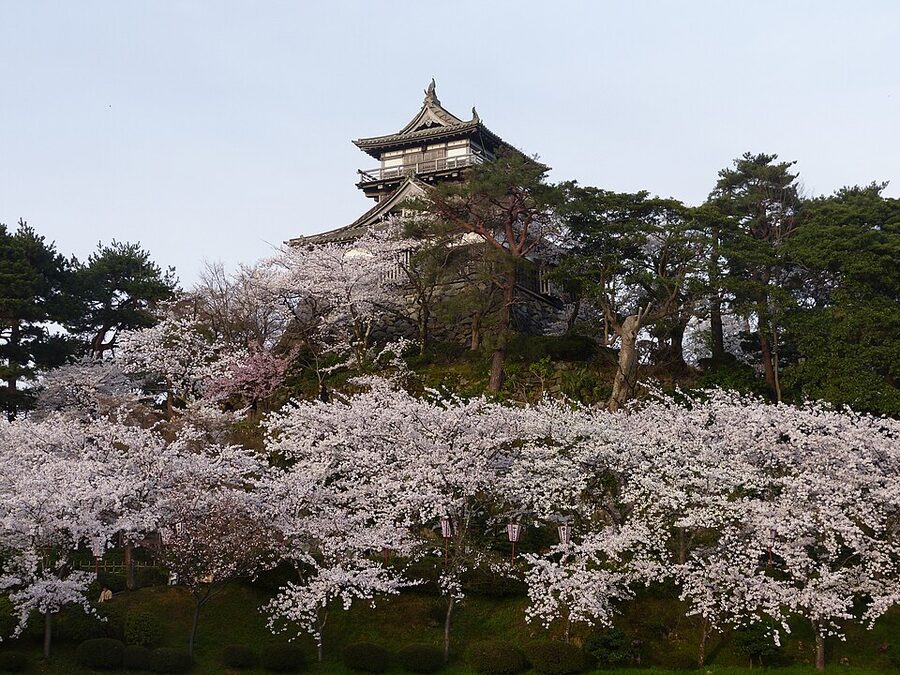
If you are coming in by car, the Hokuriku Expressway Maruoka IC is two kilometres from the castle and parking is free in the Kasumi-ga-jō Park lot. The lot fills up during the 1-20 April sakura festival — plan for early-morning arrival if you are visiting in peak bloom, or use one of the bus options. The park is walkable year-round but the peak window for sakura-with-tenshu photography is 2-10 April most years. Winter (January-February) is quiet, cold, and photographically underrated. I would pick early April for the bloom and January for the snow and would skip the summer humidity entirely.
Closing — the ship of Theseus on a chert base
Back to 28 June 1948. The recoverable timber on the slope, the town of Maruoka walking out of the rubble with a seven-year rebuild ahead of it, the National Treasure designation lost and the Important Cultural Property tier accepted, the chert stones re-stacked over a reinforced-concrete core, and the keep climbing back to where it had stood since the Kan’ei era. Seventy per cent of the Kan’ei pillars are the same wood that the Honda Narishige carpenters milled in 1628. Sixty per cent of the beams. The stone base is a mix of 2.5-million-year-old chert from the local Fukui outcrop and mid-Shōwa quarried fill. The keep is not strictly original. It is also not strictly a reconstruction. It is a ship of Theseus, rebuilt with its own timbers where possible and with new ones where not, and the question of whether it counts as one of the twelve is not a question the Maruoka tourism office is particularly interested in answering — they are interested in the fact that the keep is back up.
If you are visiting Fukui Prefecture anyway, go to Maruoka before you go to Eihei-ji. Do the climb. Pay attention to the inventory numbers still visible in chalk on some of the second-floor pillars — the carpenters did not bother painting over them, because the next generation would need to know which beam came from where. Look out of the top-floor shitomi-do windows across the Sakai plain. And on the way down, take a minute at the O-shizu stone. The Shōwa rebuild survey concluded that no human pillar is actually buried under the base. The stone is still there. The town of Maruoka chose to put it back up anyway.