The thing that ought to make Toyokawa Inari impossible is that it is not a shrine. It is a Sōtō Zen Buddhist temple. The fox statues, the red torii at the approach, the thousand white-paper banners rising along the path — all of it sits inside a working Buddhist monastery, and the deity being honoured is not the Shinto rice-kami Inari at all. She is Dakini-shinten (吒枳尼真天), a reworking of an ancient Indian demoness who was absorbed into Japanese Buddhism, eventually fused in the popular imagination with Inari, and has been receiving prayers for a harvest and a promotion in equal measure for six hundred years. Nobody goes to Toyokawa for the theology. They go because one corner of the precinct holds over a thousand stone foxes.
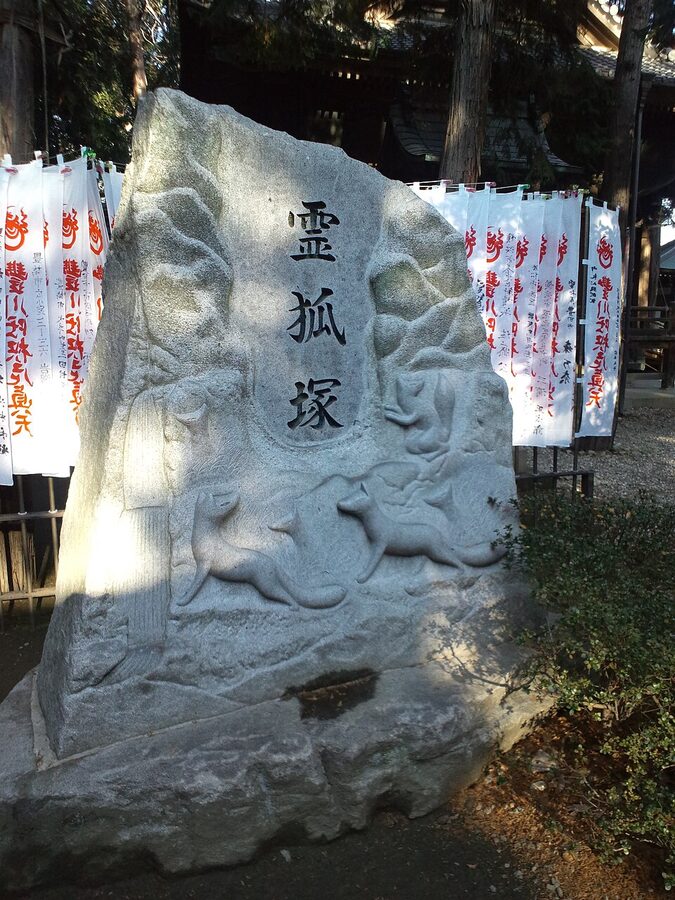
That corner is called the Reiko-zuka (霊狐塚), the “fox spirit mound”, and when you walk into it you understand the appeal in about five seconds. The foxes are stacked on platforms, on ledges, on the earth. Some of them are shoulder-high, carved sharply enough to hold a shadow. Most are small, no taller than a cat, and many wear red cotton bibs tied by visitors. They are of every weathering grade, some lichened over, some pale and recently cut. They are arranged informally but the overall effect is of an army, or a crowd, or, if you come at the last half-hour before the precinct closes at six, something that watches back.
In This Article
- A Zen Temple That Is Also the Third-Largest Inari Site in Japan
- Who Dakiniten Actually Is
- The 1441 Founding and a Vision at Sea
- Heihachirō the Fox-Monk
- The Sengoku Daimyō Who Came Anyway
- The Ōoka Tadasuke Connection and the Tokyo Branch
- How Toyokawa Survived the Meiji Persecution
- The Honden and the Secret Image
- The Reiko-zuka: Where the Foxes Live
- Senbon-nobori: The Thousand-Flag Path
- Festivals: May and November
- The Inner Garden and the Rest of the Precinct
- How to Visit Today
- The main precinct, Toyokawa city, Aichi
- Tokyo branch: Toyokawa Inari Betsuin, Akasaka
- The other branches
- Pairing Toyokawa with a bigger Aichi trip
- Eating in the monzen-machi and the Inari-zushi question
- What the Temple Tells You About Japanese Religion
- The Sculptor Tatekawa Wajirō and the Inner Ornament
- A Final Note on Pickpockets and the Night-Time Effect
- Closing
A Zen Temple That Is Also the Third-Largest Inari Site in Japan
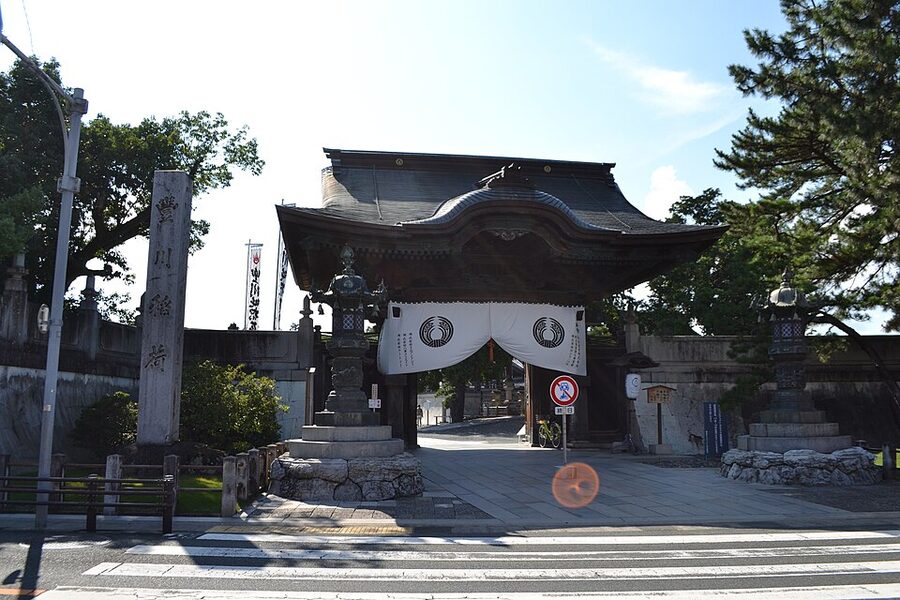
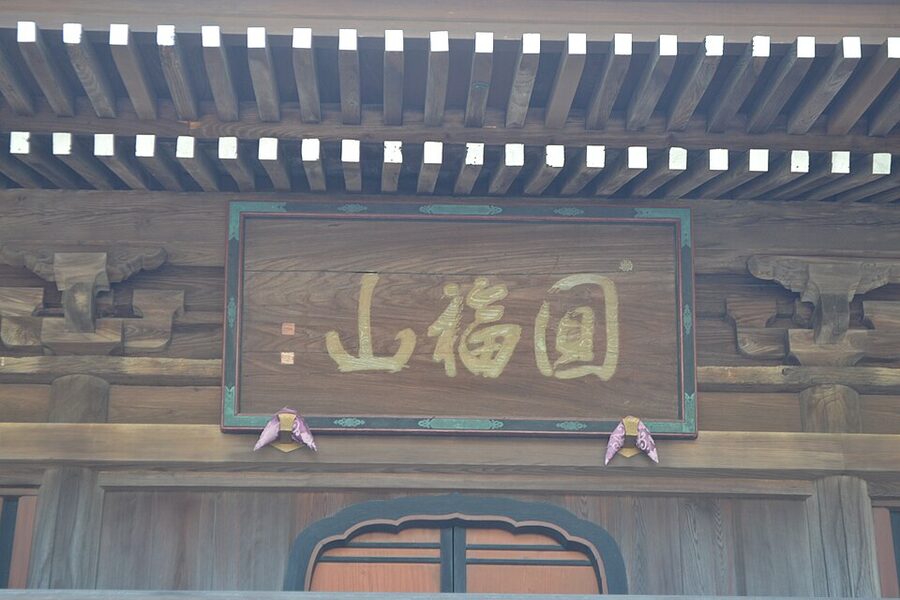
The formal name of the place is Enpuku-zan Myōgon-ji (円福山 妙厳寺) — Enpuku Mountain, Myōgon Temple — and it is a Sōtō Zen temple in Toyokawa city, in eastern Aichi Prefecture, about ninety minutes by bullet train from Tokyo. It is not a shrine. It has no shrine priests, no kannushi, no Shinto ritual calendar. The monks wear the black robes of the Sōtō order and chant Buddhist sutras in the main hall, just as they have since 1441.
The common name, Toyokawa Inari (豊川稲荷), refers to the guardian deity (chinju) housed inside the precinct — Toyokawa Dakini-shinten, whose image shows a female figure riding a white fox, carrying rice sheaves across her shoulder and a wish-granting jewel in her hand. Because Dakiniten’s iconography and Inari’s had already fused by the medieval period — both associated with foxes, both petitioned for prosperity — the temple came to be called an “Inari” site by the surrounding merchants and pilgrims. The name stuck. The torii at the entrance stuck too.
Japanese tradition ranks three sites as the country’s principal Inari destinations: Fushimi Inari Taisha in Kyoto (the largest, the one you see on postcards with the endless red senbon torii), Yūtoku Inari in Saga, and Toyokawa Inari here in Aichi. Two of those three are Shinto shrines. The third is a Zen temple. The categorical mismatch is the entire point of the article.
Who Dakiniten Actually Is
Dakiniten is not Japanese. The ḍākinī in her original Sanskrit form was a class of fierce female spirit in Hindu and early Buddhist belief — in the most alarming versions, a cannibalistic demoness who fed on human flesh. Buddhist texts told how Mahavairocana, the cosmic Buddha, took on the wrathful form of Mahākāla (Daikokuten, in Japanese Buddhism) and subjugated the ḍākinīs, converting them to the Dharma and forcing them to abandon their human-eating ways.
When this mythology came to Japan in the ninth century through the esoteric Shingon and Tendai schools, the ḍākinīs travelled with it. In Japan they coalesced into a single female deity, Dakiniten, who gradually detached from the demonic retinue and developed her own cult. By the late Heian period (that is, the 1100s) she was being worshipped as a goddess of worldly benefit — success, prosperity, good fortune, protection against calamity. The iconography settled on a woman riding a white fox and carrying a wish-granting jewel.
Now watch the fox-jump. In Shinto belief, foxes (kitsune) are the messengers of Inari — the rice kami, the patron of agriculture and merchants. Both deities are female. Both are associated with worldly prosperity. Both ride on, or are served by, white foxes. By the early medieval period, the cult of Dakiniten and the cult of Inari had bled into each other until ordinary people no longer distinguished between the two. The Inari-label got attached to Dakiniten sites across Japan, and vice versa. The syncretism produced cases exactly like Toyokawa — a Buddhist deity called “Inari” inside a Zen Buddhist temple.
What sets Toyokawa’s Dakiniten apart from more standard depictions is that she is not shown holding a sword. In the more common Tantric iconography, Dakiniten carries a sword in one hand and a jewel in the other. At Toyokawa, she holds rice sheaves across her right shoulder on a carrying-pole instead. The swap is deliberate. It marks her as the Inari-adapted version: not a wrathful deity of battle and magic, but a protector of harvest and household wealth.
The 1441 Founding and a Vision at Sea
Myōgon-ji was founded in 1441 by Tōkai Gieki (東海義易, 1412–1497), a Sōtō Zen monk of the Hōōha sub-school. The founding story is the sort of medieval vision-legend that is easy to roll your eyes at, but worth telling anyway because it is the explicit theology that the temple itself preserves.
Gieki was not the figure who first encountered Dakiniten, however. That was his sixth-generation lineage predecessor Kangan Giin, a Kamakura-period Sōtō monk and a direct disciple of Dōgen, the founder of the Japanese Sōtō school. In 1264, Giin sailed to Song China to present Dōgen’s recorded sayings — the Eihei Kōroku — to the Caodong monks of Tiantong Rujing, Dōgen’s own teacher. Three years later, as Giin prepared to return to Japan, he is said to have experienced a vision on board ship: a goddess riding a white fox, carrying a jewel in one hand and sheaves of rice on a shoulder pole. The goddess identified herself as Dakiniten and promised to become Giin’s protector. On returning to Japan Giin carved a statue from the memory.
The statue passed down the lineage to Tōkai Gieki, who in 1441 built Myōgon-ji at a place called Enpuku-ga-oka, a low hill near the Toyokawa River, and installed the Dakiniten carving as the temple’s guardian. He also enshrined an image of the Thousand-Armed Kannon (Senju Kannon) as the temple’s principal Buddhist object of worship, where it remains. On paper, the honzon, the main deity, is still the bodhisattva. In practice, ninety per cent of the visitors are here for the fox goddess.
Heihachirō the Fox-Monk
One of the secondary legends of the founding concerns a figure called Heihachirō. The story goes that shortly after Gieki had begun work on the temple, an old man appeared and offered himself as a lay servant. He carried a small iron cauldron (kama). He cooked for the monks. The food he produced from the pot was, however much he served out, always still full — enough to feed tens and eventually hundreds of visitors without ever needing to be refilled.
When asked how he managed this, the old man said he had three hundred and one servants at his disposal. He remained at Gieki’s side until the founder’s death, at which point he vanished, leaving only the pot. The locals concluded, reasonably, that he had been a fox-spirit all along — an avatar or attendant of Dakiniten who had slipped into human form to assist the temple’s founding. The pot is still preserved in the precinct, behind the Honden, and the temple was for a long period known colloquially as “Heihachirō Inari”. The detail is not historical; but it is the sort of detail people remember, which is why they remember the place.
The Sengoku Daimyō Who Came Anyway
Despite the Buddhist-temple-with-Inari-marketing oddity, Myōgon-ji became one of the most powerfully patronised religious sites of the Sengoku and early Edo periods. The reason is simple. Warriors liked Dakiniten. She was a protector deity associated with military success and personal good fortune, and she was understood to act fast. A Sōtō Zen monastery with a Dakiniten enshrined in-house gave daimyō two kinds of supernatural endorsement at once.
The temple’s first major Sengoku patron was Imagawa Yoshimoto, the Suruga-Tōtōmi-Mikawa warlord who would later be famously killed at Okehazama in 1560. In 1536 Yoshimoto sponsored the rebuilding of the temple’s main gate — the Yamamon (山門) — which still stands as the oldest surviving structure in the precinct. Everything else was rebuilt at one point or another; the Yamamon has been there for nearly five hundred years. If you come into the temple via the main approach, you pass under it. Look up at the woodwork as you do.
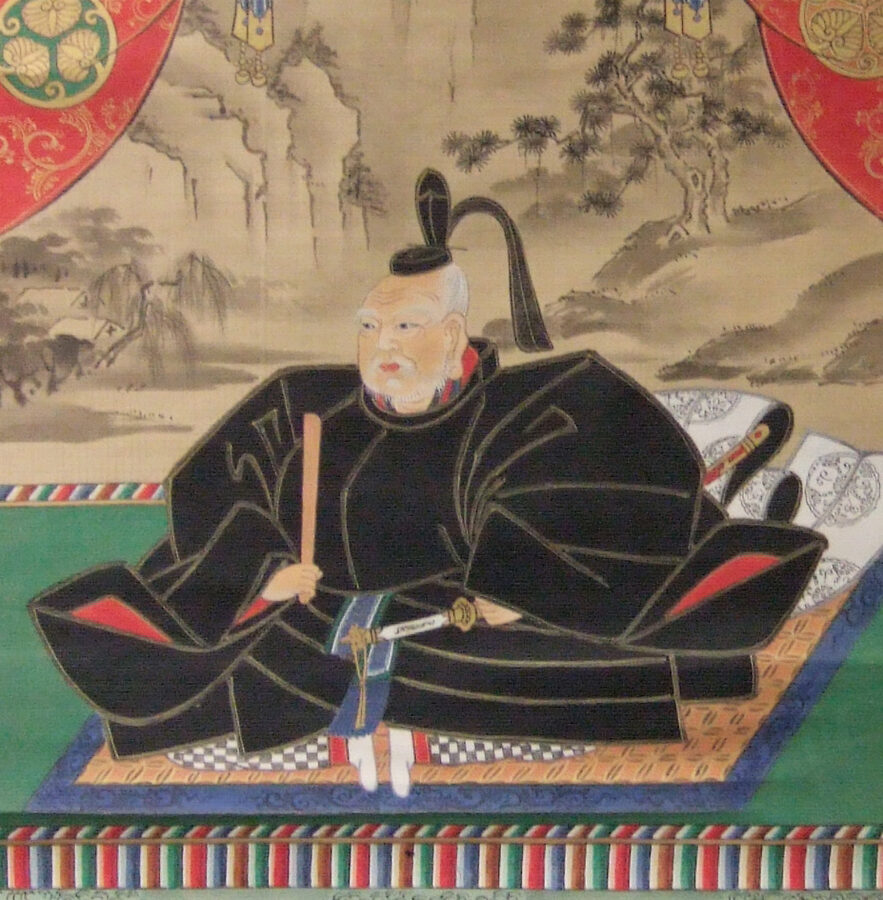
After Yoshimoto’s death, patronage passed first to Oda Nobunaga, who confirmed the temple’s holdings, and then to Toyotomi Hideyoshi. The decisive figure, however, was Tokugawa Ieyasu. In 1603, the year he was appointed shogun and inaugurated the regime that would carry Japan through its next two and a half centuries, Ieyasu issued a red-seal land grant to Myōgon-ji confirming its temple estate. Toyokawa sat directly on the Tōkaidō, the post-road between Edo and Kyoto that became the backbone of shogunal Japan, and Ieyasu wanted the major religious sites along that road inside his patronage network. A Dakiniten-worshipping Zen temple fit.
Nobunaga’s brief devotion to Dakiniten is one of those historical curiosities that deserves a footnote. He is supposed to have kept a personal Dakiniten image for protection. If you are interested in the cultural anti-logic of a syncretic Buddhist-Shinto fox goddess being petitioned by the most rationalist and anti-Buddhist of the Sengoku warlords, you will already have read the bio. The short answer is: Nobunaga’s devotions were always pragmatic.
The Ōoka Tadasuke Connection and the Tokyo Branch
The temple’s Edo-period prominence came from two sources: shogunate continuation of Ieyasu’s patronage, and the devotion of private merchant-class pilgrims travelling the Tōkaidō. By the 1700s Toyokawa Inari had developed a practical reputation in the popular religion of the cities — this was the god to petition for commercial success, for protection against theft, for career advancement. The mercantile Edo bourgeoisie arrived in numbers.
One of the specific Edo-period devotees deserves naming: Ōoka Tadasuke (1677–1752), the Edo city magistrate (machi-bugyō) under Tokugawa Yoshimune, who later became a daimyō in his own right with the Nishi-Ōhira domain in Mikawa — which meant his fief was effectively next door to the temple. Ōoka is one of the best-remembered administrators of the entire Edo period. He was famously credited with rigorous impartial justice in the Edo commoner courts, and a folklore tradition of “Judge Ōoka” stories grew up around his name in the way that “Judge Dee” stories did around Di Renjie in China.
Ōoka was also a devoted Toyokawa Inari supporter. In 1828, long after his death, a corner of his Edo residence compound in Akasaka was dedicated to a branch of Toyokawa Inari — the temple’s only directly-administered sub-temple, established as a convenient worship site for Edo-based devotees who could not make the Tōkaidō journey. That site is still there today in Minato-ku, one of the more unexpected pieces of religious real estate in central Tokyo, wedged between modern office blocks and the Akasaka entertainment district. I will come back to it in the travel section.
How Toyokawa Survived the Meiji Persecution
There is a darker chapter to the temple’s story that most visitors skip over, and it is the one that explains why this site still exists when so many comparable ones do not. In 1868 the new Meiji government issued the shinbutsu bunri edict — the order to “separate the kami from the buddhas”, dismantling centuries of Shinto-Buddhist syncretism. In the subsequent period of haibutsu kishaku (“abolish the Buddhas, destroy Śākyamuni”), thousands of Buddhist temples across Japan were either closed, burned, or stripped of Shinto-adjacent elements. The violence was uneven, regional, sometimes shocking.
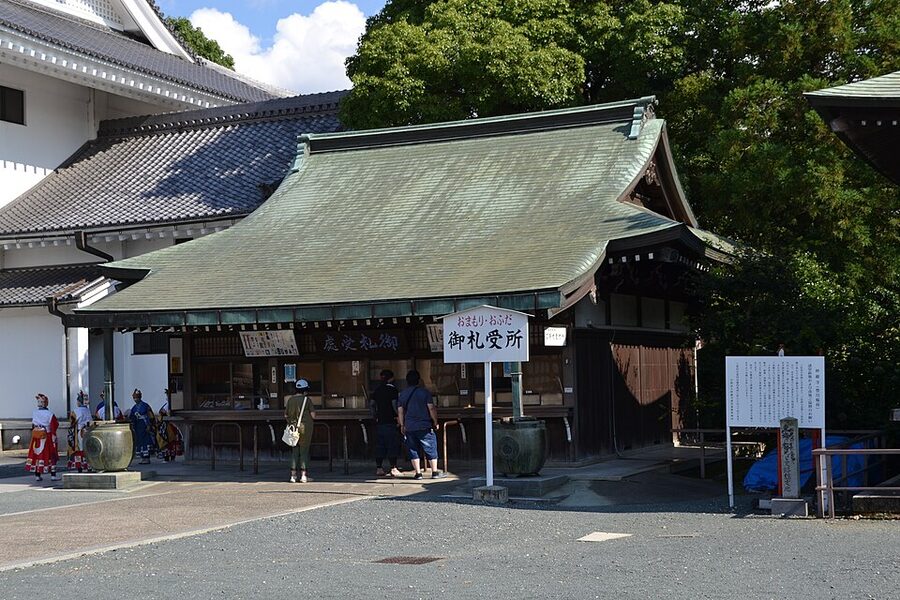
Toyokawa Inari was inspected in 1871 under the separation edict. The investigators were trying to decide whether the site was a shrine or a temple — and therefore whether the Buddhist institution had any legal right to the Inari deity on the premises. The outcome, confirmed in 1872, was that the Inari hall could remain as the temple’s guardian shrine so long as it was clearly subordinated to the Buddhist institution. The torii that had stood along the approach path were torn down. The names “Toyokawa Inari” and “Toyokawa Daimyōjin” were officially suspended. Henceforth the deity was to be called by her Buddhist-esoteric name, “Toyokawa Dakini-shinten”.
This is the bureaucratic-paperwork answer to how Toyokawa survived the 1868–72 period when so many Inari shrines, particularly small local ones with strong Buddhist infrastructure, were absorbed, secularised, or closed. By holding its Zen-temple legal status firmly and accepting the cosmetic renaming, Myōgon-ji preserved its land, its buildings, its income. The “Toyokawa Inari” name crept back into popular use within a generation; the torii at the present entrance was physically reinstated in the 1930s, using gate-posts that had stood along the old Tōkaidō and had been preserved on the temple’s land. The result is the site you see today — technically a temple, called a shrine, with torii and Buddhist monks in the same courtyard.
One side-effect worth noting. The old Kyoto-based Buddhist institution that used to supervise Inari worship across Japan — Aizen-ji, the honganjo of Fushimi Inari — was abolished in the same reforms. Toyokawa Inari, because it survived, effectively inherited Aizen-ji’s role as the national centre for Buddhist-tradition Dakiniten worship. Smaller temples around the country that wanted to enshrine Dakiniten for local veneration now looked to Toyokawa for a consecrated branch-image. The number of branch sub-temples — there are currently six official betsuin, in Tokyo, Yokosuka, Ōsaka, Sapporo, Fukuoka, and elsewhere — dates largely from this post-Meiji period.
The Honden and the Secret Image
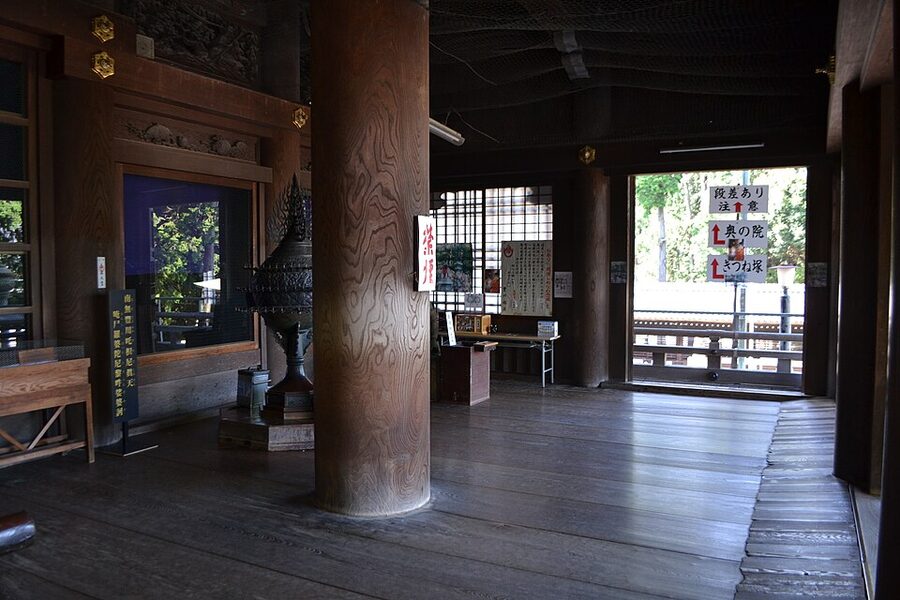
The Honden (本殿), the large twin-roofed hall at the left rear of the precinct, is the ritual centre of the place. It enshrines Toyokawa Dakini-shinten, and the image itself is a hibutsu (秘仏) — a “secret Buddha” kept permanently out of view behind closed doors. You will not see the statue on a visit. Nobody does, barring a handful of senior priests on specific ritual occasions.
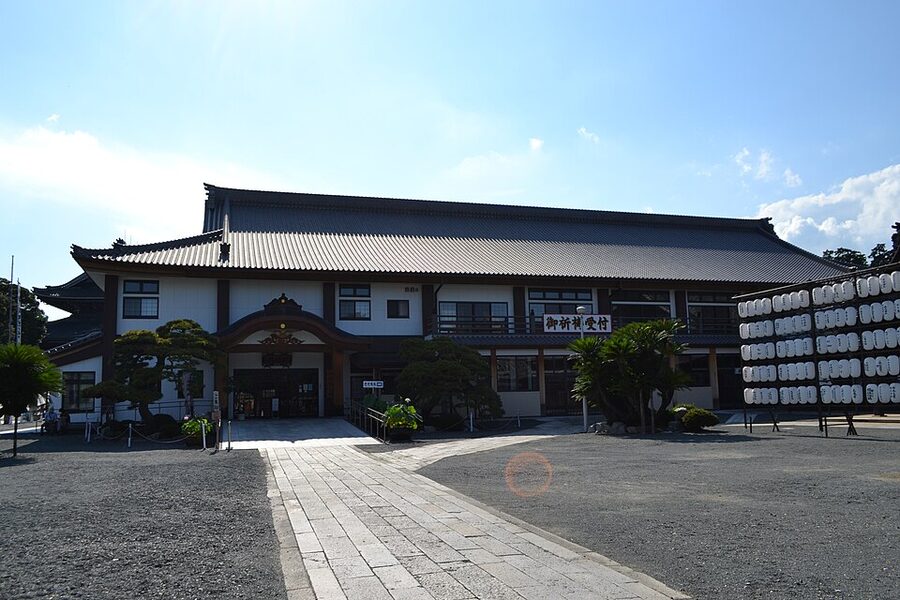
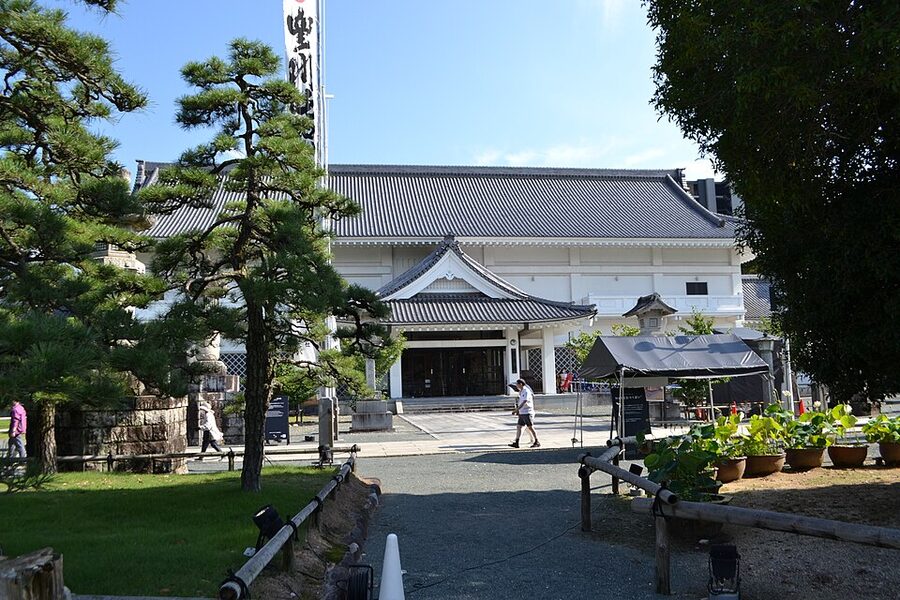
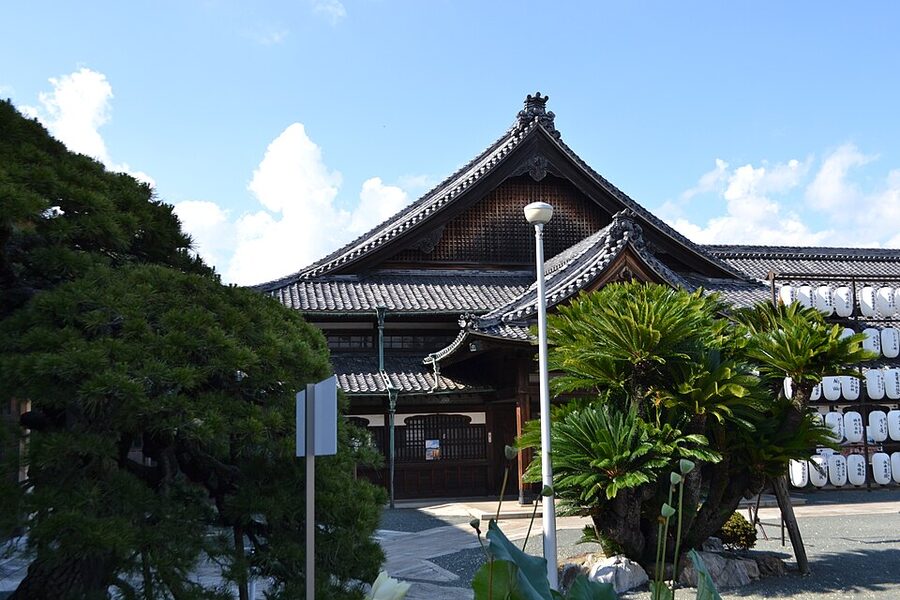
What you do see is the hall itself, which is impressive on its own terms. Construction began in 1908, in the late Meiji period, and was not finished until 1930, a twenty-two-year build carried out by local master carpenters of the Igeta-ya firm (now Hanada Kōmuten) from the nearby village of Ushikubo. The building is an irimoya-style double-roofed hall with the entrance on the gable end — an unusual proportion for its size, done for ritual reasons specific to Dakiniten veneration. The interior is cypress. The wood-carving inside the shrine chamber was done by the Tatekawa-ryū carvers Tatekawa Wajirō II and his apprentice Miyasaka Tsunezō, whose work fills the precinct.
What happens inside the hall — specifically, the goshūnō (御集納) ritual prayers conducted twice daily — is a distinctly Buddhist operation. Sutras are chanted. The Buddhist mantra On shira batta niri un sowaka (reconstructed from the Sanskrit Oṃ śila bheda nirṛti huṃ svāhā) is repeated. No norito, no Shinto-style prayers, no priest in kariginu robes. If you come at the right hour you can listen; the doors of the Honden stand open during most daytime services and any visitor can stand at the railing and watch. The sight of a Zen monk in black robes chanting the Dakiniten mantra, with a thousand foxes standing guard a hundred yards behind him, is the specific experience you have come here for.
The Reiko-zuka: Where the Foxes Live
The Reiko-zuka is reached by following the precinct path past the Honden, through the Senbon-nobori flag gallery, and into a small walled grove at the far end. It is the reason most first-time visitors come here, and it is almost always the image that fixes the temple in their memory afterwards. It is also the thing photographs consistently fail to capture, because photographs are small and there are so many foxes.
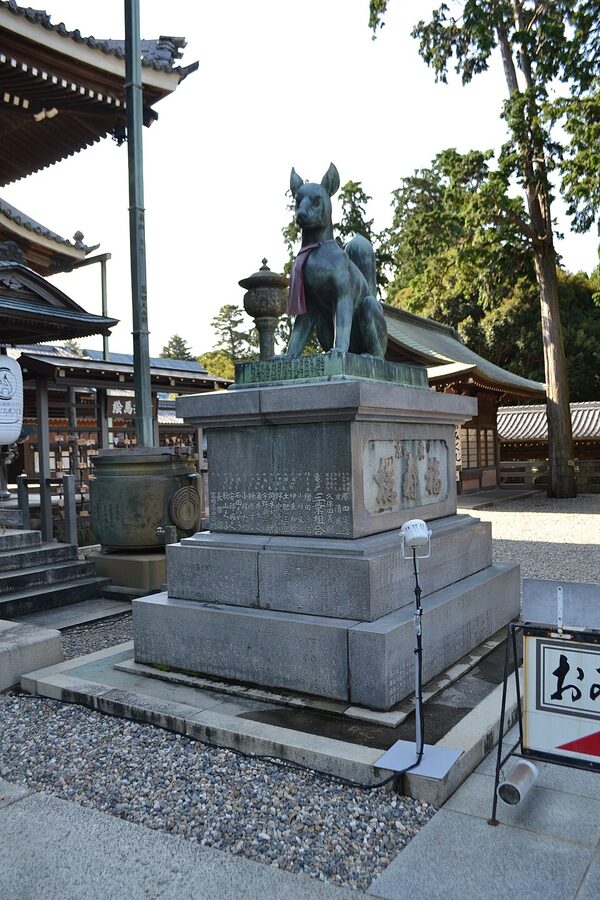
The formal name, again, is Reiko-zuka, “fox spirit mound”, and the accepted count is “more than a thousand” stone foxes. Nobody has published a precise number, and the number keeps growing: the tradition has been for devotees to commission a fox statue in gratitude for a prayer answered, and for the temple to add it to the collection. Some of the statues date back to the late Edo period. Many are Meiji and Taishō. A good portion are from the twentieth century. The newest, carved and offered in the 2020s, sit cheek by jowl with Meiji pieces.
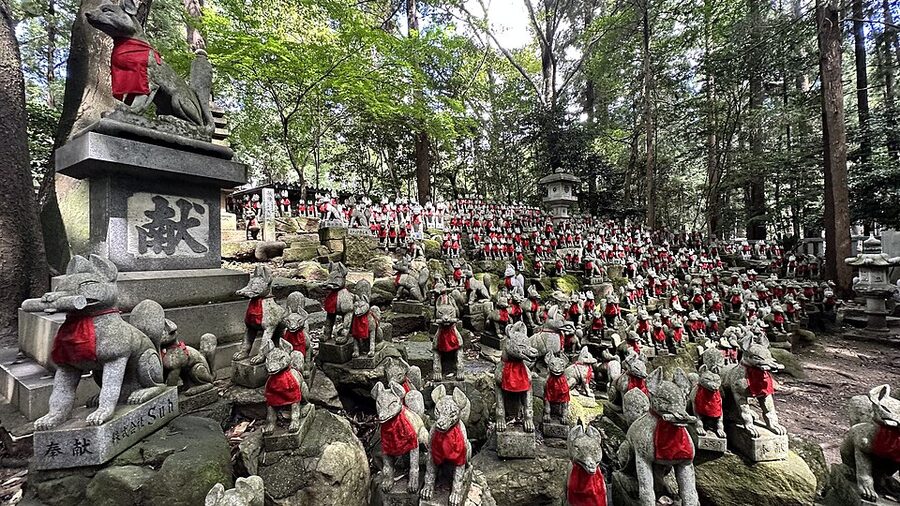
The arrangement is not regimented. At the front of the grove, there is a central altar with two much larger foxes flanking it — the ceremonial guardians of the grotto. Around and behind these, the rest are stacked on low stone platforms and wooden tiers of varying heights, with narrow gravel paths threading between them. The smaller foxes at the back sit in tight rows, four or five deep. The whole arrangement recalls a village cemetery — which is, in fact, what it effectively is: a fox ossuary, a place where the temple’s popular community of fox-patrons is gathered in sculpted form.
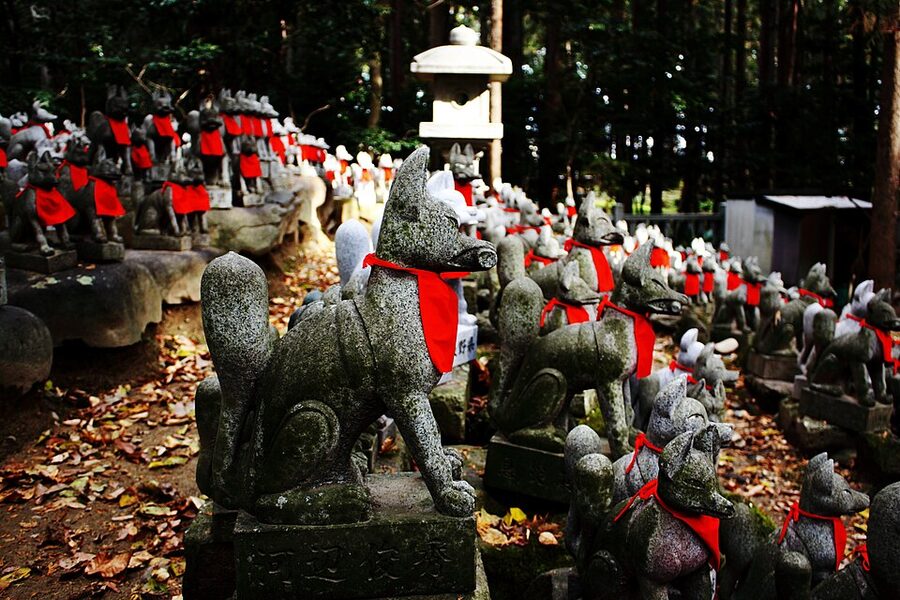
Two practical notes. First, the Reiko-zuka is open until approximately 5 p.m. in most seasons, and it takes its light from the overhead canopy — this means that on overcast or late-afternoon visits it can be genuinely dim, and the effect of the place at dusk is considerably more severe than at midday. Most photography guides will tell you to come in the late afternoon for this reason. Second, you are allowed to walk among the statues but not to touch them, not to rearrange them, and emphatically not to take any object away. The red bibs are replaced by the temple on a rotating schedule and are not souvenirs.
Senbon-nobori: The Thousand-Flag Path
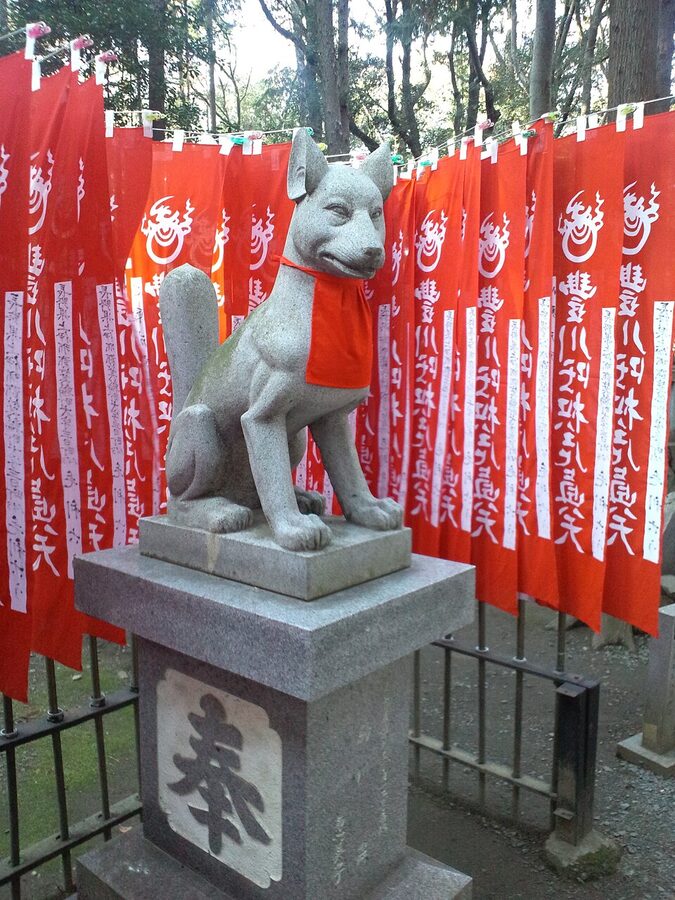
The path between the Honden and the Reiko-zuka is where the other big visual motif of the temple sits. It is called Senbon-nobori (千本幟), the “thousand-flag” path, and it is lined with red vertical banners carrying black calligraphy, each one bearing a donor name and prayer. The idea is directly related to the senbon torii (thousand-gate) path at Fushimi in Kyoto, but the material here is cloth-on-pole rather than vermilion-lacquered wood, which gives the whole thing a much more ragged, weather-worn quality. The banners whip in the wind. They are replaced periodically. Each one costs a donor about ¥20,000 a year to maintain, going to the temple.
If you have been to Fushimi Inari in Kyoto, you will find the Senbon-nobori immediately legible as a Buddhist-temple cousin of the same practice. If you haven’t, it functions well enough on its own — the visual of a hundred-metre path cross-hatched by flapping red cloth is distinctive, and the sound of the banners in a spring breeze is one of the things you remember. The best time to walk it is before the 10 a.m. tour-bus arrivals, when the path is empty.
Festivals: May and November
Toyokawa runs on a Buddhist temple calendar rather than a Shinto shrine one, and the two major annual observances are the Reisai — the spring great festival, 3 to 5 May — and the autumn great festival on the third weekend of November. These are the days to see the temple at its ceremonial peak.
The centrepiece on both occasions is a chigo gyōretsu — a children’s procession, with young boys and girls in kabuki-style heavy white makeup and elaborate headgear, walking a circuit of the precinct. A very large portable shrine (mikoshi) weighing approximately 600 kilograms is carried through the grounds by teams of bearers, accompanied by drums and hand-pulled floats. The November festival adds a giant lantern, lit at dusk, with a single fifty-kilogram candle inside. The effect is deliberately theatrical and well worth planning a visit around.
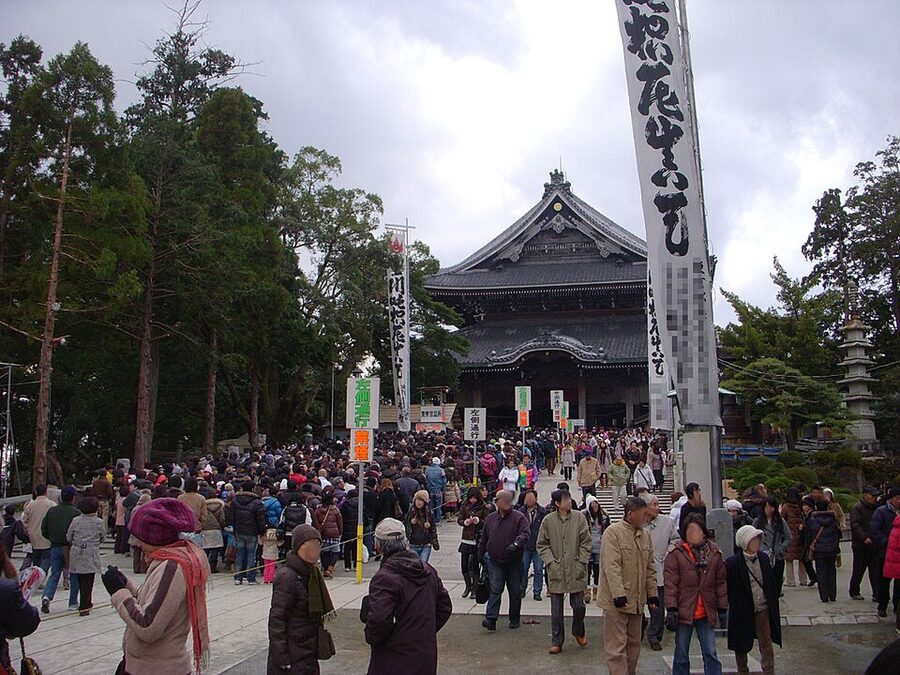
On hatsumōde — the first New Year visit, from the evening of 31 December through the first five days of January — the precinct receives around 1.45 million visitors over the three-day peak. The Toyokawa city authority closes the surrounding roads to vehicles during daylight hours and the area becomes pedestrian-only. If you are planning a hatsumōde visit, get there before 8 a.m. on 1 January or come on 4–5 January instead. The middle three days are a controlled shuffle in from the main road, a queue most of the way to the Honden, and a second queue to reach the Reiko-zuka.
Other festival dates worth knowing. The Kaizan-ki on 28–29 March commemorates the founder Tōkai Gieki; Buddhist services with visiting Sōtō clergy from across eastern Mikawa. The Kanbutsu-e on 8 April is the Buddha’s birthday celebration, with a flower-pavilion (hanamidō) set up in the precinct and sweet tea poured over a small standing Buddha image. Neither is heavily touristed.
The Inner Garden and the Rest of the Precinct
Three other things in the precinct deserve a look on a first visit. The Sōmon (総門), the outer entrance gate, was rebuilt in 1884 with an irimoya roof and a karahafu curved pediment, and its doors are single fifteen-centimetre-thick keyaki (zelkova) planks, a rare piece of wood use with a specific grain pattern the temple calls jorinmoku. The offcuts from the planks were kept and can be seen in the shōin (書院) reception hall if you ask. Second, the Saishōden (最祥殿), the 400-mat formal reception hall, was built in 1929 and is used for visitor receptions and Buddhist vegetarian meals.
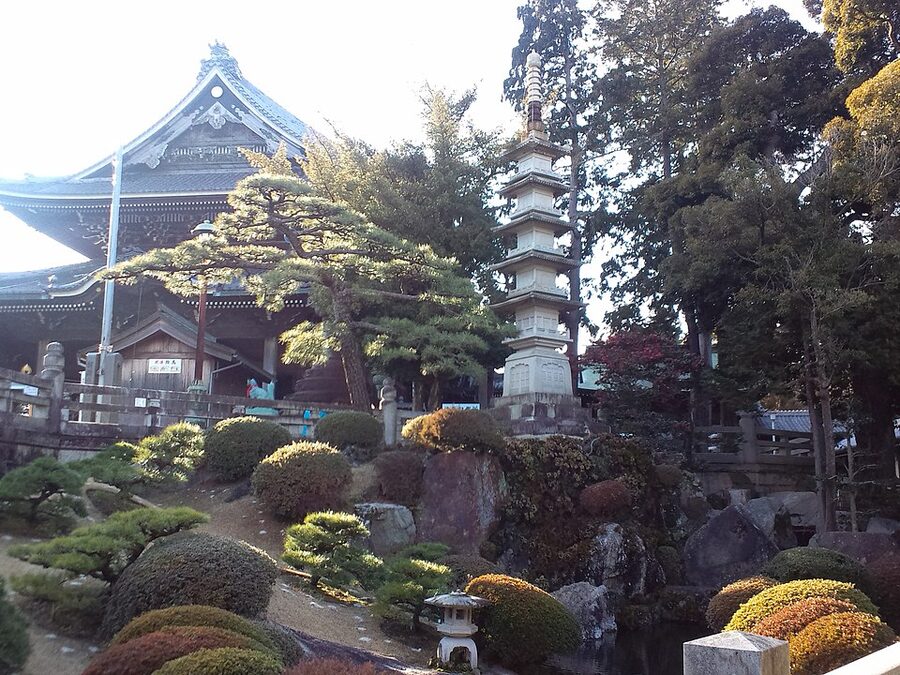
Third, the Myōgon-ji teien, the inner temple garden, is visible through side gates and partly accessible on festival days. It is a restrained example of the conservative shōin-zukuri style — a low-maintenance pond garden of the kind that was common at Sōtō Zen monasteries in the Edo period. It was never intended as a viewing destination in itself. If you are planning to see it, treat it as a footnote to the main visit, not the main event. The garden pairs thematically with the better-developed shakkei composition tradition — treated more fully in our piece on Japanese gardens — but the one here is not of that caliber. It is honest, small, and quiet.
The temple’s treasure house, the Jihōkan (寺宝館), holds a collection of Kano-school paintings considered by the art historian Nakamura Keio, who catalogued the holdings, to be of exceptional scope for a single temple. The collection is rotated and not permanently on view, but if a Kano-school exhibition is running, typically once or twice a year, it is worth the extra time and the small admission fee. There is also an important Kamakura-period pair of standing Jizō Bosatsu wooden figures (both 77 centimetres, hinoki yosegi construction with colour) that are a designated Important Cultural Property of Japan.
How to Visit Today
The practical logistics for visiting Toyokawa Inari are more forgiving than for most Aichi-prefecture cultural sites. The temple is free to enter. It opens around 5 a.m. and closes the main precinct to entry at 6 p.m., though the outer grounds remain accessible for longer. The Reiko-zuka and the inner approaches begin to lose their light from about 4 p.m., so aim to arrive before 3 p.m. if the fox statues are your priority — which they should be.
The main precinct, Toyokawa city, Aichi
The temple stands in the centre of Toyokawa city, about six minutes’ walk from Toyokawa Station on the JR Iida Line, or about the same from Toyokawa-Inari Station on the Meitetsu Toyokawa Line. If you are coming from Tokyo, take the Tōkaidō Shinkansen from Tokyo Station to Toyohashi (about one hour forty minutes on the Hikari or Kodama services; Nozomi does not stop at Toyohashi) and change there to the JR Iida Line. From Nagoya the journey is quicker — about forty minutes on the JR Tōkaidō Line to Toyohashi and then the same Iida Line change, or you can take the Meitetsu Nagoya Main Line and change at Kokufu.
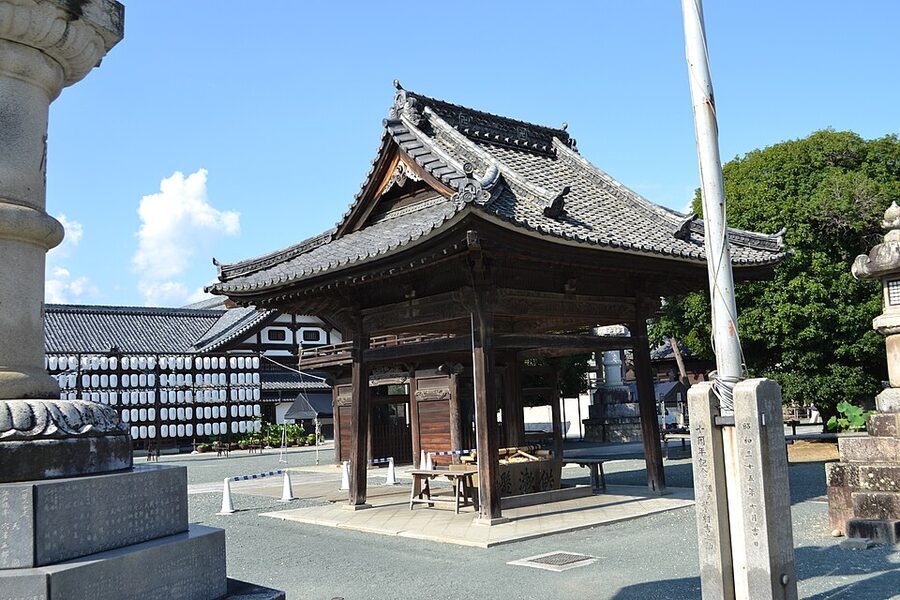
By road the nearest expressway exit is Toyokawa IC on the Tōmei Expressway, about five minutes from the precinct along National Route 151. If you are driving up the Tōkaidō in a rental car — a trip some people like to do between Tokyo and Kyoto to see the old post-road stations, which ties directly to the sankin-kōtai logistical system that shaped the route — Toyokawa is a natural stop.
The precinct is large and you should give it ninety minutes as a minimum. Two hours if you want to see the Jihōkan treasure house. Three if you want to have lunch in the monzen-machi (the shop-row outside the gate) before or after.
Tokyo branch: Toyokawa Inari Betsuin, Akasaka
If you cannot make it to Aichi, the Tokyo branch — formally Toyokawa Inari Tōkyō Betsuin — sits at 1-4-7 Moto-Akasaka in Minato-ku, five minutes’ walk from Akasaka-Mitsuke Station on the Marunouchi and Ginza lines, or Nagatachō on the Hanzomon. It is an unexpected thing to find in the middle of central-Tokyo office land: a full-sized Toyokawa-style precinct with its own Honden, an inner hall, a fox-statue area (smaller than the main Reiko-zuka but substantial), and a full Senbon-nobori path.
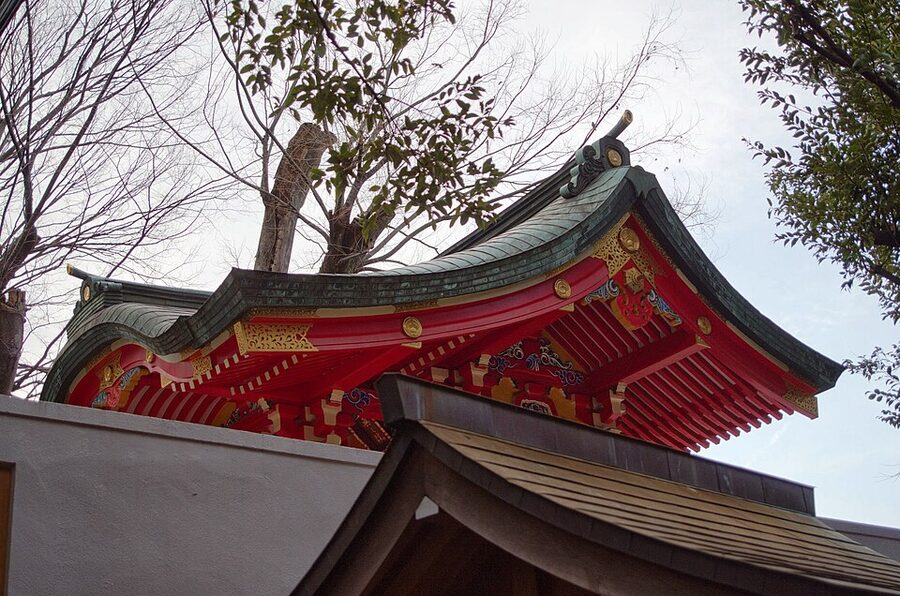
The Tokyo branch was established in 1828 on the former residence of Ōoka Tadasuke. Because the Ōoka family had used this compound as their Edo mansion during their sankin-kōtai rotation — a system of enforced residency in Edo that shaped the political geography of the Tokugawa state, which I have a longer piece on here — the branch temple’s location is itself an artefact of Edo-period daimyō logistics. It has been adjusted over the centuries. The present main buildings mostly date from the twentieth century.
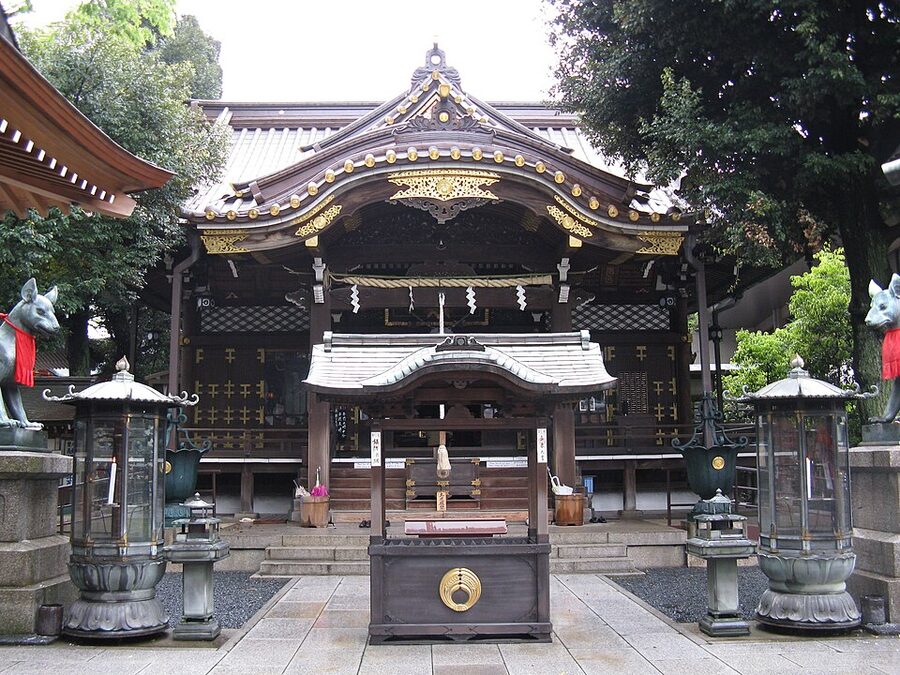
The Tokyo branch’s setsubun festival on 3 February, a traditional bean-throwing ceremony to ward off misfortune, draws minor celebrities as toshi-otoko (the “men of the year” who scatter the beans). It is the only setsubun observance in central Tokyo with any celebrity-spotting potential, if that is the sort of thing that appeals. The main Aichi temple’s setsubun is a quieter affair.
Free entry, open roughly 6 a.m. to 8 p.m. on weekdays, later on festival days. If you have one hour in central Tokyo and want to see a proper Zen-temple compound with full Inari-style accoutrements without leaving the Yamanote, this is the trip.
The other branches
Toyokawa Inari maintains five further directly-administered branch temples: Ōsaka Betsuin (Kannon-ji, at 1-5-19 Dōgashiba in Tennōji-ku, Osaka); Yokosuka Betsuin (Tokujuin, at 2-27 Ōtaki-chō in Kanagawa); Sapporo Betsuin (Gyokuhō-ji, at 1-1 Minami 7-jō Nishi 4-chōme, Chūō-ku, Sapporo); and Fukuoka Betsuin (Tōkei-in, in Kasugabaru-kita-machi). Each has its own Dakiniten installation, its own fox-statue grotto in miniature, and its own festival calendar.
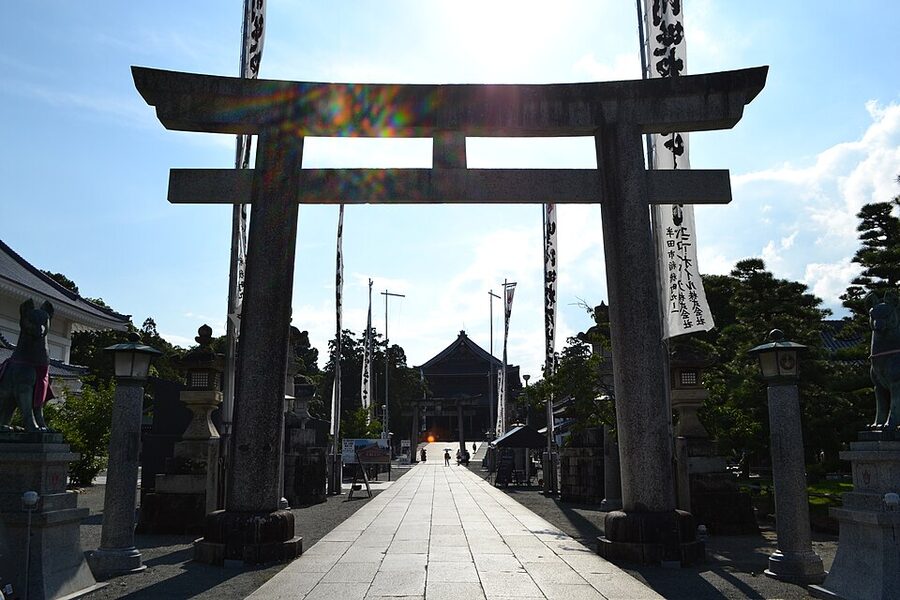
Of these, the Yokosuka branch is the smallest and the Sapporo the most recent. The Osaka branch is the one to visit if you are already in Kansai and cannot make the Aichi trip — it is about fifteen minutes’ walk from Osaka’s Tennōji Station. None of these is a substitute for the main precinct. But they are evidence of how wide the Toyokawa Dakiniten network spread after the 1872 consolidation.
Pairing Toyokawa with a bigger Aichi trip
The Aichi-Mikawa region, east of Nagoya, has the density of historical sites that makes a single-day temple visit feel wasteful. If you are already making the trip from Tokyo, consider a two- or three-day loop. Inuyama Castle is north of Nagoya in western Aichi, one of Japan’s twelve original surviving keeps, and sits about ninety minutes by train from Toyokawa with a change at Nagoya. Our Inuyama Castle piece covers the practical logistics.
Further north on the same line is Gifu Castle, the mountaintop redoubt most associated with Oda Nobunaga in the 1560s, and the nearby Saitō Dōsan site at Jōzai-ji. Going the other direction along the Tōkaidō towards Kyoto, you pass through Okazaki (Tokugawa Ieyasu’s birthplace; worth half a day on its own) and then Nagoya, whose castle, though a 1950s reinforced-concrete reconstruction, gets a serious modernist-tower cultural comparison.
Aichi has a further claim on the festival calendar worth mentioning. Tsushima Tennō Matsuri, the June float festival held at Tsushima Shrine in the western part of the prefecture, is a water-based matsuri on the Tennō River — a different kind of religious spectacle to Toyokawa’s fox-statue sobriety, and well worth pairing if your trip lands in late June.
Eating in the monzen-machi and the Inari-zushi question
The row of shops along the approach to the main precinct is the monzen-machi, the “before-the-gate town”, and it is where you go for Toyokawa’s actual culinary contribution to Japan. That contribution is inari-zushi (稲荷寿司): a pouch of toasted, sweetened deep-fried tofu skin (abura-age), filled with sushi rice and sometimes a mixed chopped filling.
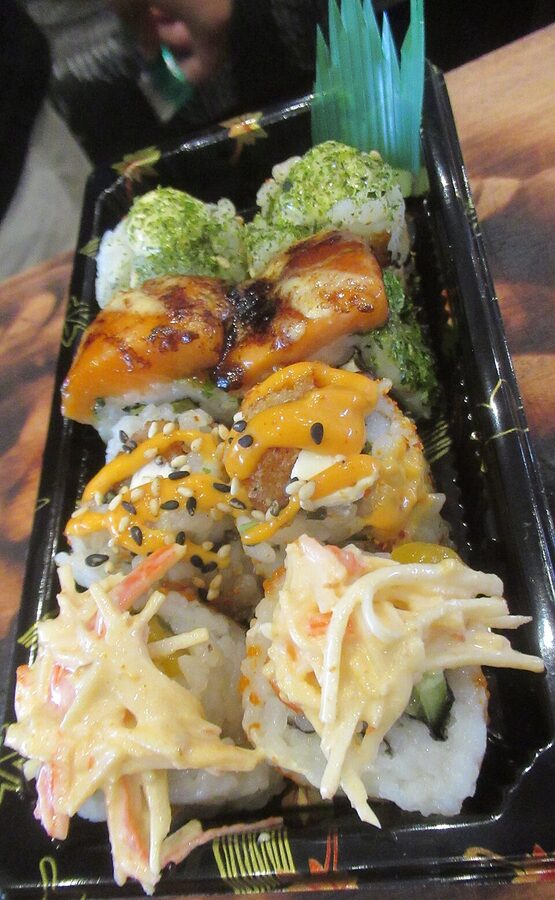
Local tradition in Toyokawa holds that inari-zushi was invented in the monzen-machi here during the early nineteenth century, with the aburaage pouch referencing foxes’ (legendary) love of tofu as a direct Inari-cult signifier. The claim is disputed — Nagoya and parts of the Kansai region have competing origin stories, and food historians generally consider the dish’s emergence to have been gradual across several regional sites. But the association between the Toyokawa precinct and inari-zushi is uncontroversial. The shops along the approach sell it in a dozen regional styles. A reasonable lunch of six pieces with miso soup will cost you around ¥1,200.
Two shops worth naming: Yamazaki and Yaotoku, both of which have been trading in the monzen-machi for at least three generations and serve variants of inari-zushi with a house-specific seasoning. Neither takes bookings. If you are visiting on a festival day expect a forty-minute queue for either. On an ordinary Wednesday you walk straight in.
If you have a further half-hour after the temple visit, detour west to Ohayashi, on the south edge of the monzen-machi, for soba-inari — a local variant that uses buckwheat noodles instead of rice inside the tofu pouch. I am not sure the combination works, but it is specific to here and worth trying once. The tea-serving rituals at Toyokawa are informal rather than ceremonial; if you want the formal experience, our separate piece on Japanese tea ceremony covers the chanoyu tradition in full.
What the Temple Tells You About Japanese Religion
Spend half a day at Toyokawa Inari and the assumption that Japanese religion divides cleanly into Buddhism and Shinto dissolves fast. Here is an old Zen Buddhist monastery with a torii at the entrance, a Shinto-adjacent name in popular use, a deity who is Indian-derived, Buddhist-registered and worshipped as a Shinto rice-kami, and a festival calendar that crosses both religious vocabularies without apology.
The explanation is historical. For over a millennium, from the ninth century to the 1860s, Japanese religion was officially a syncretic unified field called shinbutsu shūgō — a fusion in which kami (Shinto divinities) were theologically interpretable as manifestations of Buddhist entities, and Buddhist temples and Shinto shrines functioned as a common religious infrastructure. Most Japanese of the Heian, Kamakura, and Tokugawa periods would not have recognised a sharp Buddhist/Shinto distinction. The Meiji separation edict was a political act of the 1860s, not a return to some ancient natural state.
The same syncretic logic can be seen at some of Kyoto’s matsuri. Compare Gion Matsuri, the great July festival of Kyoto, which ritually honours the deity of Yasaka Shrine — a deity who was understood in pre-Meiji Japan as a manifestation of the Buddhist Gozu Tennō. You can still see the Buddhist elements of the Gion floats if you know where to look. Toyokawa is another facet of the same phenomenon: a Buddhist site that has absorbed, rather than expelled, the Shinto-style practice that grew up around it.
What this meant for the temple in practical terms is that Toyokawa Inari was never a single-purpose institution. It was a Zen monastery for the monks, a Dakiniten oracle for the daimyō, and a general-purpose Inari site for the merchant classes, all simultaneously. The Meiji edict forced a legal decision on the identity — Zen temple, as it happened — but did not eliminate the three-strand religious life that had built up over the centuries. That life is still there today, thinner than it was but continuous.
The Sculptor Tatekawa Wajirō and the Inner Ornament
One more specific point. The Tatekawa-ryū school of architectural wood-carving, based in Suwa in the Japanese Alps, was the single greatest decorative shop of the late Edo period, known for its relief carvings on temple interiors and palanquin-halls. The head of the second generation, Tatekawa Wajirō II (Tomimasa), together with his apprentice Miyasaka Tsunezō, produced the bulk of the carved decoration at Toyokawa.
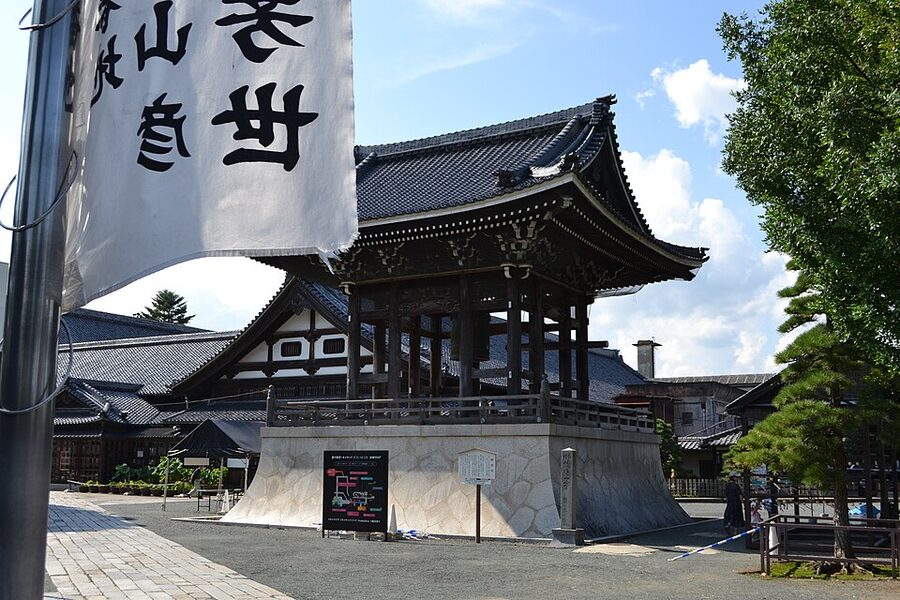
Most of this is hidden. The most elaborate pieces are inside the Honden shrine-chamber around the Dakini-shinten image, invisible to ordinary visitors. But the Sōmon doors, the carved details on the chinjudō (guardian hall), the ranma (transom) screens rescued from the old hondō (main hall) and re-installed in the new one, and the carvings in the Keiun-mon gate are all accessible on a careful walk-around. The old hondō, incidentally, was demolished in 2016 due to age, and a new hondō was consecrated in 2024. The original ranma were saved and set into the new building.
If you are at all interested in the carved wood traditions — the craft tradition behind ranma, kawara roof-tiling, tatami matting, and the whole range of Japanese architectural finishes — the Tatekawa-ryū work here is museum-level and usually overlooked. A researcher on the school has told me the Toyokawa holdings, combined with the Suwa home archive, constitute most of what survives from the second-generation output. You will not be guided to it. But if you know what you are looking at, it is there.
A Final Note on Pickpockets and the Night-Time Effect
One dry warning before I sign off on the travel notes. Toyokawa Inari has, since roughly the 1970s, been known in Japan as the particular site to petition for protection against theft. The reason is half folk-etymological (Ōoka Tadasuke was a magistrate, and his Tokyo branch became associated with judicial petitioning) and half commercial — merchants who had suffered break-ins came here in numbers for two centuries. The temple still sells o-mamori talismans specifically for thief-protection, and the joke among the monks is that these sell better than any other design on the counter.
A related point: the precinct has a yorumōde (night-time pilgrimage) tradition on the monthly ennichi days, when a section of the temple is lit and the fox-statues at the Reiko-zuka cast theatrical shadows. This is the single most atmospheric time to be in the precinct, though it happens only a few nights a year and mostly on the 22nd of each month (the monastic commemoration date of Tōkai Gieki’s original founding). The temple’s English-language page does not always publicise the schedule; check the Japanese site closer to the date.
Closing
The walk out is on the same path as the walk in. You pass under the Yamamon — the 1536 gate, the one piece of the precinct Imagawa Yoshimoto paid for before Oda Nobunaga killed him at Okehazama — and step back into the modern street outside. The monzen-machi is there, with the smell of toasted tofu pouches and vinegared rice. You can catch the five-o’clock train back to Toyohashi. On the platform the foxes will still be behind you, a kilometre away, a thousand of them, keeping their watch.
If you are already travelling the Tōkaidō between Tokyo and Kyoto, get off the Shinkansen at Toyohashi and take the twenty-minute detour. Come in the afternoon. Do not rush the Reiko-zuka. And when you eat the inari-zushi afterwards, remember it was invented here, according to at least one reasonable person, because the local monks needed something to sell to the pilgrims who kept showing up to pray to a deity nobody was quite sure whether to call a buddha or a kami. The answer, six hundred years later, is still both.