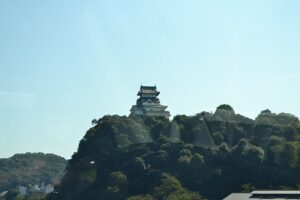
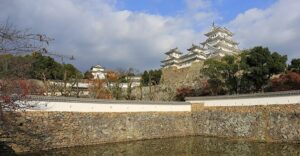
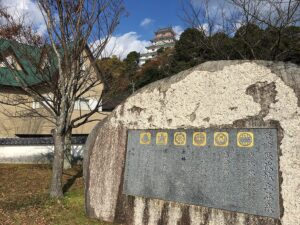
On 24 October 2015, the three-storey tenshu of Hirosaki Castle finished a 70-metre journey it had taken eight weeks to complete. The entire keep, a 400-tonne wooden building that has stood since 1811, had been jacked up, mounted on a rail-and-roller rig, slid fourteen times in staggered pushes, rotated twenty-five degrees to clear the stone wall, and parked on a temporary platform at the northwest corner of the honmaru. It is, as far as I can tell, the only time a surviving original-construction castle keep in Japan has been physically moved off its foundations and put back. The work took nine years, completed in 2024, and in the spring of 2025 they slid it all the way back.
I keep coming back to Hirosaki because the story of the keep is the story of the castle. The original 1611 five-storey tenshu lasted sixteen years before lightning detonated the gunpowder stored inside and blew the whole building apart. The current three-storey replacement, the one that got moved in 2015, is a legal workaround.
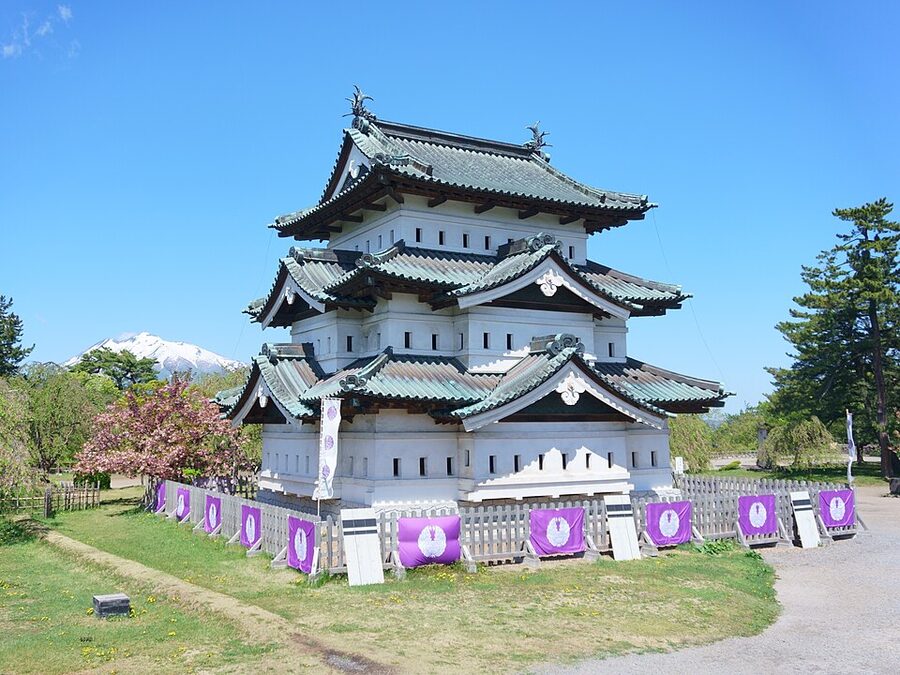
The ninth Tsugaru daimyo Yasuchika filed it with the Tokugawa shogunate as a rebuilding of a Ninomaru corner turret, not a new tenshu, because the Buke Shohatto of 1615 forbade new keep construction outright. The result is what Japanese castle guides delicately call “the de facto tenshu” — a 14.4-metre yagura built in 1811 to substitute for the main keep Hirosaki had been missing for nearly two centuries.
In This Article
- What Hirosaki Castle actually is
- Ōura Tamenobu and the 1590 Tsugaru break
- 1600 — Sekigahara and the 47,000 koku
- 1610–1611 — Nobuhira builds Takaoka Castle
- 1627 — lightning, gunpowder, and the end of the original tenshu
- 1810–1811 — Yasuchika builds a yagura that isn’t
- Meiji abolition — and the survival
- 1903 — the first 1,000 cherries
- 2015 — the keep that moved sideways
- Where to visit Hirosaki Castle today
- The main castle precinct and tenshu
- Hirosaki Sakura Matsuri — the late-April window
- Fujita Memorial Garden — the Meiji-era businessman’s house next door
- Hirosaki City Botanical Garden inside the Sannomaru
- Hirosaki History and Folk Museum
- Getting there — JR Hirosaki Station and the Dotemachi bus
- Aomori Nebuta Matsuri and the wider August context
- Tsugaru domain and the wider Edo context
- The other original-twelve castles and Hirosaki’s rank among them
- Returning to the keep that moved
What Hirosaki Castle actually is
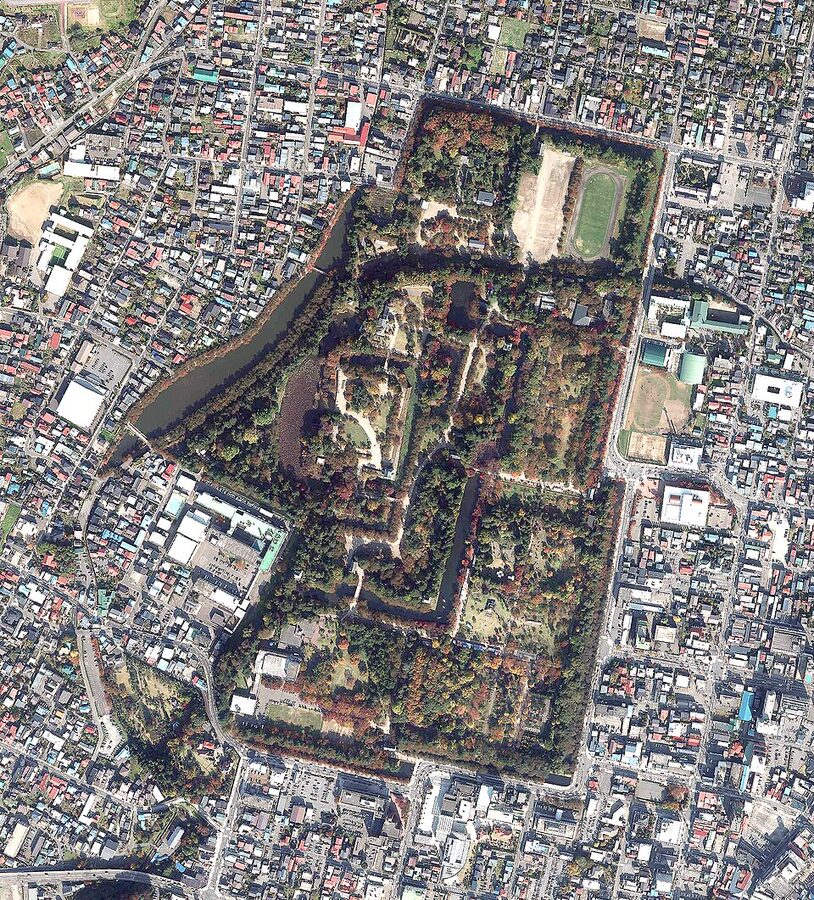
Hirosaki Castle (弘前城, Hirosaki-jō) is a hirayamajiro, a flat-hill castle, built on what is now the northern edge of central Hirosaki City in Aomori Prefecture, in the Tsugaru district of what used to be Mutsu Province. The keep complex sits inside six concentric baileys: the inner honmaru, the Ninomaru, the Sannomaru, the Yonnomaru, the Kitanokuruwa, and the Nishinokuruwa. The whole compound runs 612 metres east-to-west and 947 metres north-to-south, which makes it one of the larger surviving castle footprints in northern Japan. Its baileys were originally walled and moat-separated, and most of the moats and earthworks survive.
The castle is notable for three reasons that rarely cluster in a single site. It has an Edo-period original-construction tenshu — one of twelve such surviving keeps in Japan, alongside Matsumoto, Inuyama, Himeji, and eight others.
It has five original gates and three original yagura, all designated National Important Cultural Properties. And the surrounding Hirosaki Park holds about 2,600 cherry trees planted over roughly 120 years, making this the first-ranked cherry-blossom castle in Japan by almost every measure that matters.
It is also the only surviving original tenshu in Tohoku and the northernmost one in Japan. Wakamatsu Castle’s tenshu at Aizu and Matsumae Castle’s keep at the southern tip of Hokkaido were both lost in the twentieth century — Wakamatsu to Meiji demolition, Matsumae to a 1949 fire — and everything above Sendai is now either reconstruction or ruin. Hirosaki is the last original keep you can visit north of the Kantō region, and the only one you can photograph with Mount Iwaki in the background.
Ōura Tamenobu and the 1590 Tsugaru break
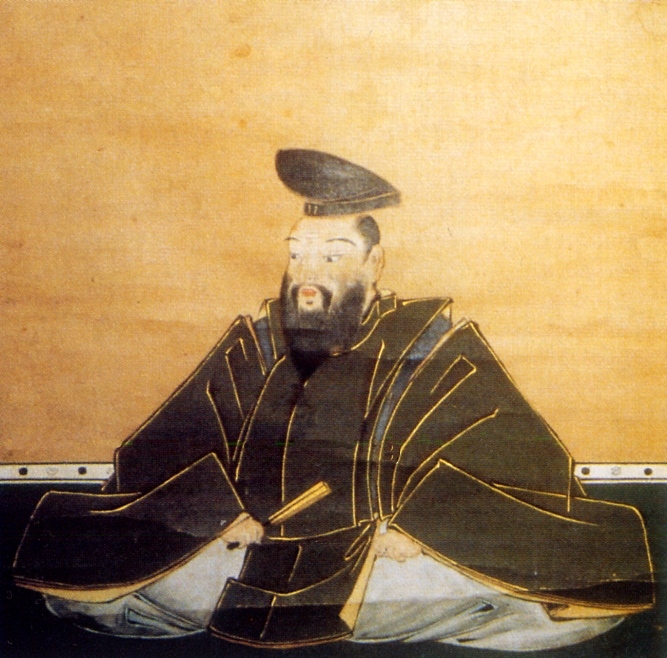
The story of Hirosaki Castle begins with a man who was, strictly speaking, somebody else’s retainer. Ōura Tamenobu (1550–1608) was born into the Ōura family, junior vassals of the Nambu clan who had held most of what is now Aomori and Iwate since the twelfth century. His family seat was Ōura Castle, a modest fortification west of the modern city of Hirosaki, and until his mid-thirties his life was the standard life of a regional second-tier samurai — holding ground, paying tribute, taking orders.
What Tamenobu did between 1571 and 1590 was the bold move that would separate the Tsugaru name from the Nambu forever. He used the twenty-year period of Nambu succession disputes to annex neighbouring Nambu fortifications — Horikoshi Castle in 1575, Ishikawa Castle in 1578, the Tsugaru Peninsula piecemeal through the 1580s — and by 1588 he was the effective sovereign of the Tsugaru plain, still technically sworn to the Nambu but ignoring them. The Nambu, preoccupied with their own internal wars and then with the Date in the south, never quite had the bandwidth to deal with Tamenobu’s gradual secession.
Then Toyotomi Hideyoshi called the Odawara campaign of 1590, and Tamenobu saw the opening. He beat the Nambu to the punch — rode south to Odawara faster than the official Nambu contingent, reached Hideyoshi’s camp first, and requested formal confirmation of his holdings as an independent daimyo. Hideyoshi, who enjoyed rewarding fait-accompli maneuvers that saved him the trouble of doing them himself, granted Tamenobu a 45,000-koku confirmation and told the Nambu, when they arrived, that the matter had already been decided. Tamenobu took the family name Tsugaru that summer and has been that ever since.
The 1594 move from Ōura Castle to Horikoshi Castle did not last. Horikoshi was militarily awkward — the castle town couldn’t hold enough retainers, the stone walls were too short, and the approach from the south wasn’t defensible. Tamenobu picked a new site at Takaoka (高岡), on the raised ground north of the Iwaki-gawa river crossing, and in 1603 ordered the layout of a new castle town there.
The town came first; the castle would follow. Tamenobu never saw it rise — he died in Kyoto in 1607, aged 58, before any construction had begun at Takaoka.
1600 — Sekigahara and the 47,000 koku
Between Tamenobu’s 1590 Hideyoshi confirmation and his 1607 death lay one more crucial move: the 15 September 1600 decision to side with Tokugawa Ieyasu at Sekigahara. Tamenobu did not fight in the main battle — he stayed in Tsugaru, holding his border against the Uesugi and the Mogami to the south — but he sent a written pledge of loyalty and his son Nobuhira’s presence in the Eastern camp, which was as much as a rear-region tozama like Tamenobu could sensibly offer. He was rewarded with a 2,000-koku increase, bringing Tsugaru-han to 47,000 koku.
The addition was a confirmation, not an expansion — 47,000 koku is a small-to-middling tozama domain, roughly the same size as Kirishima or Tosa-Hirokuni, well below the Maeda at a million koku or the Shimazu at 770,000. But it stabilised Tamenobu’s legal status.
He was now a confirmed Tokugawa retainer at full domain rank, not a Hideyoshi-era holdover of questionable standing, and that distinction mattered for the century that followed. The Tsugaru sat in the rank immediately below the senior northeastern tozama like Date Masamune‘s Sendai, which ran at 620,000 koku through most of the Edo period.
What the Sekigahara outcome did give Tamenobu was legal certainty to build. In 1603, the same year Ieyasu was appointed shogun, Tamenobu began laying out the Takaoka town, which would have been unthinkable without the confirmed status. A castle project in 1603 at the rank of a Hideyoshi-era holdover would have drawn bakufu attention; a castle project by a confirmed 47,000-koku Tokugawa retainer did not. Tamenobu and later Nobuhira played the status granted in 1600 for everything it was worth.
1610–1611 — Nobuhira builds Takaoka Castle
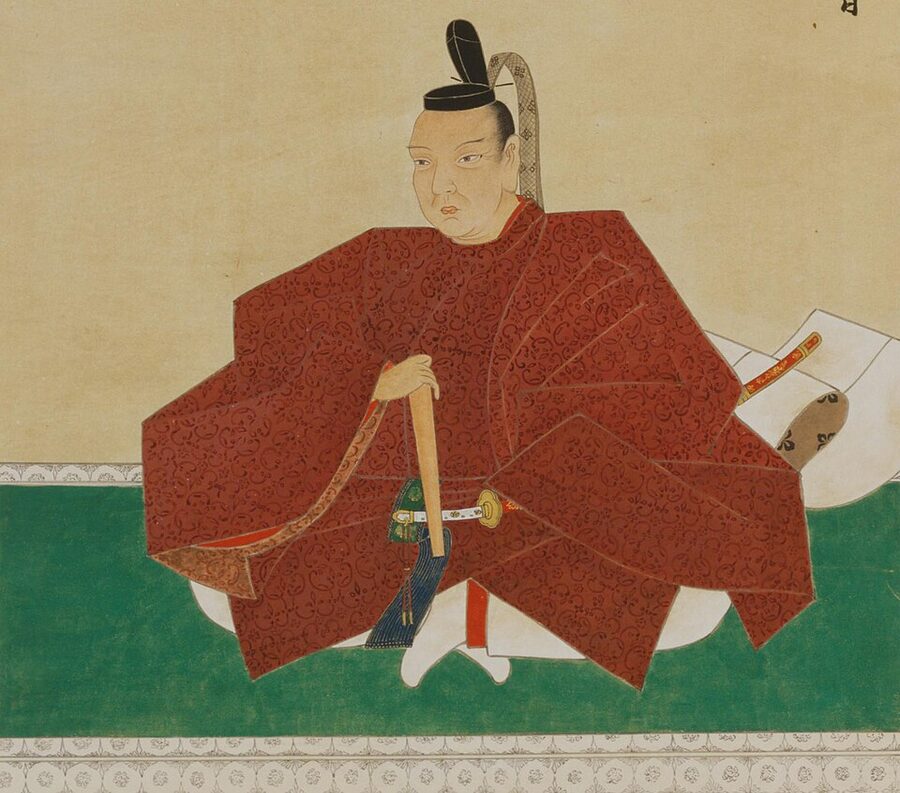
Nobuhira (1586–1631) inherited the Tsugaru seat at his father’s death in 1607 and the unbuilt castle at Takaoka along with it. For three years he did nothing. The Tsugaru-han financial accounts for 1607 to 1610 show the domain recovering from the cost of the Kyoto burial, consolidating the town layout, and stockpiling timber; the castle project restarted in the spring of 1610, one full generation after Tamenobu had first laid out the Takaoka town.
What Nobuhira did when he finally began was ruthless: he stripped every usable timber, roof tile, and stone block out of the older Ōura and Horikoshi castles and moved the materials north to Takaoka. This was how you built a castle in one year, which is what the 1611 completion date suggests. The Tsugaru Ittōshi, the 1731 domain-commissioned chronicle, is clear about Nobuhira’s material salvage programme — entire gateways were dismantled, numbered, transported, and reassembled at Takaoka. Two surviving gates today, the Kitanokuruwa North Gate and the Sannomaru Kita-uchimon, are known to have been moved from Daikōji Castle and Ōura Castle respectively, and more may have been.
The completed 1611 castle was substantial. Its original five-storey, six-floor tenshu on the honmaru’s southwest corner was, by consensus of Edo-period castle scholars, the second-largest keep in all of Tōhoku — surpassed only by the Ōtsuki five-storey at Aizu-Wakamatsu. Five castle gates, three three-storey Ninomaru yagura (the Tatsumi, the Ushitora, and the Hitsujisaru), a main hall (honmaru goten), and the full concentric moat system were all complete within the year, using older-castle materials to speed the schedule.
You can read Nobuhira’s marriage into the Tokugawa network as the other half of the 1611 completion. In 1610, one year before Takaoka Castle was finished, Nobuhira married Man-hime, a daughter of Ishida Mitsunari who had been adopted by Tokugawa Ieyasu after the purges of 1600.
The marriage was unusual, bringing a daughter of the executed Ishida into the Tokugawa succession graph, but politically it made the Tsugaru Ieyasu’s in-laws and bound the family into the inner ring of northeast Tokugawa retainers. A castle you built in one year in 1610 was a castle the shogunate would never question.
1627 — lightning, gunpowder, and the end of the original tenshu
Sixteen years after completion, a thunderstorm over Hirosaki during the evening of 12 September 1627 (Kan’ei 4) put a lightning bolt into the southwest corner of the honmaru. The strike hit the five-storey tenshu. The fourth floor of the keep held the castle’s gunpowder stores — standard Edo-period practice, because keeps were the best-defended buildings in the compound — and the bolt ignited the powder.
The explosion blew the upper three floors off the building. Fire took what was left, spread laterally to the honmaru main hall and several of the yagura, and by morning the original 1611 tenshu was gone.
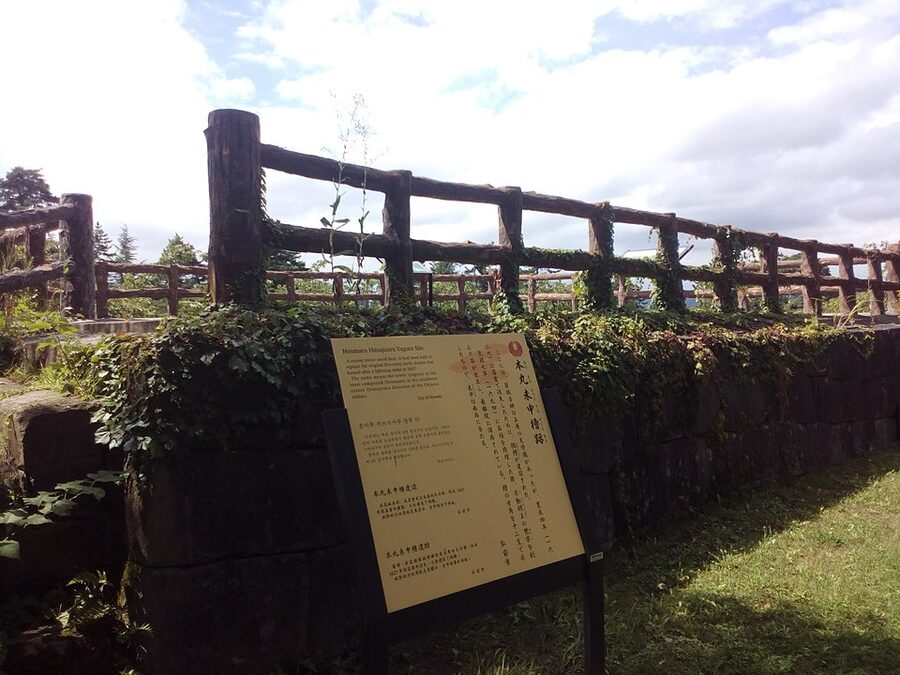
The stone foundation remained intact — it still stands today at the southwest of the honmaru, visible as a bare rectangle of stacked granite — but the wooden structure was not rebuilt. Not in 1628. Not in 1648. Not in 1698.
The castle went two centuries without a keep.
The domain lore attributes the disaster to a curse. Nobuhira’s aunt Ahogara, Tamenobu’s wife and the aunt-in-law of the daimyo, had reportedly died heartbroken after her husband, Dendan Sōemon, the castellan of Yokouchi Castle and a Nambu retainer, abandoned her during the 1590 secession to stay with the Nambu. Her ghost was said to have haunted Hirosaki Castle for the thirty-seven years between her death and 1627, and Edo-period chroniclers wrote the lightning off as her revenge.
I am agnostic about ghost stories. What I will say is that storing five barrels of gunpowder on the fourth floor of a wooden tower in a region of high summer thunderstorms was, curse or no curse, a poor strategic choice.
The year 1628 saw the castle renamed. On the recommendation of the Tendai priest Tenkai Daisōjō, the same Tenkai who had advised Ieyasu on siting the Tokugawa family shrine at Nikkō, Nobuhira renamed the place from “Takaoka” to “Hirosaki” (弘前), changing both the district and the castle. The new name would carry through the next three and a half centuries.
1810–1811 — Yasuchika builds a yagura that isn’t
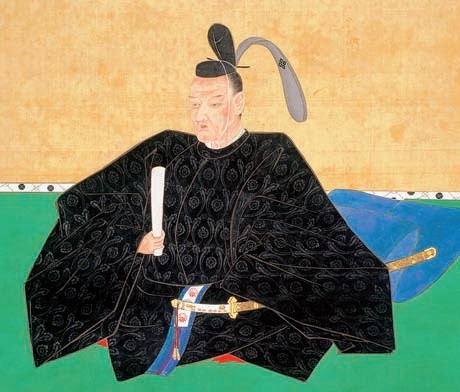
In 1810 (Bunka 7), two hundred years after the lightning, the ninth Tsugaru daimyo Yasuchika (1765–1833) made the decision to build a replacement. The pretext was a foreign-policy concern: Russian ships under Nikolai Rezanov had been harassing the Tsugaru Straits since 1806, and the castle needed a proper observation tower at its highest point. The Tokugawa shogunate’s Buke Shohatto of 1615 had forbidden new castle construction in absolute terms, but the rules allowed for the repair of existing structures. Yasuchika’s petition to Edo carefully framed the project as a rebuilding of the Ninomaru Tatsumi-yagura — a corner turret that already existed.
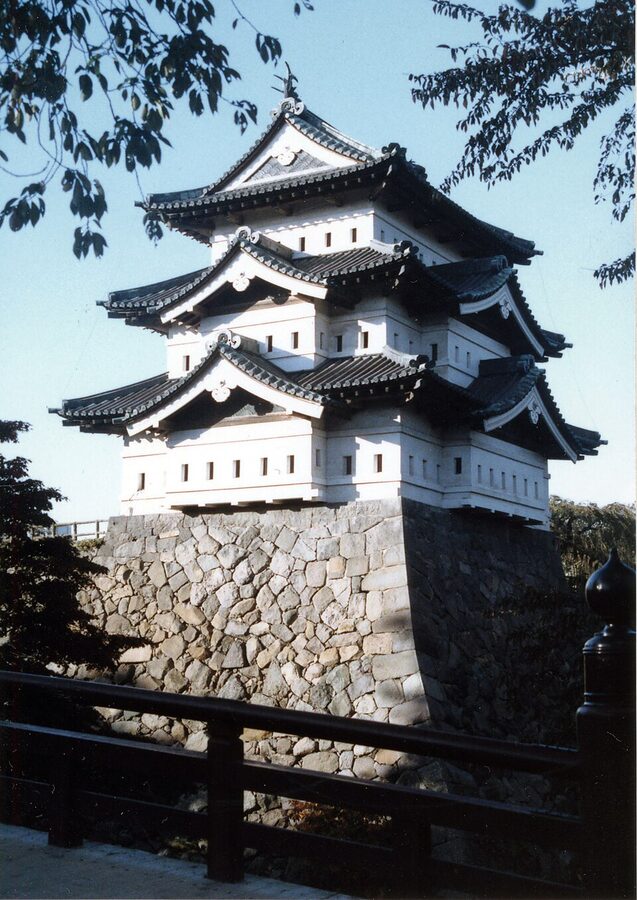
The shogunate approved the petition. Construction began in 1810 and finished in 1811, in just over twelve months. What the Tsugaru actually built was not a Ninomaru yagura at all — it was a three-storey, three-floor tenshu-in-fact, 14.4 metres tall, installed at the southeast corner of the honmaru rather than at the corner-turret location specified in the petition.
The original 1611 keep’s stone base at the southwest corner was left untouched, because touching it would have required filing a separate petition.
The design is clever. Seen from the east and south — the sides facing out of the castle, toward the approach roads — the building presents elaborate cut-out bay windows, lattice windows in decorative frames, and the standard tenshu three-tier roof with copper tiles. Seen from the north and west — the sides facing into the honmaru, the way a working yagura would naturally face — the building is plain: flat latticed windows, no bay cut-outs, no decorative gables. This is called ni-hō shōmen, “two-sided frontage”, and it is the architectural compromise of a man building a tenshu while officially constructing a yagura.
The internal construction tells you what the builders actually thought they were making. Normal Edo-period tenshu use top-grade aromatic hinoki cypress and cryptomeria, intricate joinery, elaborate shōji screens. Yasuchika’s Hirosaki keep uses the same timbers a normal yagura would use: standard-grade pine and cryptomeria, plain butt-and-peg joinery, no tatami flooring, no sliding screens.
The upper floors are essentially storage lofts, with bare plank flooring. The building was built to pass inspection as a yagura even if the shogunate bothered to look inside — and it did, once, in the 1840s, and found no grounds for complaint.
The cold-climate adaptations are where the building gives itself away as a permanent structure rather than a quick rebuild. The roof tiles are copper, not clay — standard kawara cracks when the Aomori winter freezes and thaws, and a working castle in the far north needed a roof that could hold through the 3-metre annual snow-fall.
The plaster walls are unusually thick, 18 centimetres rather than the 10–12 of an Edo yagura. And the window shutters are double-panelled against wind. None of this was needed for a temporary turret; all of it was needed for a tenshu meant to stand for centuries.
Meiji abolition — and the survival
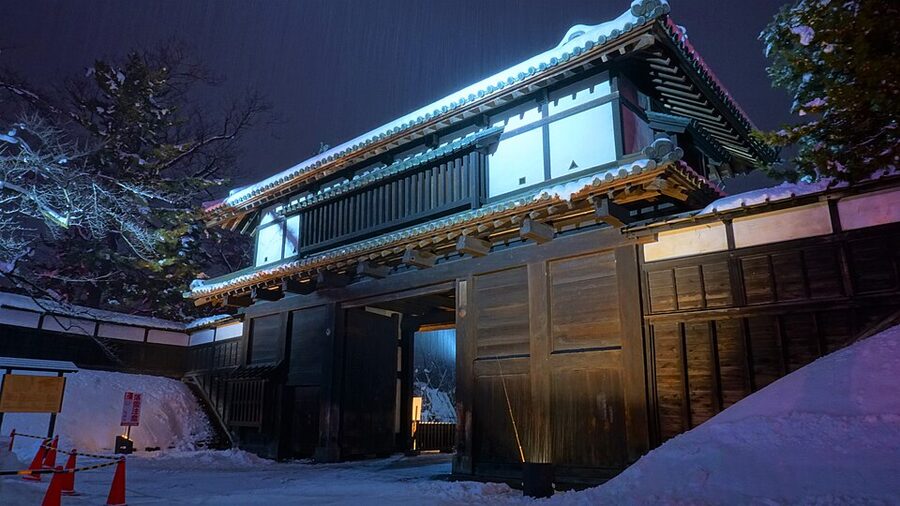
The Tsugaru surrendered Hirosaki Castle to the new Meiji government in 1871 as part of the general haihan-chiken abolition of the daimyo domains. The castle became the property of the Army Ministry, which stationed a garrison there in 1872 and used the honmaru platform as a drill ground. What saved the keep from general demolition was a quiet bureaucratic accident: the castle did not appear on either of the two lists — the Sonraku Chōjo preservation schedule or the Haijō Chōjo demolition schedule — that the 1873 Haijō-rei abolition ordinance issued. Castles not on either list were handled case-by-case, and Hirosaki was simply retained as army property.
In 1884 the army had the Honmaru Goten and the martial-arts training hall pulled down, because they had no use for them. The main keep, the five gates, and the three Ninomaru yagura were left alone. It was a near miss, at the same time the Meiji Army Ministry was demolishing Morioka Castle comprehensively and taking the roof off Nagoya Castle’s main keep, and if Hirosaki had been on the demolition schedule, it would have gone the way of Morioka.
What saved the keep institutionally was the former daimyo’s son, Tsugaru Tsuguakira, who in 1894 petitioned the Army Ministry for free use of the old castle grounds as a municipal park. The army approved on the condition that the Tsugaru family would pay the maintenance costs. The park opened to the public in 1895 as Hirosaki Park — formally Takayō-en (鷹揚園), “hawk-soaring garden”, a name given by Crown Prince Yoshihito (later Emperor Taishō) on his 1908 visit. The Tsugaru continued to pay the park’s maintenance until 1902, when the family declined further responsibility and Hirosaki City took it on.
The 1906 fire took two yagura — the Ko-no-yagura in the Kitanokuruwa and the Hitsujisaru-yagura (original) in the Nishinokuruwa. The 1909 bronze statue of Tamenobu, a four-metre-tall memorial commissioned for the three-hundredth anniversary of his death, was erected on the original southwest stone base of the lost 1611 tenshu. That statue stood for thirty-five years until the 1944 WWII metal levy took it for munitions; the Tamenobu statue currently visible in the castle grounds was recast in 2004 from 1909 blueprints, on a different base near the east gate.
In 1937 the surviving eight castle structures — the tenshu, three yagura, four gates — were designated Kokuho (National Treasures) under the old 1929 Preservation of National Treasures Law. In 1950, when the post-war Law for the Protection of Cultural Properties replaced the old National Treasure designation with the Important Cultural Property category, all nine surviving structures (the Sannomaru East Gate having been added after its 1953 reconstruction) received that status. Hirosaki ended the twentieth century with more original Edo-period castle structures than any other northern Japanese site — nine, against Matsumoto’s six.
1903 — the first 1,000 cherries
The 2,600 cherry trees that make Hirosaki Japan’s top-ranked sakura castle are the product of a 1903 decision by a retired Tsugaru retainer named Kikuchi Chōei. Kikuchi had served the Tsugaru han until 1871, lost his samurai status in the abolition, and spent the next two decades watching his old lord’s castle decline into a neglected army base and then a half-maintained municipal park. In 1882 he personally funded the planting of 1,000 cherry trees along the outer moat. It was not yet a festival — it was one man’s act of restoration.
The 1903 formal planting followed. Hirosaki City, now running the park on a municipal budget, used the 1898 establishment of the 8th Division Army Arsenal in the Sannomaru as the pretext for a substantial tree-planting campaign, framed as “beautification of the castle grounds for military morale”.
Kikuchi’s 1882 plantings formed the core; another 1,000 trees were added in 1903, and the variety selected was overwhelmingly Somei-Yoshino — the Edo-village grafted clonal cultivar that was becoming Japan’s default sakura in the Meiji period. Cross-reference this with my piece on Sakura Cherry Blossom for the full Somei-Yoshino monoculture story.
A second wave came in 1895, when another former Tsugaru retainer, Uchiyama Kakuya, planted 100 cherry trees to memorialise Tsugaru soldiers who had died in the Sino-Japanese War. Uchiyama kept planting through the Russo-Japanese War years; by 1918, when Hirosaki City officially designated the park’s annual flowering period as the Hirosaki Sakura Matsuri (弘前さくらまつり), there were approximately 2,300 trees in the park and the petal-carpet moat view was already a documented phenomenon in the Aomori regional press.
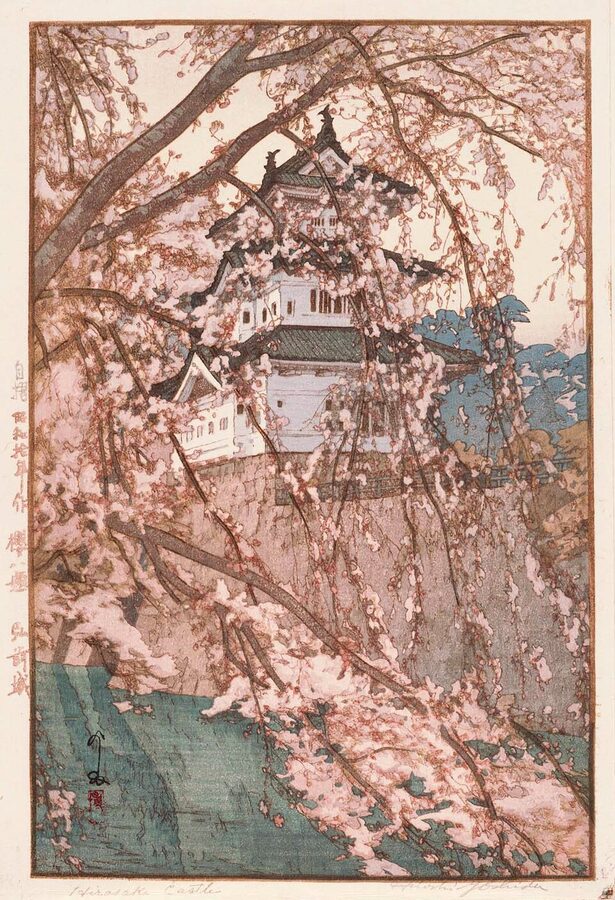
The tree count reached 2,600 by the late 1960s and has stayed there through active replacement — trees lost to age or disease get replaced one-for-one. The mix today is approximately 52 cultivars: the dominant Somei-Yoshino (about 1,700 trees, 65 percent), double-flowered yae-zakura (about 400 trees, 15 percent), and the rest a spread of weeping shidare-zakura, Yamazakura, and the Aomori-local Kambara-zakura. The cultivar mix gives Hirosaki a bloom window of about three weeks — Somei-Yoshino first in late April, then yae-zakura and shidare through early May — while a monoculture sakura park gets a single 7-to-10-day window.
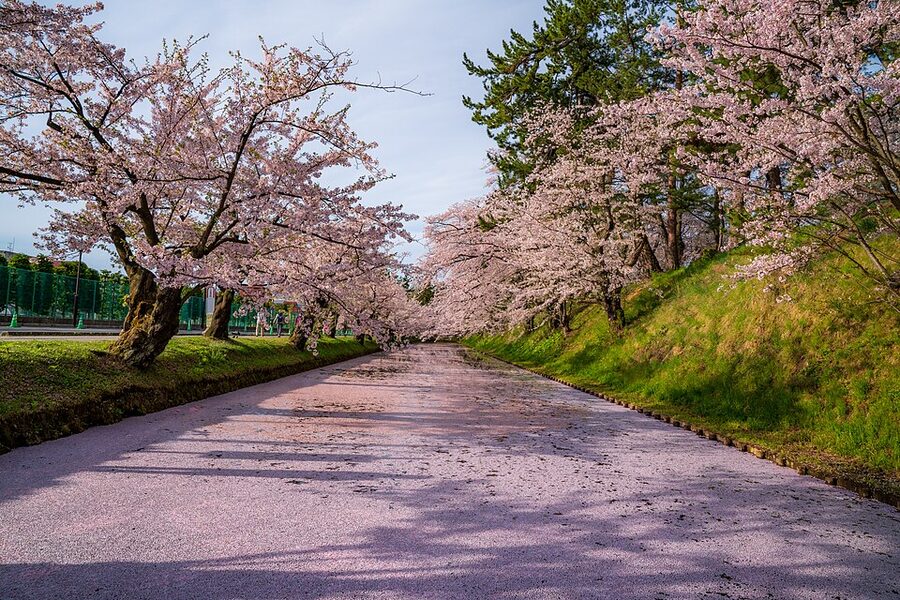
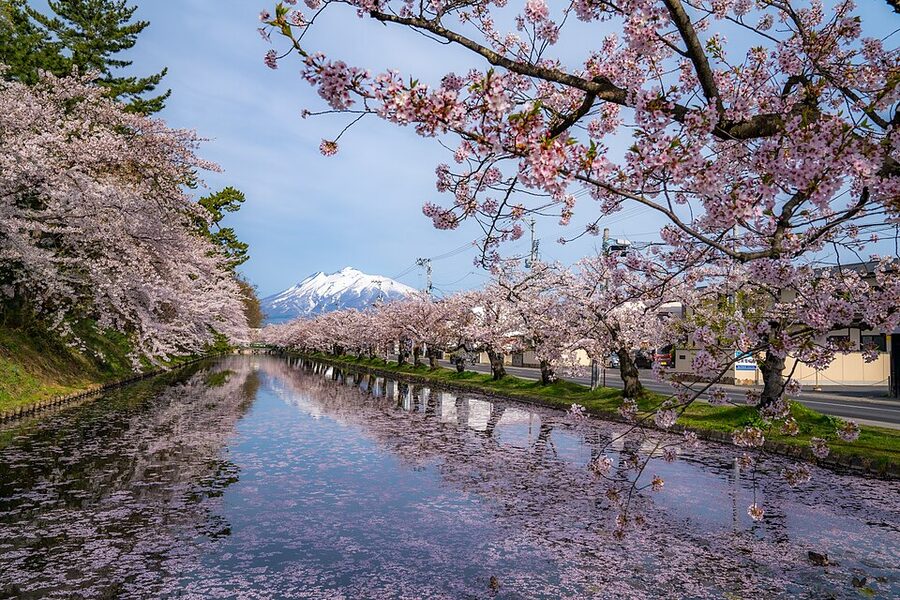
Two million visitors attend the Sakura Matsuri annually. The Japan Weather Association has ranked Hirosaki Park the number-one sakura destination in Japan every year since 2003, on criteria that combine tree count, water-framing, night illumination, and petal-carpet duration. No other castle in Japan has the full combination. Himeji has more impressive architecture, Yoshino-yama has more trees, Chidorigafuchi in Tokyo has the boat rides — but Hirosaki has all of it at once, and it is the only castle where the petal-carpet hanaikada effect reliably lasts a week on the moat.
2015 — the keep that moved sideways
In 2007 a routine inspection of the honmaru stone wall beneath the southeast tenshu discovered that the wall was bulging outward. Three decades of freeze-thaw cycles, the 1983 Nihonkai-Chūbu earthquake, and the 1994 Sanriku-Haruka-oki earthquake had each shifted the stones fractionally; by 2007 the deformation was 40 centimetres at the worst point and accelerating. Nara University’s castle-archaeology team, led by Professor Chida Kahaku, assessed that the wall would fail within twenty years if left alone. The tenshu above it would lean, then list, then come down.
The decision the Hirosaki castle foundation faced was stark. Either partial repair, replacing some of the bulged stones in place without moving the tenshu, which was unlikely to hold beyond a decade and would preserve the wall geometry poorly. Or complete disassembly-and-rebuild of the stone wall beneath the keep — which was the right archaeological answer but required the tenshu to come off the wall. The decision was made in 2012: move the tenshu off, do the wall properly, put the tenshu back.
The technique is called hikiya (曳家), literally “pulling the house” — the Japanese term for physically relocating a building by jacking it up, placing it on rollers, and sliding it sideways. Hikiya is an old technique; it has been used since the late Edo period to move farmhouses, shrines, and wooden commercial buildings in urban redevelopments. It had never been used on a surviving original-construction castle keep.
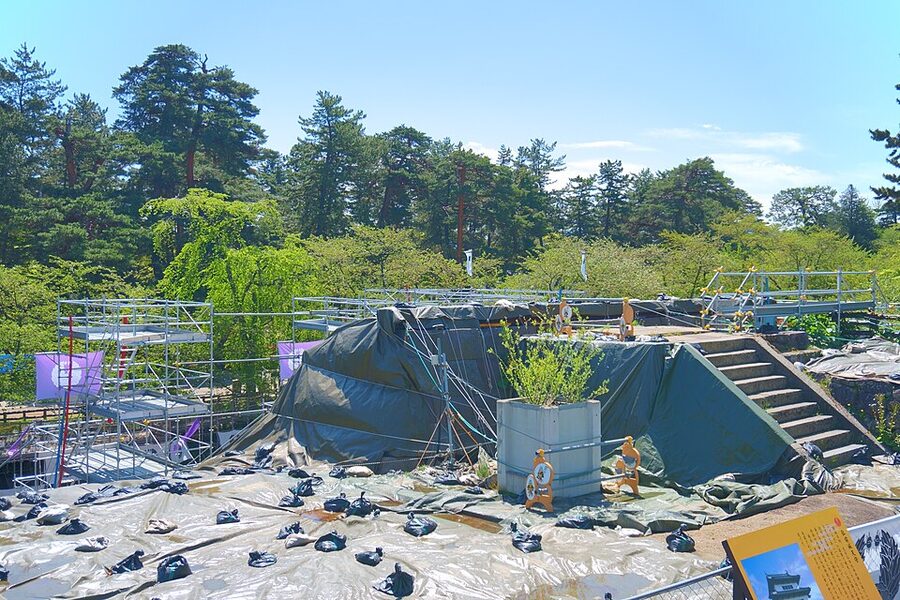
The contract went to two companies: Nishimura-gumi of Hirosaki for the local engineering coordination, and Gosei-gumi of Yonezawa in Yamagata Prefecture for the actual hikiya rig. Gosei-gumi had been moving wooden buildings since the 1950s, including temple halls and machiya townhouses, but nothing like a 400-tonne three-storey castle keep. They used a custom-fabricated steel rail system, 70 metres long, installed on the honmaru platform in the spring of 2015, and capable of taking the load on rollers spaced every 40 centimetres.
The August 2015 jacking phase took six weeks. The tenshu was lifted slightly off its stone base using forty synchronised hydraulic jacks, a process that took three weeks of careful incrementing — a millimetre a day, checked with laser level after every turn. The structure then spent two weeks suspended on temporary steel supports while the roller rig was installed underneath. On 3 and 4 September 2015, the first sliding operation moved the tenshu 32 metres northwest of its base.
On 13 September 2015, the ten-day mark, the tenshu was rotated 25 degrees on its roller rig to clear the stone-wall alignment. Rotation was the most nervous moment of the operation; the building’s centre of gravity shifted asymmetrically through the turn and the laser-level checks were continuous. Japanese castle structural engineers I have spoken to describe the 25-degree rotation as the critical pass. Between 14 September and 24 October 2015, the tenshu was slid the remaining 38 metres to the temporary platform at the northwest corner of the honmaru — a total journey of 70 metres.
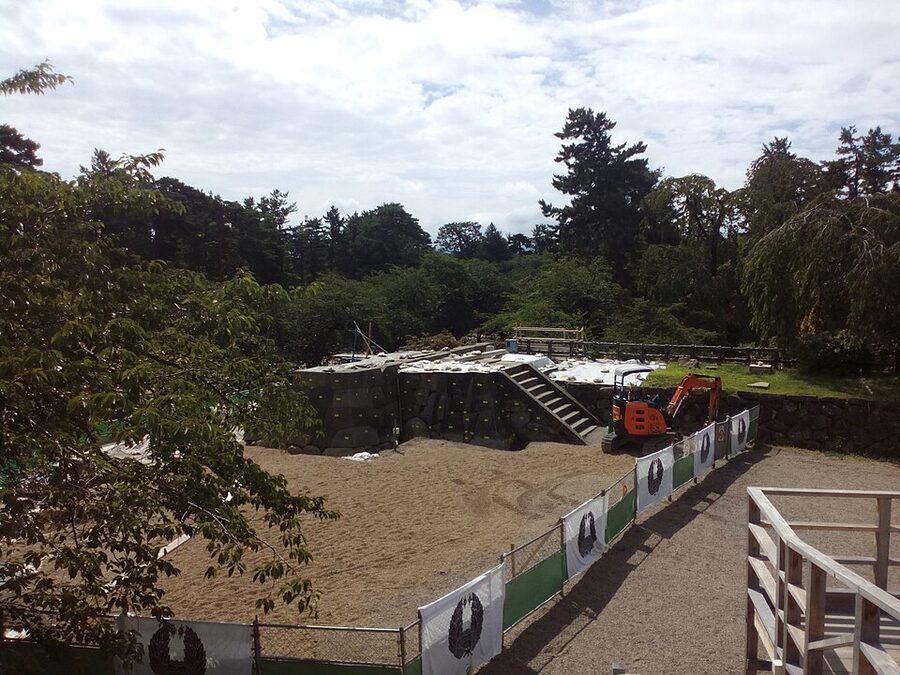
The stone-wall work ran from 2016 to 2024 — nine years for a wall that took six years to build in the 1610s. Each of the roughly 3,600 stones in the wall was removed, numbered, photographed, and laid out in a staging yard on the Sannomaru.
Stones with structural cracking or heavy weathering were replaced with fresh granite quarried from the original Hayachine-san source sixty kilometres south. The rest were cleaned, checked for fit, and reinstalled in exactly their original position. The wall geometry was restored to its 1611 dimensions using the 1663 Shōhō-jō Ezu-shūsei scroll at the National Archives of Japan as the reference.
The 2023 excavation under the original stone-base platform, once the wall was off, produced a genuine surprise: pottery and stone tools from the late Jōmon period (approximately 2,500 to 2,400 years ago). The material was sent to the Aomori Prefectural Museum for analysis. Hirosaki Castle sits on an occupation site older than the historical record.
The late Jōmon shards have been documented and reburied, the Tsugaru-han layer on top of them is the Important Cultural Property, but the record is permanent. I find this quietly satisfying: 2,500 years of people using the same ridge.
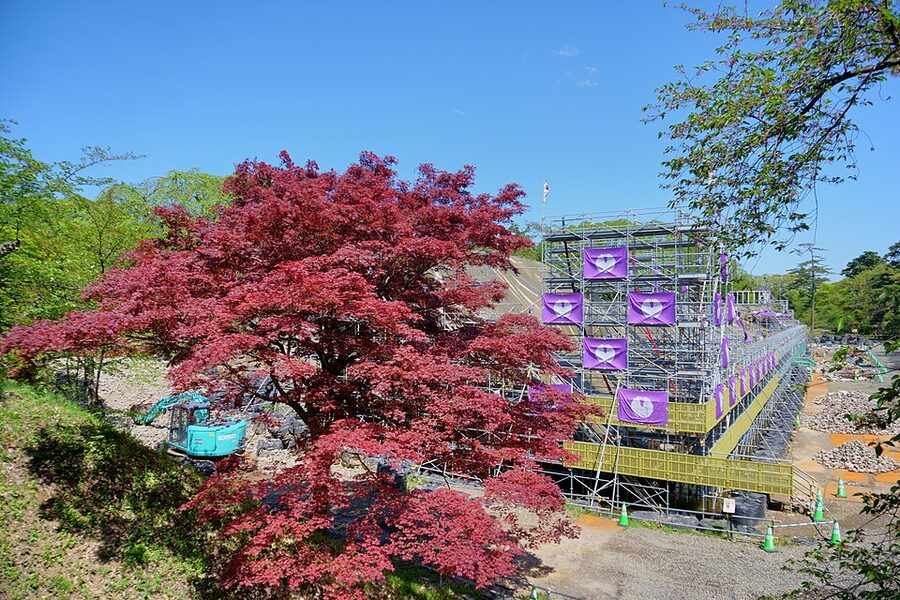
The return journey ran in spring 2025, in reverse of the 2015 sequence: 38 metres back to the rotation point, a 25-degree counter-rotation, then 32 metres home to the repaired stone base. The project foundation, Hirosaki City’s Kyōiku-iinkai (Education Commission), formally declared the tenshu restored on 15 April 2025, the week before the Sakura Matsuri opening. For the 2026 season, which I am writing this in advance of, the keep is back where it belongs for the first time in nearly a decade.
What the 2015–2025 operation actually demonstrated was that the hikiya technique scales to monumental wooden buildings without structural loss. The tenshu is unchanged; every original beam, plaster panel, and copper tile is in its original position. The stone wall is now in a condition it had not been in since the 1810s. If this project had worked 5 percent less well it would have been a catastrophe; as it is, it is the gold-standard operation for castle preservation work, and Japanese castle engineers are already quietly assessing whether the technique would work for the bulging walls at Aizu-Wakamatsu, where the reconstructed 1965 concrete keep sits on stones that the Nishimura-gumi is now confident they could disassemble.
Where to visit Hirosaki Castle today
Hirosaki Park is open year-round as a public space. The paid-entry inner zones — the honmaru with the tenshu, and the Kitanokuruwa with the Kitamon — are April 1 to November 23, 9am to 5pm, ¥320 adult entry (¥100 children). The off-season months still let you walk the outer baileys and see the gates, yagura, and moats for free, which is a substantial experience on its own.
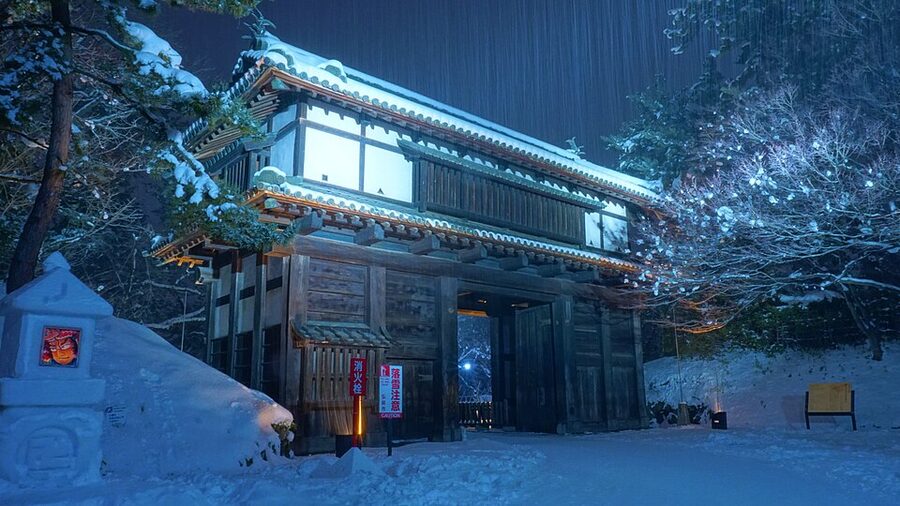
April and early May are the Sakura Matsuri window; late October and early November are the Chrysanthemum and Autumn Leaves Festival; February brings the Snow Lantern Festival. You can usefully visit in any season.
The main castle precinct and tenshu
The three priorities inside the castle are the tenshu, the five original gates, and the three Ninomaru yagura. Give yourself two hours minimum, four if you want to read every interpretive panel.
The morning slot, 9am to 10.30am, is the cleanest — the bus groups haven’t arrived yet and the light on the east face of the keep is best between 10 and 11. The ¥320 honmaru ticket includes entry to the Kitanokuruwa, so take both in one visit.
Enter from the south through the Sannomaru Ōtemon, the main gate, and walk north across the Sannomaru to the Ninomaru Minami-uchimon. The tenshu is now back on its southeast honmaru base after the 2025 return. The interior is open at staircase sections only; you climb two flights of internal steps and emerge on the third floor with the signature moat-and-sakura view through the ni-hō shōmen windows. Spend twenty minutes inside and another thirty circling the base from the moat path.
The three Ninomaru yagura — the Tatsumi, the Ushitora, and the Hitsujisaru — are all on the Ninomaru platform and all accessible from the same ticket. Each is a three-storey turret of the 1611 generation; they are structurally almost identical to the tenshu and were the castle’s main defensive towers for the 200 years between the 1627 lightning and the 1811 rebuild. The Hitsujisaru has the best preserved interior. Twenty minutes for all three is enough.
Hirosaki Sakura Matsuri — the late-April window
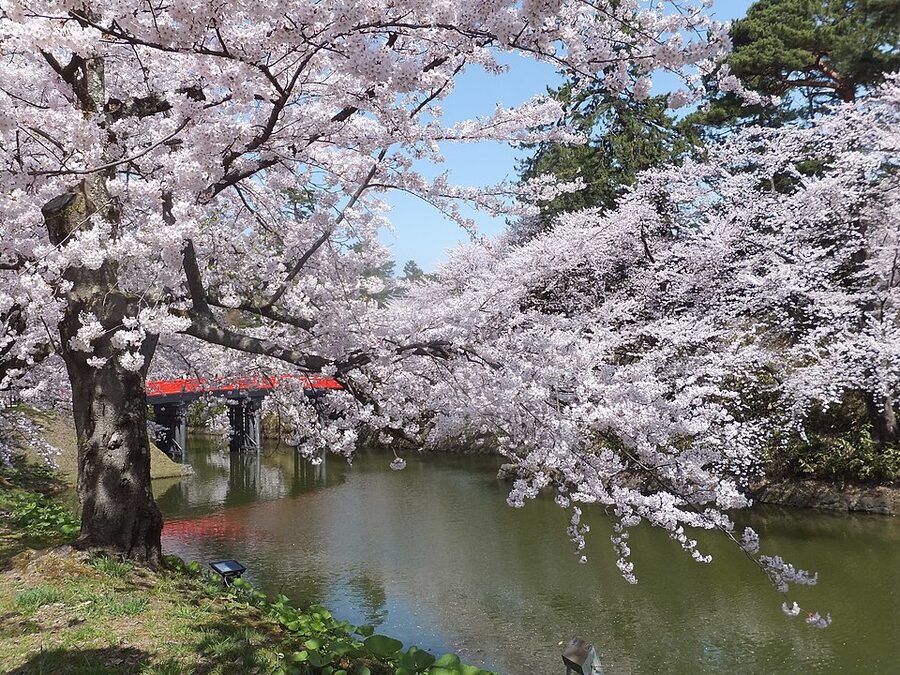
The Sakura Matsuri runs from about 23 April to 5 May depending on bloom timing, and the castle foundation posts its forecast by the first week of April on the Hirosaki Tourism and Convention Association site. Peak Somei-Yoshino bloom is typically four or five days inside the festival window; the hanaikada petal-carpet effect forms two or three days after peak. The full cultivar sequence — Somei-Yoshino, then yae-zakura, then shidare — gives a workable bloom period of about two weeks, which means even an ill-timed visit usually catches something.
Two million visitors attend the festival annually — about half during the 18:00-to-22:00 night-illumination window. If you are serious about the photography, go early morning (05:30 sunrise) and again during the 19:00 illumination. The food stalls and funfair concentrate in the Sannomaru and are avoidable if you want to; the core sakura experience is the honmaru moat path and the west moat petal-carpet. The experience is wordlessly good, and I am not prone to exclaiming, so read that carefully.
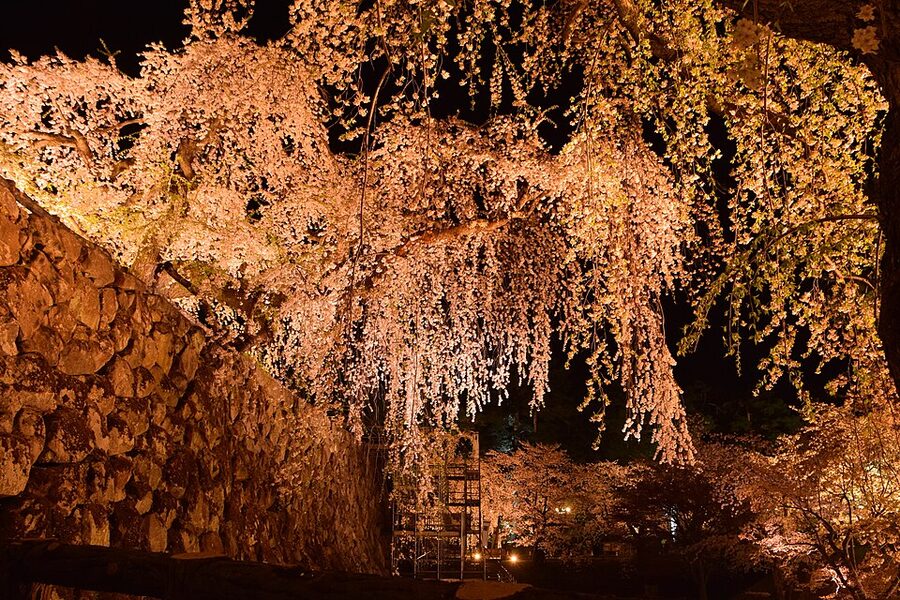
If you are photography-serious, three positions repay patience. The west moat petal-carpet view, taken from the west-moat path during mid-morning light three days after peak. The honmaru tenshu-with-sakura-foreground view, taken from the south approach at 15:00-16:00 when the south face catches the low western sun.
And the night-illumination reflection on the inner moat, taken from the Harue-bashi bridge at about 20:00. You will see other photographers in all three positions; it doesn’t matter.
Fujita Memorial Garden — the Meiji-era businessman’s house next door
A fifteen-minute walk southwest from the west moat takes you to the Fujita Memorial Garden (藤田記念庭園), which is one of the best small gardens in Tohoku. The site is the former Hirosaki residence of Fujita Kenichi (1873–1946), an Aomori-born Meiji businessman who made his fortune in railways, banking, and electrical utilities, and who wanted a proper Japanese garden adjoining a European-style residence — the standard move for a self-made late-Meiji industrialist. He hired the Tokyo-based landscape architect Nagai Tadao to design it in 1919.
Nagai’s 1919–21 design is a kairaku-tei double-garden. The upper garden preserves the Japanese-style house on the high ground, with pine-tree plantings and a cut-stone path down the hill. The lower garden is a full-sized strolling pond with a bentenshima (弁天島) central island and Taisho-era stone lanterns around the water edge.
The combination is rare, most surviving Meiji merchant gardens are single-style, and the overall aesthetic is closer to Kairakuen in Mito than to anything else. For more on the strolling-garden form see my broader piece on Japanese Gardens.
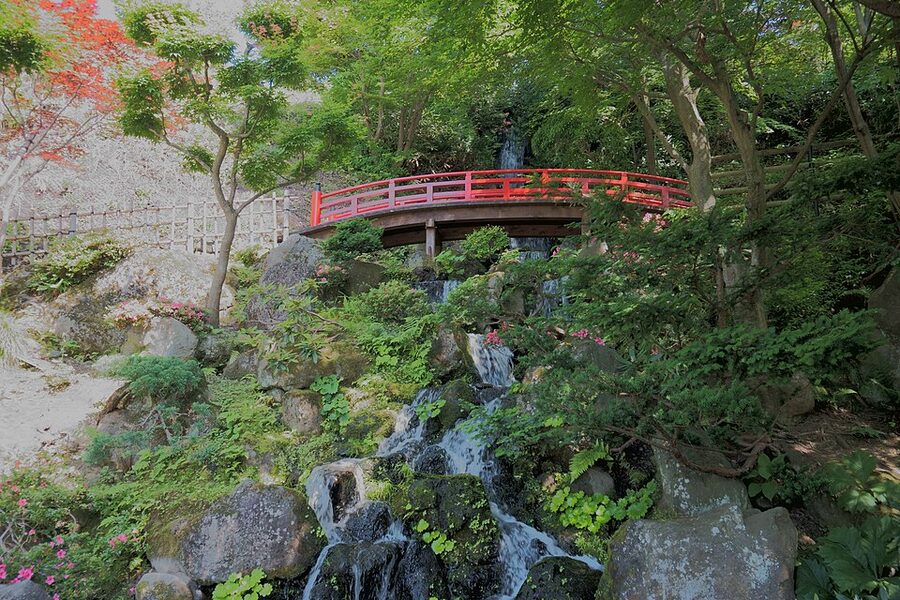
Spend ninety minutes here. The teahouse at the pond edge serves ceremonial matcha and a seasonal wagashi sweet for ¥500 — it is one of the better small-garden tea experiences in the north of Honshu, though the space is compact and at Sakura Matsuri peak you will wait thirty minutes.
See my Tea Ceremony piece for what to expect from the matcha service. Entry is ¥320 standalone or free if you hold the Hirosaki Park combined ticket.
Hirosaki City Botanical Garden inside the Sannomaru
The Hirosaki Shokubutsuen (弘前城植物園), Hirosaki City Botanical Garden, sits inside the castle Sannomaru — entry is included in the combined castle ticket. It runs seven hectares with about 1,500 plant species, heavy emphasis on Aomori-endemic and Tohoku alpine flora. The rock-garden section in the southeast corner is the best — it replicates the upper-slope flora of Mount Iwaki in miniature, with plantings of the same high-altitude rhododendrons and azaleas you would see at 1,200 metres on the mountain itself.
I recommend the botanical garden as a forty-five-minute detour rather than a destination. It is dense and quiet, and the castle stone-wall and yagura are visible through gaps in the planting, which makes it a good perimeter walk in late morning when the honmaru crowds are peaking. The seasonal highlights are late May (rhododendron peak), late June (iris), late September (acer). Skip it in February — the winter display is thin.
Hirosaki History and Folk Museum
The Hirosaki-shi Rekishi Minzoku Shiryōkan (弘前市歴史民俗資料館), the Hirosaki History and Folk Museum, is a five-minute walk east of the castle’s Sannomaru East Gate on the Tsugaru-shi border. The building is a 1979 reconstruction in pseudo-Edo style, but the collection inside is serious: Tsugaru-han documents from 1611 onwards, Nobuhira’s personal effects (his sword, a pair of stirrups), Yasuchika’s 1810 construction petition to the shogunate in original manuscript, and a scale model of the 1627 tenshu reconstructed from the Tsugaru Ittōshi descriptions.
The 1627 lightning-destroyed five-storey keep model is worth the museum ticket on its own. It shows the original tenshu footprint — 20.5 metres per side versus the current keep’s 8 metres — and lets you see at a glance just how much bigger the original was than Yasuchika’s yagura-disguised 1811 replacement.
Allow one hour for the museum. It is not well-signed in English; the model is in the second-floor room toward the back.
Getting there — JR Hirosaki Station and the Dotemachi bus
Hirosaki Station sits on the JR Ōu Main Line, the old pre-Shinkansen line that runs the length of the Japan Sea coast of Tohoku. From Shin-Aomori Station (terminus of the Tohoku Shinkansen, reached from Tokyo in about 3 hours 10 minutes on the Hayabusa service) you take an Ōu Main Line limited express, usually the Tsugaru or the Super Hakuchō service, and the journey is 45 minutes. Total travel from Tokyo is 4 hours by the fastest Shinkansen-and-limited-express connection.
From JR Hirosaki Station to the castle you have three options: a taxi (¥1,000, 8 minutes), a walk (1.8 kilometres, 25 minutes), or the Dotemachi Junkan bus — the Hirosaki “castle circulator” ¥100 municipal service, 10-minute ride, get off at the “Shiyakusho-mae” stop three minutes’ walk from the Ōtemon Gate. The Dotemachi bus is the correct choice nine times out of ten. It runs every 15 minutes from 10:00 to 18:00 and costs less than a can of coffee.
If you are driving, and the Hirosaki hinterland rewards a rented car, the Tōhoku Expressway’s Ōwani-Hirosaki Interchange is 30 minutes by road southeast. Castle parking is at Hirosaki City Hall (Shiyakusho) or at Fujita Memorial Garden, both ¥300 per hour. During Sakura Matsuri the city closes a lot of the central streets and runs festival shuttle buses from dedicated park-and-ride lots outside the centre.
Aomori Nebuta Matsuri and the wider August context
If you are in the Tsugaru region between 2 and 7 August, you should not spend the entire time at Hirosaki — you should divide your days between Hirosaki and Aomori City 45 minutes north, where the Aomori Nebuta Matsuri runs the full week. The Nebuta is one of the three great festivals of the Tohoku — massive illuminated float parades, huge drum processions, the hanetō dancers — and it is the one Tohoku festival an international traveller should see once. Aomori Station is 40 minutes by Ōu Main Line limited express from Hirosaki.
Hirosaki runs its own Hirosaki Neputa Matsuri (note: neputa with the hard T, different from Aomori’s nebuta) from 1 to 7 August, which overlaps with the Aomori festival. Hirosaki’s Neputa floats are the older fan-shaped form — large painted wooden fans on mobile platforms, pulled through the castle town streets in the evening.
The dichotomy is that you can see Hirosaki Neputa in the early evening, take the 9pm express to Aomori, and catch the Nebuta’s late night. Do this on at least one of the festival days. Compare the two festival forms with my piece on the Gion Matsuri for what “yama” versus “hoko” versus “float” differentiation means across Japan.
Tsugaru domain and the wider Edo context
The Tsugaru ran their 47,000-koku domain for 281 years across eleven daimyo — Tamenobu, Nobuhira, Nobuyoshi, Nobumasa, Nobuhisa, Nobuaki, Nobuyasu, Nobuakira, Yasuchika, Yukitsugu, and Tsuguakira — from 1590 to 1871. The domain’s annual income ran at just under 40,000 koku in real terms (the 47,000 official figure was inflated for status reasons); the han budget was stretched thin by the sankin-kōtai obligation that took the daimyo to Edo every second year with a retinue of 120–150 men and a 720-kilometre journey each way.
The Tsugaru Edo residence was in Shitaya-Hirokōji (present-day Ueno) and survived into the Meiji period as the Tsugaru Kō-kan. It was demolished in 1888 to make way for Ueno Park. The Edo-residence layout is documented in the 1795 Tsugaru-han architectural ledger and the ground plan is occasionally displayed at the Hirosaki History and Folk Museum.
Sankin-kōtai ate 40 to 60 percent of Tsugaru-han’s annual disposable budget — more than the average mid-sized domain, because the journey was longer. It is the reason the 1627 tenshu was never rebuilt; the money simply wasn’t there.
The Tsugaru cultural legacy beyond the castle is larger than the domain’s size would suggest. Tsugaru-shamisen — the fast, percussive shamisen style — emerged here in the late Edo and is the best-known single-instrument folk tradition from Tohoku. The Tsugaru-nuri lacquerware tradition, documented from the 1670s, uses a multi-layer polishing technique that is still made in about eight workshops in modern Hirosaki. Ringo-apple cultivation, introduced in 1875 and now 58 percent of Japan’s national apple production, runs through the Iwaki plain on former samurai-domain paddy land that transitioned to orchards after the Meiji abolition.
The castle is not isolated from this wider Tsugaru context. Walking the honmaru path at sakura season you will hear Tsugaru-shamisen from street musicians along the Sannomaru — Hirosaki still teaches the form at the Hirosaki University Music Department and the city hosts an annual Tsugaru-shamisen competition in early May. The festival stall tables will serve you Tsugaru-nuri lacquer bento boxes for ¥800. And the apple-blossom at the hinterland orchards peaks two weeks after sakura, giving you a second pink-bloom destination if you stayed long enough.
The other original-twelve castles and Hirosaki’s rank among them
Hirosaki is one of twelve surviving Edo-period original-construction tenshu in Japan, and in the context of the others its position is specific: smallest, northernmost, only survivor in Tohoku.
The list, with dates, runs: Inuyama 1585 (original timber), Matsumoto 1596–97 (oldest by dendrochronology), Maruoka 1576 traditional / 1948 post-earthquake reconstruction (disputed status), Kōchi 1611, Himeji 1609 (the great white tenshu), Hikone 1606, Bitchū-Matsuyama 1683, Matsue 1611, Marugame 1660, Iyo-Matsuyama 1602 (re-tenshu 1854), Uwajima 1666, and Hirosaki 1811.
Hirosaki is the youngest of the twelve — the 1811 rebuild-as-yagura date makes it two centuries younger than Matsumoto and Inuyama, and it is the only one of the twelve to have been built post-Buke Shohatto (which was supposed to make new keeps impossible). Of the other eleven, eight are in western Japan; Hirosaki, Matsumoto, and Inuyama are the only three in central-to-northern Honshu. None of the other eleven have the sakura density. None of them have been physically relocated. None have the Jōmon-era layer underneath.
If you are planning a multi-castle tour of original tenshu, my recommended sequence is roughly chronological by build date: Maruoka (if you accept the attribution), then Inuyama, Matsumoto, Hikone, Himeji, Matsue, Kōchi, Marugame, Uwajima, Bitchū-Matsuyama, Iyo-Matsuyama, Hirosaki last. The logic is that Hirosaki at the end gives you the post-Buke-Shohatto epilogue to the tenshu tradition — the moment Japanese castle-building stopped and was preserved in amber. The other eleven are pre-1715 or thereabouts.
The informal “Seven Famous Castles” list, published by novelist Shiba Ryōtarō in his Kaidō wo Yuku travel essay series, includes Hirosaki alongside Matsumoto, Himeji, Kumamoto, Hikone, Inuyama, and Matsuyama. Shiba’s list is not canonical — he was a novelist, not a castle scholar — but it is widely cited and it captures the sense that Hirosaki is in the top rank despite its small size. The Japan Castle Foundation’s 100 Fine Castles list, which is canonical, ranks Hirosaki at number 4.
Returning to the keep that moved
The 2015 hikiya operation was not the moment Hirosaki Castle became famous. The castle had been famous since 1903 for the sakura, since 1937 for the National Treasure designation, since 1950 for the Important Cultural Property status, and since 2006 for the top-4 ranking in the Japan Castle Foundation’s list. What 2015 did was give the building a story of its own again, after two hundred years in which the Yasuchika rebuild had simply stood where it was and been photographed.
What you will see in 2026 is a tenshu back on its original stone base, the stone wall freshly disassembled and reassembled with 3,600 numbered blocks, the Jōmon layer reburied underneath, and 2,600 cherry trees coming into bloom around the honmaru moat. The hikiya rail system is gone from the platform. The temporary concrete support in the northwest is dismantled. Except for the slightly crisper stone wall, and the plaque, you cannot tell the keep moved at all.
If you are travelling to Tohoku anyway, go to Hirosaki. Do it in late April if you can stand the crowds; in mid-October if you can’t. Walk the west moat before the buses arrive. Climb the tenshu. Find the Tamenobu statue near the east gate, and think about a man who bet on Hideyoshi in 1590 and then on Ieyasu in 1600 and ended up with a 47,000-koku domain and eleven descendants who held it for 281 years. And in the honmaru, stand on the original southwest stone base, where the 1611 five-storey tenshu burned in 1627, where nothing stood for two centuries, where the 1909 Tamenobu statue stood for thirty-five years, and where there is now a bare rectangle of granite with a small plaque.
The keep that moved sideways is on the other corner. It took nine years to put it back, and the people who did it cared about every numbered block. That is the kind of preservation story I come to Japan for.