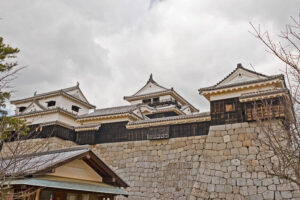
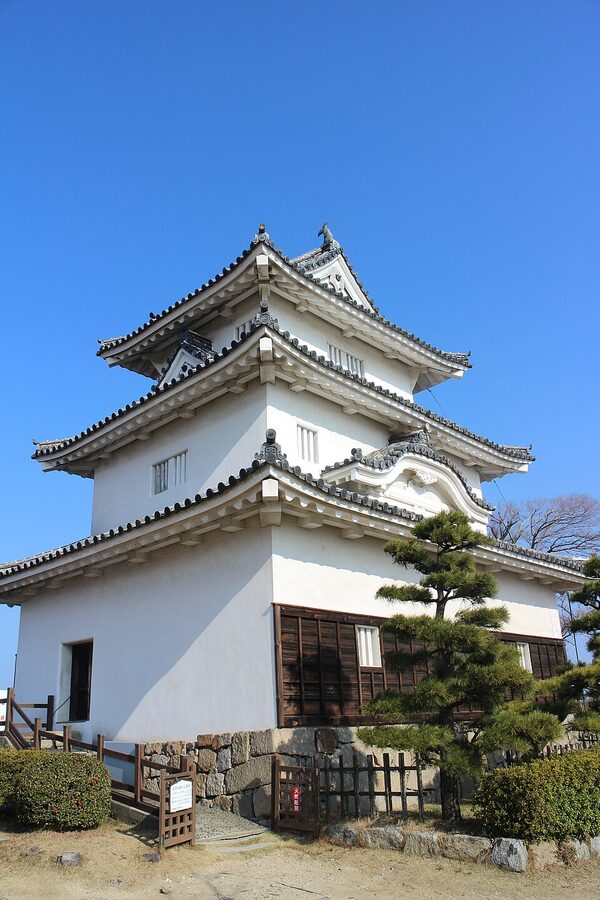
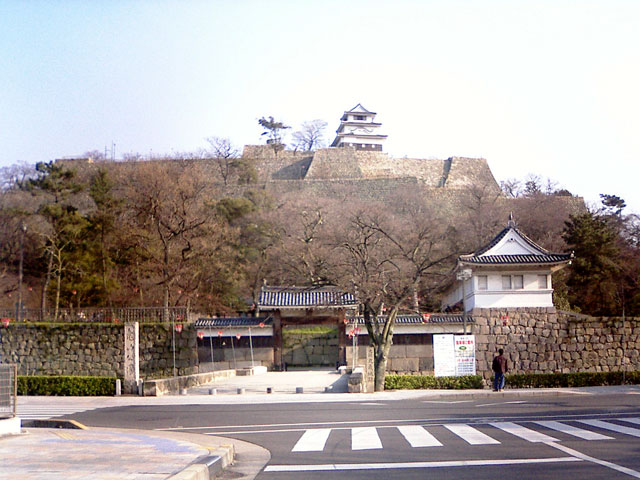
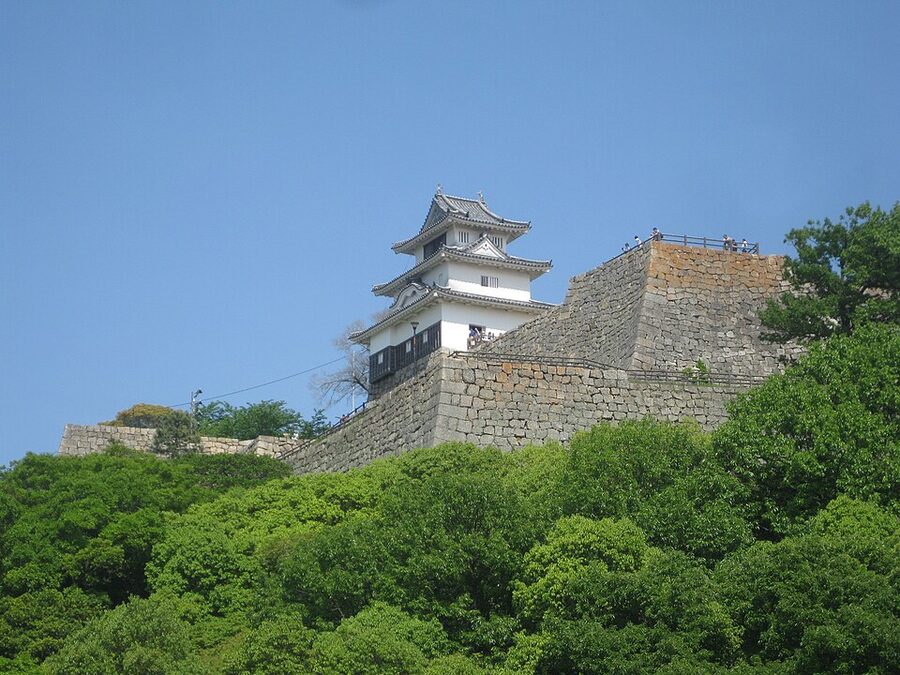
The first time you spot Marugame Castle from the Sanuki plain, you are probably not looking at the keep. You are looking at the stone. A fifteen-metre wooden tenshu, the smallest surviving original in Japan, sits on top of the tallest flight of ishigaki anyone ever built.
That ishigaki is a three-tier stack of chert and granite that climbs roughly sixty metres out of Kameyama hill. You can see those walls from a train window fifteen kilometres away. You can walk up to the foot of the keep and lose it against the Shikoku sky inside fifty metres.
That upside-down silhouette, a toy castle perched on a cathedral of stone, is why I keep coming back to Marugame. The place refuses the grammar I learned from Himeji or Osaka, where bigger stone carries bigger timber. Here the ratio breaks. Here the wall is the castle, and the keep is only the jewel on its finger.
In This Article
- The paradox, in numbers
- Ikoma Chikamasa lays the first stone, 1597
- 1615: the edict that nearly erased Marugame
- The Ikoma fall and the Yamazaki interlude
- The Kyōgoku rebuild and the tenshu of 1660
- The ishigaki, by far the real masterpiece
- The climb, and why your calves will hate you
- Inside the keep: the four windows and the plank floors
- The Meiji survival story
- Seasons at Marugame: cherry, plum, and the winter light
- The Seto Inland Sea view, and Sanuki Fuji
- The day-trip: Mannō-ike and Kūkai’s water
- Marugame among the twelve originals
- The castle town and Takahama Kyoshi
- Evening at Marugame: the illumination
- The onward question: Shikoku beyond Marugame
- Practical details and a half-day plan
- Photographing Marugame Castle
- Why you keep coming back
The paradox, in numbers
Twelve original castle keeps survive in Japan, meaning twelve tenshu that have stood since the Edo period without being rebuilt in concrete. I have now walked through nine of them. Marugame is the shortest by a clean margin, and by most measures the humblest.
The tenshu is about fifteen metres tall, three storeys, with a footprint so modest that a modern apartment block would eat it for lunch. The stone base it stands on, however, is not modest at all. Measure from the outer moat to the top of the keep’s foundation and you are looking at roughly sixty metres of dressed stone across four stacked terraces.
That makes Marugame’s ishigaki the tallest combined stonework in any Japanese castle. Individual walls at Osaka Castle are impressive in a single shot, but nowhere else in Japan do you get four full terraces stacking clear up a hillside like this.
You feel the number in your knees before your eyes catch up. The path from the Otemon gate to the keep rises in switchbacks against the stone, and every time the angle turns you lose the tenshu and refind the wall.
Ikoma Chikamasa lays the first stone, 1597
The story of Marugame begins with a Hideyoshi general named Ikoma Chikamasa. In 1587 he was handed the entire province of Sanuki, what is now Kagawa, worth 171,800 koku of rice. That is a substantial province, and Chikamasa set up his primary residence at Takamatsu Castle on the north coast.
Western Sanuki was too far from Takamatsu to govern comfortably, so in 1597 Chikamasa began a secondary castle on Kameyama hill in Marugame. It took about five years. By 1602 the outline you now call Marugame Castle was largely complete, stone walls and all, with Ikoma retainers installed as caretakers.
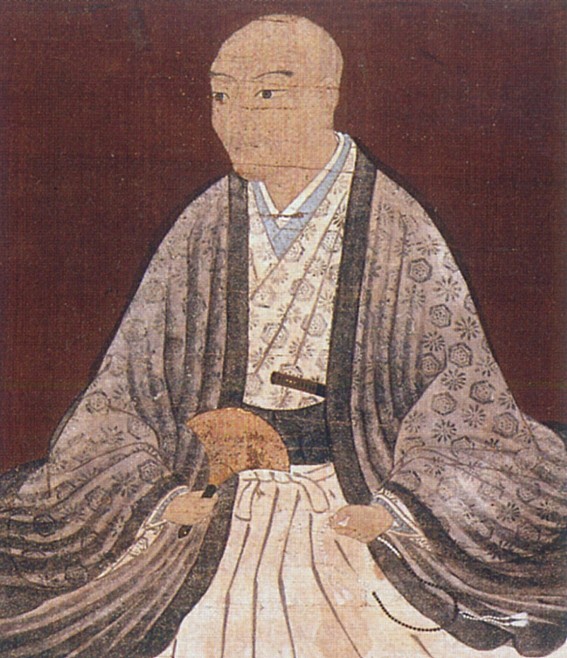
Chikamasa is worth a small detour. He had fought under Toyotomi Hideyoshi through Yamazaki, Shizugatake, Odawara, and Korea, and he owed his Sanuki lands directly to Hideyoshi’s favour. When the loyalty question came to a head in 1600, however, Chikamasa pulled a trick I still find astonishing.
He himself sided with Ishida Mitsunari’s Western army and stayed in Sanuki attacking Tanabe Castle by proxy. His son Ikoma Kazumasa rode east to fight for Tokugawa Ieyasu. Two Ikomas on two sides of the Battle of Sekigahara, one clan insured against either outcome.
It worked. Kazumasa’s Eastern service saved the domain. Chikamasa shaved his head, took Buddhist vows, and retired to Mount Koya before dying at Takamatsu Castle in March 1603.
His Marugame project was, by then, already standing on its hill. The first generation of stonework, the base courses of the ishigaki you can still touch at the Otemon gate, date from exactly this window between 1597 and 1602.
I find it almost unbearable to stand at the base of those lowest stones and understand what they witnessed. Hideyoshi was dying in Kyoto. Korea had just collapsed. Chikamasa’s own lord was about to be betrayed, and the stonemason laying the first course had no idea which new regime would be auditing his work within five years.
Kameyama hill itself was chosen for brutally practical reasons. It is an isolated rise on the flat Sanuki coastal plain, close to the natural harbour at Marugame, and far enough west of Takamatsu to command the province’s maritime border with Iyo. The geology is basalt and chert, both hard and both locally available.
1615: the edict that nearly erased Marugame
In 1615 the new Tokugawa shogunate issued the Ikkoku Ichijo-rei, the “one castle per province” decree. Every domain had to pick its primary fortress and demolish the rest. It was a power move dressed as a disarmament treaty.
The Ikoma had already committed to Takamatsu as their seat. Marugame, the secondary castle, was duly slighted. Buildings came down. The tenshu of that first generation was lost.
Crucially, the stone walls survived. You can partially demolish a wooden keep in a fortnight with a rope team. You cannot reasonably demolish sixty metres of packed ishigaki without financial insanity, so the Ikoma covered the old foundations with branches and pine trees and walked away.
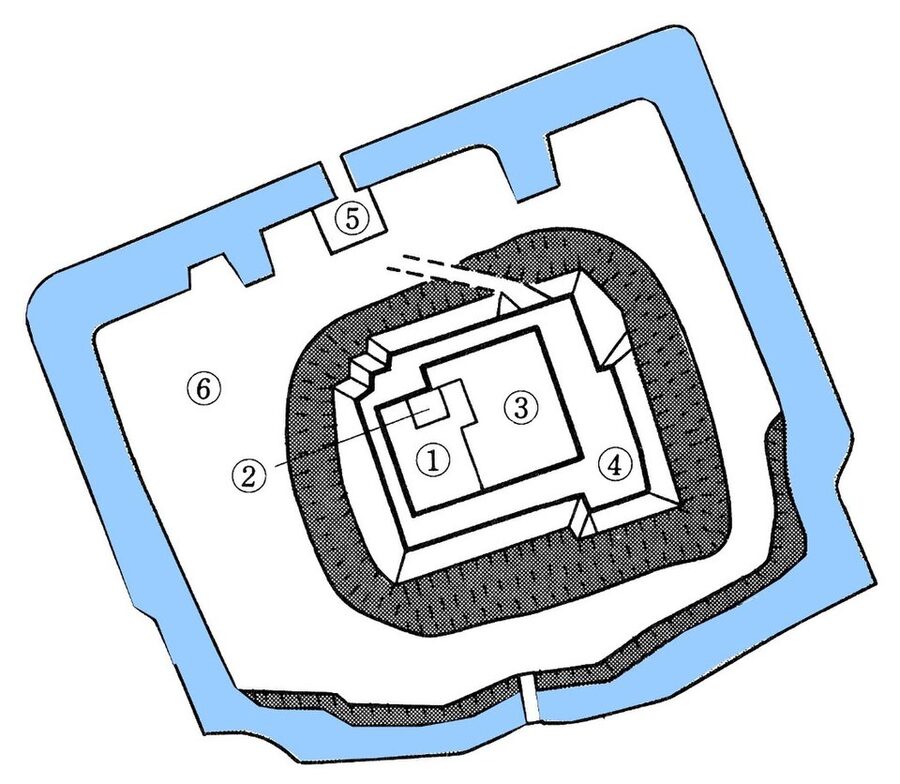
That twig-and-pine camouflage is probably apocryphal, but there is a real point in it. The ishigaki was simply too expensive to tear down properly. An Edo shogunate auditor would have accepted the missing roof and moved on, which is why the stone platform is older than the keep it supports.
You see the same pattern at other castles across western Japan. At Bitchu Matsuyama the demolition was so thorough that only a corner of the old tenshu remains. At Tsuyama and Bizen Takamatsu the walls were partially dismantled and now look like ruins in the Greek sense, platforms without their temples.
Marugame is unusual because the entire ishigaki stack survived. That continuity of stone is what makes the later Kyōgoku rebuild possible as a restoration rather than a new construction. Whatever was lost between 1615 and 1658 was wood. The bones of the place persisted.
The Ikoma fall and the Yamazaki interlude
By 1640 the Ikoma had mishandled an internal dispute called the Oie Sōdō badly enough to attract the shogun’s attention. They were stripped of Sanuki and exiled to a tiny one-prefecture rump holding in Dewa. Sanuki got split between two new lords.
A man named Yamazaki Ieharu arrived in western Sanuki in 1641 with orders to rebuild Marugame. He did, and his clan ran the domain for three short generations. When the last Yamazaki died without an heir in 1658, the castle and the province changed hands again.
The replacement was a cadet branch of the Kyōgoku clan, transferred south from Tatsuno Domain in Harima. They came with sixty thousand koku and roughly three hundred years of aristocratic pedigree that reached back to the Ashikaga era and beyond. The new daimyo was Kyōgoku Takakazu.
The Kyōgoku rebuild and the tenshu of 1660
Takakazu and his heir Kyōgoku Takatoyo are the men whose decisions you actually see today. Takakazu arrived in 1658, surveyed Yamazaki’s half-built repairs, and ordered a proper completion on top of the old Ikoma stone platform. The new three-storey tenshu was finished in 1660.
This is the keep you can still walk into. It is a compact composite layered tower, fifteen metres from base to ridge, whitewashed walls under black tile roofs with a small ornamental gable on each face. The interior is three bare plank floors connected by absurdly steep staircases.
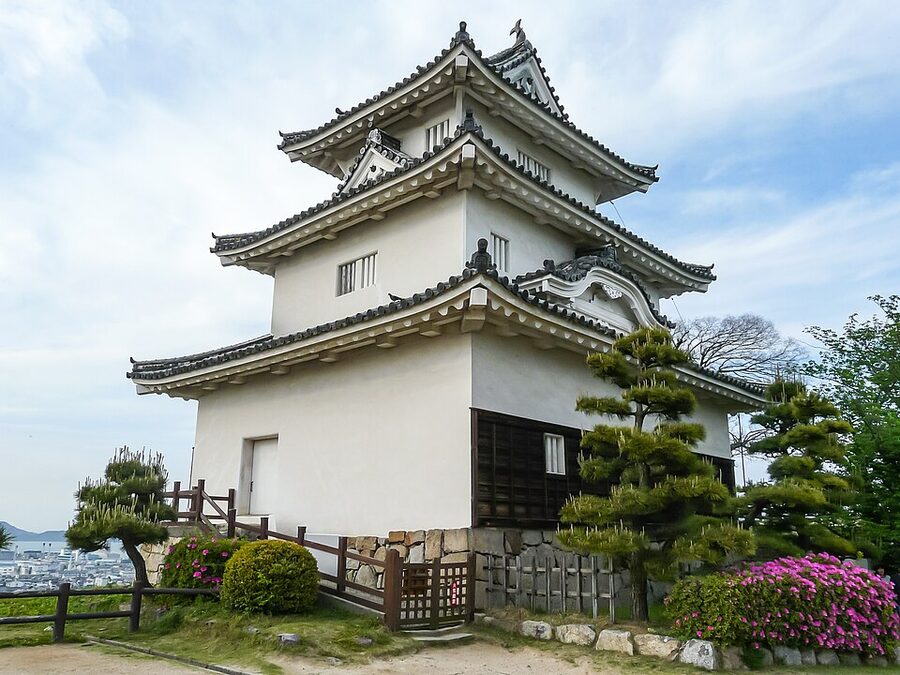
Why so small? The answer is partly politics and partly budget. The Kyōgoku were wealthy but not sixty-thousand-koku-Himeji-rich, and the shogunate of 1660 was no longer in the mood to approve grand new towers that could double as military projects.
Takakazu was also pragmatic. He already had the tallest stonework in the country holding up a commanding view of the Seto Inland Sea. A giant wooden keep on top would have looked ostentatious and added little to the military calculation. You defend this castle from the stone, not the tower.
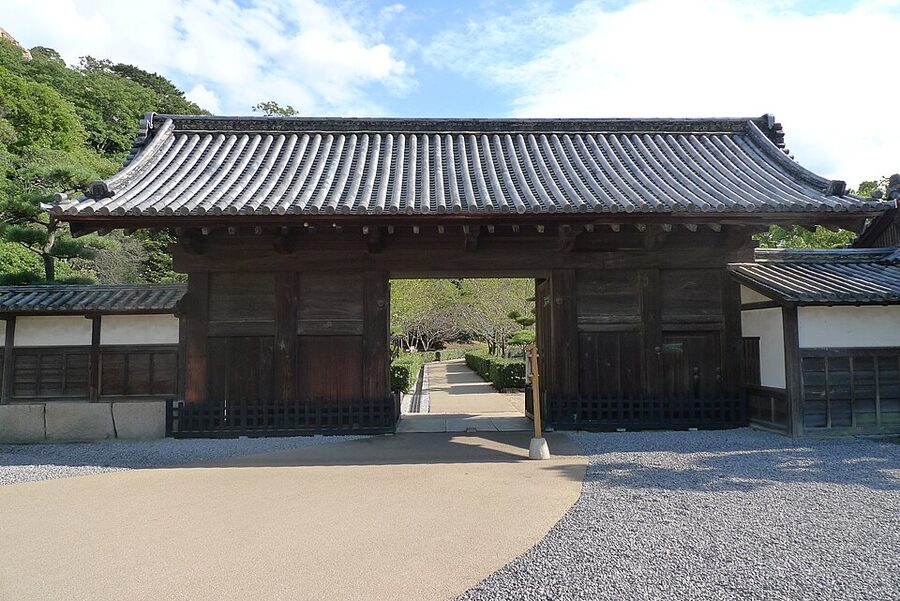
The Ote Ichi-no-mon and Ote Ni-no-mon gates at the foot of the hill were completed in 1670, around a decade after the keep. They are themselves Important Cultural Properties and still the proper way in.
The Kyōgoku family itself is worth a paragraph of context. They trace their lineage to the Sasaki clan of the Kamakura period, one of the oldest aristocratic lineages in provincial Japan. By the late sixteenth century they had splintered into several branches, including one line that married into the Catholic politics of Tango and another that served Tokugawa Ieyasu directly from Sekigahara onward.
The Tatsuno cadet branch that came south to Marugame in 1658 was the more orthodox Tokugawa line. Takakazu brought with him 60,000 koku, which was less than the Ikoma or Yamazaki had held, but enough to maintain the castle and the domain town. Over the next thirty years the Kyōgoku added a cadet branch of their own at Tadotsu, just to the west, bringing the greater Kyōgoku presence in Sanuki to about seventy thousand koku.
The ishigaki, by far the real masterpiece
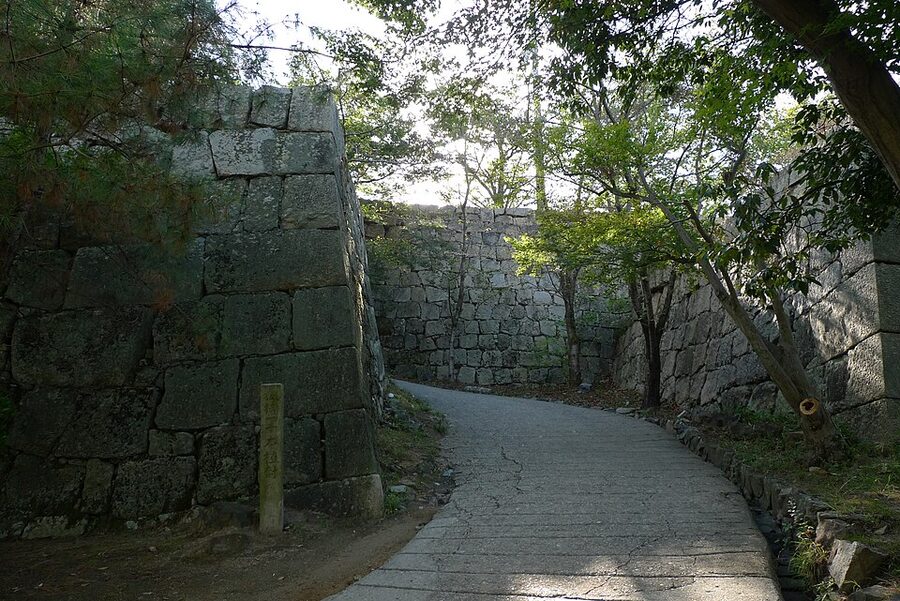
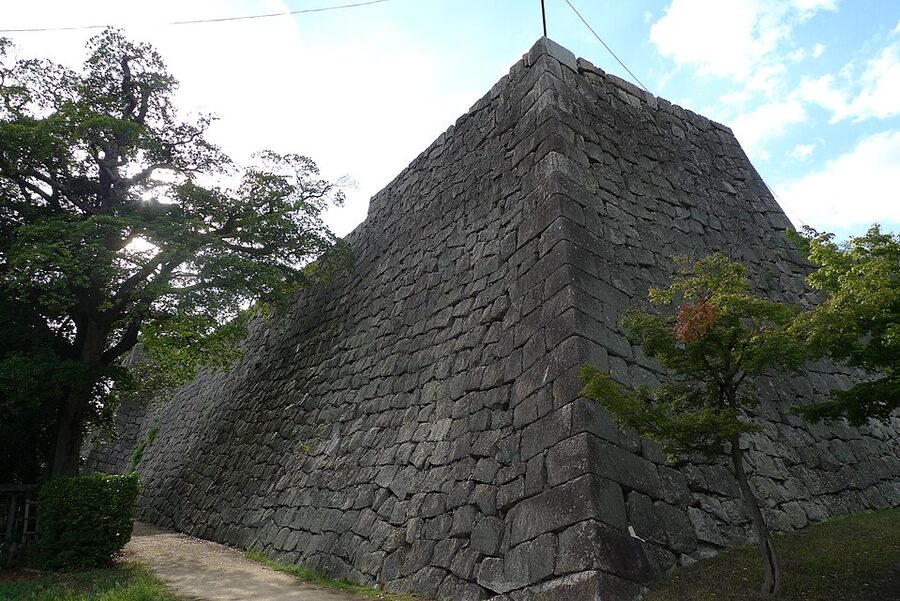
Stand in front of the third-bailey wall and try to understand what you are looking at. The face is convex, curving gently from a vertical base into a top that almost leans back over your head. Japanese stonemasons call this the ōgi-no-kōbai, or “fan gradient”, and Marugame’s is one of the most celebrated examples in the country.
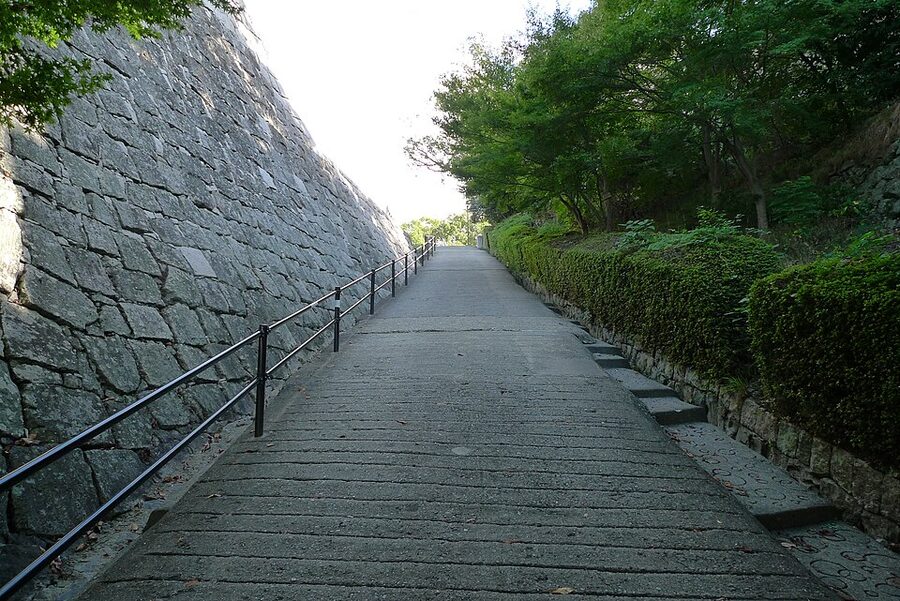
The engineering purpose is both defensive and geological. The curve confuses an attacker trying to scale the wall with ladders because the angle is constantly changing. It also absorbs earthquake energy beautifully, settling back into itself instead of cracking outward.
The stones themselves are mostly local chert and granite pulled from Sanuki quarries. You can stand two feet from the wall and still argue about whether one particular boulder is blue-grey chert or mottled pink granite, because the mason fitted them by shape, not by colour.
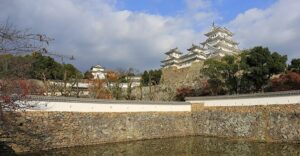
Compared with Himeji Castle, the famous white heron of the Hyogo plain, Marugame is an inverted ratio. Himeji has a monumental keep over moderate walls. Marugame has a modest keep on monumental walls. Seen side by side, they are a design argument across three centuries.
There are three named stone-laying traditions visible on the hill. The lowest and oldest course is nozura-zumi, untrimmed natural stones fitted together by eye. Above that sits the uchikomi-hagi, roughly chiselled stones with partial dressing. The top course, dating to the Kyōgoku rebuild, is kirikomi-hagi, fully dressed stones fitted with almost no gap.
You can read the history of the castle in the stonework alone if you know those three names. Ikoma-era at the bottom. Yamazaki repairs in the middle course.
Kyōgoku finish on top. The ishigaki is effectively three different generations of masonry layered into one face. A careful observer can spot the transitions by the way the stones change from rough natural shapes to tightly fitted squares as the wall climbs.
Parts of the wall collapsed in the heavy rains of 2018, and a major restoration is still underway on the southwest face. The site has reopened for visitors but one corner remains netted and scaffolded. I found that oddly reassuring, because it proved that this is a living monument that people still repair stone by stone.
The 2018 collapse involved roughly four thousand stones from the third-bailey retaining wall. Each one has since been lifted, numbered, photographed, and stored in a temporary yard at the foot of the hill. A dedicated Stone Wall Collapse Restoration and Improvement Project Promotion Center, which is a mouthful even by Japanese bureaucratic standards, opened near the southern gate to explain the work.
Watching stonemasons at work is one of those things I will detour for. On my last visit I spent close to forty minutes simply watching two craftsmen test the fit of a single boulder against a neighbour using nothing but a small maul and their eye. They rotated the stone, took it down, shaved a tenth of a millimetre, and set it back. The quality of attention was startling.
When the restoration finishes, estimated around 2028, Marugame will be the first major Japanese castle rebuilt using the full Edo-period ano-zumi technique in the twenty-first century. That alone makes the current site visit worth a longer stop. You are witnessing a craft that almost died in the 1960s being deliberately preserved for the next generation.
The climb, and why your calves will hate you
From the Otemon gate to the base of the keep is only a few hundred metres on a map. In practice the slope of the Mikaeri-zaka, the “look back slope”, means those few hundred metres rise roughly fifty vertical metres in a series of dog-legged ramps.
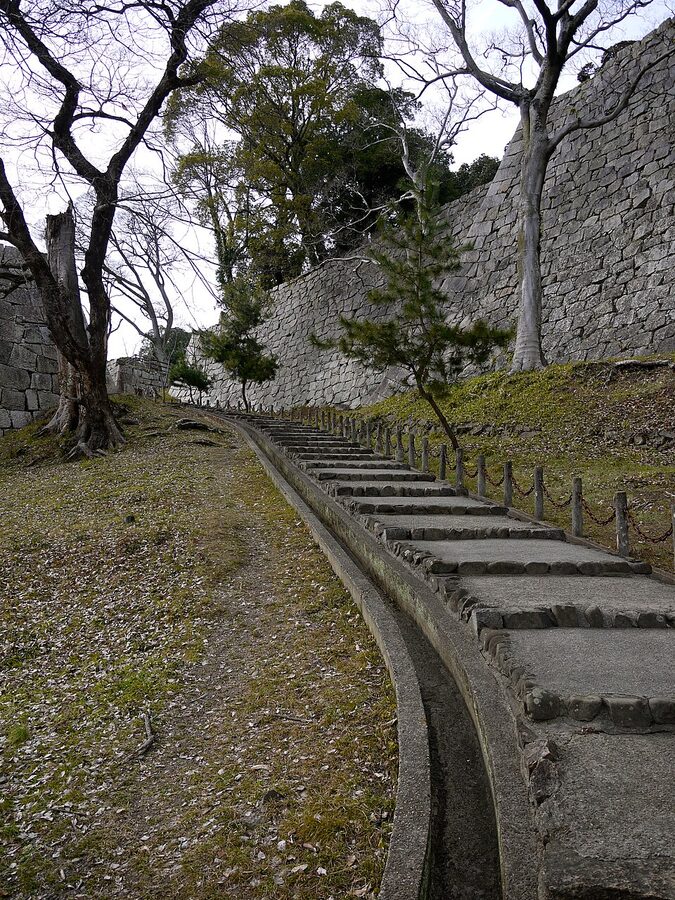
I timed the climb at about twelve minutes on a cold day without stopping, and close to twenty-five minutes on a humid summer afternoon with frequent photo breaks. Bring water. The benches at each hairpin exist for a reason.
The name Mikaeri-zaka is a joke at the visitor’s expense. It means “the slope you keep looking back down”. You look back, you see how far you have climbed, and you convince yourself to keep going.
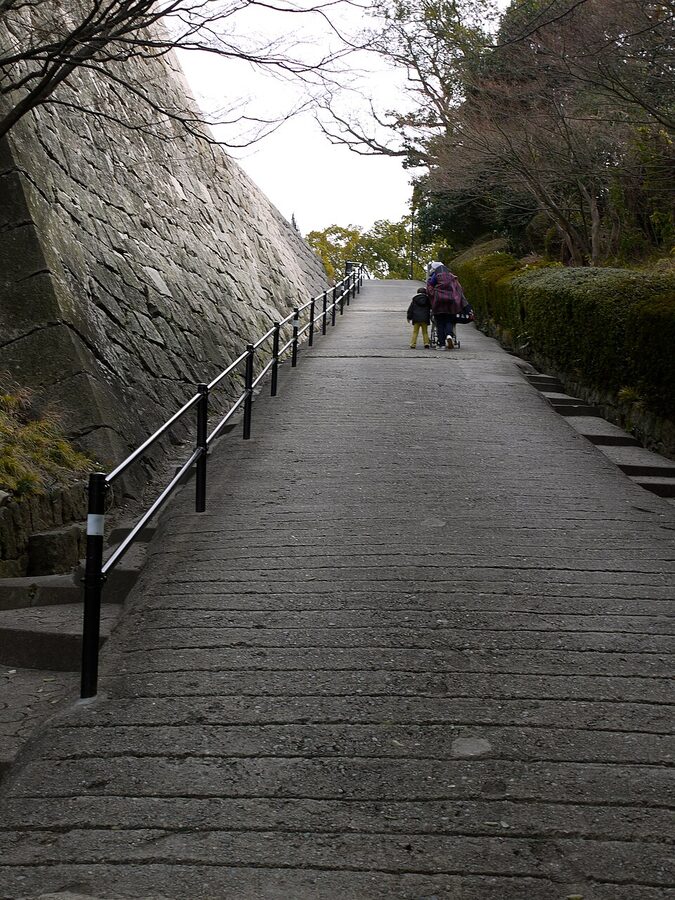
Look for the route called San-no-maru Shiritashi Zaka. It is the narrow alternative path used by castle staff, steeper and shorter and with a better sight line onto the ishigaki. I prefer it coming down.
Inside the keep: the four windows and the plank floors
The interior of the tenshu is unashamedly bare. You leave your shoes in the wooden cubby at the first-floor doorway, hand over a four-hundred-yen ticket, and climb three storeys of planed cedar floors reached by staircases so steep they behave more like wooden ladders.
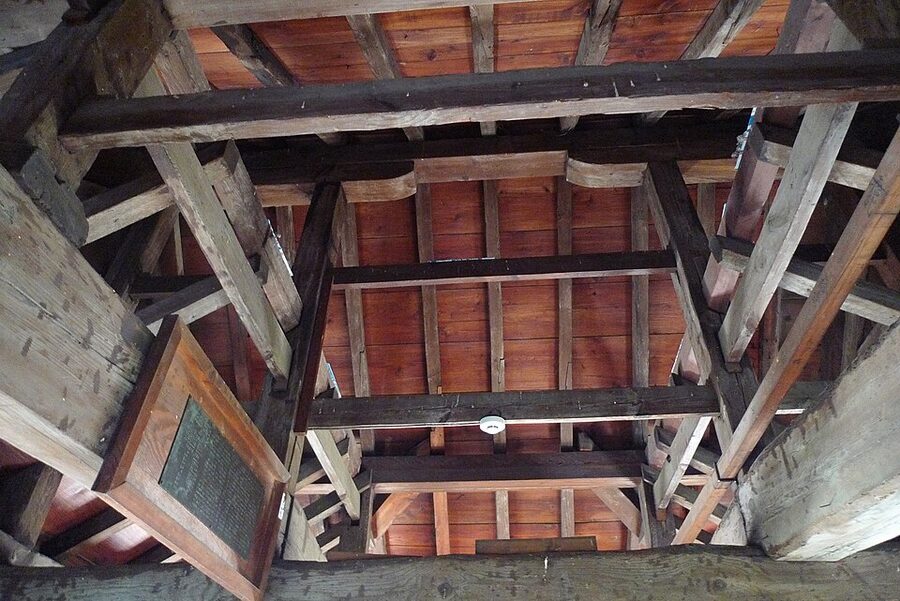
There is almost no furniture, no dioramas, and mercifully no animated samurai. The tenshu is presented as what it is: a structure, beautifully joinered, with enough small interpretive signs that you can follow the carpentry without losing the mood.
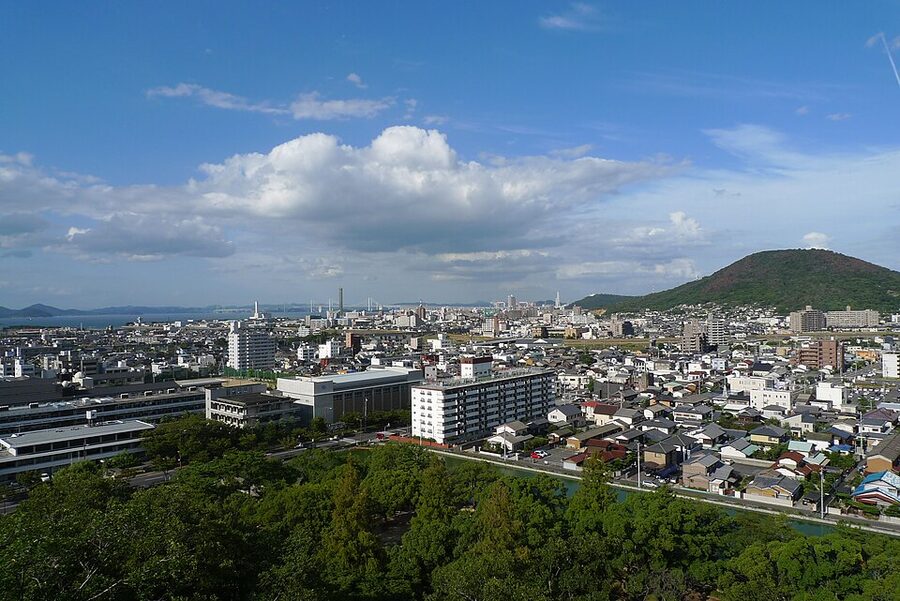
The top floor has four small square windows, one on each face. Through the north window you see the Seto Inland Sea and the bridges to Honshu. Through the east, Sanuki Fuji.
Through the south window, the Sanuki plain runs off toward the mountains of central Shikoku. Through the west, the low sprawl of Marugame city ripples out to the coast. Four windows, four stories, four compass points.
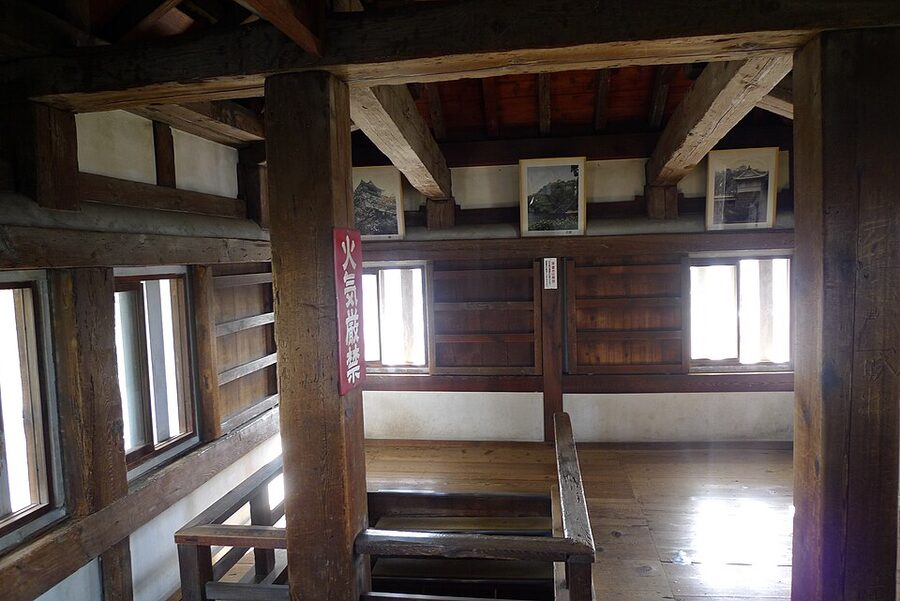
Those four views were deliberately placed to let the castellan monitor every major approach into the domain. Merchant shipping from Kobe, ferry traffic from Honshu, the road from the south, and the townspeople under his feet.
Today they also let you understand, in about ten seconds, why the Kyōgoku did not feel they needed a bigger keep. You are already above everything. Another twenty metres of roof would not have added much except wind load.
The interior also contains a small display of artefacts, mostly roofing tiles and sword fittings recovered from the 1869 palace fire and subsequent excavations. The signage is bilingual and mercifully brief. There is also a single faded hanging scroll showing the castle in its Edo-period glory, with its lost yagura and the palace compound at the base.
What strikes me inside the keep is the absence of decoration. No painted screens, no gold-leaf ceilings, no evidence of the formal reception rooms that give other keeps their domestic character. Marugame’s tenshu was always a working watchtower and a symbol of authority, not a residence. The daimyo and his family lived in the palace at the foot of the hill, which burned in 1869 and is now the park lawn by the moat.
The Meiji survival story
Most Japanese castles died twice. First in the 1868 Meiji Restoration, when the new government saw feudal fortresses as politically inconvenient, and second in World War II, when incendiary bombing reached deep into provincial Japan. Marugame dodged both.
The daimyo’s palace burned down in an accidental fire in 1869 and took the Inui-yagura turret with it. In 1872 the remaining buildings were scheduled for demolition by auction, which is to say the government was going to let scrap merchants take them down for the value of the timber.
The Imperial Japanese Army intervened at the last moment, requisitioning the site for the 12th Infantry Regiment. Barracks went up in the outer baileys. The tenshu was left standing as an administrative annex. A small cultural irony, because the army’s bureaucracy is what ultimately preserved what Ikoma stonemasons had built two and a half centuries earlier.
In 1876 most of the remaining yagura were pulled down anyway. Only the tenshu, the two Otemon gates, and substantial sections of ishigaki survived that second wave of clearance. The barracks themselves vanished when the site was converted into Kameyama Park in 1919.
The tenshu was designated an Important Cultural Property in 1943, and the two Otemon gates followed in 1957. The entire site was made a National Historic Site in 1953. The National Treasure ranking went to larger and showier survivors such as Matsumoto Castle and Hikone Castle, but Marugame narrowly missed the promotion and it remains a friendly dispute among castle enthusiasts whether that ranking was fair.
My own view is that the original National Treasure criteria skewed toward keep height and visual drama, both of which Marugame is cheerfully short on. If the same committee were ranking tenshu today with a better understanding of the ishigaki, Marugame would have a stronger case.
The comparison that really stings is Matsue, whose tenshu received National Treasure status in 2015 after a detailed structural study. Matsue is a larger keep but its ishigaki is nowhere near Marugame’s scale, and the two castles are otherwise closely comparable in date and style. A rerun of the evaluation with modern methods might well promote Marugame too.
Seasons at Marugame: cherry, plum, and the winter light
The grounds inside Kameyama Park are planted with sakura, ume, and maples, and the slope means that different microclimates bloom at slightly different dates. You can get three weeks of flowering by walking in at the Otemon and spiralling up to the keep.
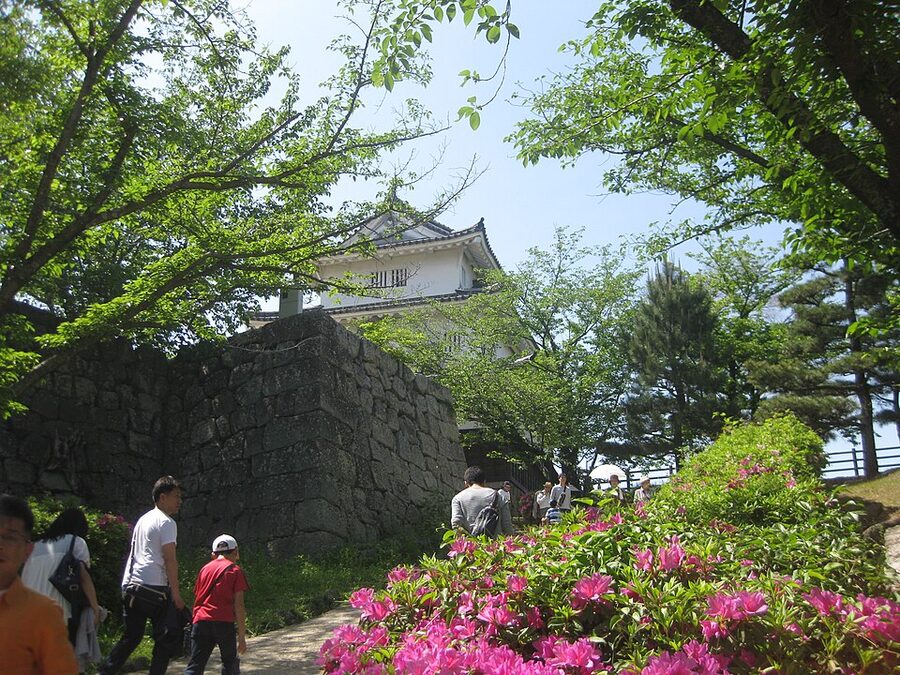
Plum comes first. The ume grove on the southern flank of the hill usually peaks in late February, and on a good year the blossoms overlap with a residual snow dust on the top storeys of the keep. If you are a photographer, that is the frame you want.
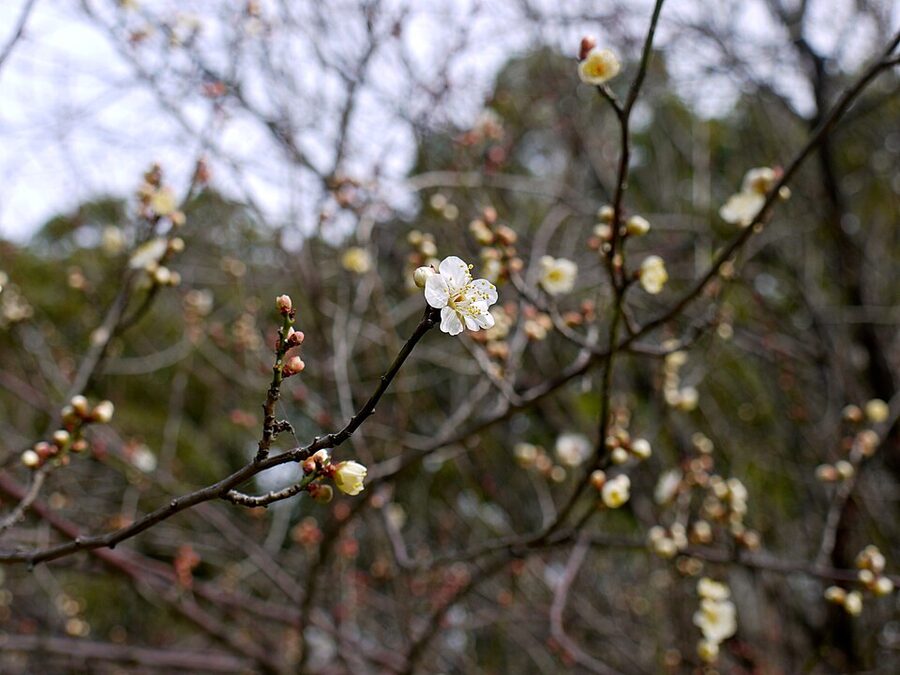
Cherry follows in the first week of April. The spiral of the path means you can walk in and out of blossom for the full length of the climb, and the hill is breezy enough that petals drift against the ishigaki for about a week after peak bloom.
Autumn at Marugame is subtler. The maples on the inner bailey go red in mid-November, but the real prize is the low winter sun that turns the ishigaki honey-coloured for about twenty minutes after sunrise. I try to arrive before the gate opens, just to catch that first strike of light.
The Seto Inland Sea view, and Sanuki Fuji
On a clear day the view from the top of the tenshu stretches north across the Seto Inland Sea to Honshu. The Great Seto Bridge hangs on the horizon in multiple white arches, car and train traffic ticking across in miniature.
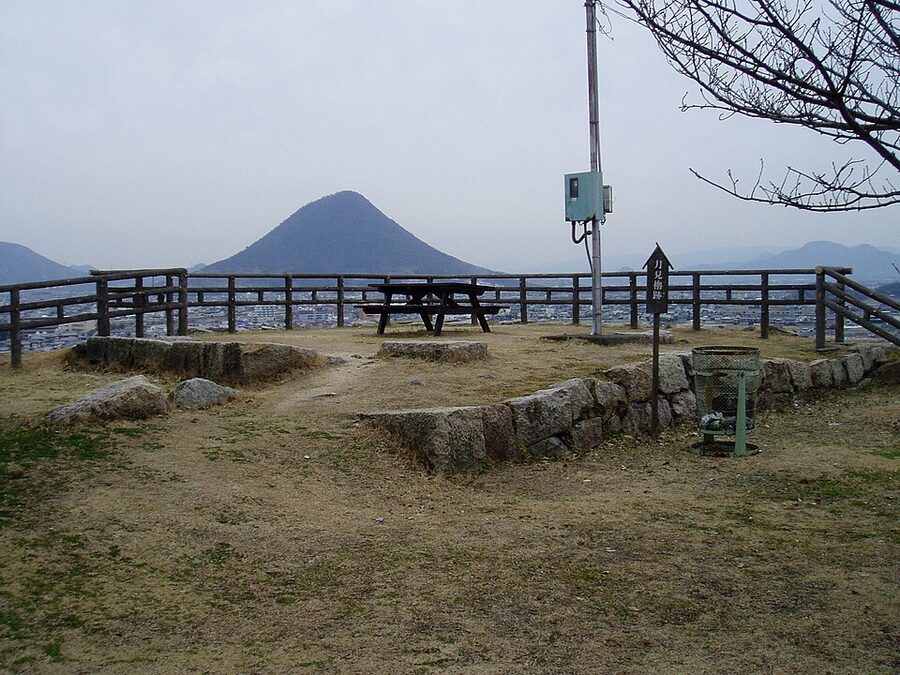
Iino-yama, Sanuki Fuji, sits to the east at 422 metres. It is not a real volcano but it looks like one, a near-perfect cone that defines the Sanuki skyline and gives the province its geographic calling card.
South of the castle the plain dissolves into mountains, and the flat rice paddies between Marugame and Zentsuji are pockmarked by the thousands of small irrigation reservoirs that make Kagawa functional. Kagawa is the smallest and driest prefecture on Shikoku, and the ponds are the only reason you can grow anything here.
The day-trip: Mannō-ike and Kūkai’s water
If you want a companion sight that completes the Kagawa story, drive or bus south about twenty-five minutes to Mannō-ike, the largest irrigation reservoir in Japan. It holds fifteen million cubic metres of water, feeds thousands of hectares of Sanuki rice, and has been in continuous use for more than twelve hundred years.
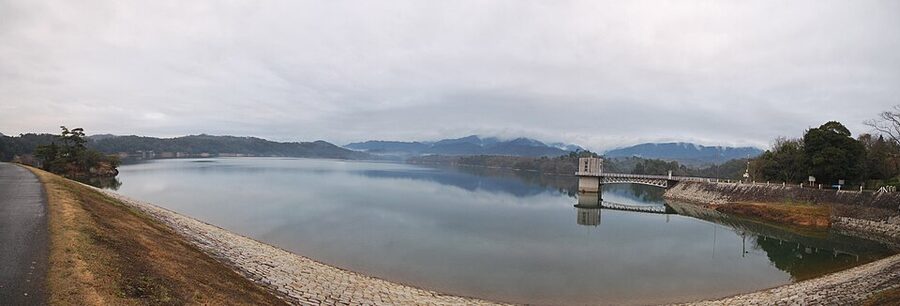
The monk Kūkai, better known abroad as Kōbō Daishi, was born a few miles from Marugame in Zentsuji. In 821 the imperial court asked him to fix Mannō-ike, whose embankment had repeatedly broken. He finished the repair in three months, using a curved dam design that local engineers had not tried before.
That curve is, in its own way, a cousin to the curve of Marugame’s ishigaki. Both are convex masonry designed to spread the load of something heavy and shifty, one holding water, the other holding a castle.
If you pack Marugame and Mannō-ike into a single day you also have time for Zentsuji temple, the seventy-fifth station on the Shikoku pilgrimage and Kūkai’s birthplace. It is a walkable loop by rental car or local bus.
The local tourism office rents bicycles at the JR Marugame Station, which is the format I now recommend for doing the full loop. Castle first, Mannō-ike for a long lunch, Zentsuji in the afternoon, back to the station by sundown. The total ride is maybe twenty-five kilometres of flat farmland roads.
If you are on foot or a rental car instead, factor in the small Uchinomi Museum on the castle’s north side. It exhibits the unearthed tile fragments and wooden elements from the various restorations, plus a careful scale model of the castle at its seventeenth-century peak. Entry is free and the staff speak some English.
Marugame among the twelve originals
The twelve original tenshu of Japan are a club that forms itself slowly over the course of a lifetime of travel. Each keep sits in its own climate, its own political history, and its own particular relationship to the stone under it.
Start with Matsumoto in the Japanese Alps, a jet-black crow castle floating over an Edo-period moat. Move south to Inuyama Castle on its bluff over the Kiso river. Continue west to Hikone, perched over Lake Biwa with bells that still ring at dusk.
Then there is Maruoka Castle, the rough timber survivor of the Fukui earthquake, and Hirosaki Castle up in Aomori with its cherry-tree riot. Matsue Castle broods over the Shimane water. Bitchu-Matsuyama Castle sits so high on its mountain that in autumn it floats above a sea of cloud.
Himeji is the peacock of the group, the white heron, the one everyone photographs. Uwajima and Kochi hold down Shikoku alongside Marugame. And Iyo-Matsuyama, the twelfth, sits an hour’s ferry away across the Inland Sea.
Marugame is the smallest of them by tenshu volume. It is also the only one where the stone platform genuinely eclipses the keep. That contrast is why I recommend visiting it third or fourth on a twelve-originals circuit: you need a couple of Matsumotos and Himejis under your belt before you can read the Kyōgoku restraint properly.
If I had to sketch a tidy ranking, I would put Himeji first for sheer scale, Matsumoto second for contrast, Hikone third for Lake Biwa setting, and Marugame fourth for sheer strangeness. It is the castle that most rewards the traveller who already knows what a castle is supposed to look like, because only then does the inversion of the usual ratio really land.
The castle town and Takahama Kyoshi
Most Japanese castles have a jokamachi, a town deliberately laid out for the daimyo, and most jokamachi have mostly disappeared under modern grids. Marugame’s survives better than average. The three main northeast-southwest streets between the castle and the port still follow the original seventeenth-century Kyōgoku plan.
Walk north from the Otemon gate and you pass through what was once the merchant district. The shophouses now sell bicycle helmets and convenience-store snacks, but the lot widths and the gap between buildings still read as an Edo-period plan. A few teahouses and a small uchiwa fan gallery do their best to hold the atmosphere together.
On the inner bailey stands a haiku monument to Takahama Kyoshi, the twentieth-century poet who did as much as anyone to preserve the classical Japanese haiku tradition. Kyoshi visited Marugame in his later years and wrote a verse praising the castle’s silhouette against the winter sky. The stone is modest but you can make out the characters if you look carefully.
Marugame is also the birthplace of the Japanese uchiwa, the round paper fan. Local craftsmen have been making them for roughly four hundred years, and the city still accounts for about ninety percent of Japanese domestic uchiwa production. A workshop near the station offers hour-long fan-making classes for about two thousand yen.
Bring an uchiwa up to the top floor of the tenshu in August and you will understand why the town made them in the first place. Those four small windows channel the breeze from the Inland Sea at exactly the height a Kyōgoku castellan would have wanted, which means you are never more than ten degrees cooler than the rice paddies below.
Evening at Marugame: the illumination
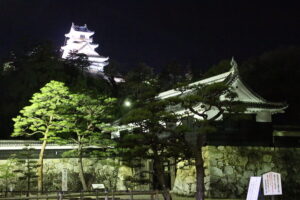
If you stay in town overnight, do not miss the nightly illumination. From sundown until about 22:00, the tenshu and the upper sections of ishigaki are lit from below by warm spotlights arranged on the lower terraces. The effect is entirely different from the daytime view.
At night the ratio inverts again. The keep, lit from below, looks twice its day-time size because you can no longer see the scale of the landscape behind it. The stone platform goes shadowy at the base and blindingly bright at the top, reversing the visual logic that makes the daytime view so strange.
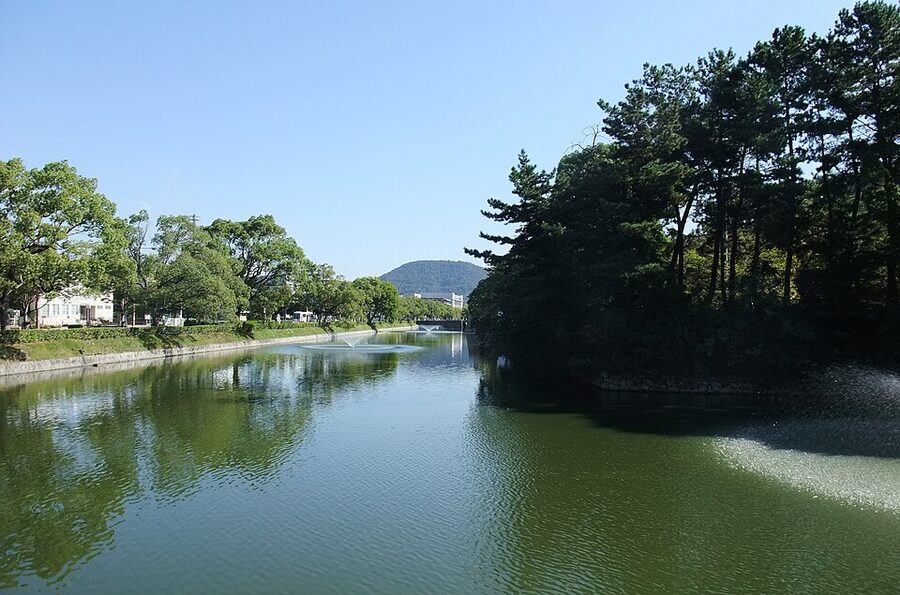
I recommend walking the perimeter of the outer moat once in the evening. The light pollution from Marugame city is weak enough that on a clear night you can still see a handful of stars above the keep. In the spring and autumn the moat water doubles the castle underneath, which is the single best photograph available on the whole property.
The onward question: Shikoku beyond Marugame
If Marugame is the first Shikoku castle you visit, it will probably not be the last. The island has three other original tenshu, all within a comfortable day’s travel of one another.
Uwajima is two hours south by train and sits on a quieter inlet. Kochi is across the central mountains and keeps a particularly photogenic keep. Iyo-Matsuyama is forty minutes by ferry or a two-hour train loop.
Marugame pairs particularly well with Iyo-Matsuyama for a long-weekend loop. Start in Okayama, cross the Seto Ohashi bridge to Marugame, stay two nights, then take the JR limited express to Matsuyama for two more. Both tenshu are Important Cultural Properties, both are original Edo survivors, and the overall contrast between Marugame’s ishigaki focus and Matsuyama’s sprawling bailey complex makes the comparison memorable.
Add Takamatsu to that loop and you visit the port town from which the Ikoma clan originally governed Sanuki. Takamatsu Castle is mostly gone, slighted and flooded over the centuries, but the site is well interpreted and gives you the visual counterweight against Marugame that explains the Ikoma strategy.
Practical details and a half-day plan
Marugame Castle sits inside Kameyama Park at 1-8 Ichiban-chō, Marugame-shi, Kagawa Prefecture. The park grounds are open every day, all day, free of charge. The tenshu is open from 09:00 to 16:30 and costs 400 yen for adults.
From JR Marugame Station on the Yosan Line, it is a flat ten to fifteen minute walk south to the Otemon gates. The city is compact and the signage is bilingual Japanese-English. If you are arriving from Okayama across the bridge, the trip takes about forty minutes by limited express.
I recommend three hours on site at minimum. One hour to climb and inspect the ishigaki properly. One hour inside the tenshu and the inner bailey. One hour to loop back down through Kameyama Park, stopping at the Takahama Kyoshi haiku monument and the small shrine near the eastern bailey.
If you have half a day, add lunch in the old castle town. Marugame is the birthplace of sanuki udon, and the area between the JR station and the castle has more good udon shops per square kilometre than almost anywhere in Japan. Look for the phrase “seimen-jo”, which marks a shop that mills its own flour.
For a full day, add the Mannō-ike loop or an afternoon ferry to Naoshima from nearby Takamatsu. Marugame is small enough to slot into a Shikoku circuit without forcing the rest of your week to bend around it.
The udon itself needs a small note. Sanuki udon is the local noodle, thicker and firmer than the standard Japanese version, served cheaply and usually self-serve in small working-class shops. Most open at seven in the morning and close by early afternoon. A bowl will cost you between three hundred and five hundred yen.
I usually queue at a place called Nakamura Udon, five minutes south of the castle grounds, where the noodles are kneaded fresh every morning and the broth is made from dried Iyo mackerel. It is not fancy. It is one of the best bowls of food you will eat in Japan for under four hundred yen.
If you want a slightly more polished experience, the restaurants on the east side of Kameyama Park serve hamono-udon, which is udon with tempura, and a small bowl of fresh Seto Inland Sea fish. Expect twelve hundred yen for that plate and ask for the local sanuki beer.
Photographing Marugame Castle
If you care about the photographs you bring home, Marugame rewards a little planning. The light is best from the south and southwest, which means late-morning and early-afternoon shots face the sun. For a dramatic front-lit view of the tenshu, shoot from the Otemon gate facing north between 10:00 and 12:00.
For the classic wall-versus-keep inversion shot, position yourself at the third-bailey viewing platform and shoot upward. A wide lens between 16 and 24 millimetre works best. You want the stone to fill the lower two thirds of the frame and the keep to sit as a small silhouette against the sky.
Seasonally, the best combined shot is a front-lit tenshu with cherry blossoms in the early-morning golden hour of the first week of April. Arrive at 06:30, set up at the bench opposite the inner gate, and wait for the sun to crest Kameyama hill. The window of good light lasts about twenty minutes.
For night shots, you want a tripod and a remote shutter. The illumination is warm and somewhat uneven, which gives you interesting shadows but requires bracketing. Shoot from the east side of the moat facing west, and the keep will reflect in the still water below.
Why you keep coming back
Every time I visit Marugame I end up in the same spot, sitting on the bench opposite the third-bailey stone face, looking up at a keep that is barely visible from that angle. The wall does all the work. The building on top is almost an afterthought.
That is a lesson Japanese architects keep repeating to foreign visitors in different dialects. The stone at Ryoanji is sparse. The joinery at Horyuji is invisible. The timber at Ise is renewed every twenty years.
Marugame does the same trick in a different material. The monument is the plinth, the plinth is the monument, and the tenshu is what you see when you stop paying attention to everything else.
Walk it once and you will remember the view from the top floor. Walk it twice and you will start to remember particular stones in the wall, the chert block with the seam like a crow’s eye, the corner granite polished smooth by four centuries of rain. That is when Marugame really starts working on you.
Go in February for plum and winter light. Go in April for cherry. Go in November for the honey-coloured ishigaki at sunrise.
Just go, and give the wall the time it asks for. A single afternoon is enough for the basic experience, but a full weekend, split between the castle grounds at different hours, Mannō-ike, and a bowl or two of sanuki udon, is what makes the memory last.
If you take one image home from Shikoku, I hope it is the wall at sunrise. If you take one memory home, I hope it is that small wooden keep on its improbable throne of stone, reminding you that in Japanese architecture the foundation is often the point and the tower is often the afterthought. Marugame is the clearest lesson in that rule I know.