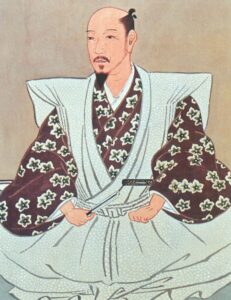
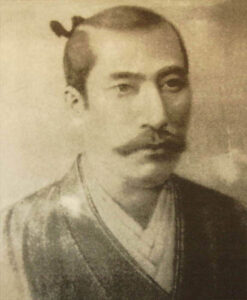
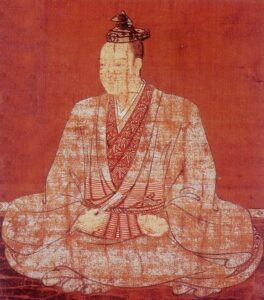
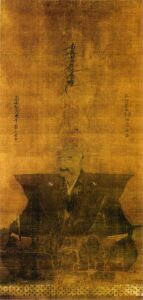
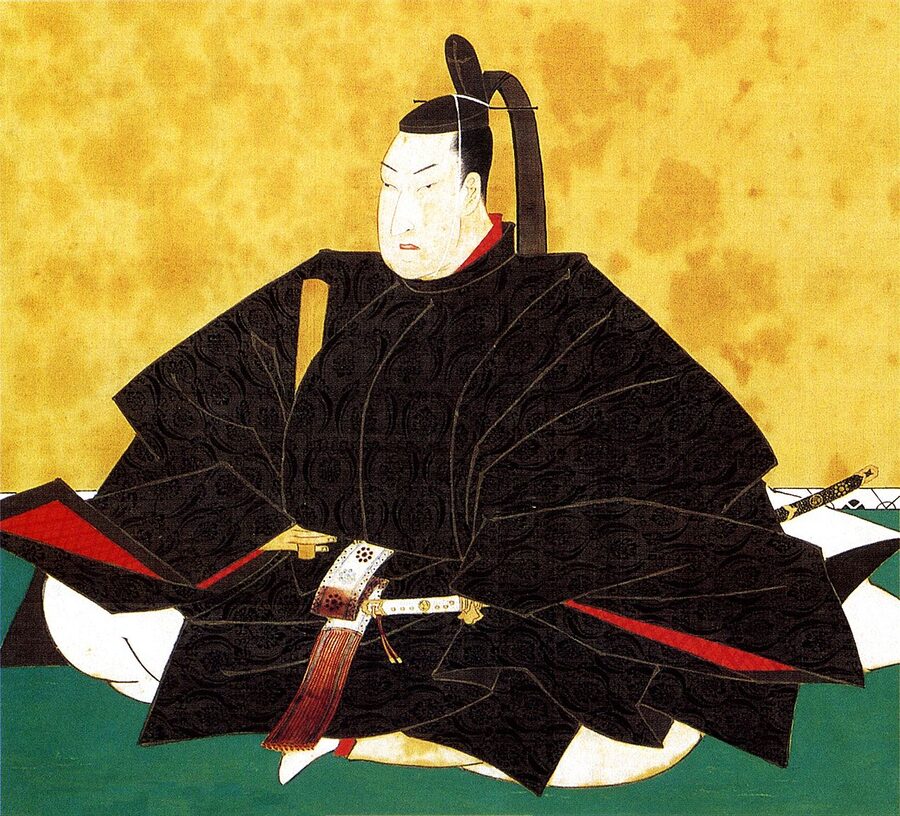
Tokugawa Tsunayoshi has the worst nickname of any Tokugawa shōgun, and it is not his fault. The “Dog Shōgun” — 犬公方 Inu-kubō, in the Edo street-slang that stuck to him during his own lifetime — was the name his subjects gave him in response to a set of policies they hated and, crucially, did not understand. For twenty-two years he tried to legislate kindness into a feudal society that had never considered kindness a policy lever. He failed. The failure killed his reputation, hollowed out the shogunate’s finances, and produced one of the most culturally durable pieces of English-language misinformation about Japan — that a mad emperor once made it illegal to step on a dog.
It was illegal to step on a dog. That part is true. The reason was not that he was mad.
In This Article
- The Unexpected Shōgun
- The Confucian Experiment
- The Edicts on Compassion for Living Things
- The Nakano Dog City
- The Akō Incident
- Death at Sixty-Two
- Where to visit Tokugawa Tsunayoshi’s story today
- 1. Kan’ei-ji Jōken-in — Ueno, Tokyo
- 2. Yushima Seidō — Ochanomizu, Tokyo
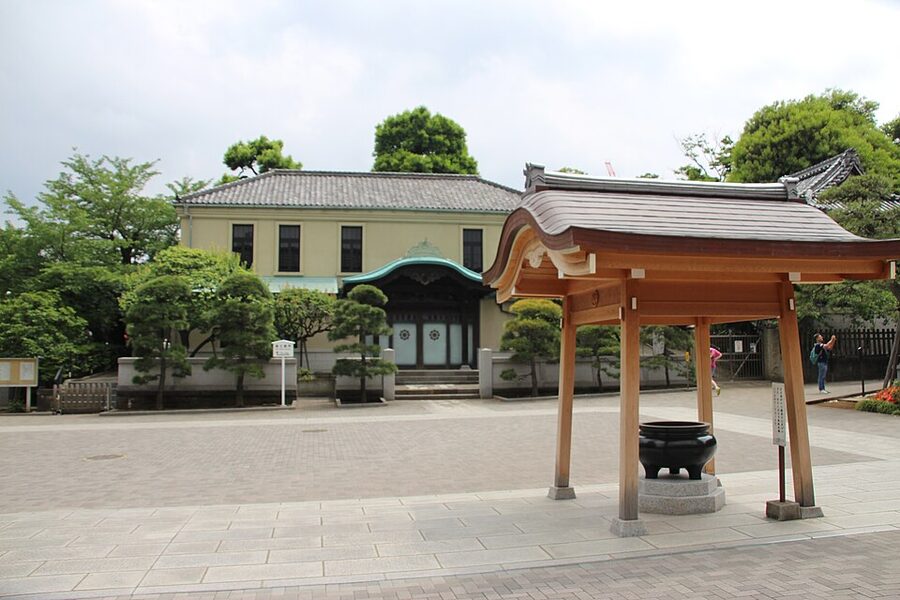
- 3. Gokoku-ji — Bunkyō-ku, Tokyo
- 4. Nakano — former dog-shelter site, western Tokyo
- The Ledger
The Unexpected Shōgun
Tsunayoshi was not supposed to be shōgun. He was the fourth surviving son of the third shōgun, Tokugawa Iemitsu, born in 1646 into a household that already had heirs lined up; by the time Tsunayoshi was a teenager he had been given a small fief at Tatebayashi in modern Gunma, a modest domain that was essentially a retirement posting, and had settled in to what the Tokugawa household expected would be a long quiet life of minor provincial administration and Confucian study.
Then in 1680 his older brother, the fourth shōgun Tokugawa Ietsuna, died at thirty-nine without surviving sons. The shogunate council went into a closed-door week-long argument about succession. The senior adviser Sakai Tadakiyo pushed hard for bringing in an imperial prince from Kyōto to adopt into the Tokugawa line — an option that would have reshaped the Edo-Kyōto balance of power for a century. The junior adviser Hōta Masatoshi pushed back equally hard for the youngest Iemitsu son still alive, the Tatebayashi lord, Tsunayoshi. Hōta won. Tsunayoshi, aged thirty-four, was summoned to Edo on seventy-two hours’ notice, adopted into the main Tokugawa line, and installed as the fifth shōgun before he had finished unpacking his country wardrobe.
This matters because he brought something no shōgun before him had: a finished Confucian education completed in the countryside with no expectation that it would ever be applied to running a country. Iemitsu’s first three sons had been raised to rule; they had tutors in strategy, tax policy, military command. Tsunayoshi had been raised to philosophise. He had spent twenty years reading the Analects, the Mencius, Zhu Xi’s commentaries. He genuinely believed, the letters from Tatebayashi make it explicit, that a society could be governed by moral example if only someone at the top were willing to be the moral example. When his brother died and he was lifted into the shōgunate, he took the elevation as a signal that heaven had given him the chance to try it.
The Confucian Experiment
The early years of Tsunayoshi’s reign, from 1680 to about 1690, were the most intellectually ambitious period of shogunate rule in the entire 265-year Edo span. He founded the Yushima Seidō (淫島聖堂) in 1690, the Confucian academy on the hill above modern Ochanomizu that became the shogunate’s official school for its administrative class. He personally lectured on the classics to his retainers — the chronicles record that he gave over 240 lectures in person across the first decade, which is a staggering number for a sitting shōgun. He published new editions of the Confucian canon at his own expense and distributed them to daimyo across the country.
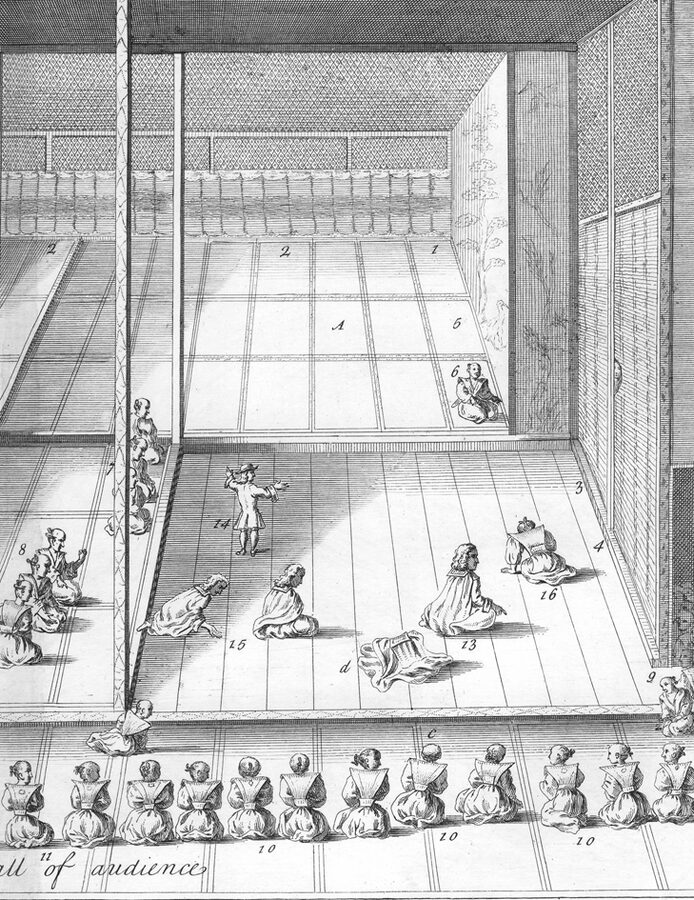
He also took a more-than-ceremonial interest in foreign knowledge. The Dutch East India Company mission from Dejima in Nagasaki was required to travel to Edo once a year to pay respects and present tribute; under Iemitsu and Ietsuna this had been a formal audience of minutes. Under Tsunayoshi it became a four-hour seminar. The company physician travelling with the 1691 and 1692 missions, the German Engelbert Kaempfer, wrote in his private journals that Tsunayoshi asked him about European anatomical dissection, Dutch astronomical instruments, Chinese medical manuscripts, and the differences between the Lutheran and Catholic catechisms. At one point, documented in Kaempfer’s book The History of Japan (1727), Tsunayoshi asked Kaempfer and his Dutch colleague to perform a European dance for the court. They did.
The shogunate had never been this intellectually curious before. It would not be again. If Tsunayoshi had died in 1690, at about forty-four, he would be remembered as the most Confucian-educated ruler Japan had produced since the Heian imperial court, and one of the most outward-looking leaders in the entire Edo period. He did not die in 1690. He lived another nineteen years and used them to make decisions that would permanently overshadow the ones he had already made.
The Edicts on Compassion for Living Things
The Shōrui Awaremi no Rei (生類怎みの令, roughly “Edicts on Compassion for Living Things”) were issued in instalments starting in 1687 and continuing until Tsunayoshi’s death twenty-two years later. There were well over sixty separate decrees — nobody has a confirmed count because some were localised, some were issued as verbal orders recorded only in domain archives, and at least a dozen contradicted each other. The popular story condenses them into “he banned killing dogs”. The actual scope was wider and stranger.
The decrees forbade, in rough chronological order: killing dogs, abandoning dogs, mistreating dogs, killing or injuring horses (including accidentally), abandoning sick horses, killing fish for sport, killing birds for sport, using cats as mousers in rice-storage warehouses (this one was quietly reversed), eating fish or poultry within the Edo city limits during periods of official mourning, killing insects found on cut vegetables, killing or trapping stray cats, abandoning children (this one was genuinely a good law), abandoning elderly relatives (also), mistreating prostitutes or abandoning them when they aged out of the trade (also), and killing or trapping mosquito larvae — which was not enforced but was on the books from 1693 to 1698.
The Confucian argument for these decrees is entirely coherent, and you have to take it seriously before you can understand how they played out. Neo-Confucian philosophy, the Zhu Xi school that Tsunayoshi had absorbed as a young man, considers all sentient beings part of a single moral continuum with humans at the top. A ruler who wanted to cultivate jen (仁, “benevolence”) in his subjects was expected to model it himself, and the most visible way to model it was in your treatment of creatures that could not defend themselves. Tsunayoshi believed this. He was not wrong about the philosophy.
The Confucian argument for enforcing compassion as law, however, is essentially not Confucian at all; it is a Tokugawa-period Buddhist-Confucian hybrid, made worse by the input of the shōgun’s mother, Keishōin.
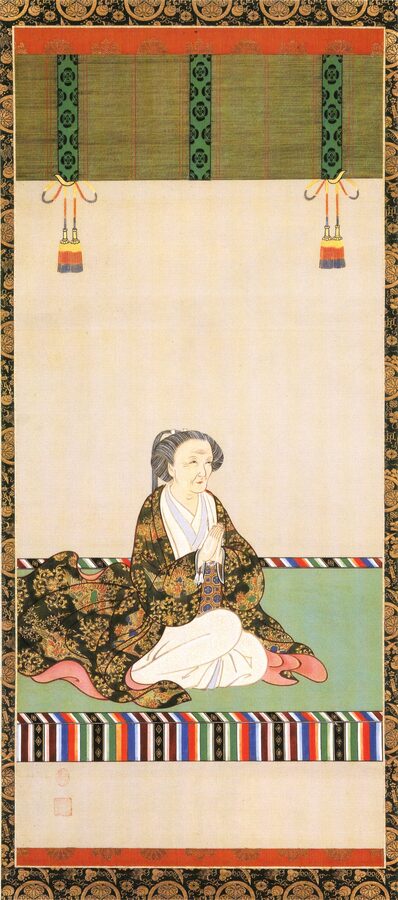
Keishōin (桂昌院, 1627-1705) was born Otama, the daughter of a Kyōto grocer, and entered the Edo castle harem in her twenties as a low-ranking lady-in-waiting. By the birth of Tsunayoshi she had become Iemitsu’s favourite concubine; after her son became shōgun she was installed in the Honmaru and effectively ran the interior of Edo Castle for the next twenty-five years. Contemporary sources are unanimous that she was a devout Buddhist who believed her son’s failure to produce a surviving male heir was karmic punishment for violence in past lives. Her advisor the Shingon monk Ryūkō (隆光, 1649-1724) supplied the theological framework and the practical policy recommendations. The mosquito edict, the cat edict, and the most severe of the dog edicts all came out of the Ryūkō-Keishōin channel. The Yushima Seidō and the Confucian-classic publication programme all came out of Tsunayoshi’s own office.
It was, in other words, two policy programmes sharing a signing hand. The educated population of Japan received the Confucian programme gratefully. It received the compassion programme as a joke and then, when enforcement arrived, as a disaster.
The Nakano Dog City
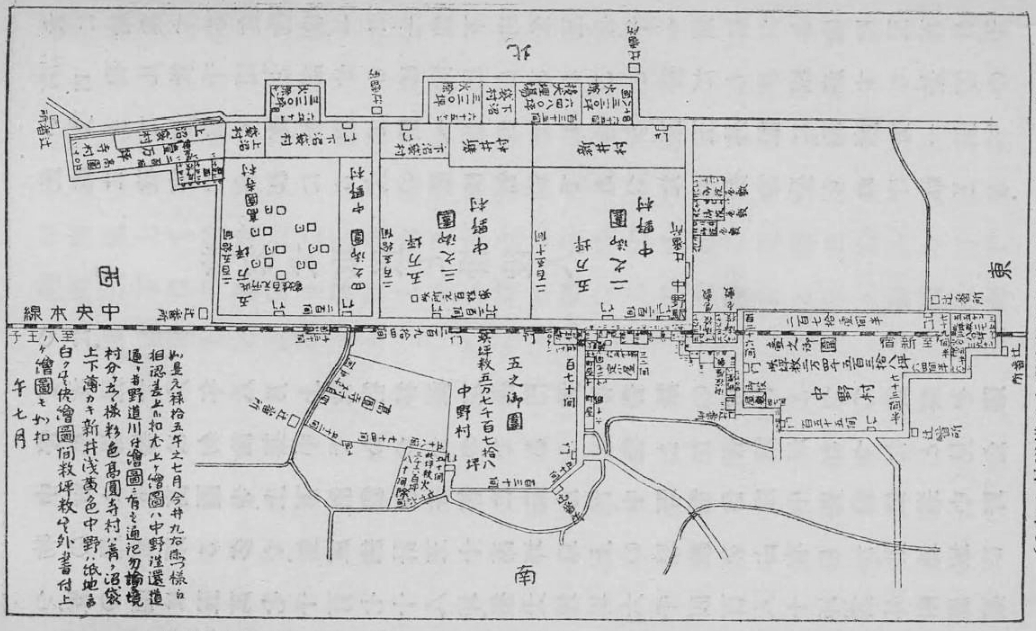
By 1695 the enforcement of the compassion edicts had produced a problem nobody had anticipated: dogs. Edo had always had a street-dog population. Under the old laws, the city’s magistrates had culled the dogs once or twice a year to keep numbers manageable. Under the new laws, culling was banned and feeding was mandated. The population exploded. By the mid-1690s there were estimated to be between 50,000 and 100,000 free-ranging dogs in the city, and they were biting people, fouling wells, attacking livestock, and causing exactly the problem the magistrates had been managing for a century.
The shogunate’s solution was a three-stage escalation. Stage one, 1695: collect stray dogs into shelters at Yotsuya and Ōkubo, on the western edge of Edo. Stage two, 1696: those shelters were immediately overcrowded; build a much larger complex at Nakano, a further four kilometres west, designed for 100,000 dogs. Stage three, 1702: Nakano was also overcrowded; expand it to 750,000 square metres across five fenced enclosures, making it the largest single government kennel in human history, at enormous and unreimbursed public cost.
The cost is the part of the story that killed Tsunayoshi’s reputation. The Genroku-era famine of 1695-1696 was one of the worst of the Edo period; rural peasants died in five-digit numbers of starvation in the northern domains. During that same famine the shogunate was spending an estimated 90,000 ryō per year, about 3% of its total revenue, on rice, miso, and sardines for the Nakano dogs. The Edo commoners who had watched relatives starve did not take this well. Tsunayoshi’s finance minister Ogiwara Shigehide responded by debasing the currency, reducing the gold content of the ryō by 34%, producing Japan’s first major inflation crisis and effectively taxing the urban population to feed the kennels. This is the point at which Edo popular wit produced the nickname Inu-kubō. It was not a fond one.
The Akō Incident
Two years into the Nakano expansion, in the fourteenth year of Tsunayoshi’s reign, the most famous act of samurai vengeance in Japanese history landed on his desk. You know this story. It is the plot of every version of Chushingura, every NHK Taiga adaptation, every kabuki play, every Keanu Reeves movie. Forty-seven rōnin from the defunct Akō domain broke into a Tokyo mansion on the night of 14 December 1702 and killed the man who had ordered their lord to commit seppuku a year and a half earlier. Then they surrendered themselves to the shogunate.
What Tsunayoshi did with them is the part of the story that rarely gets told in the English adaptations. The shogunate council argued for a full month. On one side: the rōnin had broken several major laws and a senior official was dead; if they were not punished, the shogunate’s authority collapsed. On the other side: they had acted with giri (義理, duty) and chūgi (忠義, loyalty) to their dead lord, which were the bedrock Confucian virtues the shōgun had been preaching for twenty years. If the shōgun punished virtue, he punished the intellectual project of his own reign.
Tsunayoshi’s compromise was characteristic. He ruled that the rōnin had indeed acted with virtue, and therefore deserved the honour of samurai seppuku rather than the criminal’s execution. Forty-six of the forty-seven were ordered to commit ritual suicide on 20 March 1703. The forty-seventh, Terasaka Kichiemon, had been dispatched earlier to notify the Akō clan and was not present at the vengeance itself; he lived to ninety-two and is buried alongside the other forty-six at Sengaku-ji in Tokyo. The compromise satisfied Confucian philosophy and the letter of the criminal code at the same time, and is the single most elegant decision any Tokugawa shōgun made.
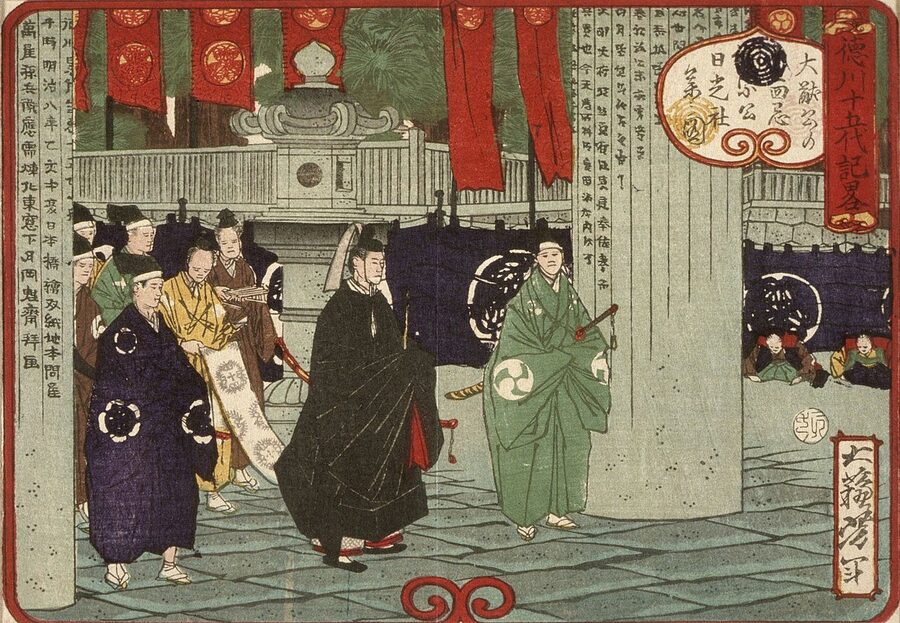
It did not help his reputation in the short term. The Akō rōnin became immediate folk heroes; Chushingura, the fictionalised version of the story, began circulating in kabuki form within three years of their deaths, and has never been out of the Japanese popular-culture repertoire since. The rōnin are the heroes of every version. Tsunayoshi, when he appears in the story at all, is the off-stage tyrant who murdered them.
Death at Sixty-Two
Tsunayoshi died on 19 February 1709 at the age of sixty-two. The official cause was measles; a smallpox outbreak had been running through Edo that winter and the shogunate surgeon’s log records fever and a rash typical of measles in his final days. He was not, in the long view of Edo medicine, an unreasonable age to die.
His wife Takatsukasa Nobuko (龘司信子) died the same day. The official cause for her was grief at his loss. The unofficial account, which appears for the first time in a private diary by Arai Hakuseki from 1716 and was elaborated by 19th-century historians working from domain archives, is that she poisoned him and then herself. The suggested motive: he had been considering replacing his adopted heir Ienobu with another candidate, possibly the son of his concubine O-Den, and Nobuko had concluded that the only way to secure the Tokugawa succession was to make sure he died before he could change it. The evidence is circumstantial. The timing of the two deaths, the specific symptoms recorded in her case (acute abdominal pain rather than any sign of measles), and the fact that no heir change was publicly announced by the regent after his death all remain consistent with either story. Modern Japanese scholarship is split roughly 70-30 toward the measles version.
Whichever you believe, his adopted successor Ienobu, his brother’s grandson, was installed within a week. Ienobu’s first official act was to repeal the Shōrui Awaremi no Rei. All of them. In a single day. The Nakano dog shelters were dismantled over the next three years; the dogs were not culled (that would have been politically impossible) but were allowed to disperse, and Nakano returned to farmland for another century and a half. Today it is a dense ward in western Tokyo.
Where to visit Tokugawa Tsunayoshi’s story today
Three places in Tokyo, all reachable in a single day by subway, plus a fourth in the western suburbs if you want to walk the ground where the dogs actually were.
1. Kan’ei-ji Jōken-in — Ueno, Tokyo
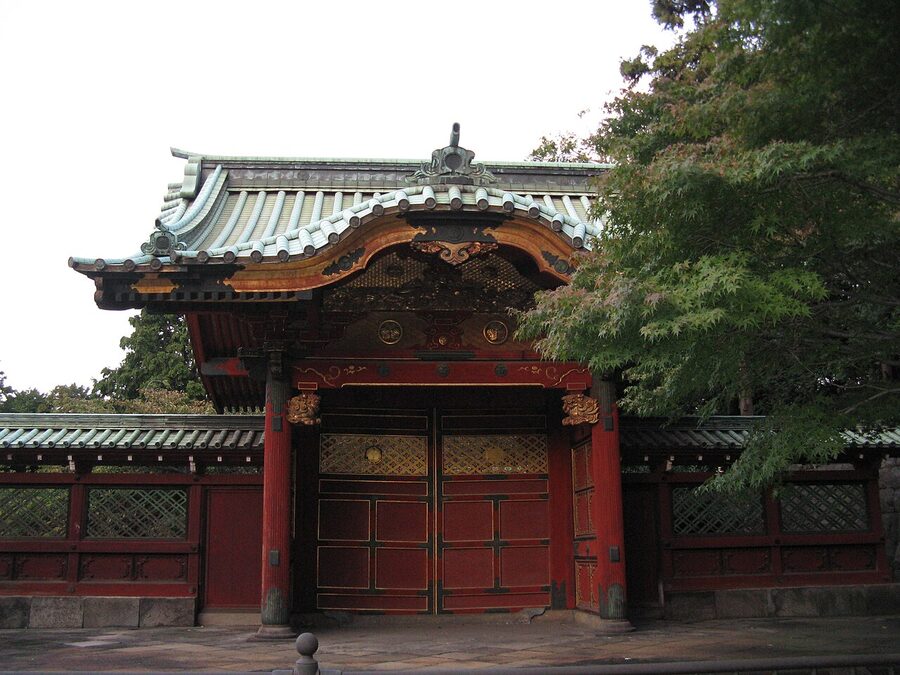
Kan’ei-ji is the Tokugawa mausoleum complex on Ueno Hill, a ten-minute walk from Ueno Station. The main temple complex was mostly destroyed in the Boshin War (1868); Tsunayoshi’s Jōken-in (常惡院) sub-temple survived because it was on the edge of the site away from the fighting. The calligraphy gate shown above is the main approach. The inner mausoleum is not open to the public, it remains imperial household property, but you can stand at the gate and consider the fact that the man interred behind it tried to make a feudal warrior society merciful and failed, and is remembered for the failure.
Best visit: go in the morning before the Ueno Park museum crowds arrive. The temple itself is free. Combine with Ueno Toshōgū (the Ieyasu shrine a hundred metres away) and the Kan’ei-ji five-storey pagoda for a morning.
2. Yushima Seidō — Ochanomizu, Tokyo
Yushima Seidō (淫島聖堂) is the Confucian academy Tsunayoshi founded in 1690, the most concrete surviving piece of his intellectual programme. It stands five minutes’ walk from Ochanomizu Station on the Chūō and Sōbu lines. The current main hall is a 1935 reconstruction — the original burned down in the 1923 Kantō earthquake — but the architectural plan, the Ming-Chinese-influenced proportions, and the positioning of the Confucius statue are faithful to Tsunayoshi’s 1690 design.
Admission is free, the grounds are open sunrise to sunset, and the small museum on the east side shows a copy of the edition of the Analects Tsunayoshi personally commissioned. Allow forty minutes. If you are reading this site you are probably the right sort of visitor for this temple; most of the guidebook tour groups skip it entirely, which is a shame and a gift.
3. Gokoku-ji — Bunkyō-ku, Tokyo
Gokoku-ji (護国寺) was built in 1681 by Tsunayoshi and his mother Keishōin as the family’s patron temple, and it is where Keishōin is buried. The main hall is an original 1697 structure — unusually for central Tokyo, it survived the 1923 earthquake, the 1945 firebombing, and every round of postwar redevelopment. It is a Shingon temple, which matters because Shingon was the sect of Ryūkō, the monk who channelled Keishōin’s Buddhist policy into Tsunayoshi’s compassion edicts. Standing in the main hall you are standing in the actual architectural space that produced the theology that produced the dog laws.
Gokoku-ji is seven minutes’ walk from Gokokuji Station on the Yūrakuchō subway line. Admission free. The temple garden is small but well-preserved; in early April the cherry trees along the main approach are excellent.
4. Nakano — former dog-shelter site, western Tokyo
If you want to stand on the ground where 80,000 dogs were fed during the Genroku famine, you can. The Nakano shelter site is now the Nakano ward government building and the surrounding residential district; a small stone marker by the JR Nakano Station south exit commemorates the Inu-yashiki (犬屋敷, “Dog Mansion”) that once stood here. There is no dedicated museum. There is no attempt at reconstruction. The site has been built over so completely that only the persistent fact of the marker remains.
Seven minutes by JR Chūō from Shinjuku. The Nakano shopping street Nakano Broadway is a five-minute walk from the marker — post-visit lunch is Nakano’s famous tonkotsu ramen or, in the spirit of the occasion, vegetarian.
The Ledger
What Tokugawa Tsunayoshi got right: the Yushima Seidō, which produced two generations of Confucian-trained shogunate administrators and eventually the entire modern Japanese civil service. The diplomatic opening to Kaempfer and the Dutch, which brought the first serious exchange of European scientific knowledge into an otherwise closed country. The Akō decision, which preserved both law and virtue at the same time, a Solomon-level judgement call. The public works programmes in Edo, Nikkō, and Kyoto, which rebuilt temple complexes damaged by the 1657 Meireki fire and the 1703 Genroku earthquake.
What he got wrong: the Shōrui Awaremi no Rei in almost every particular. Trying to legislate jen into commoners who did not share the philosophical framework. Allowing his mother’s Shingon circle to run parallel policy out of the Honmaru. Debasing the currency to fund the dog shelters. The cumulative economic damage of the Genroku debasement was so bad that the next three shōguns spent thirty years trying to repair it, and only the viper of Mino’s great-great-indirect-heir Tokugawa Yoshimune, another Confucian-educated outsider installed by succession accident, finally managed it in the 1720s.
He was not a bad shōgun. He was an over-educated one in a period that did not reward over-education in rulers. The failure of his compassion programme is what most people remember about him. What they should probably remember is that he was the one Tokugawa shōgun who actually tried to be good, in the formal moral-philosophical sense, and that the country was not set up for what happened when a ruler tried it.
If you visit his mausoleum at Jōken-in, stand at the calligraphy gate for a minute and consider that the emperor who wrote the tablet was eleven years old when Tsunayoshi died and had been told, repeatedly, to ignore everything the street said about the Dog Shōgun. The emperor ignored it. The tablet is in his own hand. Three hundred and fifteen years later, it is still there.