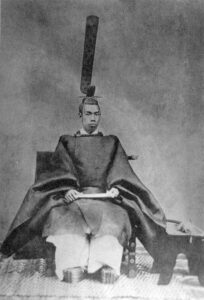
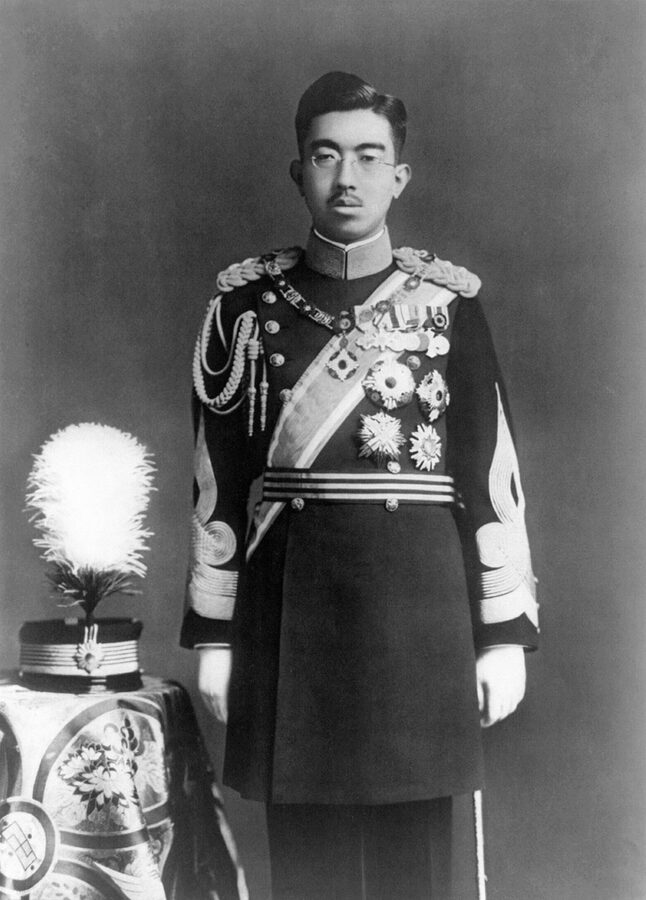
On the night of 14 August 1945, palace technicians in Tokyo recorded a four-and-a-half-minute speech onto two small phonograph discs. The voice on the discs was Emperor Hirohito reading the Imperial Rescript on the Termination of the War, and when the recording aired the following day at noon, almost no Japanese citizen had ever heard their emperor speak before. The Shōwa era already counted nineteen years on its odometer at that moment, and it would run another forty-three years after, finally closing on 7 January 1989. Across those sixty-three years and thirteen days, Japan compressed more change than most countries manage in two centuries, and that is the story I want to walk you through here.
In This Article
- What Shōwa actually means, and why the irony stings
- How the era began: a quiet succession in 1926
- The drift toward militarism: 1926 to 1937
- The Pacific War: December 1941 to August 1945
- Hiroshima, Nagasaki, and surrender
- The signing on the Missouri
- The Allied occupation: 1945 to 1952
- The Reverse Course and the San Francisco Treaty
- The economic miracle: 1955 to 1973
- The 1964 Tokyo Olympics and the Shinkansen
- 1960 Anpo and the politics of the Security Treaty
- The Mishima Incident, 25 November 1970
- The 1973 oil shock and the bubble that followed
- Cultural exports: anime, karaoke, and the Walkman
- The death of the Shōwa Emperor
- Where to actually visit Shōwa Japan today
- Reading the era now
What Shōwa actually means, and why the irony stings
The era name 昭和 was selected from a passage in the Chinese Book of Documents that runs 百姓昭明、協和万邦, which the scholar Yoshida Masuzō glossed as a hope that the common people would be illuminated and the ten thousand lands harmonised. The conventional English translation came out as “enlightened peace,” which became one of the bleaker bits of historical irony once the era’s actual events started rolling in. Shōwa would contain the Pacific War, the only nuclear weapons ever used in anger, the bloodiest occupation in Asian colonial history, the longest sustained run of double-digit GDP growth any major economy has ever posted, and the financial bubble that produced more paper wealth per square metre than any place on earth has ever seen since.
That spread of events makes the era oddly hard to write about as a single thing. The Shōwa of 1936 and the Shōwa of 1986 share an emperor and a calendar, but almost nothing else. Japanese historians sometimes split the era into Senzen Shōwa (prewar Shōwa) and Sengo Shōwa (postwar Shōwa), with the radio broadcast of 15 August 1945 as the hinge. I will follow that division here, with stops along the way for the moments that mattered most.
One small note on dates before I start. Japanese calendars count years from the start of an era, so Shōwa 20 is 1945 and Shōwa 64 is 1989. I will use the Western calendar throughout, but if you ever see a Japanese document with “Shōwa 38” stamped on it, that is 1963, the year before the Tokyo Olympics. The arithmetic is just 1925 plus the era year.
How the era began: a quiet succession in 1926
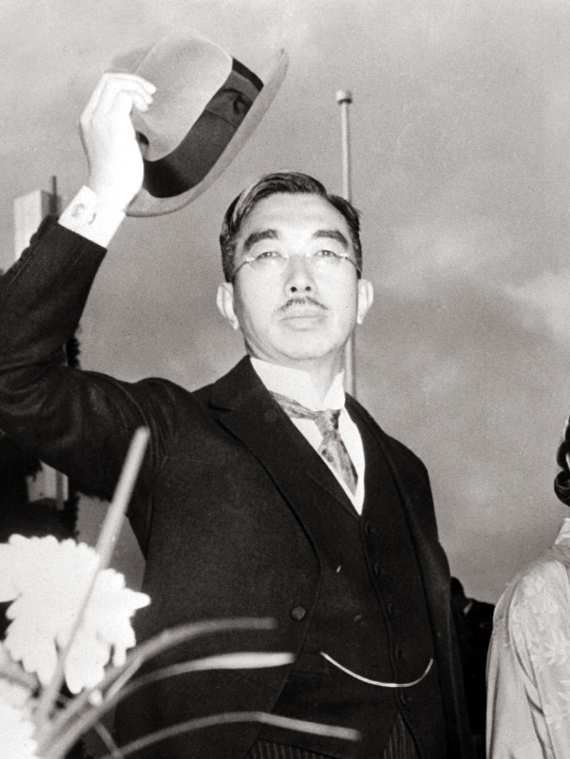
Hirohito had effectively been running the country since 1921, when his father Emperor Taishō slipped into mental illness and Hirohito was named regent. The actual succession on 25 December 1926 was therefore an administrative event rather than a political one. The official enthronement ceremonies would not take place until November 1928, by which point the new emperor had already toured Europe, married Princess Nagako, and fathered the future Emperor Akihito. He was twenty-five years old at his accession and had been trained in marine biology, the discipline that would remain his private passion across the entire era.
The Japan he inherited was already nervous. The economic boom of the First World War had collapsed in 1920, the Great Kantō Earthquake had levelled most of Tokyo and Yokohama in 1923, and the Wall Street Crash of 1929 was three years away. Civilian government in Tokyo was real but fragile, and the army and navy operated under a constitutional clause that made them answerable to the emperor rather than to the cabinet. That clause, written into the Meiji constitution to keep politicians from interfering with military operations, would become one of the mechanisms that drove the slide into war.
The drift toward militarism: 1926 to 1937
The first decade of Shōwa is best read as a slow-motion takeover of Japanese politics by officers who increasingly saw civilian government as an obstacle to imperial destiny. The pattern repeated itself in three big jolts. The 1931 Manchurian Incident saw the Kwantung Army fabricate a railway sabotage at Mukden, use it as pretext to occupy all of Manchuria, and present Tokyo with an accomplished fact.
When the League of Nations censured Japan in 1933, Tokyo simply walked out. The civilian foreign minister Yōsuke Matsuoka delivered the resignation speech and would be in the dock at the Tokyo Trials twelve years later.
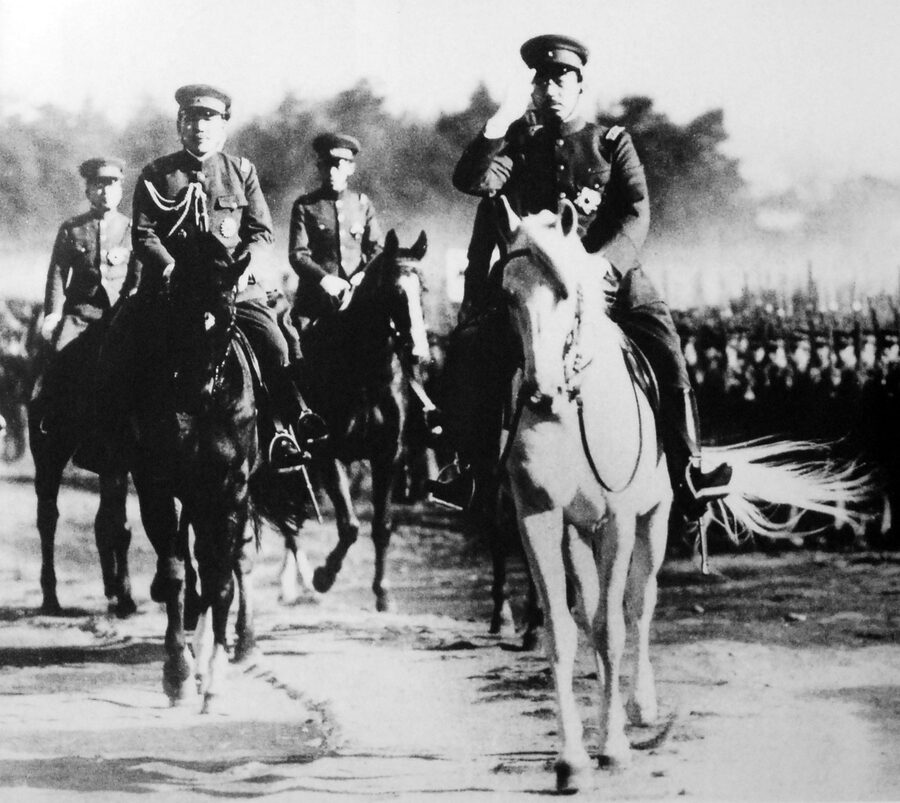
The second jolt came on 26 February 1936, when about 1,500 junior officers from the 1st and 3rd Infantry Regiments staged a coup attempt in central Tokyo. They killed Finance Minister Takahashi Korekiyo in his bed, shot Lord Keeper of the Privy Seal Saitō Makoto, stabbed Inspector General Watanabe Jōtarō, and attempted to assassinate Prime Minister Okada Keisuke (who hid in a closet while his brother-in-law was shot by mistake). The coup collapsed within three days because Hirohito himself, in a rare display of personal political will, ordered the rebellion suppressed. Nineteen ringleaders were executed, but the survivors and their faction quietly absorbed the lesson that the civilian government would not be allowed to push back against the army for very long.
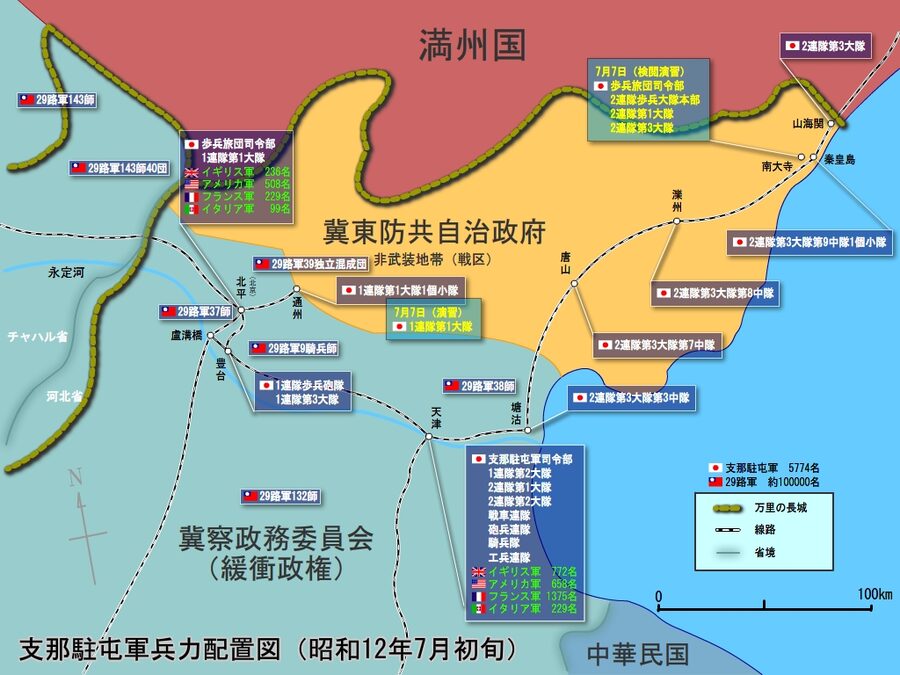
The third jolt arrived on 7 July 1937, when troops from the Japanese garrison in north China and Chinese Nationalist troops exchanged fire at the Marco Polo Bridge southwest of Beijing. The skirmish was small. Within six weeks it had escalated into the full Second Sino-Japanese War, which would consume Japanese economic and military resources for the next eight years and set the stage for Pearl Harbor. The Nanjing massacre followed in December 1937, with the city’s capture producing one of the most thoroughly documented atrocities of the twentieth century.
The Pacific War: December 1941 to August 1945
By the autumn of 1941, Japan was bogged down in China, dependent on American oil, and increasingly under American economic pressure. The Roosevelt administration’s July 1941 oil embargo, imposed after Japan moved into French Indochina, gave the Imperial Navy roughly eighteen months of fuel reserves. The choice in Tokyo was framed as either accepting the American demand to withdraw from China and Indochina or going to war while the navy still had the fuel to fight. The second option was approved at an Imperial Conference on 1 December 1941, with Hirohito presiding and not objecting.
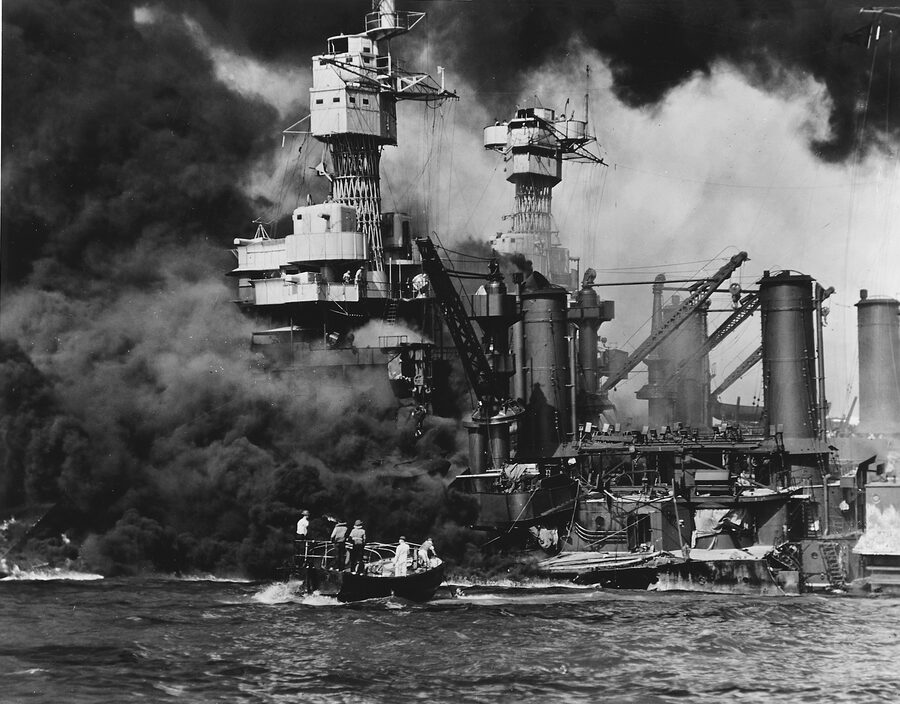
Six days after Pearl Harbor (the attack itself was the morning of 7 December in Hawaii but 8 December in Tokyo), Germany and Italy declared war on the United States, which converted the European and Pacific conflicts into a single global war. The Japanese opening run was spectacular and brief. Hong Kong fell on Christmas Day 1941, Singapore on 15 February 1942, Manila on 8 March, the Dutch East Indies by mid-March.
Then came the Battle of Midway on 4 to 7 June 1942, where four of the six Japanese fleet carriers that had attacked Pearl Harbor were sunk in a single morning. After Midway, the strategic question was no longer whether Japan would lose but how long the loss would take and how bad it would be.
The answer turned out to be three more years and very bad. American industrial output simply overwhelmed Japanese industry. By 1944, the United States was launching new aircraft carriers faster than the Imperial Navy could lose the old ones, and B-29 bombers based in the Mariana Islands began systematic firebombing raids against Japanese cities.
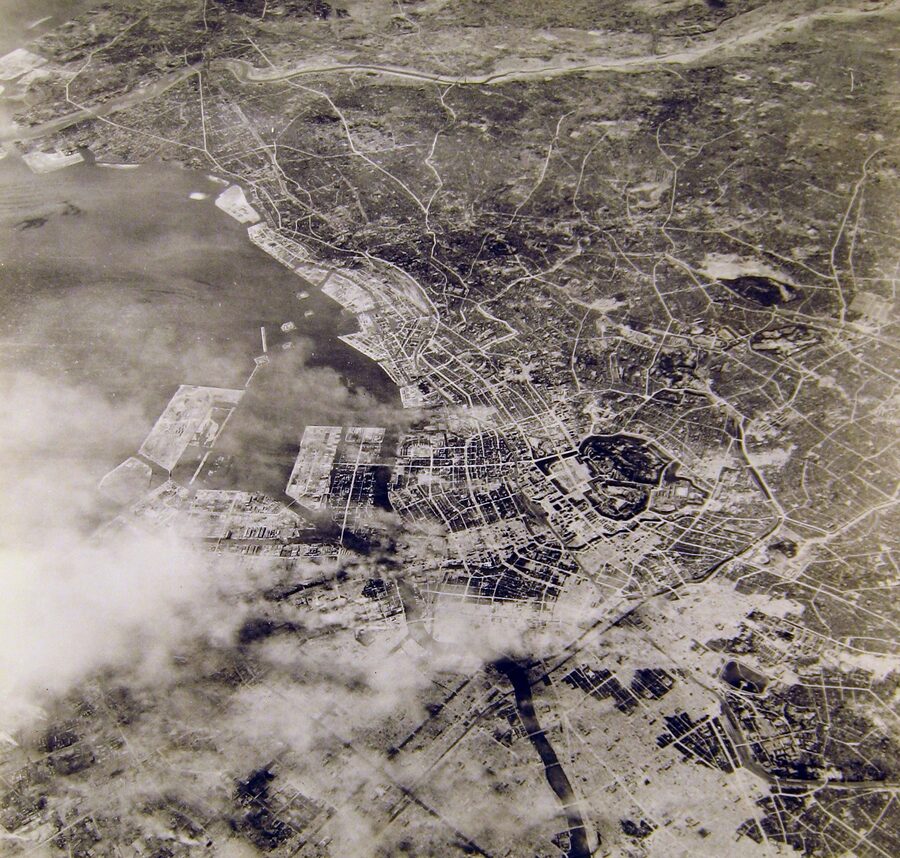
The raid of 9 to 10 March 1945 against Tokyo, designated Operation Meetinghouse, killed roughly 100,000 people in a single night and burned out about sixteen square miles of the city. It remains the single most destructive air raid in human history by death toll, including the atomic bombings.
Hiroshima, Nagasaki, and surrender
By the summer of 1945, the strategic situation was completely settled. Okinawa had fallen on 22 June after an eighty-two-day battle that killed about 240,000 people, including roughly a third of the civilian population of the island. The Japanese mainland was within easy bomber range, the navy was effectively gone, and the army had pulled most of its useful divisions back to defend the home islands. The Potsdam Declaration of 26 July 1945 demanded unconditional surrender and was rebuffed, primarily because the Japanese cabinet remained split between hardliners who wanted to fight a final defensive battle on the home islands and a peace faction that wanted assurances about the survival of the imperial institution.
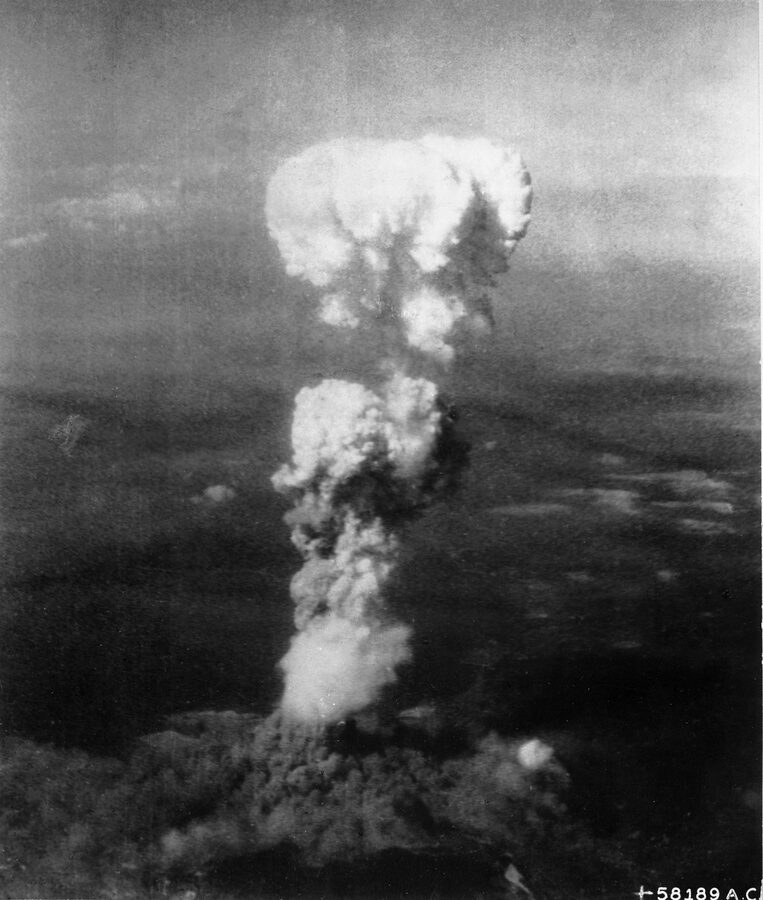
The American answer arrived on 6 August 1945, when a B-29 named Enola Gay dropped a uranium gun-type bomb codenamed Little Boy at 8:15 AM Hiroshima time. The bomb detonated about 580 metres above the Shima Hospital, roughly in the centre of the city, with a yield equivalent to about 15 kilotons of TNT.
Two days later the Soviet Union, which had honoured a neutrality pact with Japan since 1941, declared war and invaded Manchuria with about 1.5 million troops. On 9 August a second bomb, the plutonium implosion device Fat Man, was dropped on Nagasaki when cloud cover obscured the primary target of Kokura. The combined casualty figures from the two bombings sit somewhere between 130,000 and 230,000 people depending on which timeframe and which estimate you use.
The combination of the two bombings and the Soviet entry broke the deadlock in the Japanese cabinet. Hirohito personally intervened at an Imperial Conference on the night of 9 to 10 August, telling the Supreme Council to accept the Potsdam terms with the single condition that the imperial institution be preserved. The Allies replied on 11 August with language ambiguous enough to allow both sides to read it as they wished, the cabinet accepted, and the formal acceptance was sent on 14 August. That night, palace technicians recorded the emperor’s surrender broadcast.
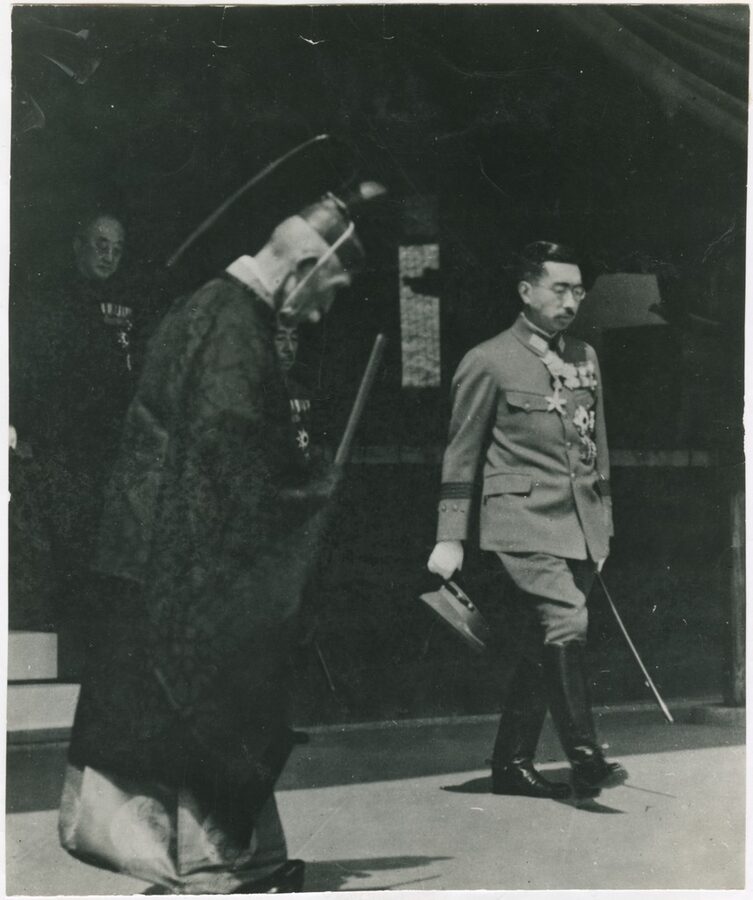
The 15 August 1945 broadcast went out at noon. Hirohito’s voice, speaking in the formal court Japanese that almost nobody understood without translation, announced that Japan had accepted the joint declaration of the Allied powers and ordered the population to “endure the unendurable.” Most listeners had to wait for the news anchors to translate the speech into modern Japanese before they fully understood that the war was over.
There was very little public reaction in either direction. People mostly stood in their streets, in offices, in factories, and listened in silence.
The signing on the Missouri
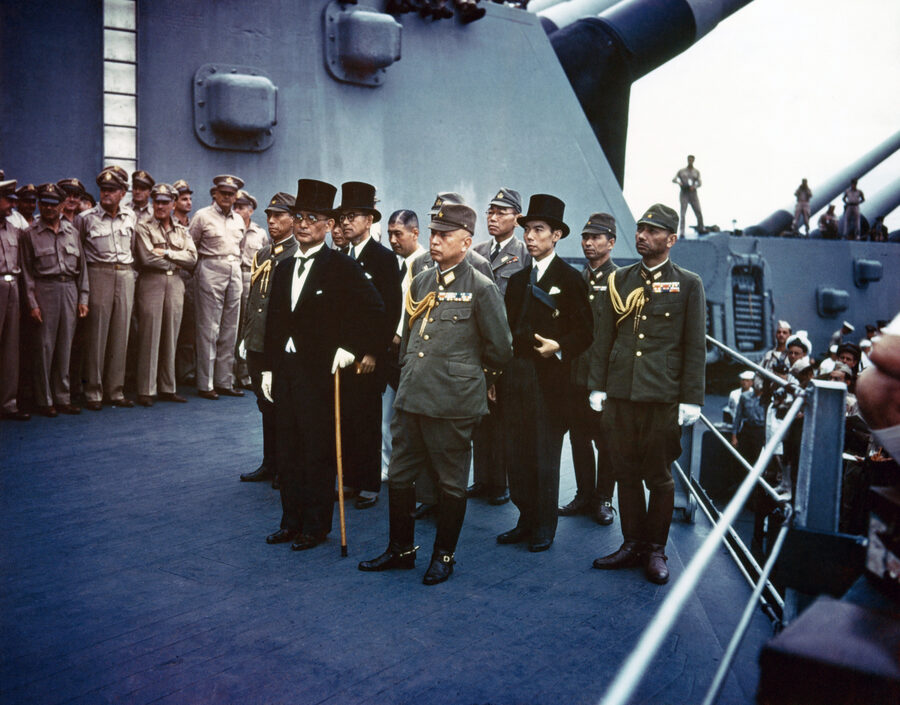
The formal surrender ceremony took place on 2 September 1945 aboard the battleship USS Missouri, anchored in Tokyo Bay roughly fifteen miles offshore. Foreign Minister Mamoru Shigemitsu signed for the Japanese government, General Yoshijirō Umezu signed for the Imperial General Headquarters, and General Douglas MacArthur signed as Supreme Commander for the Allied Powers. The instrument was signed in nine copies, one for each Allied government. World War II was officially over in twenty-three minutes.
The cost in human terms was almost incomprehensible. Estimates of total Japanese deaths from the war run between 2.6 and 3.1 million, including about 800,000 civilian deaths in Japan proper from bombing and famine. Chinese deaths in the wider war are estimated at 15 to 20 million.
The number for the entire Asia-Pacific theatre runs to roughly 25 million dead. Whatever else one says about the Shōwa era, those numbers are the inescapable centre of it.
The Allied occupation: 1945 to 1952
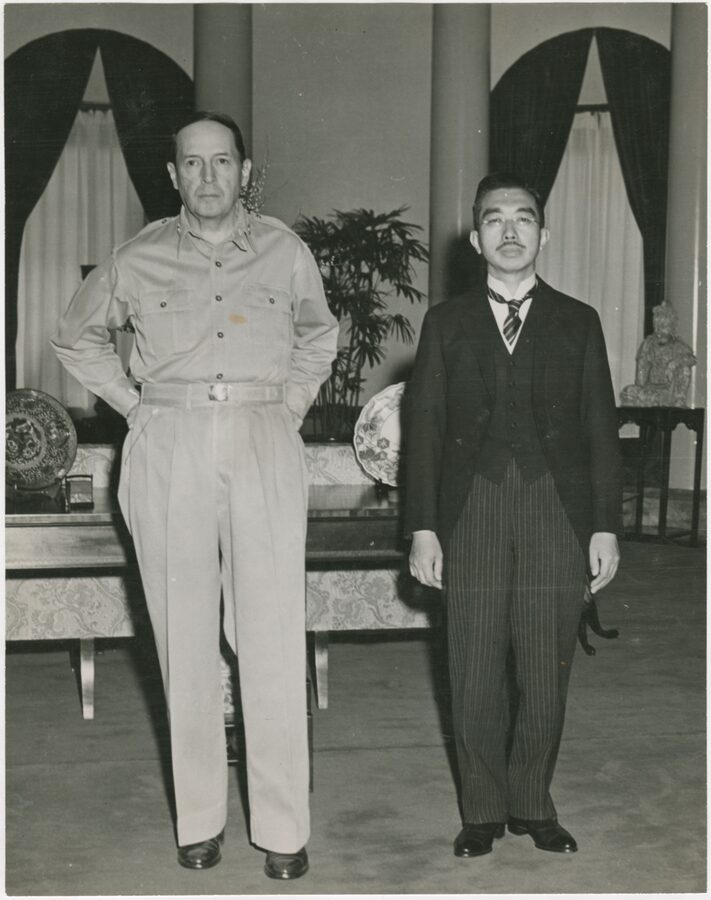
Douglas MacArthur arrived at Atsugi airfield on 30 August 1945 with his trademark corn-cob pipe and a personal staff of about a dozen aides. By the end of October, the Supreme Commander for the Allied Powers (SCAP) headquarters in the Dai-Ichi Insurance Building opposite the Imperial Palace had functioning offices for some 5,000 staff, and the work of remaking Japan was under way. The occupation would last six years and eight months, until the San Francisco Peace Treaty took effect on 28 April 1952. It was, by any reasonable measure, the most successful long-term occupation in modern history.
The first wave of reforms targeted the structural sources of militarism. The army and navy were dissolved. The State Shintō establishment that had provided ideological cover for imperial authority was disestablished. The eleven largest zaibatsu industrial conglomerates, beginning with Mitsui and Mitsubishi, were broken up (although they would quietly reconstitute as keiretsu in the 1950s).
Land reform between 1947 and 1949 redistributed about 5.8 million acres of farmland from absentee landlords to tenant farmers, fundamentally remaking the rural class structure that had supported prewar conservatism. Three million peasants became landowners by 1950.
The second wave of reforms was constitutional. The Meiji Constitution of 1889 was scrapped and replaced with a new constitution drafted in February 1946 by an SCAP team of about two dozen people working in roughly eight days. The Japanese government was given the document as a model and asked to translate, polish, and present it as their own work.
The new constitution took effect on 3 May 1947, made the emperor “the symbol of the State and of the unity of the People” with no governmental powers whatsoever, gave women the vote, separated religion and state, and famously renounced war and the maintenance of war potential in Article 9. That article remains in force today, and the question of whether to revise it has been one of the running political fights of postwar Japan.
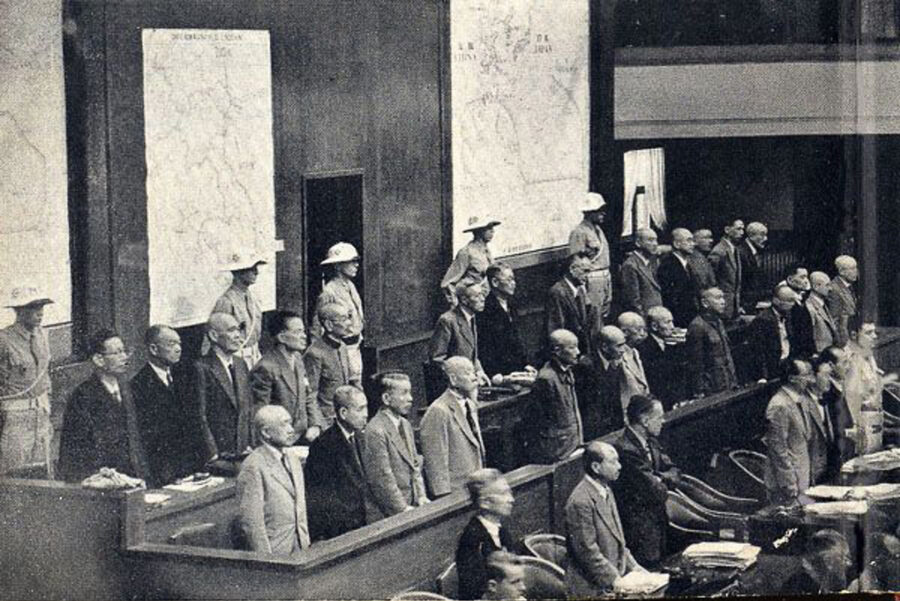
The Tokyo War Crimes Trials ran from 3 May 1946 to 12 November 1948 in the former Imperial Army headquarters at Ichigaya. Twenty-eight Class A defendants were charged with crimes against peace, war crimes, and crimes against humanity. Two died during the trial and one was found unfit to stand.
Of the remaining twenty-five, seven were sentenced to death and hanged, including former Prime Minister Hideki Tōjō. The remaining sentences ranged from life imprisonment to seven years. About 5,700 lower-ranking war criminals faced separate Class B and C trials in various Allied jurisdictions, of whom roughly 920 were executed.
The Reverse Course and the San Francisco Treaty
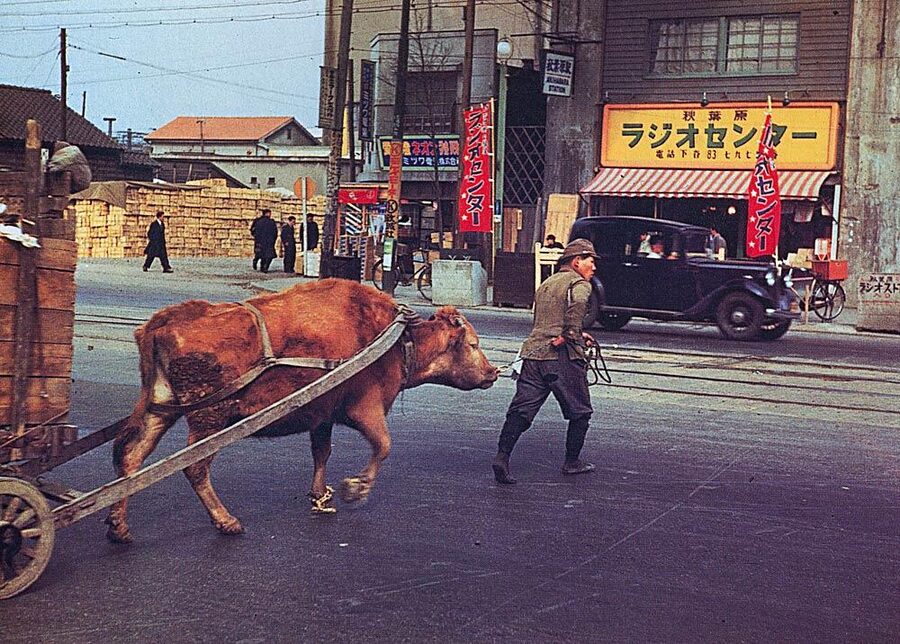
By 1948 the geopolitical context had changed completely. The Soviet Union had detonated an atomic bomb (1949), Mao Zedong’s communists had won the Chinese civil war (1949), and the Korean War would break out in June 1950. Washington’s view of Japan shifted from “former enemy to be punished” to “potential anti-communist ally to be rebuilt.”
This shift, known in Japanese as Gyaku Kōsu (the Reverse Course), included rolling back some of the early reforms. Purges of suspected wartime collaborators were halted in 1947 and many purged officials were rehabilitated. Labour union activity was restricted. American aid stopped trying to dismantle Japanese industry and started trying to revive it.
The peace settlement came together at the San Francisco conference of 4 to 8 September 1951. Forty-eight countries signed the Treaty of Peace with Japan, which took effect on 28 April 1952 and ended the occupation. The Soviet Union refused to sign, and a separate Sino-Japanese settlement would not arrive until 1972. Simultaneously, Japan and the United States signed a Security Treaty allowing American military bases on Japanese soil indefinitely, which became one of the most contentious issues in Japanese politics for the next two generations.
The economic miracle: 1955 to 1973
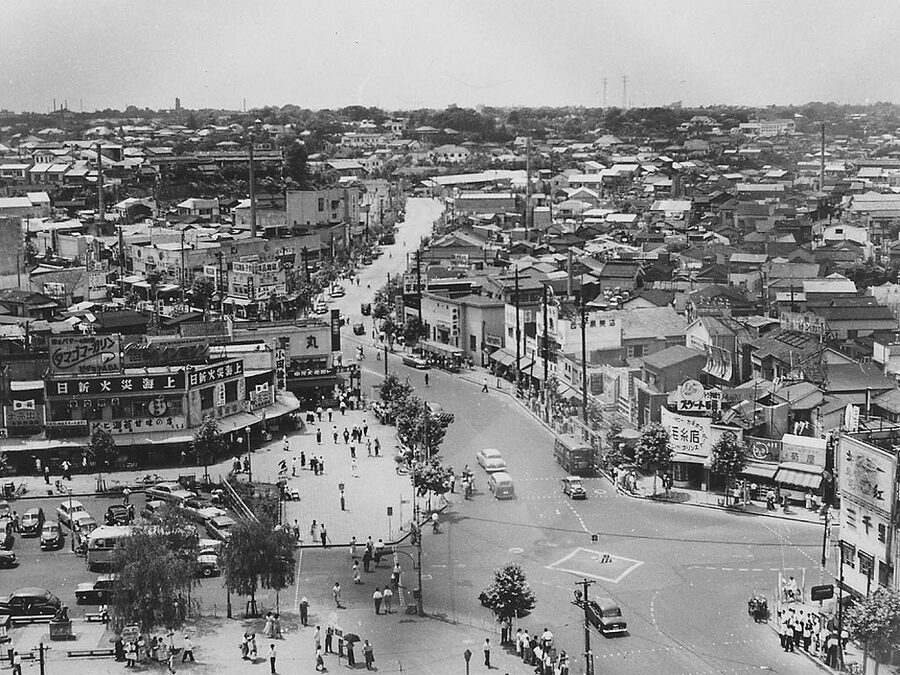
The recovery from war damage took until about 1955, the year per-capita GDP returned to 1934 levels. From 1955 to 1973, real GDP grew at an annualised rate of roughly 9.3 percent. The Income Doubling Plan announced by Prime Minister Hayato Ikeda in December 1960 targeted 7.2 percent annual growth and was met every year until the 1973 oil shock.
By 1968 Japan had passed West Germany to become the second-largest capitalist economy in the world, behind only the United States.
The mechanisms behind this surge are still studied in business schools. The Ministry of International Trade and Industry (MITI) coordinated industrial policy by allocating foreign exchange, directing capital toward strategic sectors (steel, shipbuilding, automobiles, electronics), and using import controls to protect domestic industries during their growth phases.
The keiretsu system bound banks, trading companies, manufacturers, and retailers into cooperative networks through cross-shareholdings. Lifetime employment in major firms exchanged worker loyalty for company welfare. High household savings rates, around 20 percent of disposable income through the 1960s, financed industrial investment without requiring foreign capital.
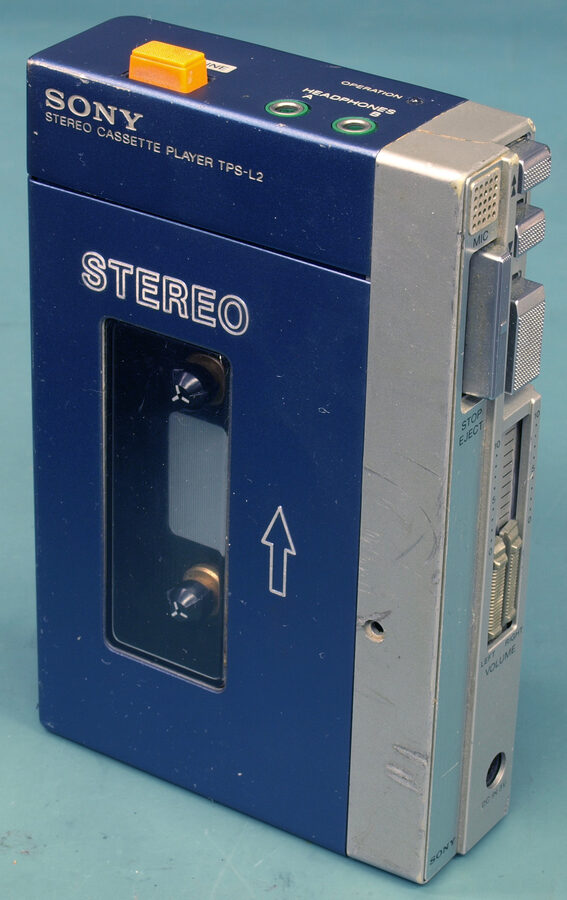
The cars and the cameras came to define Japan abroad. Toyota Motor Company, founded in 1937, exported its first car to the United States in 1957 (the Toyopet Crown, which flopped) and had become a dominant American import by 1973 with the Corona and Corolla. Sony, founded in 1946 as Tokyo Telecommunications Engineering, brought transistor radios to America in 1957 and by 1979 had launched the Walkman.
Honda, started by Soichiro Honda in 1948 as a motorcycle manufacturer, was selling more motorcycles in America than Harley-Davidson by 1965. Nintendo, much older than people realise (it was founded in 1889 to make playing cards), pivoted to electronic toys in the 1970s and to home video games with the Famicom in 1983.
The 1964 Tokyo Olympics and the Shinkansen
Japan’s coming-out party as a fully recovered nation was the 1964 Tokyo Summer Olympics, which ran from 10 to 24 October. Tokyo had originally been awarded the 1940 Olympics, which were cancelled because of the war, and the 1964 hosting was a deliberate act of international rehabilitation. The Olympic flame was lit in Olympia, carried through Asia, and brought into the National Stadium by Yoshinori Sakai, a nineteen-year-old runner born in Hiroshima Prefecture on 6 August 1945, the day of the atomic bombing. The symbolism was not subtle, and not meant to be.
The Olympics were the first to be broadcast internationally by communications satellite (Syncom 3, parked over the Pacific) and the first to use partial colour television. Tokyo built a new monorail to Haneda Airport, doubled the capacity of the Tōmei Expressway, threw up the Hotel Okura, and gutted entire neighbourhoods to make room for athlete accommodations. The combined infrastructure spend was roughly the equivalent of 30 percent of the national budget for the year, an extraordinary commitment to a sporting event.
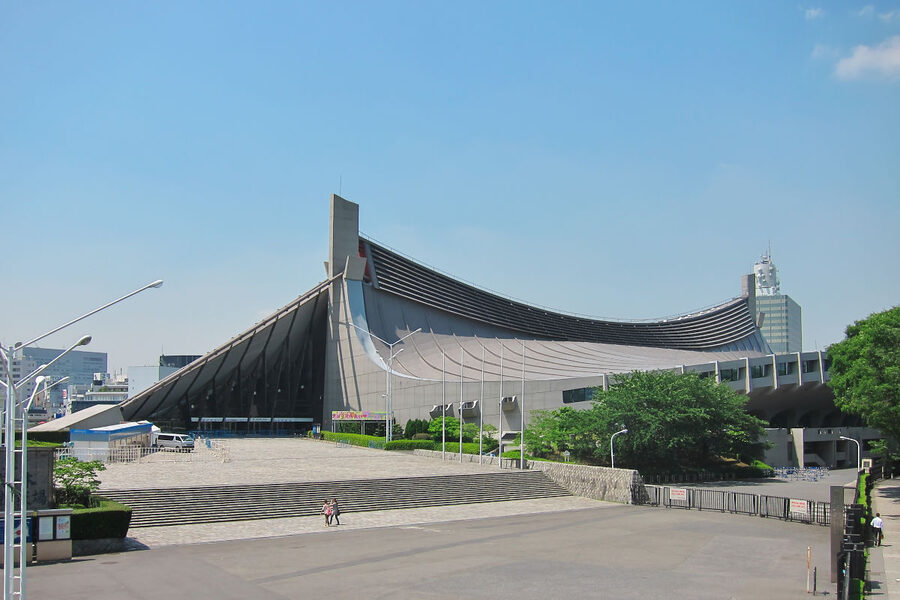
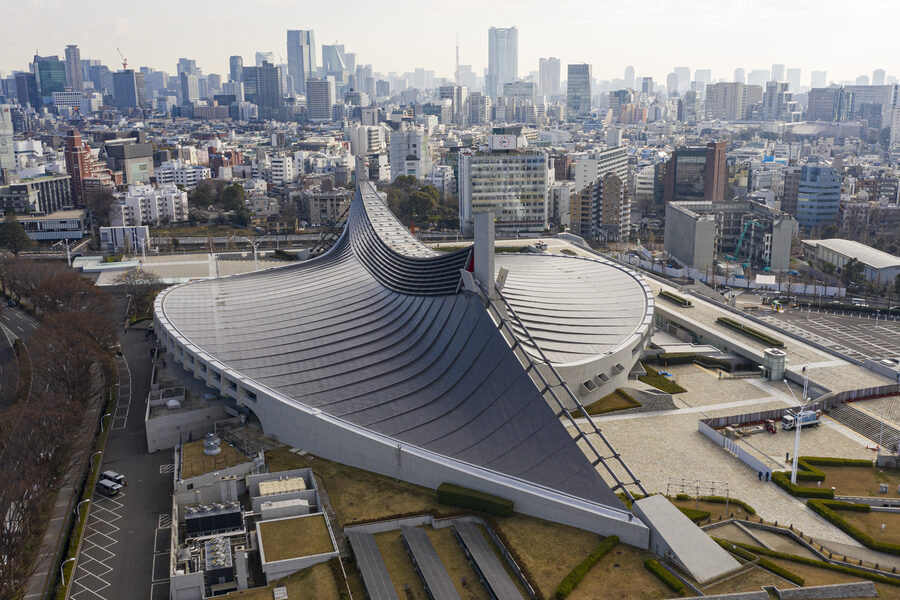
The most striking architectural legacy was Kenzo Tange’s Yoyogi National Gymnasium, completed in 1964 and used for the swimming events. Tange suspended the roof from a single concrete spine running between two masts, producing a swooping double-curve that has been imitated everywhere since. Tange would go on to design the Hiroshima Peace Memorial Museum, the Tokyo Metropolitan Government Building, and Saint Mary’s Cathedral in Tokyo. Yoyogi was the building that turned him from a respected national architect into an international one, and it was renovated and reused for the 2020/2021 Tokyo Olympics handball events.
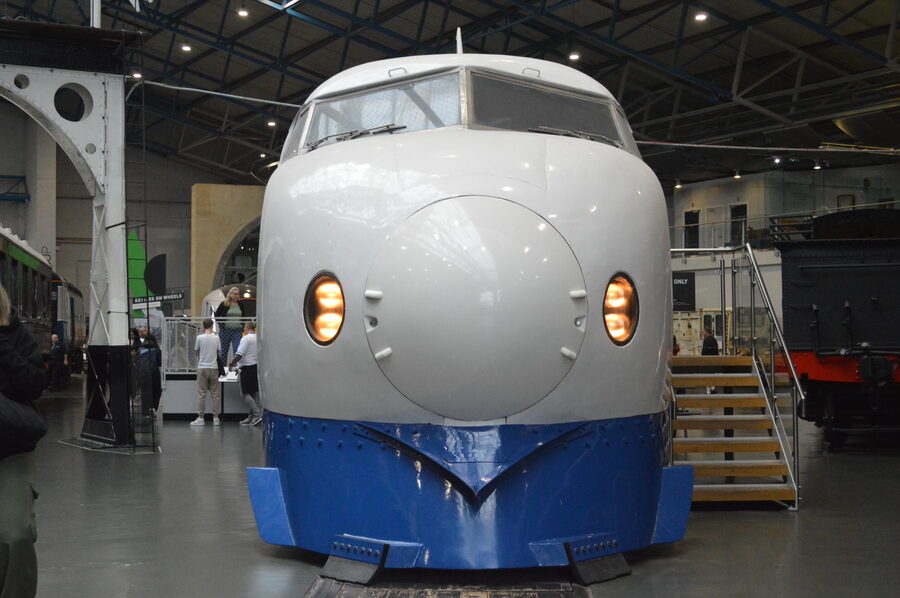
Nine days before the opening ceremony, on 1 October 1964, the Tōkaidō Shinkansen began service between Tokyo and Osaka. The world’s first high-speed rail system covered the 515 kilometres between the two cities in four hours at a top speed of 210 km/h, cutting an old eight-hour journey roughly in half. The 0 Series trainset, with its bullet-shaped nose and white-and-blue livery, became one of the most recognisable industrial designs of the twentieth century, and it stayed in service until 2008. There are now 2,830 kilometres of Shinkansen track in Japan, and on a peak day the trains carry about a million passengers.
1960 Anpo and the politics of the Security Treaty
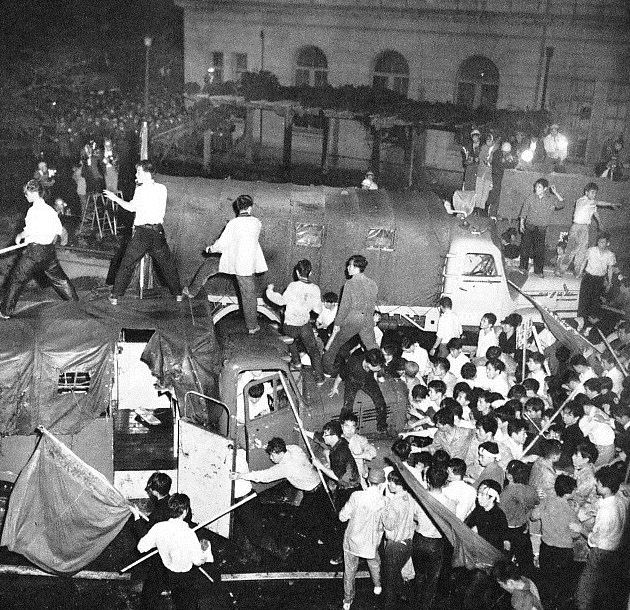
Before the Olympics could become a triumph, the country had to get through the most violent political crisis of postwar Japan. The 1951 Security Treaty was up for renewal in 1960, and Prime Minister Nobusuke Kishi (himself a former wartime cabinet minister who had been arrested as a Class A war crimes suspect, then released without charge) wanted to push through a revised version. Critics argued that the new treaty perpetuated American military dominance over Japan and dragged the country into Cold War conflicts not of its choosing.
The protests built through the spring of 1960 and exploded in May, when Kishi forced the treaty through the Lower House at midnight on 19 May with only members of his own party present and the Socialist opposition forcibly removed by police. Demonstrations of up to 300,000 people surrounded the Diet daily for the next month. On 15 June, university student Michiko Kanba was killed during clashes with police inside the Diet compound.
President Eisenhower’s planned state visit was cancelled. Kishi announced his resignation on 16 June. The treaty took effect anyway on 23 June, but the political damage permanently fractured the conservative-progressive alliance and made foreign policy a much more politically dangerous subject than it had been.
The Mishima Incident, 25 November 1970
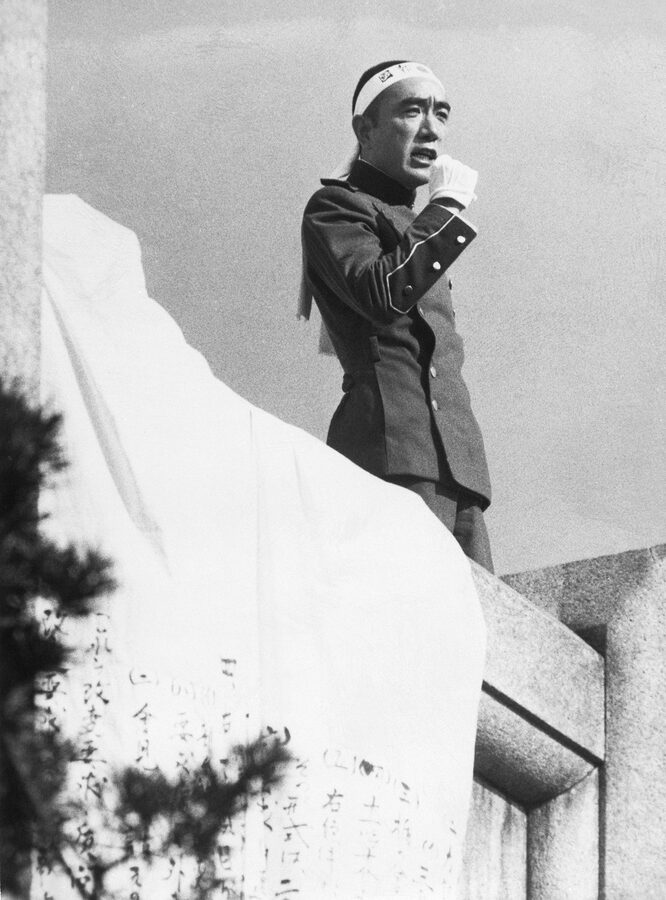
The single weirdest day of the Shōwa era was probably 25 November 1970, when the novelist Yukio Mishima and four members of his private militia (the Tatenokai or Shield Society) entered the Ichigaya headquarters of the Eastern Army of the Japan Ground Self-Defense Force, took the commandant hostage in his own office, and demanded that the assembled garrison parade so that Mishima could address them. The soldiers in the courtyard were not on his side. Mishima delivered a roughly seven-minute speech denouncing the postwar constitution and calling for a coup to restore imperial authority. He was heckled and laughed at.
Mishima then walked back into the commandant’s office and committed seppuku, the ritual disembowelment that had not been performed in Japan in any serious form since 1945. His Tatenokai second, Masakatsu Morita, was supposed to behead him at the moment of the cut, missed twice, and was finished by a third member of the group, who then beheaded Morita as well. Mishima was forty-five years old and had been nominated for the Nobel Prize in Literature three times.
The incident is read variously as the last gasp of the imperial right wing, a literary act, a deeply private psychological event, and a piece of pure performance theatre. It was probably all of those things.
The 1973 oil shock and the bubble that followed
The miracle ended sharply. The Yom Kippur War in October 1973 prompted OPEC to quadruple oil prices and embargo nations seen as supporting Israel. Japan, which depended on imported oil for 75 percent of its energy supply, saw industrial production fall by 20 percent and consumer prices rise by 30 percent within twelve months.
The double-digit growth of the 1960s never returned. From 1974 onward, Japan grew at a more normal 4 to 5 percent annually, still strong by global standards but a different economic regime entirely.
Then came the Plaza Accord, signed at the Plaza Hotel in New York on 22 September 1985 by the finance ministers of the United States, Japan, West Germany, France, and the United Kingdom. The agreement coordinated currency intervention to weaken the dollar against the yen and the Deutsche Mark. The yen rose from about 240 to the dollar in 1985 to 165 by the end of 1986 and 120 by 1988. Japanese exports became more expensive, the Bank of Japan cut interest rates aggressively to stimulate the domestic economy, and a tidal wave of cheap money flooded into the property and stock markets.
The bubble that followed was unlike anything any developed economy had produced before. The Nikkei 225 stock index closed at 38,915.87 on 29 December 1989, the last trading day of the year and the all-time high it has not reached since. (As of this writing in 2026 the index has only recently surpassed it after a thirty-five-year drought.)
Tokyo land prices roughly tripled between 1985 and 1991. By 1990, the 1.15 square kilometres of the Imperial Palace grounds in central Tokyo were notionally worth more than the entire real estate of California, and at one moment all the land in Japan was estimated to be worth about four times the entire United States.
Golf club memberships traded as financial instruments. Tokyo nightclubs charged thousands of dollars to enter.
Cultural exports: anime, karaoke, and the Walkman
The economic boom funded a cultural one. Postwar manga had begun with Osamu Tezuka, whose Astro Boy debuted in 1952 and whose body of work over the next thirty-six years (he died in 1989, just weeks after Hirohito) reshaped the entire form. Tezuka’s anime studio Mushi Production produced the first weekly Japanese animated television series, and the post-Tezuka boom in manga and anime studios from the 1960s through the 1980s produced Studio Ghibli (founded 1985), Gundam (1979), Akira (manga 1982, film 1988), and dozens of other franchises that would define what global audiences came to mean by “anime.”
Karaoke is sometimes traced to a specific man, Daisuke Inoue of Kobe, who built the first commercial coin-operated karaoke machine, the 8 Juke, in 1971. Sony’s Walkman TPS-L2 launched on 1 July 1979 at a price of 33,000 yen and sold 30,000 units in the first two months, then proceeded to sell about 400 million units worldwide before the format finally died. Nintendo’s Famicom (Family Computer, the Japanese Nintendo Entertainment System) launched in 1983 and dominated home gaming until the early 1990s. The image of the Japanese consumer electronics industry was so dominant in the 1980s that there was a cottage industry in American magazines warning that Japan was about to economically annex the United States.
The death of the Shōwa Emperor
Hirohito’s health declined visibly through 1988. He suffered an internal haemorrhage on 19 September 1988 and remained in serious condition for the next four months. The country went into a strange stasis, what the Japanese press called jishuku (self-restraint), in which festivals were cancelled, advertising was muted, and television comedies were quietly pulled. He died at 6:33 AM on 7 January 1989, of duodenal cancer that his physicians had concealed from him for over a year. He was eighty-seven years old. The Shōwa era ended at the same moment, and the Heisei era began the following day with the accession of Crown Prince Akihito.
The funeral on 24 February 1989 was attended by representatives of 164 countries, including President George H.W. Bush, French President François Mitterrand, and Britain’s Prince Philip. The hearse made its way through Tokyo streets lined with about 200,000 mourners.
Hirohito was buried at the Musashi Imperial Mausoleum in Hachiōji, west of Tokyo, in a tumulus of the same general design that had been used for his grandfather Meiji and his father Taishō. The state funeral cost about 7.4 billion yen (roughly 60 million dollars at the rate of the day) and provoked a constitutional debate about religious neutrality that has not entirely subsided.
For all the controversy that has accompanied his historical reputation, especially around the question of his personal responsibility for wartime decisions, Hirohito was in his own life a quiet, reserved man who collected sea slugs, published peer-reviewed papers in marine biology, preferred bacon and eggs to Japanese breakfasts, and spent his last decades reading and walking in palace gardens. The era he left behind was unrecognisable from the one he had inherited.
Where to actually visit Shōwa Japan today
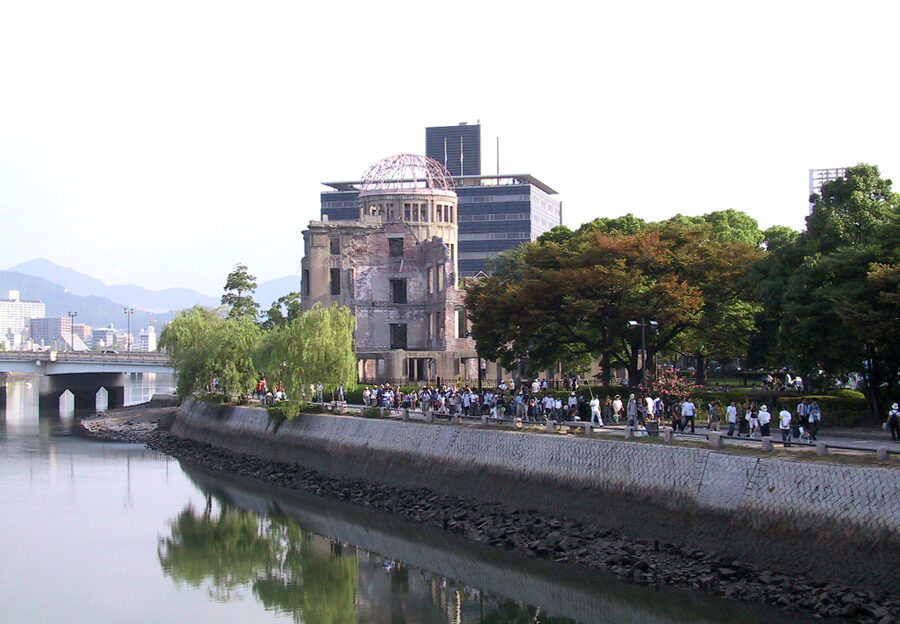
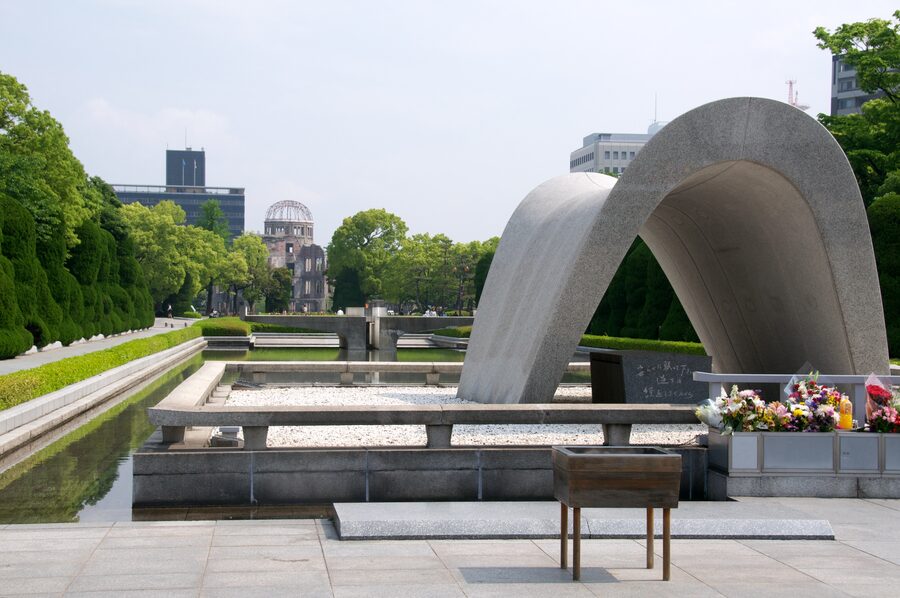
You cannot tour an era, but you can visit the places that mark it. Hiroshima Peace Memorial Park, built around the skeletal Genbaku Dome that survived the August 1945 blast, is the single most important site. The park’s central axis runs from the museum (designed by Kenzo Tange and reopened in 2019 after a major refurbishment) through the cenotaph and the Pond of Peace to the Atomic Bomb Dome. Allow at least a half-day, and accept that the museum is genuinely difficult; the curators do not soften the material.
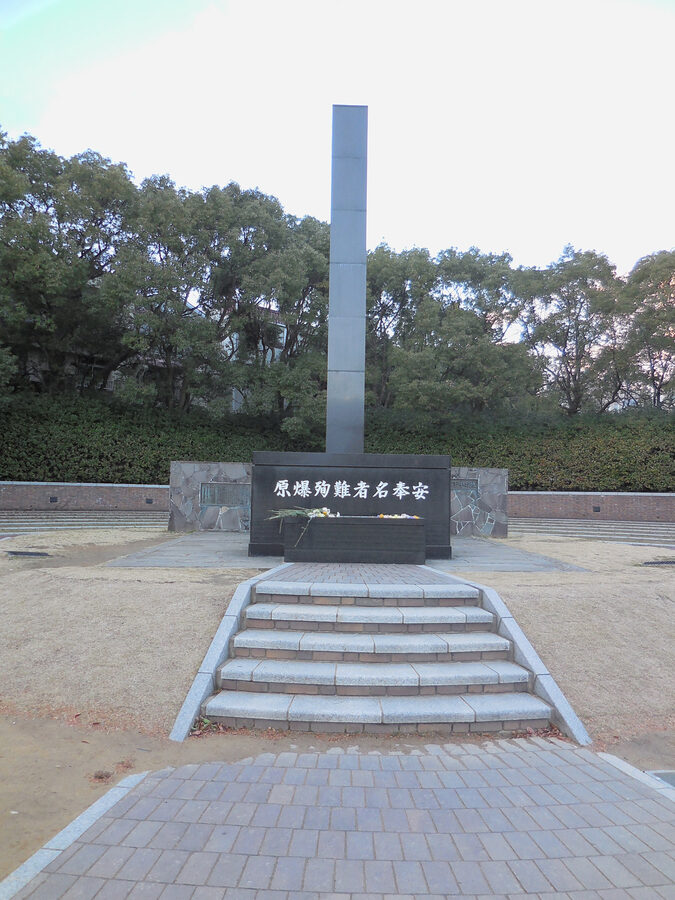
Nagasaki Peace Park sits north of the city centre at the bombing hypocenter, marked by the black stone monolith I showed you earlier. The Nagasaki Atomic Bomb Museum is smaller than its Hiroshima counterpart and structured slightly differently, with more emphasis on the city’s older Christian history and the strategic context of the bombing. Twenty minutes’ walk away is the Urakami Cathedral, which was rebuilt in 1959 after the original cathedral (the largest in East Asia at the time) was destroyed by the blast.
For the postwar boom side of the era, Tokyo is the obvious city. Yoyogi National Gymnasium is still in use and viewable for free from outside; the much larger Komazawa Olympic Park to the south of central Tokyo includes the original 1964 stadium and several other Tange-designed venues that you can walk around. The 0 Series Shinkansen has been preserved at the SCMaglev and Railway Park in Nagoya and the National Railway Museum in York, England, but a working preserved 0 Series cab section is also displayed at the Tokyo Metro Museum in Kasai.
The Edo-Tokyo Museum’s Shōwa wing (in Ryōgoku) was a wonderful immersive recreation of 1950s and 1960s Tokyo daily life, but the museum closed for major renovations in April 2022 and is scheduled to reopen in 2025; check current status before you plan a visit. While you wait, the smaller Shōwa Living Museum in Suginami and the Showa-no-kurashi Museum in Ōta City both offer detailed reconstructions of postwar working-class apartments, complete with the original appliances and tatami rooms.
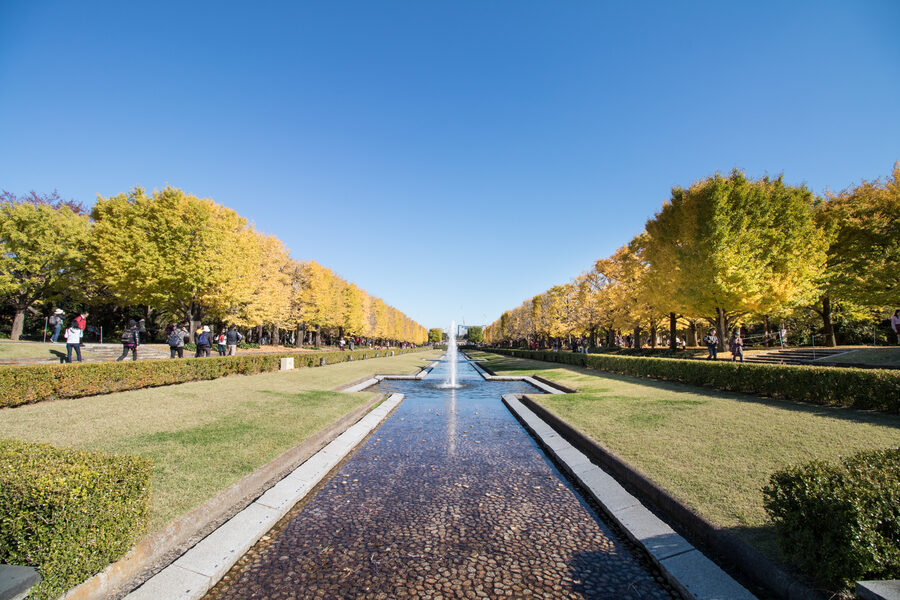
Shōwa Memorial Park (Shōwa Kinen Kōen) opened in 1983 in Tachikawa, west Tokyo, on land returned by the US Air Force from the former Tachikawa Air Base. It is huge, about 165 hectares, and has gardens, a Japanese-style pond, a children’s forest, and the ginkgo avenue I have shown above. The Hayama Imperial Villa on the Sagami Bay coast was Hirohito’s regular summer retreat and the site where he conducted much of his marine biology fieldwork; the surrounding shore has a small commemorative museum and the same coastal tide pools where he collected.
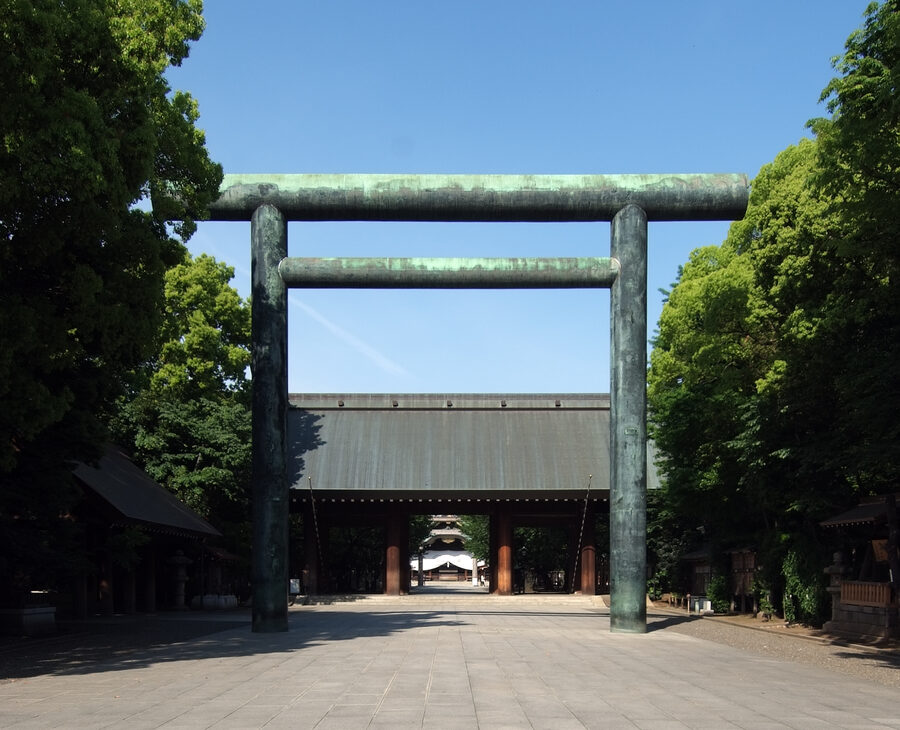
I should mention Yasukuni Shrine and its associated Yūshūkan Museum in Chiyoda, central Tokyo. The shrine enshrines about 2.5 million Japanese war dead going back to 1853, including, controversially, fourteen Class A war criminals who were secretly added in 1978.
The Yūshūkan presents an account of the Pacific War that disputes much of the standard international history. Cabinet ministers’ visits provoke diplomatic incidents with China and South Korea. I am not telling you whether to go; I am telling you that if you go, you should know what you are looking at.
Several of Japan’s older castles still bear visible Shōwa-era scars from the 1945 air raids. Of the country’s twelve surviving original castle keeps, several were lost in the war (Hiroshima, Nagoya, Wakayama, Okayama, Fukuyama) and are now postwar concrete reconstructions. Kumamoto Castle, which had survived the Satsuma Rebellion of 1877, was hit by an incendiary bomb on the night of 19 to 20 July 1945 and saw five of its turrets destroyed. The current castle reflects multiple rounds of postwar reconstruction, most recently after the 2016 earthquake.
Reading the era now
The Shōwa era is no longer current memory in Japan. People who lived through the war as adults are mostly dead; people who were children during the bombings are now in their eighties. The youngest Shōwa-era citizens, those born on 6 January 1989, are turning thirty-seven this year. The era that follows it, Heisei, ran from 1989 to 2019, and the Reiwa era that began in 2019 is now well into its first decade. Shōwa is becoming history in the strict sense, the same way the Taishō era became history a generation ago.
What gets retained tends to be either the worst (the war and the bombings) or the most flattering (the miracle and the Olympics), with less attention to the long, complicated middle. The 1950s and the early 1960s in particular, when most of the actual recovery happened and most of the political, social, and economic foundations of contemporary Japan were laid down, are often skipped over in popular treatments. That is unfair to the era, because the recovery was the harder achievement, and it is unfair to the people who did the work, who lived through the postwar shortages and rebuilt their cities by hand.
The connection back to the longer arc of Japanese history is more direct than it sometimes seems. The Imperial Palace where Hirohito spent his last years (and where the current emperor Naruhito lives now) is the same site as Edo Castle, the Tokugawa shogunate’s headquarters from 1603 to 1868. The argument over whether Japan should remilitarise is in some sense still arguing about the choices the Meiji oligarchs made in the 1870s. The festivals you visit today, including the modern Sapporo Snow Festival that grew enormously during and after the 1972 Sapporo Winter Olympics, sit on top of older traditions that the Shōwa boom amplified rather than invented. The country’s great gardens and major festivals survived the war, the boom, and the bubble, and so did the deep continuities under all of them.
I started this with the radio broadcast of 15 August 1945, the first time most Japanese ever heard their emperor’s voice, and I will close with one more detail from that day. The recording technicians at the palace had hidden the master discs overnight to prevent a faction of army officers who wanted to continue the war from seizing them. The officers raided the palace, killed the commander of the Imperial Guard, searched for the discs, and failed to find them.
The recording aired at noon as scheduled, and an empire that had been fighting in some form since 1937 ended that afternoon. The miracle and the bubble and the Walkman and the Olympics and Hayao Miyazaki and the Shinkansen all came after that, in a country that had been told by its emperor to endure the unendurable and largely did. That is the Shōwa era, taken as a whole, and the country I travel in now is in many practical ways the country those people built afterwards.