
There was a generation of Sengoku warlords who gave themselves names and a generation who got their names from other people. Saitō Dōsan did not call himself the Viper of Mino. That was what his enemies called him, what his retainers called him behind his back, what his son-in-law Oda Nobunaga pretended not to call him at the dinner table. If you had asked Dōsan himself whether he had earned it, he probably would have said yes.
He was born a commoner. He died a provincial lord. In between he allegedly rose from Kyoto oil merchant to warrior monk to mid-level retainer to chief vassal to warlord to usurper, a one-generation biography so improbable it had its own verb in Japanese — dōsan no sanhenge (道三の三変化), “Dōsan’s three transformations”. Modern historians have discovered that the improbable one-generation version was actually two generations; the father did the first half, the son did the second; the legend squashed them together into a single career. It does not much change the final picture. By the time Saitō Dōsan was in his late forties, he had taken over the entire province of Mino (modern southern Gifu) from the family he was supposed to be serving, and he had done it without ever commanding a pitched battle he could not win.
In This Article
- The Legend Everyone Believed
- What Actually Happened
- Taking Mino
- The Meeting at Shōtoku-ji
- Killed by His Son
- Where to visit Saitō Dōsan’s story today
- 1. Gifu Castle (Inabayama) — Mt Kinka, Gifu city
- 2. Dōsan-zuka (道三塚) — Gifu city, north bank of Nagara River
- 3. Jōzai-ji (常在寺) — central Gifu city
- The Viper’s Ledger
The Legend Everyone Believed
The story that ran in every Edo-period chronicle, the version that made it into grade-school textbooks and onto every NHK historical drama, goes like this. A monk named Matsunami Mineyoshi (松波尋茶丈) was born in Yamashiro Province, the area around Kyōto, around 1494. He did some years of training at Myōkaku-ji, quit the monastic life because he found it boring, and moved to Mino to sell oil. The oil trade in 16th-century Japan was profitable in the way that petrol stations were profitable in post-war America — the product was needed everywhere, the margins were good, and the supply chain ran through a handful of well-connected families.
He was apparently very good at it. There is a popular story, repeated in the Jōzai-ji temple records, that he could pour a stream of oil through the square hole in an old Chinese coin without spilling a drop on the rim. You can picture him doing the trick at dinner parties while the customers watched him with their mouths open. It is the kind of detail that may or may not be true; if it is, it tells you something about why he stopped being an oil merchant.
The legend continues: he converted from monk to merchant to martial retainer of a Mino samurai named Nagai Nagahiro; got adopted into the Nagai name; worked his way up to the senior vassalage of the Toki clan, who were the formal lords of Mino; got adopted a second time into the Saitō name (which was even older and grander than the Nagai); and then, once he had a provincial rank, started getting rid of anyone who could block his path to the top. The method was consistent: adoption, poison, betrayal, repeat. By the early 1540s, the Toki lord Toki Yorinari (土嵅頼芸) had been driven out of the province, and Saitō Dōsan was running Mino from his stronghold at Inabayama Castle.
All of this in one lifetime. That was the legend. For four centuries nobody had any reason to doubt it.
What Actually Happened
Starting in the 1960s, Japanese scholars working on the Rokuchō-ki (六角記), a collection of Omi-province local records, and on a handful of Saitō-clan documents preserved at Jōzai-ji, began to notice inconsistencies. A surviving letter referenced “the late Nagai Shinzaemon-no-jō” as Dōsan’s father — not Dōsan himself. Property records in Mino from 1510-1520 mentioned a Nagai Shinzaemon who had held minor retainer rank for twenty years. The oil-merchant story, which appeared in no contemporary source and only showed up in the 1630s Mino Monogatari, increasingly looked like a compression of two biographies into one.
The consensus now, which has been the academic position since roughly 1975, is this: Dōsan’s father, Nagai Shinzaemon-no-jō (the man whose original profession may or may not have been oil merchant), did the hard climb — moved from Kyoto to Mino, converted religious/mercantile capital into samurai rank, worked his way up to senior vassalage in the Nagai family, died in the late 1530s. Dōsan inherited his father’s position, took the Saitō name after a second adoption, and used the next decade to remove the Toki lords he was nominally serving. Two generations, compressed in the popular imagination into one improbably active man.
Does the revision change anything about the story? Not really. The individual biography becomes slightly less impossible, which makes the father look modestly competent and Dōsan look modestly less superhuman. The political achievement, a commoner-descended family usurping a hereditary daimyo clan inside a generation and a half, remains the same. The Viper of Mino is still a viper. He just had a father who was, among other things, also a viper.
Taking Mino
The mechanism by which Dōsan took Mino from the Toki is worth understanding in detail because nobody in the Sengoku period operated quite like this. Most upstart Sengoku warlords who displaced their masters did so with a short, violent war — ambush the lord, take the castle, proclaim themselves daimyo within a week. Dōsan played a slower and less honest game.
Step one: cultivate the Toki heir. Toki Yorinari (土嵅頼芸) was the younger son of the reigning lord, a man more interested in waka poetry and tea than in provincial administration. Dōsan attached himself to Yorinari’s household, provided the administrative competence the heir could not be bothered to develop himself, and made sure that when the old lord died in 1519 it was Yorinari, not his capable elder brother Yoritaka, who got the seat.
Step two: neutralise the elder brother. Toki Yoritaka was killed in 1526 under circumstances that the Saitō-friendly chronicles describe as an accident and the neutral ones describe as very convenient for Dōsan.
Step three: consolidate the administrative machinery. Over the next fifteen years, Dōsan placed his own people, retainers he had brought from his father’s Nagai household, into every significant position in the Mino bureaucracy. By 1540, Toki Yorinari was nominally the daimyo but substantively the figurehead; Dōsan was doing all the actual governing.
Step four: remove the figurehead. In 1542 Dōsan finally moved openly, forcing Yorinari into exile in Owari (modern Nagoya) and claiming Mino as his own. Yorinari spent the next decade in exile trying to rally support for a return. He got as far as persuading two neighbouring daimyo, Asakura Takakage of Echizen and Oda Nobuhide of Owari (Nobunaga’s father), to invade Mino on his behalf. Both invasions failed. Dōsan stayed in the castle.
Step five, which is the step that mattered most for the rest of Japanese history: marry your daughter to the heir of Owari. Oda Nobuhide died in 1551. Nobuhide’s son Oda Nobunaga was widely considered an idiot. Dōsan in 1549 had married his daughter Nōhime (浓姬) — also known as Kichō (帰蝶) — to Nobunaga as part of a peace settlement with Owari. In 1551, when Nobuhide died, the son-in-law whom everyone called the Great Fool (ō-utsuke, 大うつけ) succeeded him. Dōsan’s calculation had been that this would be a tame son-in-law running the neighbouring province. The calculation turned out to be wrong.
The Meeting at Shōtoku-ji
In the early spring of 1553, Dōsan arranged to meet his son-in-law for the first time at Shōtoku-ji (正徳寺), a temple on the Mino-Owari border. Nobunaga was nineteen. Dōsan was either fifty-eight or sixty-seven depending on which birth year you accept. The reports Dōsan had heard about Nobunaga were uniformly awful: he dressed like a yakuza, he ate while walking, he carried half a dozen swords stuck in his belt for decoration, he had set fire to his father’s funeral incense burner at the ceremony. Dōsan had decided in advance that he was going to bring Nobunaga to heel, and arranged the meeting at a neutral temple rather than at an Oda castle so the balance of protocol would lean toward Mino.
Dōsan hid in a side room of the temple and watched Nobunaga arrive. What he saw, according to the Shinchō-kō ki (信長公記) chronicle, was the opposite of what he had expected. Nobunaga’s escort was seven or eight hundred men, drilled, uniformed, carrying modern arquebuses in tight formation. Nobunaga himself had dressed normally, court robes appropriate to the meeting, and had tucked his personal escort of a dozen samurai into the column so that you could not tell at a glance who was the lord and who were the attendants. When he reached the temple gate, he changed from court robes into formal armour in the time it took Dōsan to cross from the side room to the meeting hall. The formal introduction was flawless.
Dōsan rode home from the meeting in silence. According to the same chronicle, he told his retainers on the road: “One day my sons will be tying their horses at the gates of that fool’s castle.” He said it because he was admitting, out loud, that he had misread the situation; his son-in-law was not the pliable idiot he had expected; the neighbouring province was going to be a problem, not an asset. What he did not say, what none of the chroniclers had him say, was that three years later his sons would indeed be tying their horses at Nobunaga’s castle, because they would be running from the same war that killed their father.
Killed by His Son
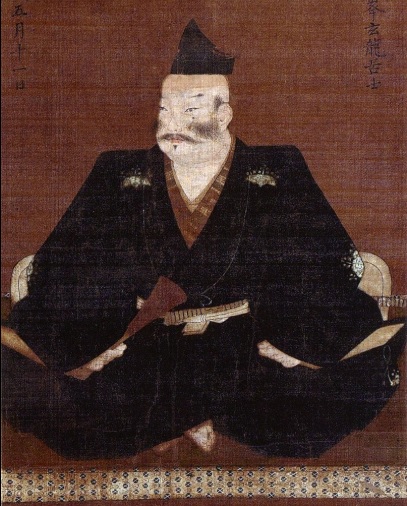
The end of the Viper of Mino came from a direction he had not seen coming. His eldest son Saitō Yoshitatsu (敺藤義龍) grew up with a persistent rumour about his paternity. Yoshitatsu’s mother had been a concubine of Toki Yorinari — the exiled daimyo whom Dōsan had displaced — before she became Dōsan’s wife. The timing of Yoshitatsu’s birth (1527) was ambiguous enough that every household gossip in Mino had an opinion on whether the boy was Dōsan’s son at all, or the last Toki heir being raised by the man who had stolen the Toki’s province.
Dōsan himself seems to have believed the gossip. In the early 1550s he began making comments about Yoshitatsu’s limited intelligence in front of retainers, and about preferring his younger sons Magoshiro and Kiheiji (孫四郎 and 喜平次) as potential heirs. By 1555, Yoshitatsu knew he was being set up for disinheritance. In November of that year he convened a private meeting at his castle at Ogura, pleaded illness, invited his two half-brothers to visit him, and had them both killed. Then he sent a formal message to his father declaring that the Saitō headship was his by right.
Dōsan did not respond with a negotiation. He raised what forces he could — somewhere between two and three thousand, a thin muster for a provincial lord — and rode out to confront Yoshitatsu, who had the Saitō main army of roughly seventeen thousand. They met on the north bank of the Nagara River (長良川) on 28 May 1556. The battle lasted less than half a day. Yoshitatsu’s army surrounded Dōsan’s in the first hour; by mid-afternoon Dōsan was fighting in person in a shrinking perimeter around his command standard. He was killed by a footsoldier named Komaki Gendayu, who took his head.
The Shinchō-kō ki records that Oda Nobunaga, receiving word of the battle a day late, set out from Kiyosu Castle with a relief force of thirty thousand men. He made it across the provincial border, halted at the rumour of Dōsan’s death being confirmed, and turned back without engaging. The son-in-law had come for his father-in-law. He had been too late.
Eleven years later, in 1567, Nobunaga would return to take the whole of Mino and reduce Inabayama Castle to rubble. He renamed the castle Gifu (峷阜) after the legendary Mount Qi where Chinese Zhou dynasty history began, and made it the administrative seat of the emerging Oda empire. Dōsan’s grandson by Yoshitatsu — Saitō Tatsuoki — was the man Nobunaga actually displaced. Dōsan’s line, through his daughter Nōhime, merged into the Oda. Legal and formal justice, arriving fifteen years late.
Where to visit Saitō Dōsan’s story today
Three places, all within the city limits of modern Gifu. You can do them together in a half-day walk, or a full day if you go up the castle mountain — which you should.
1. Gifu Castle (Inabayama) — Mt Kinka, Gifu city
Gifu Castle sits on top of Mount Kinka (金華山), 329 metres of sharp-sided rock rising out of the Nobi Plain. Dōsan’s castle was on the same spot; it was called Inabayama then, and was one of the few Sengoku fortresses designed around the terrain rather than the other way around — vertical approaches on three sides, single-track switchback trails, observation points that let the defenders see an attacking army two days before it arrived. Nobunaga’s 1567 assault succeeded only because of treachery from inside the castle; nobody in the 16th century took Inabayama by frontal attack.
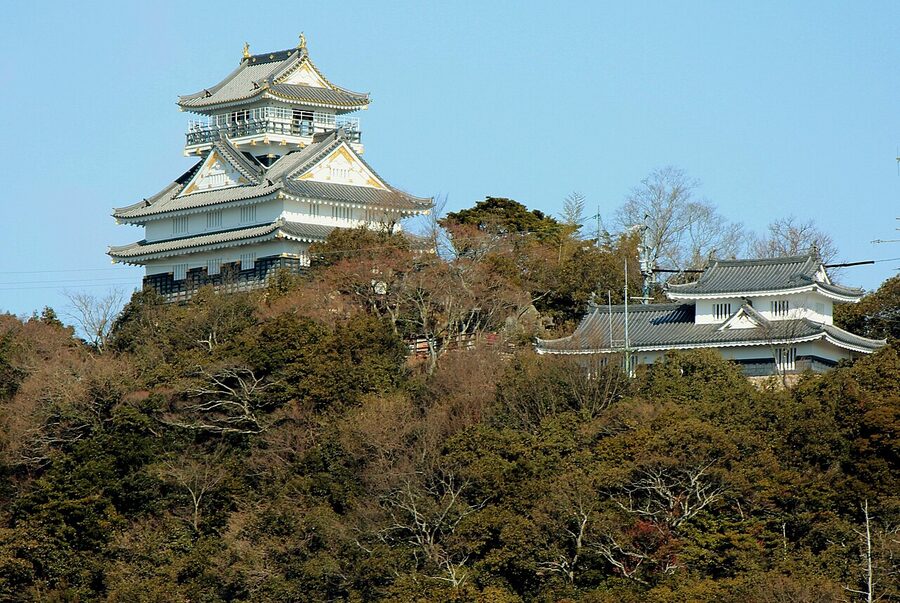
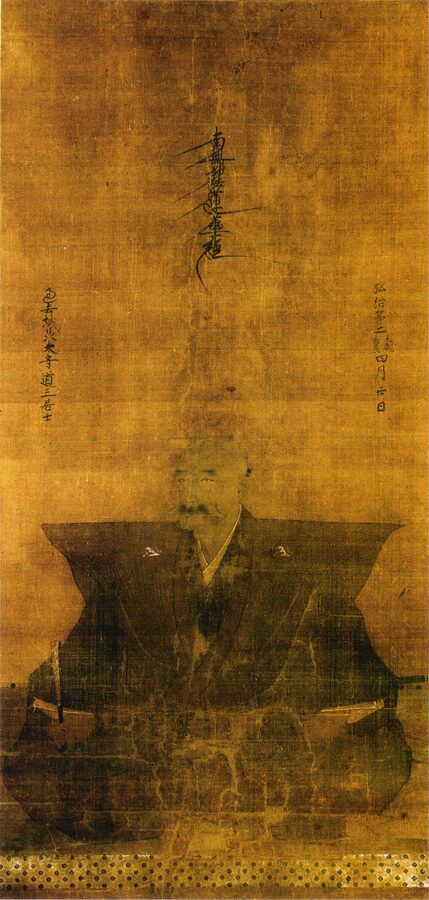
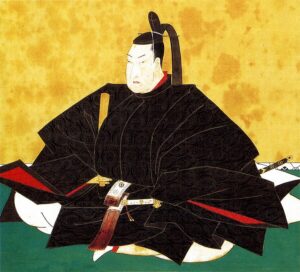
The current castle is a 1956 concrete reconstruction of the Nobunaga-era keep. It holds the Gifu Castle Museum, which is where you will find the Dōsan portrait exhibit pictured above along with a permanent display on the two-generation revision. Get there by taking the Gifu-Park-guchi bus from JR Gifu Station (fifteen minutes), then the Kinka ropeway to the top of the mountain (three minutes up, five hundred yen round trip). From the top it is a five-minute walk to the keep.
Best visit: early in the morning, before the ropeway queue forms at 9:30. The view from the keep looking south extends to Nagoya on a clear day and is genuinely worth the effort. If you want to do the climb on foot instead of the ropeway, the Nanadaka hiking trail takes about an hour and climbs 300 metres; do not attempt in summer without water.
2. Dōsan-zuka (道三塚) — Gifu city, north bank of Nagara River
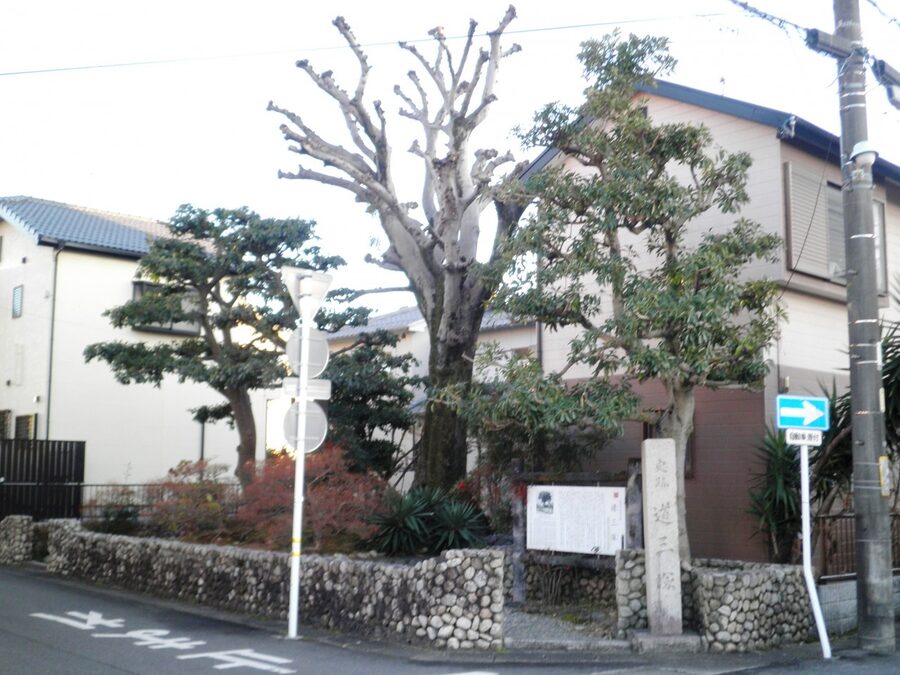
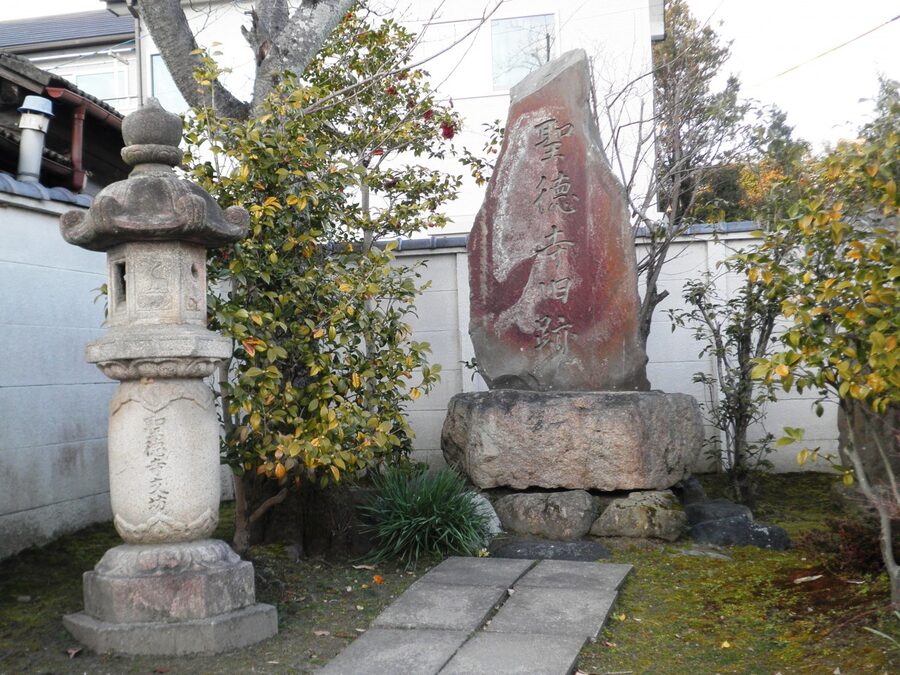
Dōsan-zuka is the burial mound where Dōsan’s head was interred after the Nagara-gawa battle. The body was reportedly buried elsewhere on the battlefield — the exact site has never been confirmed. The mound as it stands today was built up in the Edo period by the temples of Gifu city in a modest restoration effort, and then expanded again in 1876 when the post-Restoration local history associations got interested in Sengoku commemoration. The walking distance from JR Gifu Station is about fifteen minutes; the address, if you are navigating by taxi, is Nagara-fukumitsu-chō.
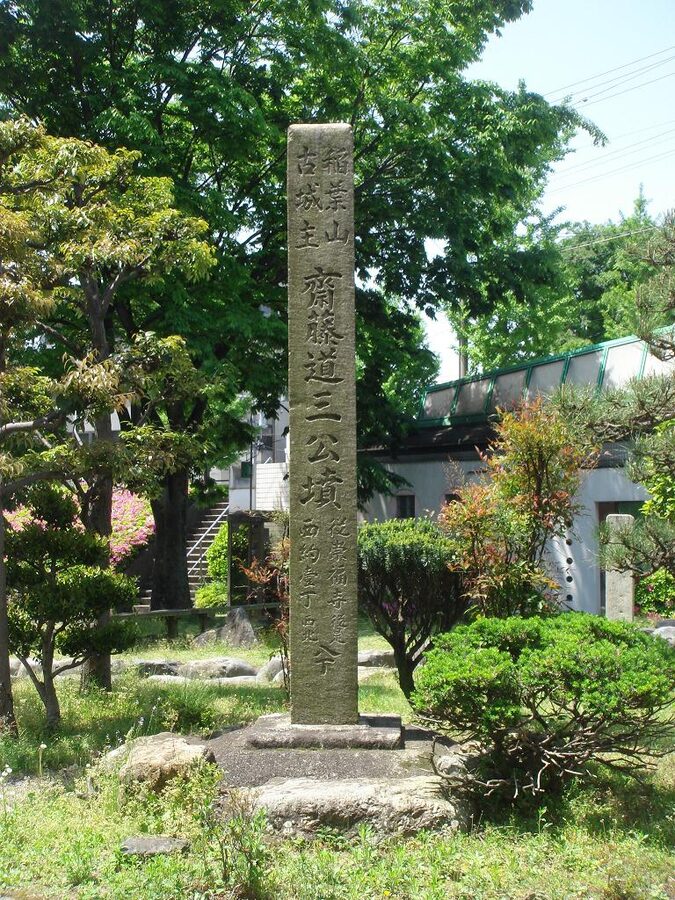
Take a minute here. Stand behind the fence and look at the mound and think about the fact that the man buried under it had, across sixty-two years, worked his way from commoner to provincial lord, and then died on a riverbank about fifteen hundred metres from where you are standing, killed by his own son in a battle that he had lost because he was outnumbered seven to one.
3. Jōzai-ji (常在寺) — central Gifu city
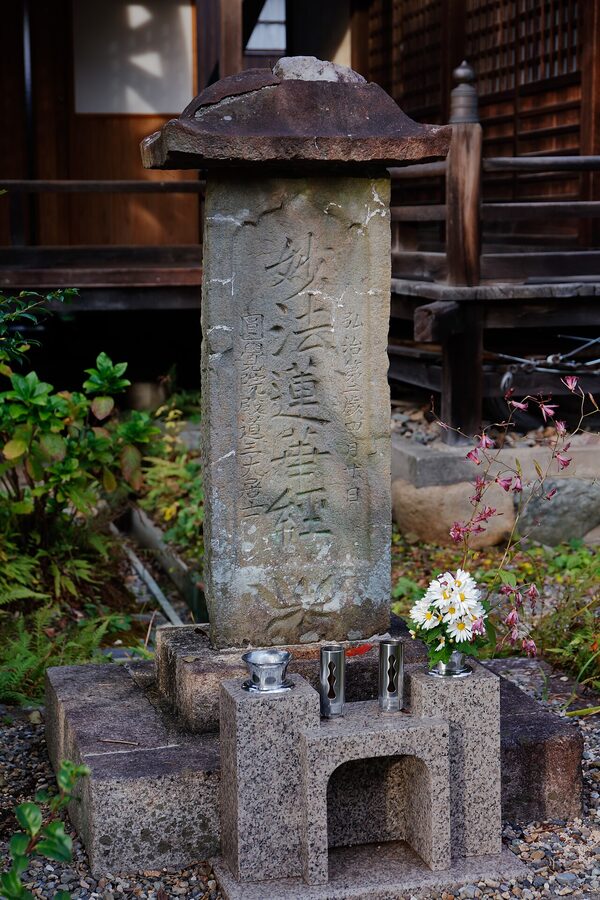
Jōzai-ji is the Saitō clan’s memorial temple, founded in 1450 and taken over as the family’s patron temple by Dōsan himself. It is in central Gifu, five minutes’ walk from the river — the location is important because it used to be inside the lower ward of Inabayama Castle, before the Nobunaga-era reconstruction flattened the lower ward and left the temple as a free-standing parish.
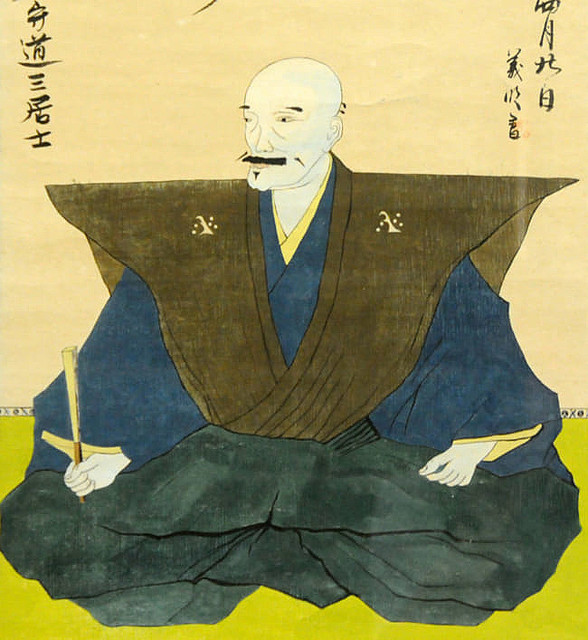
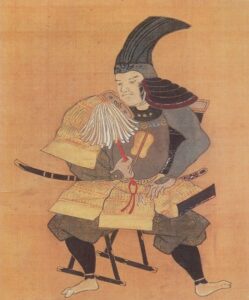
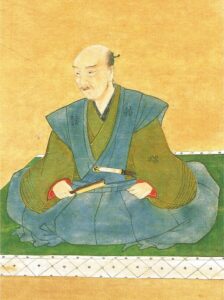
The temple holds the two 16th-century portraits this article opens and closes with — Dōsan and Yoshitatsu, painted within decades of their deaths, both kept together in the treasure room as if the family drama needed to be preserved as a single piece. The main hall is unspectacular. The garden is small. The treasure room is the reason you are visiting. Admission to the temple is free; request to view the treasure room at the office and the current head priest will take you through with a short explanation in Japanese. No English audio guide. If you do not have Japanese, bring a translated summary of Dōsan’s career to hold up at the relevant portrait — the priests are used to it.
The Viper’s Ledger
What did Saitō Dōsan accomplish? On the surface: a provincial rank, a castle, a daughter married into the right family, a son who murdered him. A mixed record. Under the surface: he was the first of the Sengoku usurpers — the generation of commoner-descended warlords who noticed, around the 1530s, that the old daimyo clans were exhausted and could be displaced by anyone with enough patience and tactical flexibility. Hōjō Sōun in the Kantō, Takeda Shingen by another route in Kai, Toyotomi Hideyoshi three decades later in Owari — Dōsan is the ancestor of all of them. Not by blood. By technique.
It is probably no coincidence that the two men who carried his method furthest were Toyotomi Hideyoshi and his own son-in-law Sassa Narimasa’s master, Oda Nobunaga. The trick — absorb a system from the inside by becoming indispensable to it, then displace the men at the top once they cannot function without you — is the pattern Nobunaga used on Shogun Ashikaga Yoshiaki in the 1560s, and that Hideyoshi used on Nobunaga’s heirs in the 1580s. Dōsan did it first, in a single province, at a slower tempo, with less violence than either of them. The difference was scale, not method.
If you had asked him at the end of his life whether he had earned the nickname, he would probably have said yes. The viper is not a villain in Japanese metaphor — it is the animal that strikes with no warning, kills with one bite, and moves on before the body is cold. That was the work. He spent forty years doing it.
If you are going to Gifu anyway, climb the mountain. Stand on the keep and look south toward Nagoya, toward where Nobunaga’s Kiyosu sat two days’ march away. Then walk down to Dōsan-zuka, which is smaller than a parked car, and read the stone. Then go to Jōzai-ji and ask to see the portraits. Saitō Dōsan and the son who killed him, hung side by side in a temple treasure room, 470 years after the battle. That is where a life of quiet strategic violence ends. A small mound. A shared wall with the son. Fresh flowers, once a quarter, if the local society still bothers.


-%E6%96%8E%E8%97%A4%E9%81%93%E4%B8%89%E5%85%AC%E4%BE%9B%E9%A4%8A%E7%A2%91Jozaiji008.jpg)