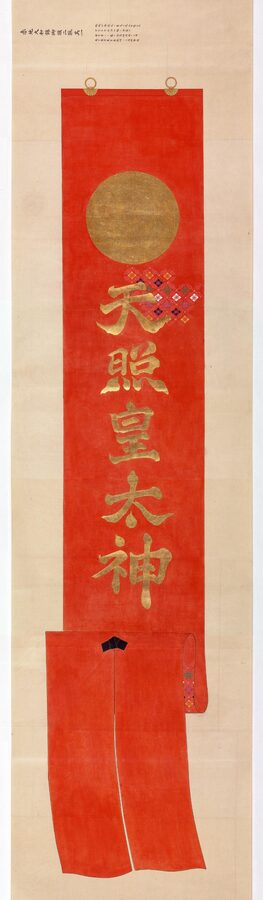
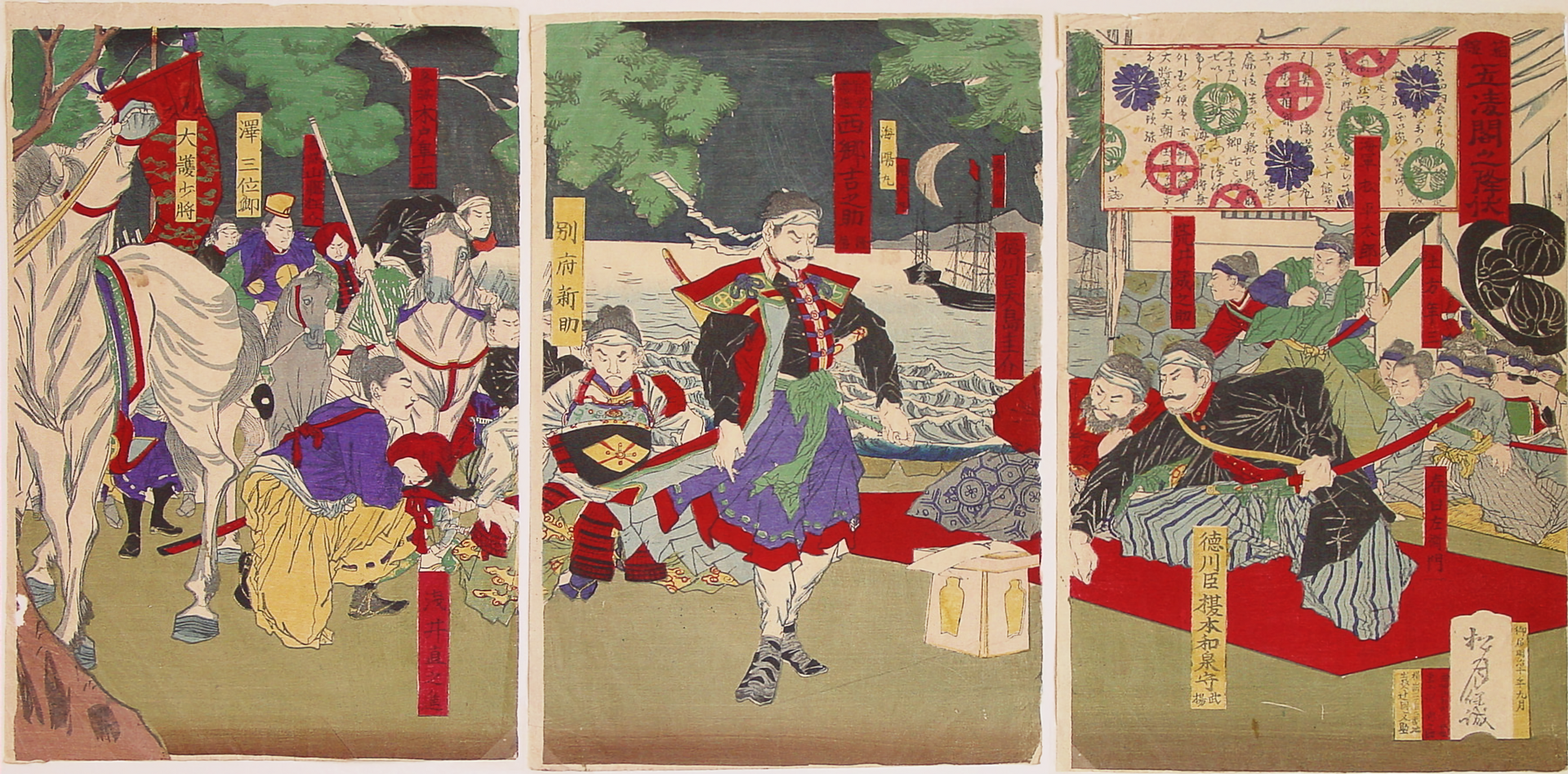
The banner that turned the shogun’s army into rebels was ordered from the silk weavers of Kyoto about three months before anyone fired a shot. In the autumn of 1867 Ōkubo Toshimichi of Satsuma had red brocade and damask bought in the Nishijin weaving district through his mistress, a Kyoto woman named Oyū, to a design by Tamamatsu Misao, a scholar in the circle of the court noble Iwakura Tomomi. Half the cloth was made up into banners at the Satsuma residence in Kyoto. Shinagawa Yajirō carried the other half home to Chōshū and had it sewn there.
When the fighting began south of the city in January 1868, the court handed one of those banners, with a ceremonial sword, to a young imperial prince and named him commander of the campaign against the Tokugawa. From that afternoon the Satsuma and Chōshū troops were the imperial army, and the men shooting at them were the emperor’s enemies. Shinagawa explained the whole business in a letter of about 1889 to a biographer of Iwakura, and the original turned up in a Kyoto archive, confirmed in December 2023, with a scrap of the red cloth still attached.
I keep coming back to that scrap. The Boshin War is usually told either as modern men sweeping away old ones or as loyal northerners betrayed, and both versions leave out most of what happened. Over seventeen months it ran from Kyoto to the southern tip of Hokkaido, killed something over eight thousand soldiers and an uncounted number of civilians, and set the terms on which the Meiji era began. In Aizu-Wakamatsu, people still argue about it.
In This Article
- A resignation, a coup and a fire in Edo
- Four days south of Kyoto
- The banner goes east
- The northern alliance
- Aizu: a month under the guns
- The White Tigers on Iimoriyama
- Who buried the dead
- Ezo: the republic that may not have been one
- Counting the cost
- Where to see the Boshin War today
- Fushimi, Toba and Yodo, Kyoto
- Tokyo: Tamachi, Ueno and Minami-Senju
- Aizu-Wakamatsu
- Nagaoka and Ojiya
- Hakodate and Esashi
- The red cloth in the letter
A resignation, a coup and a fire in Edo
By 1867 the Tokugawa shogunate had been losing ground for fourteen years. The treaties forced on it after Perry’s black ships ended two centuries of sakoku, and the “revere the emperor, expel the barbarians” movement turned the court in Kyoto into a rival centre of power. Satsuma and Chōshū, two great outside domains of the far south-west whose lords had been on the losing side at Sekigahara in 1600, made a secret alliance in 1866. That summer Chōshū beat a shogunate punitive army outright.
The fifteenth shogun, Tokugawa Yoshinobu, was the cleverest man to hold the office in a century, and he tried to change the rules before he lost the game. On the 14th day of the tenth month of 1867 he announced at Nijō Castle that he was returning the power to govern to the emperor, the taisei hōkan (大政奉還). It was, in effect, a bet that a council of great lords would need the Tokugawa, the richest house in the country, to run anything at all.
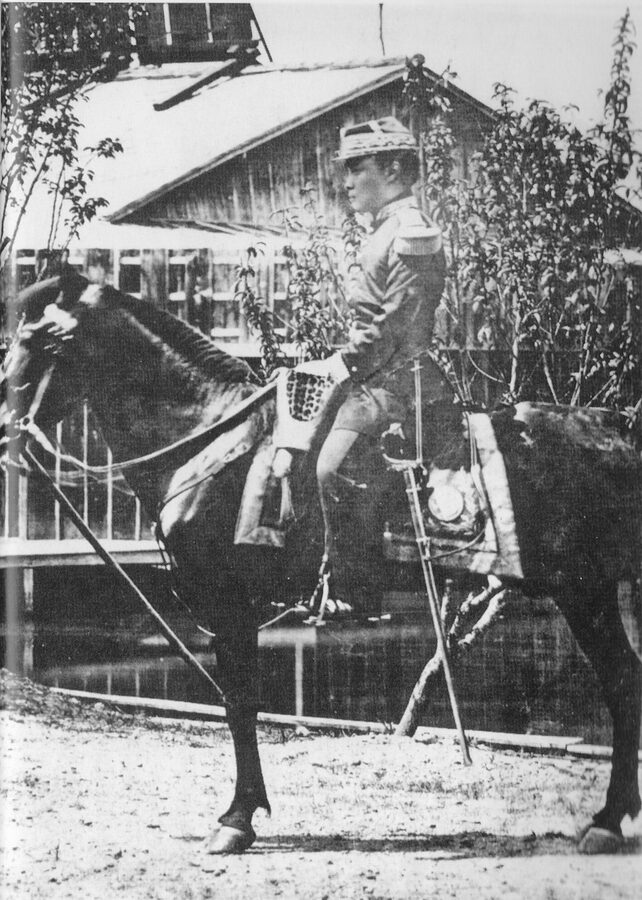
The bet nearly worked. A secret imperial order to destroy him, issued to Satsuma and Chōshū days earlier, had to be shelved, and moderate lords began to talk about a council with Yoshinobu at its head. Satsuma’s leaders, Saigō Takamori and Ōkubo above all, wanted a clean break.
On the 9th day of the twelfth month, 3 January 1868 by the Western calendar, troops from five domains seized the gates of the imperial palace and the fifteen-year-old Emperor Meiji, the boy later enshrined at Meiji Jingū, proclaimed the restoration of direct imperial rule. That night a council ordered Yoshinobu to give up his court rank and his lands. He withdrew to Osaka Castle with his army and waited for the moderates to rescue him, which by the end of the month they very nearly had.
What broke the deadlock happened four hundred kilometres away. Through the winter, gangs of rōnin based in the Satsuma residence in Edo robbed and murdered their way through the city’s merchant houses, a provocation Japanese historians generally lay at Saigō’s door. On the 23rd of the twelfth month part of Edo Castle burned, and shots were fired into a guard post of the Shōnai domain, which was policing the city; two days later the shogunate’s men burned the Satsuma residence to the ground.
When the news reached Osaka, the officers there, with Aizu and Kuwana in the lead, demanded war. Yoshinobu later said he told them to do as they pleased, and called it the worst mistake of his life. An army marched north towards Kyoto with a petition denouncing Satsuma.
Four days south of Kyoto
The Tokugawa army that left Osaka on the 2nd day of the first month of 1868 numbered about 15,000 men. Sources variously give the force waiting for it as about 5,000 or about 4,500, mostly Satsuma and Chōshū troops. On paper, with plenty of modern rifles and infantry trained by the French mission, the shogunate should have won.
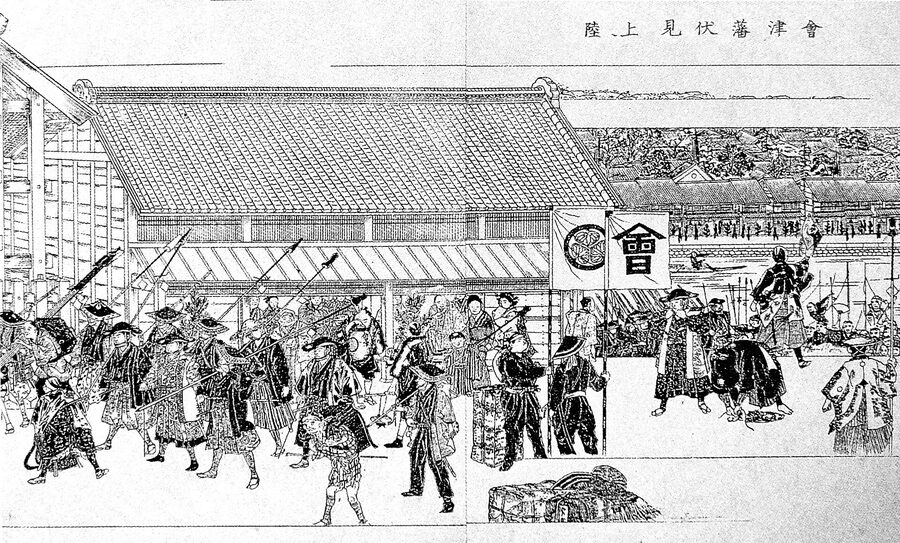
It marched as if it were going to a meeting. Its orders were to escort Yoshinobu’s petition into the capital, and many units moved in column of march with their rifles unloaded; at the head of the Toba column the Mimawarigumi wore armour and chain mail and carried no guns at all. On the Toba road, at Koeda Bridge over the Kamo river, the vanguard met Satsuma pickets on the afternoon of the 3rd, 27 January by the Western calendar, and asked to be let through.
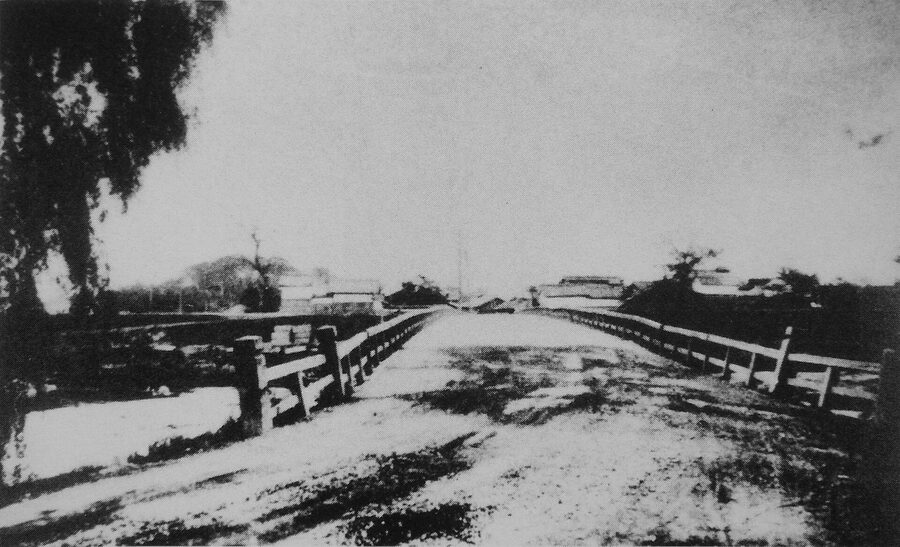
At about five o’clock the shogunate’s commissioner, Takigawa Tomotaka, announced that he would force his way through, the Satsuma officer replied that he held the road on the emperor’s orders, and a bugle sounded. Satsuma riflemen hidden in the reeds and fields on three sides opened fire into the head of the column. A Satsuma shell hit one of the shogunate guns at the front and it blew up, and Takigawa’s horse, terrified by the blast, bolted to the rear through his own men.
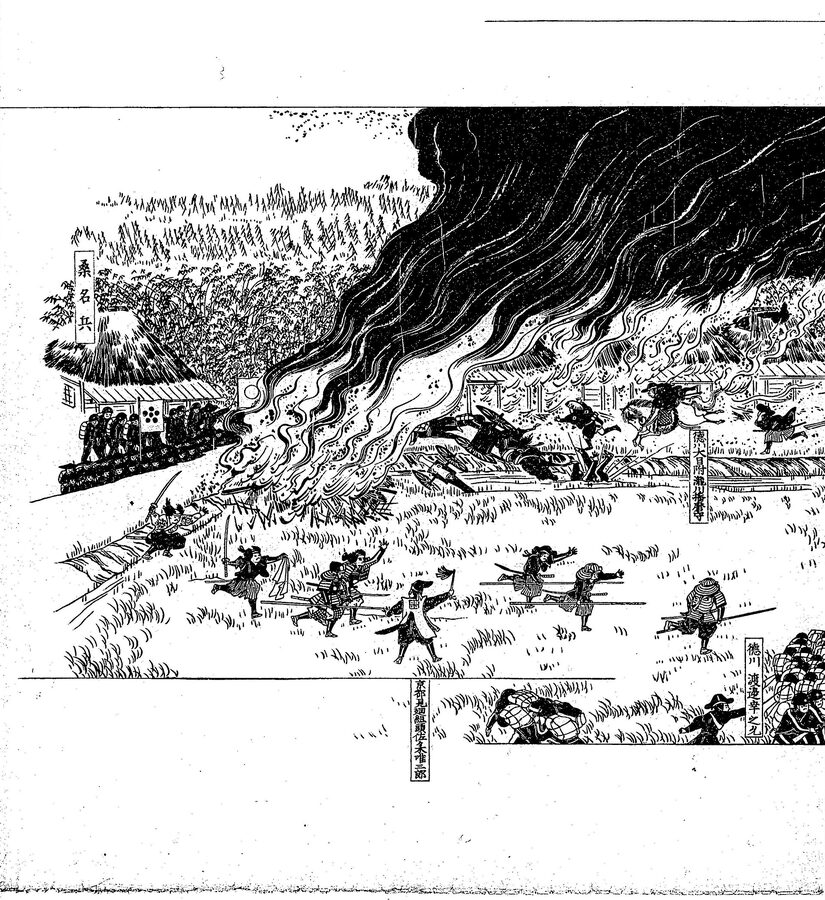
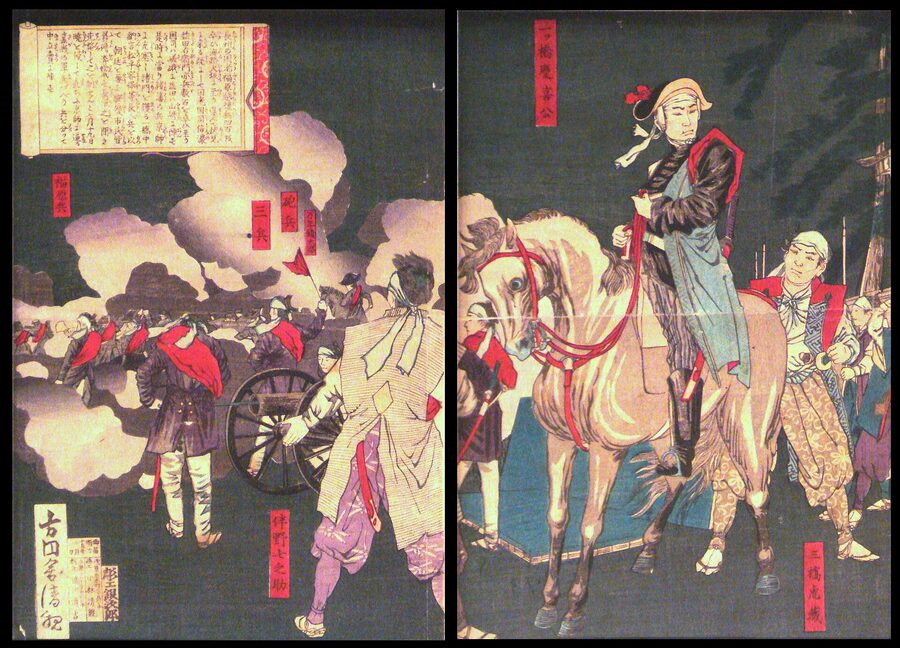
At Fushimi, a few kilometres east, the shooting started when the gunfire from Toba was heard. The shogunate held the Fushimi magistrate’s office with infantry, Aizu troops and the Shinsengumi, and Satsuma had put its guns on the higher ground at Gokōnomiya shrine, looking straight down into the compound. Charge after charge out of the gates was shot down in the narrow streets.
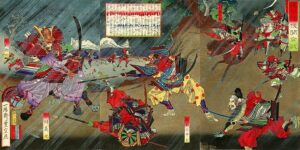
At about eight that evening a Satsuma shell hit the magazine and it exploded, and by midnight the shogunate troops had pulled out without any general order to retreat. The Satsuma men who broke in found dead stacked in the field hospital and dozens of wounded who could not move, and killed them all. It is not the version of Fushimi printed in the victory prints.
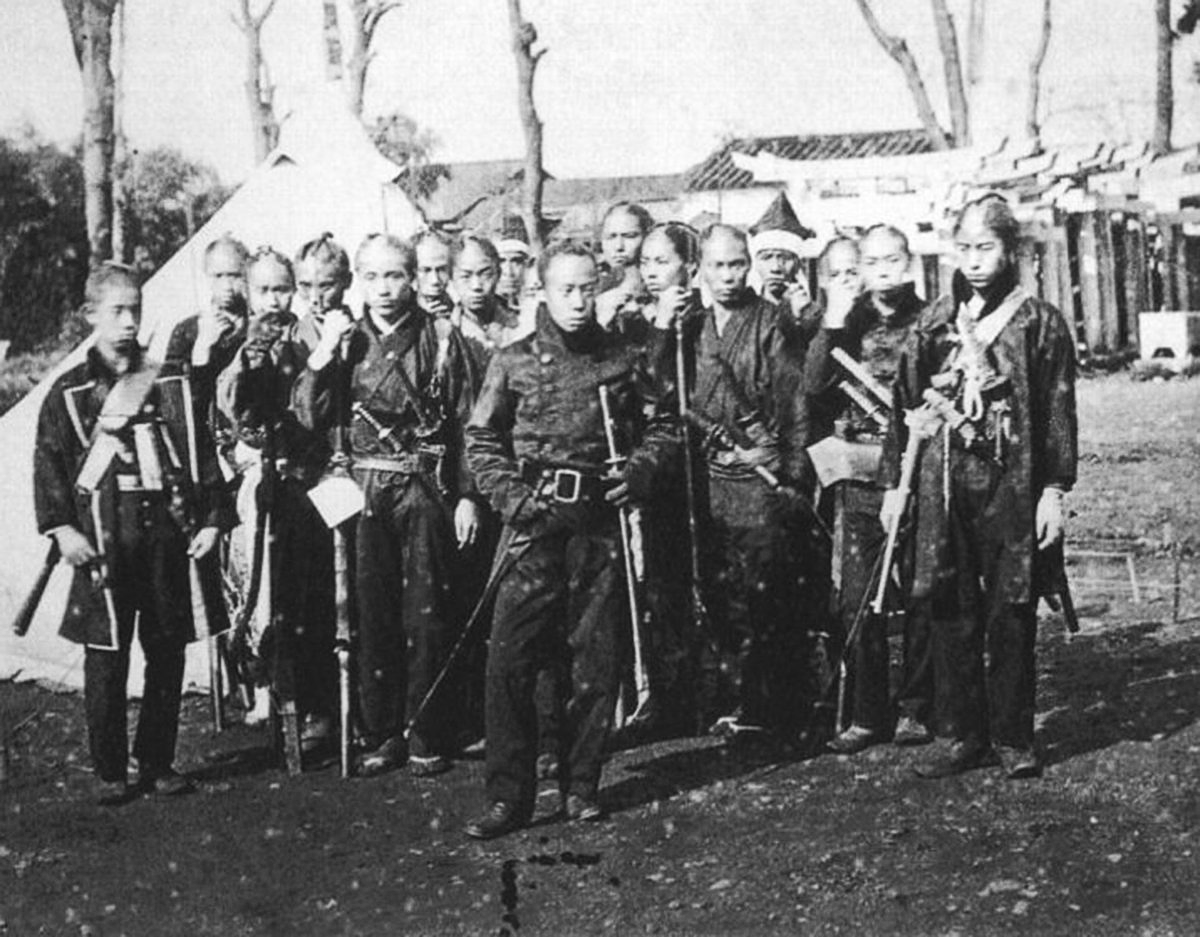
The next three days were not the rout the shorthand version suggests. The shogunate troops fought from breastworks of rice bales and earth-filled sake barrels, and Aizu spearmen hidden in the dead reeds of the Yokōji marsh charged the columns on the river embankments. Still the line was pushed back towards Yodo, and on the 5th Inoue Genzaburō of the Shinsengumi was killed on the pine-lined embankment at Senryōmatsu.
The banner did the rest. Over the protests of moderates who called the fighting a private quarrel between Satsuma and Aizu, on the 4th the court appointed Prince Ninnajinomiya Yoshiaki commander against the Tokugawa and gave him the brocade banner. The Tosa officer Tanaka Mitsuaki later recalled seeing shogunate soldiers go pale and fall back at the sight of it, afraid of being branded enemies of the court. A song about the prince and his fluttering banner, “Miya-san, Miya-san”, was soon being sung on the march, and is often called the first Japanese military song.
The domains understood the message faster than the soldiers did. On the 5th the Yodo domain, whose own lord Inaba Masakuni was a senior councillor of the shogunate, shut the gates of Yodo Castle against the retreating army. On the 6th the Tsu domain, holding the battery at Yamazaki across the river from Hashimoto, turned its guns on the shogunate’s flank, and the last line broke. Sasaki Tadasaburō of the Mimawarigumi, who is generally thought to have led the squad that killed Sakamoto Ryōma, was mortally wounded at Hashimoto.
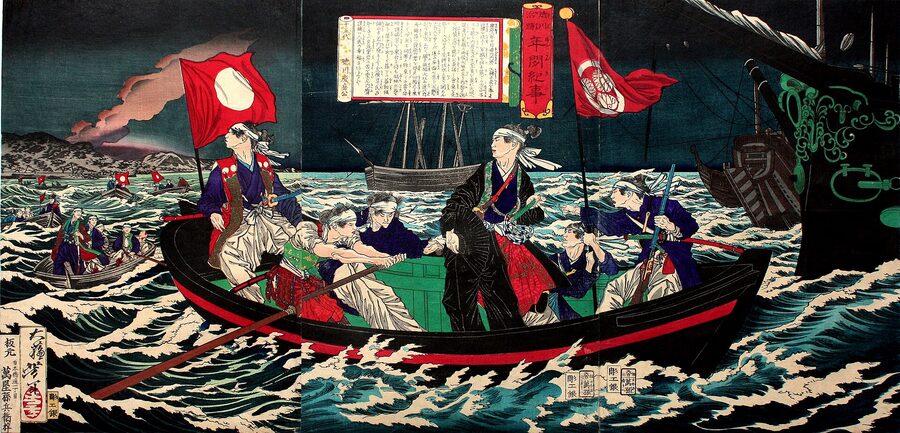
On the night of the 6th, with most of his army still intact, Yoshinobu slipped out of the castle with Matsudaira Katamori of Aizu, his brother Matsudaira Sadaaki of Kuwana and a handful of others, and sailed for Edo on the flagship Kaiyō Maru. When they came ashore, the shogunate’s naval chief Katsu Kaishū noted in his diary that their faces were “the colour of earth” and that nobody would speak.
Akeda Tetsuo’s register of the Restoration dead counts 112 killed on the new government’s side in those four days and 278 on the shogunate’s, 123 of them from Aizu. Aizu’s own history of the war, compiled in 1933, blamed the defeat on the lack of a single commander, on marching a huge army up one narrow road, and on assuming it could walk into Kyoto without a fight. All three were Yoshinobu’s to fix, and he went to Edo instead. The battle earns its place among Japan’s most decisive battles for what it did to the politics, not for its size.
The banner goes east
Within a week the court had declared Yoshinobu an enemy of the throne and stripped Aizu, Kuwana and four other domains of their ranks. Domains that had sat on the fence, Tokugawa relatives among them, lined up to swear loyalty, and by March almost every domain west of Odawara had gone over without a fight. Even the Ii of Hikone Castle, the house of the great shogunate minister Ii Naosuke, changed sides in the first days.
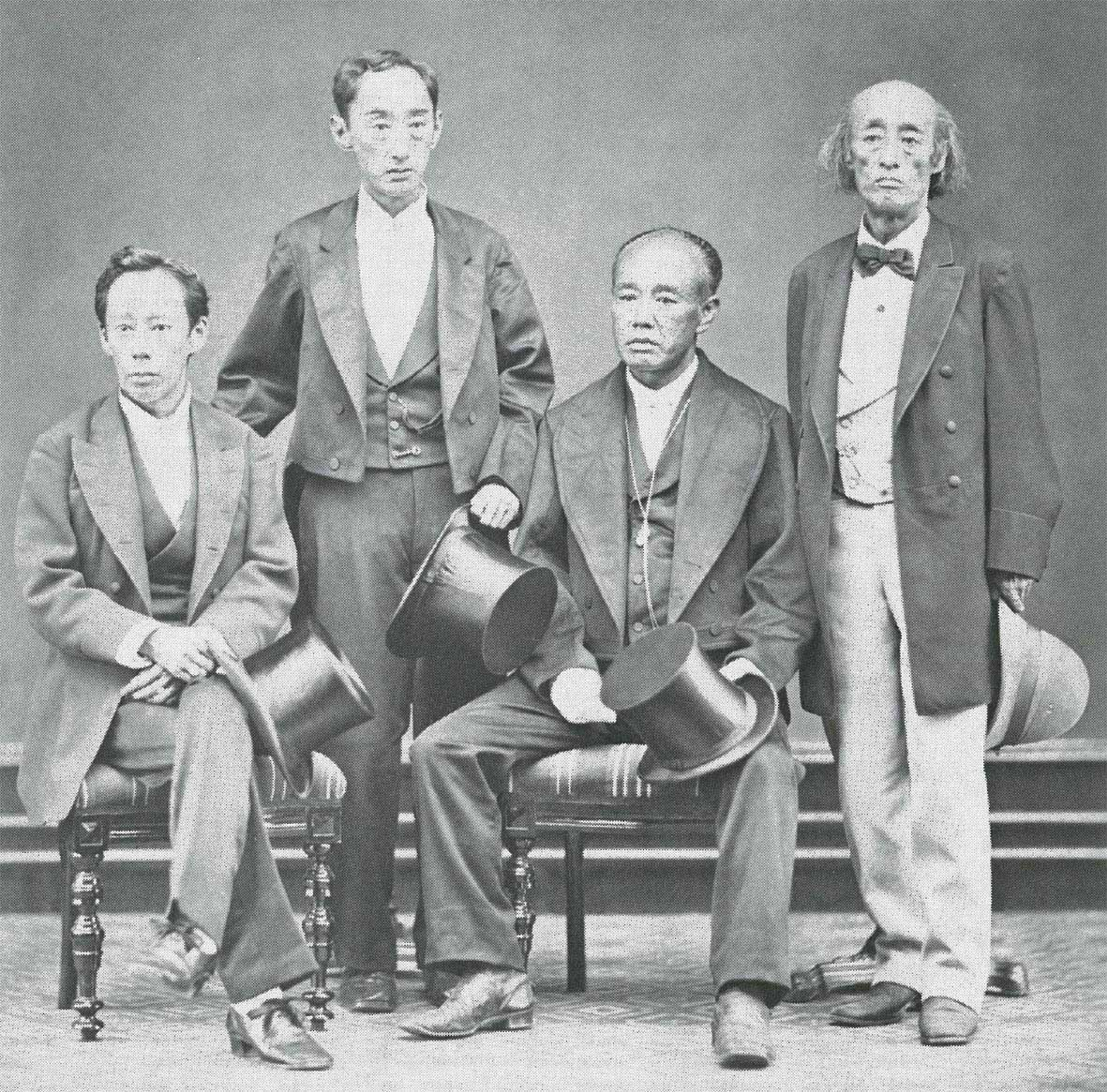
In February an army under Prince Arisugawa Taruhito set out for Edo along three roads, with Saigō as staff officer. In Edo, Yoshinobu dismissed the leader of his war party, rejected an offer of ships, arms and money from the French minister Léon Roches, and shut himself up in a temple at Ueno. If he fought the emperor’s banner and won, he told Roches, he might still end up harming the emperor, and his house would carry the name of traitor for ever. You can call that loyalty or a failure of nerve.
The negotiators were Katsu Kaishū and Saigō. Princess Kazu, the widow of the previous shogun and the late emperor’s sister, pleaded with the court for the Tokugawa, and the British minister Harry Parkes told the imperial side bluntly that attacking a ruler who had already submitted would disgrace them abroad. Napoleon, he pointed out, had only been exiled.
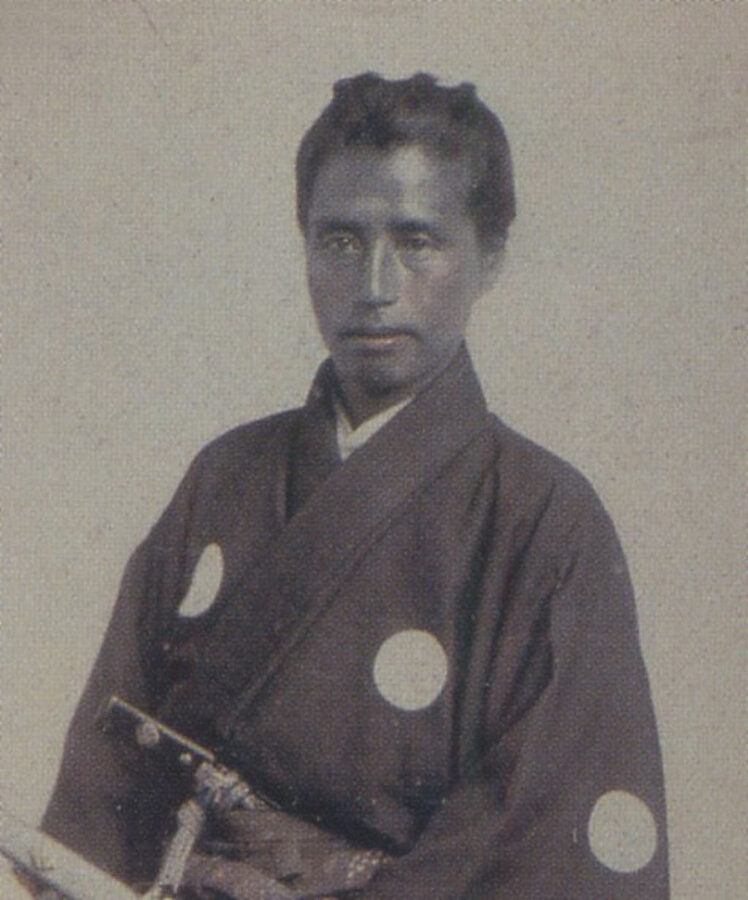
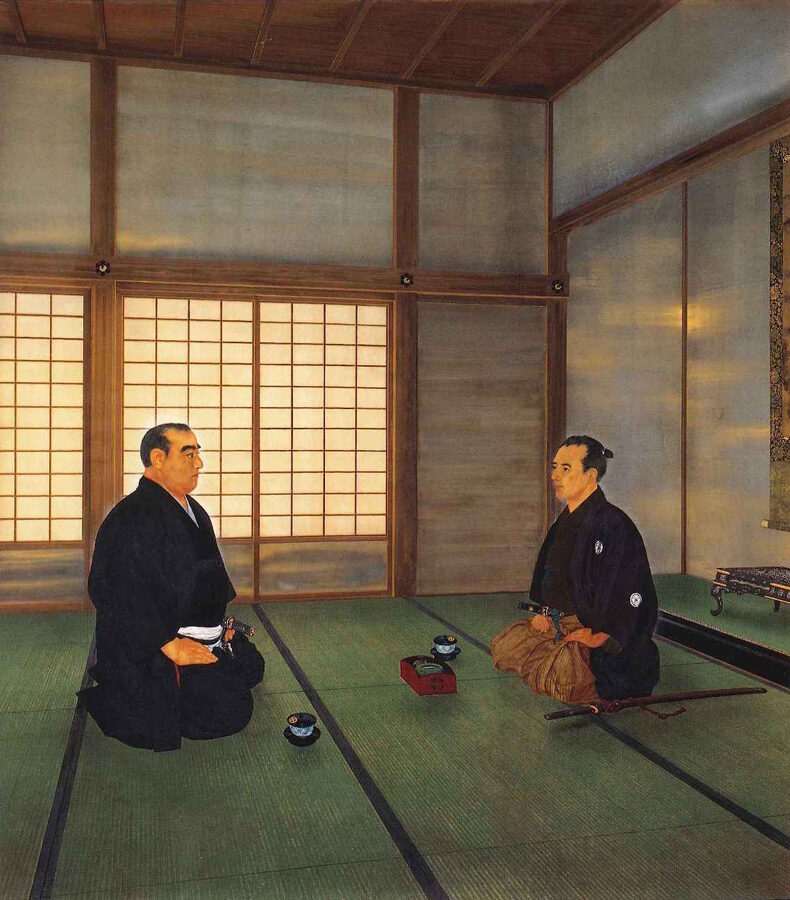
The general assault on Edo had been set for the 15th of the third month. Saigō called it off, and on the 11th day of the fourth month, 3 May 1868, the castle was handed over without a fight. The Tokugawa house passed to a five-year-old boy with a domain of 700,000 koku at Shizuoka, generous by the standards of a defeated dynasty and ruinous for the eighty thousand retainers who depended on it.
Not everyone accepted it. A few thousand shogunate infantry walked out of Edo with their weapons and fought on in the north under Ōtori Keisuke, and Kondō Isami, beaten at Katsunuma, was captured at Nagareyama and beheaded at Itabashi. In the city itself the Shōgitai, a corps of Tokugawa retainers, gathered at the great temple of Kan’ei-ji in Ueno around its abbot, Prince Rinnōji-no-miya, and attacked imperial soldiers in the streets.
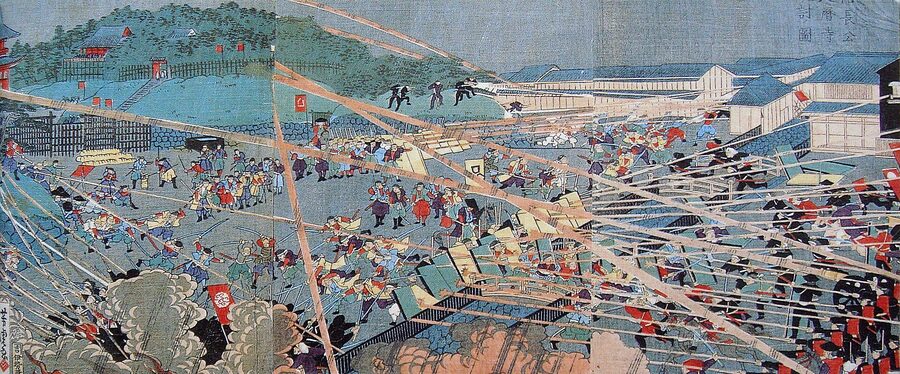
The Chōshū strategist Ōmura Masujirō, given command over Saigō’s head, blocked every road out of Ueno except one and attacked on the 15th day of the fifth month, 4 July 1868, with about 10,000 men against a defence that one count puts at about 4,000. Saga’s Armstrong guns fired across the Shinobazu pond from the Kaga domain’s residence, where the University of Tokyo stands now, while Satsuma took the main gate. It was over by five in the afternoon, and most of the temple’s great halls had burned.
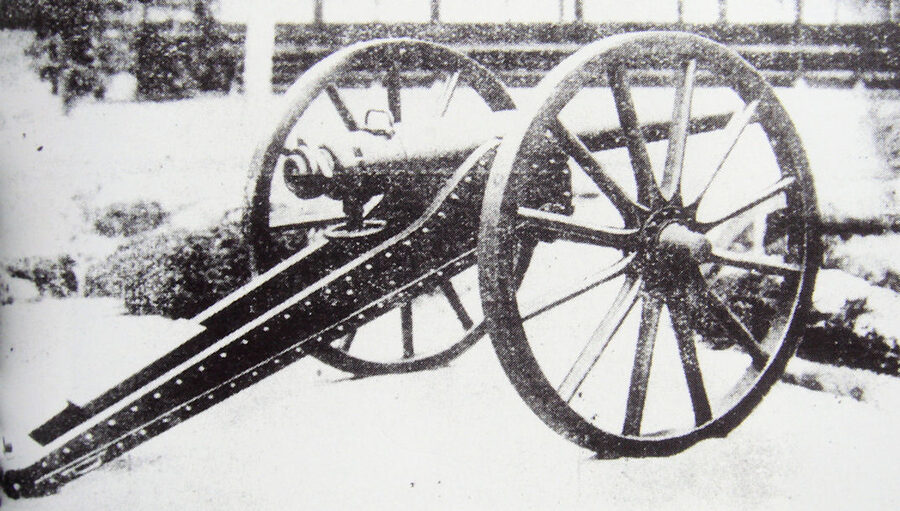
More than two hundred Shōgitai bodies lay on the hill afterwards, and by the usual account the authorities refused to let relatives take them. The abbot of Entsū-ji in Minami-Senju and a merchant called Mikawaya Kōzaburō cremated them where they lay and buried the ashes at Entsū-ji. A unit on the government side recorded clearing bodies three days after the battle, so, as so often in this war, the record does not quite agree with itself.
The northern alliance
Two men were now marked for punishment above all the others. One was Matsudaira Katamori, lord of Aizu, who as Protector of Kyoto had used the Shinsengumi and his own troops against Chōshū’s radicals for five years and whose men had led the fighting at Fushimi. The other was Sakai Tadazumi of Shōnai, whose men had burned the Satsuma residence in Edo. The two domains made an alliance of their own and began to prepare.
The government ordered Sendai, the greatest domain in the north, to attack Aizu, and Sendai, thinking the order unjust, did very little. Katamori sent petitions professing loyalty to the emperor, but kept his army under arms and maintained that firing back when fired on at Fushimi had been the duty of any soldier.
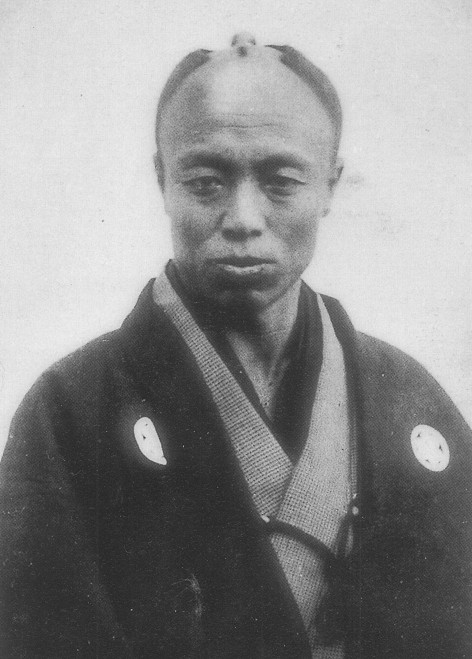
In the spring a government commission arrived in Sendai to force the issue. One of its staff officers, Sera Shūzō of Chōshū, behaved with an arrogance the north still remembers, and in the intercalary fourth month he was seized and killed at Fukushima. Sendai men also ambushed and killed Satsuma officers on the roads that spring, and one head was thrown onto the Sendai execution ground.
The northern domains turned what had begun as a petition for mercy for Aizu into a military pact. Within weeks thirty-one domains of Mutsu, Dewa and Echigo had joined what was called the Ōuetsu Reppan Dōmei (奥羽越列藩同盟), with a council at Shiroishi. Aizu and Shōnai stayed outside it but fought alongside. In the sixth month Prince Rinnōji-no-miya, who had escaped from Ueno, arrived in Sendai and was made the alliance’s figurehead.
Whether the north meant to make him a rival emperor is still argued over; the sources are thin. What is certain is that the alliance was a loose league with different aims and no single command, and that several members had joined because they had no choice.
Nagaoka was the hinge. Kawai Tsugunosuke had sold off the domain’s Edo property, traded rice at a profit in Hakodate, and spent the proceeds on modern weapons from the Prussian brothers Schnell and the Swiss house of Favre-Brandt, including two of the three Gatling guns then in Japan. He meant to stay out of the war and mediate.
On the 2nd day of the fifth month he met the government’s young staff officer Iwamura Seiichirō of Tosa at the temple of Jigen-ji in Ojiya. Iwamura saw the offer of armed neutrality as a stalling tactic for Aizu and turned it down flat, and by the usual account the meeting was over in about half an hour. Nagaoka joined the alliance, and the fighting in Echigo that followed was the hardest of the whole war.
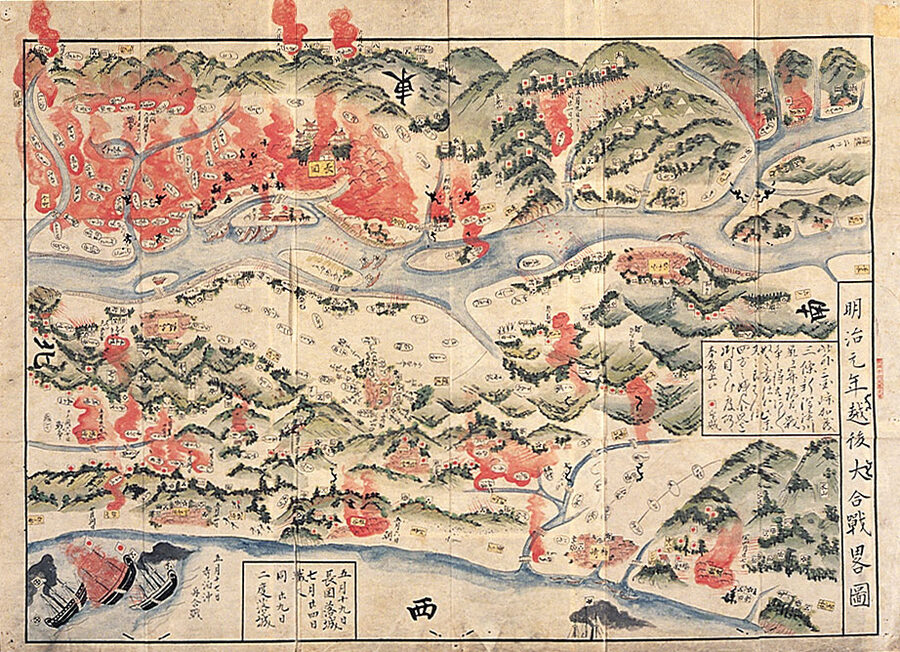
Nagaoka Castle fell on the 19th of the fifth month, 8 July. A peasant uprising against Kawai’s demands for porters and rice then spread across the domain until some 7,000 people were involved, and many were executed when it was put down. It cost him men and time, and it is one reason his reputation in Nagaoka has never been simple.
On the night of the 24th of the seventh month Kawai led his men across the Hacchōoki marsh and retook the castle the next day, one of the very few times in Japanese history that a fallen castle was recaptured. He was hit in the left knee by a bullet during the attack. Four days later, after government troops had landed on the coast behind him and the port of Niigata had fallen, the castle fell again, this time for good.
Kawai was carried over the mountain pass of Hachijūri-goe into Aizu on a stretcher, mocking himself in a haiku as a crippled samurai crossing the pass. Tetanus set in. On the 16th day of the eighth month, 1 October 1868, he died in a doctor’s house in the village of Shiozawa, now part of Tadami, after ordering his servant to prepare the fire for his own cremation. He was forty-one by Japanese reckoning.
Aizu: a month under the guns
Aizu had reorganised its army in the spring, sorting its samurai by age into four corps named for the guardian beasts of Chinese cosmology: the Vermilion Bird for men of eighteen to thirty-five, the Azure Dragon for older men, the Black Tortoise for the over-fifties. The Byakkotai, the White Tigers, were samurai sons of sixteen or seventeen by Japanese reckoning, a reserve of about three hundred boys trained in French drill.
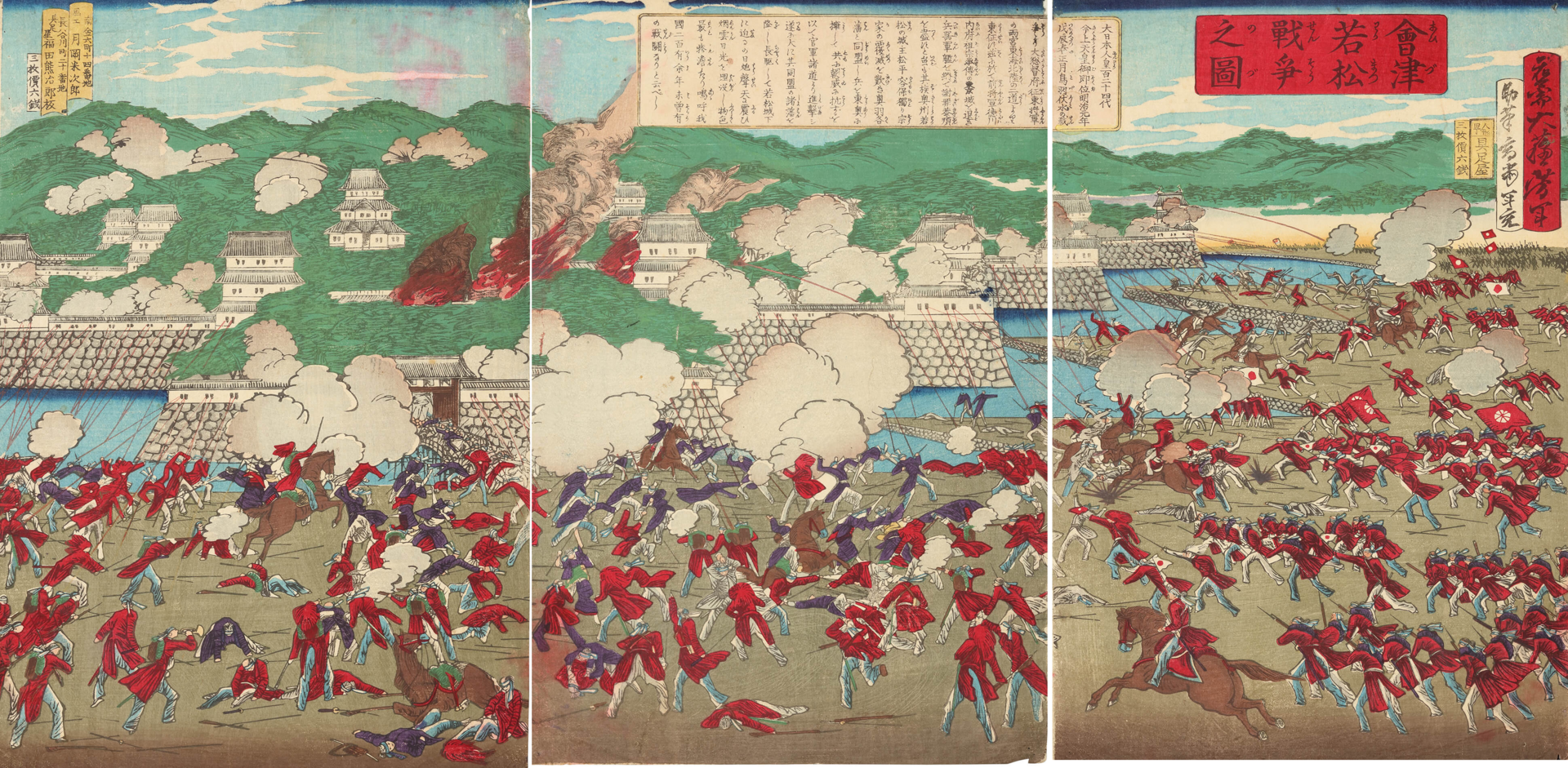
The blow fell from an unexpected direction. While Aizu’s best troops were holding the borders to the south and west, the government’s commanders on the spot, Itagaki Taisuke of Tosa and Ijichi Masaharu of Satsuma, won the argument against Ōmura, who wanted to deal with Sendai first, and drove straight at Aizu. On the 21st of the eighth month they broke through at the lightly held Bonari pass, and on the morning of the 23rd, 8 October 1868, after a dash of some forty kilometres, they were in the streets of the castle town.
The town was caught unprepared. Samurai families were meant to go into the castle when the alarm sounded, and many could not get there in time. In the house of the senior retainer Saigō Tanomo, twenty-one women and children of his family, from his mother down to small daughters, took their own lives rather than become a burden in the siege or fall into enemy hands. Other households did the same across the samurai quarter.
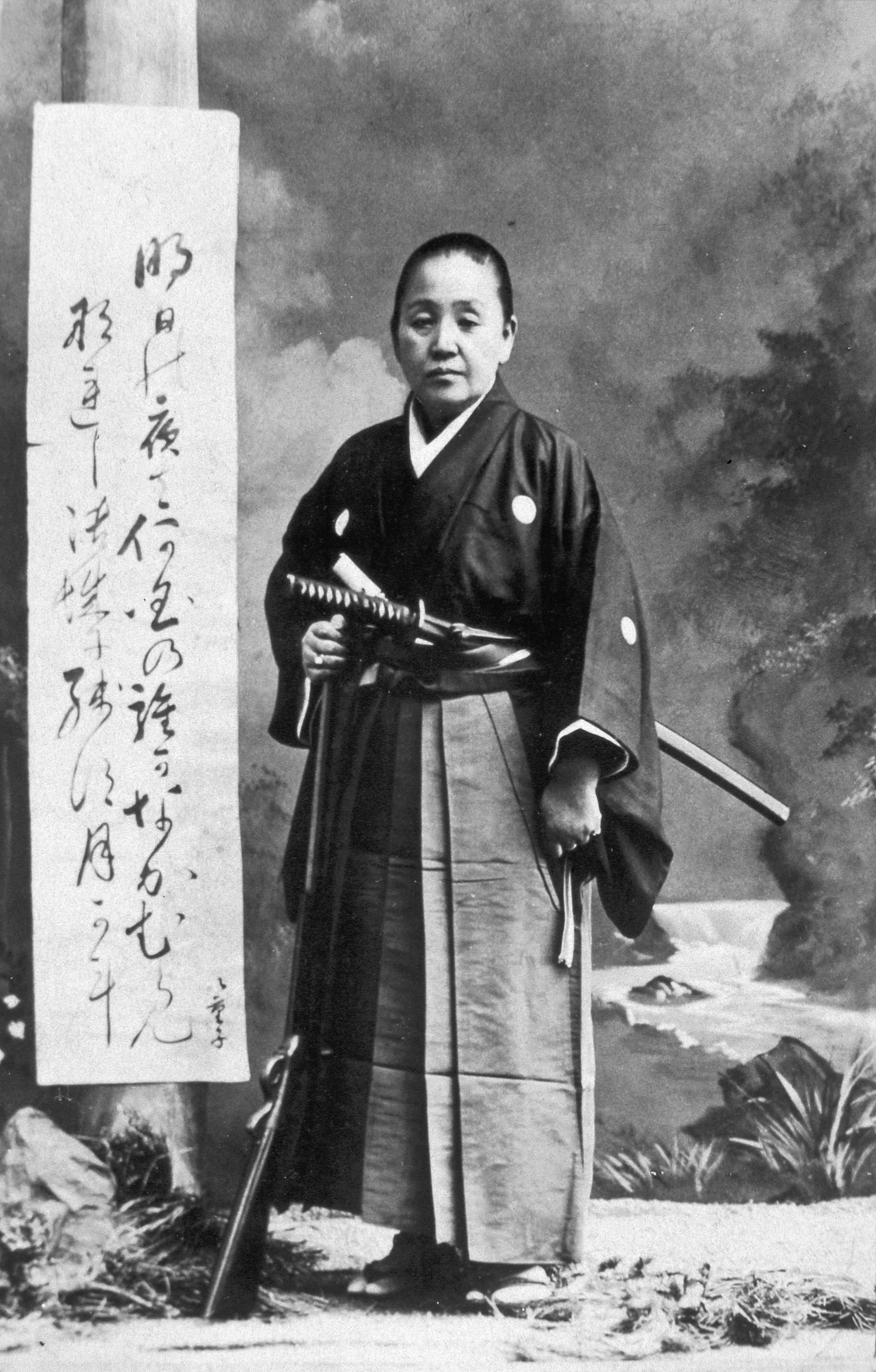
Women fought, too. By the usual account a band of women led by Nakano Takeko, a skilled fighter with the naginata halberd, charged government troops at Yanagibashi on the 25th, and Takeko was shot; her head was carried away so that the enemy would not take it, and it lies at Hōkai-ji in Aizubange. Inside the castle Yamamoto Yae, the daughter of a family of gunnery instructors, cut her hair short, put on the clothes of her brother, who had died of wounds from Toba-Fushimi, and fought with a Spencer repeating rifle.
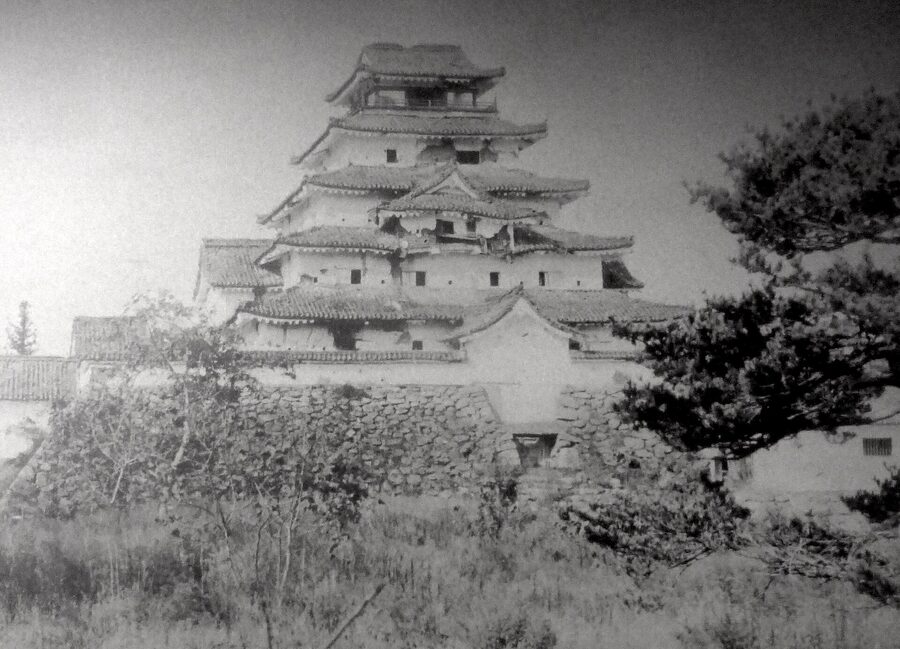
About five thousand people were crowded inside the castle, by one count including about a thousand old people, women and children. Through the ninth month the government’s guns, Saga’s Armstrongs among them, fired into it from the hill of Oda-yama to the south-east, and on the 14th fifty guns are said to have fired fifty rounds each. Food and powder ran short, the wounded filled the halls, and one by one the allies gave up: Yonezawa on the 4th of the ninth month, Sendai on the 10th.
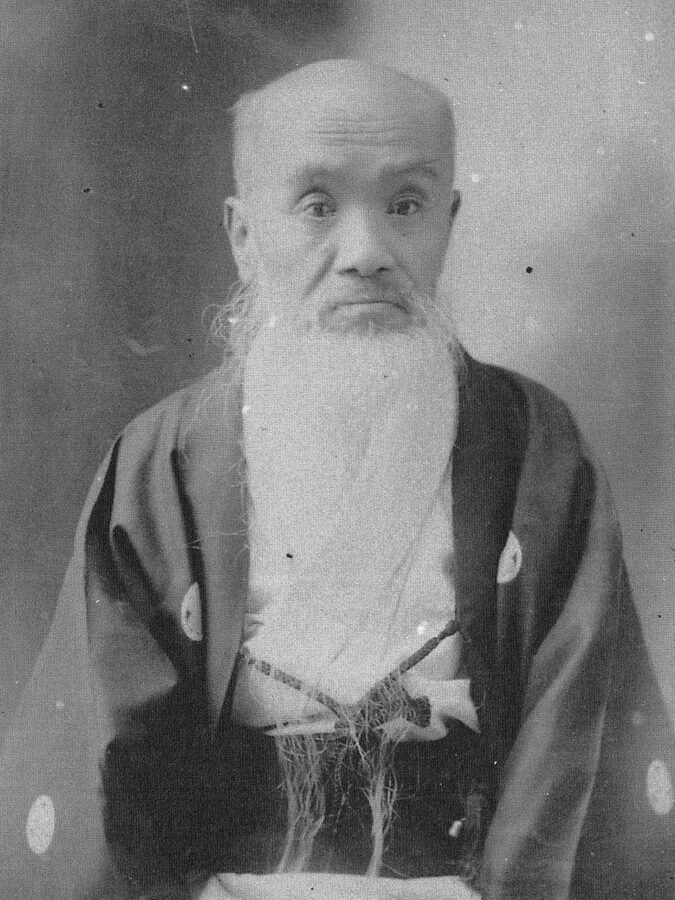
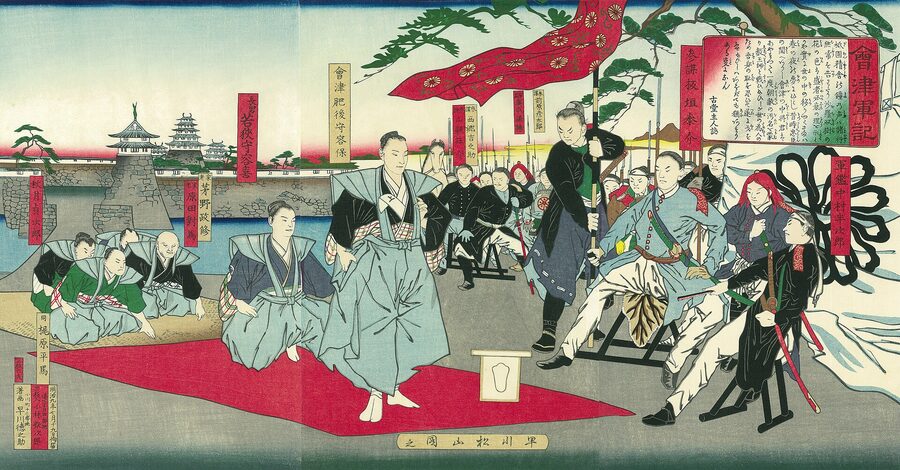
On the 22nd day of the ninth month, 6 November 1868, Aizu surrendered, through the mediation of Yonezawa. The government let Katamori come out in a palanquin rather than bound like a criminal, which Aizu men remembered. The senior retainer Kayano Gonbei was made to take the responsibility for the war and was put to death in Tokyo the following spring; sources variously describe his death as beheading or as seppuku. Shōnai, which had never let an enemy soldier into its territory, surrendered two days after Aizu, and the war in the north was over.
The White Tigers on Iimoriyama
The story that everyone knows happened on the morning the town fell. On the 22nd of the eighth month the second company of samurai-rank Byakkotai, thirty-seven boys, escorted Katamori out to the field headquarters at Takizawa and were sent on to the front at Tonokuchi-hara, where they dug in overnight in the rain. On the 23rd the government army came across the Jūrokkyō bridge, the Aizu line broke, and the company lost touch with its officers.
A group of about twenty made their way back towards the town through an irrigation tunnel and came out on the hill of Iimoriyama, overlooking the castle. The town below them was on fire. Most of them killed themselves there. Their graves number nineteen, although for decades the school textbooks spoke of sixteen.
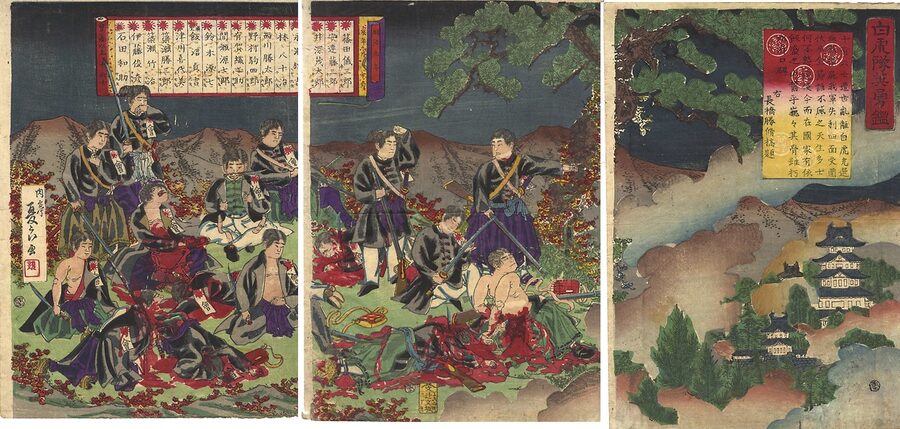
English accounts almost always say they did it because they mistook the burning town for the fall of the castle. That version became standard after a book of 1928. In 2008 a memoir dictated in 1902 by the one boy who survived, Iinuma Sadakichi, and corrected in his own hand, was found at his grandson’s house, and it describes a furious argument about whether to try to get back into the castle or charge the enemy. In 2011 an association of descendants and researchers put up a notice on the hill saying the “mistaken castle” story is wrong, though Iinuma’s own accounts changed over the years and some historians are wary of resting everything on him.
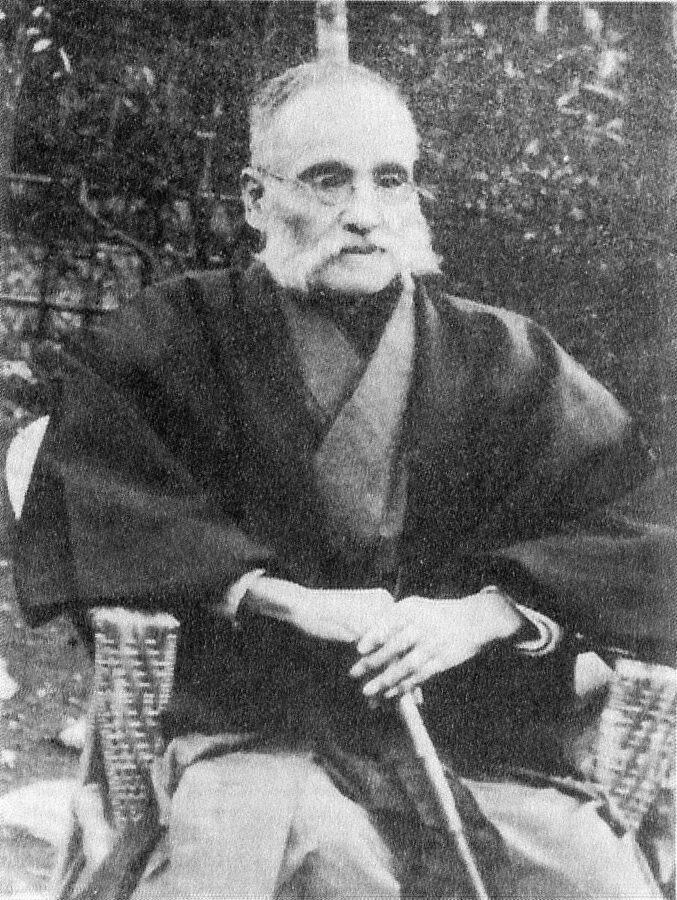
What happened to him next is the part I find hardest to forget. Captured by the government side, he was taken in by a Chōshū officer, Narasaki Raizō, and kept hidden for a time in a farming village in Chōshū’s own territory, near what is now Mine in Yamaguchi, because it would have been awkward for both sides if anyone knew. Families in the village passed the story down quietly for more than a century, and in 2016 a memorial to that kindness was put up on the site of Narasaki’s house.
More than eight in ten of the Byakkotai survived the war. One of them, Yamakawa Kenjirō, studied physics at Yale and became president of Tokyo Imperial University, and he wrote that Aizu lost because it was badly informed, rigid about rank, slow to modernise and contemptuous of its own commoners. That is not the verdict you hear from the souvenir stalls on Iimoriyama.
Who buried the dead
For more than half a century, a story has been told in Aizu that the victors forbade the burial of Aizu’s dead and left them in the fields for six months. It is one of the main reasons the war still stings there. A copy of a burial ledger found in Aizu-Wakamatsu in 2016 tells a more complicated story.
According to the ledger, and to the local historian Noguchi Shin’ichi who has written on it, the government’s civil administration ordered burials on the 2nd day of the tenth month, ten days after the surrender. Over the next fifteen days four Aizu samurai supervised the collection of 567 bodies, which were buried at sixty-four temples and other sites around the town, at a cost of seventy-four ryō; the labourers, 384 man-days of them, were paid two shu a day. Some of the dead are listed by name.
That does not make the myth groundless. Many bodies were left where they fell or thrown into wells, the townspeople’s requests to rebury them properly were ignored for months, and the reburial at Amida-ji in the second month of 1869 is probably what gave rise to the “six months” of the story. The government side did not ban burial so much as treat the dead of a defeated domain with indifference, and that was enough to be remembered for a century and a half.
There is another uncomfortable record. The British doctor William Willis, who treated the wounded of both sides, heard that Aizu troops had killed the wounded and the doctors in a government hospital at Nagaoka and robbed and raped on the retreat, and that government troops looted everywhere in Aizu, down to farmers’ tools. Whatever the truth of each story, he wrote, the cruelty grew worse the closer the fighting came to Wakamatsu.
When the castle surrendered, Aizu’s own farmers rose against the heavy taxes and village officials of the old regime, and few came out to see Katamori off when he was sent to Tokyo as a prisoner. The Aizu tragedy was a samurai tragedy, and that matters for how it is told. In 1870 the domain’s successor was allowed 30,000 koku at Tonami, at the cold northern tip of what is now Aomori prefecture, and about 17,000 people, by one count, went there; many died of hunger and cold in the first winters.
In 2013 a team led by the Tokyo historian Iokibe Kaoru found letters in the German federal archives showing that in the summer of 1868 Aizu and Shōnai had offered Prussia a ninety-nine-year lease on their lands in Ezo, the modern Hokkaido, as security for a loan. Bismarck refused, then changed his mind three weeks later, by which time events had overtaken the offer. The northern alliance, like the southern one, was willing to bargain with foreign powers to win.
Ezo: the republic that may not have been one
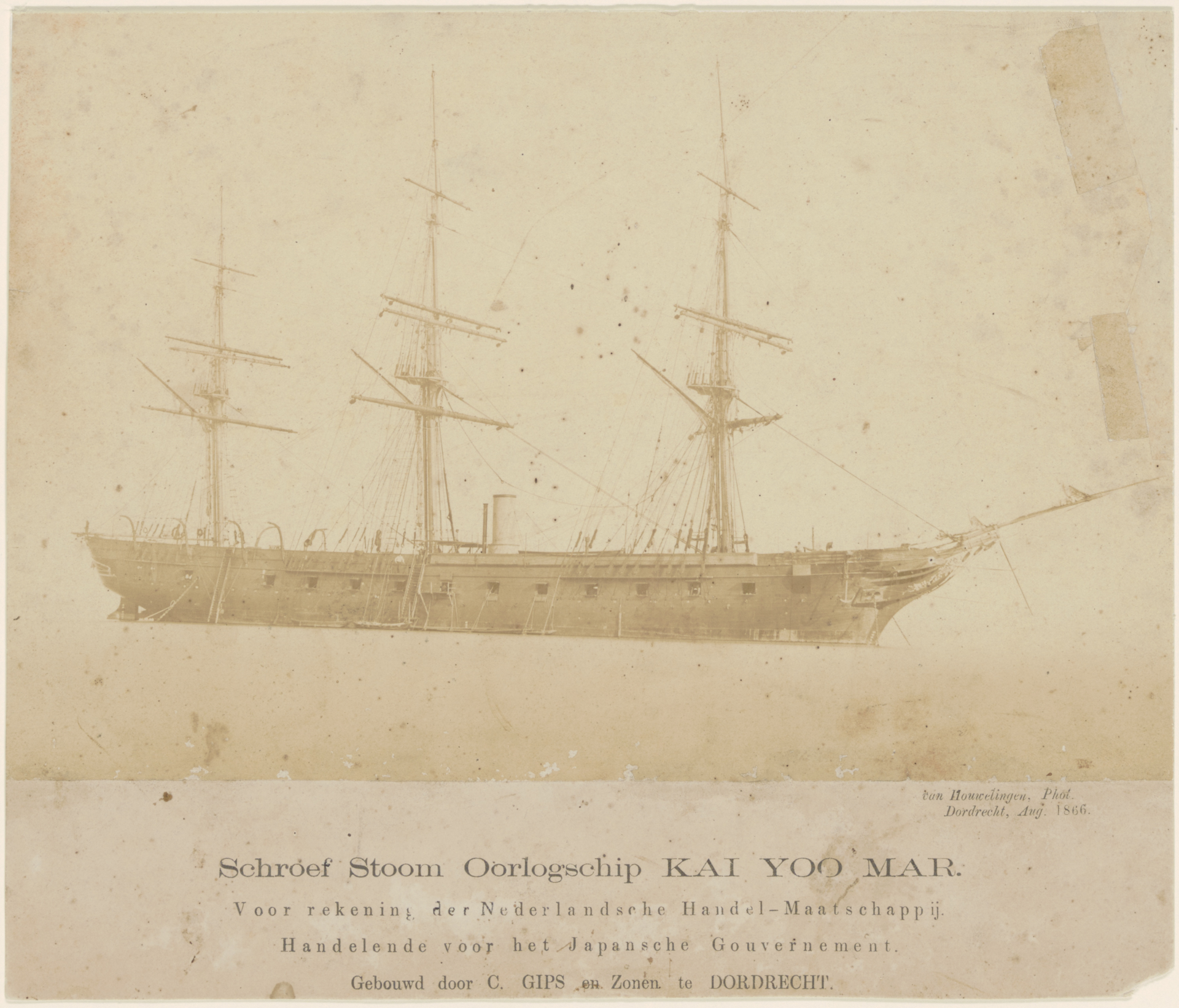
While the north was collapsing, the shogunate’s navy was still at sea. Its commander, Enomoto Takeaki, had trained in the Netherlands and brought the Kaiyō Maru home from Dordrecht in 1867, and he had refused to hand over his best ships when Edo surrendered. On the 19th of the eighth month, 4 October 1868, he left Shinagawa with eight vessels and about two thousand men, including former Shōgitai and the French officers Jules Brunet and André Cazeneuve, who had resigned from the French military mission to join him.
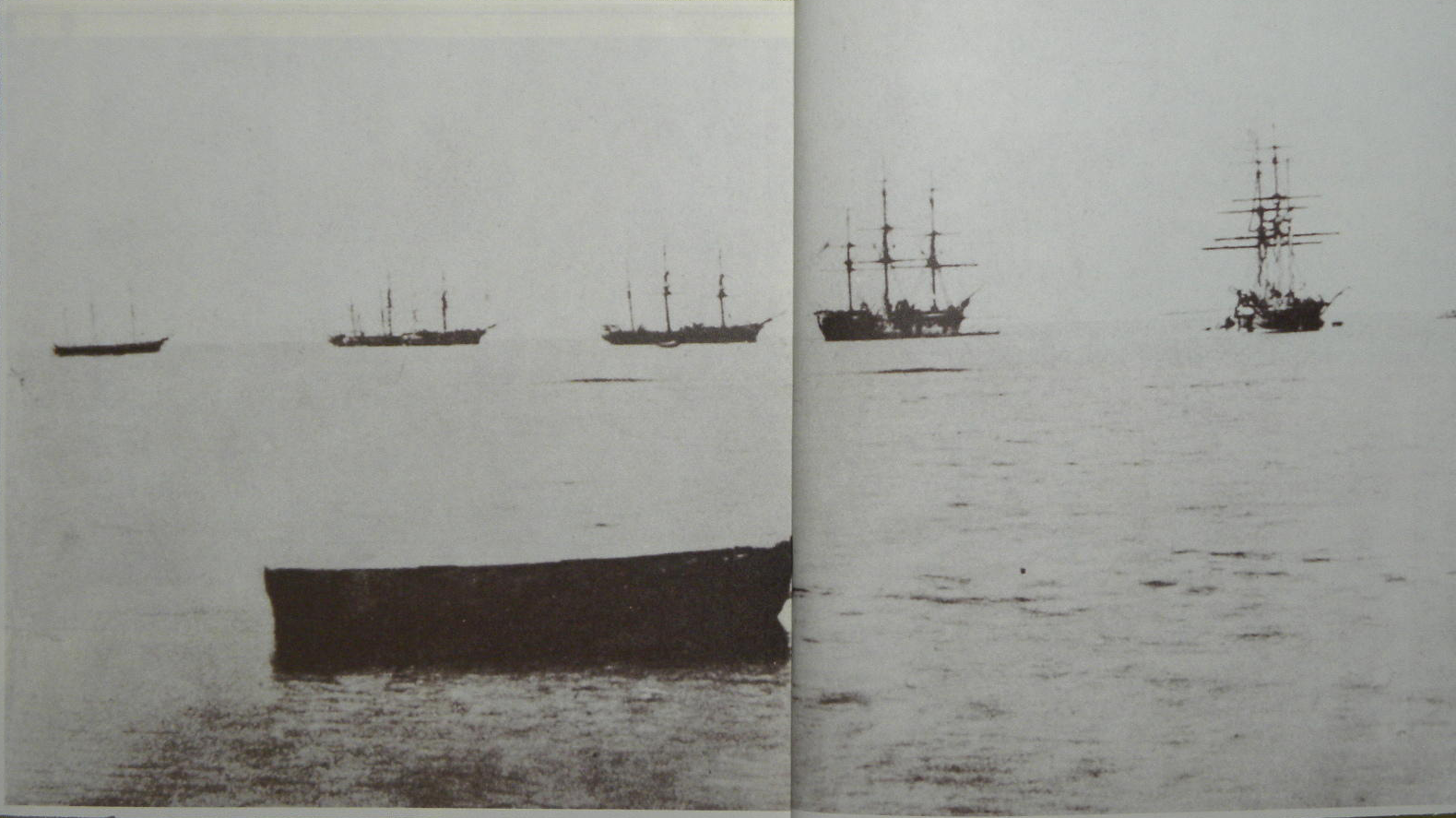
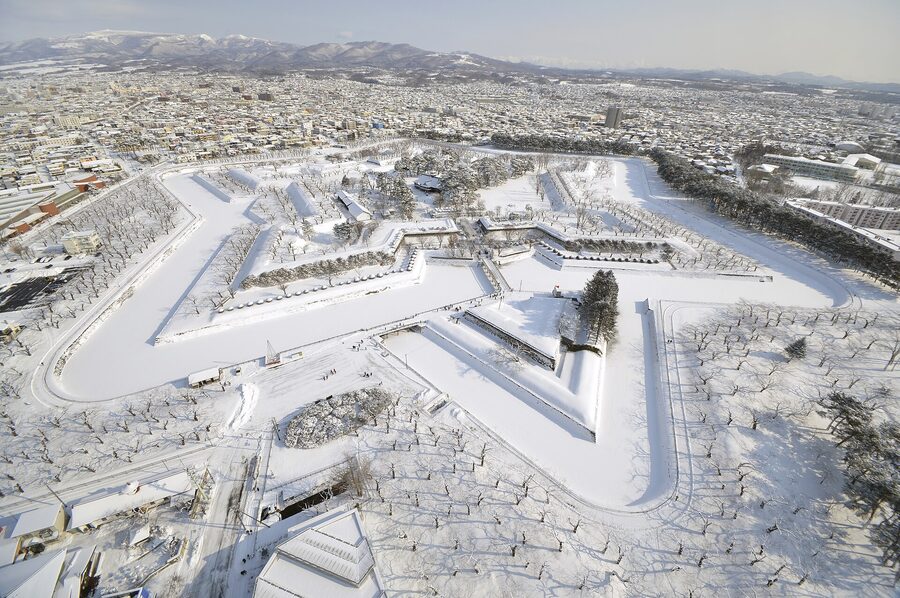
In Sendai the fleet took on the wreck of the northern cause: Ōtori Keisuke’s infantry, Hijikata Toshizō and the remains of the Shinsengumi, and three former daimyo, including Sadaaki of Kuwana. With some 3,000 men Enomoto sailed for Ezo and landed at Washinoki, north of Hakodate; sources variously give the 20th or 21st of the tenth month. By the 26th the star fort of Goryōkaku was his without a fight, and within weeks so was the Matsumae domain’s castle and almost all of the south of the island.
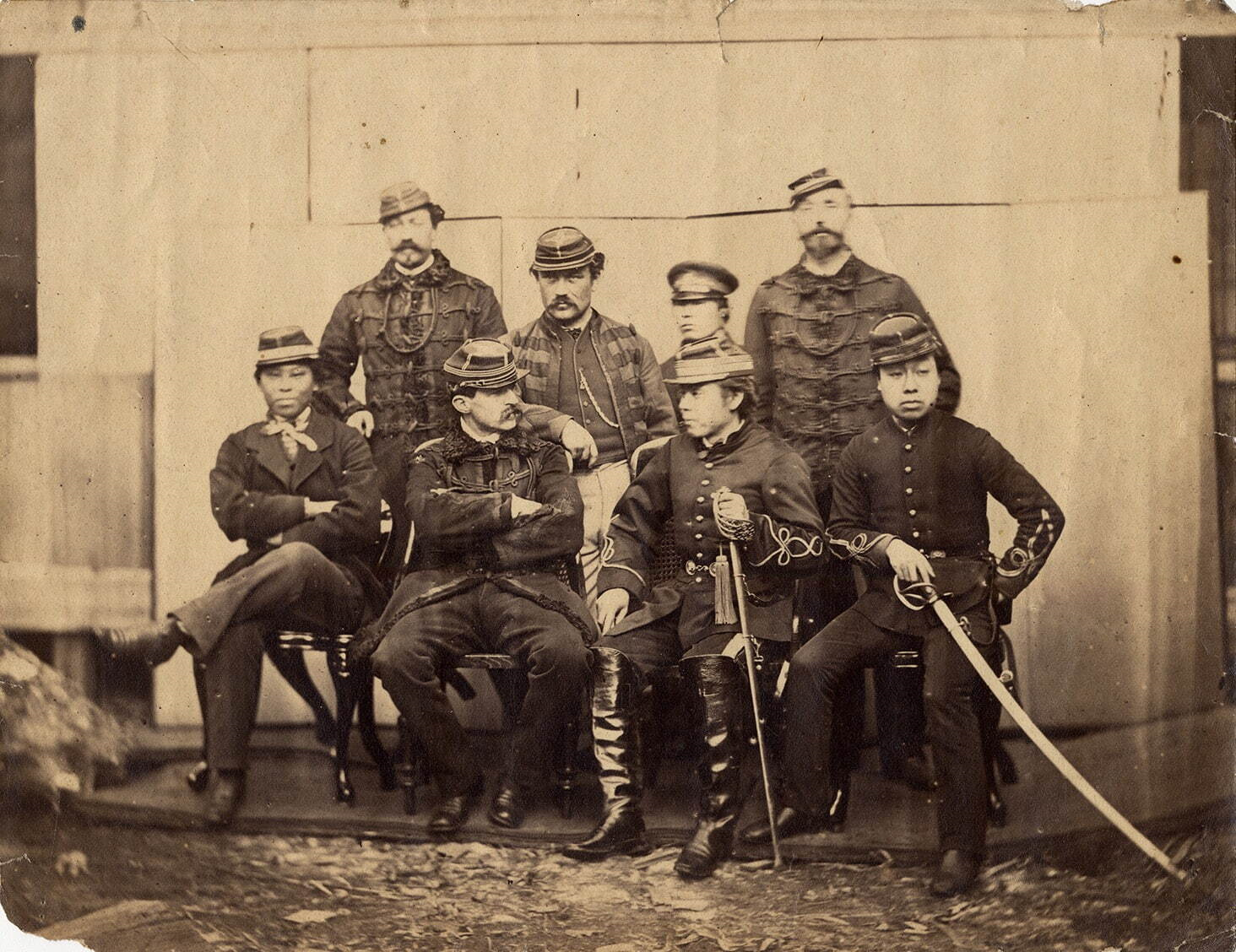
On the 15th day of the twelfth month, 27 January 1869, Enomoto’s officers elected him president of their new government. English-language accounts call it the Republic of Ezo, Japan’s first and only republic. Historians point out that no contemporary document calls it a republic, and Japanese accounts usually speak of the Hakodate government or the Ezo Island government: Enomoto’s petitions asked to be allowed to settle the Tokugawa’s unemployed retainers in Ezo under a Tokugawa lord, not to found a new state.
The vote was limited to officers. Nobody consulted the Ainu, whose land most of the island still was, as my piece on the Ainu explains. To pay their way the rebels levied forced loans on Hakodate’s merchants and minted coins of their own, and the town grew to dislike them.
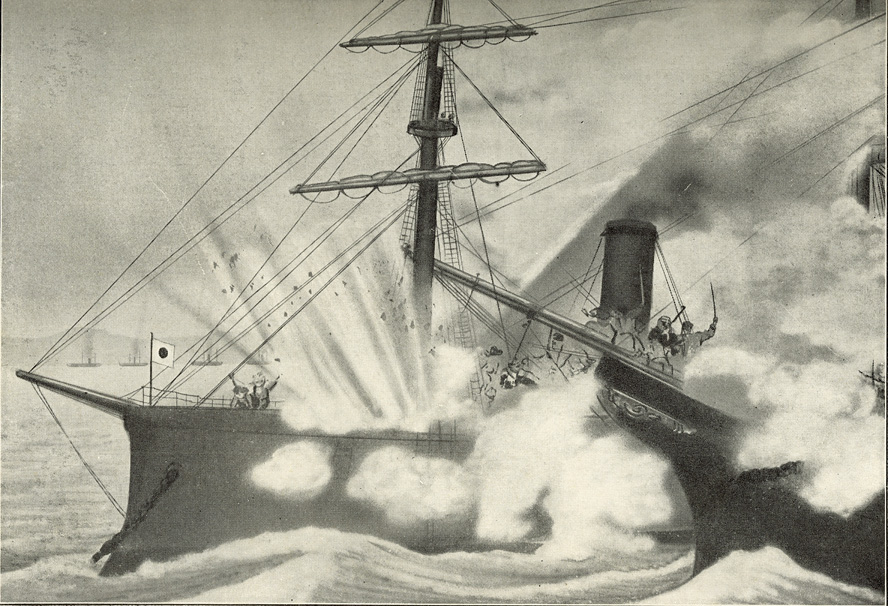
The government’s answer came with the spring: the ironclad Kōtetsu, the former CSS Stonewall, which the shogunate had ordered from the United States and the Americans now released to the new government. On the 25th of the third month, 6 May 1869, Enomoto’s men tried to seize her in Miyako Bay, the Kaiten running in under an American flag and hoisting her own colours at the last moment. The boarders who jumped down onto the ironclad’s deck were cut down by a Gatling gun and rifle fire, and nineteen were killed, including the captain, Kōga Gengo.
The government army landed at Otobe on the 9th of the fourth month and advanced on Hakodate by four routes. At the Futamata pass Hijikata’s 300 men held off attack after attack from behind sixteen breastworks for sixteen hours, firing some 35,000 rounds and cooling their rifles with buckets of water. Everywhere else the line gave way, and on the 11th day of the fifth month, 20 June 1869, the general assault began.
A government force landed behind Mount Hakodate and climbed it in fog before dawn; Ōtori later blamed the Shinsengumi sentries on the summit for not noticing. The town fell by midday, and a fire set by the defenders burned 872 houses. Hijikata rode out from Goryōkaku to relieve the battery at Benten Daiba and was shot dead near the Ippongi barrier.
The last days had an odd courtesy. The government commander, Kuroda Kiyotaka of Satsuma, had the hospital’s staff write to Enomoto urging him to surrender. Enomoto refused, but sent Kuroda his treasured Dutch volumes of maritime law, so that they would not burn; Kuroda replied with five barrels of sake and five tuna. On the 16th Nakajima Saburōsuke, who in 1853 had been one of the first Japanese officials to go aboard Perry’s ships, died fighting at the Chiyogadai outpost with his two sons rather than surrender.
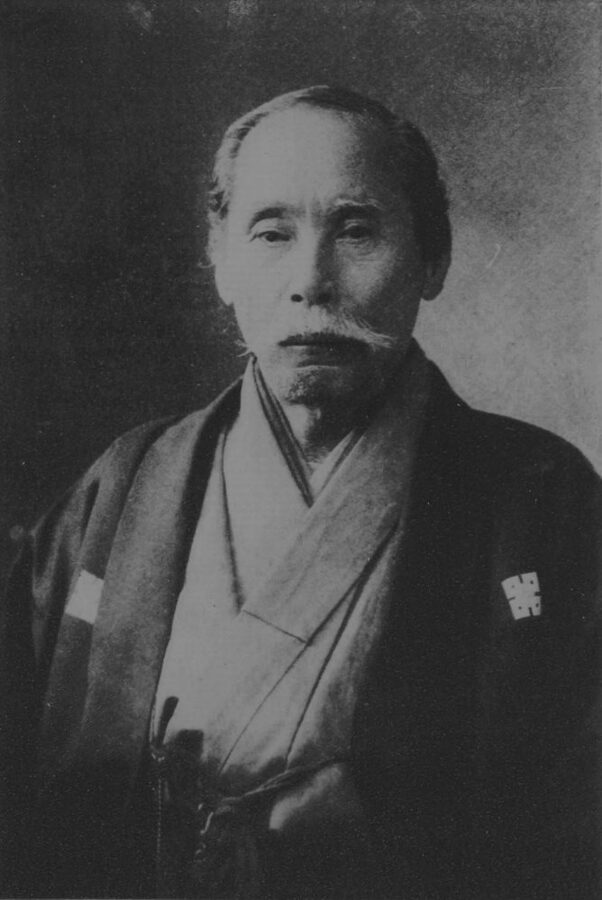
On the 18th day of the fifth month, 27 June 1869, Goryōkaku opened its gates, and the Boshin War was over. Enomoto, Ōtori and five others were imprisoned in Tokyo until 1872, while Kuroda campaigned for their lives. Enomoto went on to be the Meiji government’s envoy to Russia and a minister several times over, which says a good deal about how badly the new state needed men who could do things.
Counting the cost
How many died has several answers. English-language summaries usually say about 8,200 killed and more than 5,000 wounded, out of a total mobilised given variously as 69,000 or 120,000, and Japanese counts differ according to what they include. One Japanese estimate by domain puts Satsuma’s dead at about seven per cent of its men in the field and other domains at three to five, against 0.6 per cent for the Takeo contingent of Saga, which was armed with Spencer repeaters.
Nobody counted the civilians, who died in the fires at Fushimi and Hakodate, in the streets of Wakamatsu and in the peasant risings that broke out wherever the old authorities collapsed. At Nihonmatsu a company of boys aged twelve to seventeen was destroyed defending the castle. Villages along every route had their rice and men requisitioned, and some were still asking to be repaid years later.
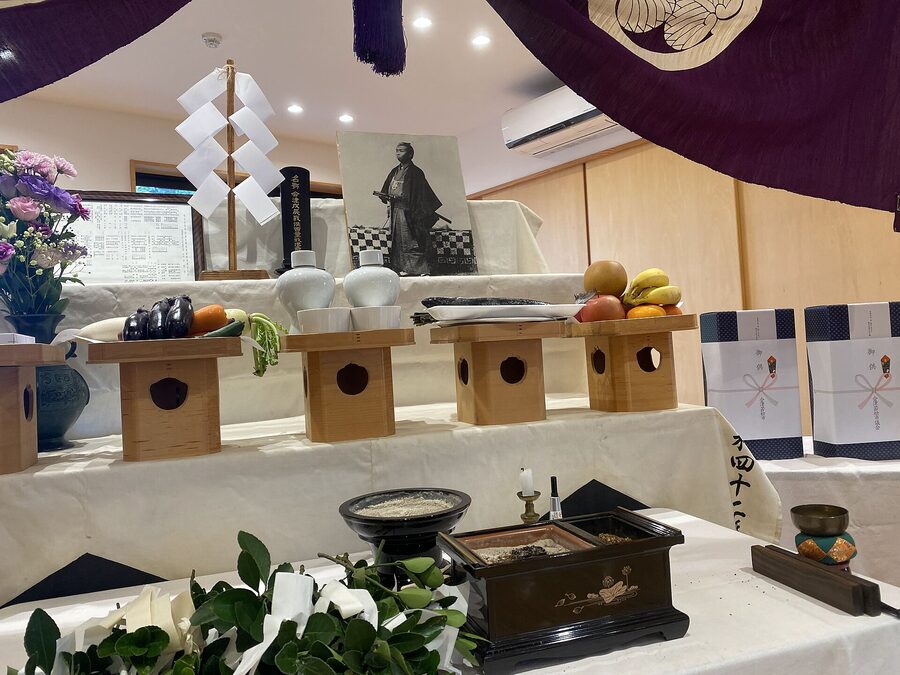
The victors honoured their own. The government’s shrine for the war dead, founded in Tokyo in 1869 and later renamed Yasukuni, enshrined the imperial dead and not the others, and until 1874 the government disapproved of memorial rites for “rebels”.
The longest-running feud is between Aizu and Chōshū. In 1986 the city of Hagi, Chōshū’s old castle town, proposed a friendship agreement with Aizu-Wakamatsu on the grounds that 120 years had passed, and Aizu-Wakamatsu reportedly replied that it had only been 120 years. After the earthquake of 2011 Hagi sent help, and the mayor of Aizu-Wakamatsu went to thank the city while making clear that this was not a reconciliation.
The other legacy is the shape of Meiji Japan, whose government the southern domains filled for a generation. Saigō Takamori, who had insisted on lenient terms for Shōnai, led the Satsuma samurai against that government in 1877; Aizu men volunteered to fight him, and some were in the army that relieved Kumamoto Castle. You can follow that thread in my piece on Saigō Takamori.
Much of what the war is remembered for was shaped later. The “last samurai” image owes more to 1877, and to an American film of 2003 that fused the two wars, than to the rifle and artillery fighting of 1868. The cult of bushidō that turned the Byakkotai into national heroes in the 1930s, alongside the 47 Rōnin, used them for purposes the boys would not have recognised. If you want the long view, the war sits at the hinge of my walk through Japan through the ages, between the Edo era it ended and the Meiji era it began.
Where to see the Boshin War today
The trail runs through five places: Fushimi and Toba south of Kyoto, Tokyo, Aizu-Wakamatsu, Nagaoka and Hakodate. Kyoto and Tokyo fill half a day each; Aizu-Wakamatsu deserves a full day, and I would give it two.
Fushimi, Toba and Yodo, Kyoto
Gokōnomiya shrine (御香宮神社) in Fushimi is where Satsuma put its guns on the 3rd of the first month, and it is four minutes on foot from Momoyama-goryōmae station on the Kintetsu Kyoto line, or seven minutes from Fushimi-Momoyama on the Keihan line. The grounds are free; the small rock garden costs ¥200. Bullet marks from 1868 are pointed out on the wall of the little Tenmangū sub-shrine to the east of the torii, and they are easy to walk past.
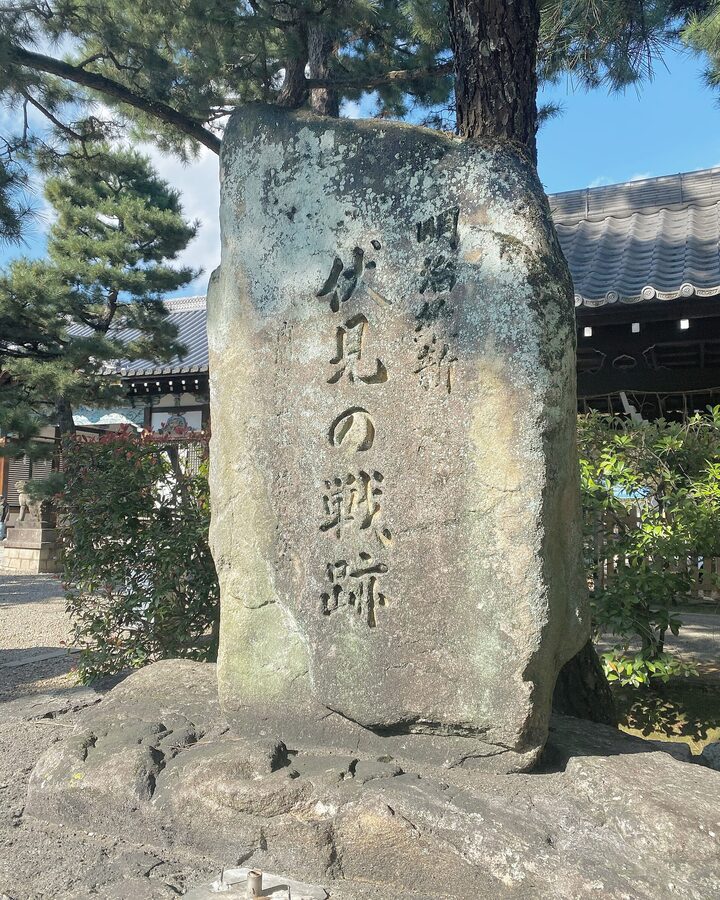
The site of the magistrate’s office the shogunate held is a few minutes’ walk downhill: a stone marker by a municipal housing estate, on land that later became an army engineers’ base. There is nothing else to see, but stand there and look back uphill at the shrine and you understand the battle in about ten seconds.
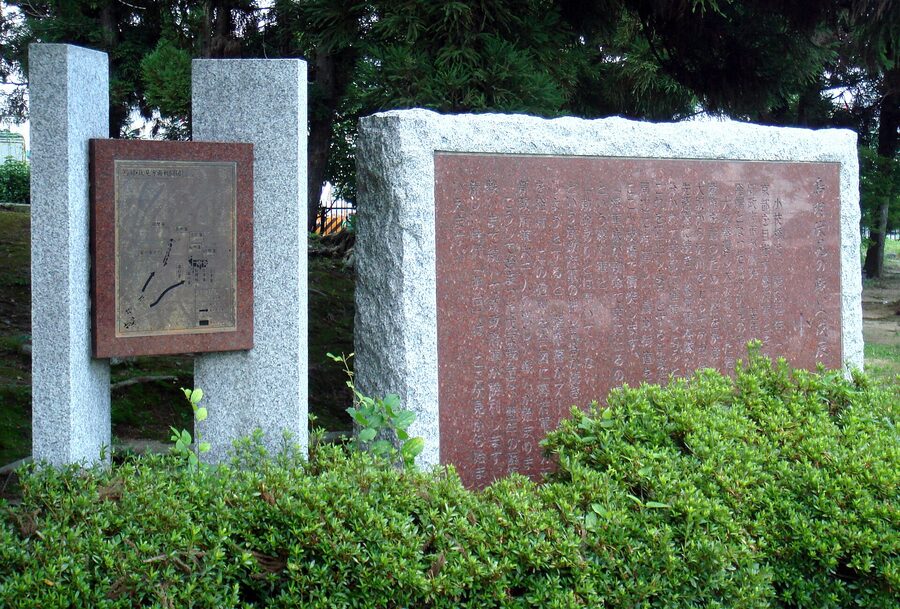
For Toba, go to Toba Rikyū Ato Kōen, the park on the site of a medieval imperial villa, about three minutes from Jōnangū shrine and roughly twenty minutes’ walk from Takeda station on the Karasuma subway and Kintetsu lines. The low hill in the park, Aki-no-yama, is where a Satsuma gun is said to have fired the first shot, and there are monuments and a battle map on and around it. Koeda Bridge, a short walk further on, has a memorial of its own to the shogunate dead.
The shogunate side of the story is around Yodo station on the Keihan line. Chōen-ji, ten minutes’ walk away, was a field hospital for the retreating army and has a monument to its dead inscribed by Enomoto. Myōkyō-ji, about twenty minutes’ walk, keeps timbers pierced by a cannonball during the fighting; ask before you go into either temple’s buildings.
By the old embankment at Senryōmatsu, across the Keihan tracks from Kyoto racecourse, a small memorial put up in 1970 says that both sides believed they were right, and that a moment’s chance made some of them the imperial army and others the rebels. I think it is the fairest inscription anywhere on this trail.
Tokyo: Tamachi, Ueno and Minami-Senju
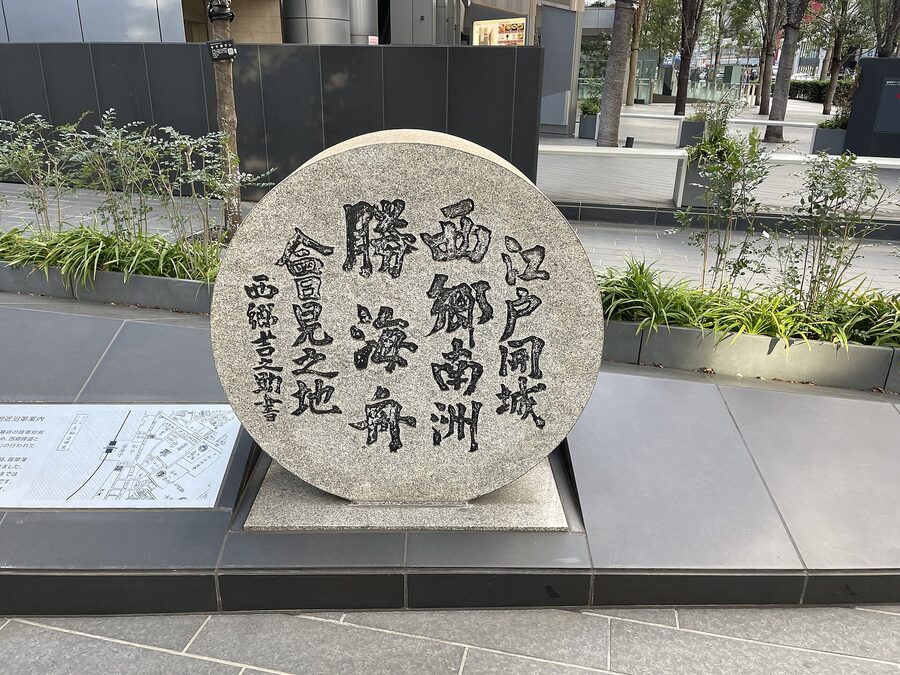
The marker for the Katsu and Saigō meeting stands at Shiba 5-chōme, in the plaza of an office building, a short walk from JR Tamachi station or Mita subway station. The calligraphy is by Saigō’s grandson.
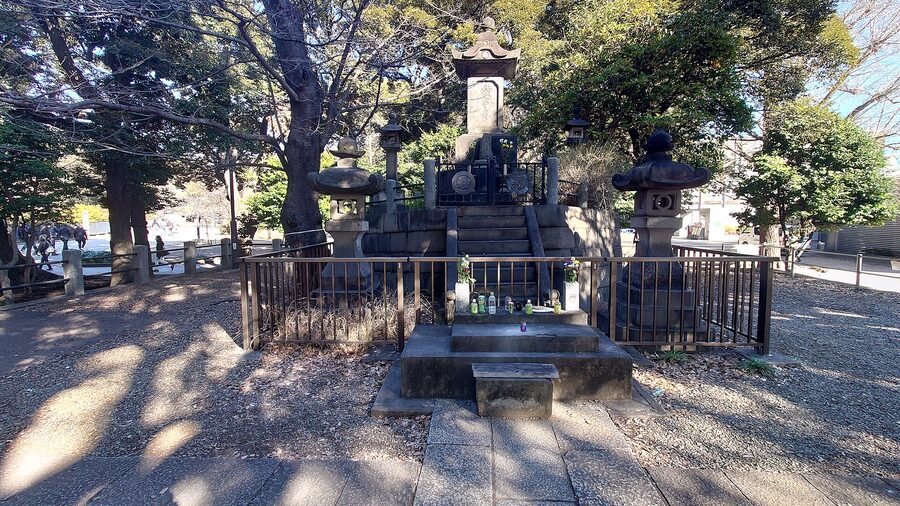
In Ueno Park, the Shōgitai grave stands just behind the bronze statue of Saigō Takamori, five minutes from the park exit of JR Ueno station. A former Shōgitai member, Ogawa Okisato, refused a government post to look after it, and his family kept it, and lent water to the people who cleaned Saigō’s statue, until the site passed to the city in 2003.
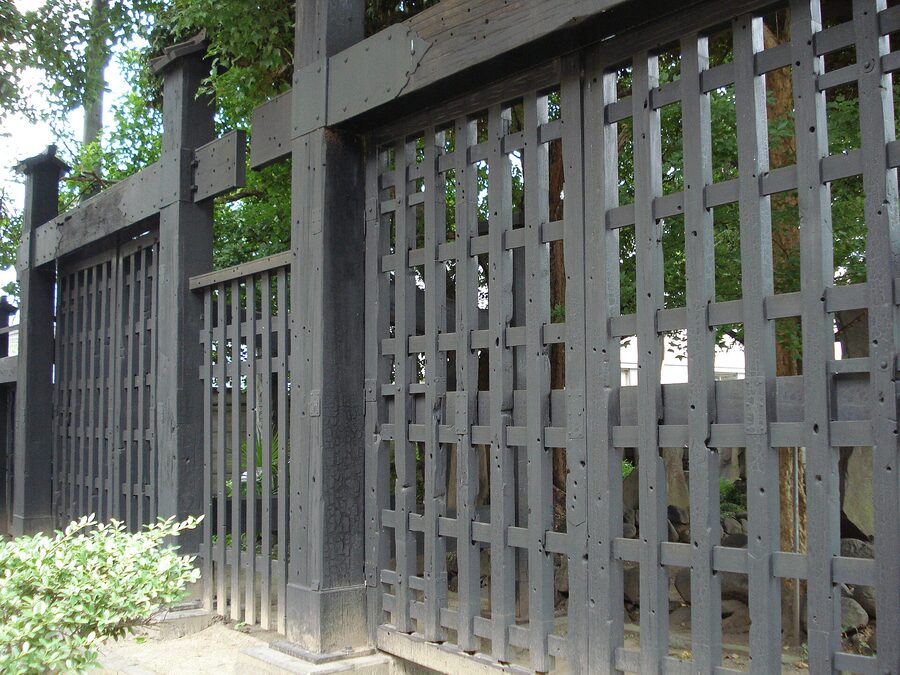
For the other half of the Ueno story, walk five minutes from Minowa on the Hibiya line to Entsū-ji (円通寺) at Minami-Senju 1-59-11. In 1907 the black gate of Kan’ei-ji, the gate Satsuma attacked, was moved here beside the Shōgitai graves, and it is riddled with bullet holes.
Aizu-Wakamatsu
Aizu-Wakamatsu is reached from Tokyo by the Tōhoku Shinkansen to Kōriyama and then the Ban’etsu West line, about sixty-five minutes from Kōriyama. In town, the Haikara-san and Akabe loop buses run in opposite directions round the main sights every thirty minutes or so from the station, and a one-day pass covers both.
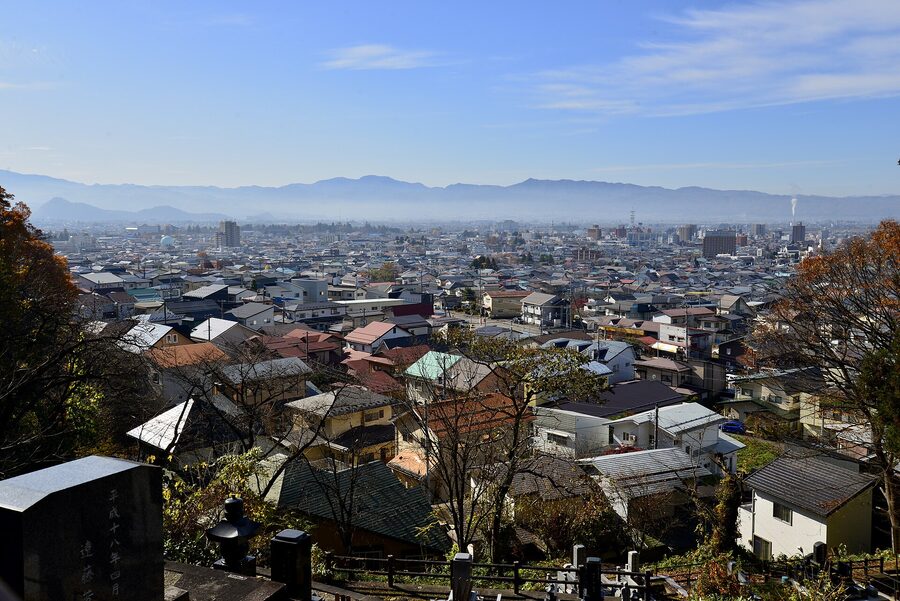
Start at Iimoriyama, because the town makes more sense from there. The Byakkotai graves are at the top of a long flight of steps (there is a paid moving walkway), free and always open, and the suicide site is a little way along the hill. Near the foot, the Byakkotai Memorial Museum (白虎隊記念館) charges ¥400 and, by the most recent listings I could find, opens 9:00–16:00; listings disagree on its closing days, so check before you go.
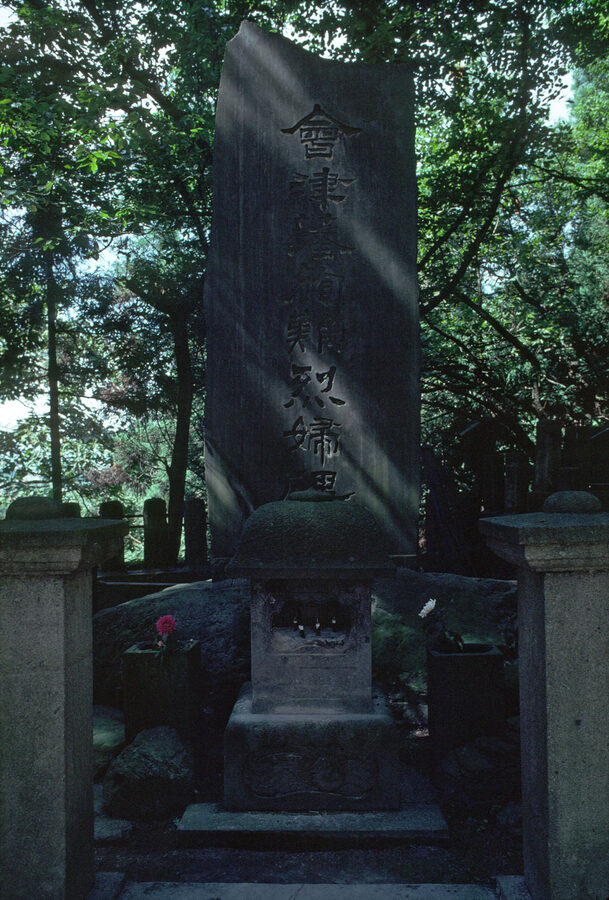
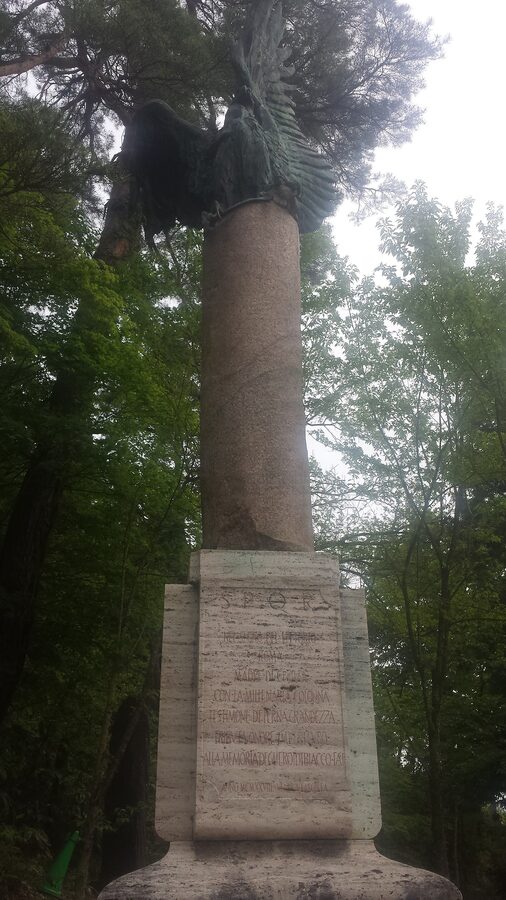
While you are on the hill, go into the Sazaedō, a wooden hall of 1796 with a double-spiral ramp inside, so that you go up one way and come down the other without passing anyone (¥400). Then look for the Pompeii column, one of the strangest war memorials in Japan.
Tsuruga Castle (鶴ヶ城) is open 8:30–17:00 every day (last entry 16:30), and the keep, which holds a local history museum, costs ¥410 for adults, or ¥520 including the Rinkaku tea house. Walk the outer walls on the south-east side and look across at the hill of Oda-yama, where the government guns were; the distance is the whole explanation of why the siege ended as it did.
The Aizu Bukeyashiki, at the foot of the hills to the east, is a reconstructed samurai quarter built around a reproduction of Saigō Tanomo’s house, and the house is laid out to tell the story of his family’s deaths. Adult admission is ¥1,000, and it is open 8:30–17:00 from April to November and 9:00–16:30 from December to March. It is a reconstruction, and parts of it feel like a film set; go for the house and skip the souvenir hall.
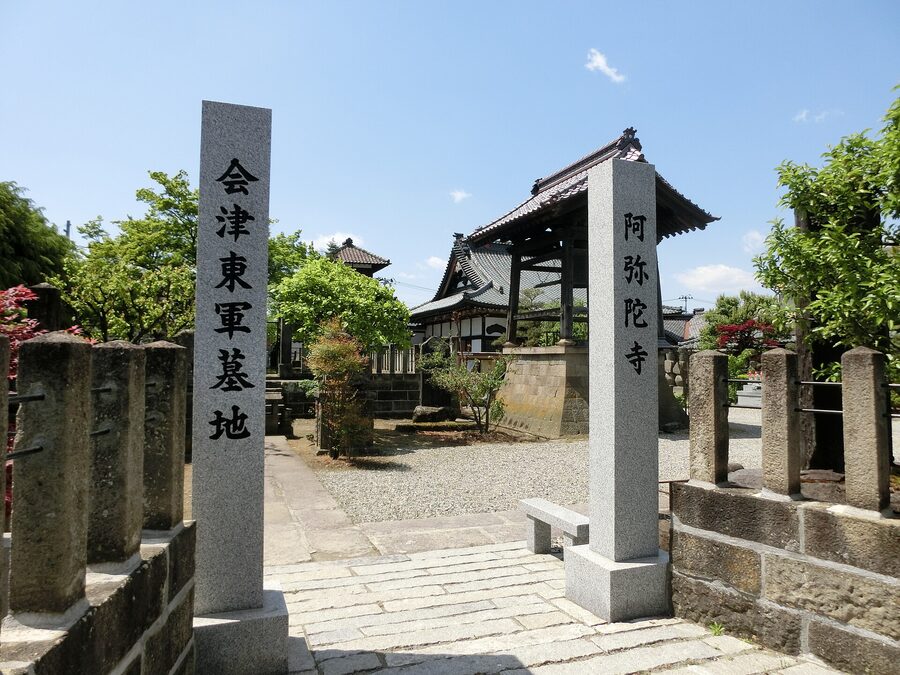
Amida-ji (阿弥陀寺) is three minutes’ walk from Nanukamachi station on the JR Tadami line, and free. Beside the cemetery stands the Gosankai, a building moved here from the castle in 1870 and one of the very few castle buildings to survive.
Nagaoka and Ojiya
Nagaoka is about an hour and a half from Tokyo on the Jōetsu Shinkansen. The Kawai Tsugunosuke Memorial Museum (河井継之助記念館), on the site of his house in Nagamachi, is open 10:00–17:00 (last entry 16:30), closed on Tuesdays, and costs ¥200. For its twentieth anniversary it is showing three of his papers for the first time until 25 January 2027: a letter to his father from his second stay in Edo, a notebook of cases of failed reform that he studied, and a scroll in his hand quoting the Song dynasty statesman Li Gang.
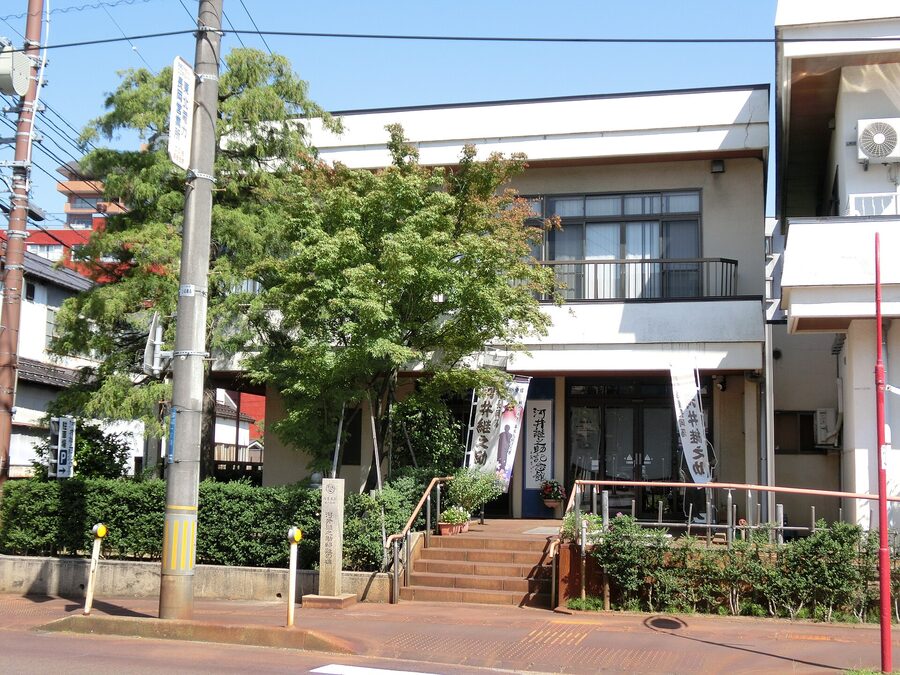
Kawai’s grave is at Eiryō-ji in the town, and people who blamed him for the war knocked the stone over more than once. The small, free Hokuetsu Boshin War Denshōkan in Ōguro-machi opens 10:00–16:00, but closes on Mondays and Fridays and from December to March.
In Ojiya, a short ride south on the JR Jōetsu line, the room at Jigen-ji where Kawai met Iwamura has been kept as it was; the temple asks you to book ahead.
Hakodate and Esashi
Goryōkaku is now a park, a tram ride from Hakodate station to Goryōkaku-kōen-mae. Goryōkaku Tower beside it is open 9:00–18:00, and its deck, ninety metres up, costs ¥1,200; it is the only way to see the star shape properly. Inside the fort, the rebuilt Hakodate Magistrate’s Office costs ¥500 and is open 9:00–18:00 from April to October and 9:00–17:00 from November to March, closed from 31 December to 3 January.
The Hekiketsu-hi (碧血碑), the memorial to about eight hundred of the shogunate’s dead, stands in the woods on the slope behind Hakodate Hachimangū, a walk uphill from the Yachigashira tram stop, and is free. Its story begins with Yanagawa Kumakichi, a Hakodate labour contractor who had supplied workers for the building of Goryōkaku. When the government left the rebels’ bodies to rot where they fell, he had his men collect them for temporary burial at three temples, against orders.
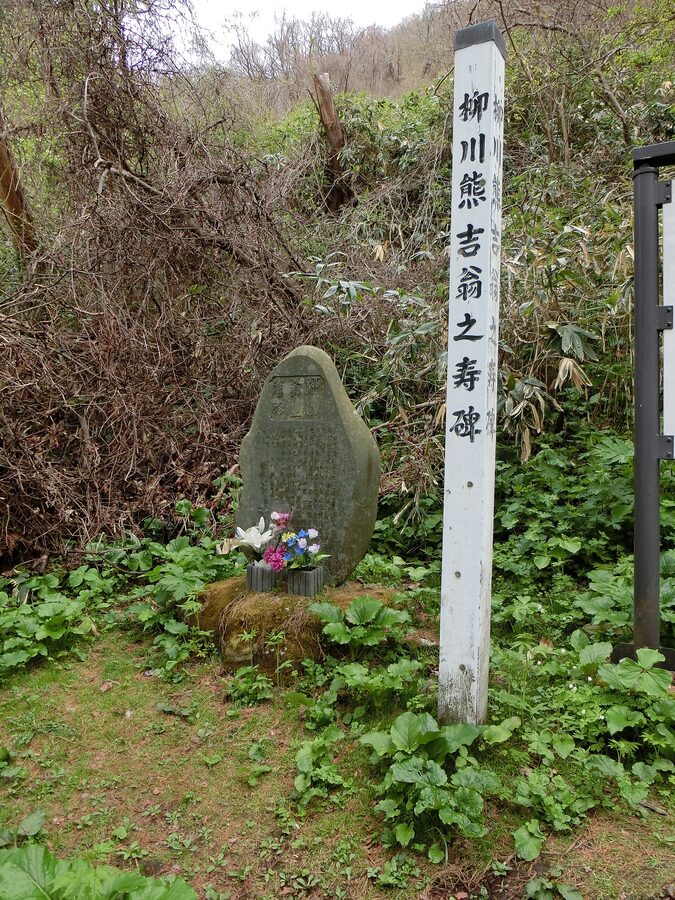
Enomoto and Ōtori joined Kumakichi in raising the monument in 1875, once the government allowed rites for the rebel dead. The inscription on the back says only that “this really happened” in 1869, which was all it was then safe to say. A memorial service is held every year on 25 June.
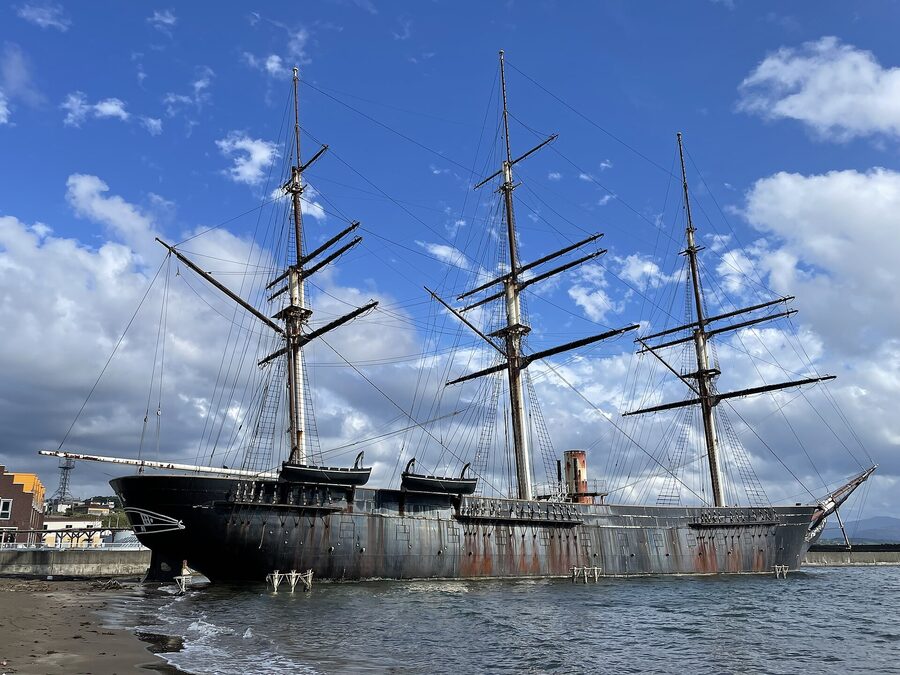
If you have a car, or patience with buses, Esashi on the Sea of Japan coast is about an hour and a half’s drive from Hakodate. A full-size replica of the Kaiyō Maru is moored in the harbour where she sank, and divers have brought up a great many objects from the wreck. At the time of writing the Kaiyō Maru museum was closed for a refit, with some of its finds shown at the town’s local history museum, so check with Esashi town before you go.
The red cloth in the letter
The red cloth in Shinagawa’s letter was bought through a mistress in Nishijin, sewn in a domain residence and handed to a prince on the second day of a battle that had already started. Everyone involved knew how it had been made, and it worked anyway, because enough men on the other side believed in what it stood for.
That is the uncomfortable centre of the Boshin War. The men on both sides thought of themselves as loyal, and very few were fighting for anything as abstract as modern Japan. The memorial at Senryōmatsu says that a moment’s chance made some of them the imperial army and some of them rebels, and having walked these battlefields I think the stonemason had it about right.
If you go to Aizu-Wakamatsu, climb Iimoriyama in the early morning before the coaches, look out towards the castle, and then walk down to Amida-ji, where the dead were reburied. Between the two you will have the whole argument about this war in about three kilometres, and you will not need a banner to decide which side to stand on.