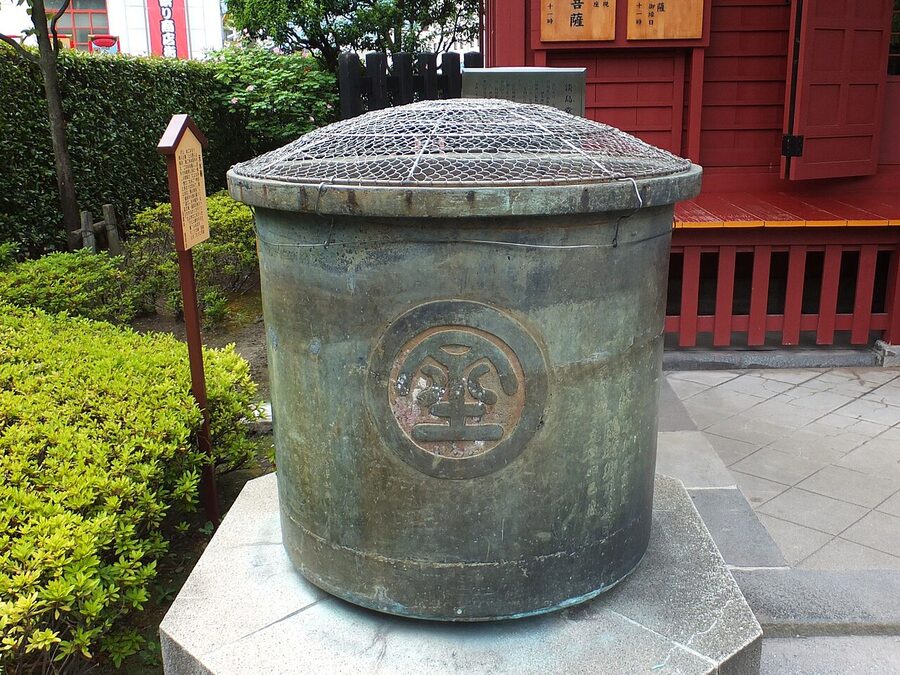
The most sacred object in Tokyo saw out the Second World War in a bronze rainwater tub, three metres under the floor of a temple that was about to burn. The priests of Sensō-ji put it there on 18 November 1943, sealed in its box inside a tub cast in 1770, and they did not open the box to check on the statue first. By the temple’s own rule nobody has looked at it since the year 645, and the abbot is not excused.
Sixteen months later, in the small hours of 10 March 1945, the hall above the tub burned to the ground along with most of Asakusa and tens of thousands of the people who lived there. The tub stayed in the earth until 7 March 1947, when it was dug up and the box inside was found safe. It stands today beside Awashimadō, a small hall a couple of minutes’ walk west of the main building, and I have never once seen anybody else stop to look at it. I think it is the most important thing in the precinct that you are actually allowed to see.
That is the paradox at the heart of Sensō-ji (浅草寺). It is the oldest temple in Tokyo and, on its own count, one of the busiest religious sites anywhere, with something like thirty million visits a year, and every one of those visits is paid to a statue that nobody making it will ever see. Everything else here (the Thunder Gate, the shopping street, the incense smoke, the pagoda) has burned and been rebuilt, some of it many times. The thing at the centre has stayed out of sight for nearly fourteen centuries, and that, I have come to think, is the whole point.
In This Article
- Two brothers, one net
- What the record actually says
- The shogun’s prayer temple
- Teahouses, top-spinners and the road to the Yoshiwara
- A park, a tower and an earthquake
- 10 March 1945
- Rebuilding in concrete
- Where to see Sensō-ji today
- The Kaminarimon and Nakamise
- The Hōzōmon, the incense and the main hall
- The corners most people miss
- Asakusa Shrine
- Denbōin
- Komagatadō
- The temple’s year
- Edo-Tokyo Museum and the memorial at Yokoamichō
- Back to the bronze tub
Two brothers, one net
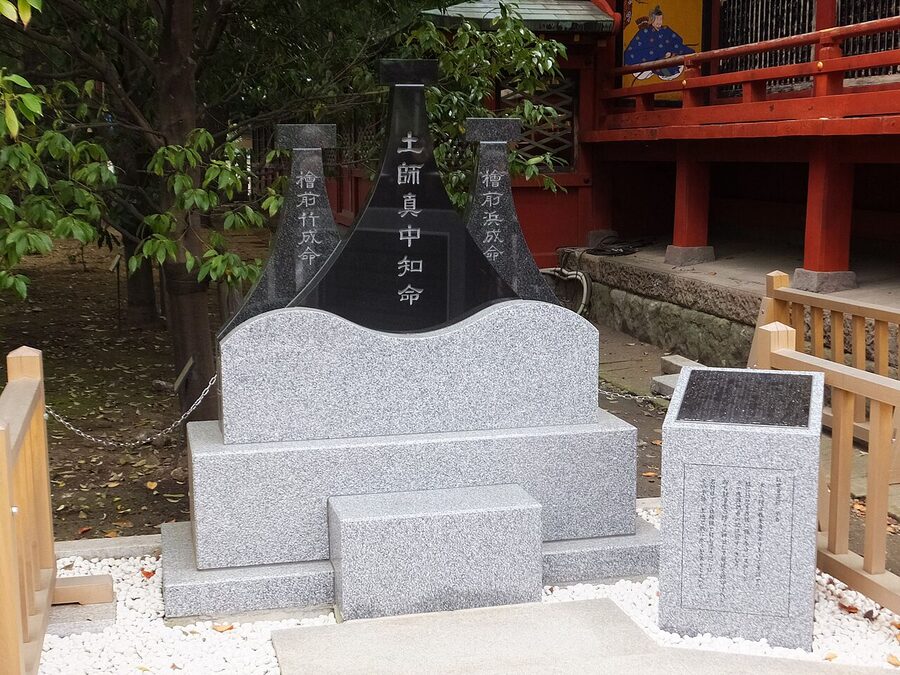
The story, as the temple tells it, begins early in the morning on the 18th day of the third month of the 36th year of Empress Suiko, which is 628. Two brothers, Hinokuma no Hamanari and Hinokuma no Takenari, were fishing the Miyato River, the old name for the stretch of the Sumida that runs past Asakusa. All morning their net came up with no fish in it, only a small figure of a person. They threw it back, moved the boat, cast again, and caught the same figure again.
They took it to the local headman, Haji no Nakatomo, a man of some learning, who told them it was an image of Shō Kannon, the bodhisattva who hears the cries of the world. The next morning ten village children who had been cutting grass built a hut of goosefoot stalks to shelter it. Nakatomo then shaved his head, became a monk and turned his own house into a temple, and that, in the telling, is the beginning of Sensō-ji. His name is one of the things the sources cannot settle: you will meet Haji no Nakatomo, Haji no Manakachi and Haji no Atai Nakatomo, and the temple itself says the question is open.
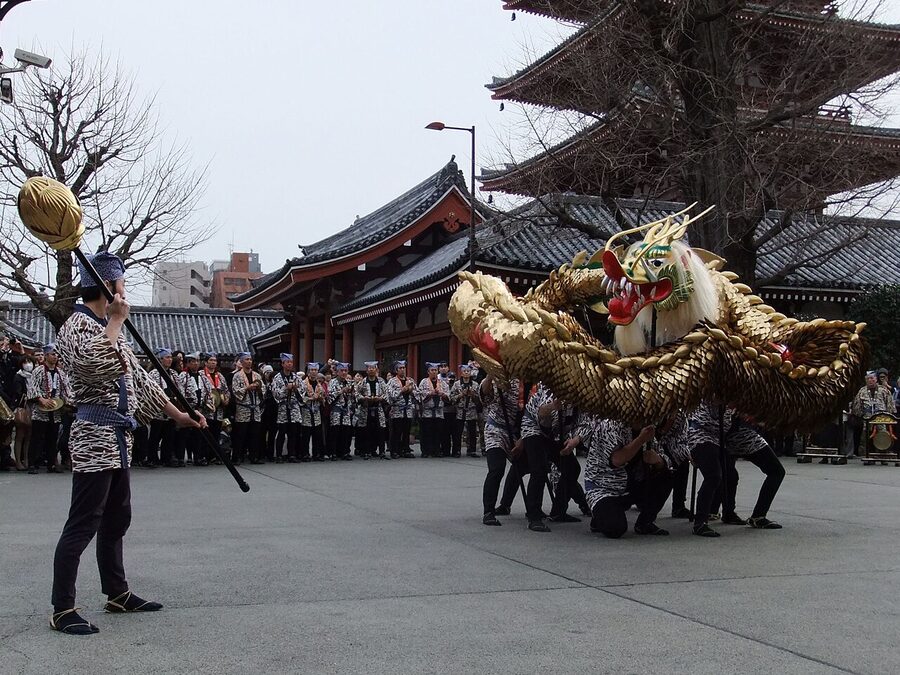
The temple’s foundation scroll adds a flourish. On the day the statue appeared, it says, a thousand pine trees sprang up overnight, and three days later a dragon with golden scales came down from the sky into the new wood. That is where the temple’s mountain name comes from, Kinryūzan, Golden Dragon Mountain, and it is also the reason for the gilded dragon that dances through the precinct twice a year.
In 645 a travelling monk named Shōkai rebuilt the hall. Kannon came to him in a dream with a short instruction, which the temple renders as “do not look upon me rashly”, and Shōkai made the statue a hibutsu (秘仏), a hidden image, shut away in its shrine. Some temples show their hidden images once every few decades. This is a zettai hibutsu, an absolutely hidden image, locked inside several nested shrines, and the temple says that not even its own chief priest looks.
What you can see, once a year, is a stand-in. The monk Ennin, the third head of the Tendai school on Mount Hiei, is said to have come here and carved an omaedachi (お前立), a proxy image that stands in front of the hidden one so that people have something to pray before. The temple dates his visit to 857, though another version of the chronology gives 828. Either way it fell early in the Heian era, and it is why Sensō-ji counts Ennin as the man who refounded it.
How big is the statue? Popular tradition has long fixed it at one sun and eight bu, about 5.5 centimetres, and solid gold. The temple calls that a folk belief that goes back no further than the Edo period. There is also a story, repeated in Japanese reference works though not by the temple, that officials who doubted the statue existed at all inspected it in 1869 and found a figure about 20 centimetres tall in the style of the Nara period, scorched, and missing its hands and feet.
I cannot tell you whether that story is true, and the only people who could are not going to say. There is even a rival claim: in Hannō, in the hills where Saitama meets Tokyo, a tradition holds that the statue was washed out of a riverside hall there in a flood a century before 628, drifted down to the Sumida, and was never given back.
Here is what is solid. Digs on the site of the main hall found material from the 7th and 8th centuries, and a stone coffin of the Kofun period was dug out of a mound behind the hall in 1869, so somebody of consequence lived here, and something stood here, before the Nara period was out. Two fishermen and a net are tradition. A temple on this spot by the 8th century at the latest is archaeology.
What the record actually says
For the next few hundred years the history is mostly the temple’s own. In 942, the story goes, Taira no Kinmasa, a cousin of the rebel Taira no Masakado, prayed here to be made governor of Musashi province, got the post, and paid for a full set of halls, the first gates and a pagoda in thanks. An earthquake in 1041 brought most of the buildings down, and a fire in 1079 burned the rebuilt hall. During that fire, the temple says, the statue removed itself to the branches of a hackberry tree, and Minamoto no Yoshitomo later had a Kannon carved from that tree’s wood, which the temple still uses every January.
The first mention in a document you could put in front of a historian comes in the Azuma Kagami, the chronicle of the Kamakura shogunate. In 1181 the new regime sent to Asakusa for carpenters to work on the Tsurugaoka Hachimangū shrine in Kamakura. In 1192 three monks of Sensō-ji were among the hundred invited to the rites for the 49th day after the death of the retired emperor Go-Shirakawa. And in the third month of 1251 the chronicle records a beast like an ox bursting into the temple refectory while some fifty monks were at their meal.
Modern Japanese reference books call the creature a monster. The temple’s own history calls it a runaway bull that injured people. I lean towards the bull.
The temple also says that Yoshitomo’s son Minamoto no Yoritomo stopped to pray here in 1180, as he marched into Musashi at the start of his war on the Taira, and that in 1189, before his campaign against the Fujiwara of Hiraizumi, who had sheltered his brother Yoshitsune, he gave it 36 chō of rice land. The later shoguns believed it, which mattered more.
In the eighth month of 1290 a former court lady from Kyoto came through. Lady Nijō, once the favourite of a retired emperor and by then a wandering nun, wrote it up in her memoir Towazugatari: a Kannon hall on rising ground in the middle of an open plain, with no trees around it and, by the sound of it, nowhere to stay. She also recorded the main image as an Eleven-faced Kannon, which is not what the temple says it is, and which tells you that nobody in 1290 had seen it either.
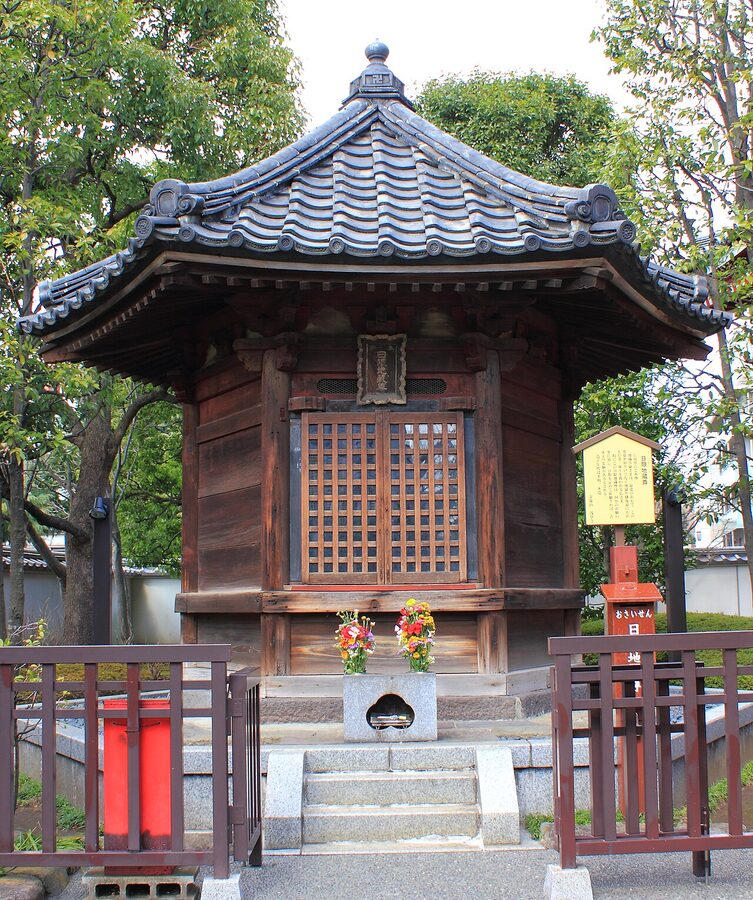
By the 13th century Sensō-ji was the 13th stop on the Bandō pilgrimage, a circuit of thirty-three Kannon temples around the Kantō modelled on the older western circuit that includes Kiyomizu-dera in Kyoto. It still is, and it is the only stop on the Bandō route inside Tokyo. Ashikaga Takauji, the first Ashikaga shogun, came in 1352 and confirmed the temple’s lands. In 1539 Hōjō Ujitsuna, lord of Odawara and master of most of the Kantō, put one of his commanders in charge of rebuilding it.
The shogun’s prayer temple
The year that made Sensō-ji was 1590. Toyotomi Hideyoshi destroyed the Hōjō that year and gave their lands to Tokugawa Ieyasu, who moved into the run-down castle at Edo. The temple’s chronology puts what happened next in the fourth month, with Hideyoshi’s armies still camped around Odawara and Edo not yet Ieyasu’s to give away. He issued Sensō-ji a notice of protection, named it his kiganjo, a temple charged with praying for him and his house, and gave it land assessed at 500 koku.
There were reasons for the choice. The temple lay northeast of Edo Castle, the unlucky direction that needed spiritual guarding; it was an old Tendai foundation, the school of Ieyasu’s adviser Tenkai, who is said to have recommended it; and it had been patronised by Yoritomo, the founder of warrior rule, whom Ieyasu openly admired. On the 1st day of the ninth month of 1600 Ieyasu summoned the head of the temple, Chūgō, to Edo Castle and ordered prayers for victory, the same rite performed for Yoritomo four centuries earlier. The battle of Sekigahara was fought on the 15th, and the temple’s reputation did not suffer.
In 1618 the second shogun, Hidetada, built that shrine, a Tōshōgū to his father, inside the precinct. It is long gone, but the stone bridge given at the same time by Asano Nagaakira, Ieyasu’s son-in-law, survives in a corner west of the main hall; at a little over 7 metres it is said to be the oldest bridge in Tokyo. Ieyasu’s great mausoleum shrine at Nikkō had been finished only the year before.
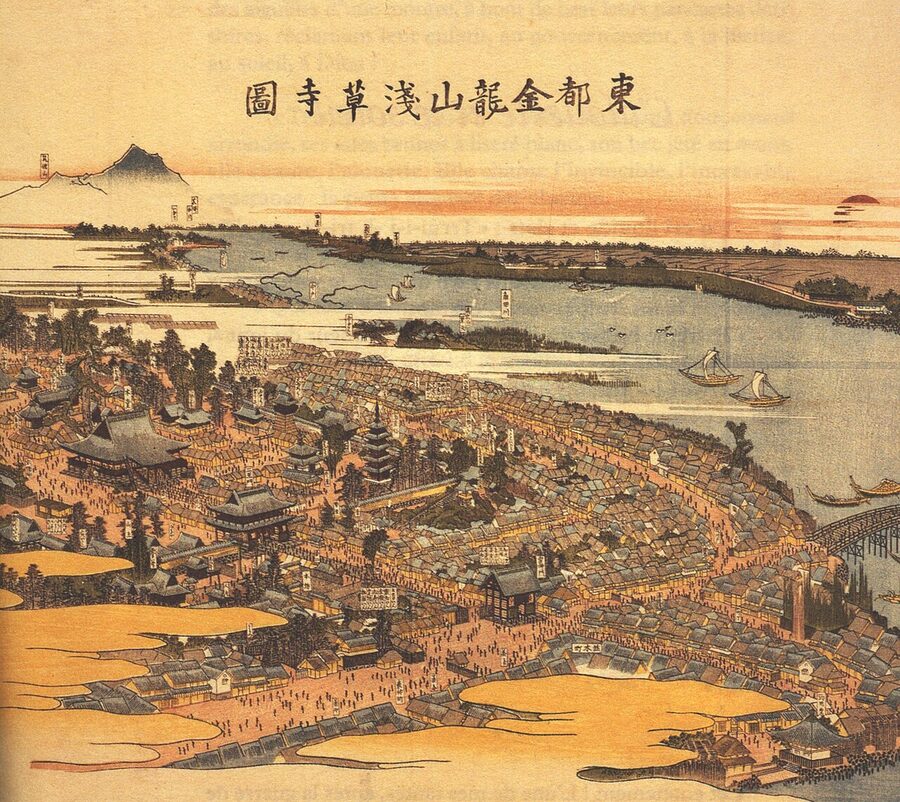
Fire came with depressing regularity. The temple burned on the 2nd day of the fourth month of 1631, and again on the 19th day of the second month of 1642, when a fire in the townhouses outside the gate spread inside. The third shogun, Iemitsu, paid for both rebuildings: his five-storey pagoda went up in 1648 and his main hall was finished at the end of 1649. That hall stood for almost three centuries, through earthquakes and the great fires of the 18th and 19th centuries; Edo writers claimed that whenever flames came close it would start to rain or the wind would change, and it was the hall that burned in 1945.
The shogunate’s affection had limits. In 1685 the head of the temple, Chūun, fell foul of the fifth shogun, Tsunayoshi, and was removed; some accounts say he had criticised the shogun’s laws protecting animals, while the temple says only that he displeased him. If you have read my piece on the dog shogun, you will not need telling which version I find easier to believe. Sensō-ji was put under the control of Kan’ei-ji in Ueno, the Tendai headquarters of the Tokugawa, and stayed there until the end of the shogunate.
From 1740 the imperial prince who headed Kan’ei-ji was also, on paper, head of Sensō-ji, and the man who actually ran the place was his deputy. His office kept a diary, the Sensō-ji Nikki, which runs from the 1740s into Meiji and records fires, foundlings, lost property and the performers in the back lots; the printed edition is past forty volumes and still coming out.
Teahouses, top-spinners and the road to the Yoshiwara
The Edo period is when Sensō-ji became what it still is: a holy place with a fairground wrapped around it. Around 1685 (some sources put it in the Genroku era, 1688 to 1704) the temple let local people set up stalls along the approach in return for sweeping the grounds. That was the start of Nakamise, the “middle shops”, so called because they stood between the shops on the broad street outside the gate and those in front of the hall. English-language accounts sometimes push Nakamise back to the 12th century, but I have found nothing in the Japanese record to support it.
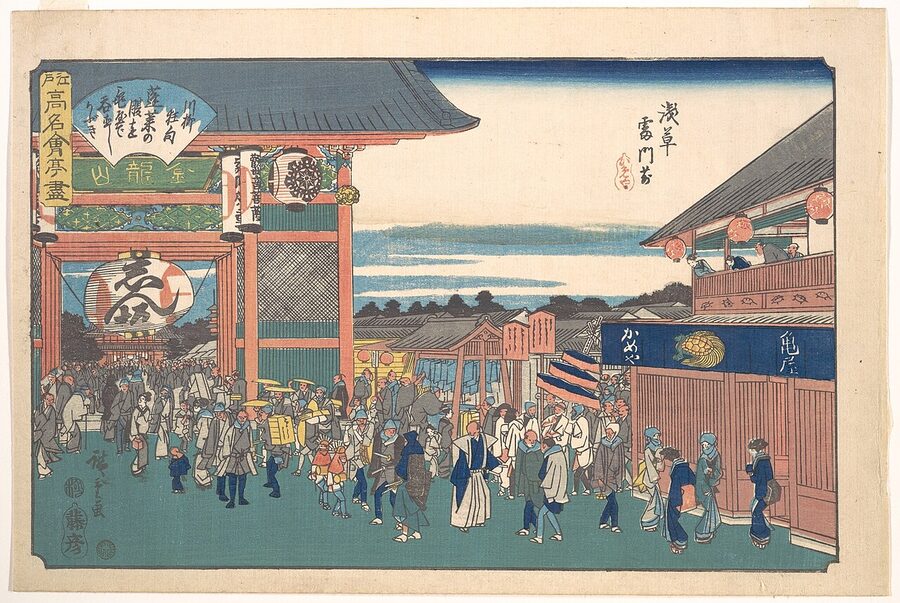
Closer to the hall stood the Twenty Teahouses, each with a pretty daughter or waitress at the front, and the most popular of these girls were drawn by Suzuki Harunobu and Kitagawa Utamaro, which made them, more or less, the pin-ups of the 18th century. A comic verse of the time has the last word on the men who sat drinking tea all day for a look: “Great fool, ruining his stomach at the teahouse.” In 1817 a confraternity of lay believers paid to pave the whole approach from the gate to the hall, which in a city built on mud was a present worth a great deal.
North and west of the hall lay Okuyama, “deep in the mountain”, the temple’s back lot and the busiest open-air entertainment ground in Edo. The temple’s own list of the stars who played there is a fine one: Matsui Gensui, who made spinning tops climb ropes and run along sword blades; Fukai Shidōken, a former monk who drew crowds with rambling, ribald street lectures; Nagai Hyōsuke, who sold tooth powder by drawing an enormous sword in a single movement; and Yanagawa Itchōsai the conjuror. The shogun Yoshimune, the temple notes, stopped on his way back from hawking to watch the tops.
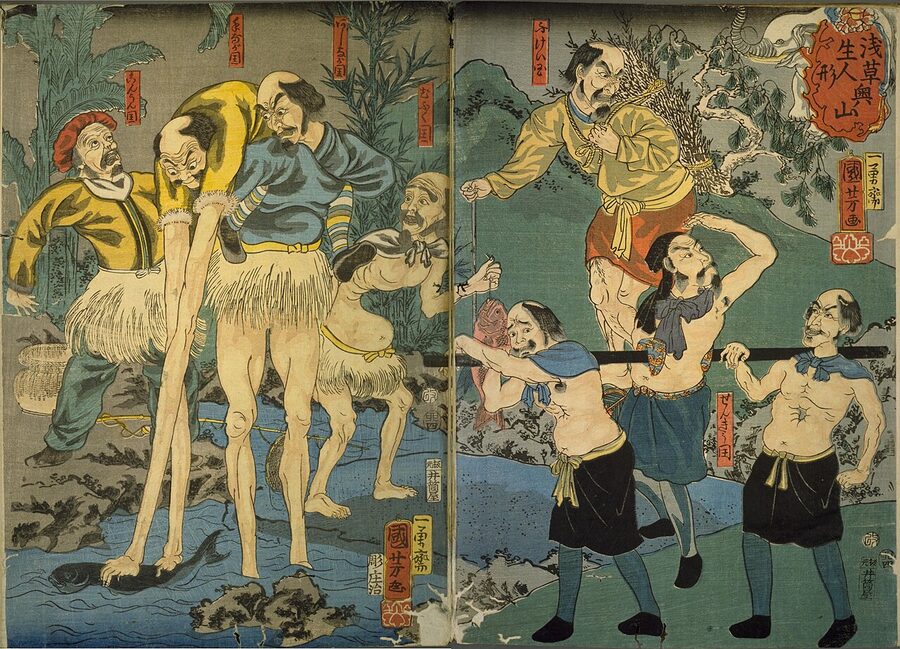
There were archery booths staffed by young women, freak shows, acrobats, women’s sumo and mechanical puppets. When the shogunate’s reforms pushed the three licensed kabuki theatres out of the city centre in the early 1840s, they were sent to Saruwaka-chō, a short walk northeast of the temple, so Asakusa had the theatre as well. It was there that Edo audiences went on weeping over the forty-seven ronin of Kanadehon Chūshingura until the end of the shogunate.
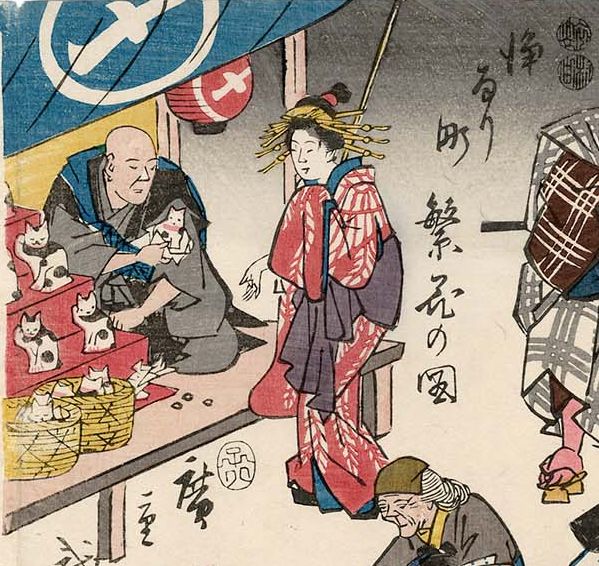
The temple even has a claim on the beckoning cat. In 1852, according to two contemporary chronicles of Edo life, an old woman began selling cats of Imado earthenware beside the torii of the Sanja shrine at Sensō-ji, each stamped on the back with a circle round the character for “tie”, for luck in money, and they were an instant craze. Excavations in Tokyo have turned up the same stamped cats, and on the strength of the records and the finds together they are the oldest beckoning cats anybody can document.
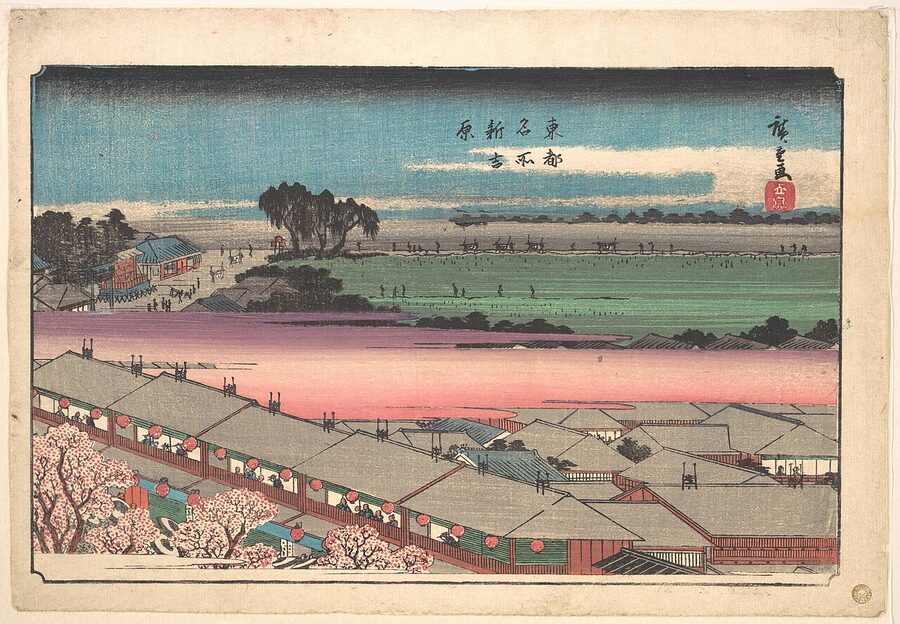
And behind all of it was the Yoshiwara. After the Meireki fire of 1657 burned most of Edo, the shogunate moved the licensed pleasure quarter from near Nihonbashi out to the rice fields north of Sensō-ji, where it became the Shin Yoshiwara, the New Yoshiwara. The road there ran along the Nihonzutsumi embankment, and a respectable excuse ran with it: a man could tell his household he was off to pay his respects to Kannon. The quarter’s courtesans and its geisha were, in the end, one more thing that Asakusa had on offer.
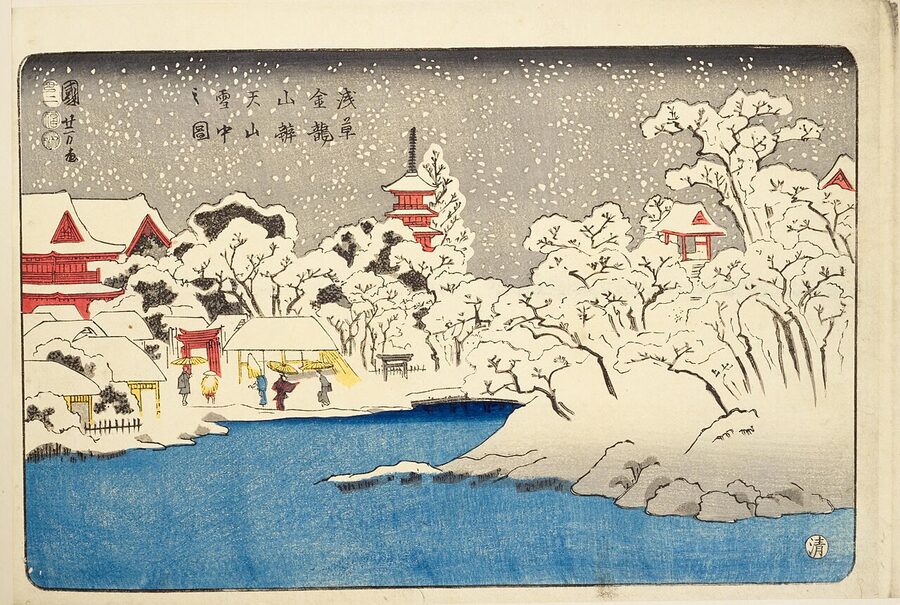
The temple bell is in the most famous poem ever written about Asakusa. In 1687 Matsuo Bashō, living across the river in Fukagawa, wrote hana no kumo / kane wa Ueno ka / Asakusa ka: clouds of blossom, and is that bell from Ueno, or Asakusa? It is the reason a certain kind of Tokyo writer cannot mention cherry blossom at either place without quoting it.
The trouble is that the bell now hanging on Bentenyama, the hillock east of the Hōzōmon gate, was recast on Tsunayoshi’s orders in 1692, five years after the poem. Whatever Bashō heard, it was not this one. It is still struck by hand at six every morning, and it survived the wartime metal drives because it was judged too historic to melt down.
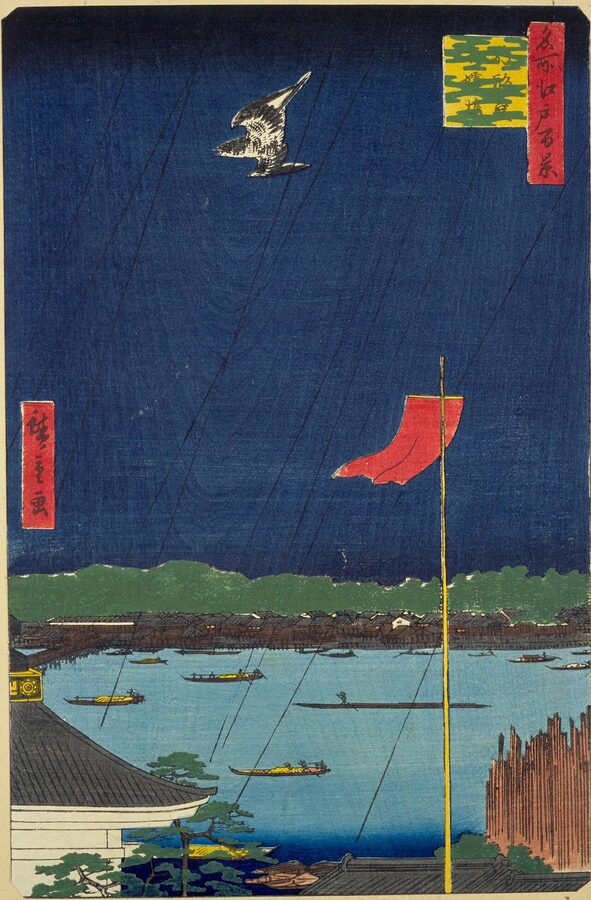
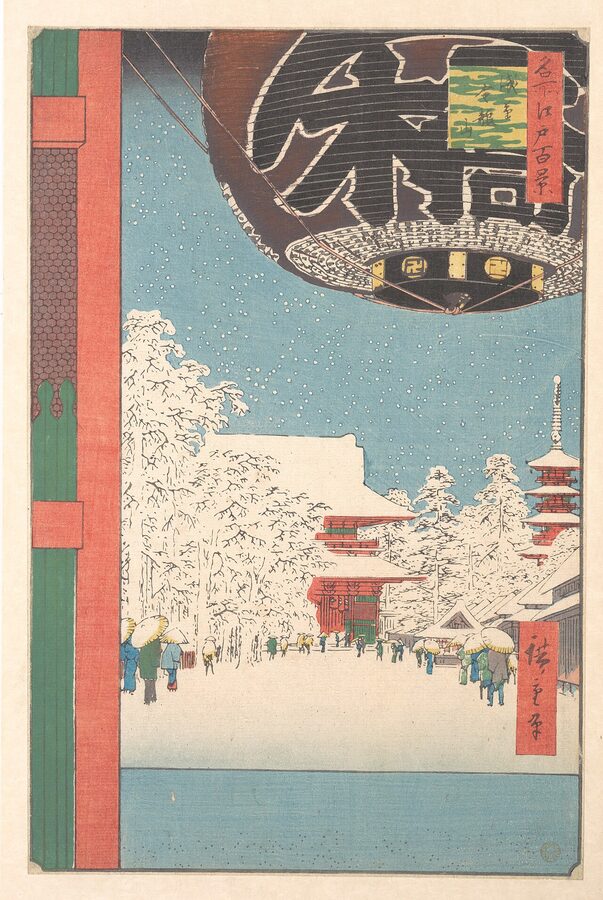
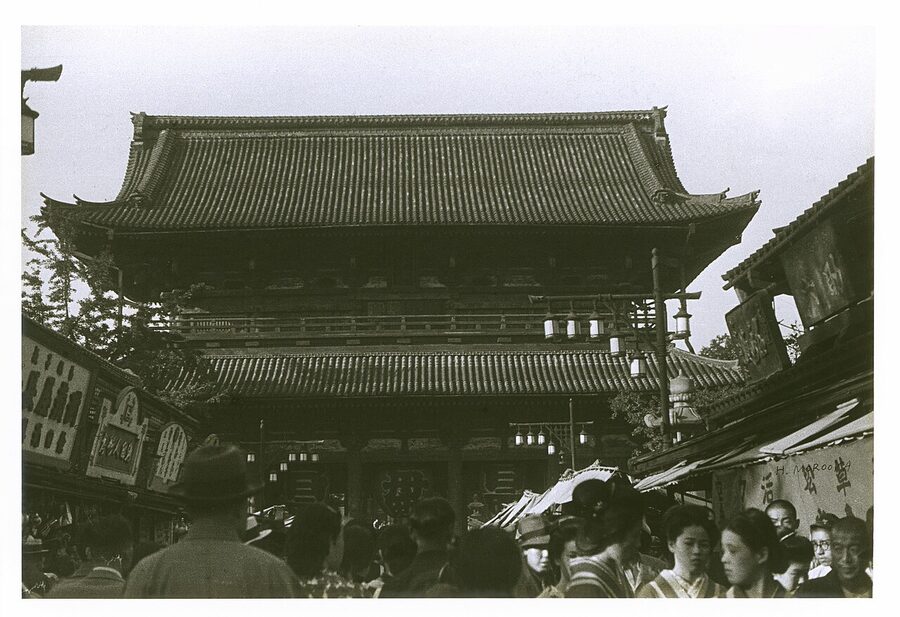
The gate everybody photographs has a longer name than most people realise. Its official title is Fūraijinmon, the Gate of the Wind and Thunder Gods, after the statues of Fūjin and Raijin in its front bays, but by the early 19th century a comic verse could already call the wind god a lodger “at the Thunder Gate”, Kaminarimon. It burned in 1642 and 1767, and the gate rebuilt in 1795 is the one Hiroshige drew.
Then, in the twelfth month of Keiō 1, a fire that started in the neighbouring district of Tawaramachi took it again. The year is usually given as 1865, though the day fell so late in it (sources say the 12th or the 14th) that one Japanese account converts it to 1866. Either way, Asakusa would go without a permanent Thunder Gate for ninety-five years.
A park, a tower and an earthquake
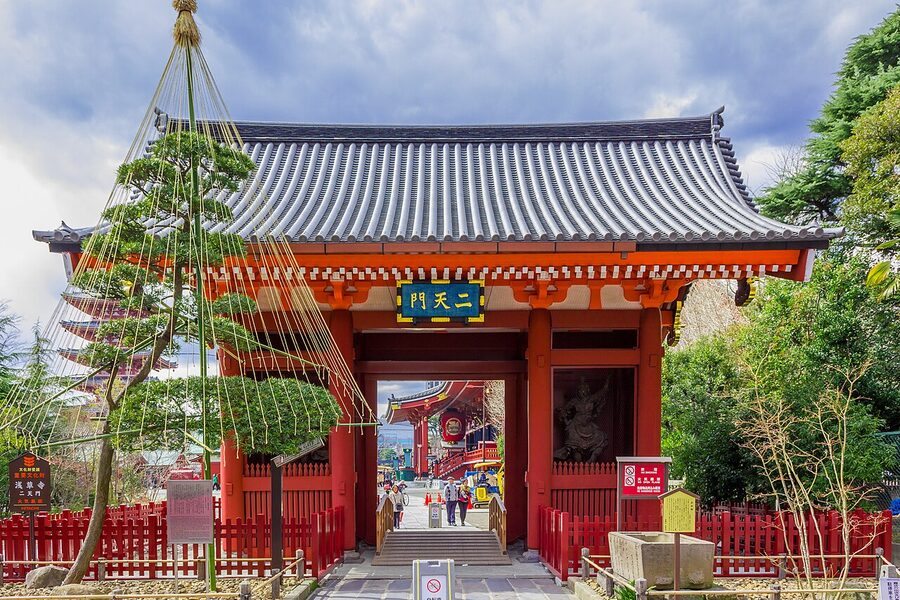
The Meiji Restoration hit Sensō-ji harder than any fire. The new government’s order of 1868 separating Shinto from Buddhism split the temple from the shrine to its founders next door, which became the Sanja Myōjin shrine and in 1873 Asakusa Shrine. In 1884 the two Shinto guardians of the old east gate were carried off to the shrine and replaced with a pair of Buddhist guardian kings, which is how Nitenmon, the Gate of the Two Kings, got its name. In 1871 the temple’s lands were confiscated, and in 1873 the precinct was declared one of Japan’s first public parks.
Asakusa Park was a money-maker for the city from the start. In 1884 it was divided into numbered districts, and the sideshows of Okuyama were moved off temple ground into a new Sixth District, built on reclaimed rice fields west of the hall around a pond dug in 1883 and named for its gourd shape, Hyōtan-ike. Rokku, “Six District”, became the Tokyo word for show business. Japan’s first purpose-built cinema, the Denkikan, opened there in 1903, and from 1917 Asakusa Opera, which was mostly operetta and comic song in Japanese, packed the theatres of the Taishō years.
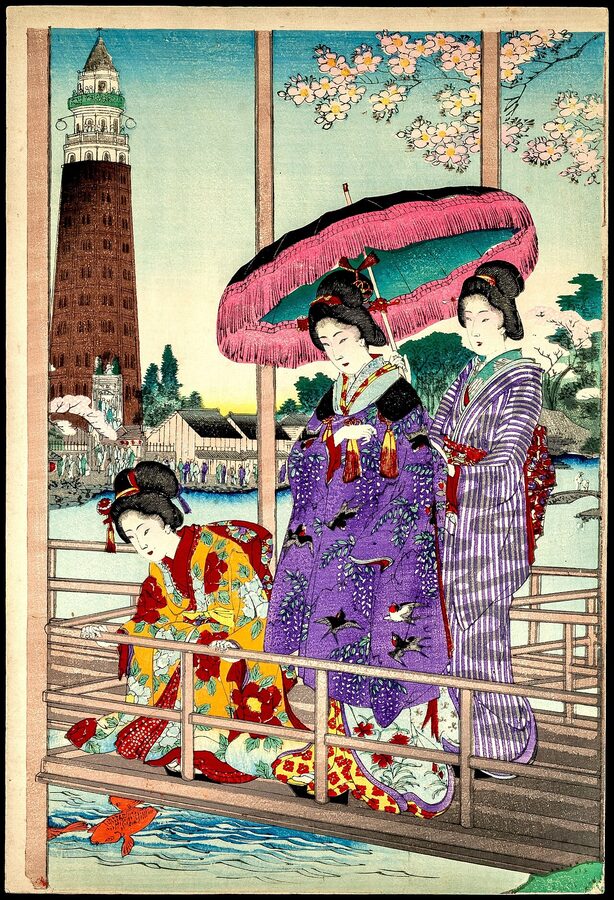
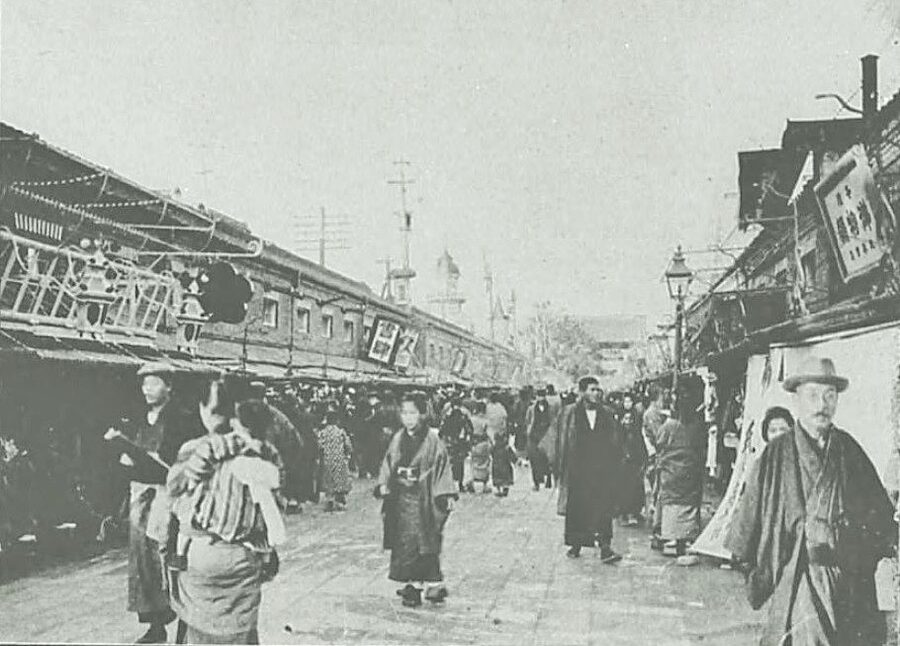
Nakamise did not escape the reformers either. In 1885 the prefecture cleared the old stalls and rebuilt both sides of the approach in red brick, to look like a modern Western street. In 1886 the pagoda needed repairs, and to help pay for them the public was charged to climb the scaffolding all the way to the top roof, which must have been the best view in Tokyo for a few months.
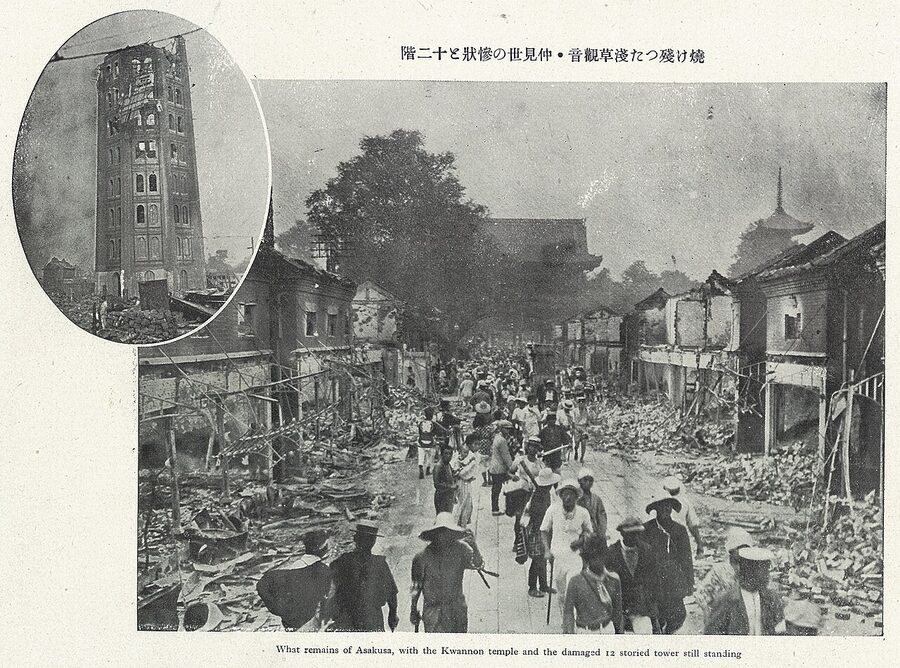
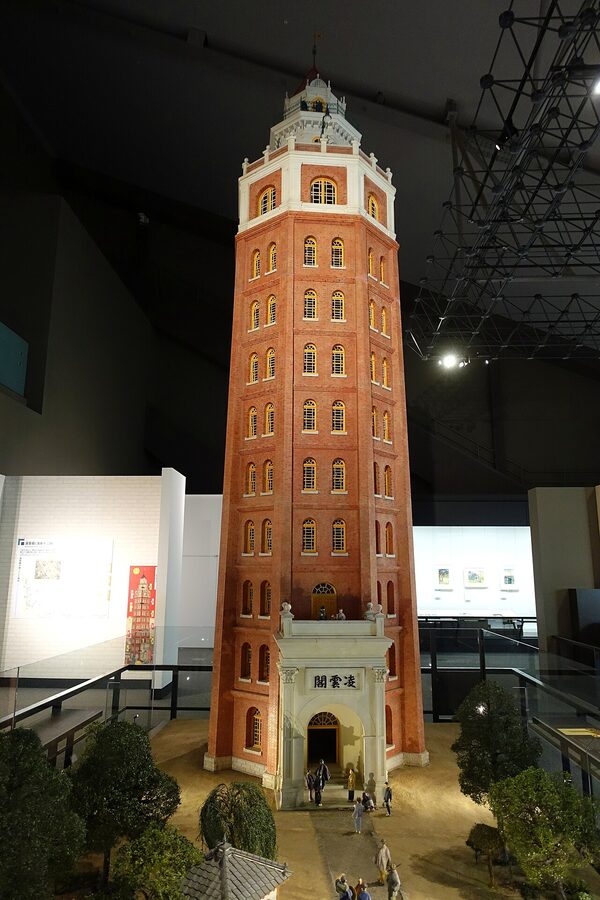
The view got better in 1890. The Ryōunkaku, “Cloud-Surpassing Tower”, rose twelve storeys in Asakusa Park to about 52 metres, designed by the Scottish engineer William Burton, with brick up to the tenth floor and timber above; it was first announced as 67 metres, which was generous. It had Japan’s first electric lift, which broke down so often from the opening day that it was taken out of use within months. Floors two to seven held 46 shops selling foreign goods, and from the telescopes at the top, they said, you could see the mountains of eight provinces.
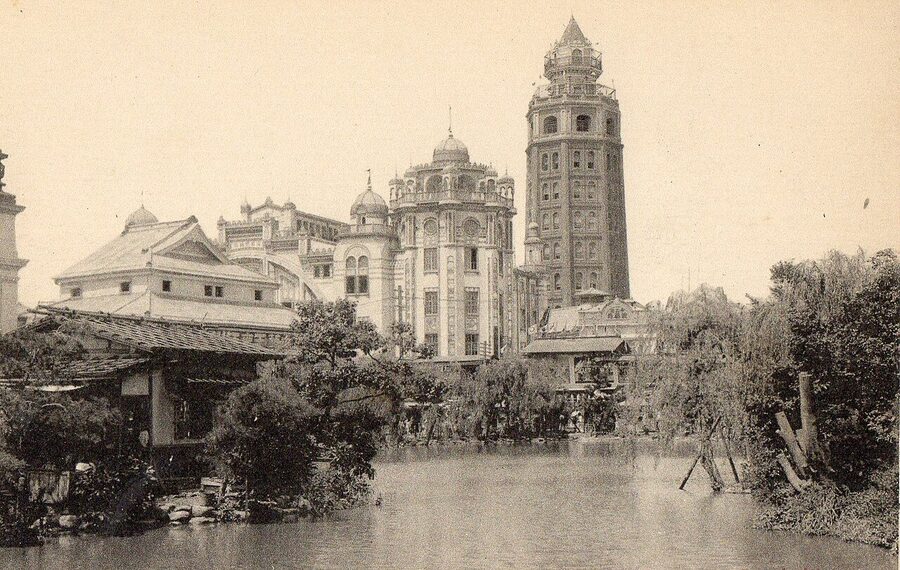
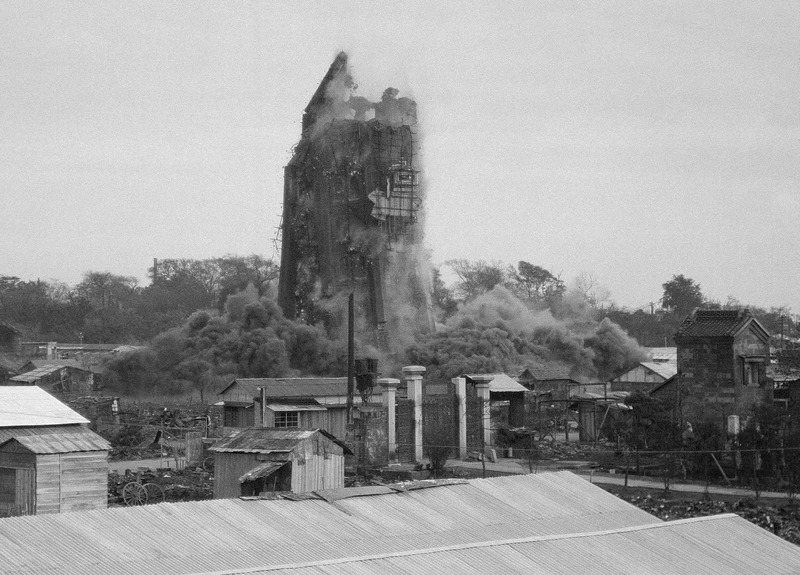
Crowds at the opening called it Japan’s Eiffel Tower; by late Meiji the business was struggling, and the streets at its foot filled with unlicensed brothels, so that “a woman from below the Twelve Storeys” became Tokyo slang. At two minutes to noon on 1 September 1923 the Great Kantō Earthquake snapped the tower at the eighth floor. Of the twelve or thirteen people at the top, the only survivor was a man who caught on an advertising sign for Fukusuke tabi socks. The ruin was too dangerous to leave and too expensive to mend, and on 23 September army engineers blew it up while crowds watched.
Sensō-ji itself came through the earthquake almost untouched, and not by luck. Most of Asakusa burned, but a local master of the tobi, the scaffolding and firefighting trades, organised the refugees who had crowded into the precinct into a bucket chain and kept the fire off the main buildings. The temple says some 50,000 people sheltered in its grounds and were saved, and afterwards it ran a school, a nursery and a workers’ hostel of its own.
The interwar years were Asakusa’s peak. The main hall was overhauled and rededicated in 1933, and during the work the temple’s great Edo-period votive paintings, more than two hundred of them by artists including Tani Bunchō, Suzuki Kiitsu and Utagawa Kuniyoshi, were taken down and for some reason never put back. It is the only reason they still exist. The first underground railway in Asia opened between Ueno and Asakusa at the end of 1927, at the start of the Shōwa era, and the crowds came by the trainload.
10 March 1945
By 1943 the war had come to the precinct in other ways. The bronze statue of the actor Ichikawa Danjūrō IX, put up behind the hall in 1919, had gone to be melted down; the Bentenyama bell was spared. On 18 November that year the hidden image went into its bronze tub and the tub went into the ground.
Shortly after midnight on 10 March 1945, around three hundred American B-29 bombers came in low over eastern Tokyo and dropped incendiaries on the most crowded wooden districts in Japan, in a strong winter wind. The first bombs fell on four aiming points, and one of them was in Asakusa, west of the temple, near what is now the Kappabashi kitchenware street, by one later reconstruction. Asakusa ward, with around 135,000 people still living in it, was among the most densely populated in the city. The fire swept east and south through Asakusa, Honjo and Fukagawa until there was nothing left to burn.
People ran for the river. Many died on the bridges and in the Sumida itself, where burning fuel spread across the water and the March cold killed those the fire did not. The police counted 83,793 dead; most later estimates put the toll for that one night at around 100,000, and by many counts it is the deadliest single air raid in history.
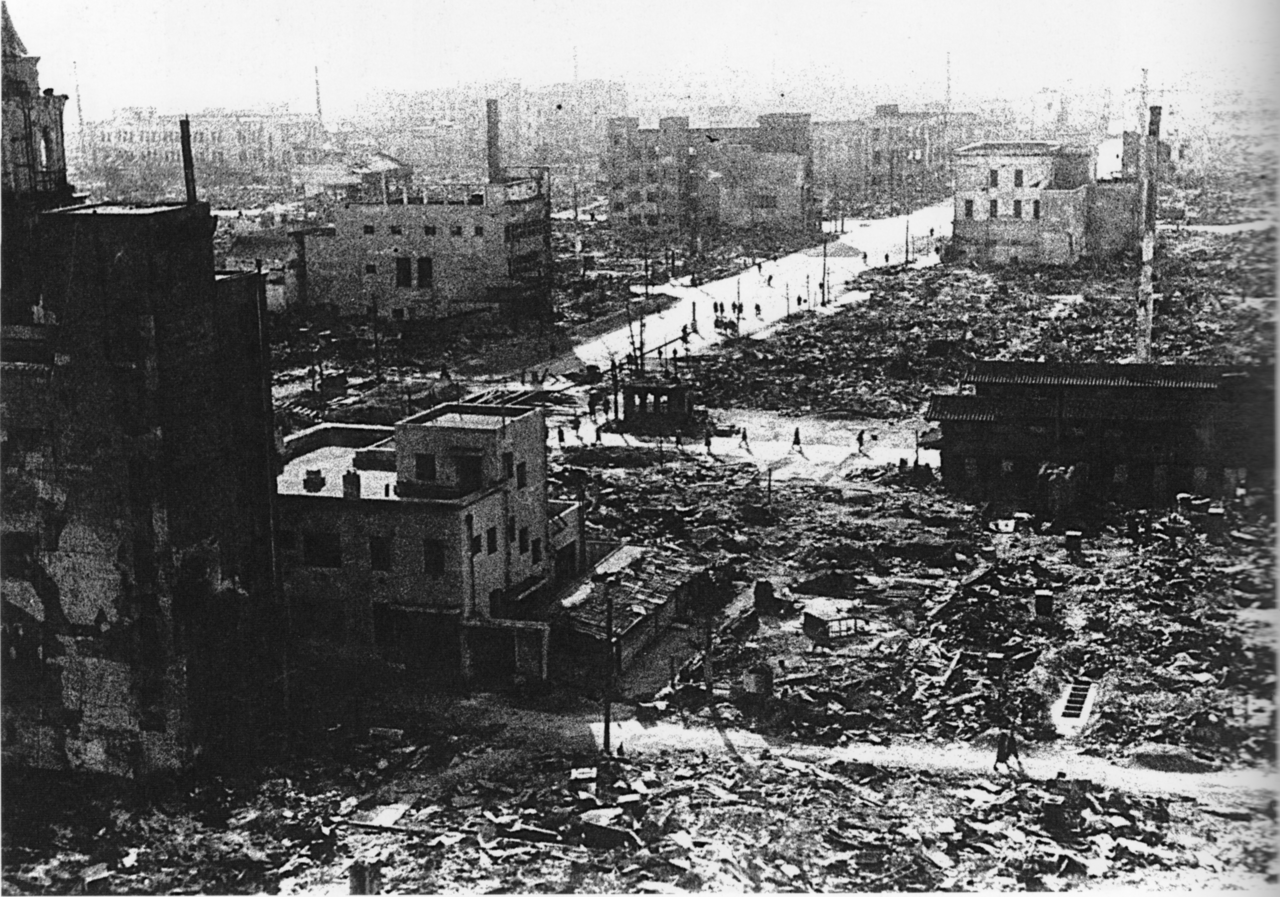
At Sensō-ji the main hall, the pagoda, the Niōmon and the sutra library all burned. A handful of older buildings survived: Nitenmon, Asakusa Shrine, Rokkakudō, the Yakushidō and the head priest’s residence at Denbōin. So did the great ginkgo southeast of the hall, said to have grown from chopsticks Yoritomo stuck in the ground, though it was scorched so badly that its status as a natural monument was withdrawn in 1950; it still stands, and so does a scarred old ginkgo beside the little shrine called Chingodō, which, the temple says, kept the flames off it.
The temple’s dead are remembered at the Peace Monument near Awashimadō, put up in 1963 for the more than 30,000 people of the Asakusa district killed in the war. Its inscription is in the hand of Yukawa Hideki, Japan’s first Nobel laureate, and asks the souls to rest in peace while the living keep the world in harmony. Every 15 August, the day the war ended and the date of Obon across most of Japan, the temple holds a service of lanterns for the dead and burns them behind the hall at dusk.
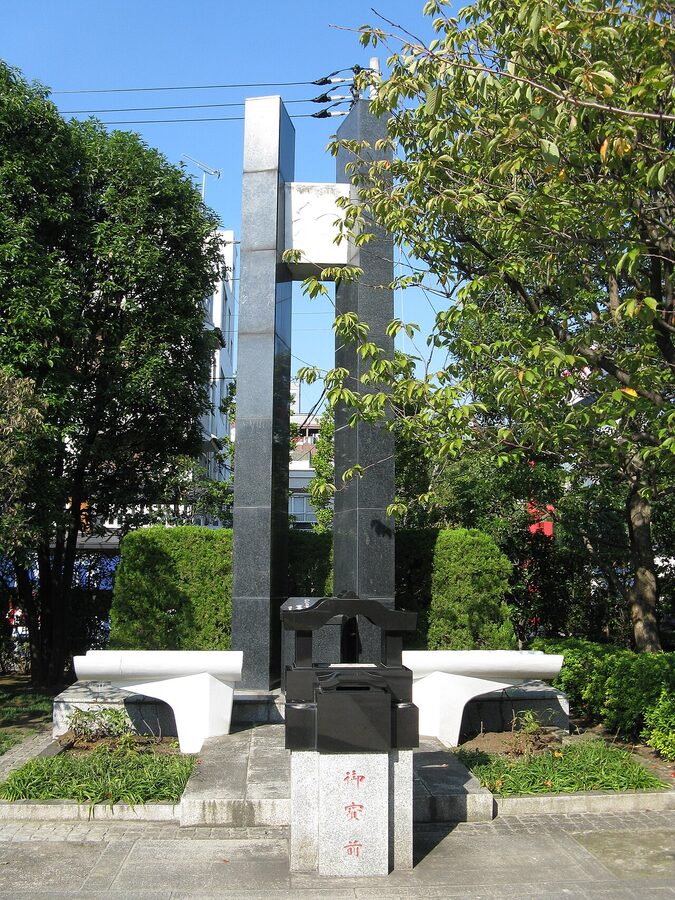
On 18 November 1945, two years to the day after the image went into the ground, a temporary main hall was dedicated on the ruins. It is the building now called Awashimadō, moved twice since, and the image was dug up on 7 March 1947 and brought into it.
Rebuilding in concrete
The rebuilding took a generation. In 1950 Sensō-ji left the Tendai school it had belonged to for over a thousand years and became the head temple of its own small sect, Shō-Kannon-shū. From April that year the proxy image went on tour to raise money, nineteen times in four years, starting at Mito. Work on a new hall began in 1951, the emperor sent a gift of money, and the temple sold the land of the Hyōtan pond, some 2,400 tsubo, to an entertainment company to pay for the rest.
The new main hall was dedicated on 17 October 1958, the same autumn that the rebuilt Meiji Jingū was finished across town. It is reinforced concrete, copied from Iemitsu’s hall but about three metres larger in each dimension, with a steep roof you can see from the end of Nakamise and a ceiling painted with a dragon by Kawabata Ryūshi and heavenly maidens by Dōmoto Inshō. In 2010 the roof was relaid in titanium tiles made to look like fired clay, a third of the weight of the old kawara and a good deal safer in an earthquake.
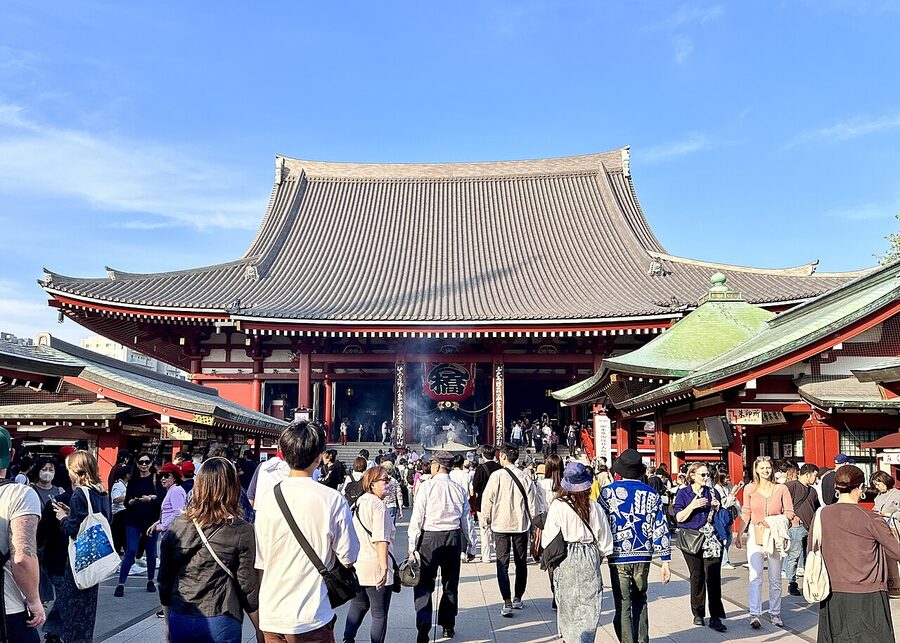
The concrete has its critics, and I am not one of them. A wooden Kannon hall at the centre of the busiest crowd in Tokyo burned roughly twenty times in its history, by the temple’s own count, and the wooden rebuilding of Kinkaku-ji after an arsonist’s fire in 1950 shows what the alternative costs and how long it takes. What the people of Asakusa wanted in the 1950s was their temple back, and they got it.
The Thunder Gate came back in May 1960, ninety-five years after the fire, and it came from Panasonic. Matsushita Kōnosuke, founder of Matsushita Electric, had been suffering from painful joints; the abbot, Shimizutani Kyōjun, prayed to Kannon for his recovery, and he got better. When the abbot asked him for help in 1958, he paid for the whole gate himself.
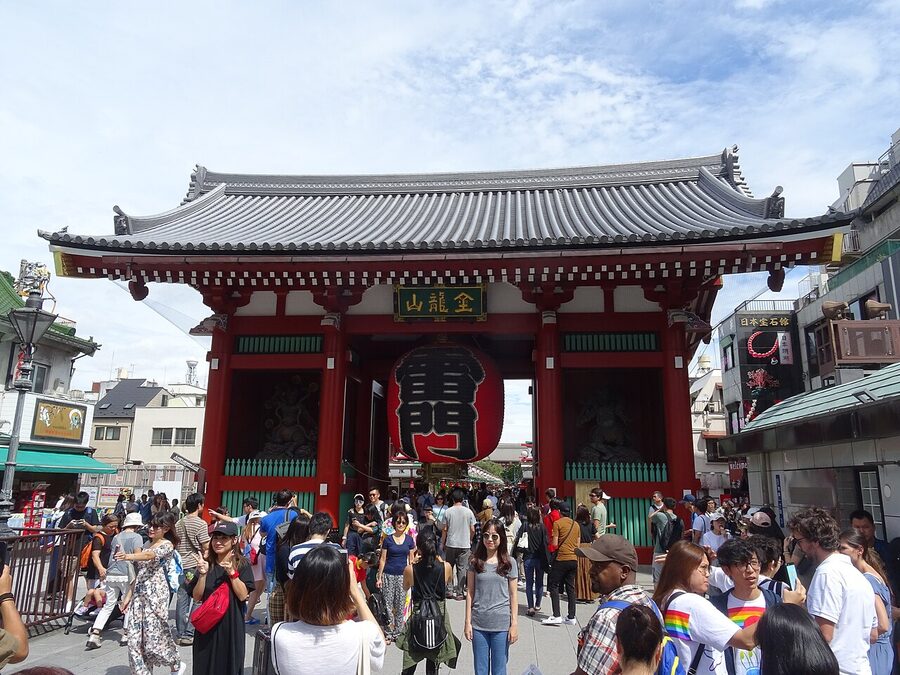
The lantern under the gate is 3.9 metres tall, 3.3 metres across and weighs about 700 kilograms. Since 1971 it has been made by Takahashi Chōchin of Kyoto from Kameoka bamboo and about 300 sheets of Fukui paper, and it is too big for the expressway toll gates, so each new one spends two days on ordinary roads coming east. It is replaced roughly every ten years, the sixth in April 2020, and it is folded up for the Sanja festival and whenever a typhoon is on the way.
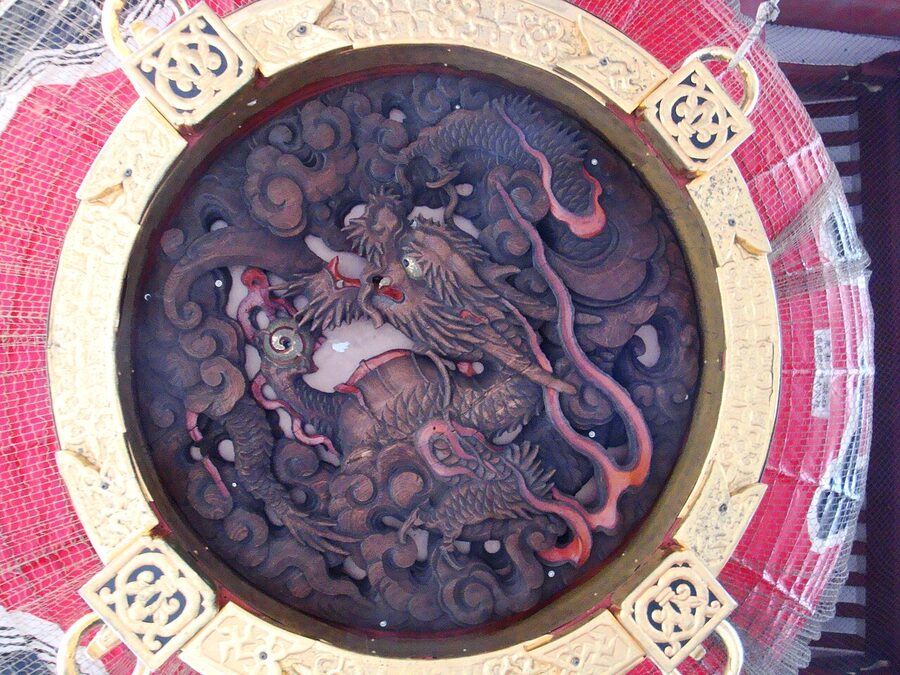
On the back of the gate stand two more guardians, the dragon gods Tenryū and Kinryū, given in 1978 for the 1,350th anniversary of the statue’s appearance. The male, Tenryū, was carved by Hirakushi Denchū, who was 106 at the time.
The Hōzōmon, the inner gate that replaced the Niōmon, followed in 1964, paid for by the industrialist Ōtani Yonetarō and his wife; later that year he opened the Hotel New Otani, and you will see his name garbled in some English sources. Its upper floor is a fireproof store for the temple’s treasures, including a set of 5,428 sutra scrolls printed under the Yuan dynasty that once belonged to Tsurugaoka Hachimangū in Kamakura. When the Meiji separation of Shinto and Buddhism threatened them with burning, a nun named Teiun bought them, and the fire-brigade chief Shinmon Tatsugorō helped move them to Asakusa.
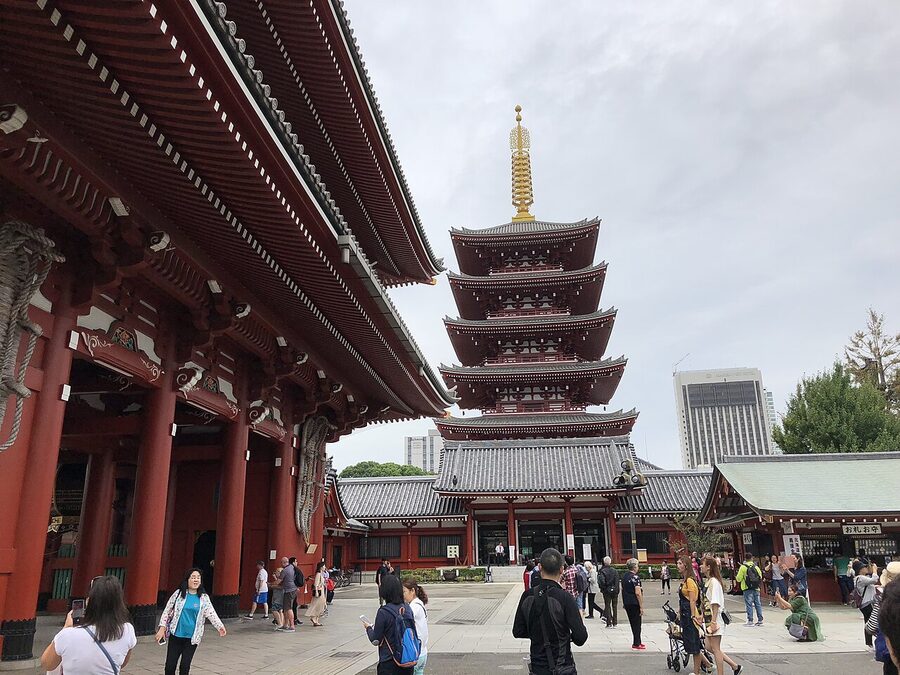
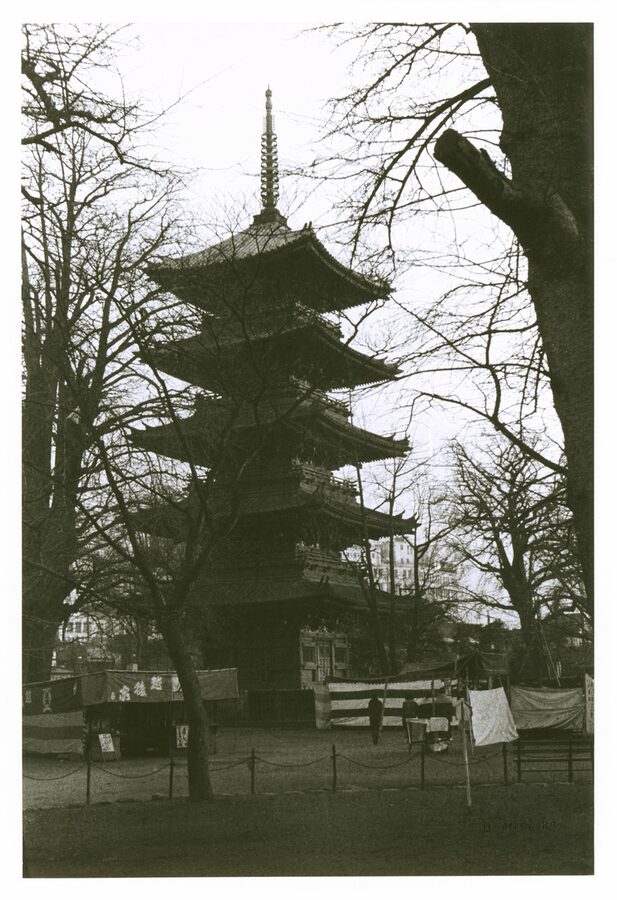
The great lantern of the Hōzōmon is the gift of Kobunachō, a merchant district of Nihonbashi, whose people first gave one in 1659; the newest was hung in October 2026. The pagoda followed in 1973, rebuilt on the west side of the approach rather than the east, 53 metres from the ground to the top of its spire. Its base holds some 30,000 memorial tablets, and its top storey a relic of the Buddha given in 1966 by the Isurumuniya temple in Sri Lanka.
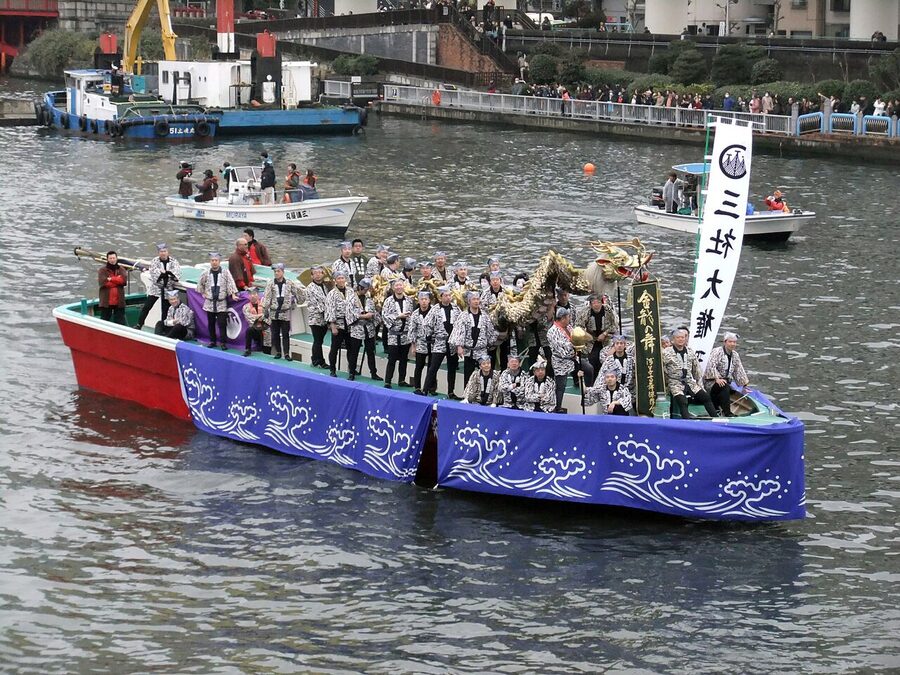
The festivals came back with the buildings. The three portable shrines of the Sanja Matsuri were remade in 1950 and 1953 to replace the seven destroyed in the raid, the golden dragon dance was created in 1958 for the new hall, and in 2012 the shrine revived the medieval boat procession on the Sumida for the festival’s 700th anniversary.
Where to see Sensō-ji today
The grounds never close and cost nothing. The main hall opens at 6:00 (6:30 from October to March) and shuts at 17:00, and the buildings are lit from sunset until about 23:00, when the precinct is at its best and nearly empty. The temple is five minutes’ walk from Asakusa Station on the Ginza line, the Toei Asakusa line (exit A4), the Tōbu Skytree line and the Tsukuba Express. For the bigger picture, my walk through Japan through the ages puts all of this in order.
The Kaminarimon and Nakamise
Come early. Before 8:00 the gate is yours and you can photograph the lantern without strangers in it; by 10:00 you cannot move. Across the road, the Asakusa Culture Tourist Information Center, the stack of timber-slatted boxes designed by Kuma Kengo, has a free terrace on the 8th floor, open 9:00–22:00, from which you can look straight down Nakamise to the Hōzōmon.
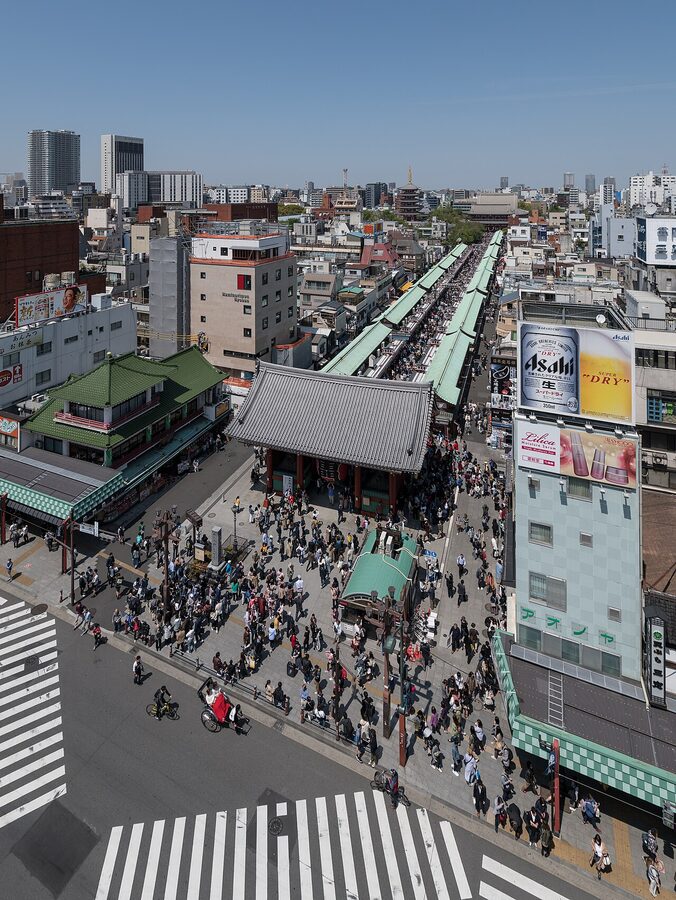
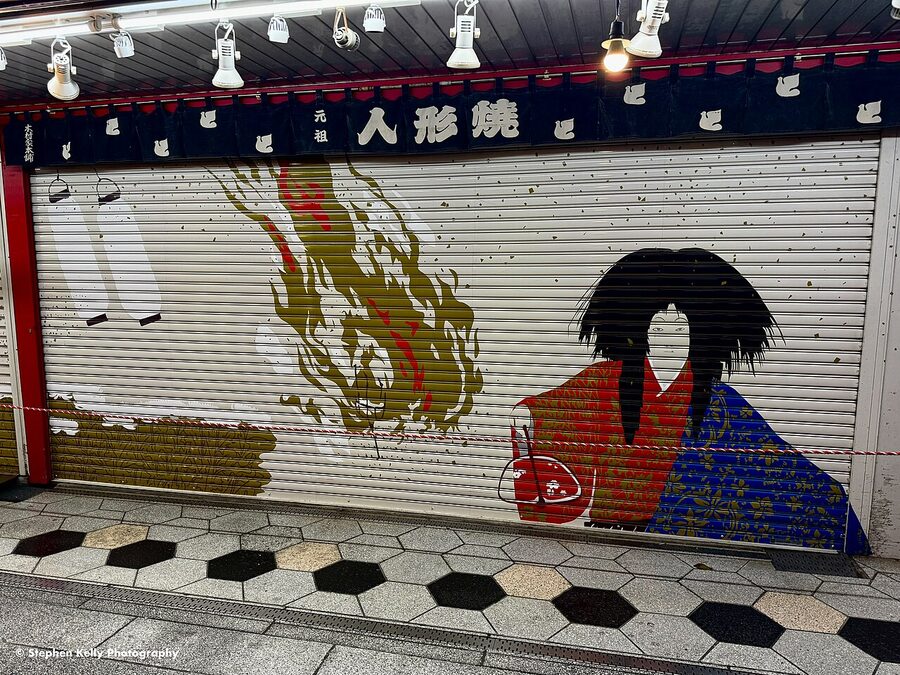
Nakamise itself runs about 250 metres from gate to gate with around ninety shops, most of them selling souvenirs, fans, sweets and things printed with Mount Fuji. The thing to eat is ningyō-yaki, little sponge cakes filled with bean paste and baked in the shapes of the pagoda, the gate and the local pigeons. Most stalls would rather you ate standing beside them than on the move, and so would everybody behind you. The middle of the day is a slow crush that I avoid.
The Hōzōmon, the incense and the main hall
Walk through the Hōzōmon and look back at the sandals. In front of the main hall stands the great incense burner, and the custom is to buy a bundle of incense, light it, add it to the burner and waft the smoke over yourself, especially over any part of you that hurts. To the right is the purification fountain, with a bronze dragon king of 1903 by Takamura Kōun: rinse your left hand, then your right, then your mouth from your cupped palm, never from the ladle.
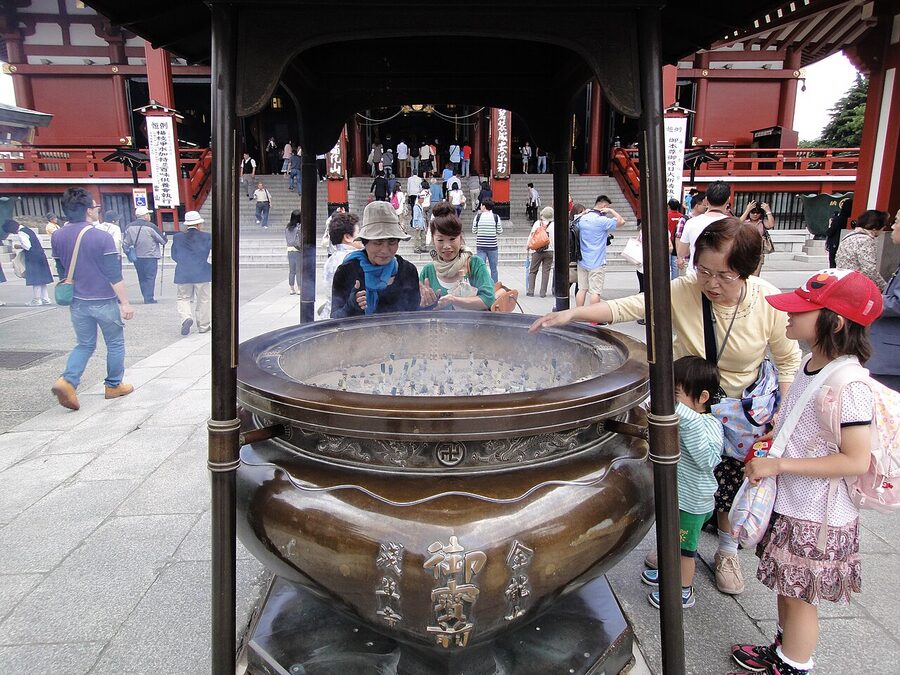
This is a working temple, and the people praying in front of the hall are not part of the scenery. A Buddhist temple is not a Shinto shrine, so you do not clap: put a coin in the offertory box, press your palms together, bow, and if you want to say something, the temple’s suggestion is “Namu Kanzeon Bosatsu”. The hall’s own lantern, 4.5 metres tall, is the biggest in the precinct, the gift since 1958 of an association from the Shinbashi district.
The fortune slips are in cabinets on both sides of the hall. Put ¥100 in the box, shake the metal canister until a numbered stick comes out of the hole, and open the drawer with that number. The oracle is famously harsh, with about three draws in ten coming up “bad luck”, and the temple’s line is that this is the original distribution and other places have gone soft. If you draw a bad one, tie it to the rack and leave it with Kannon.
On the 13th of December at 14:00, after the soot-sweeping of the inner shrine, the doors are opened and the proxy image carved by Ennin is shown to the public. It is the only time you can see any image from the shrine at the centre of the temple, and it is crowded, quiet and short.
The corners most people miss
West of the hall, past the pagoda, is Awashimadō, the temporary main hall of 1945, and beside it the bronze tub. On 8 February the hall holds a memorial service for broken needles, which seamstresses push into a block of tofu. Nearby are the Yōgōdō, where pilgrims get the temple’s seal stamp, Rokkakudō and the stone bridge of 1618.
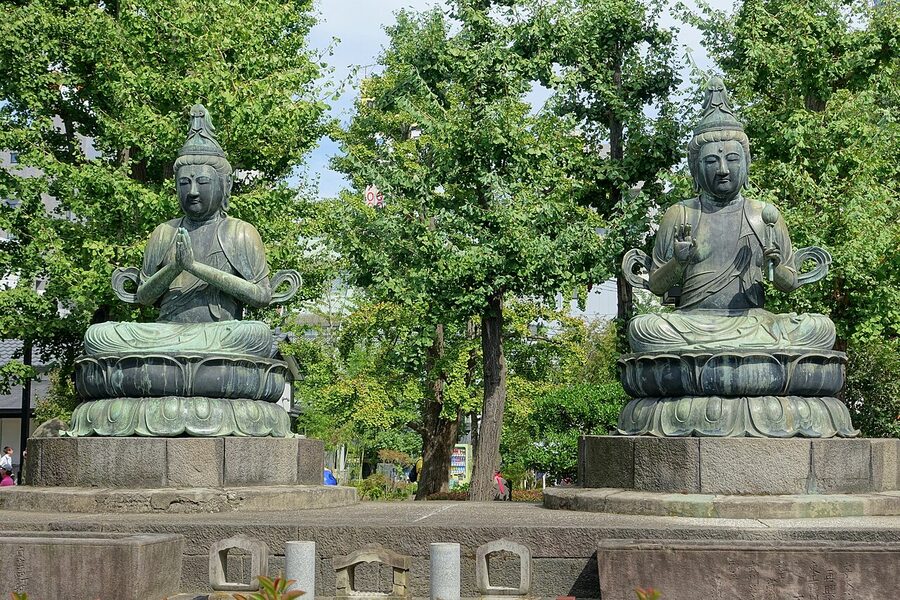
In front of the Nisonbutsu is a tiny shrine to Kume no Heinai, a swordsman of the 17th century who, legend says, had a statue of himself buried by the gate so that crowds would trample it in penance for the men he had killed. “Trampling” sounds like “sending a letter”, so he became the patron of love letters, a pun that has lasted longer than most marriages. Yoritomo’s ginkgo and the stone marking Iemitsu’s pagoda are on the east side of the precinct, near Nitenmon.
Along Denbōin-dōri, west of Nakamise, a gate on the north side leads to Chingodō, a little shrine to the tanuki. In early Meiji, raccoon dogs driven out of Ueno and Okuyama moved into the head priest’s garden; one appeared to the abbot in a dream offering protection from fire in return for a shrine, and in 1883 it got one. Rakugo storytellers and kabuki actors pray here because “tanuki” can be read as “beating the others”, and through the fence at the back you get a glimpse of the Denbōin garden.
Asakusa Shrine
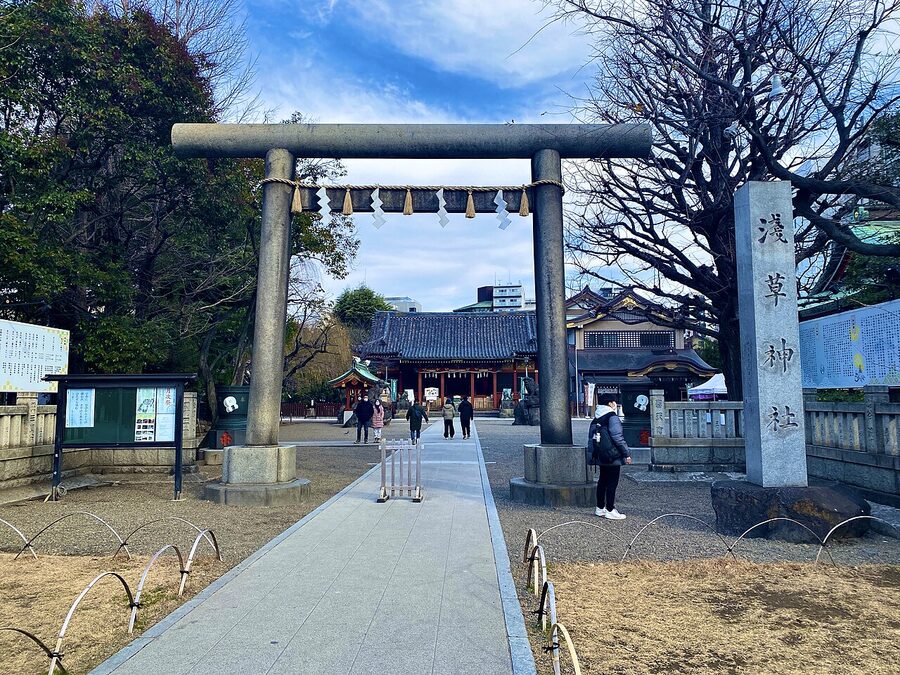
The shrine to the three founders, Asakusa Jinja (浅草神社), stands just northeast of the main hall, and its hall of 1649, Iemitsu’s gift, came through the earthquake, the fires and the raid. It is built in the gongen-zukuri style, the same plan as the Tōshōgū at Nikkō, and it is an Important Cultural Property. The shrine office is open 9:00–16:00 on weekdays and to 16:30 at weekends; look for the Edo-period guardian lions who lean in towards each other, and for Hikan Inari, a shrine of the 1850s that is a pocket-sized cousin of Fushimi Inari.
The shrine’s great day is the Sanja Matsuri, held from Friday to Sunday around the third Saturday of May and drawing something like 1.8 million people over three days. It is rougher than the Kanda Matsuri and belongs on any list of Japan’s greatest festivals. Before Meiji it was held on the 17th and 18th of the third month, around the statue’s anniversary, and the shrine’s portable shrines spent the night before the festival inside the temple’s main hall; since the Heisei era they have done so again, on 17 March each year.
Denbōin
Denbōin (伝法院), the head priest’s residence west of the Hōzōmon, has one of the finest Edo-period stroll gardens in Tokyo, traditionally attributed to Kobori Enshū and largely unchanged since the late 17th century. The garden became a national Place of Scenic Beauty in 2011 and six buildings Important Cultural Properties in 2015; the grounds also hold the Kofun-period coffin and Tenyū-an, a copy of the Omotesenke school’s Fushin’an tea house (my piece on the tea ceremony explains why that matters). It is not normally open.
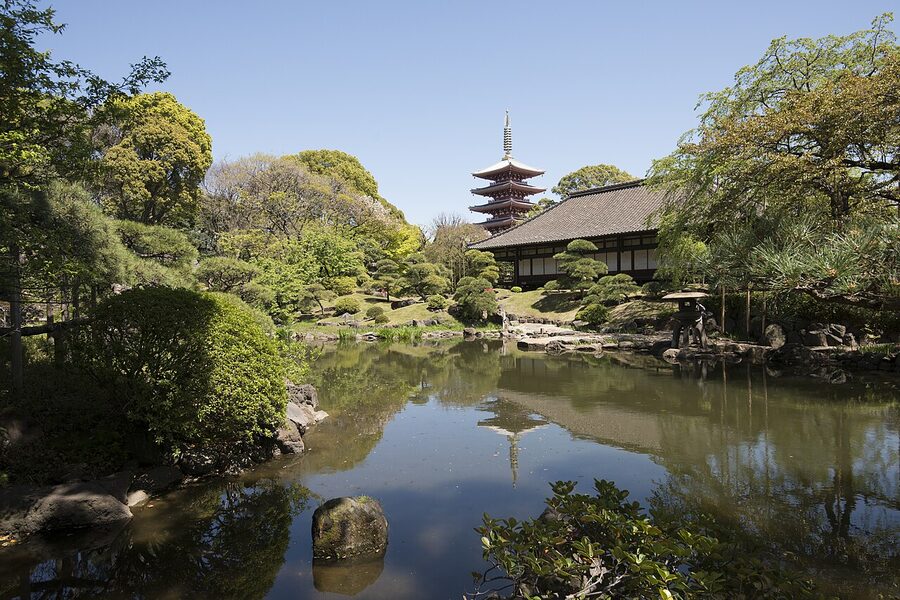
Special openings come irregularly. The most recent ran from 30 October to 3 November 2026, during the evening light show called Asakusa Culture & Lights, when the garden and the hall of votive paintings were opened with tickets at ¥2,300 in advance or ¥2,500 on the day. Watch the temple’s website for the next one, and read my guide to Japanese gardens before you go.
Komagatadō
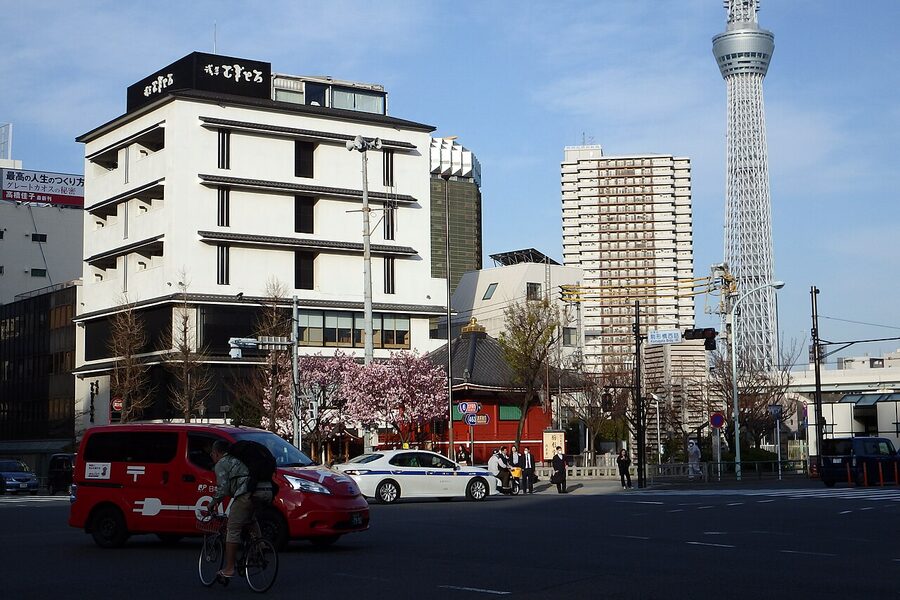
Five minutes’ walk south of the Kaminarimon, at the western end of Komagata Bridge, is Komagatadō, the small hall that marks where the statue is said to have come ashore. Its own image, a horse-headed Batō Kannon 28.8 centimetres tall, is shown on the 19th of every month. Beside it is a stone of 1693 forbidding fishing in this stretch of the river, which, the shrine says, is why the fishermen of the old Sanja river festival had to come from Ōmori.
The temple’s year
The calendar is the best reason to come back. On the 18th of every month, Kannon’s day, the hall fills with local worshippers. At Setsubun in early February the temple throws beans with the cry “fortune in!” but never “demons out!”, on the grounds that there are no demons in the presence of Kannon. On 18 March, the anniversary of the statue’s appearance, the golden dragon dances, and it dances again on 18 October for the chrysanthemum service.
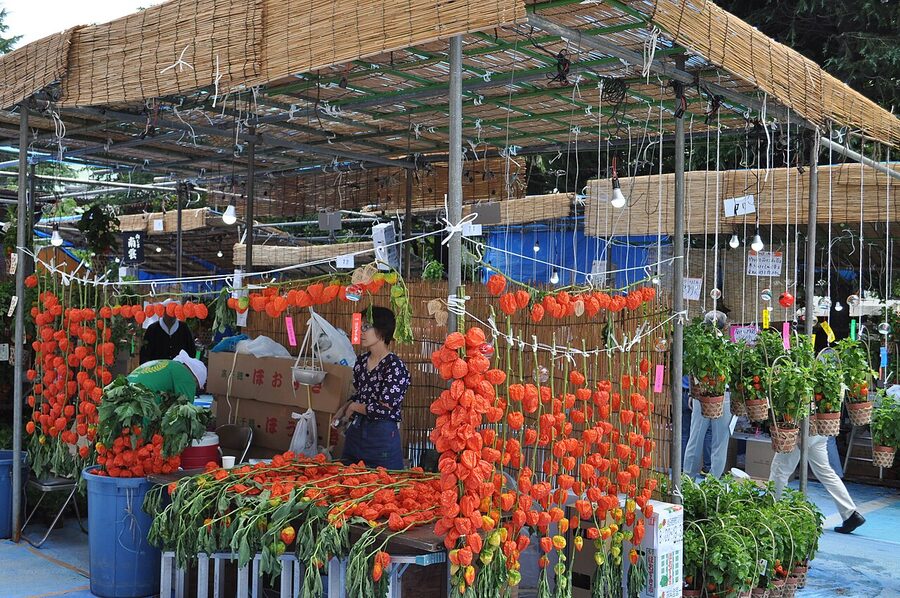
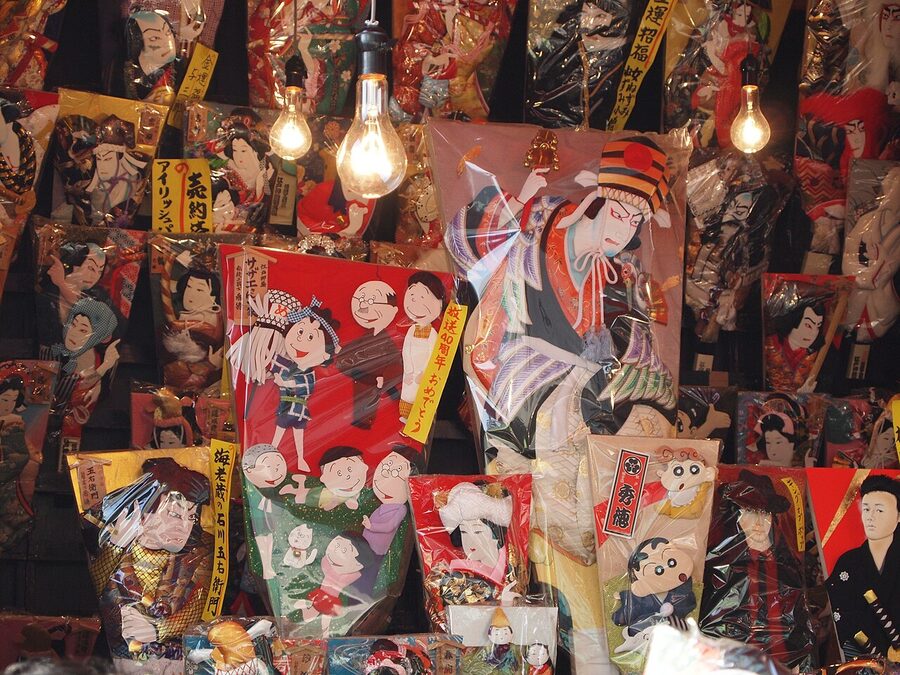
On 9 and 10 July comes Shiman-rokusen-nichi, the day when one visit is worth 46,000 days of prayer, about 126 years, which is a lifetime and then some. Around a hundred stalls sell potted Chinese lantern plants for the Hōzuki-ichi. The year closes with the Hagoita-ichi, a fair of decorated battledores, from 17 to 19 December, and the bell on Bentenyama rings in the New Year.
Two dates are worth putting in a diary now. In 2028 the temple and shrine mark the 1,400th anniversary of the statue’s appearance, with the river procession planned for 17–19 March 2028, subject to change. And if you are in Tokyo on 13 December, go to the main hall at two in the afternoon.
Edo-Tokyo Museum and the memorial at Yokoamichō
For the city that grew up around the temple, take the Ōedo line or the JR Sōbu line to Ryōgoku and the Edo-Tokyo Museum, which reopened on 31 March 2026 after four years of renovation. The permanent galleries cost ¥800 and are open 9:30–17:30 (to 19:30 on Saturdays), closed on Mondays. The old galleries had a one-tenth scale model of the Twelve Storeys; I have not checked that it is back, so treat it as a hope rather than a promise.
A few minutes’ walk from the museum is Yokoamichō Park, where the ashes of tens of thousands of unidentified victims of the 1923 earthquake and of the air raids lie in the Tokyo Memorial Hall. Beside it, the memorial to the victims of the Tokyo air raids holds a register of some 80,000 names and is opened on 10 March and 1 September. It is not a place for sightseeing, but after a morning at Sensō-ji it is where the story of 1945 ends.
Back to the bronze tub
Every time I go to Sensō-ji I end up at Awashimadō, beside a bronze tub that nobody looks at. It is the plainest object in the precinct, made in 1770 to hold rainwater for putting out fires, and for three years and four months it held the reason the whole place exists. The halls above it burned, the gate came back courtesy of Panasonic, the pagoda moved across the approach and came back in concrete, and the statue in the box, whatever size it is and whatever condition it is in, was never once looked at.
Thirty million people a year come to see something they will never see. Go early, go back after dark, and on your way out, stop at the tub.