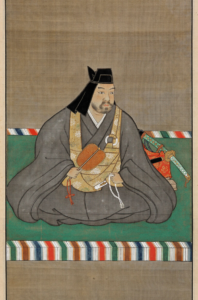
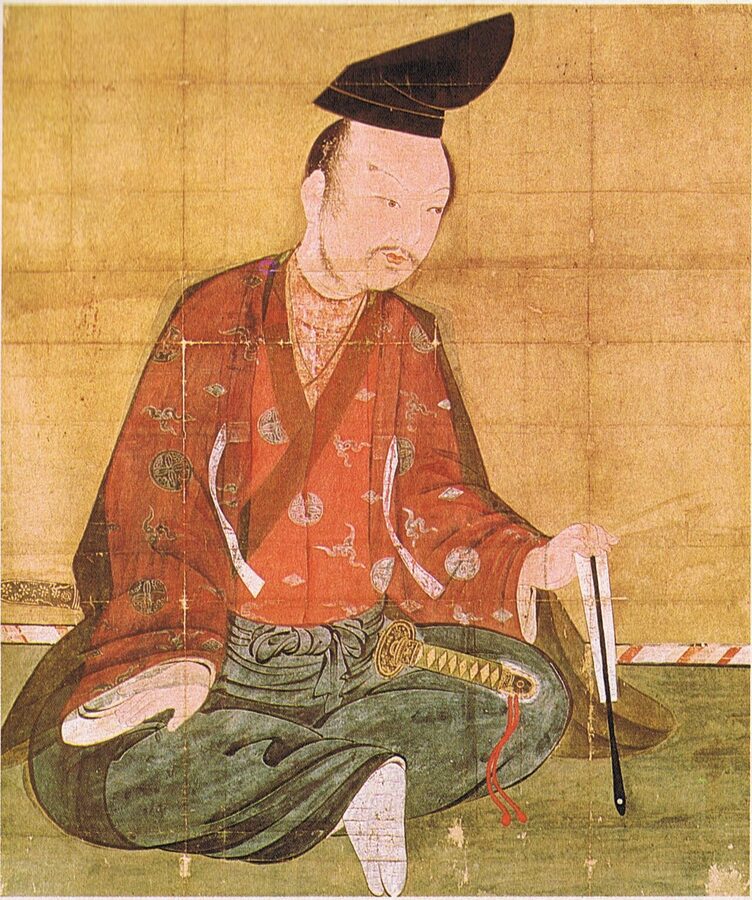
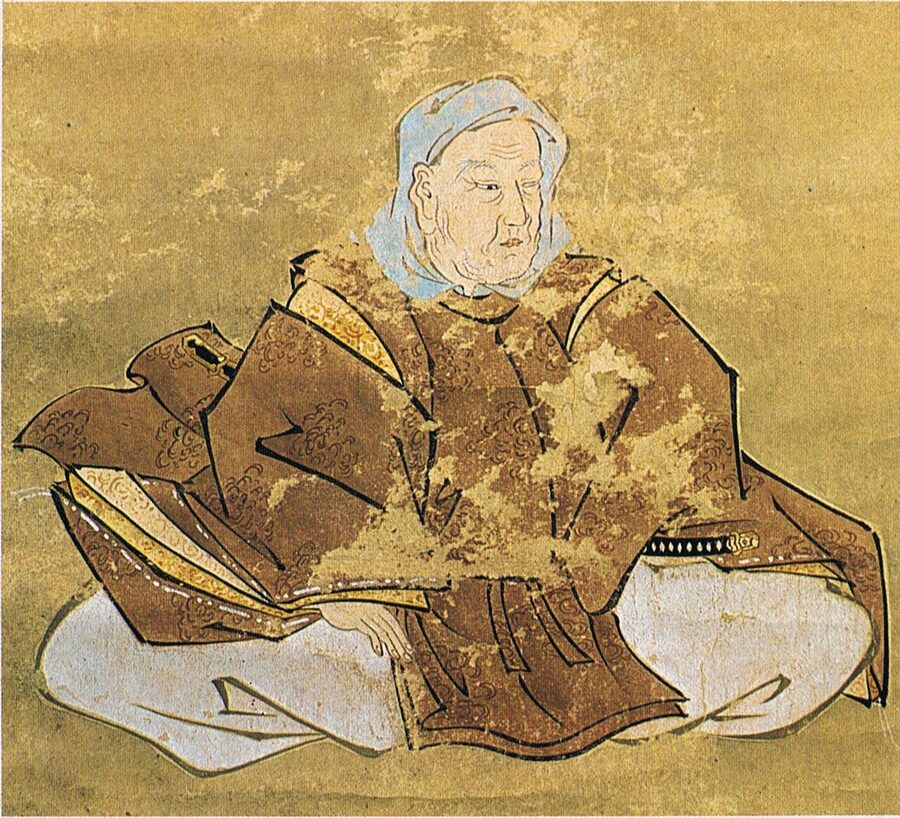
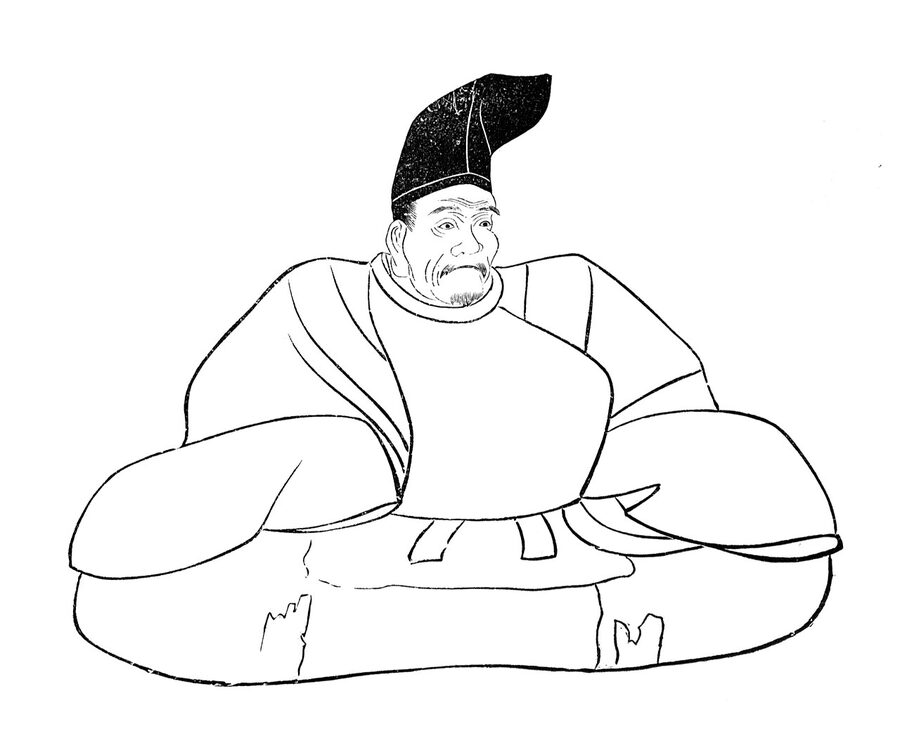
The only description of Minamoto no Yoshitsune’s face that survives from anywhere near his own lifetime comes from an enemy, and it is not kind. In The Tale of the Heike, a Taira retainer named Moritsugi, trying to put heart into his comrades before the last sea battle, passes on what he has heard about the Minamoto general: Kurō is pale and short, and his front teeth stick out so far you cannot miss him. That is the lot. No portrait was painted from life, nobody who stood next to him wrote down his height, and the man who wiped out the Taira in a little over a year entered the record as a small, pale soldier with buck teeth.
Eight hundred years of Japanese storytelling have been trying to correct this. By the time the Gikeiki was put together, some two centuries after his death, he had become as lovely as Yang Guifei, and the Edo print designers made him a slender boy with a flute who could jump over a giant monk’s head. I find the gap between those two people, the buck-toothed general and the flute-playing boy, the most interesting thing about him. This piece follows both of them, and then sends you to the places where you can still stand: the mountain above Kyoto where he was meant to learn the sword from a tengu, the temple at Koshigoe where he waited outside his brother’s city, and the hill at Hiraizumi where he died.
In This Article
- A ninth son in the snow
- The tengu, the stolen book and the bridge
- Hiraizumi and the gold of the north
- Nine years on the record
- Uji, Ichi-no-tani and a letter about an estate
- Yashima and Dan-no-ura
- Why the brothers fell out
- The letter at Koshigoe
- Outlaw
- Shizuka
- Mountain priests on the road north
- Koromogawa, the 30th day of the intercalary fourth month
- A head in sake
- The legend that outgrew him
- Hōgan-biiki
- North to Ezo
- And then he became Genghis Khan
- Where to see Yoshitsune today
- Kurama-dera, Kyoto
- Gojō Ōhashi and Matsubara-bashi, Kyoto
- Mampuku-ji, Koshigoe
- Shirahata Jinja, Fujisawa
- Hiraizumi: Takadachi Gikeidō
- Hiraizumi: Chūson-ji and Benkei’s grave
- Ataka, Komatsu
A ninth son in the snow
He was born in 1159, the ninth son of Minamoto no Yoshitomo, which is why his common name was Kurō, “ninth son”. Sources variously make him the sixth, the eighth or simply the youngest, and the Gikeiki has a charming explanation for the confusion: he was really the eighth, but took “Kurō” out of respect for an uncle who was already famous as Hachirō, the “eighth son”. His mother was Tokiwa, a maid in the household of the empress Kujōin, and his childhood name was Ushiwakamaru, the “young bull”.
Within months his father had backed the wrong side in the Heiji disturbance of the twelfth month of 1159 (English-language books usually date it 1160, because the twelfth month of that Japanese year fell early in the next Western one). Yoshitomo lost, fled east and was murdered in a bath by a retainer. Taira no Kiyomori now held the capital, and Yoshitomo’s sons were either killed, exiled, or given to the monks; the young Yoritomo was sent into exile in Izu.
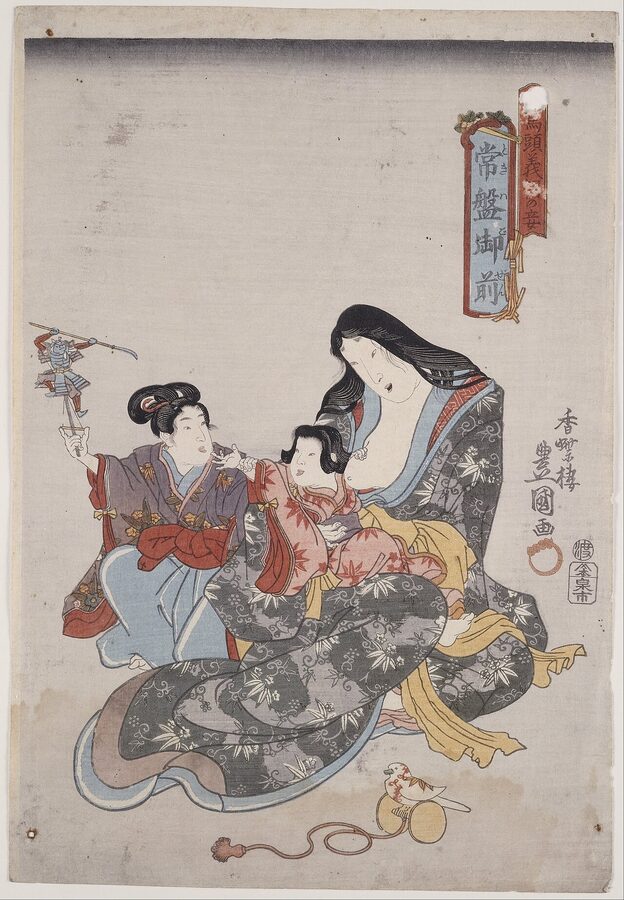
The famous part of Tokiwa’s story is the flight through the snow with three small sons, followed by her surrender to Kiyomori, who (in the war tales) was so taken with her beauty that he spared the children and made her his mistress. The second half rests on war tales rather than records. What the court genealogies do confirm is duller: she later married a minor courtier, Ichijō Naganari, and had more children by him, and Ushiwaka’s two full brothers became monks.
Ushiwaka followed them into religion, or was meant to. Japanese sources put him at Kurama-dera, in the hills north of Kyoto, at eleven by the old count; English accounts usually say ten, which is the same thing measured differently. There he had the temple name Shanaō, and there, according to legend, he refused to take vows.
The tengu, the stolen book and the bridge
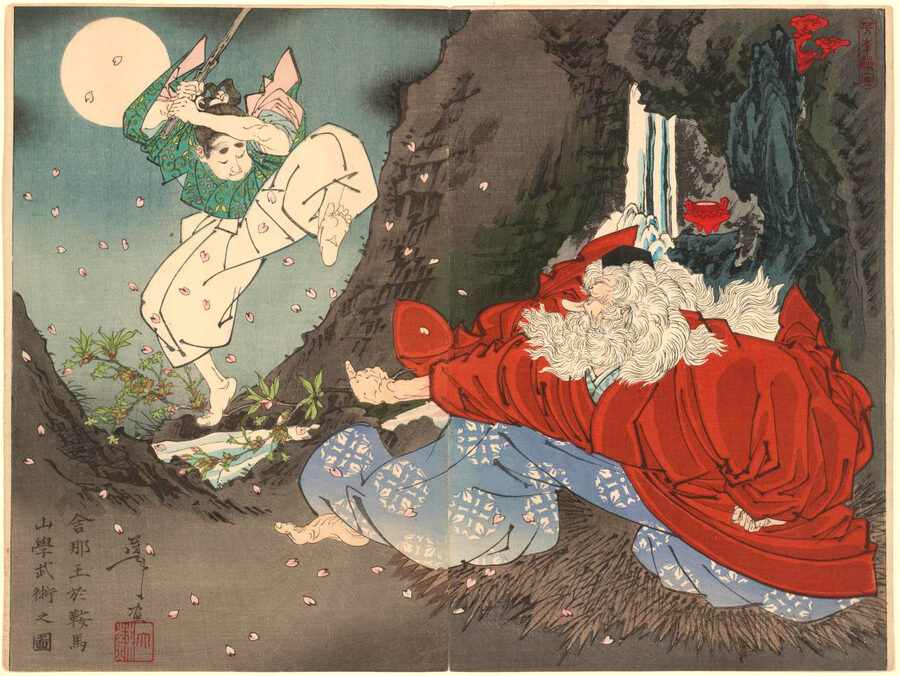
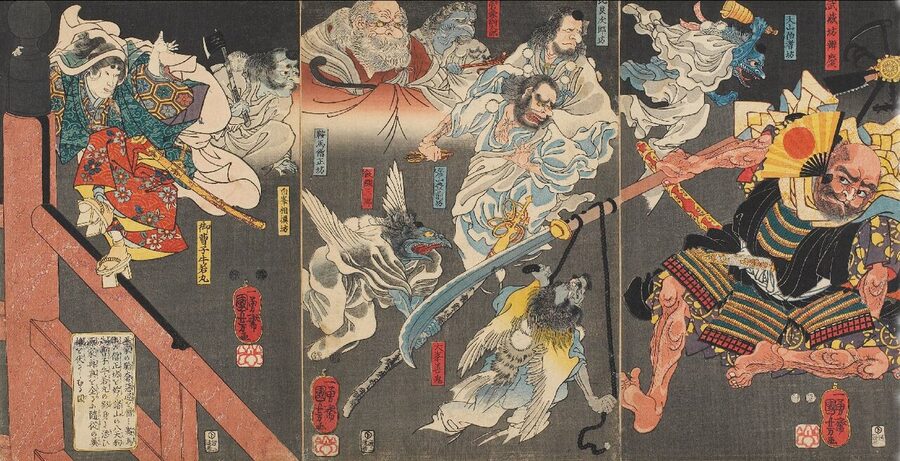
What happened on Mount Kurama is, by the frank admission of every serious reference work, unknown. That vacuum is exactly what the storytellers filled. In the Noh play Kurama Tengu he is taught the sword at night in Sōjō-ga-tani by Sōjōbō, the great tengu king of the mountain, and the woodblock print artists of the 19th century never tired of drawing a small boy in white leaping over a big red-faced goblin.
The Gikeiki adds a second teacher, a strategist and yin-yang master called Kiichi Hōgen who owned a Chinese military classic, the Six Secret Teachings. Ushiwaka seduced Kiichi’s daughter, the story goes, and had her steal it. One chapter of that book is called the “Tiger” scroll, and the story is said to be why a cram book or crib sheet in Japanese is still called a tora no maki (虎の巻), a tiger scroll.
Then there is Benkei. The Gikeiki makes him the son of the steward of Kumano (the shrines at the far end of the Kumano Kodo), carried for eighteen months and born with a full set of teeth and hair to his shoulders. Thrown out of Mount Hiei for brawling, he decided to collect a thousand swords from passers-by in Kyoto, had reached 999, and then met a boy playing a flute who would not hand his over.
Everybody knows that fight happened on Gojō Bridge. The Gikeiki does not say so: it runs their encounters from the streets of Horikawa to the Kiyomizu temple. The bridge comes from a Meiji-era children’s author, Iwaya Sazanami, whose retelling the school song “Ushiwakamaru” then fixed in every Japanese classroom. The bridge you can walk across today is not even in the right place, a point I will come back to in the travel section.
Hiraizumi and the gold of the north
He left Kurama in 1174, and the record finally gets a little firmer. The Heiji Monogatari says that on the 3rd day of the third month of that year he performed his own coming-of-age ceremony at Kagami-no-shuku, a post town on the road east of Kyoto, giving himself an adult name with no adult to give it to him; the Gikeiki sets the ceremony in Owari instead. The war tales say a gold merchant called Kichiji guided him north.
He went to Hiraizumi, the capital of the Ōshū branch of the Fujiwara, who had been running the northern frontier for three generations on the profits of gold and horses. Its lord, Fujiwara no Hidehira, took him in. The connection was probably family: Hidehira’s father-in-law and adviser was a cousin’s son of Tokiwa’s new husband, which is exactly the sort of thread a fugitive boy’s mother would pull.
Nine years on the record
Everything that can reliably be said about Yoshitsune falls between his twenty-second year and his thirty-first, the nine years from 1180 to 1189. Before that there are stories; after it, there are more. In the eighth month of 1180 his half-brother Yoritomo raised his banner in Izu against the Taira, the start of what Japanese historians call the Jishō-Juei disturbance and everybody else calls the Genpei War, and Yoshitsune slipped out of Hiraizumi to join him. Hidehira tried to stop him and, failing, sent two brothers called Satō after him with a few dozen riders.
Yoshitsune and Yoritomo met in the tenth month of 1180 at Kisegawa, near modern Numazu, and the Azuma Kagami, the shogunate’s own chronicle, says they wept. They had never seen each other before. Yoritomo had no sons yet, few troops of his own and a coalition of eastern warriors who could walk away if they chose, and a brother, even a half-brother he had never met, was valuable to him in a way no vassal was.
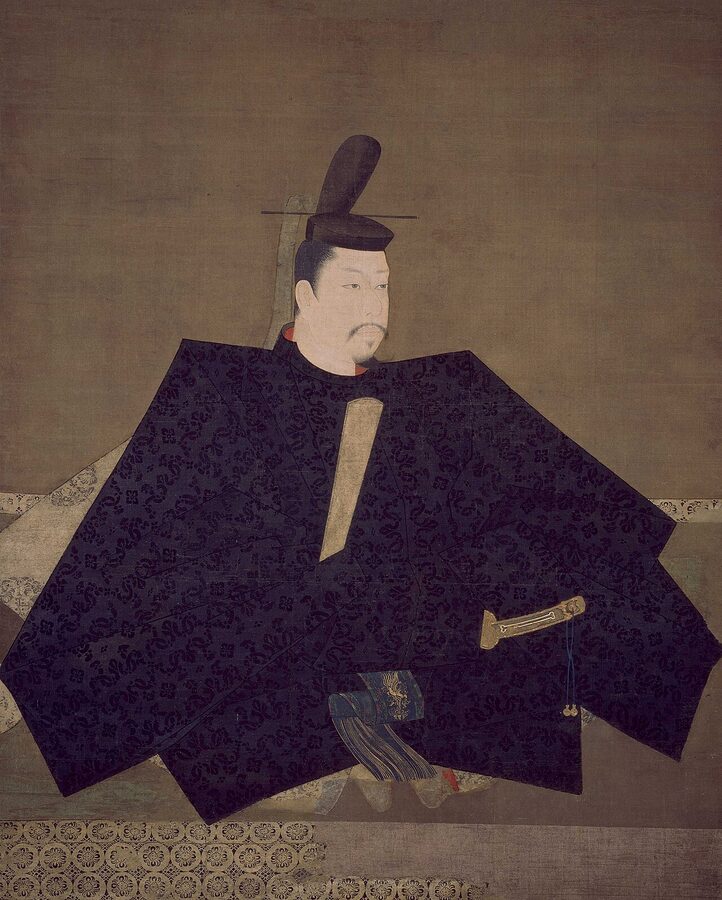
The relationship was set up as “father and son”, in the phrase of a contemporary court diary, and the Azuma Kagami records what that meant in practice. In the seventh month of 1181, at the dedication of a hall at Tsurugaoka in Kamakura, Yoritomo told Yoshitsune to lead the horse that was a gift to the carpenters. Yoshitsune said there was nobody of suitable rank to hold the other side. Yoritomo named two of his vassals and asked, in front of everyone, whether his brother thought the job beneath him, and Yoshitsune, the chronicle says, was badly frightened and went and led the horse.
Uji, Ichi-no-tani and a letter about an estate
Late in 1183 Yoritomo sent him west with only five or six hundred riders, as his deputy to the court, where their cousin Kiso Yoshinaka had taken the capital and fallen out with the retired emperor Go-Shirakawa. On the 20th day of the first month of 1184, Yoshitsune forced the crossing of the Uji River and entered Kyoto, and Yoshinaka died the same day at Awazu, the fight in which Tomoe Gozen rides out of the Heike. A court diarist who had not known his given name three months earlier now knew it very well.
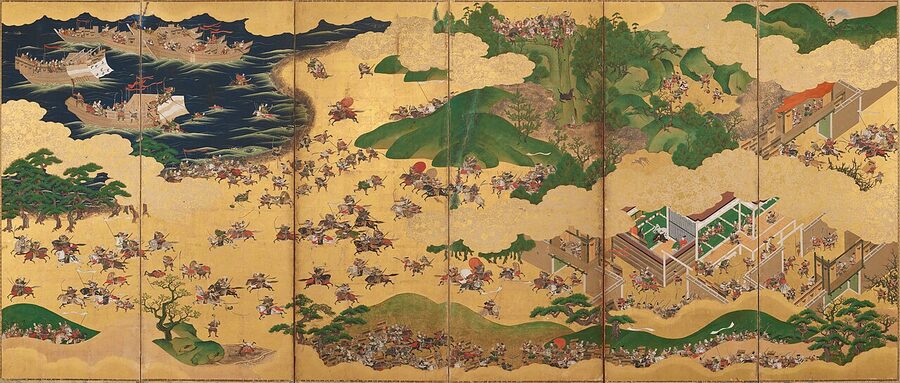
On the 7th day of the second month he fought at Ichi-no-tani, west of modern Kobe, and the Heike gives him the most famous charge in Japanese history: seventy picked riders down the cliff at Hiyodorigoe, straight into the back of the Taira camp. It is a wonderful story. The historian Hishinuma Kazunori points out that Yoshitsune’s own report says he went in through the western gate at Ichi-no-tani, with no reckless ride down a cliff by a handful of men.
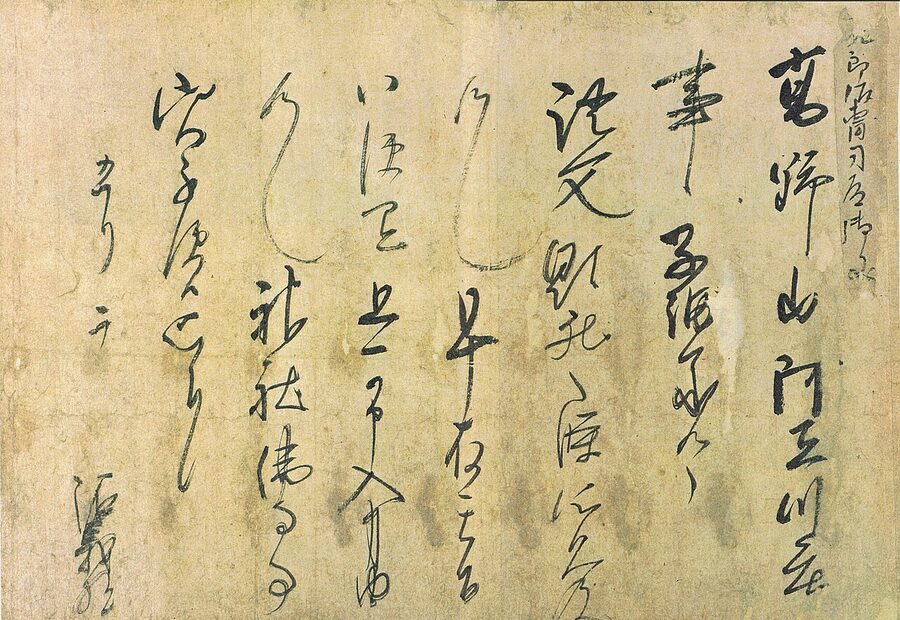
That letter matters, because it shows what his job really was. Yoritomo went back to the east; Yoshitsune stayed in Kyoto, keeping order in a hungry, frightened capital, settling disputes between temples, and organising the local warriors. On the 6th day of the eighth month of 1184, Go-Shirakawa made him a lieutenant of the Left Gate Guards and a kebiishi, a police commissioner, the third-grade office (hōgan, 判官) that gave him the name everyone would remember: Kurō Hōgan. Whether Yoritomo approved the appointment is, as you will see, one of the arguments that never ends.
Yashima and Dan-no-ura
Meanwhile his other half-brother, Noriyori, had marched an army of eastern warriors down the Inland Sea coast toward Kyushu and got stuck there without ships or rice. Early in 1185 Yoshitsune asked the court for permission to go, and got it. A courtier warned him that a commander ought to send a subordinate ahead rather than lead in person; Yoshitsune answered, in the Azuma Kagami’s version, that he had particular reasons and wished to throw away his life in the front line.
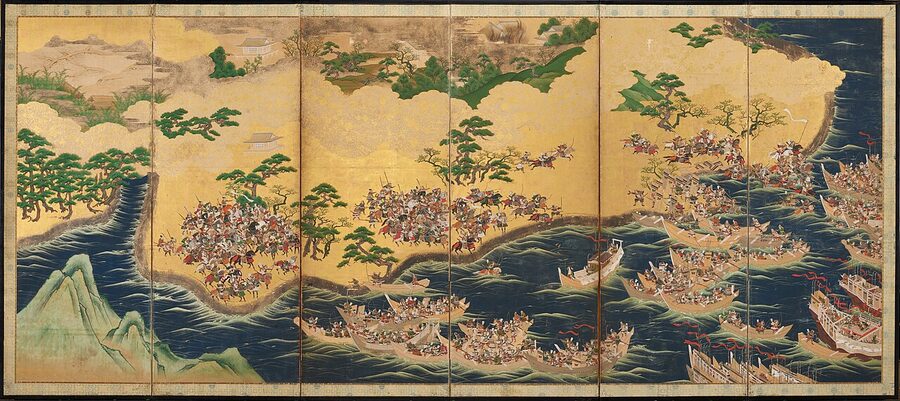
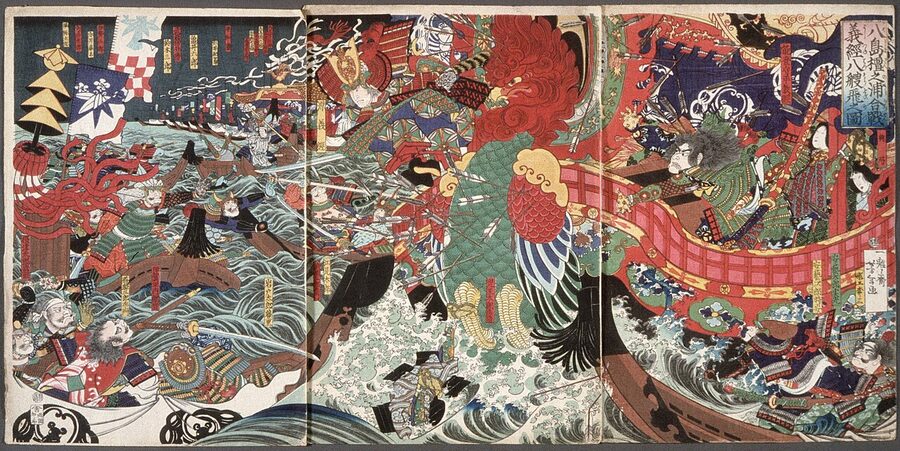
In the second month of 1185 he crossed from Settsu to Shikoku in a gale that kept most of his captains in harbour, with a handful of ships, and landed in a few hours where the passage usually took days. He took the Taira base at Yashima from the landward side, burning houses to make his small force look like a large one. The Taira took to the sea, and a month later, on the 24th day of the third month of 1185, he caught them in the straits of Dan-no-ura between Honshu and Kyushu.
You can read about the battle itself in the Genpei War piece and in Japan’s most decisive battles. For this story, two things matter. The child emperor Antoku went into the sea in his grandmother’s arms, and with him went the sacred sword, one of the three sacred treasures, which was never recovered. Yoshitsune had won outright, which Yoritomo had not asked for: Kamakura had wanted a slower squeeze, with the boy emperor and the regalia as bargaining chips in the hand.
Why the brothers fell out
The Azuma Kagami’s explanation is simple. Yoshitsune took court offices without Yoritomo’s permission; he ignored Kajiwara Kagetoki, the senior vassal sent as his adviser; he took over work in Kyushu that was Noriyori’s; he punished eastern warriors on his own authority; and he hogged the credit. Kajiwara’s report, which reached Kamakura on the 21st day of the fourth month of 1185, said precisely that, and added that the resentment was not his alone.
Modern Japanese scholarship has picked this apart from several directions. Several historians argue that his 1184 appointment as kebiishi could not have been the real cause, since Yoritomo sent him on campaign afterwards and proposed him in the eighth month of 1185 for the governorship of Iyo, the most prestigious provincial post on offer. Motoki Yasuo, followed by most recent writers, puts the break after that: a governor normally gave up his police post, Go-Shirakawa let Yoshitsune keep both, and Yoshitsune stayed in Kyoto as the retired emperor’s man instead of coming back to Kamakura. Hongō Kazuto, on the other hand, thinks the old view is right, and that unauthorised court rank was exactly what a new and fragile warrior government could not allow.
The letter at Koshigoe
What everybody remembers is Koshigoe. After Dan-no-ura, Yoshitsune escorted the captured Taira commander Munemori east to Kamakura and was stopped short of the city. Kept waiting at Mampuku-ji in Koshigoe, on the coast west of Kamakura, he wrote to Yoritomo’s secretary Ōe no Hiromoto on the 24th day of the fifth month of 1185 (the date converts to 23 June 1185 by the Western calendar), pleading his loyalty in a letter full of tears of blood and wounded brotherhood. It did no good, and he was sent back to Kyoto.
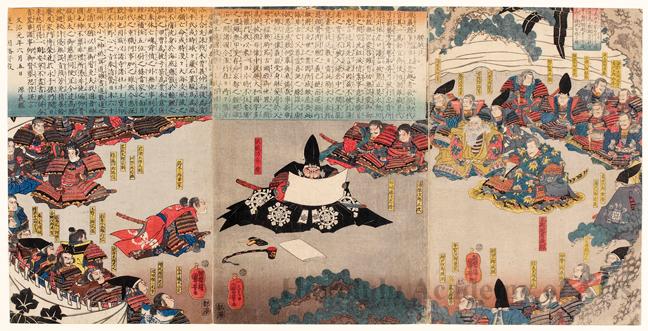
English-language accounts generally quote the Koshigoe letter as genuine. Japanese sources are much more doubtful, and the case against it is strong. The Azuma Kagami puts Yoshitsune at Koshigoe on that one day only; its entries before and after have him at Sakawa, some thirty kilometres to the west. Variant texts of the Heike and the monk Jien’s history, the Gukanshō, both say he did enter Kamakura and met his brother, so the dominant view in Japan now is that the letter is a later composition slipped into the chronicle, though a minority think it fairly reflects what he was saying at the time.
Outlaw
In the tenth month of 1185 things fell apart quickly. Yoritomo ordered him to hunt down their uncle Yukiie, who was plotting; Yoshitsune pleaded illness and, in fact, joined him. On the night of the 17th day of the tenth month a band of about sixty riders under a warrior monk, Tosabō Shōshun, attacked his mansion at Horikawa in Kyoto, and Yoshitsune beat them off. The next day Go-Shirakawa, who had little choice with two armed Minamoto in the city, issued an order to destroy Yoritomo.
Almost nobody answered it. The warriors of the capital region had been paid by Yoritomo and expected to be paid again, and Yoshitsune had nothing to give. On the 3rd day of the eleventh month he left Kyoto with about three hundred men, meaning to raise the west, and the court diarist Kujō Kanezane, no friend of his, recorded that he left so quietly that high and low alike were relieved, and called him a man of honour who would leave a good name to later ages.
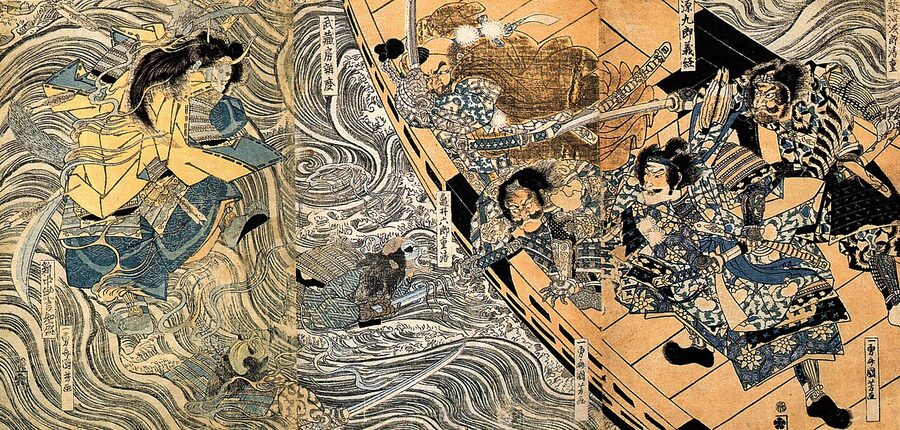
Three days later his ships put out from Daimotsu Bay, near modern Amagasaki, and a storm wrecked them and threw the survivors back on the Settsu shore. The Azuma Kagami lists who was with him afterwards, and one of the names is Benkei: one of only a handful of times the man appears in any record of the age, with no hint of size, strength or devotion. The Genpei Jōsuiki, a war tale that at least describes him, calls him a skinny monk, like a black kite.
Shizuka
The company split up in the mountains of Yoshino, where his dancer-mistress Shizuka was abandoned by the servants he had paid to take her home. On the 17th day of the eleventh month she stumbled down to the Zaō-dō, the great hall of Kinpusen-ji, late at night, and the monks handed her over to Kamakura’s men. On the 8th day of the fourth month of 1186, Yoritomo made her dance at Tsurugaoka Hachimangū, and she sang about the man who had vanished into the snow on Mount Yoshino.
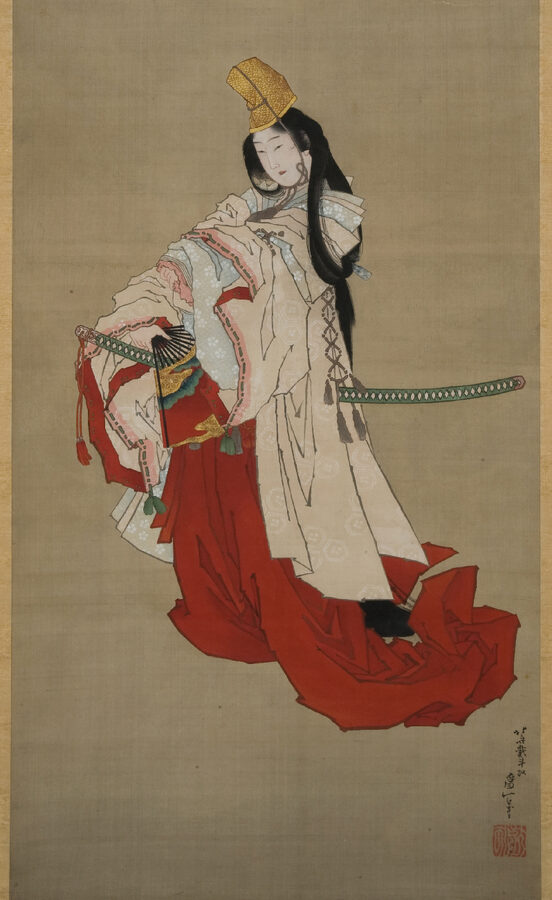
Yoritomo was furious, and his wife Hōjō Masako talked him round. Shizuka was pregnant; the order was that a girl would live and a boy would die. On the 29th day of the intercalary seventh month of 1186 she had a son, and her own mother took him from her and handed him to the men who drowned him at Yuigahama, the beach at Kamakura.
Shizuka was then sent back to Kyoto with presents from Masako, and disappears. (Folklore has since given her graves in several prefectures, one of them at Kuki in Saitama.)
Meanwhile Yoshitsune’s men were being hunted down one at a time. The court changed his name for him, by order, first to Yoshiyuki and then to Yoshiaki, and it is not clear that he ever knew.
Mountain priests on the road north
Some time in 1187 he reached Hiraizumi again, with his wife and children. The Azuma Kagami says the party went through Ise and Mino disguised as mountain ascetics (yamabushi) and a temple boy, arriving in the second month; Kujō Kanezane’s diary does not mention him in the north until early 1188, and implies he got there in the autumn. Sources variously give either, and nobody knows the route.
That gap is the space where the most famous of all the Yoshitsune stories lives. In the Noh play Ataka, written in the 15th or 16th century, the party is stopped at a barrier in Kaga, on the Japan Sea coast. Benkei, playing a monk collecting money to rebuild the Tōdai-ji, “reads” a subscription list from a blank scroll, and when a guard says the porter looks like Yoshitsune, Benkei beats his own lord with his staff for being slow. The barrier keeper, who has seen through it all, lets them go.
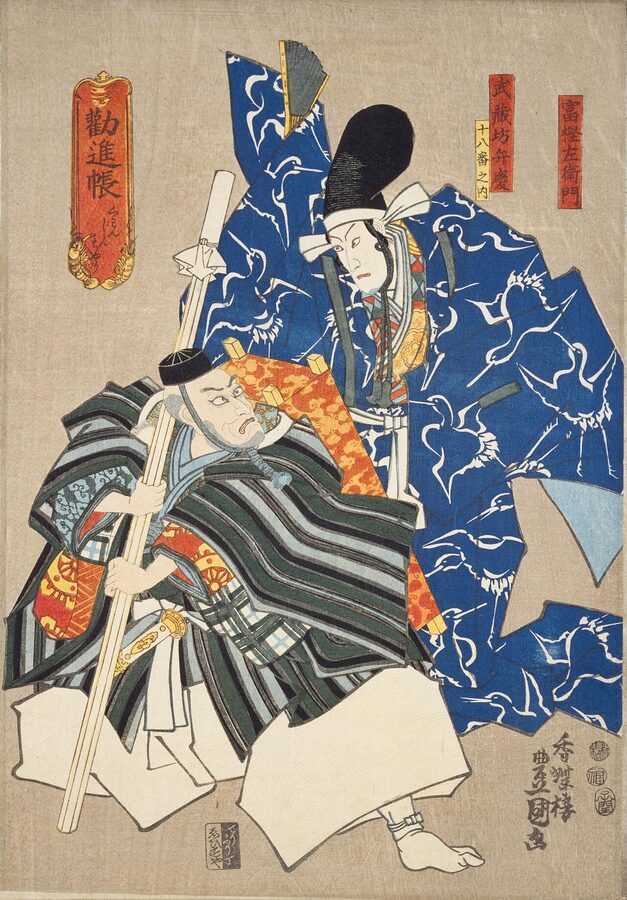
The kabuki version, Kanjinchō, opened at the Kawarazaki-za in Edo in the third month of 1840, and it is still one of the most performed plays in the repertoire. I love it, and I will tell you the uncomfortable part. The Gikeiki tells the beating scene at the Nyoi ferry, much further east, and the old sources name an Ataka post station, an Ataka crossing and an Ataka bridge, but only the Noh play mentions a barrier there at all. Whether there was ever a checkpoint at Ataka is doubted.
Koromogawa, the 30th day of the intercalary fourth month
On the 29th day of the tenth month of 1187 Fujiwara no Hidehira died. His dying instructions, as Kanezane heard them, were for his sons to swear an oath together, to make peace with each other and to treat Yoshitsune as their commander against Kamakura. His heir Yasuhira was in his early thirties, ruling a rich province that Yoritomo badly wanted, and Yoritomo had the court send order after order demanding the fugitive.
Yasuhira gave way. On the 30th day of the intercalary fourth month of 1189, which converts to 15 June 1189 by the Julian calendar, he sent a force of several hundred riders (some accounts say five hundred) against the residence at Koromogawa where Yoshitsune lived with a dozen or so men.
His followers, Benkei among them, died fighting or cut their own bellies. Yoshitsune went into the family chapel, killed his wife and their four-year-old daughter, and then himself. He was thirty-one by the Japanese count.
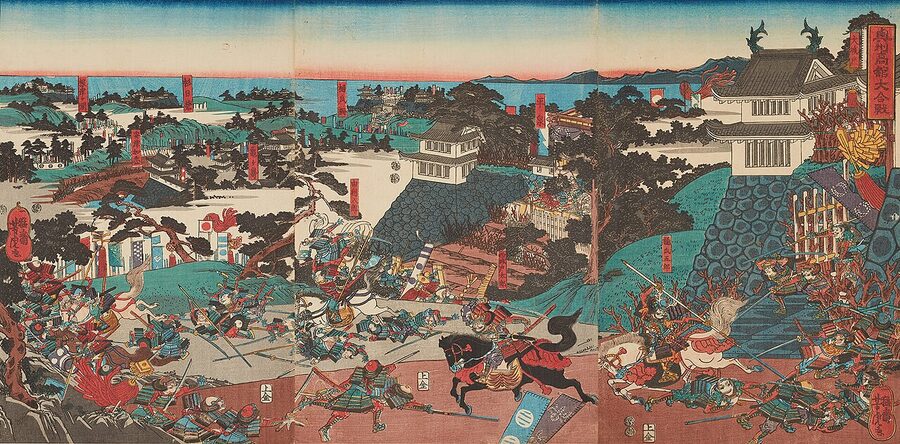
The Gikeiki gives a fuller and much more theatrical version, and nearly all of it is invention. In its account Benkei holds the door alone, arrows bristling from his body, and dies on his feet without falling: the “standing death”, Benkei no tachi-ōjō, which is now a Japanese expression for being stuck and unable to move. Yoshitsune cuts himself open with a short blade, his wife kills herself, and an old retainer kills the children (two of them in the Gikeiki, against one daughter in the Azuma Kagami) and sets the house on fire. English accounts usually say he committed seppuku; the chronicles only say he killed himself, and the details come from the later book.
A head in sake
His head was put in sake, sealed in a black lacquer box and carried south, forty-three days on the road. On the 13th day of the sixth month of 1189 it was inspected on the beach at Koshigoe, a short walk from the temple where he had waited four years earlier, by Wada Yoshimori and Kajiwara Kagetoki himself. The Azuma Kagami, which had spent pages condemning Yoshitsune, says that everyone who looked at it wept.
It did Yasuhira no good. Yoritomo now said that sheltering a rebel for so long was worse than rebellion, and in the seventh month he marched north himself. Yasuhira abandoned Hiraizumi and set fire to it as he fled, and on the 3rd day of the ninth month he was killed by his own retainer Kawada Jirō, who brought the head in and was beheaded for his treachery. Yasuhira’s head was nailed up through the forehead with a spike some 24 centimetres long, following the precedent of a northern rebel’s head more than a century before.
Hiraizumi got it back. In 1950 a scientific team opened the coffins in Chūson-ji’s Golden Hall and found, beside the mummified bodies of the first three Fujiwara lords, a head in a lacquered bucket, long labelled as his younger brother Tadahira’s, with a hole through the skull that matched the chronicle’s spike. Lotus seeds found in the bucket were coaxed into flower in 1998, and their descendants flower in the temple grounds in summer.
The legend that outgrew him
By the middle of the Kamakura era the rehabilitation had already started, and in a strange place. The Azuma Kagami records that in 1248 the regent Hōjō Tokiyori dreamed that Yoshitsune and Yasuhira had been destroyed for Yoritomo’s private grudge, not as enemies of the throne, and hurried the repair of the temple Yoritomo had built to calm their ghosts. The historian Uwayokote Masataka argued that the chronicle’s sympathy for Yoshitsune, and its spite towards Kajiwara and Yoritomo, served the Hōjō: they had taken power from Yoritomo’s line, and a hard, ungrateful Yoritomo made their case for them.
Then came the stories. The Gikeiki, eight books long and assembled in the Nanbokuchō period or early Muromachi era, is the first life of Yoshitsune, and it spends almost nothing on the war that made his name. It gives you the childhood and the flight, the tengu, Benkei, Shizuka and the last stand, the parts where no record could contradict it. The Noh stage took some thirty plays from his life and the kōwakamai ballad-dancers another nineteen, and he was so popular that, the joke went, he could walk on in a play that had nothing to do with him, say his name, and leave.
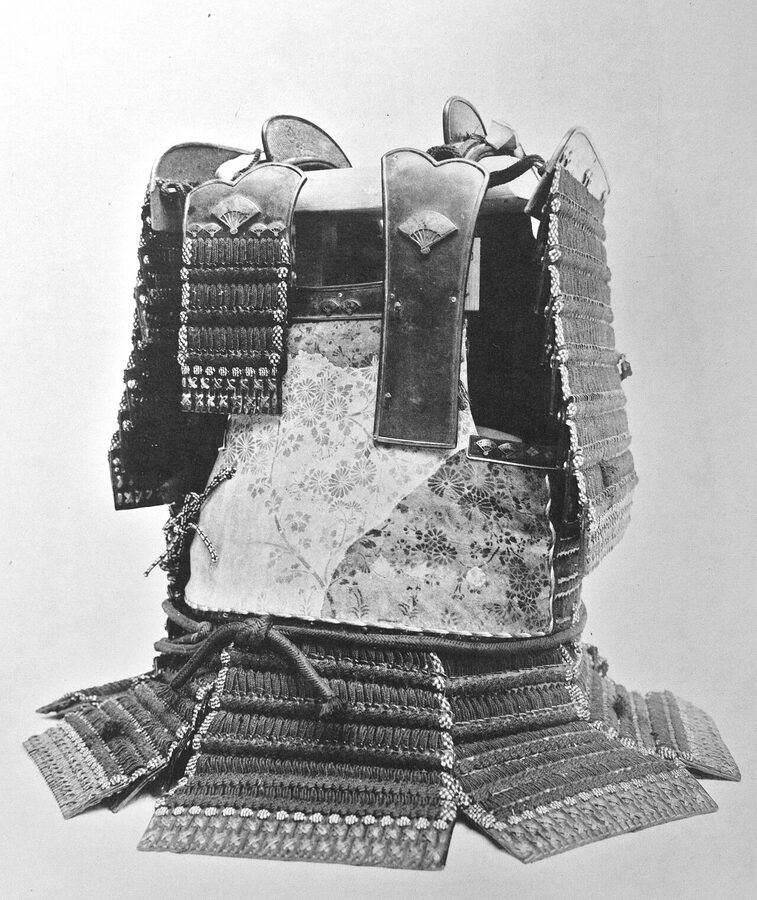
Hōgan-biiki
The legend made its own word. Hōgan-biiki (判官贔屓), “favouring the Hōgan”, means instinctive sympathy for the losing side, and it was in print by 1638, in a haiku in the anthology Kefukigusa. Japanese still use it of anyone who backs the underdog. Notice the reading: the office is normally pronounced hangan, but for Yoshitsune, and only for him, the tradition says hōgan.
I should say where I stand. I think Yoshitsune was a fast, brave and ruthless commander, a better tactician than any of his relatives, who also did a competent civil job in Kyoto, and who had no feel at all for the politics that killed him.
If you want the standard argument about whether he deserves his place, see where he lands in Japan’s greatest samurai. What strikes me is how little of the legend has anything to do with any of that. The Edo era audience did not weep over Ichi-no-tani; they wept over a beaten man and his loyal monk, and I suspect later writers on bushido found Benkei more useful than the master he died for.
North to Ezo
Not everybody accepted that he died. By the Edo period a story had grown up that he escaped from Koromogawa and went north across the strait to Ezo, modern Hokkaido. The seed was probably a Muromachi tale, Onzōshi Shima-watari, in which the young Yoshitsune visits a fabulous northern island, and the shogunate’s official history, the Zoku Honchō Tsugan compiled by the Hayashi family of Confucian scholars, wrote it in: some say he did not die at Koromogawa but reached Ezo, and his descendants survive there.
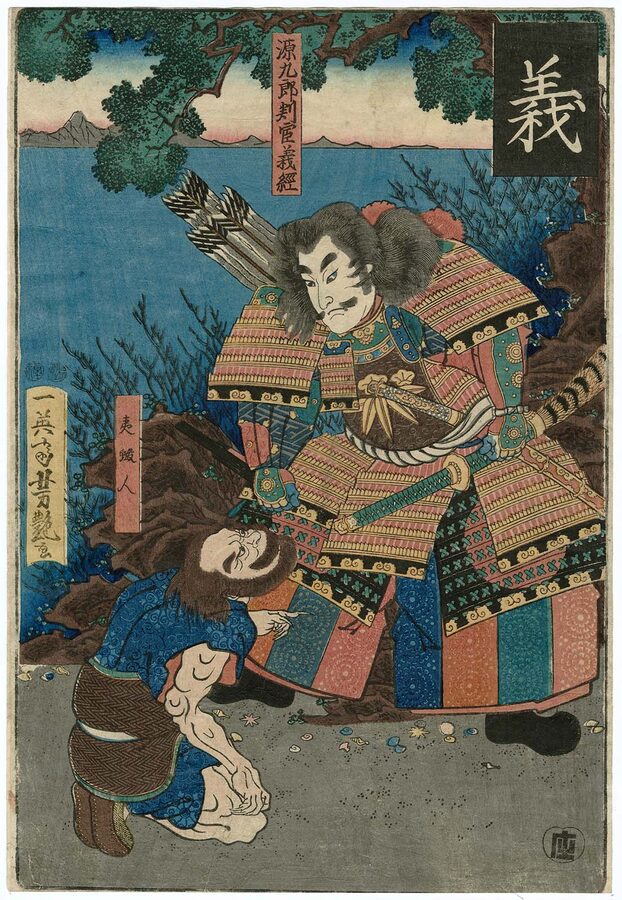
Place names along the Tsugaru coast in northern Honshu were explained by the legend (Minmaya, “three stables”, is where he is supposed to have tethered three horses before crossing). In 1799 a Yoshitsune Shrine was founded at Biratori, in Ainu country on the Saru River. And the legend was put to work in assimilation policy, which declared that the Ainu culture-hero Okikurumi was really Yoshitsune and his companion was Benkei, a way of folding Ainu belief into a Japanese story.
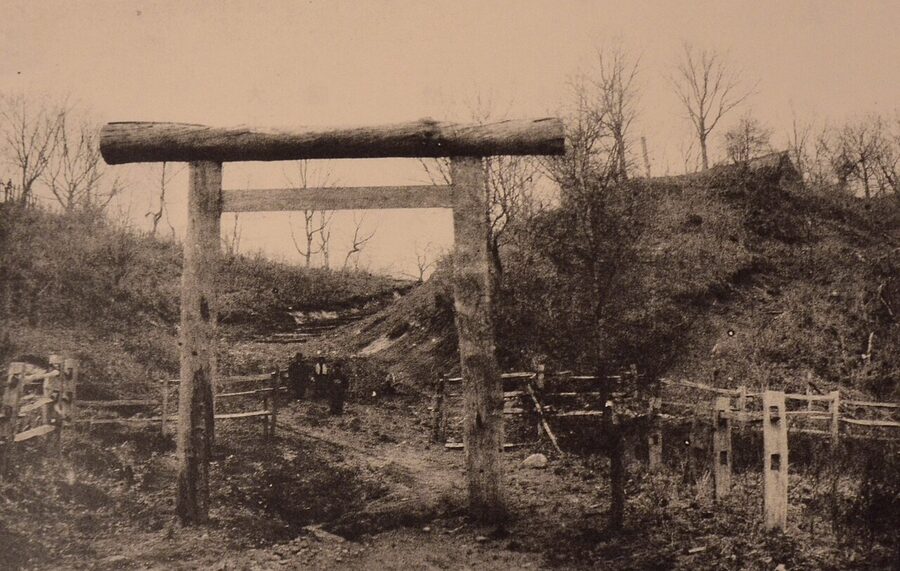
And then he became Genghis Khan
The Meiji era finished the job. In 1879 Suematsu Kenchō, a young Japanese diplomat studying at Cambridge, wrote a thesis arguing that Genghis Khan was Minamoto no Yoshitsune, who had crossed from Ezo to the mainland. Translated and published back home, it caused a stir.
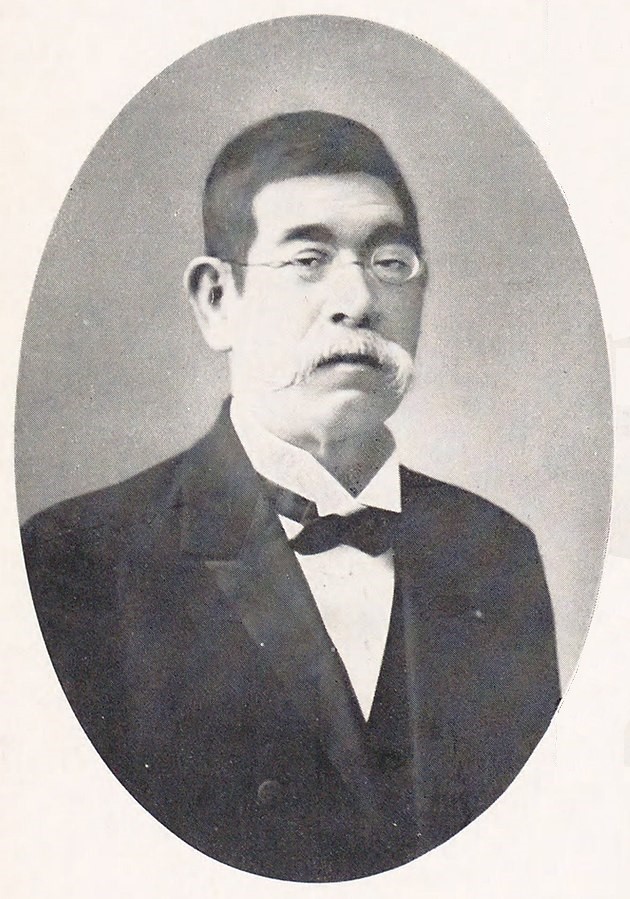
The book that made the theory famous came in 1924, in the Taishō era: Oyabe Zen’ichirō’s Genghis Khan Was Minamoto no Yoshitsune, written after a trip through Manchuria and Mongolia, which became a best-seller and stayed in print through the early Shōwa years. Its popularity tells you less about Yoshitsune than about a country pushing onto the continent.
Genghis Khan’s birth, parentage and career are known from Mongolian sources, and the idea has been rejected by every serious historian since it appeared. It is a legend. It is a good one, though, and I can see why it lasted.
Where to see Yoshitsune today
His places are scattered across a thousand kilometres, but they fall into three easy clusters: Kurama and the Kamo River in Kyoto (a day), Koshigoe and Fujisawa on the Shōnan coast near Kamakura (half a day), and Hiraizumi in Iwate (a day, two if you want Mōtsū-ji’s garden as well). For how he fits into the longer story, Japan through the ages is a useful map, and the Heian era guide explains the world he was born into.
Kurama-dera, Kyoto
Kurama-dera (鞍馬寺) sits on the south face of Mount Kurama, at the end of the Eizan Railway’s Kurama Line, about thirty minutes from Demachiyanagi. From Kurama Station it is a three-minute walk to the main gate. Admission to the mountain is ¥500 for high-school age and up, and the halls are open roughly 9:00–16:15. The temple runs its own funicular from the gate to the pagoda (a ¥200 “donation” each way, last car up at 16:20), but walk the switchbacks if you can; they are the same zigzag path Sei Shōnagon listed, a thousand years ago, among things that are near and yet far.
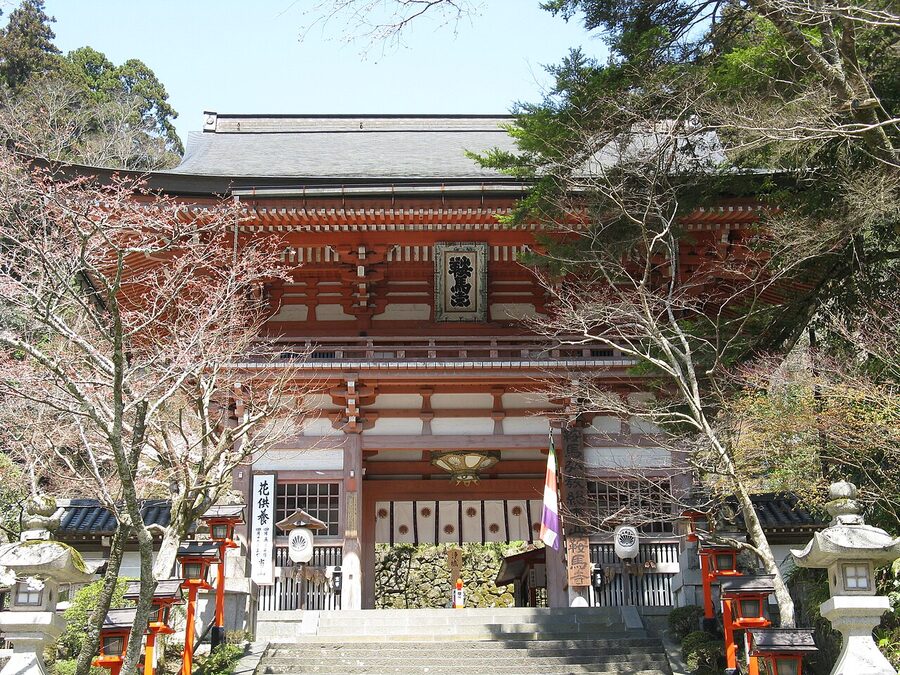
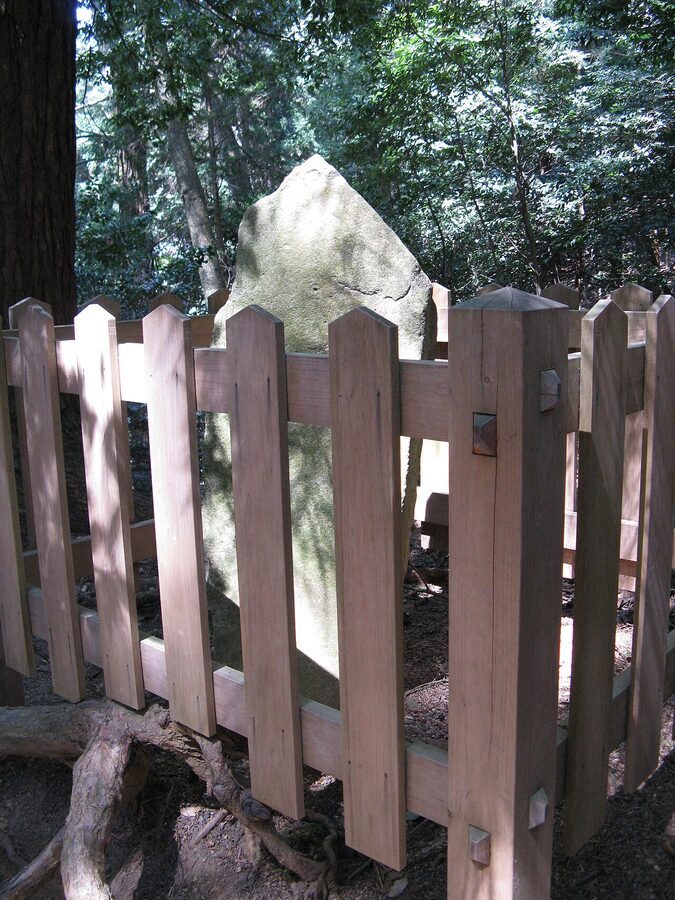
The first Yoshitsune site is on the switchback path below the main hall, where a memorial tower put up in 1940 marks the site of Tōkōbō, the lodging where tradition says he lived. The rest are above the hall, on the path through the cedar forest to the inner sanctuary. First comes a spring where he is supposed to have stopped for breath on his night runs to meet the tengu, then the stone he measured himself against before leaving for the north.
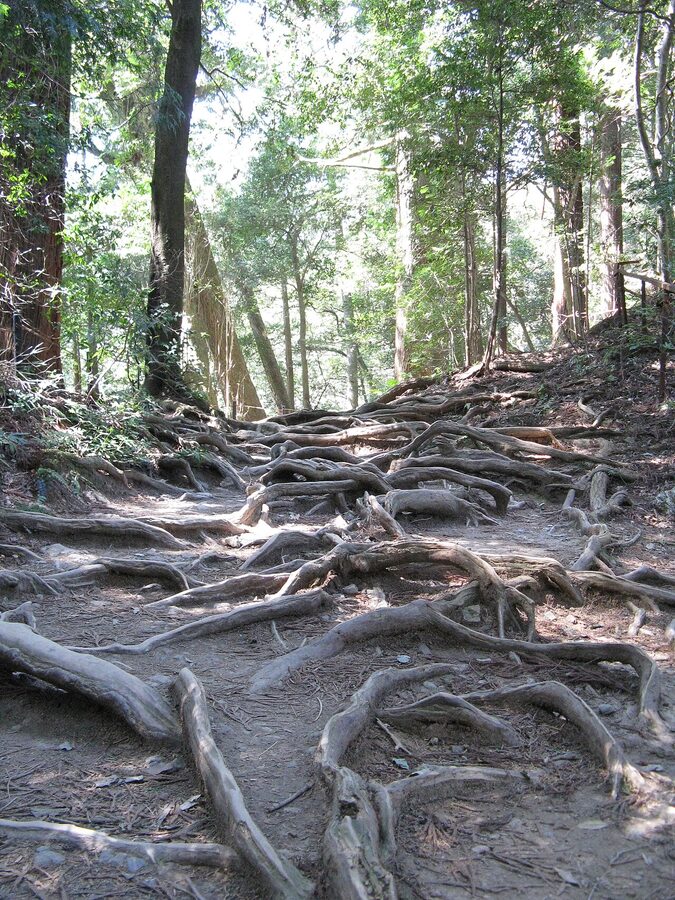
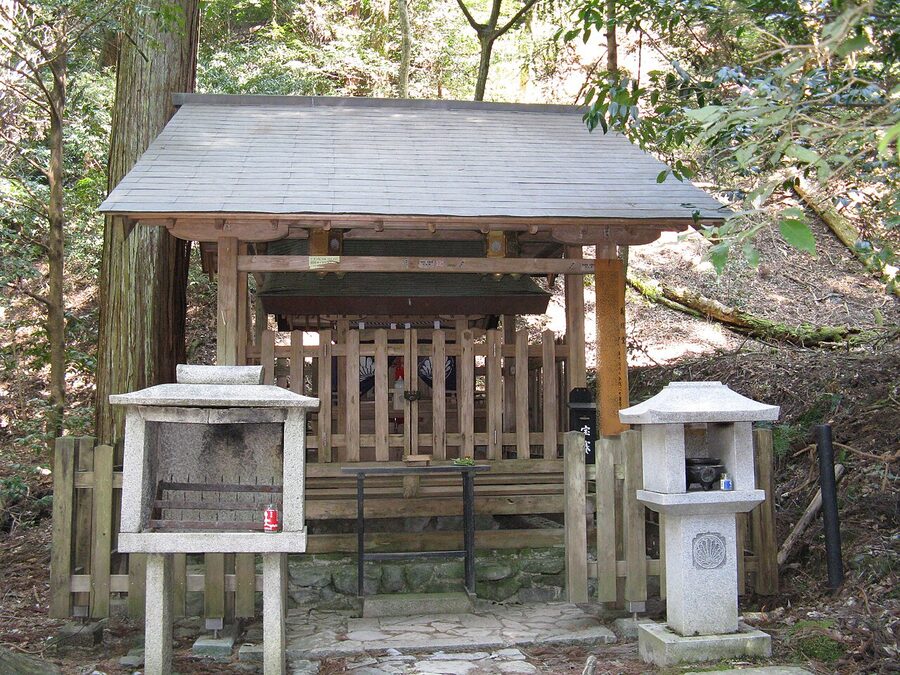
Past the stone, the trail crosses the Ki-no-ne michi, a stretch where cedar roots run across the ground like a net because the bedrock is too hard for them to sink into, and where Ushiwaka is said to have practised his footwork. Then comes Sōjō-ga-tani, the valley of the tengu king, with a small hall where the temple enshrines his spirit as Shanaō-son.
The path carries on over the ridge past the Maō-den and down the far side to the west gate and Kibune; allow about fifty minutes from the main hall to Kibune Shrine, and expect the steepest stretch between the Maō-den and the west gate. The Reihōden museum near the main hall (¥200, 9:00–16:00) closes on Tuesdays and from 12 December to the end of February. Check the temple’s own site before you go, because the funicular stops for inspections a few days each year.
Gojō Ōhashi and Matsubara-bashi, Kyoto
The Ushiwaka statue is at the west end of Gojō Ōhashi, on the bridge’s approach from Kawaramachi, a two-minute walk from Kiyomizu-Gojō Station on the Keihan line. It is free, it takes thirty seconds, and you will probably pass it anyway on the way up Gojō-zaka to Kiyomizu-dera.
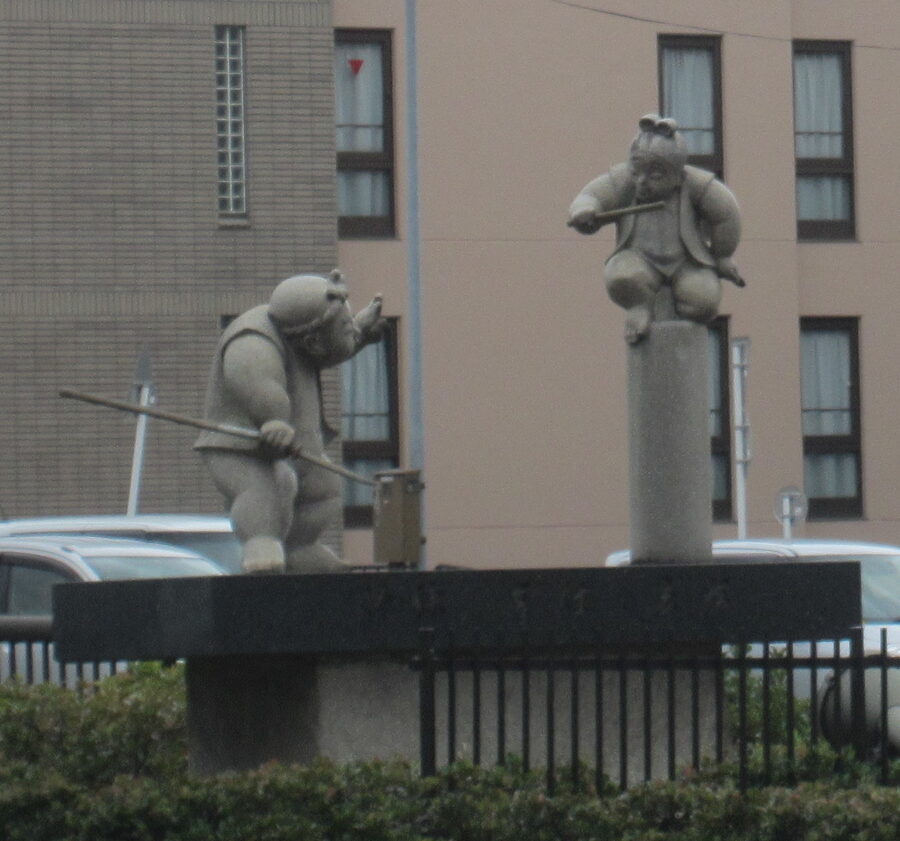
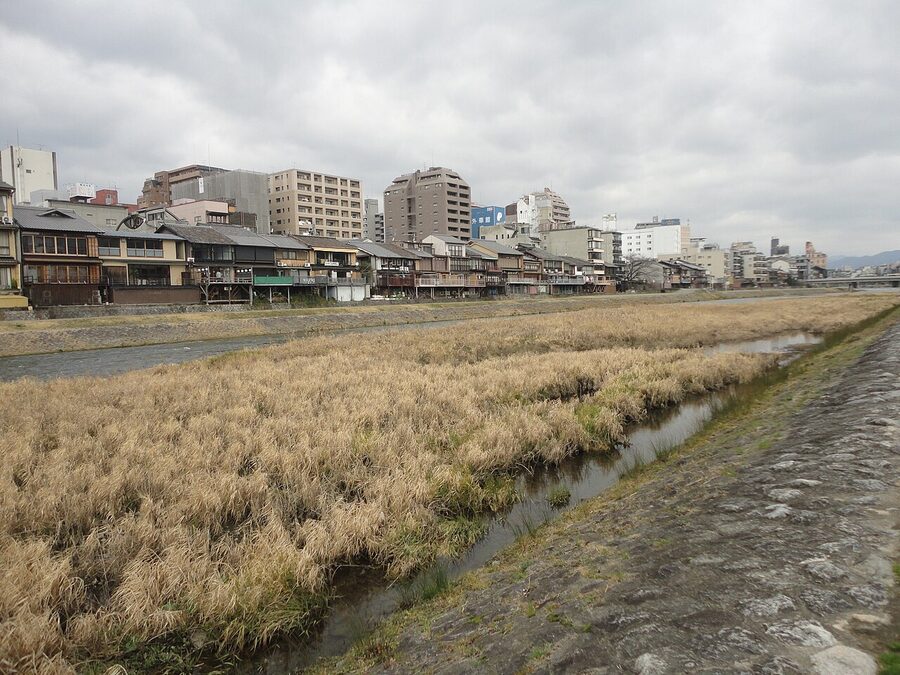
The bridge here dates from 1959, and it is not where the old one stood. In the Heian period, Gojō avenue was what is now Matsubara-dōri, one block north, and in 1590 Toyotomi Hideyoshi moved the crossing south to serve his Great Buddha at Hōkō-ji. If you want the site the Meiji storytellers meant, walk upstream to Matsubara-bashi. Some say the bridge in the story spanned a small stream near the Gojō Tenjin shrine rather than the Kamo at all.
Mampuku-ji, Koshigoe
Mampuku-ji (満福寺) is a three-minute walk from Koshigoe Station on the Enoden line, the little railway between Fujisawa and Kamakura, which runs past the temple steps at street level. It opens 9:00–17:00, and entry is ¥200 for adults and ¥100 for middle-school pupils. The temple says it was founded by the monk Gyōki in 744, and it is not shy about its famous guest: its crest is the bamboo-and-gentian of the Minamoto.
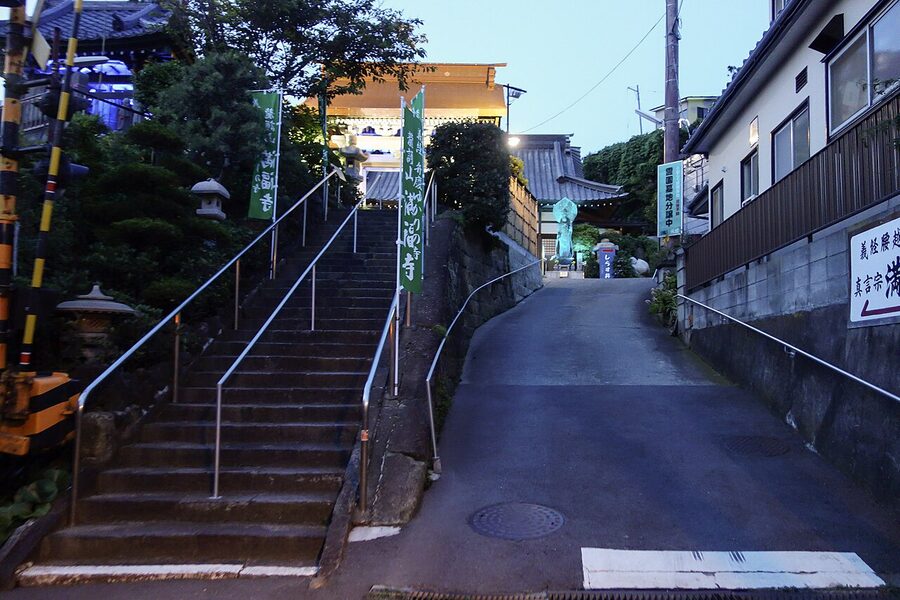
Inside you will find a draft of the Koshigoe letter attributed to Benkei, a pond whose water he is said to have used for the ink, a stone he sat on and another he juggled, and a set of sliding-door paintings of Yoshitsune’s life. You will by now know my view of the letter. Go anyway; it is a pleasant, unpretentious temple, and on the third Saturday of April it holds a Yoshitsune festival.
Shirahata Jinja, Fujisawa
The head went one stage further. Shirahata Jinja (白旗神社) in Fujisawa enshrines Yoshitsune as one of its two gods, and the story is that after the inspection at Koshigoe his head, and Benkei’s, came up the river by night and arrived here; one Edo-period guidebook has them riding on a golden turtle, laughing. It is a seven-minute walk from Fujisawa-Honmachi Station, one stop from Fujisawa on the Odakyū Enoshima Line, and entry is free.
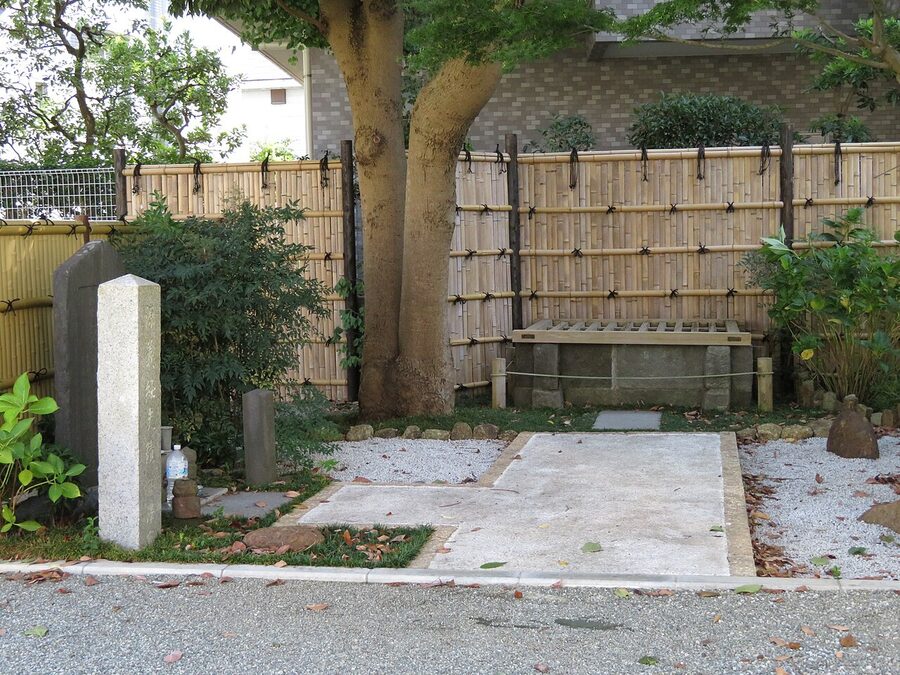
The shrine dates its enshrinement of Yoshitsune to 1249. In 1999 it held a ceremony to reunite the head with the body, which another tradition buries at Kurikoma in Miyagi, and it marks the 13th of June each year, the anniversary of the inspection. In early May its wisteria is worth the trip: white for Yoshitsune, pale purple for Benkei.
Hiraizumi: Takadachi Gikeidō
Hiraizumi is nine minutes by JR Tōhoku Line from Ichinoseki, which is on the Tōhoku Shinkansen. Takadachi Gikeidō (高館義経堂), on the hill traditionally identified as the site of the Koromogawa residence, is about twenty minutes’ walk from Hiraizumi Station. It opens 8:30–16:30 (16:00 from 5 to 20 November), and closes completely from 21 November to the end of February, so check the calendar before a winter trip. Entry is ¥300 for adults and ¥100 for children.
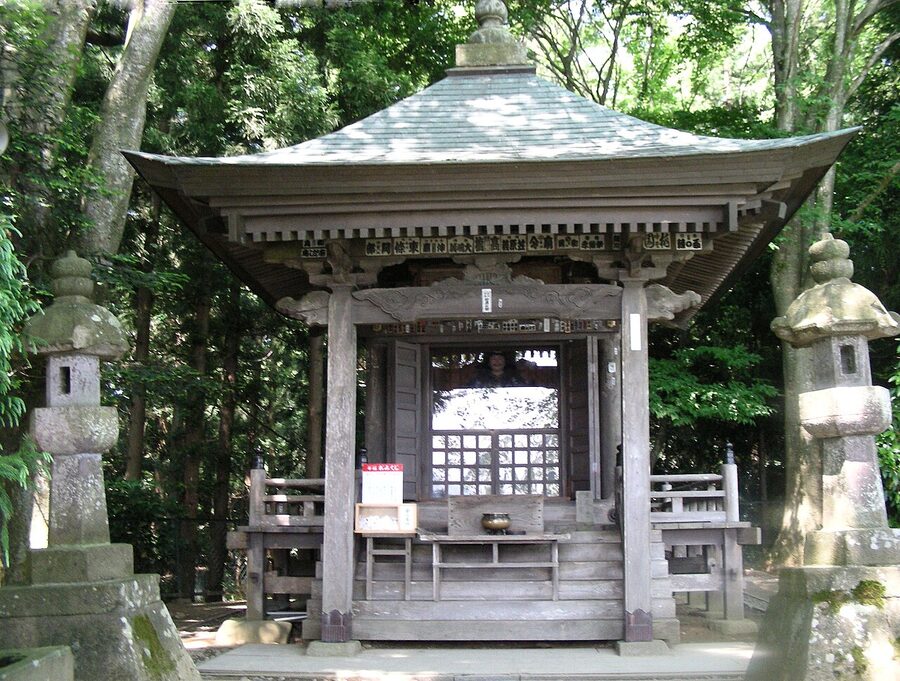
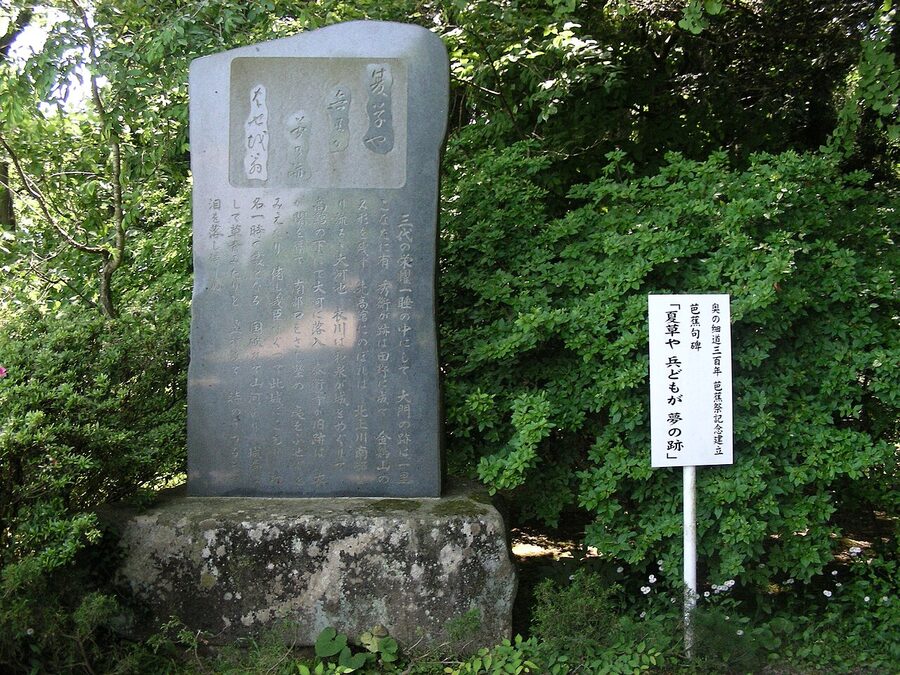
The view is the reason to come. The Kitakami River runs below the hill to the east, with Mount Tabashine beyond it, and the Koromo River joins from the west. Matsuo Bashō stood here on the 13th day of the fifth month of 1689 and wrote one of the best-known haiku in the language, about summer grasses and the dreams of warriors. One caveat about the location: an excavated site at Koromogawa in Ōshū city has also been proposed as the real residence.
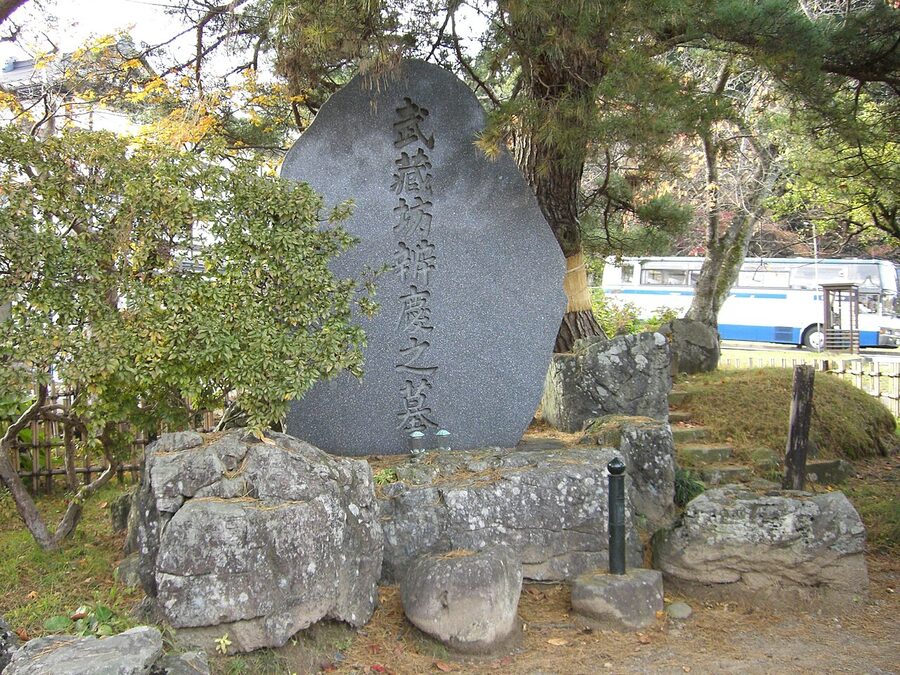
Hiraizumi: Chūson-ji and Benkei’s grave
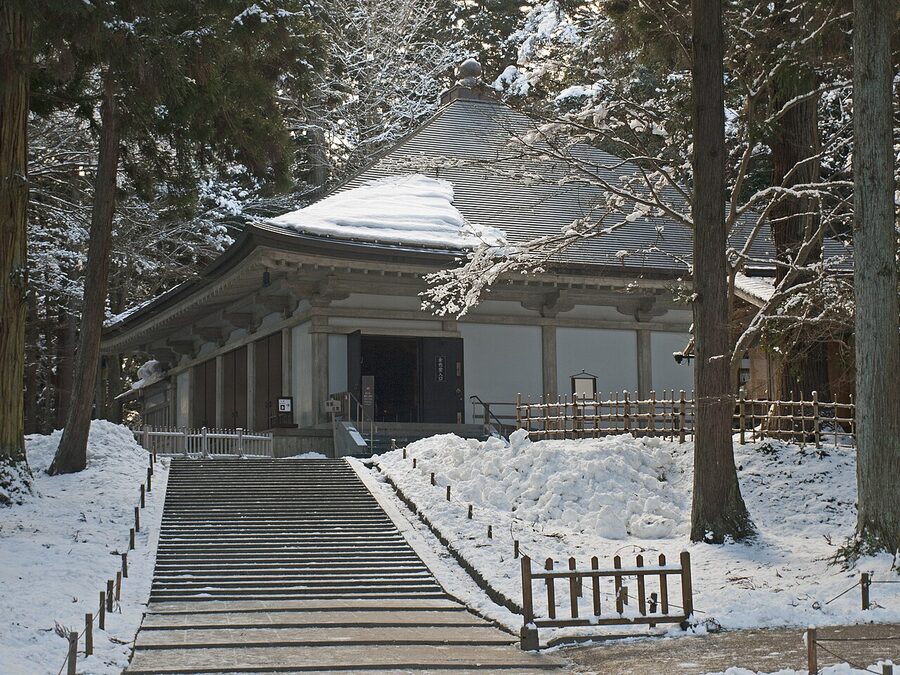
Chūson-ji (中尊寺) is a little over a kilometre from Hiraizumi Station along the road named after it, or a few minutes on the Runrun loop bus. It opens 8:30–17:00 from 1 March to 3 November and 8:30–16:30 for the rest of the year, and the common ticket to the Golden Hall and the Sankōzō treasure house is ¥1,000 for adults. The steep cedar avenue up the hill is Tsukimizaka, the “moon-viewing slope”.
At the top, the Golden Hall stands inside a concrete protective building, gilded inside and out, and under its altars lie the mummified bodies of the first three Fujiwara lords, including Hidehira, and the head of Yasuhira, the son who broke his father’s promise. Up the slope is a small hall called Benkei-dō. Mōtsū-ji, which looks after the Gikeidō, is a separate visit with a separate ticket, and its Heian garden is one of Japan’s greatest gardens.
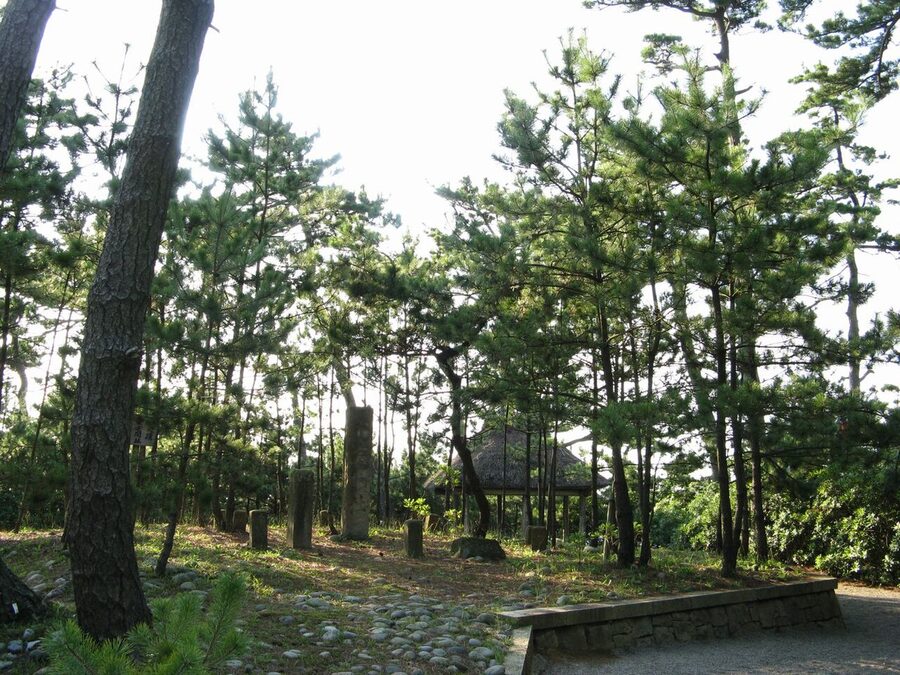
Ataka, Komatsu
If you are on the Japan Sea coast, the Ataka barrier site (安宅の関) is in the pine woods of Ataka Sumiyoshi Shrine on the coast at Komatsu in Ishikawa, a short bus or taxi ride from JR Komatsu Station. It has been a prefectural historic site since 1939. The statues of Benkei and Togashi beside it were modelled on two 20th-century kabuki actors, Matsumoto Kōshirō VII and Ichikawa Sadanji II, which seems to me the right choice for a barrier that may only ever have existed on stage.
If you only see one place, make it the hill at Hiraizumi, and go up to the hall. The man inside is a carved warrior in full armour, gallant and upright, everything the Taira gossip said he was not. Stand there a minute, think of the short pale soldier with the buck teeth who actually died on this hill, and then go out and look at the river, which, unlike everything else in this story, is exactly where it was.