The builders took the covers off the keep of Tsuruga Castle in the first week of March 2011, and Aizu-Wakamatsu looked up at a roof it had not seen since 1874. The tiles were a dull, glazed red, somewhere between brick and rusted iron, the colour the castle had been when the imperial army’s guns on Odayama spent a month trying to knock it down. Two days later the Great East Japan Earthquake shook the whole of Tōhoku. The keep reopened on 27 March, in a prefecture whose name had just become shorthand for a nuclear accident, and the red roof has been the town’s way of saying it is still here ever since.
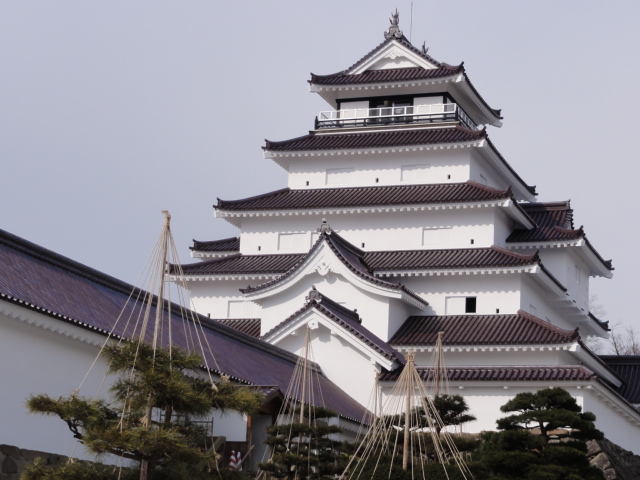
That is Aizu all over. Its castle has been built, renamed, shaken half down by an earthquake, rebuilt, besieged, surrendered, stripped and sold off, bought back for ¥2,500, used as a bicycle-racing track and rebuilt again in concrete. Through all of it the place has carried one idea, written down in 1668 by a shogun’s half-brother: that the house of Aizu serves the Tokugawa first, last and without conditions. I think that idea is the most admirable and the most destructive thing in the castle’s story, and it is the reason you should go.
This is the story of the castle Gamō Ujisato built and the lords who followed him, of the creed Hoshina Masayuki wrote, and of Matsudaira Katamori, the man who followed it into ruin. It runs from the last years of the Sengoku era to the first months of the Meiji era, three centuries of Japanese history inside one set of walls. And it ends, as these things should, with where you can stand today.
In This Article
- A crane on the Kurokawa plain
- The name and the keep
- A fugitive and a small room
- Uesugi, an earthquake and the Katō rebuild
- The half-brother and the first article
- The man who would not rebuild Edo’s keep
- Fifteen articles
- Raising boys for it
- Firewood on your back
- Kurodani, the Shinsengumi and the emperor’s letters
- The ship out of Osaka
- Thirty days in the autumn of 1868
- The Saigō house
- The boys on Iimoriyama
- Naginata, and one Spencer rifle
- The siege
- Taking the castle down, and putting it back
- Is it worth it if it is concrete?
- Where to visit Tsuruga Castle and Aizu today
- Tsuruga Castle
- Iimoriyama
- The samurai district and the Bukeyashiki
- The domain school
- Graves and temples
A crane on the Kurokawa plain
Before it was Tsuruga, the castle was Kurokawa, a fortified residence that the Ashina clan began in 1384 on the south-eastern edge of the Aizu basin. The Ashina held it for two centuries, until Date Masamune beat them at Suriagehara in 1589 and moved in (his side of the story is in the Date Masamune file). He kept it for about a year. In 1590 Toyotomi Hideyoshi, newly master of Japan, took Aizu away from Masamune, who had seized it in open defiance of Hideyoshi’s ban on private wars.
Aizu was the cork in the bottle of the north, and whoever held it was there to watch Masamune. The first choice, by some accounts, was Hosokawa Tadaoki, who declined. The man who went instead was Gamō Ujisato.
Ujisato was born in 1556 at Hino in Ōmi province, and at twelve he was handed to Oda Nobunaga as a hostage. Nobunaga, according to the clan chronicle, looked at the boy, decided his eyes were not ordinary and announced he would make him a son-in-law; he married him to his daughter. (One Japanese reference work calls her Nobunaga’s sister, which tells you how messy the genealogies get.) Under Hideyoshi he fought at Komaki-Nagakute in 1584, received Matsugashima in Ise, built the town of Matsusaka, and was baptised into the Christian faith under the name Leon.
He arrived with a fief of 420,000 koku that later surveys pushed past 900,000 (the dictionaries disagree on both numbers), which made him one of the largest landholders in Japan, a few days’ ride from the most dangerous one.
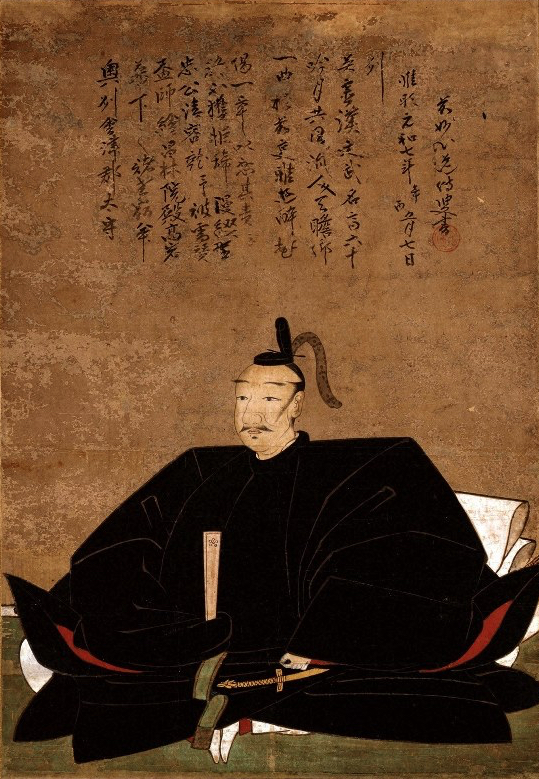
He rarely makes the lists of Japan’s greatest samurai, which I think is a mistake. At Odawara he is said to have fought off a night attack alone in borrowed armour, and in the field he wore a tall silver helmet called the catfish tail, one of the odder pieces of samurai armour on record. Rikyū called him one of the one or two great lords in Japan who mastered both the sword and the arts.
The name and the keep
In 1592 Ujisato tore into Kurokawa and rebuilt it with stone walls and wet moats, the first true early-modern castle in the region, and he renamed the town. Wakamatsu, “young pine”, came from a grove by the clan shrine back home in Hino; the same pine is said to sit inside the name of Matsusaka. In 1593 the keep was finished, and the castle was given a new name too: Tsuruga-jō, the castle of the crane.
Nobody has left a satisfying explanation of the crane. Ujisato’s childhood name was Tsuruchiyo, “crane of a thousand generations”, and the Gamō family crest was a standing crane until he changed it after coming north. I find it hard to believe that is a coincidence, but I have not seen a document that says so, and neither, I suspect, has anyone else.
The keep itself is a puzzle. Japanese sources call it “seven-layered”, which might mean seven storeys, five over two basements, or just “many-tiered”; English-language accounts say seven storeys with gold-leaf tiles in the manner of Hideyoshi’s Osaka Castle. Excavation has at least confirmed the gold: fragments of gilded eave tiles from the Gamō years have come out of the ground.
A fugitive and a small room
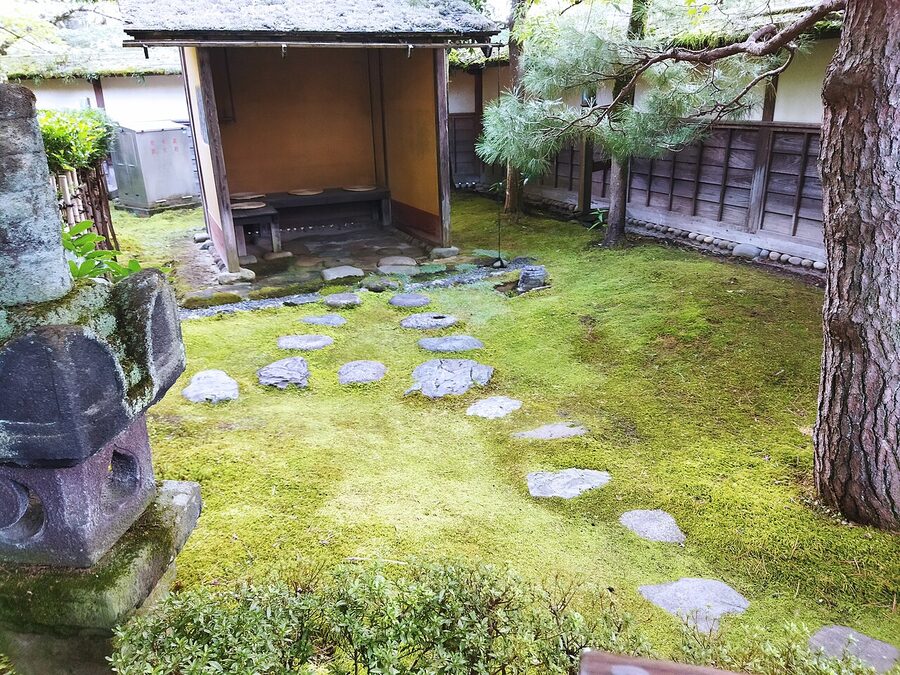
Ujisato’s other contribution to the castle is the one I like best. In 1591 Hideyoshi ordered Sen no Rikyū to kill himself, and Rikyū’s son Shōan had every reason to expect to follow. Ujisato, counted first among Rikyū’s seven great disciples, took Shōan into Aizu and kept him there for about a year and a half, and together with Tokugawa Ieyasu he petitioned Hideyoshi to let the Sen family recover. It worked: Shōan went back to Kyoto, and every school of the tea ceremony that descends from Rikyū runs through him.
The tea house Shōan is said to have built while he waited is called Rinkaku, and it is still in the honmaru. A tea master named Morikawa Zenbei saved it after the castle fell by moving it to his own garden in 1872, and the city brought it home in 1990. You can drink a bowl of matcha beside it, which seems the right way to honour a man who risked Hideyoshi’s temper for a friend’s son.
Ujisato did not enjoy any of it for long. He fell ill at Nagoya in Hizen in 1593, while the army was crossing to Korea, and died at his Fushimi mansion early in 1595, aged forty by the Japanese count. Rumour blamed poison, from Hideyoshi in one chronicle and from Ishida Mitsunari in another, but the case notes of his physician Manase Gensaku describe three years of swelling and fluid in the abdomen, and most modern readers think it was cancer. His death poem is better than either rumour.
Kagiri areba / fukanedo hana wa / chiru mono wo / kokoro mijikaki / haru no yamakaze. There is a limit, and the blossoms fall even when no wind blows; so why, spring wind off the mountains, are you in such a hurry?
Uesugi, an earthquake and the Katō rebuild
Ujisato’s son Hideyuki was too young to hold the north, and in 1598, after a feud among his senior retainers, he was moved to Utsunomiya on a fraction of the income. Into Aizu came Uesugi Kagekatsu, adopted heir of Uesugi Kenshin, with 1.2 million koku. Kagekatsu began a second, bigger castle at Kōzashi on the edge of town, and its unfinished earthworks were among the grievances Ieyasu cited when he marched north against him in 1600.
That march ended at Sekigahara. Kagekatsu was cut down to 300,000 koku at Yonezawa, and in 1601 the Gamō came back under Hideyuki. Then, in 1611, an earthquake centred on the Aizu basin brought down stretches of the stone walls and left the keep leaning. In 1627 Hideyuki’s heir died young and childless, the next brother was moved to Iyo Matsuyama, and the man sent the other way was Katō Yoshiaki.
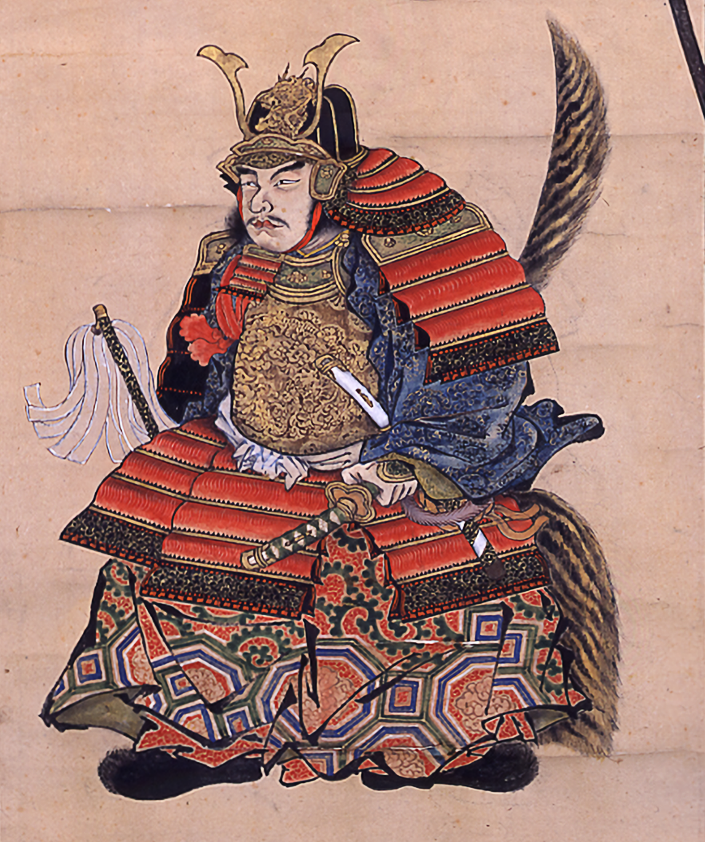
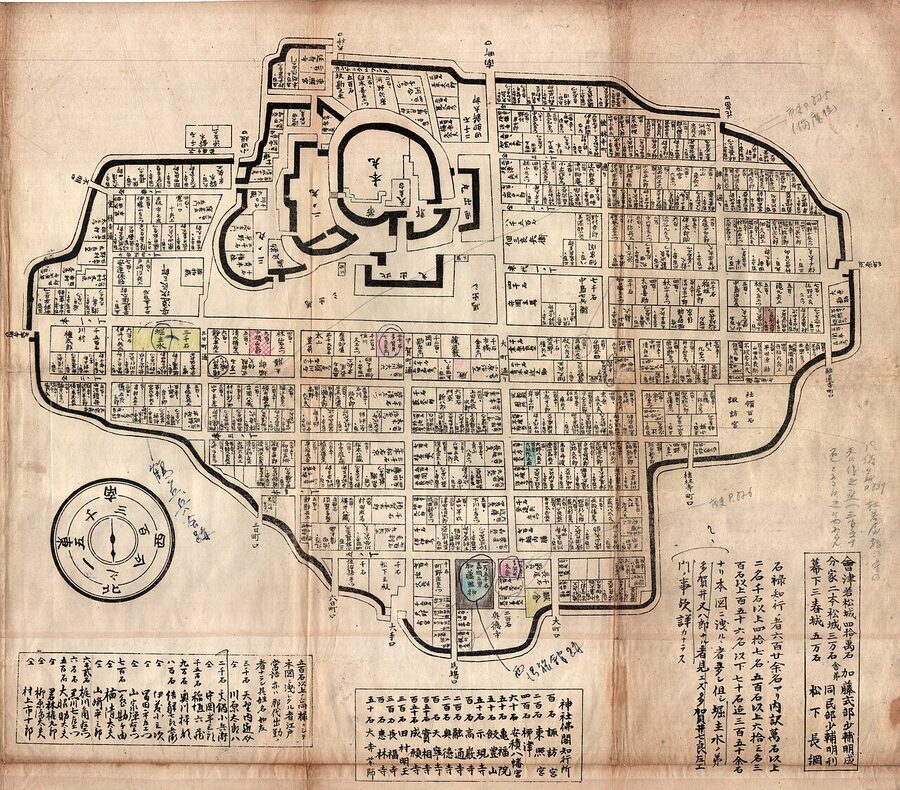
Yoshiaki had been one of the Seven Spears of Shizugatake, the young retainers who made their names in Hideyoshi’s victory over Shibata Katsuie in 1583, and he came from Iyo Matsuyama, where he had built a castle of his own. He and his son Akinari rebuilt Wakamatsu between 1627 and 1639. They turned the main approach to face north, enlarged the northern and western outworks into proper bastions, and replaced Ujisato’s lookout-style keep with the five-storey layered keep whose outline you see today.
English-language accounts often say the keep was rebuilt straight after the 1611 earthquake; the Japanese record, and the castle’s own chronology, put the rebuild in the Katō years and finish it in 1639. The northern outwork, where anyone attacking from the north had to cross ground watched from three sides and from above, earned a grim nickname: minagoroshi-maru (鏖丸), the kill-everyone bailey. In 1868 it lived up to it.
The half-brother and the first article
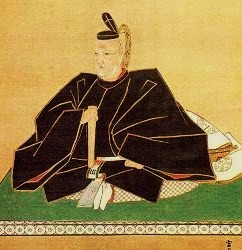
Hoshina Masayuki was the son the second shogun was not supposed to have. Tokugawa Hidetada fathered him in 1611 on a maid in his old wet-nurse’s household, and to keep the boy clear of Hidetada’s formidable wife he was raised in secret, first by Takeda Shingen’s daughter Kenshōin and then by Hoshina Masamitsu, lord of tiny Takatō in Shinano. His half-brother, the third shogun Iemitsu, is supposed to have found out he existed from a temple priest in Meguro who did not know whom he was talking to.
Iemitsu took to him. Masayuki went from 30,000 koku at Takatō to 200,000 at Yamagata in 1636 and 230,000 at Aizu in 1643, with the shogunate’s own lands in the mountains of southern Aizu thrown in to manage. When Iemitsu was dying in 1651, he had himself held upright to speak to Masayuki: “Higo (his court title), I leave the main house to you.” Masayuki spent the next two decades as guardian and senior adviser to the boy shogun Ietsuna.
The man who would not rebuild Edo’s keep
The detail that tells you most about Masayuki has nothing to do with Aizu. In 1657 the Meireki fire burned most of Edo, including the keep of Edo Castle, the biggest ever built in Japan. The stone base was rebuilt quickly, and then Masayuki argued that the keep itself should not be: keeps had started with Nobunaga at Gifu, he said, they did nothing for a castle’s defence but give a view, and the money was better spent on wider streets, firebreaks and a new bridge over the Sumida. The shogunate agreed, and Edo Castle never had a keep again.
Hold on to that, because the house he founded ended up defined by one. Masayuki’s real monuments were in his domain: a social granary that lent rice to farmers at low interest in bad years (Japanese sources give 1654 or 1655 for its start), a lifelong rice ration for anyone over ninety regardless of rank, a ban on retainers following their lord in death, and an end to the old Aizu punishments of slow burning and boiling. Japanese historians rank him with Tokugawa Mitsukuni of Mito and Ikeda Mitsumasa of Okayama as the three wise lords of the early Edo era.
He was also a rigid Confucian who leaned hard on rival schools and executed every leader of a peasant protest that crossed into his territory. Wise lords in the seventeenth century were wise in seventeenth-century ways. He died on the 18th day of the twelfth month of Kanbun 12, which is why sources variously give 1672 or 1673; by the Western calendar it was 4 February 1673.
Fifteen articles
In 1668 Masayuki set down the Aizu house code, the Kakun Jūgokajō (家訓十五箇条), fifteen articles written with the influence of his Confucian teacher Yamazaki Ansai all over them. The first is the one that mattered. In my own translation: “Serve the shogun with single-minded devotion, and do not measure yourselves by the example of other domains. If a lord of this house should ever turn two-hearted, he is no descendant of mine, and you are not to follow him.”
Read that again with 1868 in mind. It makes the retainers the guardians of the lord’s loyalty rather than the other way round, and it leaves no way out: no clause for a shogun who has given up, none for an emperor who wants something else. Every lord of Aizu for two hundred years was raised on it, and the last one took it more seriously than any of them.
Raising boys for it
The code was taught early. From the age of six, boys of samurai families in the castle town were grouped by neighbourhood into a jū (什) under a nine-year-old leader, meeting every afternoon to recite the rules. The last of them is a line Aizu still puts on posters, naranu koto wa naranu mono desu, “what must not be done must not be done”: the local edition of bushidō, learned before the boys could write.
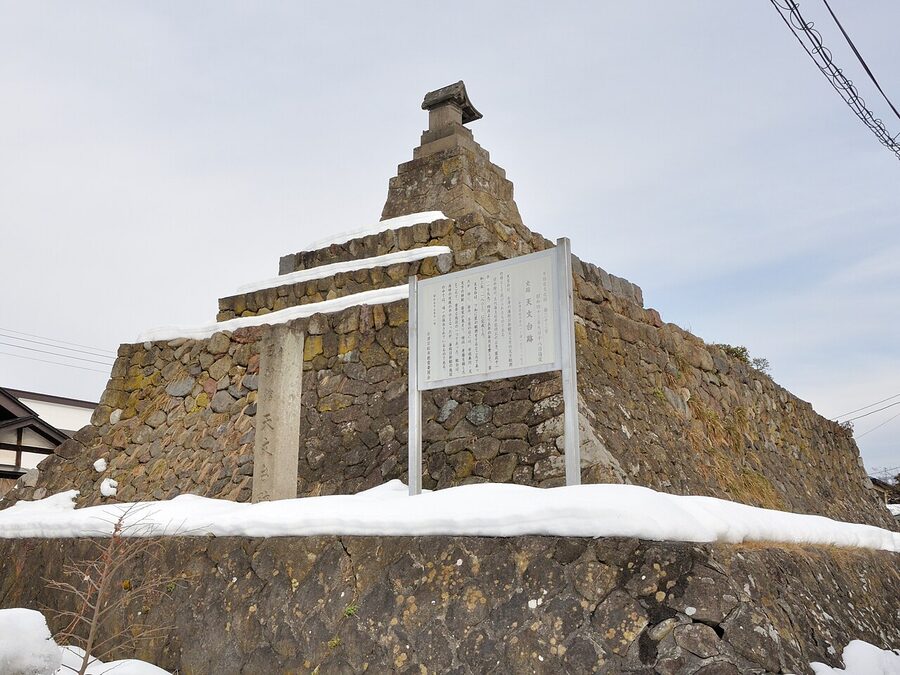
At ten, the sons of the upper ranks went on to the domain school, the Nisshinkan, founded in 1803 on the advice of the senior retainer Tanaka Gensai and built with money from a merchant. It stood just west of the castle, in a compound of roughly 220 by 110 metres, with a pool for swimming drill, an observatory and departments for medicine, mathematics, astronomy and court music. It produced the Byakkotai, and it burned in 1868.
Firewood on your back
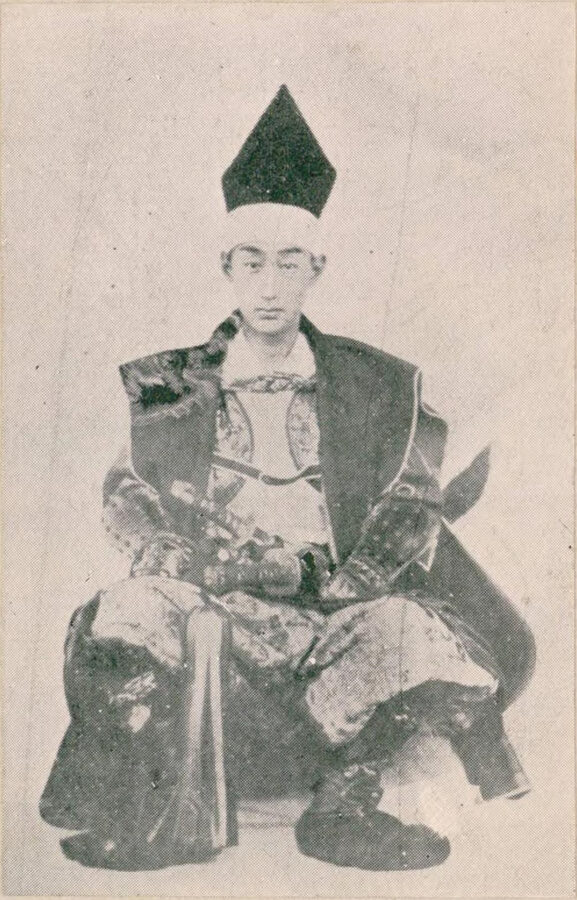
Matsudaira Katamori was not born in Aizu. He was a younger son of the lord of little Takasu in Mino, born in the family’s Edo mansion in February 1836 (the last month of 1835 by the old calendar), and adopted at ten by his uncle, the eighth lord of Aizu. Contemporaries remembered a beautiful, solemn boy, schooled very deliberately in Shinto, Confucian duty and the house code. He became lord in 1852, the year before the Black Ships, and Aizu was soon manning the new gun batteries in Edo Bay.
His brothers did well too: the four Takasu brothers ended up at the head of Owari, Hitotsubashi, Kuwana and Aizu, and on different sides of the coming war. In 1860, after Ii Naosuke was cut down outside the Sakurada Gate, Katamori talked the shogunate out of punishing Mito by force; two years later it repaid him by asking him to police Kyoto.
The post was Kyōto shugoshoku, Protector of Kyoto, created in 1862 for a capital where loyalist swordsmen were murdering officials and leaving heads by the river. Katamori was ill, and he refused, more than once. What broke him was Matsudaira Shungaku telling him that Hanitsu-kō, which is to say Hoshina Masayuki, would have accepted.
His senior retainers Saigō Tanomo and Tanaka Tosa came down from Aizu to stop him. Taking the post now, they told him, would be like carrying firewood on your back to put out a fire. Katamori answered that he had thought the same, but that the house had its founder’s instruction to rise and fall with the shogun, and that without them he could not do it at all. They wept, and agreed to make Kyoto the place where they would die.
Kurodani, the Shinsengumi and the emperor’s letters
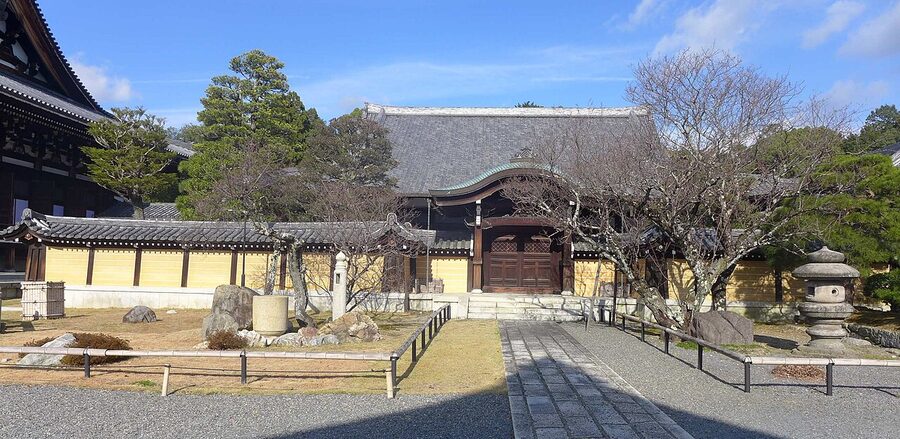
Katamori entered Kyoto at the end of 1862, to crowds that lined the road from Keage, and set up his headquarters in the temple of Konkai Kōmyō-ji on the hill at Kurodani. Within months he had a new instrument: a band of masterless swordsmen left behind at Mibu when the rest of their company went back to Edo, who petitioned to serve under Aizu. Katamori took them, and they became the Shinsengumi. Whatever you think of what they did over the next four years, they did it in Aizu’s name.
Emperor Kōmei liked him. When radical courtiers issued a forged order in 1863 to send Katamori back east, the emperor broke court custom and sent him a letter in his own hand, saying the order was false and that he relied on Aizu above anyone. After the coup of the 18th day of the eighth month that year drove the radicals and Chōshū out of the capital, Kōmei sent another letter and two poems praising Katamori’s loyalty. Katamori is said to have kept them close for the rest of his life.
He earned them in 1864, when Chōshū troops tried to fight their way back into the palace at the Hamaguri Gate. Katamori, sick enough that retainers had to hold him up by the shoulders, stood guard over the emperor for several nights in the palace grounds. Then, in the last days of 1866, Kōmei died suddenly, and Katamori lost the one patron in Kyoto who had always been on his side.
The ship out of Osaka
The end came quickly. Tokugawa Yoshinobu handed political power back to the court at Nijō Castle in late 1867, the court turned on him anyway, and at the start of 1868 the shogunate’s army, with Aizu men in its front line, was beaten at Toba and Fushimi south of Kyoto. On the night of the sixth day of the first month, Yoshinobu slipped out of Osaka Castle and onto the warship Kaiyō Maru, and took Katamori with him, without a word to the Aizu men still in the field.
It was almost certainly deliberate, to part Katamori from soldiers who would fight to the end for him, and Katamori never forgave himself. He resigned as head of the house, apologised to his men, and went home to wait, while the new government of the Meiji Restoration, run mostly by Satsuma and Chōshū, declared Aizu an enemy of the court. Chōshū in particular had five years of Kyoto grievances to settle.
The northern domains tried to broker a pardon and ended up in an alliance with Aizu instead. When a government envoy, Sera Shūzō, was murdered at Fukushima in the spring, the last door closed, and the Boshin War came north.
Thirty days in the autumn of 1868
Aizu had reorganised its army that spring on Western lines, by age. Men from eighteen to thirty-five made up the Suzaku, the Vermilion Bird; those from thirty-six to forty-nine the Seiryū, the Azure Dragon, for border defence; the over-fifties the Genbu, the Black Tortoise, as a reserve. The boys of sixteen and seventeen were the Byakkotai, the White Tiger corps, some three hundred of them, drilled in the French manner and armed with French rifles. With peasant levies, hunters, mountain ascetics and even a company of sumo wrestlers, Aizu fielded more than seven thousand.
Most of that strength was out on the borders when the blow came. On the 21st day of the eighth month (6 October 1868 by the Western calendar), government troops under Itagaki Taisuke of Tosa and Ijichi Masaharu of Satsuma broke through at Bonari Pass, the route Aizu had thought least likely. They covered more than forty kilometres in two days. Katamori rode out to the Takizawa post-house to organise a defence, with the second samurai-rank company of the Byakkotai as his escort.
The defence was at Tonoguchihara, by Lake Inawashiro, where Aizu tried and failed to pull down the stone bridge at Jūrokkyō. On the morning of the 23rd (8 October) the Tosa men laid planks across the gap and pushed through in the rain. By the time the Byakkotai had fallen back, government troops were in the castle town and the gates were closing.
The Saigō house
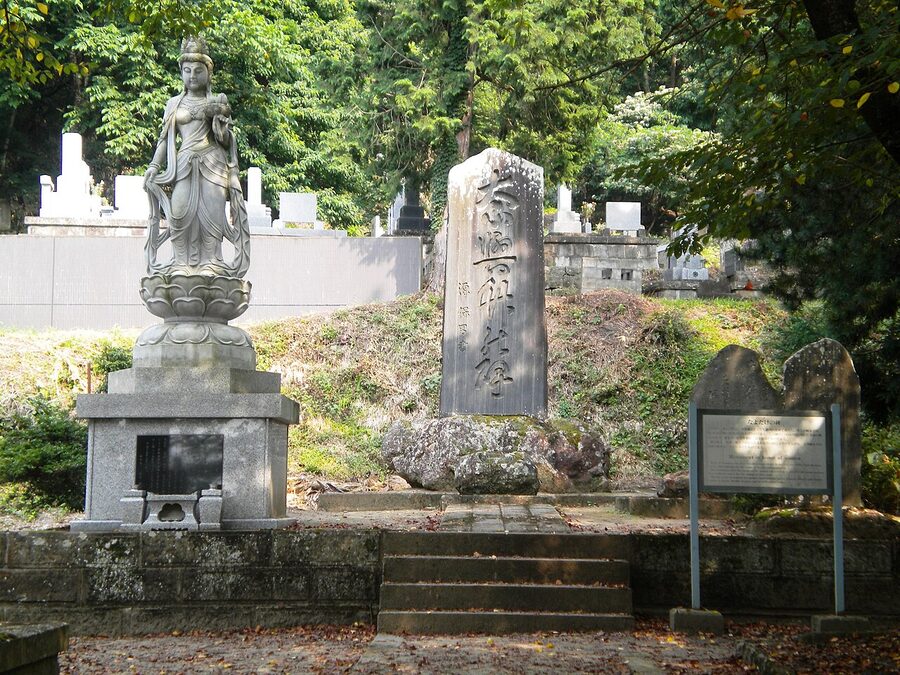
Saigō Tanomo, the retainer who had warned Katamori about the firewood, was with the army. At his house in the samurai quarter his mother, his wife Chieko, his sisters and his daughters, with other relatives, twenty-one people in all, killed themselves rather than burden the defenders or fall to the enemy. Several left poems. Chieko, thirty-four, wrote that she was only a slender bamboo bending to the wind, but that even such a bamboo, she had heard, has a node that does not bend.
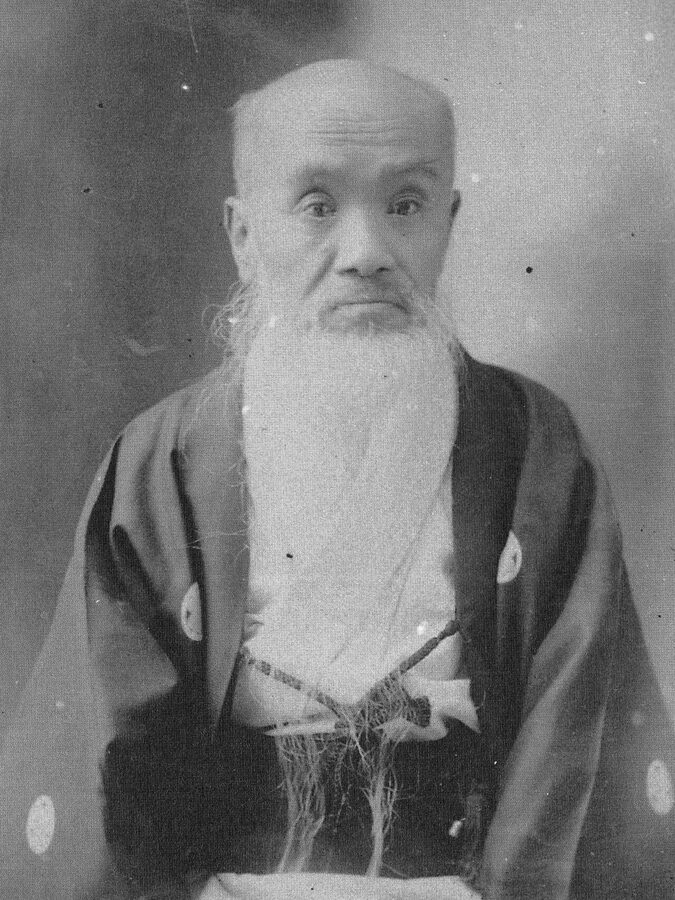
They were not the only ones. Japanese accounts count 239 women and children from 140 families who died by their own hands in the fighting for the town. Tanomo, for the record, was no relation of Saigō Takamori of Satsuma, and he survived, fighting on as far as Hakodate and Goryōkaku; he died in 1903 in a row-house in Wakamatsu, aged seventy-four.
The boys on Iimoriyama
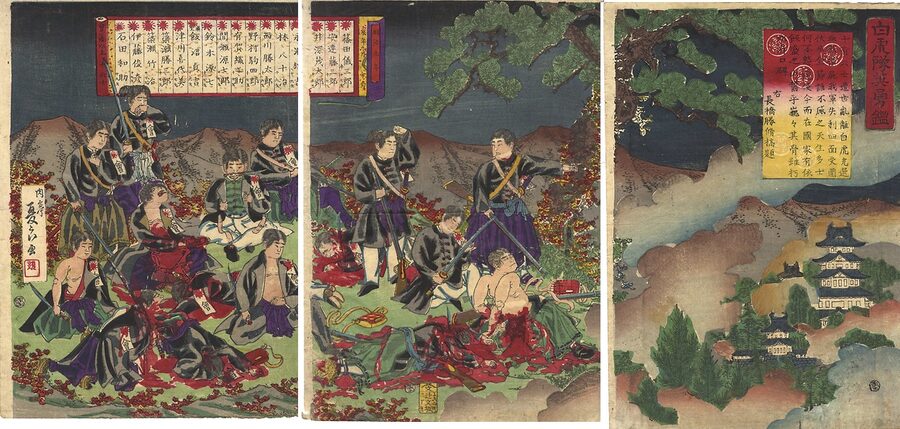
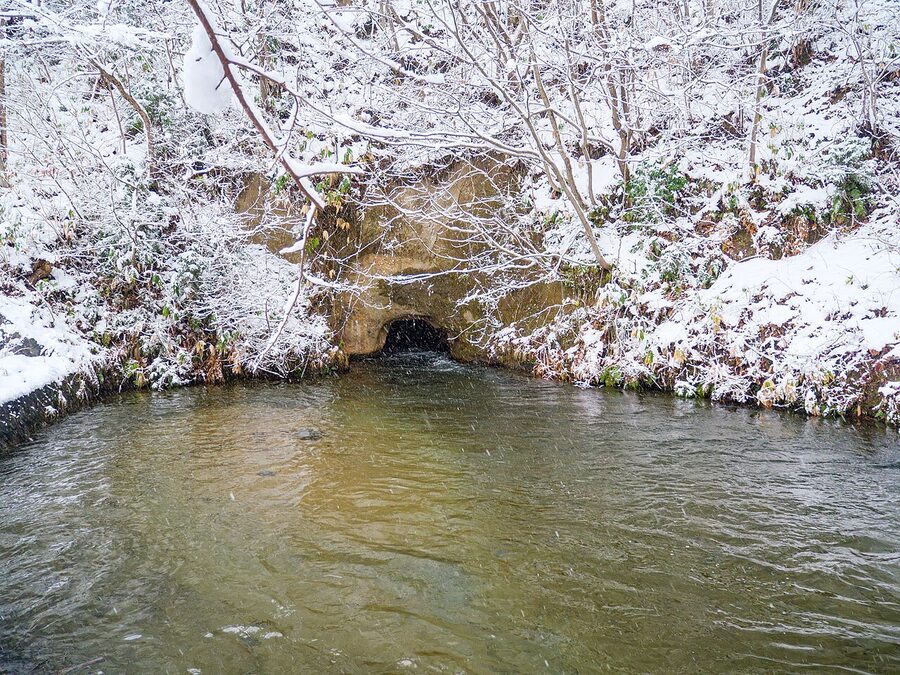
The second samurai company of the Byakkotai lost touch with its officers in the retreat from Tonoguchihara. One section of about twenty, led by a seventeen-year-old named Shinoda Gisaburō, made its own way back through the hills, crawling through the tunnel where the Tonoguchi irrigation channel runs under the shoulder of Iimoriyama, and came out on the hillside above the town. Below them the castle town was burning and the guns were firing. On that slope, most of them killed themselves.
For most of the twentieth century the story told on the hill was simple: the boys saw smoke over the castle, thought it had fallen, and died for a lord they believed already dead. You will still hear it there, and read it in the town’s tourist literature. It owes most of its shape to a 1928 history of the war by Hiraishi Benzō, and it is probably wrong.
In 2008 the family of the only survivor, Iinuma Sadakichi, found an account he had dictated in 1902 and corrected in his own hand. It says the boys argued over whether to fight their way back into the castle or charge the enemy, “some raging, some cursing”, which only makes sense if they knew it was still standing. In 2011 a group of Aizu descendants and historians put up a board on the hill saying so. Iinuma’s testimony shifted over the years, which is reason for caution, but I would rather believe a frightened argument than a convenient misunderstanding.
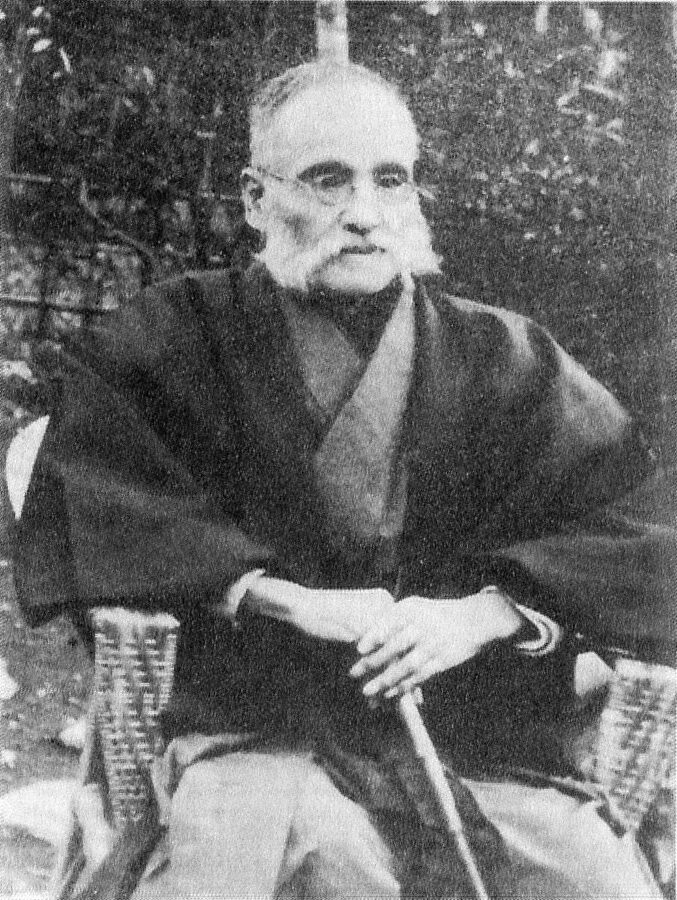
Iinuma was fifteen and had lied about his age to join. He was found still breathing by the wife of an Aizu retainer, recovered, changed his name to Sadao and became a telegraph engineer; sent to the war in China in 1894 as an army captain and told to carry a pistol, he is said to have refused on the grounds that he had already died once as one of the Byakkotai. He kept quiet about the hill until late in life, and died in 1931.
The nineteen graves you will see on the hill went up in 1890, after years of argument about who had actually died there; for decades the school textbooks said sixteen. The arithmetic most visitors never hear is this: more than eighty per cent of the Byakkotai survived the war. Yamakawa Kenjirō, who was too young for the second company and went through the siege inside the castle, became president of Tokyo Imperial University.
Naginata, and one Spencer rifle
On the 23rd a group of Aizu women, several of them trained fighters with the naginata, the long-bladed halberd that samurai daughters learned, cut their hair, put on hakama and set out to find Teru-hime, Katamori’s adoptive elder sister, who was rumoured to have taken refuge west of the town at Aizubange. The rumour was false, and by the time they knew it the castle gates were shut. So they went looking for a fight instead.
The senior retainer Kayano Gonbei turned them down flat: Aizu would be laughed at for making its women fight. They told the commander Machino Mondo they would kill themselves on the spot if refused. On the 25th (10 October by the Western calendar, though English-language accounts often give 16 October) they went into action beside Furuya Sakuzaemon’s Shōhōtai at the Namidabashi bridge. The Ōgaki and Chōshū troops laughed and shouted to take the women alive, then saw what the women were doing with their blades and started shooting.
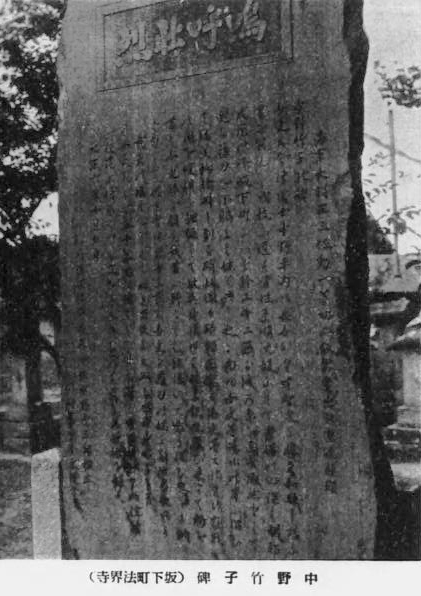
Nakano Takeko, at the front, was hit, in the forehead by most accounts and in the chest by some, and fell. Her sister Yūko, sixteen, and their mother Kōko cut off her head so that the enemy would not take it, and it was carried away and buried at Hōkai-ji in Aizubange. Takeko was twenty, or eighteen, or twenty-two, depending on whom you read; English accounts usually say twenty-one. Tied to her naginata was a slip of paper with a poem: set beside the fierce hearts of warriors, I am nothing worth counting, and yet.
The group was later given grander names, jōshigun or jōshitai, the Girls’ Army; the survivors’ own later testimony uses more than one name, and some Japanese historians think jōshigun was coined after the fact by Hiraishi Benzō. They were twenty-odd at most, mothers, widows, sisters and friends, with no ranks among them. They belong in the same line as Tomoe Gozen, with the difference that nobody doubts they existed.
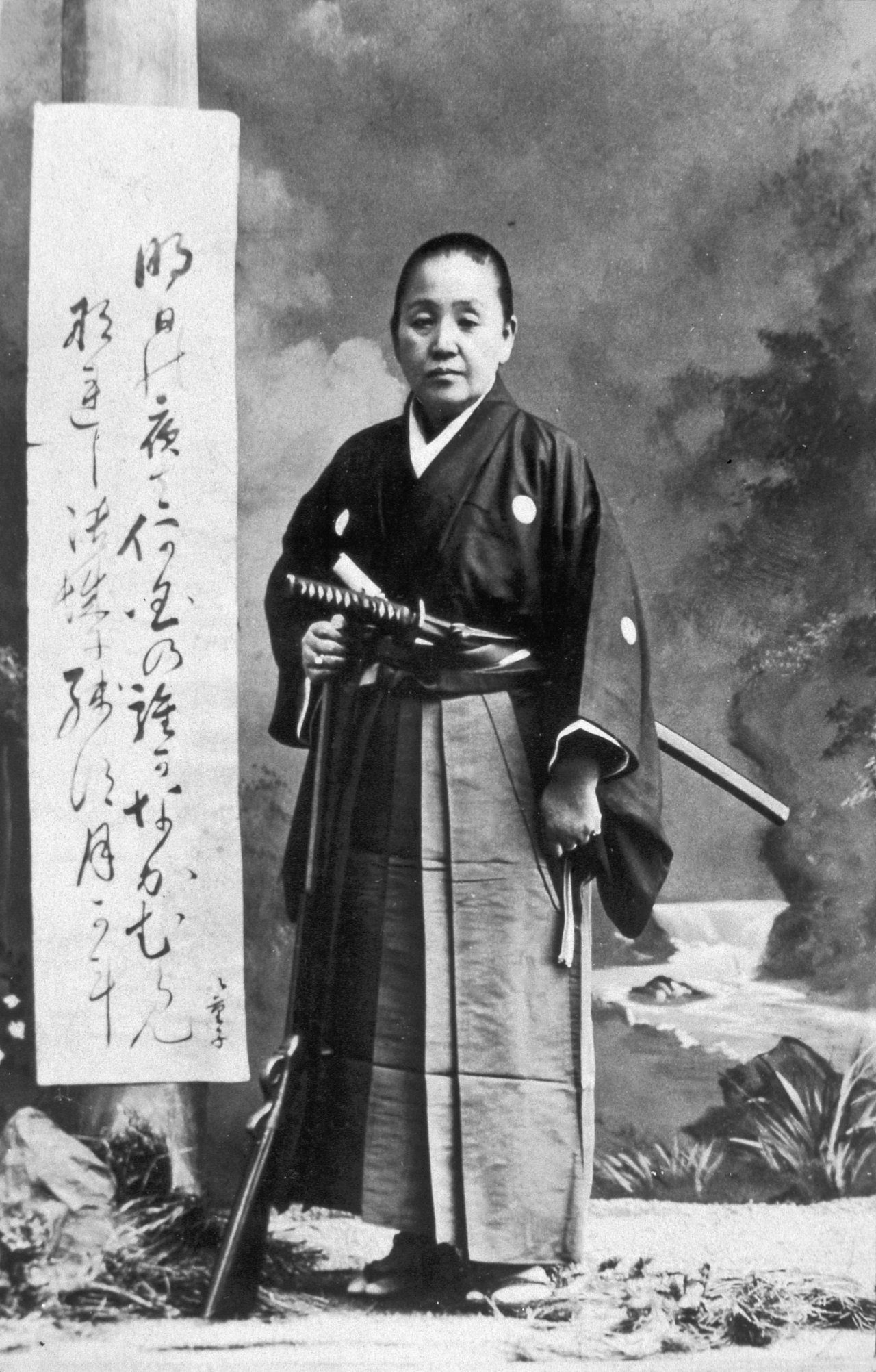
Yamamoto Yae did not join them. The daughter of the domain’s gunnery instructor, she thought women should fight with guns, not blades, so she cut her hair, dressed as a man and went into the castle with a Spencer repeating rifle and a hundred rounds for it, the only Spencer in Aizu. She fought through the siege, mostly with older muzzle-loaders once the Spencer ammunition was spent, and she is credited, perhaps generously, with wounding the Satsuma artillery commander Ōyama Iwao. Some English-language accounts put her in the women’s corps; the Japanese record is clear that she chose not to be.
The siege
The castle held for a month. The government army grew to troops from more than thirty domains, thirty to forty thousand men by Japanese estimates with around a hundred guns, and from Odayama, a wooded hill about a kilometre and a half south-east of the keep, its batteries could drop shells into the honmaru. Inside were the soldiers who had made it back, the old men, the boys and the women, who cooked, nursed and made cartridges. Through the whole siege the timekeeper in the bell tower went on striking the hours.
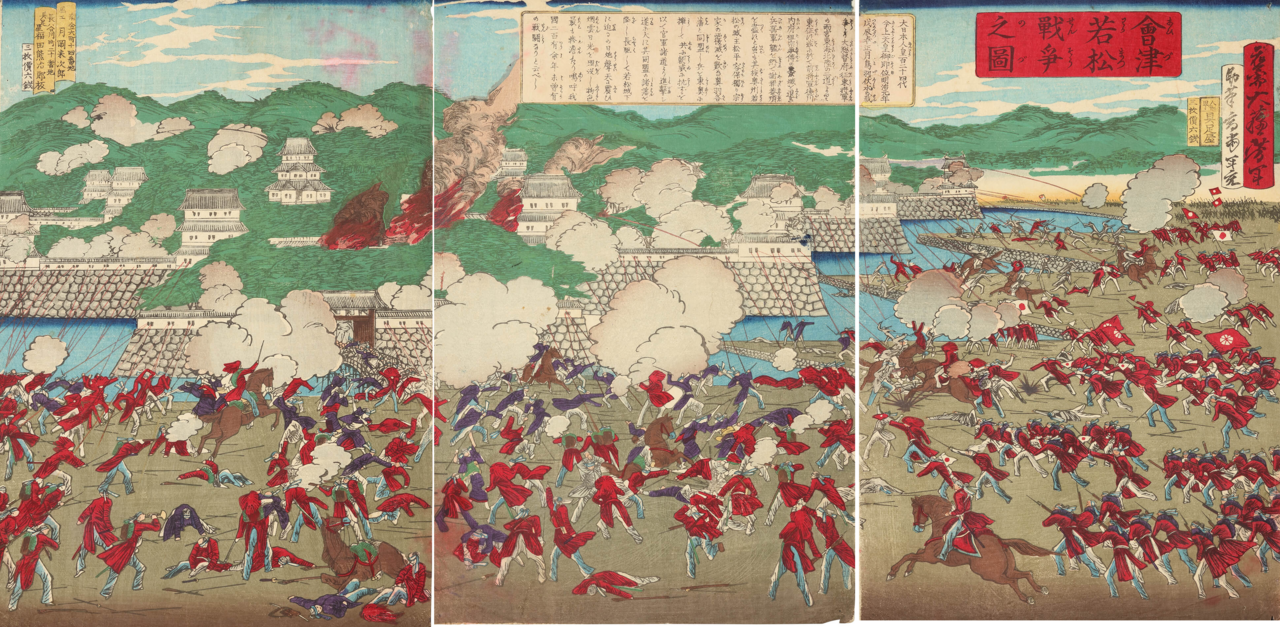
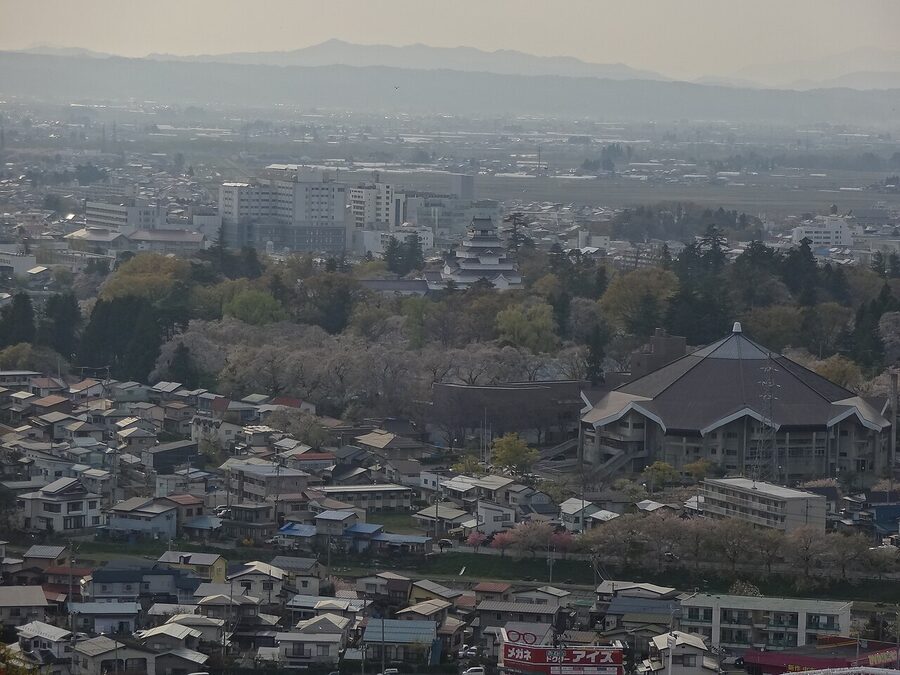
The keep took a beating that shows in every photograph from afterwards. What did not happen was a breach. The stone and water did what Katō Akinari had built them to do, and the northern outwork lived up to its nickname in the first days, when Tosa officers fell in numbers trying to rush it. Aizu was not beaten at the walls but around them: through the ninth month the allied domains of the north surrendered one by one, Yonezawa first, then Sendai, and by the third week Aizu was alone.
Itagaki Taisuke sent terms on the 19th, with the 22nd as the deadline. On the 22nd day of the ninth month, 6 November 1868, a date the new government had just made the emperor’s birthday holiday, Aizu surrendered at a ceremony on Kōka-machi street, north of the castle. The Meiji era had been proclaimed a few weeks before. Katamori’s retainers had feared he would be led out bound like a criminal; Itagaki let him leave in a palanquin, and Aizu remembered the courtesy for decades.
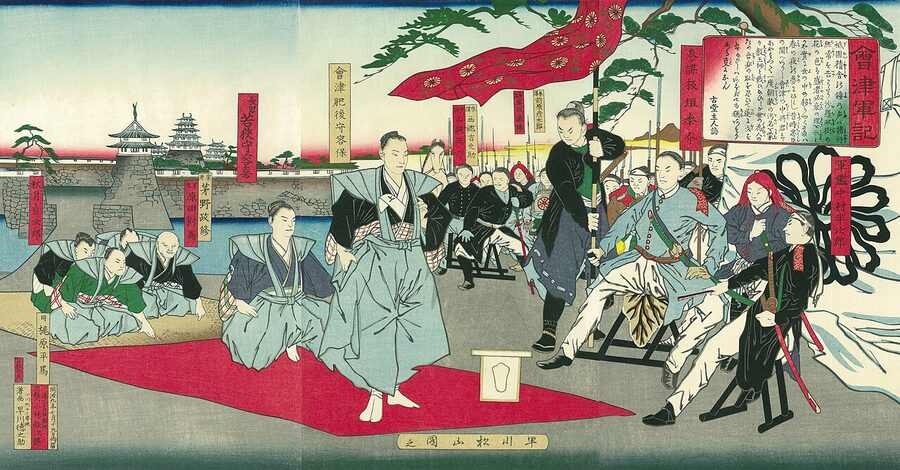
Before the gates opened, Yamamoto Yae is supposed to have scratched a poem into a wall of the castle with a hairpin. The poem, at least, is hers: “Tomorrow night, who will be looking at it, and from what country? The moonlight I leave behind on the castle I knew.” The hairpin and the wall are the kind of detail that gets added later, and I would not swear to them.
The bill came quickly. The government wanted the heads of the three senior retainers responsible; with the other two dead or missing, Kayano Gonbei, fourth in rank, declared that the war was his fault and not his lord’s, and he was ordered to commit seppuku in Tokyo in the fifth month of 1869. Katamori lived. The domain was abolished, and in 1870 his infant son was given a nominal 30,000 koku at Tonami, on the cold Shimokita peninsula at the top of Honshu, where the Aizu families who followed him spent years in grinding poverty.
Katamori himself was kept under house arrest for a few years, then allowed to live quietly in Tokyo. In 1880 he became chief priest of Nikkō Tōshō-gū, the shrine to the founder of the house he had served, and he died in 1893 at fifty-seven. It is hard to think of a more fitting job, or a sadder one.
Taking the castle down, and putting it back
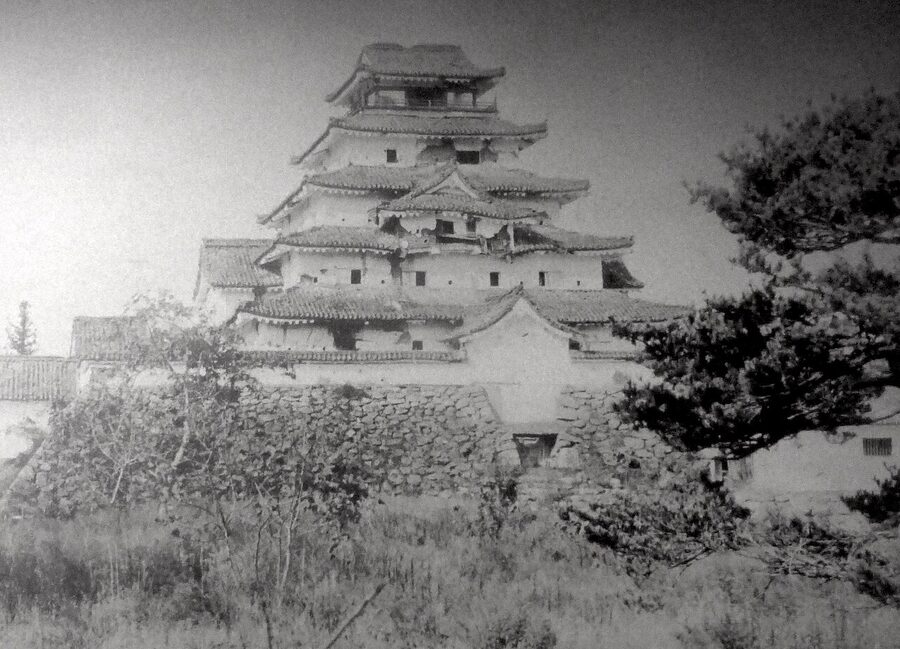
The castle passed to the army. In 1872 a Japanese photographer, Koyama Yasaburō, travelling with a French missionary and a Swiss silk merchant, photographed the battered keep, and those pictures are why the castle could be rebuilt at all. In 1873 the castle abolition order listed Wakamatsu for keeping as army property, and the local governor promptly asked for leave to tear it down. By the end of 1874 every building was gone (by 1873, in one Japanese encyclopaedia), and only the stone remained.
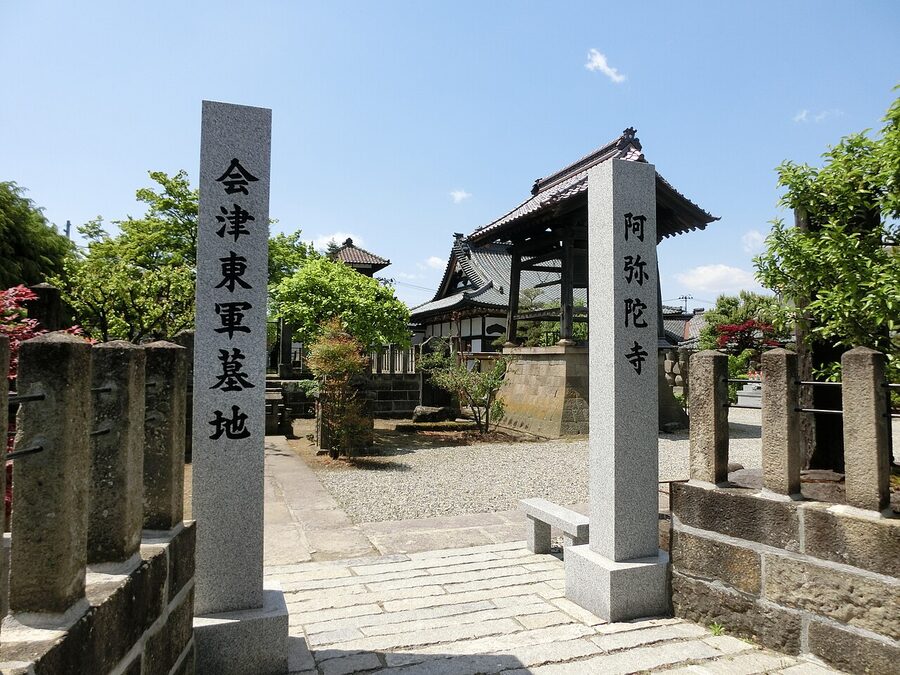
Two pieces escaped. The Gosankai, a three-storey lookout tower in the honmaru that was used, so the story goes, for secret councils, had been moved in 1870 to the temple of Amida-ji in the Nanokamachi district, along with the curved-gable porch of the lord’s great reception hall. Rinkaku, as I said, went to Morikawa Zenbei’s garden. Everything else was sold off.
The site itself nearly went. In 1890, when the government sold off the grounds, a former Aizu retainer named Endō Keishi bought all 29 hectares with ¥2,500 of his own money and gave them to the Matsudaira family so they would not be broken up. In 1917 the town, with Yamakawa Kenjirō (the Byakkotai boy, by then a university president) as go-between, bought the site on a ten-year instalment plan and made it a park; in 1934 it became a National Historic Site.
The indignities were not over. After the Second World War the city ran a velodrome for bicycle racing inside the honmaru, which closed only in 1957. Then in 1965 the town rebuilt the keep in reinforced concrete, following the Meiji photographs, and it looked, by most accounts, exactly right except for the roof.
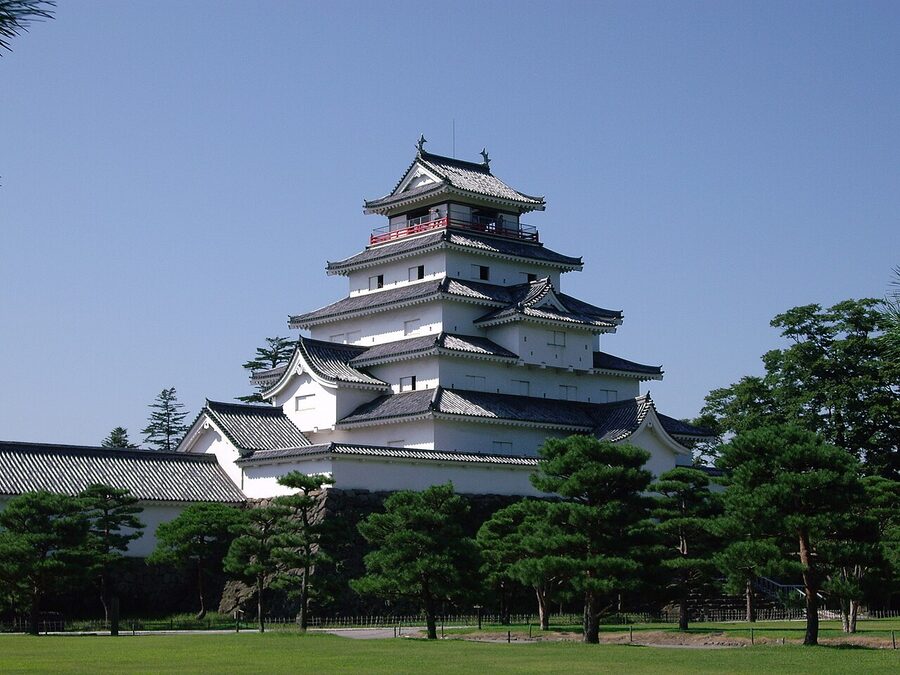
The red came from Hoshina Masayuki, which is a pleasing irony for the man who thought keeps were a waste of money. The smoked black tiles of western Japan cracked in Aizu’s winters, so on his orders local kilns developed a tile with an iron-rich glaze that could take the freeze, and by the end of the Edo era the keep wore red. When the roof was redone in 2010 and 2011 the city went back to it, and the castle claims, with some justice, that it is now the only keep in Japan you can see in these tiles.
If you want the longer story of why tile colour is a matter of chemistry and climate, the kawara tile article has it.
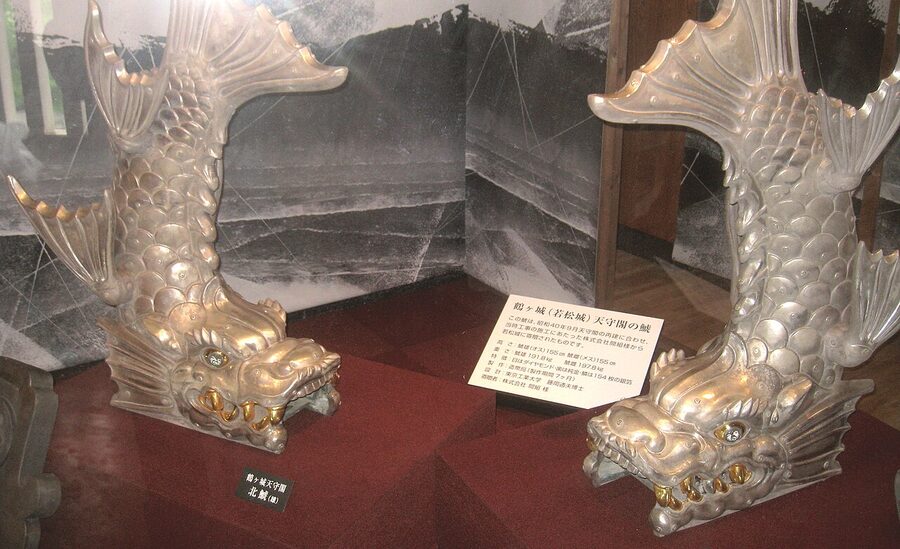
The keep also wears a pair of silver shachihoko, the fish-bodied ridge guardians, given by the chairman of the company that built the 1965 keep, with two-carat diamonds for eyes; the firm had also rebuilt Nagoya’s keep and wanted a silver pair to answer Nagoya’s gold. No Meiji photograph shows any shachihoko, and some people in Aizu wanted them taken down. Edo-period drawings show them, so they stayed.
In 2001 the Hoshii-yagura, the castle’s largest corner tower, was rebuilt in timber with the long southern gallery beside it (the castle’s own chronology says 2000). Then came the red roof, the earthquake and the reopening of March 2011.
Is it worth it if it is concrete?
I am usually hard on concrete castles. If you have stood inside the original timber keeps at Himeji, Hikone, Matsumoto or Hirosaki, a few of the twelve survivors in Japan’s 12 original castles, then a lift and a gift shop inside a concrete shell can feel like a cheat. Tsuruga is not on that list and never will be.
But I would put it above most post-war rebuilds. The stone base of the keep is Gamō work, unshaped fieldstone in the nozura-zumi style that has ridden out four centuries of earthquakes, and the moats, outworks and layout are essentially the castle of 1868. The keep of Kumamoto Castle is concrete too, and since 2016 nobody calls Kumamoto a fake; what makes these places real is what happened in them, and in Aizu that is not in doubt.
One more reason. Doi Bansui, the Sendai poet who wrote the words to Kōjō no Tsuki, “the moon over the ruined castle”, said in a lecture that he had Aoba Castle and the ruins of Tsuruga in mind. Japanese children learn it at school, and it was written about a castle that, at the time, had no keep at all.
Where to visit Tsuruga Castle and Aizu today
Aizu-Wakamatsu is an easy overnight from Tokyo and a long day trip if you push it: the Tōhoku Shinkansen to Kōriyama takes about ninety minutes, and the JR Ban’etsu West Line on to Aizu-Wakamatsu about another hour. In town, two loop buses, the Haikara-san and the Akabe, run past almost everything below; a single ride is ¥210 and a day pass ¥600. If you have one day, do the castle in the morning and Iimoriyama in the afternoon, and stay the night at the Higashiyama hot springs if you can.
Tsuruga Castle
The keep museum is open every day from 8:30 to 17:00 (last entry 16:30) and costs ¥410 for adults and ¥150 for children. A combined ticket with the Rinkaku tea house is ¥520, and one that adds the Oyakuen, the lords’ medicinal-herb garden about fifteen minutes’ walk east, is ¥730. Take the Haikara-san or the Akabe to the Tsurugajō Iriguchi or Sannomaru-guchi stops, about twenty minutes from the station on the Haikara-san, and walk in over the red-railed Rōka-bashi bridge, which was once the main entrance.
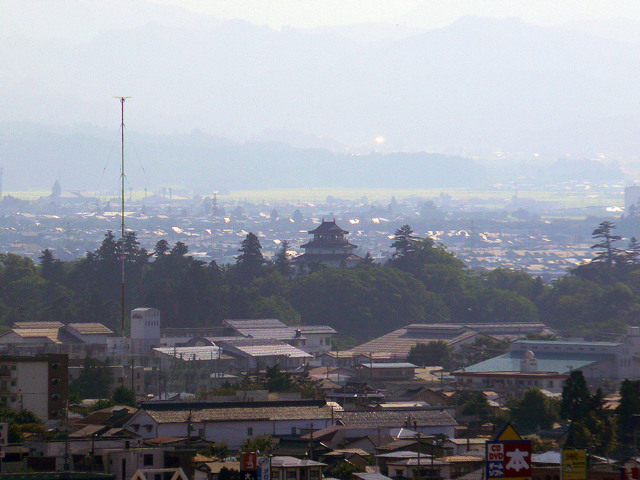
Inside, start at the bottom. The basement is the old salt store, with the Gamō-era stonework of the keep base up close; the second floor covers the lords from Ashina to Matsudaira, the third (the best) runs from Kyoto to the siege, the fourth covers Aizu people of the Meiji years, and the fifth is the lookout. From the top you can see Iimoriyama to the north-east and Odayama to the south-east, which is the whole war in one turn of the head.
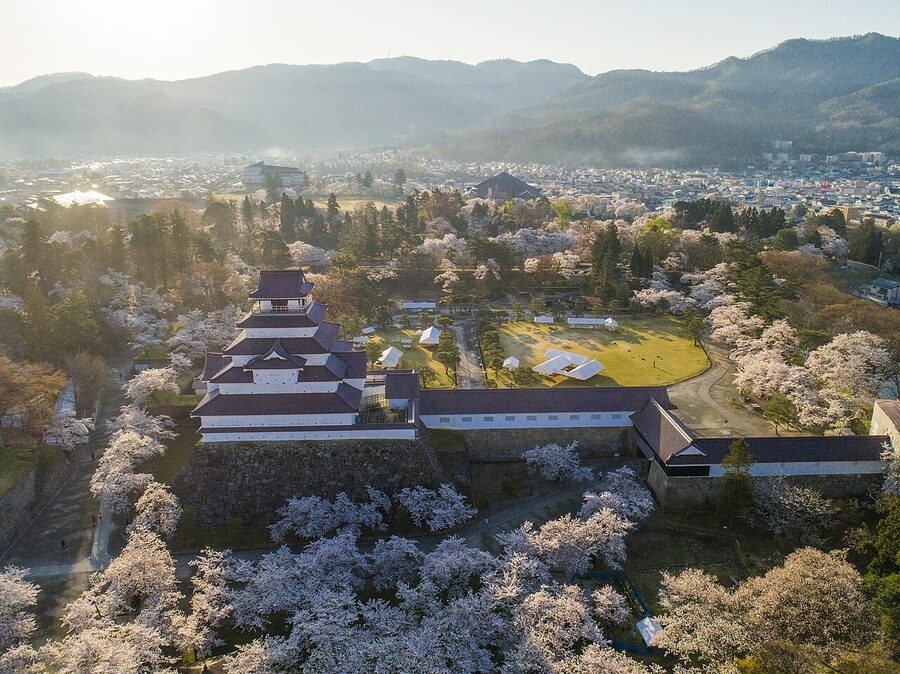
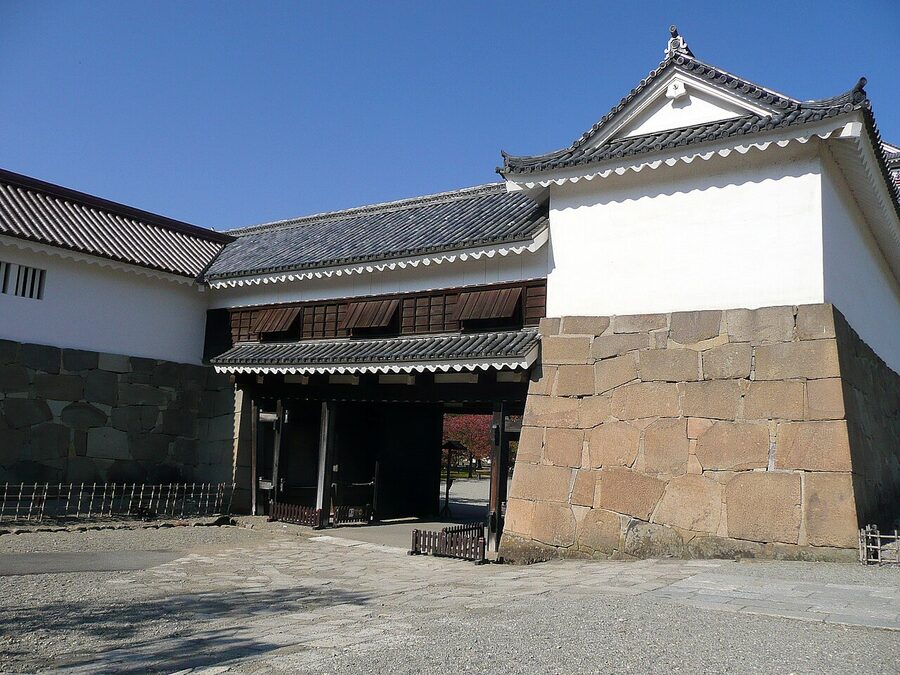
Outside, walk the honmaru. The Kurogane-mon, the iron-plated main gate tucked under the keep, was reckoned the safest spot in the castle during the siege because it stood on the far side of the keep from the main attack. The bell tower is the one whose bell kept the hours through the siege, and near it are the Kōjō no Tsuki stone and the memorial to Kayano Gonbei. Rinkaku is open 8:30 to 17:00 for ¥210 (children free), and a bowl of matcha with a sweet costs ¥600, rising to ¥700 from 1 December 2026.
In spring the park is one of the best cherry-blossom sights in Tōhoku. The castle also rents bicycles, the easiest way to reach the viewing platform on Odayama that marks the government gun line; it is not much in itself, but look at the size of the keep from there.
Iimoriyama
Iimoriyama is on the north-eastern edge of town, a few minutes’ walk from the Iimoriyama-shita stop that both loop buses serve, about five minutes from the station on the Akabe. A long flight of stone steps climbs to the Byakkotai graves, and beside it runs a moving walkway, the “slope conveyor”, for ¥250 one way up (8:00 to 17:00 from late March to late November, 9:00 to 16:00 in winter). The graves are free. Memorial ceremonies with a sword dance are held at them in spring and autumn.
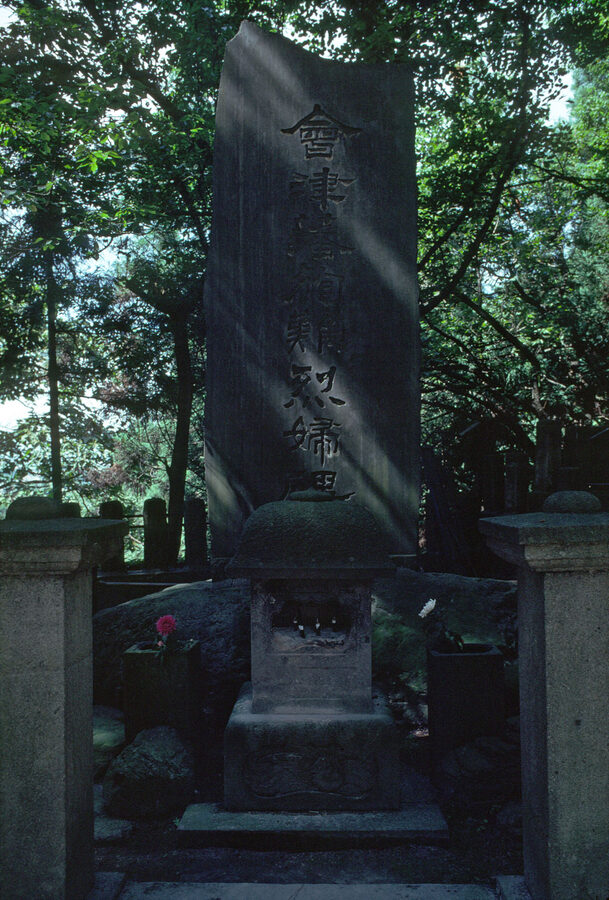
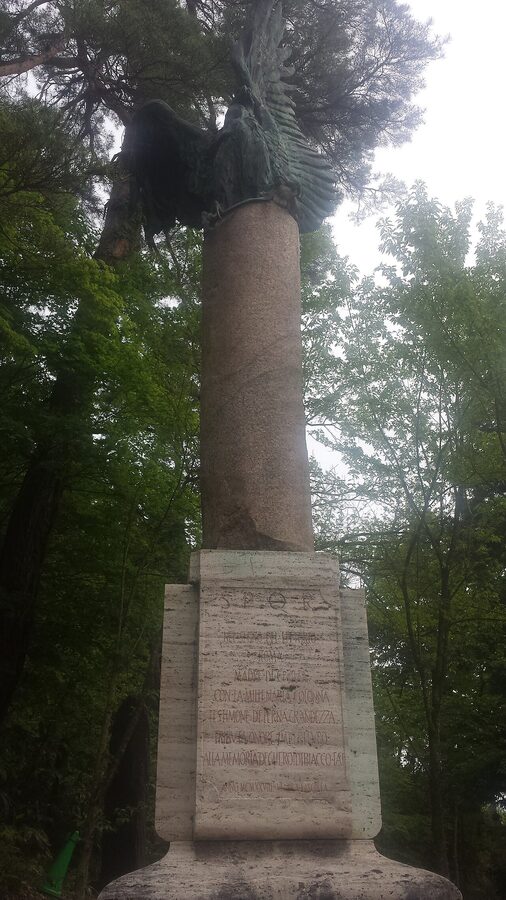
From the graves, walk to the spot on the southern slope where the boys are said to have died, marked by a statue of a Byakkotai boy gazing out towards the castle. On a clear day you can pick out the red roof from there. Nearby stand two of the odder monuments in Japan: a column from Pompeii presented in 1928 in the name of Benito Mussolini, and a German stone given in 1935 by a diplomat at the embassy in Tokyo.
The Italian gift began as a tall tale by a Japanese Italophile, Shimoi Harukichi, who told the mayor Mussolini was planning one; once the newspapers had it, the Foreign Ministry had to ask Rome. After 1945 the occupation ordered the inscriptions removed and the German stone destroyed, and the grave-keeper hid the German stone instead.
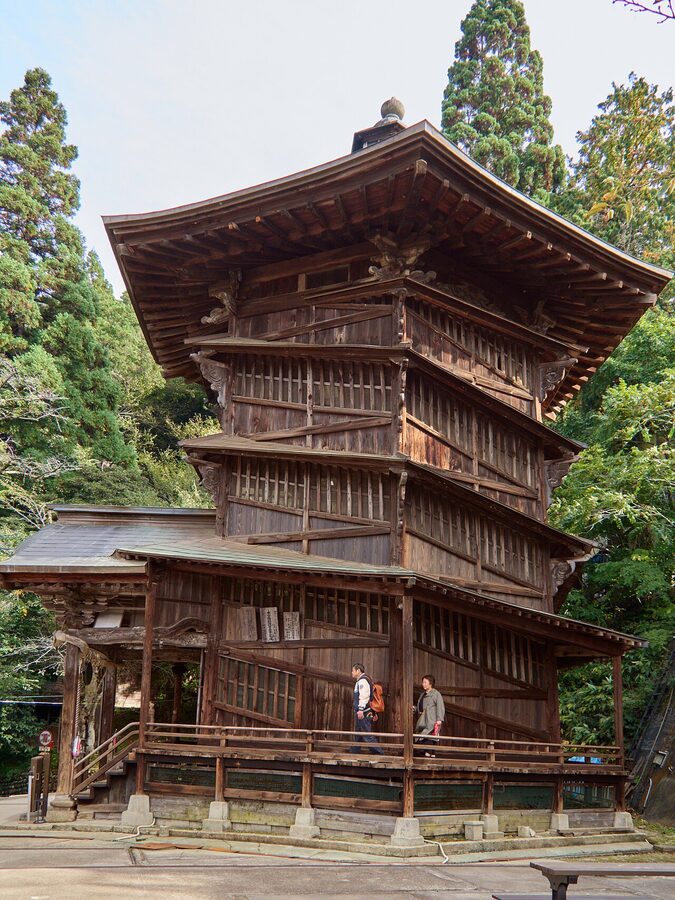
On the way down, do not miss the Sazaedo. It was built in 1796 by Ikudō, priest of a temple that no longer exists, as a pilgrimage in a box: a 16.5-metre hexagonal hall with a double-helix ramp inside, so that you walk up one spiral and down another without meeting anyone coming the other way. It is privately owned by the Iimori family and an Important Cultural Property; it opens 8:15 to sunset from April to November and 9:00 to 16:00 from December to March, and costs ¥400.
Two smaller sights finish the hill. At the foot of the slope the Tonoguchi weir channel comes out of the tunnel the boys came through, and you can see the mouth of it beside the path. And the Byakkotai Memorial Museum, founded in 1956 by an Aizu-born lawyer, keeps among much else the memoir of the survivor Sakai Mineji, found by his grandson in the family altar in 1990; listings give its hours as 9:00 to 16:00 and its fee as ¥400, but they disagree on closing days, so check before you go.
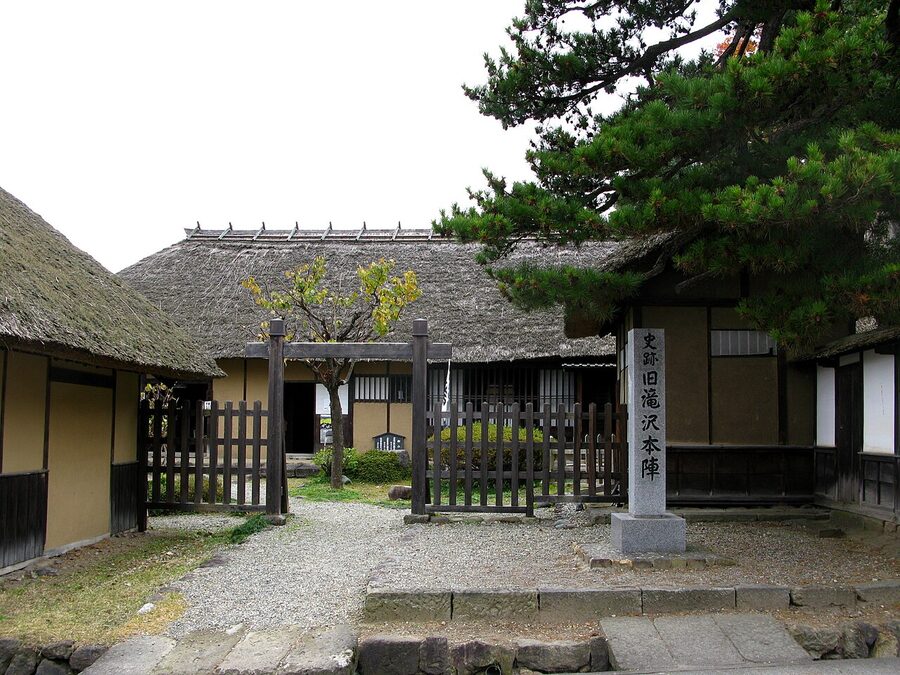
If you have time, the Former Takizawa Honjin is five minutes’ walk from the same bus stop. On the 22nd of the eighth month this thatched lodge was Katamori’s headquarters, the Byakkotai took their orders here, and the woodwork still carries bullet holes and sword cuts. It costs ¥400; it opens 9:00 to 17:00 from April to September and 9:00 to 16:00 in October and November, and by appointment in winter.
The samurai district and the Bukeyashiki
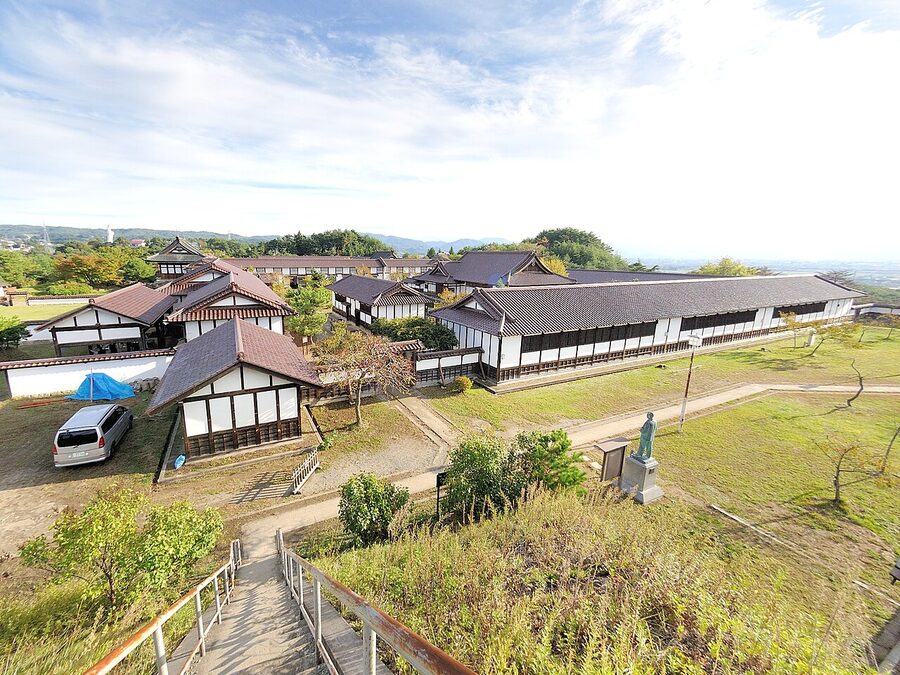
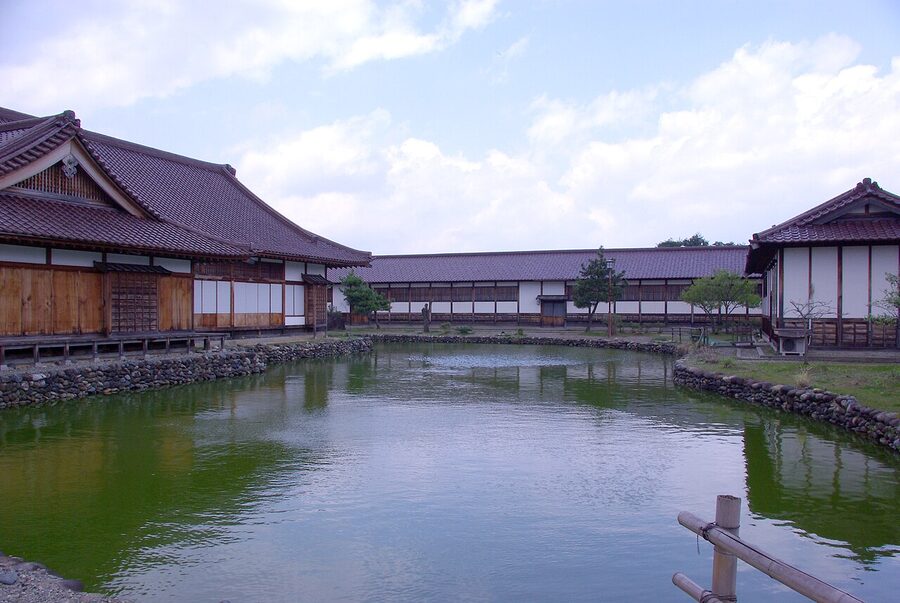
Very little of the samurai quarter around the castle survived the fires of 1868 and the century after; the street grid is there, the houses are not. For the houses, go to the Aizu Bukeyashiki in Higashiyama, an open-air museum opened in 1975 around a reconstruction of Saigō Tanomo’s mansion, with relocated buildings including the Former Nakahata Jinya, a rural magistrate’s office. It is about fifteen minutes from the station on the Akabe, open 8:30 to 17:00 from April to November and 9:00 to 16:30 from December to March, and costs ¥1,000 for adults.
Be warned that the Saigō house includes a tableau, with mannequins, of the women of the family at the moment of their deaths. I find it hard to look at and harder to defend, but it does make you understand that this happened in rooms like these, to people with names.
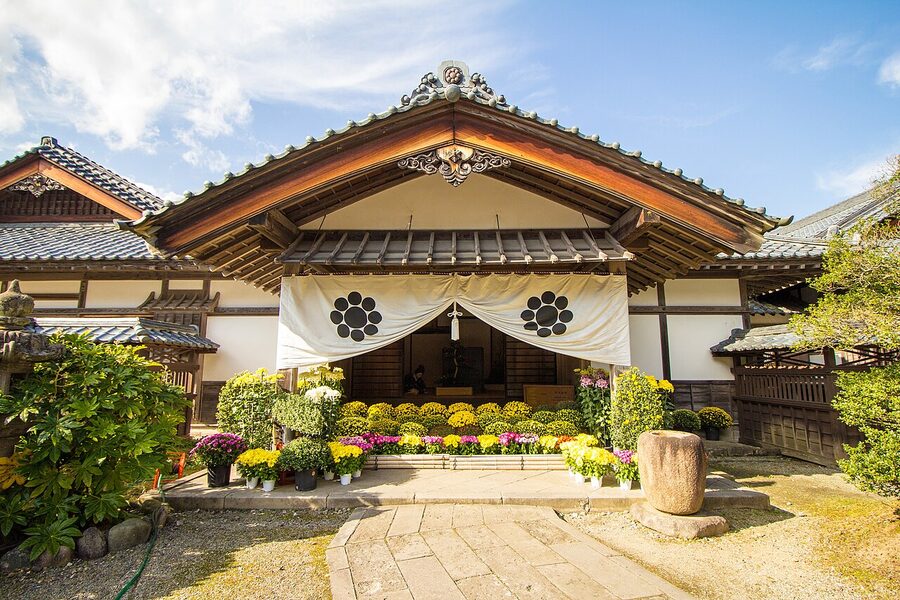
The domain school
The Nisshinkan you can visit is not the one the Byakkotai attended. That burned in 1868; this is a full-scale reconstruction from the surviving plans, built in 1987 for ¥3.4 billion at Kawahigashi, about thirty minutes from the station by bus or fifteen by taxi. It is open daily from 9:00 to 17:00 (last entry 16:00) and costs ¥1,800 for adults, which is steep, though archery (¥500 for five arrows) helps if you have children with you.
It is good at showing what a domain school was for: lecture halls, a martial-arts hall and the replica of the pool, laid out at the scale of the original. If you only want the history, the observatory remains near the castle are the real thing, and free.
Graves and temples
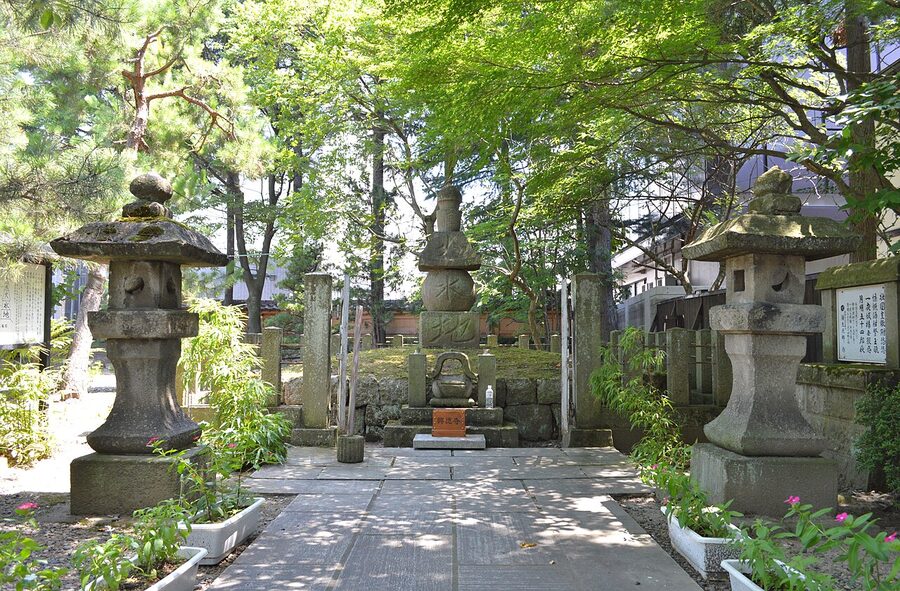
Finish in town. Amida-ji in Nanokamachi, close to Nanokamachi Station, has the Gosankai from the castle and the graves of about 1,300 Aizu dead, with Saitō Hajime of the Shinsengumi among them. At Tennei-ji, in the hills on the south-east side of town, is a grave of Kondō Isami: Hijikata Toshizō is said to have brought some of his remains here and buried them during the Aizu fighting, and Kayano Gonbei and his son are buried in the same cemetery. Both temples are free; for Tennei-ji take the loop bus to Yarōgamae and walk about fifteen minutes uphill.
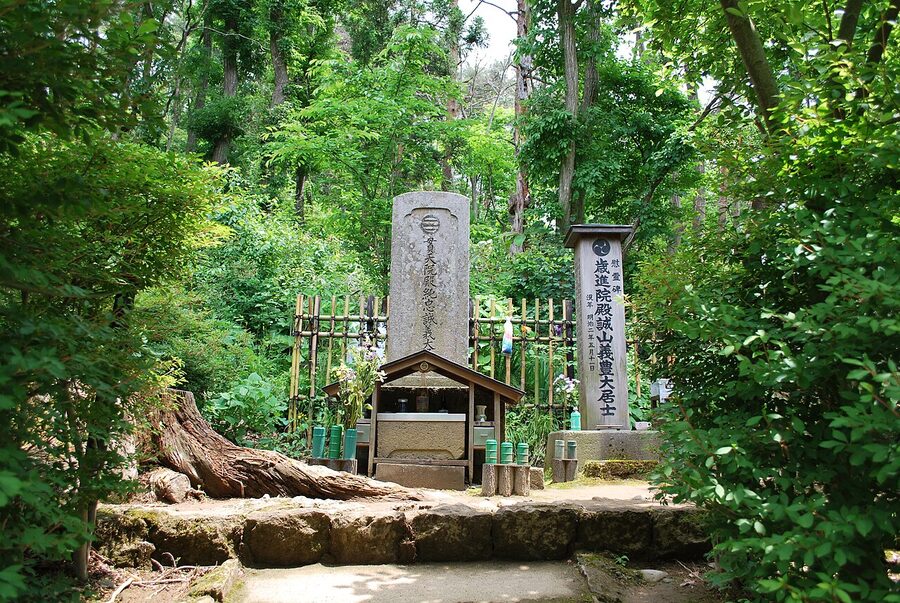
Gamō Ujisato is buried at Daitoku-ji in Kyoto, but Aizu has his memorial at Kōtoku-ji in the middle of the town he named. Hoshina Masayuki lies behind Hanitsu Shrine near Lake Inawashiro, a short walk from the stele, which is a good place to think about a man who did not believe in keeps.
Go back up Iimoriyama at the end of the day, if you can, and stand by the statue of the boy looking out towards the castle. The keep he is looking at is concrete, built ninety-seven years after he died, and its roof is the colour of the one the real boys could see through the smoke, put back two days before an earthquake by a town that does not give things up easily. The creed that sent them up that hill was a bad idea, faithfully kept. The roof is a better one.